Quick answer: which blade sharpener to buy
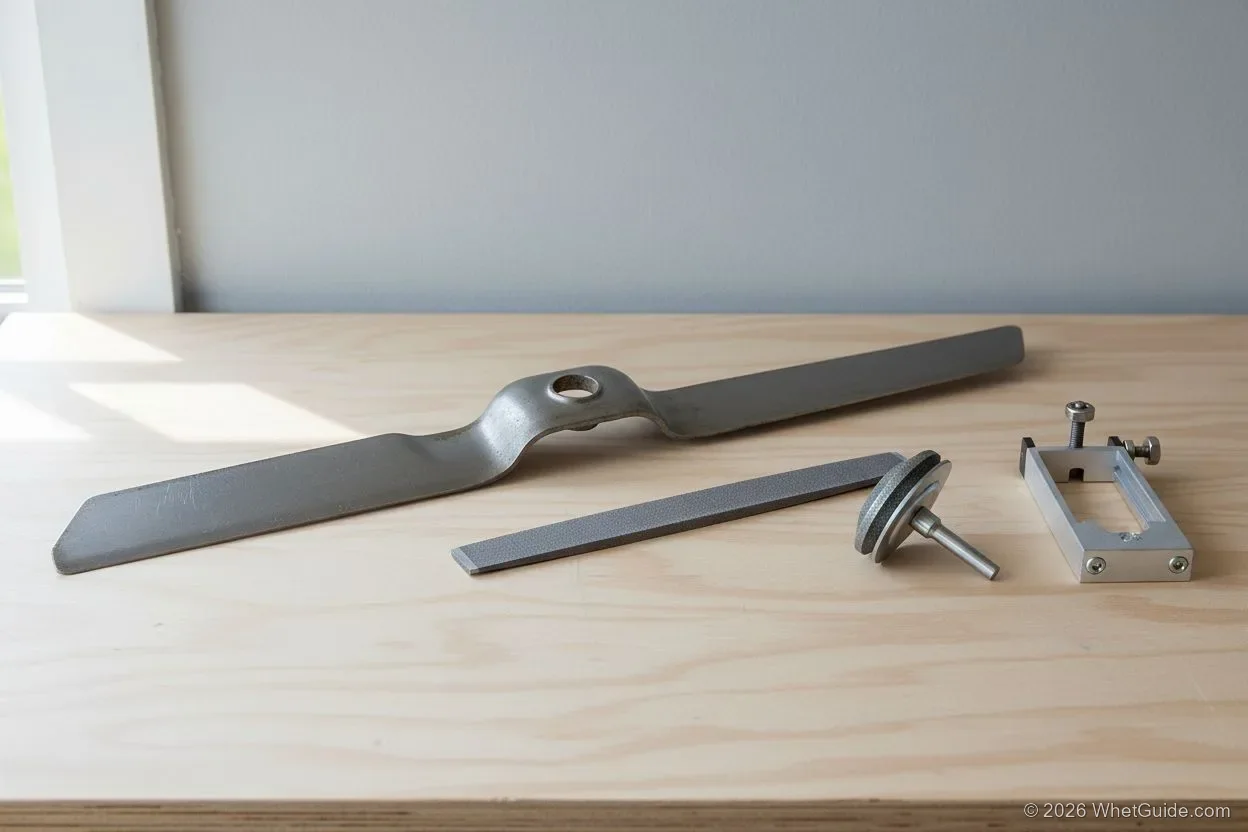
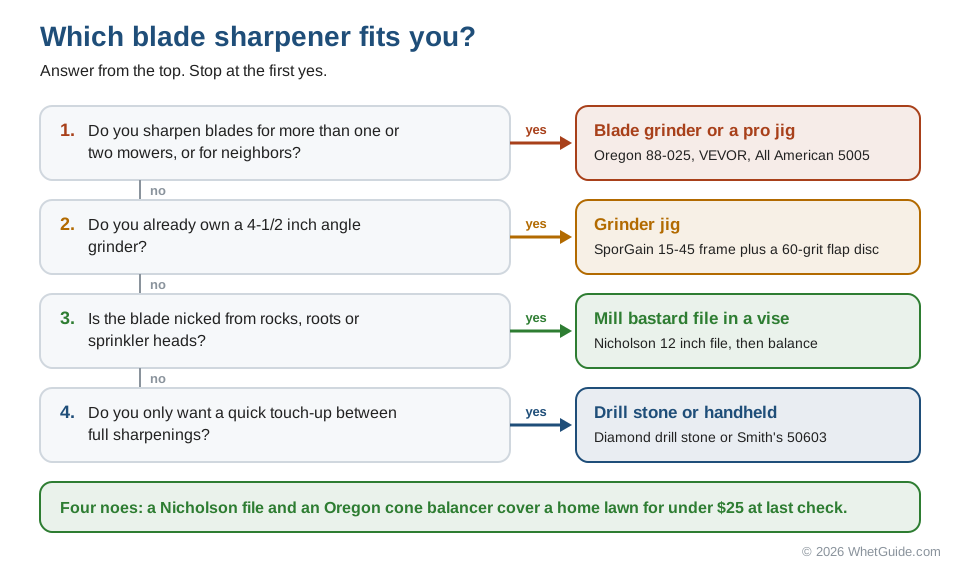
The best lawn mower blade sharpener for most people is a 12 inch mill bastard file, used with the blade clamped in a vise. The Nicholson 21842NN costs less than one shop visit. It can't overheat the steel, and it fixes the nicks a rock leaves behind. The pricier tools above it mostly buy speed. If you already own an angle grinder, a 15 to 45 degree grinder jig cuts the time per blade sharply. If you sharpen for several mowers or for the neighbors, a dedicated blade grinder is the tool the shops use. Pair any of them with a cone balancer, because every sharpener on this page takes steel off one end faster than the other unless you check.
| Your situation | Buy |
|---|---|
| One mower, a vise or a C-clamp, ten minutes to spare | Nicholson 12 inch mill bastard file |
| Quick touch-ups between full sharpenings | Diamond drill attachment or Smith's 50603 handheld |
| You want to sharpen without taking the blade off | Dremel A679-02 kit (light work only) |
| You own an angle grinder and want the angle locked | SporGain 15-45 degree frame |
| Several mowers, a riding mower, or blades for friends | All American 5005 Gen 2 or Oregon 88-025 grinder |
| Every buyer, whatever the sharpener | Oregon cone balancer |
If what you want is the technique (pulling the plug, getting the bolt off, the filing strokes), our step-by-step mower blade guide walks through it. This page is about the tool itself and what it costs next to paying a shop.
Quick picks
| Best overall | Nicholson 12 Inch Mill Bastard File | Amazon |
|---|---|---|
| Best handheld for touch-ups | Smith's 50603 Handheld Lawn Mower Blade Sharpener | Amazon |
| Best drill attachment | Diamond Drill Attachment Blade Sharpener | Amazon |
| Best for sharpening on the mower | Dremel A679-02 Sharpening Attachment Kit | Amazon |
| Best grinder jig for the money | SporGain 15-45 Degree Grinder Jig | Amazon |
| Best pro-style jig | All American Sharpener 5005 Gen 2 | Amazon |
| Best dedicated blade grinder | Oregon 88-025 Blade Sharpener and Grinder | Amazon |
How we picked these sharpeners
Every pick had to do one thing well: put a clean bevel back on a dull blade at the angle it came with, without cooking the steel. After that we looked at what the tool can't do, because that is where buyers get burned. A handheld that's lovely on a lightly dulled blade can be hopeless on one that hit a tree root. A grinder that strips a nick in seconds can also turn the tip blue before you notice. We read the blade makers' own guidance first and checked each tool against it; every source is listed at the foot of the page.
- Angle control: does the tool hold the factory bevel, or does your wrist?
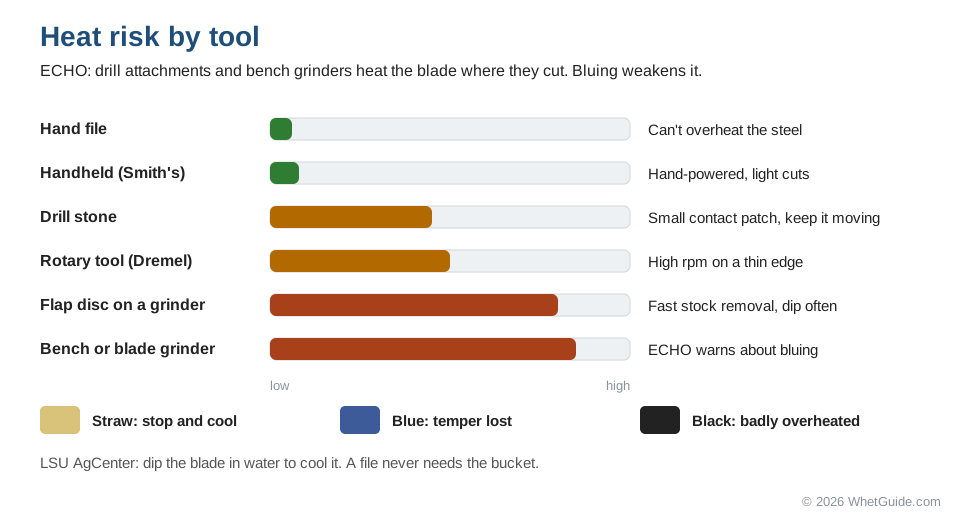
- Heat: ECHO warns that drill attachments and bench grinders heat the blade where they cut.
- Damage: can it remove a real nick, or only freshen an edge?
- Cost per blade: the tool's price against the roughly $30 Family Handyman says a shop charges per blade.
- Exclusions: we say plainly which blades each tool is wrong for.
Two of the seven are grinder jigs at different prices; the rest are one per type, from a file in a drawer to a bench machine bolted down for good. Amazon listings were checked on November 15, 2026 for model names and specs. Prices drift, so we quote them as "at last check" and lean on price bands. We don't print star ratings here; different Amazon widgets showed different numbers for several of these listings, and we'd rather show none than the wrong one.
Five kinds of lawn mower blade sharpener
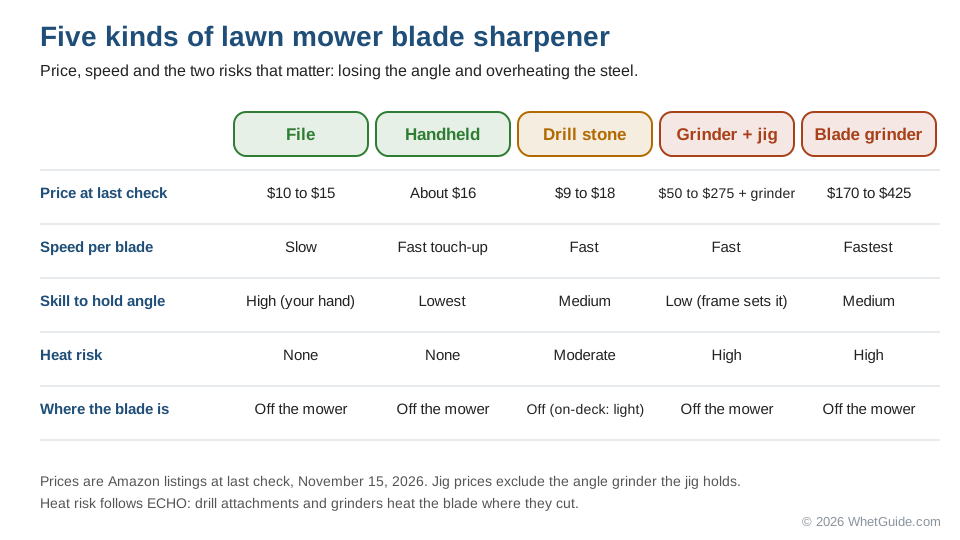
Strip away the packaging and every mower blade sharpener belongs to one of five families. They differ in two ways that decide the result. The first is who holds the angle: you, a fixed slot, a plastic guide or a steel frame. The second is how much heat the tool puts into the edge. Speed comes after both, because a fast tool that overheats the tip or wanders off the bevel leaves you with a weaker blade than you started with.
| Type | Who holds the angle | Good at | Bad at |
|---|---|---|---|
| Hand file | You | Nicks, curves, no heat, costs least | Speed on a badly worn blade |
| Handheld sharpener | A fixed slot | Fast freshening of a lightly dull edge | Deep nicks (Bob Vila reports the Smith's fell short) |
| Drill attachment | A plastic guide on the back of the blade | Quick touch-ups | Heavy damage; heat if held in one spot |
| Angle grinder with a jig | A steel frame, 15 to 45 degrees | Fast, repeatable bevels | Heat; needs a grinder you already trust |
| Dedicated blade grinder | The machine's rest and guards | Volume work, the shop standard | Price; heat on a careless pass |
There's a sixth tool that straddles the line: a rotary tool kit like Dremel's, which uses a small grinding stone with a guide. It's the one guided way to touch up a blade still bolted to the mower, and Family Handyman likes a rotary tool for the curved edges of mulching blades. It's slow on a badly worn blade, so it gets its own pick instead of standing in for a grinder.
Belt sanders turn up in some roundups too. In Bob Vila's roundup a belt sander took 12 to 27 seconds per edge, which is quick, but a belt sander is a woodworking tool first and we left it off the list. If you already own one, the same heat rules apply.
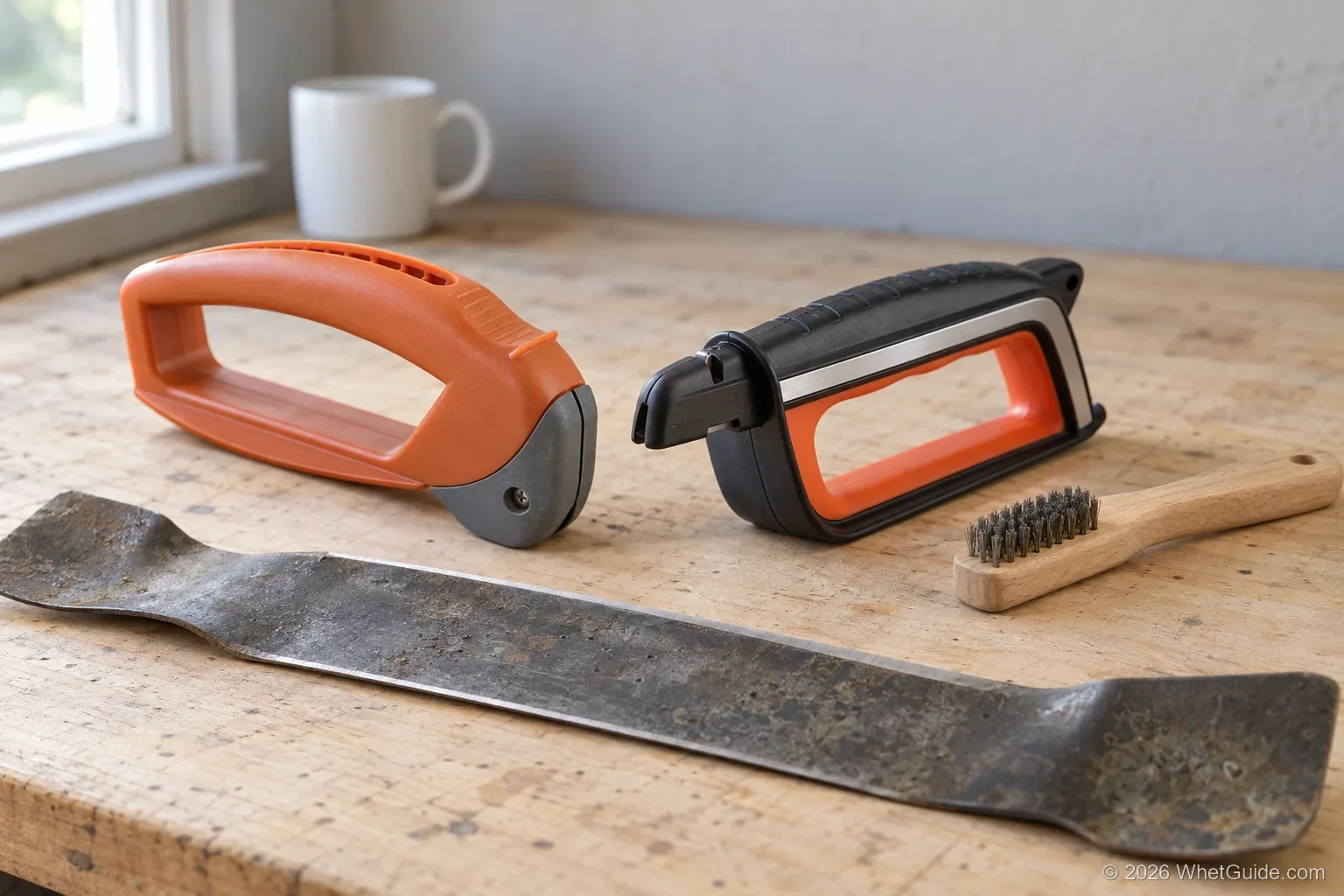
The 7 best lawn mower blade sharpeners
Nicholson 12 Inch Mill Bastard File
A mill bastard file is the oldest blade sharpener there is, and it's still the one we'd hand to someone with a single push mower. Single-cut teeth leave a smooth bevel. The bastard grade is coarse enough to clear a nick without taking all afternoon, and twelve inches of length gives you long, steady strokes. It cuts on the push and you lift it on the return, so you can see exactly how much steel comes off. It can't overheat the blade, which no powered tool on this list can promise. Bob Vila's roundup has a 12 inch file bringing a blade back in under 15 minutes, and roughly twice the strokes on a badly gouged one.
- Typehand file
- Length12 in
- Cutsingle cut, bastard grade
- Model21842NN
- Powernone
Why it stands out
- No heat, ever, so no lost temper
- Handles nicks and the curves of mulching blades
- Cheaper than one shop visit
Think twice if
- You have no vise or clamp to hold the blade
- You sharpen many blades and want speed
Smith's 50603 Handheld Lawn Mower Blade Sharpener
The Smith's sets the angle for you with a fixed slot, so there's nothing to judge: draw it along the edge and the edge comes back. That makes it the quickest freshening tool on the page for someone who doesn't want to think about bevels. Its limit is damage. Bob Vila reports that it did not fully fix a deeply nicked blade and may not suit lawns full of rocks or roots. Use it between proper sharpenings, not in place of them.
- Typehandheld
- Model50603
- Powernone
- Best onlightly dull edges
Why it stands out
- No angle to hold
- Small and cheap
Think twice if
- Your blade has real nicks from rocks or roots
- You want one tool for every job
Diamond Drill Attachment Blade Sharpener
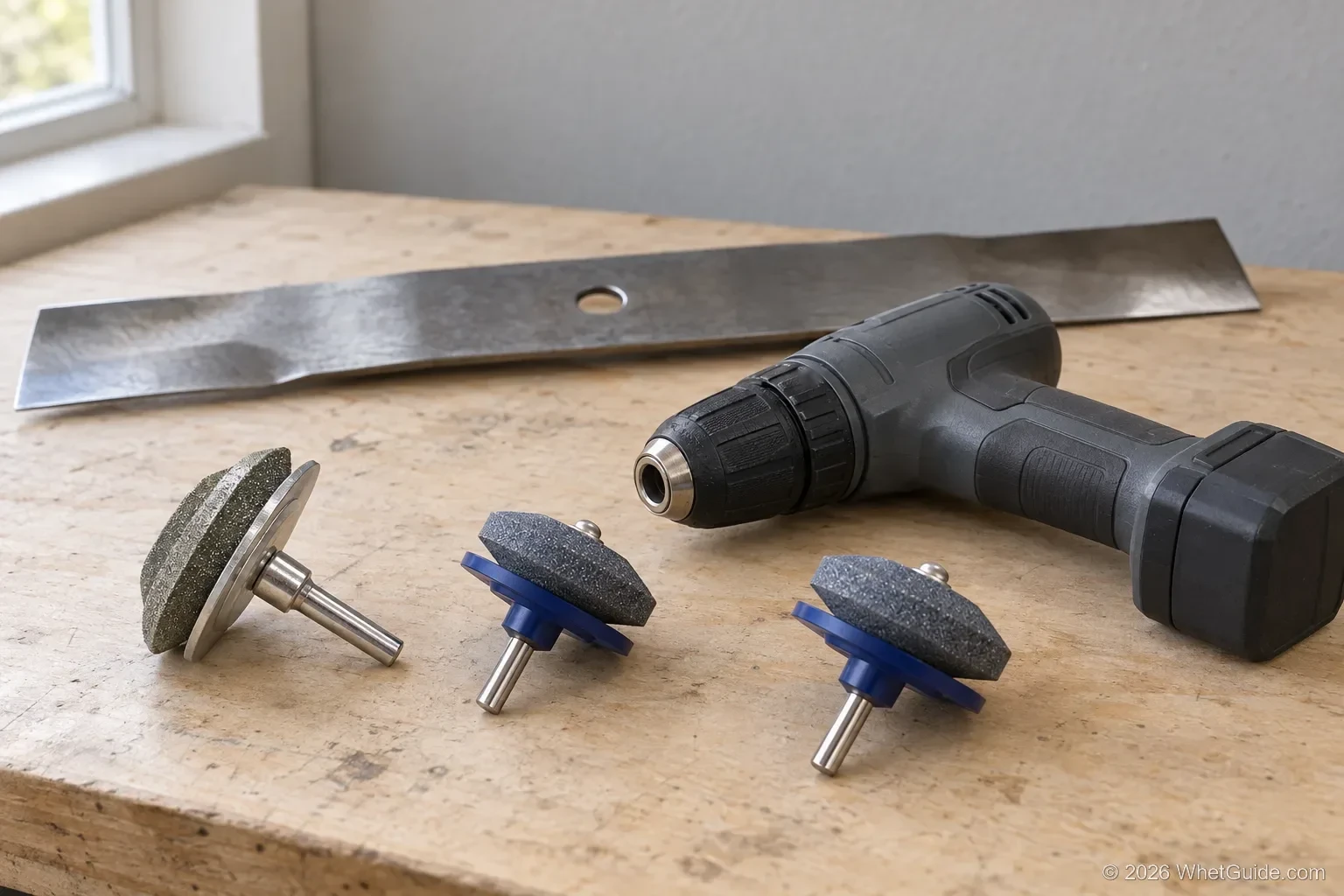
A drill attachment is a small abrasive wheel with a guide that rides against the back of the blade, so the wheel meets the edge at a set angle. This one uses a 120 grit diamond wheel instead of the usual gray stone, and it chucks into any drill you already own. It's quick on an edge that's only dull. The catches are the ones every drill sharpener shares: limited cutting power on real damage, and heat where the wheel meets the steel. Bob Vila found the Ankda drill bits hard to hold at one angle and said they did "a tolerable job." Keep it moving, keep the pressure light, and treat it as a touch-up tool. On a tighter budget, the cenoz five-pack of gray drill stones was $8.99 at last check.
- Typedrill attachment
- Abrasivediamond, 120 grit (per listing)
- Driveany power drill (per listing)
- Best ontouch-ups
Why it stands out
- Uses the drill you already have
- Diamond wheel instead of a soft stone
- Fast on lightly dulled edges
Think twice if
- Your blades come off the mower nicked and chewed
- You'd rather not watch for heat
Dremel A679-02 Sharpening Attachment Kit
This kit fits a Dremel rotary tool and adds a guide that holds a small grinding stone at the right angle. Hunker points out the trick that makes it worth owning: the guide lets you sharpen with the blade still on the mower. Tip the mower, chock the blade, and you can touch up both ends without fighting a rusted bolt. The small stone also follows the curved edges of mulching blades, where a long file is awkward. The small stone takes steel off slowly, so a badly worn blade still wants a file or a grinder. If you already own a Dremel, it's the cheapest way to add a guided sharpener.
- Typerotary tool attachment kit
- Needsa Dremel rotary tool
- On the moweryes, light work
Why it stands out
- Works with the blade still mounted
- Small stone follows mulching-blade curves
Think twice if
- You don't own a Dremel rotary tool
- Your blades need heavy repair
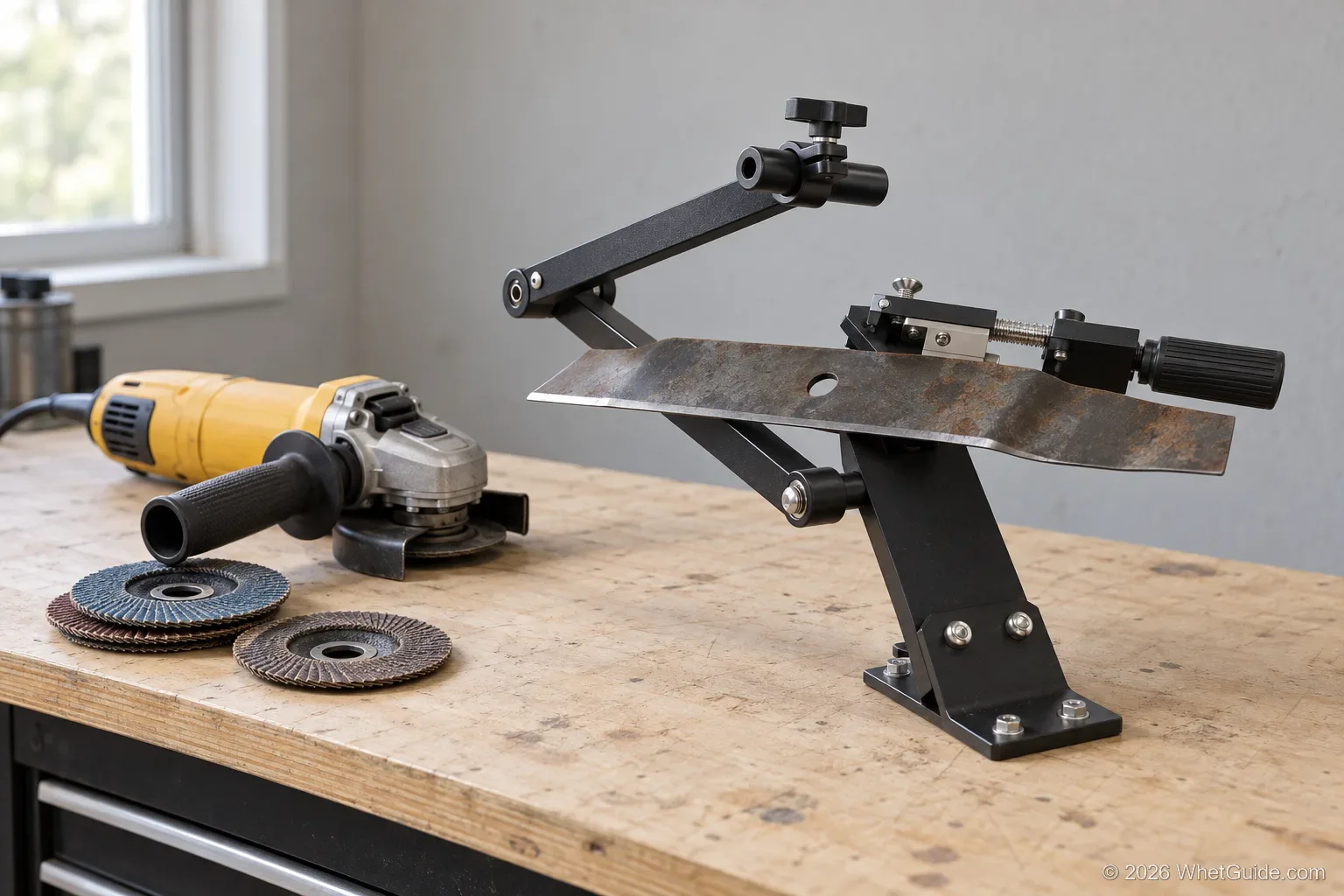
SporGain 15-45 Degree Grinder Jig
An angle grinder with a flap disc is the fastest way most homeowners can take a nick out of a blade, and also the easiest way to wreck the bevel. This frame solves the second problem. The blade sits in a holder and the grinder mounts to the frame, and per the listing you adjust both to any angle from 15 to 45 degrees. Once it's set, every pass lands on the same bevel, so the grinder's speed works for you instead of against you. You still have to manage heat, since a grinder heats the blade where it cuts, as ECHO puts it. Light sweeping passes handle most of it, with a bucket of water close by. Two kits bundle a similar frame with a blade balancer: the sharpener and balancer set and a cheaper sharpener kit with a balancer.
- Typeangle grinder frame
- Angle15 to 45 degrees, adjustable
- Grinderyours
Why it stands out
- Locks the angle the grinder can't hold by hand
- Covers the 30 to 45 degree span the sources give
Think twice if
- You don't own an angle grinder
- You have nowhere to bolt it down
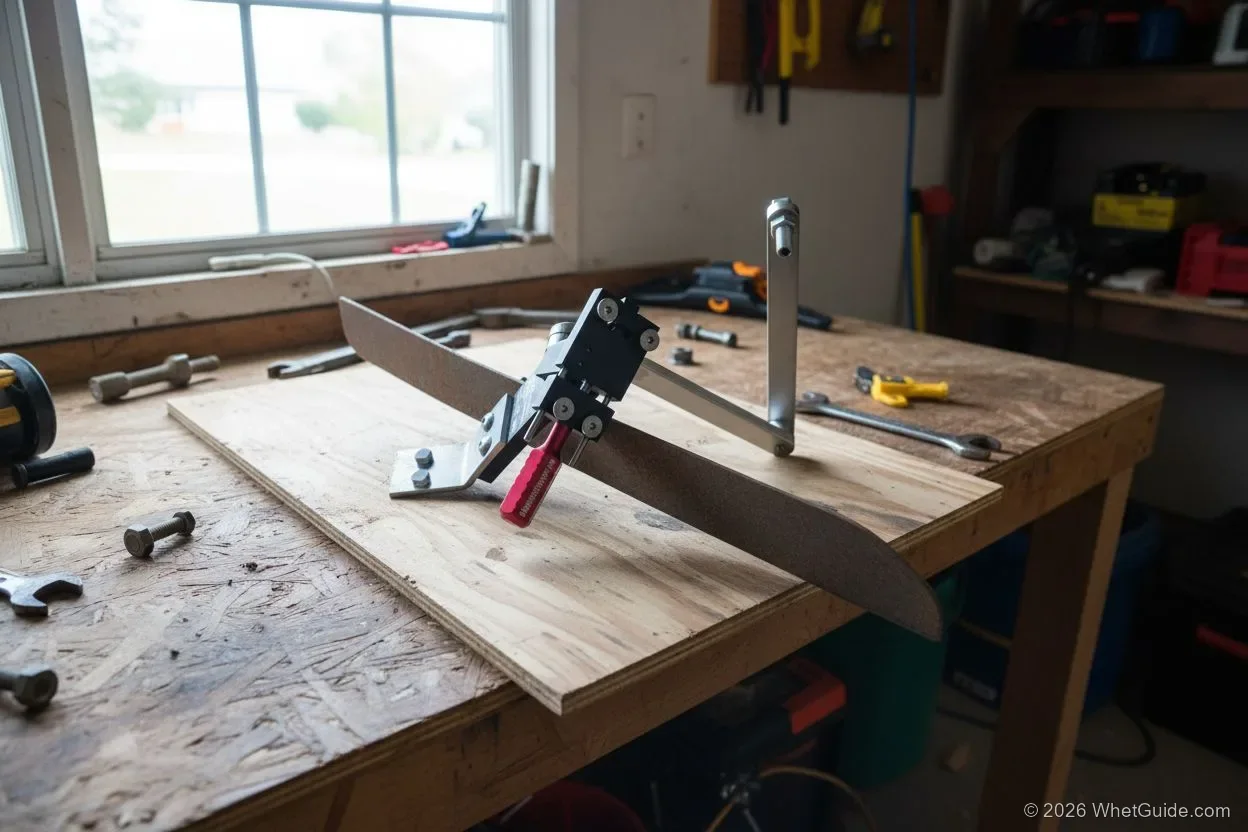
All American Sharpener 5005 Gen 2
The All American is the heavier, pricier version of the same idea. It holds the blade and guides your angle grinder across it at an angle you set between 15 and 45 degrees. Bob Vila puts the setup at about 10 minutes and names it the best system in its roundup. That setup is a one-time job. After it, each blade goes through at the same angle as the last, which counts for a lot when you sharpen a riding mower's set or a crew's worth of push mowers. The older Model 5002 is still listed for straight and standard blades, and a full kit combo adds accessories at a higher price.
- Typegrinder jig
- Angle15 to 45 degrees
- Grindernot included
- Setupabout 10 minutes (Bob Vila)
Why it stands out
- Built for repeat work
- Uses a grinder you can also use elsewhere
Think twice if
- You sharpen one mower's blade once or twice a year
- You don't own an angle grinder
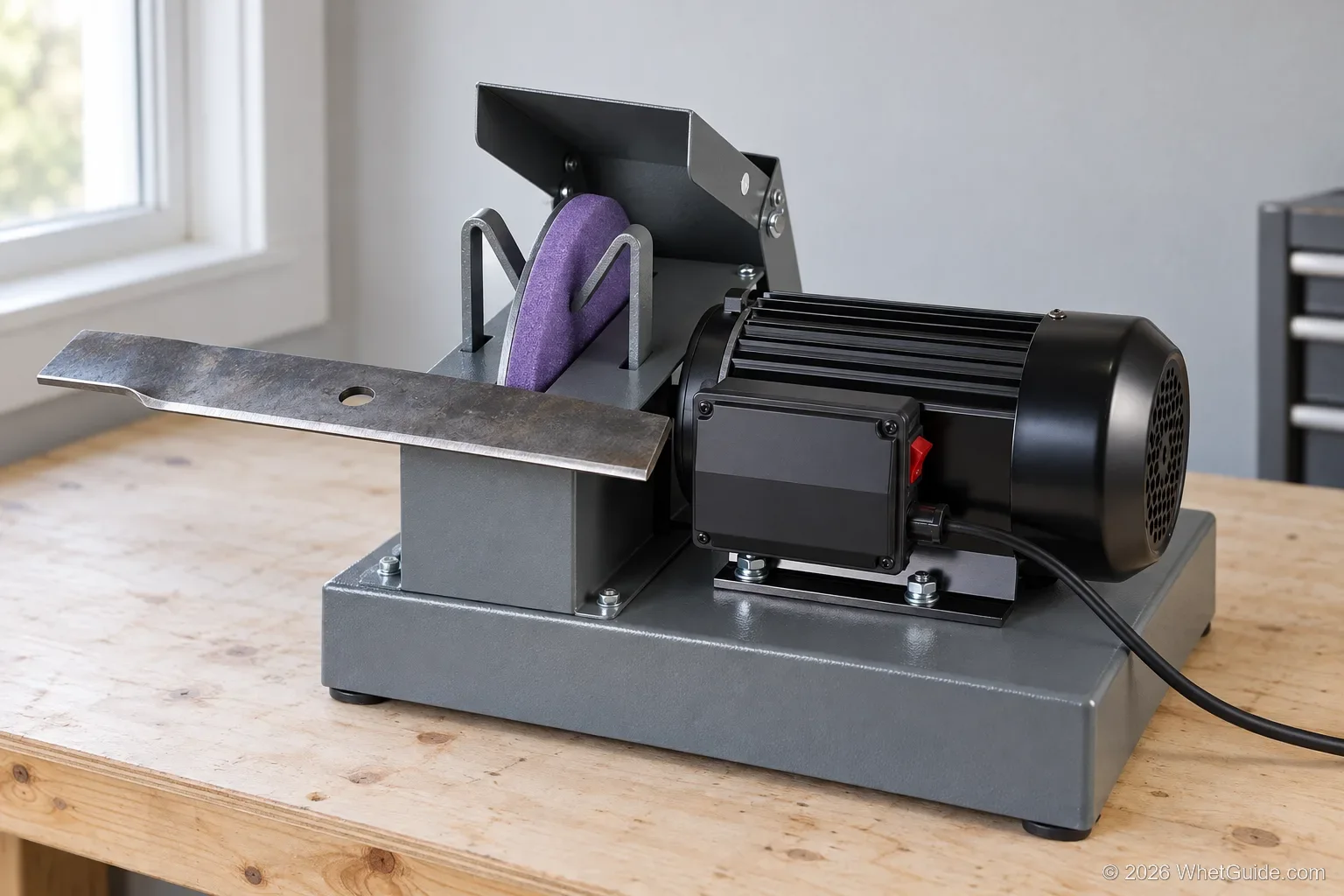
Oregon 88-025 Blade Sharpener and Grinder
Oregon makes mower blades as well as grinders, and its own guide says flatly that "The best way to sharpen a mower blade is with a dedicated blade grinder." The 88-025 is its economy model, a 1/3 HP grinder sold for blade work. What you pay for is consistency. The rest and guards put the blade against the wheel the same way every time, which is how shops turn out even bevels by the dozen. Oregon's setup notes are specific. The top tongue guard sits no more than 1/4 inch from the wheel, the bottom guard at the work table no more than 1/8 inch, and the grinder stays off until both are set. For one mower it's far more machine than you need. For a small-engine side business, or a rural property with three mowers, it's the right tool.
- Typebench blade grinder
- Motor1/3 HP
- Model88-025
Why it stands out
- The blade maker's own recommended method
- Repeatable bevels for volume work
Think twice if
- You own one mower
- You don't have bench space for a permanent machine
- Cheaper newer options: VEVOR's 1 HP grinder with a 9 inch ceramic wheel and its 1/3 HP model with a 7 inch wheel. Both cost less than the Oregon at last check, with far fewer owner reviews.
Side-by-side comparison
The seven picks in one table. "Heat risk" follows ECHO's warning about drill attachments and grinders; "on the mower" means you can work without removing the blade.
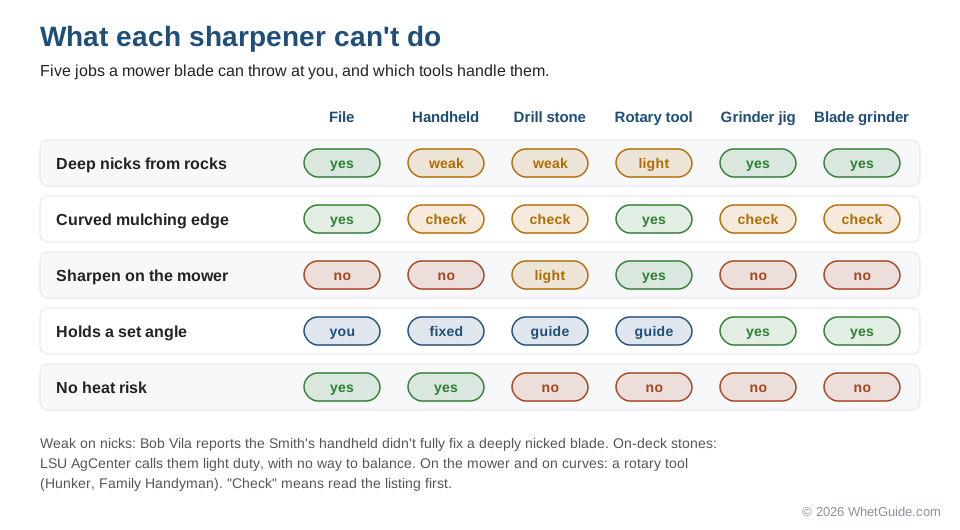
| Pick | Type | Angle held by | Heat risk | Deep nicks | On the mower | Needs |
|---|---|---|---|---|---|---|
| Nicholson 12 in file | Hand file | You | None | Yes | No | A vise or clamp |
| Smith's 50603 | Handheld | Fixed slot | None | Weak | No | Nothing |
| Diamond drill attachment | Drill stone | Guide | Moderate | Weak | Light work | A drill |
| Dremel A679-02 | Rotary kit | Guide | Moderate | Light work | Yes | A Dremel |
| SporGain frame | Grinder jig | Frame, 15 to 45 | High | Yes | No | Grinder and a bench |
| All American 5005 Gen 2 | Grinder jig | Frame, 15 to 45 | High | Yes | No | Grinder and a bench |
| Oregon 88-025 | Blade grinder | Rest and guards | High | Yes | No | Bench space |
Mower blade files: the cheapest sharpener that works
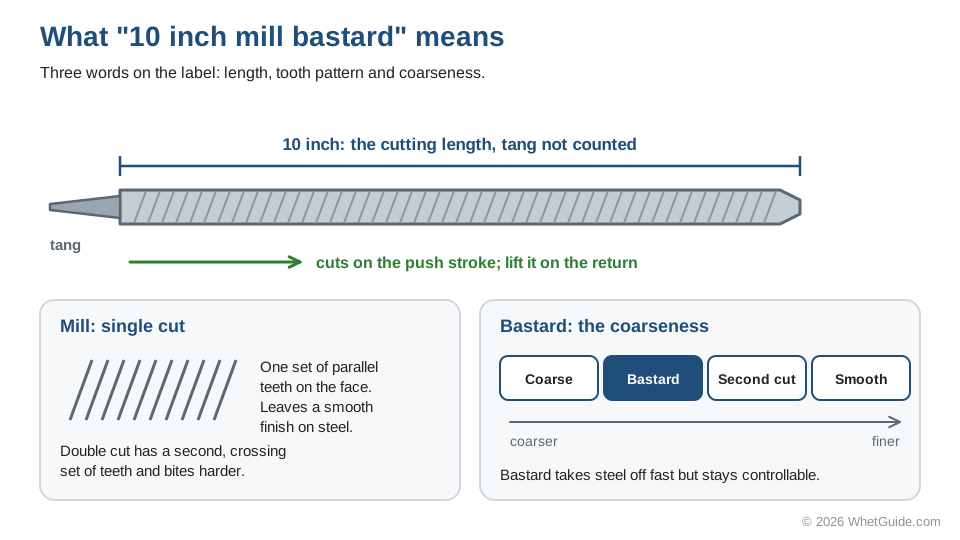
Ask for a mill bastard file. "Mill" means single-cut teeth running one way across the face. "Bastard" is the coarseness grade one step finer than coarse. Ten to twelve inches is the useful length, and longer is easier, because each push stroke covers more of the bevel and you make fewer of them. Bob Vila's top tool was a 12 inch double-cut Nicholson, whose crossed teeth cut more aggressively and leave a rougher face. A mower blade doesn't care about a rough face. It cares that the edge is even from the tip inward and that both ends got the same work. Fit a handle to the tang before you start, since a bare tang digs into the palm.
- Nicholson 12 inch mill bastard, single cut: our overall pick, the long stroke and the smooth cut.
- Crescent Nicholson 10 inch flat, double cut: faster bite, closer to what Bob Vila used.
- WORKPRO 10 inch flat file: the value choice if you just want something that cuts.
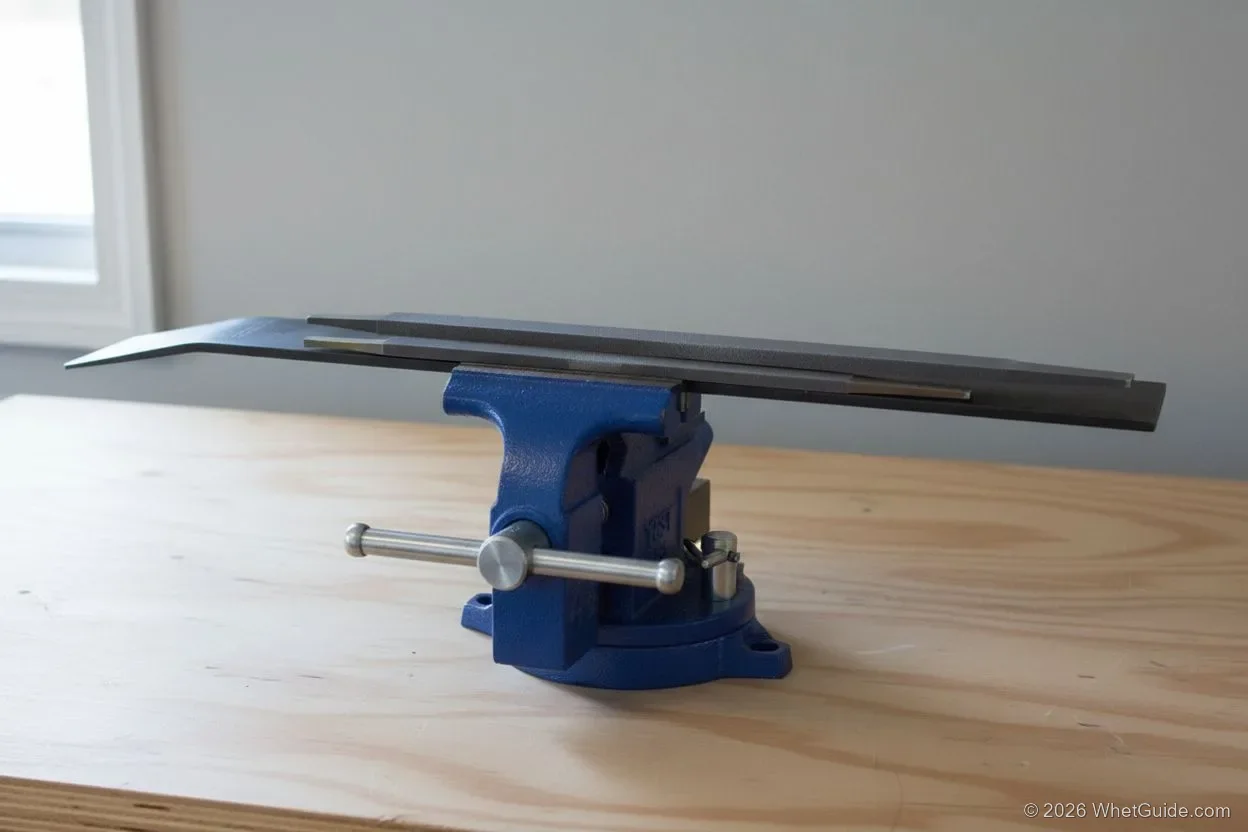
The technique fits in a sentence. Clamp the blade by its flat center in a vise, file the top bevel only on the push stroke, and lift the file on the way back. ECHO is firm that you grind the top surface and leave the grass side alone. Keep the file on the angle the blade already has and count your strokes, then give the other end the same count so the blade stays close to balanced. Our mower blade sharpening guide has the full sequence, from pulling the plug to torquing the bolt. A Yost LV-4 homeowner's vise is plenty for the job, and a C-clamp holding the blade flat to a sturdy bench edge works if you have no vise at all.
Drill attachment sharpeners: what they do well and badly
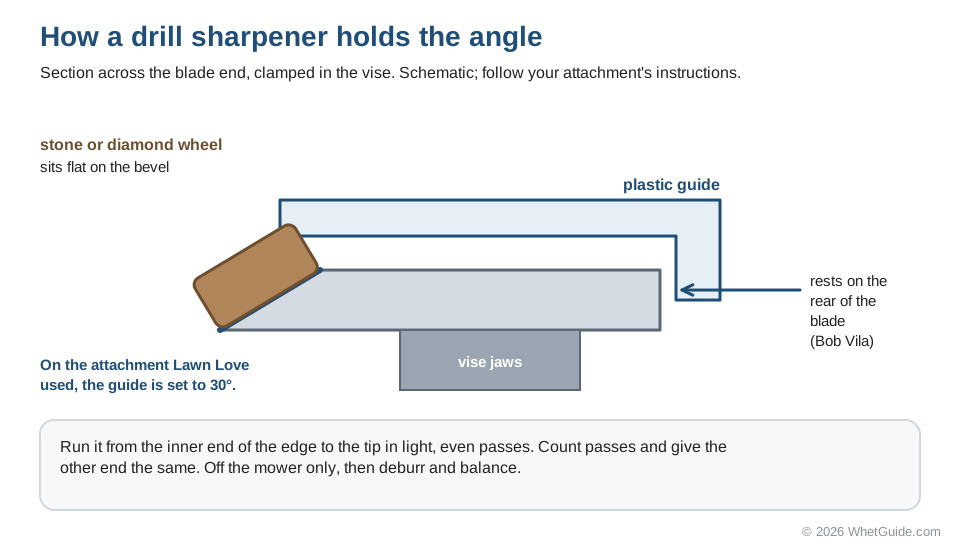
A drill attachment is two parts: a round abrasive, stone or diamond, and a plastic guide. Bob Vila describes the guide resting against the rear of the blade, which sets the angle without any judgment from you. Run the drill, slide the wheel along the bevel, and an edge that's merely dull comes back in a few passes. They're cheap enough to buy on impulse at the hardware counter, and for a mid-season freshening that impulse is fine. The diamond version we picked swaps the usual gray stone for a diamond wheel; the stone versions tend to sell in multipacks, like the cenoz five-pack.
Where they go wrong is damage and heat. LSU AgCenter calls drill-mounted stones light duty, and that matches what the tool is: a small wheel with a small contact patch, made for a dull edge rather than a blade that bounced off a landscape rock. The wheel heats the blade where it sharpens, and a small patch heats fast if you linger. The guide is also only as steady as the hand on the drill. Use it with the blade off the mower and clamped, keep the wheel moving, and balance the blade afterward like any other.
| Use a drill attachment when | Reach for something else when |
|---|---|
| The edge is shiny and rounded but straight | You can see notches or flat spots from rocks |
| You want a five-minute freshening mid-season | The blade hasn't been sharpened in years |
| The blade is a standard straight blade | The edge curves sharply, as on many mulching blades |
| You'll balance it afterward | You were hoping to skip the balancer |
Angle grinder jigs and bench grinders
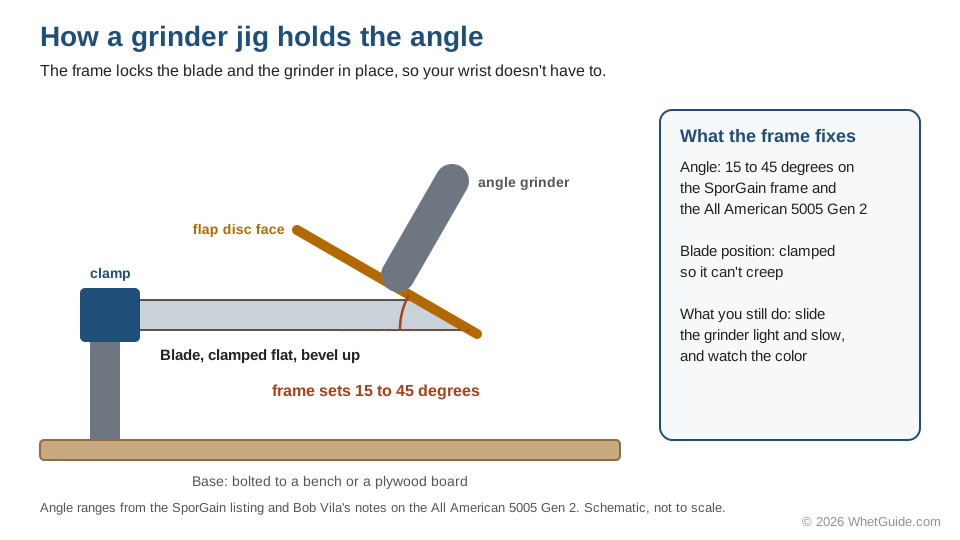
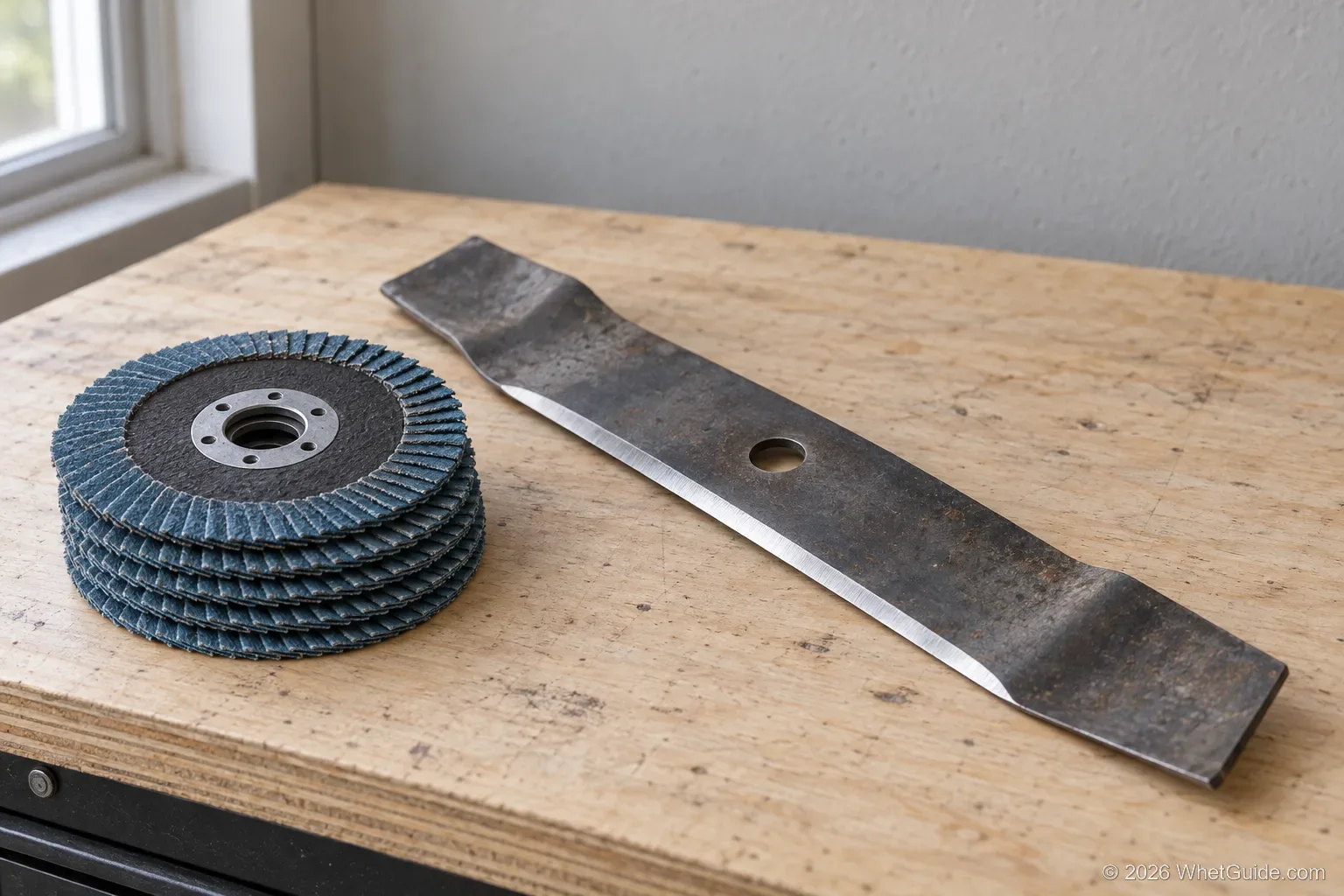
If you own a 4-1/2 inch angle grinder, you already own the motor half of a fast blade sharpener. What you need is a flap disc, a layered abrasive that's easier to control on a blade than a hard grinding wheel. Owners on lawn forums mostly reach for a 36 to 60 grit disc on a 4-1/2 or 5 inch grinder. The NEIKO 11143A is a ten-pack of 60 grit zirconia discs in the common Type 29 shape, and the DEWALT DWE4011 is a plain 4-1/2 inch grinder if you need one. In Bob Vila's notes a flap disc needed six to thirteen passes, about six on a blade with moderate wear. That's fast, and speed is the problem when your hand is the only thing holding the angle.
A jig takes the angle out of your hands. Both the SporGain frame and the All American clamp the blade and hold the grinder at a fixed angle you set, anywhere from 15 to 45 degrees. Every pass then lands on the same bevel, which is the one thing freehand grinding gets wrong most often. What a jig can't do is manage heat for you. Light pressure and steady, sweeping passes are still your job, and so is watching the color of the steel as you go.
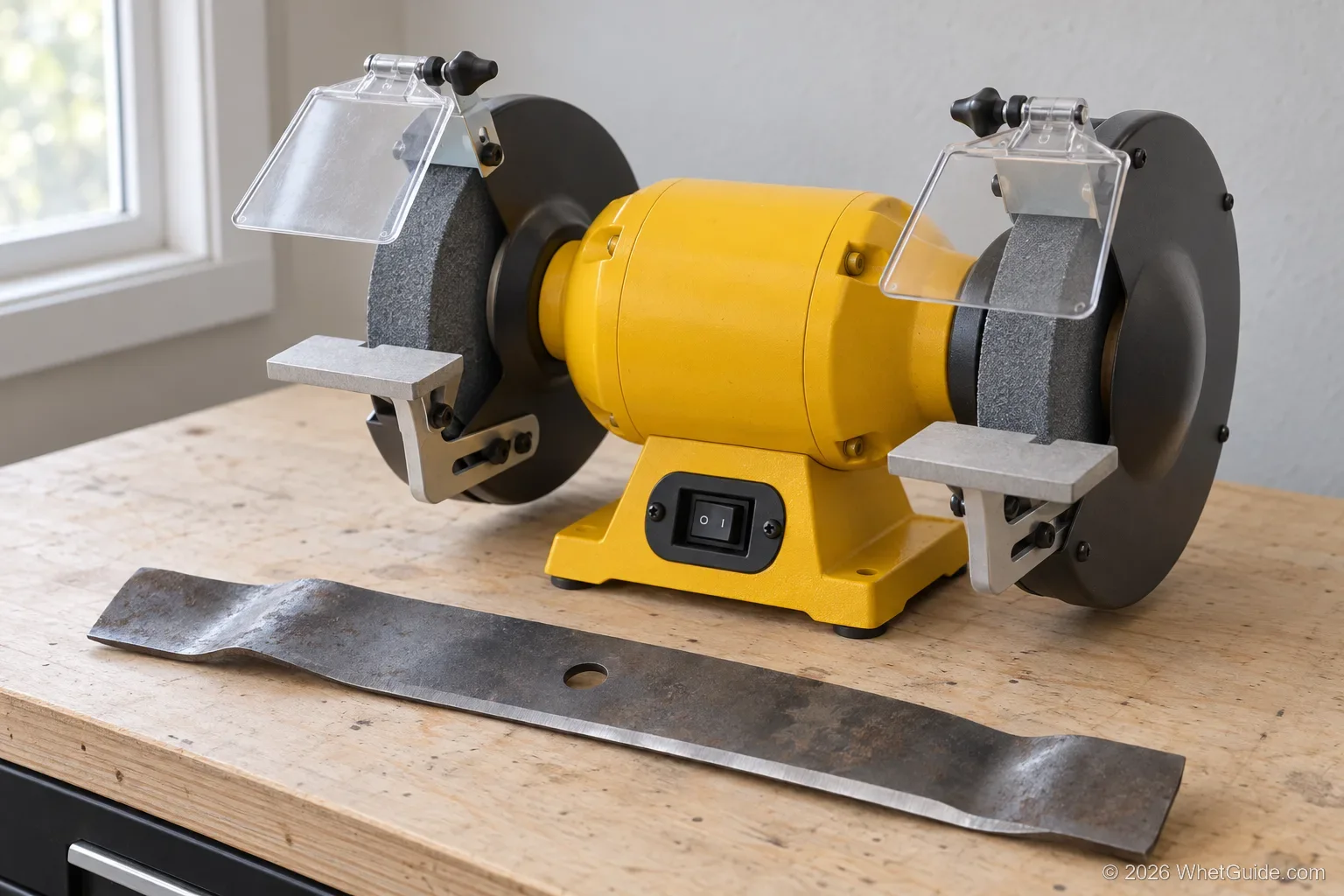
A general bench grinder, like the DEWALT DW758 8 inch, will also sharpen a mower blade if you rest the blade on the tool rest and feed the bevel into the wheel. It has no blade-specific guide, so the angle comes from how you hold the blade, and the heat warnings later on this page apply in full. The sources split on where to stand as the wheel spins up: Oregon's grinder instructions put you in front of the wheel, while an extension guide says to keep out of its path at start-up. The safe reading is to stay out of the wheel's line for those first seconds and follow your own grinder's manual. Our bench grinder guide covers wheel dressing and the heat habits that carry over to blades.
Electric lawn mower blade sharpeners
"Electric lawn mower blade sharpener" on a store shelf usually means one of two things: a bench grinder built around mower blades, or a drill attachment marketed as electric because the drill is. The first kind is the real step up, and it's the 88-025 pick above. Sharpening Supplies points true volume users toward machines like the Magna-Matic 9000. One mower sharpened twice a season is a file job. A landscaping crew's worth of blades every week is a machine job.
| Machine | Motor and wheel | Who it suits |
|---|---|---|
| Oregon 88-025 | 1/3 HP | Small shops and big properties; the blade maker's own economy grinder |
| VEVOR 1 HP | 1 HP, 9 inch ceramic wheel | Volume work on a budget, from a newer listing |
| VEVOR 1/3 HP | 1/3 HP, 7 inch ceramic wheel | The cheapest dedicated blade grinder we found |
| DEWALT DW758 | 8 inch general bench grinder | A shop that also grinds chisels and tools; no blade guide |
The Work Sharp question comes up a lot, because Work Sharp's belt sharpeners already live in many garages. Sharpening Supplies names the Work Sharp Ken Onion with its blade grinding attachment as one route to sharp mower blades. We couldn't confirm that attachment's Amazon listing, so it isn't a pick here. If you're weighing the machine itself for knives and tools, our Work Sharp MK2 vs Ken Onion comparison lays out the two models.
The Harbor Freight question: what the budget tools get right
Harbor Freight doesn't sell a tool called a lawn mower blade sharpener so much as the cheap tools that do the work. SlashGear's Cody D. Campbell went through the store's options in a piece dated August 16, 2025. The prices then were hard to beat. A Pittsburgh 8 inch file was $3.99 and a 12-piece file set $13.99. A Warrior 4-1/2 inch angle grinder was $14.99, a Central Machinery bench grinder $47.99. Bauer bench grinders ran $54.99 to $179.99, and Hercules topped the range at $199.99. Treat those as a snapshot from that date. Store prices move, and the shelf you walk up to may not match.
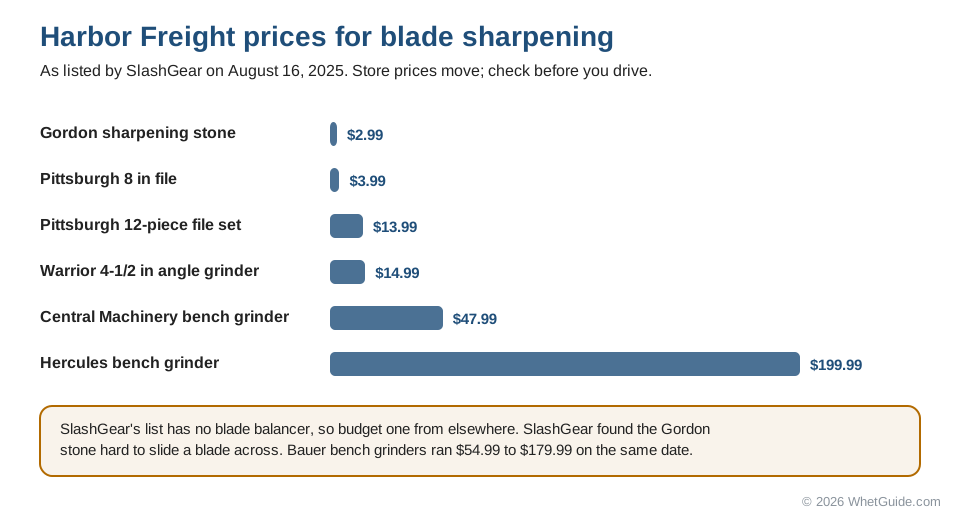
What the budget route gets right is the file. A cheap file cuts mower steel well enough, and nothing about a blade's soft edge needs premium teeth. A budget angle grinder with a flap disc works too, though a cheap grinder doesn't change the heat rules, and it makes a jig more worthwhile rather than less. Two cautions from the same article. SlashGear found the $2.99 Gordon stone hard to slide a blade across, so skip it for this job. And its list had no blade balancer, so plan to buy one elsewhere; the Oregon cone below costs less than ten dollars at last check.
What a sharpener costs next to a shop
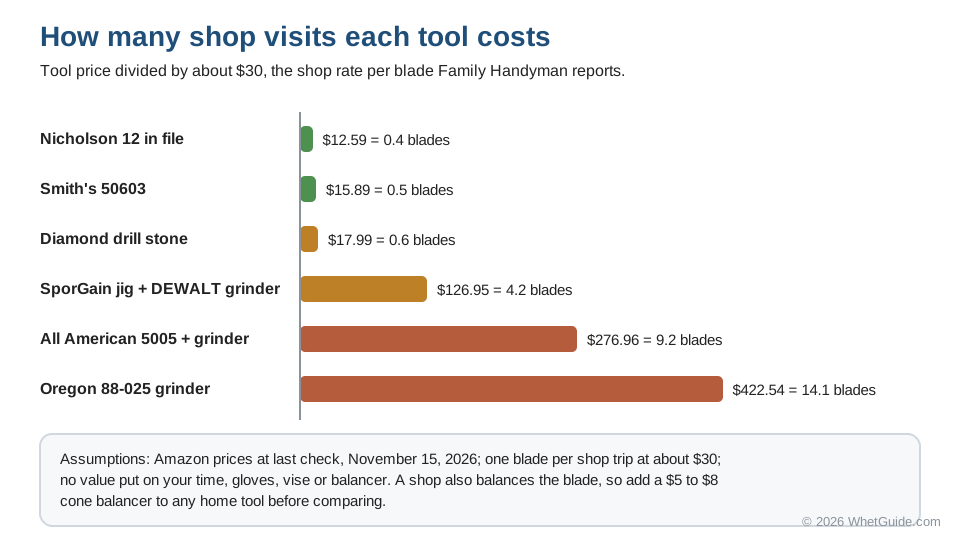
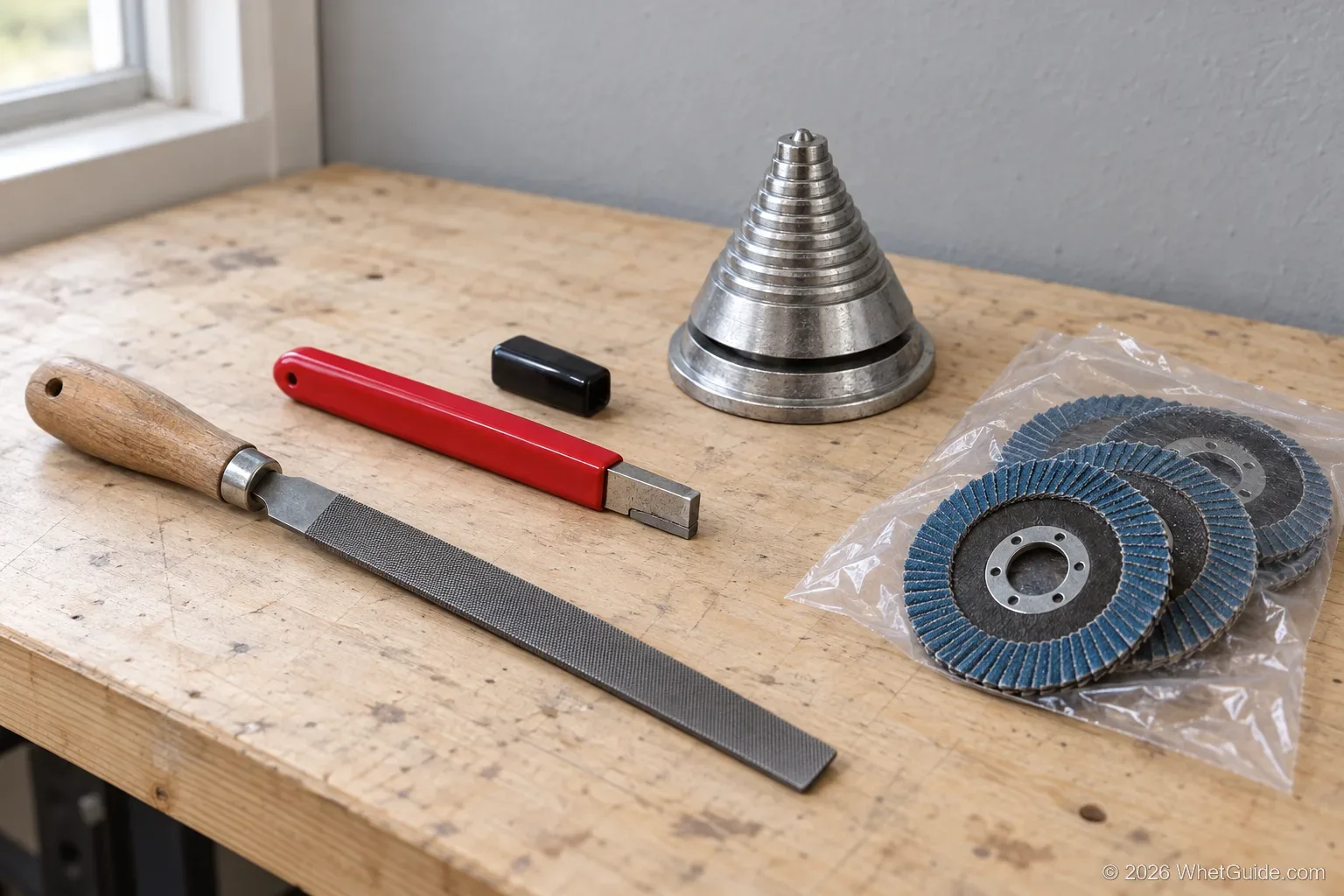
Family Handyman puts the typical shop price at about $30 a blade when you bring the blade in already removed. That makes the arithmetic simple. Divide a tool's price by $30 and you get the number of blades it takes to pay for itself, before you count the drive to the shop or the days the mower sits idle. The table uses Amazon prices at last check on November 15, 2026. It leaves out things most people already own, like a socket wrench.
| Setup | Price at last check | Blades to break even at $30 |
|---|---|---|
| Nicholson 12 inch file plus Oregon cone balancer | About $20 | Under 1 |
| Diamond drill attachment plus balancer | About $26 | Under 1 |
| SporGain frame plus a DEWALT 4-1/2 inch grinder plus discs | About $151 | About 5 |
| All American 5005 Gen 2 plus the same grinder | About $277 | About 9 |
| Oregon 88-025 blade grinder plus balancer | About $430 | About 14 |
A walk-behind mower usually has one blade. Sharpened twice a season, as LSU AgCenter plans for most lawns, that's two shop trips a year, or about $60. A file and a balancer pay for themselves the first time you use them. A jig with a grinder takes two or three seasons on one mower, sooner on a riding mower with more than one blade under the deck. The big grinders only make sense when the blade count runs into the dozens.
↑ Back to all sectionsFive households, five sharpeners
| Household | The arithmetic | What to buy |
|---|---|---|
| Small lawn, one push mower, sharpened twice a season | Two shop trips a year at about $30 is about $60. A file plus a cone balancer was about $20 at last check. | Nicholson 12 inch file and the Oregon cone. Done for years. |
| Riding mower with three blades, rocky yard | Three blades twice a season is six shop blades, about $180 a year. Rocks leave real nicks. Handhelds and drill stones handle those badly. | An angle grinder plus the SporGain frame (about $151 with discs) pays back inside one season. Add a torque wrench: Cub Cadet gives 70 to 90 ft-lb for its riding mowers. |
| Mulching blades with deep curves | A long file fights the bends; a straight-edged jig may not clamp them. | A file for the straight runs plus the Dremel A679-02 for the curves. |
| Busy family, no time to pull the blade mid-season | One full sharpening in spring, then quick touch-ups in place. | The Dremel kit for on-mower touch-ups; a file once a year with the blade off and balanced. |
| You sharpen for neighbors or a small crew | Thirty blades a season would be about $900 at shop rates. | The All American 5005 Gen 2 with a grinder (about $277), or the Oregon 88-025 (about $423) if you want the blade maker's own machine. |
You also need a blade balancer
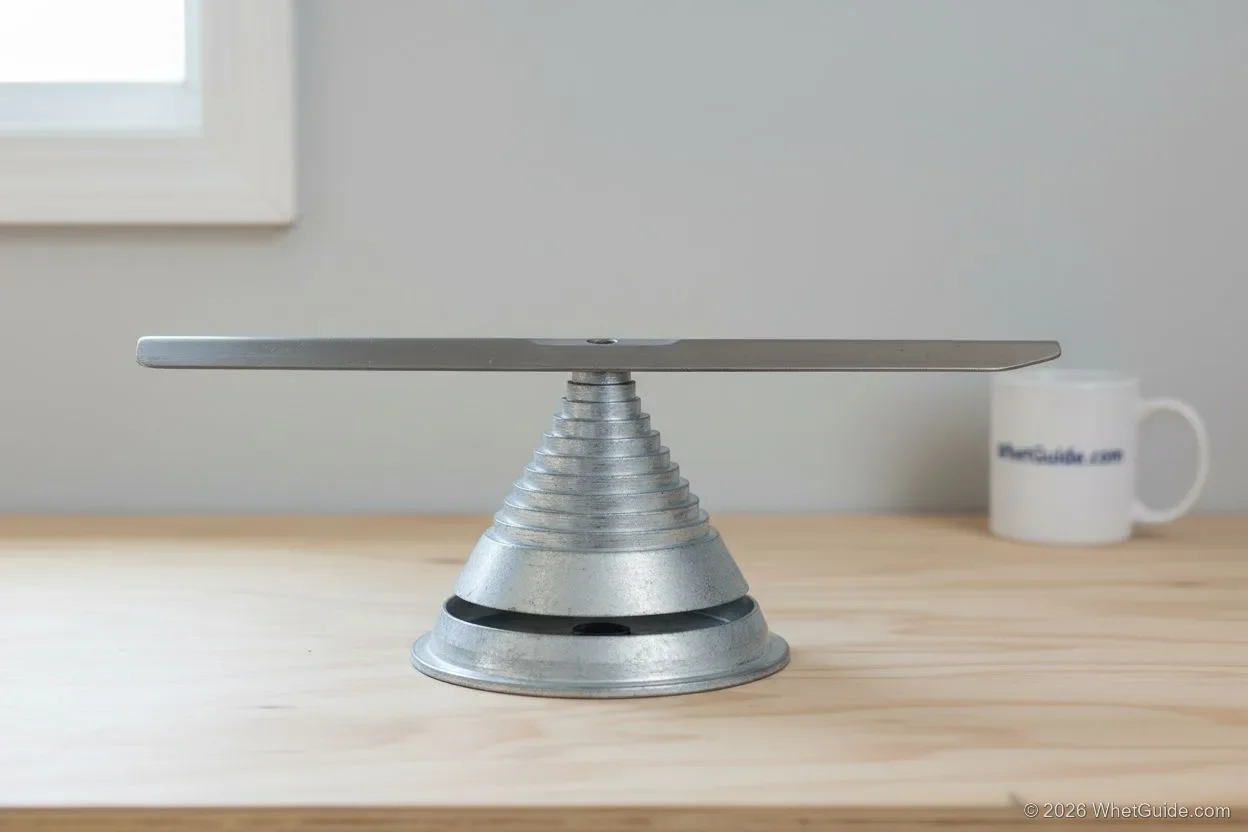
Every sharpener on this page removes steel, and none of them removes exactly the same amount from both ends. A spinning blade turns a small difference in weight into vibration. Cub Cadet's support pages put it plainly: a blade out of balance "can cause vibrations that may weaken or loosen components." LSU AgCenter adds that a balanced blade causes less engine wear.
Where to take the metal off is the one point the sources split on, as the table shows. We follow the blade maker and grind the heavy end's sharpened edge. Owners on lawn forums also split on whether balancing matters at all, and some skip it. A cone that costs less than a sandwich isn't worth the argument. No cone? A nail through the center hole into a wall stud does the same job, the method LSU AgCenter describes.
| Source | Where to remove metal from the heavy end |
|---|---|
| Oregon (blade maker) | The sharpened edge only; never the tip or the back |
| LSU AgCenter | More metal off that end's cutting surface |
| This Old House | The back edge, not the cutting edge |
| Bob Vila | The back edge, not the cutting edge |
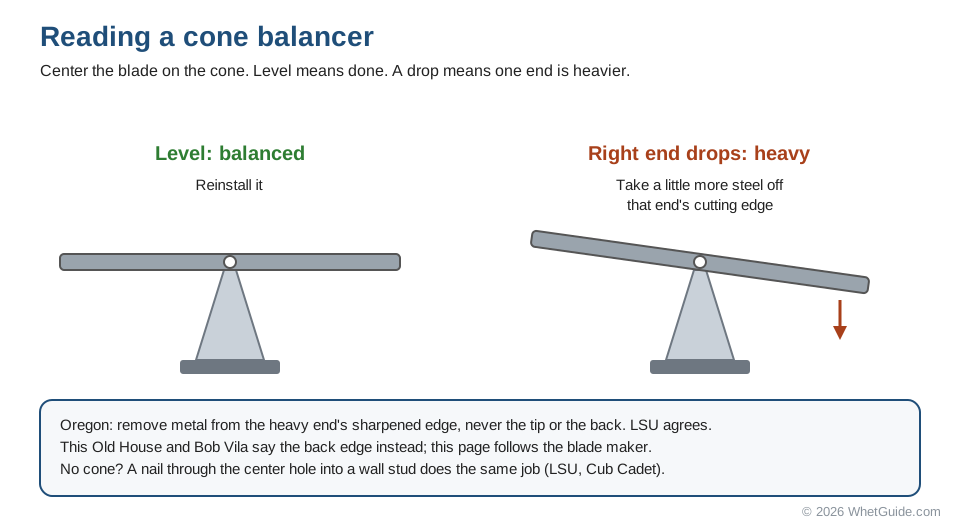
- Oregon Universal Precision Mower Blade Balancer: Oregon's own cone, $7.89 at last check.
- Metal blade balancer, single pack: a cheaper metal version, $5.29 at last check.
- The jig bundles above (the sharpener and balancer set) include one, if you're buying a frame anyway.
The rest of the kit: getting the blade off and back on
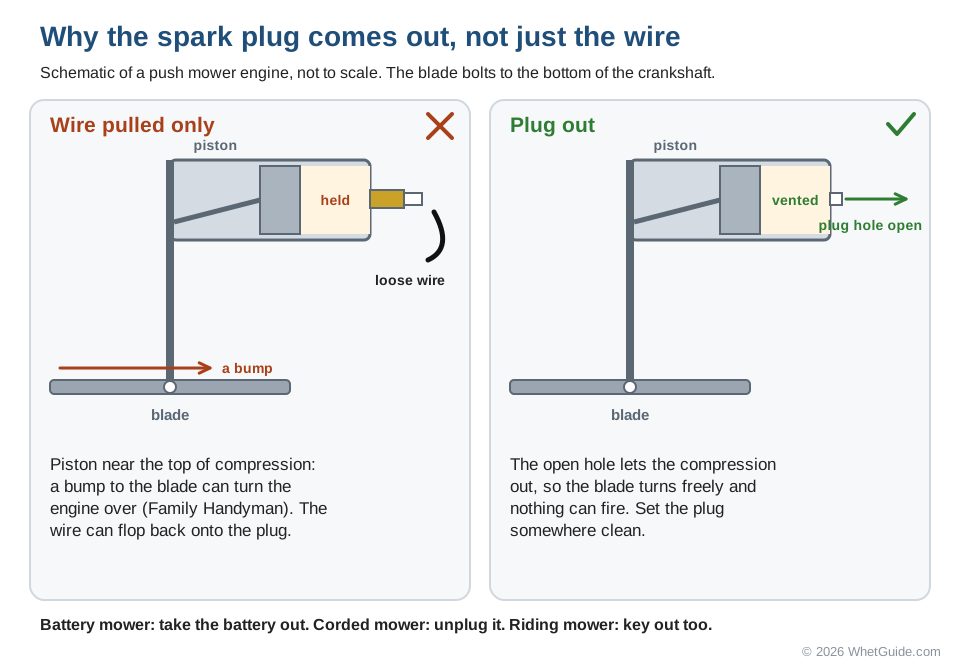
A sharpener is only useful once the blade is off and held still, and that's where most first attempts stall: blade bolts are tight and often rusted. A blade-removal clamp locks the blade while you break the bolt loose, though a scrap of 2x4 wedged against the deck does the same thing for free. Pull the spark plug itself, not only the wire. Family Handyman points out that with the piston near the top of its compression stroke, a bump to the blade can turn the engine over.
| Item | Why it's in the kit | Our pick |
|---|---|---|
| Bench vise | Holds the blade so both hands are on the file or grinder | Yost LV-4 |
| Blade removal tool | Stops the blade turning while you loosen and tighten | MaxPower 339079 |
| Torque wrench | Blade bolts have a specified torque; guessing is how they loosen | EPAuto 10-150 ft-lb, 1/2 inch drive |
| Spark plug socket | Plug out, not just the wire | DURATECH 5/8 inch swivel |
| Safety glasses | Filings and sparks, whichever tool you pick | NoCry clear anti-fog |
| Cut-resistant gloves | The edge is sharp even when it's dull | Schwer Pro Max A9 leather |
| Penetrating oil | Frees a seized bolt | Blaster PB |
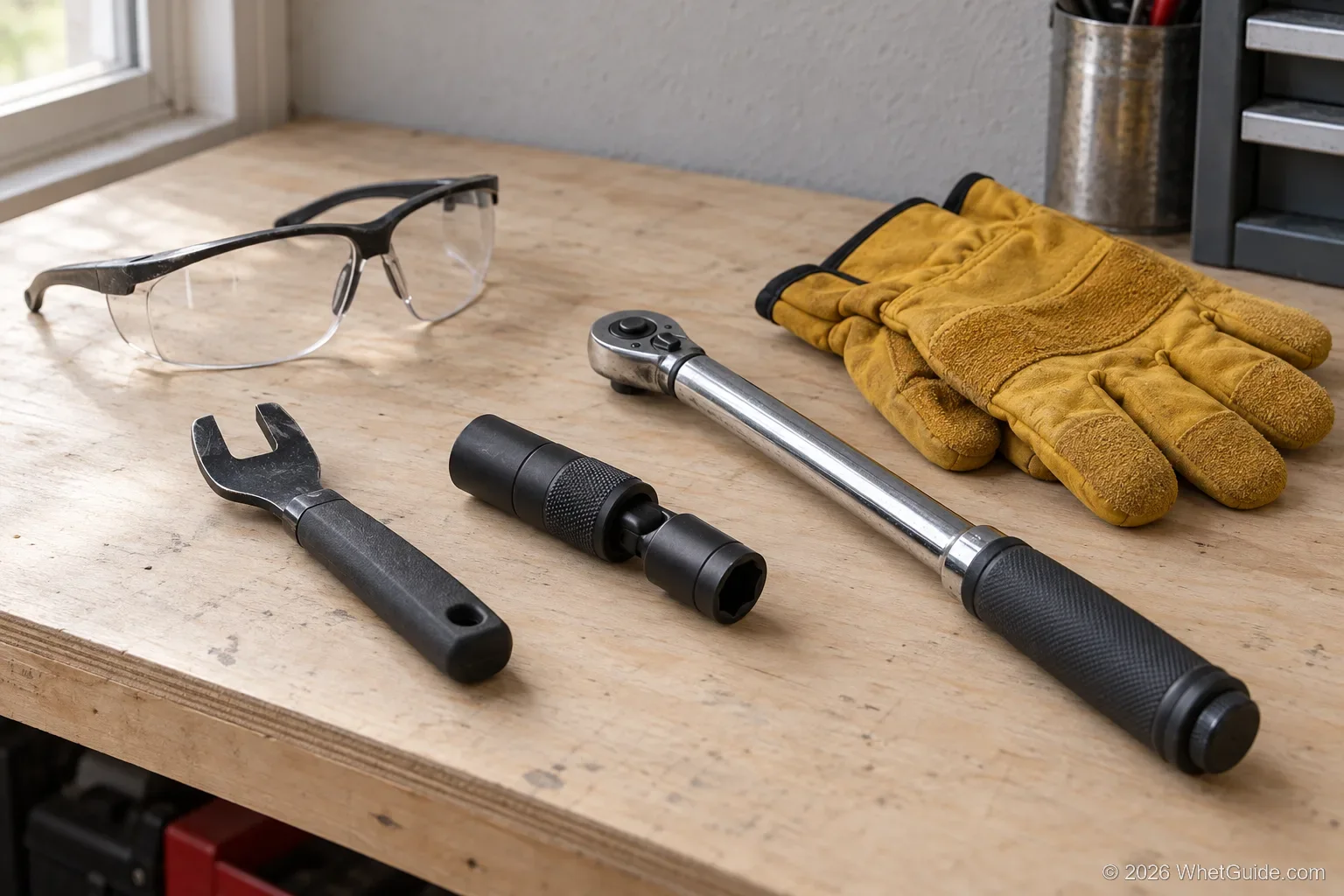
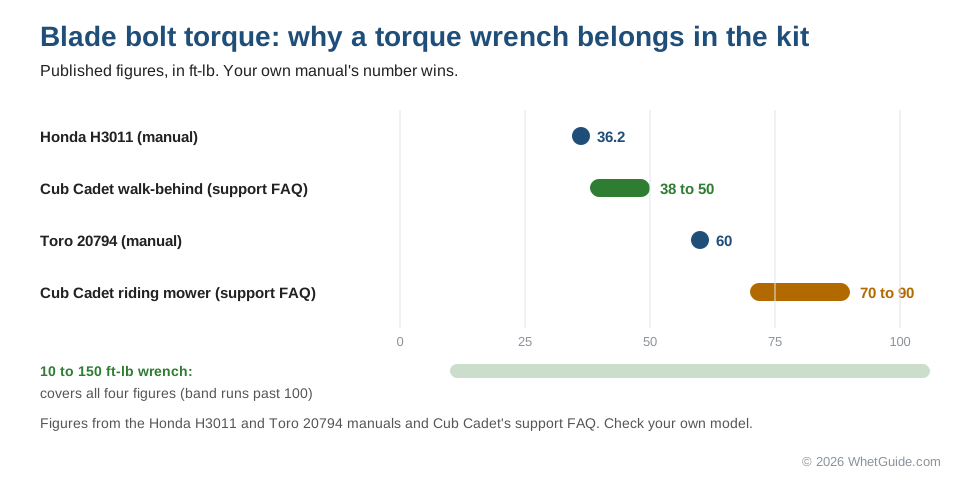
The torque wrench is the item people skip, and the one we'd argue for hardest. Blade bolts have a number in the manual, and the published figures in the chart below run from 36.2 to 90 ft-lb depending on the mower. Family Handyman warns that an under-tightened bolt can throw off engine timing and cause hard starting. A 1/2 inch drive click wrench with a 10 to 150 ft-lb range covers every one of those figures. Use your own manual's number, not the chart's.
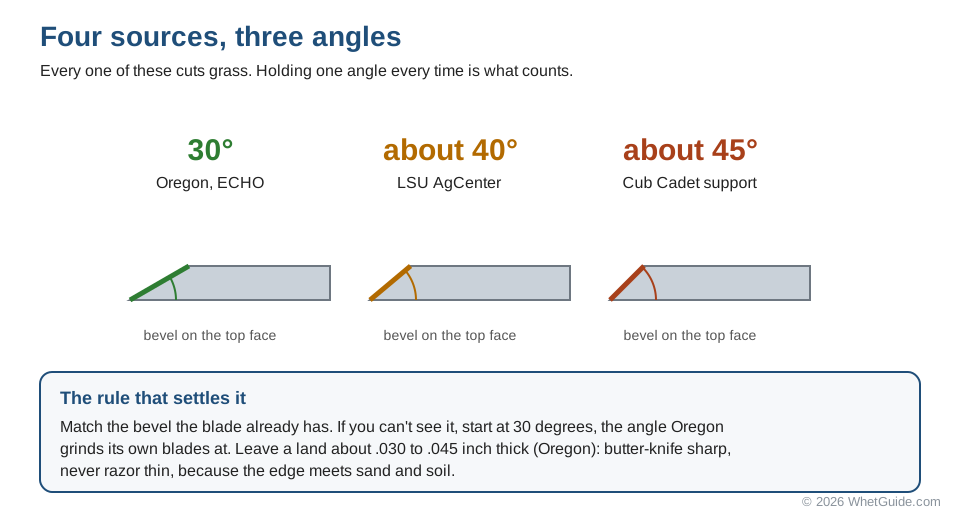
Holding the factory bevel (about 30 degrees, per Oregon)
Ask four sources for the right mower blade angle and you get three answers, laid out below. All of them cut grass. What spoils a blade is changing the angle from one sharpening to the next, which wastes steel and leaves a wavy bevel. So the rule is the one ECHO states: maintain the angle of the original cutting edge. If wear has hidden it, 30 degrees is the starting point with a blade maker behind it.
| Source | Angle | What it says |
|---|---|---|
| Oregon | 30 degrees | Grinds all of its blades at 30 |
| ECHO | 30 degrees | File at 30; keep the original edge's angle |
| LSU AgCenter | About 40 degrees | Thinner is weak; thicker cuts less cleanly |
| Cub Cadet support | About 45 degrees | "About a 45 degree angle is sufficient" |
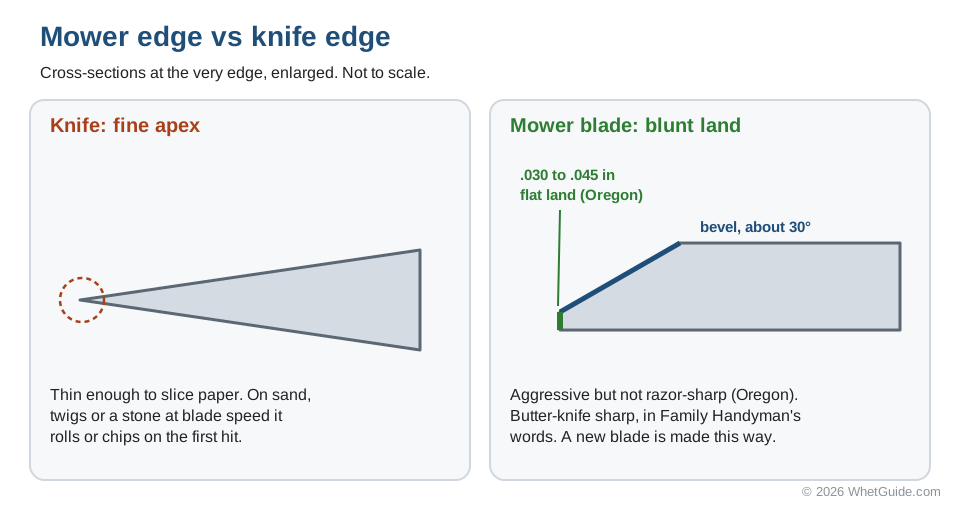
This is where tool choice comes back in. A jig or a blade grinder can hold any of those angles all day; set it once and forget it. A drill attachment's guide and a handheld's slot hold whatever angle they were made for, which may or may not be your blade's. A file holds exactly the angle your hands give it, so watch the bevel as you go and keep the file flat on it. The edge itself should end in a small flat land rather than a knife point. Oregon recommends an edge .030 to .045 inch thick, "aggressive but not razor-sharp," which is why people describe the target as butter-knife sharp.
Heat: the risk that comes with every motor
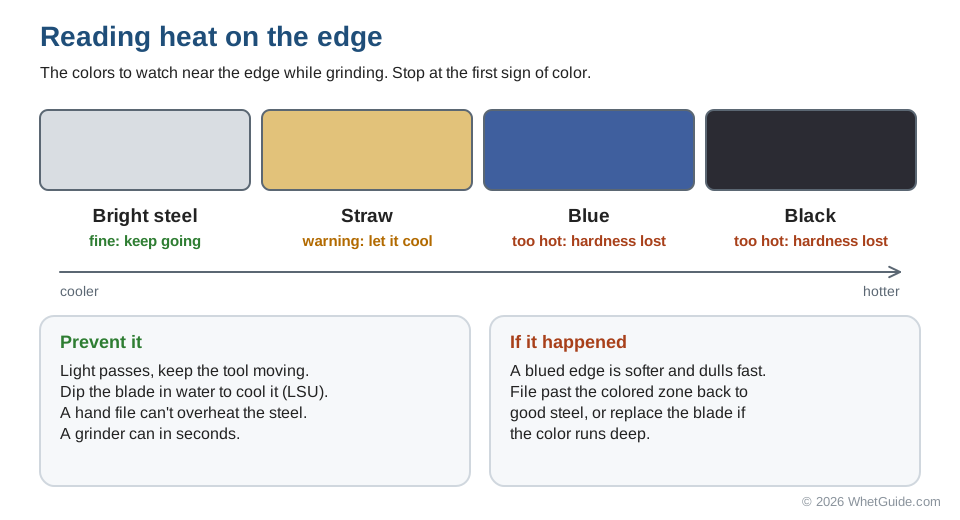
Sharpening heat can take the hardness out of a blade. ECHO is specific: "Using a drill attachment or bench grinder will heat the blade in the area it is sharpened," and it says to make sure that area doesn't turn blue. Overheated steel has lost its temper, and the fix while you work is simple: dip the blade in water to cool it. The color tells you what happened. Straw is a warning to let the steel cool. Blue or black means the steel got hot enough to lose hardness, and ECHO says bluing reduces the blade's strength as well.
The hand tools can't do this; a file and a handheld simply don't move fast enough to heat steel. Every powered tool can, and the faster it cuts, the faster it heats. Keep a bucket of water at the bench when you use a grinder, make light passes, and lift off between passes rather than parking the disc in one spot. Any color on the steel means the next pass waits until the blade has cooled.
Matching the sharpener to the blade type
Cub Cadet sorts blades into a few families. Standard blades, which it also calls high-lift, are the 2-in-1 type that discharges or bags. Mulching blades are the 3-in-1 type, with a more curved surface and extra cutting edges that keep clippings circulating under the deck. Older mowers sometimes run "+" blades, two blades crossed at right angles. Lift blades move more air for bagging; mulching blades trade that for more bends and cutting surface. For sharpening, the shape decides the tool. A straight standard edge suits anything on this page. The curves of a mulching blade are where a file or a rotary tool earns its place, since a long straight abrasive can't follow a bend.
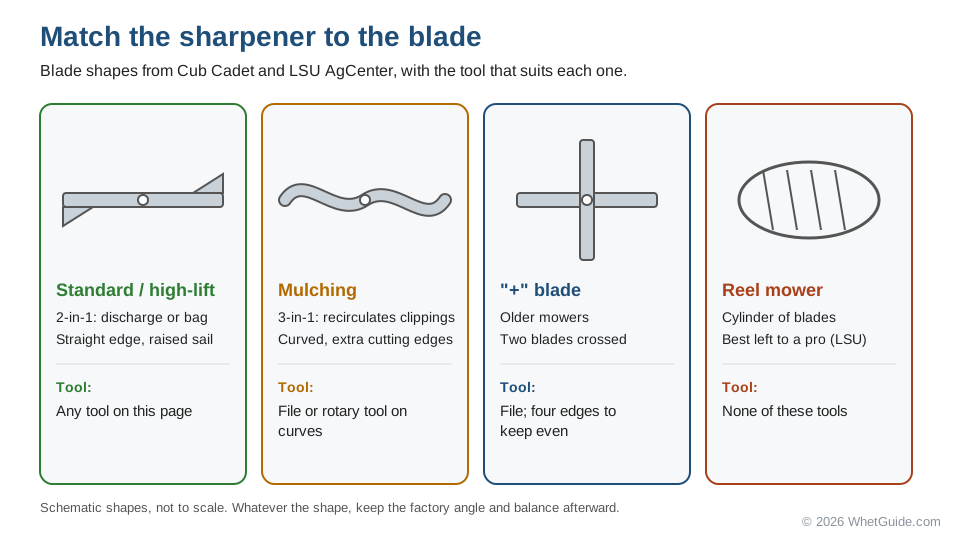
Reel mowers are a different machine: a spinning cylinder of curved blades that cuts against a fixed bed knife. LSU AgCenter calls sharpening them difficult and best left to a professional, and none of the tools above is built for the job. If you're fitting an aftermarket blade, check what it does to your warranty first. Whatever the type, sharpen to the existing angle and balance it before it goes back on.
↑ Back to all sectionsSafety before the sharpener touches steel
The sharpener is the least dangerous part of the job. The risk sits in the mower: an engine that can turn over, fuel that can leak, and an edge that cuts even when it's dull. Toro's 20995 manual says to tip the mower with the air filter up, and to run the tank dry through normal use before tipping if you can. Oregon wants gloves at the grinder along with ear and eye protection, and ECHO's checklist opens with disconnecting the spark plug or battery. Here is the order we'd follow before any tool on this page comes out.
- Take the spark plug out (or the battery on an electric mower), not only the wire.
- Run the fuel tank low first, then tip the mower with the air filter up.
- Mark the grass side of the blade before you remove it.
- Chock the blade with a block of wood or a removal tool.
- Put on gloves and eye protection; add hearing protection for any grinder.
- Clamp the blade before sharpening, never hold it loose against a powered tool.
With a grinder, add sparks to the list. Clear sawdust and rags from the bench, keep loose sleeves away from the wheel, and stay out of the wheel's line as it spins up. Our mower blade safety section goes deeper on tipping the mower and handling the fuel.
↑ Back to all sectionsSharpen or replace the blade?
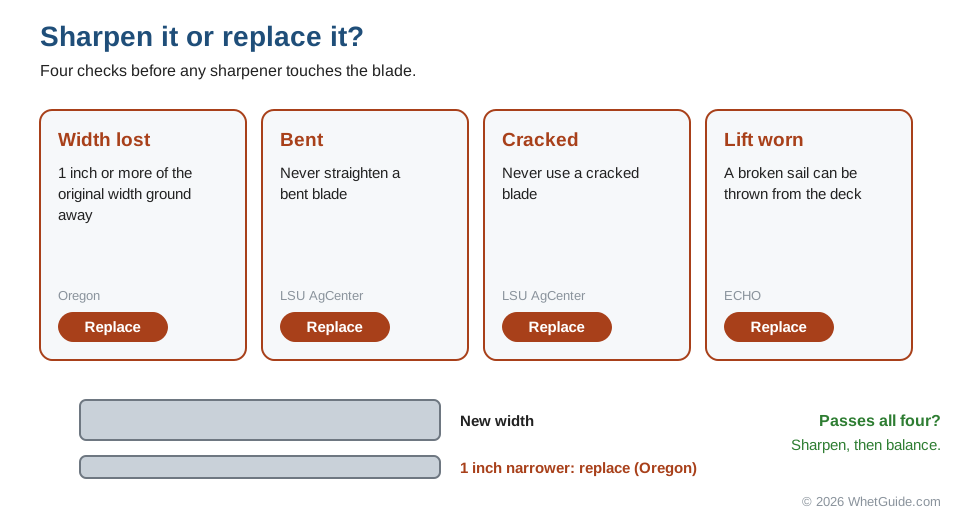
No sharpener fixes a blade that should be thrown away, so check four things before you clamp it (the chart below gives the limit and the source for each). Toro's 20794 manual is blunt about the last group: replace a damaged or cracked blade immediately. If the blade passes all four checks, sharpen it. If not, put the money toward a new blade instead.
How often you'll be sharpening decides which tool makes sense. The published intervals run from about once a year to every 20 to 25 hours of mowing. At once or twice a year a file is all the sharpener you need; a big property mowed twice a week reaches 25 hours fast, and that's where a jig starts paying off.
| Source | How often |
|---|---|
| ECHO | Every 20 to 25 hours of mowing, or once or twice a season |
| Toro 20794 manual | Sharpen or replace every 25 hours |
| LSU AgCenter | Twice a season; three times for zoysia |
| Cub Cadet support | Service residential blades annually |
| Oregon | About once a year for home use |
Buying mistakes, and what to get instead
| Mistake | Why it goes wrong | Instead |
|---|---|---|
| A handheld for a rock-chewed blade | Bob Vila reports the Smith's didn't fully fix a deeply nicked blade | A mill bastard file, or a grinder with a jig |
| A drill stone as your only sharpener | LSU AgCenter calls them light duty | A file for full sharpenings, the stone for touch-ups |
| A freehand grinder on your first blade | Fast removal plus no angle guide means a wandering bevel | A 15 to 45 degree frame, or start with a file |
| No balancer | Every tool removes steel unevenly; Cub Cadet warns of vibration | An Oregon cone, or a nail in a stud |
| Grinding the grass side | ECHO says to grind the top surface only | Mark the grass side before removal |
| Sharpening razor thin | Oregon wants a .030 to .045 inch edge, not a knife point | Stop at butter-knife sharp |
| A blade grinder for one mower | About 14 shop visits to pay back at last check | A file and a balancer |
| Sharpening a bent or cracked blade | LSU AgCenter: never straighten or use one | Replace it |
After sharpening: what went wrong and how to fix it
| What you notice | Likely cause | Fix |
|---|---|---|
| The mower shakes after the blade goes back on | One end is heavier; Cub Cadet warns an unbalanced blade vibrates | Back on the cone; take a few strokes off the heavy end's cutting edge |
| Hard starting after blade work | An under-tightened bolt can throw off engine timing (Family Handyman) | Torque the bolt to the figure in your manual |
| Grass tips still look torn or brown | The edge is still rounded somewhere; ECHO says dull blades tear grass | Resharpen until the bevel is even out to the tip |
| The edge goes dull within a mow or two | Sharpened too thin, or the steel was blued | Leave Oregon's .030 to .045 inch land; use lighter passes |
| Straw or blue marks on the bevel | Grinder or drill stone heat (ECHO calls it bluing) | Stop, cool the blade in water, and come back with lighter pressure |
| A fresh edge but a poor cut | The blade went back upside down | Reinstall with the marked grass side down |
| The bevel looks wavy or doubled | The angle changed from the last sharpening | Find the factory bevel and hold it; a jig makes that automatic |
| A drill stone stops cutting | The stone has worn smaller or out of round | Swap in a new stone |
Common beliefs the sources don't back
| What people say | What the sources say |
|---|---|
| "Get it razor sharp." | Oregon wants an edge .030 to .045 inch thick, "aggressive but not razor-sharp." |
| "Sharpen both sides." | ECHO: grind the top surface only, never the bottom. |
| "Pulling the plug wire makes it safe." | Family Handyman says take the plug out; with the piston on compression, a bump to the blade can turn the engine over. |
| "Balancing is only for pros." | Cub Cadet ties an unbalanced blade to vibration that can loosen parts. A nail in a stud does the job for free. |
| "A bent blade can be hammered straight." | LSU AgCenter: never straighten a badly bent blade. |
| "The angle has to be exact." | Published angles run from 30 to about 45 and all cut grass. ECHO's rule is to keep the original angle, not to hit a magic number. |
| "Hand-tight is fine for the bolt." | Every manual we read gives a torque figure; the ones in our chart run from 36.2 to 90 ft-lb. |
Looking after the sharpener itself
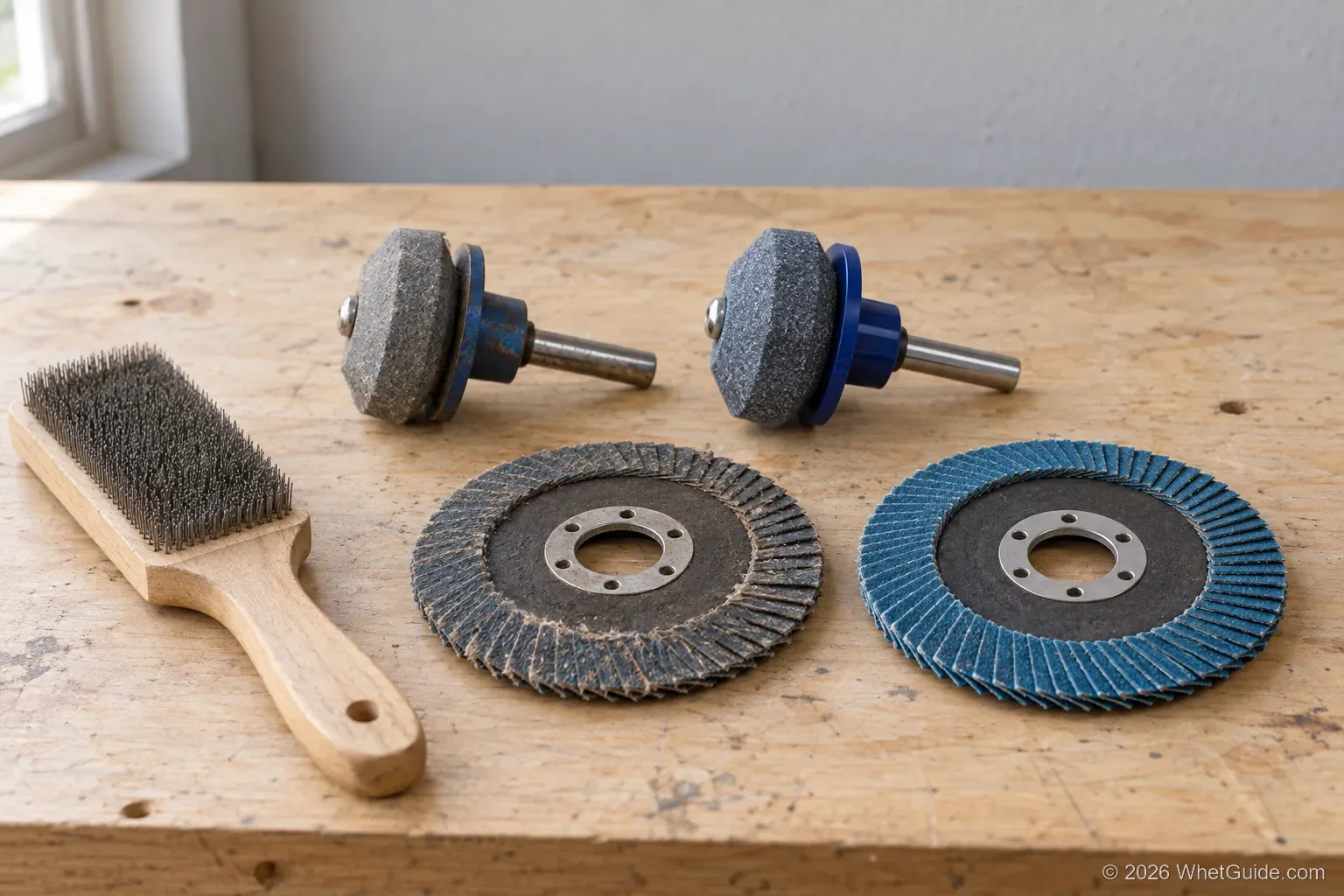
Sharpeners wear too, and a worn one is slower and hotter. A file loads up with steel between its teeth. A file card (a stiff wire brush made for the job) clears it. If a clean file still skates over the steel, it has gone dull and wants replacing. Drill stones wear smaller and out of round, so budget for replacements. Flap discs wear down through their layers and should be swapped before you're grinding on the backing plate. Store files so their teeth don't rattle against other tools.
On a bench or blade grinder, inspect the wheel before each session and set the guards to the gaps the maker gives; Oregon's are no more than 1/4 inch at the top tongue guard and 1/8 inch at the work table. A jig needs little more than a wipe and a check that its clamp still grips squarely, since a slipping clamp sets the wrong angle without telling you.
↑ Back to all sectionsThe same tools on other garden blades
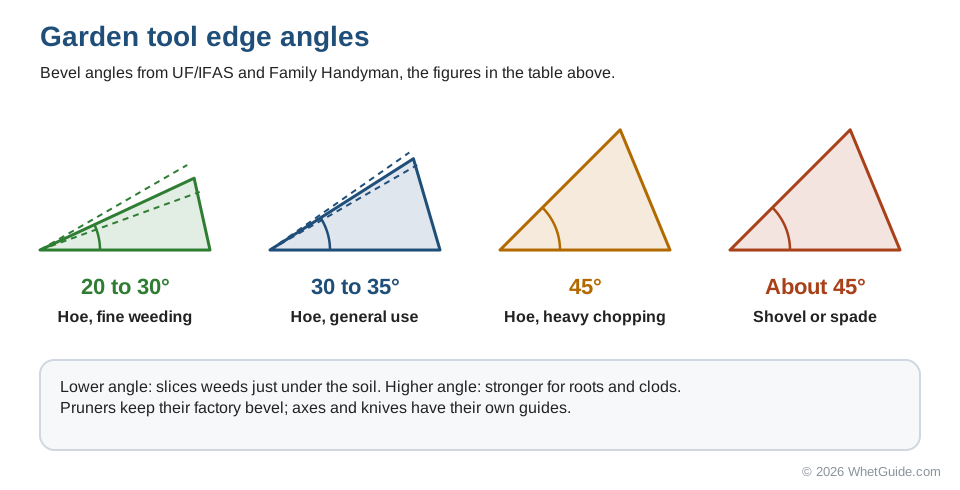
A mower blade sharpener rarely sharpens only mower blades. The same mill file handles shovels and hoes, and University of Florida's IFAS extension gives the angles: about 45 degrees for a shovel, 30 to 35 for a general hoe, and 20 to 30 for a fine weeding hoe. For pruners and shears, small handheld sharpeners do the work a file can't reach. The SHARPAL 103N is sold as an all-in-one sharpener for knives and garden tools, mower blades included. The Corona handheld sharpener is the cheap pocket option for garden tools. Our pruning shears guide covers the bypass blade technique, and the best scissor sharpener page covers shears that live indoors.
- Clean rust and dirt off first with steel wool or a wire brush (UF/IFAS).
- Match the existing bevel, just as with a mower blade.
- Wipe a thin coat of oil on bare steel afterward.
Sources: Oregon, lawn mower blade sharpening how-to guide (30 degree grind; edge thickness; dedicated grinder; guard gaps; balancing; wear limit; safety gear); ECHO, sharpening lawn mower blades (30 degree file angle; bluing; top face only; interval; lift check); Cub Cadet support FAQ (about 45 degrees; balance; torque ranges; annual service) and mulching vs high-lift blades; LSU AgCenter, lawn mower blades (about 40 degrees; temper; drill stones; balance; reel mowers; bent and cracked blades); Bob Vila, best lawn mower blade sharpeners (time per blade; flap disc passes; the Smith's on nicked blades; All American setup); SlashGear, Harbor Freight tools that can sharpen mower blades (August 16, 2025 prices); Hunker, tools to sharpen mower blades (file length; Dremel on the mower; cenoz pack); Sharpening Supplies, three ways to sharpen a lawn mower blade; The Saw Guy, mower blade sharpeners; Toro 20794 and 20995 and Honda H3011 operator's manuals; Family Handyman (shop price; strokes; rotary tools; plug removal; bolt torque); This Old House; Lawn Love; UF/IFAS Gardening Solutions. Product details from Amazon listings checked November 15, 2026; prices change, so we quote them as at last check. How we research · Affiliate disclosure