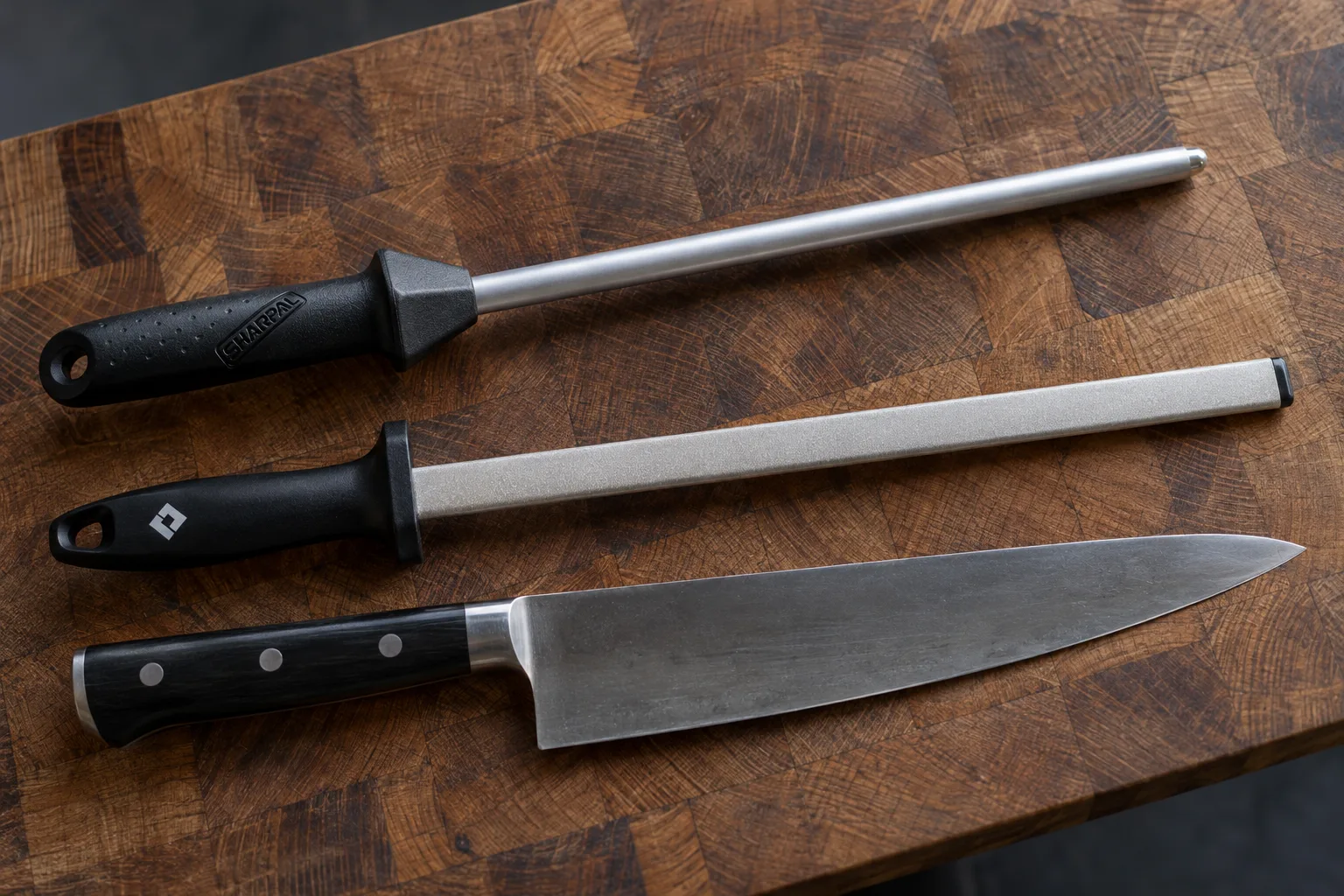
Buy the Kota Japan 12-inch oval diamond rod if you want the best-selling one: it has 7,863 ratings and about 1,000 purchases a month on Amazon. Buy the SHARPAL 119N or the DMT extra-fine if you only want to touch up an edge, since both are fine grit. And if a knife is already sharp and you just want to straighten it, you don't need diamond at all; a plain steel is gentler.
Quick picks
| Best overall | Kota Japan 12-inch Diamond Rod | Amazon |
|---|---|---|
| Best fine-grit pick | SHARPAL 119N Diamond Sharpening Steel | Amazon |
| Best name-brand oval rod | Smith's 3001 10-inch Oval Diamond Steel | Amazon |
| Best coarse rod for dull knives | LEVINCHY 12-inch Diamond Sharpening Steel | Amazon |
| Best made-in-USA pick | DMT 12-inch Diamond Steel, Extra Fine (DS2E) | Amazon |
| Best gift box | Kimura 10-inch Diamond Honing Steel | Amazon |
| Best flat rod | MITSUMOTO SAKARI 10-inch Flat Diamond Honing Steel | Amazon |
How we picked these rods
We searched Amazon for diamond sharpening steels on Oct 29, 2026, then sorted by "bought in the past month" and rating counts. The Kota Japan 12-inch led with 1,000+ purchases. The SHARPAL 119N followed at 200+. Past that, most diamond rods sell in the tens per month, so we leaned on listing quality. We read each listing for the grit (when stated), whether the rod is round, oval or flat, the length and the warranty. Where a listing doesn't state a grit, we say so.
This is a spec review. We compared listings and a retailer guide; we didn't use these rods. Details were checked Oct 29, 2026. How we research.
Does a diamond rod sharpen or hone?
The names get mixed up. Knives and Tools separates the two by material: a honing steel is plain steel and "doesn't remove any material," while a sharpening steel has a ceramic or diamond layer that removes metal to restore a dull edge. A diamond rod is a sharpening steel. How much it removes depends on the grit.
| Your situation | Use | Why |
|---|---|---|
| Sharp knife, edge just feels slightly off | Plain steel or fine ceramic | Realigns without removing steel; see ceramic vs steel. |
| Edge dull but no chips, a block-set knife | Fine diamond (1200 or extra fine) | Cuts a fresh edge with little metal loss. |
| Very dull, or hard-to-sharpen steel | Coarse diamond (about 600) | Removes metal fast. Follow with a finer surface. |
| Thin, hard Japanese edge | Fine ceramic or a stone | Our judgment: a coarse diamond rod can scratch a fine edge, and a stone gives a better finish. |
For a daily plain steel, see our honing rod picks or grab a basic Henckels sharpening steel. For whetstone-versus-rod, read honing rod vs whetstone.
The 7 best diamond sharpening steels
Kota Japan 12-inch Diamond Rod
The best-selling diamond rod on Amazon by a long way: 7,863 ratings and 1,000+ purchases a month. It's an oval rod, which the listing says raises sharpening efficiency, and the seller says it needs "much less force than most sharpening steel." The listing doesn't give a grit, so we can't say whether it behaves like a hone or a sharpener. Use light pressure and see.
- Length12 in
- Shapeoval
- Coatingelectroplated diamond on carbon steel
- Gritnot stated
- Warrantyunconditional lifetime guarantee (per seller)
Why it stands out
- Most owners of any diamond rod here
- Lifetime guarantee from the seller
- 12 inches covers a big chef knife
Think twice if
- You want to know the grit before you buy
SHARPAL 119N Diamond Sharpening Steel
This is the clearest diamond rod on the page about what it does: a 1200 grit coating that the listing calls "ideal for routine maintenance." That makes it the one to buy if you're afraid of eating a good knife. It's round, so it fits more block slots than an oval. It has 2,487 ratings at 4.6 stars.
- Grit1200 (listing)
- Shaperound
- Coatingfine diamond particles
- Handleprotective ring
- Warranty3-year after-sale support
Why it stands out
- Grit stated, and it's fine
- Round profile
- Hand guard on the handle
Think twice if
- You need to remove much steel fast
Smith's 3001 10-inch Oval Diamond Steel
Smith's makes an oval, interrupted surface that it says speeds sharpening by giving the swarf somewhere to go. The 10-inch length suits a home cook with 8-inch knives. The listing says it hones and realigns at the same time, which is a fair description for a diamond rod. There's a plastic tip so you can rest it on a counter.
- Length10 in
- Shapeoval
- Surfaceinterrupted diamond
- Handleoversized guard, rubber grip, hang ring
- Tipplastic cap to protect counters
Why it stands out
- Plastic tip protects the counter
- Large hand guard
Think twice if
- You want a 12-inch rod for a 10-inch chef knife
LEVINCHY 12-inch Diamond Sharpening Steel
This is the one that sharpens. The listing says its diamond particles are about 600 grit, and at that coarseness it will take off real steel. That makes it right for a dull, soft block-set knife that needs more than a touch-up, and wrong for a knife you want to baby. Stroke it gently and finish on something finer.
- Length12 in
- Gritabout 600 ± 50 (22 microns)
- Rodhigh carbon steel
- Handlelarge guard
Why it stands out
- Coarse enough to revive a dull edge
- Grit stated on the listing
Think twice if
- Your knives are thin or hard
- You only want daily upkeep
DMT 12-inch Diamond Steel, Extra Fine (DS2E)
DMT is the name in diamond sharpening, and the DS2E is its fine version, described as extra-fine for regular honing or a final polishing step. It has 194 ratings at our check, a small base for the price, so the case for it is the brand and the made-in-USA stamp. A color ring tells you the grit at a glance.
- Length12 in
- Gritextra fine
- Diamondmicronized monocrystalline
- Handleplastic with large guard, color-coded ring
Why it stands out
- Extra-fine, so it's gentle on good steel
- Hang-up ring and color-coded grit
Think twice if
- You'd rather spend less on a similar grit
Kimura 10-inch Diamond Honing Steel
Kimura gives the clearest directions on the page: a 15 to 20 degree angle, one to three passes per side, with the angle chosen to match the knife. It's magnetized, which the listing pitches as a safety feature. It comes in a gift box, which is why it makes the list for stocking stuffers. Only 179 ratings at our check.
- Length10 in
- Coatingmicrocrystalline diamond on carbon steel
- Suggested angle15 to 20 degrees, 1 to 3 passes per side
- Warrantylifetime
- Packaginggift box
Why it stands out
- Clear use directions on the listing
- Gift box and lifetime warranty
Think twice if
- You want a rod with a large ratings history
MITSUMOTO SAKARI 10-inch Flat Diamond Honing Steel
A flat profile gives more surface on the blade per stroke than a round rod, and Mitsumoto sells a round version too. The listing says to use light pressure and a consistent angle for edge touch-ups between full sharpenings. No grit is given. 798 ratings.
- Length10 in (12 in also sold)
- Shapeflat (round also sold)
- Surfacediamond abrasive on high carbon steel
- HandleABS with hand stop
Why it stands out
- Flat profile and a hand guard
- Round and 12-inch versions available
Think twice if
- You want a stated grit

Side by side
| Rod | Length | Shape | Grit (listing) |
|---|---|---|---|
| Kota Japan | 12 in | Oval | Not stated |
| SHARPAL 119N | Not listed | Round | 1200 |
| Smith's 3001 | 10 in | Oval | Not stated |
| LEVINCHY | 12 in | Not stated | About 600 |
| DMT DS2E | 12 in | Not stated | Extra fine |
| Kimura | 10 in | Not stated | Not stated |
| MITSUMOTO SAKARI | 10 in | Flat | Not stated |
"Not stated" means the listing doesn't say. For the length, a rod should be at least as long as the longest knife you use, so a 12-inch rod suits a 10-inch chef knife and a 10-inch rod suits 8-inch knives.
Round, oval or flat, and how long
Dellinger, a Czech knife-tool maker, sells diamond steels in both round and oval and describes the split plainly: round is universal and easy to use, oval gives a larger contact surface for longer strokes or bigger knives. Knives and Tools adds the practical catch above, that oval steels often won't fit a round block slot. Flat rods like the Mitsumoto follow the oval logic.
For length, Dellinger lists 250 to 260 mm (about 10 inches) for home kitchens and universal working knives. Knives and Tools says longer steels make strokes easier to control and also take more drawer or block space; some blocks can't fit a 30 cm (12 inch) steel. The listings above run 10 to 12 inches. A rod roughly as long as your longest blade is a good floor.
Using a diamond rod
- Plant the tip on a towel on the counter, or hold the rod out and away from you with the guard toward your hand.
- Set the knife at the angle your edge was ground at. Dellinger says 15 to 20 degrees per side, Kimura's listing says 15 to 20, and the W Withlent listing says 20. For a Japanese knife, check the maker's angle first; our angle chart has common figures.
- Draw the blade from heel to tip with very light pressure, as Dellinger puts it, "a light hand." A few strokes per side is plenty: Kimura says 1 to 3, W Withlent 2 to 3.
- Stop when the edge bites a tomato skin. Knives and Tools notes diamond leaves a slightly "bitey" edge that suits meat and tomatoes.
- Wipe the rod dry after use, as the W Withlent listing directs.
Frequency is the part most pages skip. Knives and Tools advises against daily use of a diamond steel because it removes so much metal, and the chef-supply retailer ChefKnivesToGo calls diamond "closer to sharpening than honing." Use it when the edge has gone dull, not as a habit.
Who should skip a diamond rod
- Owners of thin, very hard Japanese knives. Dellinger warns they may be too aggressive for diamond rods and suggests ceramic rods or stones. ChefKnivesToGo says ceramic is "almost always the right choice" for regular upkeep on Japanese knives and suggests 10 to 15 degrees with three to five light strokes per side.
- Owners of single-bevel knives (yanagiba, deba, usuba). ChefKnivesToGo says they shouldn't be honed on a round rod and need flat stones.
- People who just want to straighten a good edge. Knives and Tools says plain honing steels help only slightly softer knives: modern blades at 59 HRC and above gain little, while softer butcher's and boning knives benefit.
The upside, per the same guide: a diamond steel won't break if dropped, which ceramic can, and a few strokes work even on very hard steel.
How to choose
Ask first whether you need diamond at all. A plain steel does the job for soft stainless knives you hone every few days. Diamond makes sense when the steel is hard, the knife is dull, or you want one rod that can both touch up and revive.
Next, match grit to the job. If you only want to refresh, buy the 1200 or extra fine. If you're reviving a neglected block-set knife, the 600 grit rod does it faster. If you can't tell from the listing, assume it's coarser than you think and use a feather touch.
Check the shape. Round rods fit round block slots. Oval and flat rods put more diamond on the blade per stroke and may not fit a block.
Then think about the hand. A guard matters because you're drawing a blade along a rod. For the step-by-step see how to use a honing rod, and to finish the edge, a leather strop takes off the fine burr. If the knife needs more than a rod can do, a diamond stone is the next step. Gift ideas sit in knife sharpening gifts.
Sources: Amazon listings and search data pulled Oct 29, 2026; Knives and Tools, sharpening steel buying guide; Dellinger, diamond honing steels; ChefKnivesToGo, honing rods; Knives and Tools, difference between a honing steel and a sharpening steel, read the same day. Grits are only given where the listing states them. How we research · Affiliate disclosure. As an Amazon Associate we earn from qualifying purchases.