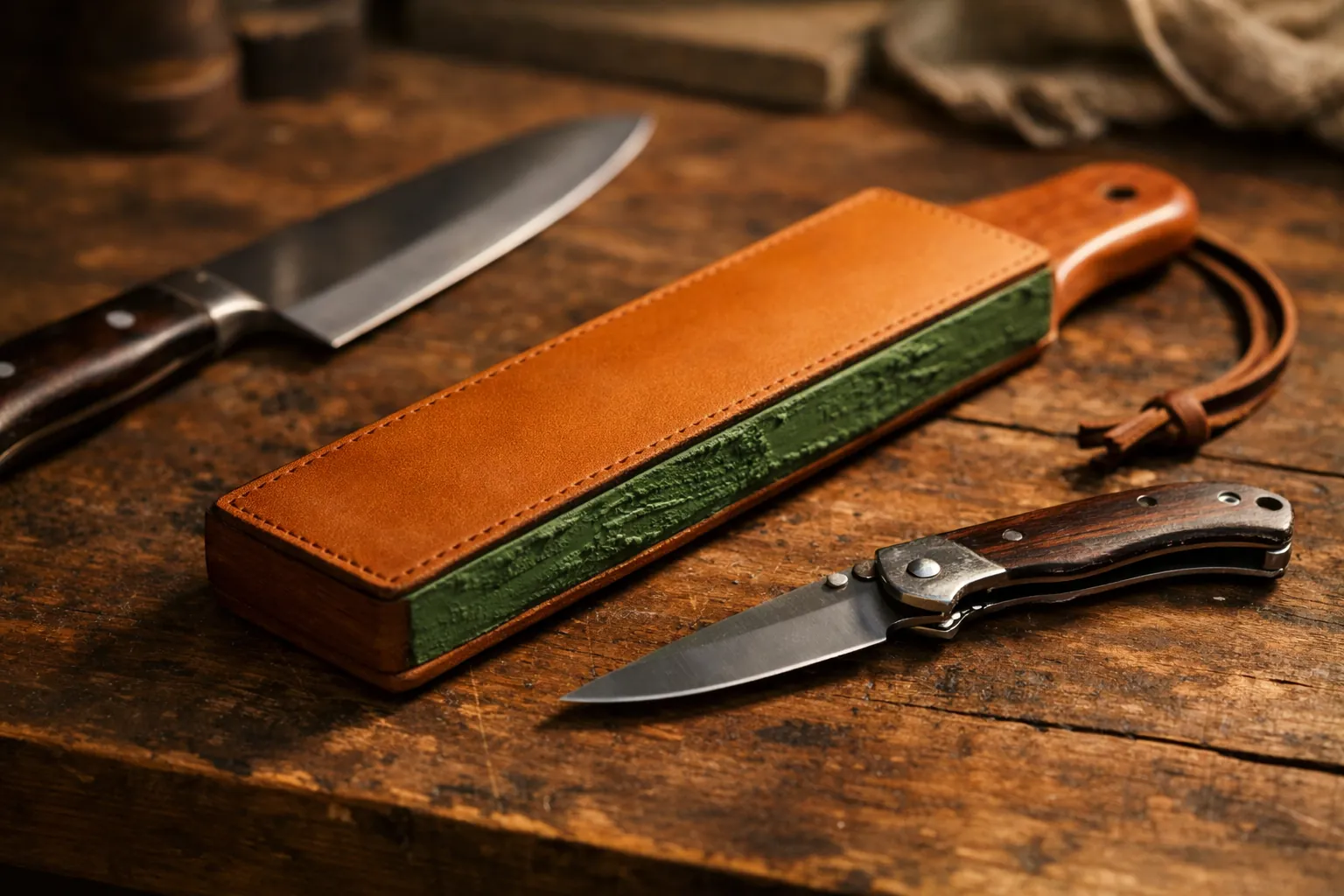
The best leather strop for most knives is a double-sided paddle strop with green compound, like the SHARPAL 205H or the BeaverCraft LS6P1. Both come with compound, and both turn up in most of the competing roundups. A knife strop for kitchen knives wants a long paddle; for a pocket knife, a small block does the job. Pull the blade edge-trailing with light pressure and a minute of work polishes the edge and clears the burr. The best stropping compound to load it with is a fine green bar such as the SHARPAL 208H, covered in the compound section below. New to it? Technique for every kind of blade goes deeper in how to strop a knife.
↑ SectionsQuick answer: which strop to buy
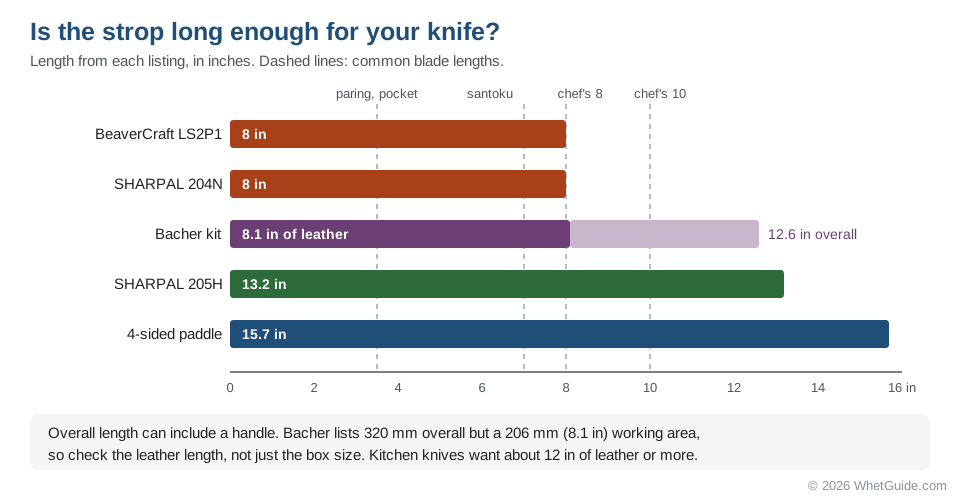
Measure your longest knife, then buy the strop that fits it. A chef's knife needs about a foot of leather so the whole edge can cross it in one sweep; a pocket knife needs eight inches.
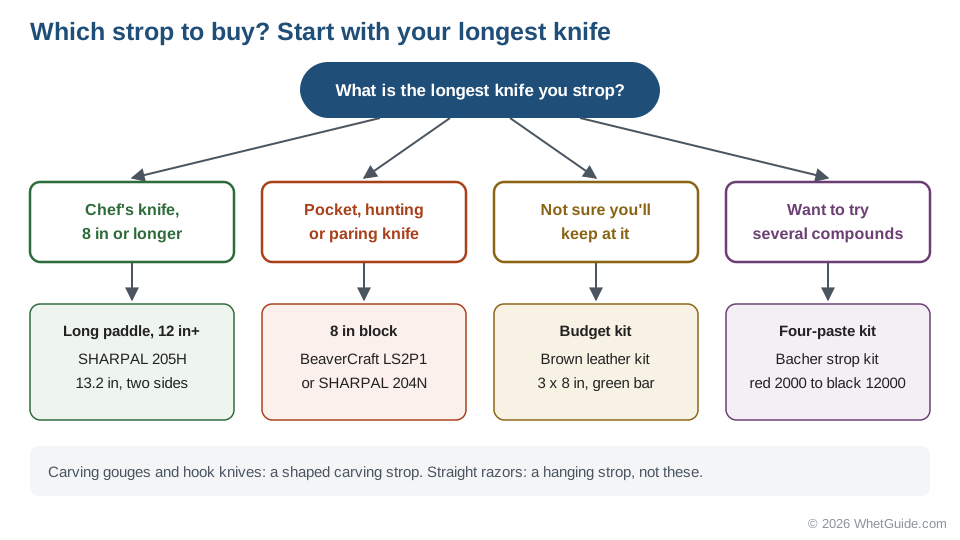
- Best overall for kitchen and pocket knives: SHARPAL 205H, a 13.2 inch double-sided paddle with green compound and an angle guide.
- Best for knives plus woodworking tools: BeaverCraft LS6P1, a long double-sided paddle with compound.
- Best budget kit: Hutsuls brown strop, 3 x 8 inches of 4 mm buffalo leather with a green bar.
- Most compounds in the box: Bacher strop kit, four pastes from red 2000 to black 12000 plus a balm.
- Best compact strop: BeaverCraft LS2P1, a 3 x 8 inch block for pocket and hunting knives.
- Best compact bench block: SHARPAL 204N, cowhide on a wood base with non-slip mats.
- Best compound refill: SHARPAL 208H, two green bars listed at 1 to 2 microns.
Already have a strop and just want the technique? Jump to the stroke, the angle and stroke counts, or print the cheat sheet.
↑ Back to all sectionsHow we picked
We started with the strops people actually own, then sorted by size. A kitchen knife needs a strop long enough to sweep heel to tip; a pocket knife doesn't. After that we looked at what comes in the box, since compound, a second leather side and a handle all save a separate purchase. Specs below come from each maker's product listing, and where a listing is silent we say "check listing." We read the competing roundups too, and most of them skip the part that decides whether a strop helps or hurts: the angle and pressure you use. That gets its own section here.
- Working length. We favored strops with enough leather for the knives they are sold for, and we flag listings that give an overall size including the handle.
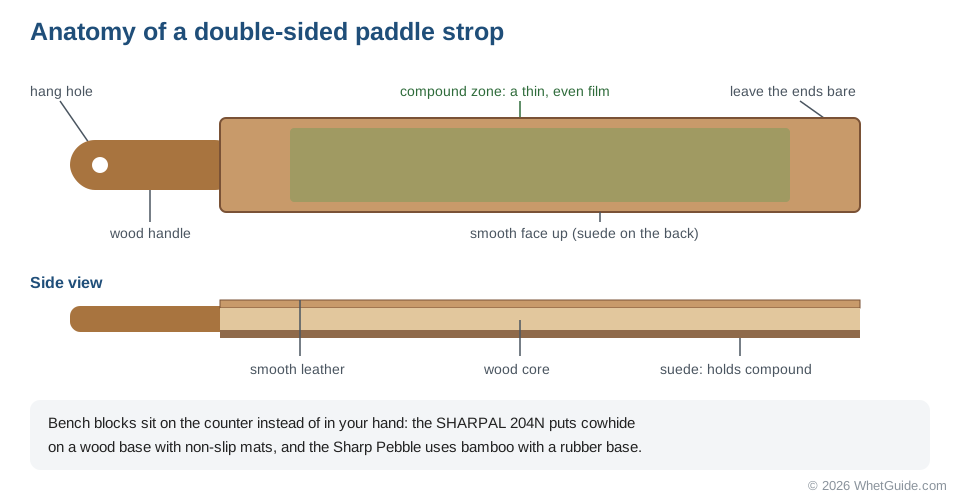
- Leather and backing. Firm hide on a flat wood or bamboo core beat thin, soft leather on anything that flexes.
- Sides. Two faces let you keep one loaded and one bare, which is how Sharpening Supplies describes a full routine.
- What's included. A compound bar, an angle guide or extra pastes each save a separate order.
- Stated specs. A listing that gives a micron figure, a leather thickness or a working area got credit over one that only says "premium."
Ray Mercer, who writes our sharpening guides, has been sharpening knives and chisels for more than 25 years and shares what he knows here; the numbers on this page come from the makers and the sources named in each section, with links at the bottom.
↑ Back to all sectionsWhat a strop does, and how to use one
A sharpening stone leaves a burr: a thin wire of steel folded over the apex. It feels sharp for a few cuts, then folds over and the edge goes dead. Dragging the edge backward across leather flexes that wire until it breaks off and polishes the scratches the stone left. With compound on the leather, a very small amount of steel comes off too, a bit like an extra-fine stone. Sharpening Supplies calls stropping the best way to take off the wire edge, and Knafs adds the limit: stropping does not replace sharpening. Knivesandtools offers a starting line for when to reach for leather: a knife is ready for stropping once it has been sharpened on a stone of about 5000 grit (JIS); the best whetstone guide covers stones that get you there.
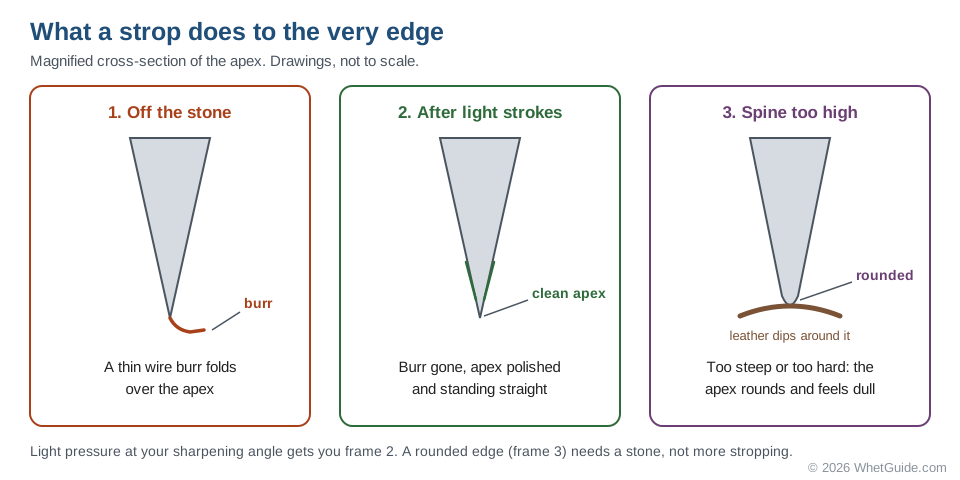
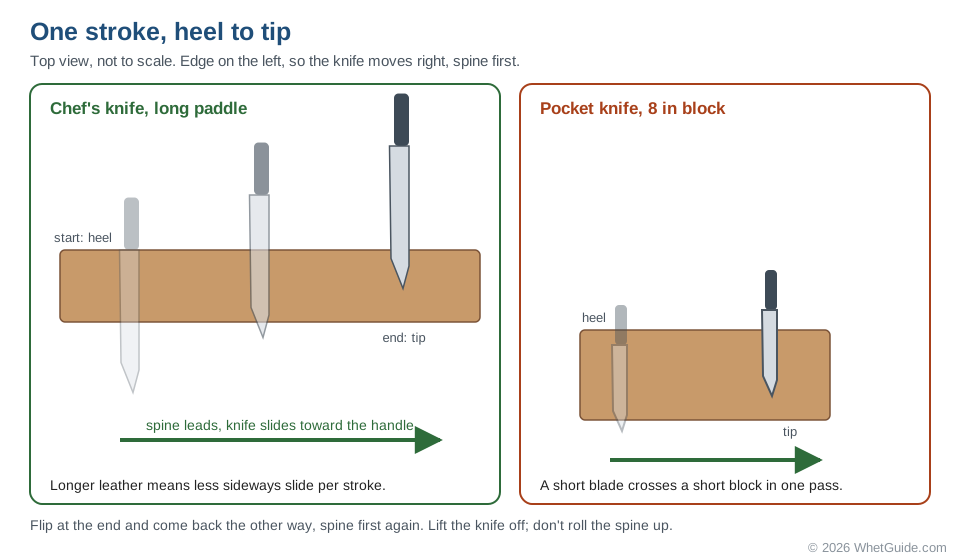
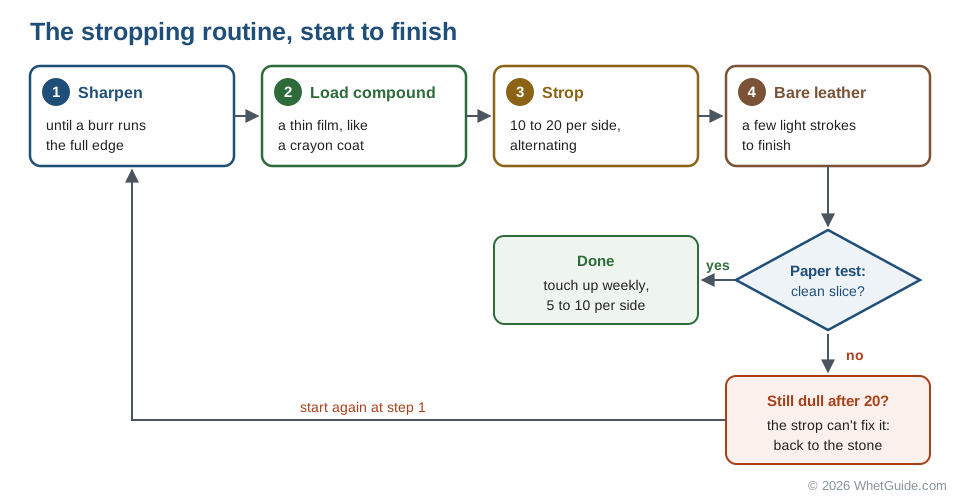
The routine itself takes about a minute. The diagram below is the whole stroke; the numbered steps after it are the order to do it in. If the knife just came off diamond stones, Wicked Edge says to clean it thoroughly of metal filings before it touches the strop.
- Set the strop on a flat, stable surface, or hold a paddle firmly with the leather level. A bench block with non-slip feet frees both hands.
- Rub a thin, even layer of compound onto the leather, like a crayon coat. More isn't better.
- Lay the blade flat at the far end, edge facing away from you, then raise the spine until the bevel sits on the leather. That is about the angle you sharpened at.
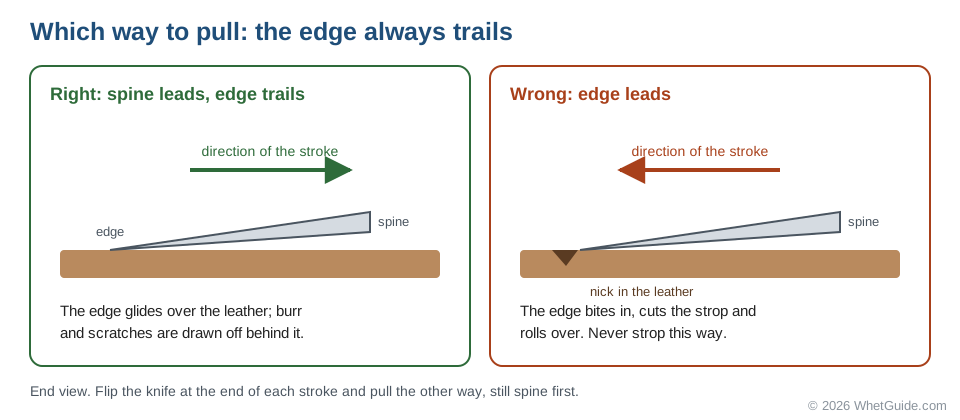
- Draw the knife toward you, spine first, in one smooth stroke that sweeps heel to tip, so the whole edge crosses the leather.
- At the end, lift the whole knife straight up. Don't roll the spine over the edge.
- Flip the knife and stroke the other way, still spine first. Alternate every stroke, ten or so per side, then finish with a few on the bare side if your strop has one.
The most common slip is at the end of the stroke. People finish by tipping the spine up, which drags the very apex across the leather at a steep angle and slowly rounds it. Lift the knife off flat instead, and slow down for the last few strokes.
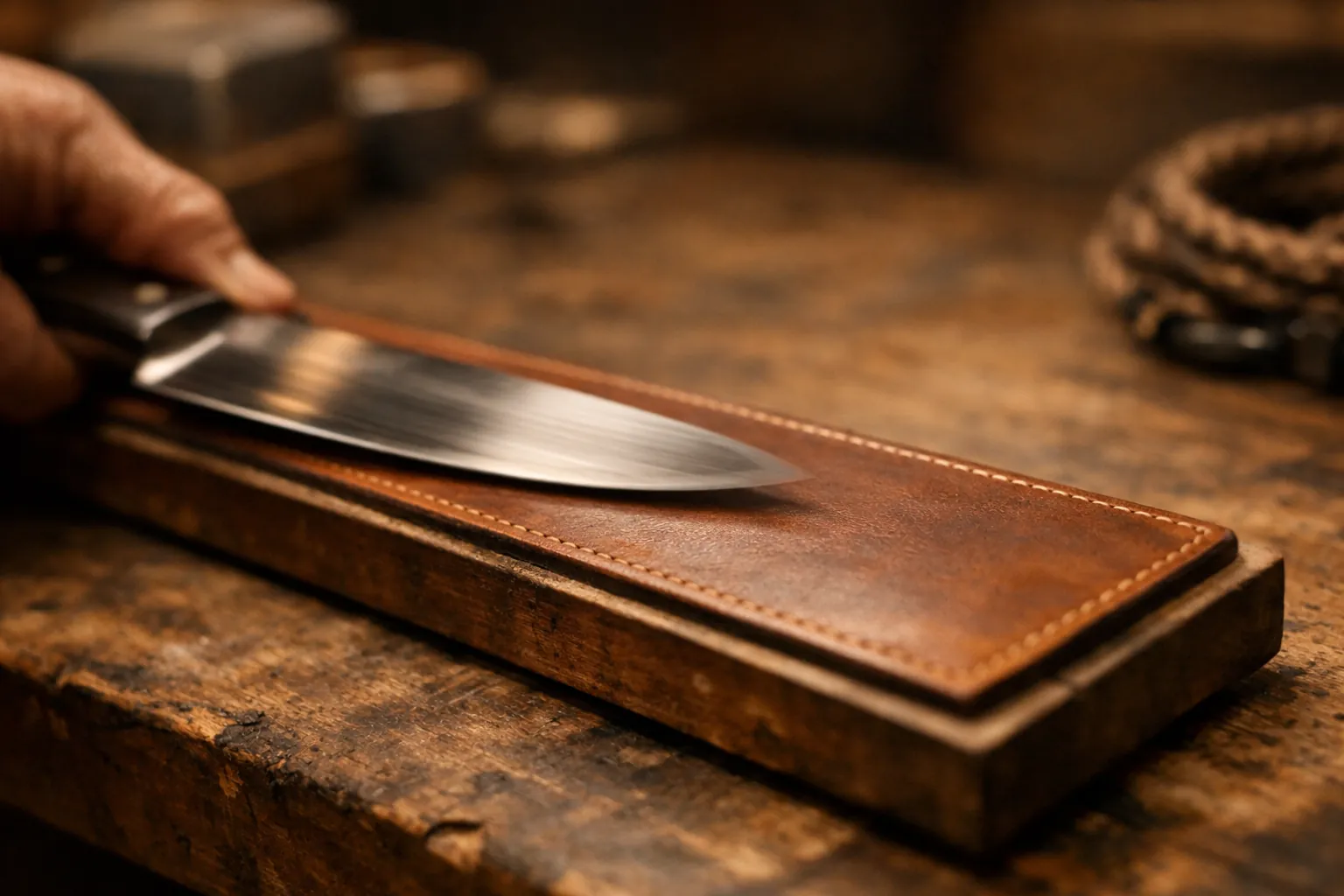
On a curved belly, Knivesandtools says to follow the curve by turning your wrist rather than your whole arm. Long knives get the sweep shown below; short knives cross a block in one pass. For recurve blades, convex edges, axes or razors, the full stropping guide goes through each one.
Strop angle: match your sharpening angle
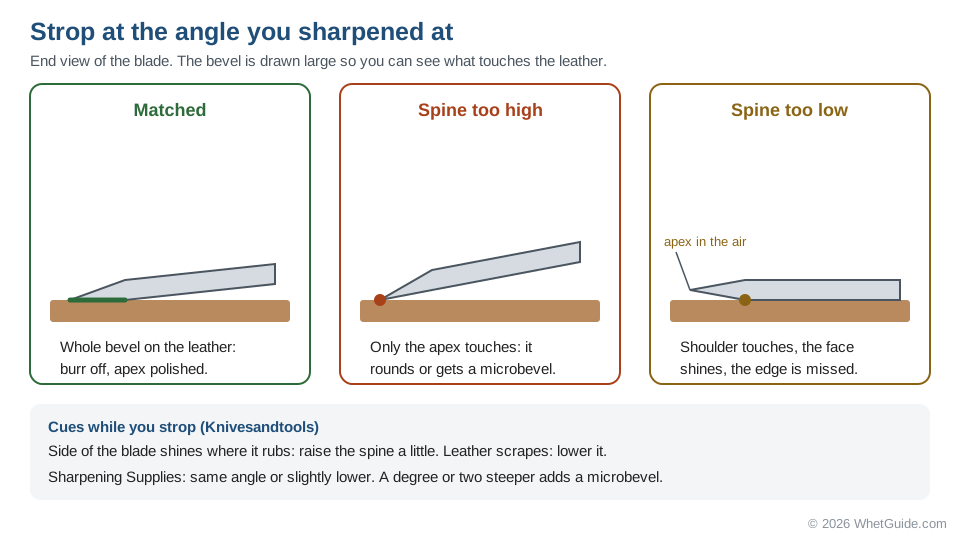
Strop at the angle you sharpened at. Sharpening Supplies says the same angle or slightly lower, and warns that a degree or two steeper puts a tiny microbevel on the edge; pressing hard does the same by accident. Leather gives under the blade, so it forgives a small wobble better than a stone, a point Work Sharp makes as well. If you lose track, match the bevel and don't go more than a degree or two above it. Wicked Edge's Michael Allison leans lower and advises reducing the sharpening angle by 1 to 2 degrees when stropping, to protect a refined edge.
| Knife | Maker's figure (per side) | Strop at | More |
|---|---|---|---|
| Wusthof standard blades | 14.5° (10° for santokus and nakiris) | The same, or a hair lower | Wusthof angle |
| Shun double-bevel | 16° | 16° | Shun angle |
| Zwilling | 15° (9 to 12° for santokus and Miyabi) | The same | Zwilling angle |
| Miyabi | 9.5 to 12° | Very low: use a guide | Miyabi angle |
| Global | 10 to 15° (Global's range) | Match what you sharpened | Global angle |
| Benchmade | About 15 to 18° (30 to 35° inclusive) | The same | Benchmade angle |
| Spyderco | Not published; owners report 15 to 20° | Match your bevel | Spyderco angle |
| Anything else | Check the chart | Match your bevel | Angle chart |
Not sure what angle your knife has? Most makers publish one, and the table pulls the figures from our maker pages; strop at the same number per side, and use an angle guide like the one in the SHARPAL kits if your hand drifts. Two cues from Knivesandtools help while you work: if you see the side of the blade shining where it rubs, raise the spine; if you hear the leather scrape, lower it. A marker line on the bevel shows the same thing, the way the sharpie trick works on a stone.
Pressure: about the weight of the knife
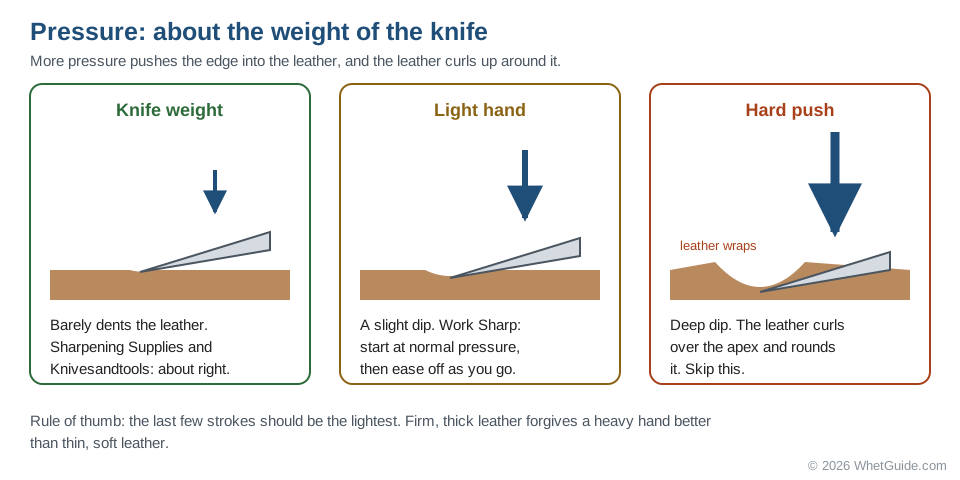
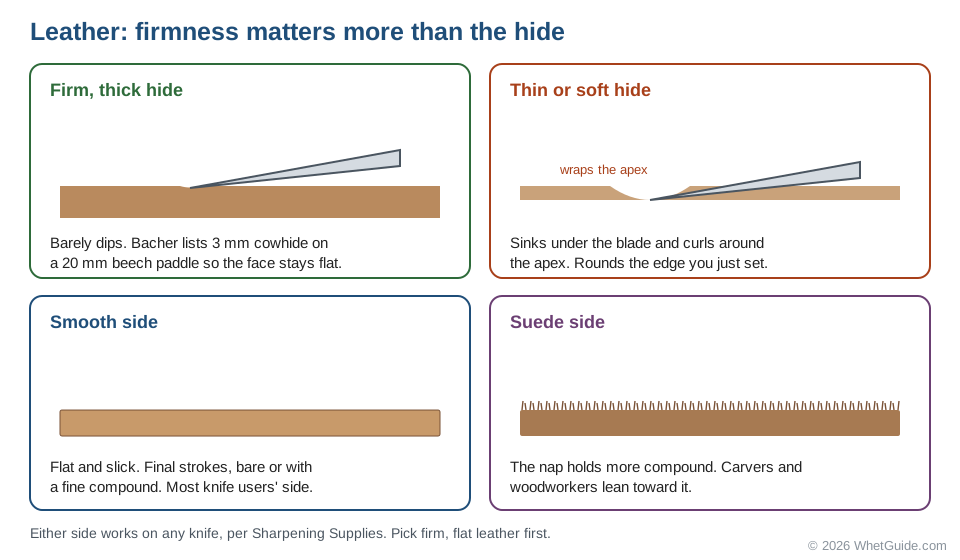
Sharpening Supplies and Knivesandtools both put the right pressure at about the weight of the knife. Work Sharp's advice is to start at normal pressure and ease off as you go, since lighter strokes leave a finer edge. A zKnives knifemaker describes the same thing in his own routine: the knife's weight and no more. The reason is in the drawing: leather is soft, so a heavy hand presses the edge into it and the leather curls up around the apex. That's the rounding everyone warns about. Firm, thick leather resists it better than thin or soft hide, which is one reason our picks favor 3 to 4 mm leather on a solid core.
How many strokes, and how often
| Situation | Strokes per side | Surface |
|---|---|---|
| Right after sharpening on stones | 10 to 20, alternating | Compound side, then a few on bare leather |
| Straight off a coarse stone or a pull-through | More than usual, but fix the burr first | Bare leather to peel the burr, then compound |
| Weekly touch-up on a sharp kitchen knife | 5 to 10 | Compound side or bare leather |
| Mid-task (carving, field dressing) | 3 to 5 | Pocket strop or whatever is at hand |
| Still dull after 20 | Stop | Back to a whetstone |
These are starting points, and a finely honed knife needs fewer. Bacher's listing says ten to twenty light passes after your finest stone. Knivesandtools gives no number at all and wants the knife already sharp from a stone of about 5000 grit before it meets the strop.
↑ Back to all sectionsThe 6 best leather strops
Two long paddles for kitchen knives, two kits for people who want to try stropping cheaply or try several compounds, and two small blocks for pocket knives. All six ship with compound. Specs are from each listing; "check listing" means the listing doesn't say.
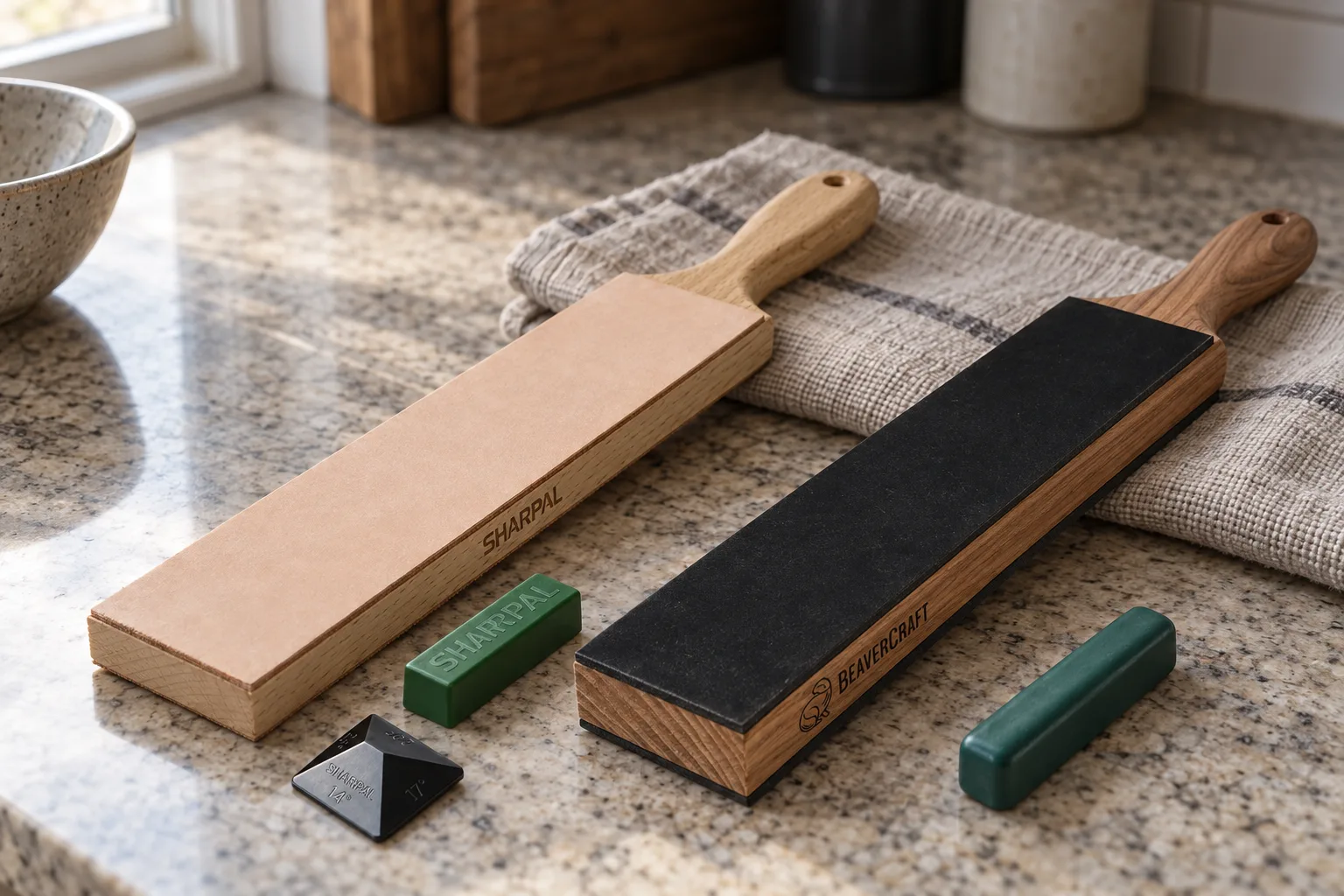
SHARPAL 205H double-sided leather strop kit
- Best overall
- Size: 13.2 x 2.4 in
- Leather: vegetable-tanned cowhide, smooth + suede sides
- Handle: wood
- Included: 2 oz green compound, 4-angle guide
If the house has both kitchen and pocket knives, buy a long two-sided paddle, and this is the one that shows up in nearly every roundup we read. SHARPAL lists the size as 13.2 x 2.4 inches, which gives a chef's knife room for a full stroke. The leather is vegetable-tanned cowhide with what SHARPAL calls a fine-ground finish, smooth on one side and suede on the other, mounted on a wooden handle with a pre-drilled hole for hanging. The box adds 2 oz (57 g) of green compound and a four-angle guide, so you can load the suede, keep the smooth side bare for finishing strokes and check your angle while you learn. SHARPAL backs it with a three-year commitment on the listing.
- Strengths: long enough for kitchen knives; two sides for compound and bare leather; angle guide included.
- Skip it if: you want something pocket-sized, or you only strop knives under four inches.
BeaverCraft LS6P1 double-sided strop
- Best for knives and woodworking tools
- Size: 14 in
- Sides: double-sided
- Handle: ashwood
- Included: stropping compound, sharpening e-books
- Uses: knives, woodcarving tools, chisels
BeaverCraft is a woodcarving-tool company, so this 14-inch strop was designed with chisels in mind as much as knives. It comes double-sided with compound. Pick it over the 205H if carving tools share your bench, since the e-books it ships with are written for carving knives and the company's other compounds and shaped strops match it. The current Amazon title doesn't print the model code, so check the listing details for "LS6P1" and the length before you order.
- Strengths: long, double-sided; compound included; also suits chisels and carving tools.
- Skip it if: you only need a small strop for one pocket knife.
Hutsuls brown leather strop with compound
- Best budget kit
- Size: 3 x 8 in, 4 mm thick
- Leather: genuine buffalo, smooth + rough sides
- Compound: green, included
- Extras: step-by-step guide
Not sure stropping is for you? This is the cheap way to find out. You get a 3 x 8 inch strop of 4 mm leather with a smooth side and a rough side, a bar of green compound and a printed guide. Four millimeters is on the thick side, which helps the leather resist dishing under a heavy hand. Eight inches is short for a chef's knife, though, so treat it as a pocket-knife strop or a trial run. The current Amazon title no longer shows the brand name, so check the Brand field on the listing.
- Strengths: inexpensive and complete; guide for first-timers; thick leather.
- Skip it if: you want a long strop for big kitchen knives.
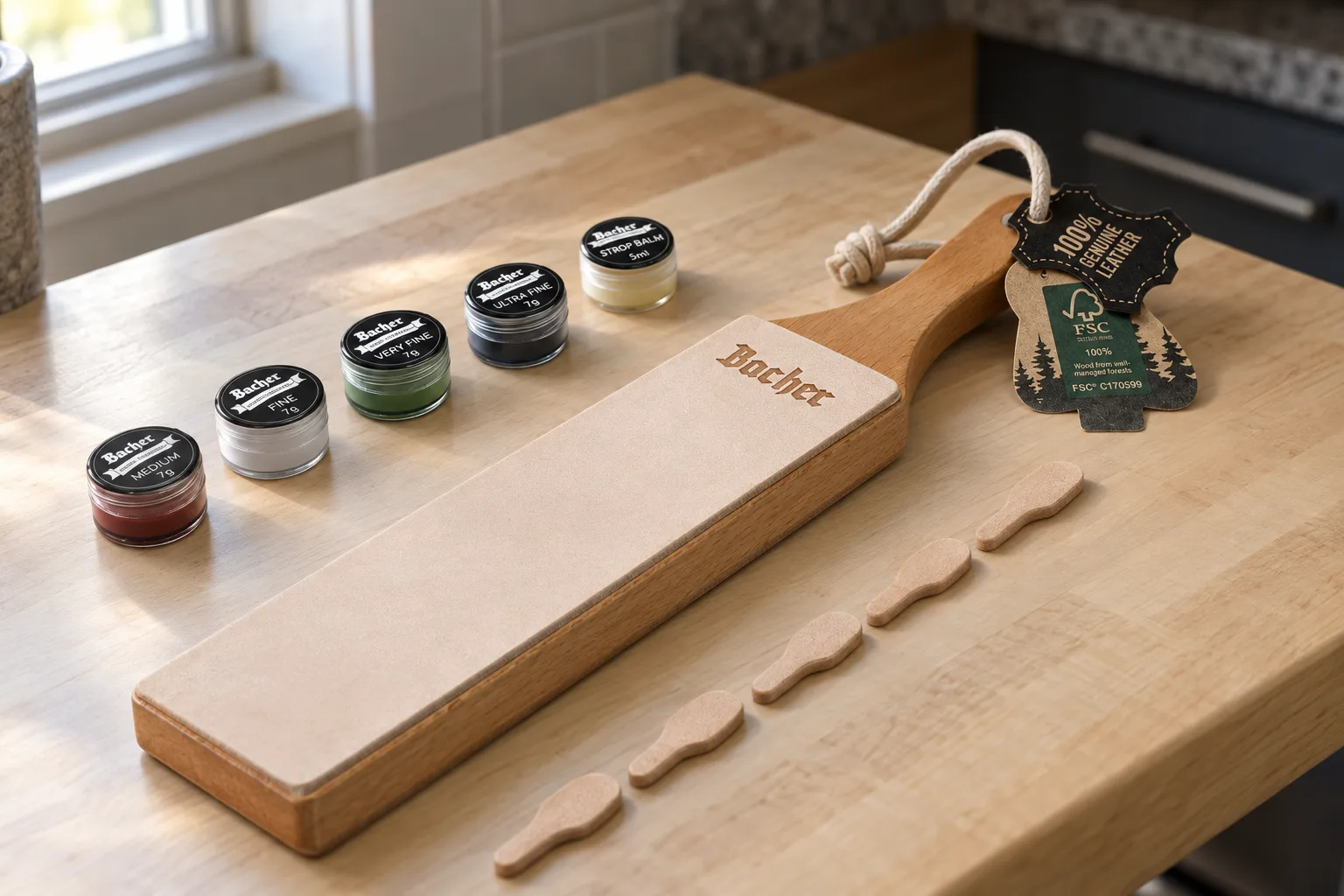
Bacher leather strop kit
- Most compounds included
- Length: 12.6 in overall, 8.1 in working area
- Leather: 3 mm full-grain cowhide, double-sided
- Compounds: red 2000, white 5000, green 8000, black 12000
- Extras: balm, applicators
Four compounds come in this kit. Bacher lists them by grit: red 2000, white 5000, then green 8000 and black 12000 for the last polish, in 7 g pots with five wooden applicators. Its listing says about 1 g covers one side, so each pot is good for roughly seven coats, and it suggests white on the rough side and green on the smooth side. The hide is 3 mm full-grain cowhide, bark-tanned and made in Poland, on a 20 mm beech paddle. Bacher's pitch is that thick, firm hide rounds the apex less, and standard sharpening advice agrees. One catch: the 12.6 inch figure is the overall size, and the listing puts the working area at 206 x 56 mm, about 8.1 x 2.2 inches. That's plenty for paring and pocket knives.
- Strengths: four compounds to try in order; balm to keep the leather supple; firm 3 mm hide on thick beech.
- Skip it if: you just want one simple compound, or you want a full foot of leather for long slicers.
BeaverCraft LS2P1 strop (3 x 8 in)
- Best compact strop
- Size: 3 x 8 in
- Sides: smooth (with compound) + rough
- Kit: polishing compound included
Eight inches is all a pocket or hunting knife needs. This small block fits in a drawer or a pack, ships with compound, and its 3-inch width keeps a short blade steady. BeaverCraft's listing says the smooth side takes the compound and the rough side works without it, and lists a weight of 60 g, so it rides along in a pack without much thought. It is made in Ukraine.
- Strengths: compact and cheap; wide surface for short blades; light enough to carry.
- Skip it if: you strop long chef's knives.
SHARPAL 204N leather strop kit (8 x 3 in)
- Best compact alternative
- Size: 8 x 3 in
- Leather: cowhide on wood base, non-slip mats
- Included: green compound (1 to 2 micron), angle guide 14°/17°/20°/25°
Same size as the BeaverCraft block, built differently. SHARPAL glues the cowhide to a natural wood base with anti-slip mats underneath, so it sits on the bench instead of in your hand and both hands stay on the knife. A 2 oz green compound bar, listed at 1 to 2 microns, and an angle guide with 14, 17, 20 and 25 degree settings come with it. It's a good fit for small kitchen knives as well as pocket knives. A small strop like this is also the easiest way to keep an X-Acto blade sharp. The listing describes a single stropping block, so count on one working face.
- Strengths: small, stable block; angle guide covers kitchen and outdoor angles.
- Skip it if: you want a long stroke for chef's knives, or two faces.

Also worth a look
Plenty of other strops are good. These came up in the competing roundups or in our listing sweep, and each suits a narrower buyer than the six above.
| Strop | What the listing says | Who it suits |
|---|---|---|
| Sharp Pebble leather strop | Leather on a bamboo base with a non-slip rubber base; green compound included | Counter users who want a block that stays put |
| BeaverCraft LS9P02 pocket strop | Dual-sided cowhide on a small wood block with a lanyard and two compounds (white and green); about 8.3 in long | Carvers and campers who strop mid-task |
| BeaverCraft LS5P1 carving strop | Double-sided paddle with a leather side, a sandpaper side and a compound bar | Woodcarvers with gouges and hook knives |
| Four-sided paddle with diamond compound | 15.7 x 3 in, four faces | Long slicers and people who want several grades on one tool |
| Lansky leather stropping hone | Hand-held strop sold for Lansky systems | Lansky owners |
| Work Sharp leather strop and diamond emulsion kit | Strop sold with a diamond emulsion | Work Sharp owners who want a matched finish |
| HORL and Tumbler leather strops | Strops sold as accessories for each brand's rolling sharpener | Rolling-sharpener owners; see Tumbler vs HORL |
Side-by-side comparison
| Strop | Size (listing) | Sides | Leather | Compound | Angle guide | Best for |
|---|---|---|---|---|---|---|
| SHARPAL 205H | 13.2 x 2.4 in | 2 (smooth, suede) | Vegetable-tanned cowhide | Green, 2 oz | Yes, 4 angles | Kitchen + pocket |
| BeaverCraft LS6P1 | 14 in (check listing) | 2 | Check listing | Included | Check listing | Knives + chisels |
| Hutsuls brown | 3 x 8 in, 4 mm | 2 (smooth, rough) | Buffalo | Green, included | No | Budget |
| Bacher | 12.6 in overall, 8.1 in working | 2 | 3 mm full-grain cowhide | 4 pastes + balm | No | Experimenting |
| BeaverCraft LS2P1 | 3 x 8 in | 2 (smooth, rough) | Check listing | Included | No | Pocket knives |
| SHARPAL 204N | 8 x 3 in | 1 (on wood base) | Cowhide | Green, 2 oz, 1 to 2 µm | Yes, 14/17/20/25° | Pocket knives, bench use |
The table hides one difference you notice every day: how you hold the strop. A paddle with a handle (SHARPAL 205H, BeaverCraft, Bacher) can be held in the air, which is handy at a cutting board but easy to tilt. A block (SHARPAL 204N) sits on the counter and stays flat on its own. If your hand shakes or you're teaching a teenager, the block is the safer start.
What more money buys
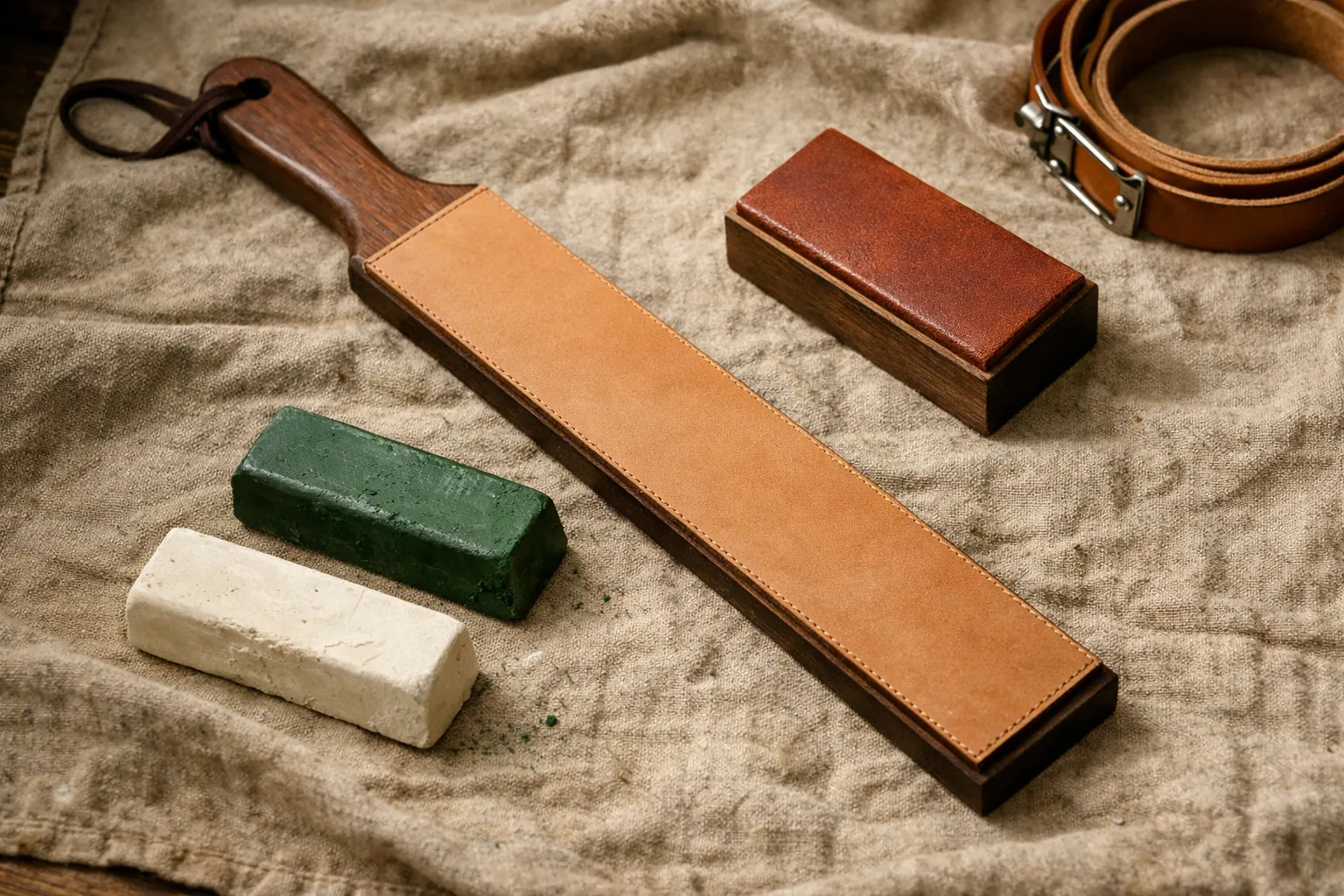
We don't quote prices we haven't checked on the day, and strop prices move often. The tiers below describe what each step up gets you, so you can judge the listing in front of you. For comparison, sending knives out costs money every time; the sharpening service cost page has the checked figures. A strop doesn't replace sharpening, but it stretches the time between visits.
| Tier | What you get | Examples |
|---|---|---|
| Entry kit | 8 in block or strip, one green bar, sometimes a printed guide | Hutsuls brown, BeaverCraft LS2P1 |
| Mid kit | Longer paddle or a stable block, angle guide, 2 oz compound, two faces | SHARPAL 205H, SHARPAL 204N, BeaverCraft long paddle |
| Compound kit | Several grades, balm, applicators, thicker hide | Bacher kit |
| System strops | Strops and emulsions matched to a sharpening system | Work Sharp, Lansky, HORL, Tumbler, Wicked Edge strops |
Best stropping compound for a leather strop
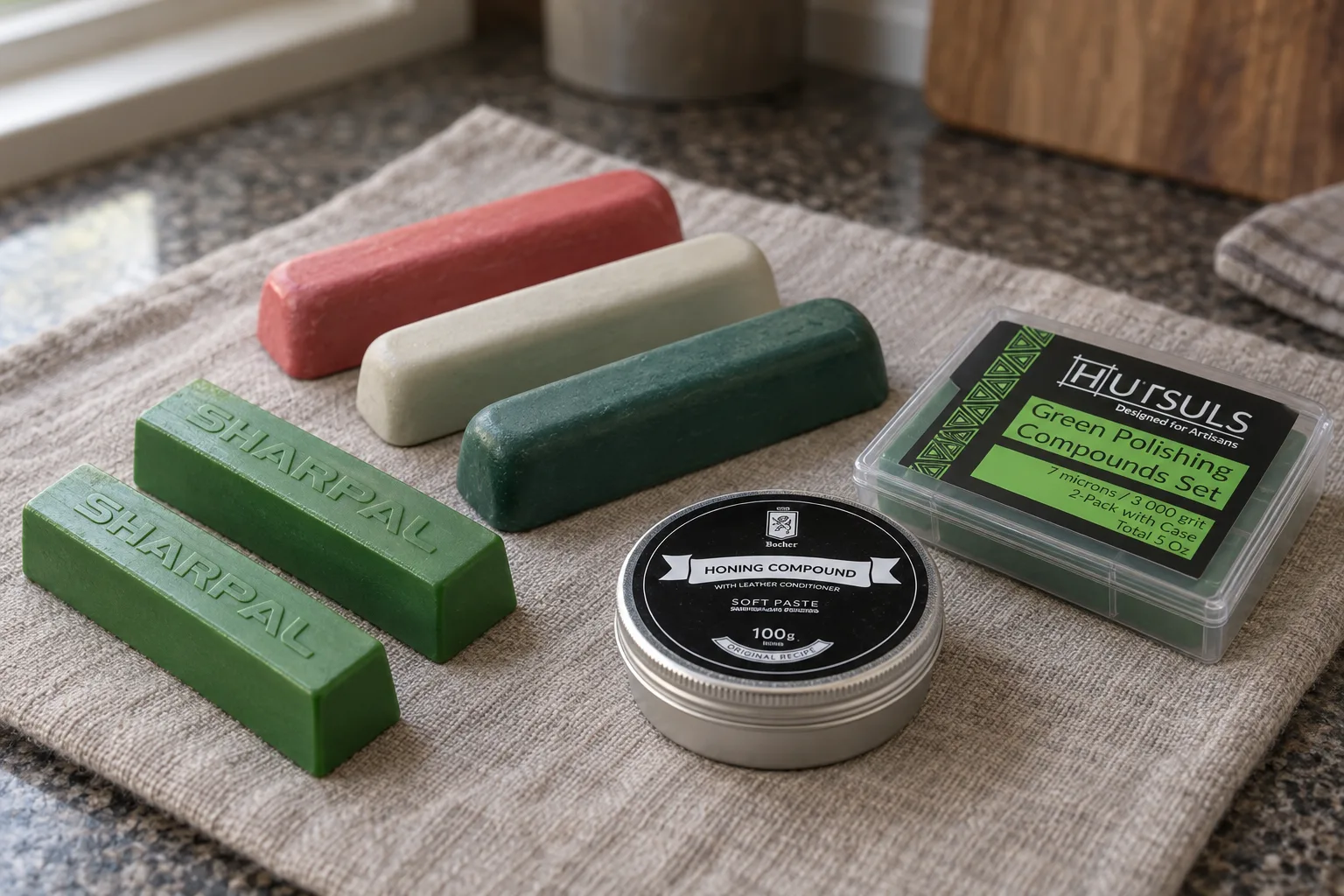
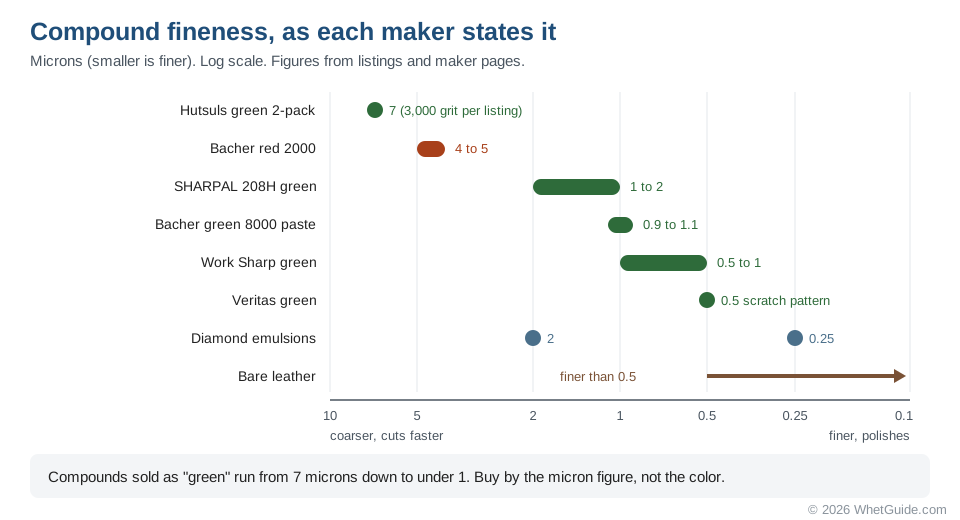
A strop is only as good as the compound on it. Use a fine green bar for kitchen and pocket knives: it's the standard stropping compound, and most kits already include one. When the bar runs out, or you bought a bare strop, one of these refills it. The labels differ between brands, so go by the micron figure on the listing rather than the color.
| Compound | Form | Stated fineness (listing) | Best for |
|---|---|---|---|
| SHARPAL 208H green | Wax bars, 2-pack (4 oz, 106 g total) | 1 to 2 micron; aluminum and chromium oxide | Best all-round strop compound |
| Bacher green 8000 | Soft paste, 3.53 oz tin | 0.9 to 1.1 micron, chromium oxide | A paste that also conditions the leather |
| Hutsuls green 2-pack | Wax bars with a case, 5 oz total | Listed as 7 micron or 3,000 grit | Value and storage |
| BeaverCraft 3-compound kit | Three bars: white, red, green-gray | Not stated as microns | Trying different compounds |
| BeaverCraft green bar | Single 2 oz bar | Not stated as microns | Refilling a BeaverCraft strop |
| SCOTTCHEN fine green | Three small bars, 4 oz total | Not stated as microns | Cheapest way to refill |
| Tormek PA-70 | Honing compound bar | Not stated | Tormek wheels and other leather strops |
Which stropping compound to buy
The SHARPAL 208H is the one we'd buy. It's a two-pack of green aluminum and chromium oxide bars, 106 g in all. SHARPAL describes particles of 1 to 2 microns and compares the result to a 10,000 to 14,000 grit stone, which is a polishing grade rather than a cutting one. The listing says it works on a leather strop or a honing wheel and names kitchen and pocket knives and axes, along with chisels and gouges. The Bacher green is the pick if you'd rather have a soft paste than a hard bar: the listing says it's chromium oxide at 0.9 to 1.1 microns, blended with beeswax and lanolin to feed the leather, sold in a 3.53 oz tin with an applicator disc, and good for 50 to 100 applications. The Hutsuls 2-pack comes with a plastic case, though its listing calls the compound 7 micron or 3,000 grit, so it's coarser than the other two and works as a middle step rather than a finisher.
The BeaverCraft three-compound kit bundles white and red bars plus a green-gray one, listed for knife and chisel stropping. BeaverCraft describes the white as a final finish on harder metals, the red as polishing without cutting action, and the green-gray as a high-luster step to use after the white. It suits you if you want to compare compounds before you settle. Tormek owners can use Tormek's PA-70, which is listed for its leather wheels and other leather strops. SCOTTCHEN's fine green bars are the low-cost refill; the listing suggests warming a dry bar with a hair dryer and putting a little mineral oil on dry, hard leather.
Compound colors decoded
"Green compound" sounds like a standard. It isn't. The usual convention puts black on emery (coarse), white on aluminum oxide (medium), green on chromium oxide (fine) and red on iron oxide (rouge, very fine), and BeaverCraft's blog lays out similar color tiers. But the makers break it constantly, and forum regulars on BladeForums say the same: colors vary by brand. The table shows what each maker actually prints.
| Color | What one maker means | What another maker means |
|---|---|---|
| Green | SHARPAL 208H: 1 to 2 µm, a finisher | Hutsuls 2-pack: 7 µm or 3,000 grit, a middle step |
| Red | Bacher red 2000: the coarsest paste in its kit (listed at 4 to 5 µm) | SCOTTCHEN mini kit: coarse; BeaverCraft: polishes without cutting |
| White | Bacher white 5000: a middle grade | SCOTTCHEN: fine; BeaverCraft: final finish on harder metals |
| Black | Bacher black 12000: its finest | Traditional convention: emery, a fast coarse cutter |
- Buy by the stated micron or grit figure. If a listing gives neither, treat it as a general polishing bar.
- If you buy a multi-color kit, read that maker's own order and stick to it, coarse to fine, the same way you'd step through stones on our grit chart.
Compound by steel and job
| Blade | Compound | Why |
|---|---|---|
| Stainless kitchen knives (Victorinox, Wusthof, Zwilling) | One fine green bar | Plenty for softer stainless; bare leather for the last strokes |
| Hard Japanese knives | Fine green, or a 1 µm-ish paste | Polishes without the force a steel rod needs |
| Very hard or high-carbide steels | Diamond paste or emulsion | Green polishes these slowly; forum users reach for diamond |
| Pocket and hunting knives | Fine green | Fast touch-ups, pack-friendly bars |
| Carving knives and gouges | The carving maker's own bar on suede | Suede holds more compound; carvers strop every few minutes |
| Straight razors | Little or none | Razor routines use mostly bare leather; see the razor strop guide |
How to use strop compound
- Make sure the leather is clean and dry, and brush off any old grit.
- Rub the bar across the leather in one direction for a few passes, enough for a thin, even film. Press a paste on in small dabs and spread it with a clean finger or the applicator.
- If the bar is hard and won't mark, warm it with a hair dryer for a few seconds, as SCOTTCHEN's listing suggests.
- Leave it a minute to settle, then strop as above. Don't re-load every session; a thin layer lasts many.
- If the strop gets glazed and the knife stops improving, scrape the surface lightly and reapply.
- Keep one compound per side. Mixing two grades on one face defeats the purpose.
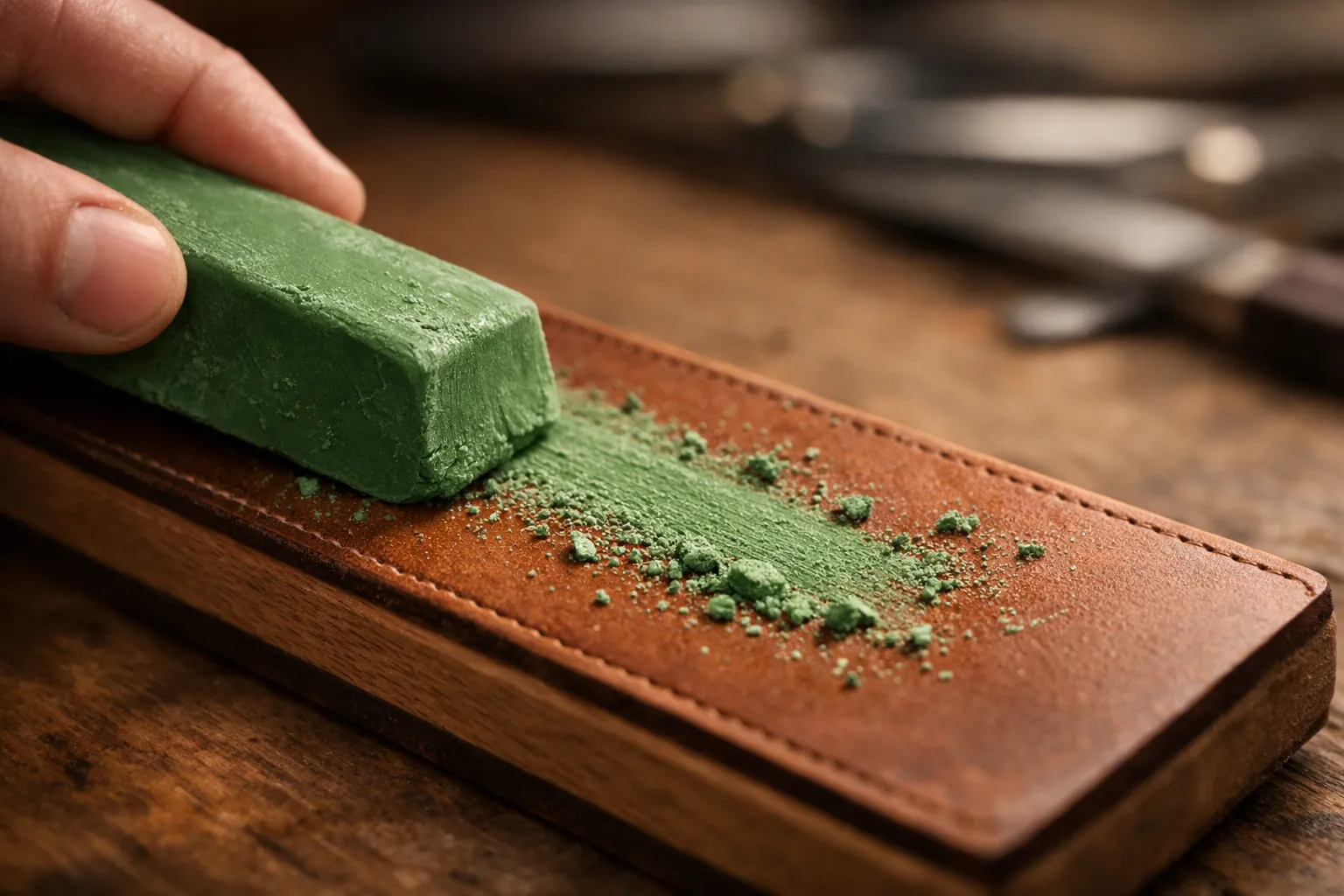
How much is enough? Bacher's listing puts it at about 1 g of paste per side. Knivesandtools says a coat applied for weekly use should last at least a month, with a little added now and then, and that a black strop is normal: the black is steel coming off.
Diamond pastes and emulsions
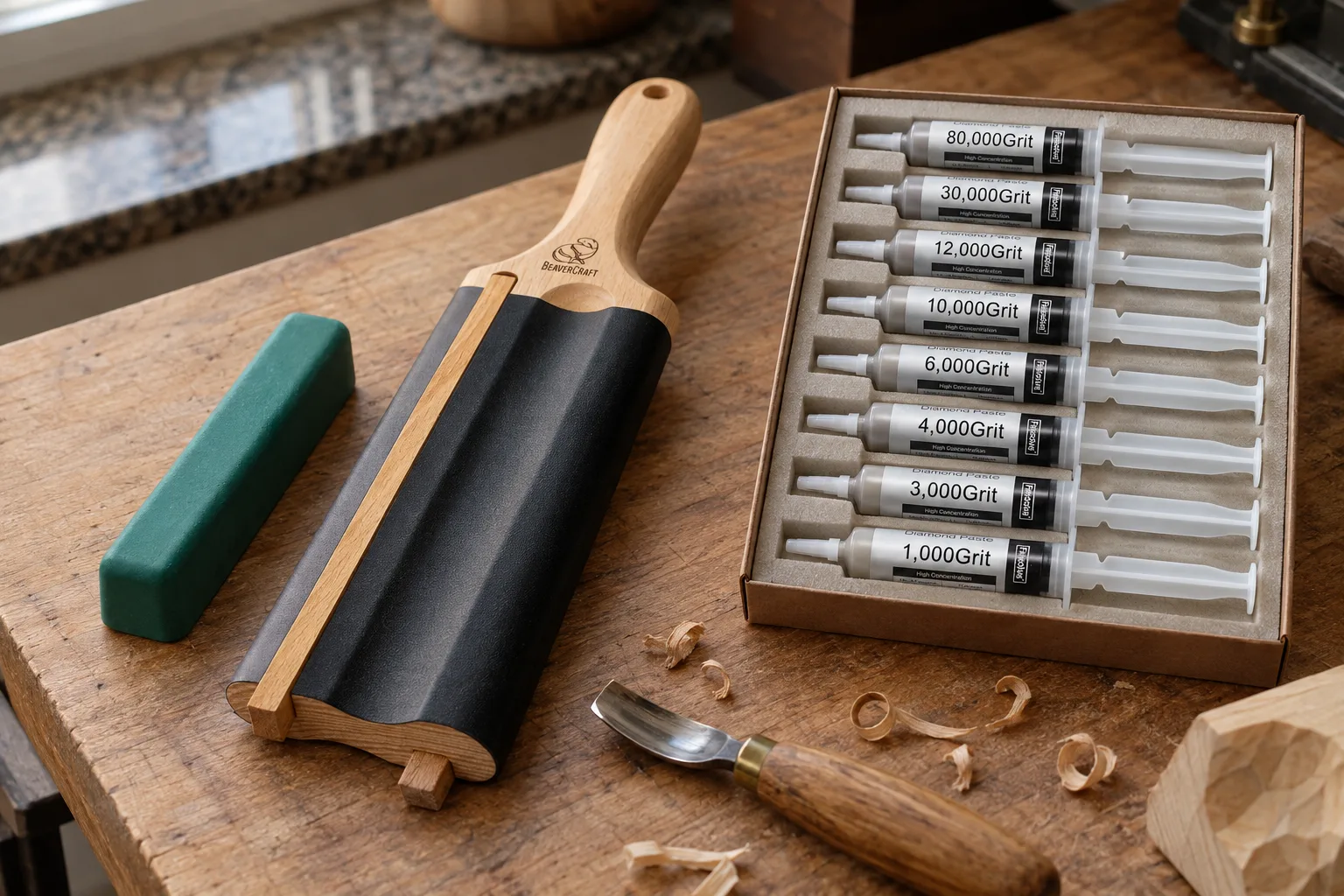
Diamond goes finer than green and cuts harder steels faster. Emulsions and sprays are sold by micron size, commonly 2 microns down to 0.25, and a zKnives knifemaker describes finishing on 0.5 micron chromium oxide and diamond sprays, each on its own pad. For very hard steels that green compound polishes slowly, an 8-syringe diamond paste kit runs from 1,000 to 80,000 grit per its listing. Most kitchen knife owners never need any of it. If you do buy diamond, dedicate a strop or one face to it, because diamond particles embed in leather and stay there. Wicked Edge and Work Sharp both sell diamond emulsions alongside their strops for owners of their systems (for that route, the Wicked Edge review is the one to open).
↑ Back to all sectionsPaddle, bench block, hanging, pocket or belt
| Format | Good for | Watch out for | Examples |
|---|---|---|---|
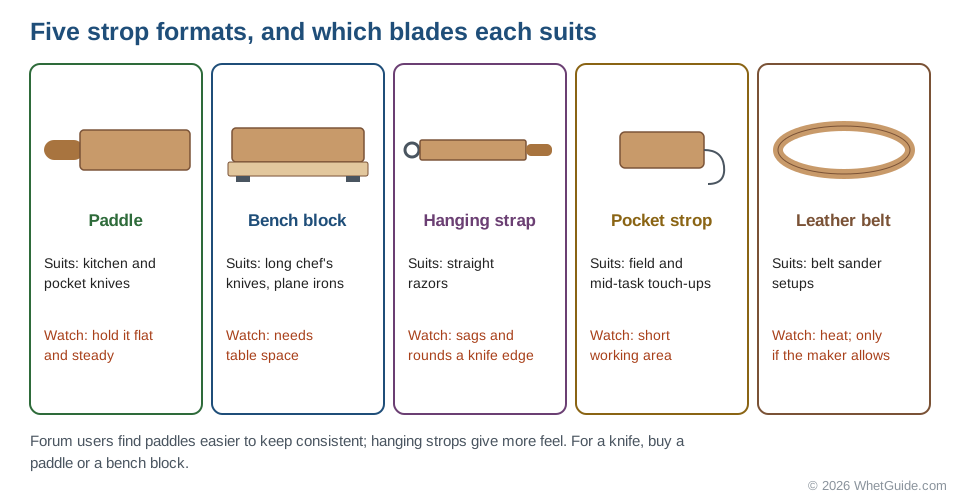
| Paddle (leather on a board with a handle) | Most kitchen and pocket knives, plus hunting knives | Not suited to recurve blades, per Knivesandtools | SHARPAL 205H, BeaverCraft, Bacher |
| Bench block | Long chef's knives, plane irons; both hands free | Takes table space | SHARPAL 204N, Sharp Pebble |
| Hanging strap | Straight razors | Sags under a knife and rounds the edge unless held very taut | See razor strops |
| Pocket strop | Field and mid-task touch-ups | Short working area | BeaverCraft LS9P02 |
| Leather belt or wheel | Belt sanders and buffers | Heat, speed; only where the maker allows it | 1x30 leather honing belts, Tormek leather wheel |
| Magnetic or bench pads | One pad per compound, swapped on a base | More parts to buy | Described by a zKnives knifemaker |
On forums such as Sharp Razor Palace and BladeForums, the paddle-versus-hanging argument usually settles the same way: paddles are easier to keep consistent, hanging strops give more feel. For a knife, consistency wins. The flex a razor wants is exactly what rounds a thicker knife edge. Power stropping is its own topic. Work Sharp's Ken Onion Edition page says it doesn't recommend leather belts on its powered sharpeners, so check your machine's manual first; you'll find the setups where a leather belt makes sense in belt sander guide.
↑ Back to all sectionsStrop leather: cowhide, buffalo, horsehide or suede
Leather matters more than the shape of the strop. The usual trade-off runs both ways: leather that is too hard lets the knife skid with little feel, and leather that is too soft lets the edge round over. What you want is firm, flat, vegetable-tanned hide on a stiff base. Bacher's listing makes the same argument from the other side, saying its 3 mm hide was chosen because thin, soft hide sinks under the blade.
| Leather | Where you see it | What it's like |
|---|---|---|
| Vegetable-tanned cowhide | SHARPAL 205H, Bacher (bark-tanned, 3 mm) | Firm, takes compound well; the default for knife strops |
| Buffalo | Hutsuls brown (4 mm) | Shows up on budget kits; the one here is 4 mm thick |
| Horsehide (shell cordovan) | Premium strops | A denser leather used in some premium strops |
| Latigo | Some razor and hanging strops | Check the listing for firmness before using it on a paddle |
| Suede (rough side) | Back face of most double-sided paddles | Holds more compound; carvers like it |
On rough versus smooth, Sharpening Supplies puts compound on the suede side and uses the smooth side plain for the last strokes. The smooth side is the knife user's usual finishing face; the suede side holds more compound, which is why woodworkers and carvers lean toward it. We found no maker test showing horsehide beats cowhide on a kitchen knife, so pick on firmness and flatness rather than the animal. Thickness helps: listings for the picks here run 3 to 4 mm, and anything thinner on a soft backing is where rounding starts.
↑ Back to all sectionsBuying guide
Carving tools and very hard steels
Woodcarvers with gouges and hook knives should look at the BeaverCraft LS5P1 carving strop: a double-sided paddle with a leather side, a sandpaper side and a compound bar. Flat leather can't reach the inside of a gouge, which is why carving makers sell shaped and profiled strops. For very hard steels that green compound polishes slowly, an 8-syringe diamond paste kit runs from 1,000 to 80,000 grit per its listing. Most knife owners never need it. Chisels and plane irons want a wide, flat bench strop; the chisel guide and the woodworking tools guide both handle them.
Already have one?
| Sharpener | Strop | Our page |
|---|---|---|
| Work Sharp Guided Field Sharpener | Built-in leather strop | Review |
| Intelitopia whetstone set | Leather strop in the box | Whetstone sets |
| Tormek grinders | Leather honing wheel; PA-70 compound | Tormek models |
| HORL and Tumbler rollers | Leather strops sold as accessories | Tumbler vs HORL |
| Lansky systems | Leather stropping hone sold separately | Using a Lansky |
| Wicked Edge | Leather strops and diamond emulsions sold for it | Wicked Edge review |
Do you need a strop at all?
| You sharpen with | Strop? | Why |
|---|---|---|
| Whetstones | Yes | The classic pairing; it takes the burr the stone leaves (how to use a whetstone) |
| A guided system (Lansky, Work Sharp, Wicked Edge) | Yes | Most of them sell a strop for this reason |
| A rolling sharpener | Optional | Both big brands sell one; see rolling sharpeners |
| An electric sharpener | Optional | Many have a fine honing stage; a strop still cleans up the burr (electric sharpeners) |
| A pull-through | Helps a little | Bare leather peels the coarse burr, but can't fix the angle (pull-through sharpeners) |
| A mail-in service | For upkeep | Weekly stropping stretches time between services (mail-in services) |
Which strop for which knife
| Knife | Strop | Stroke tip | More |
|---|---|---|---|
| Chef's knife, 8 to 10 in | Long paddle (12 in+) | Heel-to-tip sweep, wrist turns at the belly | Kitchen knives |
| Santoku and nakiri | Long paddle or block | Flatter profile, less wrist; mind the low angle | Japanese knives |
| Paring and petty | Block | Short strokes, light pressure | Knife care |
| Pocket folder | 8 in block or pocket strop | Watch your fingers near the pivot | Pocket knives |
| Hunting and fillet knives | Block at home, pocket strop in the field | Wipe off fat before stropping | Hunting knives, fillet knives |
| Carving knife (slicer) | Long paddle | Long sweep, keep the blade flat | Carving knives |
| Serrated bread knife | Don't strop the scallops | Strop only the flat back, lightly | Serrated knives |
| Chisels and plane irons | Wide bench strop | Back flat and light; bevel at its own angle | Chisels |
| Axes and machetes | Paddle or leather on a board | Keep fingers well back | Axes, machetes |
| X-Acto and hobby blades | Small block | A few strokes per side | X-Acto |
| Ceramic knives | Diamond only, carefully | Green barely touches ceramic | Ceramic knives |
Convex edges, common on some axes and bushcraft knives, have no flat bevel to match. The usual approach is leather over a soft backing so it curves with the blade, with a slight roll of the wrist through the stroke. That's common practice rather than a maker rule, and it rounds faster, so keep the pressure lighter than on a paddle.
↑ Back to all sectionsWhere a strop fits in your routine
Strop after every sharpening to remove the burr, and again whenever the knife starts to feel less keen. On hard Japanese knives a strop is gentler than a honing rod. On softer German knives a honing rod is quicker. When neither brings the edge back, the knife needs a whetstone.
| Tool | What it does | Best on | When |
|---|---|---|---|
| Leather strop + compound | Removes the burr, polishes the apex | Every knife after sharpening; hard Japanese knives between sharpenings | After every sharpening, weekly touch-ups |
| Steel honing rod | Pushes a rolled edge straight | Softer Western stainless | Before or after each use |
| Ceramic rod | Straightens and removes a little steel | Harder knives that a steel rod would chip | When the edge starts to drag |
| Fine stone (3000 to 8000) | Refines the bevel | Any knife being sharpened | Last stone before the strop |
The rod-or-strop question has its own page: honing rod vs whetstone and ceramic vs steel rods cover the trade-offs, and how often to sharpen knives puts all three on a calendar. A good weekly habit for a home cook is a few rod strokes before cooking and a few strop strokes on the weekend.
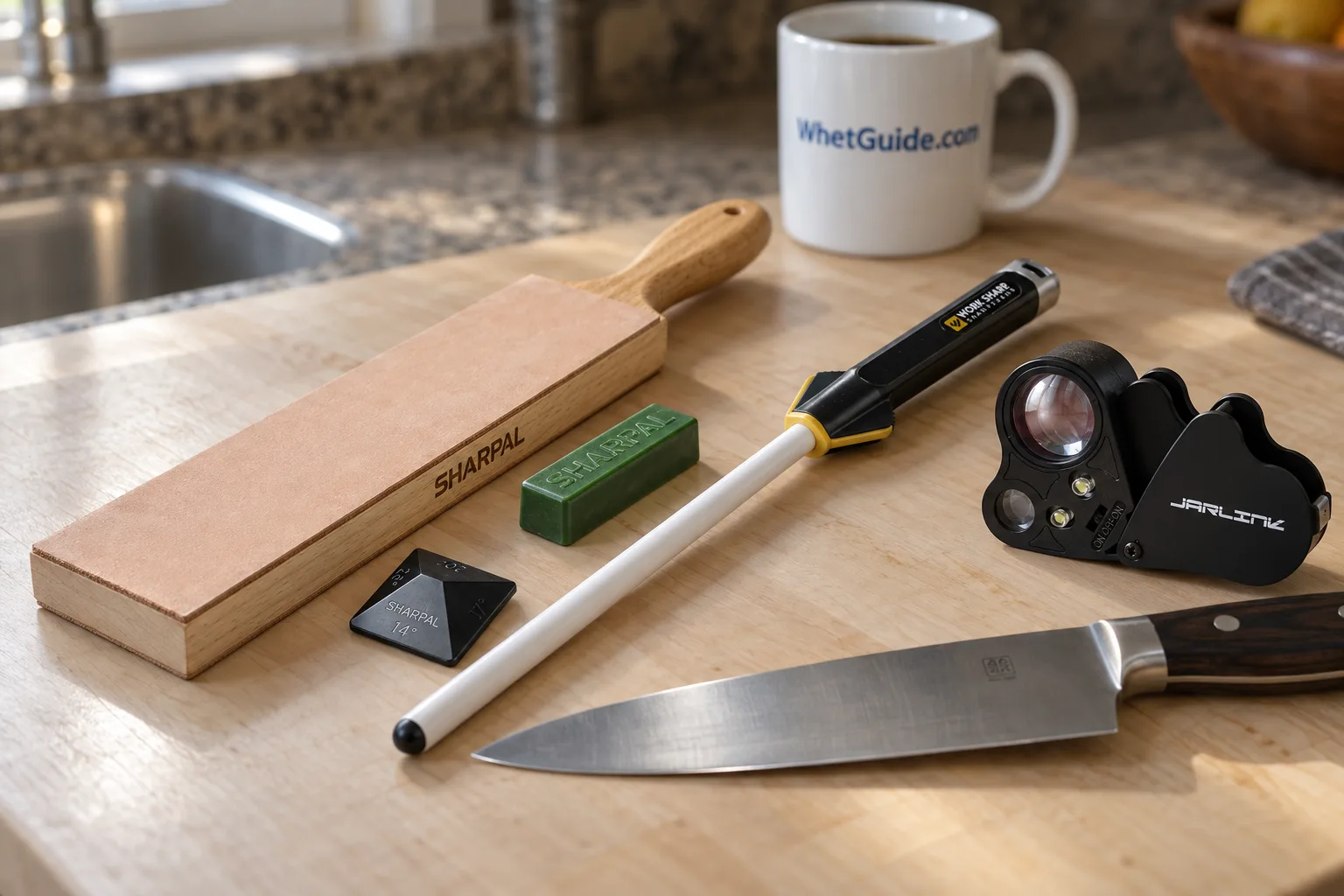
A small illuminated loupe is the cheap way to see what's happening at the apex: a bright line of reflected light along the edge means rounded or damaged metal, and a clean stropped edge shows none. The burr guide explains how to feel for a burr before you strop, since a strop only handles a small one.
↑ Back to all sectionsLooking after a leather strop
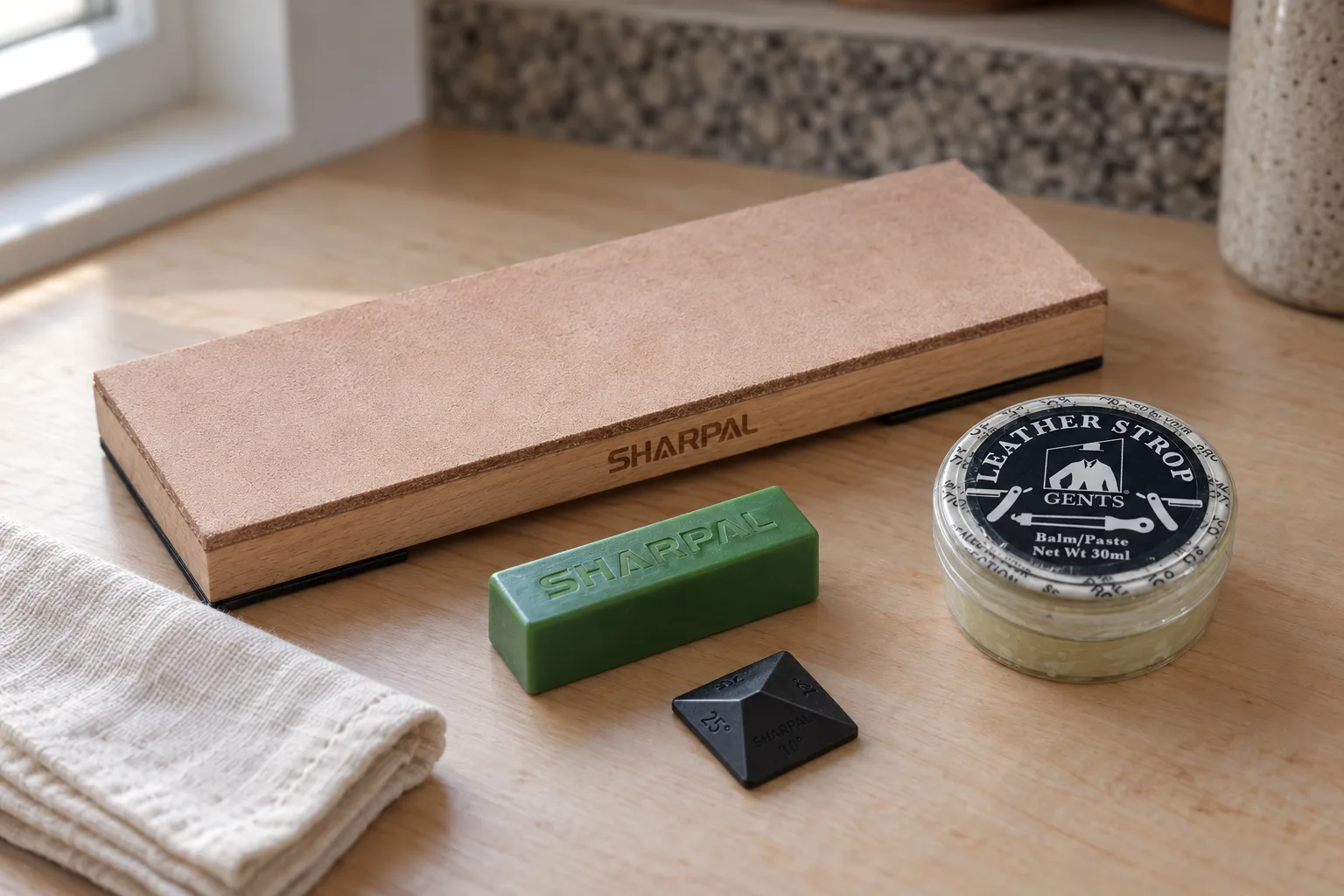
The leather turns black with steel and compound. That's normal. When it starts to look shiny and glazed, Knivesandtools suggests roughing it lightly with a wire brush to open the surface. Go gently, and only when it begins to gleam. If the leather dries out and the compound won't stick, Work Sharp's fix is a little petroleum jelly rubbed in, then fresh compound. Sharpening Supplies says leather generally won't dry out on its own, and SCOTTCHEN's listing suggests a little mineral oil on dry, hard leather. Leather balms and conditioning pastes, such as the balm in Bacher's kit or GENTS strop paste, do the same job with less mess.
- Brush the surface with a stiff dry brush after a session and wipe the dust off.
- If compound has built into a crust, scrape it gently with a flat edge and lay a fresh, thin coat.
- Clean dirty leather with a leather cleaner, not hot water and dish soap; the zKnives knifemaker is firm on this.
- Condition sparingly when the leather feels dry or the compound won't hold.
- Store it flat and covered, away from the grinding bench. One stray grain of grit scratches every edge you polish.
- Replace the leather when it has deep cuts, a dished middle that won't lie flat, or cracks.
Troubleshooting: when stropping isn't working
| Symptom | Likely cause | Fix |
|---|---|---|
| Edge feels duller after stropping | Spine too high, too much pressure, or rolling the spine at the end | Lower the angle, lighten up, lift the knife off flat; a few strokes on a fine stone if it's rounded |
| Knife catches or cuts the leather | Edge-leading stroke, or a stroke that started too abruptly | Always pull spine first; set the blade down flat before moving |
| No improvement after 20 strokes | The knife wasn't sharp yet, or a big burr from a coarse stone | Back to the stone; work the burr down on finer grits first |
| Compound won't stick | Dry or glazed leather | Condition lightly, rough the surface, reload thin |
| Strop squeaks or screeches | Angle too steep, or dry leather | Lower the spine (the Knivesandtools scrape cue); condition |
| Scratches on the bevel | Grit or steel crumbs on the leather, or a coarse compound | Clean the strop; use a finer compound on its own face |
| Tip feels rounded | Lifting at the end of the stroke, or the tip running off the strop | Finish the stroke on the leather; slow down at the tip |
| Shiny line along the apex under a lamp | Rounded or damaged edge | The strop can't fix it; sharpen |
Sharpening Supplies adds a note for the most common complaint, an edge that feels duller after stropping: often it's simply more polished, the stone before it was too coarse, or the angle was too steep. A polished edge can feel less "toothy" on a thumbnail and still push-cut paper better. Do the paper test before you decide something went wrong.
↑ Back to all sectionsCommon stropping mistakes
- Too much compound, or old compound caked with steel and grit.
- Using a thin, soft strop or a sagging strap on a knife.
- Stropping a serrated edge across its scallops.
- Mixing grades on one face of the strop.
- Roughing the strop too hard; Knivesandtools says to start gently.
- Leaving the strop open on a bench where grinding grit can land on it.
DIY and makeshift strops
You don't need a store-bought strop to strop. Work Sharp's own list of makeshift strops includes denim, canvas, a coarse leather belt and cardboard, and cardboard works because it holds fine abrasive. For a homemade bench strop, glue a strip of 3 mm vegetable-tanned leather to a flat hardwood board about 2 inches wide and 10 to 12 inches long, clamp it flat while it cures, and load it as above. Trapped air bubbles make high spots that round the edge, so press them out. More household options are in how to sharpen a knife without a sharpener, and the US Forest Service ax manual calls leather glued to a board the best way to take off the last wire edge on an ax.
- A leather belt: loop one end around a post, hold the other taut and strop the smooth side. Loose belts sag and round the edge.
- Cardboard: a plain cereal box laid flat on a counter. Work Sharp says it works because it holds fine abrasive particles.
- Denim: pulled tight over a flat board. Rough, but it works in a pinch.
Leather strop cheat sheet
| Buy | Chef's knife: 12 in+ paddle (SHARPAL 205H). Pocket knife: 8 in block (BeaverCraft LS2P1, SHARPAL 204N). Firm leather on a flat base. |
|---|---|
| Compound | One fine green (SHARPAL 208H, 1 to 2 micron). Buy by microns, not color. One compound per face. |
| Load | Thin film, like a crayon coat. About 1 g a side. Reload when bare, not every session. |
| Direction | Spine first, edge trailing. Never push the edge forward. Lift the knife off flat. |
| Angle | Match the bevel. Face shines: raise the spine. Leather scrapes: lower it. |
| Pressure | Weight of the knife. Lighter on the last strokes. |
| Strokes | 10 to 20 per side after stones, 5 to 10 weekly, 3 to 5 in the field. Still dull after 20: stone. |
| Don't strop | Serrated scallops, chipped edges, dull knives. |
| Care | Brush it, store it flat and covered, condition it when dry, and rough it lightly when glazed. |
Which strop to order
Measure your longest knife. If it's a chef's knife, order the SHARPAL 205H, or the BeaverCraft LS6P1 if you also carve. If nothing you own is longer than a pocket knife, the BeaverCraft LS2P1 is all the strop you'll need, or the SHARPAL 204N if you'd rather it sit on the counter. And if you're only curious, spend the least on the Hutsuls kit and upgrade once stropping becomes a habit. Add a SHARPAL 208H two-pack when the included bar runs low, keep one face bare, and use the knife's weight and nothing more. When the strop stops bringing the edge back, it's telling you it's time for the whetstone.