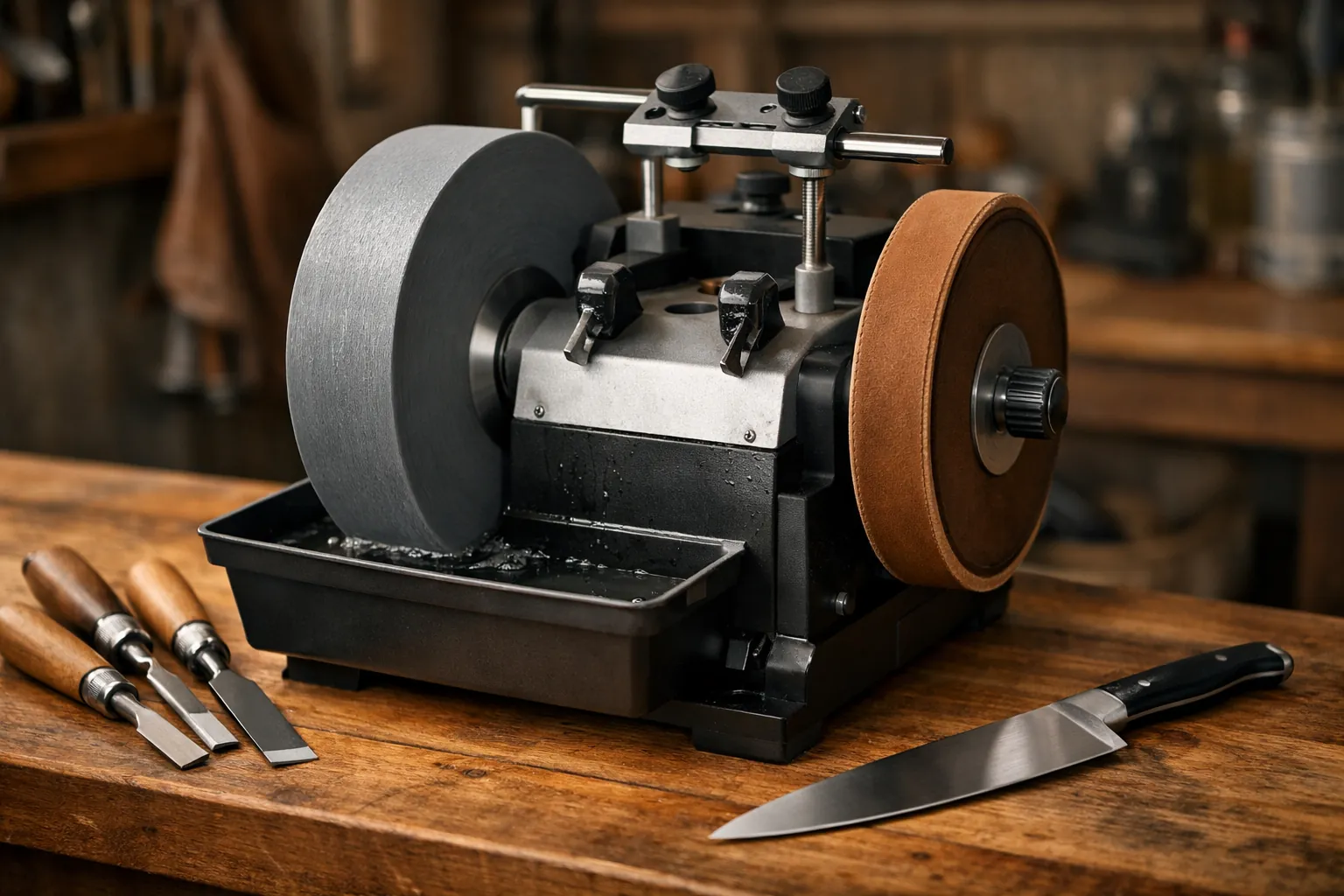
Home cook sharpening only kitchen knives: buy the Tormek T-1. Professional kitchen: the T-2 Pro. If you sharpen knives and woodworking or garden tools, get the T-4 for a home workshop or the T-8 for heavy and professional use. The split is simple. The T-1 and T-2 are knife sharpeners with diamond wheels and built-in angle guides. The T-4 and T-8 are water-cooled grinders that take a jig for each kind of tool. Most buyers land on the T-1 or the T-4 plus a knife jig; the T-2 Pro and the T-8 are the heavy-duty versions of those two.
Quick answer: which Tormek to buy
| Your situation | Buy | Why |
|---|---|---|
| Kitchen knives at home, Western and Japanese double-bevel | T-1 | Built-in guide, 8 to 22 degrees per side, no water, no jigs, 45 dB |
| Restaurant, butcher, catering kitchen | T-2 Pro (dealer) | 200 mm diamond wheel, continuous-duty motor, optional 360 and 1200 grit wheels |
| Knives plus woodworking edges and an axe, a few times a month | T-4 + KJ-45 knife jig | Same jigs as the T-8 for $453 less when checked |
| Woodturning, a sharpening business, long sessions | T-8, or the T-8 Knife Sharpening Kit | 250 mm stone, 14.7 Nm, 25,000-hour motor, SE-77 and truing tool included |
| Budget under about $200, or mostly serrated knives | Not a Tormek | A guided manual system or a serrated rod does the job for far less; see cheaper paths |
- 01What you sharpenOnly knives, or knives plus tools
- 02FamilyDry diamond (T-1, T-2) or water stone (T-4, T-8)
- 03SizeHome or heavy use
- 04JigsT-4 and T-8 only: one per tool type
Quick picks
| Best for home cooks | Tormek T-1 Kitchen Knife Sharpener | Amazon |
|---|---|---|
| Best for a home workshop | Tormek T-4 Original | Amazon |
| Best for heavy and professional use | Tormek T-8 Original | Amazon |
How we compared them
- Tormek's own machine pages and its machine-comparison grid, which gives each model's motor figures and box contents, plus its size and weight. Where the comparison page and a product page differ, we say so.
- Tormek's FAQ answers on the T-1 vs T-2 and the T-4 vs T-8.
- The Amazon listings for the T-1, T-4, T-8, the T-8 knife kit and each jig and wheel we name, with prices read on November 14, 2026. The T-2 Pro has no Amazon US listing, so its price comes from Sharpening Supplies.
- Retailer comparisons from Sharpening Supplies, Highland Woodworking and Axminster. Reviews: GearJunkie's T-4 Bushcraft piece, plus home-cook T-1 reviews from Tom's Guide and PureWow. Owner threads on the Tormek forum, UK Workshop and Blade Forums. Where only one source makes a claim, we name it in the sentence. More in how we research.
| Where sources disagree | One source | The other | What we use |
|---|---|---|---|
| T-4 and T-2 Pro speed | Tormek's comparison page: 140 rpm | Several retailer pages: 120 rpm | 140, attributed to Tormek |
| T-4 motor duty | Tormek: continuous, 10,000 hours | Axminster and Highland (older pages): 30 minutes per hour | Tormek's figure, with the older one noted |
| Warranty length | Tormek: 5 years, 8 with registration | Highland's T-4 vs T-8 page: 7 years | Tormek's 5 + 3 |
| T-2 Pro commercial warranty | Tormek FAQ: full warranty in commercial kitchens | Comparison page: unclear for the T-2, 2 years for commercial use of the T-4 | Both, flagged; confirm with your dealer |
Two families, four machines
The names suggest a ladder from 1 to 8. It isn't one. The T-1 and T-2 Pro are a separate product line that Tormek built for kitchens: a dry diamond wheel on one side of the motor, a composite honing wheel on the other, and an angle guide on top that the blade rests in. They take no jigs and sharpen nothing but knives. The T-4 and T-8 are the machines Tormek is best known for: a gray aluminum oxide stone that turns slowly through a water trough, a leather honing wheel, and a universal support bar that holds whichever jig fits the tool in your hand.
So the first question isn't "how much do I want to spend?" It's "is there anything besides kitchen knives I want to sharpen?" If the answer is no, a T-4 or T-8 is a workshop machine you'd be buying for one job, and you'd still need a knife jig for it.
Spec comparison
| T-1 | T-2 Pro | T-4 Original | T-8 Original | |
|---|---|---|---|---|
| Made for | Home kitchen knives | Professional kitchens | Home workshop, all edge tools | Heavy and professional use, all edge tools |
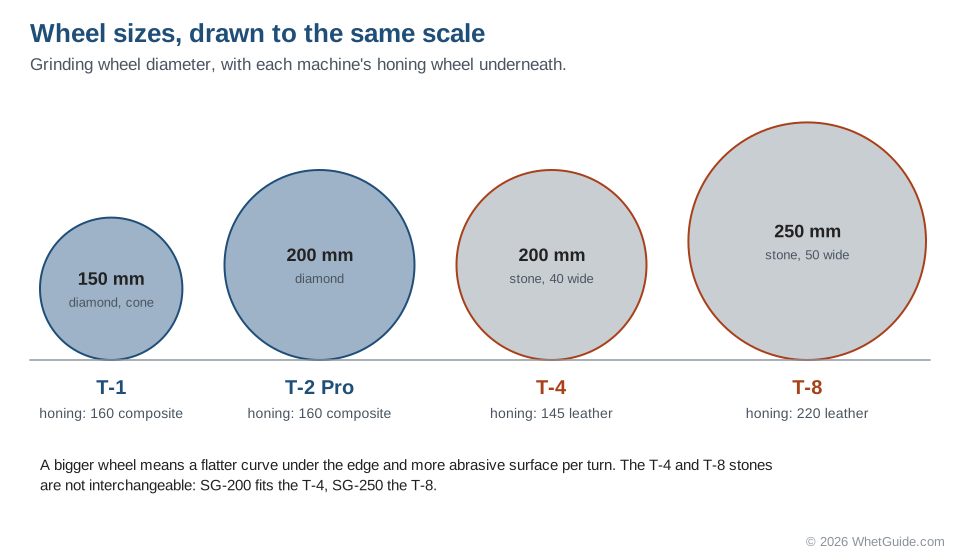
| Grinding wheel | Conical diamond, fine (600 grit), Ø150 mm | Diamond, fine (DWF-200), Ø200 mm; coarse (DWC-200, 360) and extra-fine (DWE-200, 1200) options | Aluminum oxide stone SG-200, Ø200 × 40 mm, 220–1000 grit equivalent | Aluminum oxide stone SG-250, Ø250 × 50 mm, 220–1000 grit equivalent |
| Honing wheel | Composite with polishing agent, Ø160 mm | Composite with polishing agent, Ø160 mm | Leather LA-145, Ø145 mm | Leather LA-220, Ø220 mm |
| Cooling | Dry (diamond) | Dry (diamond) | Water | Water |
| Knife angle | Built-in guide, 8°–22° per side | Built-in adjustable guide | Via knife jig (sold separately) | Via knife jig (sold separately) |
| Motor | 60 W idle / 120 W max, 150 rpm, intermittent duty | 120 W, 140 rpm (Tormek comparison page), continuous | 120 W, 140 rpm (Tormek comparison page), continuous | 200 W, 100 rpm, continuous |
| Torque | 2 Nm | 8.4 Nm | 8.4 Nm | 14.7 Nm |
| Motor service life | 10,000 hours | 10,000 hours | 10,000 hours | 25,000 hours |
| Noise (per Tormek) | 45 dB | 54 dB | 54 dB | 54 dB |
| Weight | 5.4 kg | 7.8 kg | 8 kg | 14.8 kg |
| Warranty | 8 years (5 + 3 on registration), home use only | 8 years (5 + 3); Tormek's FAQ covers commercial kitchens, confirm with your dealer | 8 years; 2 years commercial, industrial or educational use | 8 years (5 + 3 on registration) |
Source: tormek.com product and machine-comparison pages. Some retailers still list 120 rpm for the T-4 and T-2 Pro.
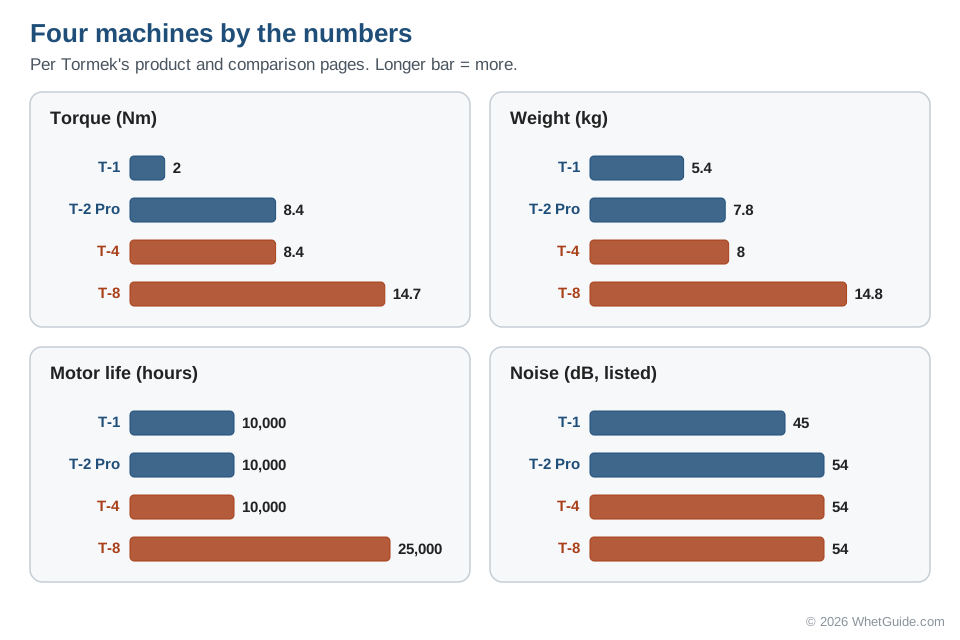
Read the torque row before the wattage row. The T-1's 2 Nm is plenty for a kitchen knife resting lightly on a diamond wheel. Reviewers of the T-1, Tom's Guide and PureWow among them, stress a light hand, and the low torque is one more reason to listen. The T-4's 8.4 Nm lets you grind a chisel or an axe without bogging the stone. The T-8's 14.7 Nm is for reshaping turning gouges and long sessions where you're taking real metal off.
↑ Back to all sectionsWhich Tormek to buy
Three cards below for the machines sold on Amazon US, plus the T-2 Pro, which you buy from a Tormek dealer. Each card says who should think twice.
Tormek T-1 Kitchen Knife Sharpener
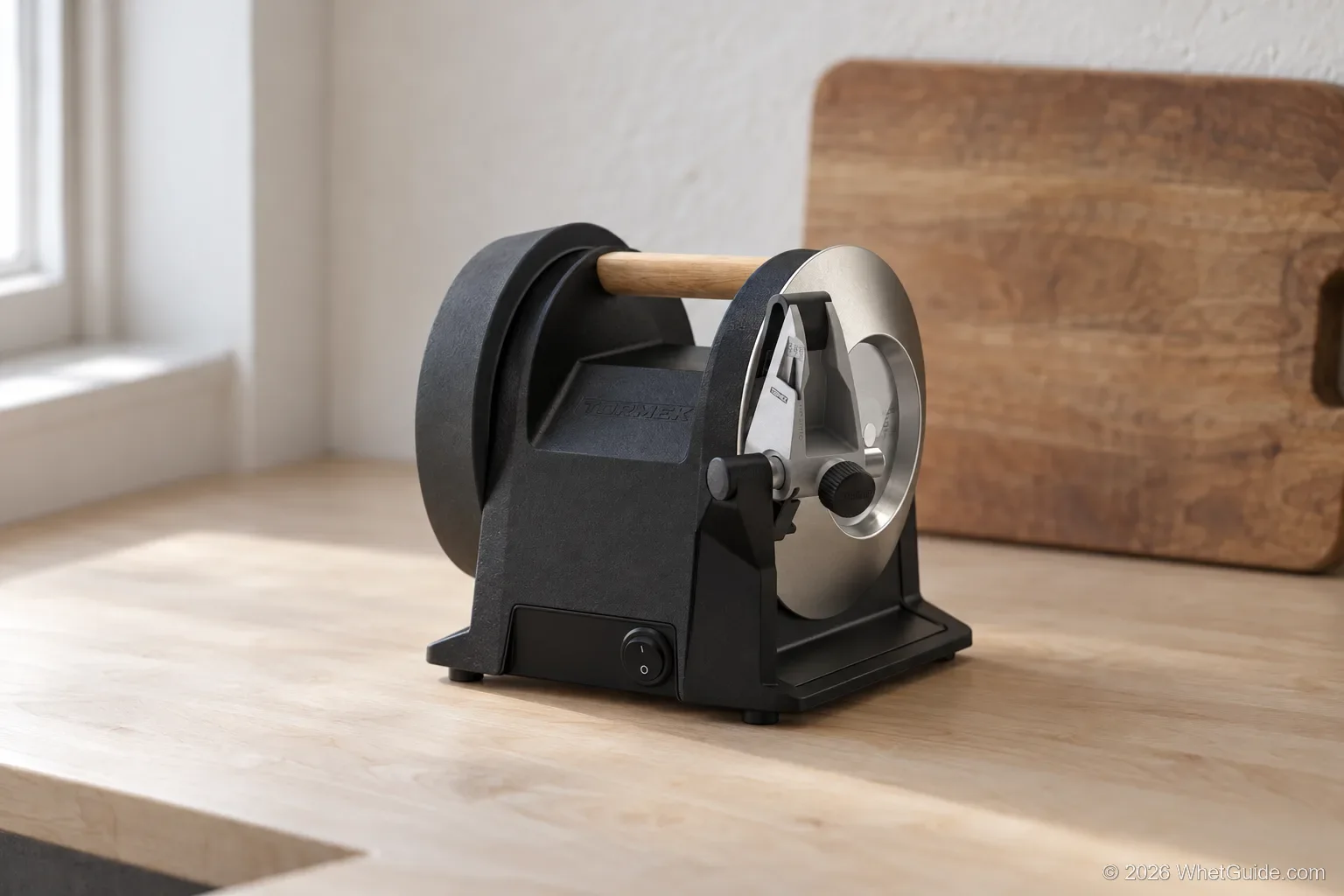
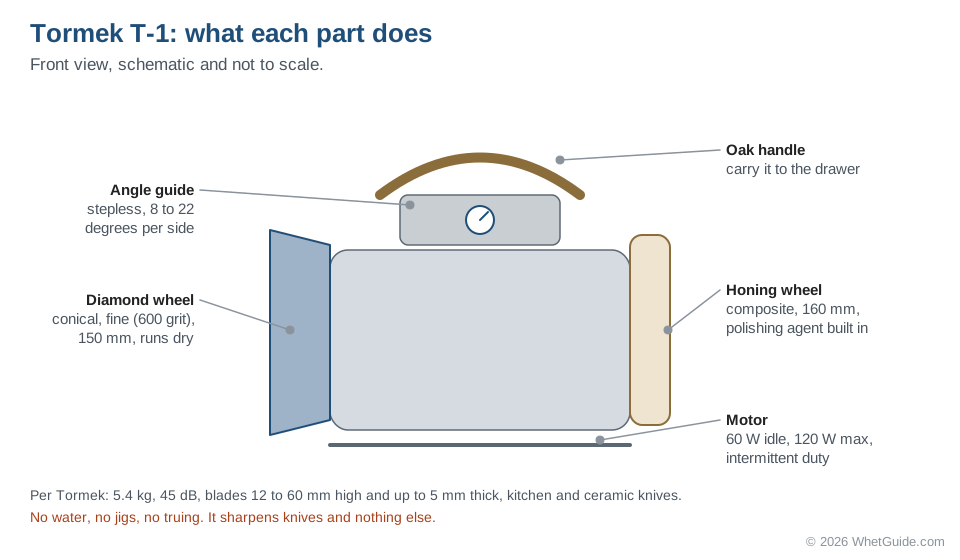
This is the machine for someone who just wants their kitchen knives properly sharp. A patented guide sets the angle anywhere from 8 to 22 degrees per side with no fixed steps, and each side can be set on its own. A fine diamond wheel does the sharpening; a composite honing wheel deburrs and polishes. Tormek says it removes only as much steel as necessary.
The body is cast zinc with an oak handle, small enough for a counter and listed at 45 dB. Tormek says it handles every kitchen knife type plus ceramic knives. Against a whetstone, you trade flexibility (no chisels, no axes) for speed and a repeatable angle.
- Wheelconical diamond, 600 grit
- Honingcomposite wheel with polishing agent
- Angle8°–22° per side, stepless
- Noise45 dB
- Blades12–60 mm high, up to 5 mm thick (per Tormek)
Why it stands out
- Built-in angle guide covers Japanese and Western angles
- Quietest Tormek, made for a home counter
- Removes little steel
Think twice if
- You also want to sharpen workshop or garden tools
- You need to sharpen serrated bread knives
- You're on a budget: a guided manual system costs a fraction as much
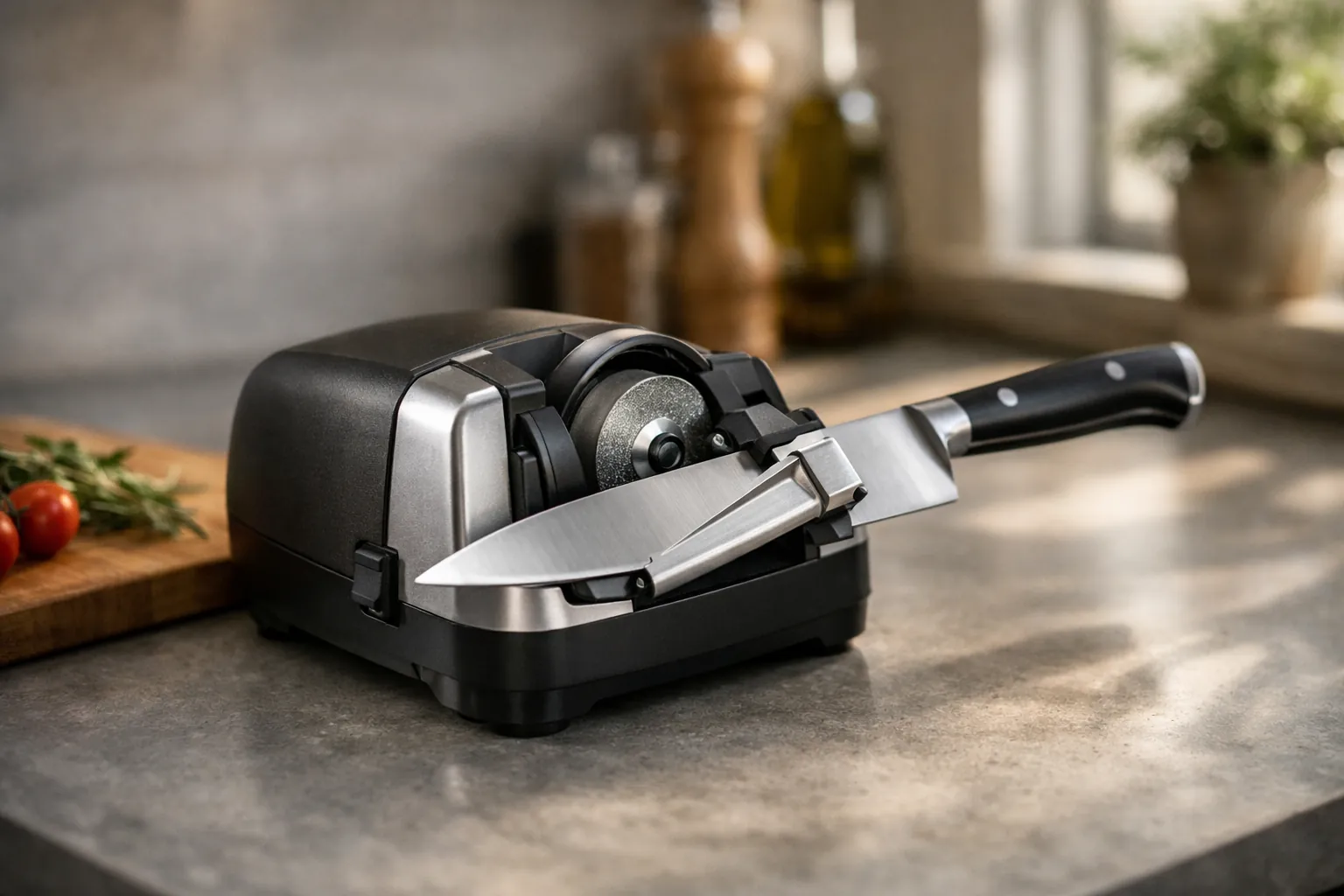
- Two limits to know before you order a T-1. Its motor is rated for intermittent duty, so it's a machine for a drawer of knives on a Sunday, not a restaurant's whole roll every morning.
- The warranty covers home use only. If either limit sounds like a problem, you're describing the T-2 Pro.
Tormek T-2 Pro: for professional kitchens
Tormek built the T-2 Pro for commercial kitchens and meat processing, and it points home users back to the T-1. The differences are scale: a larger 200 mm fine diamond wheel with optional coarse (DWC-200, 360 grit) and extra-fine (DWE-200, 1200 grit) wheels, a 120 W motor rated for continuous duty with 8.4 Nm of torque, and accessories for kitchen scissors and round blades, including the RBS-140 round-blade jig. We couldn't find the T-2 Pro sold directly on Amazon US at the time of writing. Buy it from an authorized Tormek dealer; Sharpening Supplies listed it at about $895 when we checked.
| T-2 Pro wheel | Grit | Use it for |
|---|---|---|
| DWC-200 coarse | 360 | Chipped or neglected edges, without an hour on the fine wheel |
| DWF-200 fine | Fine (standard) | Everyday sharpening; the wheel it ships with |
| DWE-200 extra fine | 1200 | A more polished finish before honing |
The swap-in wheels are the T-2's real advantage over the T-1 for a busy kitchen. The T-1 has one wheel, and that's the deal.
Tormek T-4 Original
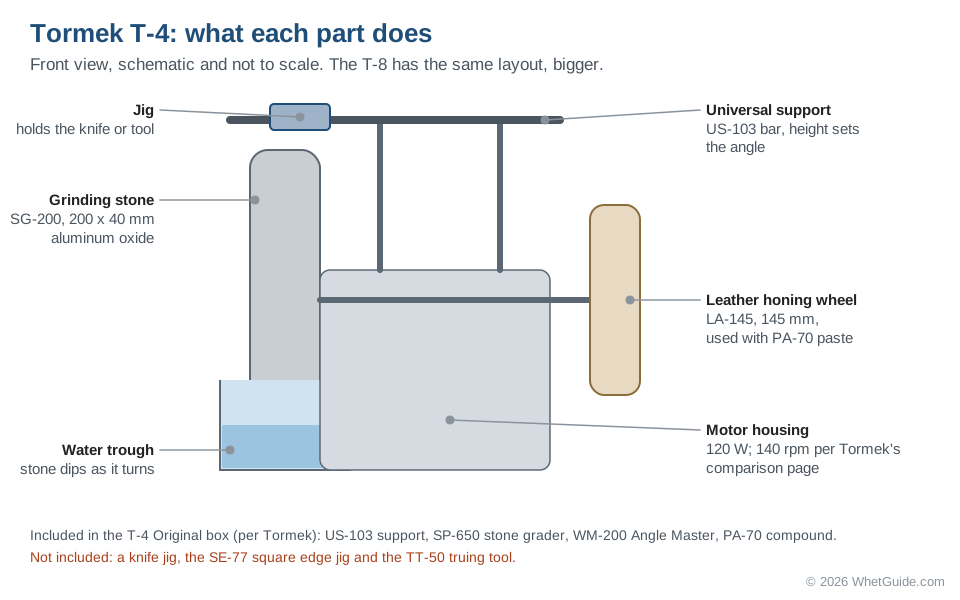
Here's Tormek's classic water-cooled grinder in a compact size. The stone turns slowly through water, so it won't overheat steel, and the included stone grader makes it cut coarser or finer (Tormek lists an equivalent of 220 to 1000 grit). With the matching jigs it does knives and scissors. It also handles chisels and plane irons, plus lawnmower blades and woodturning tools.
For knives you'll need a knife jig such as the Tormek KJ-45 centering knife jig, which isn't included with the standard T-4 Original.
- Stonealuminum oxide, Ø200 × 40 mm, 220–1000 grit equivalent
- Honingleather wheel Ø145 mm
- Motor120 W, 120 rpm, continuous
- Weight8 kg
- IncludedUS-103 support, stone grader, AngleMaster, honing compound (per Tormek)
Why it stands out
- Sharpens nearly every edge tool with the right jig
- Water cooling protects tempered steel
- Same jigs as the T-8
Think twice if
- You only sharpen kitchen knives: the T-1 is simpler and faster
- You'll sharpen for hours at a time on big jobs
Tormek T-8 Original
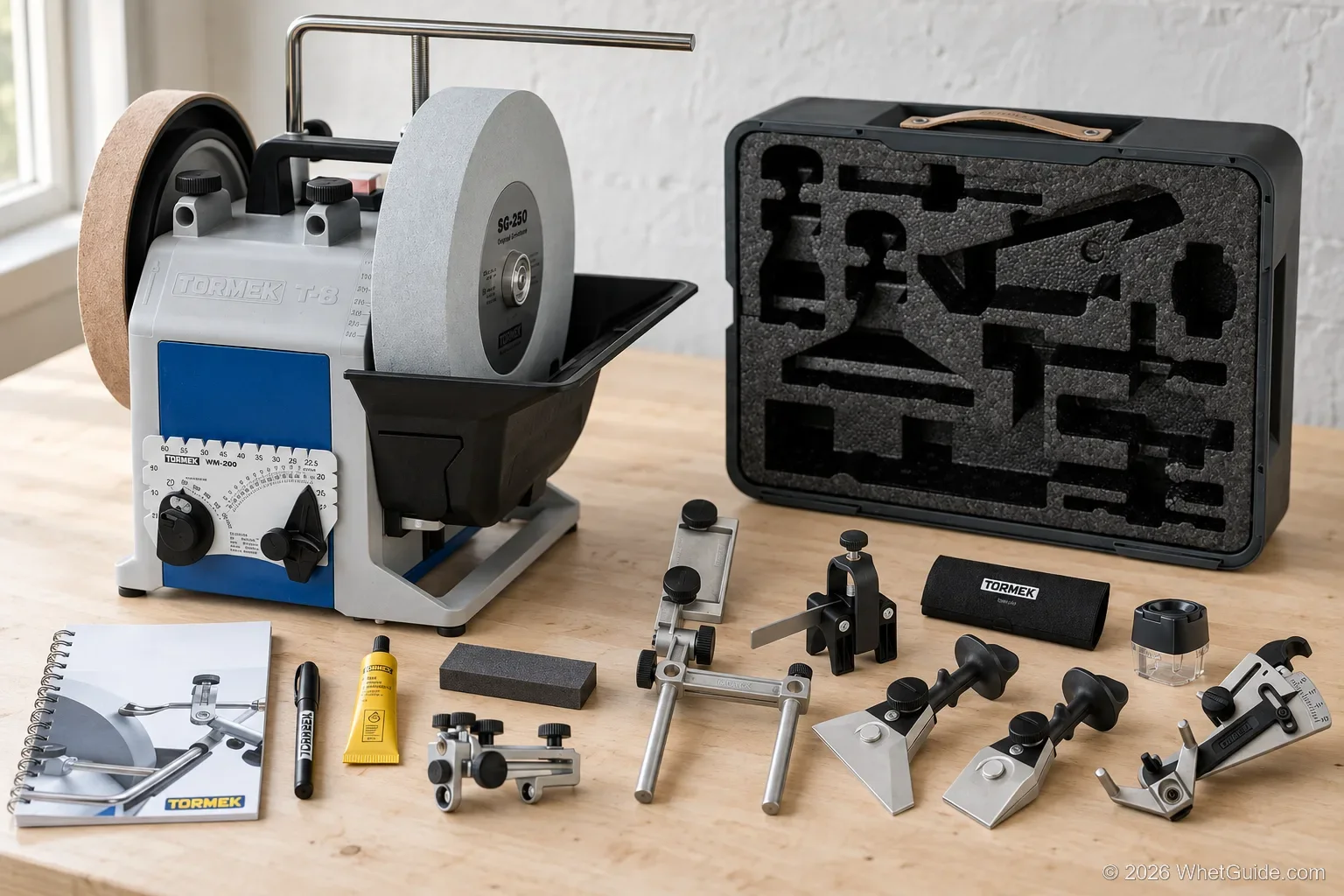
Everything on the flagship is bigger. The stone is wider, the leather honing wheel larger, and the 200 W motor has almost twice the torque of the T-4 (14.7 Nm vs 8.4 Nm, per Tormek) with a 25,000-hour service rating. Two extras come in the box that T-4 owners buy separately: the SE-77 square edge jig for chisels and plane irons, and a truing tool that keeps the stone round and flat.
As with the T-4, knives need a separate jig, or buy the T-8 knife sharpening kit bundle, which pairs the T-8 Original with Tormek's KSK-106 knife jigs.
- Stonealuminum oxide, Ø250 × 50 mm, 220–1000 grit equivalent
- Honingleather wheel Ø220 mm
- Motor200 W, 100 rpm, continuous, 25,000-hour rating
- Weight14.8 kg
- IncludedSE-77 square edge jig, truing tool, US-105 support (per Tormek)
Why it stands out
- Most powerful, most durable Tormek
- Square edge jig and truing tool included
- Wider stone handles long knives and plane irons easily
Think twice if
- You sharpen occasionally at home: the T-4 does the same jobs
- You only sharpen kitchen knives
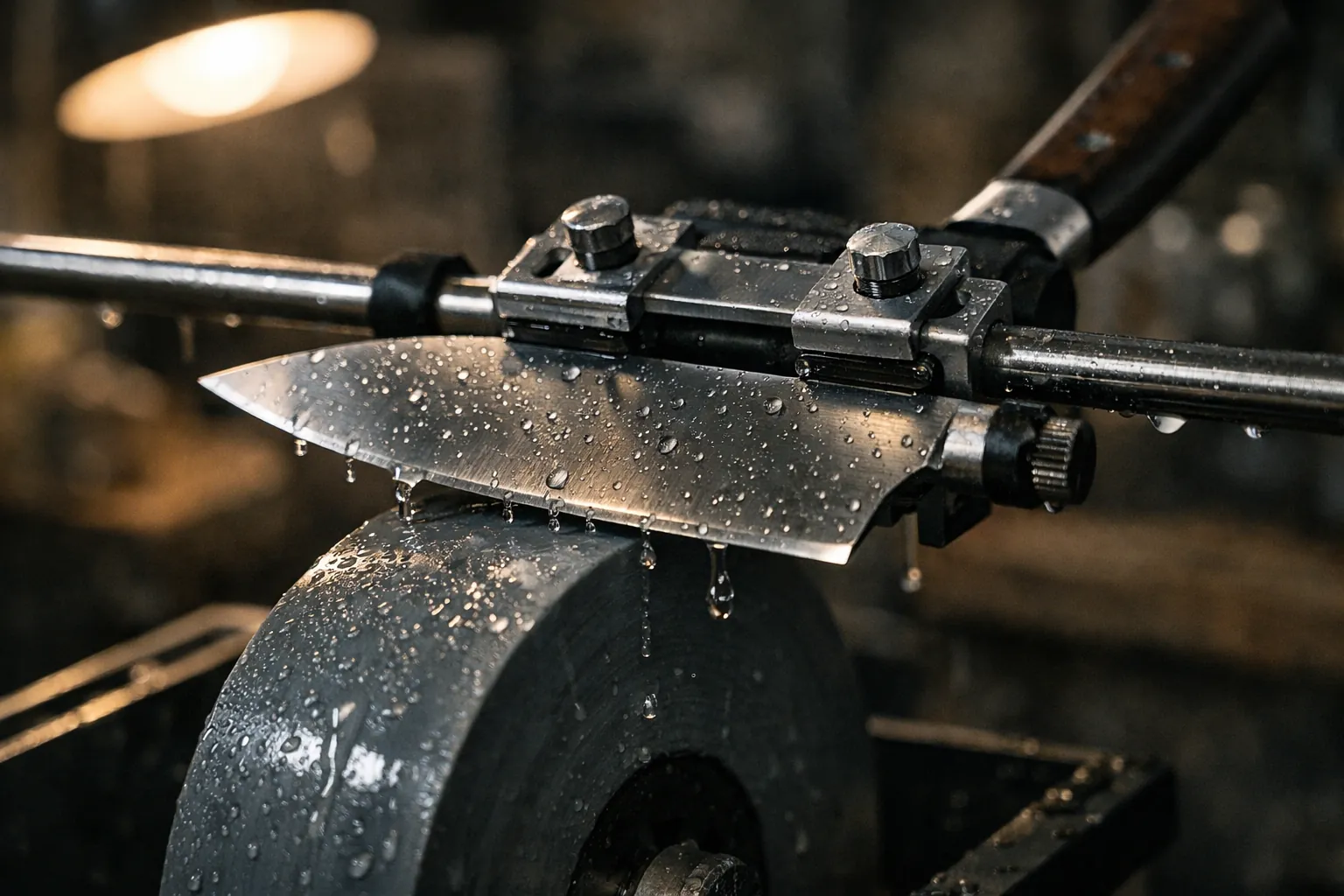
Run the numbers on that kit before you click. When we checked, the T-8 Original was $1,066 and the KSK-106 jig set was $395, which adds up to $1,461. The kit was $1,445. That's $16 saved, so buy the kit only if you want the whole KSK-106 set. If one KJ-45 covers your knives, the T-8 plus a KJ-45 came to $1,139.
↑ Back to all sectionsTormek T1 vs T2: home or professional kitchen
Tormek's own FAQ answers this one in a line: the T-2 Pro is for professional kitchens and the T-1 is for the home. The table shows what that means in hardware.
| T-1 | T-2 Pro | |
|---|---|---|
| Diamond wheel | Conical, fine 600 grit, 150 mm | Fine DWF-200, 200 mm |
| Other grits | None | DWC-200 coarse (360), DWE-200 extra fine (1200) |
| Motor duty | Intermittent, 2 Nm | Continuous, 8.4 Nm |
| Noise | 45 dB | 54 dB |
| Weight | 5.4 kg | 7.8 kg |
| Extras | None needed | Scissors accessories, RBS-140 round-blade jig |
| Warranty | Home use only | Commercial kitchens covered per Tormek's FAQ |
| Where to buy (US) | Amazon, $428 when checked | Tormek dealers, about $895 |
For a home cook, the T-2's extra grits are the only feature worth wanting, and most home knives never get dull enough to need a 360 wheel. A café or a butcher counter is a different story: knives come back to the machine daily, a continuous-duty motor is the point, and a home-use-only warranty on a T-1 would be void the first week. Tormek's support FAQ makes the same split: the T-1 is approved for home use, while the T-2 is certified for commercial use and adds 360 and 1200 grit wheels to the standard 600.
↑ Back to all sectionsTormek T4 vs T8: what the extra $453 buys
Tormek's FAQ answer to "T-4 or T-8?" is careful to the point of unhelpful: both sharpen the same tools with the same jigs. That's true. The differences are in capacity and what comes in the box, and they add up.
| T-4 Original | T-8 Original | What it means | |
|---|---|---|---|
| Stone | 200 × 40 mm | 250 × 50 mm | More width for plane irons; a flatter curve under the edge |
| Leather honing wheel | 145 mm | 220 mm | More leather per turn, easier on long blades |
| Torque | 8.4 Nm | 14.7 Nm | The T-8 keeps speed under heavy grinding |
| Motor life | 10,000 hours | 25,000 hours | Matters only if you sharpen for a living |
| Weight | 8 kg | 14.8 kg | The T-4 moves; the T-8 stays on the bench |
| SE-77 square edge jig | Buy separately | Included | Chisels and plane irons |
| TT-50 truing tool | Buy separately ($99) | Included | Keeps the stone round and flat |
| Honing wheel mount | Standard | Quick-release | Faster wheel swaps |
| Drive and trough | Standard | Zinc drive wheel, trough with screw lift | Small things that make long sessions easier |
| Blackstone SB-250 | No | Yes | The T-8-only wheel for hard steels |
| Price when checked | $613 | $1,066 | Difference: $453 |
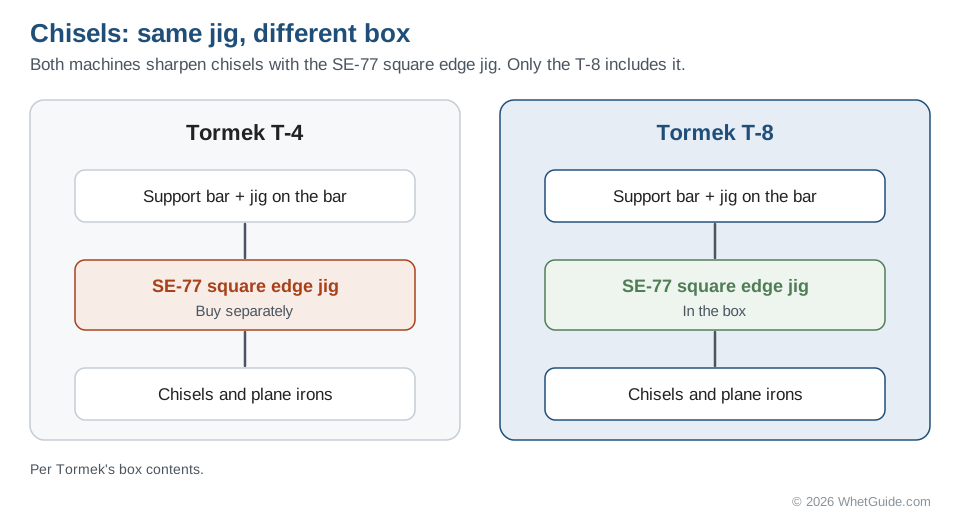
Count what a T-4 owner adds to match a T-8: the TT-50 at $99 plus an SE-77. That closes part of the $453 gap, but not the stone size, the torque or the motor rating. Our read: if you'll grind chisels and turning tools weekly, the T-8 is the better buy. If the machine will come out once a month for the kitchen knives and an axe, the T-4 is plenty, and the savings buy a knife jig and a truing tool with money left. Weight counts as well: at 8 kg the T-4 comes off a shelf and onto a bench for a Saturday session, and some owners on UK Workshop and the Tormek forum pick it over the T-8 for that alone.
↑ Back to all sectionsKits and bundles
Tormek sells each workshop machine in more than one box. These are the ones you'll see listed, and who each fits. Prices are from Amazon on November 14, 2026; "not listed" means we didn't find a current US price.
| Variant or bundle | What it adds | Price when checked | Who it fits |
|---|---|---|---|
| T-4 Original | Base T-4 (see the spec table) | $613 | Home workshop, add jigs as needed |
| T-4 Bushcraft | T-4 plus the KJ-45 knife jig and AX-40 axe jig | Not listed | Knives and axes for camp and garden |
| T-4 Magnum Kit | T-4 plus the HTK-1006 hand tool kit and TNT-808 woodturner's kit | $1,066 | A new woodturner starting from nothing |
| T-8 Original | Base T-8, with SE-77 and TT-50 | $1,066 | Heavy use, add jigs as needed |
| T-8 Custom | A T-8 sold with a different set of accessories | Not listed | Check the dealer's box list |
| T-8 Knife Sharpening Kit | T-8 plus the KSK-106 knife jig set | $1,445 | Lots of knives on a T-8 |
| T-8 Hand Tool Kit | T-8 plus jigs for chisels and plane irons | $1,435 | Furniture makers, carpenters |
| T-8 with RB-180 | T-8 plus the RB-180 rotating base | $1,045 | Anyone who wants to spin the machine between jobs |
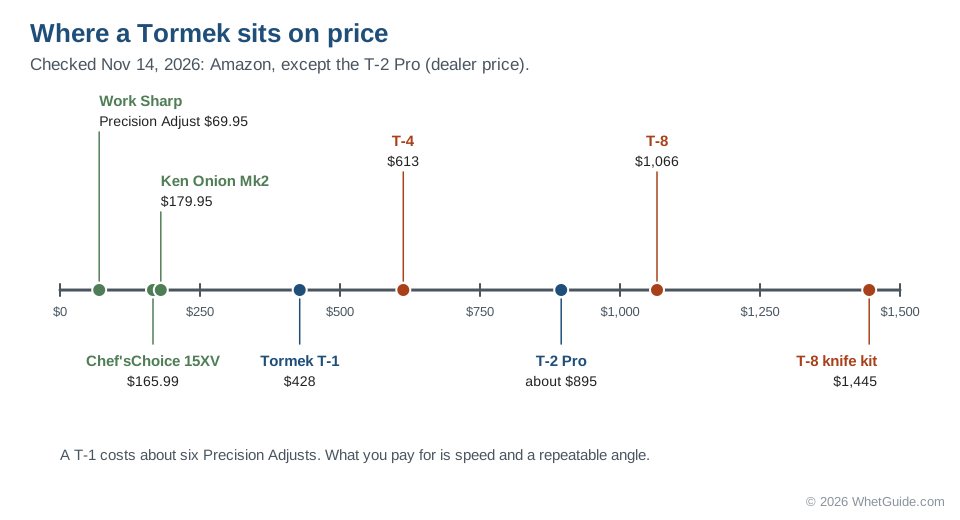
The T-8 RB-180 bundle was $21 cheaper than the bare T-8 when we checked, which says more about Amazon pricing than about the bundle. Check both listings on the day. GearJunkie priced its T-4 Bushcraft setup at over $1,600 with accessories, which is a reminder that the box price is never the final number. Our cost-to-own section adds it up for four buyers.
↑ Back to all sectionsPick by what you sharpen
| If you… | Buy |
|---|---|
| Sharpen kitchen knives at home, including Japanese knives | Tormek T-1 |
| Run a restaurant or sharpen dozens of knives a week | Tormek T-2 Pro (from a Tormek dealer) |
| Sharpen knives plus workshop and garden tools at home | Tormek T-4 + knife jig |
| Sharpen for a living, for woodturning, or for long sessions | Tormek T-8 + knife jig |
| Want a guided, precise edge for far less money | A manual guided system |
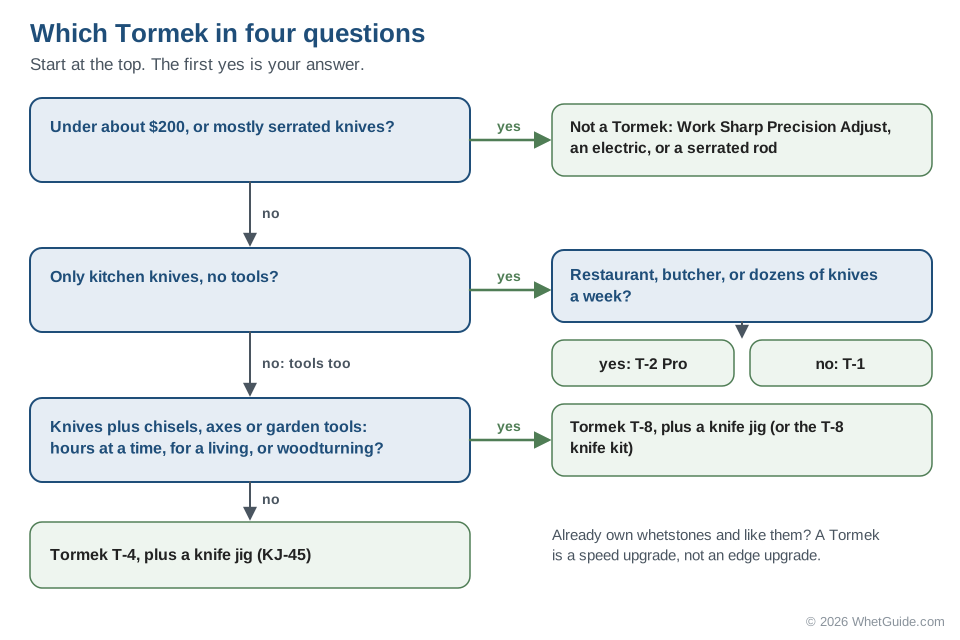
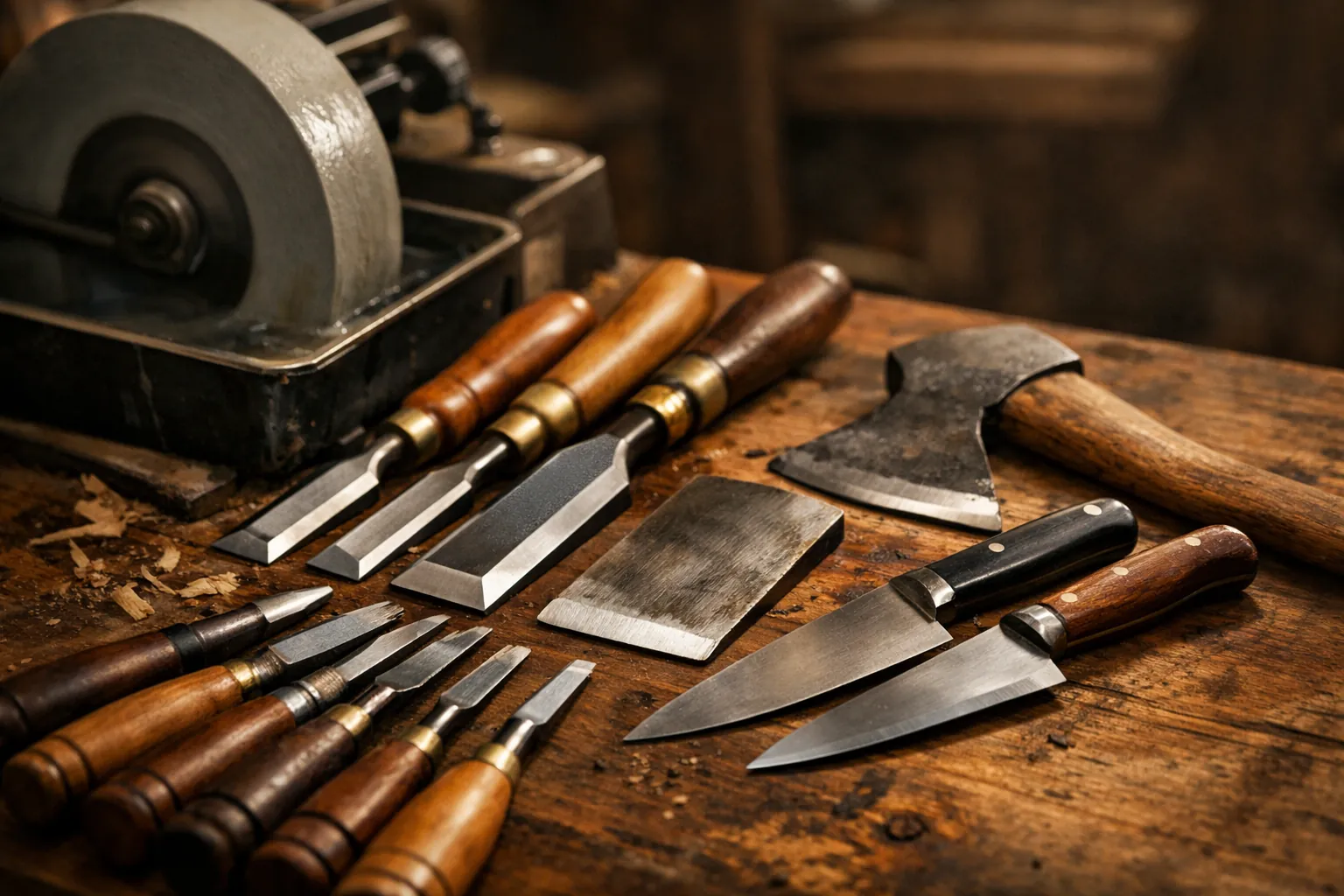
One more way to decide: count your edges. A household with eight kitchen knives and nothing else has no use for a stone that grinds plane irons. A household with eight kitchen knives, a set of chisels, two axes, pruning shears and a mower blade has five jobs a T-4 can do and a T-1 can't.
↑ Back to all sectionsDry diamond vs water-cooled stone
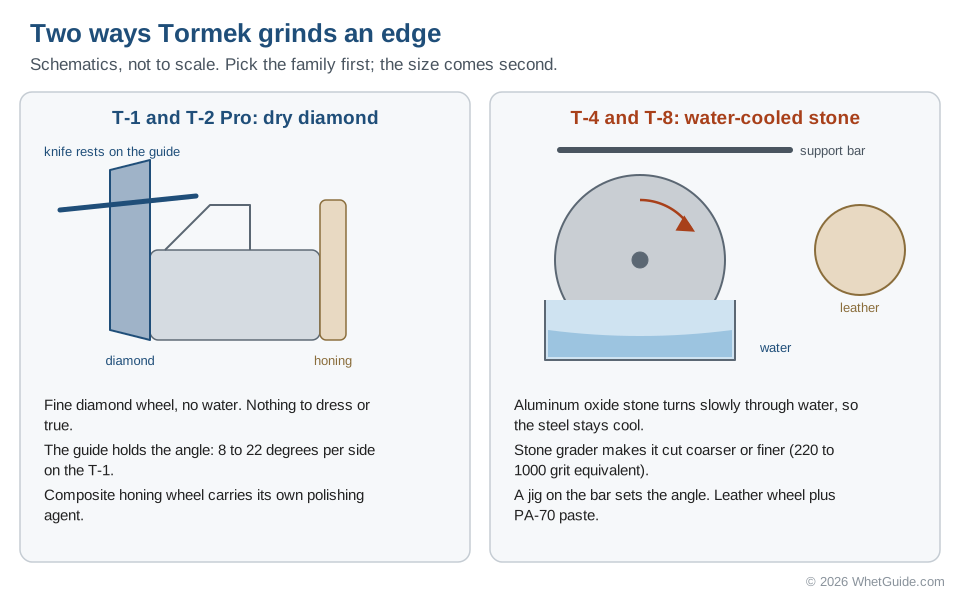
The T-1 and T-2 run dry diamond wheels. They're fast and flat, need no water and cope well with hard steels, but you're limited to the grits Tormek sells for them: one on the T-1, three on the T-2. A diamond wheel doesn't wear into a groove the way a soft stone can, so there's nothing to true. The trade is that you can't change its character; it cuts the way it left the factory until it wears out.
The T-4 and T-8 run an aluminum oxide stone through water. The water keeps the edge cool. That counts most on tempered tools like chisels and turning gouges, where a dry grinder can draw the temper out of a thin edge. The SP-650 stone grader dresses the surface coarser for fast grinding or finer for a smoother finish, which Tormek describes as 220 to 1000 grit equivalent from one stone. The broader trade-offs between diamond and conventional abrasives are in whetstone vs diamond stone.
The hollow grind, and why stone size matters
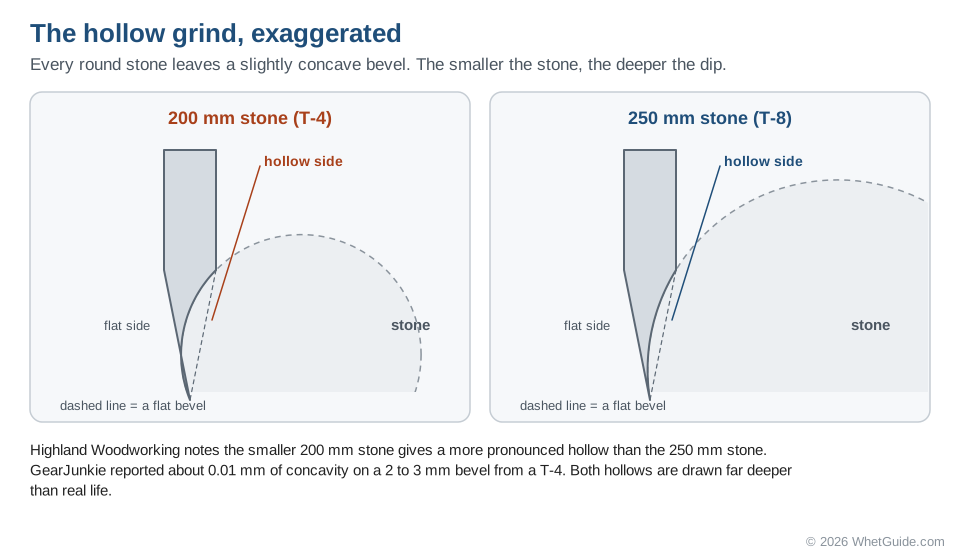
Any round wheel grinding on its rim leaves a bevel that's very slightly concave, because the bevel takes the curve of the wheel. The smaller the wheel, the tighter the curve and the deeper the dip. Highland Woodworking's T-4 vs T-8 page makes exactly this point: the T-4's 200 mm stone gives a more pronounced hollow than the T-8's 250 mm stone.
How big is the dip? GearJunkie reported roughly 0.01 mm of concavity across a 2 to 3 mm bevel from its T-4. That's small. For kitchen knives and axes it's a curiosity. For a chisel or plane iron you then hone on a flat stone, a slight hollow is a feature: the flat stone only touches the toe and heel of the bevel, so honing goes faster. For anyone who wants a perfectly flat bevel on a fine Japanese knife, it's one more reason to finish on a flat stone or think about the T-1.
↑ Back to all sectionsAngles: what each machine can set
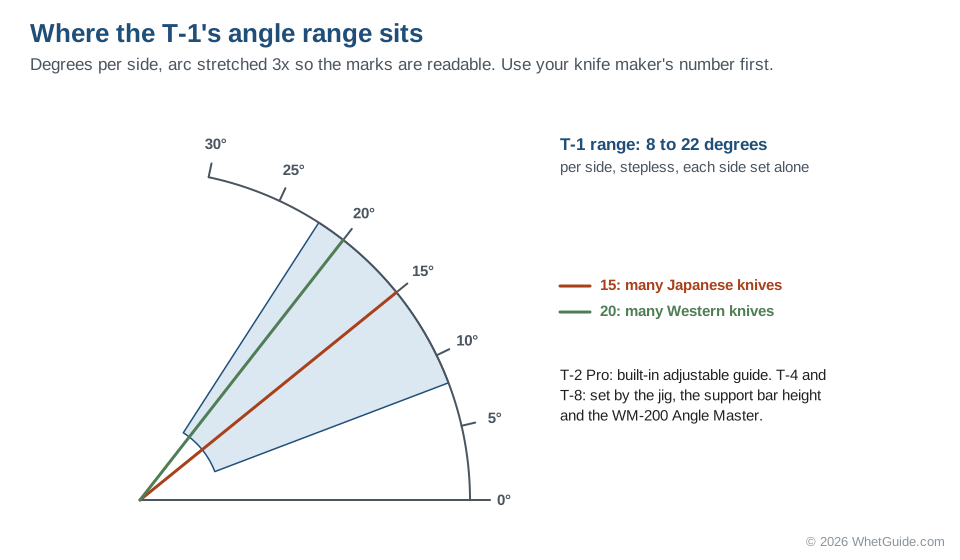
The T-1's 8° to 22° per side range covers the common settings: many Japanese knives around 15° per side and many Western knives around 20°. Each side sets on its own, which also lets you match an existing slightly uneven bevel instead of grinding it square. Check your knife maker's recommendation first; typical angles by brand and knife type are on the angle chart, and the angle calculator converts per-side numbers to inclusive ones.
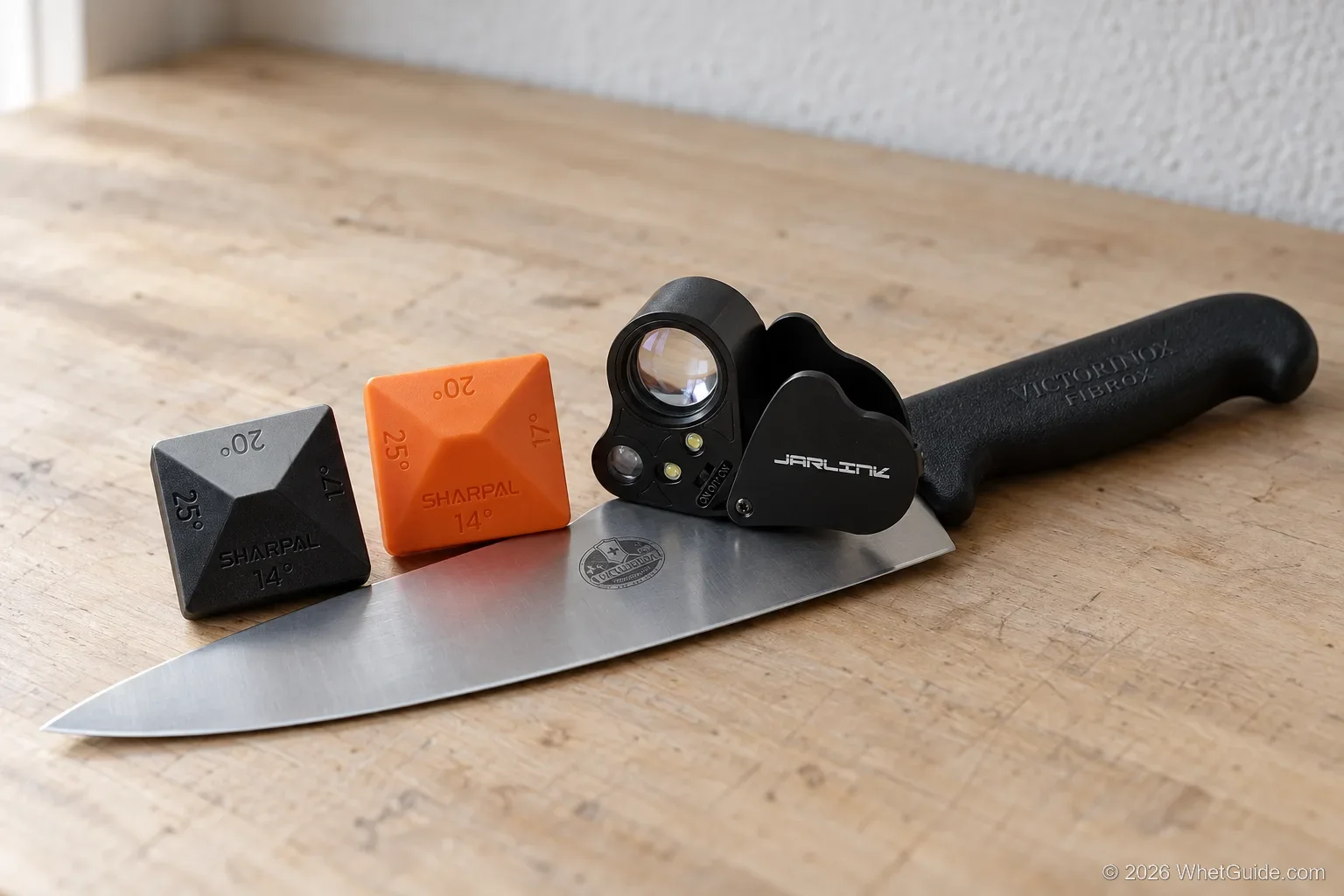
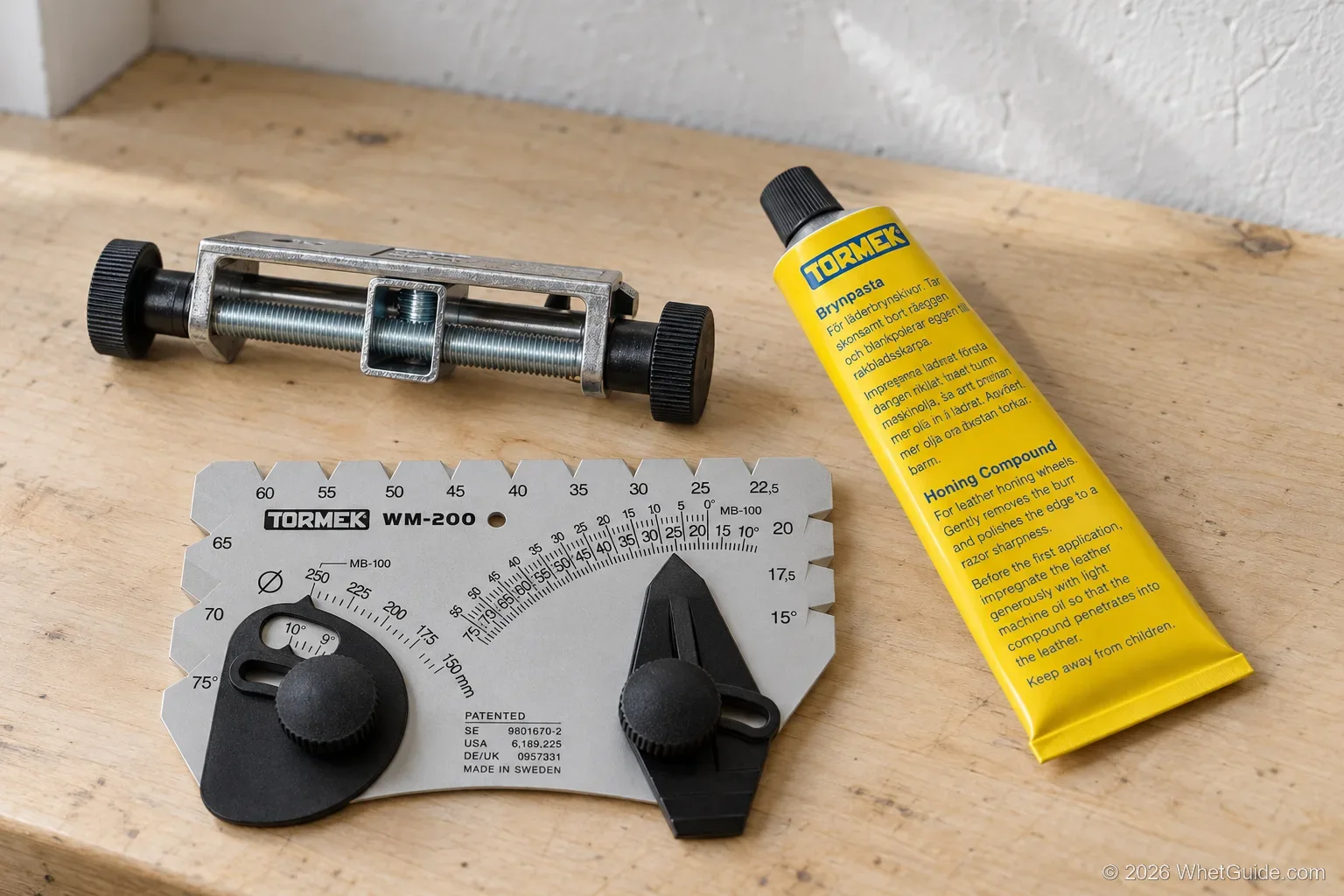
On the T-4 and T-8, Tormek's WM-200 Angle Master (in the box) reads the angle against the stone, and the jig and support bar set it. There's no fixed range: you can grind a 25° chisel, a 30° axe and a 15° fillet knife on the same machine. The flexibility is real, and so is the setup time. The step-by-step for setting the angle handles it.
Honing wheels: composite vs leather
Every Tormek has a second wheel for honing, and it's half the reason the edges come off these machines finished rather than just ground. Grinding leaves a burr, a thin curl of steel along the edge. The honing wheel removes it and polishes the bevel. Our guide to the burr spells out what a leftover burr does to edge life.
| T-1 and T-2 Pro | T-4 | T-8 | |
|---|---|---|---|
| Wheel | PW-160 composite, 160 mm | LA-145 leather, 145 mm | LA-220 leather, 220 mm |
| Compound | Built into the wheel | PA-70 paste (in the box) | PA-70 paste (in the box) |
| Upkeep | Wipe clean | Re-apply paste; keep it dry | Re-apply paste; quick-release for swaps |
| Refill cost | None | PA-70, $21.75 when checked | PA-70, $21.75 when checked |
One rule for leather wheels catches new owners: the wheel must turn away from the edge, never into it, or the edge digs into the leather. Honing on a Tormek is edge-trailing, like stropping by hand. If you already own a strop, our stropping guide uses the same motion.
↑ Back to all sectionsHow much room and noise
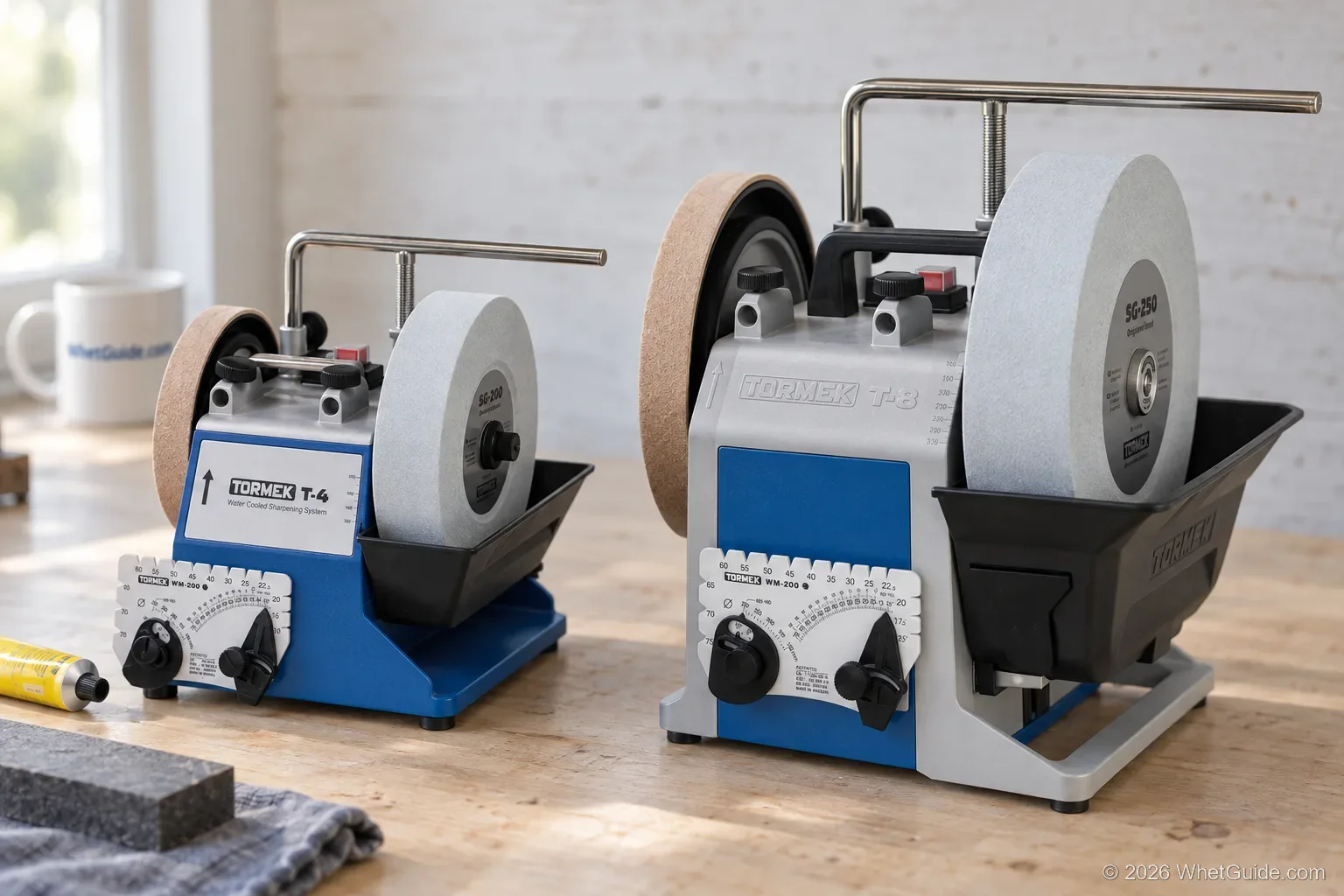
| T-1 | T-2 Pro | T-4 | T-8 | |
|---|---|---|---|---|
| Weight | 5.4 kg | 7.8 kg | 8 kg | 14.8 kg |
| Noise | 45 dB | 54 dB | 54 dB | 54 dB |
| Water | None | None | Trough, plus drips | Trough, plus drips |
| Where it lives | Kitchen counter or drawer | Prep area or back room | Shelf, out to a bench | Fixed spot on a bench |
Only the T-1 is designed to live on a kitchen counter. It's the smallest and, at a listed 45 dB, the quietest. The T-4 and T-8 need a bench with room on both sides: the stone end for the trough and support bar, the other end for the leather wheel and the jig as you swing it across. Give the T-8 a permanent spot; at nearly 15 kg it isn't a machine you'll lift down every time. Water on the T-4 and T-8 also means a towel under the trough and a bench you don't mind getting gray.
Can I sharpen this on it?
"Jig" means the machine can do it once you add the named jig. "No" means the machine can't, whatever you add. Kitchen-machine answers come from Tormek's T-1 and T-2 pages; workshop answers from Tormek's jig range.
| Tool | T-1 | T-2 Pro | T-4 / T-8 |
|---|---|---|---|
| Chef's knife, santoku, gyuto | Yes | Yes | Jig (KJ-45) |
| Paring and small knives | Yes, 12 mm blade height and up | Yes | Jig (SVM-00) |
| Long, flexible slicer or fillet knife | Yes | Yes | Jig (KJ-140), plus US-430 for very long blades |
| Cleaver | Up to 60 mm blade height and 5 mm thick | Check blade size with the dealer | Jig, with US-430 support |
| Ceramic knife | Yes, per Tormek | Check with the dealer | Check with Tormek |
| Serrated bread knife | No | No | No |
| Single-bevel Japanese knife | Poor fit | Poor fit | Poor fit (GearJunkie) |
| Kitchen scissors | No | With accessory | Jig (scissors jig) |
| Chisel, plane iron | No | No | Jig (SE-77; in the T-8 box) |
| Axe, hatchet | No | No | Jig (AX-40; in the T-4 Bushcraft box) |
| Woodturning gouges | No | No | Jig (turning jigs) |
| Lawn mower blade | No | No | Yes, per Tormek |
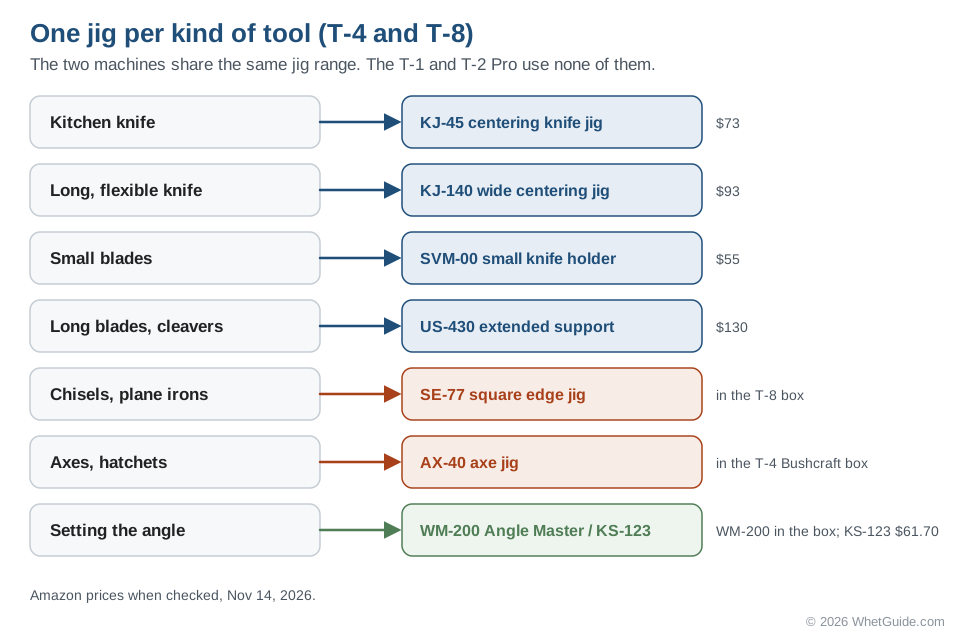
For the tools on that list that aren't knives, we have full guides: chisels, axes, woodworking tools, mower blades and pruning shears. Each covers the Tormek route alongside the cheaper ones.
↑ Back to all sectionsPrices, checked November 14, 2026
| Item | Price when checked | Where |
|---|---|---|
| Tormek T-1 | $428 | Amazon |
| Tormek T-2 Pro | About $895 | Sharpening Supplies (no Amazon US listing) |
| Tormek T-4 Original | $613 | Amazon |
| Tormek T-8 Original | $1,066 | Amazon |
| T-8 Knife Sharpening Kit | $1,445 | Amazon |
| KJ-45 knife jig | $73 | Amazon |
| TT-50 truing tool | $99 | Amazon |
| KSK-106 knife jig set | $395 | Amazon |
| SJ-200 Japanese waterstone (4000) | $349.99 | Amazon |
| DF-200 or DE-200 diamond wheel | $337 each | Amazon |
Prices on these machines move with sales and stock, so treat the table as a snapshot. The ratios hold better than the dollars: the T-4 costs about 1.4 times the T-1, and the T-8 about 1.7 times the T-4.
↑ Back to all sectionsWhat a working setup costs
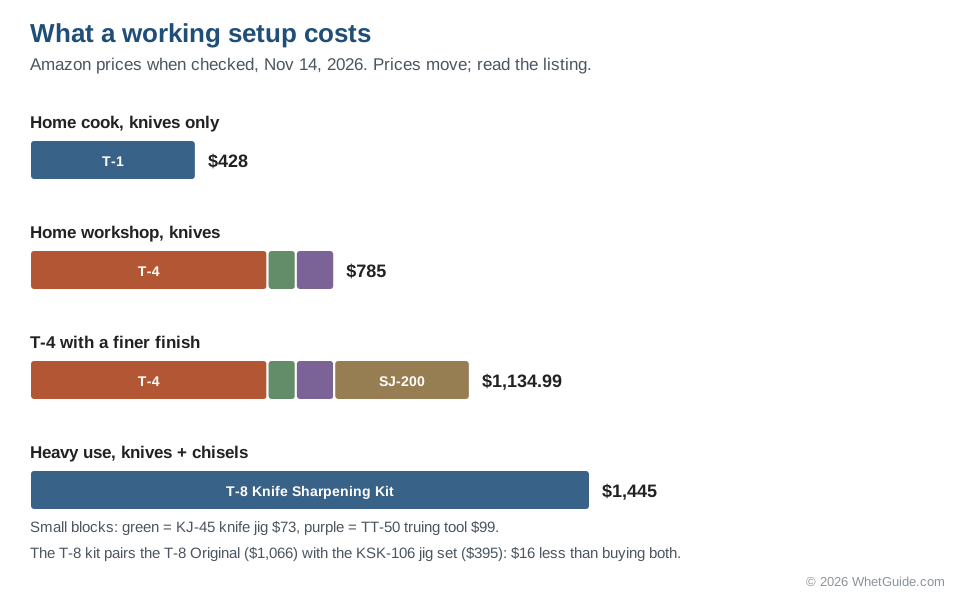
| Buyer | Cart | Total when checked |
|---|---|---|
| Home cook, knives only | T-1 | $428 |
| Home workshop, knives first | T-4 + KJ-45 + TT-50 | $785 |
| Home workshop, finer kitchen edge | T-4 + KJ-45 + TT-50 + SJ-200 | $1,134.99 |
| Heavy use, one knife jig | T-8 + KJ-45 (SE-77 and TT-50 in the box) | $1,139 |
| Heavy use, full knife set | T-8 Knife Sharpening Kit | $1,445 |
Running costs are small next to the purchase. The T-1 and T-2 need nothing but an eventual replacement wheel. The T-4 and T-8 use PA-70 honing paste ($21.75) and the stone wears down slowly with use and truing; we found no wear rate from Tormek, so we won't guess one. The true running cost on a workshop Tormek is jigs: each new kind of tool tends to bring one more.
↑ Back to all sectionsWhat's in the box, and what's missing
| Item | T-1 | T-2 Pro | T-4 Original | T-8 Original |
|---|---|---|---|---|
| Built-in knife angle guide | Yes | Yes | No | No |
| Composite honing wheel | Yes | Yes | No | No |
| Leather honing wheel | No | No | 145 mm | 220 mm |
| Universal support bar | No | No | US-103 | US-105 |
| WM-200 Angle Master | No | No | Yes | Yes |
| SP-650 stone grader | No | No | Yes | Yes |
| PA-70 honing compound | No | No | Yes | Yes |
| Knife jig | Not needed | Not needed | No (Bushcraft: KJ-45) | No (knife kit: KSK-106) |
| SE-77 square edge jig | n/a | n/a | No | Yes |
| TT-50 truing tool | n/a | n/a | No | Yes |
| AX-40 axe jig | n/a | n/a | No (Bushcraft: yes) | No |
The two lines that cause most "I wish I'd known" moments are the knife jig and the truing tool. A T-4 or T-8 Original arrives unable to hold a kitchen knife at a set angle. Order the jig in the same cart. The T-4 also arrives without a way to true its stone, which you'll want once the surface starts to wear unevenly.
↑ Back to all sectionsWhat to know before you spend this much
The short list
- Diamond vs water-cooled stone: dry diamond (T-1, T-2) is cleaner, faster to start and kitchen-only; the water stone (T-4, T-8) is messier and slower to set up, and it sharpens almost every edge in the house. The full comparison is above.
- Angles: the T-1 covers 8 to 22 degrees per side with no jig. The T-4 and T-8 cover whatever the jig and bar allow, which is more, at the cost of setup. See angles and setting the angle.
- Upkeep and running costs: the kitchen machines are close to maintenance-free, since the diamond wheels need no dressing or water and the composite honing wheel carries its own polishing agent. The T-4 and T-8 stones wear down slowly and need occasional truing to stay round and flat; the T-8 includes a truing tool, and both include a stone grader and PA-70 honing paste. The real running cost is jigs, since each type of tool on the multipurpose machines has its own.
- Space and noise: only the T-1 is made for a kitchen counter. The T-8 weighs nearly 15 kg and belongs on a workbench with room for the water trough. Sizes are in the space table.
- Serrated knives: don't buy any of them for bread knives. Serrations need a tapered ceramic or diamond rod; see how to sharpen a serrated knife.
Cheaper alternatives
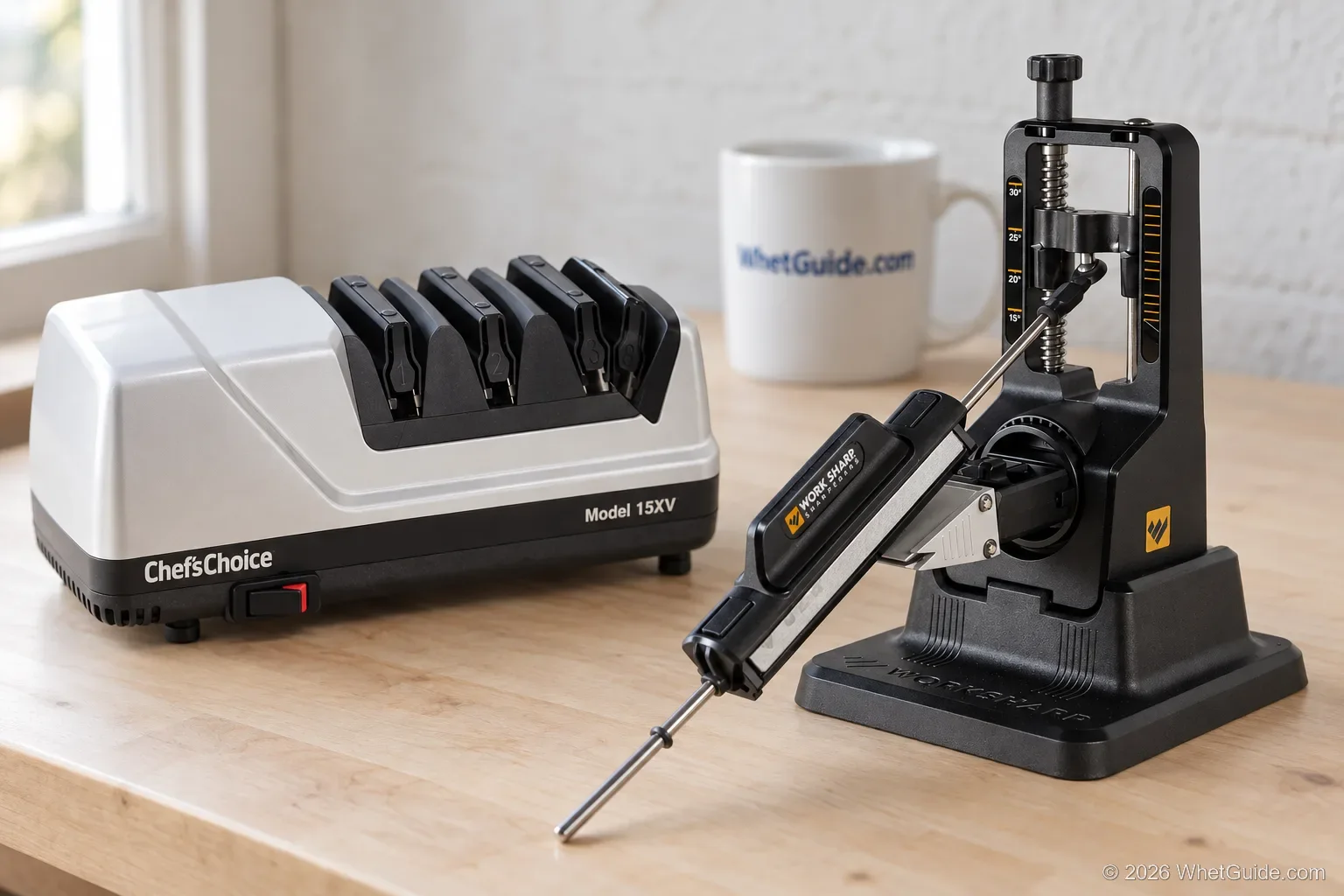
A guided manual system like the Work Sharp Precision Adjust holds the angle for a fraction of the cost. For kitchen knives, an electric like the Chef'sChoice 15XV is faster. Our best sharpening system guide weighs both kinds. For a premium manual precision system, compare the Wicked Edge.
| Step up the ladder | Price when checked | What you get | Read more |
|---|---|---|---|
| Whetstones | Less than any machine here | Everything a Tormek does, slower, with a learning curve | Whetstone vs sharpener, beginner sets |
| Work Sharp Precision Adjust | $69.95 | A clamped, guided angle from 15 to 30 degrees | Review |
| Chef'sChoice 15XV | $165.99 | A fast three-stage electric for kitchen knives | Best electric sharpeners |
| Work Sharp Ken Onion Mk2 | $179.95 | A powered belt sharpener for knives and some tools | Mk2 vs Ken Onion |
| Tormek T-1 | $428 | The first Tormek | Card above |
Who should skip a Tormek
- Anyone sharpening mostly serrated knives. None of the four handles serrations. A tapered rod costs a fraction of a T-1.
- Owners of single-bevel Japanese knives (yanagiba, deba, usuba) and strongly asymmetric edges. GearJunkie's T-4 review lists these among the things it would leave off the machine; a flat waterstone suits them better.
- Cooks with three inexpensive stamped knives. A good kitchen sharpener or a sharpening service once or twice a year costs less than a T-1 for years.
- Fans of convex edges. Every Tormek wheel grinds a flat or slightly hollow bevel; a convex edge comes from a strop, a slack belt or a mousepad and sandpaper.
- Small kitchens with no drawer space and no tolerance for a 54 dB motor. The T-1 is small and quiet; the others aren't.
Hand sharpening also deserves a word. If you already enjoy a whetstone and get the edge you want, a Tormek is a speed upgrade, not an edge upgrade. Owners on Blade Forums argue about whether a Tormek or a Wicked Edge gets the keener edge. Our whetstone guide is the free alternative.
↑ Back to all sectionsChoosing jigs for a T-4 or T-8
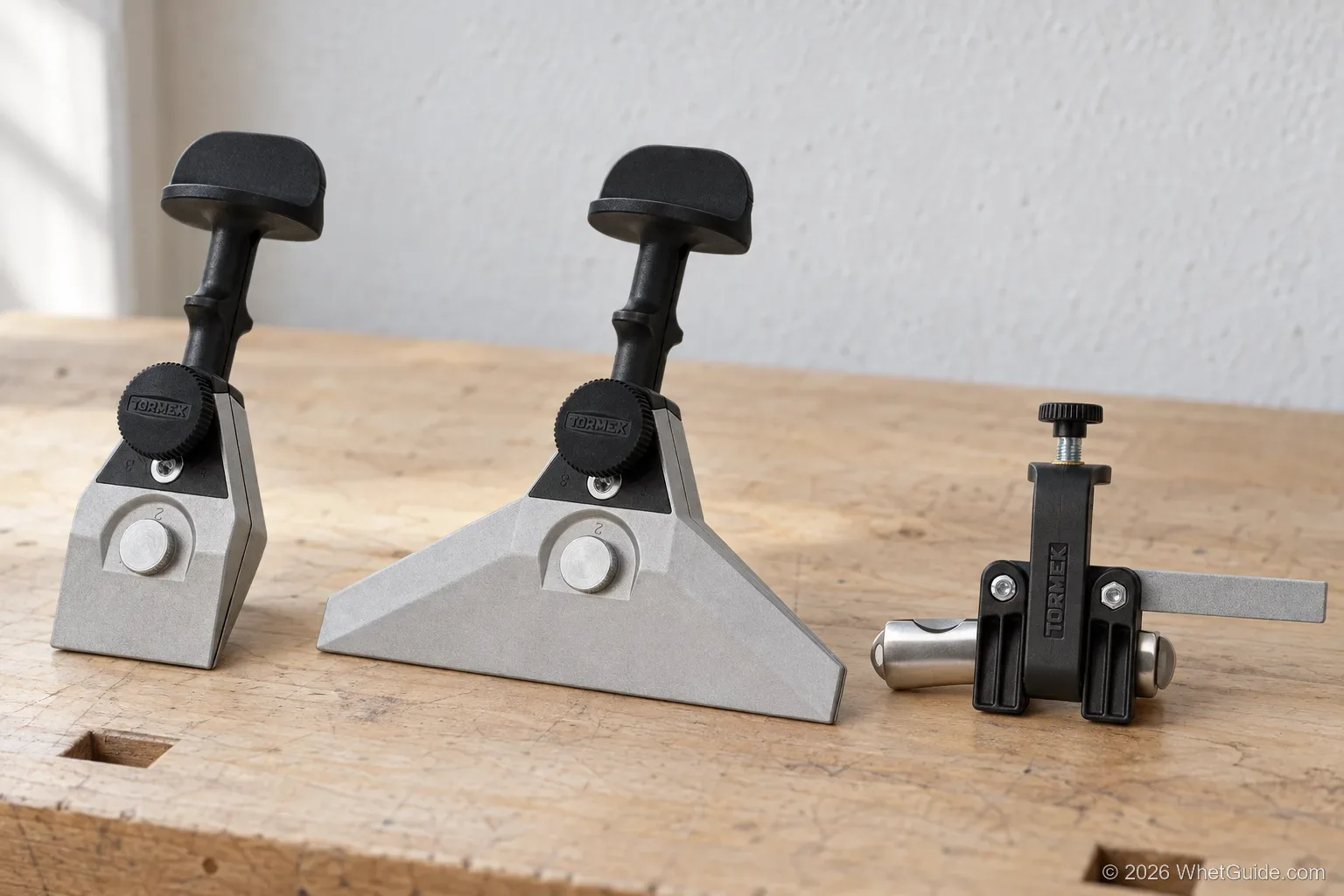
Buy the KJ-45 first. It's Tormek's centering knife jig: it clamps the blade so the spine sits centered, which makes the angle repeat when you flip the knife to do the other side. For most chef's and utility knives, and for hunting knives too, it's the only jig you'll need ($73 when checked). The KJ-140 ($93) is the same idea with a wider clamp for long, flexible slicers and fillet knives that would bend in the KJ-45. The SVM-00 ($55) holds small blades, including paring knives and short pocketknives.
Two add-ons help with angle and length. The KS-123 angle adjuster ($61.70) sets a knife angle directly instead of reading it with the Angle Master. The US-430 extended support ($130) gives long blades and cleavers a longer bar to ride on. If you'll sharpen many kinds of knives, the KSK-106 set ($395) bundles Tormek's knife jigs; check its listing for the exact contents before you assume it has a jig you need.
↑ Back to all sectionsSetting the angle on a T-4 or T-8, step by step
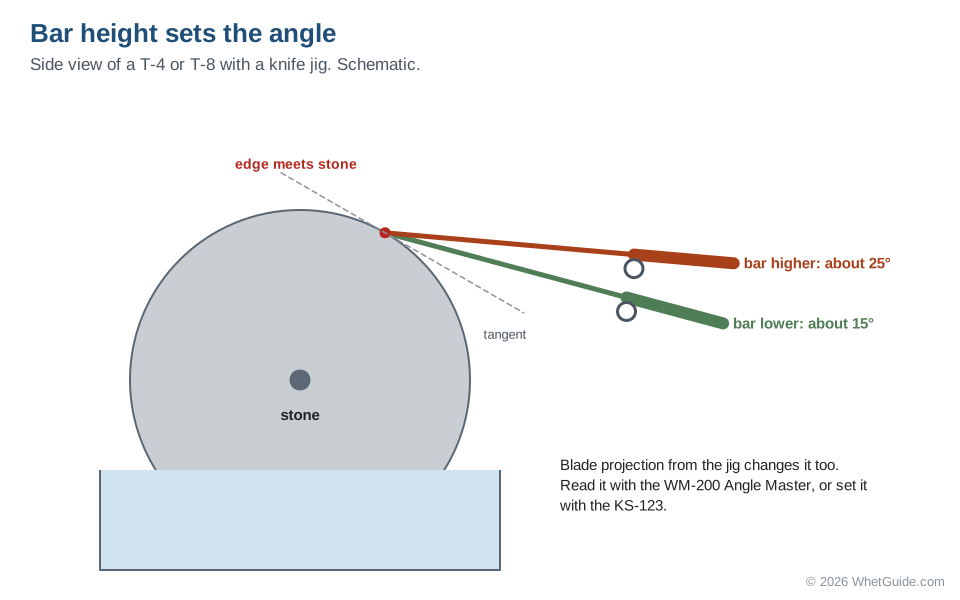
- Clamp the knife. Put the blade in the KJ-45 with the spine against the stop so the jig centers it. Tighten it. Note how far the blade projects, because that distance is part of your angle.
- Fit the support bar over the stone and slide the jig onto it. Follow Tormek's knife instructions for the bar position and the direction the stone turns against the edge.
- Set the angle. Put the WM-200 Angle Master on the stone at your target (say 15 or 20 degrees per side) and raise or lower the bar until the knife's bevel lines up with it. With a KS-123, set the number and adjust the bar to match.
- Check it with a marker. Color the bevel, give it one light turn on the stone, and look. Ink gone from shoulder to edge means you've matched it. The Sharpie trick guide shows what each result means.
- Grind until a burr forms along the whole edge, moving the jig from heel to tip with light pressure. Flip the jig and do the other side to the same burr.
- Hone on the leather wheel with PA-70, edge trailing, alternating sides with light passes until the burr is gone.
- Leave the bar where it is if you have more knives at the same angle. Repeat sharpening is where a jig system pays for itself: the second knife needs no setup.
That's the whole difference in workload between the two families. On a T-1, step 3 is turning a dial and the rest is drawing the knife through the guide. On a T-4 or T-8, the first knife takes the setup, and every knife after it is quick.
↑ Back to all sectionsFirst-day checklist
- Keep the box and receipt until the registration is done. The extra three years only apply if you register within 90 days, per Tormek.
- Start on a cheap knife, not the best one in the block. The first session teaches you the machine.
- On a T-4 or T-8, grade the stone coarse with the SP-650 for a dull edge, and fine once you have a burr.
- Label each jig's setting for each knife (a strip of masking tape works) so the next session needs no measuring.
- On a T-1, go light. Home reviewers keep coming back to that point; let the wheel do the work.
- Drain and wipe the trough after a T-4 or T-8 session so the stone doesn't sit in water.
Which wheels fit which machine
| Wheel | T-1 | T-2 Pro | T-4 (200 mm) | T-8 (250 mm) |
|---|---|---|---|---|
| Original grindstone | n/a | n/a | SG-200 | SG-250 |
| Diamond, coarse / fine / extra fine | Fixed fine wheel | DWC-200, DWF-200, DWE-200 | DC-200, DF-200, DE-200 | DC-250, DF-250, DE-250 |
| Japanese waterstone 4000 | n/a | n/a | SJ-200 | SJ-250 |
| Blackstone silicon | n/a | n/a | No | SB-250 |
| Honing wheel | PW-160 composite | PW-160 composite | LA-145 leather | LA-220 leather |
The plain-English version: wheels do not swap between the T-4 and T-8, and none of the workshop wheels fits the kitchen machines. Jigs do swap between the T-4 and T-8. If you think you'll outgrow a T-4, buy jigs freely and wheels carefully, since only the jigs move with you to a T-8.
↑ Back to all sectionsUpkeep: what each machine asks of you
| Job | T-1 and T-2 Pro | T-4 and T-8 |
|---|---|---|
| After each session | Wipe the swarf, brush the guide | Drain the trough, wipe the machine, dry the leather |
| Now and then | Nothing scheduled | Grade the stone with the SP-650; re-paste the leather |
| When the stone runs out of round | n/a | True it with the TT-50 (included on the T-8) |
| Between uses | Store covered, in a drawer or on the counter | Cover it (an MH-380 machine cover, $39); keep the stone dry |
| Stone vibrates or the edge comes off uneven | n/a | The stone is likely out of round: true it |
| The other half of edge life | Boards and storage, plus washing, in the knife care guide | |
Common mistakes and the fixes
| Mistake | What happens | Fix |
|---|---|---|
| Buying a T-4 or T-8 Original for knives with no knife jig | The machine can't hold a knife at a set angle | Order a KJ-45 in the same cart, or buy a bundle with one |
| Pressing hard on a T-1 | The wheel slows; the edge comes out uneven | Light pressure, steady draw, let the diamond cut |
| Honing with the leather turning into the edge | The edge digs into the leather | Edge trailing on the honing wheel, always |
| Skipping the angle check | You grind a new bevel instead of sharpening the old one | Marker on the bevel, one light turn, look |
| Never truing the stone | Vibration, uneven bevels | TT-50 when the stone runs out of round |
| Missing the 90-day registration | 5 years of warranty instead of 8 | Register the day it arrives |
| Buying T-4 wheels before moving to a T-8 | They don't fit the T-8 | Buy jigs freely, wheels for the machine you'll keep |
| Putting a bread knife on any Tormek | Flattens the serrations | A tapered rod, by hand |
What owners and reviewers say
| Point | Where it comes up | Our take |
|---|---|---|
| The T-4's duty rating | Tormek forum and UK Workshop owners quote the old 30 minutes per hour; Tormek now lists continuous | Use Tormek's current figure; buy the T-8 if you'll grind for hours |
| T-8 for a fixed bench, T-4 to carry | UK Workshop T-4 vs T-8 thread | Matches the weights: 14.8 kg vs 8 kg |
| Light pressure on the T-1 | Tom's Guide and PureWow T-1 reviews | Good advice; the T-1's torque is 2 Nm |
| Not for single-bevel, asymmetric knives or khukuris | GearJunkie T-4 Bushcraft review (8.9/10) | Agree; use a flat stone for those |
| Tormek vs Wicked Edge sharpness | Blade Forums threads | Both get there; the Tormek is faster across many knives; the Wicked Edge clamps each knife for fine angle control |
| Price with accessories | GearJunkie: over $1,600 for its T-4 Bushcraft setup | Budget for jigs from the start |
These are recurring themes from owner forums and published reviews, with the source named; we don't count posts, so read them as themes, not tallies. GearJunkie's review is the most useful hands-on account we found for the workshop machines: it used a T-4 Bushcraft on wildland fire tools and about 30 kitchen knives, and reported the 0.01 mm hollow mentioned above. For the T-1, the home-cook reviews read the same way: easy and quick but pricey, and best with a light hand.
↑ Back to all sectionsWarranty in plain words
| Machine | Standard | With registration in 90 days | Commercial use |
|---|---|---|---|
| T-1 | 5 years | 8 years | Not covered: home use only |
| T-2 Pro | 5 years | 8 years | Covered in commercial kitchens per Tormek's FAQ; confirm the terms with your dealer |
| T-4 | 5 years | 8 years | 2 years (commercial, industrial or educational) |
| T-8 | 5 years | 8 years | Check Tormek's current terms |
The registration step is the cheapest three years you'll ever buy, and it's the one most often missed. Note that Highland Woodworking's older T-4 vs T-8 page still says seven years; Tormek's current figure is five plus three.
↑ Back to all sectionsTormek T-1 vs T-2 vs T-4 vs T-8 cheat sheet
| T-1 | Home kitchen. Dry 150 mm diamond cone, 8 to 22 degrees per side, 45 dB, 5.4 kg, intermittent duty, home-use warranty. $428 when checked. |
|---|---|
| T-2 Pro | Professional kitchen. Dry 200 mm diamond, 360 and 1200 options, continuous duty, scissors and round-blade accessories. Dealer only, about $895. |
| T-4 | Home workshop. 200 mm water stone, 145 mm leather, 8.4 Nm, 8 kg. Add a KJ-45 for knives and a TT-50 for truing. $613 when checked. |
| T-8 | Heavy use. 250 mm water stone, 220 mm leather, 14.7 Nm, 25,000-hour motor, 14.8 kg, SE-77 and TT-50 included. Add a knife jig. $1,066 when checked. |
| Jigs | T-4 and T-8 share them. KJ-45 knives, KJ-140 long flexible knives, SVM-00 small blades, SE-77 chisels, AX-40 axes. T-1 and T-2 take none. |
| Wheels | 200 mm wheels fit the T-4, 250 mm the T-8. Nothing crosses between the kitchen and workshop machines. |
| Honing | Composite wheel on the T-1 and T-2, no paste. Leather plus PA-70 on the T-4 and T-8, edge trailing. |
| Warranty | 5 years, 8 if registered within 90 days. T-1 home use only. T-4 commercial use: 2 years. |
| Never | Serrated bread knives, on any of them. |
The one most people should buy
If kitchen knives are the only edges in your house, buy the Tormek T-1. Its 8° to 22° range covers every common kitchen angle. The moment a chisel or an axe enters the picture, the answer changes to the T-4, or the T-8 if you'll run it for hours. Order a knife jig in the same cart, because neither Original model ships with one. If you run a kitchen, call a Tormek dealer about the T-2 Pro instead of stretching a T-1's home warranty. And if the price of any of these made you wince, you're not the buyer Tormek built them for: a guided sharpener at a sixth of the price will keep your knives sharp, and you can come back to this page when you have a garage full of tools.
Specifications from Tormek's official product and machine-comparison pages. Prices are Amazon prices checked November 14, 2026 (T-2 Pro: Sharpening Supplies), shown as "price when checked"; prices change, so read the listing before you buy. How we research · Affiliate disclosure