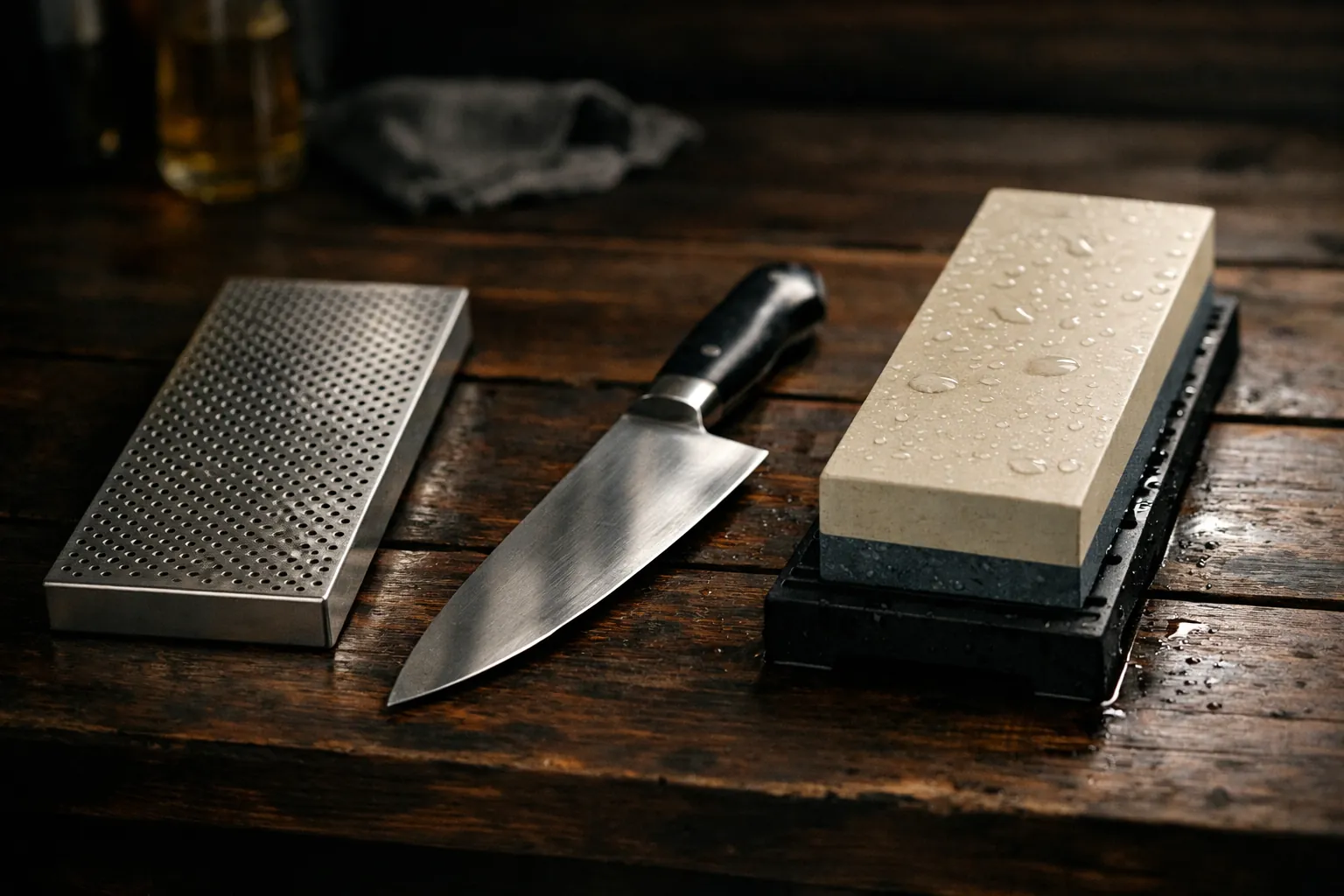
Quick answer: water stone or diamond plate?
For kitchen knives, buy a water stone (whetstone) first. It gives a finer, more polished edge, and you get more grits for the money. A diamond stone is faster and stays flat. It also cuts very hard steels easily, so it's the better first buy for pocket knives in hard modern steels. It's also the tool for flattening water stones, which is why so many sharpeners end up owning one of each. If you search for a "diamond whetstone," that means a diamond plate like these; the best flattening stone guide covers the plates used to keep water stones flat.
| Your main knives | Buy first | Add later |
|---|---|---|
| German or Victorinox kitchen knives | A 1000/6000 water stone | A coarse diamond plate to flatten it |
| Japanese kitchen knives | A 1000 and a 5000 or 6000 water stone | A coarse plate for chips and flattening |
| Folders in S30V, M390 or similar | A 325/1200 diamond plate | A fine water stone or a strop |
| Hunting and camp knives | A diamond plate plus a pocket stone | A fine ceramic or Arkansas stone |
| Ceramic (zirconia) knives | A fine diamond plate | Nothing; water stones barely cut it |
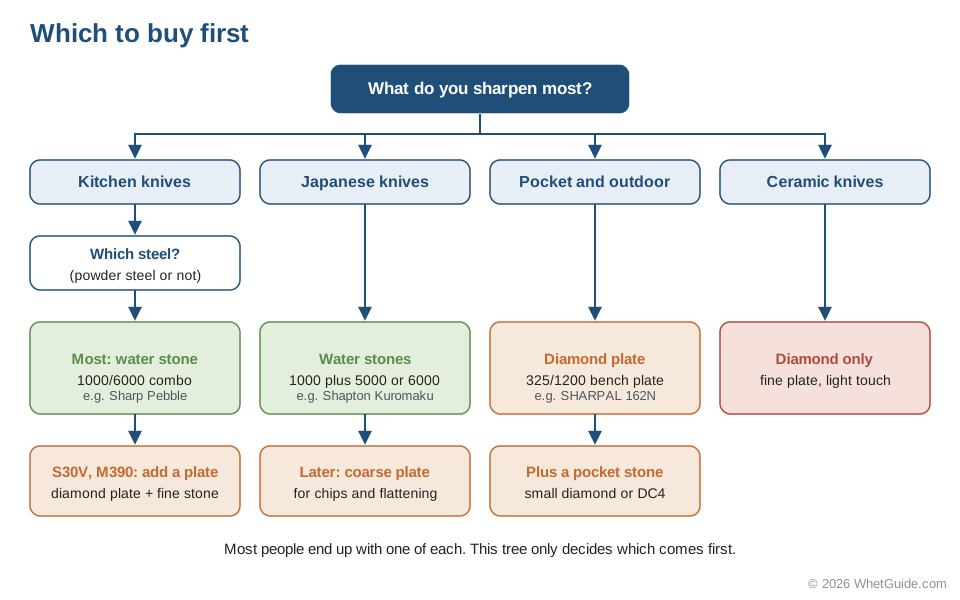
Put simply, diamond is the faster, tougher tool. Water stones leave the nicer edge for less money. The tree below turns that into a first purchase. If you'd rather start from your knife's steel, jump to steel hardness; if you already own one of each and want to know how to use them together, go to using both.
This comparison is standard sharpening practice, plus what named makers and shops publish. Products are described from their Amazon listings, checked October 3, 2026; new material added November 14, 2026. How we research.
What is a diamond whetstone?
A diamond whetstone is a diamond plate: a flat metal base coated with diamond particles. It isn't a stone at all, but that's the name people search for, and it does the same job a water stone does. The diamond cuts, and the diamond doesn't wear away the way a water stone does, so the surface stays flat far longer. It also grinds hard steels that a water stone cuts slowly.
One catch is the numbers. Diamond plates are often rated in microns or mesh, while a water stone uses JIS grit, so a 1200 plate and a 1200 water stone leave different finishes. Grit vs microns sorts out the scales, and the side-by-side session shows how each one is used.
↑ Back to all sectionsWhetstone vs diamond stone at a glance
| Water stone (whetstone) | Diamond plate | |
|---|---|---|
| Abrasive | Aluminum oxide or silicon carbide in a bonded stone | Diamond particles bonded to a steel plate |
| Cutting speed | Moderate | Fast |
| Flatness | Wears and dishes; needs flattening | Stays flat |
| Very hard steels | Slower | Handles easily |
| Finest finish available | Very fine (8000+ common) | Fewer very fine options |
| Feedback and feel | Smooth, builds slurry | Scratchier, especially when new |
| Prep | Soak (or splash-and-go types) | Dry or a splash of water |
| Cost per grit | Lower | Higher |
| Common grit range | About 120 to 8000+ (Sharpening Supplies) | About 120 to 1200 on most plates; DMT goes to 8000 mesh |
| Break-in | None | Feels coarse for its first few sessions (Koi Knives) |
| Rust risk | None; it's a ceramic stone | The steel base can rust if soaked or stored wet |
| Mess | Slurry, soaking tub, wet towel | A little gray water |
| Best at | Sharpening and polishing kitchen knives | Repairs, hard steels, flattening other stones |
| Weak at | Hard powder steels; staying flat | Fine polish; gentle feedback for beginners |
The top eight rows are the ones people argue about; the rest are the everyday things nobody mentions until the stone is on the counter, like rust on a plate left wet or the rough first week of a new one. Neither column wins outright. Woodcraft's comparison table sums up diamond in a few words: "light strokes, no polishing grits." Sharpening Supplies, which sells both, says water stones are commonly used after diamond for the finest polish. Every source we read agrees on that split, from woodworking shops to Japanese knife sellers, and it's why the two-tool setup keeps showing up.
↑ Back to all sectionsWhy they feel so different
A water stone's binder lets go of worn abrasive and exposes fresh grains. The loose grains mix with water into a slurry that helps polish. Water stones feel smooth and leave fine finishes for the same reason they slowly dish. You can feel the slurry working: the stone goes slightly muddy under the blade, the sound softens, and the edge picks up an even, hazy finish. That feedback is a big part of why beginners learn faster on a water stone. When the angle wobbles, the stone tells you through the change in sound and drag.
Diamond is the hardest abrasive in common use. A diamond plate cuts even very hard, wear-resistant steels quickly and keeps its shape while doing it. One catch: grit numbers don't line up exactly between the two, and the grit chart explains why. The plate doesn't release anything, so there is no slurry, just a thin gray film of steel in the water. It feels and sounds scratchier, more like a file than a stone, and the edge shows a more visible scratch pattern.
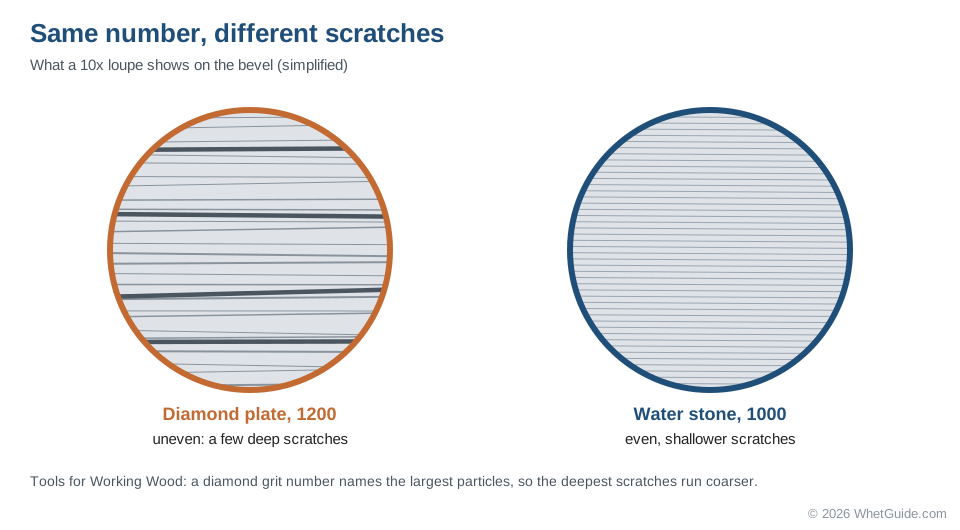
That scratch pattern is the real reason most cooks finish on a water stone. Tools for Working Wood explains it this way: the grit number on a diamond plate names the largest particles, so a few of them cut deeper than the label suggests. A 1200 diamond edge bites hard into rope and cardboard, which pocket-knife owners like. On a tomato or a piece of fish it can feel a little grabby next to an edge finished at 5000 or 6000.
Grit vs microns: what the numbers on each really mean
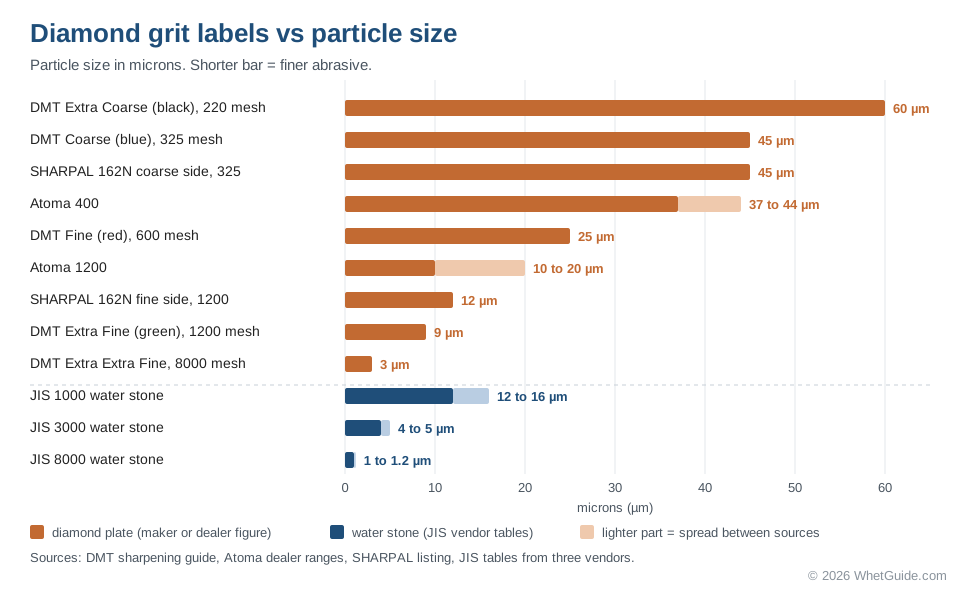
Water stones mostly use the Japanese JIS grit scale. Diamond plates use mesh numbers, color codes or the maker's own grit labels. The only number that compares across all of them is the particle size in microns (µm), and the better diamond makers print it. DMT's own sharpening guide gives every color a micron size, SHARPAL lists both sides of the 162N, and Atoma dealers publish ranges. Here they are on one scale, with three JIS water-stone rows for reference.
| Plate or stone | Label | Microns | Closest water stone (by microns) |
|---|---|---|---|
| DMT Extra Coarse (black) | 220 mesh | 60 | About JIS 220 |
| DMT Coarse (blue) | 325 mesh | 45 | About JIS 320 |
| SHARPAL 162N coarse side | 325 grit | 45 | About JIS 320 |
| Atoma 400 | 400 | 37 to 44 | JIS 320 to 400 |
| DMT Fine (red) | 600 mesh | 25 | About JIS 600 |
| SHARPAL 162N fine side | 1200 grit | 12 | JIS 1000 to 1200 |
| Atoma 1200 | 1200 | 10 to 20 | JIS 800 to 1200 |
| DMT Extra Fine (green) | 1200 mesh | 9 | About JIS 1500 |
| DMT Extra Extra Fine (tan) | 8000 mesh | 3 | About JIS 4000 |
Three things to take from it. First, "1200" means three different sizes on three plates: 12 microns on the SHARPAL, 10 to 20 on an Atoma, 9 on a DMT green. Second, a DMT plate labeled 8000 mesh is about a JIS 4000 stone, not a JIS 8000. Third, even when the microns match, the diamond plate still feels coarser, because diamond is so much harder than the steel and the largest particles set the deepest scratch. When you plan a progression from a plate to a stone, step to a water stone at least one size finer than the plate's micron figure suggests. The complete JIS to FEPA to ANSI conversion table sits on the sharpening stone grit chart.
↑ Back to all sectionsHow fine each one goes
Sharpening Supplies puts water stones at roughly 120 to 8000 and beyond, and diamond plates widely available up to about 1200. That ceiling is the single biggest difference in use for a cook. Most of what makes a kitchen edge feel refined happens between 3000 and 8000, and that zone belongs to water stones. DMT does sell an extra extra fine 8000 mesh plate, but at 3 microns it sits at about JIS 4000, and it's a specialty item, not what comes in a typical 325/1200 plate box.
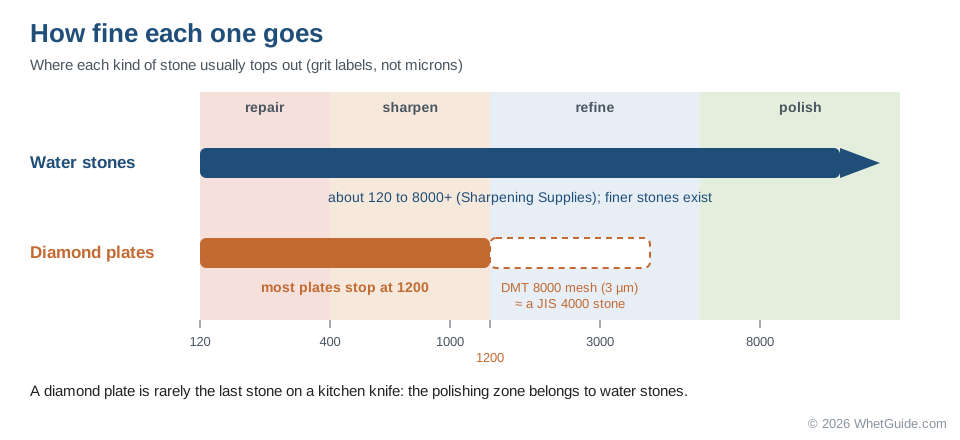
So a diamond plate is rarely the last stone on a kitchen knife. On a pocket knife it often is, and that's fine: a 1200 edge with some tooth is what many folder owners want. If you want both, the answer is a ladder, not a single tool, and the using both section lays it out.
↑ Back to all sectionsElectroplated vs sintered diamond: how plates are built
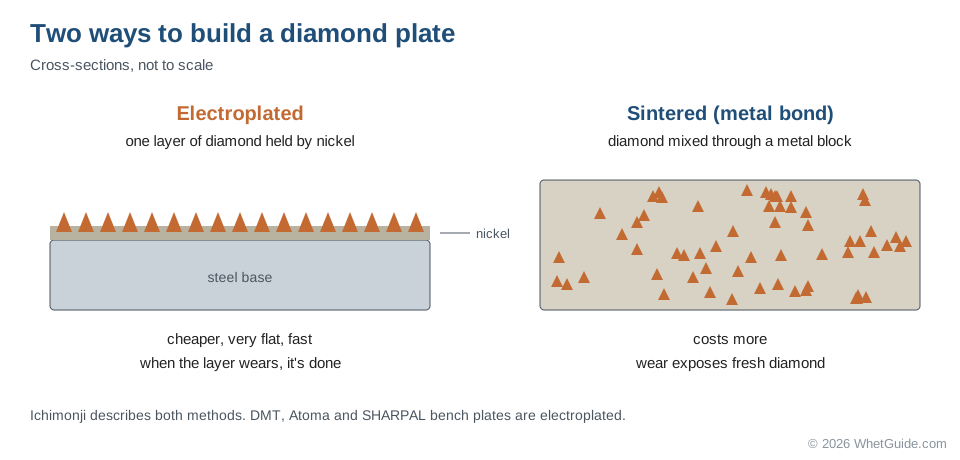
Ichimonji, a Japanese knife shop that also sells diamond stones, describes two ways to make one. Electroplated (also called electrodeposited) plates hold a single layer of diamond on a steel base with a thin layer of nickel. Sintered plates, sometimes called metal-bonded, mix diamond through a block of metal powder that's pressed and heated into a solid. DMT and SHARPAL bench plates, along with Atoma's, are all electroplated, which is what most home sharpeners will buy.
| Electroplated | Sintered (metal bond) | |
|---|---|---|
| Diamond layer | One layer on the surface | Through the whole block |
| Price | Lower | Higher |
| Flatness | Set by the steel base | Set by the block; can be lapped |
| As it wears | Loses bite; done when the layer is gone | Fresh diamond is exposed |
| Common use | Bench plates plus folding and pocket stones | Premium Japanese diamond stones |
For a home kitchen, electroplated is the sensible buy. The plate's flatness comes from its steel base, it cuts fast from day one, and the single layer lasts years at home pressure. A sintered stone is the pick for someone who sharpens daily or professionally and wants a diamond stone that behaves more like a conventional stone over time. Whichever you own, the care rules below are the same.
↑ Back to all sectionsWhich should you buy?
| If you… | Choose | Example |
|---|---|---|
| Sharpen kitchen knives at home | Water stones | Sharp Pebble 1000/6000 |
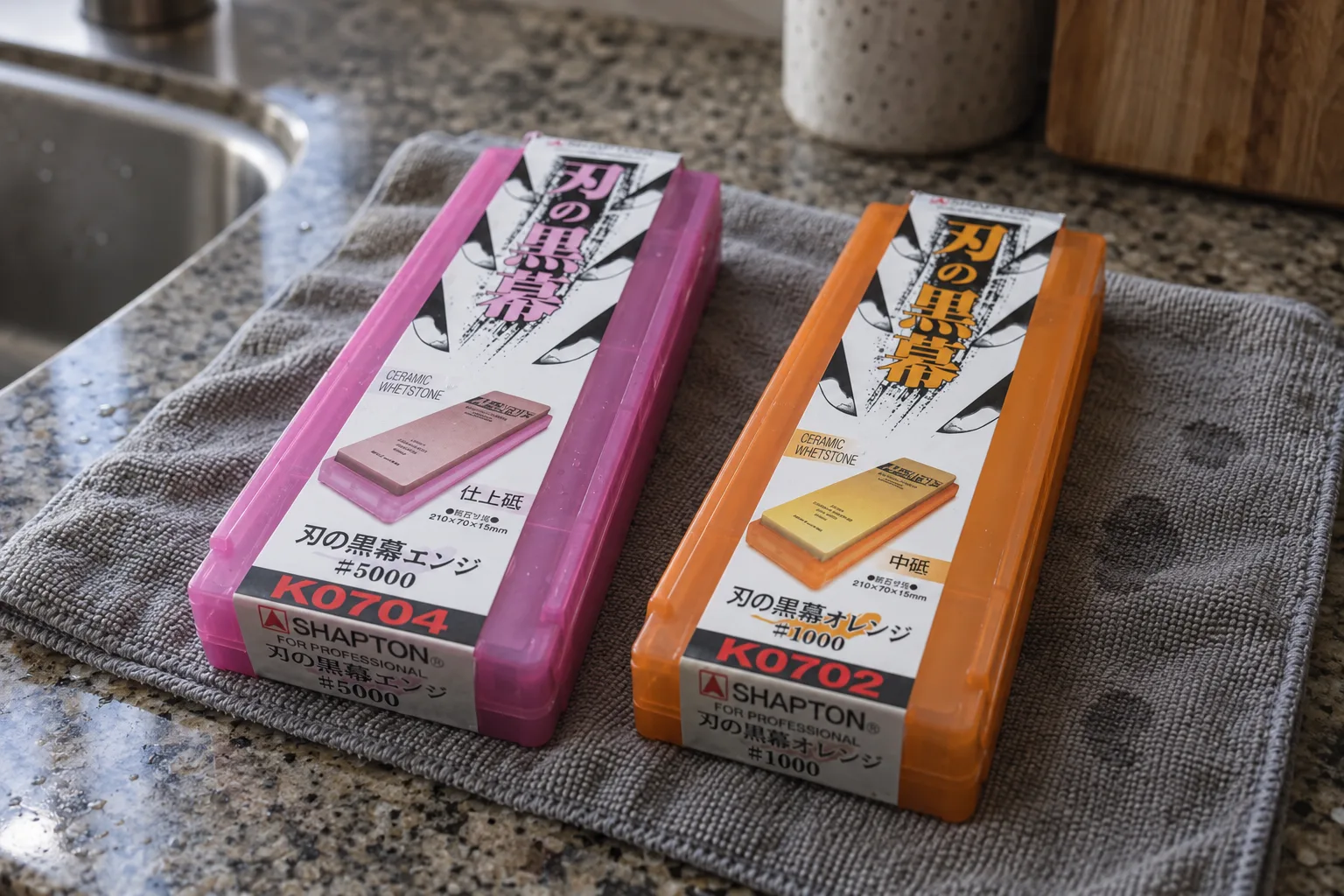
| Own Japanese knives and want a refined edge | Water stones | Shapton Kuromaku 1000 + 5000 |
| Carry pocket knives in very hard steels | Diamond plate | SHARPAL 162N 325/1200 |
| Need to repair chips fast | Coarse diamond plate | DMT Diafold FWFC coarse/fine |
| Need to flatten your water stones | Coarse diamond plate | SHARPAL 162N |
| Sharpen outdoors or on the go | Small diamond stone | Smith's DCS4 4" diamond |
Notice the SHARPAL appears twice. One 325/1200 plate covers both the hard-steel pocket knife and the flattening job, which is why it's the most common second purchase for people who started on a water stone. If you can only buy one thing today and your knives are kitchen knives, it's still the water stone.
↑ Back to all sectionsDiamond on kitchen knives: where the sources disagree
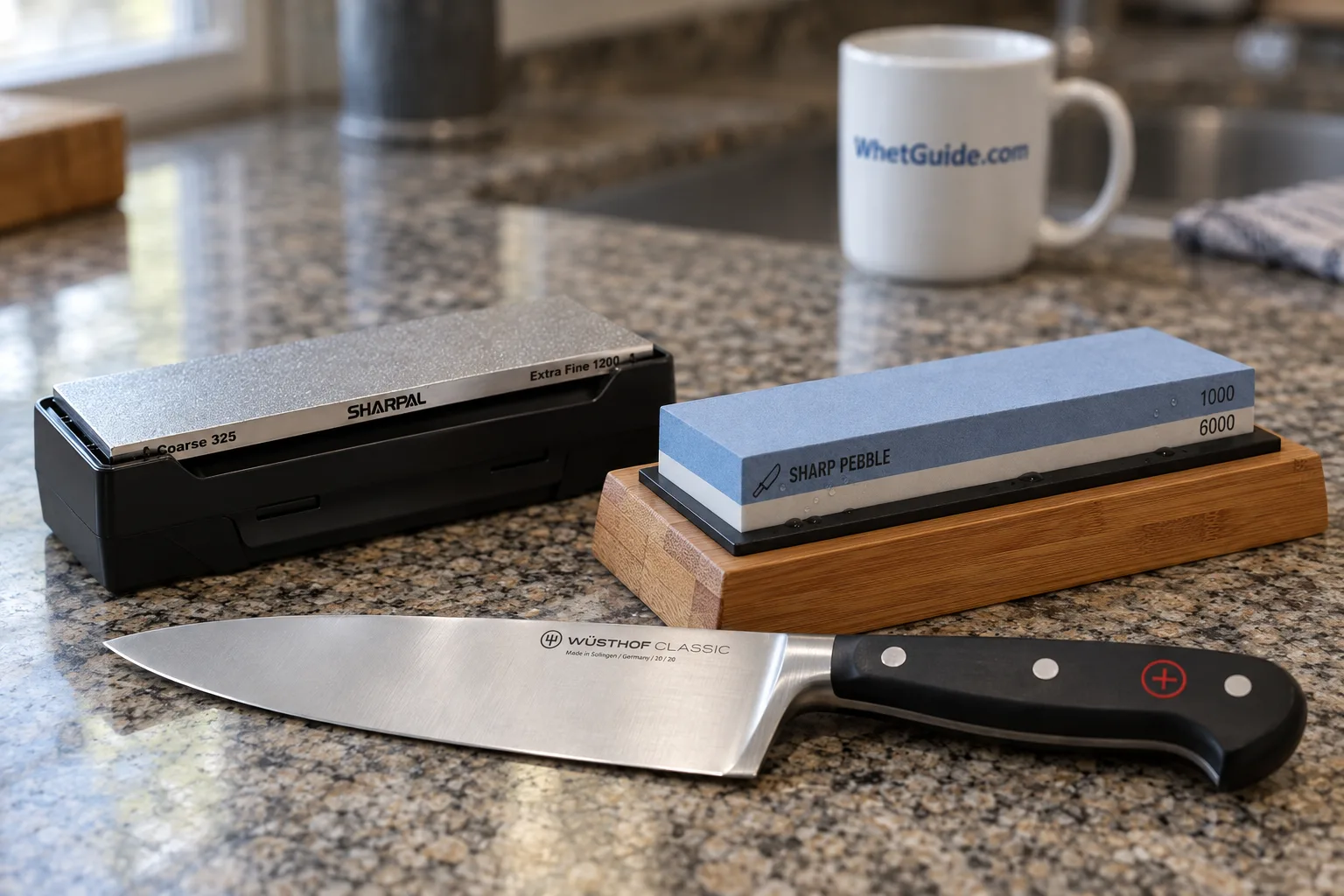
This is the one point where the sources split. One sharpening guide we read warns against diamond on good kitchen knives and says it leaves a brittle or dull-feeling edge. Retailers that sell diamond say it sharpens any knife quickly. Tools for Working Wood, writing mostly for woodworkers, calls diamond overkill for knives. Both camps are describing the same thing from different ends. A fine diamond plate works on a kitchen knife if you keep the pressure light. What it leaves is a scratchier edge than a water stone at the same number, and a coarse plate pressed hard can take off more steel than the knife needed. So our advice is simple: use diamond on a kitchen knife for repairs and for very hard steels, then finish on a water stone or a strop. For everyday sharpening of German and Victorinox knives, a 1000/6000 water stone is all you need, and the how to sharpen kitchen knives guide walks through it step by step.
↑ Back to all sectionsDiamond stones worth knowing
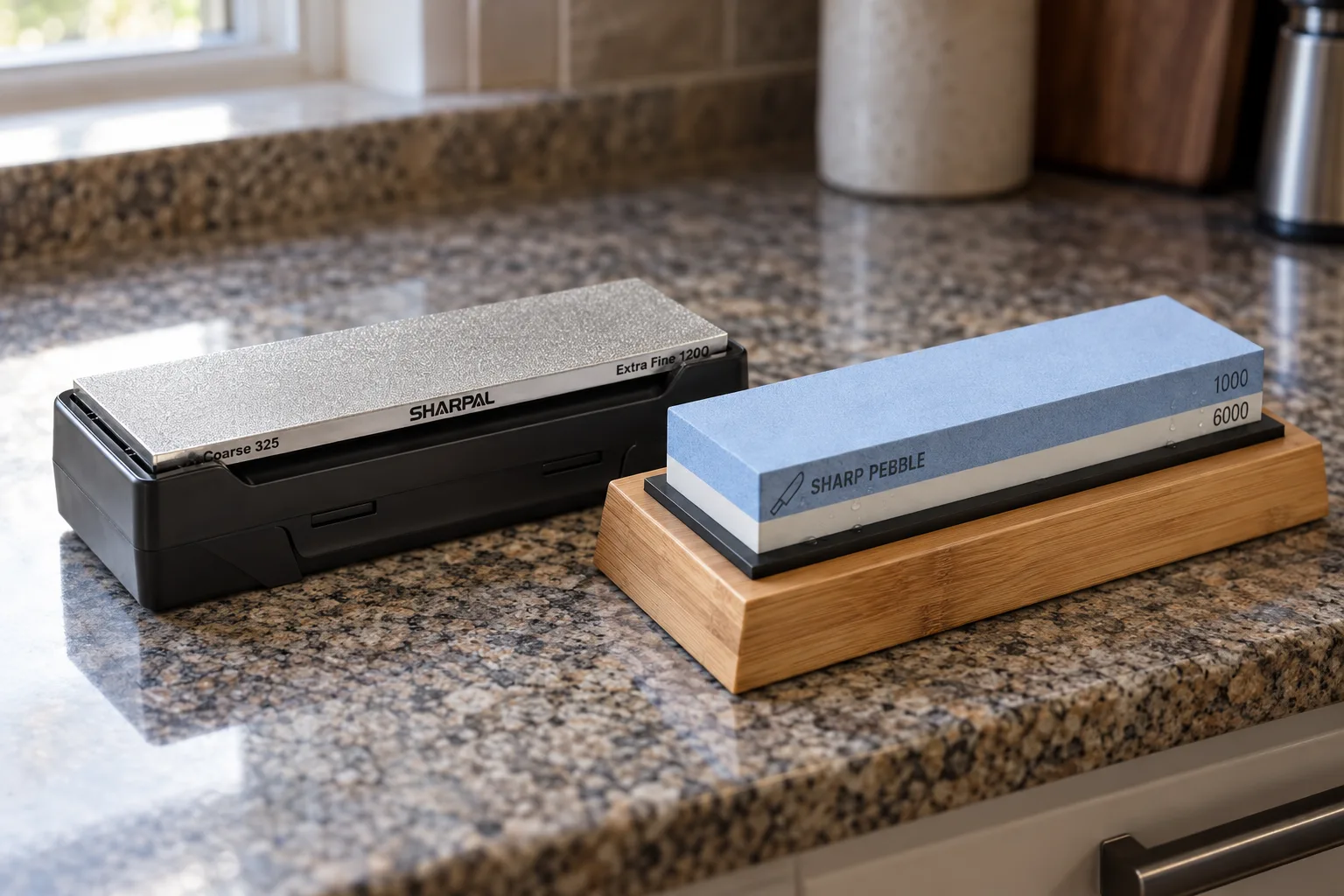
If you buy one diamond plate, make it the SHARPAL 162N. When we checked on October 3, 2026, it ranked in Amazon's top 10 sharpening stones with 1,000+ purchases the previous month. SHARPAL lists an 8 x 3 inch plate of monocrystalline diamond electroplated on stainless steel, with a coarse 325 grit (45 micron) side and an extra-fine 1200 grit (12 micron) side, usable dry. The storage box doubles as a non-slip base, and an angle guide with 14°, 17°, 20° and 25° settings comes with it. The coarse side repairs and flattens; the fine side sharpens. That's two of the three jobs on this page from one plate.
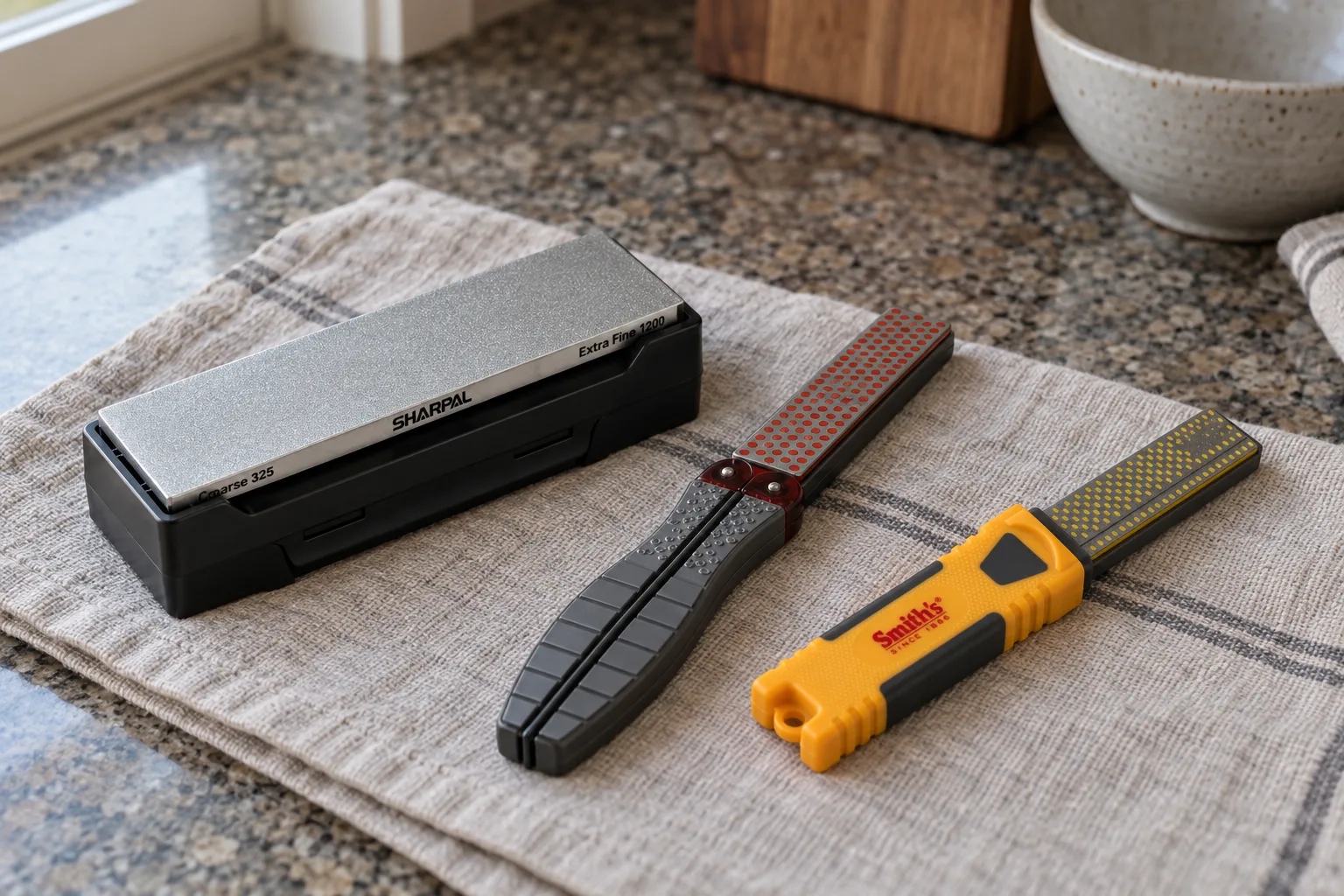
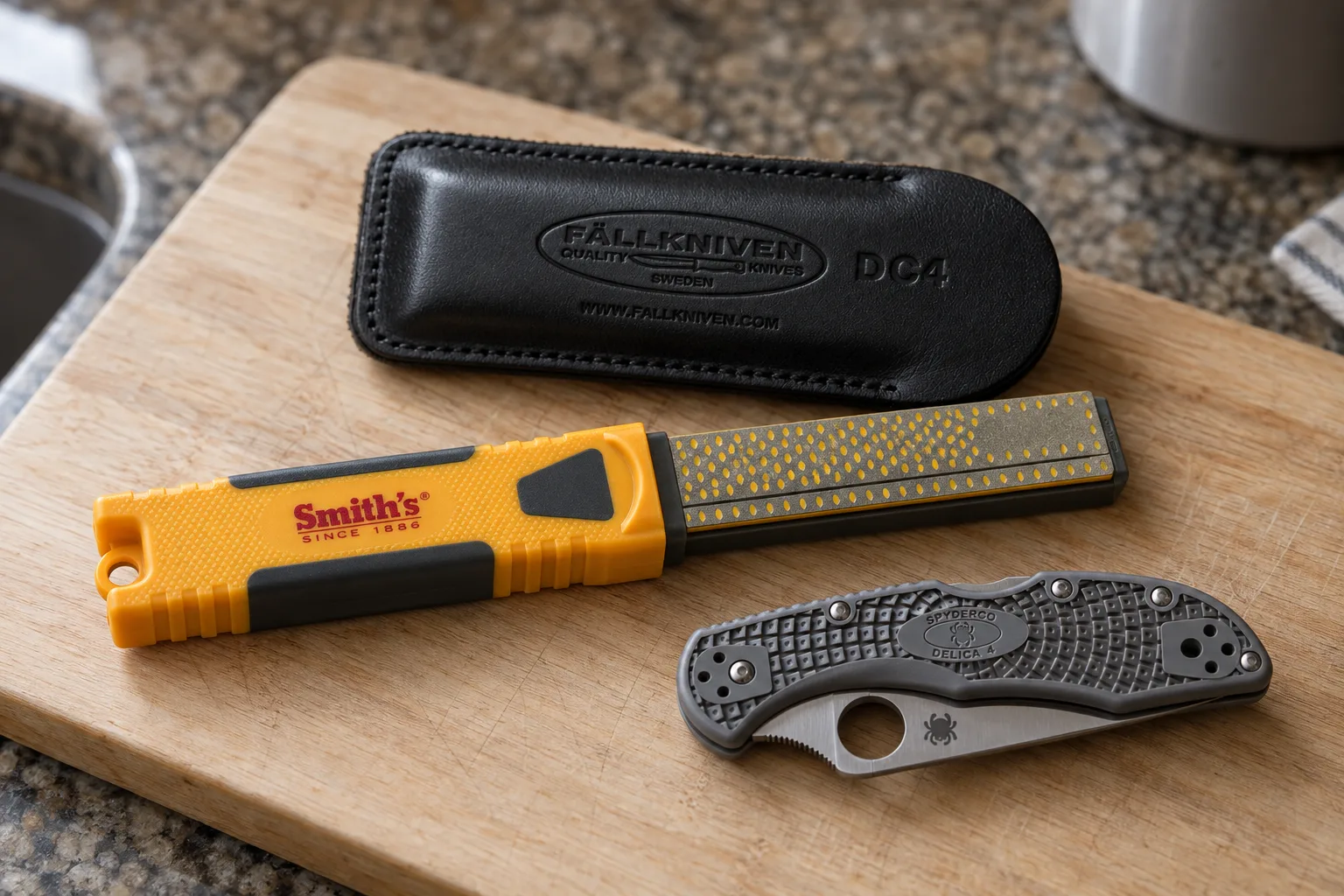
DMT has made diamond plates for a long time; its fine/coarse DMT Diafold (FWFC) is a folding sharpener, 9.5 inches open and 5 closed, with 45 micron and 25 micron sides. (Amazon's title calls it a DuoSharp 8-inch, but the model number and the listing's own bullets describe the Diafold.) Our DMT sharpener review decodes DMT's grit colors and line names. For other pocket or pack options, look at the Smith's DCS4 or the Fallkniven DC4, which has diamond on one side and ceramic on the other. We rank plates by specs and sales in best diamond sharpening stone.
| Format | Example | Grits listed | Good for |
|---|---|---|---|
| Bench plate, two-sided | SHARPAL 162N | 325 and 1200 | Home sharpening, flattening, hard steels |
| Folding sharpener | DMT Diafold FWFC | Coarse 45 µm, fine 25 µm | Packs, tackle boxes, shop drawers |
| Pocket stone | Smith's DCS4 | 4-inch diamond | Field touch-ups |
| Diamond plus ceramic | Fallkniven DC4 | Diamond one side, ceramic the other | Field sharpening and finishing in one stone |
Other diamond plates worth a look if those don't fit: DMT's 8-inch Dia-Sharp bench plates in fine or coarse, the smaller DMT 6-inch fine/coarse, the SHARPAL 156N at 6 x 2.5 inches for folders, and the Atoma 400 and 1200 plates if you want the premium option that many Japanese-knife sharpeners use to flatten stones. The budget plates section handles budget 400/1000 plates.
↑ Back to all sectionsWater stones worth knowing
One 1000/6000 combination stone handles sharpening and finishing for most kitchens. The Sharp Pebble 1000/6000 and the King KW65 are the usual starting points. Shapton's Kuromaku stones are the step up if you'd rather splash and go than soak. Beyond these, the best whetstone sets for beginners lines up more kits. A combination stone soaks as one piece, so check the maker's note: some say to soak until the bubbles stop, and splash-and-go stones like the Shapton only need water on top.
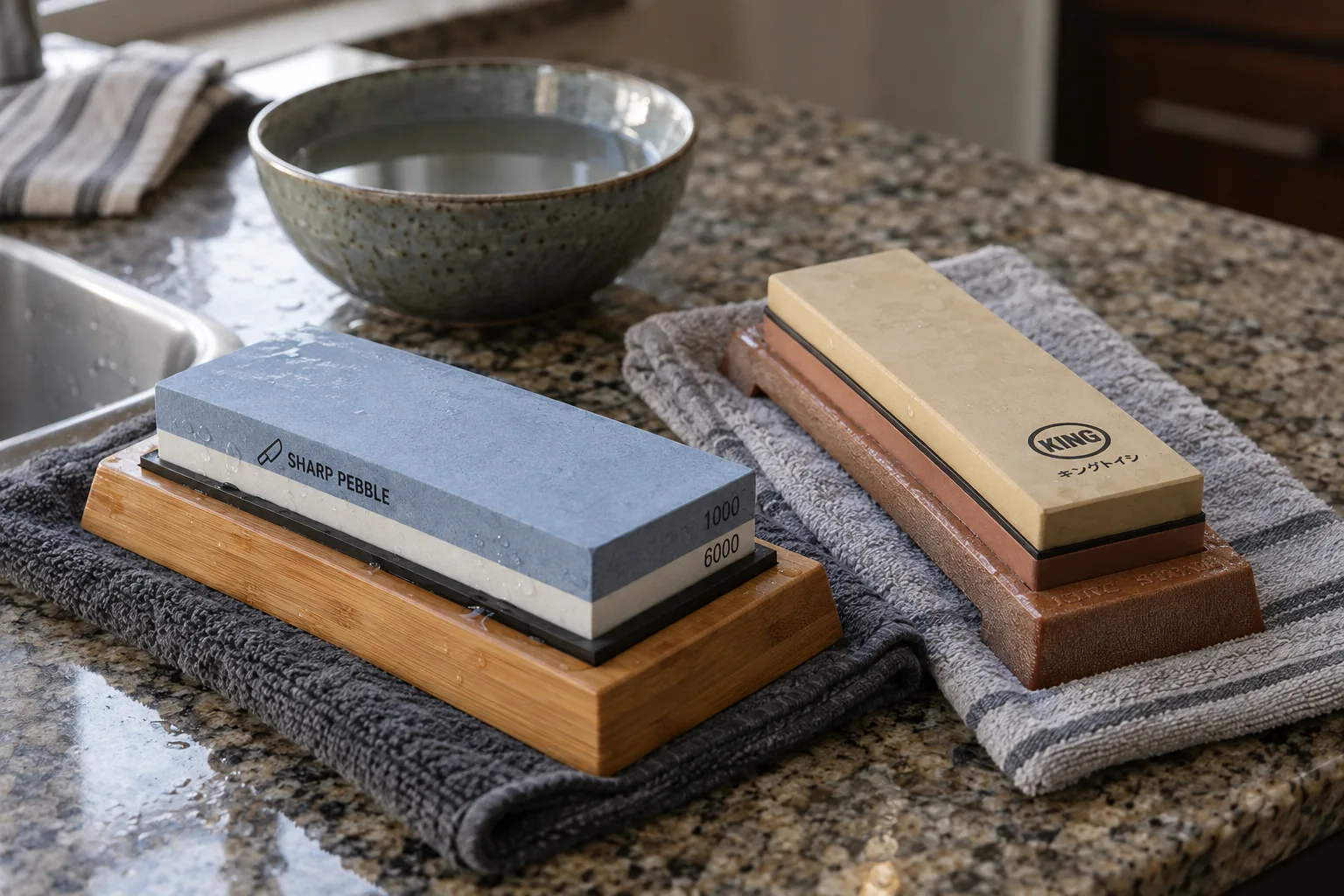
Past the combination stones, the water-stone choices fan out quickly. Splash-and-go 1000 stones such as the Suehiro Cerax 1000 and the Shapton Pro 1000 skip the soak. A Sharp Pebble 400/1000 adds a coarser repair side for chipped edges, and a Sharp Pebble 3000/8000 or a King 6000 extends the finish. Naniwa's Chosera 400 and Goken 1000 are common in Japanese-knife kits. Those get in-depth treatment in the best Japanese whetstone guide.
| Stone type | Prep | Typical grits | Pick it if |
|---|---|---|---|
| Combination soaking stone | Soak until bubbles stop | 1000/6000, 400/1000, 3000/8000 | You want one stone and a low price |
| Splash-and-go stone | Water on top | 1000, 2000, 5000+ | You hate waiting and sharpen often |
| Boxed set with flattener and guide | Soak | 400/1000 plus 3000/8000 | You want the whole ladder in one box |
Budget diamond plates: are cheap ones any good?
The sources stress different things here. Koi Knives says an inexpensive import diamond plate does the job about as well as a name brand. Woodsmith's guide says a quality plate stays flat in use. The gap between those is what "cheap diamond plate" covers, from careful factories to plates with patchy coatings. Instead of trusting the brand, check the plate. The common budget formats are 8-inch plates split 400/1000 and 325/1200 like the SHARPAL; the 400/1000 split gives up some coarseness for repairs in exchange for a gentler second side, which some beginners prefer. A plate that passes the four checks below is worth keeping at any price.
- 01FlatLay a steel ruler on edge across it, then corner to corner, and look toward a window. No light should show under the ruler.
- 02LabeledThe listing names a grit for each side, ideally with a micron figure. "Coarse" and "fine" alone tell you nothing.
- 03EvenThe coating looks uniform under a light: no bare shiny patches, no lumps, no flaking at the edges.
- 04GentleGive it the same light-pressure break-in as any plate. A budget plate that still feels lumpy after a few sessions goes back.
What about oil stones?
Natural and synthetic oil stones, such as Arkansas and India stones, are the traditional third option. They wear slowly and turn up in a lot of outdoor and hunting kits. They also cut more slowly than water stones and need honing oil. Already own one? Keep using oil on it, because switching an oiled stone to water doesn't work well. The Arkansas stone guide sorts out the grades, and sharpening stone oil looks at which oil to use. If you're buying new, skip them for a water stone or a diamond plate.
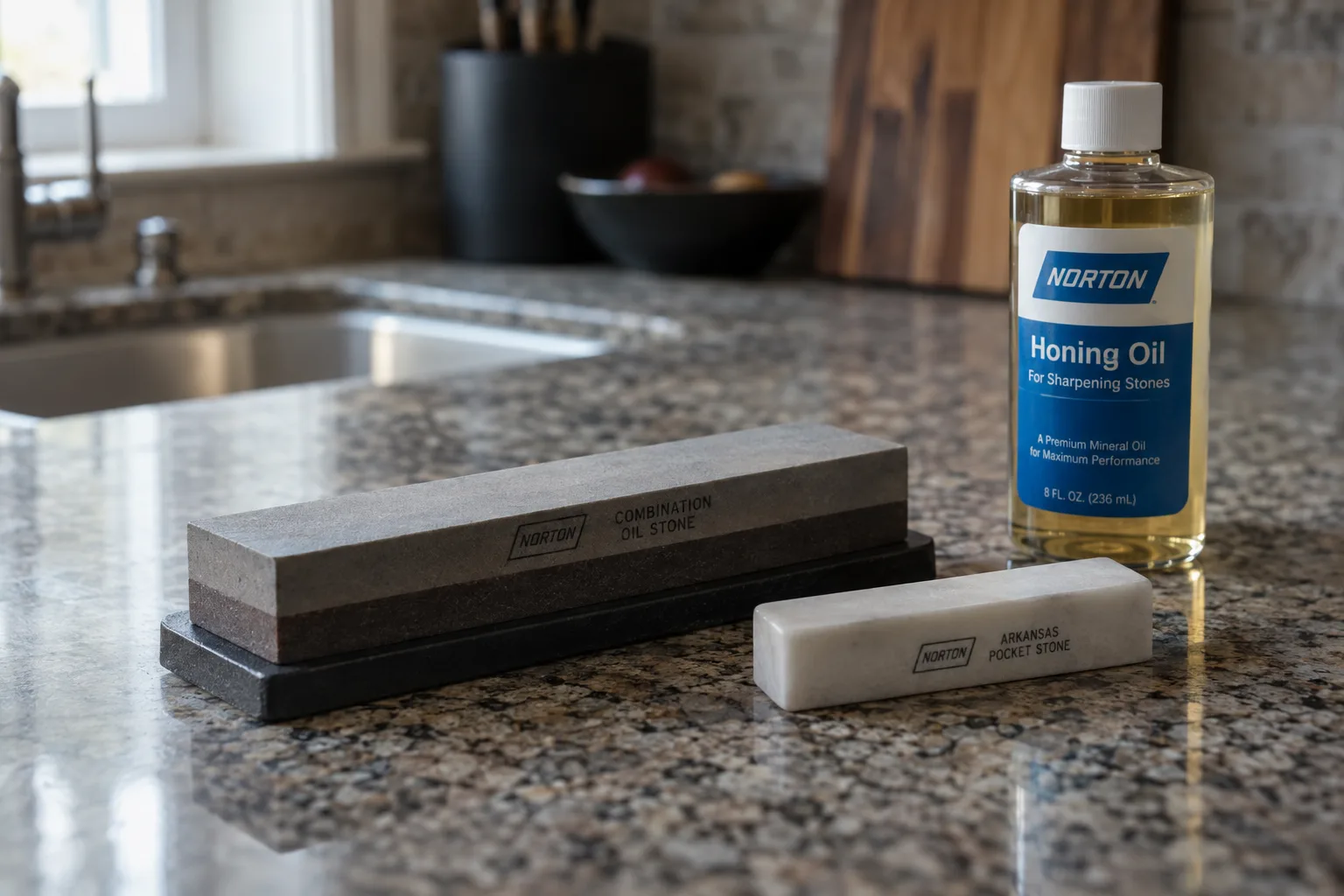
| Oil stone | Water stone | Diamond plate | |
|---|---|---|---|
| Lubricant | Honing oil | Water | Water or dry |
| Cutting speed | Slow | Moderate | Fast |
| Wear | Very slow | Fastest; dishes | Stays flat |
| Finish | Fine on hard and translucent Arkansas | Finest range overall | Coarse to medium on most plates |
| Mess | Oily | Muddy | Gray water |
| Where it shines | Outdoor kits, tradition | Kitchen knives | Repairs, hard steels, flattening |
Using both: the common combination
Plenty of home sharpeners settle on three surfaces. A coarse diamond plate handles repairs and reprofiling, plus the very hard steels, and it keeps the water stones flat. A 1000 water stone does routine sharpening. A 3000 to 6000 water stone refines and polishes. Add a strop and you have the ladder below, which is the same one forum regulars and knife shops describe in different words. Norton's Trish Dawson describes the same pairing in New Equipment Digest, noting that diamond leaves a less polished surface and that some sharpeners polish afterward with a hard Arkansas stone or a fine waterstone.
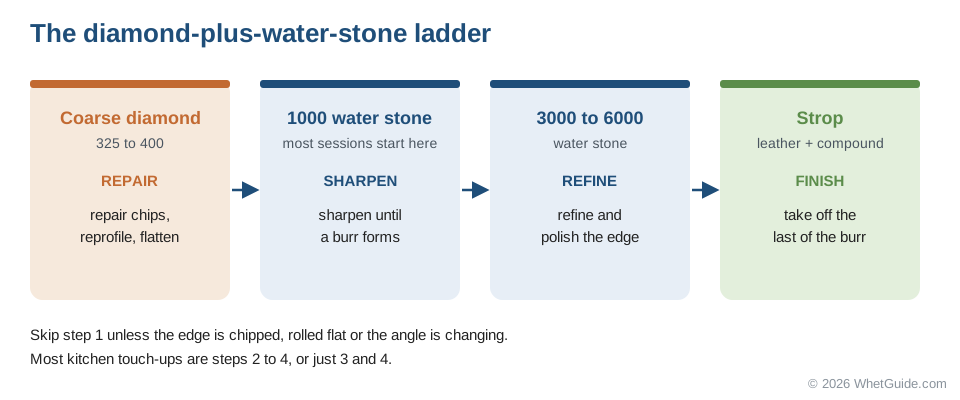
| Job | Surface | Stop when |
|---|---|---|
| Chip, broken tip, very rolled edge | Coarse diamond (325 to 400) | The damage is gone and a burr runs the full length |
| Changing the angle | Coarse diamond | The marker is gone from the whole new bevel |
| Normal dull kitchen knife | 1000 water stone | A burr forms on each side, heel to tip |
| Refining after 1000 | 3000 to 6000 water stone | The 1000 scratches are gone under a loupe |
| Last of the burr | Strop with compound | The edge catches a fingernail cleanly with no drag |
| Hard-steel folder | Fine diamond (1200), then strop | A clean, toothy edge that slices paper |
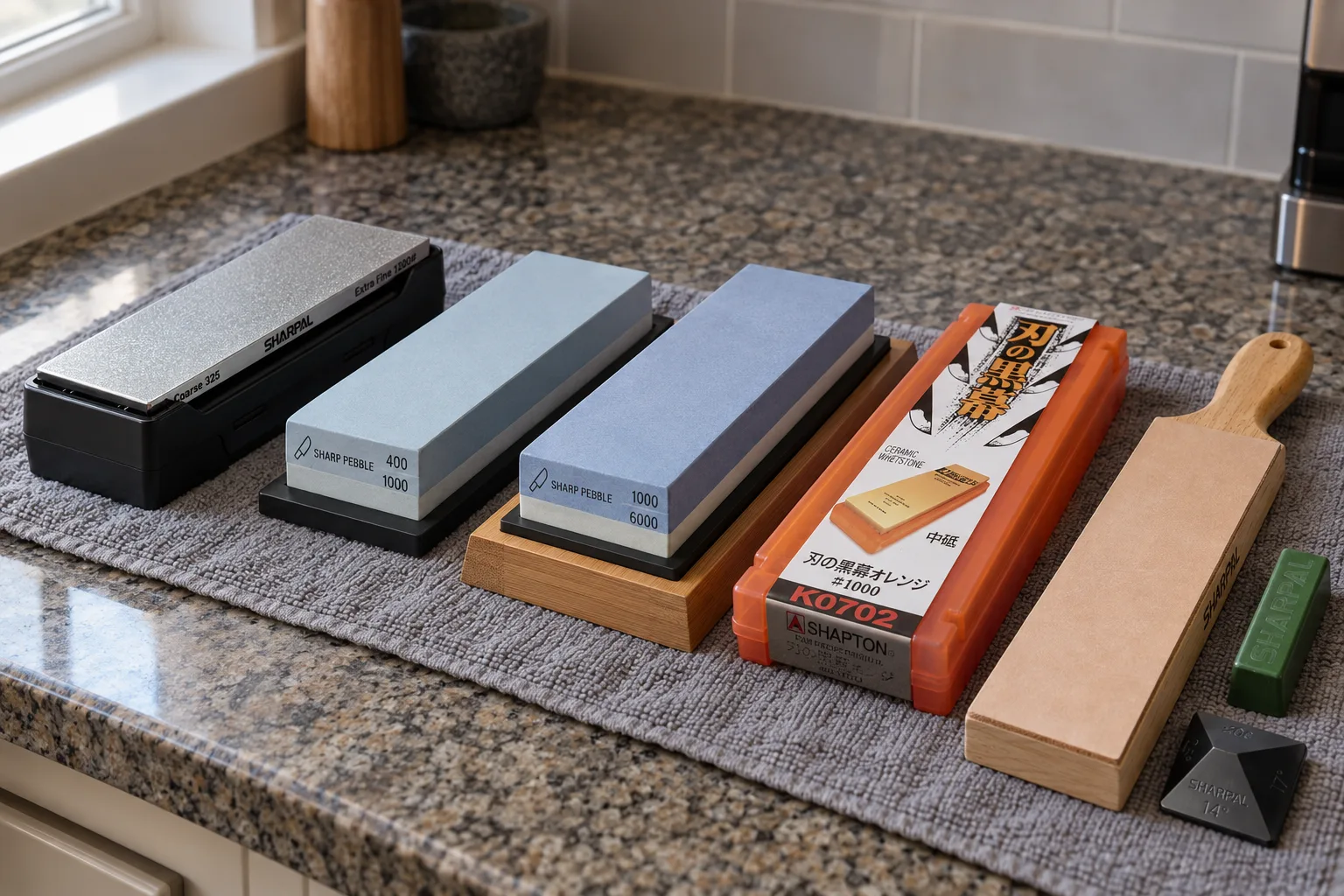
The order matters more than the brands. Never jump from a coarse plate straight to a 6000 stone; the 6000 would take ages to clear the deep diamond scratches. Go through a 1000 in between. And keep the plate you flatten with separate from the one you sharpen on if you can, for reasons the next section explains. The how to use a whetstone guide goes through the stroke itself, and how to strop a knife walks through the last step.
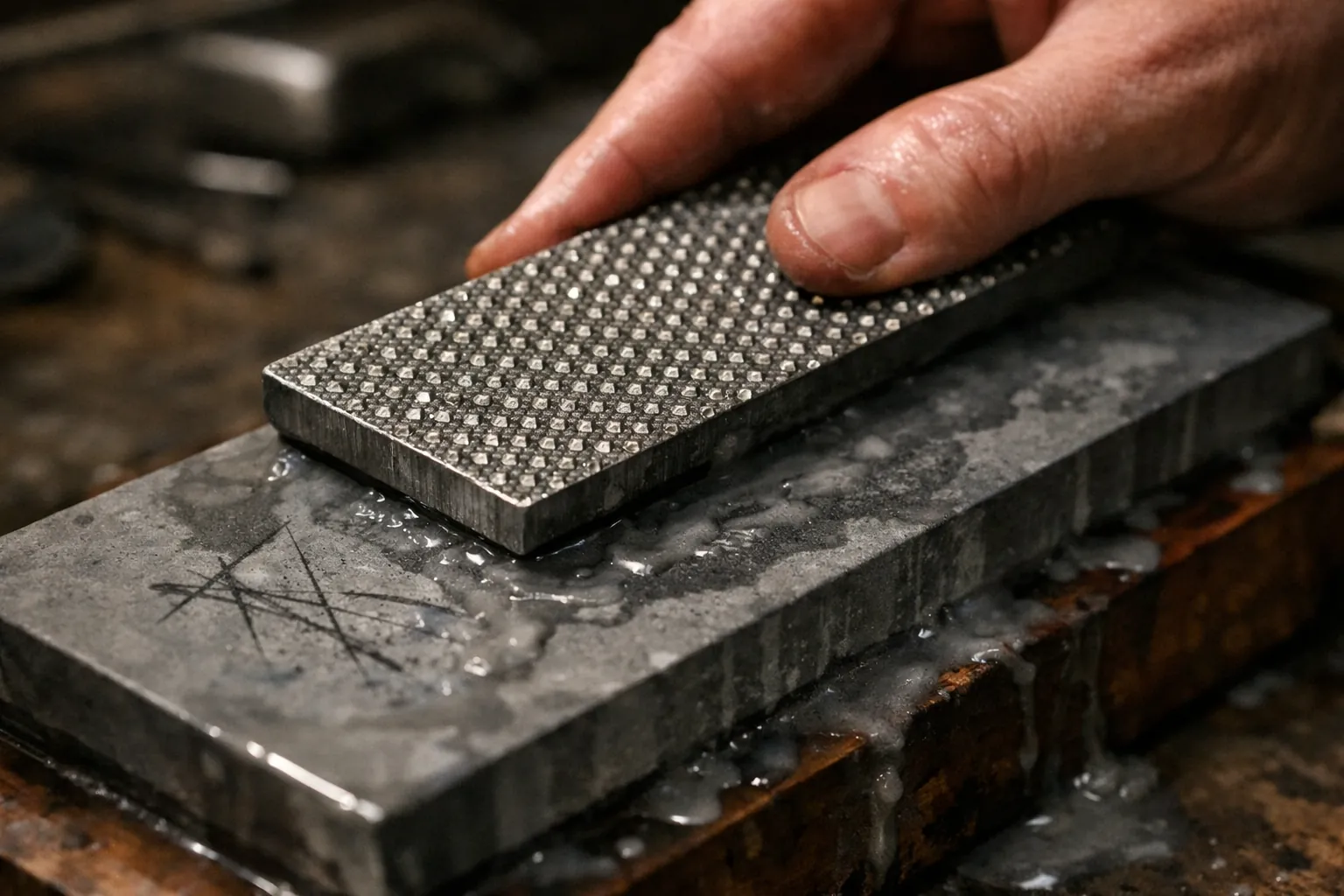
How to flatten a water stone with a diamond plate
Water stones dish in the middle because that's where most strokes land. A dished stone rounds the edge and makes a consistent angle almost impossible, so flattening is part of owning one. Fine Woodworking's method is the standard: use a coarse diamond plate larger than the stone, and dedicate it to lapping so the wear spreads evenly across the plate. The tiny scratches it leaves on the stone don't affect sharpening.
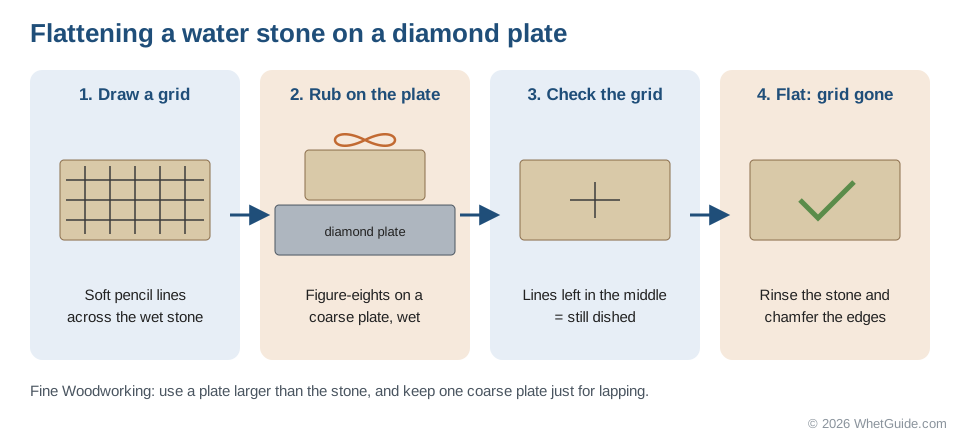
- Soak the stone (or wet it, if it's splash-and-go) and set the diamond plate on a damp towel or in its base so it can't slide.
- Draw a grid of soft pencil lines across the stone's face, about half an inch apart.
- Splash water on the plate. Lay the stone face down on it and rub in long strokes or figure-eights, using the whole plate, with even pressure.
- After a dozen strokes, stop to look. Lines left in the middle mean the stone is still dished. Keep going.
- Stop when every pencil line is gone. Rinse both the stone and the plate well so no coarse diamond grit or slurry rides onto your knife.
- Run the stone's edges lightly along the plate at an angle to chamfer them, so a sharp corner can't chip or catch the blade.

How often? Every few sessions for a 1000 stone in regular use, less for finer stones, which wear slowly. If you only own the SHARPAL 162N, flatten on its 325 side and keep its 1200 side for knives; Tools for Working Wood notes that water-stone slurry wears the plating on fine plates. Dedicated flatteners, whether diamond or not, get ranked in best flattening stone, and the routine itself sits in how to flatten a whetstone.
↑ Back to all sectionsHow to check that a stone or plate is flat
A straightedge and a light source are all you need. Lay a steel ruler on its edge across the stone, then lengthwise, then corner to corner, and look toward a window or lamp. Light under the middle means a dish. On a water stone that's normal wear, and the pencil-grid method above fixes it.
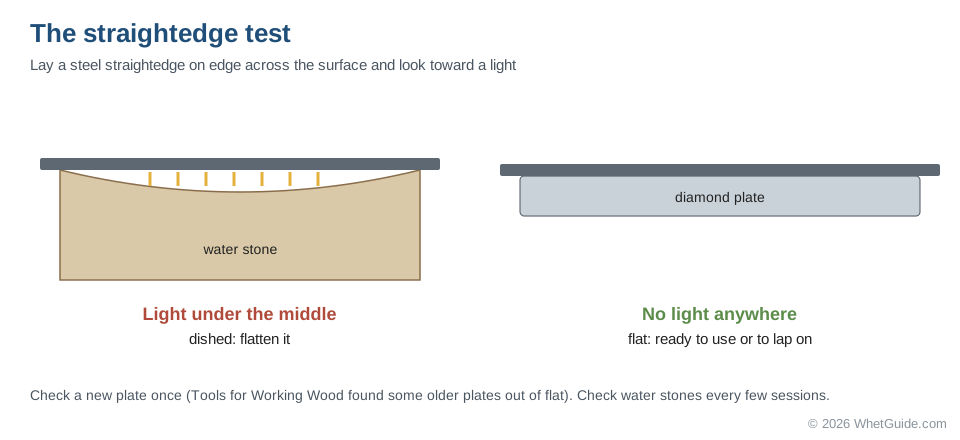
On a diamond plate the test only matters once, when it arrives. Tools for Working Wood says modern plates on solid steel bases are flat but that some older plates failed its straightedge test. A new plate with light under the middle should go back, because a plate can't be flattened the way a stone can, and a dished plate will dish every stone you lap on it.
↑ Back to all sectionsBreak-in: why a new diamond plate feels rough
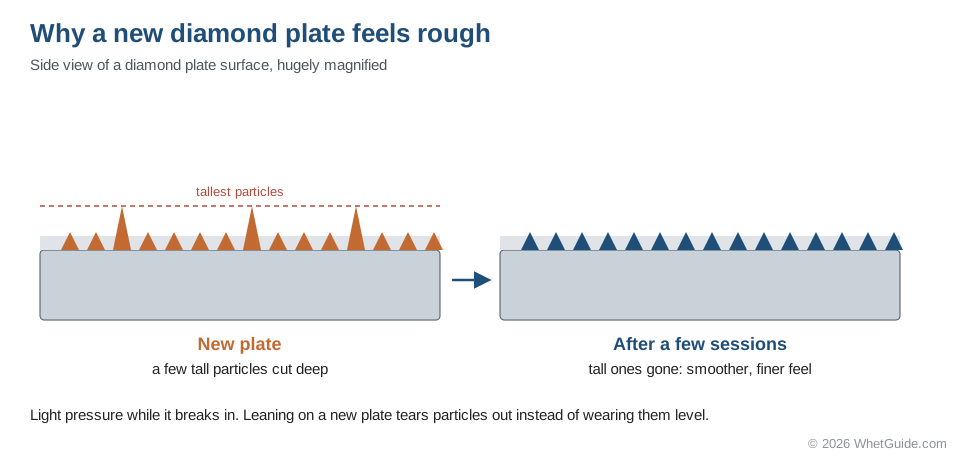
A brand-new diamond plate cuts coarser than its label for the first few sessions. Koi Knives says it takes a few uses before a plate settles to its rated grit. The reason is simple: a handful of diamond particles stand taller than the rest, and those few cut deep scratches until they break off. Dennis Perkins' Woodsmith guide agrees, and adds that you shouldn't lean harder to hurry it along, since the high points wear down on their own.
- 01Check it flatStraightedge test before first use. Return a plate that isn't flat.
- 02Light pressureThe weight of the knife and a little more. Heavy pressure tears particles out instead of wearing them level.
- 03Use waterA splash carries away the loose particles and the steel, unless the maker says to use the plate dry.
- 04Clean afterRinse, scrub with a soft brush and dry fully. Expect the gray water to clear faster each session.
Some owners speed the process up by rubbing a cheap old knife, a piece of mild steel or the back of a scrap blade across a new plate before their good knives go near it. That works, but it's optional; a few normal sharpening sessions with light pressure get you to the same place.
↑ Back to all sectionsDiamond plate care: rinse, dry, never soak
A diamond plate needs almost no maintenance, which is one of its selling points. The two things that shorten its life are pressure and water left sitting on the steel. Koi Knives warns that a diamond plate shouldn't be soaked like a water stone because the steel base can rust.
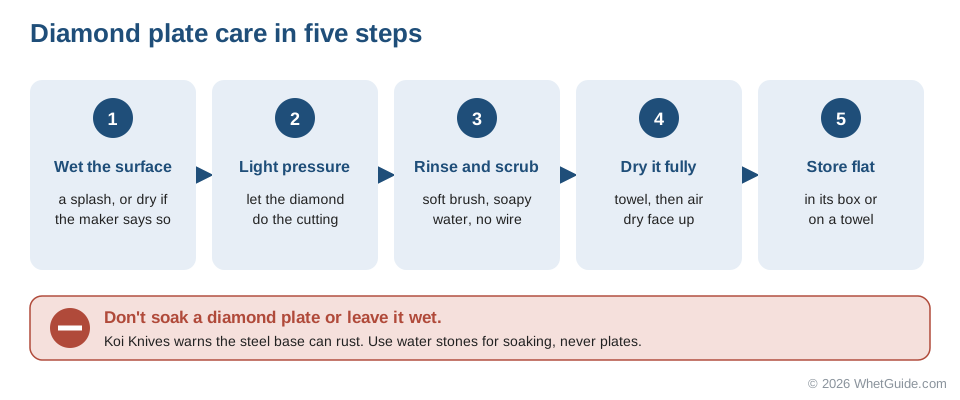
- Water or dry: follow the maker. SHARPAL lists the 162N as usable dry; most plates work better with a splash of water to carry the steel away. Oil isn't usually recommended.
- Use the whole plate, not just the center, so the diamond wears evenly.
- Don't drag a knife tip or corner into the face, and don't grind the edge straight down into the plate. Both can pull out diamond.
- Clean with water, a drop of dish soap and a soft nylon brush. Skip wire brushes and scouring powder.
- Dry with a towel and let it air-dry face up before it goes in the box. A plate stored wet in a closed box is how the rust starts.
- If a plate starts to load up with steel and cut slowly, a scrub usually brings it back. If it still feels smooth, the diamond layer is worn.
How to use a diamond whetstone vs a water stone
| Step | On a 1000/6000 water stone | On a 325/1200 diamond plate |
|---|---|---|
| Set up | Soak until the bubbles stop (or splash a splash-and-go stone); set it on a damp towel or in its base | Splash water on the face, or none if the maker says dry; set it in its box base or on a towel |
| Check the surface | Is it dished? Flatten first if a straightedge shows light | Nothing to check after the first day |
| Mark the bevel | Color the edge bevel with a marker | Same |
| Find the angle | A few light strokes; adjust until the marker comes off the whole bevel | Same, with even lighter pressure, because the plate cuts faster |
| Raise a burr | Work the 1000 side, heel to tip, until a burr runs the full length; then the other side | Start on the 1200 side; use the 325 side only for chips or a new angle |
| Refine | Flip to the 6000 side and repeat with lighter strokes; keep the slurry | Fewer, lighter strokes on the 1200 side, or move to a water stone or strop |
| Remove the burr | Alternating single light strokes, then a strop | Same |
| Test | Paper or a tomato; the edge should bite without pushing | Paper or cardboard; expect a toothier bite |
| Clean up | Rinse, let the stone air-dry slowly, flatten if it's due | Rinse, scrub, towel-dry, air-dry face up, then box it |
Tips for each
Diamond plates
Go light, especially on a new plate; heavy pressure just tears out diamonds. Add a little water to carry away metal particles unless the maker says dry only. Clean the plate and let it dry when you're done. Because a plate cuts fast, it also raises a burr fast, so check for one sooner than you would on a stone.
Water stones
- Soak soaking stones until the bubbles stop. Splash-and-go stones just need water on top.
- Use the full length of the stone and flatten it every few sessions.
- Let stones dry completely before storing.
- Keep the slurry. Don't rinse it off between strokes; it does part of the polishing.
- Never let a stone dry in direct sun or next to a heater. Fast drying can crack it.
The angle is the same on both
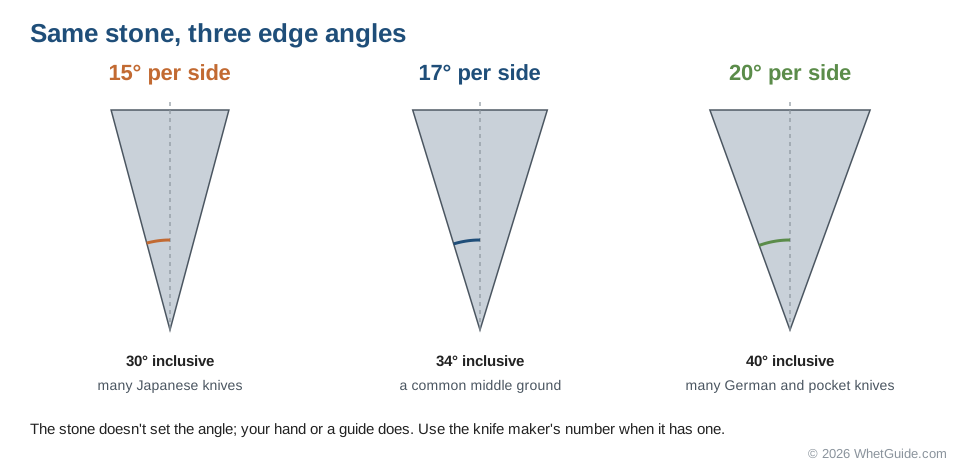
The angle matters more than the abrasive. Many Japanese knives are sharpened around 15° per side and many German knives around 20°, but your knife maker's number comes first. Shun lists 16° per side for its knives, and Wüsthof's own pages give 14 to 14.5° per side for its standard blades. Neither a stone nor a plate sets the angle; your hand or a guide does. Color the bevel with a marker, take a few light strokes and look: if the marker is gone from the whole bevel, you're on the angle. The angle chart and how to use a whetstone cover the rest.
Steel hardness: when diamond really matters
Most kitchen stainless sharpens fine on conventional water stones. The trouble starts with some modern pocket knives and premium Japanese knives, which use very hard, wear-resistant steels full of hard carbides. Conventional abrasives cut those slowly. Diamond doesn't care. Zirconia ceramic knives are harder still, and diamond is the only option; see how to sharpen a ceramic knife.
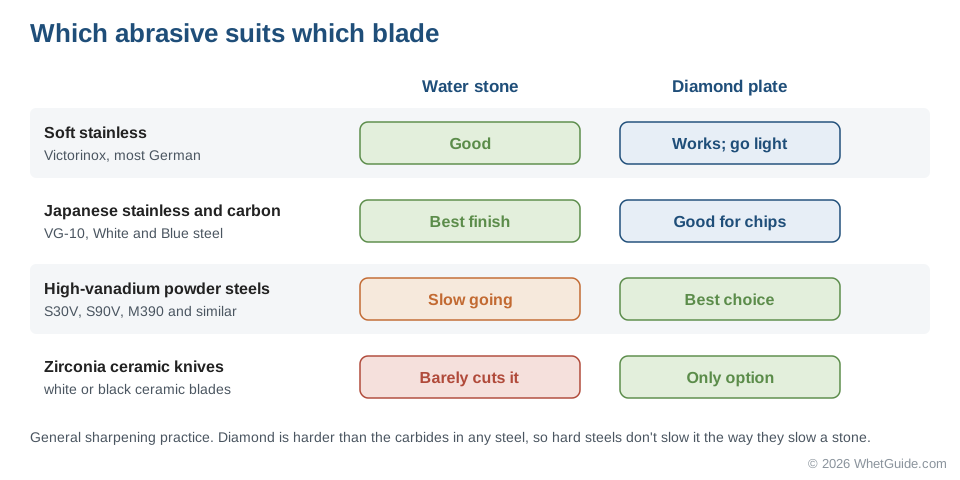
Here's the test: if your knife's maker calls it a high-wear-resistance or powder steel and your water stone seems to take forever, buy the diamond plate. CBN (cubic boron nitride) abrasives do a similar job and are sold for some guided systems; Spyderco makes CBN rods for the Sharpmaker, for example. The best steel for kitchen knives guide lists which steels fall where, if you're not sure what your knife is made of.
| Blade material | Examples | Water stone | Diamond plate |
|---|---|---|---|
| Soft stainless | Victorinox Fibrox, most German knives | Sharpens easily; best choice | Works, but go light; easy to over-grind |
| Harder Japanese stainless | VG-10 and similar | Sharpens well; best finish | For chips and fast repairs |
| Japanese carbon steel | White and Blue steel | Traditional choice; superb finish | For repairs; finish on stone |
| High-vanadium powder steels | S30V, S90V, M390 | Slow; can feel like it isn't cutting | Best choice |
| Zirconia ceramic | White or black ceramic blades | Barely cuts it | Only practical option; very light pressure |
Japanese knives: water stones first, diamond for repairs
Japanese kitchen knives are the reason water stones are so popular in the West, and for good reason: thin, hard edges at around 15° per side benefit most from a refined finish, and a 5000 or 6000 stone is the easy way to get it. Ichimonji, a Japanese shop that sells both the knives and diamond stones, lists the jobs where diamond helps a Japanese-knife owner: flat sharpening, pressing the flat back of a single-bevel knife, and resurfacing other stones.
- Double-bevel gyuto, santoku, petty: a 1000 stone and a 5000 or 6000 stone. Add a coarse diamond plate for flattening and for the occasional chip.
- Single-bevel yanagiba, deba, usuba: water stones on the bevel side. The flat back (ura) is touched lightly on a fine stone, and needs a dead-flat surface, which is where a diamond plate earns its keep.
- Chipped edge: start on a coarse diamond plate or a 400 stone such as a Naniwa Chosera 400, then come back up through 1000 and 5000.
- Powder-steel Japanese knives (SG2/R2 and similar): a fine diamond plate speeds up the 1000 step; finish on water stones.
Hard Japanese steel is also more brittle than German steel, so the pressure rule matters more. A coarse plate pushed hard can chip a thin edge. Most chips on Japanese knives come from twisting in a cut or hitting bone, not from sharpening, but there's no reason to add to them. Our best knife sharpener for Japanese knives guide and the Shun sharpening angle page have more detail.
↑ Back to all sectionsPocket and outdoor knives: why diamond usually wins
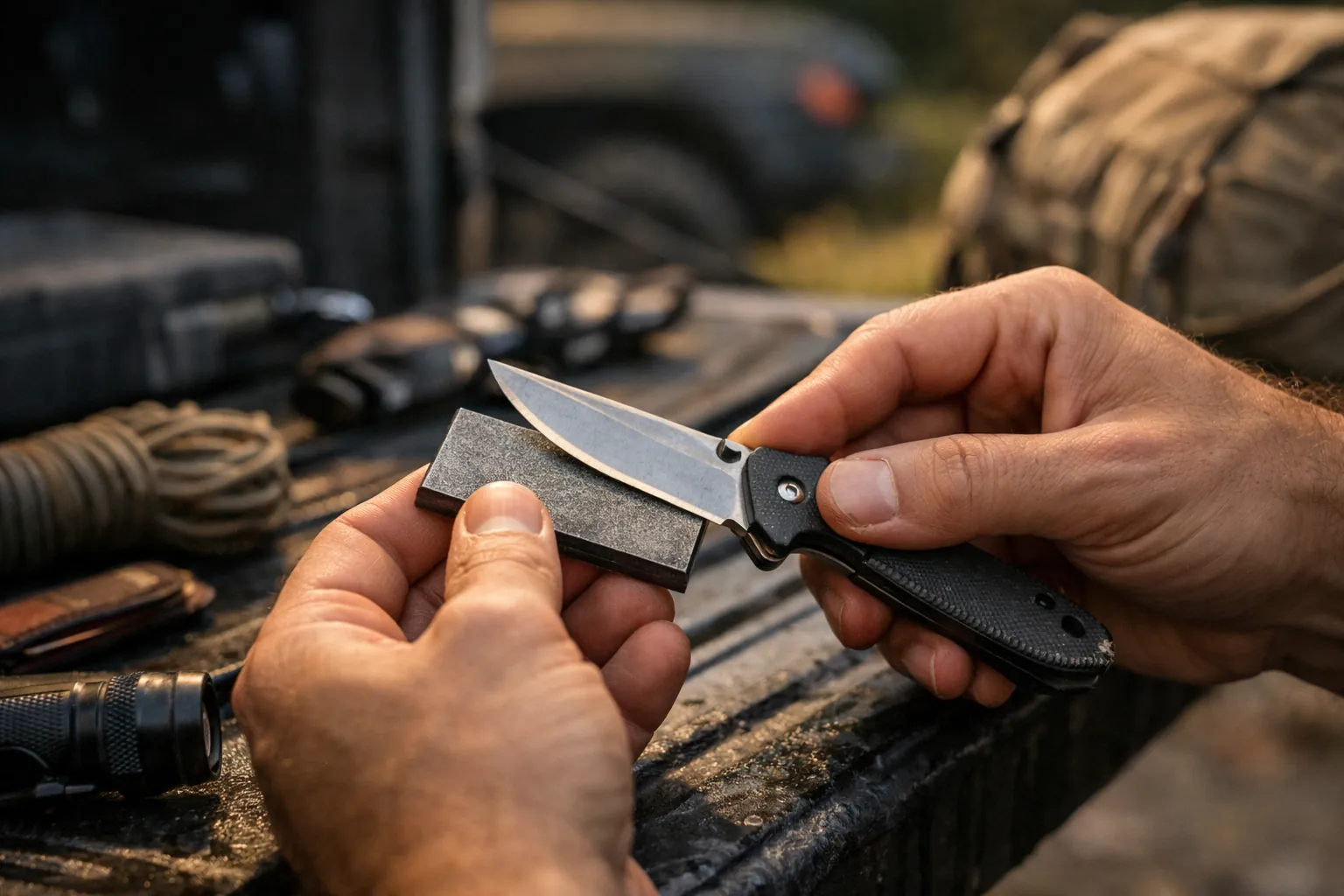
Pocket knives flip the kitchen answer. Many modern folders use the hard, wear-resistant steels that diamond handles best, and a field kit can't depend on a soaking tub. A diamond stone works dry or with a splash from a water bottle, it doesn't break if dropped the way a water stone can, and it stays flat in a pocket for years. The fine 1200 edge it leaves has the bite that cuts rope, cardboard or zip ties well.
For serrated folders, a tapered diamond rod gets into the scallops where a flat plate can't. And for full how-to steps, see how to sharpen a pocket knife; our picks for every budget are in best knife sharpener for pocket knives. Hunting knives follow the same logic, as how to sharpen a hunting knife shows.
↑ Back to all sectionsOther jobs only diamond does well
| Job | Why diamond | More |
|---|---|---|
| Ceramic kitchen knives | Ordinary stones barely cut it | Ceramic knife guide |
| Flattening water stones | Stays flat while it laps | Flattening stones |
| Axes and hatchets | Fast on thick bevels; no soaking at camp | How to sharpen an axe |
| Chisels and plane irons | Flattening backs on a dead-flat surface | How to sharpen a chisel |
| Serrated knives | Tapered diamond rods fit the scallops | Serrated knife guide |
| Carbide-tipped tools | Conventional stones skid over carbide | Diamond plates |
| Scissors and small tool edges | A small plate or diamond file fits where a bench stone won't | DMT review |
| Honing between sharpenings | Diamond rods cut, not just realign | Diamond honing rods |
Cost and lifespan over time
A water stone gets used up. Every sharpening wears a little away, and flattening takes more. A home cook still gets years from one, especially the finer grits, which wear slowly; coarse, soft stones go fastest. A diamond plate doesn't get thinner. Its diamond layer slowly loses bite with heavy use, and pressing hard or catching an edge in it can damage it. Brian Boggs writes in Fine Woodworking that his diamond plate has kept its flatness for five years with virtually no maintenance. A home user won't replace either one often, so the real cost difference is the purchase price, where water stones give you more grits for the money.
| Water stone route | Diamond plate route | |
|---|---|---|
| Price tier to start | Low (one combination stone) | Mid (one two-sided plate) |
| What wears out | The stone, slowly; coarse grits first | The diamond layer's bite |
| What replaces it | Another stone of the same grit | Another plate |
| Hidden costs | A flattener, a holder, a soaking tub | Usually none; a base if the plate has no box |
| Grits per purchase | Two on a combination stone | Two on a two-sided plate, both coarser |
Add-ons that help with either
| Add-on | What it does | Example |
|---|---|---|
| Stone holder | Grips a stone or plate so it can't slide | POWERTEC adjustable holder |
| Silicone tray | Holds the stone and catches slurry | SHARPAL 149H |
| Angle guide | Shows you the angle before you start | SHARPAL 194H guide; SHARPAL 196N pyramid (14°, 17°, 20°, 25°) |
| Marker | The marker test for the angle | Any fine-point permanent marker |
| 10x loupe | Shows the scratch pattern and the burr | Any jeweler's loupe |
| Strop and compound | Takes off the burr; final polish | SHARPAL 205H strop kit |
| Flattener | Keeps water stones flat | A coarse diamond plate, or a 120/320 flattening stone |
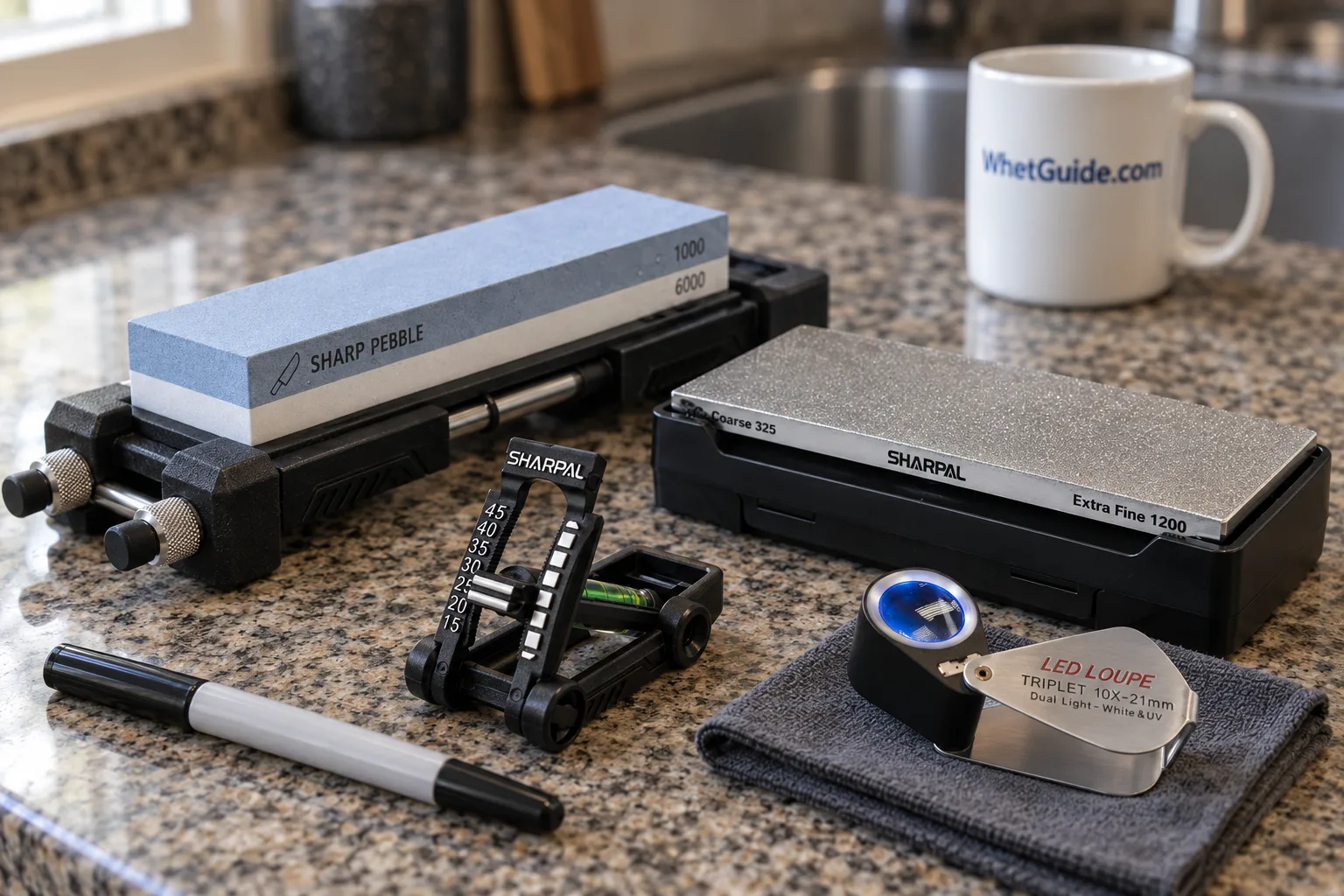
None of the add-ons in the table are needed on day one; they're the small things that make a stone or plate easier to use. If you buy one, make it the strop. Both a diamond plate and a water stone leave a burr, and a few passes on leather take it off more reliably than more stone work. Pick one from the best leather strop guide.
↑ Back to all sectionsTen mistakes with stones and plates, and the fix for each
| Mistake | What happens | Fix |
|---|---|---|
| Pressing hard on a diamond plate | Pulls diamond out; deep scratches | The knife's weight and a little more |
| Soaking a diamond plate | The steel base can rust | A splash of water on top, then dry it |
| Storing a plate wet in its box | Rust spots on the base | Air-dry face up first |
| Never flattening a water stone | A dished stone rounds the edge | Pencil grid and a coarse plate every few sessions |
| Flattening on your fine plate | Slurry wears the plating | Flatten on the coarse side or a dedicated plate |
| Skipping the burr | The edge never gets truly sharp | Sharpen until you feel a burr heel to tip |
| Jumping from a coarse plate to 6000 | Hours to clear deep scratches | Go through a 1000 stone first |
| Drying a stone in the sun | Can crack the stone | Dry slowly at room temperature |
| Using water on an oiled stone | Water beads up; the stone clogs | Stay with oil once a stone has had it |
| Finishing a kitchen knife on coarse diamond | A grabby, scratchy edge | Finish on a 3000 to 6000 stone or a strop |
Cheat sheet: water stone or diamond plate
| Question | Answer |
|---|---|
| First stone for kitchen knives | 1000/6000 water stone |
| First stone for hard-steel folders | 325/1200 diamond plate |
| Flatten water stones with | A coarse diamond plate, larger than the stone |
| Does a diamond plate need flattening? | No; check it flat once when new |
| Soak a diamond plate? | Never; a splash or dry |
| Pressure on diamond | Light; heavier only on a coarse repair plate, and still moderate |
| Compare grits by | Microns when the maker lists them |
| Diamond 1200 is about | JIS 1000 to 1500, depending on the plate |
| Finest common diamond plate | About 1200; DMT's 8000 mesh is about JIS 4000 |
| Ceramic knives | Diamond only |
| Angle | The knife maker's number; about 15° Japanese, 20° German |
| Finish a kitchen edge on | A 3000 to 6000 stone or a strop |
Your first purchase
Kitchen knives only? Buy a 1000/6000 water stone like the Sharp Pebble above and stop there until a stone needs flattening. Carry a folder in powder steel? Start with a diamond plate like the SHARPAL 162N instead. Either way, the second purchase is the other one. Our pick for each case is named in the best whetstone guide.
- 01FirstA 1000/6000 water stone. It sharpens and finishes most kitchen knives.
- 02SecondA coarse diamond plate, or a 325/1200 plate, to flatten the stone and fix chips.
- 03ThirdA strop, or a finer finishing stone such as a 3000/8000.
- 04MaybeA holder, an angle guide and a loupe. Nice, not needed.