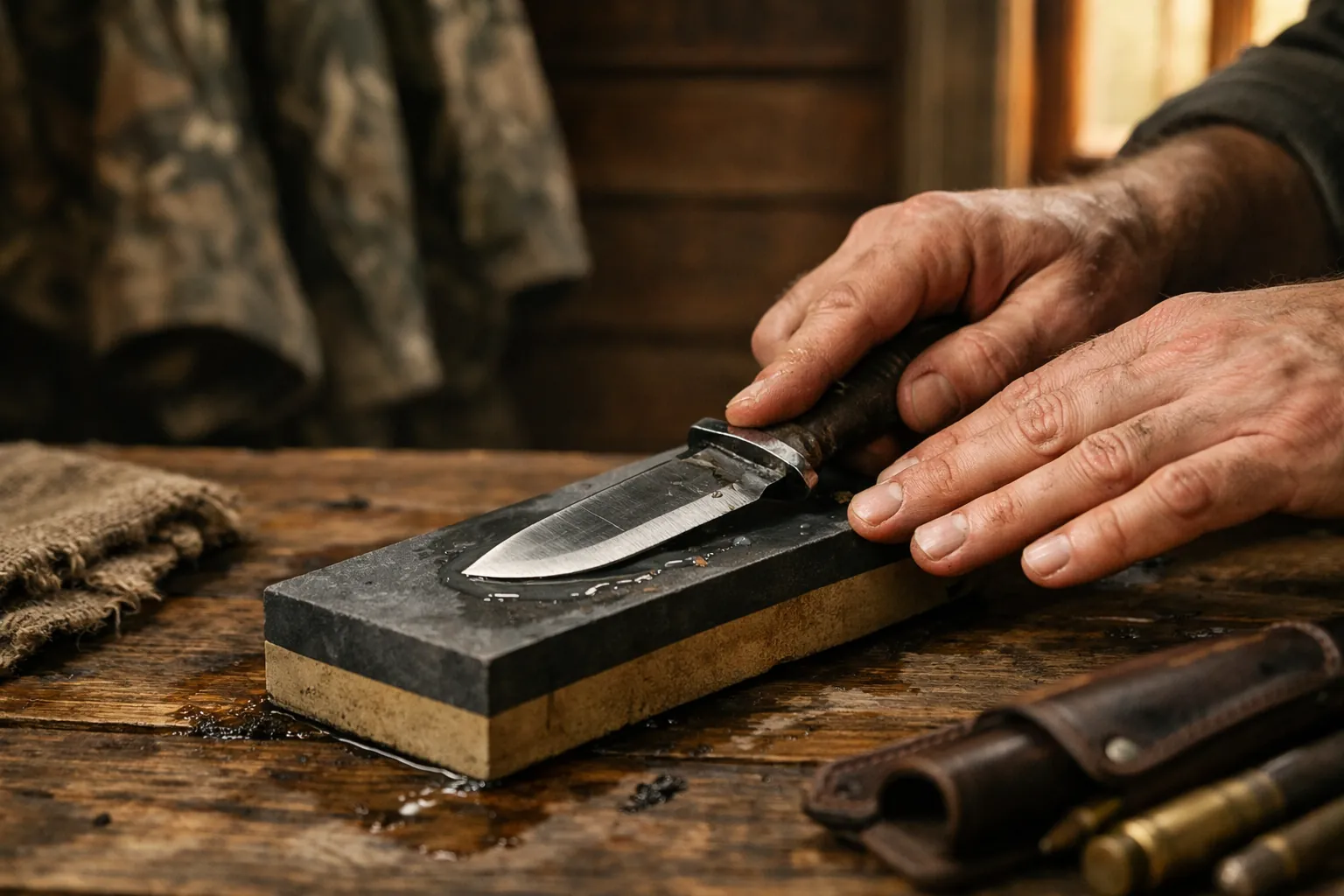
Set the angle (20 to 25 degrees per side suits most hunting knives), grind on a coarse surface until a burr forms along the whole edge, flip and repeat, then refine on a finer surface and strop the burr off. That's the same whether you use a whetstone, a clamp system or a field sharpener. What changes is how much you do where: real sharpening at home, light touch-ups in the field. If you're still choosing tools, start with the best knife sharpener for hunting knives.
Step zero: pick the angle
| Blade | Per side | Note |
|---|---|---|
| Drop point, general field dressing | 20–25° | Lansky's 25° is "ideal for hunting and outdoor knives" |
| Skinner | about 20° | Thinner slices hide more cleanly |
| Caping knife | 17–20° | Detail work; touch up often |
| Gut hook | existing bevel | Inside of the hook only |
| Hard-steel folder (S90V, MagnaCut) | maker's range | Benchmade lists 15–18° for most of its knives |
Don't know what angle your knife has now? Color the bevel with a marker and take one light stroke; where the ink comes off tells you. The sharpie trick guide shows how to read it, and the angle calculator turns your angle into a spine height for freehand work: a 32 mm (1.25 in) wide hunting blade at 22° needs the spine about 12 mm off the stone.
Method 1: whetstone at home
A 400/1000 combination stone handles nearly every hunting knife: 400 resets a dull or nicked edge, 1000 finishes it. The Sharp Pebble 400/1000 kit includes a flattening stone and a non-slip base, per its listing.
- Soak or wet the stone as its instructions say, and set it on a towel or base so it can't slide.
- Hold the knife at your angle, edge facing away, and push it across the coarse side from heel to tip in one sweeping stroke. On a curved skinner, lift the handle as you reach the belly so the edge stays on the stone.
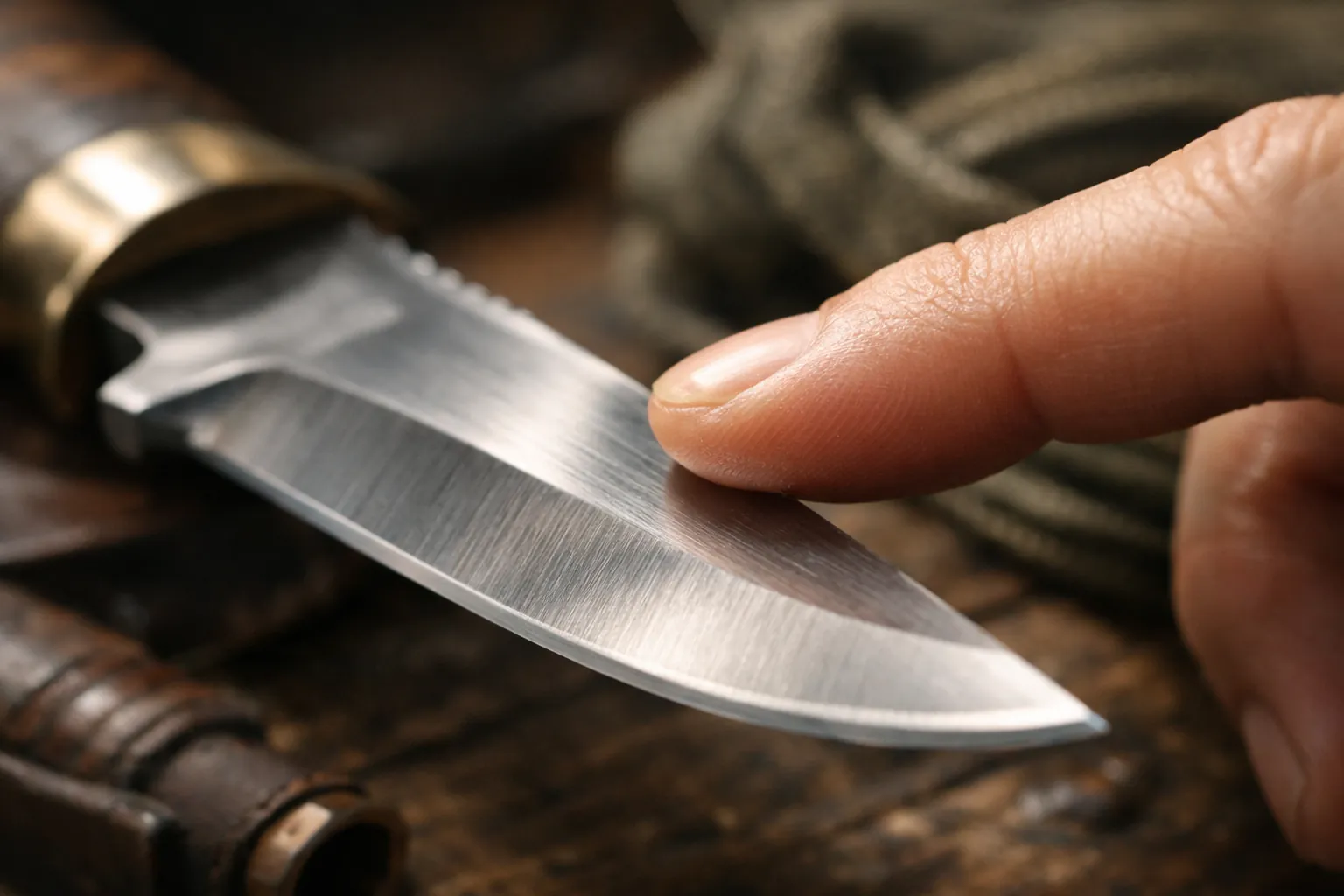
- Keep going on side one until you can feel a burr, a slight rough lip, along the entire opposite side. Check by drawing a fingertip from spine toward edge, never along it.
- Flip and repeat on side two until the burr moves back.
- Move to the fine side. Same angle, lighter strokes, alternating sides every few strokes.
- Strop: drag the edge spine-first across leather a dozen times per side to take the last of the burr off.
Our full how to use a whetstone guide covers grip and pressure in more detail.
Method 2: guided system at home
A clamp system takes the angle out of your hands, which helps most on short, thick hunting blades where the spine barely lifts. On the Work Sharp Precision Adjust you set the angle anywhere from 15 to 30 degrees; on a Lansky clamp you choose the 20 or 25 degree hole.
- Clamp the blade near its middle so the arm can reach both heel and tip.
- Set the angle. Mark the bevel and do a test pass to confirm it matches.
- Work the coarse abrasive along the edge until a burr forms the full length, then flip.
- Step through the finer abrasives with lighter pressure.
- Strop off the clamp.
The first session on a new guided system can take a while if your knife's factory angle differs from your setting. After that, each sharpening only touches the edge.
Method 3: in the field, between animals
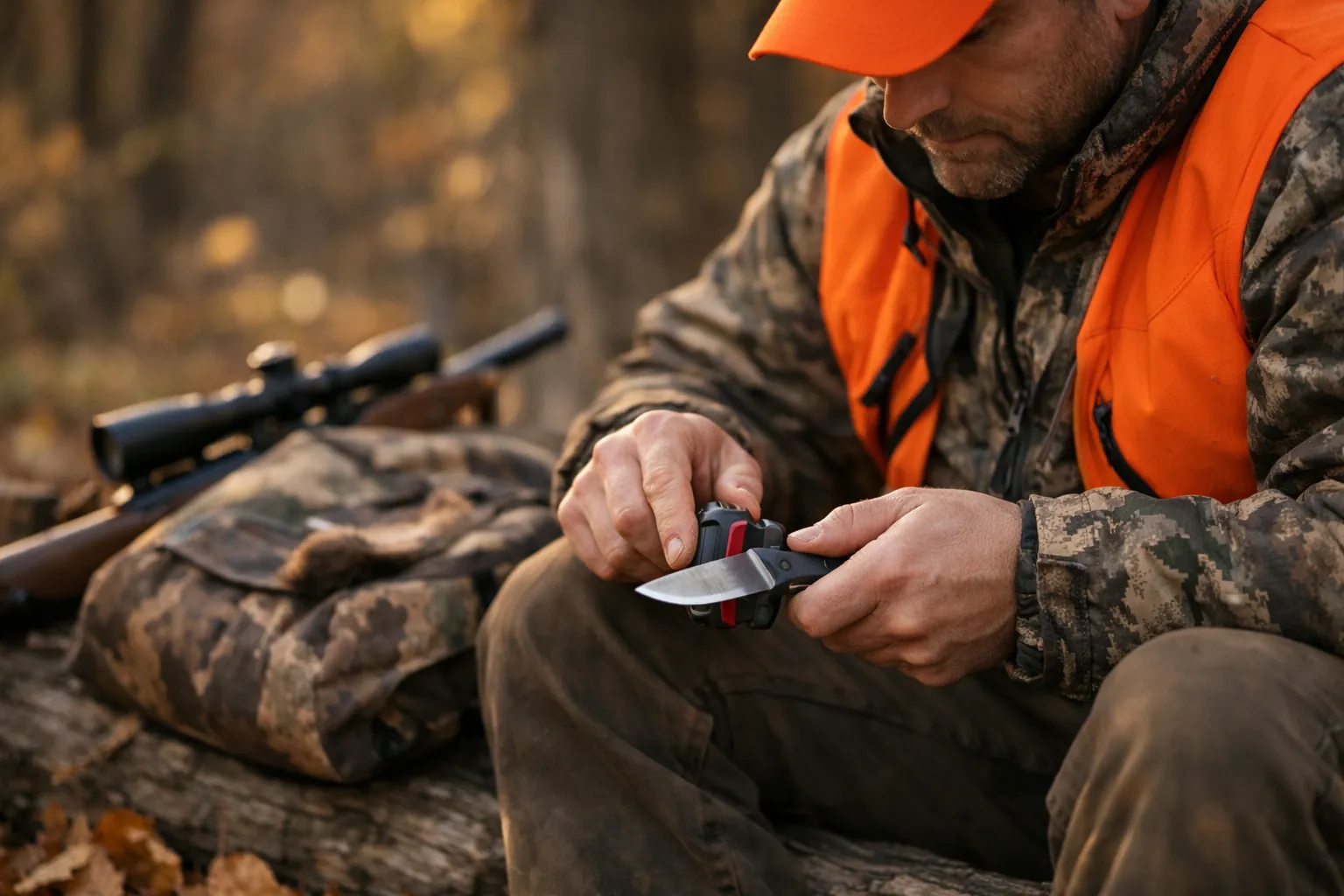
Fat and bone dull an edge fast, and a dull knife is a slipping knife. The goal in the field is to restore bite with as little steel removed as possible.
- Wipe the blade clean. Fat and blood clog abrasives and hide what you're doing.
- Start on the finest surface you have: a ceramic rod, a fine diamond plate or a strop. Five or six light strokes per side at your angle.
- Test on paper, a bag edge or the hair on your arm. If it still drags, go one step coarser and repeat.
- Only use the coarse diamond if the edge is chipped or rolled flat on bone.
The Work Sharp Guided Field Sharpener fits this routine: 20 and 25 degree guides, diamond plates, a ceramic rod and a leather strop in one pocket tool. Keep your hand behind the edge and stroke away from your body; cold fingers and a fresh edge are a bad combination.
Sharpening a gut hook
A gut hook's edge is on the inside of a curve, so flat stones can't reach it. You need a round tapered rod narrow enough to sit in the hook.
- Find the hook's bevel. Most are ground on one side only.
- Lay the tapered rod in the hook at the same angle as that bevel, and stroke from the inside out, rotating slightly to follow the curve.
- Take the tiny burr off the flat side with one light pass of a fine stone held flat against it.
The SHARPAL 101N pocket sharpener includes a tapered 400-grit diamond rod that its listing names for serrations and gut hooks.
Finish with a strop
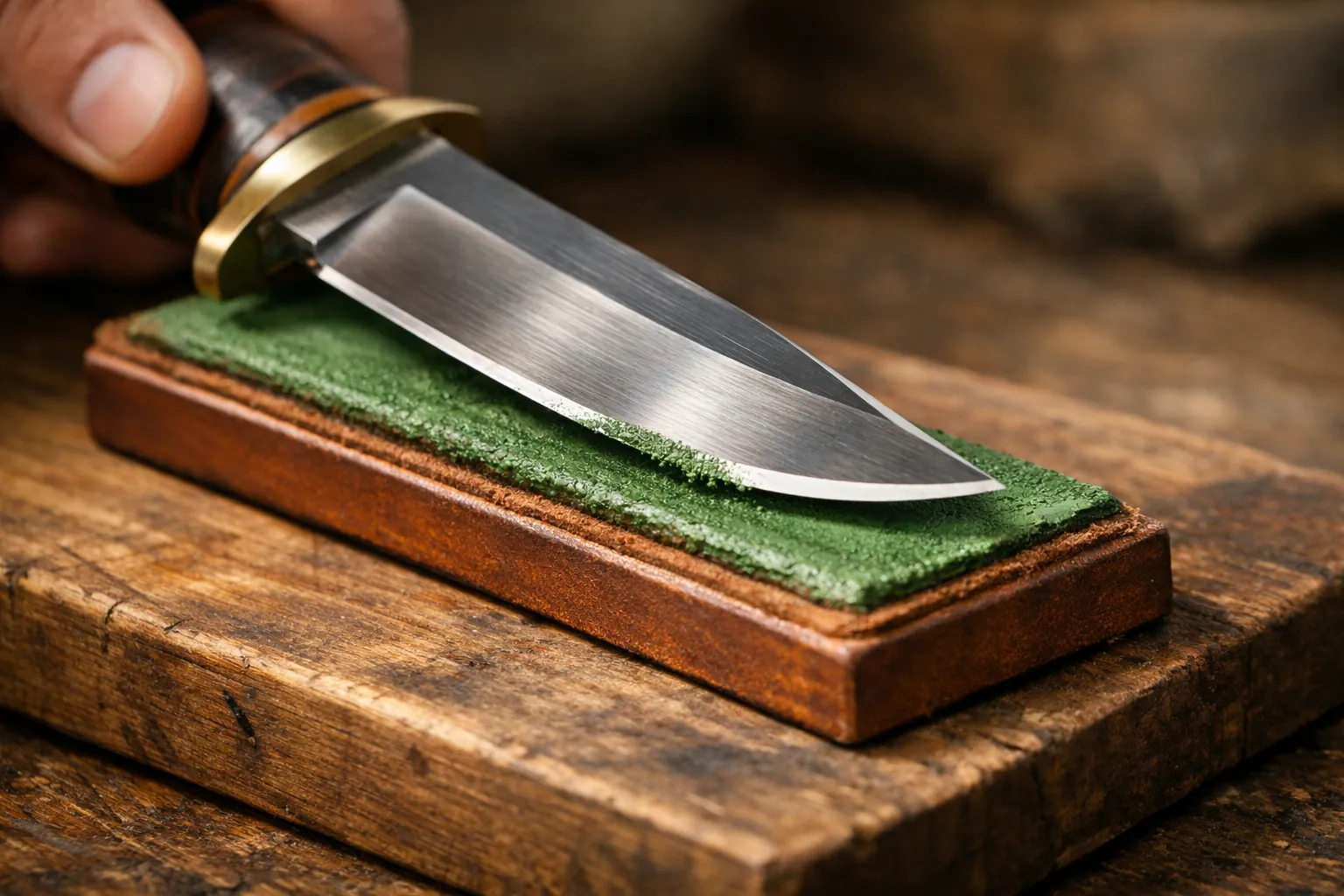
A strop is the most underrated field tool there is. Pulled spine-first across leather loaded with compound, the edge loses its burr and gets back much of its bite without losing steel. The SHARPAL 205H double-sided strop comes with green compound and a 4-angle guide, per its listing. More options are in our best leather strop guide, and the full technique, from angle to stroke count, is in how to strop a knife.
A season routine
- Before the season: full sharpening at home, coarse to fine, at your chosen angle.
- During: ceramic or strop touch-ups after each animal; fine diamond only if needed.
- After: clean and oil the blade, then reset the edge at home.
If an axe or hatchet comes along on the trip, its edge works differently; see the axe sharpening angle guide, then how to sharpen an axe for the file-and-puck routine at camp. Thin, flexible blades need a lighter hand, and our fillet knife guide shows how to stop the blade flexing on the stone.
Angle guidance from Lansky's and Benchmade's published pages, checked October 3, 2026. Spine height calculated. Product details from Amazon listings checked the same day. How we research · Affiliate disclosure