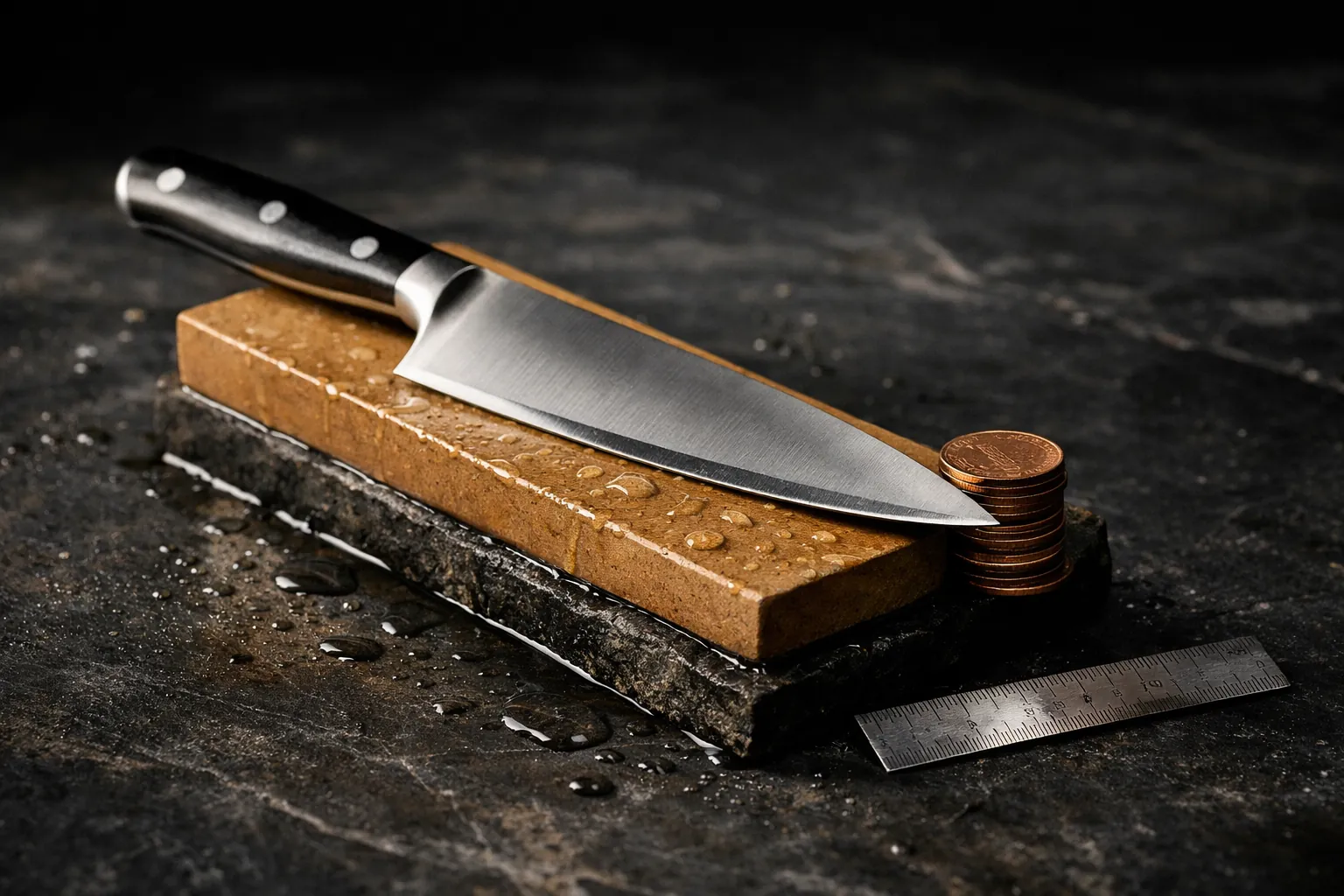
Spine height = blade width × sin(angle per side). Pick your knife brand or type an angle, measure the blade, and the calculator tells you how high to lift the spine off the stone. It also works backward, so you can check the angle you're actually holding. For the angles themselves, start with our knife sharpening angle chart.
Assumes a straight, double-bevel edge with the bevel flat on the stone. Angles are per side unless you tick the inclusive box. Heights are measured straight up from the stone. Your last knife is remembered in this browser only.
How to measure your blade
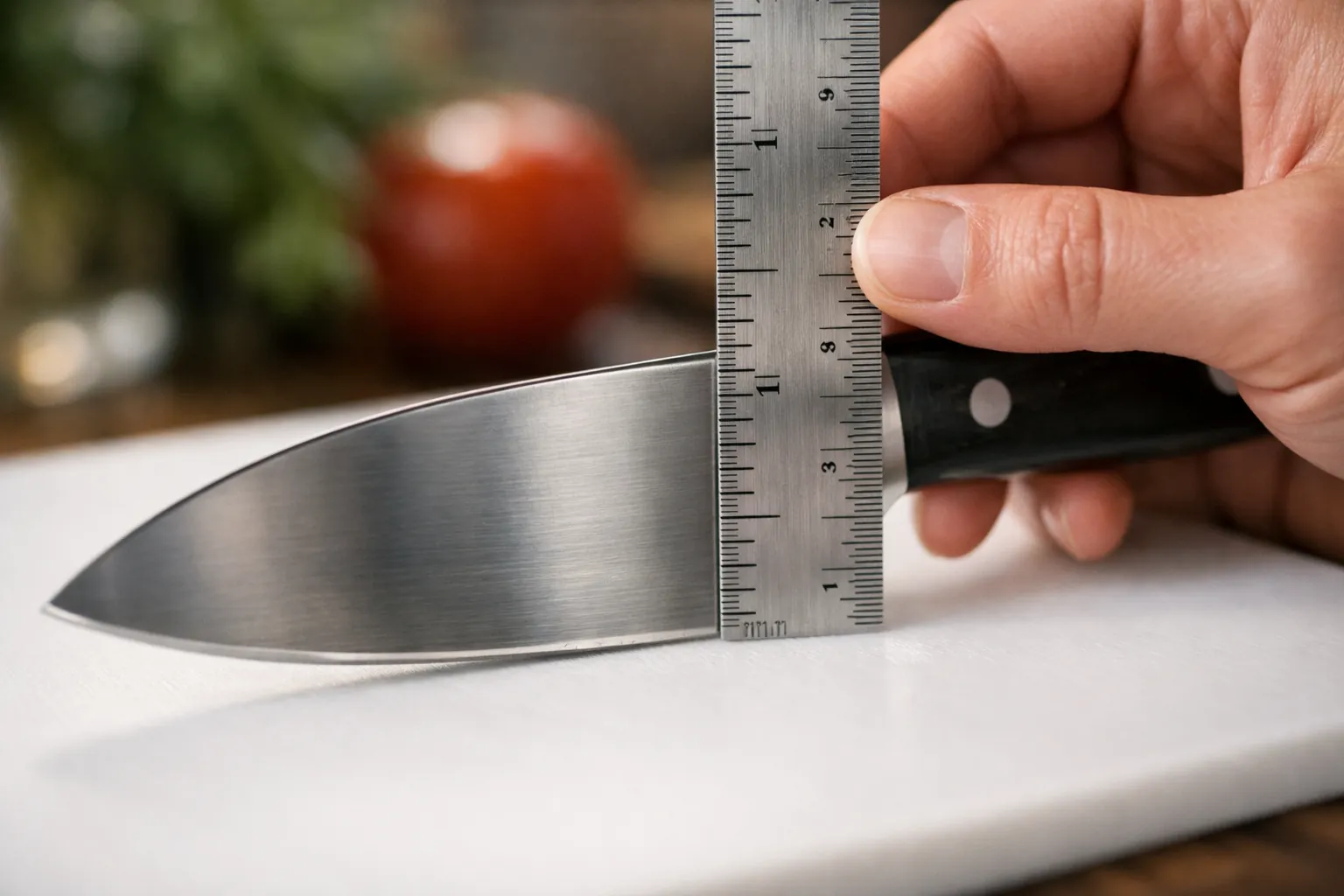
Blade width is the straight-line distance from the cutting edge to the top of the spine, measured at the part of the edge that's on the stone. Start at the heel, since that's where most people begin a stroke. A ruler held square to the edge is accurate enough: a 1 mm error on a 50 mm blade moves a 15° result by about 0.3°.
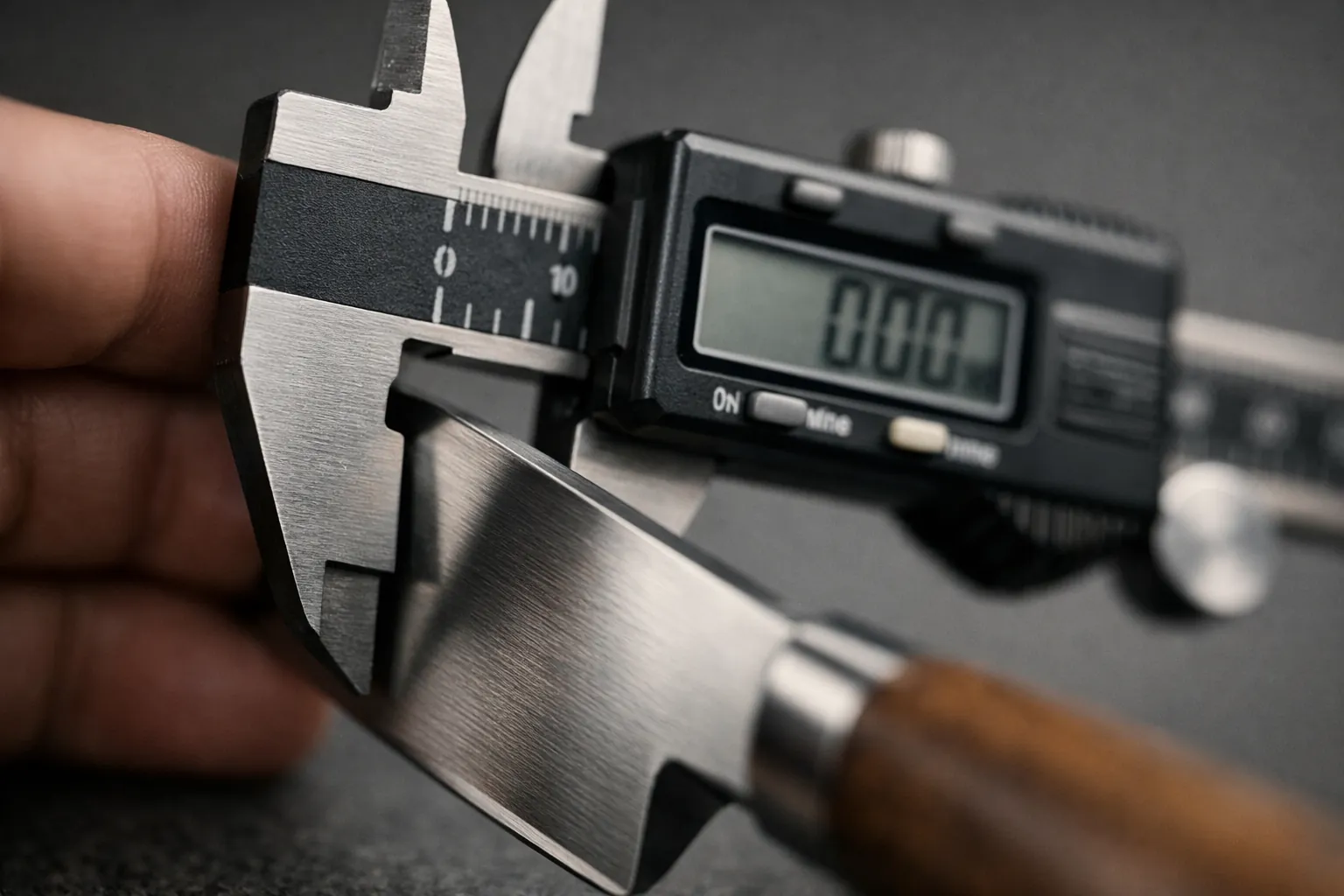
Spine thickness only matters if you measure the height with coins or a gauge under the spine. Those sit under the spine's lower face, not its middle, so a 2 mm spine at 15° reads about 1 mm lower than the centerline. Leave it at 0 if you're eyeballing against a ruler at the center of the spine.
How it works
The calculator treats the blade's center plane as a straight line running from the edge (on the stone) up to the spine. When the bevel lies flat on the stone, that line meets the stone at the per-side bevel angle. That's a right triangle: the blade width is the hypotenuse and the spine height is the side opposite the angle.
| What it works out | Formula |
|---|---|
| Spine centerline height | hc = W × sin(θ) |
| Height under the spine (coins, gauges) | h = W × sin(θ) − (t ÷ 2) × cos(θ) |
| Coins to stack | n = h ÷ coin thickness |
| Angle from a measured height | θ = asin((h + (t ÷ 2) × cos θ) ÷ W), solved by repeating it from θ = asin(h ÷ W); exact when t = 0 |
| Per side and inclusive | inclusive = 2 × θ |
W is blade width, t is spine thickness and θ is the angle per side. Coin thicknesses are the US Mint's published specs: cent 1.52 mm, nickel 1.95 mm, dime 1.35 mm, quarter 1.75 mm. The Mint's coin specifications page blocks automated fetches, so we cross-checked the figures against Wikipedia's coin articles, which cite it. Real coins wear thinner, so treat the count as a guide and measure your stack once.
Check the math: nine worked examples
| # | Inputs | Result |
|---|---|---|
| 1 | 15°, W = 50 mm, t = 0 | 50 × sin 15° = 50 × 0.25882 = 12.94 mm; 12.94 ÷ 1.52 = 8.5 pennies |
| 2 | 15°, W = 50 mm, t = 2 mm | hc = 12.94 mm; h = 12.94 − 1 × 0.96593 = 11.98 mm; 7.9 pennies |
| 3 | 20°, W = 50 mm, t = 2 mm | hc = 50 × 0.34202 = 17.10 mm; h = 17.10 − 0.93969 = 16.16 mm |
| 4 | Wüsthof preset 14°, W = 45 mm, t = 0 | 45 × 0.24192 = 10.89 mm; 7.2 pennies |
| 5 | 10°, W = 50 mm | 50 × 0.17365 = 8.68 mm |
| 6 | 15°, W = 2.00 in | 2.00 × 0.25882 = 0.518 in (13.15 mm) |
| 7 | 20°, W = 38 mm, t = 3 mm (pocket knife) | hc = 38 × 0.34202 = 13.00 mm; h = 13.00 − 1.5 × 0.93969 = 11.59 mm |
| 8 | Height to angle: h = 12.9 mm, W = 50 mm, t = 0 | asin(12.9 ÷ 50) = asin(0.258) = 14.95° |
| 9 | Sharpmaker 40° inclusive | 40 ÷ 2 = 20° per side |
Type any row into the calculator and you'll get the same numbers. We test against this table every time the page is updated.
Brand presets and where the numbers come from
Each preset uses the figure the knife maker publishes, checked on the maker's site on October 3, 2026. Where a maker gives a range, the preset picks a point inside it and says so. Where a maker contradicts itself, the brand page explains both numbers.
| Brand or line | Per side | Inclusive | Source |
|---|---|---|---|
| Wüsthof standard blades | 14° (14.5° in two Wüsthof articles) | 28–29° | Wüsthof product pages |
| Wüsthof santoku, nakiri | 10° | 20° | Wüsthof product pages |
| Shun / Kai double-bevel | 16° | 32° | Shun FAQ |
| Global | 10–15° | 20–30° | Global Cutlery USA |
| Victorinox | 15–20° | 30–40° | Victorinox FAQ |
| Zwilling J.A. Henckels | about 15° | about 30° | Zwilling sharpening guide |
| Miyabi | 9.5–12° | 19–24° | Zwilling's Miyabi pages |
| Spyderco | Not published by Spyderco; Sharpmaker 15° or 20° | 30° or 40° | Spyderco Sharpmaker page |
| Benchmade folders | about 15–18° | 30–35° | Benchmade Knife Care 101 |
| MAC | factory 15°, recommended 10–15° | 20–30° | Tormek's maker list (2020) |
Brand pages link straight into the calculator with the preset loaded, for example this link opens it set to Wüsthof. Keep every brand on one sheet with the printable angle chart by brand.
Check the angle with a marker before you commit
A calculated height gets you close. The marker tells you whether you're on the existing bevel. Color the bevel with a permanent marker, take one light stroke at the height from the calculator, and look where the ink came off. Ink gone only at the edge means you're too high; ink gone only at the shoulder means you're too low. The sharpie trick guide shows each pattern, and the calculator's second mode turns your corrected height back into an angle.
Can't hold it by hand? These hold the angle for you
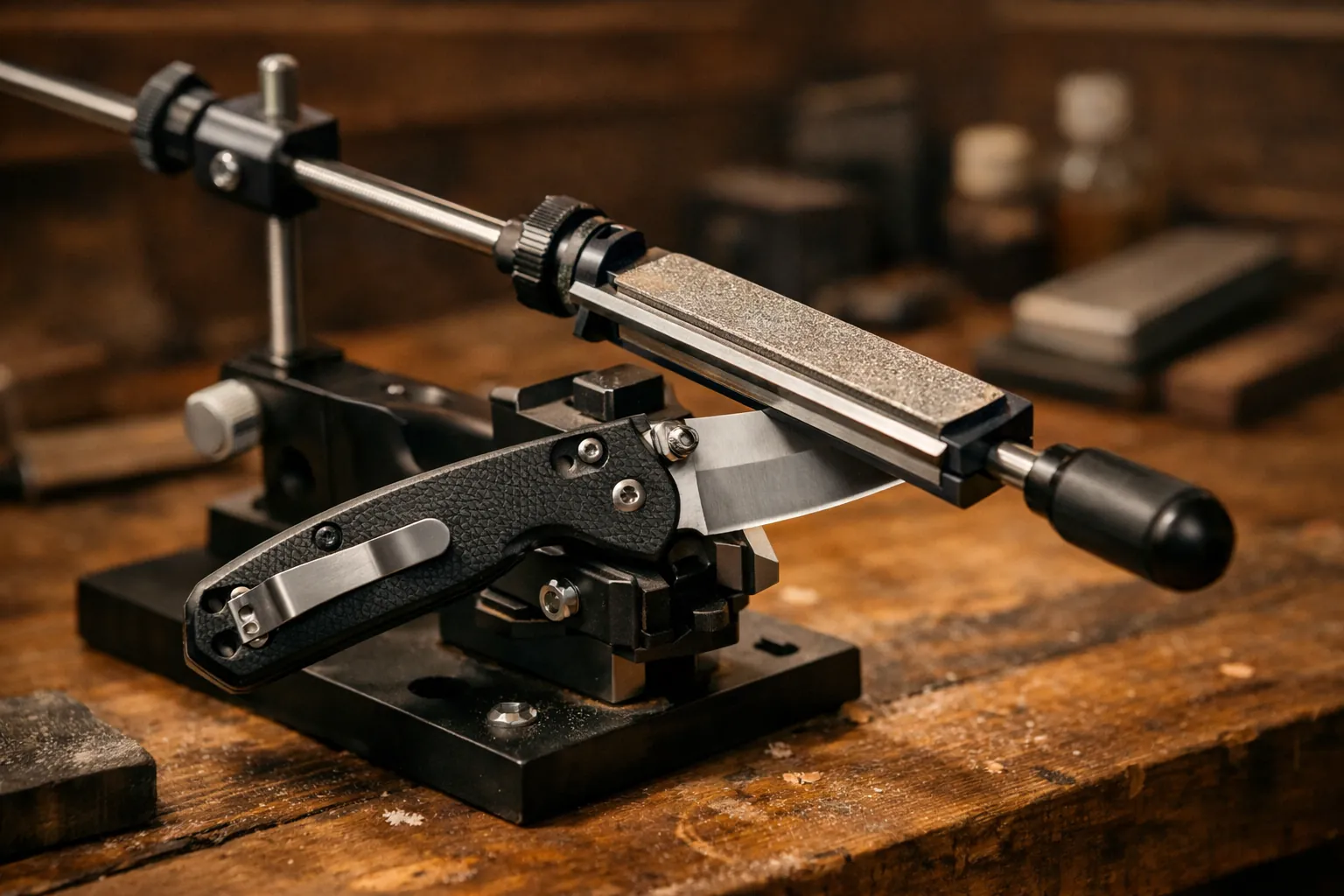
- The Work Sharp Precision Adjust dials from 15 to 30 degrees per side, which covers every brand preset above except Miyabi, Wüsthof's Asian-style blades and the low end of Global's range.
- A Lansky Deluxe 5-stone system uses fixed holes in its clamp. Lansky lists four: 17, 20, 25 or 30 degrees.
- The Spyderco Sharpmaker sets its stones at 30 or 40 degrees inclusive, so 15 or 20 per side.
- A clip-on SHARPAL 194H whetstone angle guide keeps freehand stone work near a fixed height while you learn. It's the cheapest option and the least exact.
Our best sharpening system guide compares them in detail, and the Sharpmaker review covers the 30/40 setup.
What the calculator can't do
It assumes a double-bevel edge. Single-bevel Japanese knives (yanagiba, deba) are sharpened on one face and their flat back is only polished, so follow the existing bevel instead of a calculated height. It also assumes the bevel is flat, not convex, and that the stone is flat; a dished stone changes the real angle by a degree or more across the blade. And the heights are only as good as your blade measurement. If you hold the height but the marker says otherwise, believe the marker.
Brand angles come from each maker's own pages, checked October 3, 2026, with Tormek's 2020 "Knife sharpening angles: Manufacturer's recommendations" PDF as a cross-check. Formulas are standard right-triangle trigonometry. Coin thicknesses from the US Mint specifications. Product details come from Amazon listings checked the same day. How we research · Affiliate disclosure