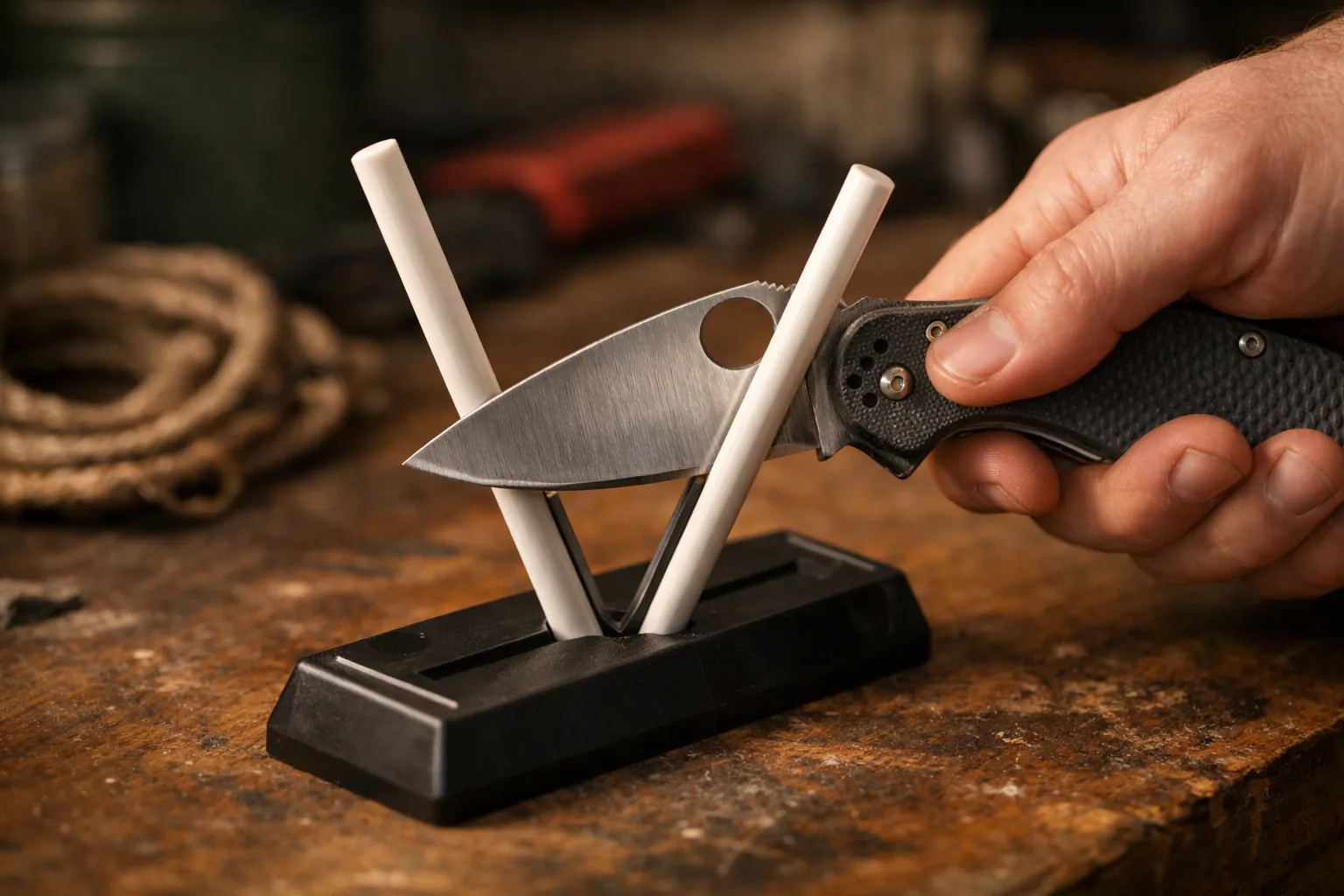
Sharpen a Spyderco at about 15 degrees per side (30 inclusive) for a fine slicing edge, or 20 per side (40 inclusive) for a tougher one. Spyderco doesn't publish a factory edge angle on its product pages, so the 15° figure comes from owners measuring their knives. What Spyderco does publish is the angle of its own sharpeners, and they're built around exactly those two numbers. For other brands, see the knife sharpening angle chart.
What's official and what's owner-reported
| Claim | Source | Status |
|---|---|---|
| Sharpmaker sets stones at "30° (15° each side) or 40° (20° each side)" | Spyderco's sharpener pages | Official |
| Gauntlet holds rods at "40-degree angle (20 degrees per side)" | Spyderco | Official |
| Galley-V sets fine ceramic rods at "20-degree angle (10 degrees per side)" for kitchen knives | Spyderco | Official |
| Factory edges are about 30° inclusive | Owner threads on Spyderco's forum, such as "List of factory edge angles" | Owner-reported, not on Spyderco's product pages |
| A specific angle for the PM2, Delica, Endura or Tenacious | none found | Not published |
We checked Spyderco's sharpener and knife listings on October 3, 2026. None of the knife pages states an edge angle. Forum figures are measurements by owners, they vary by knife and by batch, and Spyderco's factory edges have changed over the years, so use them as a starting point and confirm with the marker trick below.
Using the Sharpmaker's 30 and 40
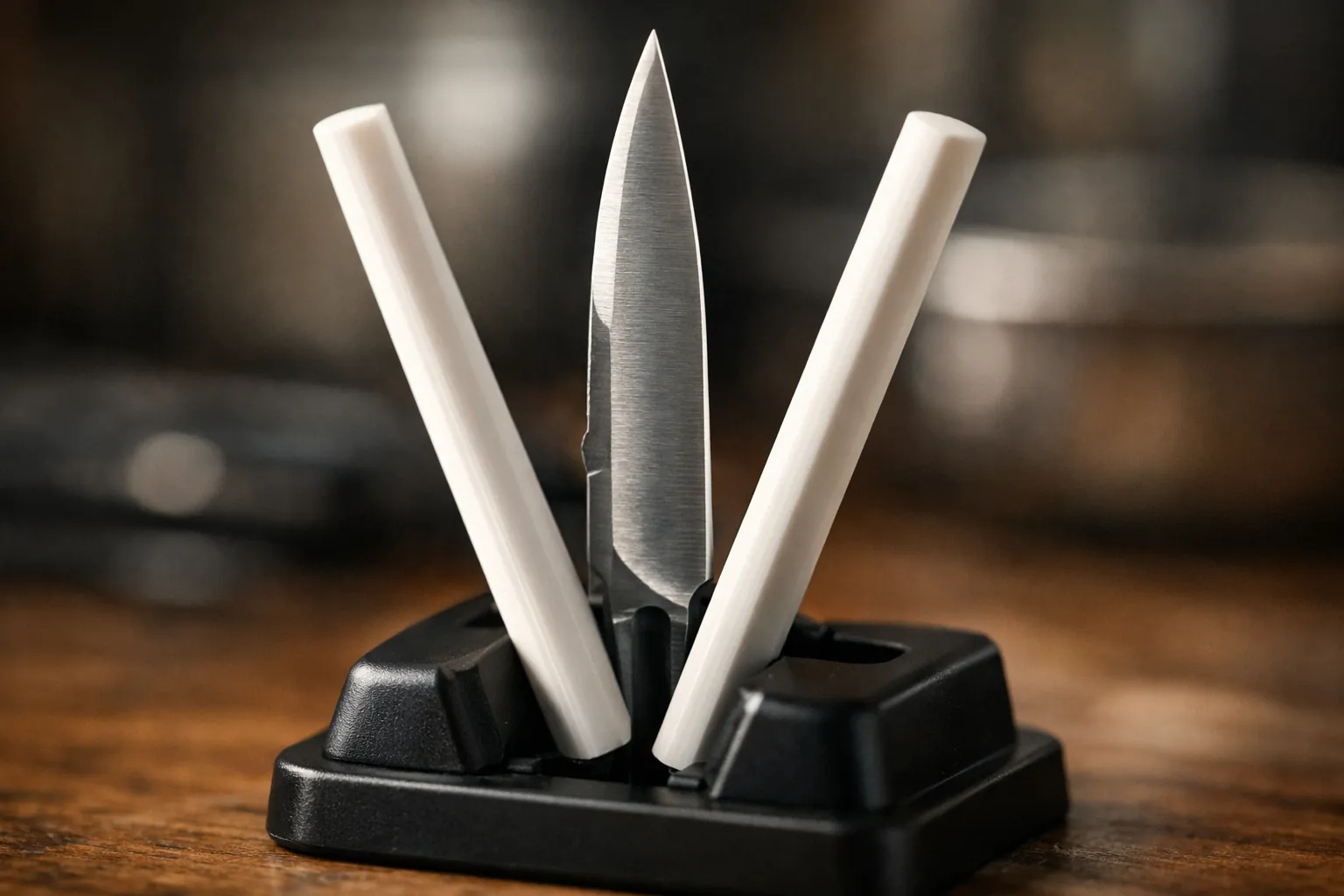
The Sharpmaker's base has two pairs of keyed holes. You keep the blade straight up and down, and the stones' lean sets the angle. The two settings do different jobs:
| Setting | Per side | Use it for |
|---|---|---|
| 30° holes | 15° | Reworking a dull edge across the whole bevel; setting a thin back-bevel |
| 40° holes | 20° | Fast touch-ups at the apex only; adding a stronger microbevel after the 30° work |
The kit includes medium (brown) and fine (white) alumina ceramic stones, per Spyderco. Ceramic is slow on today's hard, wear-resistant steels, so a badly dulled knife can take a long time at 30°. Spyderco's accessory diamond Sharpmaker stones (also sold in CBN and ultra fine) speed up the reworking step. Our Spyderco Sharpmaker review covers the system in detail.
A microbevel: 15° behind, 20° at the edge
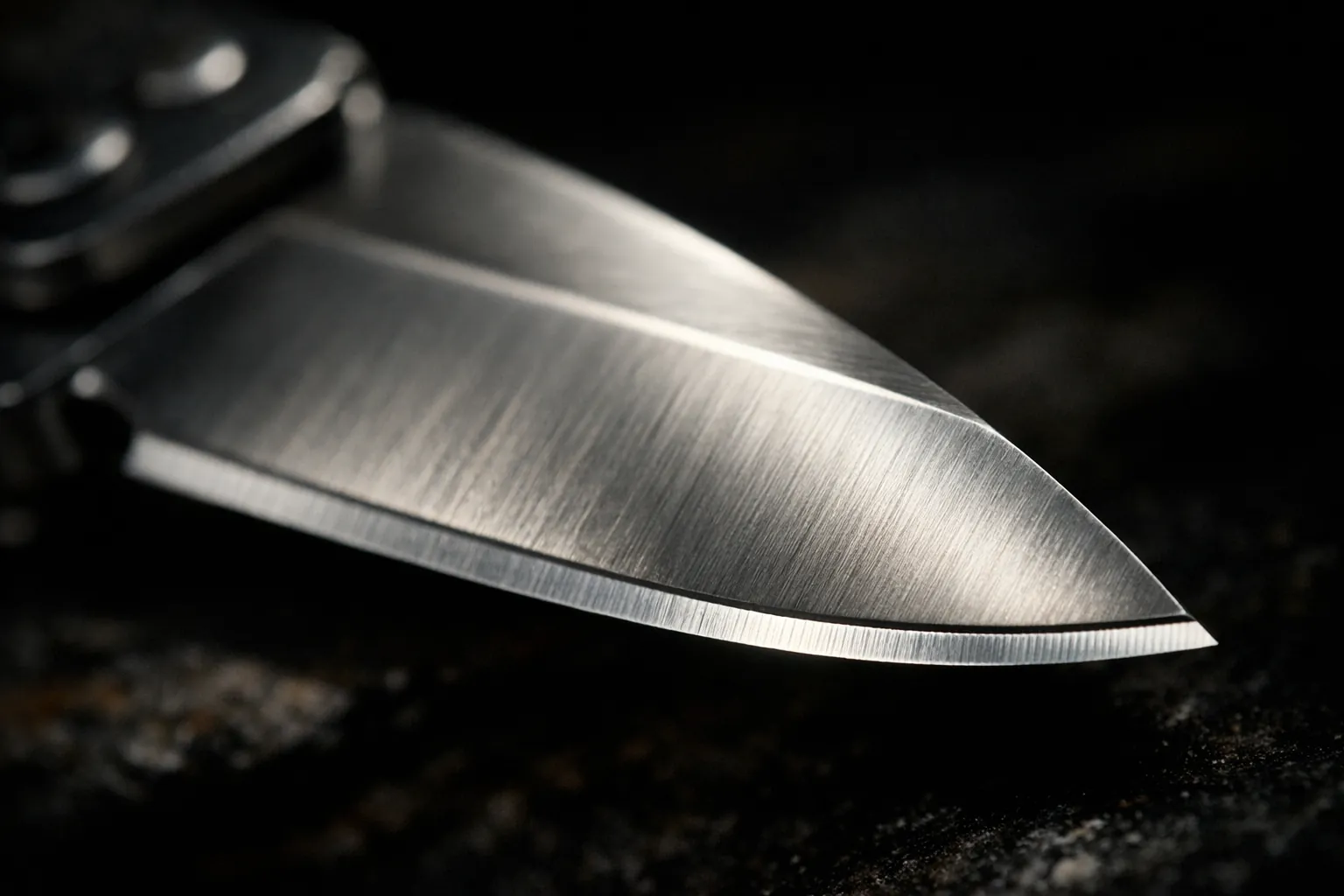
The Sharpmaker makes a two-angle edge easy. Sharpen at 30° (15 per side) until you've raised a burr, then switch to the 40° holes and take a few light strokes per side on the fine stones. The result is a thin 15° bevel that slices well, with a sliver of 20° at the very edge that resists rolling. When it dulls, touch up at 40° for months before you need the 30° slots again. It's the same idea behind the microbevel on our angle chart.
Popular models: the steel decides, not the name
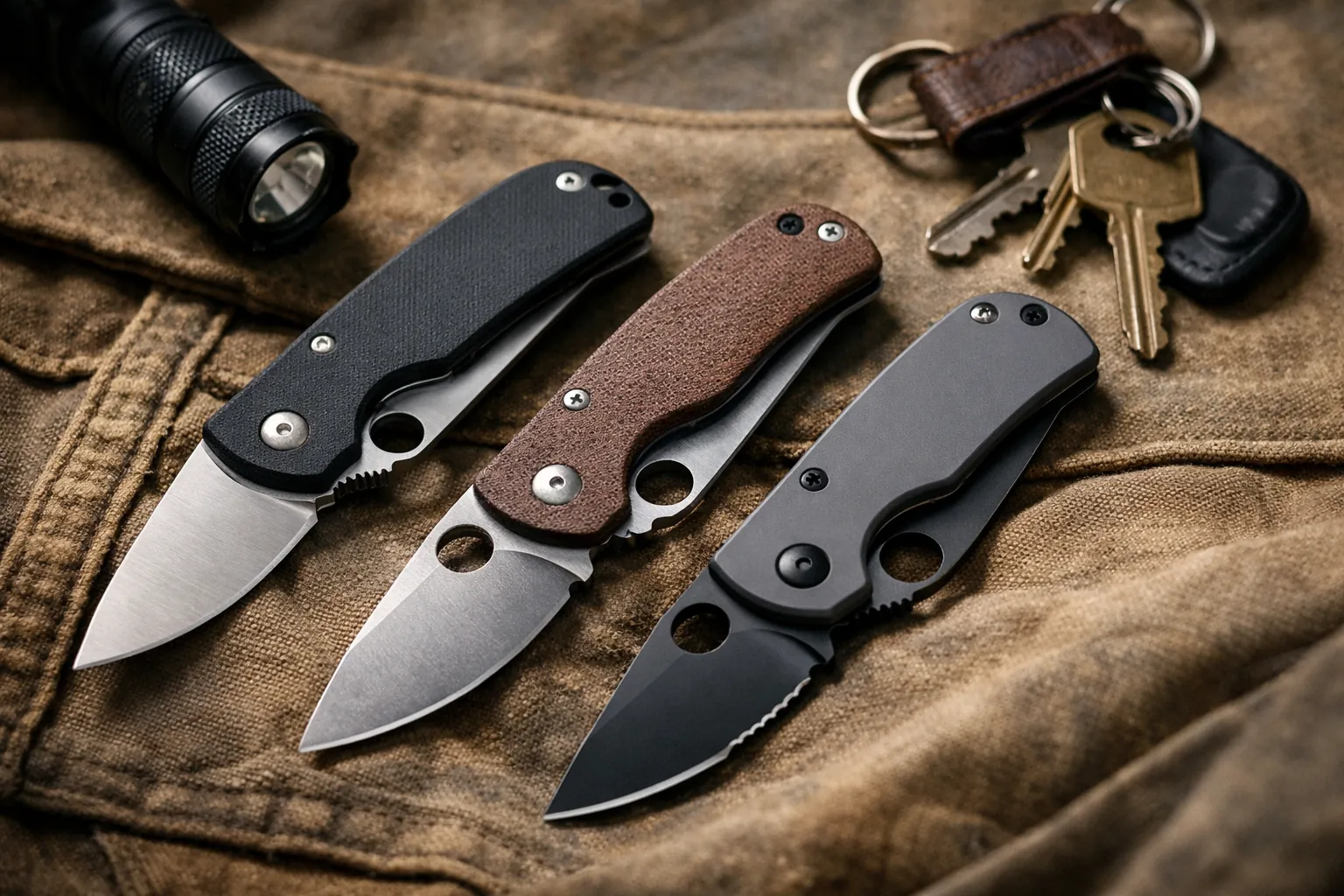
Spyderco makes most of its popular models in more than one steel, and the steel is what should move your angle. Here's what Spyderco's own listings say about a few common versions.
| Model (version) | Steel per Spyderco | Our suggested angle |
|---|---|---|
| Tenacious (C122G) | 8Cr13MoV stainless | 17–20° per side; softer budget steel rolls if thinner |
| Endura 4 Lightweight Flat Ground | VG-10 | 15° with a 20° microbevel |
| Para Military 2 Lightweight Salt | CPM MagnaCut | 15° per side; tough enough for thin |
| Manix 2 Lightweight Maxamet | Carpenter Micro-Melt Maxamet | 15–20°; use diamond, not ceramic, to sharpen |
| Delica 4 (many versions) | varies by version | Check your blade's steel, then use the rows above |
Steels from spyderco.com listings, checked October 3, 2026. Suggested angles are our starting points, not Spyderco recommendations.
Spine heights for pocket-knife blades
Pocket blades are narrow, so the spine barely lifts. That's why freehand sharpening is harder on a folder than a chef's knife, and why Spyderco sells a sharpener that holds the angle for you.
| Blade width (edge to spine) | 15° | 17° | 20° |
|---|---|---|---|
| 18 mm / 0.71 in | 4.7 mm | 5.3 mm | 6.2 mm |
| 22 mm / 0.87 in | 5.7 mm | 6.4 mm | 7.5 mm |
| 25 mm / 0.98 in | 6.5 mm | 7.3 mm | 8.6 mm |
| 30 mm / 1.18 in | 7.8 mm | 8.8 mm | 10.3 mm |
Spine centerline height = width × sin(angle). Thick folder spines sit lower under the spine's bottom face; the calculator corrects for that if you enter the thickness.
Use the angle calculator with the Spyderco preset for your exact blade, including spine thickness, which matters more on a 4 mm folder spine than on a kitchen knife.
Find your knife's actual angle first
Before you pick 30 or 40, color the bevel with a permanent marker and take two light strokes per side at 30°. If the ink is gone across the whole bevel, your factory edge is near 15° per side and the 30° holes match it. If it's only gone at the shoulder, the factory edge is steeper; either use 40° or accept a longer first session to reset at 30°. The sharpie trick guide shows the patterns. Once you know the angle, our guide to sharpening a pocket knife covers partly serrated and recurve edges too.
Other tools that hit Spyderco angles
- The Spyderco Sharpmaker: 15° or 20° per side, ceramic stones, more than 5,000 Amazon ratings.
- The Work Sharp Precision Adjust: any whole degree from 15 to 30, and it clamps the blade.
- A Lansky Deluxe 5-stone system: fixed 17° and 20° holes; Lansky itself recommends 20° for "higher quality blades".
The best knife sharpener for pocket knives guide compares them for folders, and the Benchmade sharpening angle page covers the other big EDC brand, which does publish a figure.
Sharpener angles and knife steels from spyderco.com, checked October 3, 2026. Factory-edge figures are owner-reported on Spyderco's forum and labeled as such. Spine heights calculated. Product details from Amazon listings checked the same day. How we research · Affiliate disclosure