Quick answer: which pocket knife sharpener to buy
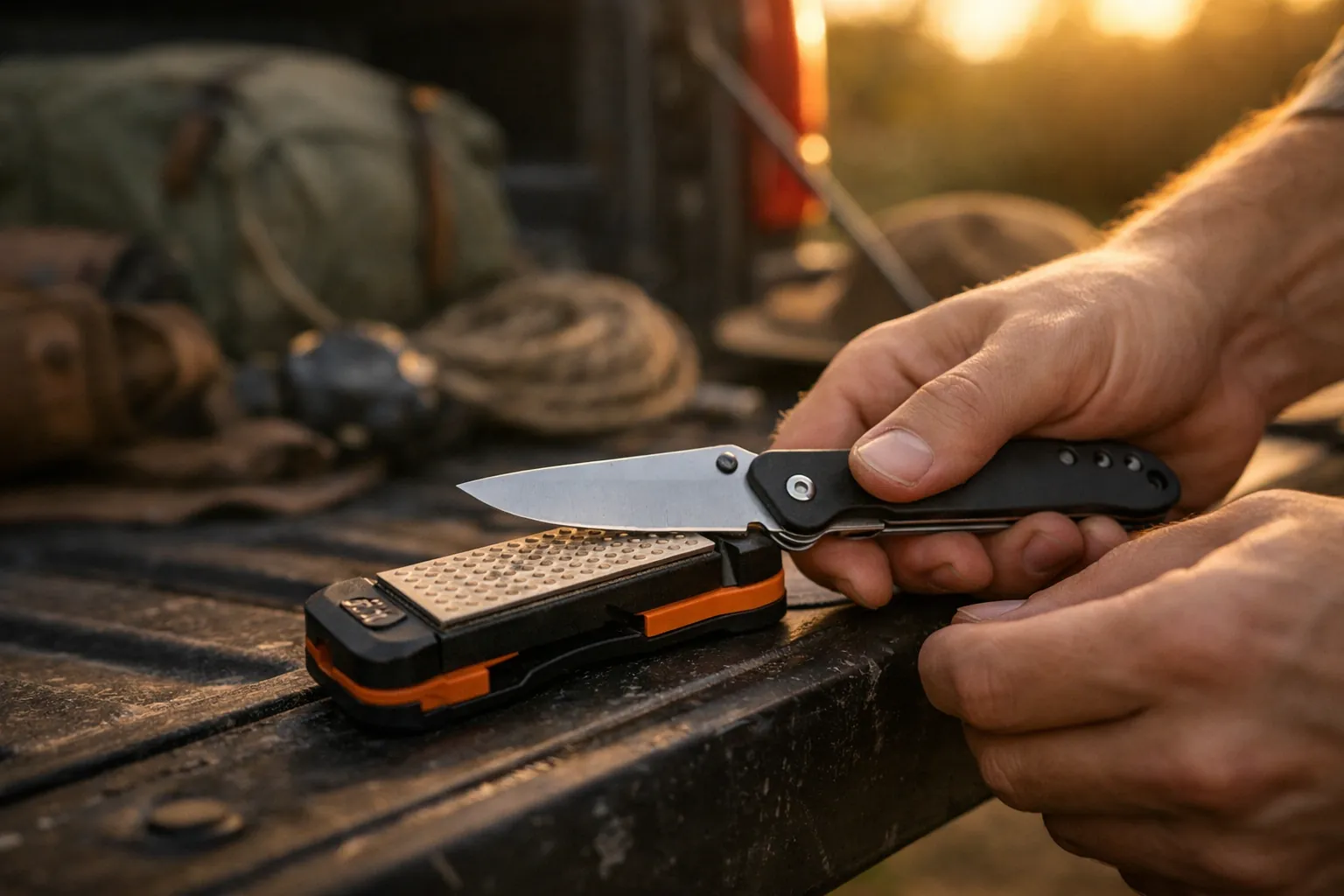
The best knife sharpener for pocket knives is the Work Sharp Guided Field Sharpener. It has 20° and 25° guides and diamond plates, plus a ceramic rod for serrations and a leather strop, in a body small enough for a pocket. If you sharpen at a bench, the Work Sharp Precision Adjust gives a more precise edge. The Spyderco Sharpmaker is the fastest way to maintain a serrated blade, and the Work Sharp Pocket Knife Sharpener is the cheaper pocket-sized option.
Quick picks
| Best overall for pocket knives | Work Sharp Guided Field Sharpener | Amazon |
|---|---|---|
| Best for precise edges at home | Work Sharp Precision Adjust | Amazon |
| Best for serrated pocket knives | Spyderco Tri-Angle Sharpmaker | Amazon |
| Best small pocket sharpener | Work Sharp Pocket Knife Sharpener | Amazon |
| Best cheap pocket tool | Work Sharp Portable Pivot Knife Sharpener | Amazon |
| Best for reprofiling on a budget | Lansky Deluxe 5-Stone System | Amazon |
| Best bench stone with guides | Work Sharp Benchstone | Amazon |
| Best lightweight backup | Smith's DCS4 4-inch Diamond Stone | Amazon |
How we picked
A pocket-knife sharpener has to hold an angle somewhere around 17° to 25° and reach the belly and tip of a short blade. It also needs some way to deal with serrations. Many folders now use hard steels, so we favored diamond abrasives. To rank what passed, we used Amazon ratings and "bought in the past month" counts from October 3, 2026. The listings were rechecked on November 14, 2026. Specs come from each listing and from the makers' own pages. Most roundups treat a folder like a short kitchen knife. This page is built around the parts of a folder that sharpeners actually get wrong: the heel next to the choil, the tight belly and tip, and the serrations.
- Angle control first. A guide, clamp or fixed rod beats a bare stone for most owners, so six of the eight picks hold the angle for you.
- Reach second. Short blades sit close to the pivot and the handle, so a tool that cannot reach the heel or follow the belly loses points no matter how good its abrasive is.
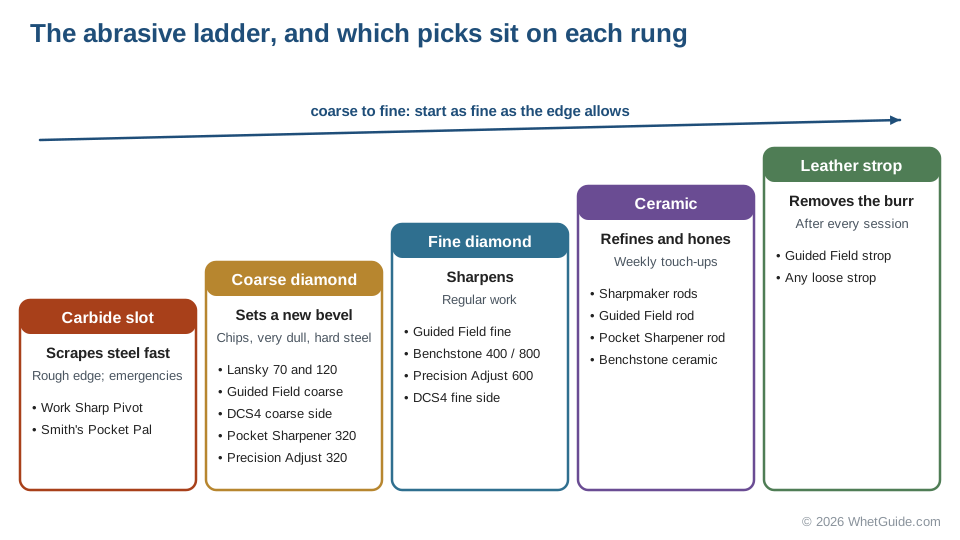
- Abrasive third. Diamond cuts the high-carbide steels that show up in mid-priced folders; ceramic is for upkeep; carbide is for emergencies.
- Serrations and size last. A partly serrated knife needs a rod. A tool that lives in a pocket needs to weigh next to nothing.
- Where a maker publishes a number we lean on, such as Spyderco's inclusive Sharpmaker angles or Buck's per-side range, it's named where it appears. Where a reviewer made a point we agree with, like GearJunkie on rolling sharpeners or Knife Informer on pull-throughs, they're credited. How we research has the rest.
What makes pocket knives different
A kitchen knife gives a sharpener eight inches of nearly straight edge to work with. A three-inch folder gives it maybe two inches of straight edge, then a belly that curves up fast, then a tip. Every degree of wobble shows on a blade that short, and the heel sits hard against the choil and pivot, with no room for a clamp or a guide.
| If you… | Get |
|---|---|
| Want one tool that rides everywhere | Work Sharp Guided Field Sharpener |
| Want the most precise edge at home | Work Sharp Precision Adjust |
| Carry serrated or partly serrated knives | Spyderco Sharpmaker |
| Want to reprofile factory edges cheaply | Lansky Deluxe 5-stone |
| Want a cheap pocket-sized sharpener with angle guides | Work Sharp Pocket Knife Sharpener |
| Want the lightest backup | Smith's DCS4 diamond stone |
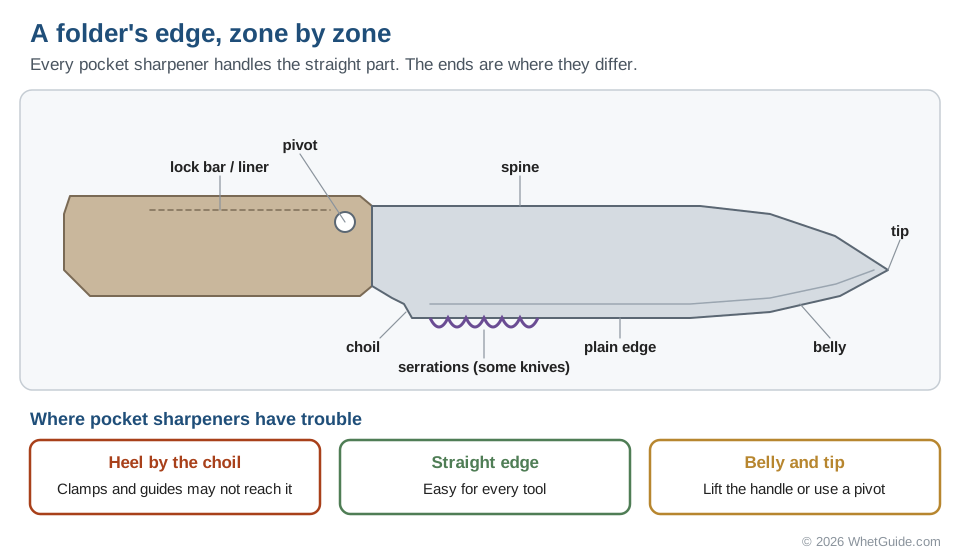
Three more things set folders apart. They lock open, and the lock is the only thing between a slipping stroke and your fingers, so you sharpen with the blade fully open and the lock engaged. They pick up lint and grit in the pivot, which grinding swarf makes worse. And many carry a partly serrated edge, which no flat plate can sharpen. For Swiss Army knives specifically, see the best sharpener for Victorinox knives.
↑ Back to all sectionsThe 8 best sharpeners for pocket knives
Work Sharp Guided Field Sharpener
Five abrasives in one flat body: two diamond plates, a leather strop, and a rotating ceramic rod with a coarse face, a fine face and a fish-hook groove. Built-in guides hold 20° or 25°, which covers most pocket and hunting knives. Pop the diamond plates off and there's a broad-head wrench underneath. It sold 2,000+ in the month before our October 3 check, which puts it among Amazon's best-selling pocket-knife sharpeners. The Work Sharp Guided Field Sharpener review takes each plate and the strop in turn.
- Guides20° and 25°
- Abrasivescoarse and fine diamond plates, ceramic rod (coarse, fine, fish hook groove), leather strop
- Weight135 g
- Warranty3 years
Why it stands out
- Complete kit that fits in a pocket
- Angle guides for EDC and hunting angles
- Ceramic rod handles serrations
Think twice if
- You want angles below 20°
- You want bench-level precision
Work Sharp Precision Adjust
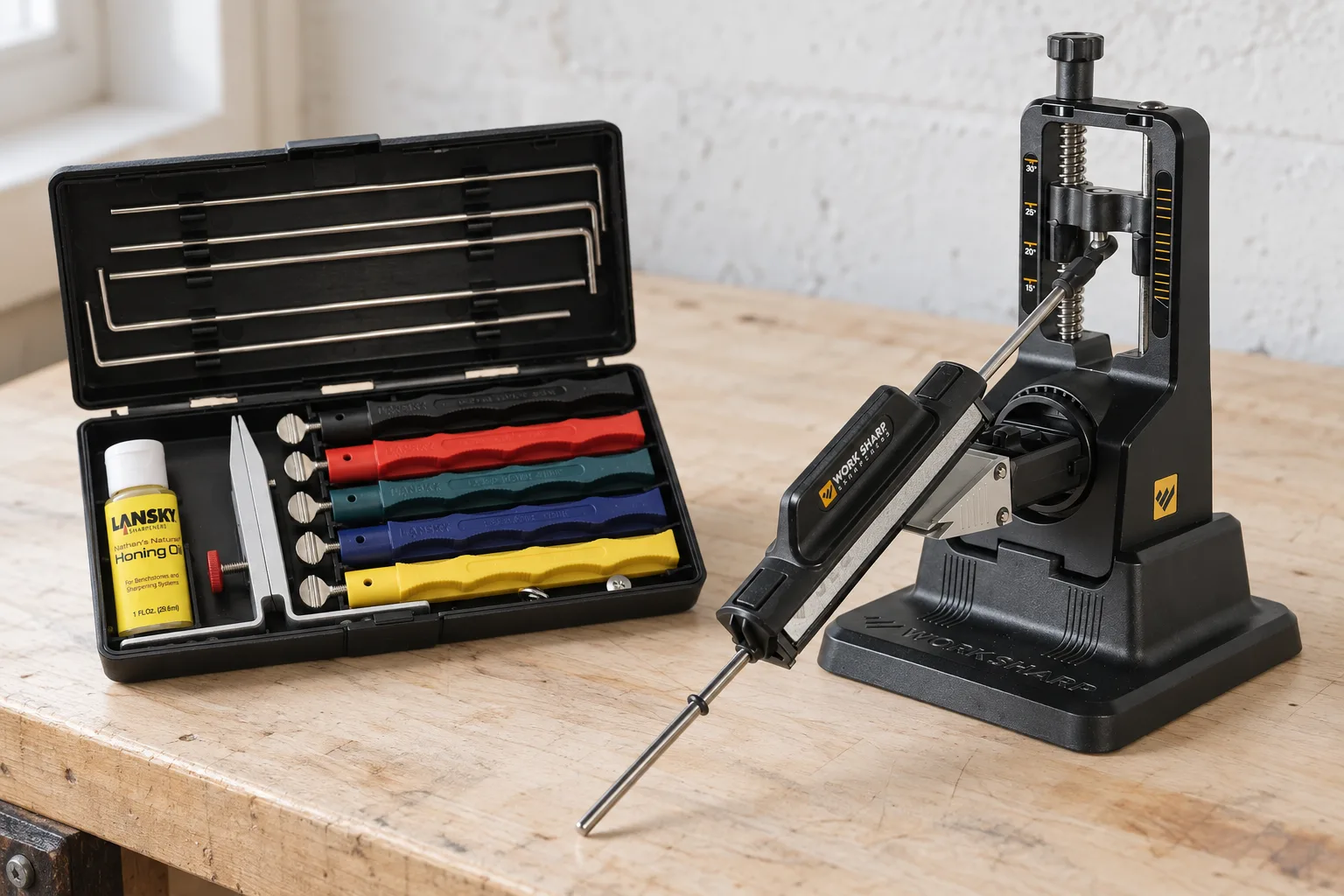
Clamp systems shine on short blades. The whole edge sits close to the clamp, so the angle barely changes from heel to tip. This one sets anywhere from 15° to 30° and uses diamond that cuts hard steel without oil. Keep a Guided Field Sharpener in the truck for touch-ups away from home.
- Angle15° to 30°
- AbrasivesTri-Brasive 320/600 diamond + fine ceramic
- Typeclamp + arm, benchtop
- Warranty3 years
Why it stands out
- Any angle from 15° to 30°
- Very consistent on short blades
Think twice if
- You need something portable
Spyderco Tri-Angle Sharpmaker
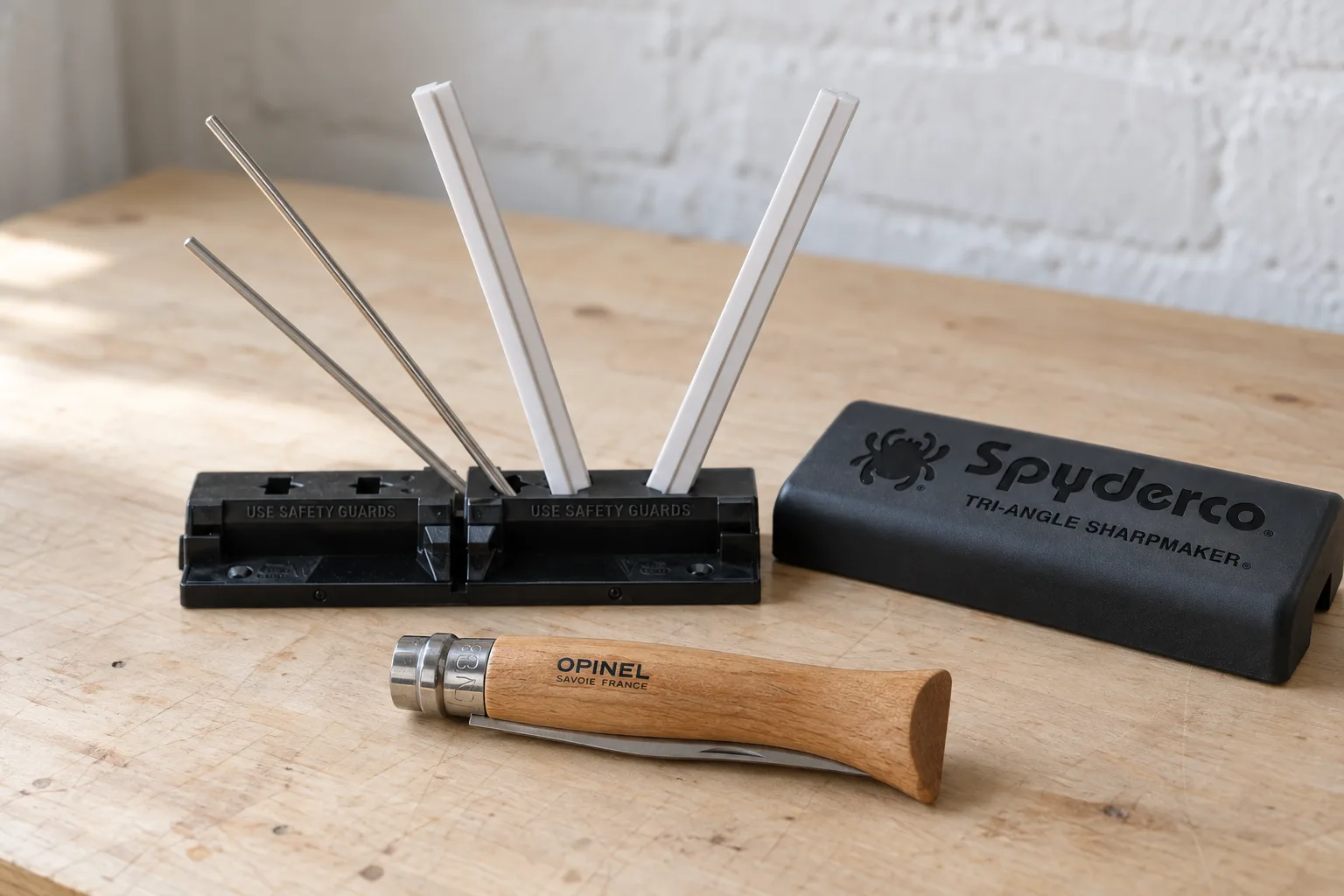
Spyderco sells a lot of serrated folders, and it designed the Sharpmaker for them. The corners of the triangular stones fit into each serration. You hold the blade vertical and stroke down, nothing more. For routine upkeep it's the quickest option here. Very dull edges or hard steels call for Spyderco's add-on diamond stones. See our Sharpmaker review.
- Angles30° / 40° inclusive (15° / 20° per side)
- Stonesmedium and fine ceramic
- Edgesplain and serrated
- Warranty2 years
Why it stands out
- Handles serrations easily
- Minimal learning curve
Think twice if
- You need 25° per side
- Your knives are very dull and you won't add diamond stones
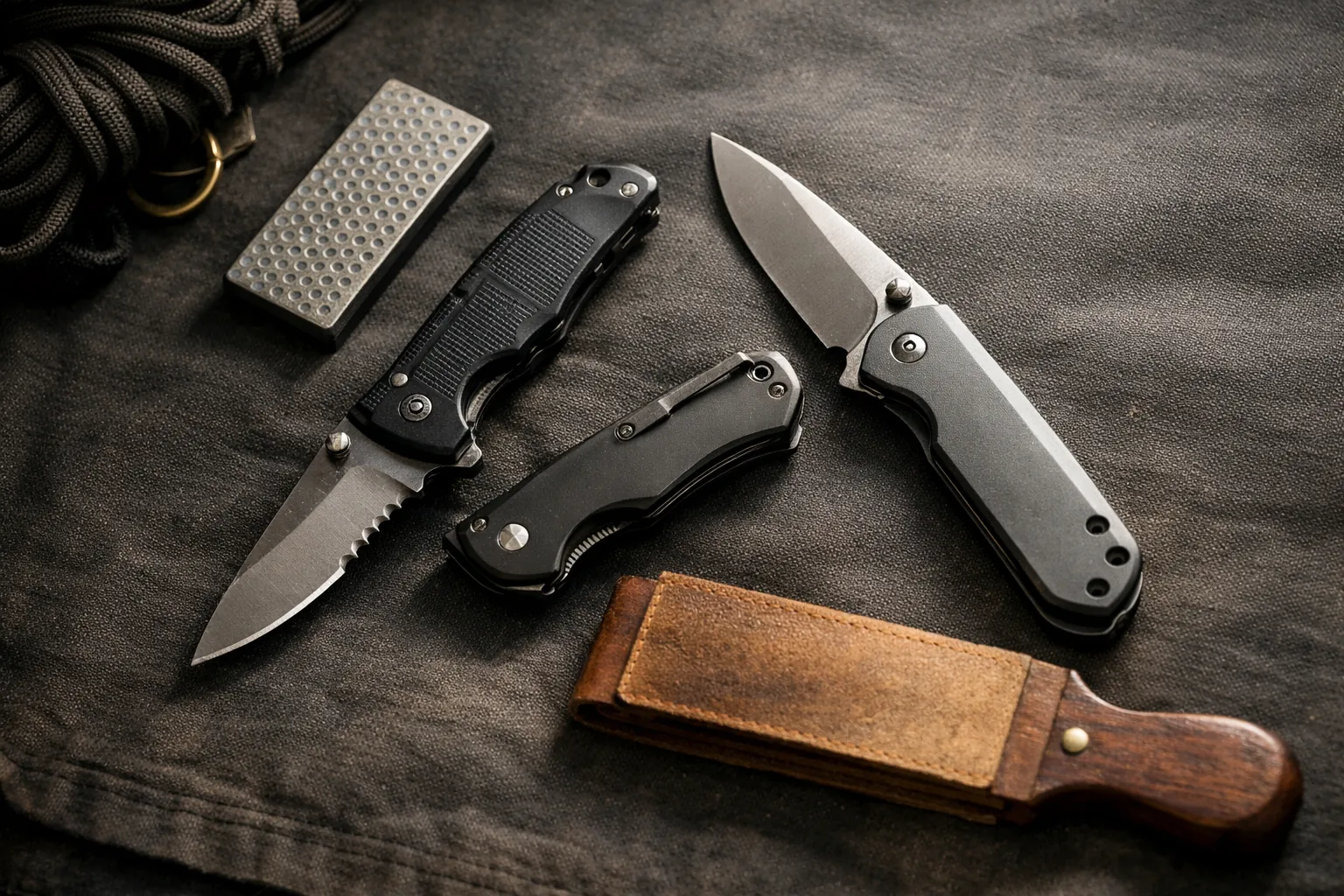
Work Sharp Pocket Knife Sharpener
This is the model people mean when they search for the Work Sharp pocket knife sharpener. One 320 diamond plate and one fine ceramic rod share a slim body, and each has its own angle guide, per the Amazon listing. There's no strop and no serration rod, so it's the one to clip in a bag for quick fixes rather than a full kit. Work Sharp's page says it handles hard steels such as S30V and MagnaCut. If you want a strop and a serration rod, step up to the Guided Field Sharpener. Our Guided Field Sharpener review lays the two side by side.
- Guides20° on the 320 diamond plate, 25° on the fine ceramic rod
- Weight1.6 oz
- Rating4.6 stars (November 2026 listing)
- ModelWSGPS-W
Why it stands out
- 1.6 oz, easy to forget it's in the bag
- Diamond handles hard steels
Think twice if
- You need a strop or a serration tool in the same body
- You want 15° or 17° edges
Work Sharp Portable Pivot Knife Sharpener
The cheapest Work Sharp here and one of its most-rated. The pivot follows the curve of the blade, per the listing, which suits short folders. The carbide slot cuts fast, so use the ceramic hone for routine work. It's a touch-up tool, not an angle-controlled one.
- Abrasivesconvex carbide, ceramic hone, diamond plate
- Size2.75 x 0.75 x 2.35 in
- Weight1.2 oz
Why it stands out
- 1.2 oz, very low cost
Think twice if
- You want a set angle or a strop
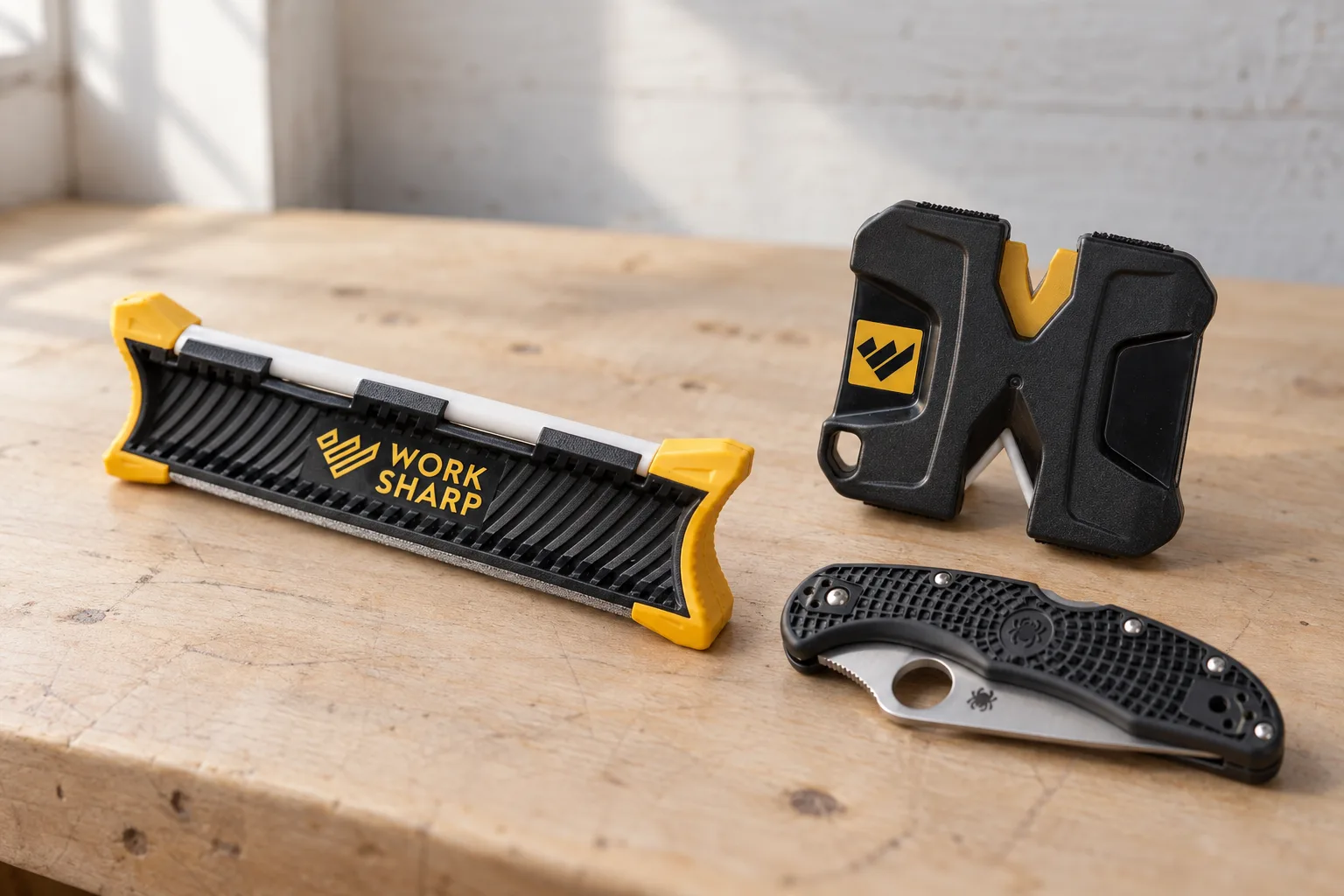
Lansky Deluxe 5-Stone System
Plenty of pocket knives leave the factory with a lopsided or steep edge. Lansky's 70-grit extra-coarse hone grinds a new one fast, then four finer stages bring it back up. Short blades sit well in the clamp, and the kit packs into a small case that goes on hunting trips.
- Angles17°, 20°, 25°, 30° preset
- Hones70, 120, 280, 600, 1000
- Includedclamp, guide rods, oil, case
Why it stands out
- Five grits including extra coarse
- Portable case
Think twice if
- You dislike oil
- You want a single-hand, quick touch-up tool
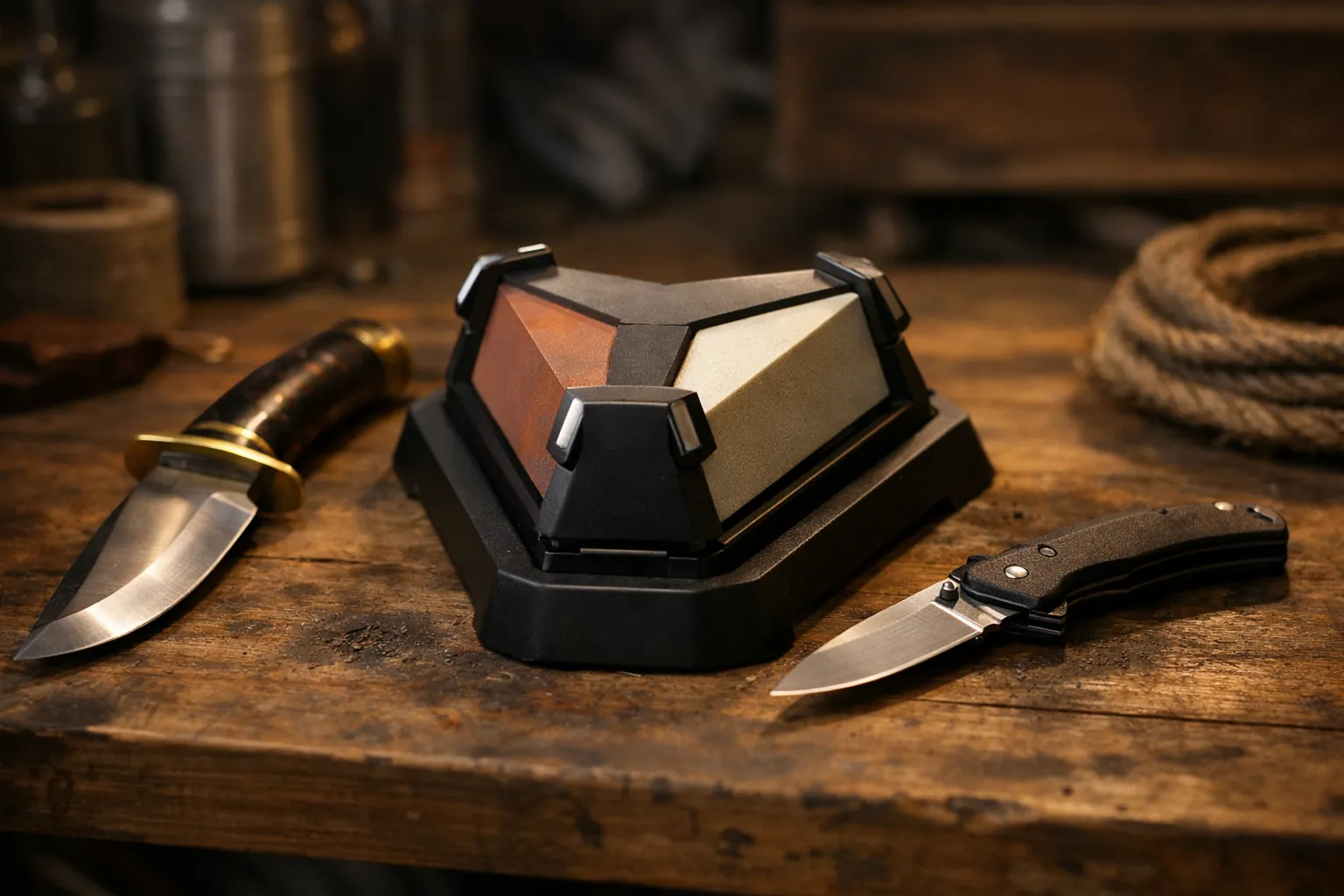
Work Sharp Benchstone
Three faces on one rotating body: 400 diamond, 800 diamond and fine ceramic. Clip on the 20° or 25° guide, or take it off and go freehand. According to Work Sharp, the abrasive pivots to follow the blade's curve, which helps through a pocket knife's belly. Lock the pivot when you want it rigid. Work Sharp also lists 15° and 17° guides as available.
- Abrasives400 diamond, 800 diamond, fine ceramic (3-sided)
- Guides20° or 25°, removable
- Pivotfollows blade curve, can be locked
- Warranty3 years
Why it stands out
- Guided or freehand
- Pivot follows the belly
Think twice if
- You need it to fit in a pocket
Smith's DCS4 4-inch Diamond Stone
This is the one to leave in the glovebox or tackle box. A small two-sided diamond stone tucks inside its own rubber-grip handle, with a coarse side for quick touch-ups, a fine side to finish, and a groove for fish hooks. It has no angle guide, so skip it unless you already sharpen freehand.
- Abrasivemonocrystalline diamond, coarse and fine sides
- Extrasfish hook groove, micro-tool pad, lanyard loop
- Storagestone stores inside handle
Why it stands out
- Tiny, light, protected in its handle
- Diamond handles hard steels
Think twice if
- You need an angle guide
Side-by-side comparison
| Sharpener | Angle | Diamond | Serrations | Portable |
|---|---|---|---|---|
| WS Guided Field | 20° / 25° | Yes | Ceramic rod | |
| WS Pocket Knife Sharpener | 20° / 25° | Yes | No | |
| WS Portable Pivot | Pivots to follow blade | Plate | No | |
| WS Precision Adjust | 15°–30° | Yes | Listed | Bench |
| Spyderco Sharpmaker | 15° / 20° | Add-on | Yes | Bag |
| Lansky Deluxe | 17/20/25/30° | No (diamond kit available) | Pro kit | Case |
| WS Benchstone | 20° / 25° guides | Yes | No | Bench |
| Smith's DCS4 | Freehand | Yes | No |
What each pick can't do
Every tool on this list has a hole in it. Better to know it before the box arrives.
| Pick | Can't do | Fill the gap with |
|---|---|---|
| Guided Field | Angles below 20°; heavy reprofiling is slow on its small plates | Precision Adjust or Lansky at home |
| Precision Adjust | Travel; its stock kit has no strop | A strop, and the Guided Field for trips |
| Sharpmaker | 25° per side; fast repair on stock ceramic | Spyderco's diamond rods, or a coarse plate first |
| Pocket Knife Sharpener | Strop, serrations, angles under 20° | A strop at home |
| Pivot | A set angle you choose; a fine finish | A strop, and a guided tool for real sharpening |
| Lansky Deluxe | Quick touch-ups; dry use (it wants oil) | A ceramic rod for daily upkeep |
| Benchstone | Pocket carry; serrations | A pocket tool for the field |
| DCS4 | Hold the angle for you; serrations | Practice, or the marker test |
Which one fits you: four questions
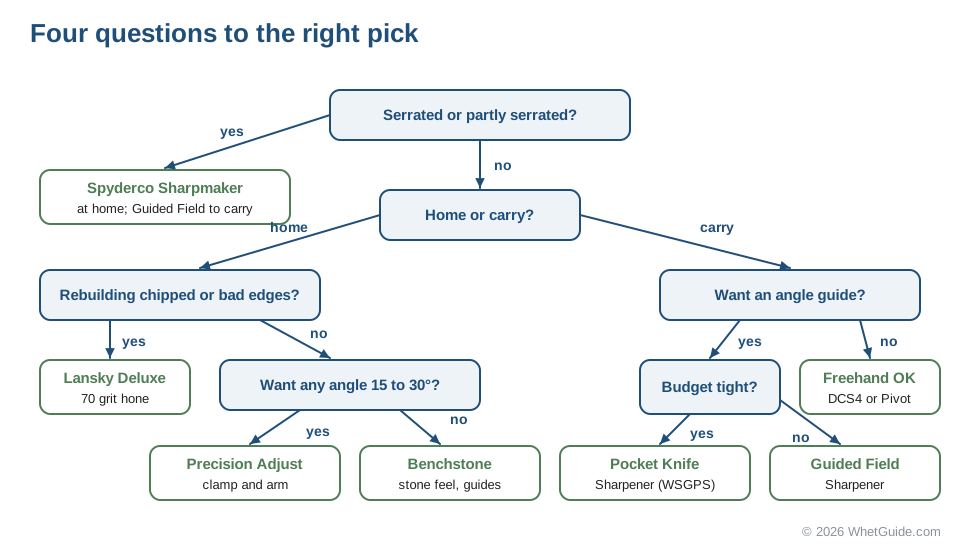
Most people answer the first two questions in a second. Serrations decide more than anything else, because only three of the eight picks can sharpen a scallop at all. After that it's where the sharpening happens: at a bench with time to set up, or on a tailgate with two minutes.
| Your top priority | Pick | Why |
|---|---|---|
| Smallest and lightest | Work Sharp Pivot | 1.2 oz per its listing |
| Fastest routine touch-up | Spyderco Sharpmaker | Fixed rods; no setup beyond dropping them in the base |
| Finest, most even edge | Work Sharp Precision Adjust | Clamped blade, one-degree steps |
| Serrations away from home | Work Sharp Guided Field | Ceramic rod built in |
| Hard steel (S30V, M390 class) | Pocket Knife Sharpener or Guided Field | Diamond plates; Work Sharp names S30V and MagnaCut |
| Fixing a bad factory edge | Lansky Deluxe | 70 grit hone |
| Learning freehand | Smith's DCS4 or the Benchstone with guides off | No guide to lean on |
Per side or inclusive: read the number before you buy
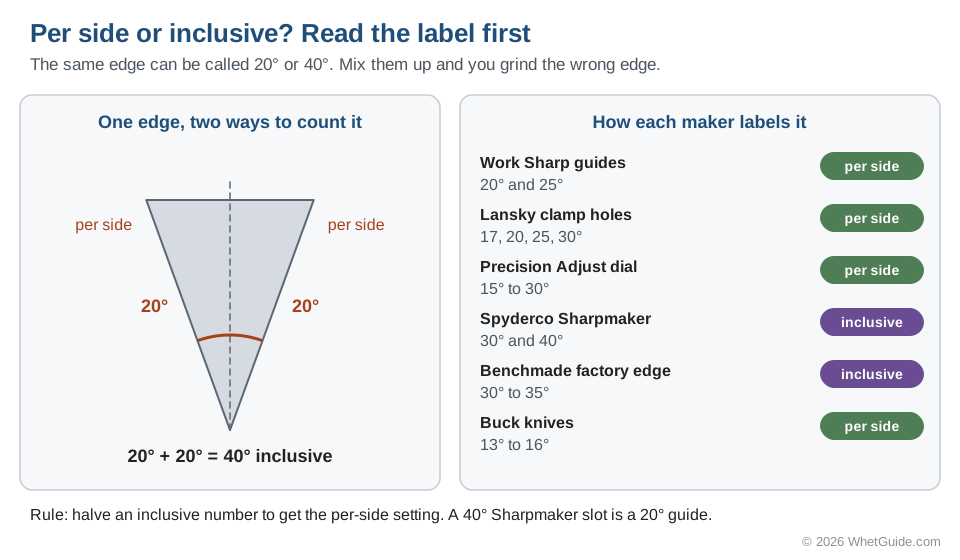
Sharpener makers don't agree on how to write an angle. Work Sharp and Lansky give the angle on one side of the edge, and so does Buck. Spyderco and Benchmade give the total across both sides, which is twice as big. So the Sharpmaker's "40°" slot and the Guided Field's "20°" guide put the same edge on a knife.
- If the label says per side, set that number on your tool.
- If it says inclusive, or it gives a single number above 30°, halve it.
- If it says neither, look at the size. A pocket knife at 35° per side would be close to a wood-splitting edge, so a number that high is almost always inclusive.
- The angle calculator converts between the two and shows what each setting does on a real blade.
Angle by pocket knife maker
Here is what the makers themselves say, as collected on our angle chart, and how each number fits the sharpeners above.
| Maker | Stated angle | Per side | Pocket picks that hit it |
|---|---|---|---|
| Buck (110, 112 and others) | 13°–16°, per side (stated) | 13°–16° | Precision Adjust at 15° or 16°; Sharpmaker 30 slot (15°); guided pocket tools add a steeper 20° edge |
| Case (Trapper, Stockman) | 10°–15°, angle to the stone | 10°–15° | Precision Adjust at 15°; Sharpmaker 30 slot; freehand on a stone |
| Opinel | 20°, angle to the rod | 20° | Every guided pick |
| Victorinox Swiss Army | 15°–20° on a stone | 15°–20° | Sharpmaker either slot; Guided Field at 20° |
| Benchmade (Bugout and others) | 30°–35° inclusive | 15°–17.5° | Precision Adjust at 15° to 17°; Lansky 17° hole; Sharpmaker 30 slot |
| Spyderco (Delica, Endura) | Not published; owners on Spyderco's forum report about 30° inclusive | About 15° | Sharpmaker 30 slot, which is what it was built for |
Two things stand out. Several traditional makers grind thinner than the 20° guides on the pocket tools, so a Guided Field or Pocket Knife Sharpener will put a slightly steeper, tougher edge on a Buck or a Case. That's fine for a working knife and costs a little slicing bite. If you want the factory geometry back, the Precision Adjust or the Sharpmaker's 30° slot gets you there. Chris Reeve Knives sharpens its own folders to 18 to 20 degrees and says the Sharpmaker's 40 degree holes (20 per side) work fine for them. Brand-by-brand detail lives on our Benchmade, Spyderco and Victorinox angle pages.
↑ Back to all sectionsSix kinds of pocket knife sharpener, and how each holds the angle
The abrasive gets the attention, but what decides the edge on a short blade is how the tool holds the angle. Here are the six designs you'll find, from the most hands-off to the least.
| Type | Who holds the angle | Good at | Weak at | On this page |
|---|---|---|---|---|
| Clamp and arm | The clamp and a set pivot | The most even bevel; any angle in its range | Setup time; the heel by the jaws | Precision Adjust, Lansky Deluxe |
| Fixed V-rods | The base slots; you keep the blade upright | Fast upkeep; serrations on the rod corners | Heavy repair on ceramic | Sharpmaker |
| Guided handheld | A raised guide you rest the blade on | Anywhere, in a minute | Angles below 20° | Guided Field, Pocket Knife Sharpener |
| Pivoting bench stone | Clip-on guide, or you | Following the belly | Carry | Benchstone |
| Freehand stone | You | Every shape and angle, once learned | Consistency at first | DCS4 |
| Pull-through and carbide | The slot | Speed on a cheap blade | Steel removal; finish; tips | Pivot, Pocket Pal |
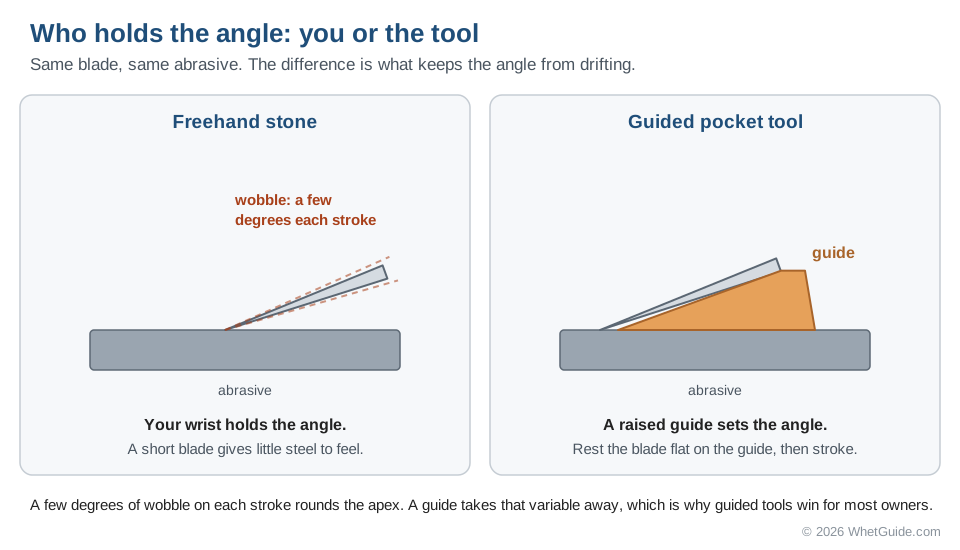
On a long kitchen knife, freehand wobble averages out over the stroke. On a three-inch folder you get fewer strokes per side and less steel to feel, so every wobble lands on the apex. That's the whole case for a guide on a pocket knife, and it's why six of the eight picks have one. If you already sharpen freehand well, the DCS4 or the Benchstone with its guides off will do everything the guided tools do and more. Our whetstone guide shows the freehand stroke.
↑ Back to all sectionsBest folding knife sharpener: handheld and small options
Searches for the best pocket knife sharpener, a small pocket knife sharpener or the best handheld knife sharpener usually mean the same thing: something that fits in a pocket or pack and works on a folder. Three picks above qualify. The table sorts them by what you give up for the small size.
| Handheld option | Angle control | Abrasive | What you give up |
|---|---|---|---|
| Work Sharp Guided Field Sharpener | 20° and 25° guides | Diamond plates, ceramic rod, strop (135 g) | No angle below 20° |
| Smith's DCS4 diamond stone | Freehand | Coarse and fine diamond; stores inside its handle | You hold the angle yourself |
| Smith's Pocket Pal | Fixed slots | Carbide, ceramic and a fold-out diamond rod | Removes metal fast; best on cheap knives |
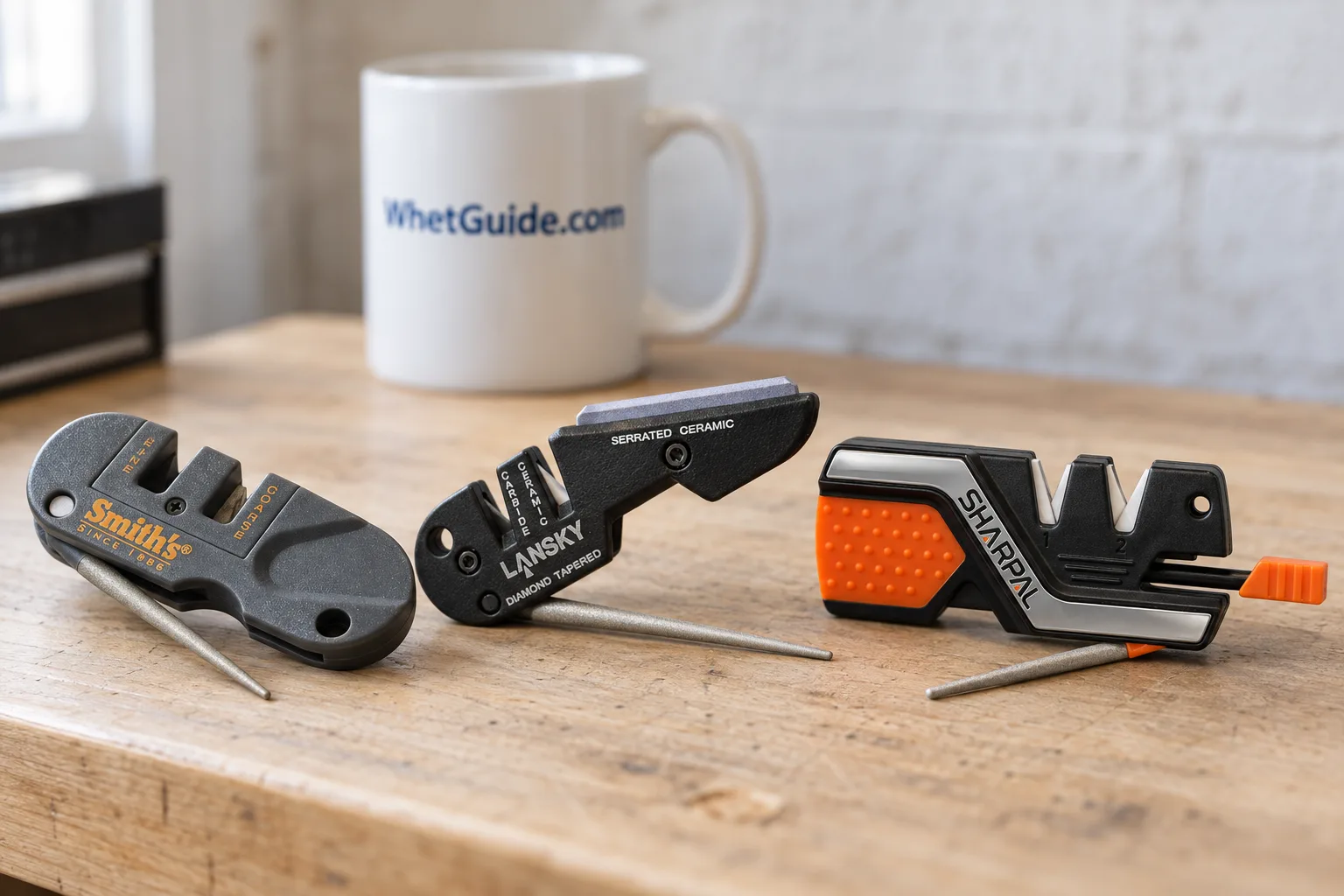
A folding knife adds two small problems. The pivot end of the blade sits close to the handle, so keep your fingers behind the spine, and open the blade fully so the lock is engaged before you start. And a short blade has a tighter curve at the belly, which is why a guided handheld such as the Guided Field Sharpener is easier than a bare stone for a first attempt. Pack-sized tools get a wider look in the best portable knife sharpener guide.
A few handhelds that didn't make the eight are still worth knowing by name. The Lansky BladeMedic puts a carbide slot, a ceramic rod and a serration and hook tool in one body. SHARPAL's 101N pairs V-notch slots with a tapered diamond rod for serrations, and its 178N is a 4-inch, 600-grit pocket model. Work Sharp's Folding Field Sharpener folds into a clip-on body. None of them beats the Guided Field on angle control, which is why they sit here and not in the list.
↑ Back to all sectionsPull-through sharpeners on a pocket knife: when they're fine
Knife Informer and Outdoor Life warn against pull-throughs, as does HiConsumption, and Bob Vila's guide still names the Pocket Pal as its pocket pick. Both camps have a point. A carbide slot shaves steel off the edge in a few strokes. That's handy when the edge is gone and you're miles from a bench. It's also how a pull-through chews up a good knife over a year.
- Fine on a cheap or beater folder; a field emergency; the ceramic slot for a quick hone.
- Not on a knife you paid real money for; thin traditional blades; anything with a tip you care about; serrations (the carbide on the Pocket Pal is for straight edges only, per its listing).
- If you do use one, use light pressure, the ceramic slot first, and pull straight through without rocking. Lift off before the tip, so the slot doesn't round it.
The cheapest rung on Amazon is a two-slot pull-through such as Smith's CCKS or Jiffy-Pro, and Victorinox sells a compact dual sharpener for its own knives. They'll bring a box-cutter-grade edge back. The steel-removal argument gets its full treatment on the page about whether pull-through sharpeners are bad.
↑ Back to all sectionsLansky vs Work Sharp vs Smith's for a pocket knife
These three brands cover most of what people buy, and they solve different problems.
| Brand and model | How it holds the angle | Best use | Weak spot |
|---|---|---|---|
| Lansky Deluxe | Clamp on the blade, guide rod in preset holes (17°, 20°, 25°, 30°) | Reprofiling a factory edge, with a 70 grit hone for heavy work | It needs oil and setup time, and the clamp is slow to move |
| Work Sharp Guided Field | Raised guides at 20° and 25° on each plate | Quick sharpening anywhere, serrations included | No angle below 20° |
| Smith's Pocket Pal | Preset pull-through slots plus a fold-out diamond rod | A small touch-up tool on a lanyard | Its carbide slot removes metal fast and is for straight edges only, per the listing |
Pick the Lansky if you want to rebuild a bevel at home, and the Work Sharp if you want one tool that goes in the pack. The Pocket Pal costs the least and gives the roughest edge, so keep it for knives you don't mind scuffing. Our Work Sharp vs Lansky comparison and which Lansky kit to buy go deeper on the clamp side. Smith's full range, including the DCS4, is in our Smith's sharpener review.
↑ Back to all sectionsPocket-size stones and the Benchstone
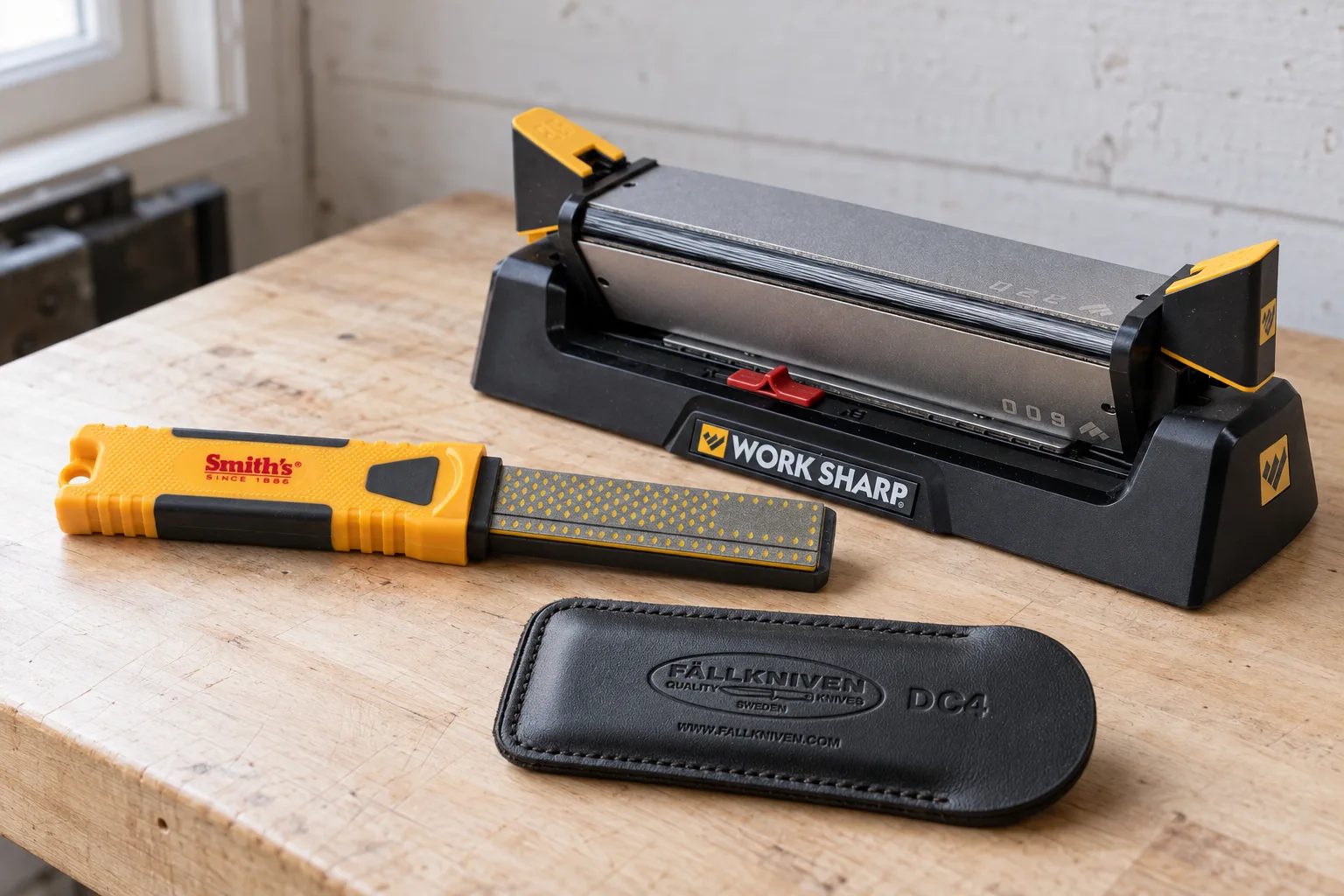
A small stone is the most flexible pocket sharpener there is, as long as you can hold an angle. Three are worth a look:
- The Smith's DCS4 has coarse and fine diamond and stores inside its own handle, so it rides in a tackle box without chipping.
- Fallkniven's DC4 is a pocket stone with diamond on one side and ceramic on the other. Outdoor Life picked it as its best pocket sharpener. It isn't on our list because it has no guide, and the DCS4 covers the same job.
- The Work Sharp Benchstone stays home, but its pivoting face and clip-on guides make it the easiest freehand-style stone for a curved folder blade.
For learning freehand on a full-size bench stone, an eight-inch diamond plate (DMT's Dia-Sharp and SHARPAL's 162N are common choices) or a 1000/6000 water stone gives more room than any pocket stone. Our diamond stone and beginner whetstone guides compare them.
↑ Back to all sectionsMatch the abrasive to your knife's steel
The steel in your folder decides which abrasive is worth carrying. Soft stainless sharpens on almost anything. Steels with lots of hard carbides, the kind in many mid-priced and premium folders, barely notice ordinary ceramic and want diamond.
| Steel family | Common in | Sharpens well on | Slow on |
|---|---|---|---|
| Basic stainless (420HC, 8Cr, 440A class) | Budget folders, many traditional knives | Anything; ceramic is plenty for upkeep | Nothing; just don't over-grind it |
| Carbon steel (1095 class) | Traditional slip joints, Opinel Carbone | Ceramic, stones, diamond | Nothing, but dry it after sharpening |
| Fine-grained stainless (14C28N, AUS-8 class) | Mid-priced EDC folders | Diamond or ceramic | Carbide slots leave it rough |
| High-carbide powder steels (S30V, S35VN, MagnaCut, M390 class) | Premium EDC folders | Diamond | Stock ceramic; soft stones |
| Tool steel (D2) | Value folders | Diamond | Ceramic for anything but upkeep |
This is the one place the Sharpmaker needs help. Its stock rods are ceramic, so a dull S30V blade takes a long time. Spyderco's diamond rods fix that. More on the trade-off in whetstone vs diamond stone.
↑ Back to all sectionsGrinds: what the sharpener actually touches
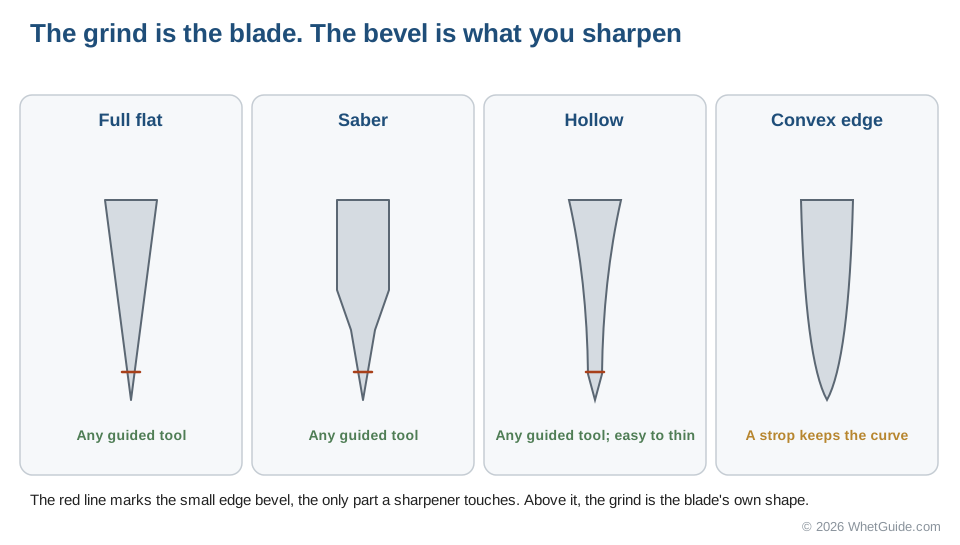
Flat and saber grinds end in a small V-shaped edge bevel, and so do hollow grinds. That bevel is all any sharpener here works on. So the grind matters less than people think. Two exceptions. Thin hollow-ground blades sharpen fast and are easy to over-thin, so stay on fine abrasives. Convex edges, found on some outdoor knives, turn into V edges on any flat guided tool; if you want to keep the curve, finish on a strop. Thick and thin blades get more depth in the pocket knife how-to.
↑ Back to all sectionsBuying guide
Angle
Start at 20° per side unless the maker says otherwise. Most pocket knives fall between about 17° and 25°: lower slices better, higher survives rough work. The angle chart lists common knives. Pack-sized options are rounded up in the best portable knife sharpener guide.
The belly and tip
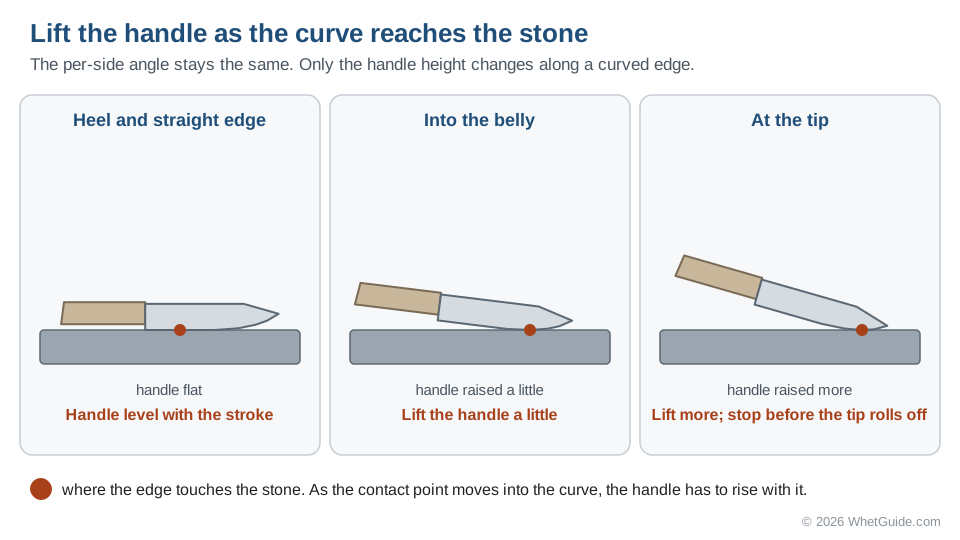
The tip is the part people miss. On a stone, lift the handle a little as you sweep through the belly. A clamp or a pivoting stone does that work for you, and the stroke-by-stroke method is in how to use a whetstone.
Steel
Hard, wear-resistant steels are common in modern folders, and they sharpen slowly on ordinary stones. Diamond cuts them much faster (more in whetstone vs diamond stone).
Quick pocket tools
Tiny pull-through sharpeners such as the Smith's Pocket Pal (carbide and ceramic slots plus a fold-out diamond rod, per its listing) are fine for field touch-ups on cheap knives. They take off metal fast, so use the ceramic slot for routine work.
Serrations
- Fully serrated or partly serrated folder at home: the Sharpmaker.
- The same knife on the road: the Guided Field Sharpener's ceramic rod.
- Everything else on the list will sharpen the plain part only.
Where it lives
A tool in a drawer at home gets used when you remember it. A tool in your pocket, truck or pack gets used when the knife is dull. If you only buy one, buy the one that will be there when the edge goes. That's usually the Guided Field, not the bench system.
↑ Back to all sectionsThe marker test: find your knife's angle before you sharpen
Knife Informer mentions this trick in one line. It deserves more, because it answers the question every new owner has: does my sharpener's 20° match the edge my knife came with? GearJunkie's pocket knife guide frames the goal the same way: unless you plan to reprofile, match the angle the knife came with.
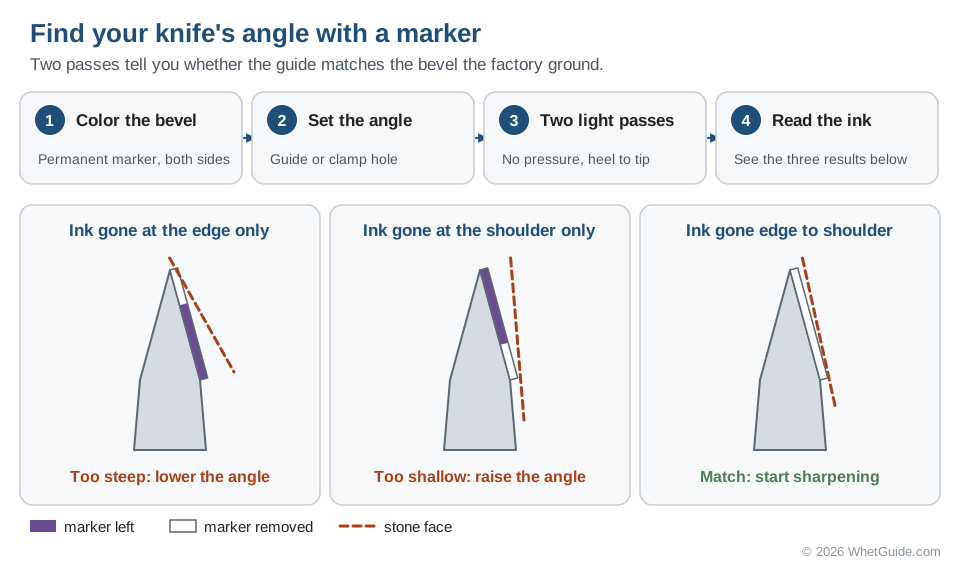
- Color the edge bevel on both sides with a permanent marker. Let it dry.
- Set the tool: the 20° guide on a Work Sharp, the 20° hole on a Lansky, the 40 slot on a Sharpmaker, or your best guess on a stone.
- Make two light passes on one side, heel to tip, with no pressure.
- Look at the bevel under a good light. Where did the ink come off?
- Ink gone only at the very edge: your setting is steeper than the factory bevel. Go lower.
- Ink gone only at the shoulder (the top of the bevel): your setting is shallower. Go higher.
- Ink gone across the whole bevel: you match. Sharpen.
On a fixed-guide pocket tool you can't change the angle, so the test tells you something else: how much steel the first session will take. A Buck ground at 15° on a 20° guide will only touch the edge at first, and it takes a while to build the new, steeper bevel. That's normal. Close-ups of each result are on the marker trick page, and an angle pyramid guide or a digital angle gauge helps if you want a number instead of a guess.
↑ Back to all sectionsYour first session on a guided pocket sharpener
This is the Guided Field Sharpener routine, and it carries over to the Pocket Knife Sharpener and the Benchstone with guides on. The full home method is in how to sharpen a pocket knife, which also handles recurve and tanto blades.
- 1Brace itFlat on a table, a log or a knee. Never in the air.
- 2Open and lockBlade fully open, lock engaged, fingers behind the spine.
- 3Rest on the guideLay the flat of the blade on the 20° ramp, then slide onto the plate.
- 4Heel to tipOne smooth stroke per pass, lifting the handle through the belly.
- Start on the fine diamond plate. Only drop to the coarse plate if the fine plate hasn't raised a burr after a dozen or so strokes per side.
- Work one side until you can feel a burr along the full length of the opposite side. Then switch.
- Match the burr on side two. Then alternate single light strokes, side to side, five or six times.
- Move to the ceramic rod for a few light alternating strokes, a touch steeper than the plates. On the Pocket Knife Sharpener the rod has its own 25° guide. That small, steeper microbevel helps the edge last.
- Strop: edge-trailing passes on the leather, spine first. Then wipe the blade and the plates.
The heel is the bit that gets missed. Start each stroke with the heel right at the near end of the plate, not an inch in, or you'll end up with a dull patch by the choil that grows every session.
↑ Back to all sectionsThe burr: when to flip, when to stop
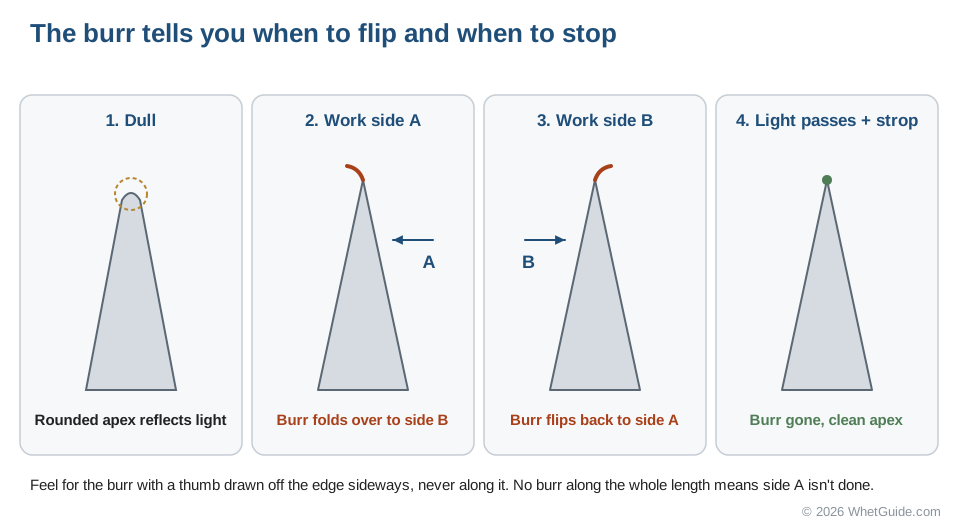
A burr is a thin lip of steel that folds over the edge when the two bevels meet. It's the only reliable sign that a side is done. Draw your thumb sideways off the edge, from spine toward edge, never along it; you'll feel a slight catch on the side away from the stone. No catch along the whole length means keep going. Then the burr has to come off, or the edge will feel sharp for a day and fold over on the first cardboard box. Light alternating strokes shrink it; a strop takes off what's left. Buck's official how-to gives the same instruction in its honing stage: light single strokes until you feel no burr on either side, with a warning that a burr can cut like a sharpened edge. The burr guide takes you through the full method.
↑ Back to all sectionsSerrated and partly serrated pocket knives
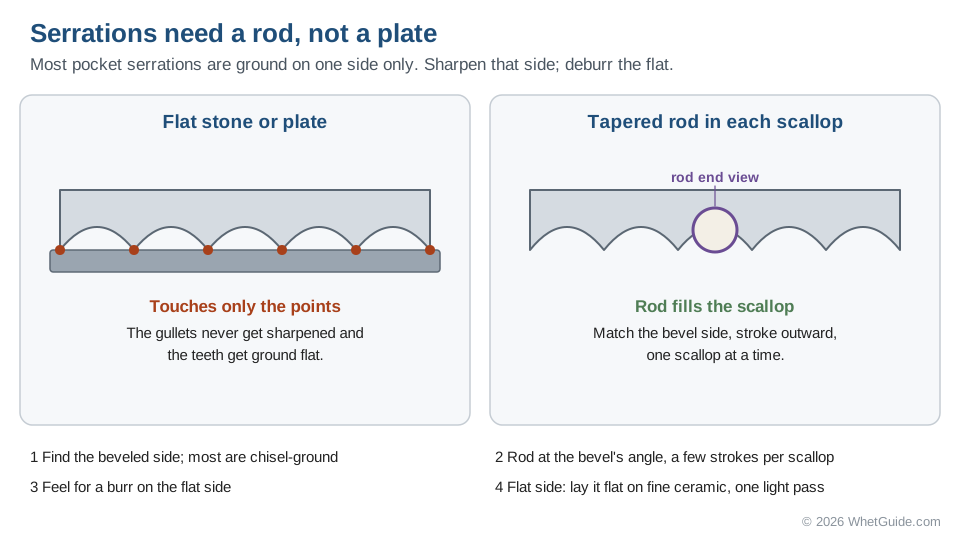
Most pocket knife serrations are ground on one side only. You sharpen that beveled side and leave the flat side alone except to take off the burr. On a partly serrated folder, sharpen the plain section first with your usual tool, then do the serrations.
| Tool | How it reaches the scallops | Notes |
|---|---|---|
| Spyderco Sharpmaker | The corners of the triangular rods | The easiest; it was built for Spyderco's serrated folders |
| Guided Field Sharpener | Rotating ceramic rod | Works scallop by scallop; you match the bevel by eye |
| Tapered diamond or ceramic rod | Rod sized to each scallop | Lansky BladeMedic and SHARPAL 101N carry one |
| Flat plates, carbide slots | They don't | Grinds the teeth flat; avoid |
Count strokes. Three or four per scallop, the same in each, keeps the teeth even. Our serrated knife guide and best sharpener for serrated knives cover bread knives and full serrations too.
↑ Back to all sectionsSlip joints and multi-blade knives: trapper, stockman, Swiss Army
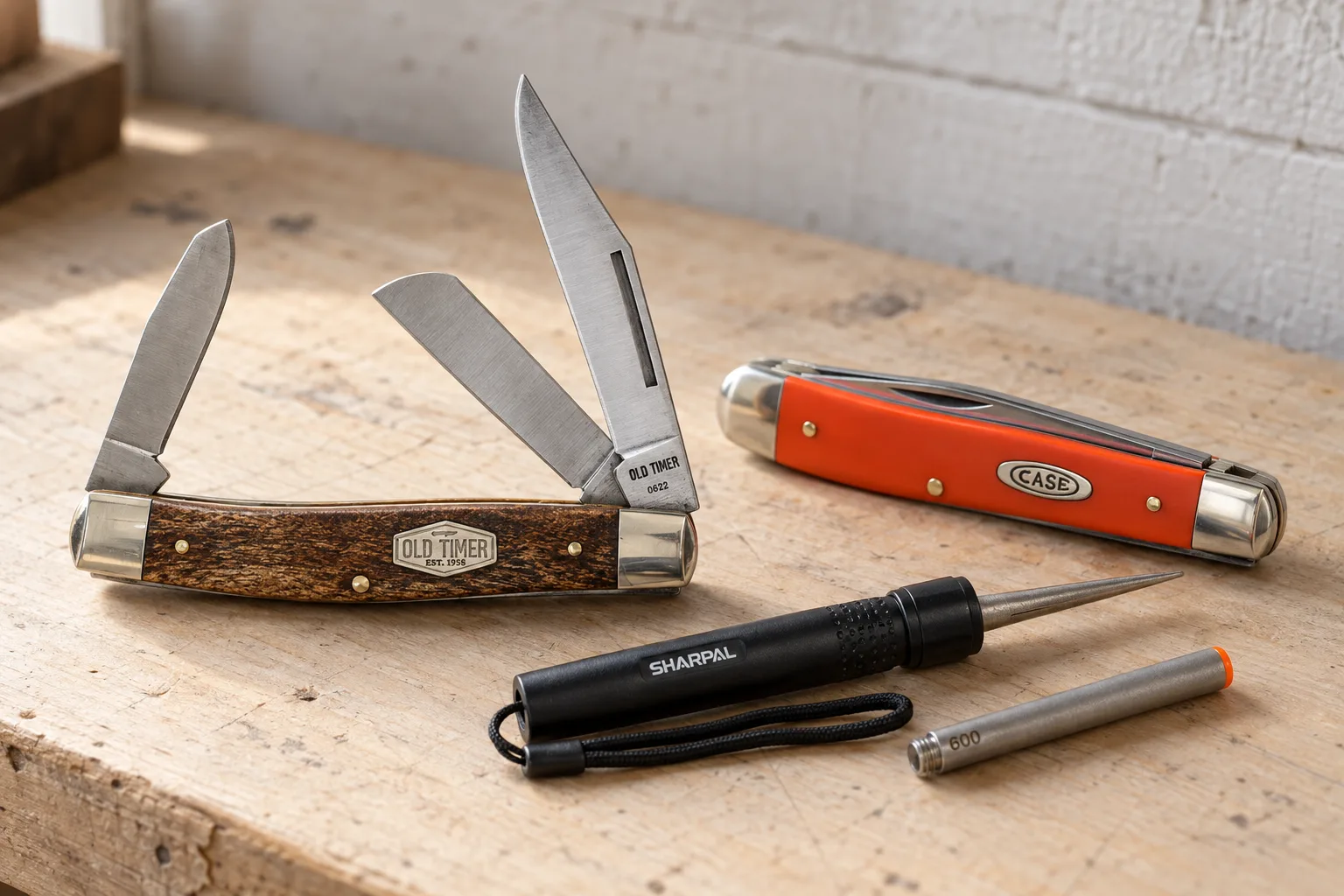
Traditional slip joints have no lock, only a back spring holding the blade open. That changes the technique more than the tool.
- Push strokes toward the spine can fold a slip joint closed. Use edge-trailing or light, controlled strokes. Keep your fingers off the edge line.
- The sheepfoot and Wharncliffe blades on a stockman have straight edges. Any tool handles them, and they're the easiest blades a beginner can practice on.
- The spey blade has a short, steep belly. A fixed-angle pocket guide reaches it if you lift the handle more than you think.
- Clip blades on trappers have a long, fine tip. Stop the stroke as the tip reaches the edge of the plate, or you'll round it.
- Case lists 10° to 15° to the stone. On a 20° guide you're adding a steeper edge, which is fine for a working knife.
Small blades on Swiss Army knives are thin and short enough that a fine ceramic rod or the Sharpmaker's 30 slot suits them better than a coarse plate. Each blade shape is handled in the multi-blade section of our how-to.
↑ Back to all sectionsFixing a bad factory edge
Some new folders arrive with an edge that's uneven side to side, wider at the heel than the tip, or ground steeper than it should be. The marker test shows it in a minute. Fixing it is a coarse-abrasive job, and it's where the Lansky Deluxe earns its place.
On a pocket tool, reprofiling high-carbide steel is slow work; the plates are small. Buck's own sharpening page is firm that a knife never goes on a power grinding wheel built for other jobs, because you can burn the temper and leave the edge brittle. If it's a nice knife with a badly ground edge, a clamp system or the maker's sharpening service makes more sense than an hour with a 1.6 oz sharpener. You'll find the clamp setup in Lansky how-to.
↑ Back to all sectionsSharpening a pocket knife in the field
Out there you need a touch-up, not a rebuild. Work in this order. Serrated edges are part of the full home method in how to sharpen a pocket knife.
- Brace the sharpener on a log or your knee. Don't hold it in the air.
- Set the angle with the built-in guide (20° or 25° on the Guided Field Sharpener), or match the existing bevel by eye.
- Try the fine diamond or the ceramic first. Go to the coarse plate only if that doesn't bring the edge back.
- Alternate sides with light strokes from heel to tip, lifting the handle slightly at the belly.
- Strop if you can. A few edge-trailing passes on leather, or even a belt, clean up the burr.
- Wipe the blade and the sharpener dry before you pack them.
Cold hands and gloves change the job. Skip the coarse plate and do more strokes on the ceramic, because a slip on diamond takes skin. Rain is fine for diamond and ceramic; dry everything before it goes back in the pack.
↑ Back to all sectionsThe right kit for how you carry
| How you carry | Sharpener | Add |
|---|---|---|
| Pocket only, office or town | Nothing on you; a Sharpmaker or ceramic rod at home | A strop on the desk |
| Daypack, hiking | Pocket Knife Sharpener or Pivot | A rag |
| Hunting or fishing pack | Guided Field | Its fish-hook groove; a DCS4 as a spare |
| Truck box or glovebox | Guided Field or DCS4 | A small bottle of pivot oil |
| Home bench | Precision Adjust, Lansky or Benchstone | Strop, compound, marker |
Pack weight, ounce by ounce
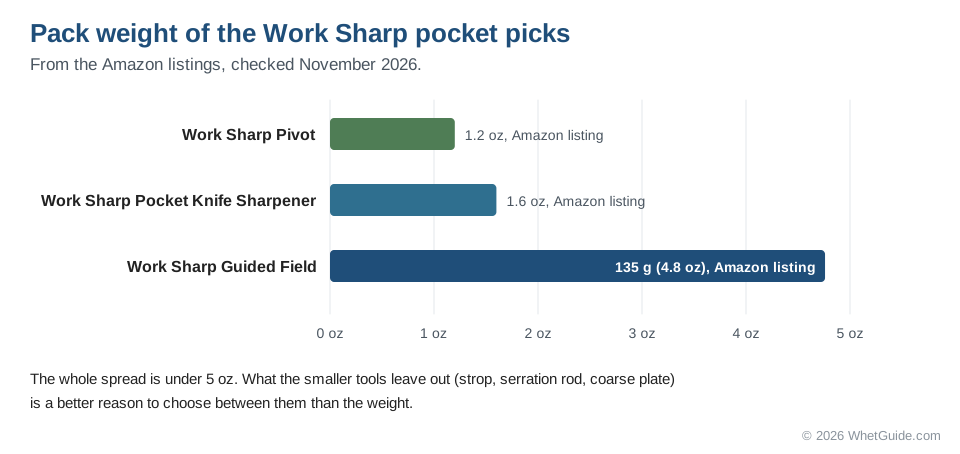
The weights come from the Amazon listings, checked in November 2026. The DCS4's listing gives no weight, so it's left off the chart.
↑ Back to all sectionsSharpening a folder safely
Most cuts during sharpening happen in the second after a slip, when the hand holding the tool is in the blade's path. A folder adds the lock to worry about.
- Open the blade fully and check that the lock is engaged before the first stroke. On a liner or frame lock, look at the lock bar; on a back lock, try to close it gently.
- Keep the fingers of your guiding hand on the flat of the blade or behind the spine, never in front of the edge.
- Stroke away from the hand holding the sharpener, or put the sharpener down on a non-slip surface so neither hand is in front of the edge.
- On a slip joint, avoid hard strokes toward the spine; the blade can fold.
- Wipe the blade from spine to edge, with the cloth folded, not along the edge.
- Close the knife only after the blade is clean. Grit in the pivot scratches the blade and wears the lock face.
A cut-resistant glove on the hand that holds the sharpener costs little and takes the worry out of a field session.
↑ Back to all sectionsKeeping a pocket knife sharp longer
Cut on wood or cardboard. Stone and metal roll or chip an edge on contact. A few passes on a leather strop every week or two will put off a full sharpening for a long time.
Two habits ruin more pocket knives than dull edges do. One is prying: using the tip as a screwdriver is the fastest way to snap it. The other is putting the knife away wet, because corrosion along the edge dulls it as surely as use does.
A touch-up schedule by use
Use these as starting points; the knife will tell you when it needs the next step up.
| What it cuts | Strop | Ceramic | Fine diamond or stone |
|---|---|---|---|
| Mail, string, tags | When it stops catching paper cleanly | Every month or two | A few times a year |
| Food, fruit, a camp kitchen | Weekly | Every few weeks | When the ceramic stops working |
| Cardboard, plastic straps, daily | Every few days | Weekly | Monthly or so |
| Whittling, wood | Often, during the job | When the strop stops working | Rarely, unless it chips |
| Game processing | During and after | Between animals | Before each trip |
Cardboard is the edge killer for most EDC knives; it carries grit. The signs to watch for are on the page about how often to sharpen knives.
↑ Back to all sectionsThe finishing kit: strop and pivot oil
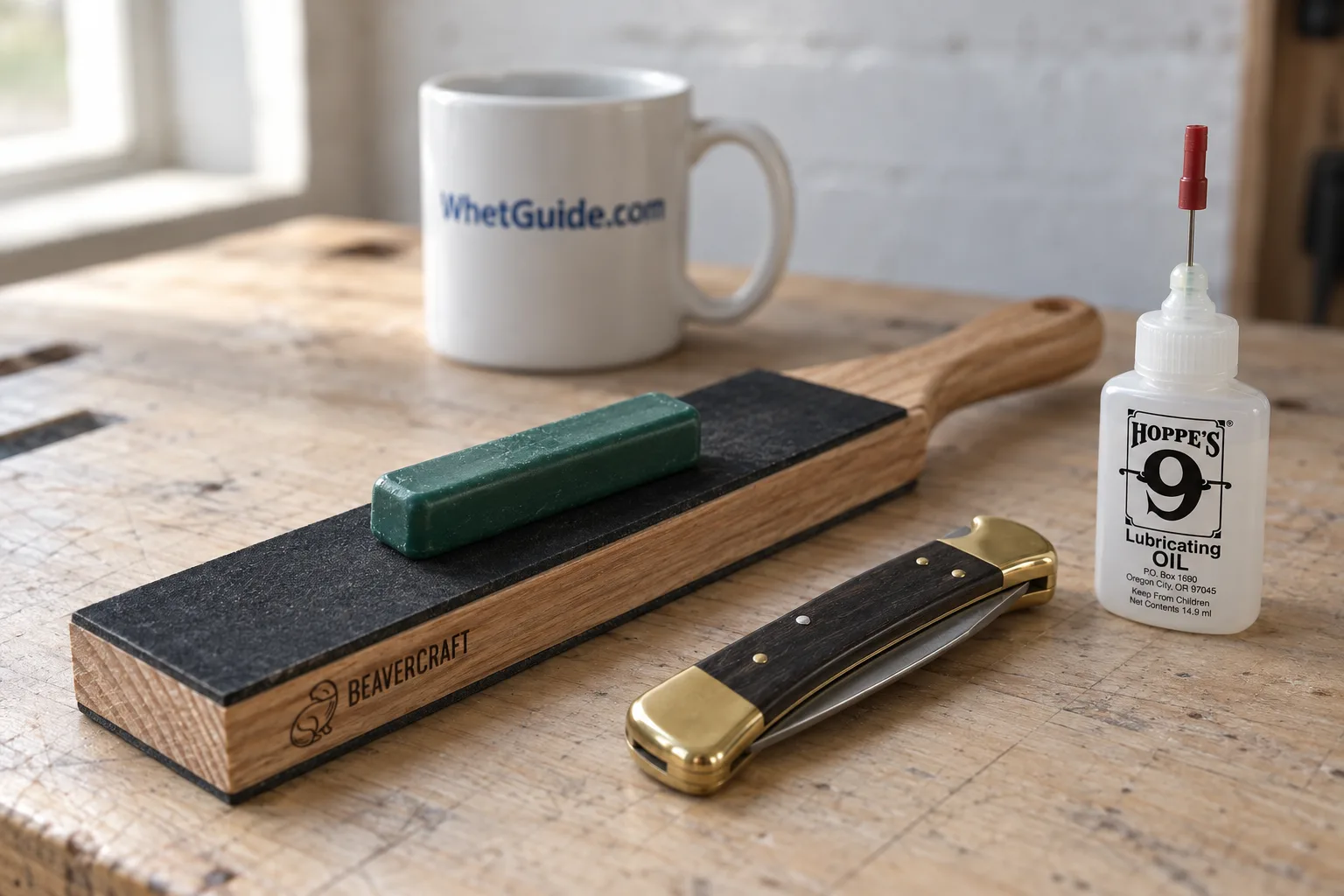
The strop is the cheapest upgrade to any sharpener on this page. Only the Guided Field has one built in. For the rest, a loose leather strop or a double-sided paddle with a bar of green compound takes off the burr the plates leave and brings back a slightly dull edge between real sharpenings.
- A strop: leather on a paddle or a block. BeaverCraft and SHARPAL both sell inexpensive ones, and strops are compared in the strop guide.
- A fine green compound bar. A little goes a long way; rub it on, then rub it in with your thumb.
- The stroke is edge trailing, spine first, with light pressure, lifting the handle through the belly just as on the plate. Ten passes a side is plenty, and how to strop a knife has the detail.
- After sharpening, blow or brush the swarf out of the pivot, then add one drop of light oil such as Hoppe's No. 9, work it in by opening and closing the blade, and wipe off the extra.
- A cheap 30x or 60x jeweler's loupe shows you the burr and any flat spots that light alone hides.
The budget ladder: where spending more stops helping
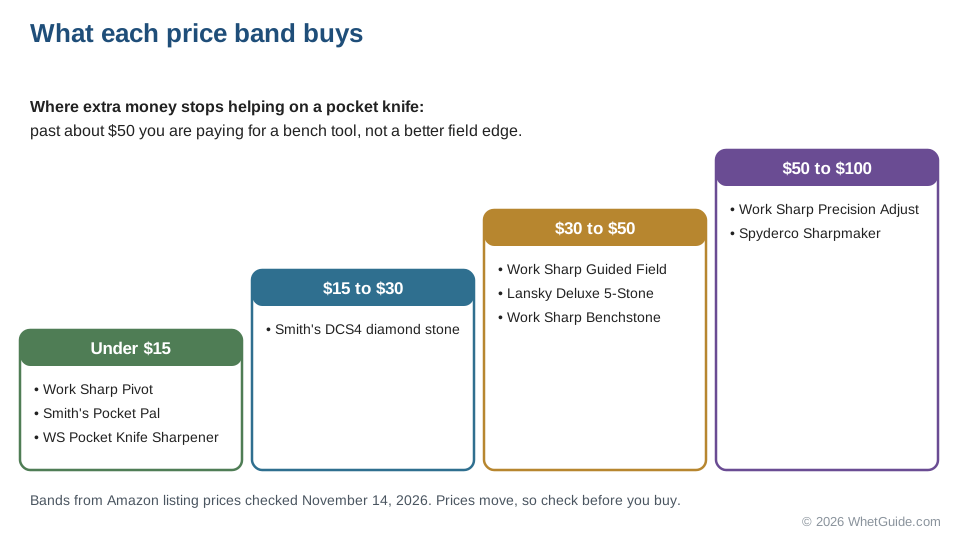
| Band | Best pick in the band | What the next band adds |
|---|---|---|
| Under $15 | Work Sharp Pocket Knife Sharpener | A strop, a serration rod and a coarse plate |
| $15 to $30 | Smith's DCS4 (for freehand users) | Guides on a full kit |
| $30 to $50 | Work Sharp Guided Field | A bench setup with more angles |
| $50 to $100 | Precision Adjust or Sharpmaker | Nothing for one pocket knife; more only if you sharpen a whole drawer |
For a single EDC folder, the Guided Field band is where the edge stops getting better and you start paying for a bench tool. A $20 knife sharpens fine on a $15 tool. The case for spending more is that you'll keep the sharpener through your next few knives. For more options in that band, see best sharpener under $50.
↑ Back to all sectionsUpgrades and spare parts
Two of the picks grow with you, which is part of why they're on the list.
| If you own | Restock or step up | Why |
|---|---|---|
| Precision Adjust | Work Sharp's upgrade kit (more abrasives and a case), or the Precision Adjust Elite | Finer grits and a strop, plus storage (Precision Adjust vs Elite) |
| Sharpmaker | Spyderco's diamond rods; spare medium stones | Diamond for hard steel; ceramic loads up and wears over years |
| Lansky Deluxe | Lansky's diamond hones and a serrated hone | Hard steels; serrations |
| Benchstone | Work Sharp's 15° and 17° guides | Thinner factory edges, such as Buck and Benchmade |
| Any of them | A leather strop and compound | The cheapest improvement on the list |
The pocket tools (Pivot, Pocket Knife Sharpener, DCS4) don't take spare parts. When the diamond wears smooth, buy another. For the bench systems, the best sharpening system roundup goes further up the ladder.
↑ Back to all sectionsCommon mistakes, and the fix for each
| Mistake | What happens | Fix |
|---|---|---|
| Starting on the coarse plate | Steel gone that didn't need to go | Start on ceramic or fine diamond; drop down only if nothing happens |
| Rocking the blade on the guide | A rounded, shiny apex | Rest the flat of the blade on the guide on every stroke |
| Heavy pressure at the tip | A rounded or snapped tip | Lighten up as the tip comes onto the plate; stop before it slides off |
| Skipping the burr check | An edge that won't get sharp no matter how long you go | Feel for the burr along the full length before switching sides |
| Leaving the burr on | Sharp for a day, then dull | Light alternating strokes, then strop |
| Missing the heel | A dull patch by the choil that grows into a recurve | Start each stroke right at the heel |
| Flat plate on serrations | Teeth ground flat | A rod, scallop by scallop |
| Chasing a mirror edge on a utility folder | A polished edge that slides on cardboard | Stop at fine diamond or ceramic; a little tooth cuts better |
| Closing a gritty blade | Scratches; wear on the pivot and lock | Wipe, brush out the pivot, one drop of oil |
More fixes, with pictures, are in the mistakes section of our pocket knife how-to.
↑ Back to all sectionsBuying one as a gift
If you're buying for someone who carries a knife and you don't know their kit, the Guided Field Sharpener is the safe choice. It sharpens plain and serrated edges, needs no setup and no oil, and it'll fit in whatever bag they carry. For a smaller budget, the Pocket Knife Sharpener does the plain-edge part of the same job. Someone with a collection and a bench will get more from a Sharpmaker. Add a leather strop to any of them. For more ideas, browse the sharpening gift guide.
↑ Back to all sectionsIf you only buy one
Make it the Work Sharp Guided Field Sharpener. It goes where the knife goes, and it handles plain and serrated edges. Spend more only for a specific reason: the Work Sharp Precision Adjust if you want a bench setup for precise edges, or the Spyderco Sharpmaker if most of your knives are serrated. Serrated owners should also read how to sharpen a serrated knife before the first session.
Specs and sales figures come from Amazon listings checked October 3, 2026. On November 14, 2026 we rechecked the ratings and weights, plus the price bands. We don't quote exact prices, because they change. How we research · Affiliate disclosure