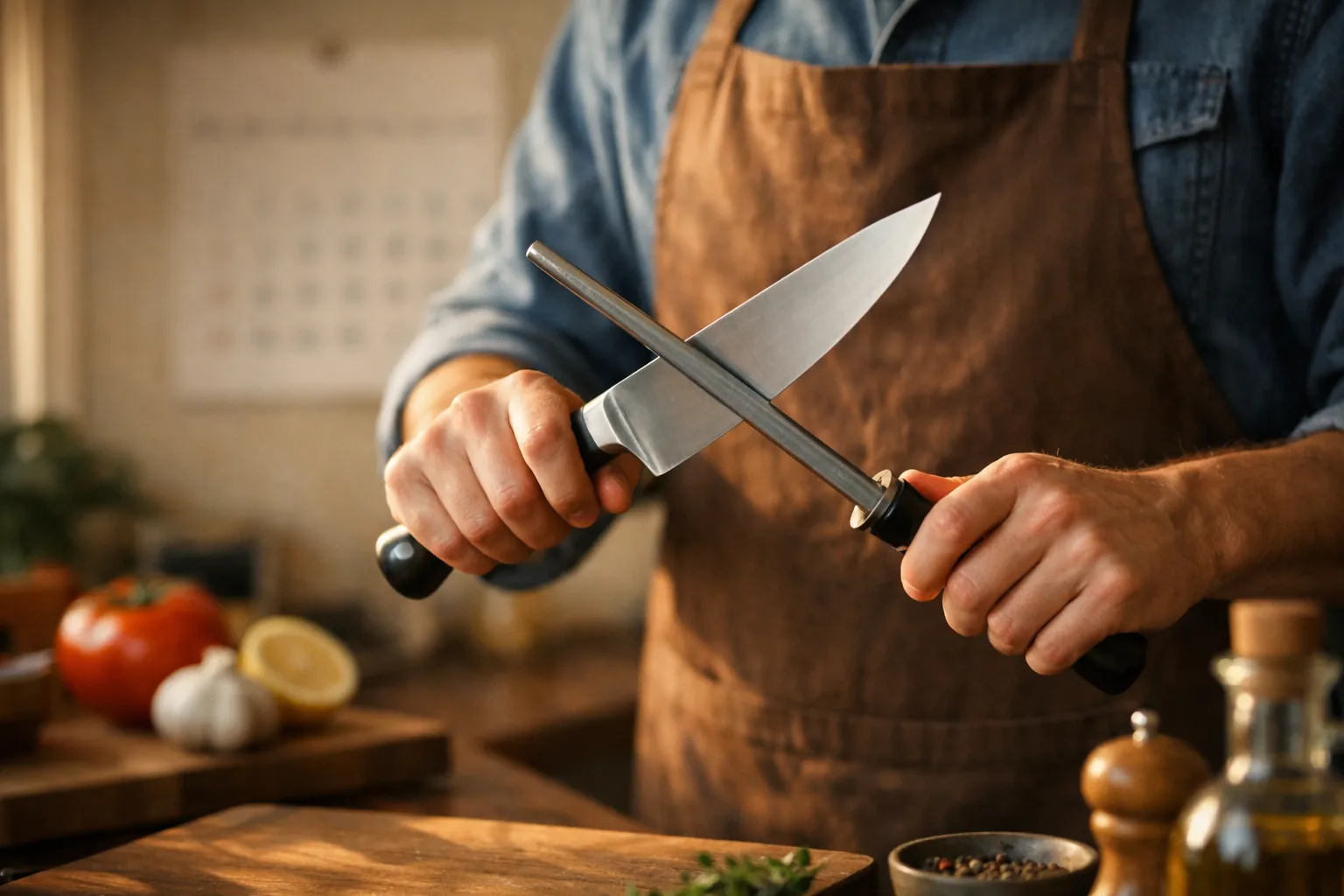
Most home cooks should sharpen their knives once or twice a year and hone them every time they cook. Victorinox gives exactly that schedule for its kitchen knives, and Wüsthof says to use the coarse slot of its handheld sharpener only "once or twice a year". Daily heavy use shortens it to every two or three months; a knife that only slices bread and cheese might go years. The real answer comes from the knife: if honing brings it back, it doesn't need sharpening yet. Our honing rod vs whetstone page explains the two jobs side by side. For the bread knife, see how to sharpen a bread knife. Some block sets build the sharpener in: best knife block set with sharpener. To send knives out, see mail-in sharpening services compared.
The schedule, by how you use your knives
| Knife and use | Hone | Strop or fine touch-up | Sharpen |
|---|---|---|---|
| Kitchen knife, cook most days | Every session | Monthly | Every 2–3 months |
| Kitchen knife, cook a few times a week | Every session or two | Every couple of months | Once or twice a year |
| Japanese kitchen knife (hard steel) | Gently, ceramic rod or strop only | Every few weeks | Every 3–6 months, on stones |
| Pocket or EDC knife, daily carry | Not usually | Weekly, on a strop | Every 1–3 months |
| Hunting knife | In the field as needed | After each animal | Before and after the season |
Our starting schedule, built on Victorinox's and Wüsthof's published guidance for kitchen knives. Adjust it with the tests below.
What knife makers say
- Victorinox's sharpening and honing page: hone "ideally before or after each cooking session"; sharpening "is needed far less often, only when honing no longer helps", "about once or twice a year". For most home cooks, "once or twice a year by a professional is enough".
- Wüsthof's how-to-sharpen article: use the fine slot "to regularly hone your knife" and the coarse slot "to sharpen your knife once or twice a year". On a steel, 6 to 8 strokes, alternating sides.
Two big kitchen-knife makers, the same answer: hone often, sharpen rarely. Neither ties the schedule to a number of meals, because it depends on the board, the food and the steel. That's why the tests below matter more than any calendar.
Five tests: hone or sharpen?
Run these in order. Hone first, then test again. If the knife passes after honing, it didn't need sharpening.
- The tomato test. Rest the edge on a ripe tomato and draw it back lightly without pushing down. A sharp edge bites into the skin straight away; a dull one skids.
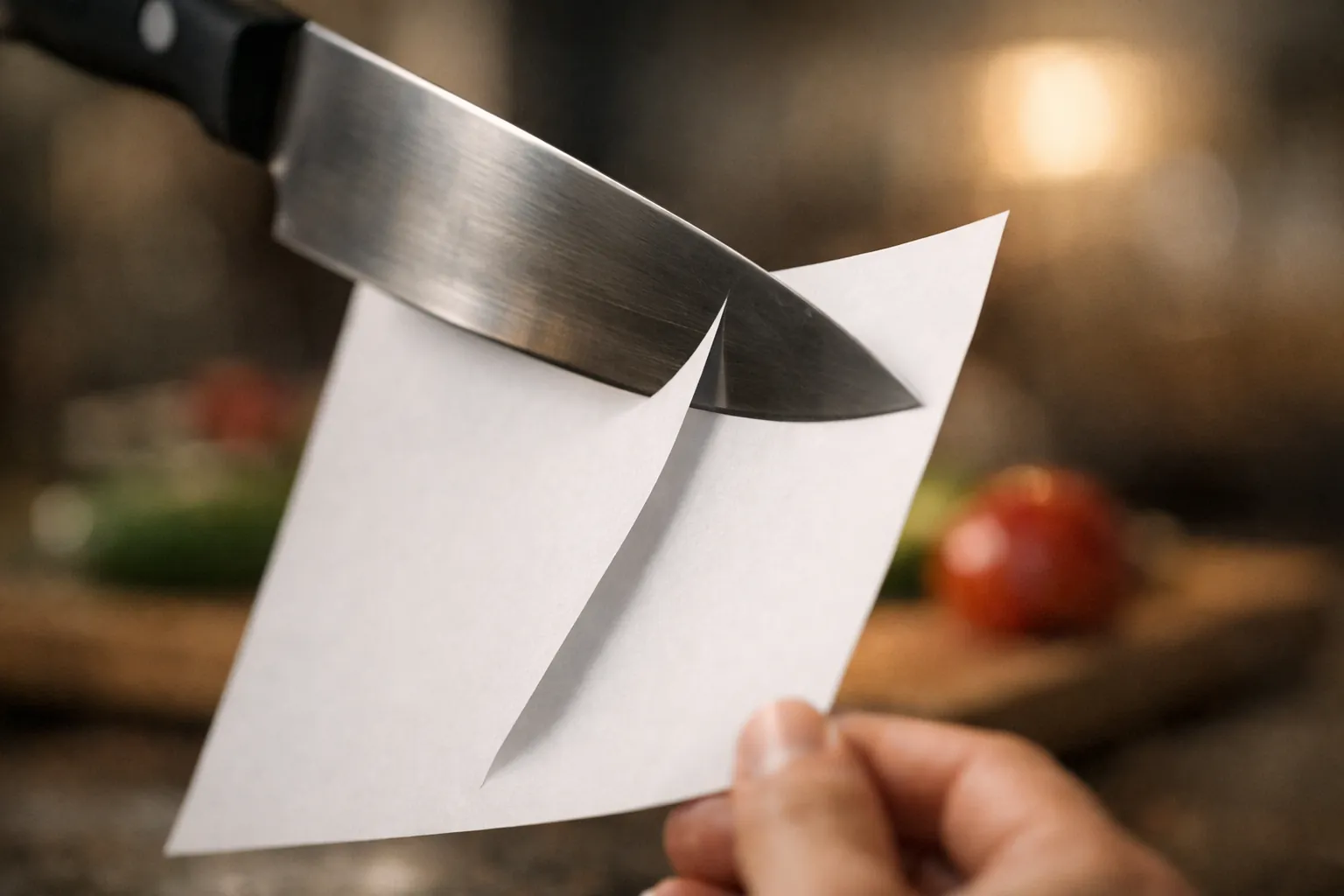
- The paper test. Hold a sheet of printer paper by one corner and slice down through it. Clean and quiet means sharp. Tearing, catching or a ragged cut means dull, at least in the spot that caught.
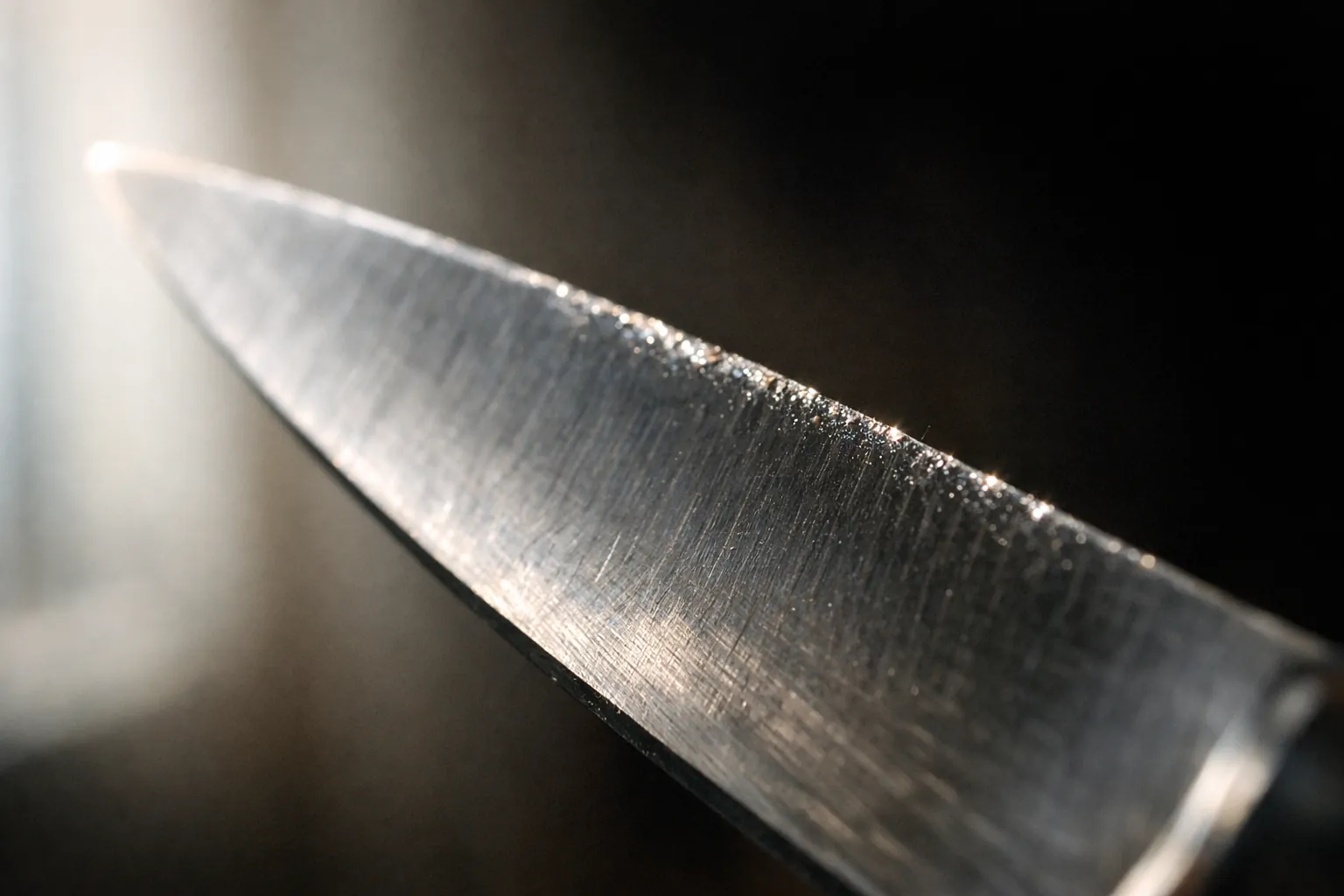
- The light test. Hold the knife edge-up under a bright light and look straight down at the edge. A sharp edge is almost invisible. Bright glints are flat, rounded spots, and those need sharpening, not honing.
- The onion test. If the knife crushes onion layers or slips off the curved skin, it's dull.
- The feel test. If you're pressing harder than you used to for the same cut, the edge is going. Pressure is also how people get hurt.
Honing: the habit that stretches sharpening
With use, a thin edge dulls at the very tip. Honing on a steel or ceramic rod is often described as pushing a rolled edge back into line, but Science of Sharp's electron micrographs show the rod forms a tiny micro-bevel at the apex instead (our ceramic vs steel honing rod page has the details). That's why a knife can feel sharp again after a few strokes. It removes very little steel, so you can do it every day. Hold the rod at about your sharpening angle (Victorinox says 20° for its knives), use light strokes, and alternate sides. Here's how to hone a knife with a rod, stroke by stroke.
A plain steel rod takes off the least metal. A ceramic rod is a little more abrasive, which suits harder knives. Global, for example, tells owners not to use ordinary steels on its knives and to use ceramic or diamond rods instead. The Utopia 12-inch honing rod is a basic carbon-steel rod with more than 8,000 Amazon ratings; our best honing rod guide compares steel, ceramic and diamond options.
Stropping: the in-between step
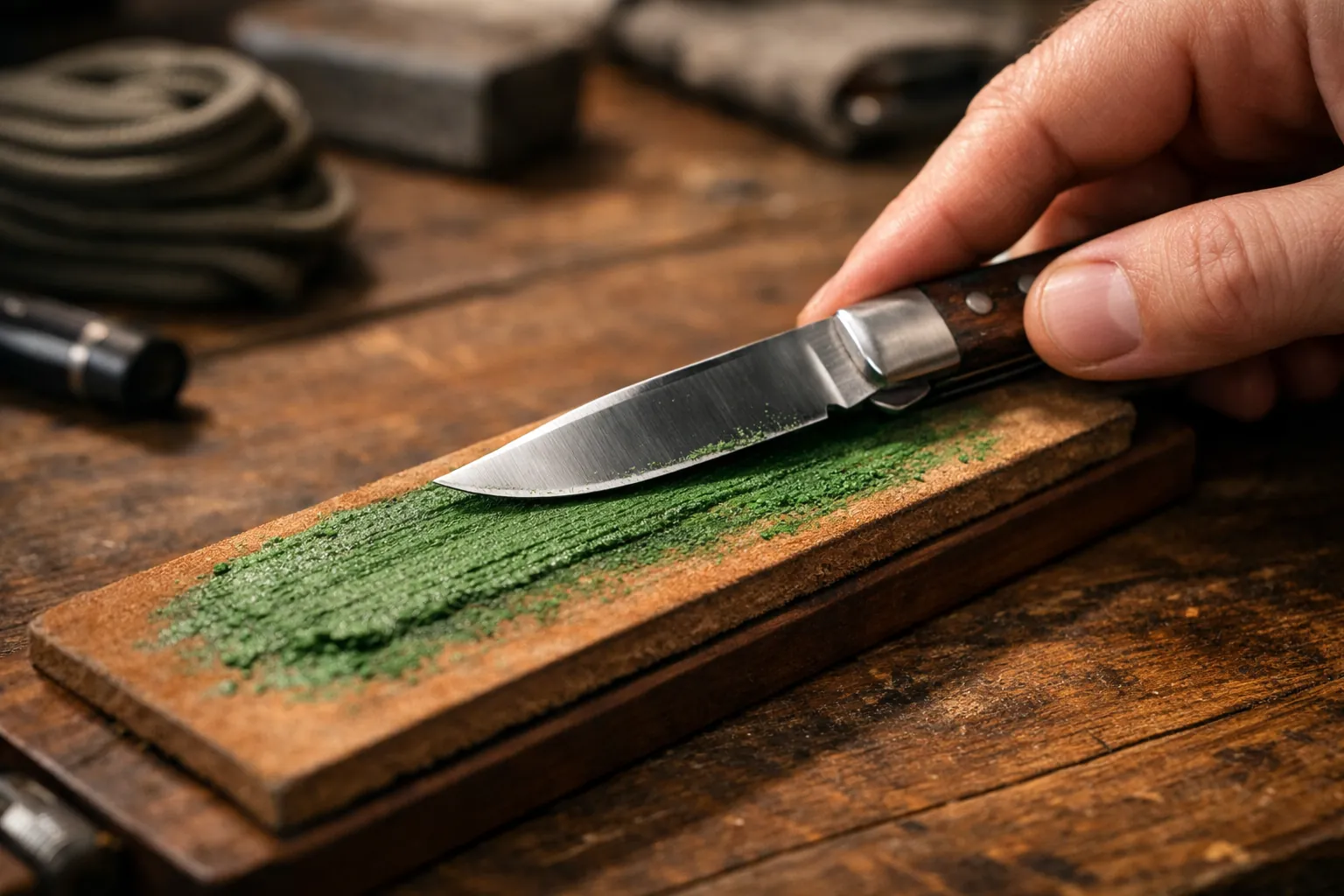
For pocket knives and anything you don't hone on a rod, a leather strop loaded with compound does the same job: drag the edge spine-first a dozen times per side. It's also the last step after every sharpening. The Bacher 12.6-inch strop kit comes with four compounds, per its listing. More in our best leather strop guide.
When it's time to sharpen
When honing stops working, sharpen. For a home kitchen, the simplest tool is a two-stage pull-through like the KitchenIQ Edge Grip, nearly 98,000 Amazon ratings; use the coarse slot only on a truly dull knife. For a better edge, a 1000/6000 whetstone. Our best knife sharpeners under $50 guide covers both, and the printable grit progression chart has a log so you can see when each knife was last sharpened, which turns "how often" into a number for your kitchen. When it's time, here's how to sharpen kitchen knives with each kind of tool. Victorinox's "by a professional" line is the other route; we gathered what a pro charges from published price lists. A hardware-store kiosk is the cheapest way to hand it off; here is what Ace Hardware's knife sharpening offers.
What shortens the time between sharpenings
- Glass, stone or ceramic cutting boards. Use wood or plastic.
- The dishwasher. Global warns that dishwasher heat and strong detergents can harm its steel, and in the rack a knife edge knocks against everything else in there.
- A drawer full of loose utensils. Use a block, a magnetic strip or blade guards.
- Scraping food off the board with the edge. Flip the knife and use the spine.
Every one of those is cheaper to fix than an extra sharpening, and each sharpening removes steel the knife doesn't get back.
Schedules quoted from Victorinox's and Wüsthof's own sharpening pages, checked October 3, 2026. Product details from Amazon listings checked the same day. How we research · Affiliate disclosure