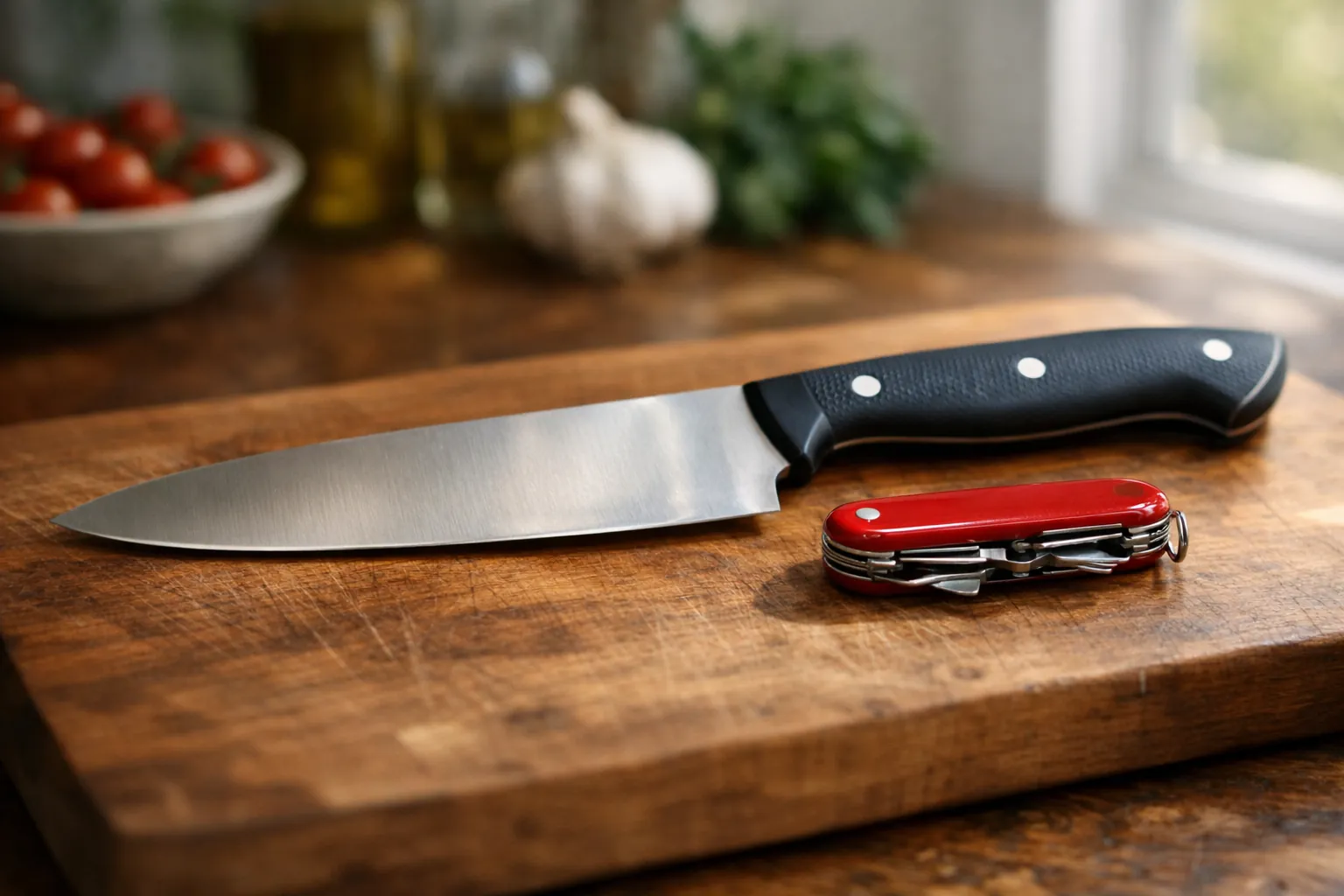
Sharpen Victorinox knives at 15 to 20 degrees per side. Victorinox itself usually writes that as 30 to 40 degrees, because it quotes the total of both sides (the inclusive angle). Set a guided sharpener to 40 and you'll grind a blunt wedge, so halve the number first. Our knife sharpening angle chart explains per side and inclusive in more detail.
What Victorinox says, page by page
Victorinox publishes its guidance in four places, checked October 3, 2026. Read them together and they agree: 15 to 20 per side.
| Victorinox page | Exact wording | Per side |
|---|---|---|
| Swiss Army Knives FAQ | "resharpen your blade using a whetstone at an angle of 15° - 20°. This will result in a cutting angle of 30° - 40°." | 15–20° |
| Cutlery FAQ | "When using a sharpening steel, the angle should be between 30-40°." | 15–20° (the figure is a total) |
| How to sharpen and hone | "Hold the knife at a 20° angle to the honing steel." | 20° |
| Pocket knife sharpening tips | "For pocket knives, aim for a 15 to 20° angle." | 15–20° |
The one that confuses people is the cutlery FAQ. Read literally, "the angle should be between 30-40°" with a steel would mean holding the blade at 30 to 40 degrees to the rod, which would round the edge over. Taken as the total of both sides, it matches every other Victorinox page. Tormek's compiled list of maker recommendations reads it the same way: "Victorinox indicates the total cutting angle... 15-20 degrees on each side."
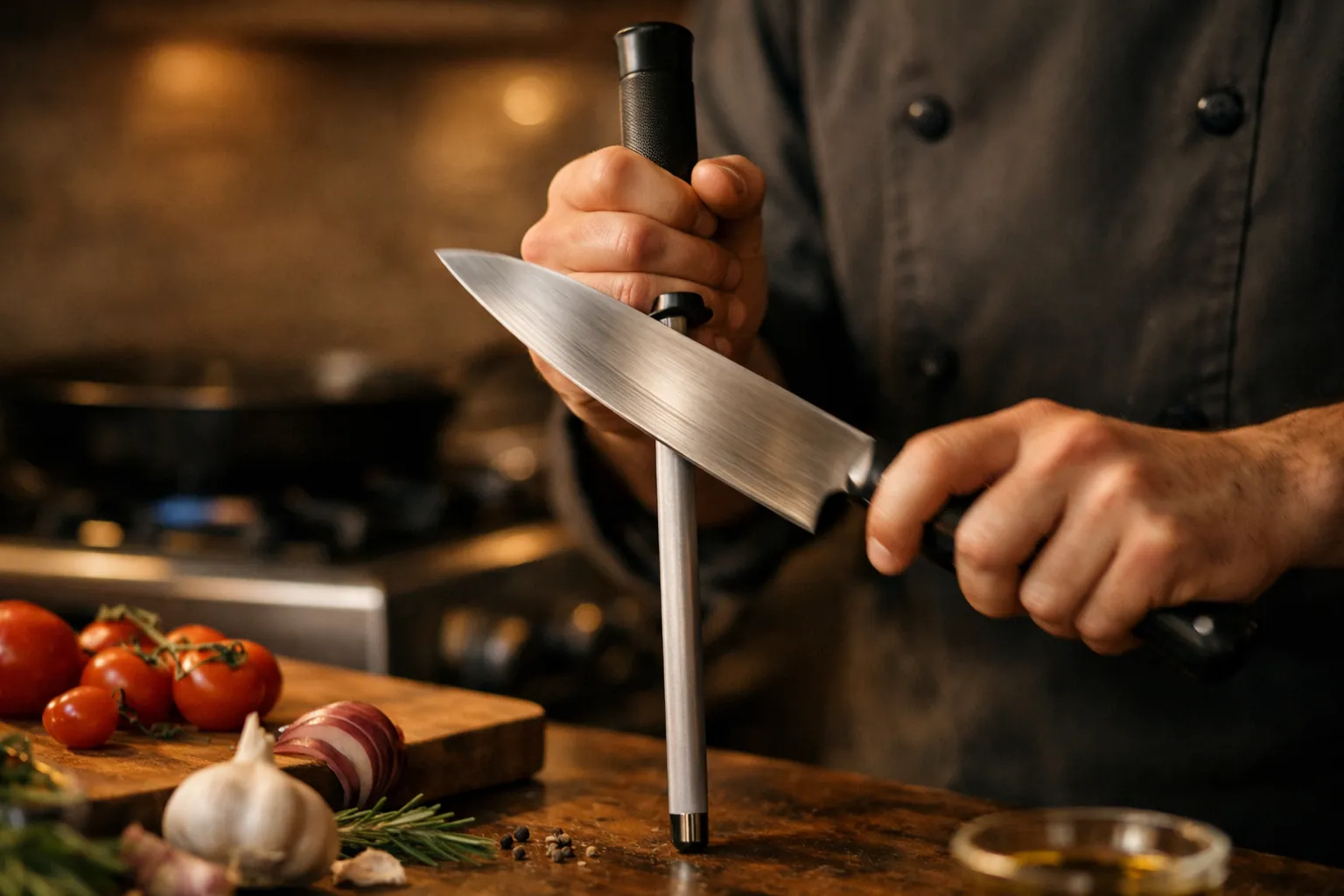
Converting Victorinox's numbers
| Victorinox says (total) | Per side | Set your tool to |
|---|---|---|
| 30° | 15° | Precision Adjust 15 · Sharpmaker 30 slots · rolling sharpener 15° side |
| 35° | 17.5° | Lansky 17 hole · Precision Adjust 17 or 18 |
| 40° | 20° | Precision Adjust 20 · Sharpmaker 40 slots · Lansky 20 hole · most pull-throughs |
The Spyderco Sharpmaker is the one tool that speaks Victorinox's language: its slots are marked in total degrees, 30 and 40, exactly the ends of Victorinox's range. The angle calculator with the Victorinox preset converts any other number and gives you a spine height.
Fibrox kitchen knives vs Swiss Army pocket knives
Victorinox uses the same 15 to 20 degree guidance for both, but the knives behave differently on a stone.
| Fibrox and other kitchen knives | Swiss Army pocket knives | |
|---|---|---|
| Our pick in the range | 20° for a chef's knife that does everything; 15–17° for a slicer or paring knife used on soft food | 20° for a blade that opens boxes and cuts cord; 15–17° if it mostly slices fruit |
| Spine height at our pick | about 15.4 mm at 20° on a 45 mm (1.8 in) blade | about 5 mm at 20° on a 15 mm blade |
| Easiest tool | Pull-through or guided system at 20° | A small handheld sharpener, or a guided clamp |
| Victorinox's own tip | Hone before or after each cooking session; sharpen once or twice a year | Use a whetstone at 15–20°; cool a grinding wheel with plenty of water |
Pocket knife blades are short and narrow, so the spine barely lifts: under 5 mm at 15° on a 15 mm blade. That's hard to see freehand, which is why a tool with a fixed angle helps more on a Swiss Army knife than on a chef's knife. The full routine for small Swiss Army blades is in how to sharpen a pocket knife.
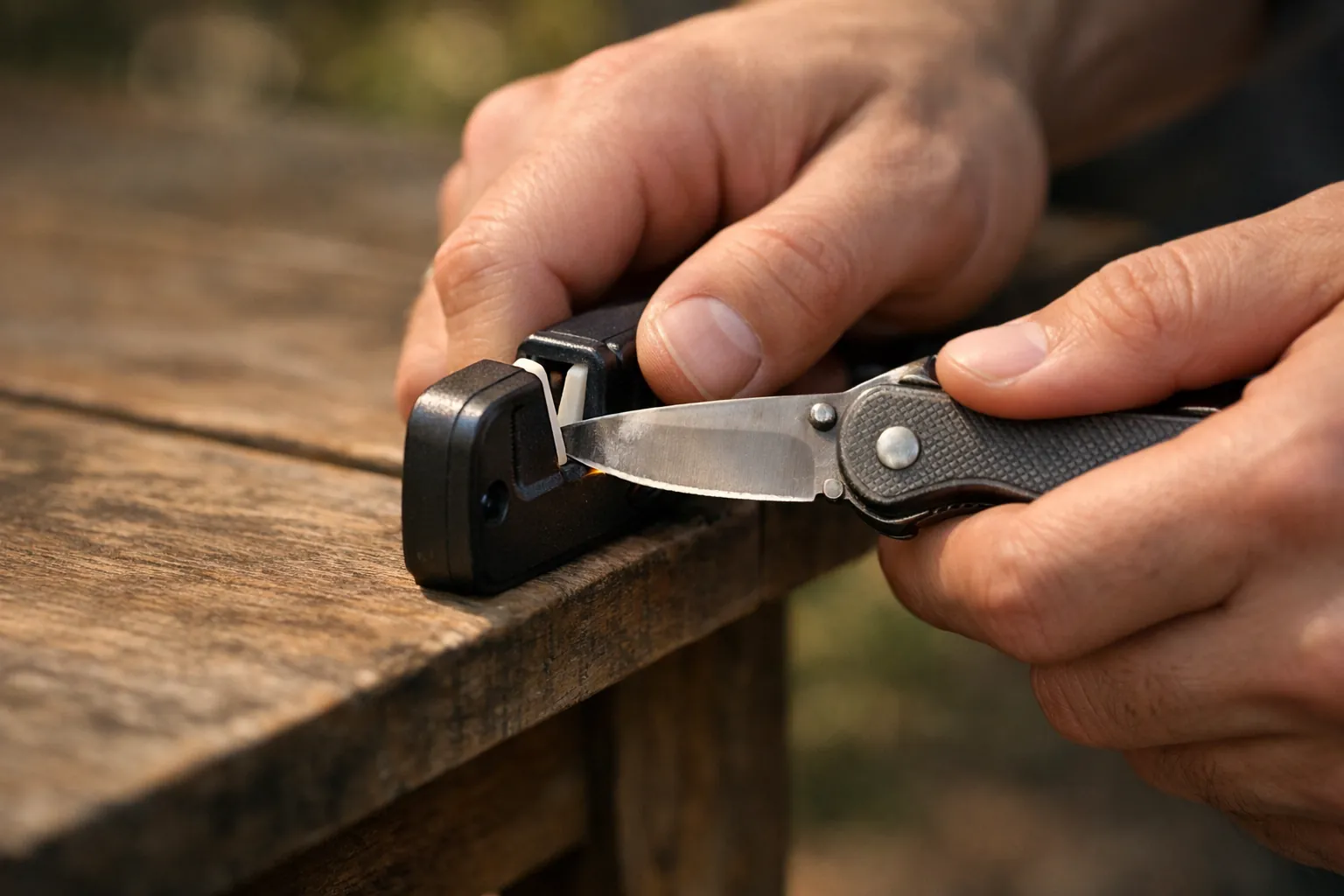
Spine heights at 15, 17.5 and 20 degrees
| Blade width (edge to spine) | Typical knife | 15° | 17.5° | 20° |
|---|---|---|---|---|
| 12 mm / 0.47 in | small pocket blade | 3.1 mm | 3.6 mm | 4.1 mm |
| 18 mm / 0.71 in | large pocket blade | 4.7 mm | 5.4 mm | 6.2 mm |
| 25 mm / 1.0 in | paring | 6.5 mm | 7.5 mm | 8.6 mm |
| 38 mm / 1.5 in | boning, utility | 9.8 mm | 11.4 mm | 13.0 mm |
| 45 mm / 1.8 in | chef's, santoku | 11.6 mm | 13.5 mm | 15.4 mm |
| 50 mm / 2.0 in | wide chef's | 12.9 mm | 15.0 mm | 17.1 mm |
Spine centerline height = width × sin(angle per side). Widths are examples, not Victorinox specifications. Measure your blade at the heel.
Budget tools that hit Victorinox's range
Victorinox knives are the budget favorite, and the good news is that their angle is the one cheap sharpeners are built for. Almost anything set to 15 or 20 degrees per side is inside Victorinox's guidance.
- Victorinox's own Dual-Knife Sharpener for straight blades is a pencil-sized tool with a honing stone and a ceramic notch, and nearly 19,000 Amazon ratings. Victorinox sells it for Swiss Army knives and other straight blades.
- The KitchenIQ Edge Grip 2-stage pull-through has coarse and fine slots and more than 97,000 Amazon ratings: the cheapest way to keep a Fibrox chef's knife cutting.
- The Spyderco Sharpmaker uses Victorinox's own total-angle numbers, 30 and 40.
- The Lansky Deluxe 5-stone system has 17 and 20 degree holes, both inside the range, and its clamp does the angle-holding for you.
We rank these and others in the best knife sharpener for Victorinox knives. For more choices sorted by price, see the best knife sharpeners under $50. For kitchen knives in general, see the best knife sharpeners for kitchen knives, and for Swiss Army knives and other folders, the best pocket knife sharpeners.
Hone often, sharpen twice a year
Victorinox's own schedule is simple: hone "ideally before or after each cooking session", and sharpen "about once or twice a year". Its steel is on the softer side, so the edge rolls before it chips, and a rolled edge comes back on a rod in a few strokes. Hold the rod at 20°, as Victorinox says. Our best honing rod guide compares steel and ceramic rods.
Quotes from victorinox.com (cutlery FAQ, Swiss Army knives FAQ, how to sharpen and hone, pocket knife sharpening tips), checked October 3, 2026, cross-checked against Tormek's "Knife sharpening angles: Manufacturer's recommendations" (2020). Spine heights calculated. Product details from Amazon listings checked the same day. How we research · Affiliate disclosure