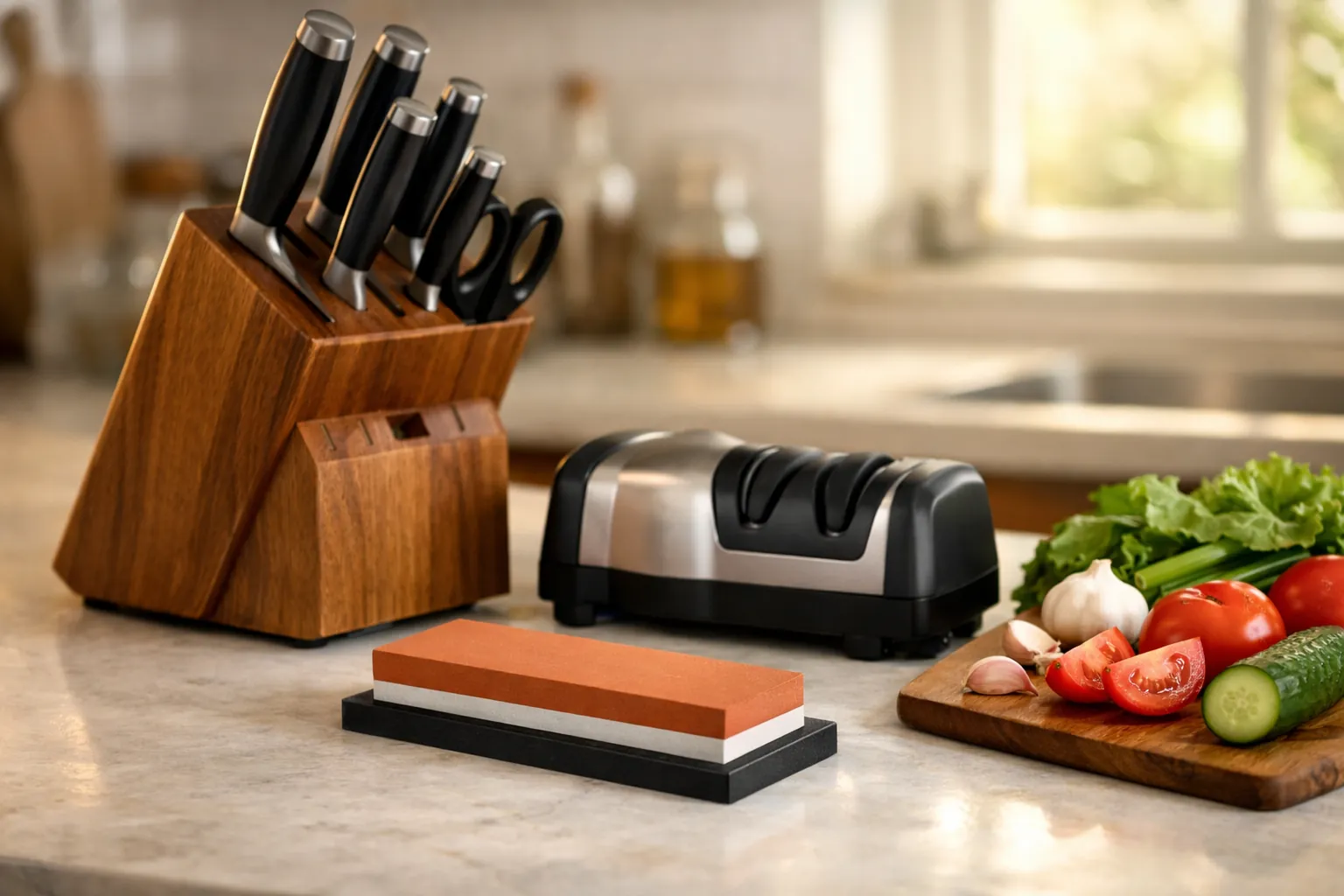
Quick answer: the best sharpener for kitchen knives
The best knife sharpener for kitchen knives, for most homes, is the Chef'sChoice 15XV electric. In about a minute, with no skill, it puts a consistent 15° edge on a chef's knife or a santoku, and it does serrated knives too. For more control, the Work Sharp Precision Adjust holds any angle from 15° to 30°. For the best possible edge, a 1000/6000 whetstone still wins if you're willing to learn it. Whatever you pick, add a honing rod.
Starting from zero? Go to our beginner picks. Want no power and no outlet? See the best manual knife sharpeners. Spending as little as possible? The budget picks under $50 are there.
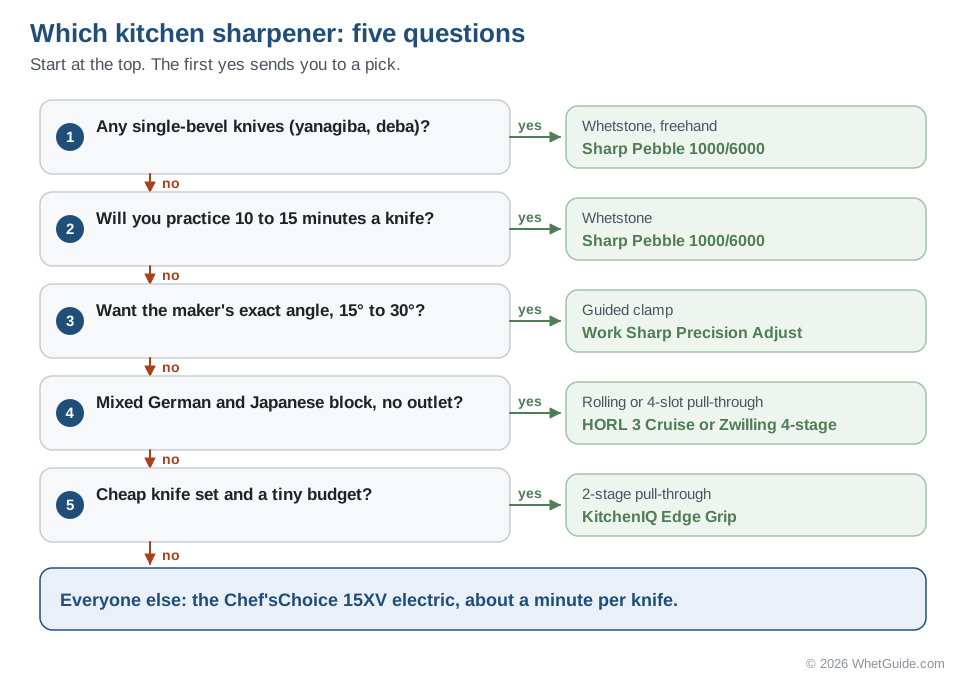
Quick picks
| Best overall for kitchen knives | Chef'sChoice 15XV EdgeSelect | Amazon |
|---|---|---|
| Best for precision without a learning curve | Work Sharp Precision Adjust | Amazon |
| Best edge quality | Sharp Pebble 1000/6000 Whetstone | Amazon |
| Best rolling sharpener | HORL 3 Cruise Rolling Sharpener | Amazon |
| Best pull-through for mixed knife sets | Zwilling 4-Stage Pull-Through | Amazon |
| Best for German knife owners | Wüsthof 2-Stage Hand-Held Sharpener | Amazon |
| Best for a Henckels block | Henckels Handheld Sharpener | Amazon |
| Best budget pick | KitchenIQ Edge Grip 2-Stage | Amazon |
How we picked
A kitchen sharpener has to cope with an 8-inch or longer chef's knife and cover both German and Japanese angles. Serrated support is a bonus. We checked Amazon ratings and "bought in the past month" counts on October 3, 2026: the Chef'sChoice 15XV showed 2,000+ purchases and 14,000+ ratings, and the KitchenIQ Edge Grip nearly 98,000 ratings. Specs are from each product's listing.
- Angle coverage first. A kitchen block usually mixes a German chef's knife near 20° with something Japanese near 15°, so every pick either covers both, or is labeled for the knives it suits.
- Length second. The tool has to sharpen an 8-inch chef's knife from heel to tip without the tip dragging off a base or out of a slot.
- How much steel it takes. Coarse carbide and coarse diamond stages count against a pick when there's no gentler stage for routine work.
- Serrated support is a bonus, credited only when the listing says so.
- Where a maker publishes a number, such as Wüsthof's 14.5° or Shun's 16°, it goes in the angle-by-brand table, next to a link to our page on that brand. Where a reviewer made a point we agree with, like Outdoor Life on coarse pull-through slots or GearJunkie on the 15XV's non-replaceable diamond stones, they're credited by name.
Best kitchen knife sharpener by knife and effort
| Type | Setup | Time per knife | Cleanup | Noise and space |
|---|---|---|---|---|
| Pull-through | None: set it on the counter | Under a minute | Wipe off metal dust | Silent, fits in a drawer |
| Electric | Plug in | About a minute (per Chef'sChoice for the 15XV) | Empty or wipe the filings | Motor noise, needs counter space and an outlet |
| Rolling | Stick the knife to the magnet | A few minutes | Wipe the disc and the blade | Silent, small enough to leave out |
| Guided clamp | Clamp the knife, set the angle | Several minutes | Wipe the abrasives | Silent, needs a bit of table |
| Whetstone | Soak or splash the stone | 10 to 15 minutes after some practice | Rinse and dry it; flatten it now and then | Silent, wet, needs a towel and sink nearby |
The 8 best knife sharpeners for kitchen knives
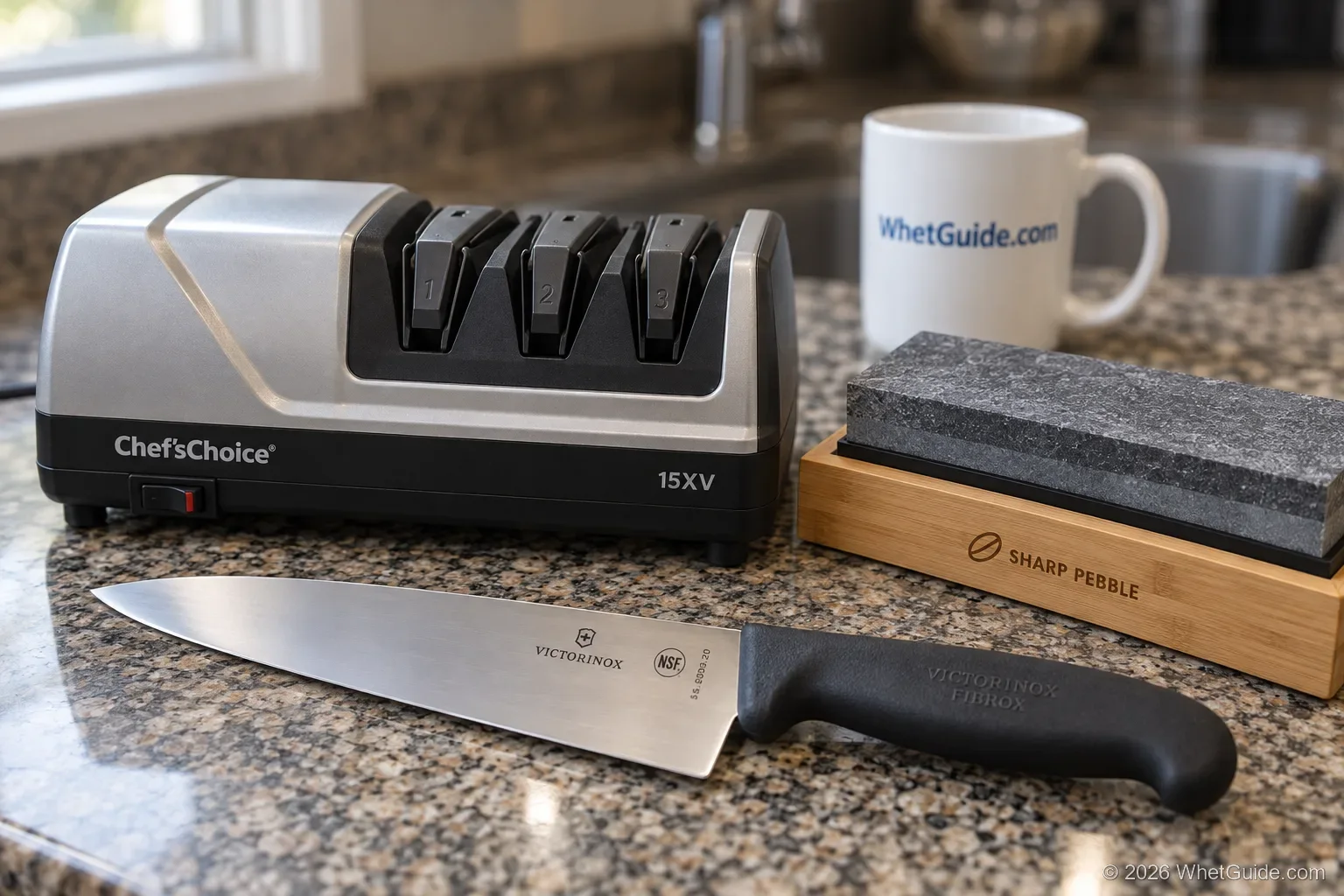
Chef'sChoice 15XV EdgeSelect
A sharpener only works if you use it, and this one is fast enough that you will, every week. Spring-loaded guides hold the angle. Two diamond stages sharpen and hone, then a flexible third stage strops. Chef'sChoice says it turns a typical 20° factory edge into a 15° edge, which cuts with less effort. Straight and serrated knives both go through it, and it's one of Amazon's best-selling electrics. Chef'sChoice also sells it as the Trizor XV, and the 15-degree trade-off is the subject of the Trizor XV review.
- Type3-stage electric
- Edge15°
- Abrasives100% diamond (stages 1-2), flexible stropping (stage 3)
- Kniveschef's, santoku, bread, serrated, more
- First sharpeningabout 1 minute (per maker)
Why it stands out
- Consistent edge in about a minute
- Serrated knives supported
- 14,000+ ratings
Think twice if
- You own single-bevel Japanese knives
- You want to keep a 20° edge on heavy-duty knives
Work Sharp Precision Adjust
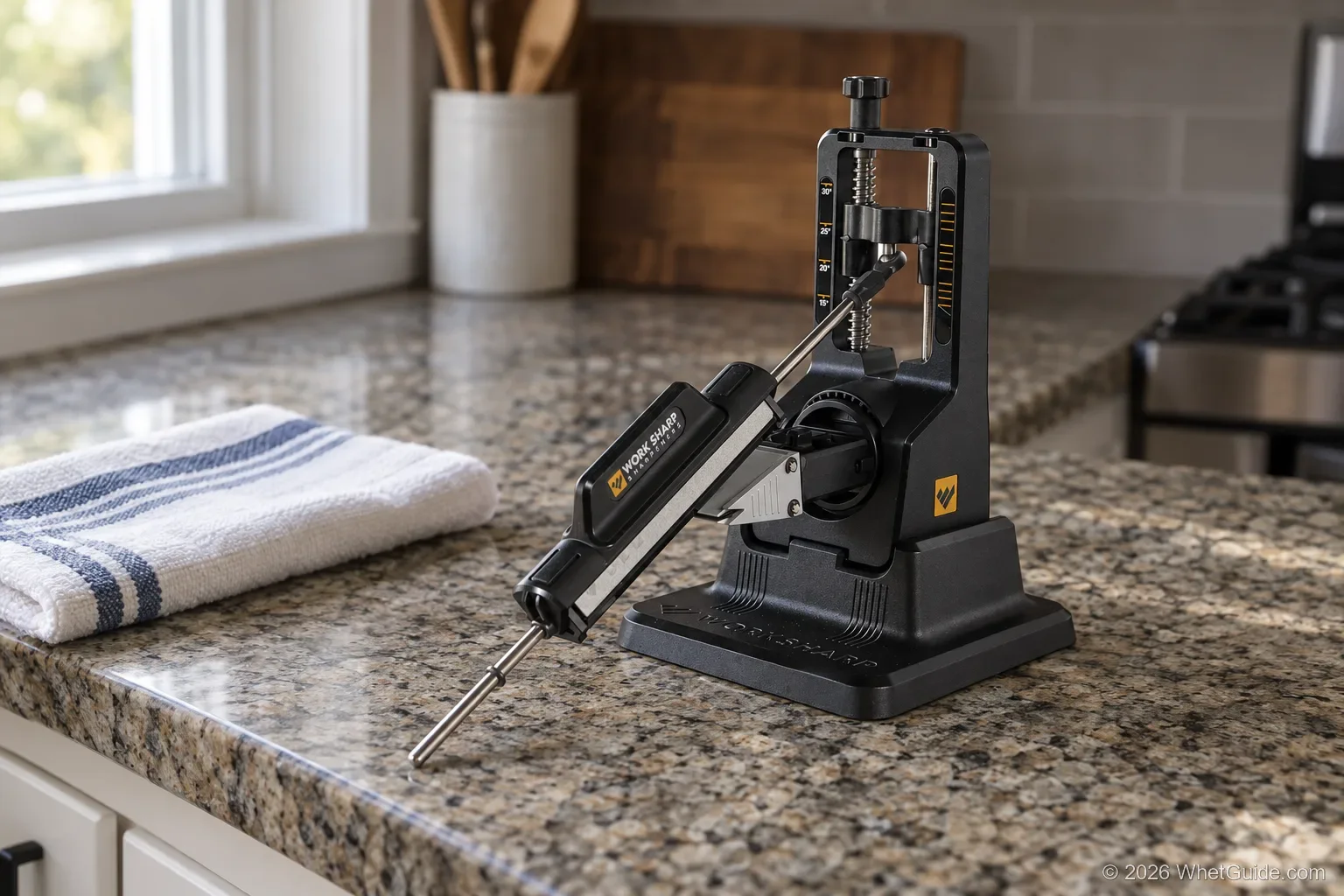
Want a stone-quality edge at exactly the angle your knife maker recommends, without learning freehand? Clamp the knife, set 15° for a typical Japanese knife or 20° for a typical German one, and sweep the abrasive along the edge.
- Typeguided clamp + arm
- Angle15° to 30°
- Abrasives320/600 diamond + fine ceramic
- Powernone
Why it stands out
- Any angle from 15° to 30°
- Gentle on good knives
Think twice if
- You want speed for a whole knife block
Sharp Pebble 1000/6000 Whetstone
No sharpener gives a more refined edge or takes off less metal than a whetstone, and this is the most popular kit on Amazon. Give it a few practice sessions. After that, a chef's knife takes 10 to 15 minutes. To learn the stone, read how to use a whetstone; the best whetstone for knife sharpening picks compare the sets.
- Grits1000 / 6000
- Lubricantwater
- Includedbamboo base, angle guide
- Amazon rank#1 in Honing Stones
Why it stands out
- Works on every kitchen knife, including single-bevel
- Low cost
Think twice if
- You won't practice
HORL 3 Cruise Rolling Sharpener
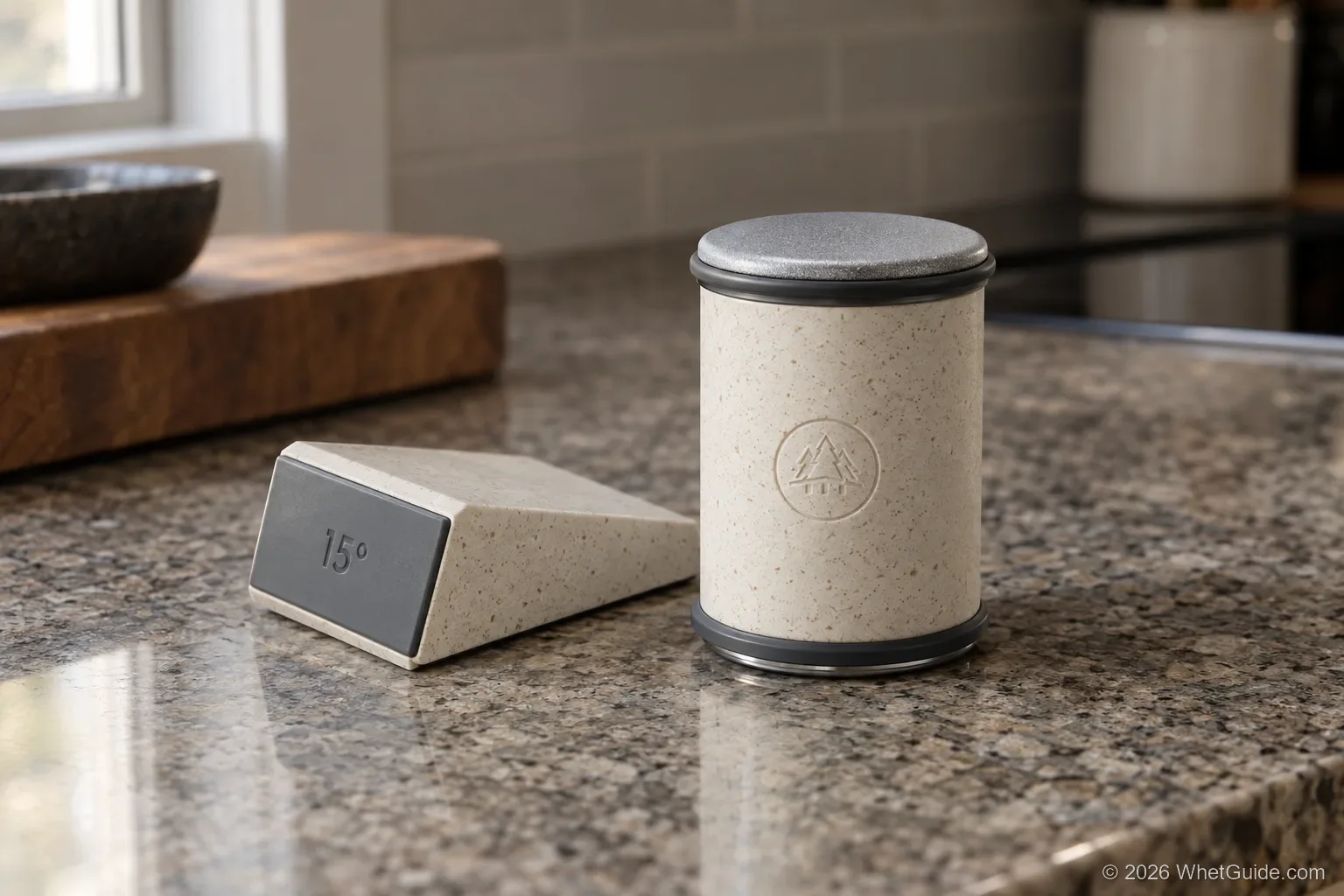
Somewhere between a pull-through and a guided system. Stick the knife to the magnetic block at 15° or 20°, roll the diamond disc along the edge, then the steel disc to take off the burr. HORL pitches the 15° side at Japanese and carbon blades, the 20° side at European chef's knives. It's quick and makes no mess, and it looks fine left out on the counter.
- Angles15° and 20°
- Discsdiamond + stainless honing
- Holdermagnetic angle support
- Waternone
Why it stands out
- Covers German and Japanese angles
- No water, minimal learning
Think twice if
- You need serrated knife support
Zwilling 4-Stage Pull-Through
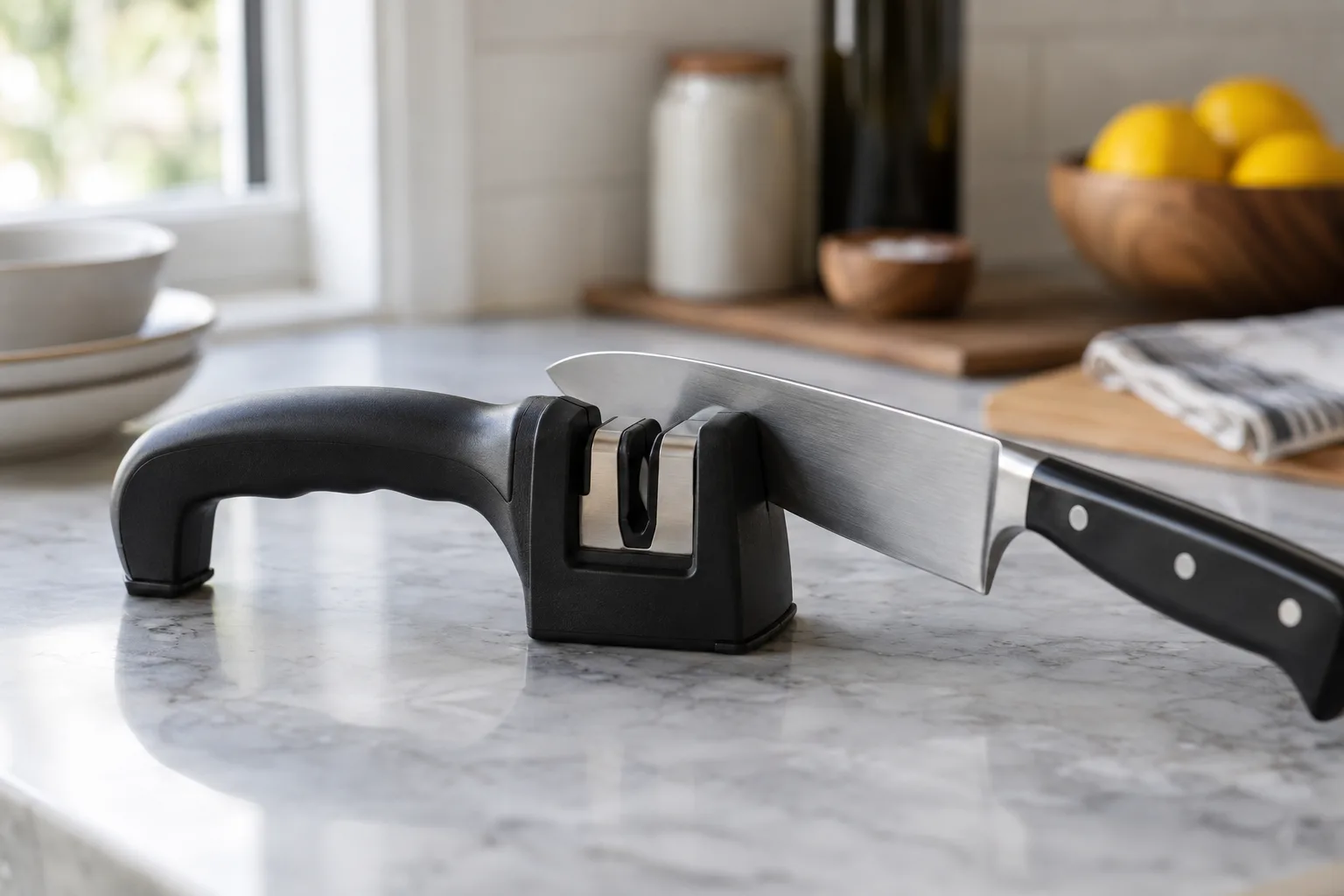
Four slots in one compact handle: coarse and fine for Western blades, coarse and fine for Asian-style blades. If your block mixes German and Japanese knives, that's the simplest way to give each one a suitable angle without adjusting anything. We compare every pull-through worth buying in best manual knife sharpener. For a whole Henckels block, see the best knife sharpener for Henckels knives.
- Typemanual pull-through
- Stagescoarse and fine for Western blades, coarse and fine for Asian-style blades
- Basenon-slip
- Cleaningdamp cloth, not dishwasher safe
Why it stands out
- Separate Western and Asian slots
- From a major knife maker
Think twice if
- You want a refined, polished edge
Wüsthof 2-Stage Hand-Held Sharpener
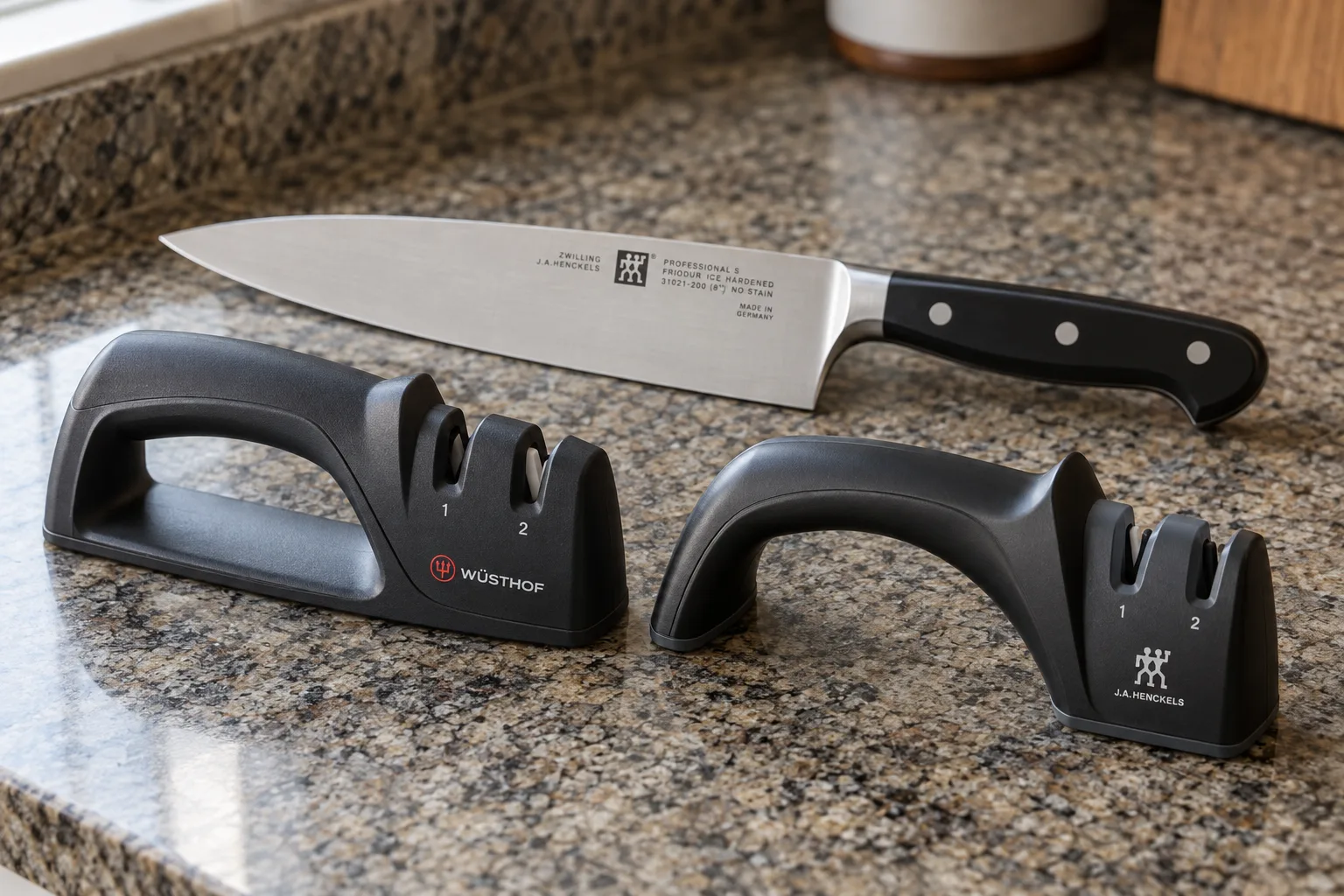
Wüsthof makes German knives, and this is its own handheld sharpener for them. Carbide wheels set a dull edge, ceramic slats refine it, and the angle is preset. Choose it over a budget gadget if your block is Wüsthof or similar. Do routine touch-ups on the ceramic side.
- Stagescarbide wheels (sharpen), ceramic slats (fine)
- Anglepreset
- Handleergonomic, non-slip base
Why it stands out
- Made by a German knife maker for its style of knife
- 3,600+ ratings
Think twice if
- You own Japanese knives
Henckels Handheld Sharpener
Henckels sells its own two-stage handheld, with coarse and fine ceramic grits and a safety grip that keeps fingers away from the blade. It sells about 1,000 a month, which makes it one of the most popular manual sharpeners for German-style knives. It is the Henckels counterpart to the Wüsthof handheld above; the matching angles come from the Henckels sharpener guide.
- Typehandheld 2-stage
- Gritscoarse and fine ceramic
- Handlecontoured, with a safety grip
- Amazon4.5 stars, 1,900+ ratings, about 1,000 bought last month
Why it stands out
- Safety grip keeps fingers clear
- Coarse and fine stages
Think twice if
- You want an adjustable angle or a polished edge
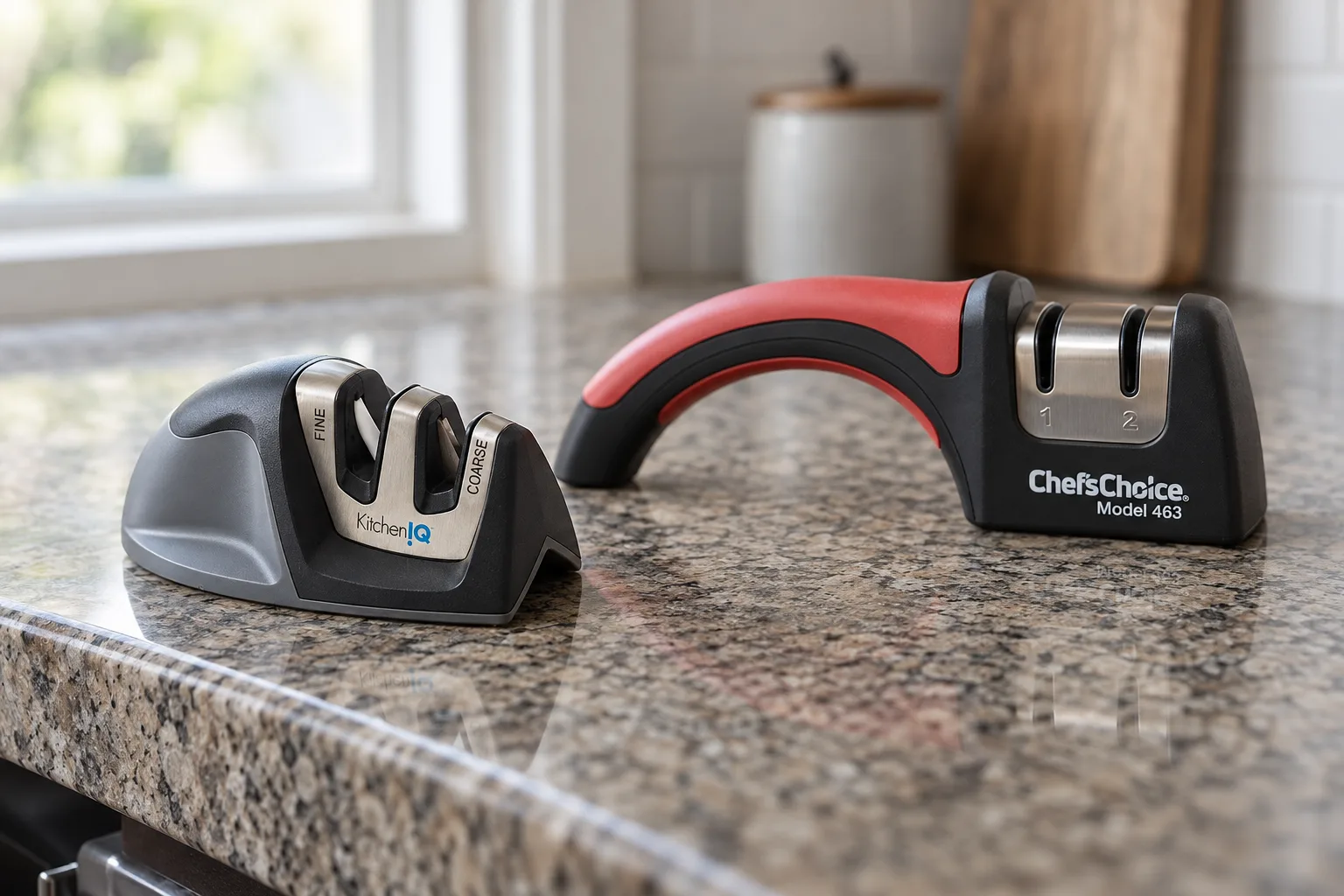
KitchenIQ Edge Grip 2-Stage
Nearly 98,000 ratings make this one of the most-reviewed knife sharpeners on Amazon. It's cheap and tiny, and it's fine for an inexpensive knife set. A V-notch sits over the counter edge so a long blade's tip doesn't drag.
- Stagescarbide (coarse) + ceramic (fine)
- Knivesstraight and serrated
- Basenon-slip, counter-edge V grip
Why it stands out
- Very low cost
- Handles serrated knives
Think twice if
- You own good Japanese or premium knives
Side-by-side comparison
| Sharpener | Type | Angles | Serrated | Effort |
|---|---|---|---|---|
| Chef'sChoice 15XV | Electric | 15° | Yes | Lowest |
| Work Sharp Precision Adjust | Guided | 15°–30° | Listed | Moderate |
| Sharp Pebble 1000/6000 | Whetstone | Any | No | Highest |
| HORL 3 Cruise | Rolling | 15° / 20° | No | Low |
| Zwilling 4-Stage | Pull-through | Western + Asian slots | Check listing | Lowest |
| Wüsthof 2-Stage | Pull-through | Preset | Check listing | Lowest |
| Henckels Handheld | Pull-through | Preset | Check listing | Lowest |
| KitchenIQ Edge Grip | Pull-through | Preset | Yes | Lowest |
Which pick handles which knife
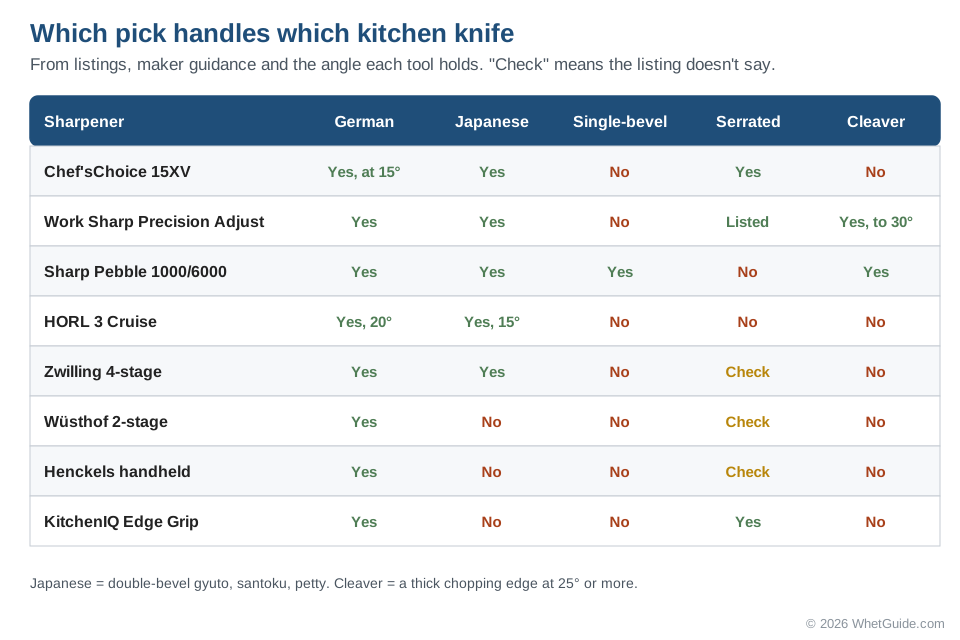
The comparison table says what each sharpener is. This grid says what it will and won't do in a real kitchen block, from the listings, the maker's guidance and the angle each tool can hold. "Check" means the listing doesn't say, so read it before you put a bread knife through it.
What each pick can't do
- Chef'sChoice 15XV: it holds 15° and only 15°. A German knife comes out thinner than the factory made it, and single-bevel knives and cleavers don't belong in it.
- Work Sharp Precision Adjust: speed. Clamping and unclamping eight knives is a Saturday job, not a Tuesday one.
- Sharp Pebble 1000/6000: forgiveness. The stone holds no angle for you, and the first few sessions are slow.
- HORL 3 Cruise: serrations, single-bevel knives, and anything you want below 15° or above 20°.
- Zwilling 4-stage: a polished edge. Its slots are fixed, so you get the angle Zwilling chose.
- Wüsthof 2-stage and Henckels handheld: Japanese knives. Both are preset for German blades.
- KitchenIQ Edge Grip: gentleness. Its carbide stage is fast and rough, so keep it for knives that cost less than a nice dinner.
Which page fits your situation
This page covers every type of sharpener for a home kitchen. If you already know what kind of buyer you are, these pages go deeper.
| If you are | Start with | Read |
|---|---|---|
| New to sharpening | An electric with fixed guides, or a simple pull-through | Best knife sharpener for beginners |
| Avoiding power tools | A pull-through, a rolling sharpener or a stone | Best manual knife sharpener |
| Spending under $50 | KitchenIQ Edge Grip or a 1000/6000 stone | Best budget knife sharpener |
| Buying a powered sharpener | Chef'sChoice 15XV | Best electric knife sharpener |
| Buying a roller or a gift | HORL or Tumbler | Best rolling knife sharpener |
| Owning mostly Japanese knives | Whetstone or 15° guided | Best sharpener for Japanese knives |
| Owning a Wüsthof or Henckels block | Match the maker's angle | Wüsthof and Henckels guides |
German vs Japanese: the two angles in most kitchen blocks
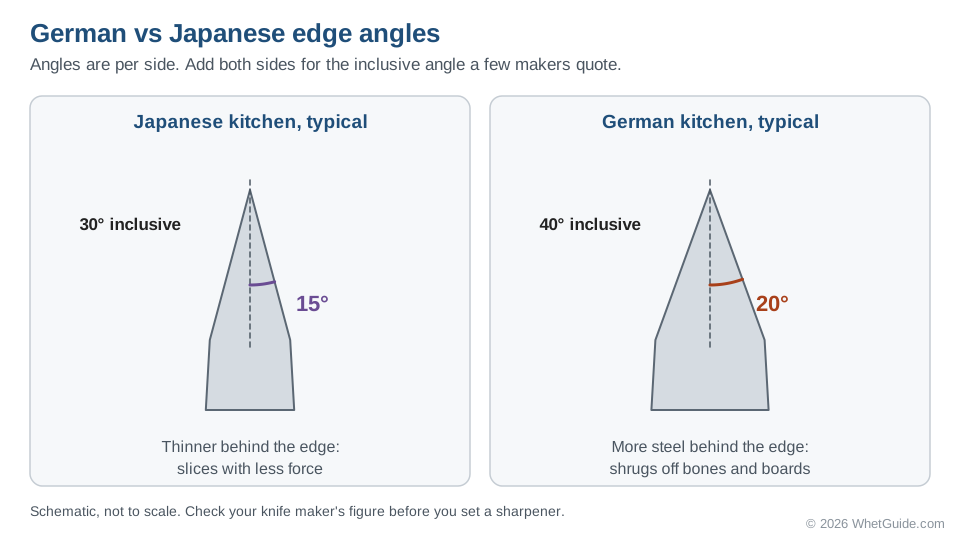
Two numbers cover most kitchen knives sold in the US: about 20° per side for traditional German and Western knives, about 15° for Japanese ones. Lower angles slice with less effort. Higher ones hold up better against bones and frozen food. The line has blurred, though. Wüsthof now states 14.5° for its standard blades, which puts a German chef's knife closer to the Japanese number than to the old German one.
The trap is the word "per side." Most makers and sharpener brands quote the angle on one side of the edge. A few quote the inclusive angle, both sides added together, so a 30° inclusive edge and a 15° per-side edge are the same thing. The full table is in the knife sharpening angle chart, and the angle calculator turns a degree setting into how high to hold the spine on a stone.
↑ Back to all sectionsKitchen knife angle by brand
| Brand | Maker's figure | Per side? | Picks that land on it | More |
|---|---|---|---|---|
| Wüsthof (standard blades) | 14.5° | Per side, stated (PEtec article) | 15XV, Precision Adjust at 15°, HORL at 15°, whetstone | Wüsthof angle, Wüsthof sharpeners |
| Wüsthof (santoku, nakiri) | 10° on the honing steel | Read as per side | Whetstone; nothing guided on this page goes that low | Wüsthof angle |
| Zwilling and Henckels | 15° on the honing steel; 9 to 12° for santoku | Angle to the steel, not a stated factory edge | 15XV, Zwilling 4-stage, Precision Adjust, HORL at 15° | Zwilling and Henckels angle, Henckels sharpeners |
| Shun (double-bevel) | 16°; 22° on the Western Cook's Knife | Per side, stated (Shun FAQ) | Whetstone, Precision Adjust set near 16°; the 15XV and HORL sit a degree lower | Shun angle |
| Miyabi | 9.5 to 12° | Read as per side | Whetstone only, among these picks | Miyabi angle |
| Global | 10 to 15° | Read as per side | Whetstone; 15° tools reach the top of the range | Global angle |
| Victorinox (kitchen) | 30 to 40° on the steel | Not stated | 15XV, Precision Adjust at 15 to 20°, KitchenIQ for Fibrox | Victorinox angle, Victorinox sharpeners |
| Mac, Tojiro, Mercer, Messermeister | No maker figure on file | n/a | Match the existing bevel | Marker test below |
Don't know your angle? The marker test
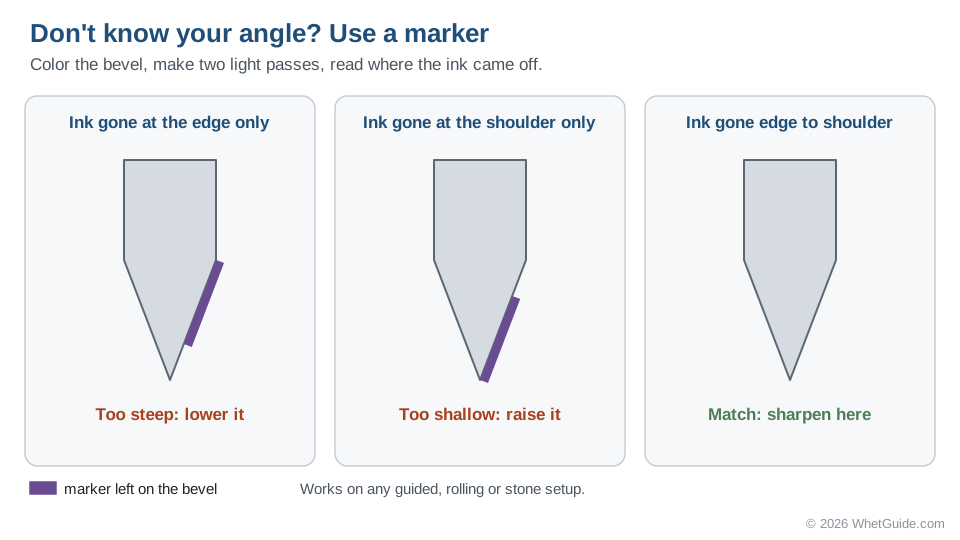
A no-name knife from a wedding-registry block, a hand-me-down, a Mac or a Tojiro with no published number: the bevel already on the blade tells you what angle it wants. A fine-point permanent marker and two light passes are all it takes. This works on any tool where you can set or choose the angle (guided clamps, rolling sharpeners, a stone with an angle guide). With fixed-slot pull-throughs and electrics you can't change anything, so the test only tells you how far off the slot is.
- Color the whole bevel on one side with the marker, from heel to tip.
- Set your guide, clamp or roller block to your best guess: 15° for a Japanese-style knife, 20° for a German one.
- Make two light passes, no pressure.
- Look at where the ink came off. Edge only: lower the angle. Shoulder only: raise it. The whole bevel: you match, start sharpening.
On a cheap knife it's fine to ignore the factory bevel and simply sharpen at 20°; the first session takes a little longer while the new bevel forms. On a good Japanese knife, matching the existing bevel saves steel. For photos of each result, see Sharpie trick page.
↑ Back to all sectionsFive kinds of kitchen sharpener, and how each works
Pull-through and handheld
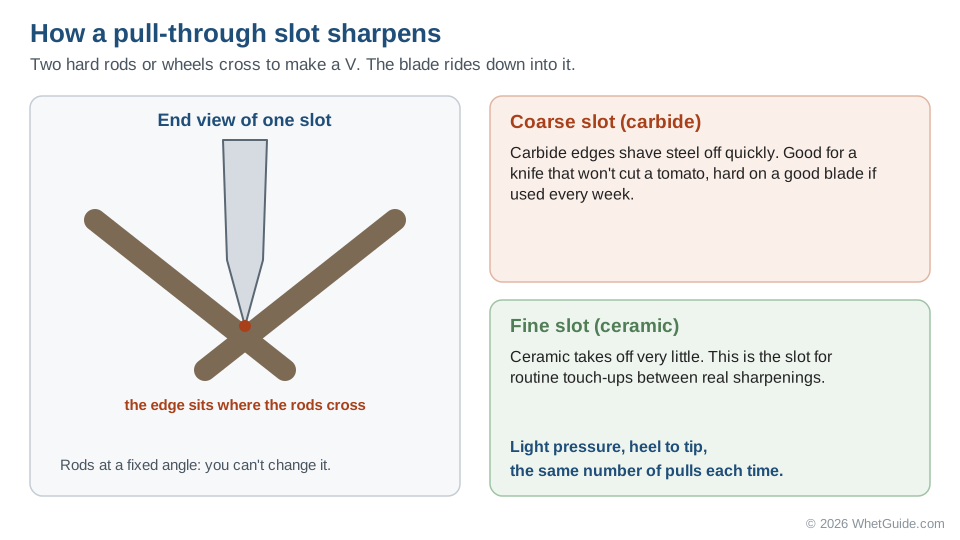
Two hard edges cross to make a V, and you draw the knife down through it. The coarse slot is usually tungsten carbide, which shaves steel off fast and leaves a toothy edge. The fine slot is usually ceramic, which takes off very little. Four of our eight picks work this way: the Zwilling 4-stage, the Wüsthof and Henckels handhelds, and the KitchenIQ Edge Grip.
Cheaper rungs exist. Smith's sells a basic two-step and the Jiffy-Pro handheld, and Victorinox makes a small dual-knife sharpener that suits its Fibrox knives. Chef'sChoice also makes manual pull-throughs: the Pronto at 15° and a two-angle 15/20 model that also handles serrated knives. None of them change the basic trade: seconds of work, a fixed angle, and a coarse slot to use sparingly.
Electric
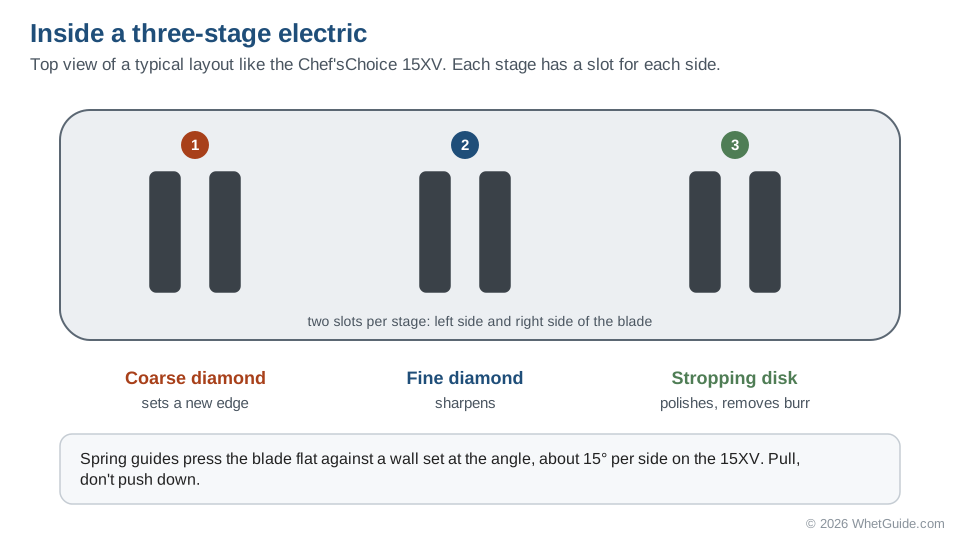
An electric sharpener puts motor-driven abrasive wheels at the bottom of guided slots. A spring holds the blade against a wall cut at the angle, so the tenth pull matches the first. The Chef'sChoice 15XV uses two diamond stages and a flexible stropping stage, and it's the reason this category is our overall pick: a minute a knife, almost no learning.
The downsides are real. Electrics take more steel than a stone, they need counter space and an outlet, and they're loud. Single-bevel knives are out. And the diamond wheels wear: GearJunkie notes the 15XV's diamond stones can't be replaced, which is worth knowing before you buy any electric for a big family.
More electrics worth knowing
- A block that mixes German and Japanese knives: Chef'sChoice's AngleSelect has slots for both 15° and 20°.
- Mostly German knives: the Chef'sChoice Hybrid pairs electric stages at 20° with a manual stage.
- Belt machines, and how they compare with wheel electrics: our electric sharpener roundup. Stage order on any Chef'sChoice: the Chef'sChoice how-to.
Rolling
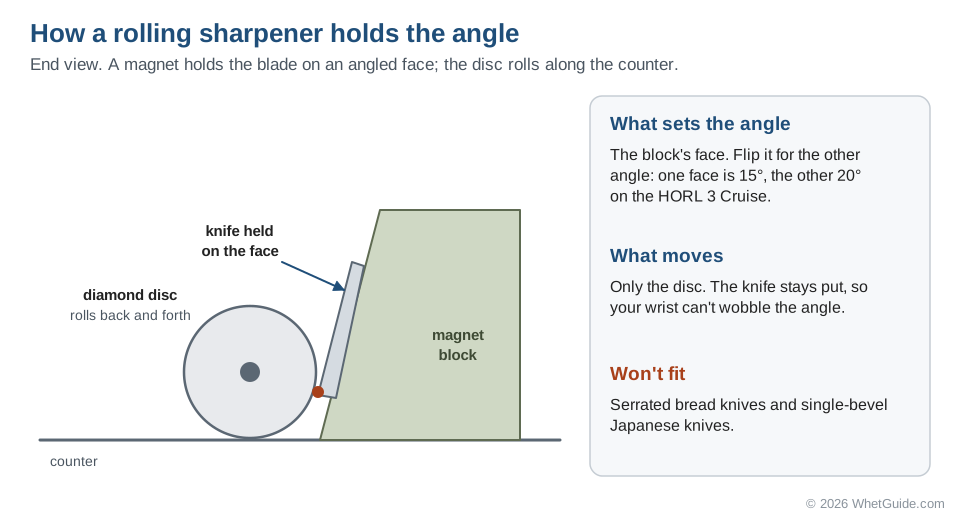
A rolling sharpener splits the job in two. A magnetic block holds the knife at a fixed angle, and a disc with a diamond face rolls along the counter against the edge. The HORL 3 Cruise gives 15° on one side of the block and 20° on the other, then finishes with a steel disc to take off the burr. The Tumbler is the other well-known roller with the same two angles; Tumbler vs HORL sets the two against each other, and best rolling knife sharpener ranks the field.
Guided clamp
A clamp holds the knife, and an arm or rod carries the abrasive at a set angle. You choose the number on a dial, then sweep. The Work Sharp Precision Adjust covers 15° to 30°, which is every double-bevel kitchen knife in the brand table except Miyabi and Global's low end. Higher up, the Edge Pro Apex 4 uses water stones on a guided arm and suits someone who'd rather not learn freehand but wants a stone finish. Other systems sit in the best sharpening system guide, and that one gets a full write-up in the Precision Adjust review.
Whetstone
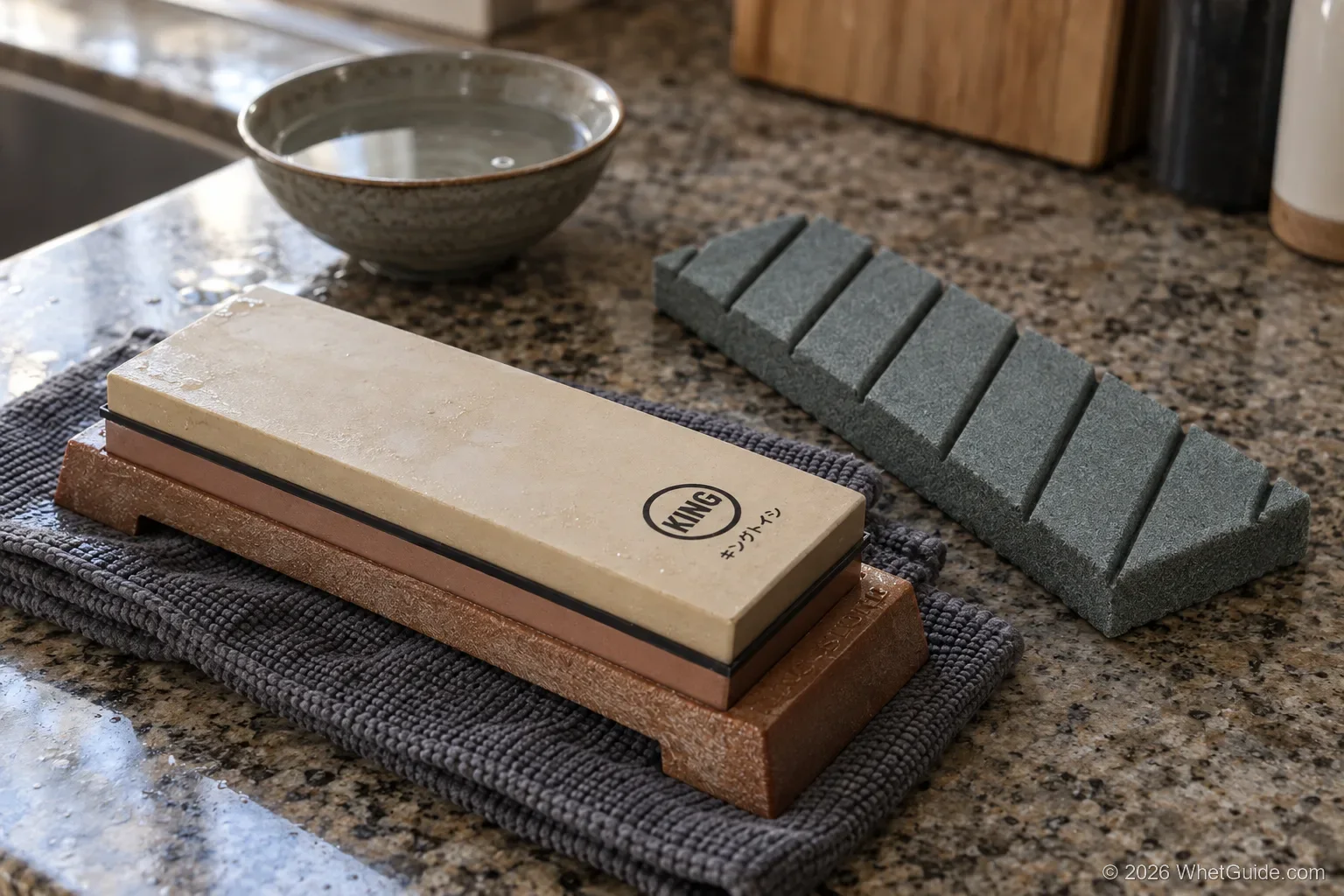
A flat stone and a little water. Nothing else gives you every angle, every knife including single-bevel, and the most refined edge for the least steel removed. The Sharp Pebble 1000/6000 is the popular starter. Other combination stones fill the same slot: the KING 1000/6000 is the classic Japanese two-sided stone, and the Suehiro 1000/3000 is a lower-cost alternative. The Shapton #1000 is a splash-and-go stone, so no soaking. Add a KING 6000 later if you start on a single 1000.
Stones dish in the middle as you use them, so a flattening stone such as Norton's belongs in the same drawer. A non-slip holder keeps the stone from skating on a wet counter, and a clip-on angle guide helps for the first few sessions. Start with how to use a whetstone, then the grit chart and beginner whetstone sets.
↑ Back to all sectionsWhat wears out, and what that costs over the years
| Type | What wears | Can you replace it? | What to budget for |
|---|---|---|---|
| Pull-through | Carbide edges dull; ceramic glazes over | Rarely; most are sealed units | A new unit when the coarse slot stops biting. Cheap ones are close to disposable. |
| Electric | Diamond wheels, the stropping disk | Model by model; GearJunkie says the 15XV's diamond stones are not replaceable | A long life for one cook, a shorter one for a big family. Check parts before you buy. |
| Rolling | The diamond disc | Check the maker for spare discs | The disc, not the block |
| Guided clamp | Diamond and ceramic abrasives | Check the maker for replacements | Abrasives every few years of heavy use |
| Whetstone | The stone itself, slowly; it dishes | You replace the whole stone, eventually | A flattening stone up front; a new stone after many years |
| Honing rod | Steel rods lose their ridges; ceramic can chip if dropped | Whole rod | A rod every several years |
Are pull-through sharpeners bad for kitchen knives?
| Your knives | Pull-through verdict | Why |
|---|---|---|
| A cheap stamped set | Fine | Speed matters more than steel. A carbide slot brings back a working edge in seconds. |
| Mid-range German (Wüsthof, Zwilling, Henckels) | Occasional, fine slot first | The makers' own handhelds suit them. Keep the coarse slot for real dullness. |
| A good Japanese gyuto or santoku | Avoid carbide | Hard, thin edges can chip in a carbide slot. Bob Vila lists common V-notch presets at 18° and 22°, wider than a 15° Japanese edge. |
| Single-bevel knives | Never | A V-slot grinds both sides and ruins the flat back. |
| Serrated bread knife | Only if the listing names serrated | Otherwise the slot flattens the scallops' points. |
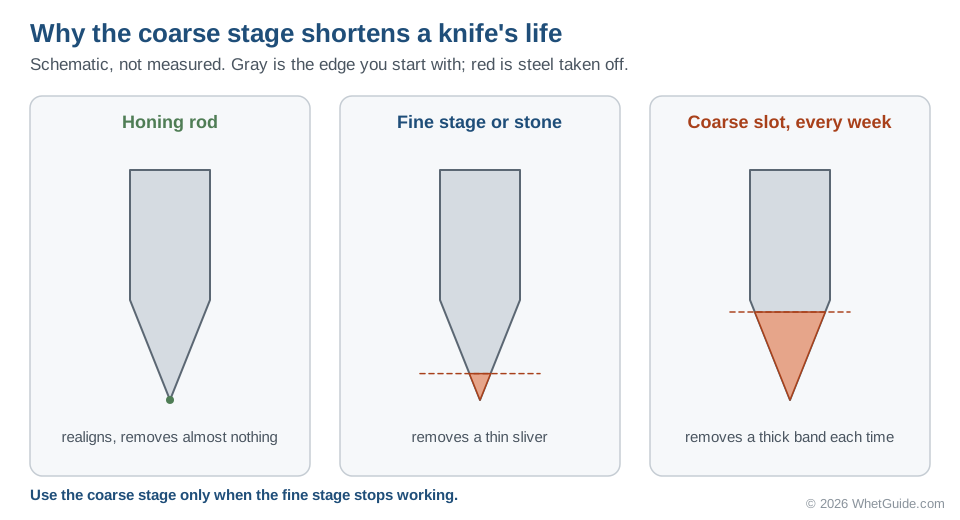
Outdoor Life's sharpening guide puts it bluntly: pull-throughs can do more harm than good. That's true of the coarse slot used as a weekly habit. Wüsthof's own instructions for its hand-held sharpeners agree on the habit and keep the coarse slot to once or twice a year. It's less true of the fine ceramic slot, which takes off little more than a honing rod would. So the honest answer depends on which slot you reach for. Our full take is in are pull-through knife sharpeners bad.
Coarse stages on electrics behave the same way. Use stage one when the knife won't bite a tomato after honing and a few passes in the fine stage, and skip it the rest of the time.
↑ Back to all sectionsCheap look-alikes: what to check before you buy
- No angle stated anywhere on the listing. Reputable makers say what the slots or guides are set to.
- "Diamond" with no detail about which stage, how coarse, or what the rest of the tool is made of.
- Four or five "stages" in a palm-sized body, usually the same carbide V repeated.
- A tiny review history, or reviews that talk about shipping instead of edges.
- No mention of serrated knives, then photos of a bread knife in the slot.
- No non-slip base. A pull-through that slides is how fingers get cut.
The bolster problem on German chef's knives
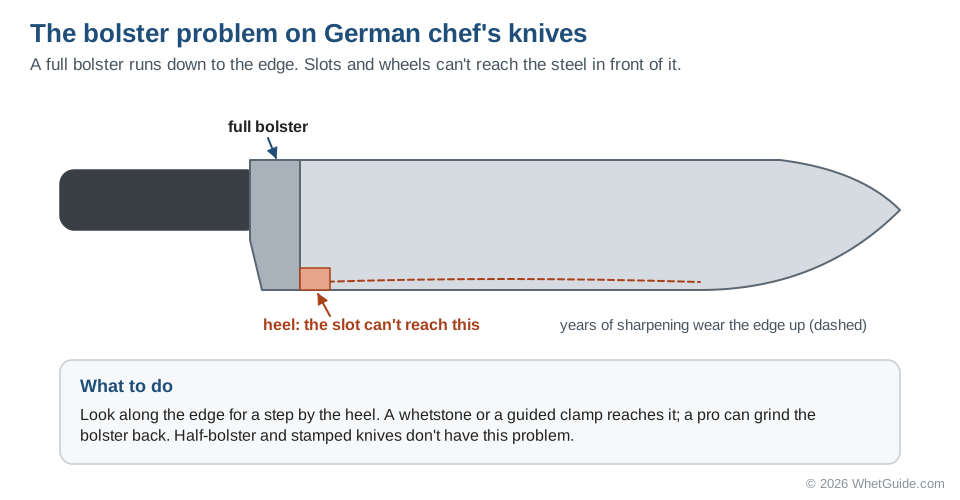
Many forged German chef's knives have a full bolster: a thick collar of steel where the blade meets the handle, running all the way down to the edge. A pull-through or electric slot can't get past it, so the last half inch of edge in front of the bolster is never sharpened. The rest of the edge wears a little higher every time. After a few years a step forms at the heel, and the knife rocks on it instead of meeting the board along its length.
Check yours by setting the knife on a cutting board and looking for light under the heel. If there's a gap, a whetstone or a guided clamp can reach the heel, and a sharpening service can grind the bolster back. Knives with a half bolster, or stamped knives with no bolster at all, don't have this problem, which is one reason stamped knives like Victorinox's Fibrox line pair so easily with pull-throughs.
↑ Back to all sectionsBuying guide
German, Japanese, or both?
German and Western knives commonly sit around 20° per side, Japanese knives around 15°. Go by your knife maker's recommendation and buy a sharpener that covers the angles in your block. The angle chart lists typical numbers. Japanese-knife owners should read the best sharpeners for Japanese knives. Own Wüsthof? Sharpeners matched to Wüsthof's 14.5° edge. If you are buying knives too, the best knife block set with sharpener picks are worth a look.
Serrated bread and steak knives
Plenty of sharpeners can't do serrations. If you need it, buy one whose listing names serrated knives, or see how to sharpen a serrated knife. More on that below.
Coarse stages remove metal
- Pull-through and electric sharpeners have aggressive first stages. Keep those for knives that are truly dull.
- Regular touch-ups belong in the fine stage, and your knives last longer for it.
- If a sharpener has only one coarse stage and nothing gentler, it's a tool for cheap knives.
Checklist before you check out
- Blade steel: steel knives only, unless the tool says it handles ceramic (diamond only).
- Angles in your block: write down each knife and its maker's angle, then make sure the sharpener covers them all.
- Serrations: if you own a bread knife you care about, the listing must say serrated.
- Single-bevel knives: only a stone, so a pull-through or electric is a second tool for everything else.
- Space and noise: an electric wants a spot near an outlet; a whetstone wants a sink nearby.
- Who will use it: a fixed-angle tool for a household where several people sharpen, a stone or clamp for one careful person.
- Warranty and parts: whether abrasives can be replaced decides how long the purchase lasts.
Which sharpener for which kitchen knife
| Knife | Good choices | Avoid |
|---|---|---|
| German chef's knife (Wüsthof, Zwilling style) | Electric, guided, whetstone, Wüsthof or Zwilling handheld | Nothing in particular; these are forgiving |
| Japanese gyuto or santoku | Whetstone, guided at 15°, rolling at 15°, 15° electric | Coarse carbide slots |
| Single-bevel (yanagiba, deba) | Whetstone | Electric, pull-through, most guided systems |
| Bread knife | Tapered rod, Sharpmaker, sharpeners listing serrated support | Flat stones on the scallops |
| Paring knife | Any of the above; short blades are easy | Over-grinding with coarse stages |
| Cleaver | Whetstone or guided at a higher angle | 15° settings, which are too thin for chopping |
| Ceramic knives | Diamond abrasives only (check the maker) | Steel rods, conventional pull-throughs |
Signs your kitchen knives need sharpening
- The knife slides off a tomato or pepper skin instead of biting in.
- You find yourself pressing down hard to cut carrots or onions.
- Herbs bruise and turn dark at the cut instead of slicing cleanly.
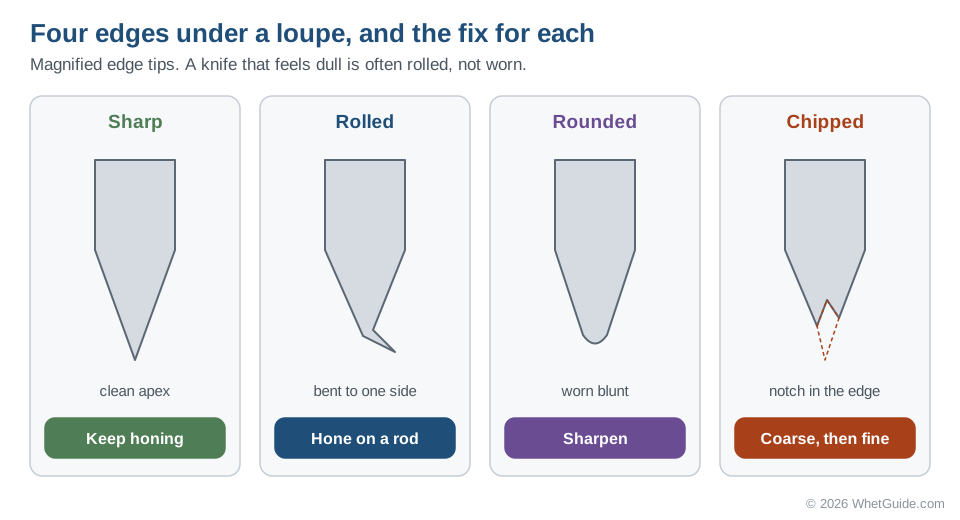
- Honing on a rod no longer brings the edge back.
Dull knives are also the dangerous ones. They need more force, so they slip more. For a home kitchen, sharpening every few months with honing in between is the usual rhythm. When it's time, each method is walked through in the guide to sharpening kitchen knives at home.
↑ Back to all sectionsBread knives and other serrated edges
Serrated knives stay useful long after a plain edge would feel dull, because the points do the cutting and the scallops between them barely touch the cutting board. That means a bread knife needs sharpening far less often than your chef's knife. When it does, either use a sharpener whose listing names serrated knives or work each scallop with a tapered rod. Spyderco's explainer on serrated edges adds that the ridges between the scallops help reinforce the edge.
| Pick | Serrated? | Source |
|---|---|---|
| Chef'sChoice 15XV | Yes | Listing and maker |
| KitchenIQ Edge Grip | Yes | Listing |
| Work Sharp Precision Adjust | Mentioned on the listing | Listing |
| Zwilling, Wüsthof, Henckels | Check the listing | Not stated in what we read |
| HORL 3 Cruise | No | A flat disc can't reach the scallops |
| Sharp Pebble | No | Flat stones only touch the points |
- The tapered-rod method: find the beveled side, lay the rod in one scallop at the bevel angle, stroke a few times, move on. Finish with a light pass on the flat side to take off the burr.
- Which? noted in its January 2026 round-up that many pull-through and rolling models can't do serrated edges, so read the listing even on well-known brands.
- Full method with diagrams: how to sharpen a serrated knife, and the tools in best sharpener for serrated knives.
Hone first, sharpen second
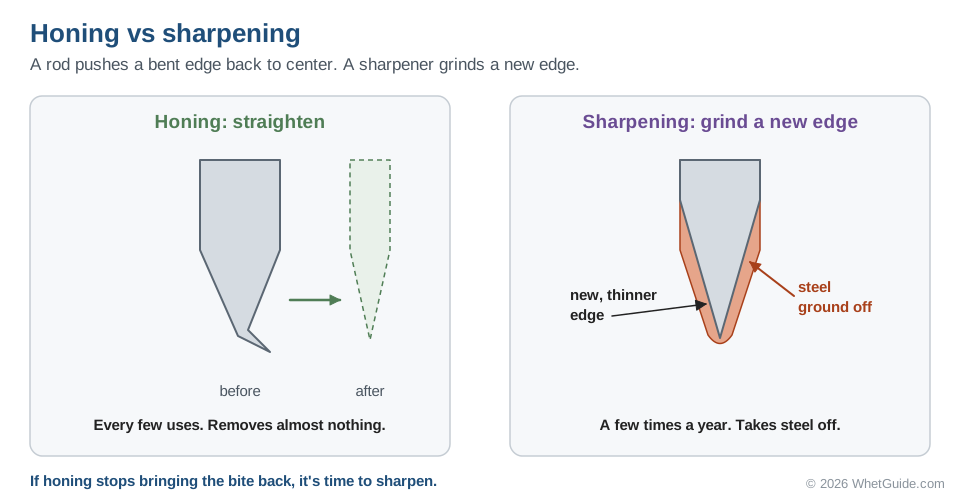
The thin edge of a kitchen knife bends over in use. It hits the board on every stroke while you dice an onion, and the apex rolls to one side. It still looks fine, but it no longer meets food edge-on, so it feels dull. A honing rod pushes that rolled edge back to center in a few light strokes and removes almost no steel.
So hone first. If the knife slices paper cleanly after honing, you're done. If it doesn't, sharpen. Zwilling's care guide frames the routine the same way: honed regularly, sharpened occasionally. Cooks who skip the rod tend to sharpen far too often and wear knives out early. Honing rod vs whetstone and how to use a honing rod cover technique; ceramic or steel is answered in ceramic vs steel honing rods.
↑ Back to all sectionsHow often to sharpen kitchen knives
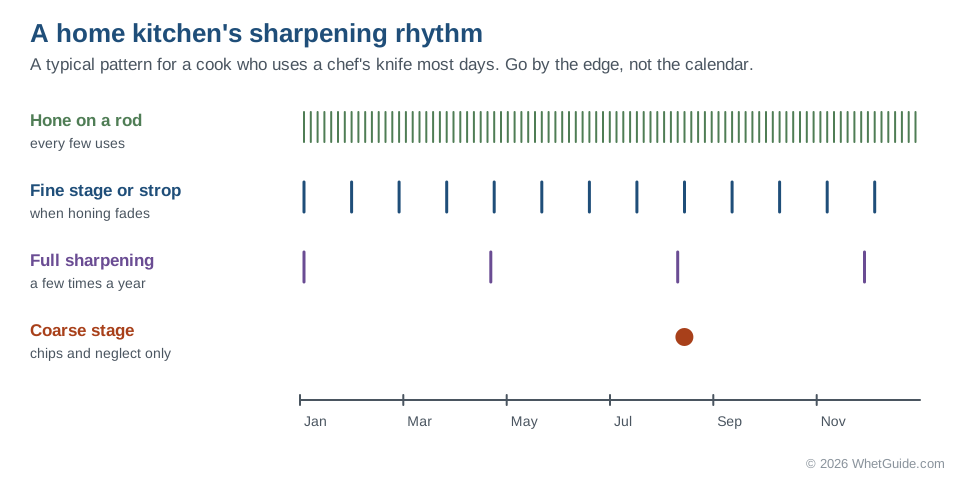
For a home cook, the usual rhythm is a few strokes on the rod every few uses, a light touch-up in the fine stage when honing stops bringing the edge back, and a full sharpening a few times a year. The coarse stage comes out for chips and neglect. Shun's FAQ is firm that sharpening isn't a weekly job and warns that doing it too often can shorten a knife's life. If you cook every night, shift everything a notch more often; if you cook on weekends, a notch less.
| Knife | Hone | Sharpen |
|---|---|---|
| Chef's knife or santoku, used daily | Every few uses | Every few months |
| Paring and utility knives | When they feel dull | A few times a year, or less |
| Bread knife | Rarely | Rarely: when it tears bread instead of slicing it |
| Carving and slicing knives | Before each use | When honing stops bringing the edge back |
| Japanese knives on a stone | Light strop or ceramic rod | When the stone's finer side stops reviving it |
Your first session with a new sharpener
Every sharpener comes with instructions, and those come first. What follows is the general shape, so you know what to expect and when to stop. Practice on your cheapest knife before your best one; the kitchen knife sharpening guide goes further, with every method in detail.
Electric or pull-through
- 1Set it downOn a dry counter, non-slip feet down, cord out of the way.
- 2Pick the stageFine stage if the knife is slightly dull; coarse only if it won't bite a tomato.
- 3Pull slowlyHeel to tip, light pressure, the same number of pulls in each side's slot.
- 4Test and stopSlice a sheet of paper. If it cuts cleanly, you're done; strop or finish stage last.
Guided clamp or rolling
- 1Find the angleThe maker's figure, or the marker test.
- 2Mount the knifeClamp it at the balance point, or set it square on the magnet.
- 3Raise a burrWork one side until you feel a slight lip along the whole other side.
- 4Flip and finishMatch the passes on side two, then go finer and lighter.
Whetstone
- 1Wet the stoneSoak or splash, per the stone. Set it on a towel or holder.
- 2Hold the angleA clip-on guide helps, or use the spine heights in the angle calculator.
- 31000 grit to a burrEdge-leading strokes in sections, then the other side.
- 46000 grit to polishFewer, lighter strokes. Alternate sides at the end.
Sharpening safely in a kitchen
- Non-slip base or a damp towel under it. Nothing should slide when you pull.
- Your free hand goes on the handle of the sharpener, behind the slot, never in front of the blade's path.
- Dry the knife first. A wet handle twists in your grip.
- Pull, don't saw. Back-and-forth strokes in a pull-through chew up the edge and bring your hand toward the slot.
- A cut-resistant glove on the hand holding the sharpener costs little. Gloves are listed under accessories.
- Wipe the blade with a folded towel from spine to edge, then wash it. Metal filings don't belong in food.
- Empty the filings from an electric over the trash, not the sink, and unplug it first.
Common mistakes, and the fix for each
| Mistake | What happens | Fix |
|---|---|---|
| Coarse stage every time | The knife wears down fast and the edge stays rough | Fine stage for touch-ups; coarse only when the fine stage fails |
| Pressing hard | Deeper scratches, a big burr, and a wobbly angle | The weight of the knife is close to enough in a guided slot |
| Skipping the burr check | The edge feels sharp, then folds after one meal | Feel for the burr, then remove it with the fine stage or a strop |
| Wrong slot for the knife | A Japanese knife ground to a German angle, or the reverse | Label the slots with tape if more than one person sharpens |
| Never honing | Sharpening far more often than needed | A few rod strokes every few uses |
| Dishwasher | Edges bang against racks and dull fast | Hand wash and dry right away |
| Glass or stone cutting board | The edge rolls on every cut | Wood or soft plastic boards |
Still dull after sharpening? Troubleshooting
| Symptom | Likely cause | Try |
|---|---|---|
| Still won't slice paper | The sharpening never reached the apex | Marker test; more passes in the coarser stage, then fine |
| Sharp, then dull within a day | A burr was left on and has folded | Light alternating passes on the finest stage or a strop |
| Sharp in the middle, dull at the heel | A bolster blocks the slot | See the bolster problem |
| Dull near the tip | The tip slipped out of the slot early, or the clamp was set too far back | Keep pulling until the tip leaves the slot; reclamp nearer the middle |
| Edge rolls after a few cuts | The angle is too low for the steel or the job | Go up to 20° on soft German steel |
| Sharpener slides or squeals | Wet counter, worn feet, or pressing hard | Dry the counter, use a damp towel underneath, lighten up |
Keeping kitchen knives sharp between sharpenings
- Hone every few uses, before you start, not after.
- Cut on wood or soft plastic. A glass or stone board rolls the edge on every cut.
- Hand wash and dry the knife right away. Dishwashers rattle edges against the rack.
- Store knives in a block, on a magnetic strip, or in edge guards in a drawer. A loose knife in a drawer of utensils is dull by the end of the week.
- Scrape food off the board with the spine, not the edge.
- Use the right knife: a cleaver or a boning knife for chicken bones, the chef's knife for everything else.
Starter kits by kitchen
| Your kitchen | Sharpener | Add |
|---|---|---|
| An inexpensive starter set | KitchenIQ Edge Grip | A steel honing rod |
| A wedding-registry Wüsthof or Zwilling block | Chef'sChoice 15XV, or the maker's own handheld | A Wüsthof or Victorinox honing steel |
| A mixed German and Japanese block | HORL 3 Cruise or Zwilling 4-stage | A fine ceramic rod, such as Messermeister's 12-inch |
| One prized Japanese gyuto | Sharp Pebble 1000/6000 or a KING 1000/6000 | A flattening stone, a stone holder and a ceramic rod |
| A Shun knife or two | Precision Adjust set near 16°, or a stone | Shun's own honing steel, which has a 16° guide |
| A bread-heavy kitchen | Chef'sChoice 15XV for straight and serrated | A tapered rod for a good bread knife |
| Knives that live in a drawer | Any pick above | Edge guards, such as Mercer's 8-inch |
A sharpening service or a sharpener?
| Situation | Better choice | Why |
|---|---|---|
| Routine upkeep, several knives | Sharpener at home | A one-time purchase, and you're never without your knives |
| Single-bevel knives | Service, or learn the stone | Nothing else on this page handles them |
| Chips, a broken tip, a heel step | Service | Takes a lot of steel off; a pro grinder is faster and more even |
| A once-a-year reset | Either | A pro reset plus a home rod works well |
| Ceramic knives | Service or the maker's diamond sharpener | Ordinary sharpeners can't cut ceramic |
- Local rates vary, so check before you compare: knife sharpening service cost lists what to expect.
- Mail-in options are covered in mail-in knife sharpening, and hardware-store sharpening in does Ace Hardware sharpen knives.
- Ceramic knife owners should read how to sharpen a ceramic knife first.
Why other reviews pick differently
- GearJunkie names the Work Sharp Precision Adjust best overall and the Chef'sChoice 15XV best for kitchen knives. Most of its picks lean toward outdoor and pocket knives.
- Outdoor Life covers mostly guided and enthusiast systems, names the HORL 2 Pro best for kitchen knives, and warns that pull-throughs can do more harm than good.
- Popular Science picks the Trizor XV, which is the 15XV under another name (swap details in the Trizor XV review).
- Bob Vila includes a Shenzhen Knives electric for ceramic knives and lists common V-notch presets at 18° and 22°.
- Chowhound's round-up spans a wide price range, from the Tumbler roller and the Orange Ninja adjustable pull-through to inexpensive four-in-one gadgets.
- Which? (UK) measured edges with a sharpness tester and published "Don't Buy" verdicts, and noted that many pull-through and rolling models can't do serrations.
Buying one as a gift
The accessory to buy first: a honing rod
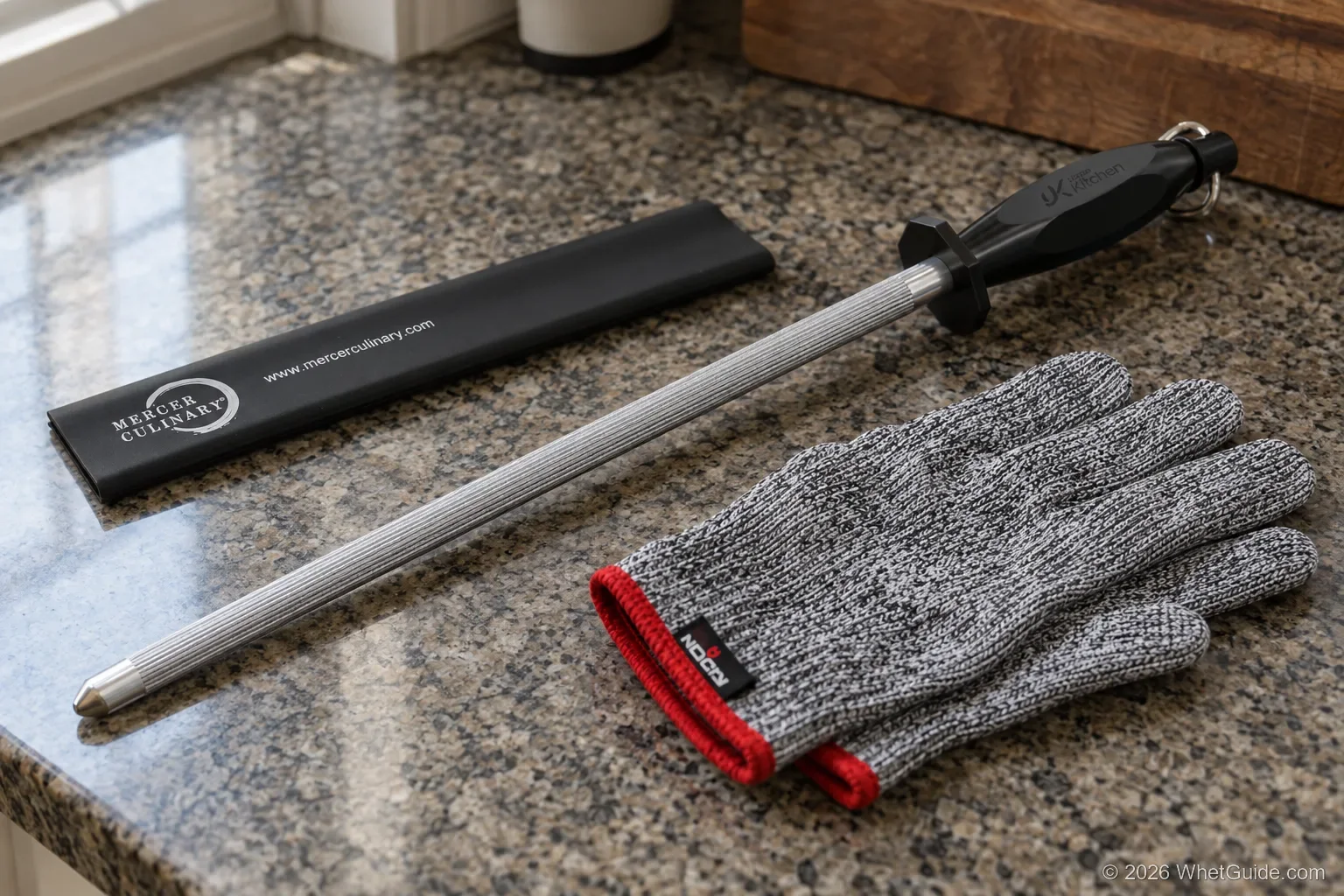
Hone every few uses and you'll sharpen far less often. The Utopia Kitchen 12-inch honing rod is a cheap, popular steel rod with a hanging loop. The 12-inch carbon steel honing rod is another well-reviewed option, with more than 10,000 ratings and about 1,000 bought last month. See the best honing rods and honing rod vs whetstone.
Pull-through slots and fast electric stages leave your fingers close to a fast-moving blade, so a cut-resistant glove is a cheap addition. The level 5 food-grade cut gloves have 15,000+ ratings and about 2,000 bought last month.
How much time will you give it?
A minute per knife: the Chef'sChoice 15XV, and it's what we'd put in most kitchens. A few minutes, for an edge set to your knife maker's exact angle: the Work Sharp Precision Adjust. Ten to fifteen minutes and some practice, for the finest edge: the Sharp Pebble whetstone. Seconds and almost no money: the KitchenIQ Edge Grip. If you're leaning electric but want to compare more models first, read the best electric knife sharpeners.
Specs come from Amazon listings, as do ratings and sales figures, checked October 3, 2026. We do not quote prices we have not checked. How we research · Affiliate disclosure