Quick answer: the whole routine in 10 rules
Wash it by hand right after use, dry it right away, cut on wood or plastic, and store it so the edge touches nothing. Everything else on this page is detail on those four habits, plus what carbon steel and outdoor knives need on top.
- Wash by hand as soon as you finish cutting, with warm water, a drop of mild dish soap and a soft sponge.
- Wipe from the spine toward the edge, with the edge pointed away from you.
- Never soak a knife or leave it in the sink. Food acids and standing water spot the steel and swell the handle.
- Keep it out of the dishwasher unless its maker says otherwise. Even then, hand washing is kinder.
- Dry it at once with a cotton or linen towel, including the joint where the blade meets the handle. Don't let it air-dry.
- Cut on wood, soft rubber or plastic. Never on glass, stone, ceramic or metal.
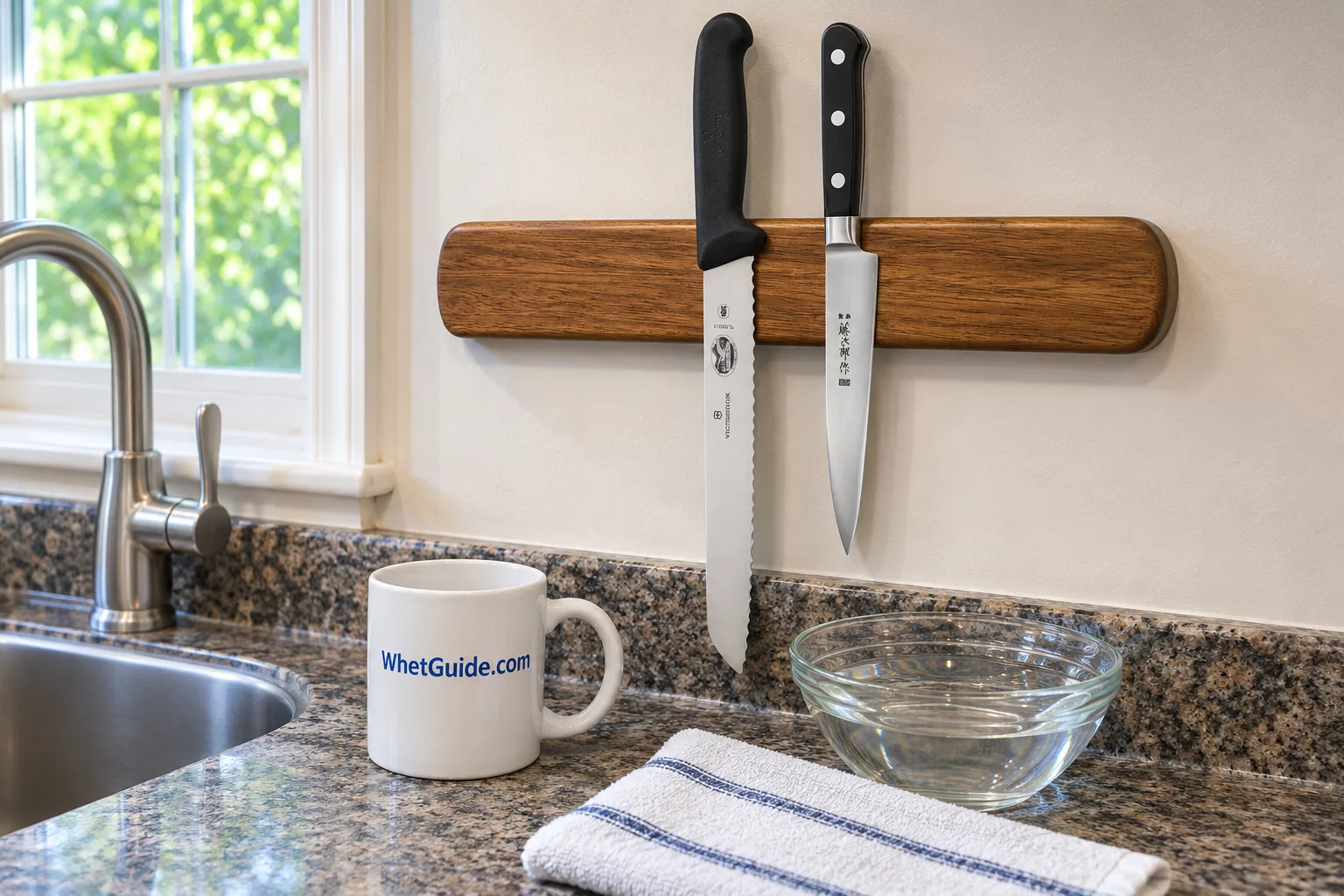
- Store it so the edge touches nothing: a magnetic strip, a block with the knife on its spine, an in-drawer tray, or a guard.
- Hone it regularly and sharpen when honing stops bringing the edge back.
- On carbon steel, wipe the blade while you work, dry it, and give it a thin film of oil before it sits.
- Deal with rust the day you see it, starting with the gentlest fix.
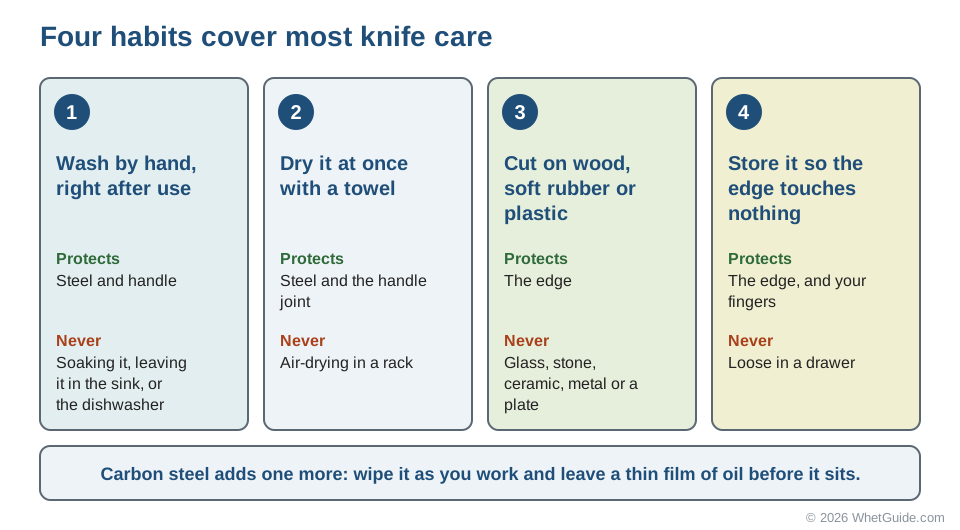
The same rules fit on one card in the printable cheat sheet. Hunting, pocket and work knives have a few extra steps; jump to hunting, folders or utility knives.
↑ Back to all sectionsWhat care actually protects
Four things wear out on a knife, and care slows down all four.
- The edge. It's the thinnest steel on the knife. Glass boards, dishwasher racks and other cutlery in a drawer fold and chip it long before the steel itself wears away.
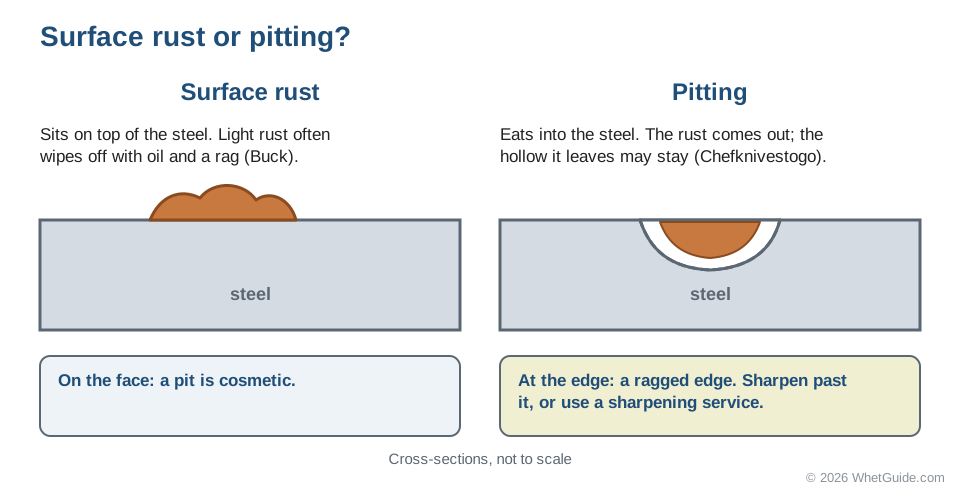
- The steel. Rust starts as a spot, then pits. Pits on the face are cosmetic; pits at the edge make a ragged edge that won't hold.
- The handle. Wood swells when it soaks and cracks as it dries. Gaps open at the bolster and rivets, and water and food get in behind them.
- Your hands. A dull knife needs more force, and force is what makes a blade skid off a tomato skin and into a finger. A knife loose in a drawer cuts whoever reaches in.
None of it takes long. A hand wash and a towel dry is the one habit that covers most of this page.
↑ Back to all sectionsHow to wash a knife by hand
Every maker we read says the same thing: by hand, right after use. Wusthof says warm water and mild dish soap, then dry promptly with a soft cloth. Shun says warm or cool water, because hot water can bake food onto the blade. Zwilling's distributor Compreforce adds a non-scratch cloth or sponge.
- 01RinseRight after the last cut, before food dries on
- 02WashSoft sponge, mild soap, spine to edge
- 03DryTowel, blade and handle joint, at once
- 04Put awayStrip, block on its spine, tray or guard
Step by step
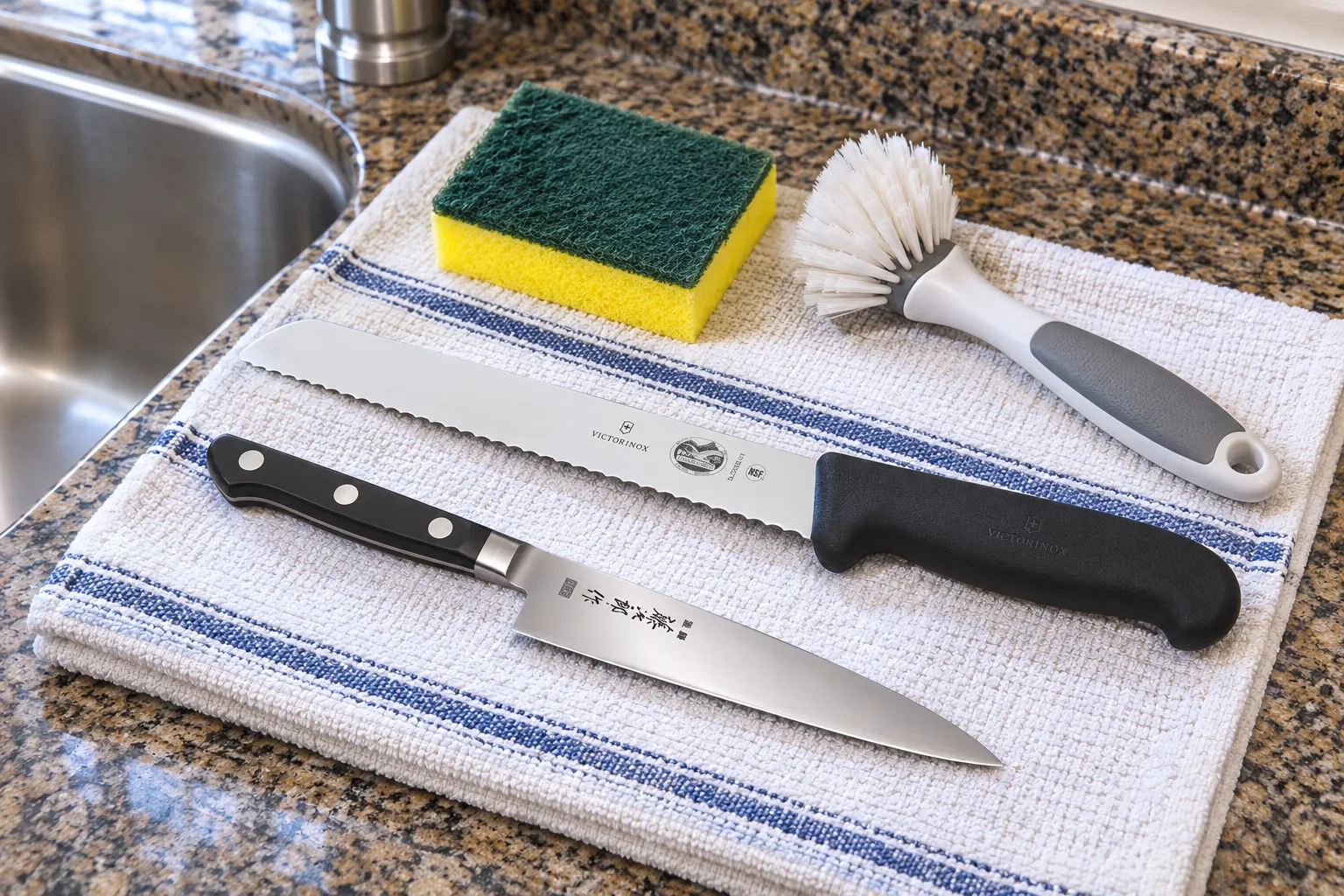
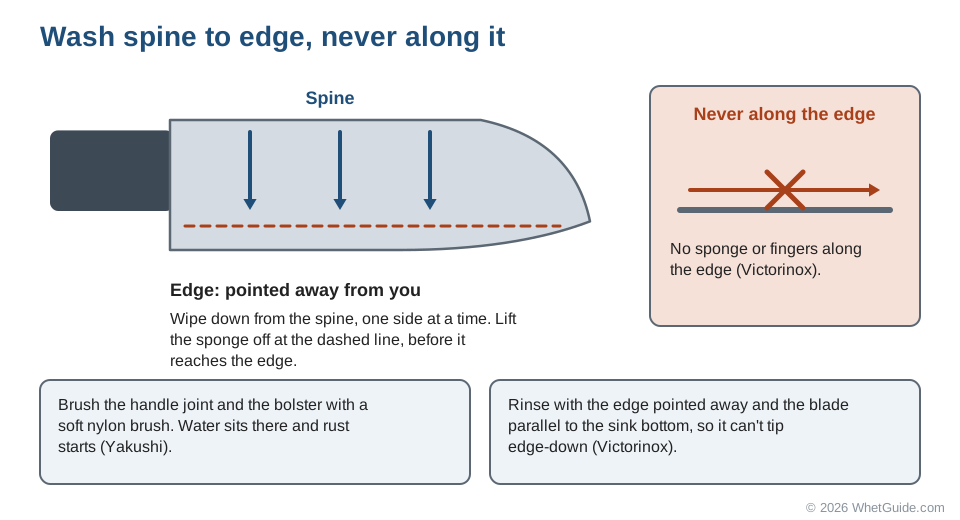
- Rinse it as soon as you're done. Victorinox says to rinse right after use under cold running water and rub the blade with your fingers, never along the edge. Salty and acidic food left on a blade stains it.
- Hold the knife by the handle with the edge pointed away from you, and keep the blade parallel to the sink bottom, as Victorinox describes, so it can't tip edge-down.
- Put a drop of mild dish soap on a soft sponge or cloth.
- Wipe from the spine toward the edge, one side at a time, and lift the sponge off before it reaches the edge. Never run your fingers or a sponge along the edge.
- Clean the joint where the blade meets the handle, and the bolster (the thick steel collar) on a forged knife. A soft nylon brush gets into the gap. Yakushi names this joint as the place water sits and rust starts.
- Rinse off the soap with the edge still pointed away from you.
- Dry it straight away (how to dry) and put it away before you wash the next thing.
What not to use: steel wool, scouring pads and abrasive powders on a polished blade. Knifewear says even the green plastic scrubbies scratch. Victorinox says plain water is enough for polished stainless if you rinse it right away, and Buck warns against harsh detergents that contain chlorine because they speed corrosion.
Wash one knife at a time. A knife dropped into a sink full of suds is invisible, and the next hand in finds it. It's the easiest kitchen cut to avoid.
Should you soak a knife to loosen dried food? No. Wusthof says not to let knives sit or soak, because spices, sauces and juices damage the blade. Soak the cutting board or the pan instead, and use the nylon brush on the knife. One popular care guide suggests soaking for stubborn residue; every maker we read says the opposite.
After raw meat, poultry or fish
A knife that just cut raw chicken carries its juices to whatever it touches next. The FDA's safe food handling page says to wash cutting boards, dishes and utensils with hot soapy water after preparing each food item, and to use one board for fresh produce and a separate one for raw meat, poultry and seafood. IKEA's knife care guide gives the same reason for washing a knife right after use: it stops bacteria spreading from raw chicken to fresh vegetables.
- Finish the raw protein, then stop. Don't wipe the blade on a towel and go on to the salad.
- Rinse the knife first, so nothing gets a chance to dry on.
- Wash it in hot soapy water, spine to edge, with the edge pointed away from you. Shun's warning about hot water baking food on is the reason to rinse first.
- Scrub the joint where the blade meets the handle, and the bolster on a forged knife, with a nylon brush. That's where residue and water collect, as Yakushi points out.
- Rinse well and towel dry the whole knife, handle joint included.
- Wash the board, and your hands, before anything ready to eat touches either one.
If you only have one board, cut the vegetables and anything else that won't be cooked first, and the raw meat last. Then everything gets washed once.
↑ Back to all sectionsCan knives go in the dishwasher?
For a good kitchen knife, no. Wusthof, Shun, Global and Seisuke all say so outright, and Zwilling says a dishwasher shortens a knife's lifespan and reduces its edge retention. The few "dishwasher-safe" knives come with conditions, and most of those makers still recommend washing by hand.
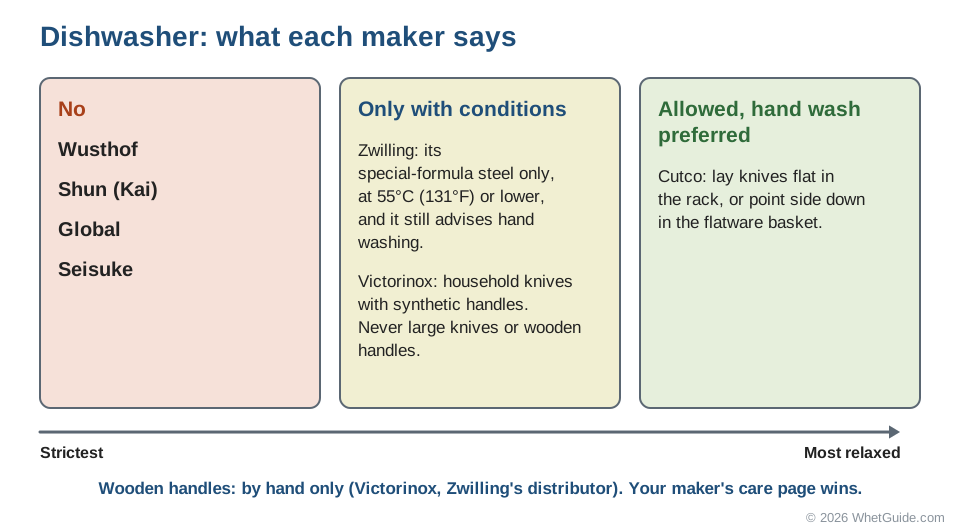
Zwilling's distributor lists four things that do the damage. They add up:
Knifewear adds that heat and long moisture can rust even stainless, and Victorinox says aggressive or excess detergent can stain a blade.
What each maker says
| Maker | Dishwasher? | What their care page says |
|---|---|---|
| Wusthof | No | "Do not place knives in the dishwasher." High heat and rubbing during the cycle. Source |
| Shun (Kai) | No | Knives get knocked around, and citrus-based detergents can cause pitting or corrosion. Source |
| Global | No | Dishwasher heat and detergent harm the knife. Source |
| Zwilling | Only its special-formula steel, at 55°C (131°F) or lower | Still advises hand washing. Dishwashers can shorten lifespan and reduce edge retention. Source. Its distributor adds: wooden handles by hand only. Source |
| Victorinox | Household knives with synthetic handles: yes. Large knives: no. | Hand wash all large knives whatever the handle, and never wooden handles. If you use the machine: rinse first, keep knives from touching other metal, and open the door briefly after the cycle. Source |
| Cutco | Yes, but hand washing recommended | "Hand-washing is the best way to preserve their sharp edge and to assure longevity." In the machine, lay knives flat in the rack, or point side down in the flatware basket so you don't grab a blade when unloading. Detergent and water minerals can affect results. Source |
| Seisuke | No | Hand wash and dry completely. Source |
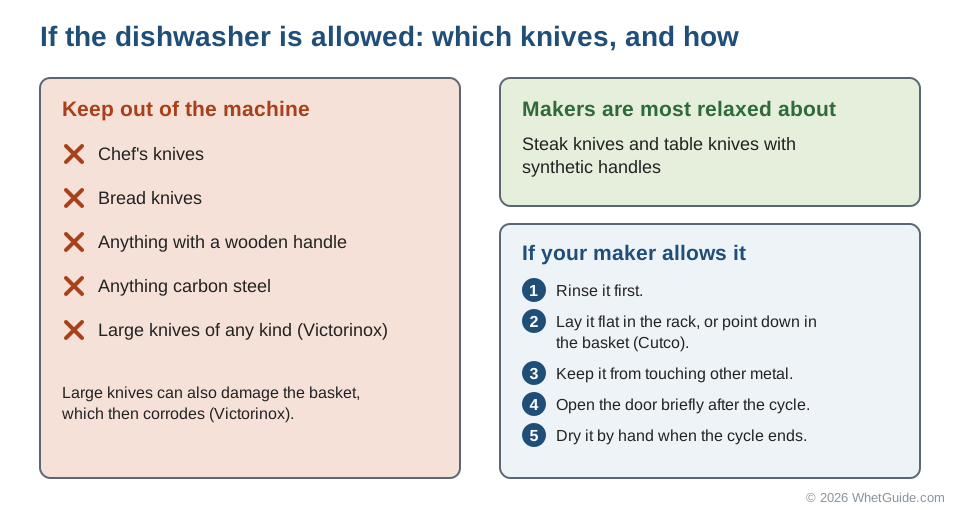
Steak knives and table knives with synthetic handles are the knives makers are most relaxed about. Chef's knives, bread knives, anything with a wooden handle and anything carbon steel should stay out. Victorinox also warns that large knives can damage the dishwasher basket, which then corrodes and can affect the steel of whatever sits in it.
If you use a machine anyway for knives the maker allows, follow Victorinox's conditions above and dry the knives by hand when the cycle ends. Lay them flat in the rack. If they have to go in the flatware basket, Cutco says to put them point side down, so you don't grab a blade when you unload. For any other brand, your maker's own care page wins. Consumer Reports notes that misuse can void a warranty.
↑ Back to all sectionsDrying: right away, by hand
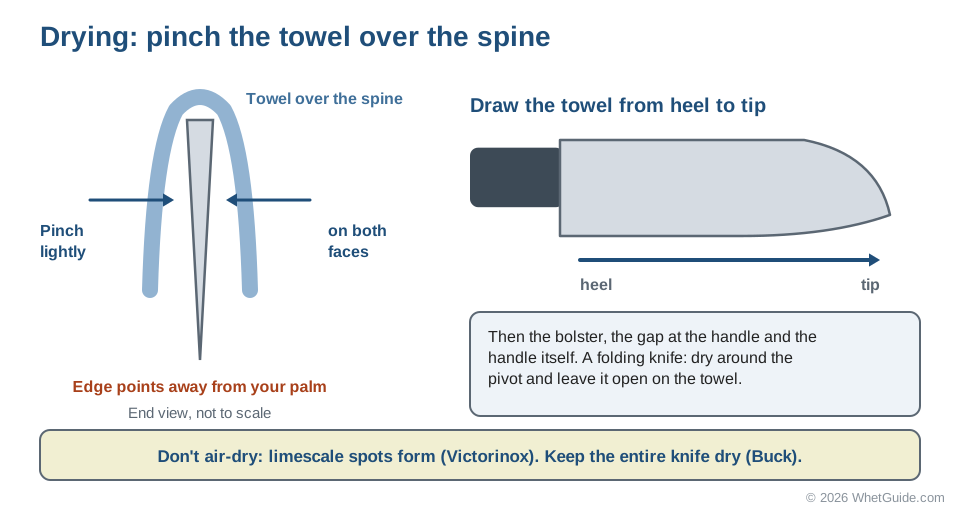
Dry the knife the moment it's clean. Victorinox says not to let knives air-dry, because limescale spots form, and to use a clean cotton or linen towel. Yakushi says leftover water causes rust, especially where the blade meets the handle, and Buck says to keep the entire knife dry, not just the blade.
- Fold the towel over the spine and pinch it lightly against both faces.
- Draw it from the heel toward the tip, fingers on the spine side, so the edge points away from your palm.
- Dry the bolster, the gap at the handle and the handle itself.
- On a folding knife, open it and dry around the pivot too, then let it sit open on the towel for a while before closing it.
A dish rack is not storage. Knives standing edge-up in a rack stay wet at the handle joint and are easy to grab by the edge.
Does leaving a knife wet hurt it?
Yes, slowly. Water on a stainless blade leaves spots, and on carbon steel it rusts. Wusthof says food left on the blade can cause spots and corrosion. Water that wicks into a wooden handle swells it and opens gaps around the tang. Yakushi's FAQ says acids etch steel within minutes, which is why a knife covered in tomato or lemon juice shouldn't wait on the counter while you eat. Consumer Reports adds the obvious one: don't leave knives in a wet sink.
↑ Back to all sectionsCutting boards: what's kind to an edge
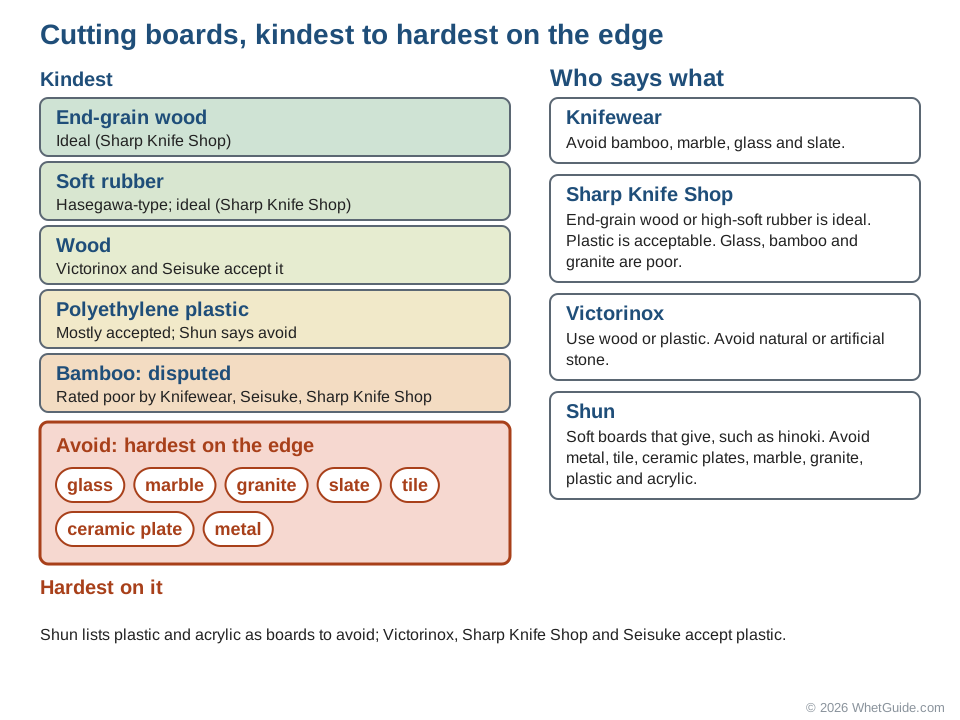
The board touches the edge more than anything else in the kitchen, so the board decides how often you sharpen. Soft surfaces give a little under the edge. Hard ones fold or chip it on every cut.
| Surface | Verdict | Who says what |
|---|---|---|
| End-grain wood | Best | Sharp Knife Shop calls end grain and soft rubber ideal. Shun recommends soft woods such as hinoki. |
| Soft rubber (Hasegawa and similar) | Best | Sharp Knife Shop: ideal. |
| Edge-grain and face-grain wood | Good | Victorinox, Knifewear, Seisuke and Chefknivestogo all say wood. |
| Soft plastic (polyethylene) | Good, with one dissent | Victorinox, Knifewear, Seisuke and Chefknivestogo say plastic is fine; Sharp Knife Shop calls it acceptable. Shun lists plastic and acrylic among surfaces to avoid. |
| Bamboo | Disputed | Knifewear, Seisuke and Sharp Knife Shop put it on the poor or avoid list. Some care guides recommend it. |
| Composite (paper or resin) | Hard | Chefknivestogo lists composite with glass and granite as boards to avoid. |
| Glass, marble, granite, slate, tile, ceramic, metal | Avoid | Every source. Shun names metal, tile, ceramic plates, marble and granite; Knifewear adds glass and slate; Victorinox says no natural or artificial stone. |
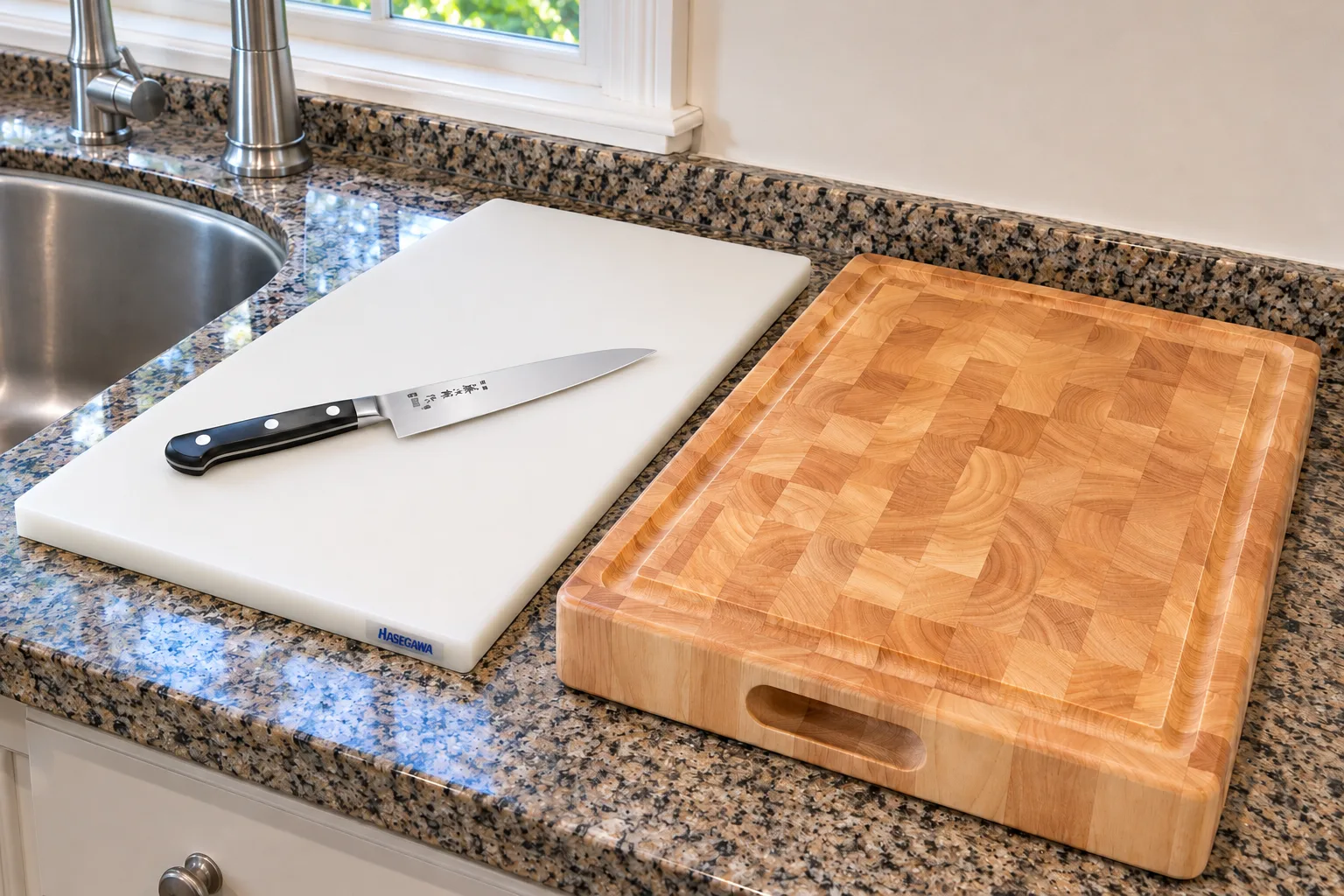
When makers disagree, go with the maker of your knife. If you own Shun, use wood. If you own Victorinox, a good plastic board is fine.
How you use the board counts as much as what it's made of:
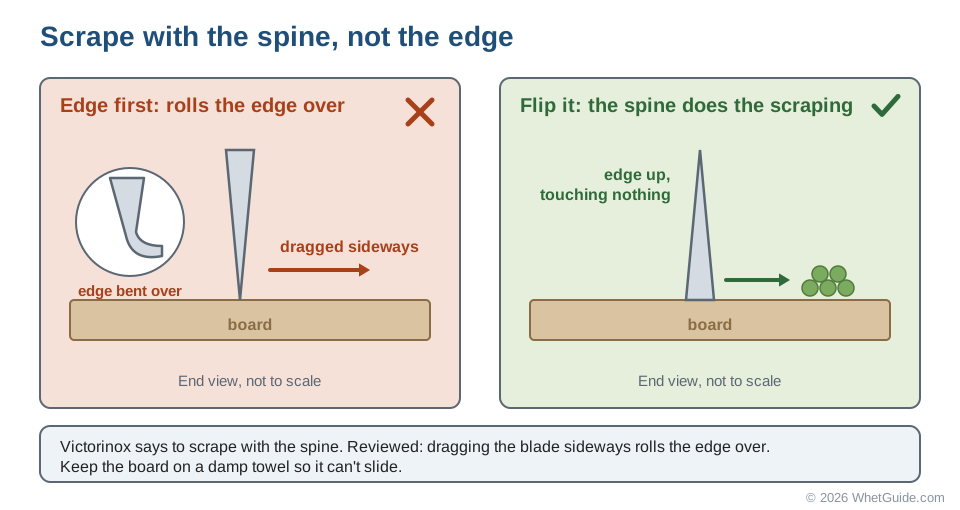
- Scrape chopped food off the board with the spine, not the edge. Victorinox says so, and so does Maria's Condo's care guide. Reviewed lists dragging the blade sideways across the board as a habit to drop, because it rolls the edge over.
- The plate is not a board. Shun lists ceramic plates among the surfaces to avoid, so cut the steak on a board and plate it after.
- Keep the board still on a damp towel so it can't slide under the knife.
Storage: keep the edge from touching anything
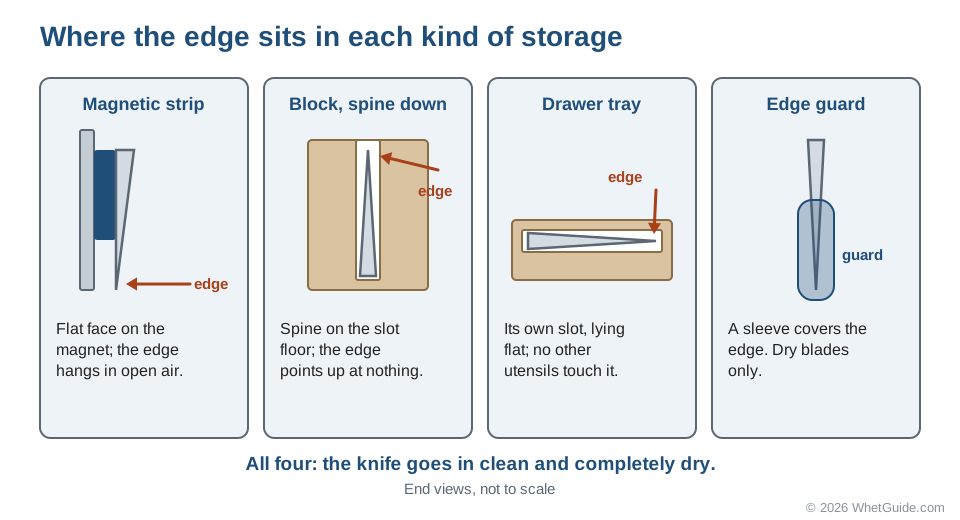
Every storage method that works does one thing: nothing touches the edge. Zwilling's care page says a knife should have its very own space away from other objects. The only option every maker rules out is loose in a drawer. Shun says it can dull or chip the edge, and Victorinox says never.
| Method | Good for | Watch out for | Listed by |
|---|---|---|---|
| Slotted block | A set that came with one; counter space | Edge-down slots dull the edge; damp slots if knives go in wet | Wusthof, Shun, Victorinox, Zwilling (preferred) |
| Universal block | Mixed knives of any size | Must stay dry; knives go in dry | Cook's Illustrated |
| Magnetic strip | Small kitchens; air around the whole blade | Careless loading; bare metal bars on thin Japanese edges | Shun, Victorinox, Knifewear, Escoffier, Cook's Illustrated |
| In-drawer tray | Clear counters; homes with children | Only in a dedicated tray, never loose | Wusthof, Zwilling, Shun, Victorinox |
| Edge guard | Drawers, knife bags, odd-sized knives | Putting a wet knife in a guard | Wusthof, Knifewear, Escoffier, Zwilling (sleeves) |
| Saya, roll or sheath | Travel, Japanese knives, outdoor knives | Trapped moisture | Wusthof (rolls), Shun (sheath, case), Chefknivestogo (saya) |
Whatever you choose, the knife goes in clean and completely dry. That's the most sanitary way to store a knife, and it's what stops rust in a slot or sheath you can't see into.
Knife blocks: store knives on the spine
Cook's Illustrated ran the one real storage test we found. In a wooden block with angled vertical slots, a knife slid in edge-first could not cleanly cut a piece of paper after 70 strokes. The same knife stored on its spine in the same block showed no visible damage after 200 strokes. The test covered that one slotted block. It didn't test strips or drawers.
A wooden block also needs dry knives. Consumer Reports says wet knives corrode and create mold in wooden storage blocks, so towel each one dry before it goes in.
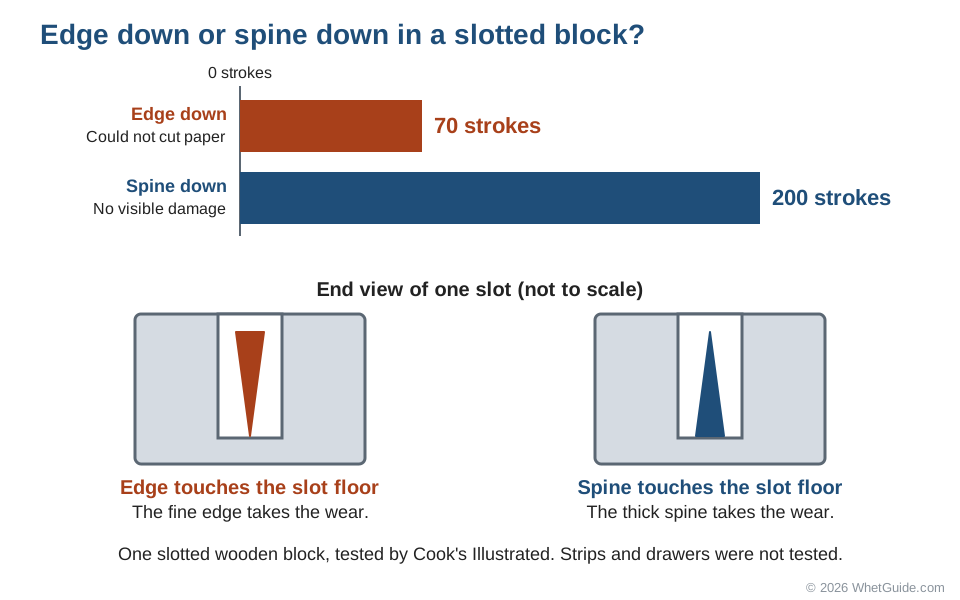
So in a slotted block, turn the knife so it rests on its spine with the edge facing up. In a block with horizontal slots the knife lies on its flat side, and the problem goes away. Slide each knife in and out slowly, without dragging the edge along the slot wall.

A universal block, filled with plastic rods or bristles instead of fixed slots, takes any blade shape. Cook's Illustrated lists universal blocks among its recommended options, along with magnetic strips and upright wooden blocks. Escoffier says to keep a block fully dry, so only a dry knife goes in. Turn any block upside down and shake out the crumbs now and then. Consumer Reports adds a reason to towel-dry first: wet knives breed mold in a wooden block.
A slotted wooden block needs a real wash now and then too. America's Test Kitchen says to keep it out of the dishwasher, which leaves wood damp too long and strips the finish. Instead, scrub each slot with a skinny, firm bottle brush and hot soapy water, wash the outside, and rinse. Pat it dry, then let it air-dry for a few days, flipping it now and then, and put nothing back until block and knives are completely dry. For a rod or bristle block, follow the maker's care card for its insert.
A block that came with a set is fine to keep using; just turn the knives spine-down. If you're shopping for a set, our guide to knife block sets with a built-in sharpener covers what those sharpeners do to an edge.
Magnetic strips: how to load one without chipping
Shun, Victorinox, Knifewear and Escoffier all list a magnetic strip as good storage. The blade sits in open air, so it dries, and nothing rubs the edge. The risk is in how the knife goes on and comes off.
- Hold the knife with the spine toward the strip.
- Touch the spine to the strip first.
- Roll the blade flat onto the magnet so the edge lands last and lands softly. This is Chefknivestogo's method.
- To take it off, reverse it: pivot on the spine to roll the edge away from the strip, then lift it clear.
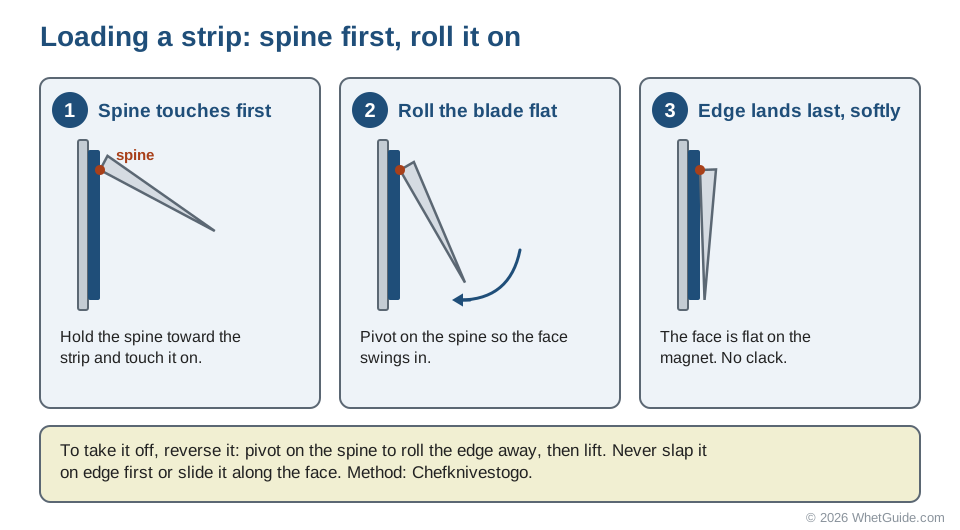
Never slap a knife edge-first onto the strip or slide it along the face. Chefknivestogo recommends wooden bars over bare metal ones for Japanese knives, since a thin, hard edge that clacks against steel can chip.
Why a strip, and how to choose one
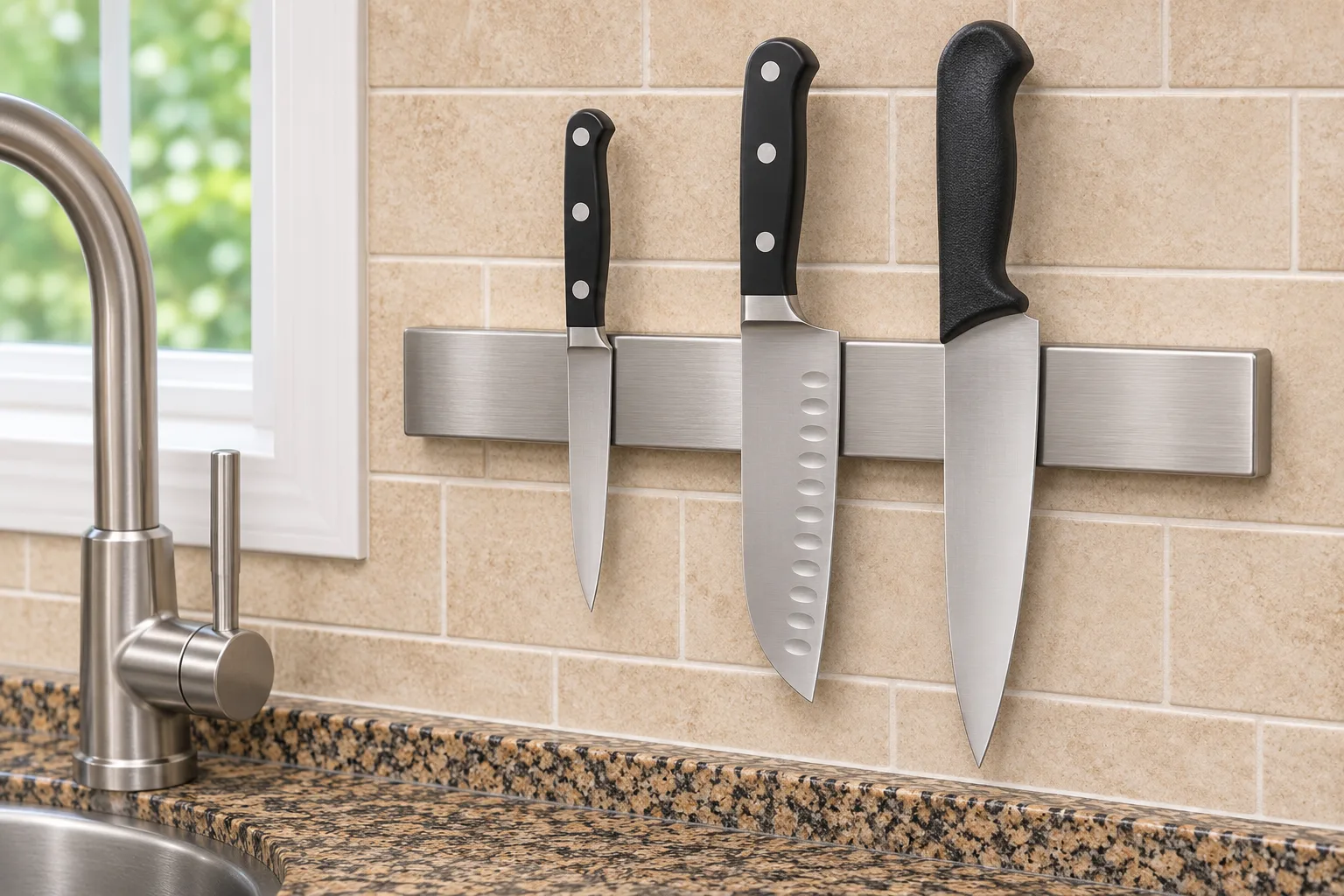
A strip earns its wall space. It frees the counter a block would take and the drawer a tray would fill. Each knife hangs on its own, so blades don't knock together the way they do loose in a drawer, and you can see at a glance which knife is where. The whole blade sits in open air, so any damp you missed with the towel dries off instead of sitting in a slot.
- Face: wood or bare stainless. A wood face is the softer landing, and it's the one Chefknivestogo recommends for Japanese knives. A stainless bar wipes clean and suits a modern kitchen, and it's fine for tougher Western blades if you load them spine-first.
- Length. Lay the knives you own side by side, spines up, with a finger's gap between handles, and measure. Knifewear suggests leaving wall room for another strip later, because collections grow.
- Height for your longest knife. Hang your longest blade, usually the bread knife or a slicer, and check that its tip hangs clear of the counter and anything stored below it.
- Magnet strength. A former Knife Planet guide warned that weak magnets leave dead zones where a knife can slip or drop. A strip with magnets running its full length avoids that. Once it's up, hang your heaviest knife at each end and in the middle, and make sure it doesn't creep down the face.
- Mount it properly. The strip carries a row of steel, so it has to stay put. Williams-Sonoma's mounting sheet starts with a stud finder and a level, and says its screws and plastic anchors are meant for drywall or a stud only; for other walls, ask a hardware store. IKEA sells its KUNGSFORS rack without screws and warns it must be securely anchored, with screws and plugs that suit your wall. On tile, Knifewear avoids drilling and uses heavy-duty double-sided tape on cleaned tile. If you go that way, follow the tape maker's cure time before you load it.
- Place it with care. Mount it out of children's reach and away from where people brush past. Knifewear also says to think twice about the wall above the sink or the stove. Williams-Sonoma's sheet warns that strong magnets can affect pacemakers and metal implants, so keep that in mind if someone in the house has one.
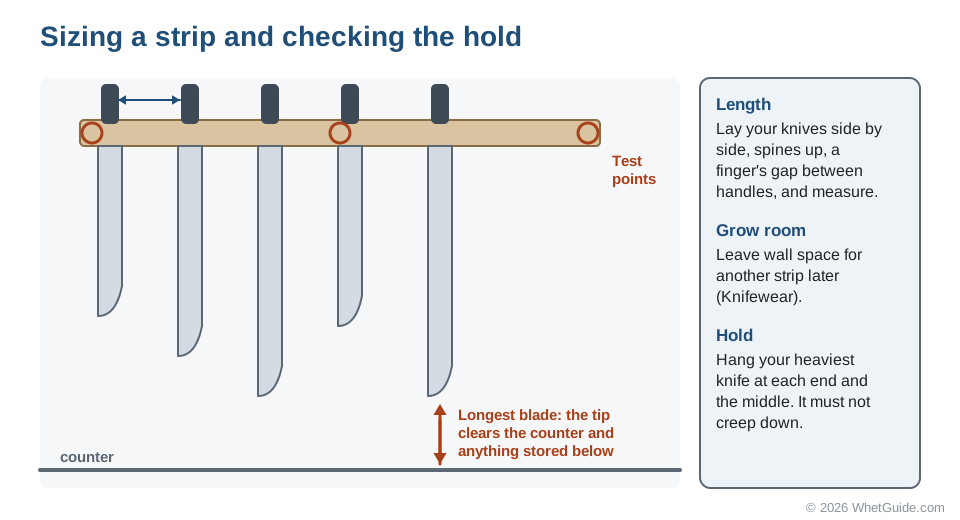
Hang heavy knives near the middle of the strip and check that each one is held firmly before you let go.
In-drawer storage: trays, never loose
A drawer is fine if the drawer is built for knives. Zwilling, Wusthof, Shun and Victorinox all list in-drawer holders. A tray holds each knife in its own slot so blades never touch each other or other utensils.
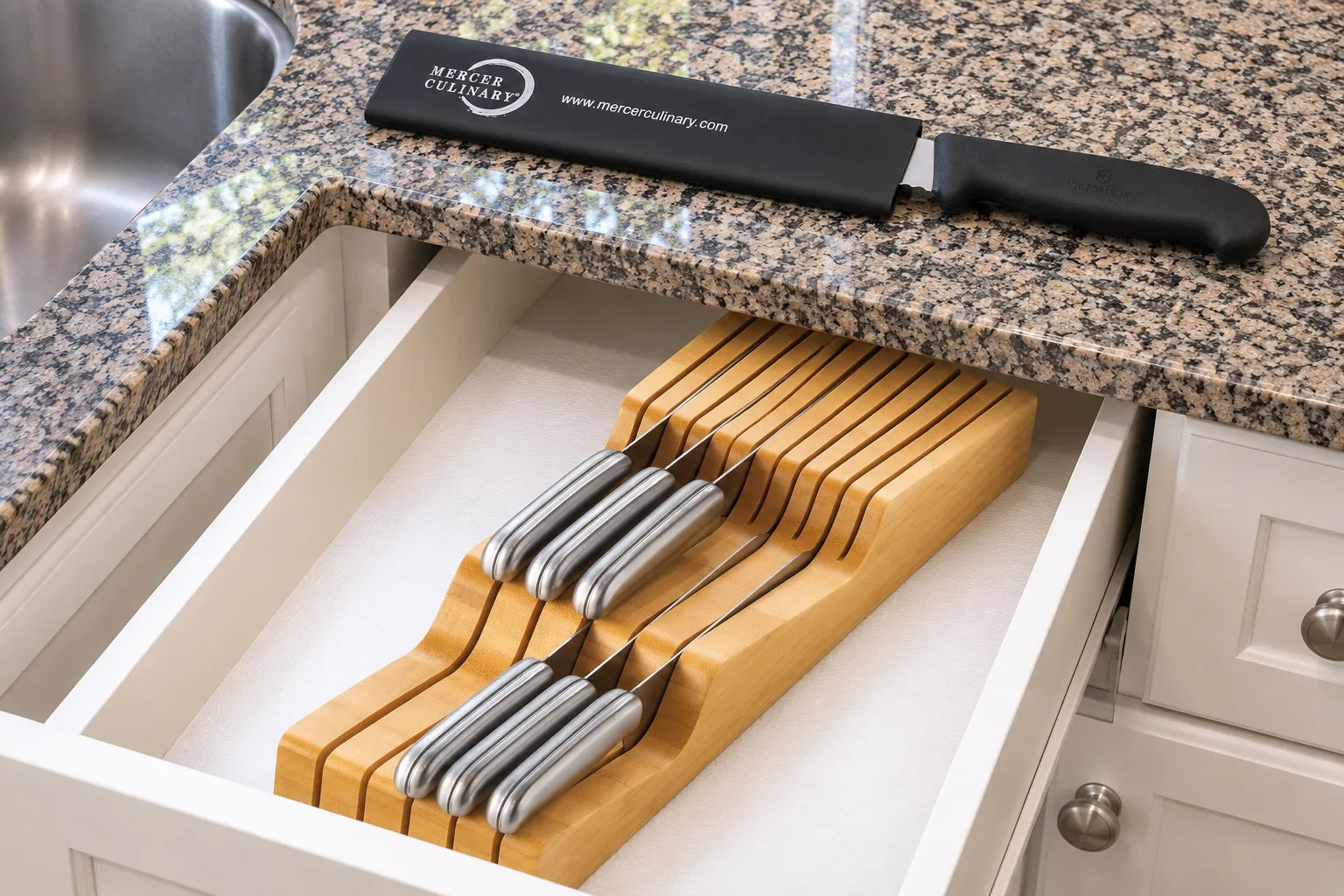
Put knives in with the handles toward you so you never reach toward an edge. A drawer suits a house with small children, as long as it has a child latch. If a knife doesn't fit any slot, put it in an edge guard rather than loose beside the tray. That's also the answer for storing knives in a cabinet: a tray or a guard on every blade.
Edge guards
An edge guard is a plastic sleeve that covers the blade. Knifewear suggests felt-lined plastic guards in drawers and a guard on every knife in a knife bag. Wusthof and Escoffier list them too, and Zwilling calls them protective sleeves. They're cheap, and they let any knife live safely in a drawer, a bag or a camp box.
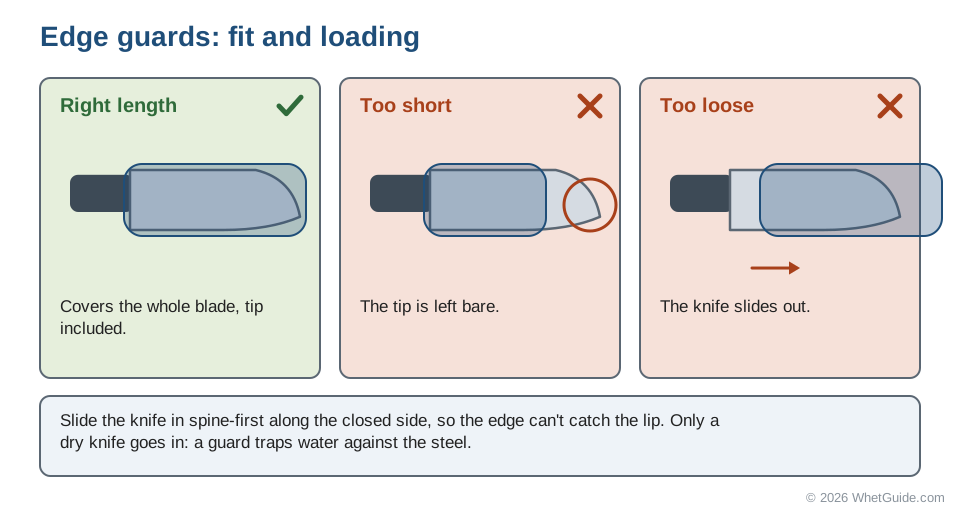
- Only a dry knife goes in a guard. A guard traps water against the steel.
- Slide the knife in spine-first along the closed side of the guard, so the edge doesn't catch the lip.
- Pick a guard that fits the blade's length. A short guard leaves the tip bare, and a loose one lets the knife slide out.
- Rinse and dry the guard now and then. Crumbs collect inside.
Saya, knife rolls and sheaths
A saya is a fitted wooden sheath for a Japanese knife, and Chefknivestogo says the inside must be dry before the knife goes in. Knife rolls and bags carry several knives: Wusthof lists rolls as good storage, and Knifewear says to guard every blade inside a bag. For carbon steel that won't be used every day, MTC Kitchen suggests oiling the blade and wrapping it in newspaper.
Leather sheaths on hunting knives get their own notes under hunting and survival knives.
↑ Back to all sectionsWhat dulls a knife fastest
Roughly from the habits that do the most damage in the least time, using what the makers and knife shops name:
- Cutting on glass, stone, ceramic or metal. Every source names these.
- The dishwasher: knocking, heat and detergent (Wusthof, Shun, Zwilling).
- Loose drawer storage. Shun says it can dull or chip the edge.
- Edge-down in a slotted block. Cook's Illustrated's knife failed the paper test after 70 strokes.
- Cutting bone, frozen food or anything hard. Knifewear's rule: "Never cut anything you wouldn't bite with your own teeth."
- Twisting, prying, and opening packages or jars. Sharp Knife Shop and Reviewed both name these, and they chip the tip and heel.
- Scraping food across the board with the edge (Victorinox, Reviewed).
Normal cutting dulls a knife too, but slowly, and much of that dulling is the edge rolling over, which honing fixes. If a knife you only use on wood goes dull every week, check this list before you buy a new sharpener. A pull-through sharpener used too often is its own problem; see are pull-through knife sharpeners bad.
↑ Back to all sectionsRust: why it starts and how to stop it
Rust needs three things on bare iron: water, oxygen and time. Acids and salt speed it up. Carbon steel has no defense of its own, so it rusts fast. Stainless steel has a chromium-rich film on its surface that blocks most of it, but Sharp Knife Shop puts it well: stainless is "stain-LESS, not stain-PROOF." Leave a stainless knife wet, salty or acidic long enough and it spots too. The steel section explains the film.
Rust prevention, in order of payoff
- Wash soon after use. Wusthof says food left on the blade can cause spots and corrosion.
- Dry the whole knife, not just the blade. Buck's care page says exactly that, and Yakushi names the blade-to-handle joint as where rust starts.
- Wipe carbon steel during use, especially after citrus, tomatoes or onions. Chefknivestogo says acidic food speeds oxidation more than anything else.
- Store dry, in air. A strip or a dry block, never a damp sheath or a guard over a wet blade.
- Oil carbon steel before it sits. A thin film of camellia or food-grade mineral oil keeps air and water off. See when to oil.
- Don't handle the blade more than you need. Great Eastern Cutlery, which makes carbon steel pocket knives, says fingerprints can cause rust and to wipe the blade after each use.
"My new knife rusted after the first use"
It's a common forum question, and the fix depends on what you're looking at.
- Gray, blue, brown or a faint rainbow, smooth to the touch, on a carbon steel knife: that's patina, and it's normal. Leave it. See patina or rust.
- Orange or red, rough or powdery: rust. Take it off today with the ladder below.
- Small white or cloudy spots on stainless: often limescale from air-drying, which Victorinox warns about. They wipe off with a damp cloth; dry by hand next time.
- Dark spots on stainless after the dishwasher: detergent staining or pitting. Victorinox says excess detergent stains; Shun says citrus detergents pit.
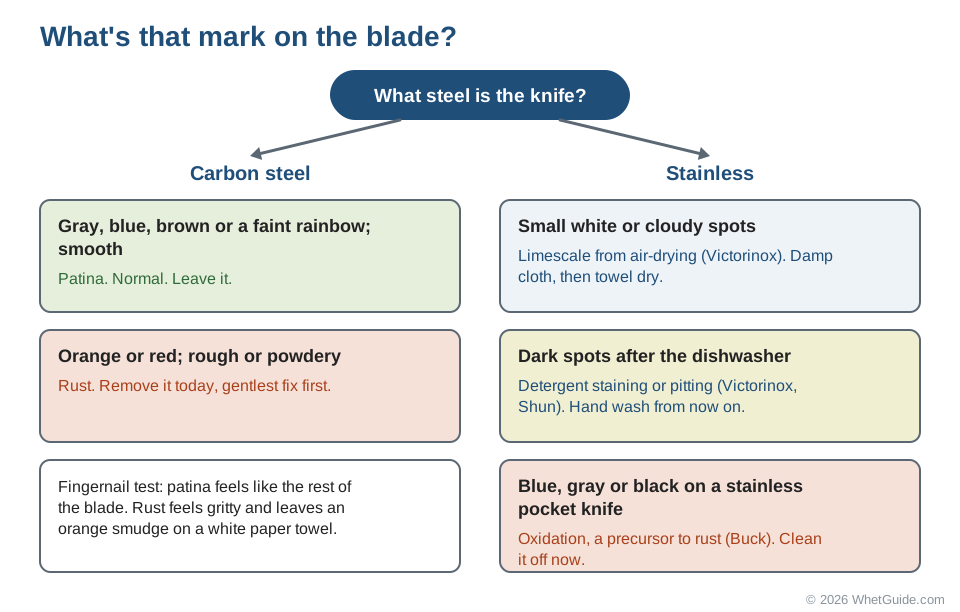
Buck says blue, gray or black discoloration on its knives is oxidation and a precursor to rust, and to clean it off right away. That's good advice for a stainless pocket knife, where discoloration means something is wrong. On a carbon steel kitchen knife, the same gray or blue is the patina that protects it.
↑ Back to all sectionsHow to remove rust from a knife
Start gentle and stop the moment the rust is gone. Every step up the ladder takes more of the finish with it.
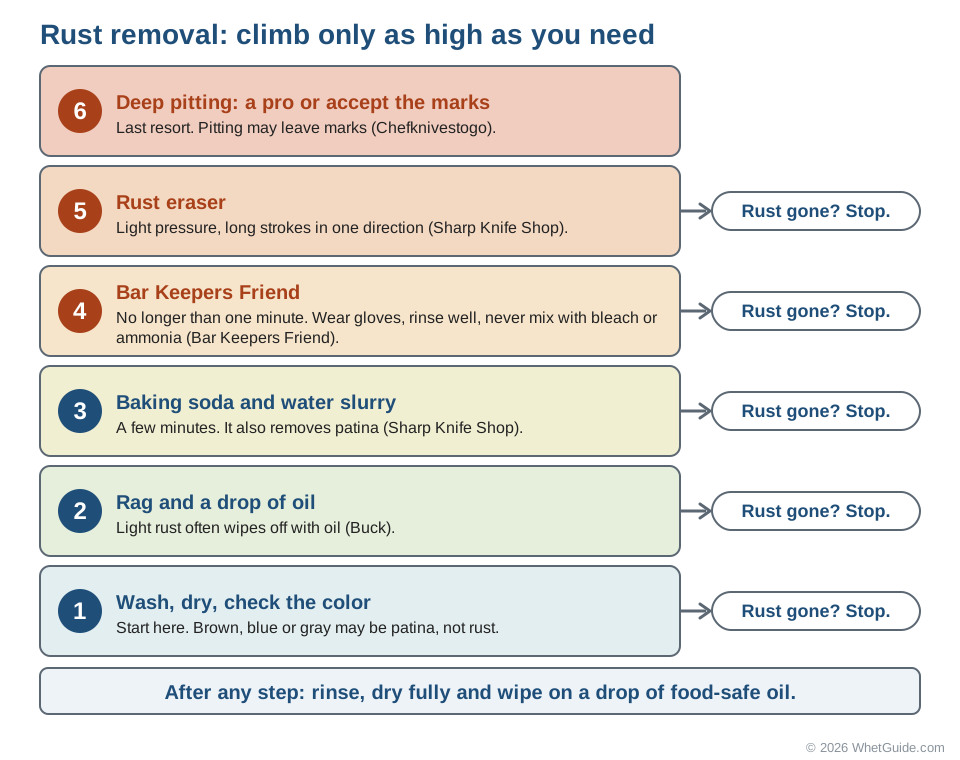
- Wash, dry, and check the color. If it's gray, blue or brown and smooth, it's patina; stop here.
- Oil and a rag. Buck says light rust can be removed with oil. Put a few drops on a cloth and rub along the blade, spine to edge, edge pointed away. Fresh surface rust often wipes right off.
- Baking soda paste. Mix baking soda with a little water into a paste and rub it on with a soft cloth for a few minutes. Sharp Knife Shop and Chefknivestogo both give this method. It removes patina too, so expect a lighter patch.
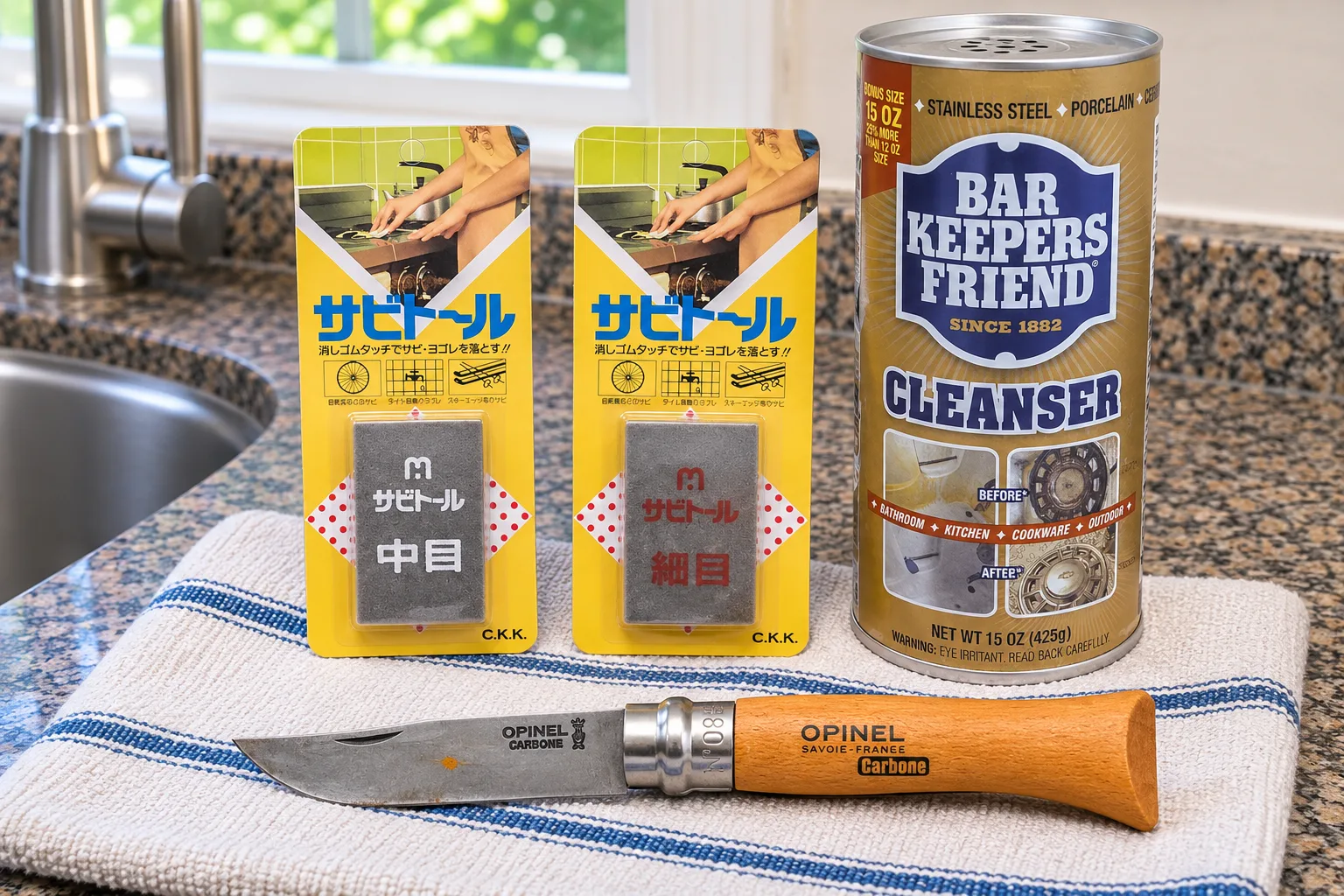
- Bar Keepers Friend. Its active rust remover is oxalic acid. The maker's FAQ (written about stainless cookware) says to leave it on no longer than one minute, rinse thoroughly, wear gloves for prolonged use, and never mix it with other cleaners, especially anything with bleach or ammonia. Chefknivestogo lists it for light surface rust on carbon knives.
- Rust eraser. A rubber block with abrasive in it, such as a Sabitoru. Sharp Knife Shop calls it a last resort: light pressure, long strokes in one direction along the blade, never circles. It will leave a matte or brushed finish where you rub.
- Deep pitting. Chefknivestogo says pitting may leave marks after the rust is gone. Pits on the face are cosmetic. Pits at the edge need a sharpening session that grinds past them, and a badly pitted knife is a job for a sharpening service.
After any step, rinse, dry completely and wipe on a thin film of oil. Bare, freshly cleaned steel rusts faster than steel with a patina.
A former Knife Planet guide on carbon steel also listed 3000 grit wet-and-dry paper, a slice of daikon, and Flitz metal polish for small rust spots. Buck says a non-abrasive metal polish is fine. MTC Kitchen's method for its carbon knives is a rust remover followed by polishing with a high-grit stone, which leaves less surface for rust to grab next time.
About vinegar. Vinegar dissolves rust, but it attacks the steel as well; it's one of the ways people deliberately darken carbon steel. On a rusty kitchen knife, the ladder above is safer. If you do use it, keep the contact short, then wash, dry and oil. Lemon juice gets passed around as a rust remover too, and the same caution applies: it's an acid, and it darkens carbon steel the same way.
Can you use a knife with rust on it? Remove the rust first. It spreads, it pits the steel, and it doesn't belong in food.
Carbon steel: the care routine
Carbon steel takes a keen edge and is easy to sharpen. It also rusts if you look away. A former Knife Planet guide noted that modern stainless can match carbon on hardness and edge retention, and that carbon's lasting advantage is how easily it sharpens. If you own one, this is the routine:
- Wipe the blade on a towel as you work, and right after anything acidic.
- Wash it straight after use with warm water and a little soap. No soaking, no dishwasher.
- Dry it completely, including the handle joint.
- Put a drop of camellia or food-grade mineral oil on a cloth and wipe a thin film over the blade if it will sit unused.
- Store it in open air or in a dry saya, never damp.
- Let a patina build. It's your friend.
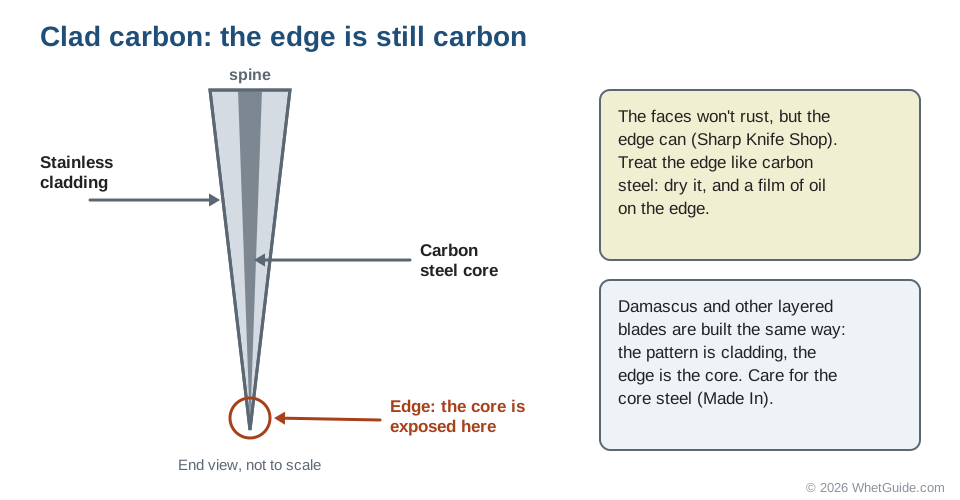
Some "carbon" knives are stainless clad: a carbon steel core laminated between stainless outer layers. Sharp Knife Shop notes that the core is still exposed right at the edge, so the edge can rust even though the faces won't. Treat the edge like carbon steel.
Acidic foods and carbon steel
Carbon steel reacts with acid faster than stainless, according to the Knife Planet guide, and Chefknivestogo says acid speeds oxidation more than anything else. Citrus, tomatoes, onions, vinegar dressings and pickles all darken a carbon blade quickly. Wipe the blade straight after cutting them. Knife Planet's guide suggested keeping a stainless petty knife for lemons and limes, and wiping a reactive blade with a baking soda slurry, which neutralizes the acid. Yakushi's FAQ says acids etch steel within minutes, so the wipe can't wait until the dishes.
Patina or rust? Read the color
Patina is a thin, stable oxide layer. Chefknivestogo describes it as gray, blue, brown or a faint rainbow, and says it doesn't need removing. Rust is orange, rough or powdery, and it has to go. Sharp Knife Shop's rule of thumb: rust is red, and patina can be almost any color except red.
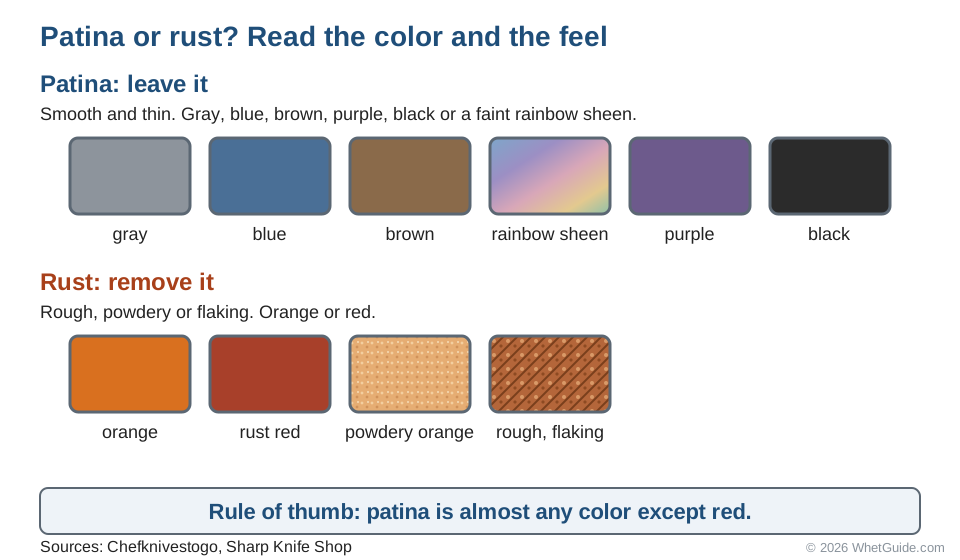
Run a fingernail over the spot. Patina feels like the rest of the blade. Rust feels gritty or raised and leaves an orange smudge on a white paper towel.
Great Eastern Cutlery says a patina adds protection against pitting, and that you can polish it off or force one on purpose. A forced patina is an even, dark coat you put on deliberately instead of the blotchy one that builds with use. The Knife Planet guide listed mustard, warm vinegar and potatoes as ways people do it. A forced patina changes the look of the blade until you remove it; Sharp Knife Shop notes that a baking soda slurry takes patina off, and a metal polish does too.
When and how to oil a knife
Sources disagree on how often, and the reason is that they're talking about different knives.
| Source | How often | For which knives |
|---|---|---|
| Seisuke | After each use, or before extended storage | Carbon steel kitchen knives |
| Chefknivestogo | A light coat before long-term storage | Carbon steel kitchen knives |
| Escoffier | A drop after drying | Carbon steel kitchen knives |
| Buck | At least twice a year, and after every cleaning | Buck pocket and hunting knives, especially the pivot and blade |
For a carbon kitchen knife you use daily, a film after the evening wash is plenty. Stainless kitchen knives that are washed and dried don't need oil at all; every source in our research saves oil for carbon steel, folding knife pivots and storage.
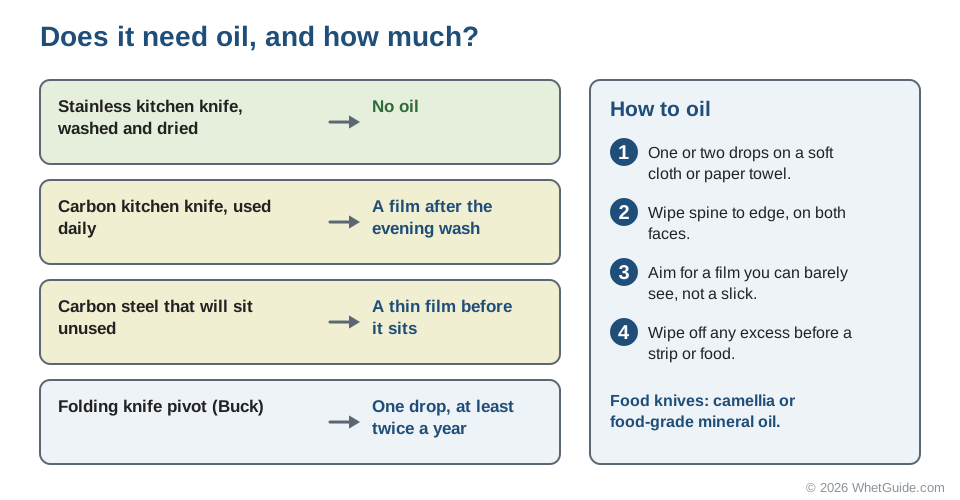
How to oil: one or two drops on a soft cloth or paper towel, wiped along the blade from spine to edge on both faces. You want a film you can barely see, not a slick. Wipe off any excess before the knife goes on a strip, and before it cuts food.
↑ Back to all sectionsWhich oil to use on a knife
For anything that touches food, use camellia oil or food-grade white mineral oil. Save the rest for tools and outdoor knives.
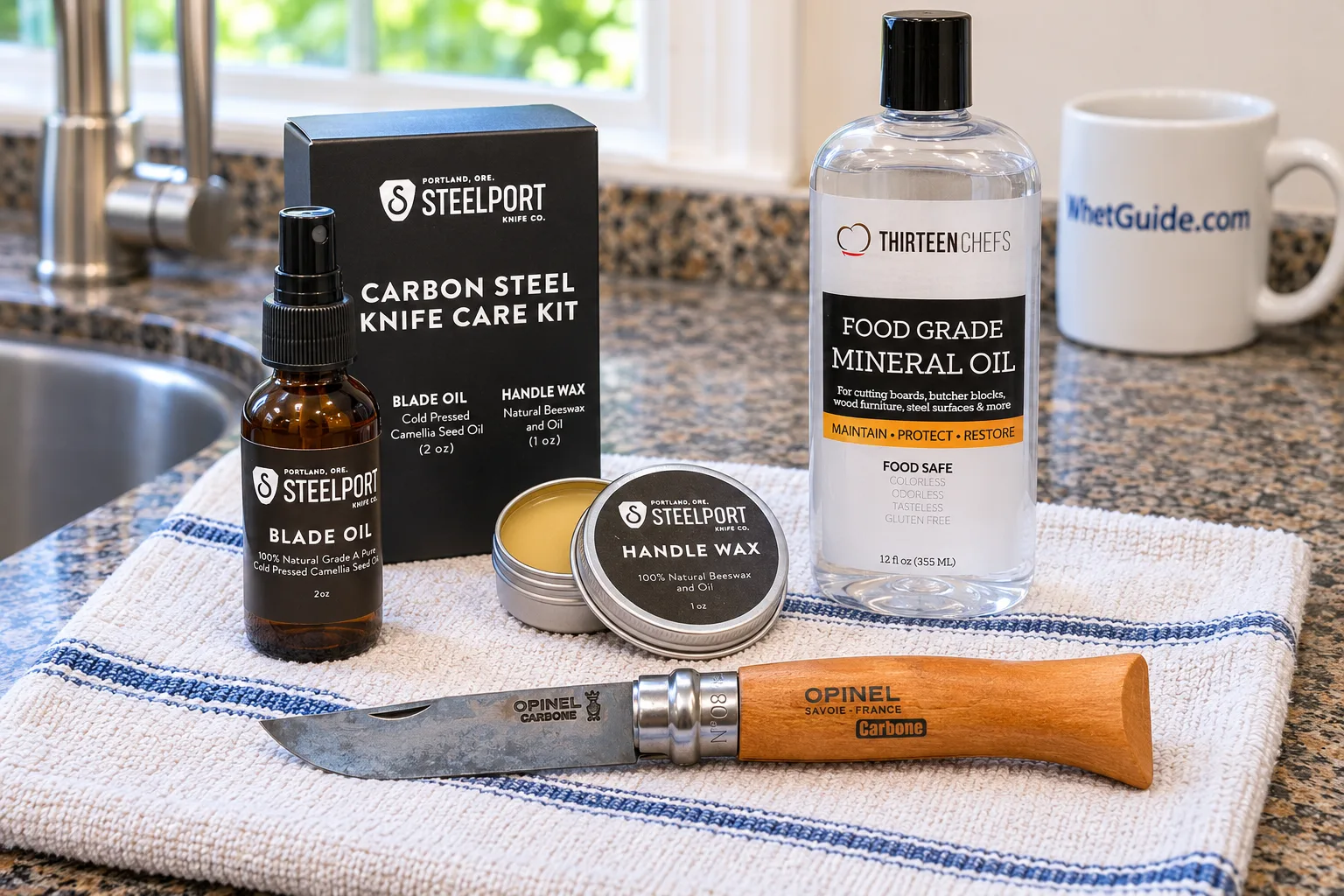
Knife oils compared
| Oil | Food knives? | What the sources say |
|---|---|---|
| Camellia (tsubaki) | Yes | The traditional Japanese knife oil. Seisuke, Chefknivestogo, Escoffier and MTC Kitchen all name it. Steelport sells it with a handle wax. |
| Food-grade white mineral oil | Yes | Escoffier, Chefknivestogo and Great Eastern Cutlery name it. US food rule 21 CFR 172.878 says white mineral oil may be safely used in food under listed conditions; it doesn't mention knives. Buy it labeled food grade. |
| Olive, canola and other vegetable oils | Works short term | MTC Kitchen lists plant-based oil, tsubaki or vegetable. The Knife Planet guide warned that vegetable oil polymerizes into a gummy film that's hard to clean off. Fine in a pinch; not for storage. |
| WD-40 | Check the label | A ship's carpenter writing in Fine Woodworking found it turned sticky and smelly on his tools over nine months at sea. Not a food knife oil. |
| Gun oil, multipurpose oil, Ballistol | Outdoor and tool knives only | Good rust films for knives that never touch food. Follow each label for food contact. |
| Paste wax | No | A tool-blade option; see tool blades. |
What can you use instead of knife oil? Food-grade mineral oil from a pharmacy or the cutting-board aisle works. Don't use oil on a whetstone that's meant for water; that's a different question, covered in sharpening stone oil.
↑ Back to all sectionsHandle care: wood, plastic and Japanese wa
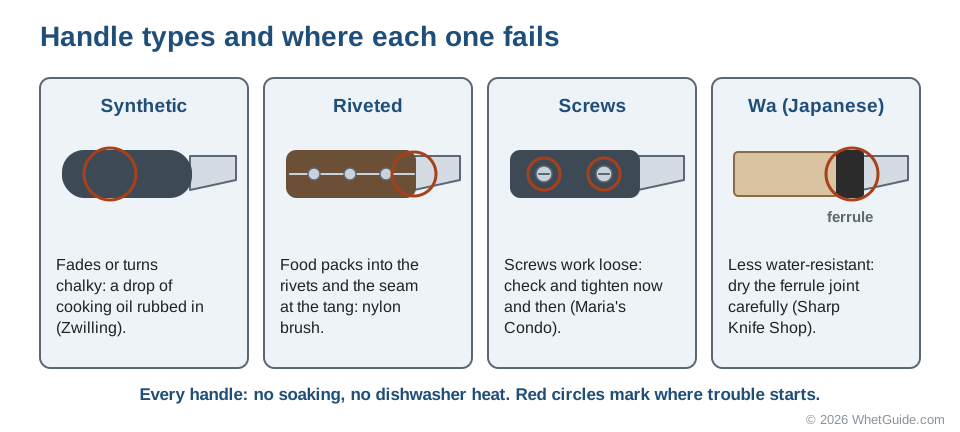
Most handle damage comes from water and heat, which means the dishwasher and the sink.
- Synthetic (polypropylene, POM and similar). Zwilling's distributor says polypropylene handles resist heat, food acids, alcohol and salts. If one fades or turns chalky, Zwilling says a drop of cooking oil rubbed in restores the color.
- Riveted handles: check the rivets and the seam where the scales meet the tang. Food packs in there. A soft nylon brush clears it.
- Handles with screws: Maria's Condo's guide suggests checking handle screws now and then. Tighten them before they work loose.
- Japanese wa handles (octagonal or D-shaped wood, often with a horn or resin ferrule): lighter, and Sharp Knife Shop notes they're less water-resistant than Western full-tang handles. Dry the ferrule joint carefully and never let one sit wet.
Wooden handles
Wood never goes in the dishwasher (Victorinox, Zwilling's distributor) and never soaks. Dry it right after washing. When it starts to look pale or feel dry:
- Make sure the handle is clean and fully dry.
- Rub in a little oil or wax. Victorinox suggests a cooking oil, preferably cold-pressed rapeseed (canola) or linseed, or its own protective wax. Zwilling's distributor names linseed oil or beeswax.
- Let it soak in, then buff off the excess with a dry cloth so the handle isn't slippery.
Do it whenever the wood looks pale or thirsty. A handle that's kept oiled sheds water instead of drinking it.
↑ Back to all sectionsHoning and sharpening: a care calendar
Daily care keeps the knife from getting damaged. Honing and sharpening put back the edge that normal cutting wears down. The calendar below puts the whole routine in one place, with each source's figure.
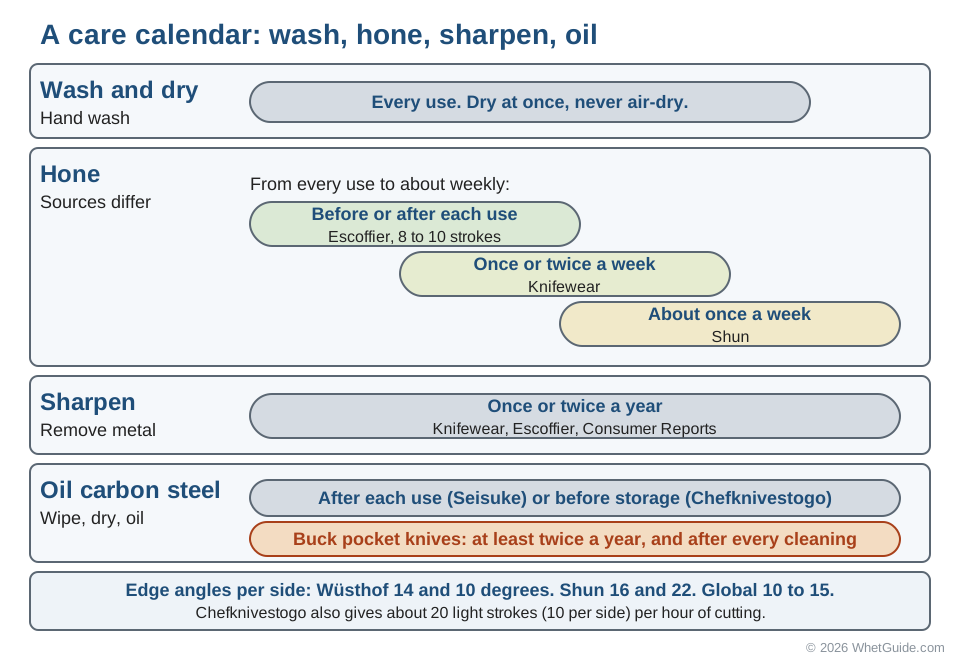
| Task | How often | Source |
|---|---|---|
| Wash and dry | Every use | Every maker |
| Hone | Before or after each use, 8 to 10 strokes total | Escoffier |
| Each time you take the knives out, a handful of strokes per side | Consumer Reports | |
| Once or twice a week | Knifewear | |
| Once a week or so, depending on use | Shun | |
| Hone (heavy use) | About 20 light strokes, 10 per side, per hour of active cutting; about 50 for a deeper session | Chefknivestogo |
| Sharpen | Once or twice a year for a home kitchen | Knifewear, Escoffier, Consumer Reports |
| Oil carbon steel | After each use or before storage | Seisuke, Chefknivestogo |
| Oil a pocket knife | At least twice a year, and after cleaning | Buck |
The honing figures range from every use to once a week. They're all workable. Hone when the knife starts to slip on tomato skin or crush instead of slice, and you'll land somewhere in that range on your own. A busy cook hones more often than someone who cooks twice a week.
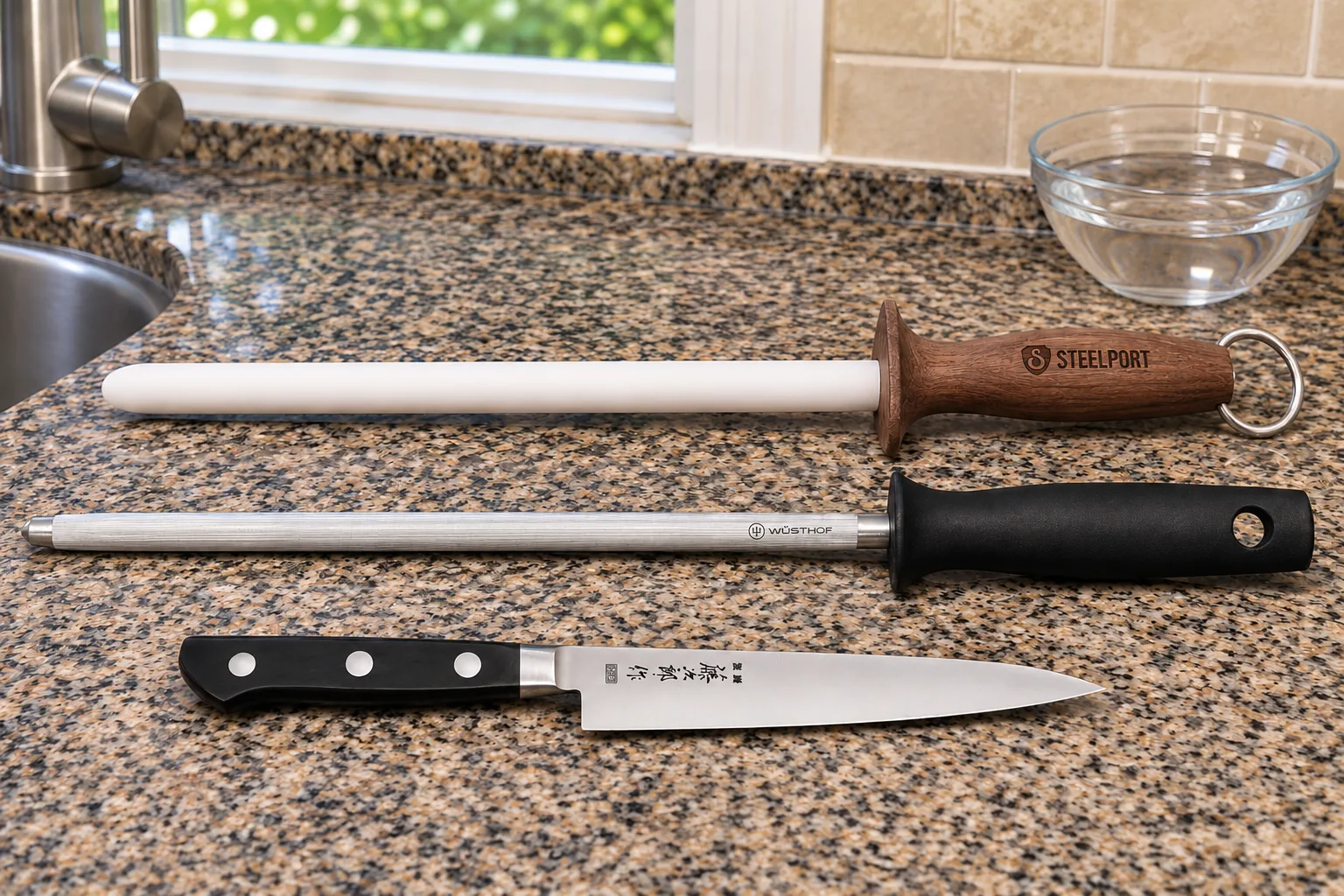
Which rod? It depends on the steel. Chefknivestogo says to use a ceramic rod on fine Japanese edges, because grooved steels and diamond rods can damage them. Shun says to use a honing steel and not to use diamond steels for regular honing, since they remove metal. Global says to use its ceramic or diamond rods, not a traditional steel. Knifewear and Seisuke go further: Japanese steel goes on a whetstone, not a rod or pull-through. Softer German and American knives are what a classic steel was made for. The full comparison is in ceramic vs steel honing rod, and the technique is in how to use a honing rod.
Angles come from the maker. Wusthof lists 14 degrees per side for its standard knives and 10 for its Asian-style blades. Shun lists 16 degrees, and 22 for its Western Cook's Knife. Global sharpens between 10 and 15. Chefknivestogo puts Japanese carbon knives at about 15 degrees and Western knives at 20 to 25. Every brand's figure is on our knife sharpening angle chart.
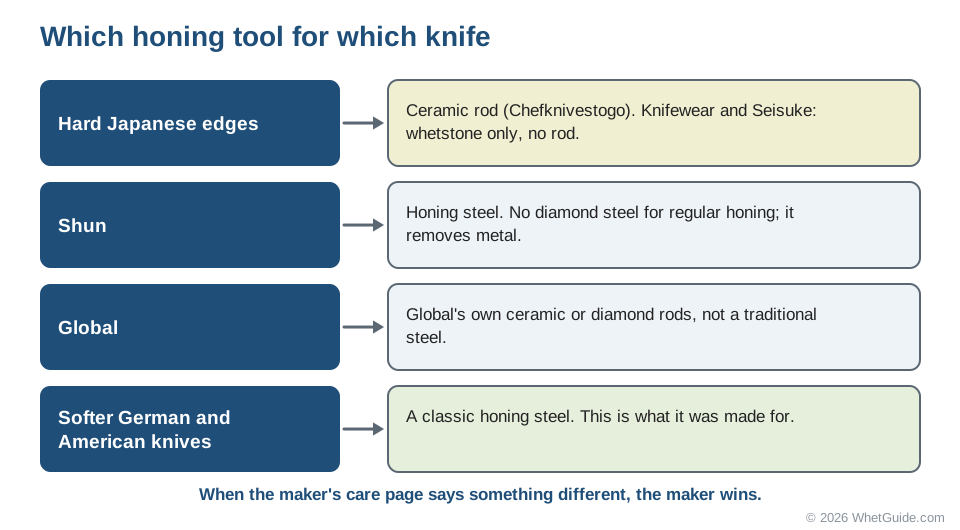
Honing or sharpening: which does your knife need?
Honing pushes a rolled edge back into line and removes almost no metal. Sharpening grinds new bevels to make a new edge. Maria's Condo's guide puts it the same way, and so does every maker's page we read.
| What you notice | What it needs |
|---|---|
| Was sharp last week; now slips on tomato skin | Hone |
| Honing helps for a day, then it's dull again | Sharpen |
| Won't slice printer paper even after honing | Sharpen |
| Bright line or specks along the edge under a light | Sharpen (those are flat, worn spots) |
| Visible chips or a bent tip | Sharpen on a coarse stone, or a service |
| Sharp, but wedges through carrots | Thinning, not sharpening (see thinning) |
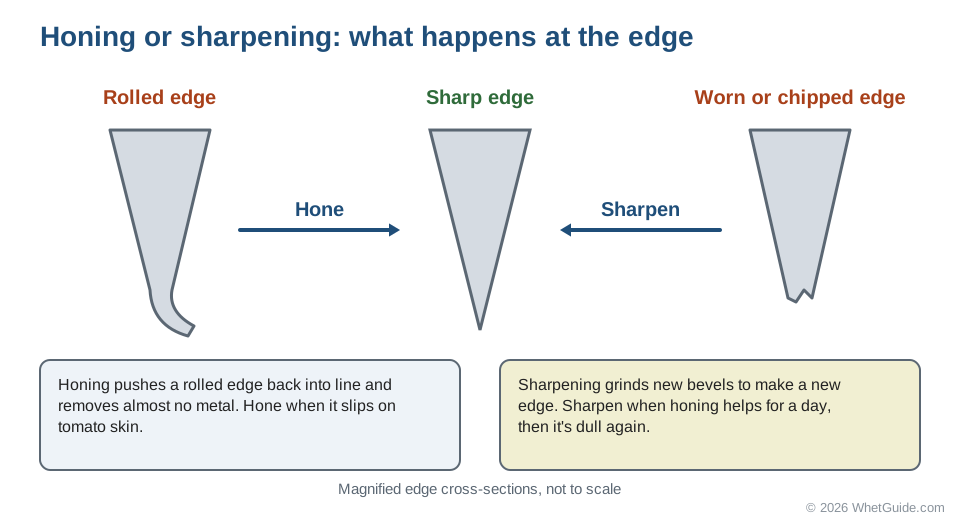
The paper and light tests are explained step by step in our whetstone guide. To sharpen at home, start with how to sharpen kitchen knives or how to use a whetstone; for timing, see how often to sharpen knives.
↑ Back to all sectionsBread and serrated knives
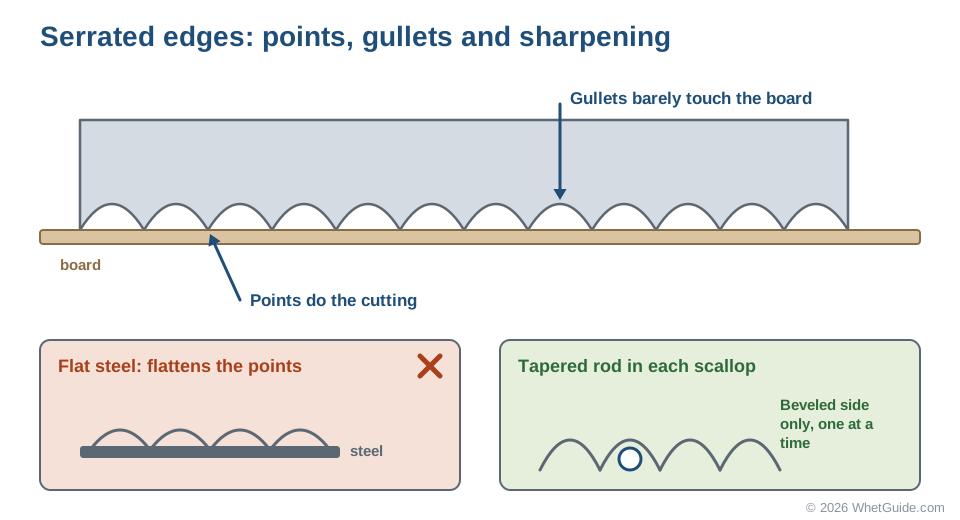
A serrated edge stays sharp a long time because the points do the cutting and the scalloped gullets between them barely touch the board. The care is the same as for any kitchen knife, with three differences.
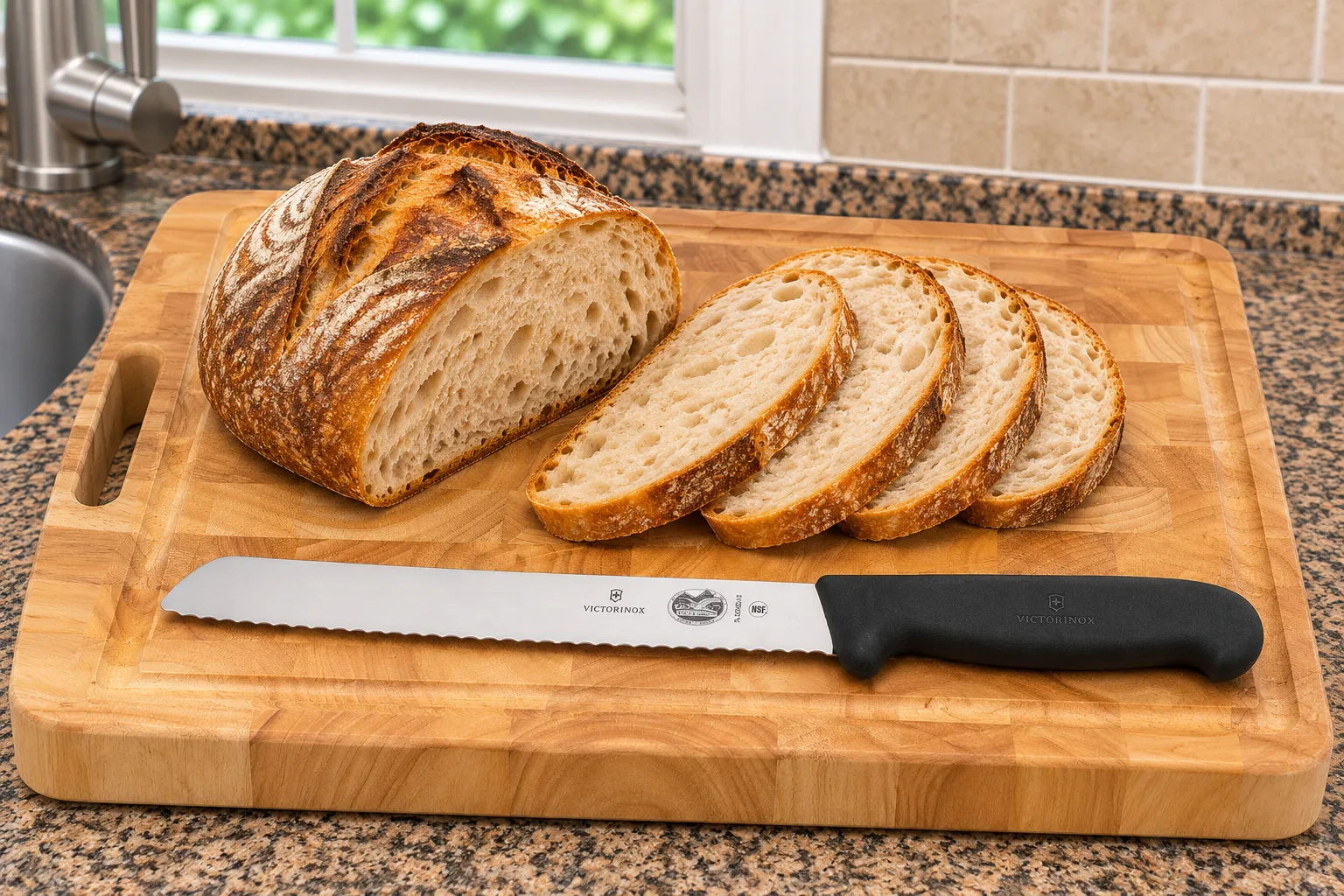
- Wash along the blade from spine to edge, as with any knife, then use a soft brush along the serrations, where crumbs and dough lodge. Don't run a sponge along the teeth.
- Long bread knives don't fit most block slots or drawer trays. A magnetic strip or an edge guard sized to the blade is easiest.
- Never twist the blade to break through a crust or lever a frozen loaf apart. The points chip and the long, thin blade bends.
Honing a serrated knife on a flat steel just flattens the points. When it finally needs work, each scallop is sharpened on its own with a thin tapered or ceramic rod, and only the beveled side is touched. That's covered in how to sharpen a bread knife and how to sharpen a serrated knife.
Utility knives: kitchen utility and box cutters
"Utility knife" means two different tools, and they need different care.
The kitchen utility knife (a petty or utility knife, between a paring knife and a chef's knife) is cared for exactly like a chef's knife: hand wash, dry, wood or plastic board, strip or tray, hone. Its narrow tip is the first thing to break if you pry with it, so don't.
The work utility knife (box cutter, retractable or folding, with replaceable blades) is a different animal. You don't sharpen most of these. You change the blade.
- Change or snap off the blade as soon as it drags or tears cardboard instead of cutting it. A dull utility blade needs more force, and that's when it skips and cuts a hand.
- Retract or fold the blade every time you set the knife down.
- Keep the slide or lock clean. Tape residue, drywall dust and cardboard fibers clog it, and a slide that sticks half-open is a hazard. Blow it out and wipe it with a dry cloth.
- Put a drop of light oil on the slide or pivot now and then, and wipe the excess so it doesn't collect grit. Store the knife dry, where spare blades won't rust.
- Put spent blades in a closed container or a blade bank, not loose in the trash.
OLFA, which makes snap-off utility blades, says dull or carelessly thrown-out blades lead to injury, and that a blade disposal case is the most secure way to retire old ones. It makes pocket cases and wall-mounted ones, such as the slim DC-7, with a slot for snapping off segments straight into the case.
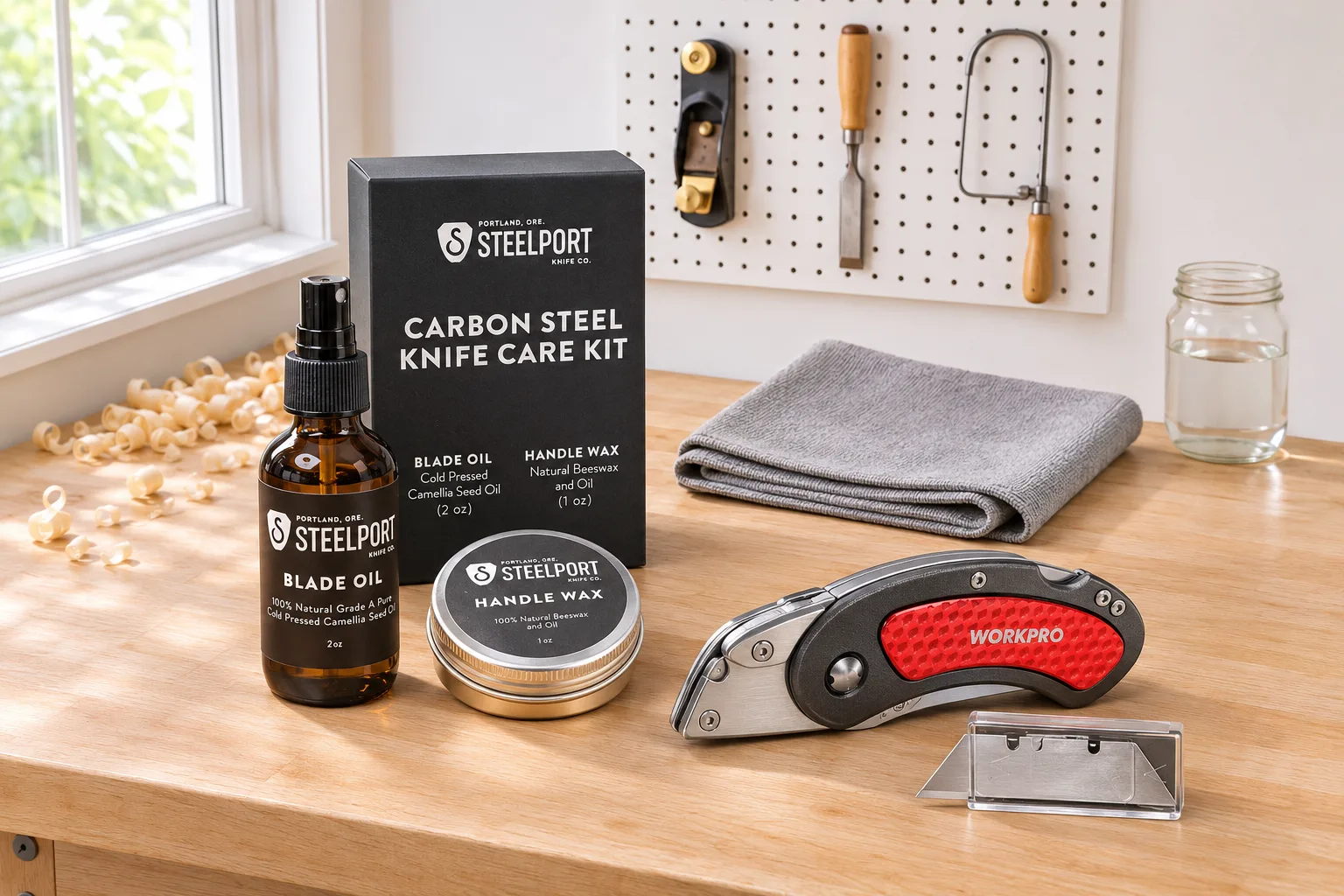
Fixed hobby blades, like a craft knife, follow the same change-the-blade rule. If you'd rather keep yours going, see how to sharpen an X-Acto knife.
↑ Back to all sectionsHunting and survival knives: field to storage
A hunting knife works in blood, fat, wet grass and snow, then often goes back into a leather sheath. That's the worst routine for steel, so the care runs in three stages.
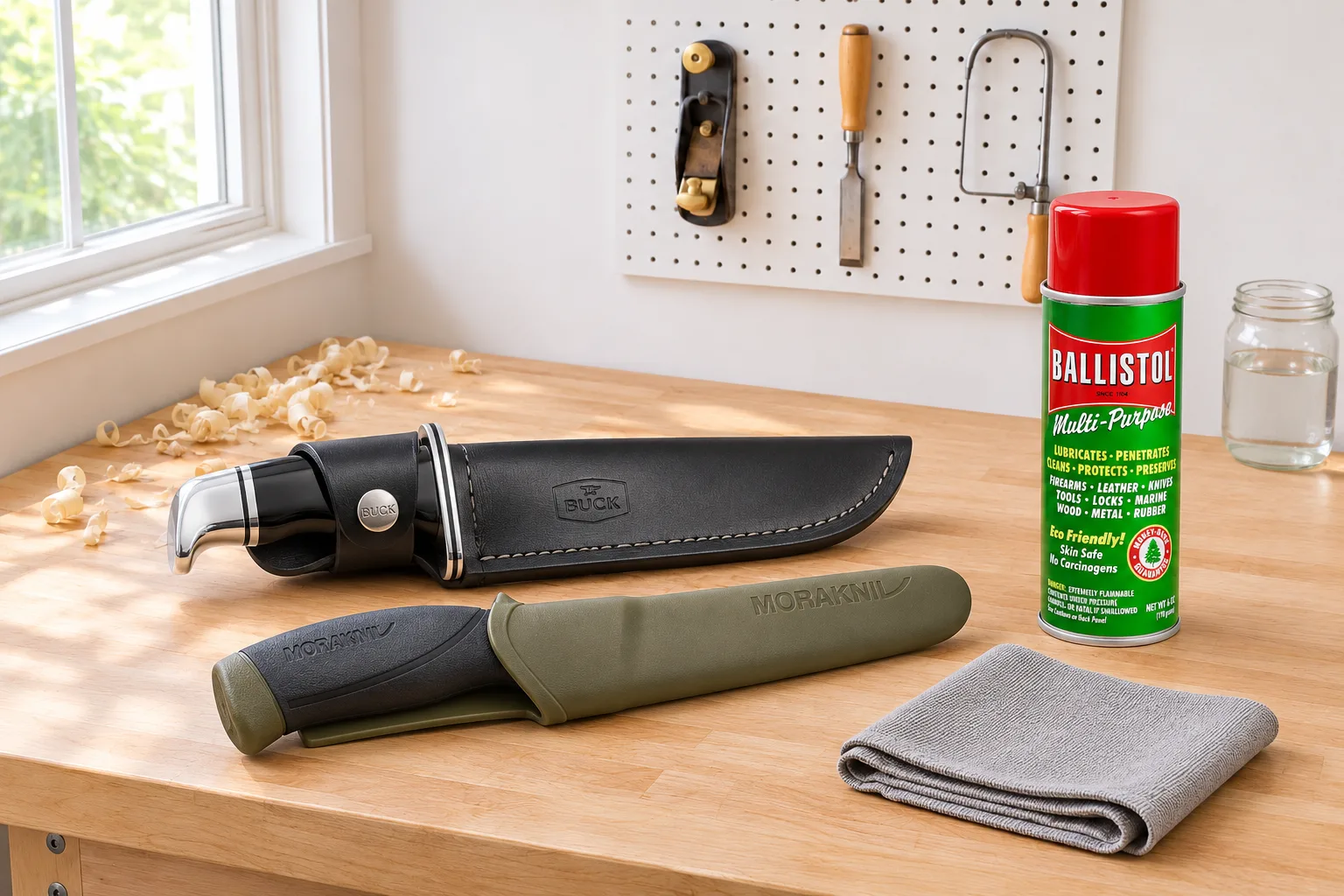
In the field. MeatEater's field guide says to wipe the blade with a clump of wet grass, rinse it with water or snow, and keep the knife sheathed between jobs. Don't wipe blood off on your pants; it dries in the handle joint.
At camp or home.
- Clean it fully the same day. MeatEater says to clean it at camp; Buck says to clean the whole knife, not just the blade.
- Warm water and mild soap, a soft brush around the guard and handle joint. Buck says to avoid immersing a knife and to dry it thoroughly if you do, and to avoid harsh detergents with chlorine.
- Dry the blade, guard and handle completely.
- Wipe on a thin coat of oil (MeatEater). If you'll use the knife on game you're going to eat, use a food-safe oil such as mineral or camellia.
- Let the sheath dry too, open, away from direct heat, before the knife goes back in.
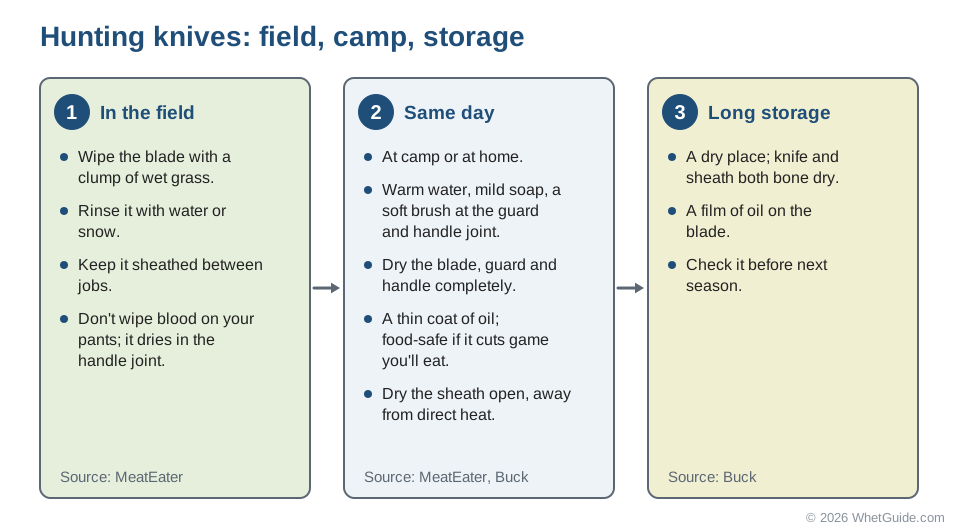
Long storage. Buck says to store knives in a dry place and keep the entire knife dry. A sheath that got wet in the field is the one place on the knife that dries last, so make sure it's bone dry before the knife goes back in for the off-season. A dry knife on a shelf, with a film of oil, is the safe default. Check it before the next season.
Sharpening. MeatEater says to sharpen as soon as cutting performance slips, and to test on paper. The full method is in how to sharpen a hunting knife.
Survival and bushcraft knives get the same care. Many are carbon steel, such as the Morakniv carbon models, so everything in the carbon steel section applies too: wipe, dry, oil, and accept a patina.
↑ Back to all sectionsPocket and folding knives
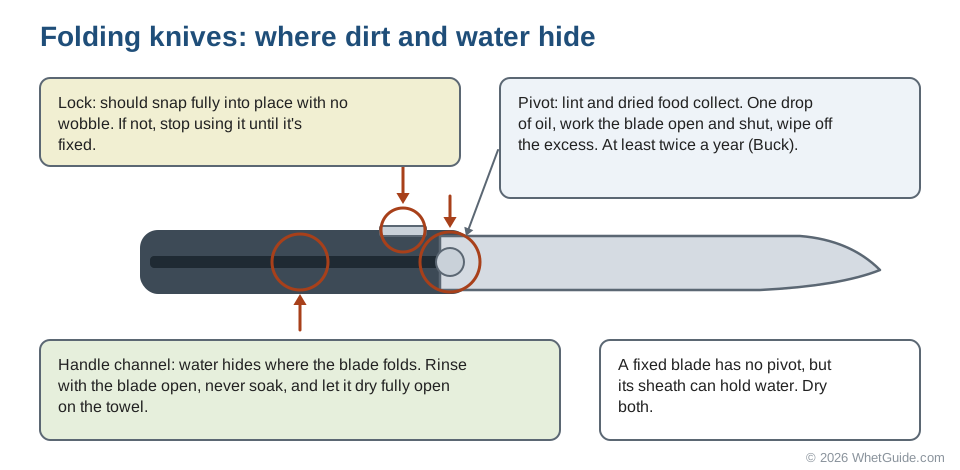
A folding knife has two extra places for trouble: the pivot and the lock. Pocket lint, dust and dried food collect in both, and water hides there.
- Open the knife and wipe the blade, spine to edge.
- Brush out the pivot area and the lock with a soft brush or a cotton swab. Buck says to clean the blade, pivot points and locking mechanism.
- If it's sticky, rinse it under warm water with the blade open, working the blade to flush the pivot. Buck says to avoid immersing it, so rinse rather than soak, and dry it thoroughly.
- Let it dry fully with the blade open.
- Oil the pivot with one drop, work the blade open and shut, and wipe off the excess. Buck says at least twice a year and after every cleaning.
- Check the lock: it should engage fully and not wobble. A lock that doesn't snap into place is a reason to stop using the knife until it's fixed.
Fixed blade vs folding, for care: a fixed blade has no pivot to clean, so it's quicker to wash and dry, but it lives in a sheath that can hold water. A folder lives in a pocket, which is mostly dry but full of lint. Folders with carbon blades, such as the Opinel Carbone, need the same wipe-and-oil habit as any carbon knife. To put the edge back, see how to sharpen a pocket knife.
↑ Back to all sectionsKeeping tool blades from rusting
Chisels, plane irons, axes, pruning shears and garden tools live in garages and sheds, where humidity swings and condensation do the damage. The fix is the same idea as a kitchen knife: clean, dry, and a thin film on the steel.
- Wipe tools clean and dry after use. Sap, soil and sweat hold moisture.
- Put a thin film of oil or wax on bare steel before storage.
- Store edge tools so the edges don't touch each other: a rack, a roll, or blade guards.
Which film? In Fine Woodworking, ship's carpenter Paul Schurch reported on rust preventers he used on his tools over nine months at sea. Camellia oil protected best; 3-in-One, WD-40, LPS-1 and LPS-2 turned sticky and smelly. That's one craftsman's experience, not a lab test, but it's a real-world one in a harsh place. Paste wax is the other common choice among woodworkers, rubbed on thin and buffed off.
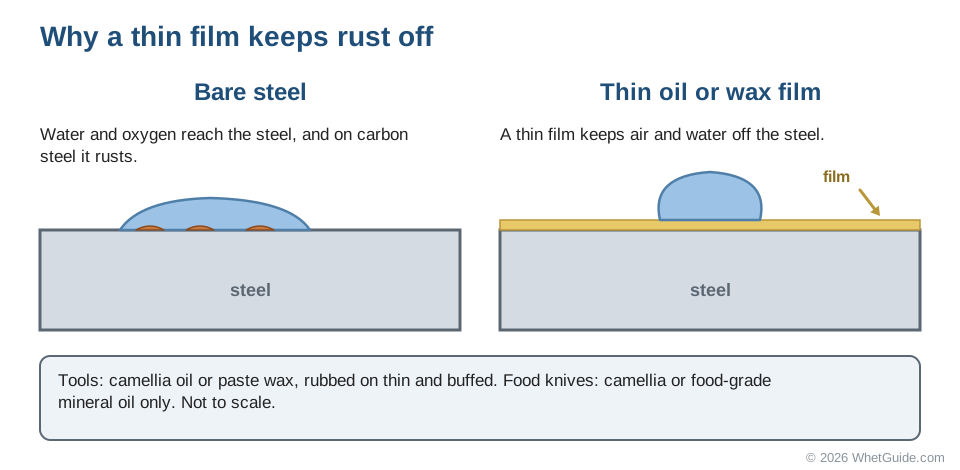
The old tip about rubbing lip balm on a blade to keep it rust-free rests on the same idea: a thin, water-repelling film. Camellia oil or paste wax is the tool-grade version, and doesn't leave a sticky coat that grabs sawdust.
If rust has already set in on a tool, WD-40's own guide says its Multi-Use Product loosens and dissolves rust so sandpaper or a wire brush can take it off. Keep that for tools. On a food knife, check the can's label first and use the rust ladder instead.
Sharpening guides for the tools themselves: chisels, axes and pruning shears.
↑ Back to all sectionsKnife anatomy: where care problems start
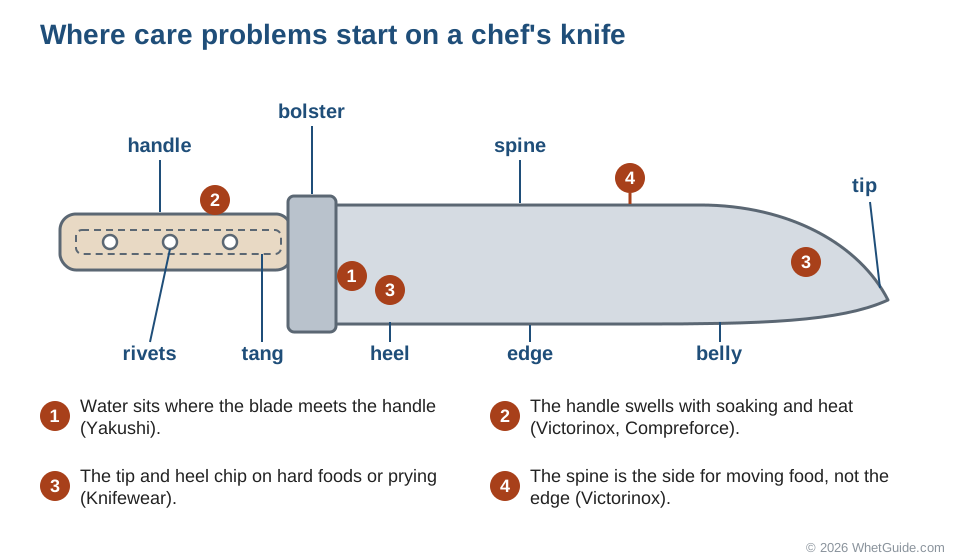
The parts of a knife each have their own way of going wrong. Knowing the names makes the rest of this page easier to use.
| Part | What it is | Care note |
|---|---|---|
| Tip | The point, used for fine work | Breaks first when you pry. Knifewear names tip and heel chipping on hard foods. |
| Edge | The sharpened cutting line | Never let it touch anything but food and the board. |
| Belly | The curved part of the edge near the tip | Does the rocking cuts; dulls first on hard boards. |
| Heel | The back end of the edge, near the handle | For heavier cuts. Chips if you chop bone. |
| Spine | The thick, unsharpened top | The side for scraping food off the board (Victorinox). |
| Bolster | The thick steel ring between blade and handle on forged knives | Food and water collect around it. Brush it. |
| Tang | The part of the blade that runs into the handle | Water that gets under the handle rusts it out of sight. |
| Rivets and scales | The pins and the two handle halves | Gaps here mean water is getting in. |
| Handle | Wood, synthetic or composite | Swells with soaking and heat (Victorinox, Zwilling's distributor). |
Japanese wa-handled knives have no bolster. Instead, a ferrule (a collar of horn, wood or resin) caps the end of the handle where the blade goes in. That joint is the one to dry carefully.
↑ Back to all sectionsStainless, carbon and ceramic: why each needs different care
How much care a knife needs comes down to its steel.
| Blade | Rust risk | Daily care | Oil? | Hone with |
|---|---|---|---|---|
| Western stainless (German, American, Swiss) | Low, not zero | Wash, dry | No | Steel or ceramic rod |
| Hard Japanese stainless | Low | Wash, dry; no twisting | No | Ceramic rod or fine stone |
| Carbon steel | High | Wipe during use, wash, dry | Yes | Ceramic rod or stone |
| Stainless-clad carbon | High at the edge | Treat the edge like carbon | A film on the edge | Ceramic rod or stone |
| Damascus or layered | Set by the core steel | Wash, dry | A little (Made In) | Same as its core |
| Ceramic | None | Wash, dry; no twisting, no hard boards | No | Diamond only; see ceramic knives |
Damascus or layered blades follow their core. The pattern is the cladding, and the cutting edge is the core steel, so care for it as that steel. Made In says its Damascus knife, with a VG-10 core, is more prone to rust than its other stainless blades because of the higher carbon. Its routine: wash by hand in warm soapy water, skip steel wool and chloride cleaners, dry with a soft towel, and buff in a little mineral oil along the grain. Never the dishwasher.
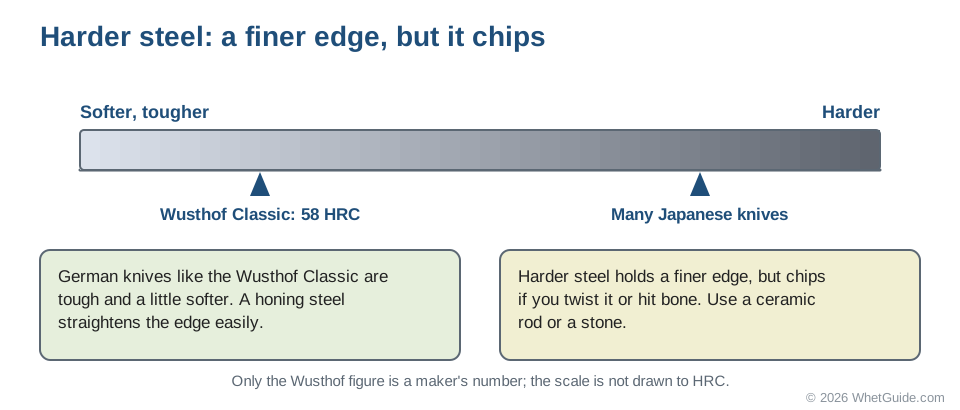
Hardness changes the care too. Wusthof lists its Classic chef's knife at 58 HRC. German knives like it are tough and a little softer, so a steel straightens them easily. Many Japanese knives are harder, which holds a finer edge but chips if you twist it or hit bone. That's why Japanese makers and shops push ceramic rods and stones over steels.
Why stainless resists rust (and why it still spots)
Every stainless steel contains at least 10.5% chromium, according to Eurofer, the European steel association. The chromium forms a passive layer on the surface that Eurofer describes as very thin, 2 to 3 nanometers. That film keeps water and oxygen off the iron underneath.
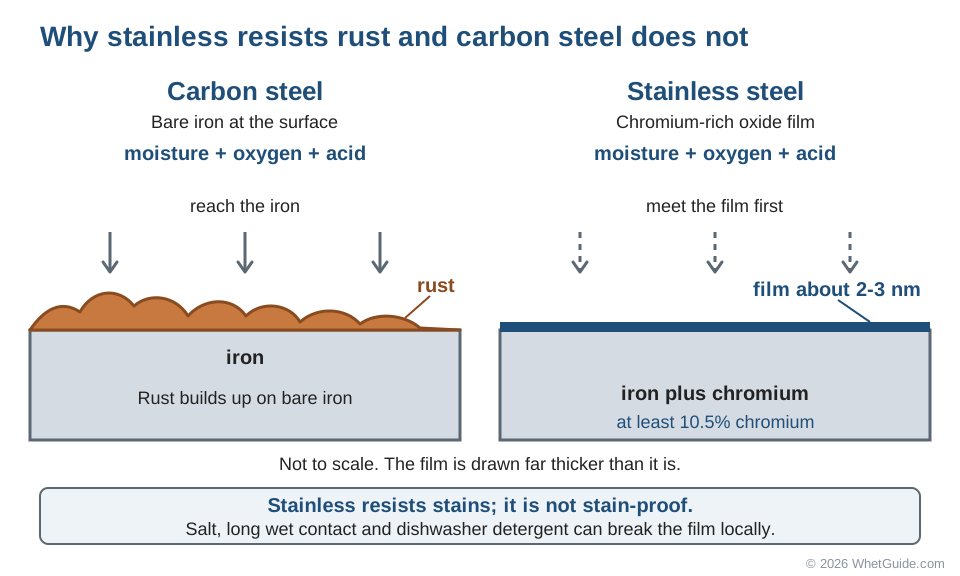
A film that thin can be broken locally. Salt, acids left sitting on the blade, harsh dishwasher detergent and long wet contact all attack it, which is where spots and pits come from. Shun's warning about citrus detergents pitting its blades is this effect. Carbon steel has too little chromium to form the film at all, so its surface is bare iron and carbon, and only patina, oil and drying protect it.
↑ Back to all sectionsCommon mistakes and fixes
| Mistake | What it does | Fix |
|---|---|---|
| Knives in the dishwasher | Dulls, spots and pits the blade; cracks wooden handles | Hand wash. If the maker allows the machine, follow its conditions. |
| Leaving a knife in the sink | Rust, stains, swollen handle; a cut for the next person; IKEA warns heavy pots and pans can dent it | Wash and dry it as soon as you finish cutting. |
| Soaking to loosen food | Water into the handle, acid on the blade | Rinse right away; nylon brush for stuck food. |
| Air-drying in a rack | Limescale spots, water at the handle joint | Towel dry, then put it away. |
| Cutting on glass, stone or a plate | Folds and chips the edge on every cut | Wood, soft rubber or plastic only. |
| Scraping food with the edge | Rolls the edge flat | Flip the knife and use the spine. |
| Loose in a drawer | Dull and chipped edges; cut fingers | In-drawer tray or a guard on every blade. |
| Edge-down in a slotted block | Dulled after 70 strokes in Cook's Illustrated's test | Store it on the spine, edge up. |
| Wet knife into a block, guard or sheath | Rust you can't see | Dry first, always. |
| Leaving acidic food on carbon steel | Fast dark staining; rust spots | Wipe after each acidic ingredient. |
| Scrubbing a patina off every time | Bare steel that rusts faster | Leave gray, blue and brown alone; remove only orange. |
| Vegetable oil for storage | A gummy film over time | Camellia or food-grade mineral oil. |
| Prying, twisting, opening packages | Snapped tips, chipped heels | Use scissors or a utility knife for packages. |
| Honing a hard Japanese knife on a grooved steel | Chips the edge | Ceramic rod or a fine stone. |
Knife care cheat sheet
The whole routine on one card. Screenshot it for the kitchen, or print it.
| Every use | Rinse right away. Warm water, mild soap, soft sponge, spine to edge, edge away from you. Towel dry at once, handle joint too. Put it away. No soaking, no sink, no dishwasher. |
|---|---|
| Boards | Wood, soft rubber or plastic. Never glass, stone, ceramic, metal or a plate. Scrape with the spine. |
| Storage | Nothing touches the edge. Strip (spine on first, roll it on), block spine-down, drawer tray, or a guard. Never loose. Dry before it goes in. |
| Carbon steel | Wipe during use and after acids. Thin film of camellia or food-grade mineral oil before it sits. Gray, blue, brown = patina, leave it. Orange = rust, remove it. |
| Rust | Gentlest first: oil and rag, baking soda paste, Bar Keepers Friend (1 minute max, rinse, never with bleach), rust eraser (light, one direction). Dry and oil after. |
| Hone | Every use to about weekly. Ceramic rod for hard Japanese knives. Angle: maker's figure (Wusthof 14, Shun 16, Global 10 to 15 per side). |
| Sharpen | When honing stops working; about once or twice a year at home. |
| Now and then | Handle gaps, loose rivets or screws, dry wood (oil it), rust at the handle joint, chips. Folders: clean and oil the pivot, check the lock. |
| Outdoor | Field: wet grass, water or snow, keep sheathed. Home: wash, dry, thin oil, dry the sheath. Store it somewhere dry, knife and sheath both dry. |
If the edge is the problem
Good care slows dulling; it doesn't stop it. When the knife needs more than a wash and a hone, these guides take over: how to use a honing rod, how to sharpen kitchen knives, how to use a whetstone, and how to strop a knife. If you'd rather hand it off, what knife sharpening costs compares the options, including mail-in services.
Sources: Eurofer, Stainless and specialty steel (10.5% chromium minimum; 2 to 3 nm passive layer); Zwilling, Use and care: knives (55°C dishwasher limit for its special-formula steel, storage, handle discoloration); Compreforce, Zwilling's distributor, Cleaning and care for knives (dishwasher hazards, handle care); Wusthof, How to clean your Wusthof knives and Classic cook's knife (angles, 58 HRC); Shun, FAQ; Victorinox, Knife care tips; Global, Knife care; Buck Knives, Knife care; Bar Keepers Friend, FAQ; US eCFR, 21 CFR 172.878; Cook's Illustrated, Knife storage; Chefknivestogo, Carbon steel care guide; Sharp Knife Shop, The definitive guide to knife maintenance; Knifewear, Care; Escoffier, How to sharpen your knife; Seisuke, Knife care guide; MTC Kitchen, How to care for your knife; Consumer Reports, How to care for kitchen knives; Reviewed, How to care for your kitchen knives; Yakushi, How to clean a knife and FAQ; Maria's Condo, Ultimate guide to knife maintenance; Great Eastern Cutlery, Caring for carbon; MeatEater, Field care tips for hunting knives; Fine Woodworking, Camellia oil outscores other rust preventers; Knife Planet, 5 essential ways to fight rust (archived 2020); Cutco, How to wash knives safely; US FDA, Safe food handling; IKEA, How to care for your knife and KUNGSFORS magnetic knife rack; Williams-Sonoma, Magnetic knife bar mounting instructions; Knifewear, How to install magnetic knife racks on drywall and tile; Knife Planet, The 6 best magnetic knife holders (archived); America's Test Kitchen, Do I really need to clean my knife block?; OLFA, Proper tool usage and DC-7 blade disposal case; WD-40, Rust repair for hand tools; Made In, Does Damascus steel rust?. All read November 14, 2026. Where sources disagree, the page says so and names them. How we research