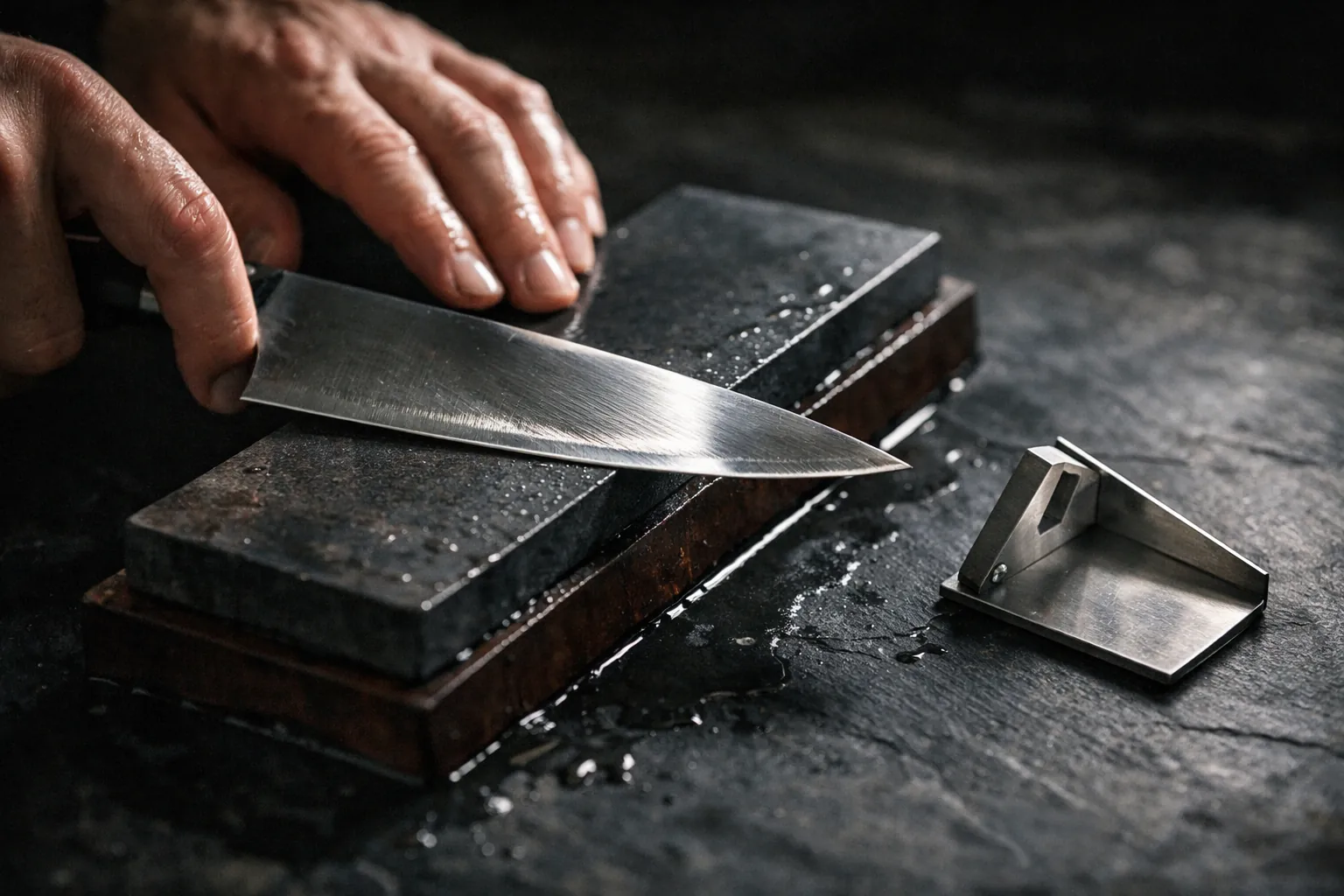
Quick answer: three numbers and one rule
Most kitchen knives are sharpened between 15 and 20 degrees per side: many Japanese knives around 15° (some lower), many Western and German knives around 20°. Pocket and hunting knives tend to sit around 20 to 25°, and choppers like cleavers go higher still. Treat these as starting points. Your knife maker's number beats any chart, and if you can't find one, match the bevel that's already on the blade. A one-page sheet by brand further down prints or saves as a PDF.
| If your knife is | Start at (per side) | Inclusive | Jump to |
|---|---|---|---|
| Japanese kitchen (gyuto, santoku, petty) | About 15° | 30° | Japanese knives |
| Western or German kitchen | About 20° (newer lines 14.5–15°) | 40° | Brand table |
| Pocket, hunting, camp | About 20–25° | 40–50° | Angle by job |
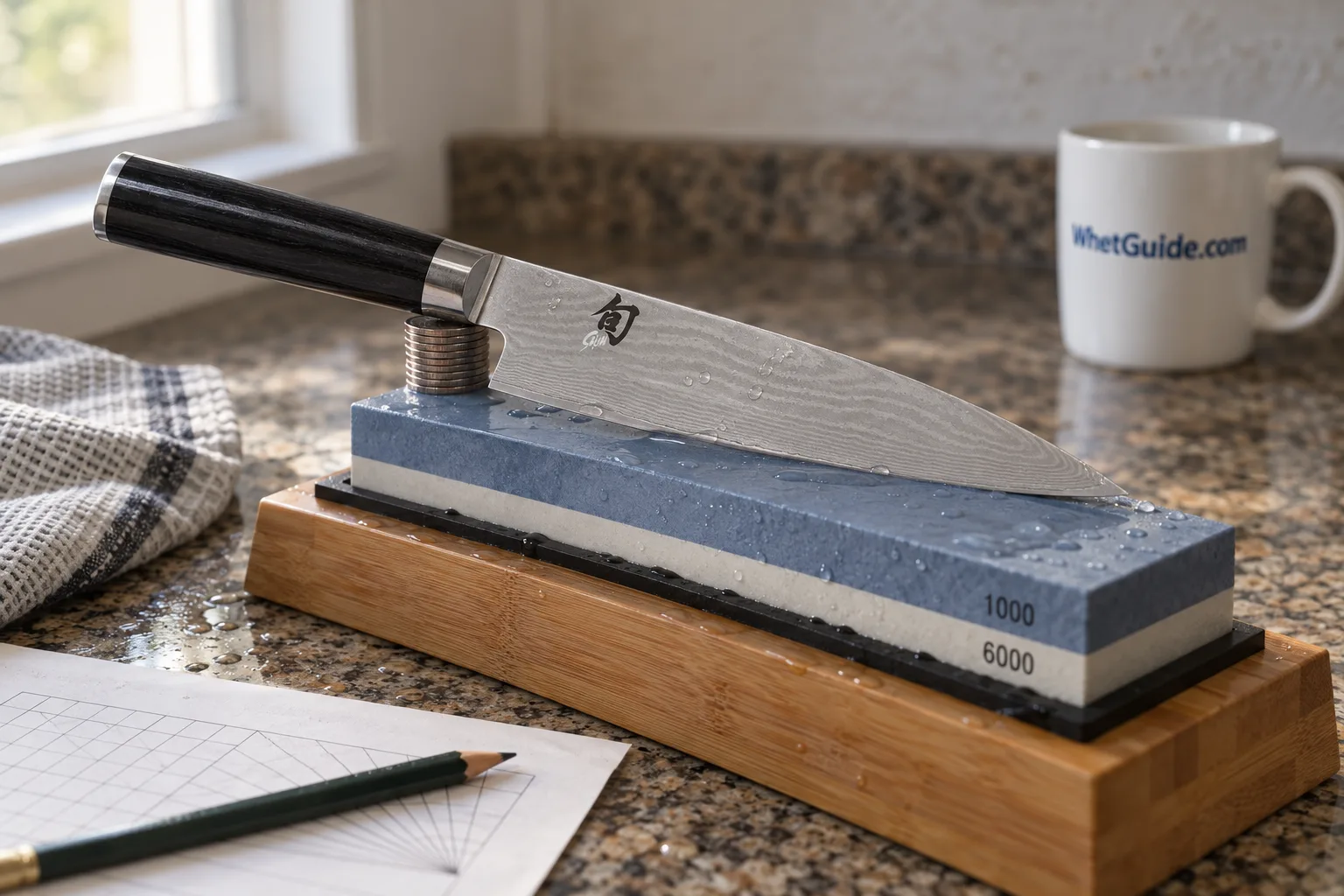
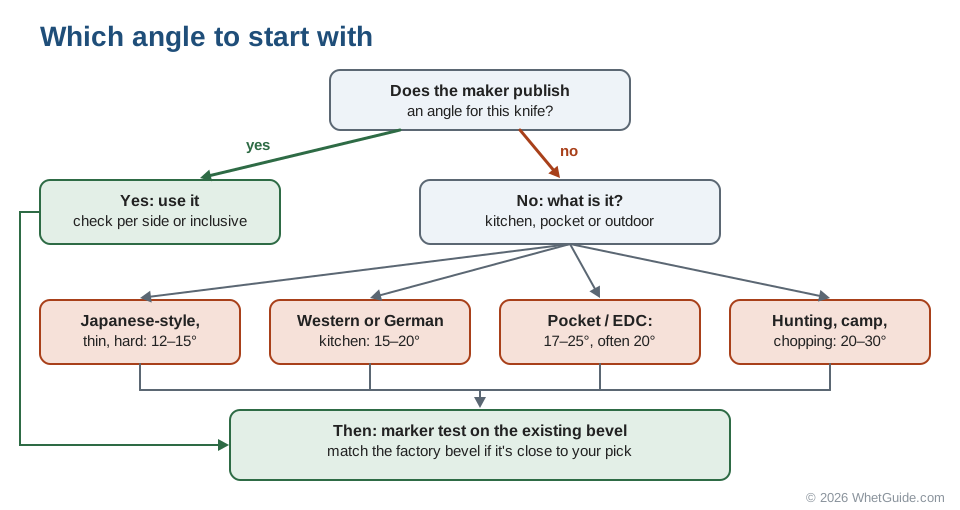
The one rule: before you pick a number, check what's already on the knife. Grinding a new angle onto a good factory edge wastes steel and an evening. The marker test takes a minute and tells you whether your chosen number matches the bevel you have.
What is the best knife sharpening angle?
No one number wins for every blade, but each knife has a best one. A thin, hard Japanese kitchen knife does well at about 15° per side, which is as keen as the steel will hold. A softer German chef's knife wants 20°, a little blunter at the start and far tougher against bones and the board. Own both kinds and want a single setting? Seventeen degrees per side is a workable middle.
Going lower than your maker's number mostly buys you chips. Going higher costs you cutting ease from day one. If a guided tool would take the guesswork out, the best knife sharpener for kitchen knives guide covers the ones that hold a set angle.
↑ Back to all sectionsKnife sharpening angle chart by knife type
Angles are per side unless noted. The ranges reflect well-established practice, and individual makers vary.
| Knife type | Common angle per side | Inclusive (total) | Notes |
|---|---|---|---|
| Japanese kitchen (gyuto, santoku, petty, nakiri) | About 12°–15° | 24°–30° | Hard, thin steel supports a fine edge. Many makers quote around 15°. |
| Japanese single-bevel (yanagiba, deba, usuba) | Bevel on one side only | Varies | Follow the existing bevel; the flat back is only polished, not beveled. Details under single-bevel knives. |
| Western / German chef's knife | About 20° | 40° | Traditional German edge. Some newer lines are closer to 15°, so check the maker. |
| Paring and utility knives | About 15°–20° | 30°–40° | Match the rest of your set. |
| Kitchen fillet and boning knives | About 12°–17° | 24°–34° | Thin, flexible blades for clean slicing. Hard Japanese slicers sit at the low end; Made In gives 12.5° for its own kitchen fillet knife. |
| Outdoor fillet knives (soft stainless) | About 17°–20° | 34°–40° | Soft steel such as AFTCO's 4116 (56–58 HRC) rolls at thin angles, and Wicked Edge recommends 20°–25° for fillet knives. Method: how to sharpen a fillet knife. |
| Serrated (bread) knives | Follow the scallops' bevel | n/a | Usually beveled on one side; sharpen each scallop with a tapered rod. |
| Pocket / EDC knives | About 17°–25° (often ~20°) | 34°–50° | Lower for slicing, higher for rough use. |
| Hunting and outdoor knives | About 20°–25° | 40°–50° | Durability counts for more than ultimate sharpness. |
| Cleavers, machetes, axes | About 25°–30° or more | 50°–60°+ | Chopping tools need a thick, strong edge. |
Read the chart as a band, not a single line. Two knives of the same type can sit five degrees apart because one maker uses harder steel or a thinner grind. When your knife falls between two rows, pick the row that matches how you use it, then let the marker test have the last word.
↑ Back to all sectionsPer side vs inclusive: the confusion that ruins edges
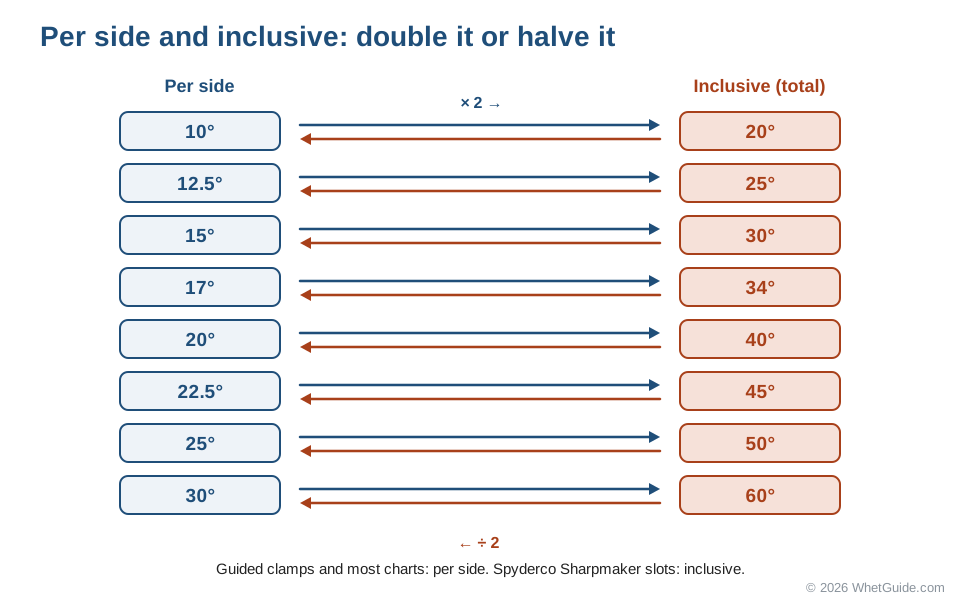
An edge has two bevels. The per-side angle is measured from the center line of the blade to one bevel. The inclusive angle is the total of both sides. A "20-degree knife" almost always means 20° per side, or 40° inclusive. Knivesandtools does the same arithmetic with a 17-degree example, which gives a 34-degree total edge.
Get this wrong and you'll know. Set a per-side tool to 40° because you thought it meant the total, and you grind a blunt 80° wedge. The manual says which convention your sharpener uses; check it once and write it on the box.
Some makers write neither. Global's knife care page says its knives are factory sharpened between 10 and 15 degrees and stops there. Morakniv, on the other hand, says 27 degrees and calls it the total angle, which is 13.5 per side. The brand table below has a column that says which convention each maker uses, and where the page is silent, how we read it.
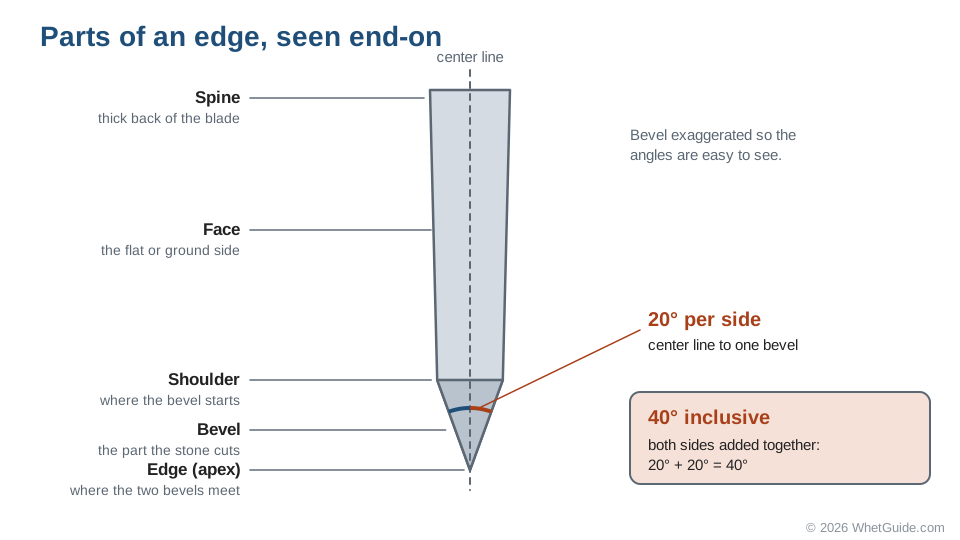
The parts of the edge have names too, and the rest of this page uses them. The shoulder is where the bevel meets the face of the blade. The apex is the line where the two bevels meet. When the marker test says "ink gone at the shoulder," this is the line it means.
↑ Back to all sectionsKitchen knife sharpening angle, and other knife types
The chart gives the numbers. This section gives the reasons, because once you know why a fillet knife sits low and a hatchet sits high, you can place any knife the chart forgot.
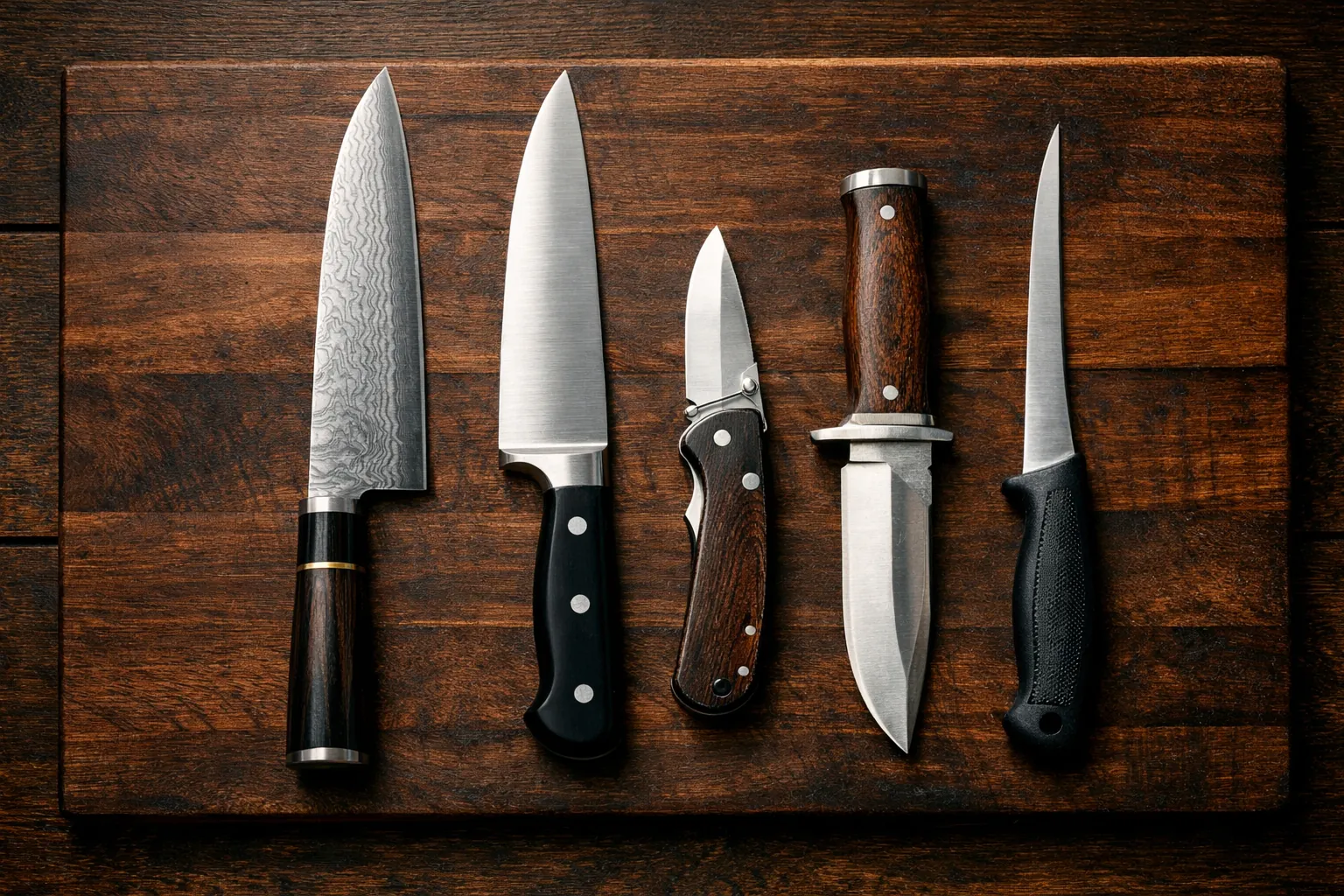
Japanese kitchen knives: 12 to 15 degrees
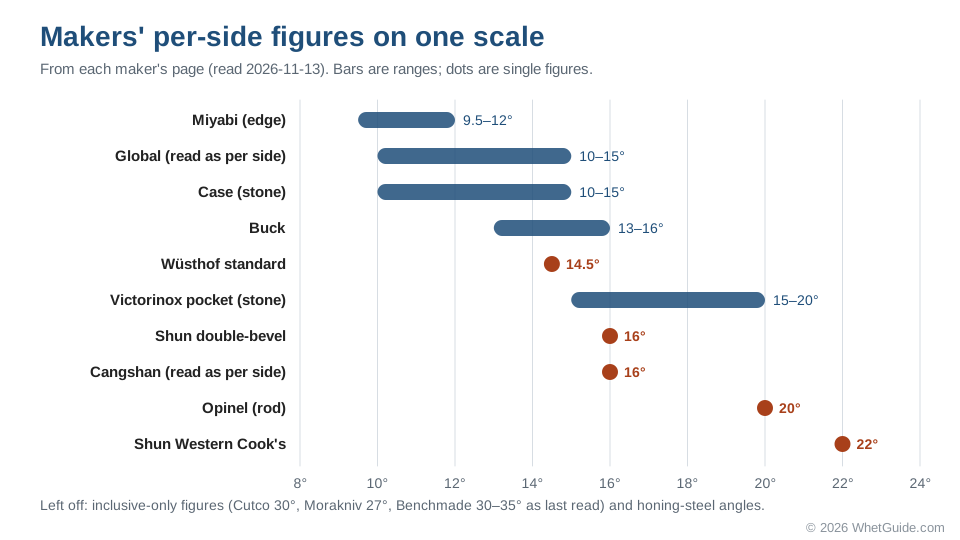
Japanese gyuto and santoku knives, along with petties and nakiris, are usually ground thin and hardened high. That lets the edge stay at a low angle without folding over. Shun's FAQ gives 16° per side for its double-bevel knives, Miyabi's page gives 9.5 to 12°, and Global says 10 to 15°. So "Japanese" covers a wide band, and the maker's number is worth looking up.
The trade is chipping. A thin, hard edge doesn't bend; it breaks. Twisting the blade in a squash, hitting a chicken bone or chopping on a glass board takes small chips out of it. If yours chips often, a degree or two more, or a micro-bevel, fixes it without giving up much.
Western and German kitchen knives: 15 to 20 degrees
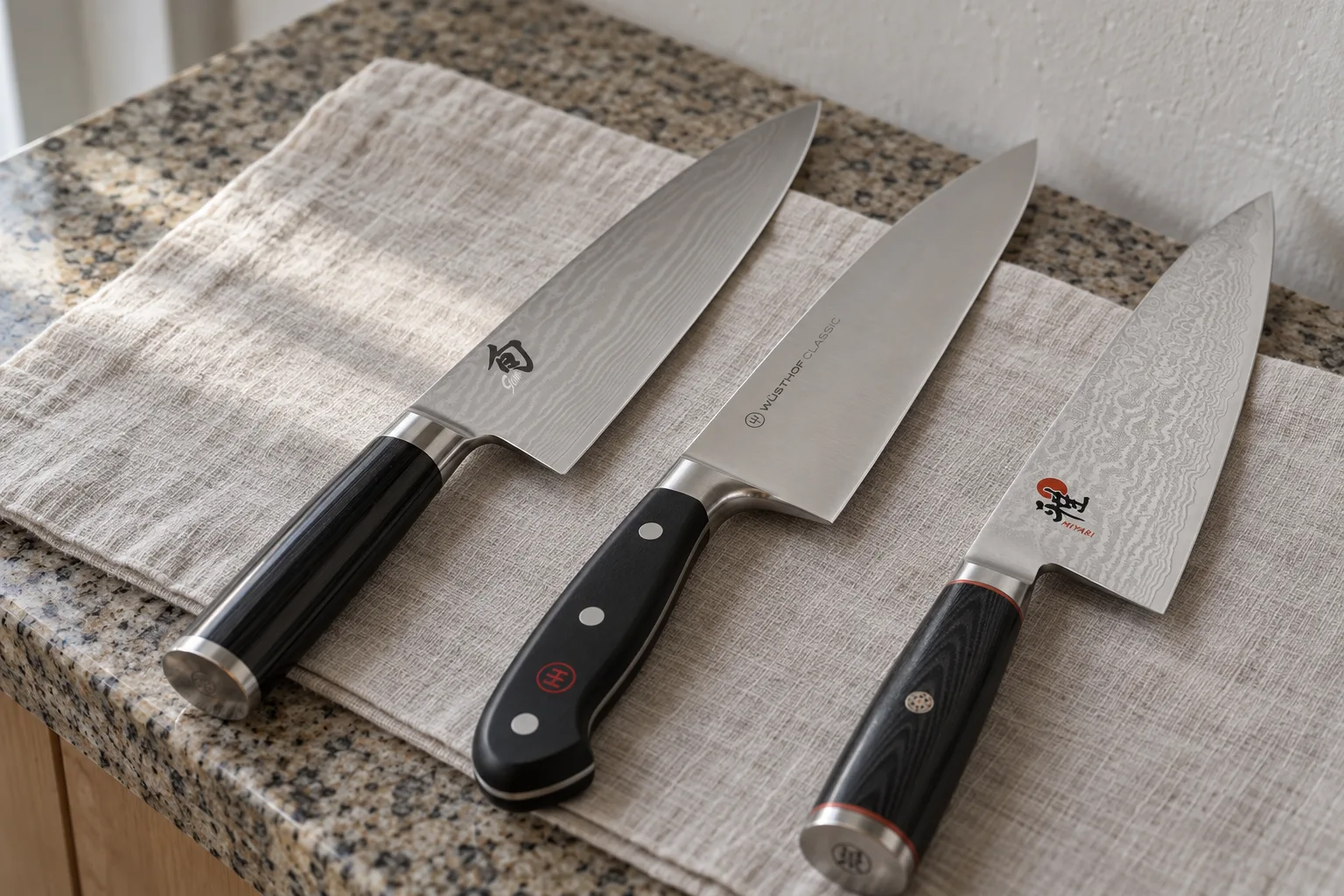
The classic German edge was about 20° per side on softer stainless steel. That's still a sound default for an older Henckels, a Victorinox Fibrox or a knife of unknown make. Wüsthof has moved its standard blades to 14.5° per side, though. Zwilling's honing guidance is 15° for its German knives. A recent German knife may be closer to a Japanese angle than the old rule suggests. Softer steel is why the old default sat higher. A thin edge on soft steel rolls sideways on a cutting board and needs honing back straight; at 20° there's more steel behind the apex to resist that.
Paring, utility, fillet and boning knives
- Paring and utility knives do fine work in the hand and rarely meet bone, so 15 to 20° covers them. Match the rest of your set so one setting does every knife in the block.
- Kitchen fillet and boning knives go lower, about 12 to 17°, because they slice soft flesh.
- Outdoor fillet knives in soft stainless steel are the exception: AFTCO's 4116 steel (56 to 58 HRC) rolls at thin angles, and Wicked Edge recommends 20 to 25° for fillet knives.
Pocket, hunting and outdoor knives: 17 to 25 degrees
A pocket knife opens boxes and cuts the odd zip tie, often on whatever surface is around. Around 20° per side handles that mix. Buck's own page gives 13 to 16° per side for its knives, and Opinel says 20° to the rod, so the makers spread out more than the chart does. Hunting and camp knives go to 20 to 25° because they meet bone and grit, and you can't sharpen properly in the field. Fixed blades used for batoning or prying go higher still. A thin edge that skins cleanly will roll the first time it splits a branch, so if one knife does both jobs, sharpen for the harder one.
Cleavers, machetes and axes: 25 degrees and up
Chopping tools land with force, so they need a thick wedge. Sharpening Supplies' bevel chart puts cleavers at 25 to 30°, and Council Tool's axe page gives 25° on a slightly convex edge. A Chinese vegetable cleaver is the exception: it's a thin slicer shaped like a cleaver, and it takes a kitchen angle. Machetes and axes are separate topics: how to sharpen a machete and axe sharpening angles.
Razors, craft blades, scissors and chisels
- Razors sit at the low end because they never chop. Sharpening Supplies puts razor blades and X-Acto knives at 7 to 12°. A straight razor's angle comes from its spine resting on the hone, so you don't set it.
- Craft blades are usually cheaper to replace than to sharpen, though sharpening an X-Acto knife works in a pinch.
- Scissors are single-bevel, measured from the flat side, and their bevels are much steeper than knife edges because the two blades shear past each other. Follow the existing bevel; sharpening scissors on a whetstone walks through it.
- Chisels and plane irons are single-bevel too and have their own angle conventions, covered in how to sharpen a chisel.
Sharpening angles by brand, from the makers
Every figure in this table comes from the maker's own page, linked in the last column. The "per side or inclusive" column repeats what the maker says. Where the page doesn't say, the cell says so, and adds how we read it when the instructions make that clear.
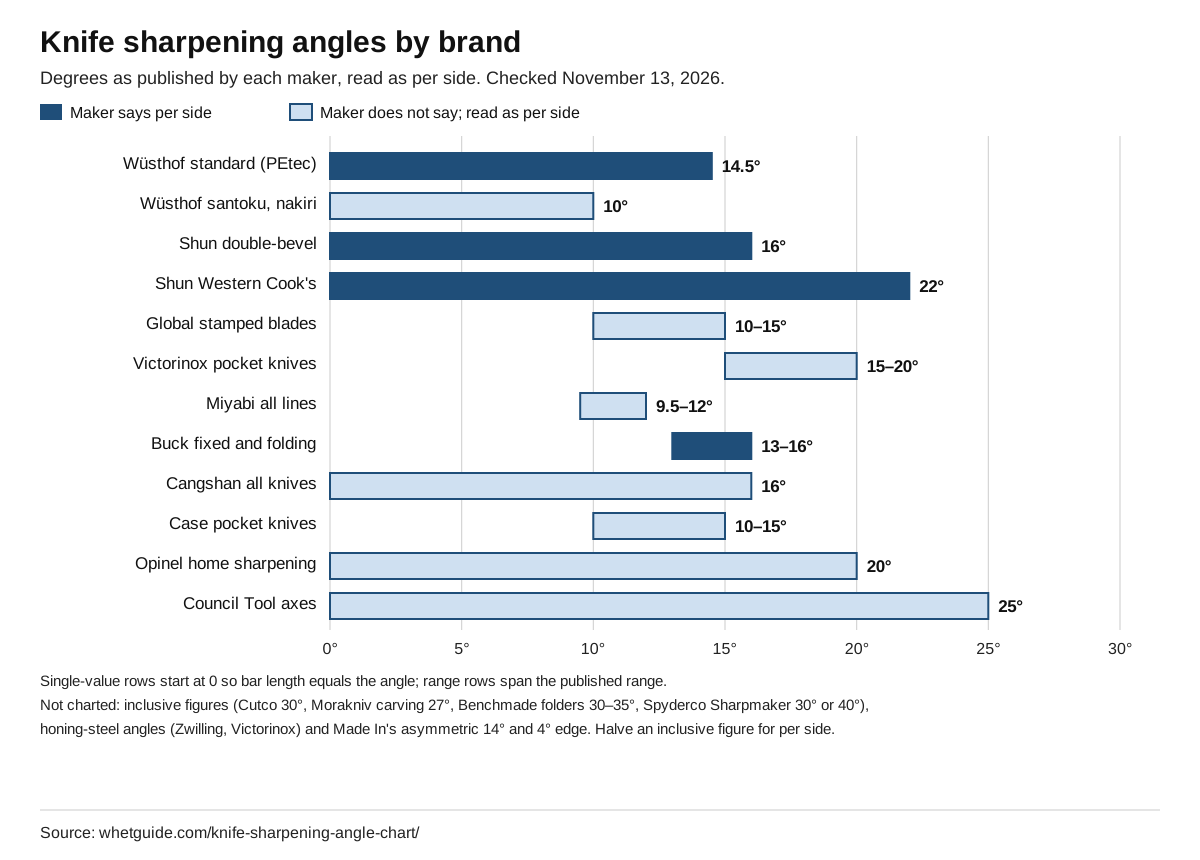
| Brand | Line | Angle | Per side or inclusive | Source |
|---|---|---|---|---|
| Wüsthof | PEtec standard blades | 14.5° | Per side (stated) | Wüsthof PEtec article |
| Wüsthof | Standard blades, whetstone how-to | 14.5° | Not stated; per side by the steps | Wüsthof how-to-sharpen article |
| Wüsthof | Asian-style blades (santoku, nakiri), honing-steel step | 10° | Not stated; read as per side | Wüsthof how-to-sharpen article |
| Shun | Double-bevel knives | 16° | Per side (stated) | Shun FAQ |
| Shun | Western Cook's Knife | 22° | Per side (stated) | Shun FAQ |
| Global | Stamped blades, factory edge | 10–15° | Not stated; read as per side | Global Cutlery USA knife care page |
| Victorinox | Swiss Army pocket knives, stone | 15–20° | Not stated; angle to the stone, read as per side | Victorinox pocket-knife sharpening page |
| Victorinox | Kitchen knives, sharpening steel | 30–40° | Not stated | Victorinox cutlery FAQ |
| Zwilling | ZWILLING knives, honing steel (not a stated factory edge) | 15° | Not stated; angle to the steel | Zwilling sharpening guide |
| Zwilling | Santoku and Miyabi, honing steel (not a stated factory edge) | 9–12° | Not stated; angle to the steel | Zwilling sharpening guide |
| Miyabi | All Miyabi, edge | 9.5–12° | Not stated; read as per side | Zwilling Miyabi page |
| Benchmade | Folders (last read Oct 3, 2026; page blocked on Nov 13, so not re-verified) | 30–35° | Inclusive (as last read) | Benchmade Knife Care 101 |
| Spyderco | Sharpmaker slots, a sharpener setting and not a knife edge (last read Oct 3, 2026; page returned 404 on Nov 13) | 30° or 40° | Inclusive (as last read) | Spyderco sharpener pages |
| Buck | Fixed and folding knives | 13–16° | Per side (stated) | Buck sharpening page |
| Cutco | Kitchen knives | 30° | Inclusive (stated) | Cutco knife-making page |
| Cangshan | All knives | 16° | Not stated; read as per side | Cangshan FAQ |
| Case | Pocket knives, re-sharpening | 10–15° | Not stated; angle to the stone, read as per side | Case Knives sharpening page |
| Opinel | Home sharpening | 20° | Not stated; angle to the rod, read as per side | Opinel sharpening tips |
| Morakniv | Carving knives | 27° | Inclusive (the page says total angle) | Morakniv sharpening guide |
| Made In | Asymmetrical Bevel Tech knives | 14° on one side, 4° on the other | Asymmetric; no single per-side figure | Made In ABT article |
| Council Tool | Axes (slightly convex) | 25° | Not stated by the maker | Council Tool axe page |
Some rows need a closer read:
- Wüsthof says 14.5° per side for standard blades in its PEtec article, and its how-to article gives the same 14.5°. Older Wüsthof product pages say 14°, and Wüsthof's site returned a rate-limit error when we tried to re-check them on 2026-11-13, so we use 14.5. The 10° row sits in the honing-steel step of the how-to article.
- Zwilling's 15° and 9 to 12° are the angle between the blade and the honing steel, not a stated factory edge. Victorinox's 30 to 40° is for the steel too, and the maker doesn't say whether it counts one side or both. Its 15 to 20° is for a stone.
- Benchmade and Spyderco are kept from our October 3, 2026 reading. Benchmade's page returned an access error and Spyderco's returned a 404 on 2026-11-13, so neither figure is re-verified. The Spyderco number is a setting on its sharpener, not a knife edge.
- Made In's asymmetrical edge is 14° on one side and 4° on the other, so no single per-side number applies.
No published figure: we found no angle from the maker for MAC, Messermeister or Kramer by Zwilling, so they aren't in the table. Tormek's 2020 list of maker recommendations has numbers for some of them, but we haven't confirmed those at the makers. For these brands, match the existing bevel with the marker trick below. Sharpener specs are left out too, because they describe the tool and not the knife.
Embed this chart
The chart is free to use on your own site, blog or class handout. Paste this snippet where you want it. It loads the image from this site and carries the credit link. The image scales to any column width; keep the credit line under it, and that's the only condition. Teachers and forum posters can link the printable sheet instead if a page is easier to hand out.
<img src="https://whetguide.com/assets/img/charts/knife-sharpening-angle-chart.svg" alt="Knife sharpening angles by brand, from each maker's published figures" width="1200" height="860" style="max-width:100%;height:auto">
<p>Chart: <a href="https://whetguide.com/knife-sharpening-angle-chart/">whetguide.com</a></p>Spine-height table: see the angle on a whetstone
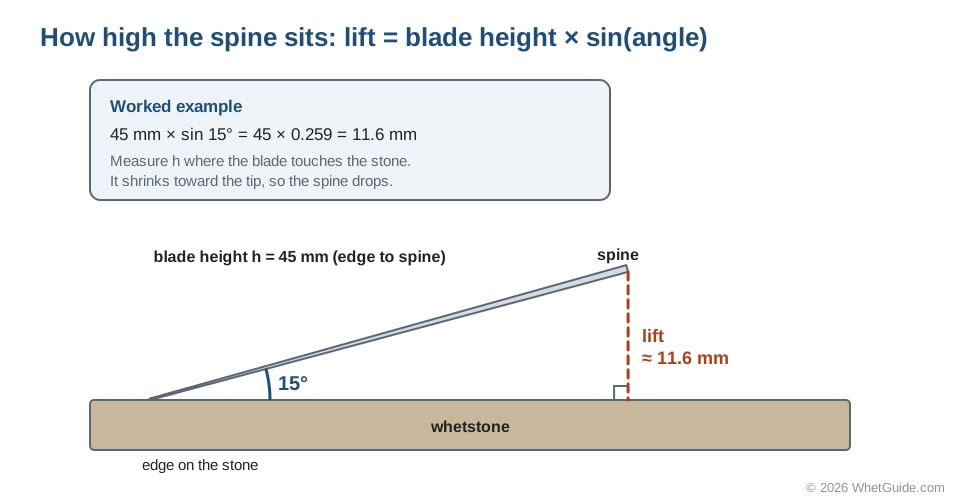
Nobody can see 15° freehand. You can see how high the spine sits above the stone, though. The height is simple trigonometry: spine height = blade height × sin(angle), where blade height is measured from edge to spine at the point touching the stone. Find your blade's height, read across to your angle, and raise the spine that much.
| Blade height (edge to spine) | 12° | 15° | 17° | 20° | 25° | 30° |
|---|---|---|---|---|---|---|
| 1 in (25 mm), paring / pocket | 0.21 in / 5 mm | 0.26 in / 6.5 mm | 0.29 in / 7 mm | 0.34 in / 8.5 mm | 0.42 in / 10.5 mm | 0.50 in / 12.5 mm |
| 1.25 in (32 mm), utility / hunting | 0.26 in / 6.5 mm | 0.32 in / 8 mm | 0.37 in / 9.5 mm | 0.43 in / 11 mm | 0.53 in / 13.5 mm | 0.62 in / 16 mm |
| 1.5 in (38 mm), petty / boning | 0.31 in / 8 mm | 0.39 in / 10 mm | 0.44 in / 11 mm | 0.51 in / 13 mm | 0.63 in / 16 mm | 0.75 in / 19 mm |
| 1.75 in (44 mm), santoku | 0.36 in / 9 mm | 0.45 in / 11.5 mm | 0.51 in / 13 mm | 0.60 in / 15 mm | 0.74 in / 18.5 mm | 0.87 in / 22 mm |
| 2 in (50 mm), chef's knife | 0.42 in / 10.5 mm | 0.52 in / 13 mm | 0.58 in / 14.5 mm | 0.68 in / 17 mm | 0.85 in / 21 mm | 1.00 in / 25 mm |
Measure your own knife rather than trusting the label. Lay a ruler across the heel from the edge to the top of the spine. Wüsthof lists its Classic 8" chef's knife at 1.9 inches, about 48 mm, but your knife may differ by several millimeters. Years of sharpening also shrink that height a little, so measure again on an old knife.
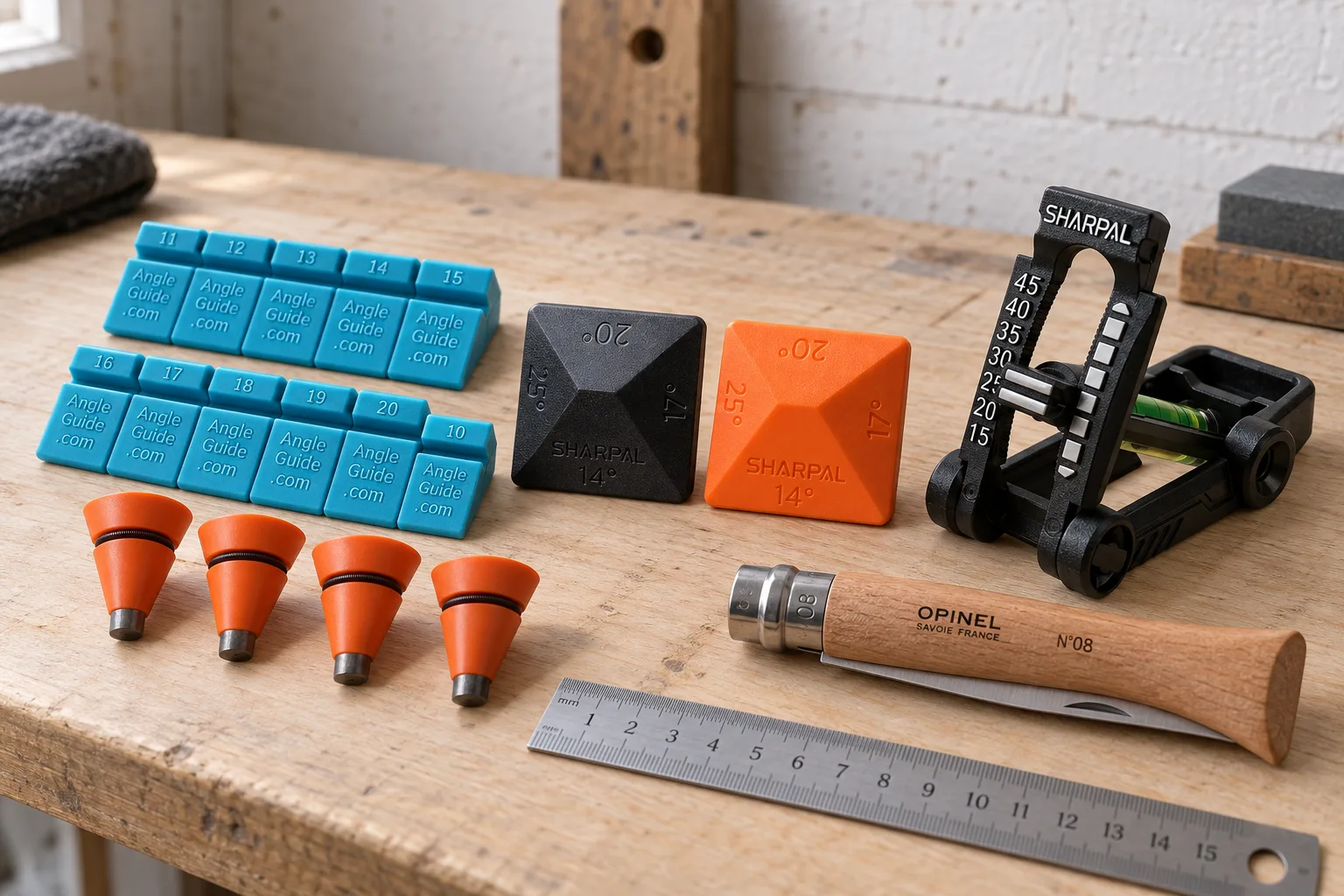
Height grid in millimeters: every common blade and angle
The table above rounds to the half millimeter. This grid goes to a tenth, for blades from 25 to 55 mm and angles from 10 to 25° per side in the steps guided systems use. Find your blade height down the left, read across to the angle, and the cell is the spine lift in millimeters.
| Blade height | 10° | 12.5° | 15° | 17° | 20° | 22.5° | 25° |
|---|---|---|---|---|---|---|---|
| 25 mm (0.98 in) | 4.3 | 5.4 | 6.5 | 7.3 | 8.6 | 9.6 | 10.6 |
| 30 mm (1.18 in) | 5.2 | 6.5 | 7.8 | 8.8 | 10.3 | 11.5 | 12.7 |
| 35 mm (1.38 in) | 6.1 | 7.6 | 9.1 | 10.2 | 12.0 | 13.4 | 14.8 |
| 40 mm (1.57 in) | 6.9 | 8.7 | 10.4 | 11.7 | 13.7 | 15.3 | 16.9 |
| 45 mm (1.77 in) | 7.8 | 9.7 | 11.6 | 13.2 | 15.4 | 17.2 | 19.0 |
| 50 mm (1.97 in) | 8.7 | 10.8 | 12.9 | 14.6 | 17.1 | 19.1 | 21.1 |
| 55 mm (2.17 in) | 9.6 | 11.9 | 14.2 | 16.1 | 18.8 | 21.0 | 23.2 |
Worked example: a 45 mm santoku at 15° per side. Find 45 mm, read across to 15°, and the grid says 11.6 mm. Stand a ruler on the stone beside the spine and lift until the spine reaches that mark. That's your 15°.
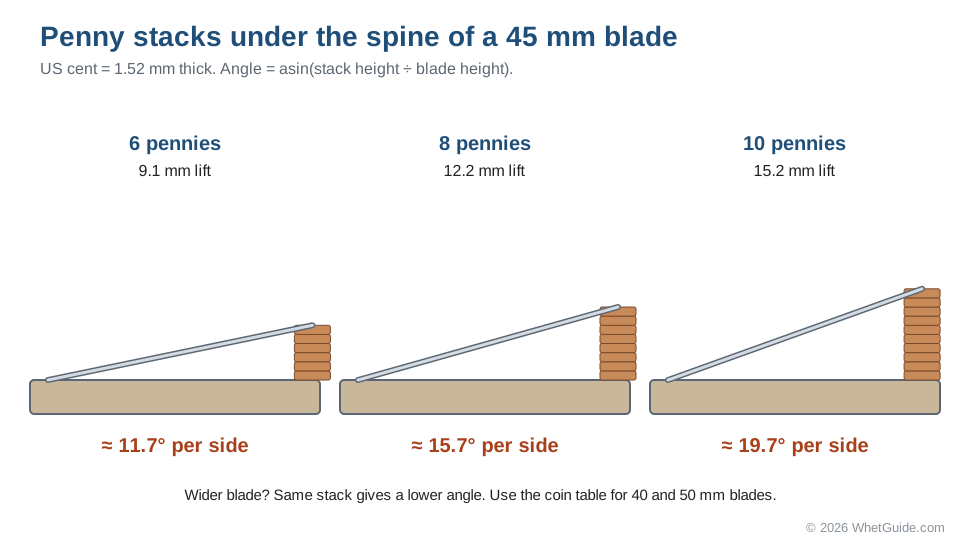
Coin stacks: a reference height from your pocket
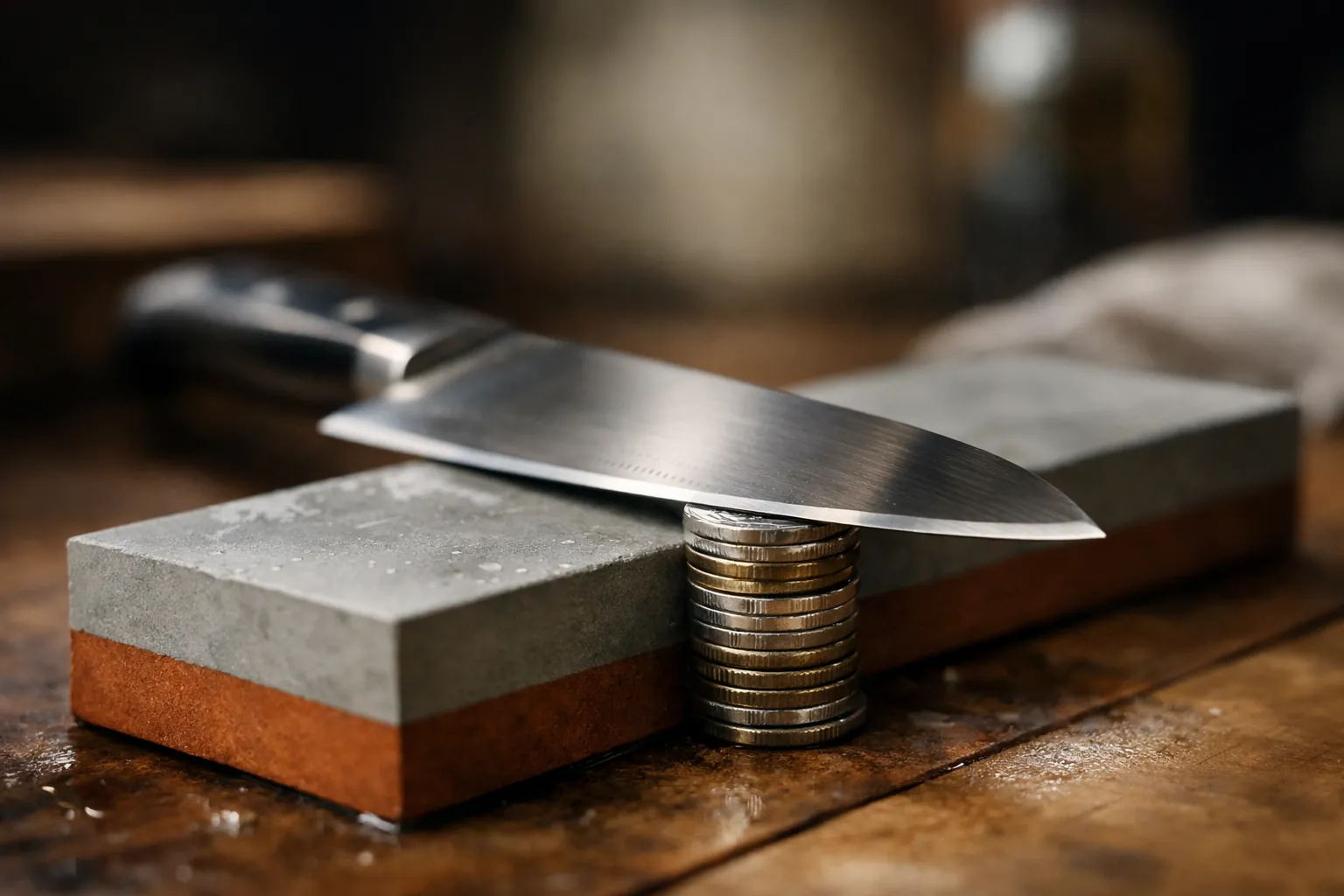
A ruler is awkward on a wet stone. A stack of coins isn't. Set the stack on the stone, rest the spine on it with the edge on the stone, and look at the angle the blade makes. Then take the coins away and hold that picture. US coins are made to published thicknesses: a cent is 1.52 mm, a dime 1.35 mm and a quarter 1.75 mm. The table counts how many of each it takes.
| Blade height | Angle per side | Lift | Pennies | Dimes | Quarters |
|---|---|---|---|---|---|
| 40 mm | 12° | 8.3 mm | 5.5 | 6.2 | 4.8 |
| 40 mm | 15° | 10.4 mm | 6.8 | 7.7 | 5.9 |
| 40 mm | 17° | 11.7 mm | 7.7 | 8.7 | 6.7 |
| 40 mm | 20° | 13.7 mm | 9.0 | 10.1 | 7.8 |
| 40 mm | 25° | 16.9 mm | 11.1 | 12.5 | 9.7 |
| 45 mm | 12° | 9.4 mm | 6.2 | 6.9 | 5.3 |
| 45 mm | 15° | 11.6 mm | 7.7 | 8.6 | 6.7 |
| 45 mm | 17° | 13.2 mm | 8.7 | 9.7 | 7.5 |
| 45 mm | 20° | 15.4 mm | 10.1 | 11.4 | 8.8 |
| 45 mm | 25° | 19.0 mm | 12.5 | 14.1 | 10.9 |
| 50 mm | 12° | 10.4 mm | 6.8 | 7.7 | 5.9 |
| 50 mm | 15° | 12.9 mm | 8.5 | 9.6 | 7.4 |
| 50 mm | 17° | 14.6 mm | 9.6 | 10.8 | 8.4 |
| 50 mm | 20° | 17.1 mm | 11.3 | 12.7 | 9.8 |
| 50 mm | 25° | 21.1 mm | 13.9 | 15.7 | 12.1 |
A half coin doesn't exist, so round. Eight pennies under a 45 mm blade give about 15.7°, close enough for a 15° to 16° target such as Shun's 16°. If you sharpen one knife most of the time, tape the right stack together and keep it with the stone.
The marker trick: find the angle your knife already has
The safest angle is almost always the one the factory put on. To find it, color the bevel with a permanent marker, set the knife on the stone at your best guess, and make one light stroke.
If the stroke took ink off only at the very edge, your angle is too high, so lower the spine. If it took ink only from the top of the bevel, you're too low; raise the spine. When the ink comes off evenly across the whole bevel, you've matched it.

- Clean and dry the bevel. Oil or water on the steel keeps the ink from sticking.
- Color the whole bevel on one side, from heel to tip, with a fine-point permanent marker. Let it dry for a minute.
- Set the knife on a medium stone at your best guess, using the height grid or a coin stack.
- Make one slow, light stroke. Don't press; you want to see where the stone touches, not to sharpen.
- Look at the bevel under good light, or with a loupe. Adjust the spine and repeat on a fresh patch of ink.
- Once the ink comes off evenly, note the spine height. That's your knife's angle, and it's the number to sharpen at.
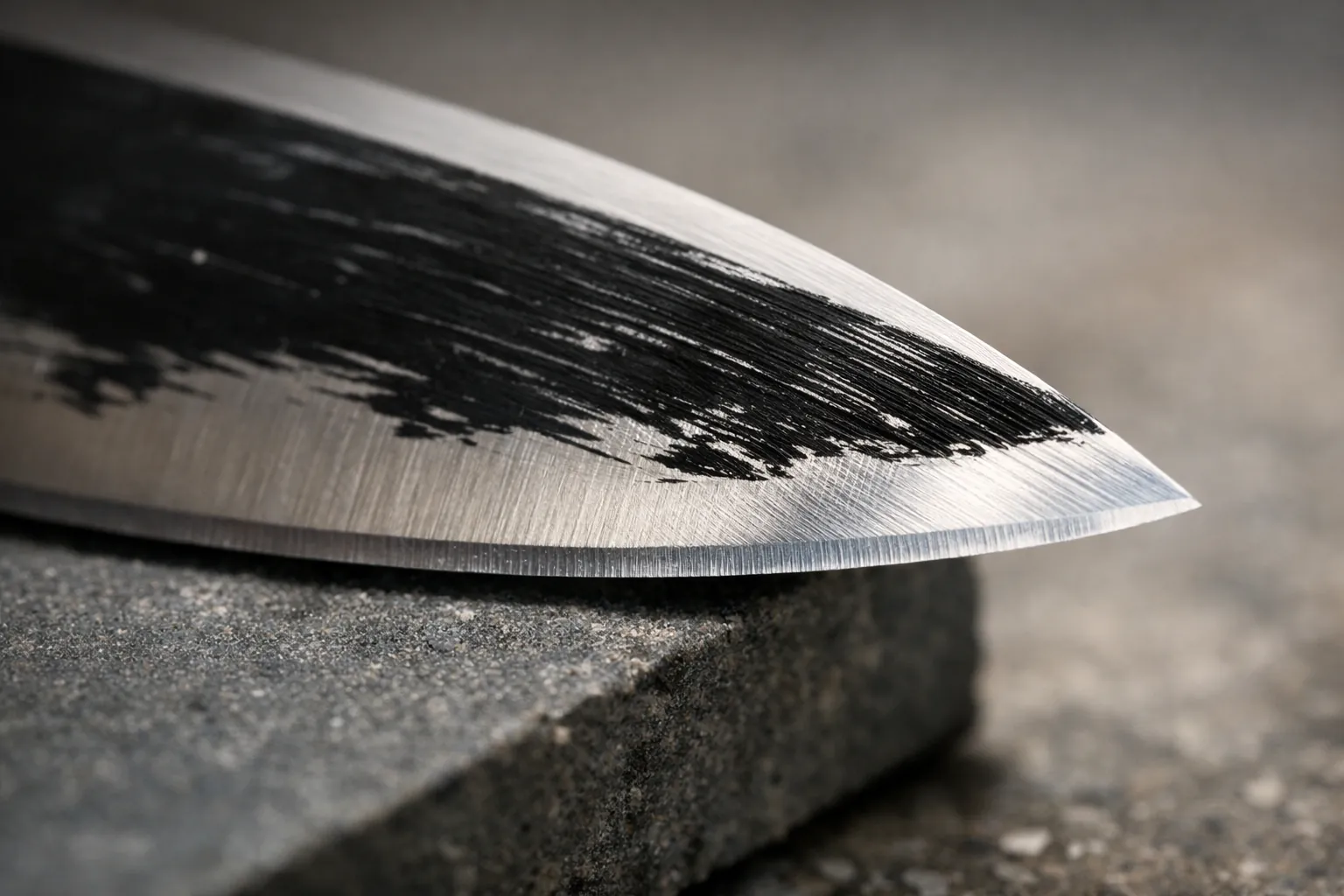
Read the whole length of the edge, not just the heel. If the ink comes off evenly at the heel but only at the edge near the tip, you're letting the spine rise as you move toward the tip. That's the common freehand fault, and the marker shows it on the first try. Our Sharpie trick guide has more on reading the scratch pattern.
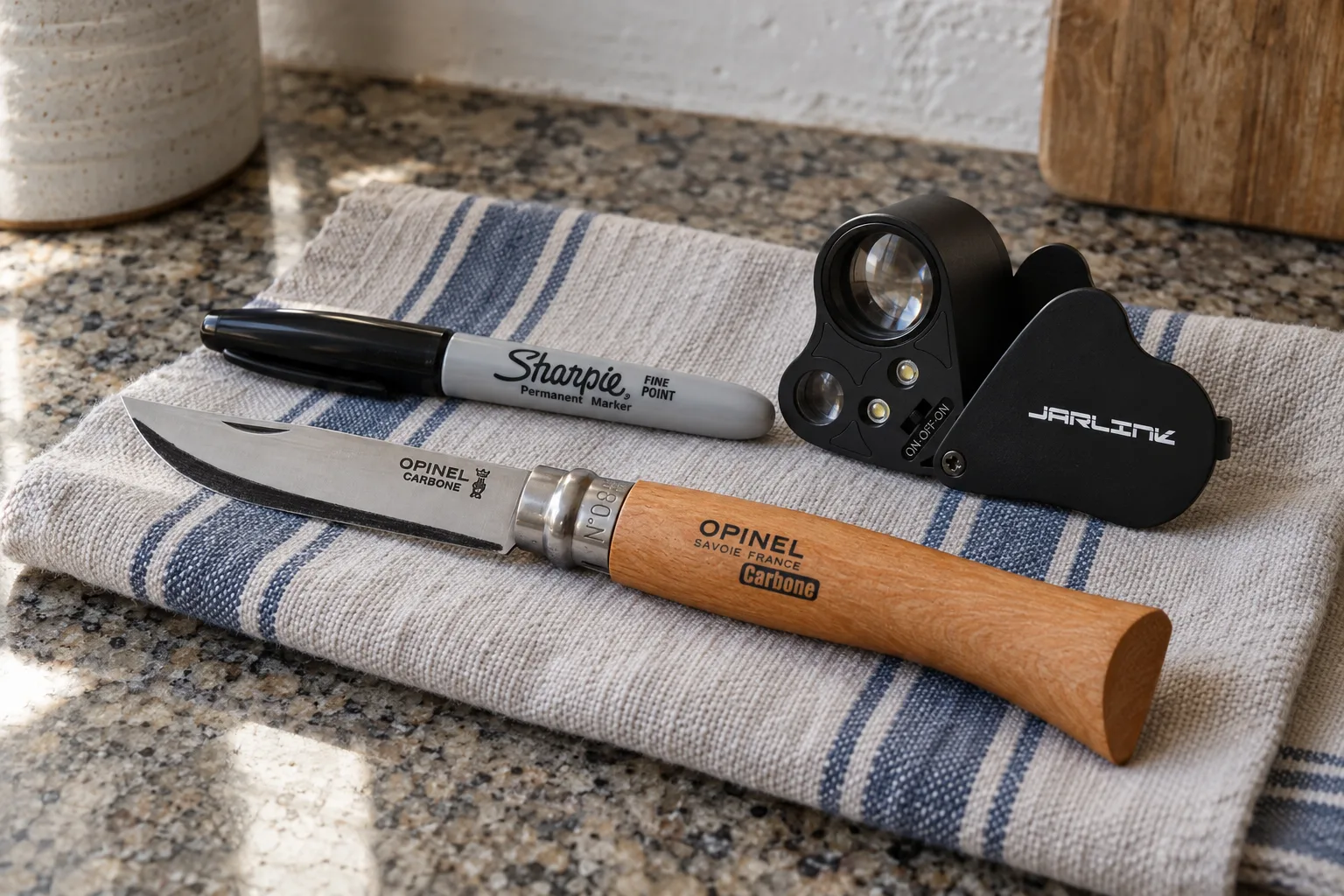
Measure the angle as a number
The marker tells you when you've matched the bevel. To put a number on it, measure the spine height at that moment and read it off the grid, or use a digital angle gauge.
- Ruler method: with the bevel matched, stand a steel ruler on the stone beside the spine and read the height. Find it in the height grid row for your blade.
- Coin method: slide coins under the spine until it just touches the top coin, then read the coin table.
- Digital gauge: zero the gauge on the stone, then set it on the flat of the blade with the bevel matched. It reads the blade's tilt, which is close to the per-side angle on a thin, flat-ground blade.
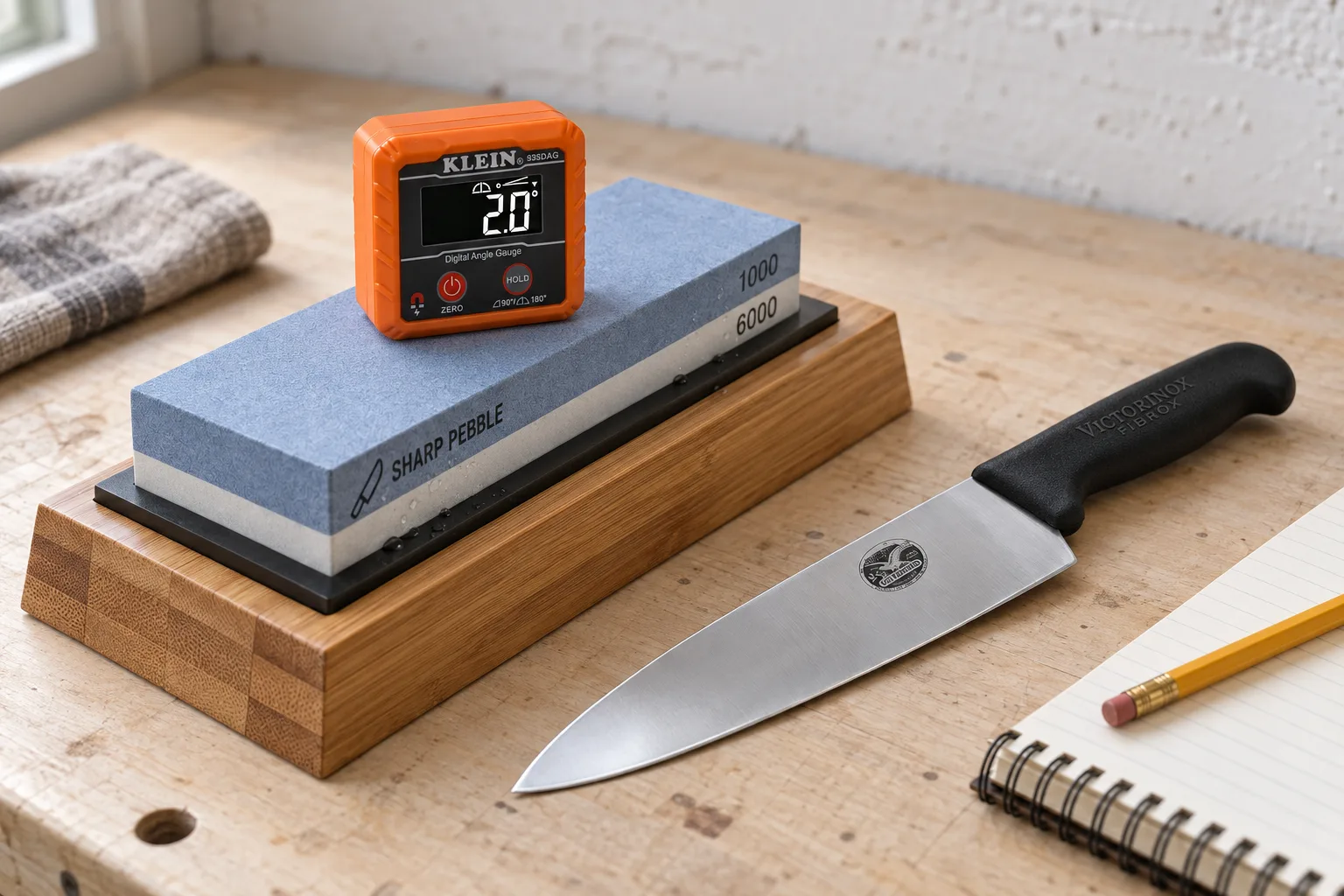
The gauge reading has one catch. The face of the blade isn't exactly parallel to the center line, because the blade tapers from spine to edge. On a thin kitchen knife the difference is small; on a thick hunting knife with a full flat grind it can be a degree or two. For thick blades, trust the ruler and the grid.
Write the number down. A strip of masking tape on the box or a line in a notebook saves you from doing this again next time. The printable sheet has room for it.
↑ Back to all sectionsSingle-bevel Japanese knives: one side does the work
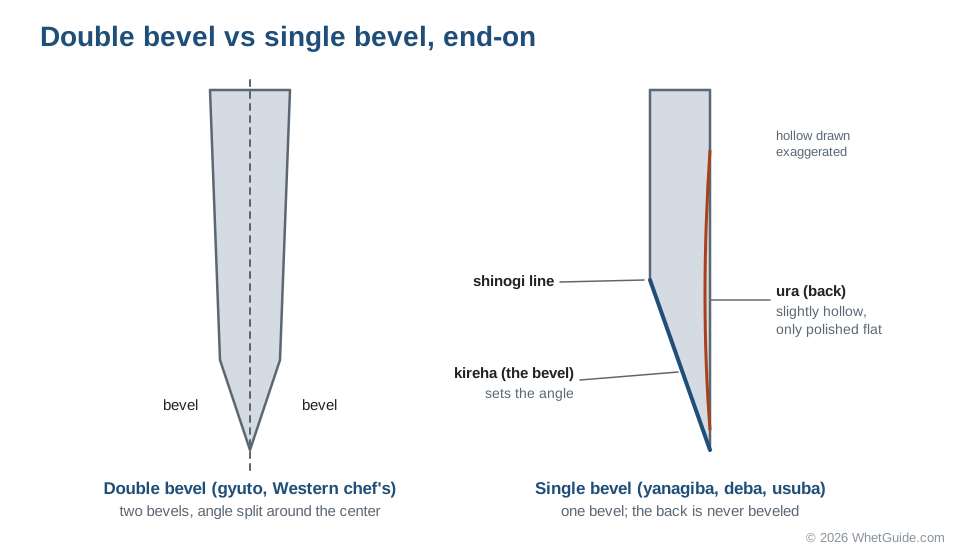
A yanagiba, deba or usuba has a bevel on one side only. The bevel side (kireha) is a wide, flat facet that ends at the shinogi line. The back (ura) is slightly hollow and is never beveled. You sharpen by laying the kireha flat on the stone, which sets the angle for you, then remove the burr with a few light strokes with the ura flat.
That's why charts list "follow the existing bevel" for these knives instead of a number. The bevel already is the angle. Raising the spine to add a secondary bevel on the kireha side is something some sharpeners do on a deba for toughness, but it's a deliberate change, not the default. Don't grind the back to "even it up"; the hollow ura is what lets the blade release food and sit flat on the stone. A single-bevel angle measured from the flat side can't be compared with a per-side figure on a double-bevel knife. A single-bevel edge with a given bevel angle has that whole angle on one side, so it's the inclusive angle too. Our guide to sharpeners for Japanese knives covers which tools can handle them; most pull-throughs can't.
↑ Back to all sectionsAsymmetric edges: two numbers, one knife
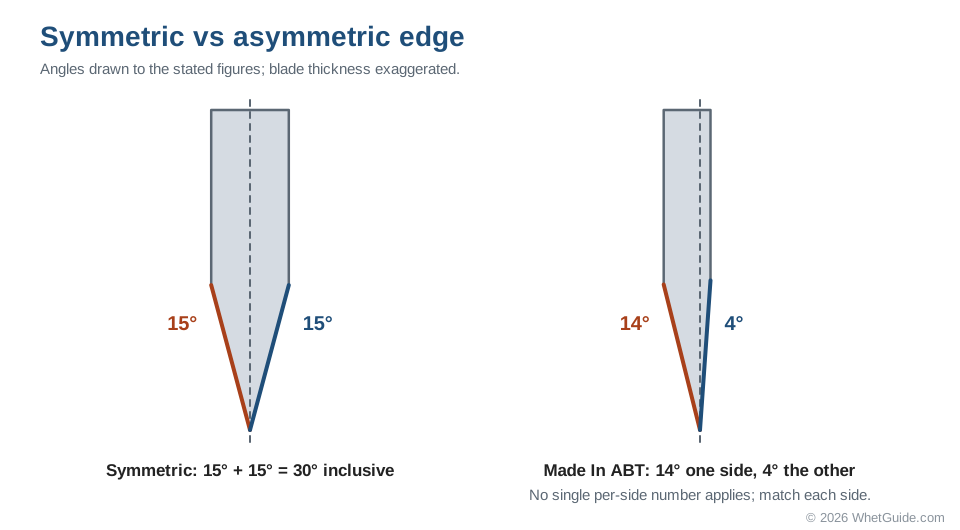
Some double-bevel knives are sharpened at different angles on each side. Made In's Asymmetrical Bevel Tech knives are 14° on one side and 4° on the other, by the maker's own article. Many Japanese gyuto come from the maker with an uneven edge too, often a bigger bevel on the right side for right-handed cooks, though few publish the figures.
No single per-side number fits an asymmetric edge, so don't look for one. Do the marker test on each side separately and sharpen each side at the height that matches. Count your strokes so you take roughly the same metal off both faces, and the edge stays where the maker put it.
↑ Back to all sectionsMicro-bevels: a stronger apex for almost nothing
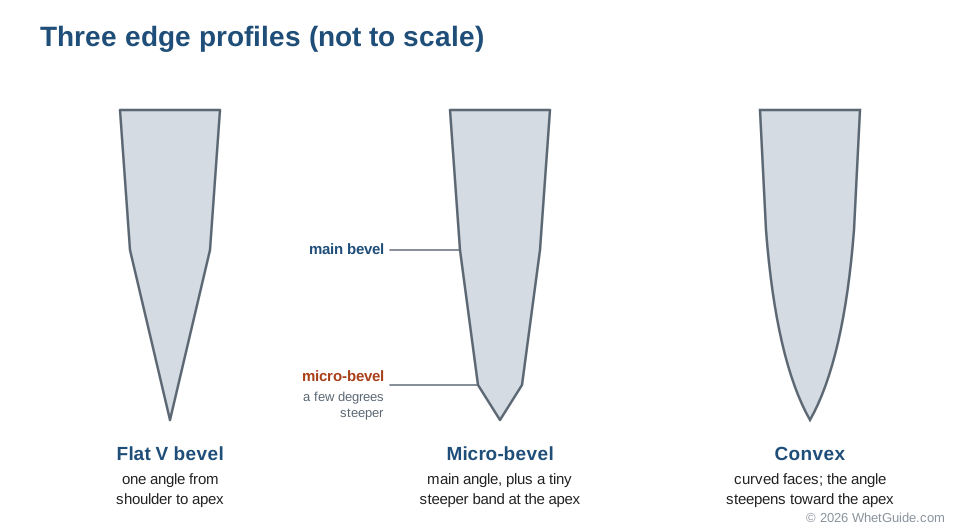
A micro-bevel (secondary bevel) is a narrow band at the apex, ground a few degrees steeper than the main bevel. You sharpen at your main angle, then raise the spine slightly and make a few light strokes on a fine stone. The band is too small to see without magnification.
Two things make it worth doing. The steeper band adds strength right where an edge fails, so a 15° knife with a micro-bevel chips less. And next time you sharpen, you only have to remove that thin band, which takes a few strokes. Keep the step small, 2 to 5 degrees, and keep it light. A heavy micro-bevel turns into a new main bevel.
Convex and hollow grinds
- A convex edge has curved faces that meet at the apex, so the angle grows steeper toward the edge. Axes, many bushcraft knives and blades sharpened on a slack belt or a strop on a soft backing end up this way. Council Tool calls its axe edge slightly convex at 25°. When a maker gives a number for a convex edge, read it as the angle near the apex.
- Hollow grinds go the other way. The faces are ground concave on a wheel, which leaves a thin section behind the edge and a distinct shoulder. Straight razors and many hunting knives have hollow grinds. The edge bevel itself is still a flat V you can measure; only the blade behind it is hollow. Sharpen the bevel at its angle and leave the hollow alone.
Choosing between a lower and a higher angle
A lower angle cuts more easily but chips or rolls sooner. A higher angle is tougher but feels less keen. Steel decides most of it: hard steels (common in Japanese knives) hold a thin edge, while softer stainless steels (common in Western knives) often roll at very low angles. Knifewear draws the same line by steel, putting harder Japanese steel lower and softer steels higher.
Then think about the work. Slicing fish or vegetables favors a lower angle; breaking down chicken, cutting rope or batoning wood favors a higher one. Your habits count too. If you scrape food across the board with the edge, or you use a glass board, go a little higher and the edge will survive longer. Can't decide? Sharpen at the lower angle and add a micro-bevel 2 to 5 degrees higher.
| Per side | Cutting feel | Edge durability | Why | Fits |
|---|---|---|---|---|
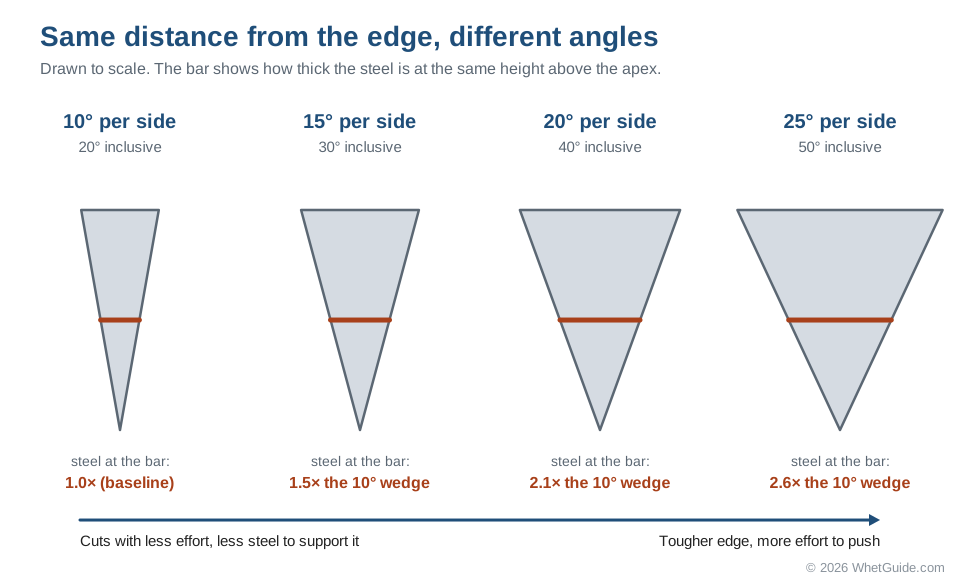
| 10–12° | Falls through food | Lowest | Very little steel behind the apex | Hard Japanese slicers, razors |
| 13–16° | Very keen | Moderate on hard steel | Thin wedge, needs hard steel to stay straight | Japanese kitchen, newer German lines |
| 17–20° | Keen, a little more push | Good | About twice the steel of a 10° edge at the same depth | Western kitchen, most pocket knives |
| 21–25° | Noticeable push in dense food | High | Thick wedge resists rolling and chips | Hunting, camp, heavy EDC |
| 25–30°+ | Splits more than slices | Highest | Wedge built for impact | Cleavers, machetes, axes |
Steel and hardness: what the angle has to stand on
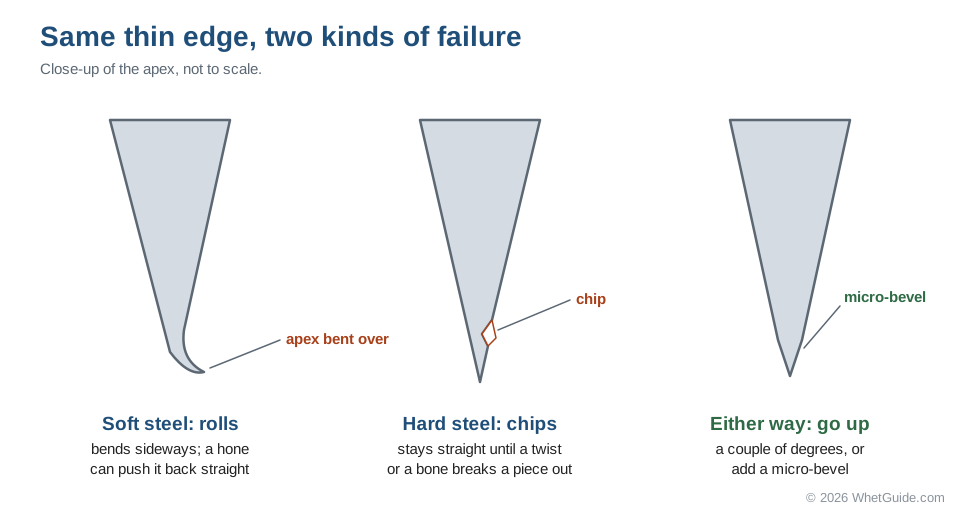
Harder steel generally supports a lower angle, and softer steel does better higher. A thin edge on soft steel bends over in use; a thin edge on hard steel stays straight but can chip if it's twisted or hits bone. That's the rule behind the chart's split between Japanese and German knives.
The published figures bear it out. AFTCO lists its fillet knives in 4116 steel at 56 to 58 HRC, and fillet sharpening advice for soft steel like that runs to 20 to 25° (Wicked Edge). Miyabi's harder Japanese blades sit at 9.5 to 12°. Makers state their steel and hardness on product pages more often than they state an angle, so look there when the angle isn't listed. The names are decoded in the guide to knife steels. Carbon kitchen knives are often hard and take a low angle well, as long as they're kept dry; a rusty apex is a weak apex.
Angle by job, not just by knife
| Job | Per side | Note |
|---|---|---|
| Slicing raw fish | 10–15° | Single-bevel yanagiba follows its own bevel |
| Push cuts on vegetables | 12–17° | Thin edge wedges less in carrots and onions |
| General kitchen prep | 15–20° | Match the maker; use a micro-bevel if it chips |
| Breaking down poultry | 17–22° | Joints and cartilage roll a thin edge |
| Filleting soft-steel outdoor knives | 17–20° | Soft stainless rolls below that (AFTCO, Wicked Edge) |
| Skinning and field dressing | 18–22° | Keen enough for hide, tough enough for hair and grit |
| Wood carving | Morakniv: 27° inclusive | About 13.5° per side; a Scandi grind is one flat bevel |
| Cardboard, rope, zip ties | 20–25° | Cardboard carries grit that wears thin edges fast |
| Bushcraft and batoning | 22–30° | Impact on wood needs a thick wedge |
| Chopping (cleaver, axe, machete) | 25–30°+ | Council Tool gives 25° for axes, slightly convex |
When to change your angle
- Your edge tells you when the angle is wrong for your use. Read the failure below, then move in the direction it points.
- The edge rolls or folds (a bright line you can feel with a fingernail): steel too soft for the angle. Go up 2 to 3 degrees, or add a micro-bevel.
- The edge chips (tiny notches that catch light): the edge is too thin for the job or the steel is brittle. Go up a little, or change how you cut.
- The knife wedges in dense food and cracks carrots instead of slicing them: the angle or the blade behind the edge is thick. Go down 2 to 3 degrees.
- It tears tomato skins even right after sharpening: usually a burr or a rounded apex, not the angle. Check the burr before changing anything.
- Change one thing at a time. Move the angle, use the knife for a couple of weeks, and see what changes. Two changes at once and you won't know which one helped.
Converting an edge from 20 to 15, or 15 to 20
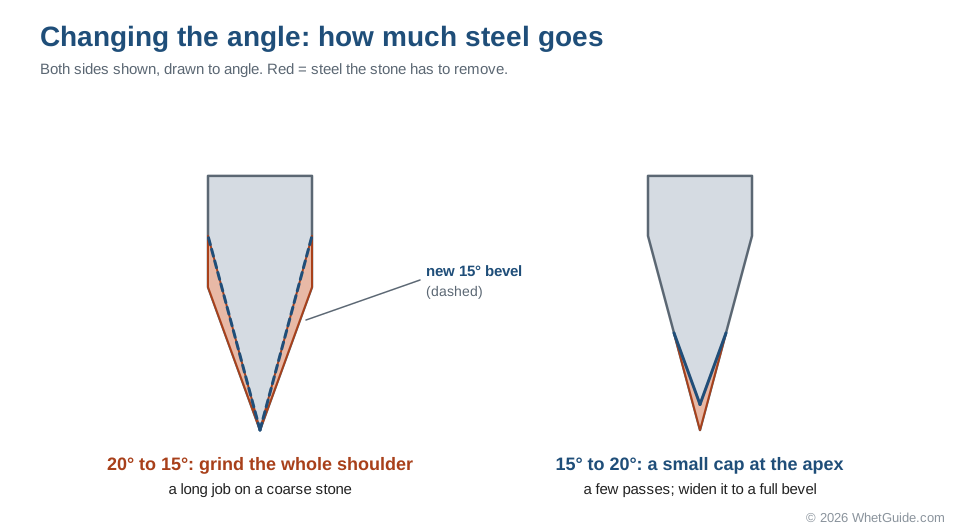
Going higher is easy. A 15° knife sharpened at 20° only touches the apex at first, so a new, steeper bevel forms there in a few passes; keep going until it runs the full length of the edge and raises a burr. Going lower takes work. A 20° knife sharpened at 15° touches the shoulder first, far from the apex, and you have to grind the whole shoulder away before the new, wider bevel reaches the edge:
- Start on a coarse stone. A fine stone takes a very long time to move that much steel.
- Color the bevel with marker and set the spine to the new, lower height.
- Sharpen one side until the ink is gone right down to the apex and you can feel a burr along the full length on the other side.
- Flip the knife and do the same on the second side.
- Work up through your grits at the new angle. Read the grit progression chart for the stone order.
Lowering the angle on a soft-steel knife is the one change that's often a mistake. If the maker set 20°, the steel may not hold 15. Try a single step first, to 17°, and see how it holds up before going further.
↑ Back to all sectionsTools that hold the angle
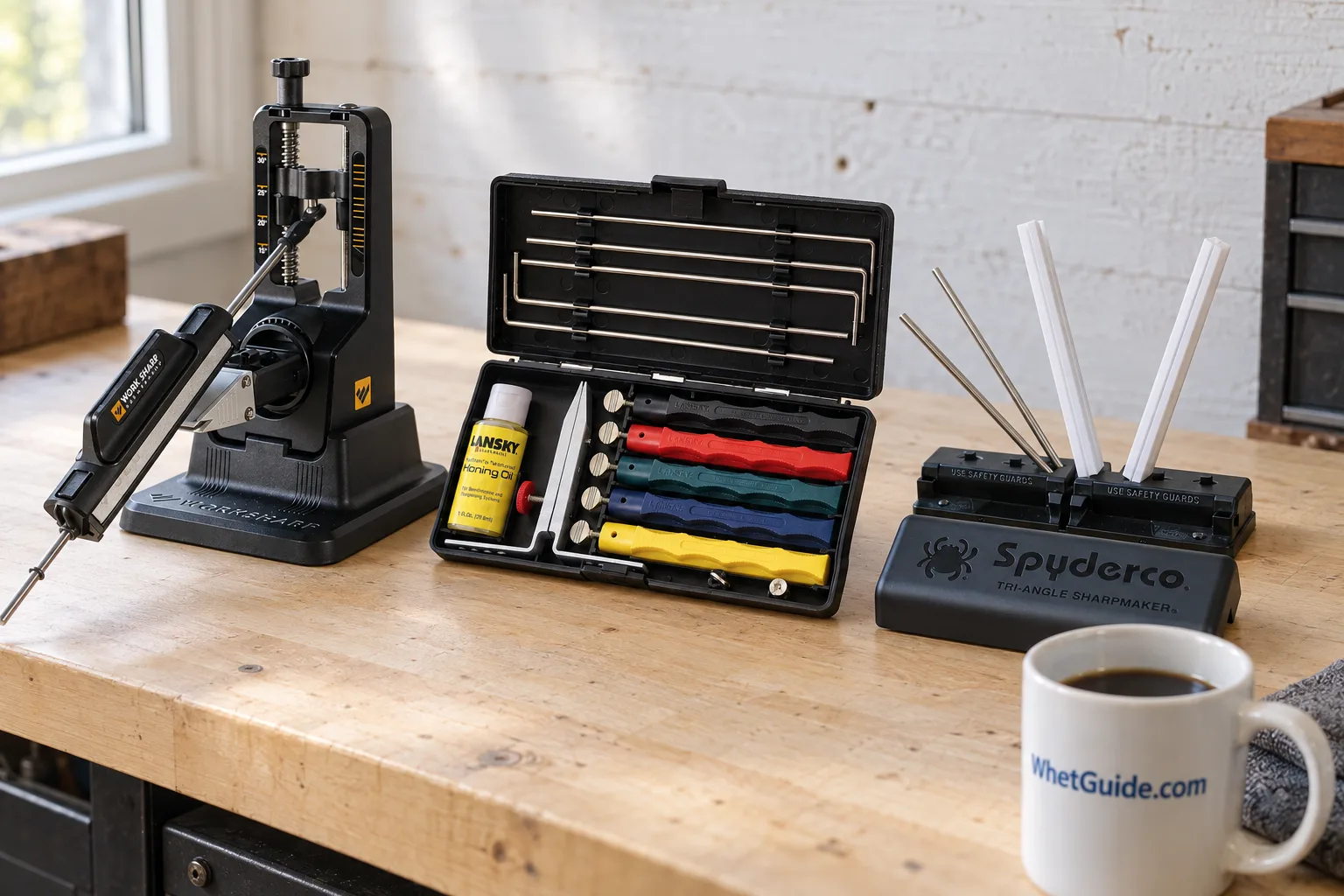
If holding an angle freehand is the problem, a clip-on guide such as the SHARPAL 194H angle guide sets a fixed spine height while you learn. A clamp system such as the Work Sharp Precision Adjust dials any angle from 15° to 30°, and the Lansky Deluxe 5-stone system uses preset angle holes. Electric sharpeners like the Chef'sChoice 15XV are fixed at one angle (15° on that model), and what that does to a 20° knife gets a full look in the Trizor XV review. Compare them in the best sharpening system guide, or see how to use a whetstone and the grit chart.
The Spyderco Sharpmaker is the one to read twice. Its base slots are 30° and 40° inclusive, which is 15° and 20° per side. If a Sharpmaker owner tells you their knife is at "30," they mean 15 per side. Our Sharpmaker review walks through the slots.
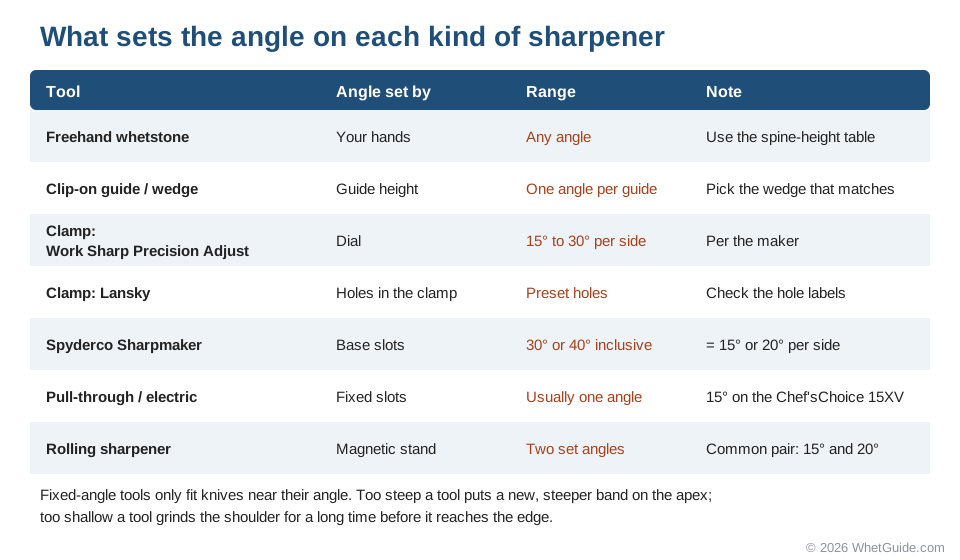
Freehand on a whetstone sets no angle at all; you do. That's the most flexible option and the hardest to hold. Until your wrist learns the height, use the grid, a coin stack or a clip-on guide as training wheels; clip-ons and wedges are compared across the angle guide picks.
When the sharpener's angle and the knife's angle don't match
A fixed-angle sharpener does the same thing to every knife. That's fine when the knife was made for it, and a slow change when it wasn't. Match the tool to the knives you own most of: a home with a block of German knives and one Japanese gyuto is better served by a tool that does both angles, or by a whetstone, than by a 15° pull-through. Here's what a mismatch does:
- A 20° sharpener on a 15° knife touches only the apex. It forms a narrow 20° band there, like a micro-bevel, and widens it every session until the knife is a 20° knife. It still cuts, but it won't feel like the knife you bought.
- A 15° sharpener on a 20° knife touches the shoulder first and grinds there for a long time before it reaches the apex. Meanwhile the edge stays dull, and many owners decide the sharpener doesn't work. Our page on whether pull-through sharpeners are bad has more on fixed slots.
Electric and rolling sharpeners
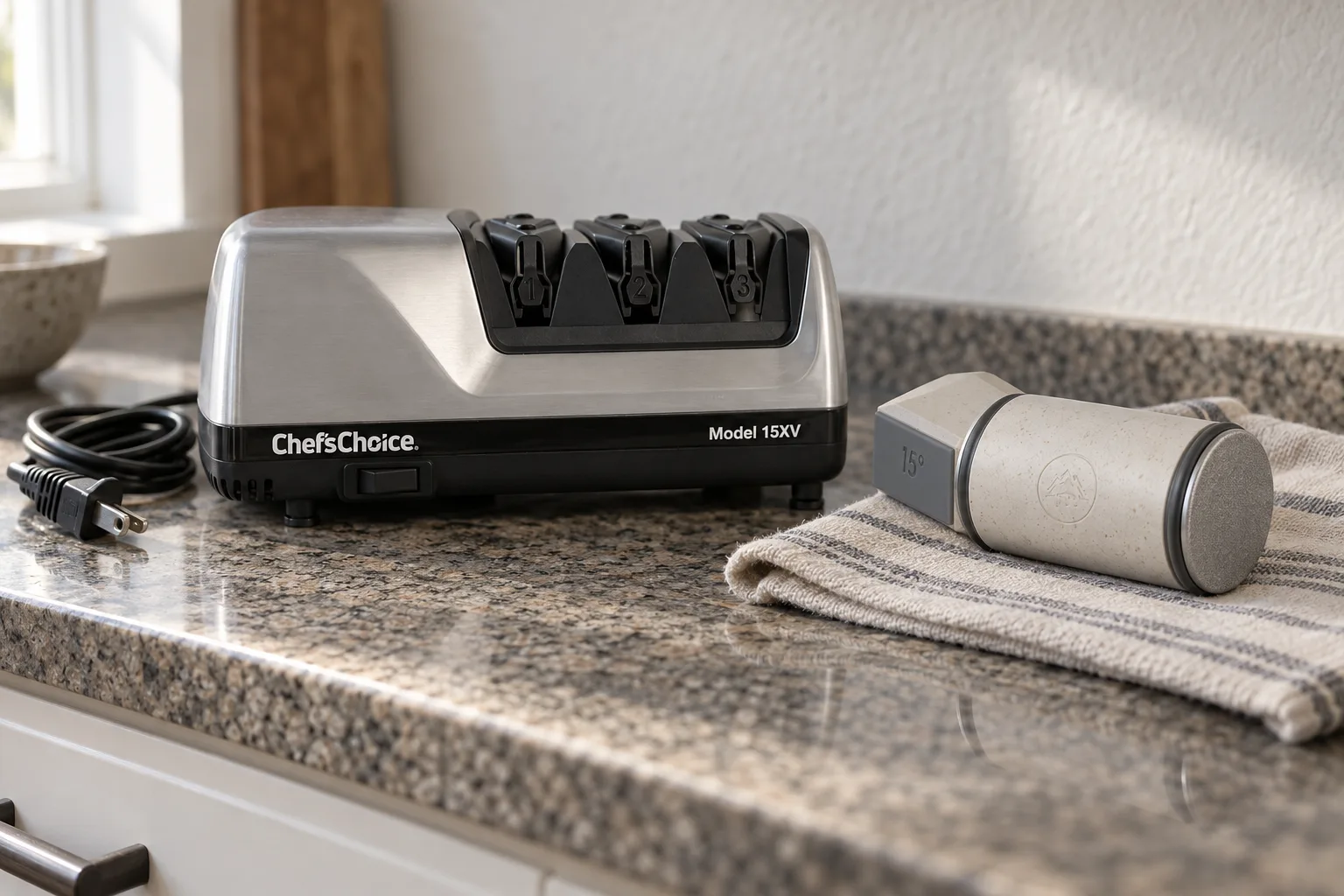
Electric sharpeners set the angle with guide slots, and most models have one. Chef'sChoice's 15XV is 15° per side, and some other models in the line are 20°. An adjustable electric like the Work Sharp Ken Onion Mk2 lets you pick, but you still need to know which number you want, which is what this chart is for. Models by angle are sorted in the electric sharpener guide.
Rolling sharpeners hold the knife on a magnetic stand and roll a disc along the edge. The stand sets the angle, and the HORL stands come with two set angles, commonly 15° and 20°. Pick the one closer to your knife's bevel. Everything else about them is weighed in the rolling sharpener vs whetstone comparison.
Honing and stropping at the right angle
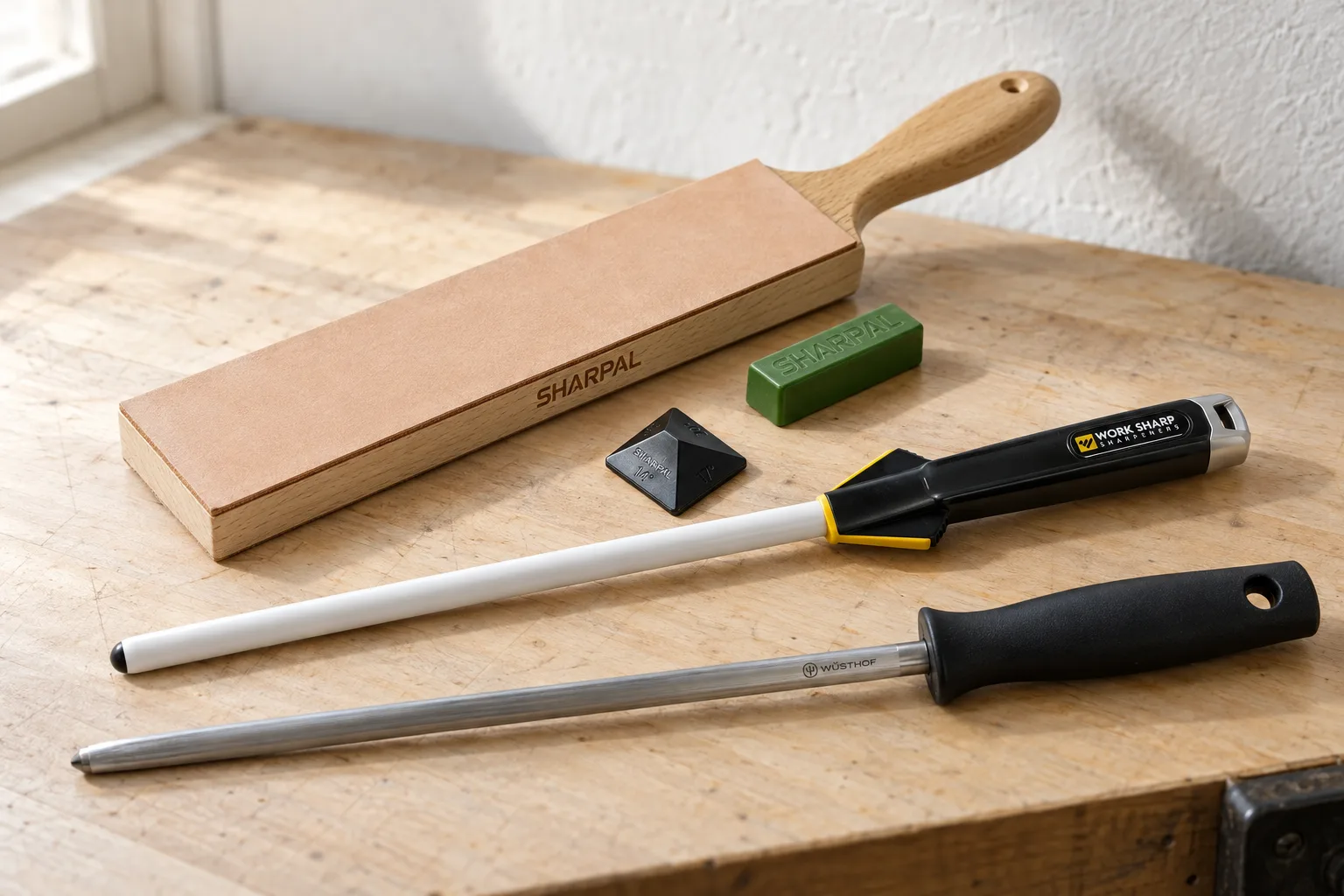
Honing straightens an edge between sharpenings, and it works at about the same angle as the edge, or a touch higher. The makers that publish a honing angle say this:
| Maker | Knives | Angle to the steel | Note |
|---|---|---|---|
| Zwilling | German ZWILLING knives | 15° | Per its sharpening guide |
| Zwilling | Santoku and Miyabi | 9–12° | Same guide |
| Wüsthof | Asian-style blades (santoku, nakiri) | 10° | Honing-steel step of its how-to |
| Victorinox | Kitchen knives | 30–40° | Doesn't say one side or both |
Stropping works at the edge angle or a hair lower, with the spine leading so the edge trails. Raise the spine above the sharpening angle and you round the apex. See how to use a honing rod and how to strop a knife for the strokes.
↑ Back to all sectionsAngle mistakes and how to fix them
| Mistake | What it does | Fix |
|---|---|---|
| Reading inclusive as per side | Set a guided tool to 30 for a "30° knife" and you grind 60° inclusive | Check the chart's convention; halve inclusive figures for per-side tools |
| Angle drifting between strokes | Rounds the bevel into a convex edge that never gets sharp | Lock your wrist, move from the shoulder, check with marker |
| Spine rising toward the tip | Tip gets a steeper, duller bevel than the heel | Lower the spine as the blade narrows; re-ink the tip |
| Going below the maker's angle on soft steel | Edge rolls in days | Return to the maker's figure or add a micro-bevel |
| Pressing harder on the last strokes | Raises a big burr and can roll the edge | Lighter pressure as you finish, fewer strokes on fine stones |
| Forgetting the blade has worn | Old heights give a higher angle on a narrower blade | Re-measure blade height every few years |
| Honing far steeper than the edge | Rounds the apex each time | Hone at the edge angle or a degree or two above |
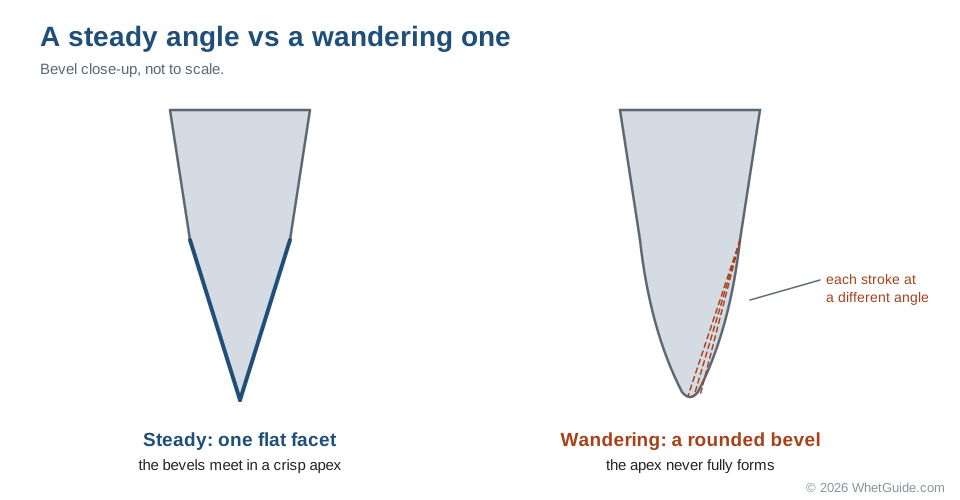
The first two cause most of the trouble. If a knife won't come sharp after a long session, the angle is rarely wrong; it's usually wandering. Ink the bevel and look.
↑ Back to all sectionsPrintable knife sharpening angle chart by brand
Print this one page and tape it inside the cabinet where your knives live. It answers the question a mixed knife block raises every time: which number goes with which knife. Angles are the makers' own published figures where they exist, checked 2026-11-13 (full sources in the table above). Only the sheet prints, on US Letter with narrow margins.
A. By brand (maker's figure)
| Brand | Line | Angle | Per side or inclusive |
|---|---|---|---|
| Wüsthof | PEtec standard blades | 14.5° | Per side (stated) |
| Wüsthof | Standard blades, whetstone how-to | 14.5° | Not stated; per side by the steps |
| Wüsthof | Asian-style blades (santoku, nakiri), honing-steel step | 10° | Not stated; read as per side |
| Shun | Double-bevel knives | 16° | Per side (stated) |
| Shun | Western Cook's Knife | 22° | Per side (stated) |
| Global | Stamped blades, factory edge | 10–15° | Not stated; read as per side |
| Victorinox | Swiss Army pocket knives, stone | 15–20° | Not stated; angle to the stone, read as per side |
| Victorinox | Kitchen knives, sharpening steel | 30–40° | Not stated |
| Zwilling | ZWILLING knives, honing steel (not a stated factory edge) | 15° | Not stated; angle to the steel |
| Zwilling | Santoku and Miyabi, honing steel (not a stated factory edge) | 9–12° | Not stated; angle to the steel |
| Miyabi | All Miyabi, edge | 9.5–12° | Not stated; read as per side |
| Benchmade | Folders (last read Oct 3, 2026; page blocked on Nov 13, so not re-verified) | 30–35° | Inclusive (as last read) |
| Spyderco | Sharpmaker slots, a sharpener setting and not a knife edge (last read Oct 3, 2026; page returned 404 on Nov 13) | 30° or 40° | Inclusive (as last read) |
| Buck | Fixed and folding knives | 13–16° | Per side (stated) |
| Cutco | Kitchen knives | 30° | Inclusive (stated) |
| Cangshan | All knives | 16° | Not stated; read as per side |
| Case | Pocket knives, re-sharpening | 10–15° | Not stated; angle to the stone, read as per side |
| Opinel | Home sharpening | 20° | Not stated; angle to the rod, read as per side |
| Morakniv | Carving knives | 27° | Inclusive (the page says total angle) |
| Made In | Asymmetrical Bevel Tech knives | 14° on one side, 4° on the other | Asymmetric; no single per-side figure |
| Council Tool | Axes (slightly convex) | 25° | Not stated by the maker |
B. By knife type (common practice, when the maker gives no number)
| Knife | Per side | Knife | Per side |
|---|---|---|---|
| Japanese kitchen (gyuto, santoku) | 12–15° | Pocket / EDC | 17–25° (often 20°) |
| German / Western chef's | about 20° (newer lines 14–15°) | Hunting / outdoor | 20–25° |
| Paring, utility | 15–20° | Cleaver, machete, axe | 25–30° or more |
| Fillet, boning | 12–18° | Single-bevel (yanagiba, deba) | follow the existing bevel |
C. Spine height for a 50 mm (2 in) blade: W × sin(angle)
| Angle | 10° | 12° | 14° | 15° | 16° | 18° | 20° | 25° |
|---|---|---|---|---|---|---|---|---|
| Height | 8.7 mm | 10.4 mm | 12.1 mm | 12.9 mm | 13.8 mm | 15.5 mm | 17.1 mm | 21.1 mm |
| US pennies | 5.7 | 6.8 | 8.0 | 8.5 | 9.1 | 10.2 | 11.3 | 13.9 |
D. Marker check (find the angle your knife already has)
- Color the whole bevel with a permanent marker.
- One light stroke on the stone at your best-guess height.
- Ink gone at the edge only: lower the spine. Gone at the shoulder only: raise it. Gone evenly: you've matched it.
How to use the sheet
Find your brand in table A and read the last column before you copy the number. Some makers quote one side and some quote both. Several don't say. Rows marked honing steel are angles for the steel, not factory edges. Table B is for knives whose maker gives no number.
The spine-height strip assumes a blade 50 mm wide where it touches the stone, about right for the heel of an 8-inch chef's knife (Wüsthof lists its Classic 8" chef's knife at 1.9 inches). Narrower blades need a lower spine for the same angle. Our knife sharpening angle calculator does any width, in millimeters or inches.
Where each brand number comes from
Every figure is linked to the maker's page in the table above. The brand pages carry the quotes and spine heights:
- Wüsthof says 14.5° per side in its PEtec article and gives 14.5° again in its how-to. Older product pages say 14°; we couldn't re-check them on 2026-11-13.
- Shun's FAQ says 16° on each side, and 22° on each side for the Western Cook's Knife.
- Global says its knives are factory sharpened between 10 and 15 degrees on its knife care page.
- Victorinox gives 15 to 20 degrees for a stone on pocket knives, and 30 to 40 degrees for a sharpening steel, with no basis stated.
- Zwilling gives 15° and 9 to 12° for the honing steel; its Miyabi page says a 9.5 to 12° edge.
- Spyderco published no factory angle on its knife pages, and its sharpener page was unavailable on 2026-11-13.
- Benchmade's care guide said 30 to 35 degrees inclusive when we last read it on October 3, 2026; the page was blocked on 2026-11-13.
Printing tips
- For an A4 printer, choose "fit to page" in the print dialog.
- To save a PDF, pick "Save as PDF" as the printer.
- Laminate the page or slip it into a sheet protector if it's going near the sink.
- If you sharpen on whetstones, the whetstone grit progression chart is the companion sheet, with a session checklist and a sharpening log.
Keep a log of your own knives
| Knife | Blade height | Maker's angle | Angle I matched | Spine height or coins | Last sharpened |
|---|---|---|---|---|---|
| Example: 8 in chef's | 45 mm | 16° per side | 16° | 8 pennies | (date) |
Where to start tonight
Pick up the knife you use most and do the marker trick before you touch a guide or a chart. If the ink comes off evenly at a height close to the table above, you already know your angle. If it doesn't, start at 15° per side for a Japanese kitchen knife, 20° for a German, Western or pocket knife, and 20 to 25° for a hunting knife. Then hold that one number steadily. A steady 20° beats a wobbly 15° every time. Write the number on tape, stick it to the knife's box or the inside of the drawer, and you won't have to work it out again.