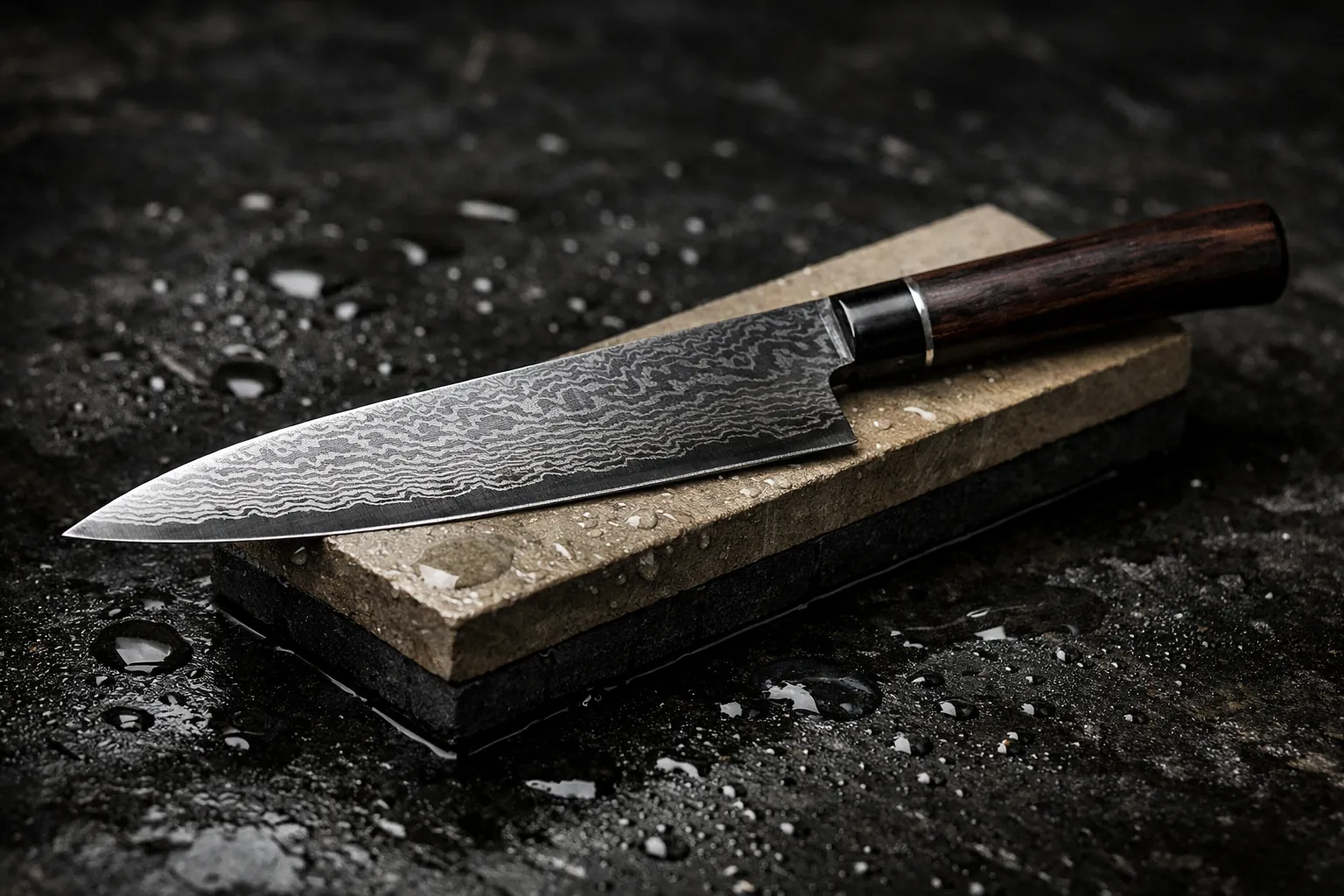
Shun knives are sharpened to 16 degrees per side. That isn't our estimate: Shun's own FAQ says its knives are "sharpened to a 16° angle on each side of the blade", and its honing steel and sharpening stand are both built around the same number. Third-party sites that say 15° are rounding to the generic Japanese figure. For other brands, see our knife sharpening angle chart.
The quote, and the one exception
Here's what the Shun FAQ said when we checked it on October 3, 2026:
| Topic | What Shun says | What it means for you |
|---|---|---|
| Standard edge | "sharpened to a 16° angle on each side of the blade" | 16° per side, 32° inclusive |
| Western Cook's Knife | "sharpened to a slightly wider angle; 22° on each side" | Sharpen this one at 22°, not 16° |
| Honing Steel | "a handle with a built-in 16° honing guide" | Rest the blade on the guide and you're at 16° |
| Retractable sharpener | "Diamond and Ceramic Retractable Sharpener, which matches the 16° angle" | A Shun-made touch-up tool at the right angle |
| Sharpening System | honing steel, whetstone and "a bamboo stand angled to 16°" | Shun's own stone kit is set up for 16° |
| Service | return Shun knives to Tualatin, Oregon "for free sharpening" | An option for a chipped or very dull blade |
Tormek's compiled list of maker recommendations (2020) agrees: "Shun recommends a 16-degree angle of Shun and Kai double-beveled knives." Note the word double-beveled. That's where the next section comes in.
Single-bevel knives don't follow the 16° rule
Traditional Japanese slicers and fish knives (yanagiba, deba, usuba) are ground on one side only, with a flat or slightly hollow back. The 16° figure is for double-bevel knives, which is what nearly all Shun kitchen lines are. If you own a single-bevel knife from any maker, sharpen the beveled face at the angle it already has, and only polish the back flat on a fine stone. Never grind a bevel onto the back.
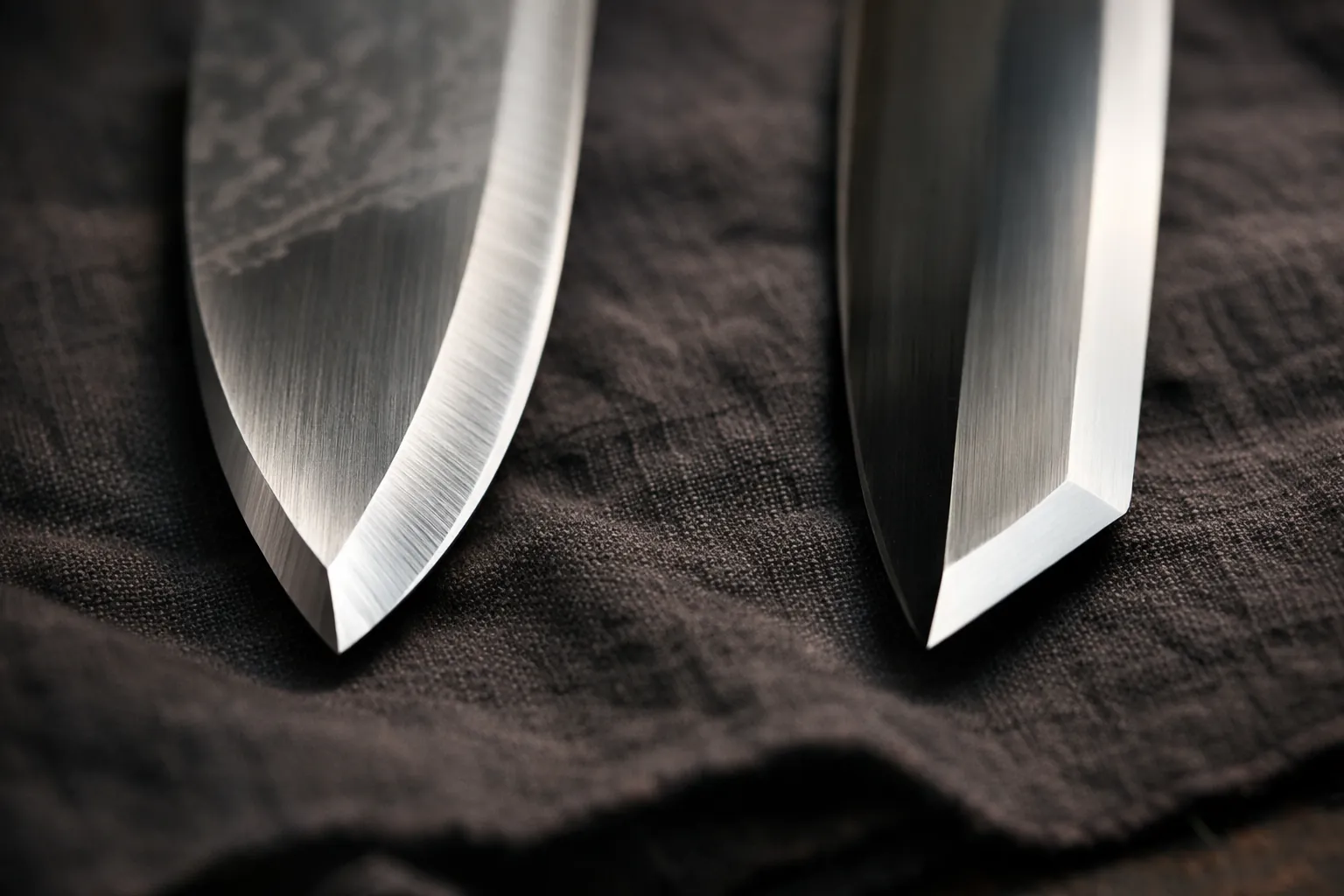
How do you tell? Lay the knife flat on a table, edge toward you, and look along the edge. A double bevel shows a narrow polished strip on both faces. A single bevel shows a wide bevel on one face and nothing on the other.
15 vs 16: how much it actually matters
On an average chef's knife, the gap between 15 and 16 degrees is less than a millimeter of spine height. That's smaller than the wobble in most people's freehand stroke. So the argument is real but small, and it matters for one reason: tools.
| Blade width at heel | Knife it fits | Spine at 15° | Spine at 16° (Shun) | Difference |
|---|---|---|---|---|
| 25 mm / 1.0 in | paring | 6.5 mm | 6.9 mm | 0.4 mm |
| 35 mm / 1.4 in | utility, petty | 9.1 mm | 9.6 mm | 0.6 mm |
| 45 mm / 1.8 in | santoku, nakiri | 11.6 mm | 12.4 mm | 0.8 mm |
| 50 mm / 2.0 in | 8-inch chef's | 12.9 mm | 13.8 mm | 0.8 mm |
Spine centerline height = blade width × sin(angle). Widths are typical examples, not Shun specifications: measure your own blade at the heel.
Most fixed-angle sharpeners offer 15 and 20. Use 15 on a Shun and each session takes the edge a hair thinner than Shun set it. Over years that's a slightly more fragile edge on very hard steel. Use 20 and you grind the edge thicker, which costs you the reason you bought a Shun. If your tool can do 16, use 16. If it can only do 15 or 20, pick 15. Plug your exact width into the angle calculator with the Shun preset to get your number.
Tools that hold 16°, or close
| Tool | Angle | For a Shun |
|---|---|---|
| Shun's own honing steel, retractable sharpener and Sharpening System | 16° | Exact match, by design |
| Work Sharp Precision Adjust | 15–30° per side, adjustable | Set it to 16. The only common guided system here that lands on Shun's number. |
| Spyderco Sharpmaker | 30° inclusive = 15° per side | One degree thin; fine for touch-ups |
| HORL 3 Cruise rolling sharpener | 15° or 20° (magnetic angle support) | Use the 15° side |
| Chef'sChoice 15XV | 15° (electric) | Works; removes more steel than a stone |
| Whetstone, freehand | whatever you hold | Exact, once your hand learns it |
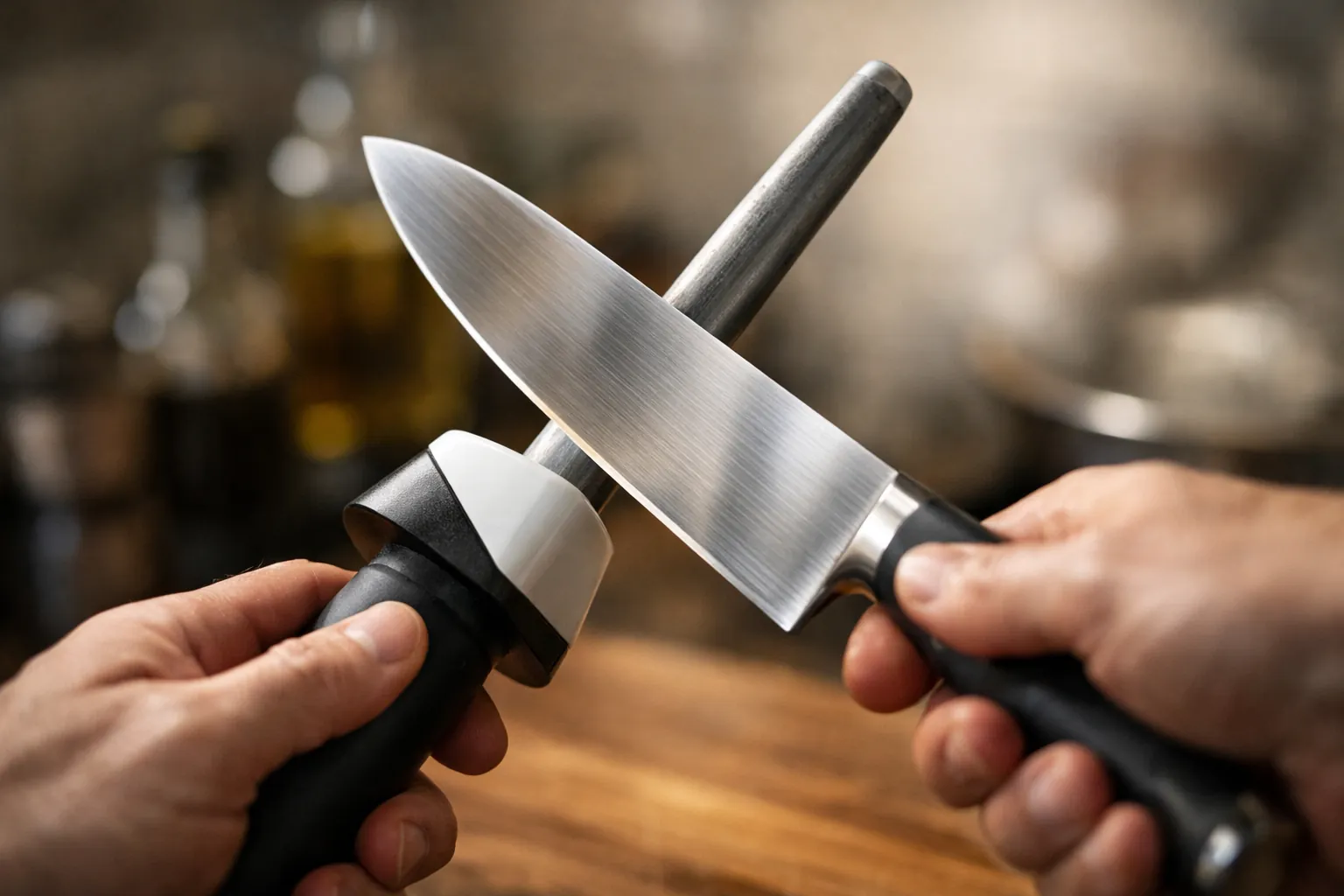
For honing between sharpenings, Shun's FAQ says its honing steel has the 16° guide built into the handle. The Shun Premier combination honing steel has that built-in guide: its listing says it hones to a 16 degree angle, with a smooth side for weekly honing and a micro-ribbed side for monthly honing. Our best honing rod guide covers ceramic rods, which are gentler on hard Japanese steel than a plain grooved steel.
The stone route, and the grits to use
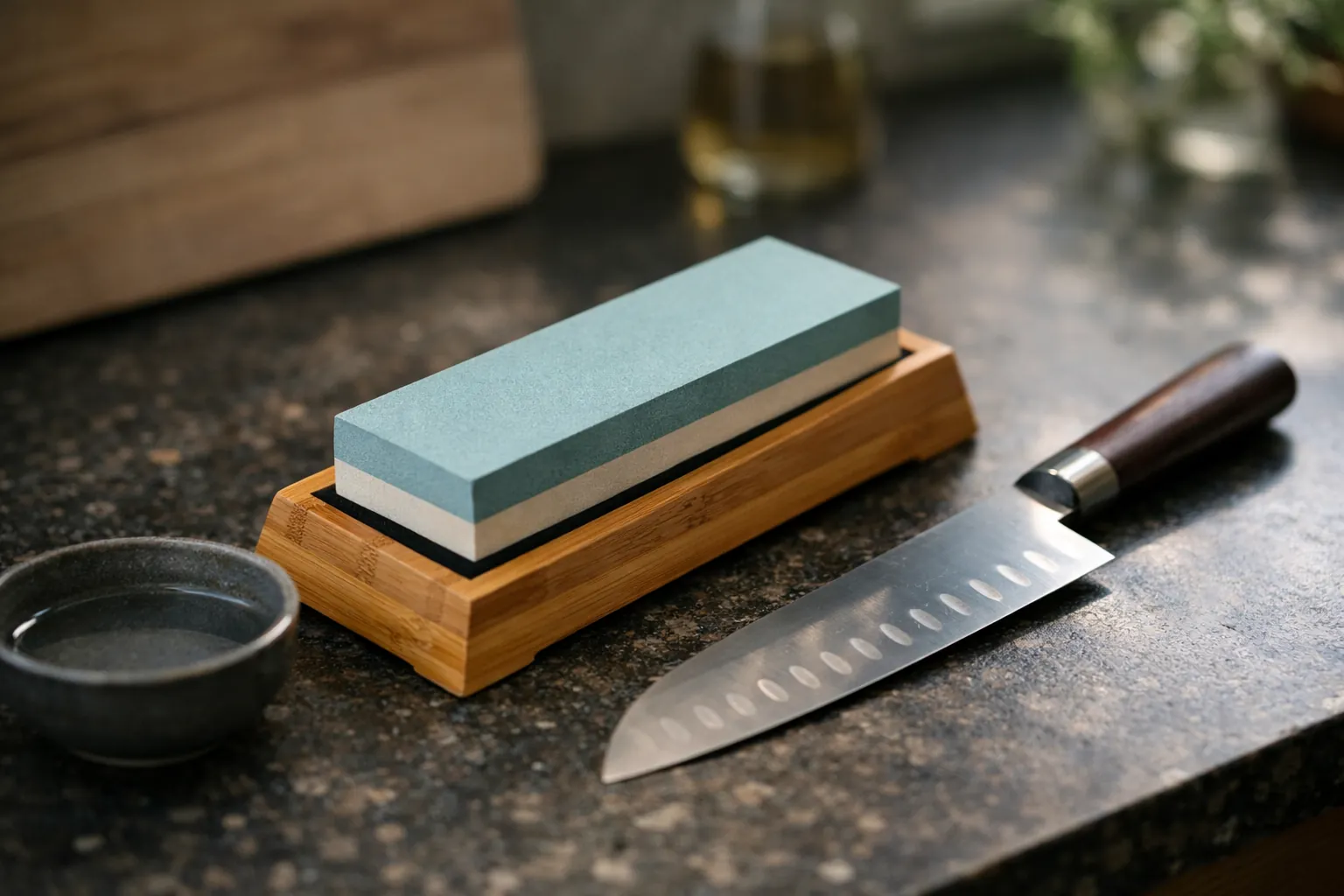
Shun's hard, thin steel is what whetstones do best. A 1000-grit stone sets the 16° bevel and a 5000 or 6000 finishes it. Two good-value ways in:
- The Sharp Pebble 1000/6000 combination stone, which has more than 25,000 Amazon ratings and comes with a bamboo base and an angle guide (the listing doesn't state the guide's angle).
- The Shapton Kuromaku 1000 + 5000 set, two separate 210 × 70 mm ceramic stones whose ventilated plastic boxes double as holders. It's the step up for anyone sharpening Japanese knives every few weeks.
If the edge has a chip, start lower than 1000. The whetstone grit progression chart lays out the order by knife condition and has a session checklist you can print. For complete kits, see the best whetstone sets for beginners and the best knife sharpeners for Japanese knives.
Or let Shun do it
Shun's FAQ offers free sharpening at its Tualatin, Oregon facility. For a chipped tip or an edge that's been through a pull-through sharpener a few too many times, that's the cheapest fix there is, even after shipping. For routine upkeep, though, a week without your favorite knife gets old. A stone and a honing steel at 16° mean you only need the service for real damage.
Quotes from shun.kaiusa.com/faq, checked October 3, 2026, cross-checked against Tormek's "Knife sharpening angles: Manufacturer's recommendations" (2020). Spine heights calculated. Product details from Amazon listings checked the same day. How we research · Affiliate disclosure