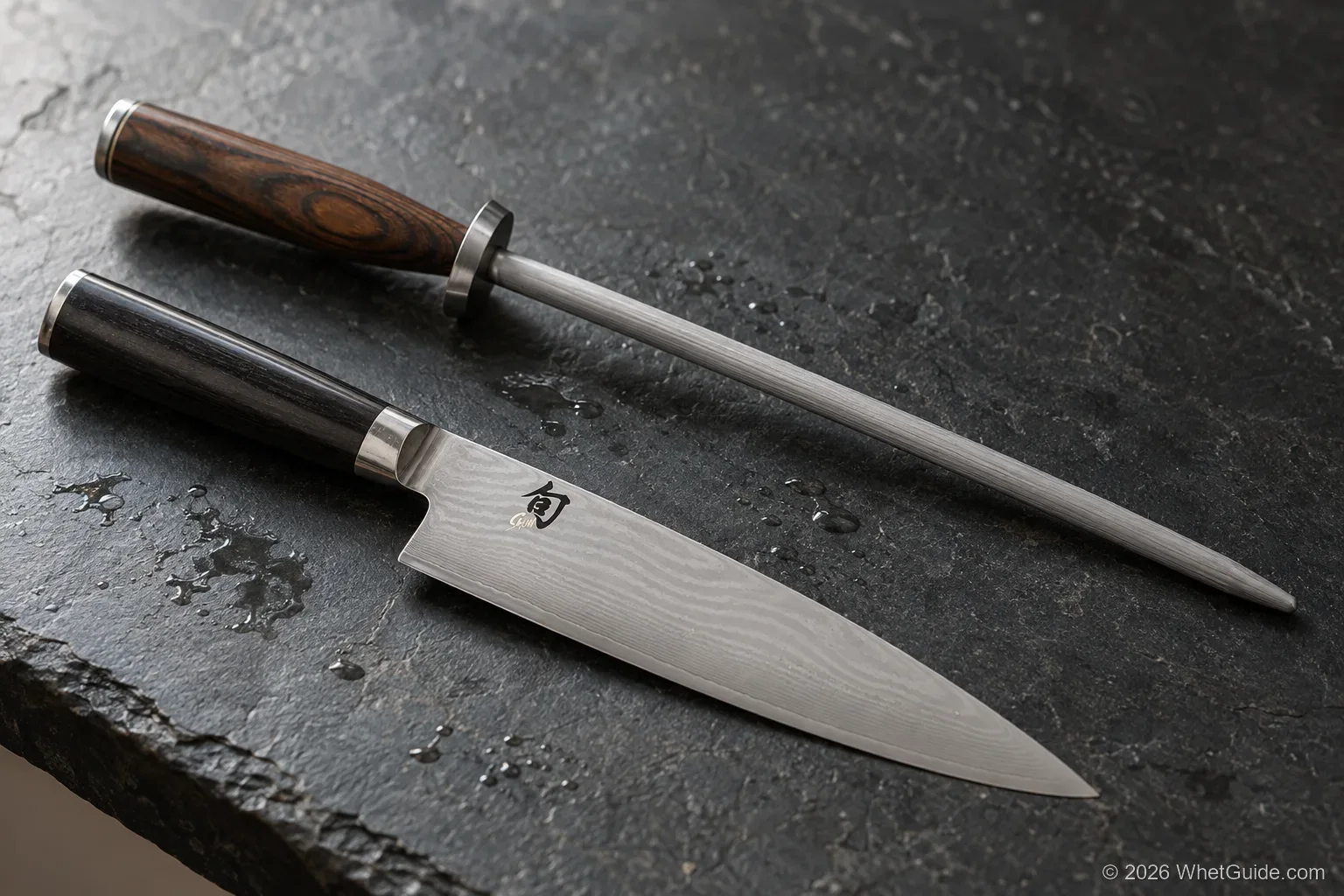
The best knife sharpener for Shun knives is one that can hold 16 degrees per side, which is the angle Shun grinds its standard knives to. Shun's own answer is Kai's retractable pull-through, fixed at 16 and about $30. The Work Sharp Precision Adjust is the easiest tool you can set to 16 for every knife you own. A 1000/6000 whetstone gives the best edge if you will learn it. A fixed 20 degree pull-through is the one thing to avoid.
Quick picks
| Shun's own pull-through | Kai PRO retractable sharpener | Amazon |
|---|---|---|
| Shun's own stone kit | Shun 3-piece whetstone sharpening system | Amazon |
| Best for hitting 16° | Work Sharp Precision Adjust | Amazon |
| Best whetstone to start with | Sharp Pebble 1000/6000 whetstone kit | Amazon |
| Best for weekly honing | Shun Premier 9 inch combination honing steel | Amazon |
| Best Japanese-made stone kit | KING 1000/6000 whetstone starter set | Amazon |
| Best adjustable pull-through | Cangshan 3-stage adjustable sharpener | Amazon |
| Best budget angle choice | Sharp Pebble 5 Precision Adjust | Amazon |
| Cheapest touch-up | AccuSharp Gourmet 15 degree | Amazon |
| Best electric, with caveats | Chef'sChoice 15XV EdgeSelect | Amazon |
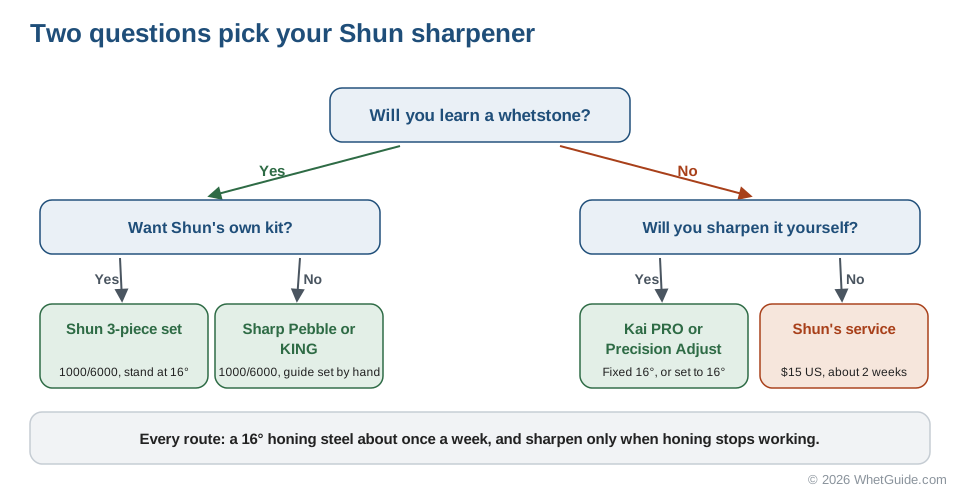
How we picked these
Forums argue about this question without settling it, and most retail pages that rank for it list generic sharpeners. We started from the one fact that decides fit: edge angle. Shun's own FAQ says its knives are sharpened to 16 degrees on each side, which our Shun sharpening angle guide covers in full. We then went through Amazon listings and maker pages and kept tools whose stated angles reach 16 or land within a degree or two, plus the 1000/6000 stone kits that follow the same grit path as Shun's own set.
Three picks carry the Shun or Kai name (Kai is the Japanese company that makes Shun). The Kai pull-through and Shun's 3-piece set go first because they're built to Shun's number; the Shun steel follows later as the honing pick. The rest are angle-matched rather than brand-matched. Angles and grits come from each product listing unless a line says otherwise. Where the listing is silent, we name the outside source, and when only one source gives a figure we say so.
Start with Shun's own sharpeners
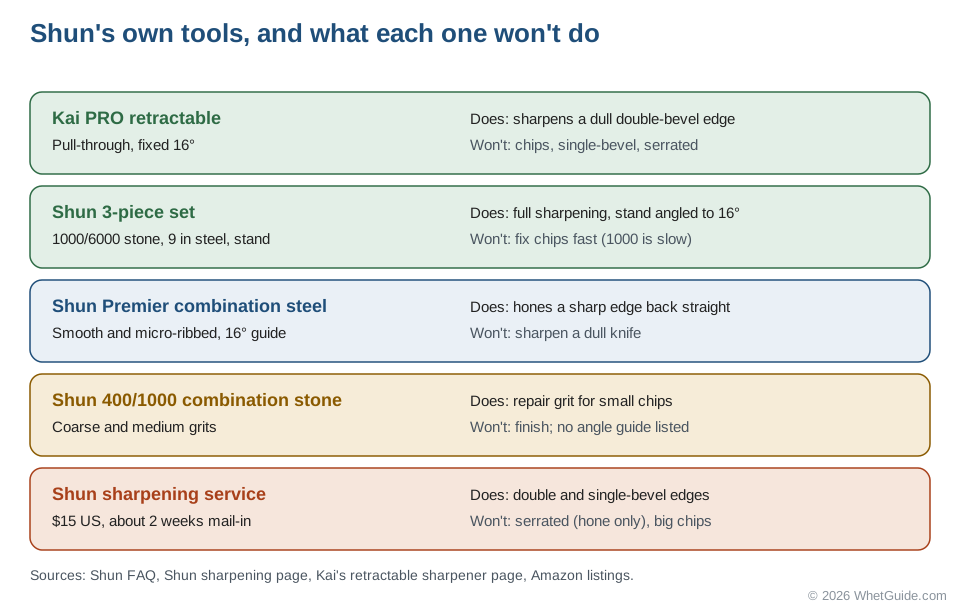
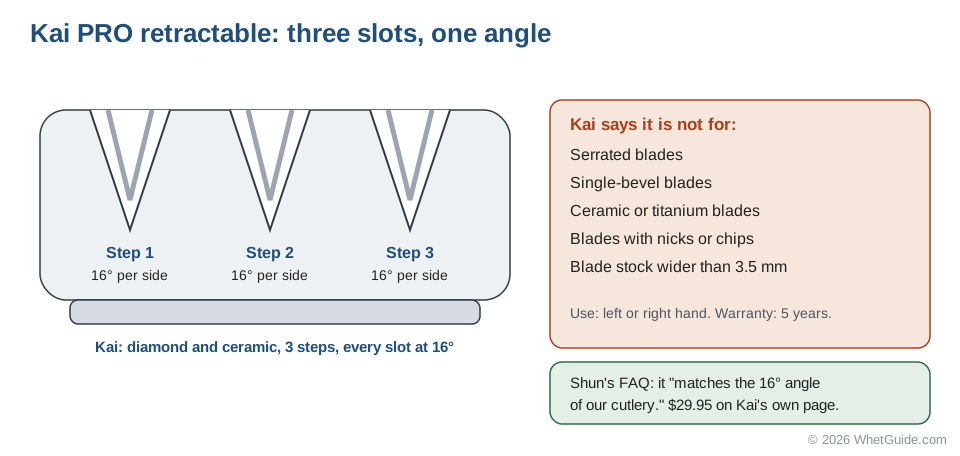
Most "best sharpener for Shun" lists skip the obvious place to look. Shun's FAQ names its pick for a manual pull-through: "try our Diamond and Ceramic Retractable Sharpener, which matches the 16° angle of our cutlery." On Amazon it's sold as the Kai PRO Ceramic Diamond Pull Sharpening System, and Kai's own page lists it at $29.95 with three steps, a 16 degree angle on every step and a 5-year warranty. No other pull-through we found states 16. For stones, Shun's FAQ describes a 3-piece system: a 1000/6000 combination whetstone, a 9 inch honing steel and a bamboo stand "angled to 16°."
Both have limits, and Kai prints them. The pull-through is not for serrated, single-bevel, ceramic or titanium blades, or for blades with nicks or chips, or blade stock wider than 3.5 mm. That rules it out for a Shun bread knife and for any single-bevel knife, and it makes it the wrong tool for the Western Cook's Knife, which Shun grinds at 22 degrees. The 3-piece set has no coarse stone, so a chipped Shun needs a 400 grit first.
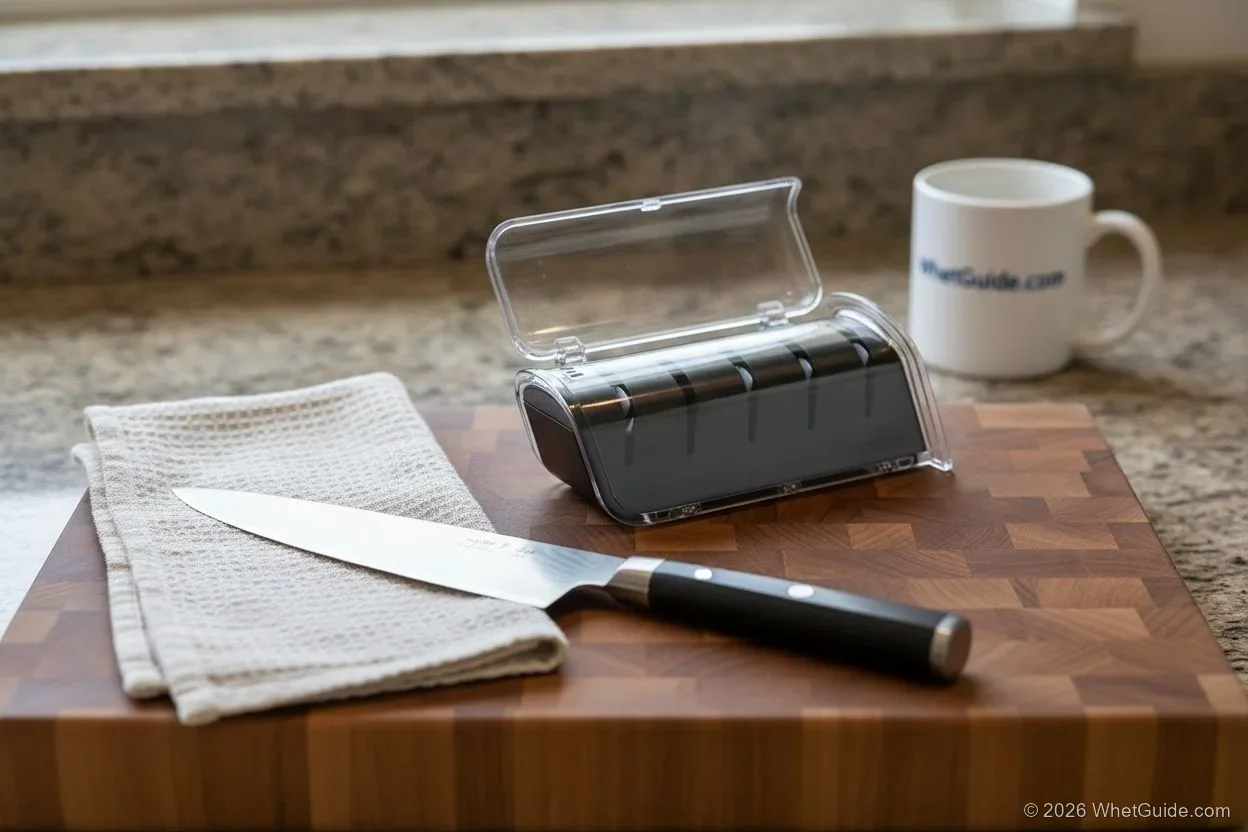
Check which Shun edge you have
The 16 degree rule covers Shun's double-bevel kitchen knives, which is nearly the whole line. Shun's FAQ names one exception: "the Western Cook's Knife has been sharpened to a slightly wider angle; 22° on each side." Single-bevel knives follow a different rule. Shun's sharpening page says they have a small micro-bevel on the back, and its service restores it. Serrated knives are their own case again: Shun's service only hones them, and Kai's pull-through refuses them.
So before you buy, look at the knives in your block, not just the chef's knife. If you own the Western Cook's, an adjustable tool you can set to 22 keeps both knives right. A single-bevel owner needs a stone or the service. For a Shun bread knife, see sharpeners for serrated knives.
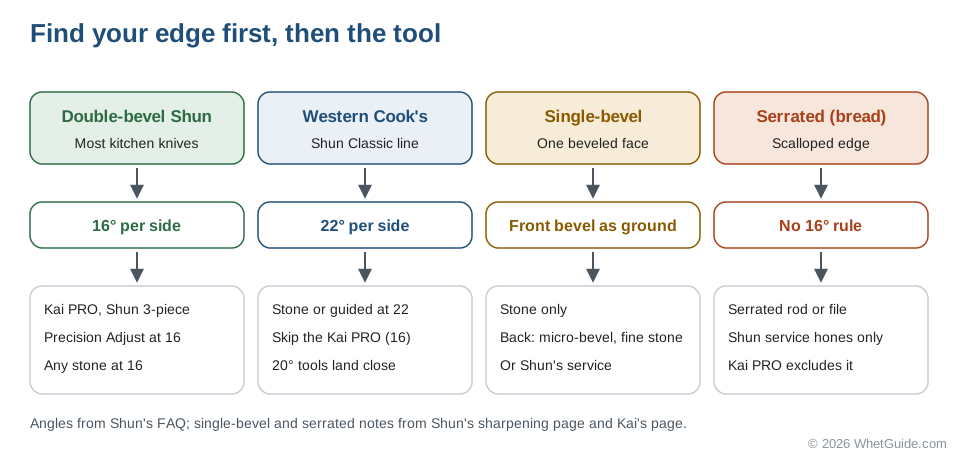
- Count the double-bevel knives. They all take 16, so one fixed-16 tool covers them.
- Look for a Western Cook's Knife. If you have one, buy an adjustable tool that reaches 22.
- Look for a one-sided edge or scallops. Single-bevel and serrated knives rule out the Kai PRO.
- Sight down the edge under a light. Visible nicks mean a coarse stone or the service first.
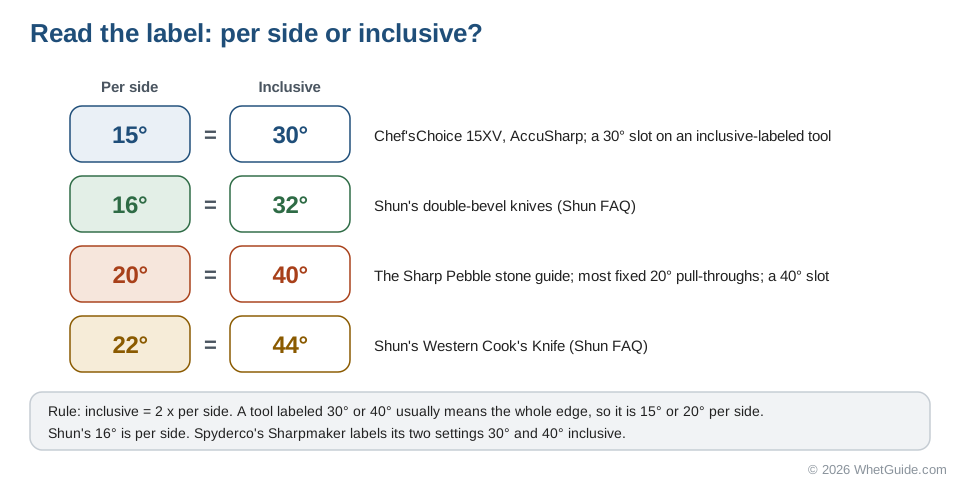
- Read the angle on the box as per side or inclusive before you compare it with 16.
Shun line by line: steel and hardness, plus the sharpener to fit
| Shun line | Steel | Rockwell | Edge | Sharpener that fits |
|---|---|---|---|---|
| Classic, Classic Blonde | VG-MAX | 60 to 61 | 16° double bevel | Kai PRO or any 16° tool; the Western Cook's in this line is 22° |
| Premier, Premier Blonde | VG-MAX | 60 to 61 | 16° double bevel | Kai PRO, Precision Adjust at 16 or a 1000/6000 stone |
| Dual Core | VG10 and VG2, layered | 60 to 61 | 16° double bevel; the yanagiba is single bevel | Any 16° tool; the yanagiba goes to a stone or Shun's service |
| Kanso | AUS10A | 60 | 16° double bevel | Kai PRO or Precision Adjust at 16 |
| Sora | VG10 | 60 to 61 | 16° double bevel | Kai PRO is the low-cost match |
| Narukami | Blue II carbon steel | 61 to 62 | 16° double bevel | Stone or guided at 16; carbon steel needs drying straight after use |
Which tools can hit 16 degrees
Most home sharpeners offer one or two preset angles. A tool that only does 15 and 20 forces a choice on a Shun. Use 15 and each session takes the edge a little thinner than Shun set it. Use 20 and you grind the edge thicker, which gives up the thin edge you bought the knife for. The table puts every pick against 16.
| Tool | Angles stated | Reaches 16? |
|---|---|---|
| Kai PRO retractable | 16° fixed (Kai) | Yes, by design |
| Shun 3-piece set | Stand angled to 16° (Shun FAQ) | Yes, by design |
| Shun Premier combination steel | Built-in 16° guide | Yes, by design (hones only) |
| Work Sharp Precision Adjust | 15° to 30°, adjustable | Yes, set it to 16 |
| Cangshan 3-stage | 14° to 24°, adjustable | Within its range |
| Sharp Pebble Precision Adjust | 12°, 15°, 18°, 21°, 24° | No; use 15 or 18 |
| AccuSharp Gourmet | 15° fixed | No; one degree thin |
| Chef'sChoice 15XV | 15° only (converts 20° edges) | No; one degree thin |
| Sharp Pebble 1000/6000 stone | Guide included: 20° (GearJunkie; listing gives no number) | Not with the guide; freehand at 16 |
Angles from each listing unless a source is named in the row. The Sharp Pebble guide angle comes from one source, GearJunkie's guide to knife sharpeners, so check yours with the marker test. Shun's stated angle and its exception are in our angle guide.
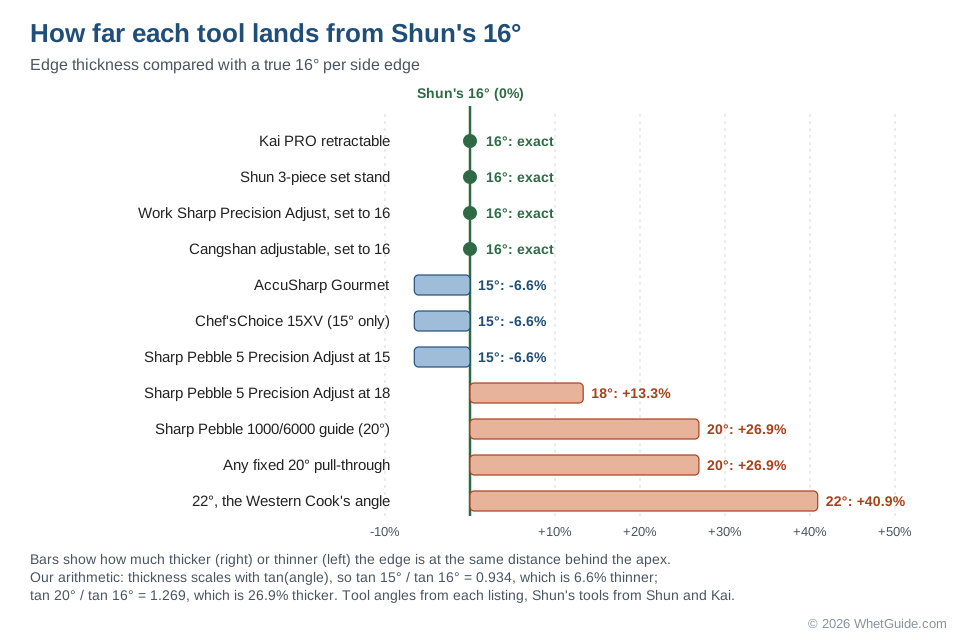
| Per-side angle | Edge thickness 1 mm behind the apex | Against Shun's 16° |
|---|---|---|
| 15° | 0.54 mm | 6.6% thinner |
| 16° (Shun) | 0.57 mm | Shun's edge |
| 18° | 0.65 mm | 13.3% thicker |
| 20° | 0.73 mm | 26.9% thicker |
| 22° (Western Cook's) | 0.81 mm | 40.9% thicker |
The 10 best sharpeners for Shun knives
Kai PRO retractable sharpener
This is the pull-through Shun's FAQ recommends, and the only one we found that states 16 degrees. You don't set anything. Kai's page lists three steps and a 5-year warranty, and the slots retract for storage. Its not-for list, in the specs, is the catch. For a set of double-bevel Shun knives in good shape, it's the cheapest way to stay on Shun's angle.
- Angle16° fixed
- Steps3 (diamond and ceramic)
- Handleft or right
- Warranty5 years (Kai)
- Not forserrated, single-bevel, ceramic, titanium, chipped blades
Why it stands out
- Fixed at Shun's 16°, recommended by Shun
- About $30 on Kai's page
Think twice if
- Your knives have chips, or include the 22° Western Cook's
Shun 3-piece whetstone sharpening system
Shun's own stone kit: the 1000/6000 grit path, a 9 inch steel for honing between sharpenings, and a bamboo stand Shun says is angled to 16 degrees. It costs several times a generic 1000/6000 kit. You're paying for the matched stand and the steel, plus the name. If you already own a steel and can hold an angle, a Sharp Pebble kit covers the same grits for less.
- Stone1000 / 6000 combination
- Steel9 in honing steel
- Standbamboo, angled to 16° (Shun FAQ)
- ModelDM0610
Why it stands out
- Built around Shun's 16°, sold by Shun
- Stone and steel in one box, with a matched stand
Think twice if
- Your knife is chipped, since 1000 is the coarsest grit
Work Sharp Precision Adjust
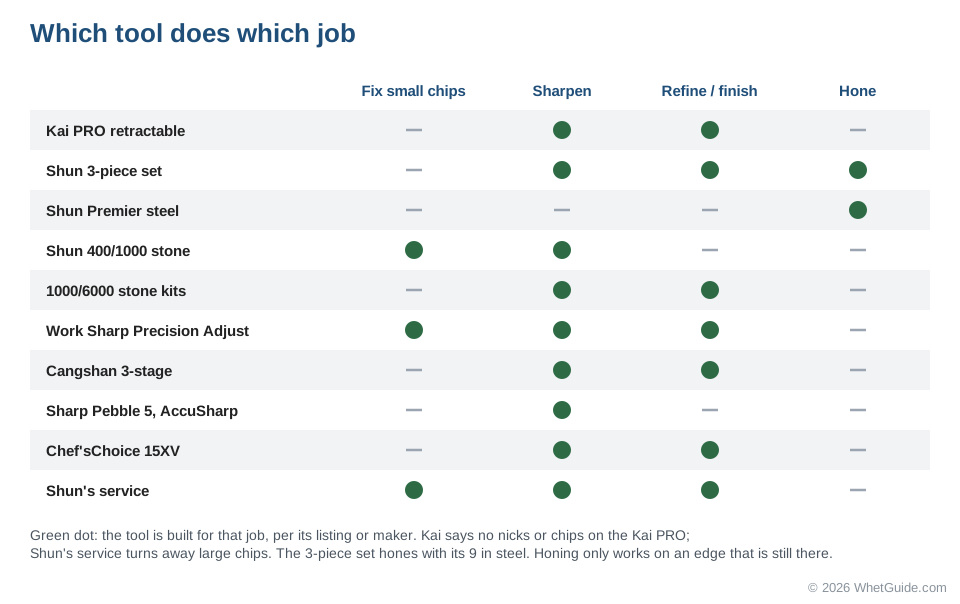
Set it to 16 and the guide holds that angle every stroke, so you get Shun's number without learning freehand. The listing says it goes from coarse to fine in one setup, so a chipped edge gets reprofiled and then polished, and it handles the 22 degree Western Cook's on the same dial. America's Test Kitchen's 2025 roundup named a Work Sharp controlled-angle system its upgrade pick, with a 15 to 30 degree range and a learning curve. GearJunkie also ranks it first but notes the angles aren't always accurate and that reprofiling is slow, so run the marker test on your first knife. More on the clamp in our Precision Adjust review.
- Angle15° to 30°, adjustable
- Typeguided manual system
- Abrasivesgraded plates, coarse to fine
- Serrated edgeslisted
- Powernone
Why it stands out
- Lets you set 16, not 15 or 20
- Over 11,000 ratings on the listing
Think twice if
- You want a two-second pull-through, since this is a setup-and-clamp system
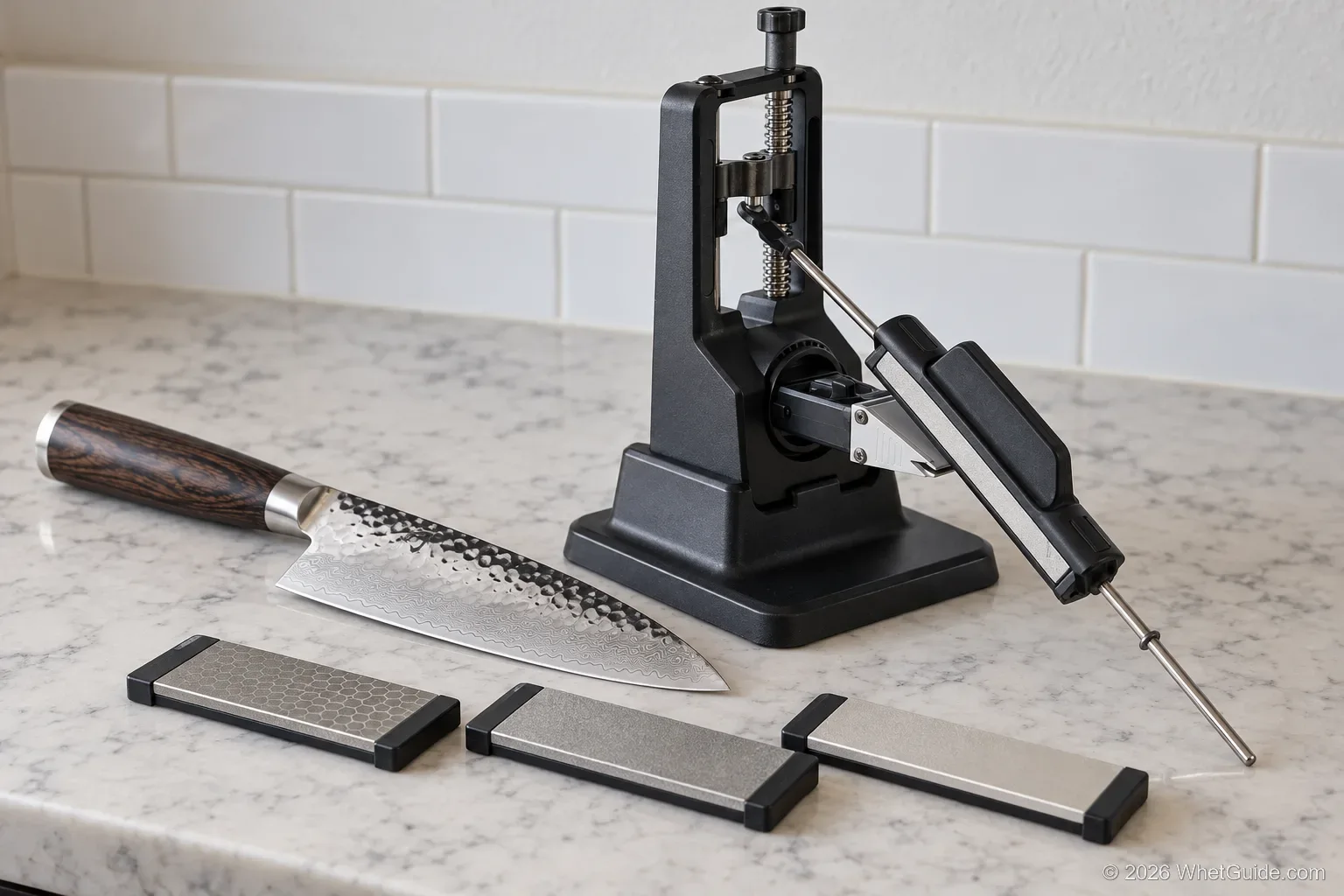
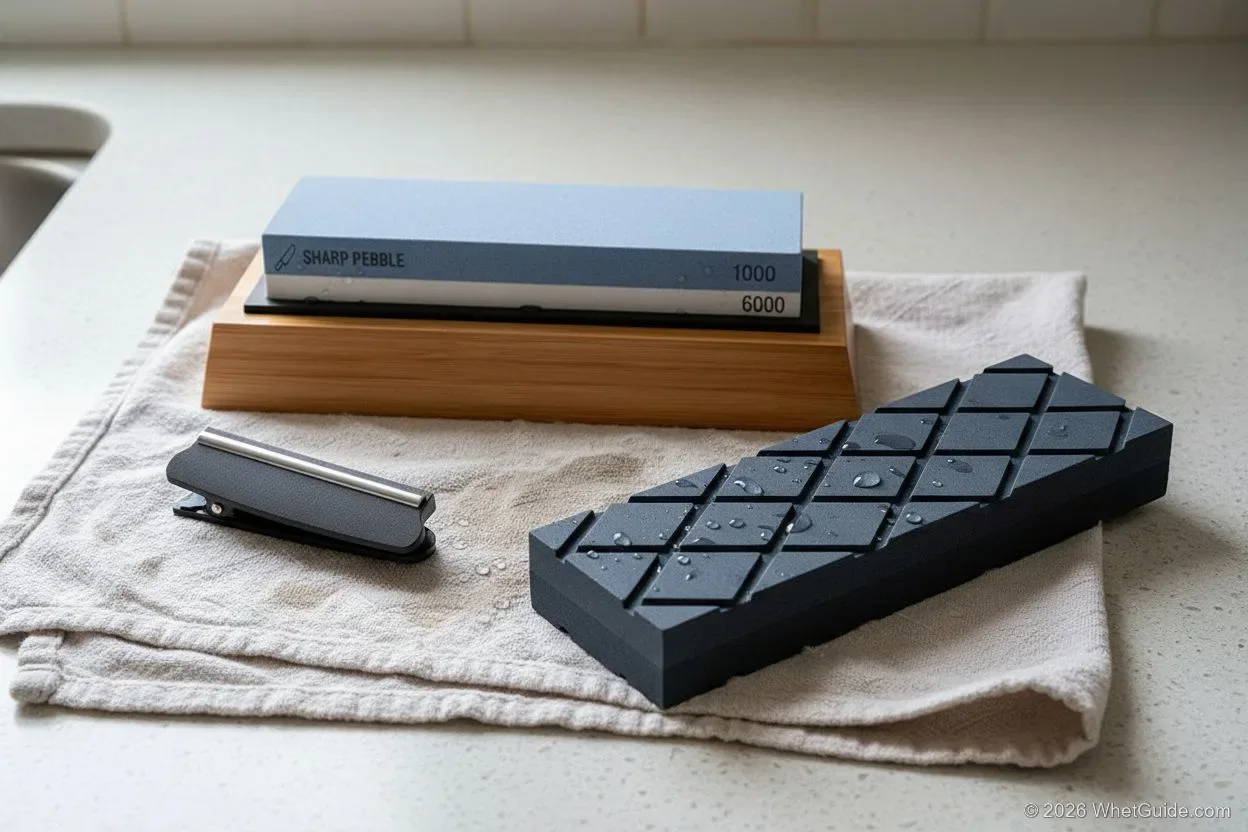
Sharp Pebble 1000/6000 whetstone kit
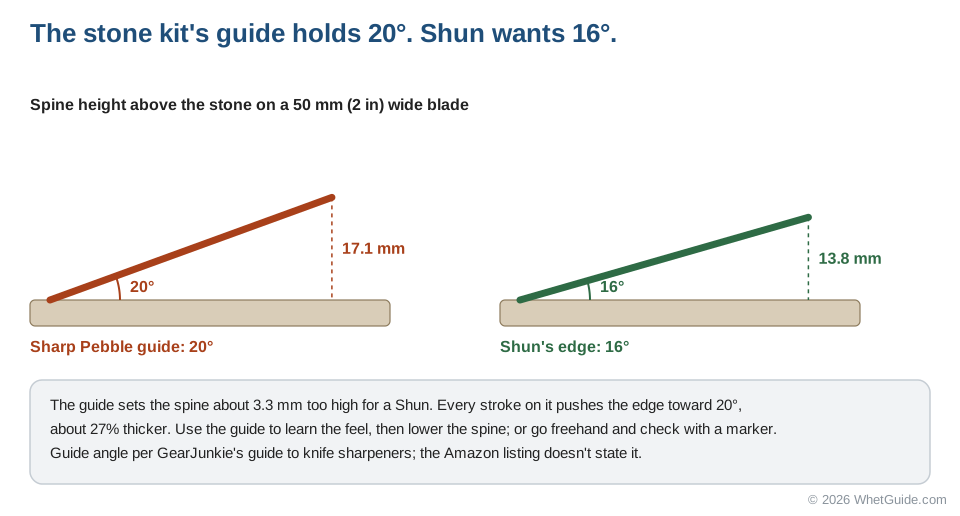
The same 1000/6000 grit path as Shun's own set, at a fraction of the cost, with over 25,000 ratings. The catch is the angle guide. The listing gives no number, and GearJunkie's guide says the one included is 20 degrees. That's 4 degrees steep for a Shun, so use the guide to learn the motion, then lower the spine about 3 mm on a 50 mm wide blade, or go freehand and check with a marker. No coarse stone comes in the box. For kits that start coarser, see beginner whetstone sets.
- Grits1000 / 6000
- Materialcorundum
- Includesbamboo base, angle guide, instruction manual
- Lubricantwater
- Size7.25 x 2.25 in
Why it stands out
- The 1000/6000 path Shun's own kit uses
- Water only, no oil
Think twice if
- Your edge is chipped, because 1000 grit is a slow starting point
- You want the included guide to set 16 for you
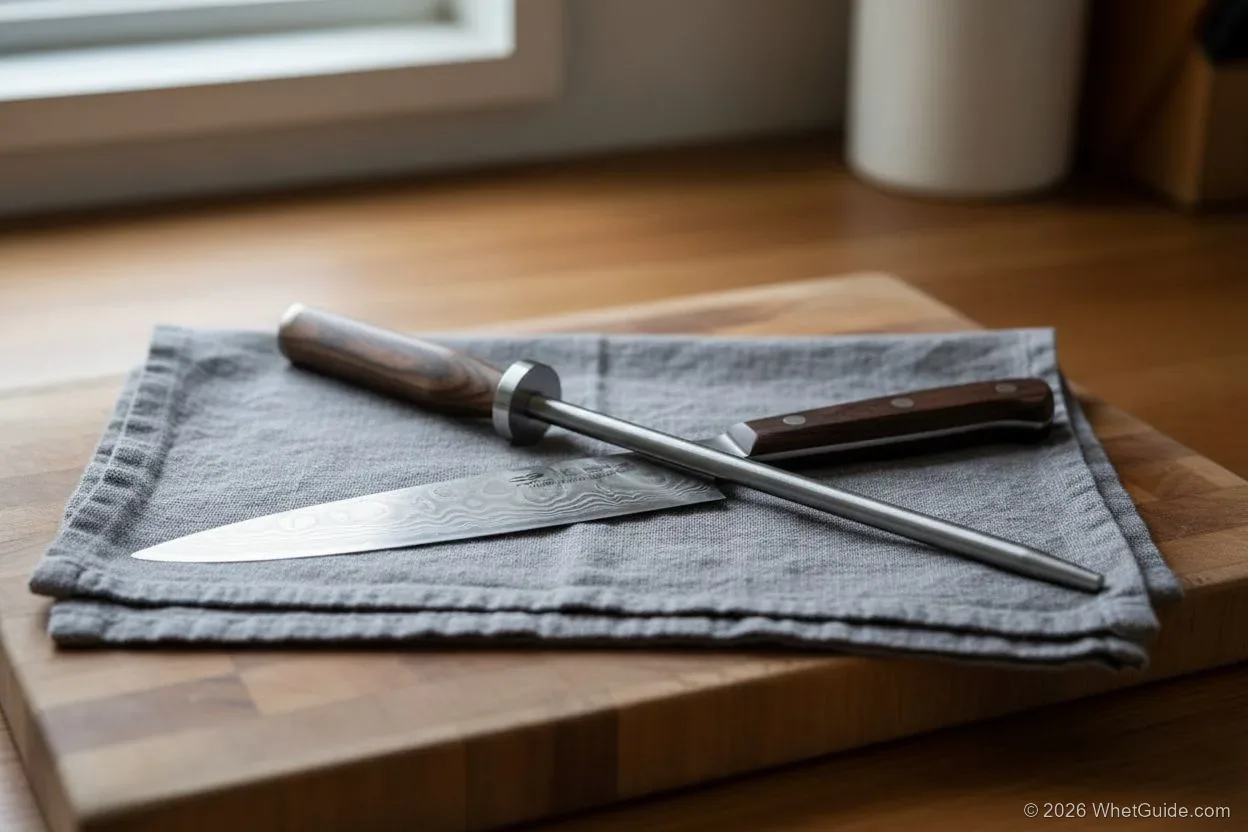
Shun Premier 9 inch combination honing steel
Honing doesn't sharpen a dull knife, but it keeps one sharp longer. The guide on the handle sets 16 degrees, so you don't have to judge it. The listing assigns the smooth side to weekly use and the micro-ribbed side to monthly use. Buy this one even if you also own a stone: it's the tool you'll pick up most often, and Shun asks owners to keep diamond steels out of regular honing.
- Length9 in
- Anglebuilt-in 16° guide
- Surfacessmooth (weekly) / micro-ribbed (monthly)
- HandlePakkawood
- Materialstainless steel
Why it stands out
- Matches Shun's angle by design
- Two surfaces for different intervals
Think twice if
- Your knife is already dull, since a steel only maintains an edge
KING 1000/6000 whetstone starter set
A heavier, larger stone than the Sharp Pebble, made in Japan according to the listing, with an angle holder that has ceramic rods. The listing leaves the holder's angle unspecified, so treat it like any guide and confirm 16 with a marker. Pick it for the bigger surface, which makes long strokes on an 8 or 10 inch Shun easier, and for a stone with Japanese origin.
- Grits1000 / 6000
- Originmade in Japan (per listing)
- Includesangle holder with two ceramic rods, wiping cloth
- Size9 x 3.1 x 2.2 in
Why it stands out
- Larger stone surface than most kits
- Angle holder included
Think twice if
- You want a documented preset angle
Cangshan 3-stage adjustable sharpener
The cheapest adjustable tool with 16 inside its range, with a carbide stage for dull edges and a ceramic stage for finishing. Cangshan says it works on Western and Asian knives, and the listing warns against serrated and single-bevel blades. Next to the Kai PRO, its edge is that it can also go to 22 for the Western Cook's. Use light pulls, and stop when the first stage has raised a burr.
- Angles14° to 24° adjustable
- Stagestungsten carbide, ceramic, scissor slot
- Not forserrated or single-bevel knives
- Basenonslip rubberized
Why it stands out
- Range covers 16 and 22 degrees
- Fast, with no clamp
Think twice if
- You own single-bevel or serrated Shun knives
Sharp Pebble 5 Precision Adjust
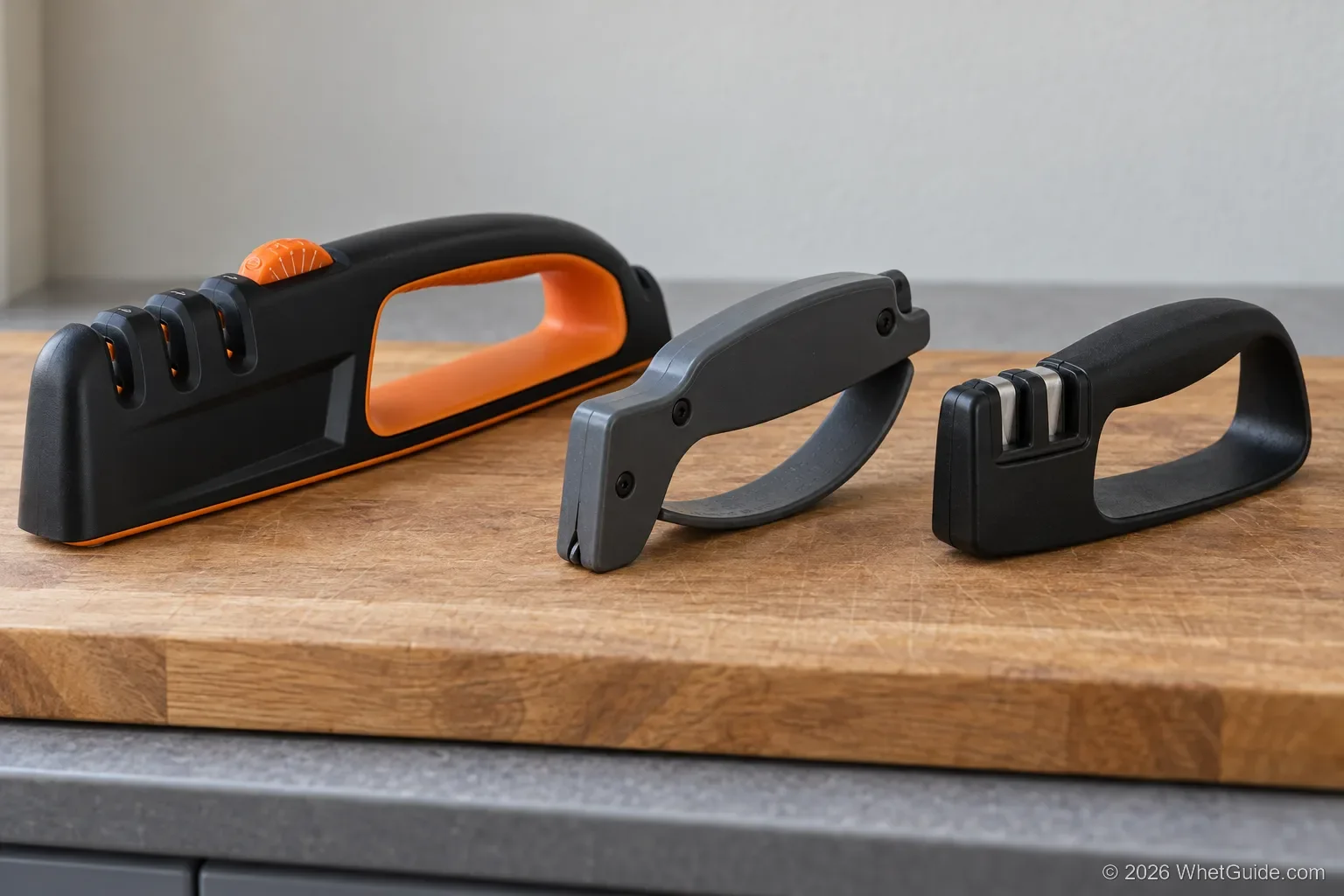
The five settings step by 3 degrees, so 16 isn't available. Choose 15 for slightly thinner than Shun, or 18 for slightly thicker. We'd pick 15 on a Shun: by our arithmetic it's 6.6 percent thinner, against 13.3 percent thicker at 18. The listing says straight blades only.
- Angles12°, 15°, 18°, 21°, 24°
- Stages3
- BodyABS plastic
Why it stands out
- Five angle choices, including 15
- About 1.5 ounces, so it travels anywhere
Think twice if
- You want exactly 16 degrees
AccuSharp Gourmet 15 degree
A single-angle pull-through for fast touch-ups at 15 degrees, one degree thinner than Shun's edge. The listing says the blades reverse to double the sharpener's life, and it has more than 28,000 ratings. A tungsten carbide pull-through is an aggressive tool, so keep it for the times a steel won't bring the edge back and a stone isn't handy.
- Angle15°
- Bladesreversible diamond-honed tungsten carbide
- Edgesserrated or straight
- Guardfull-length finger guard
Why it stands out
- 15 degrees is close enough for occasional use
- Tiny and cheap
Think twice if
- You sharpen your Shun weekly, because carbide removes more metal than a stone
Chef'sChoice 15XV EdgeSelect
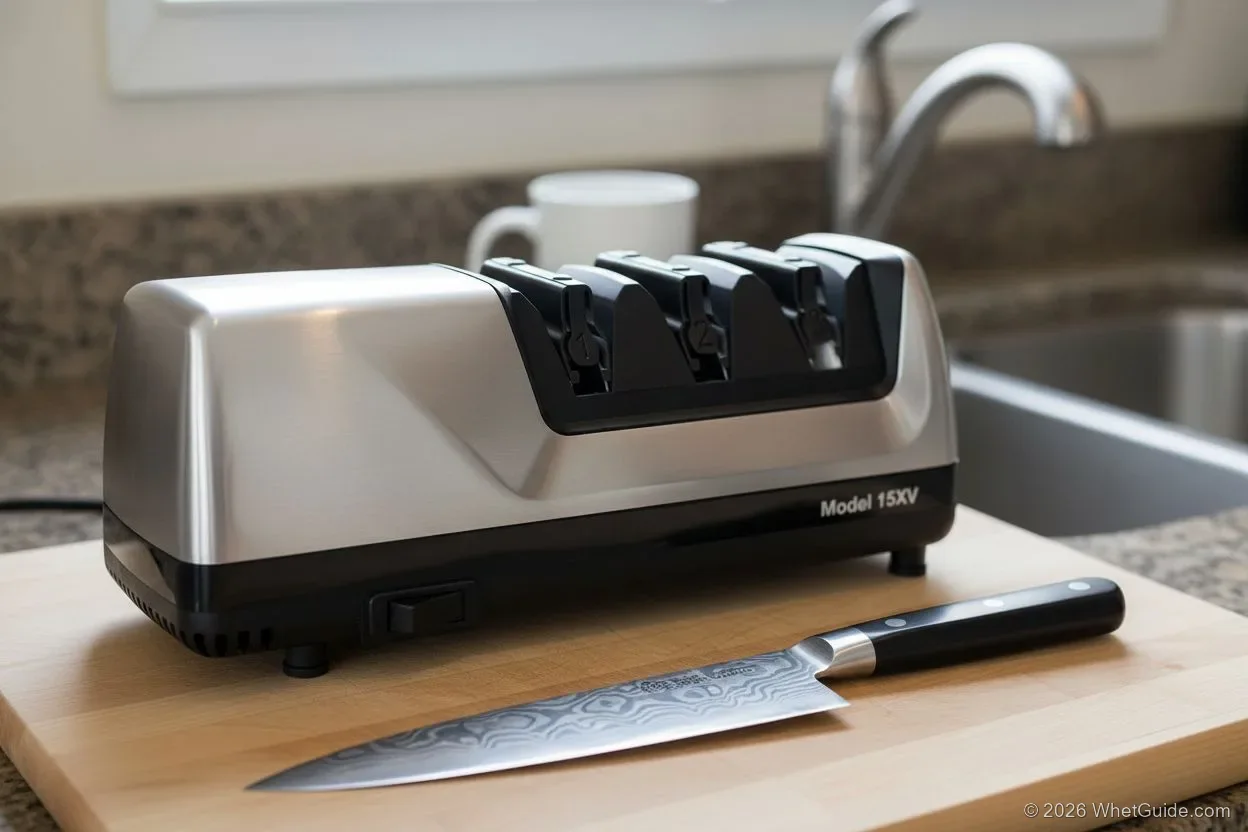
The 15XV converts edges to its 15 degree profile, a hair thinner than Shun's 16, and GearJunkie lists "only 15-degree bevel" among its cons. It does that quickly: the listing says about a minute the first time and about ten seconds after. The tradeoff is permanent. You swap Shun's factory geometry for Chef'sChoice's, and each session takes a little steel. It suits a household with a drawer of mixed knives where one or two are Shun.
- Angle15° only
- Stages3 (two diamond, one flexible stropping)
- Housingbrushed metal
- Knivesstraight and serrated
- Timeabout 1 minute first sharpening, per listing
Why it stands out
- Fast and easy for a household with many knives
- Third stage strops the edge
Think twice if
- You care about keeping Shun's original 16 degrees
- You own Shun's Western Cook's Knife, which is ground at 22
Which route fits you
| If you want | Pick | Trade-off |
|---|---|---|
| Shun's angle with no setup | Kai PRO retractable | No chips, single-bevel or serrated |
| Exact 16° on every knife you own | Work Sharp Precision Adjust | Setup time |
| The best edge for the money | 1000/6000 whetstone | Practice; its guide is 20° |
| Shun's own stone kit | Shun 3-piece set | Costs the most of the stone kits |
| Weekly maintenance | Shun combination steel | Does not fix dull knives |
| A fast pull-through near 16° | Cangshan adjustable | Trust the slot |
| A chip to repair | Shun 400/1000 combination stone | Needs a finishing stone after |
| No effort at all | Shun's service | Shipping and wait |
All ten picks, spec by spec
| Pick | Angle | Abrasive | Chips | Single-bevel | Serrated |
|---|---|---|---|---|---|
| Kai PRO retractable | 16° fixed | Diamond and ceramic, 3 steps | No (Kai) | No (Kai) | No (Kai) |
| Shun 3-piece set | Stand angled to 16° | 1000/6000 stone, plus steel | Slow at 1000 | Yes, freehand | No |
| Work Sharp Precision Adjust | 15° to 30° | Graded plates, coarse to fine | Yes, coarse plate | Not stated | Listed |
| Sharp Pebble 1000/6000 | Guide 20° (GearJunkie) | 1000/6000 corundum | Slow at 1000 | Yes, freehand | No |
| Shun Premier steel | 16° guide | Smooth and micro-ribbed steel | No | Not stated | Not stated |
| KING 1000/6000 | Holder angle not stated | 1000/6000 stone | Slow at 1000 | Yes, freehand | No |
| Cangshan 3-stage | 14° to 24° | Carbide, then ceramic | Not stated | No (listing) | No (listing) |
| Sharp Pebble 5 | 12°, 15°, 18°, 21°, 24° | 3 stages | Not stated | Not stated | No, straight only |
| AccuSharp Gourmet | 15° fixed | Tungsten carbide | Not stated | Not stated | Yes (listing) |
| Chef'sChoice 15XV | 15° fixed | 2 diamond stages, 1 strop | Not stated | Not stated | Yes (listing) |
Three worked examples
A new Shun Classic owner with a starter block
- Check the block for a bread knife or a Western Cook's Knife. Those two are the exceptions; every other Classic knife is 16° VG-MAX.
- Buy the Premier combination steel first and hone about once a week on the smooth side, as Shun's FAQ suggests.
- When honing no longer brings the edge back, sharpen the straight knives in the Kai PRO, steps 1 through 3.
- Send the bread knife to Shun for honing, or use a serrated method; don't put it in the Kai PRO.
- Use a wood or other soft board. Shun's FAQ says a board that shows a slight cut line is soft enough.
A Premier chef's knife with a chipped tip
- Look at the chip under good light. If it's small, it's a home job. If it's large, Shun's service won't take it, so ask a local sharpening service.
- Keep it out of the Kai PRO. Kai lists blades with nicks or chips as not-for.
- On the 400 side of a 400/1000 stone, hold 16° and work the tip area until the chip is gone and a burr forms.
- Blend the rest of the edge on 1000, then refine on 6000. Run the marker test once to confirm you stayed at 16°.
- Find the cause. Shun's FAQ lists the chip risks: bones or joints; frozen food; hard boards; rust spots on the edge.
A Kanso used every day
- Kanso is AUS10A at 60 Rockwell with a 16° edge, per Shun's comparison page, so every 16° tool on this page fits.
- Hone about weekly at the steel's 16° guide, as Shun's FAQ suggests.
- Sharpen when honing stops working. A Kai PRO or a Precision Adjust set to 16 keeps the job to a few minutes.
- Hand wash and dry it. Shun's FAQ says brown spotting can occur on its blade steels, and a rust spot on the thin edge can turn into micro chips.
Three complete kits for a Shun
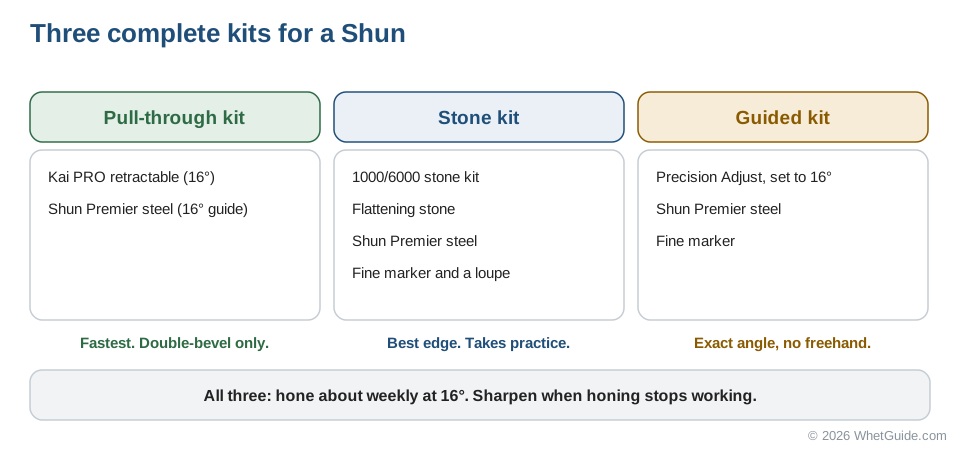
The stone kit has the most parts. Water stones dish with use, and a dished stone changes the angle at the edge even when your hands don't move, so add a flattener such as the Sharp Pebble 120/320 flattening stone or the SCOTTCHEN diamond plate. A POWERTEC stone holder keeps a bare stone from sliding. For the marker test, a fine marker plus a JARLINK 30x/60x loupe shows exactly where the ink came off. Flattening steps are in how to flatten a whetstone.
Anyone who wants a finer finish than 6000 can add the Sharp Pebble 3000/8000, or a leather strop such as the SHARPAL 205H with SHARPAL green compound. Neither is required. Hasu-Seizo suggests a 3000 to 6000 finish for many home cooks, so the 6000 side of a combination stone already sits at the top of that range. Guided-kit owners weighing the Precision Adjust Elite can compare the two in Precision Adjust vs Elite.
The four stones, head to head
| Stone | Grits | Angle aid | Comes with | Best for |
|---|---|---|---|---|
| Shun 3-piece set | 1000/6000 | Bamboo stand angled to 16° (Shun FAQ) | 9 in honing steel | Owners who want Shun's own setup |
| Sharp Pebble | 1000/6000 | Guide at 20° (GearJunkie) | Bamboo base, manual | Learning freehand on a budget |
| KING starter set | 1000/6000 | Holder with ceramic rods, angle not stated | Wiping cloth | A bigger stone, made in Japan per the listing |
| Shun 400/1000 | 400/1000 | None listed | Not stated | Taking out a small chip first |
What each budget buys
| Budget | Best Shun buy | Why |
|---|---|---|
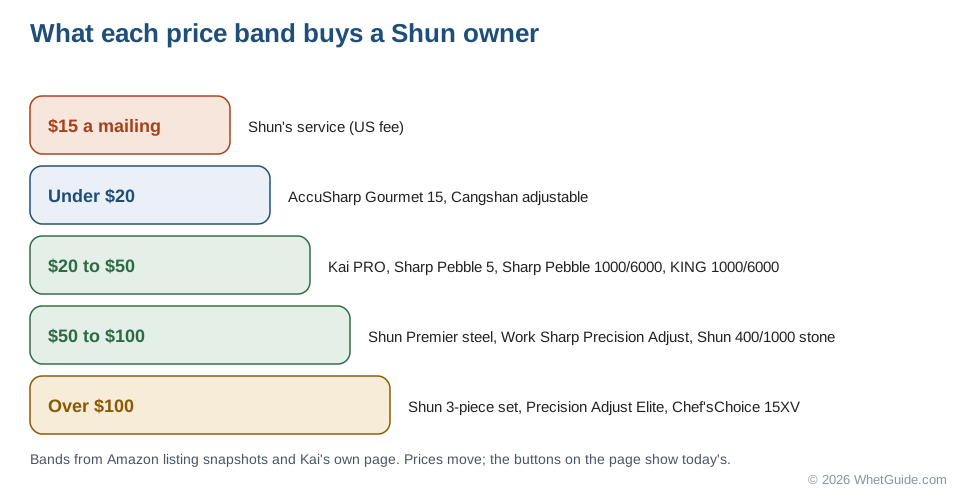
| Under $20 | Cangshan adjustable | 16 is in its range; the fixed 15 tools aren't exact |
| About $30 | Kai PRO retractable | Fixed at 16, recommended by Shun |
| About $40 | Sharp Pebble 1000/6000 | Shun's grit path; learn freehand |
| About $70 | Work Sharp Precision Adjust | Set 16 or 22 on a dial |
| Over $100 | Shun 3-piece set | Shun's stone and steel, with a 16° stand |
Seven common setups, and what to buy for each
| Your knives | Buy | Why |
|---|---|---|
| A Shun Classic block: a chef's knife, a paring knife, a utility knife plus a bread knife | Kai PRO plus the Premier steel; the bread knife goes to a serrated method | Every straight edge is 16. Kai's pull-through refuses serrated blades, and Shun's service only hones them. |
| One Shun chef's knife among German knives | Work Sharp Precision Adjust | Set 16 for the Shun and the other knives' own angle for the rest, on one tool. |
| A Shun chef's knife plus the Western Cook's | Precision Adjust or the Cangshan | Both reach 16 and 22. A fixed-16 tool would thin the Western Cook's by 6 degrees. |
| A Shun with a small chip near the tip | Shun 400/1000 stone, then a 1000/6000 | Kai says no nicks or chips in its pull-through; the 400 removes the damage first. |
| A single-bevel Shun | A 1000/6000 stone, or Shun's service | The pull-throughs on this page exclude single-bevel blades. Shun's service restores the back micro-bevel. |
| You already own the Chef'sChoice 15XV | Keep it, and add the Premier steel | 15 is about 6.6% thinner than 16. Stick with one angle rather than switching tools each session. |
| A gift for a Shun owner | Kai PRO plus the Premier steel, or the Shun 3-piece set | Both come from Shun's maker and sit on 16, so there's nothing for the owner to set. |
Sharpening a Shun on a stone at 16 degrees
- Wet the stone as its maker says, and set it on a holder or damp towel so it can't slide.
- Check that the stone is flat. A dished stone changes the angle at the edge.
- Color the bevel with a fine marker so you can see where you're cutting.
- Set the angle: on a 50 mm (2 inch) wide blade, the spine sits about 13.8 mm off the stone at 16 degrees.
- On the 1000 side, sharpen one face until you can feel a small burr along the whole edge on the other face.
- Switch sides and raise a burr the other way at the same angle.
- Move to the 6000 side with lighter strokes, alternating sides, until the burr is gone.
- Finish with a few light strokes on the steel at its 16 degree guide, or on a strop.
The spine height is our arithmetic (blade width times the sine of the angle), and it matches the figures in our Shun angle guide, which has a full table by blade width. Narrower knives need less lift: a paring knife's spine barely leaves the stone. At 60 to 62 Rockwell (see the line table), the steel rewards patience on the 1000 more than force.
A small chip changes the order. Start on a coarse stone such as the Shun 400/1000 combination stone until the chip is gone, then go to 1000 and 6000 as above. If the chip is large, Shun's service won't take it either, so a local sharpening service is the next place to ask. Full stone technique is in how to use a whetstone.
Check that your tool really lands on 16
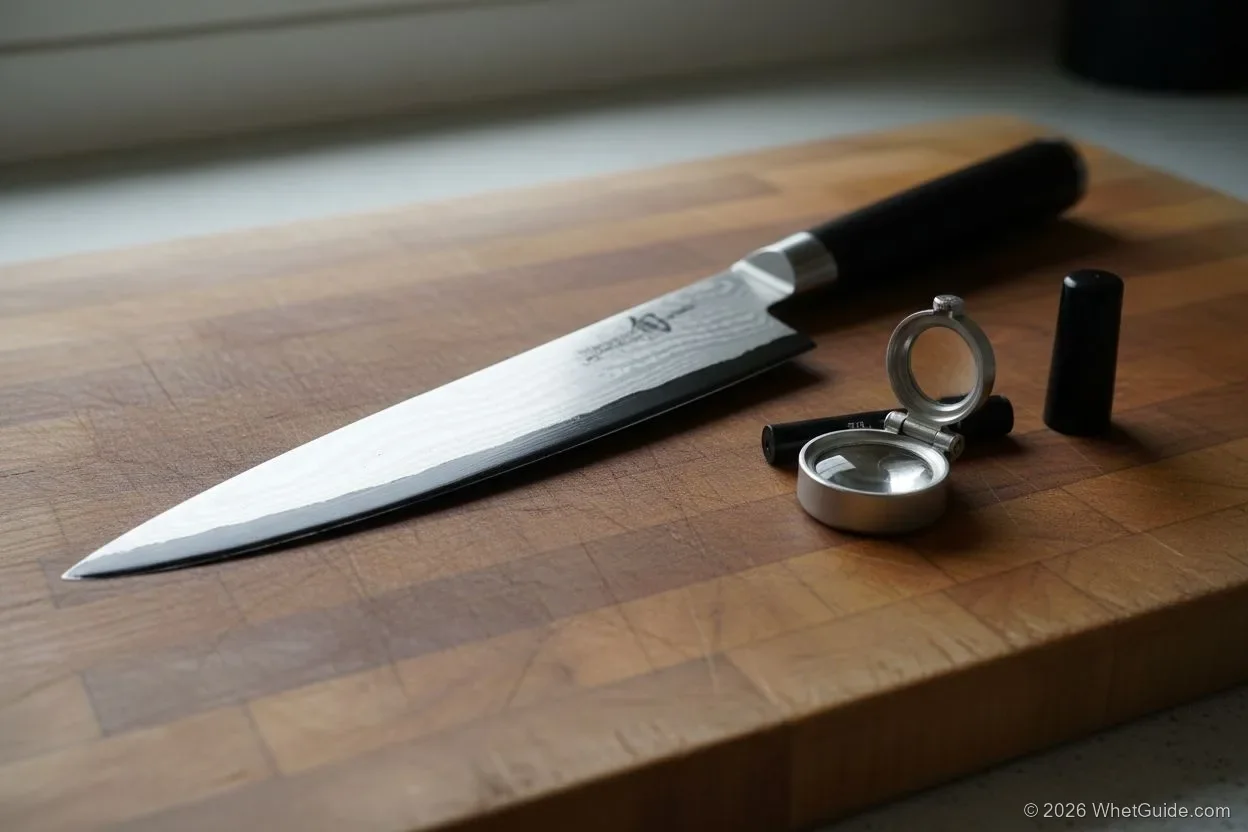
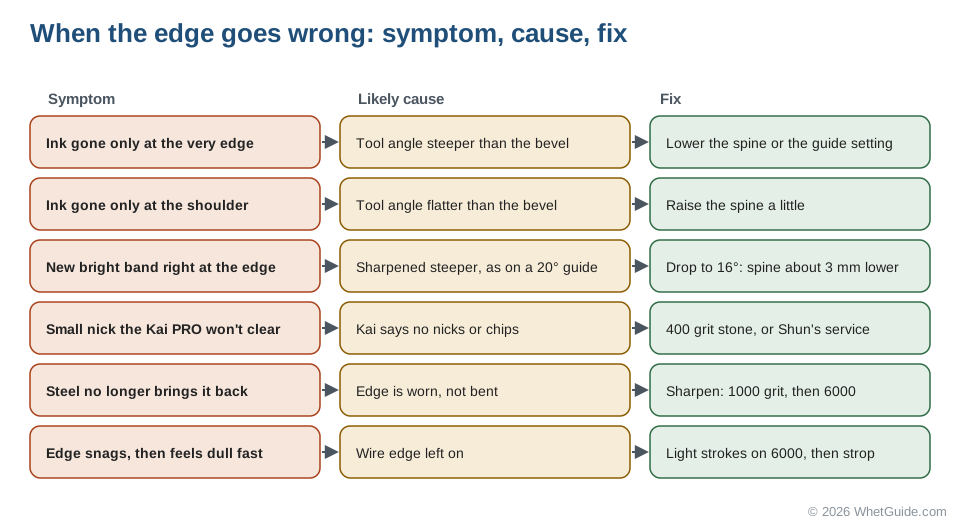
Every tool on this page can be checked the same way. Color the bevel with a fine marker, make one light pass or stroke, and look at the ink, with a loupe if you have one. Ink gone across the whole bevel means you've matched it. Ink gone only at the very edge means the tool is steeper than the bevel. Ink gone only at the shoulder means it's flatter. Our marker trick guide shows each pattern.
Do it the first time you use any guide, including the expensive ones. GearJunkie's testers measured angles with digital inclinometers and still flagged the Precision Adjust's angles as not always accurate. A dial reading 16 is a starting point. The ink tells you where the stone actually touched.
Common claims, checked against Shun's own pages
| You'll read | What Shun's FAQ says (other sources named) |
|---|---|
| "Shun knives are 15 degrees" | 16 per side. Fifteen is the generic Japanese figure; our angle guide traces where it comes from. |
| "Every Shun is 16" | Shun names the Western Cook's Knife at 22 per side, and single-bevel knives follow their own bevel. |
| "Shun doesn't make a sharpener" | It recommends Kai's retractable pull-through at 16 and describes a 3-piece stone set with a stand angled to 16. |
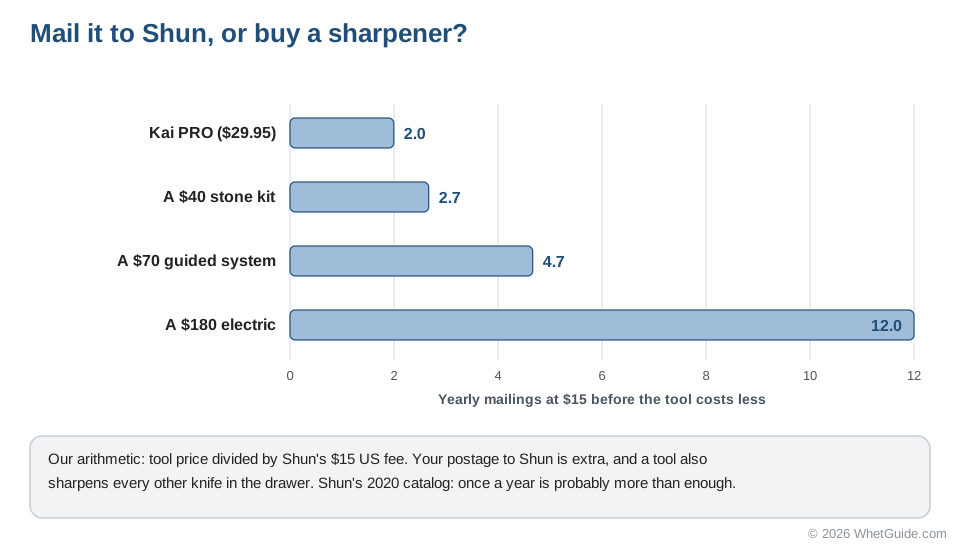
| "Shun sharpens for free" | The sharpening is free; Shun's page lists a $15 US shipping and processing fee ($25 for Canada and Mexico). |
| "A honing steel sharpens" | It calls Shun's steel strictly for honing. A steel realigns an edge; it doesn't restore a worn one. |
| "A diamond steel is better for hard Shun steel" | It asks owners not to use a diamond steel for regular honing, because diamond steels remove metal. |
| "Never put a Shun in an electric sharpener" | Allowed, if it sharpens to the correct 16 degrees. Read the angle on the box. |
| "Hard Shun steel can't chip" | Micro chipping "can be the downside of very hard stainless steel" without proper knife technique. |
| "VG-MAX and SG2 are stainless, so they can't spot" | Brown spotting may occur on Shun's higher-quality blade steels, and a rust spot on the edge can cause micro chips. |
| "One Rockwell point is nothing" | One degree of Rockwell is about 10% more hardness. SG2 at 61 to 62 is harder than VG-MAX at 60 to 61. |
| "A Shun can handle any cutting job" | No bones, joints or frozen foods, and avoid very thick-skinned vegetables. |
| "Any board will do" | Avoid metal, tile, ceramic plates, marble, granite, plastic or acrylic. |
| "The stone kit's guide sets the right angle" | GearJunkie gives the Sharp Pebble guide as 20 degrees. That's 4 degrees steep for a Shun. |
Chips and broken tips: what causes them and the fix
| Damage | Likely cause, per Shun's FAQ | Fix | Avoid |
|---|---|---|---|
| Micro chips along the edge | Very hard steel plus poor knife technique | 1000 stone at 16° until the chips are gone, then 6000 | The Kai PRO until the chips are out |
| Chips near a dark spot on the edge | A rust spot on the thin edge | Sharpen past the damage, then wash by hand and dry after use | The dishwasher |
| A notch you can catch a fingernail on | Bones, joints or frozen food | Start on 400 grit, then 1000, then 6000 | Pull-throughs; Kai lists chipped blades as not-for |
| Broken or bent tip | Bones, frozen food or a hard surface | Reshape the tip on 400, then resharpen at 16° | The Kai PRO, which isn't for chipped blades |
| Large chip or crack | Bones, joints or a hard surface | A local sharpening service | Shun's mail-in service, which excludes large chips and cracks |
| Edge dulls fast after any of the above | Cutting on metal, tile, ceramic, marble, granite, plastic or acrylic | Switch to a board soft enough to show a slight cut line | Glass and stone boards |
The honing steel route
If your Shun is only a little dull, hone it instead of sharpening. Rest the blade on the steel at its 16 degree guide and make a few light strokes per side. That pushes the edge back into line without removing much steel. Shun's FAQ is firm on the point: its honing steel is strictly for honing, with an angle guide built into the handle. It also asks owners not to use a diamond steel for regular honing, since in Shun's words diamond steels "are for sharpening and will remove metal from your knife before it is necessary." If you hold the angle yourself, steel rods beyond Shun's own are in the best honing rod roundup, and the stroke is in how to use a honing rod.
| Job | How often | Source |
|---|---|---|
| Wash by hand, never the dishwasher | After each use | Shun FAQ |
| Cut on a soft board; no bones, joints or frozen food | Every use | Shun FAQ |
| Hone on the smooth side at 16° | About once a week | Shun FAQ; Premier steel listing |
| Hone on the micro-ribbed side | About once a month | Premier steel listing |
| Sharpen on a stone or tool | Not weekly; once a year is "probably more than enough for most home cooks," or when honing stops working | Shun FAQ; Shun 2020 catalog |
| Check the stone for flatness | Before each sharpening session | A dished stone changes the angle at the edge |
| Diamond steel | Not for regular honing | Shun FAQ |
Getting 16 out of guided and pull-through tools
A guided system holds the angle, but only relative to how the knife sits in the clamp. Clamp the blade at the same spot each time, and on a curved Shun chef's knife let the guide follow the belly instead of forcing a straight stroke. A pull-through is simpler: let the slot set the angle, keep the blade upright, pull with light pressure, and stop once the coarse slot has raised a burr.
- Fixed 16 (Kai PRO): nothing to set; check the not-for list first.
- Adjustable (Precision Adjust, Cangshan): set 16, or 22 for the Western Cook's, and confirm with the marker.
- Stepped (Sharp Pebble 5): 15 is the closer miss. Don't alternate 15 and 18 between sessions.
- Fixed 15 (AccuSharp, 15XV): fine for touch-ups; the edge drifts a little thinner each time.
Using the Kai PRO on a Shun
- Check the knife against Kai's not-for list: no chips, no single-bevel or serrated edge, and blade stock no wider than 3.5 mm.
- Open the sharpener and set it on a flat counter.
- Draw the blade through step 1 from heel to tip with light pressure, keeping it upright.
- Repeat in step 2, then step 3.
- Hone on the steel at 16°, then wipe the blade clean.
The four pull-throughs, head to head
| Pull-through | Angle | Miss against 16° | Reaches 22° |
|---|---|---|---|
| Kai PRO retractable | 16° fixed | None | No |
| Cangshan 3-stage | 14° to 24° | None if set right | Yes |
| Sharp Pebble 5 | 15° or 18° nearest | 6.6% thin or 13.3% thick | 21° nearest |
| AccuSharp Gourmet | 15° fixed | 6.6% thin | No |
Shun's own sharpening service
Shun's own sharpening page (shun.kaiusa.com/sharpening) says sharpening is free but that "shipping and processing fees are required for all Kai sharpening and warranty services," listed as $15 for US addresses and $25 for Canada and Mexico. Free sharpening applies to products bought from Kai USA or an authorized dealer in the US, Canada or Mexico. Mail-in turnaround is listed at about 2 weeks, with up to six weeks including delivery. Walk-in service in Tualatin, Oregon is weekdays 8 AM to 4:30 PM, with up to two knives done while you wait.
The page lists what the service does not cover: serrated knives (honing only), scissors, honing rods, large chips or cracks, thinning blade stock and custom work. A badly chipped Shun may need a different route. For comparison, see what other services charge in knife sharpening service cost.
| Question | Shun's service | A tool at home |
|---|---|---|
| Cost | $15 US, $25 Canada or Mexico, per Shun's page | From under $20 to over $100, once |
| Time without the knife | About 2 weeks; up to 6 weeks with delivery; same day for 2 knives at the walk-in | Minutes |
| Which knives | Kai products bought from Kai USA or an authorized dealer in the US, Canada or Mexico | Any knife the tool accepts |
| Serrated | Honing only | A serrated rod or file |
| Single bevel | Yes; restores the back micro-bevel | Stone only |
| Large chips or cracks | Not covered | 400 grit stone, or a local service |
| Skill needed | None | None for the Kai PRO; some for a stone |
Electric sharpeners and Shun's rule
| Electric angle | On a 16° Shun | On the 22° Western Cook's |
|---|---|---|
| 15° (Chef'sChoice 15XV) | About 6.6% thinner; acceptable to many owners | Thins it by 7 degrees; avoid |
| 16° | Exact, and what Shun asks for | Thins it by 6 degrees |
| 20° | About 27% thicker; avoid | 2 degrees thin; the closer miss |
If you own the Western Cook's Knife
| Tool | Closest setting | Against 22° | Verdict |
|---|---|---|---|
| Work Sharp Precision Adjust | 22° | Exact | Best fit; set 16 for the rest |
| Cangshan 3-stage | 22° (range 14 to 24) | Exact | Fine on a budget |
| Sharp Pebble 5 | 21° | About 5% thinner | Close enough |
| Chef'sChoice 15XV | 15° (its only setting) | About 34% thinner | Skip on this knife |
| Kai PRO retractable | 16° | About 29% thinner | Skip on this knife |
| Any 1000/6000 stone | Freehand at 22° | Exact if you hold it | Spine about 18.7 mm up on a 50 mm blade |
What to skip
| Skip | Why, on a Shun |
|---|---|
| Fixed 20° pull-throughs and electrics | About 27% thicker than Shun's edge by our arithmetic |
| Tools that don't state an angle | Assume they won't hold Shun's 16° until a marker test shows otherwise |
| Assuming every Kai sharpener is 16° | Kai's pocket Seki Magoroku AP-0308 doesn't state an angle on its listing. Shun's FAQ matches only the retractable model to 16° |
| Diamond steels for weekly honing | Shun asks owners not to use them for regular honing |
| The Kai PRO on chipped, single-bevel or serrated blades | Kai lists all three as not-for uses |
| The dishwasher | Shun's FAQ says to hand wash; a sharpener can't undo that damage |
Which one to buy
Buy the Kai PRO retractable if your Shun knives are double-bevel and undamaged and you want Shun's 16 with no learning. Buy the Work Sharp Precision Adjust if you want 16 on a dial, or 22 for a Western Cook's, without freehand. Buy the Sharp Pebble 1000/6000 kit if you'll practice, and hold the spine a little lower than its guide. Whatever you pick, add the Shun combination steel for weekly care. Got a Shun with a small chip? The mail-in service is a fair option, but Shun's page excludes large chips.
Angles and features come from each Amazon listing unless a source is named. Shun's angles and rules are from its FAQ and sharpening page, and the Kai PRO's limits from Kai's product page. Prices change, so the buttons show the current price on Amazon. How we research · Affiliate disclosure
Where the facts on this page come from
| Source | What we took from it |
|---|---|
| Shun's FAQ | 16° per side; the Western Cook's 22°; its pull-through recommendation; the 3-piece stand at 16°; honing rules, including no diamond steel; steel hardness; the electric-sharpener rule; chip causes; board and dishwasher rules |
| Shun's sharpening page | Service fees; turnaround; walk-in hours; exclusions; the single-bevel micro-bevel |
| Kai's retractable sharpener page | 16° on all three steps; the not-for list; the 3.5 mm limit; the 5-year warranty; the $29.95 price |
| Shun's series comparison page; Shun's Dual Core explainer | Each Shun line's steel and Rockwell figure, plus its edge angle |
| Shun's 2020 catalog | Once a year "is probably more than enough for most home cooks" |
| GearJunkie's guide to knife sharpeners | The Sharp Pebble guide at 20°; the Precision Adjust accuracy caveat; the 15XV's fixed 15° bevel |
| Knife Informer's sharpening-system roundup | Sharpmaker and Lansky angle settings |
| America's Test Kitchen; Hasu-Seizo | The 2025 Work Sharp upgrade pick; the 3000 to 6000 finish range |
| Amazon listings | Every other angle and grit; sizes; rating counts |