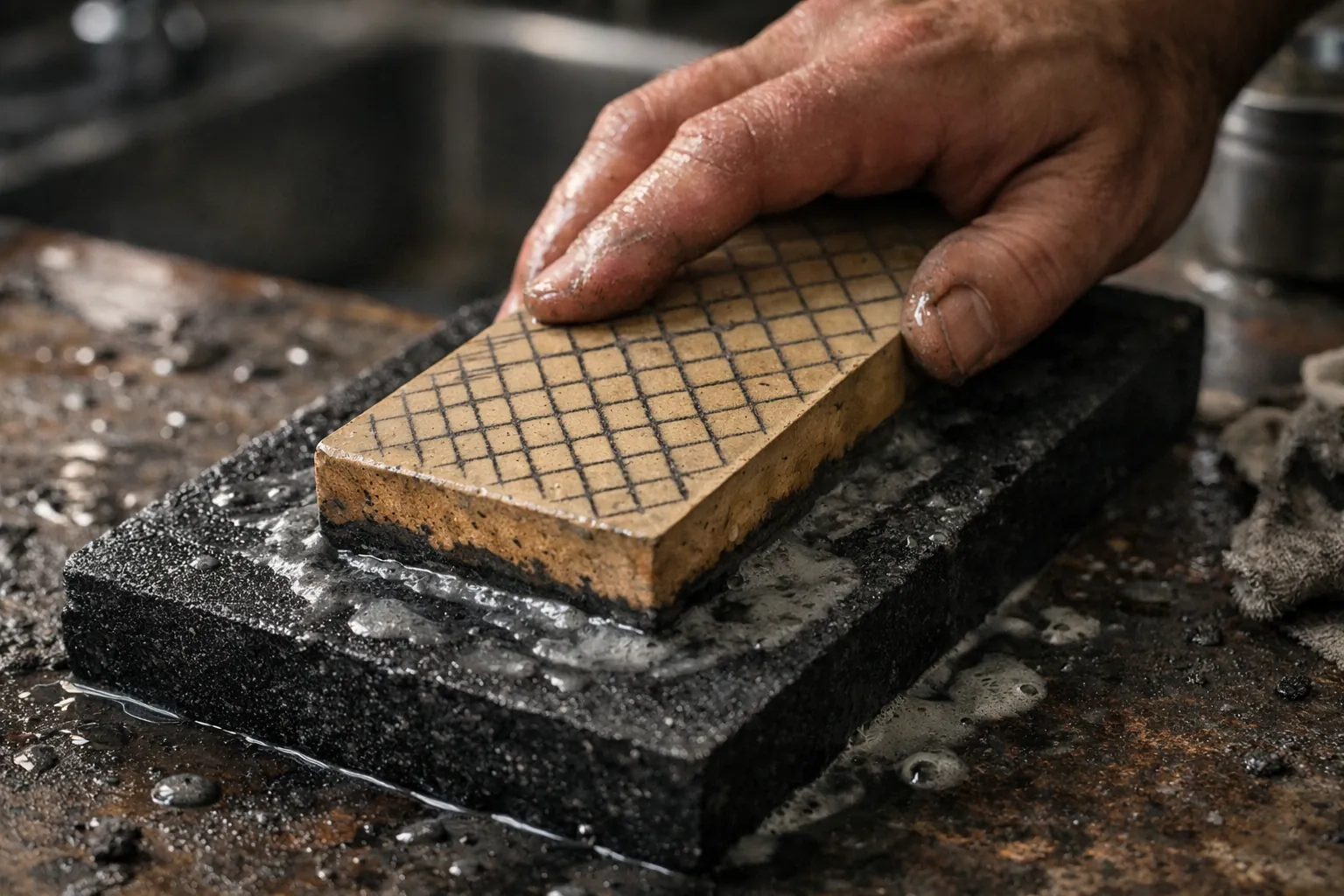
Two jobs keep a whetstone cutting. Cleaning is a rinse after every session, plus a deeper scrub when the surface goes dark and shiny. Flattening is a pencil grid and a few minutes on something flatter and coarser, then beveling the edges. The flattener can be a purpose-made flattening stone, a diamond lapping plate or coarse sandpaper on glass. If you're new to stones, start with how to use a whetstone; this page assumes you already have one that's wearing.
Cleaning by stone type
| Stone | After each use | Deep clean (clogged or glazed) | Don't |
|---|---|---|---|
| Water stone (soaking or splash-and-go) | Rinse, rub off slurry, air dry | Nagura or a few strokes on a flattener to expose fresh grit | Add oil; store wet in a closed box |
| Oil stone (Arkansas, India and similar) | Wipe with honing oil and a rag | Fresh oil and a stiff brush to float out the metal, then wipe | Switch it to water later |
| Diamond plate | Water, wipe dry (DMT) | Mild kitchen abrasive cleanser and a nylon brush (DMT) | Flood it with oil (DMT says dry or water only) |
| Ceramic stone or rod | Rinse and dry | Household cleanser and a scourer (Spyderco, Global) | Drop it; ceramic breaks |
The sources behind that table: DMT's FAQ says to "clean after each use with water and wipe dry", and "after several sharpenings, use a mild kitchen abrasive cleanser and a nylon scrub brush (an old toothbrush works well too)". It adds that DMT products should be used "dry or with water only", because oil "can impede sharpening if used in excess". Spyderco says its Galley-V's ceramic rods "are also easily cleaned with ordinary household cleanser". Global's knife care page says its ceramic rod discolors with residue in its pores and recommends "warm soapy water and if necessary a scourer". And the US Forest Service's axe manual says that "once you put oil on a whetstone, you should continue to use only oil as a lubricant for that whetstone." That goes for Arkansas stones too. Which oil to use, and what to avoid, is in sharpening stone oil.
A clogged or glazed stone
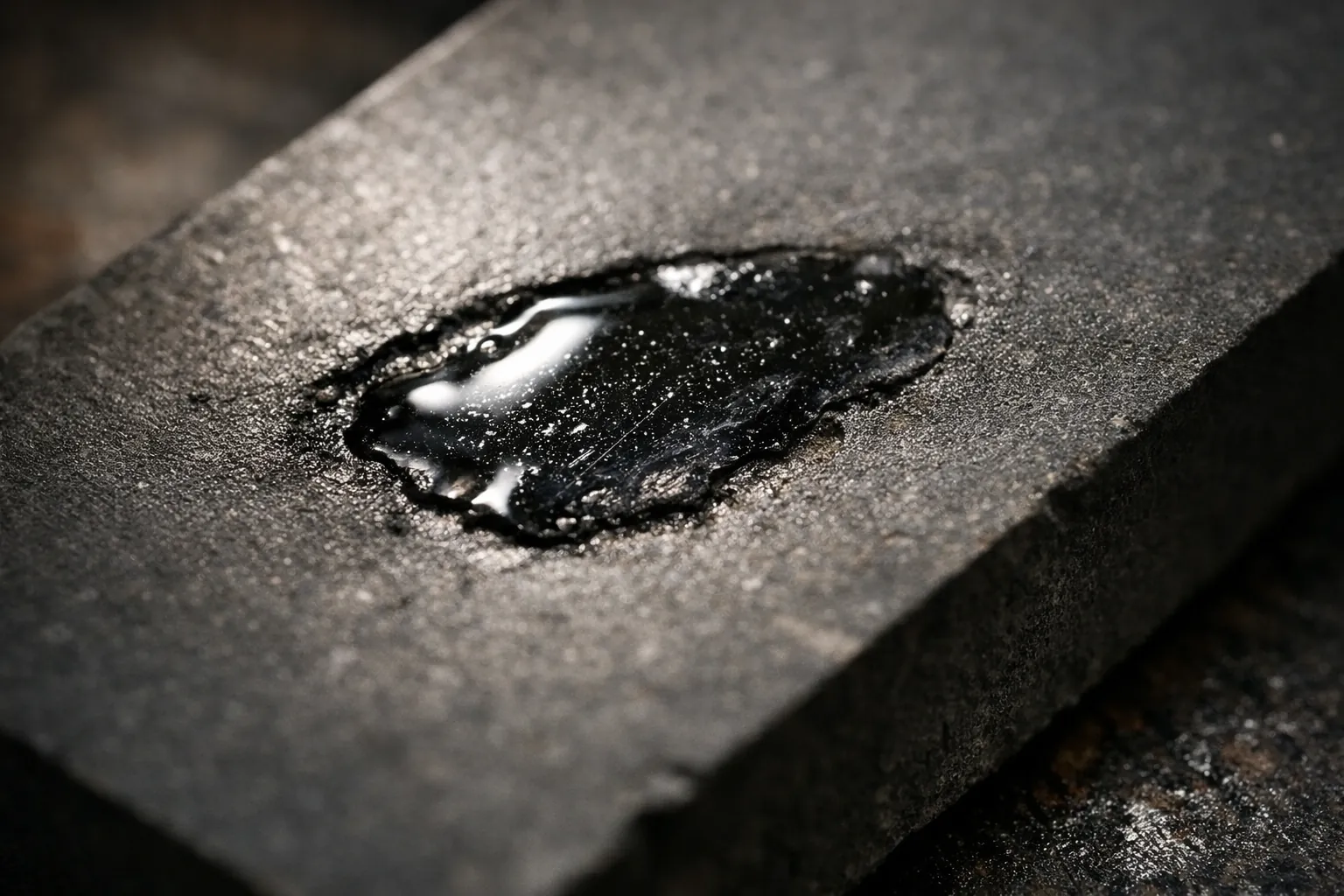
A clogged stone has metal particles (swarf) packed into its surface. It looks gray or black and shiny where it should be matte, and the knife skates instead of biting. It happens fastest on fine stones, hard stones and anything used without enough water. The fix depends on how bad it is:
- Scrub under running water with a stiff nylon brush. This clears light loading.
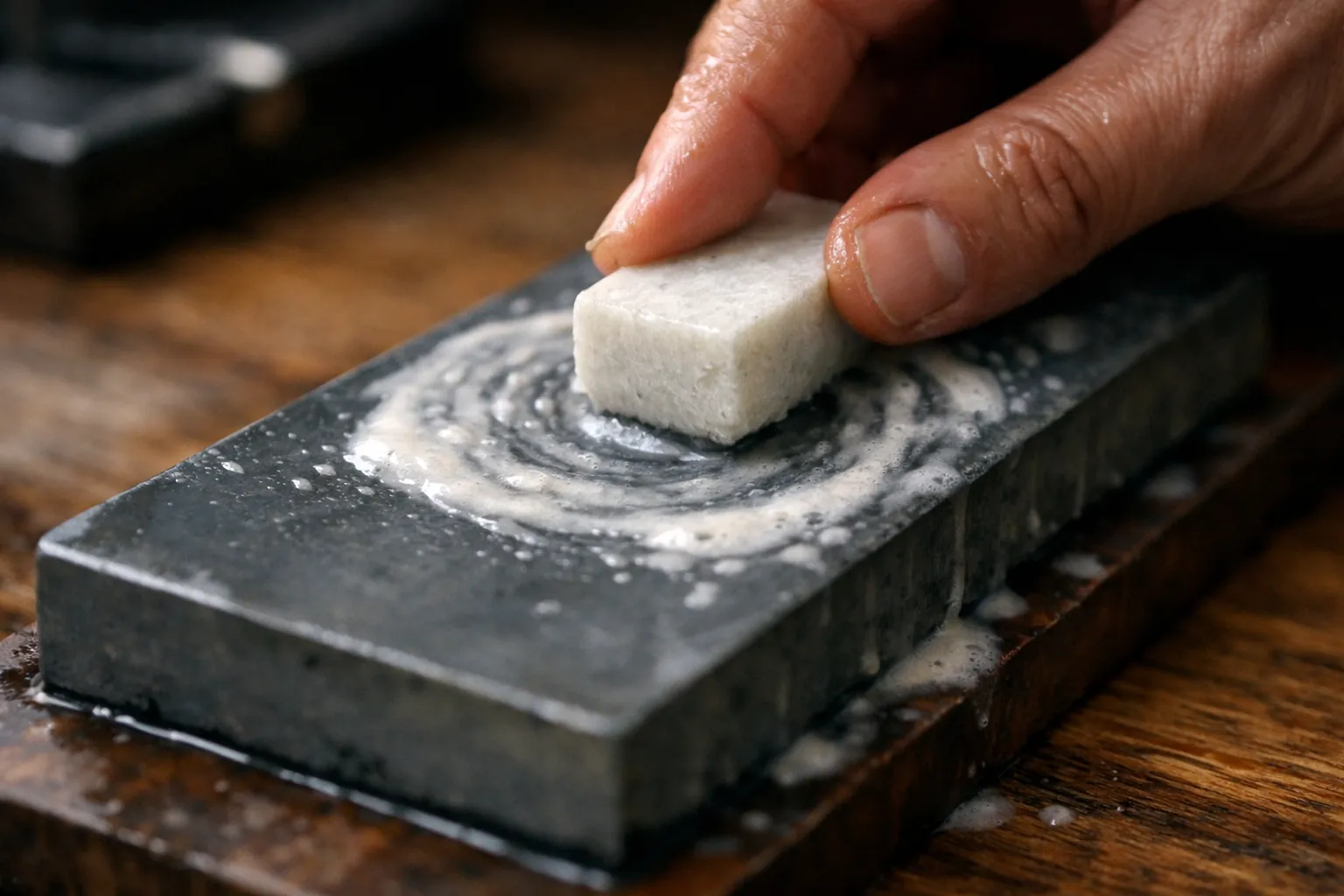
- Rub a nagura (a small conditioning stone) over the wet surface in circles. It raises a slurry and lifts the packed metal out. Fine Japanese stones are often sold with one.
- If it's still glazed, take a few strokes on your flattening stone or sandpaper, as described in the flattening steps below. Removing a thin layer exposes fresh abrasive. No flattener yet? Our flattening stone picks match one to the stones you own.
- Abrasive eraser blocks are sold for rubbing loading off sharpening surfaces. Check which stones the block's maker lists before using one.
Never put a stone in the dishwasher. No stone maker's instructions we've read allow it, and many stones are glued to their bases. Skip the wire brush on a diamond plate (DMT's instructions call for nylon), and skip boiling water or bleach, which no maker's care instructions mention. Don't mix lubricants either: oil on a water stone, or water on an oil stone you've already oiled, leaves a stone that does neither job well.
Drying, storage and mold
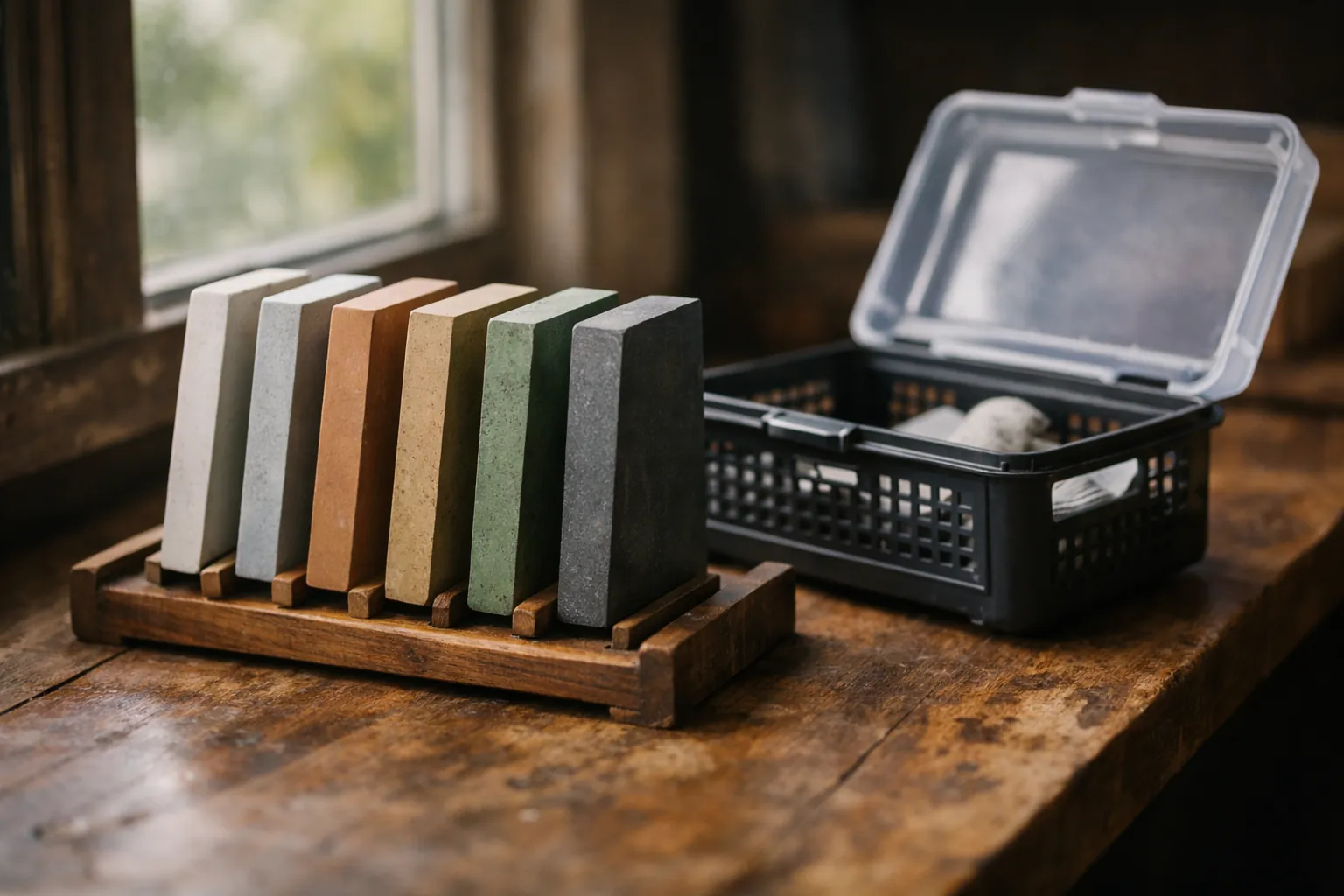
Mold and mildew show up on soaking stones and their wooden bases when a stone goes into a closed box still wet. A soaked stone holds water deep inside, so a dry-looking surface doesn't mean it's dry. Stand it on edge somewhere with airflow for a day or two before you close it up. If mold appears, scrub with water and a stiff nylon brush, then dry it completely. DMT's advice for its plates applies to every stone: "Always put away dry and store in a dry area." Shapton's Kuromaku stones come in ventilated plastic boxes that also serve as holders, which helps. Makers differ on whether a soaking stone can live in its water bath between sessions, so check your stone's instructions before you try it.
A five-minute end-of-session routine
- Rinse the knife and wipe it dry first.
- Rinse the stone and rub the slurry off.
- Check flatness with a pencil grid; flatten briefly if needed.
- Rinse again so no coarse grit travels to your fine stones.
- Stand the stone on edge to dry; store it once it's dry through.
The same steps are the last lines of the session checklist on our printable whetstone grit progression chart.
Check first: is it actually dished?
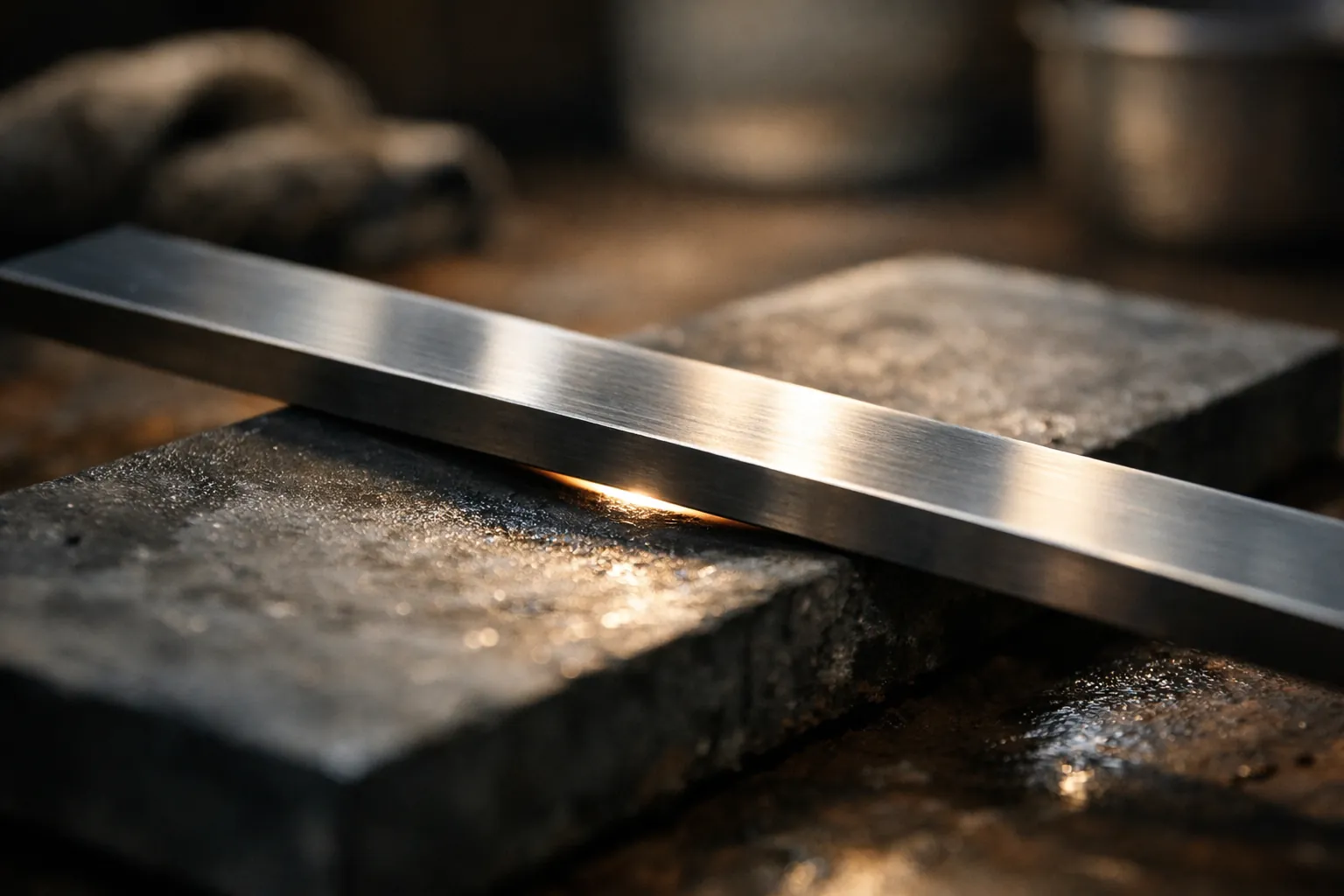
Lay a steel ruler on edge along the stone, then across it, then corner to corner. If you see light under the middle, it's dished. No straightedge? The pencil grid below does the same job: a few strokes on the flattener will erase the lines on the high spots first, and whatever's left shows you the low area.
What a dished stone does to your angle
A stone wears fastest in the middle, where most of your strokes land, so its surface becomes a shallow trough. As your knife travels along that trough, the surface under it tilts at the ends. That tilt adds to or subtracts from the angle you're holding.
| Dish depth along a 7-inch (180 mm) stone | Surface tilt at the ends of the stroke | What it does to a 15° edge |
|---|---|---|
| 0.25 mm | about 0.3° | Barely noticeable |
| 0.5 mm | about 0.6° | Bevel starts to round at the shoulder |
| 1 mm | about 1.3° | Each stroke sharpens at roughly 14 to 16°: a convexed, rounded edge |
| 2 mm | about 2.5° | You can't hold a consistent angle; the edge stays dull |
Calculated for a dish shaped like a shallow curve: the slope at the ends is about 4 × depth ÷ length. Real stones dish unevenly, which is usually worse.
Across the stone's width, a dish does something else: the stone touches the edge before the shoulder, and the bevel slowly rounds over. That's why sharpening on a dished stone can make a knife feel duller. The angle calculator gives the spine height for your angle, but it assumes a flat stone. Flatten first.
The pencil-grid method, step by step
- Soak or wet the whetstone as you normally would, and wet the flattener.
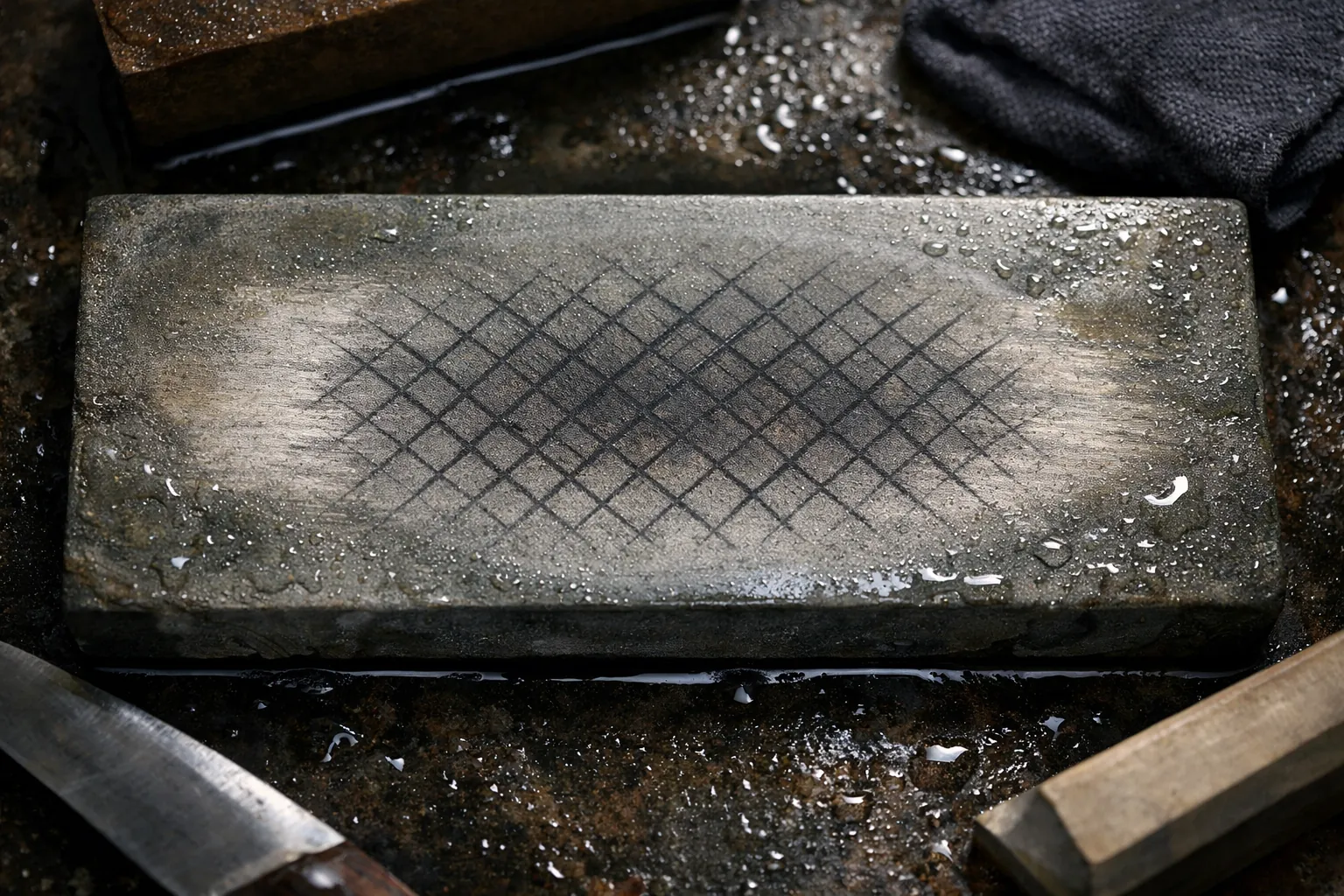
- Draw a crosshatch grid on the stone's face with a soft pencil: lines about 1 cm apart, both directions.
- Hold the stone face-down on the flattener and rub with even pressure in figure-eights or long back-and-forth strokes. Turn the stone end for end every dozen strokes so you don't tilt it one way.
- Lift and look. Lines gone at the ends but not the middle means it's dished; keep going.
- When every line is gone, the face is flat. Redraw the grid and do a few strokes to confirm.
- Chamfer the stone's long edges: a few angled strokes to knock off the sharp corners, so they don't crumble or catch the knife.
- Rinse both stones well. Coarse grit left on a fine stone will scratch your next edge.
Three ways to flatten
| Flattener | Good for | Watch out for |
|---|---|---|
| Flattening stone (coarse bonded abrasive) | Cheap, sold alongside stones, easy to keep near the sink | It wears too and eventually needs flattening itself |
| Diamond lapping plate | Fast, stays flat, works on hard stones | Use one sold for flattening; DMT warns against using its regular plates on waterstones |
| Wet-or-dry sandpaper on glass | No special tools; any size stone | Paper wears fast; tape it down and replace sheets often |
On the diamond plate point: DMT's own FAQ says that unless a stone is designated "Diaflat", designed for flattening, it doesn't recommend using it to flatten waterstones, Arkansas stones or synthetic stones. For the Diaflat plates, DMT suggests 120 micron for 1000 grit and coarser stones and 95 micron for finer ones. If you were planning to flatten with an ordinary double-sided diamond sharpening stone, that's the maker telling you not to. Our whetstone vs diamond stone page explains the difference between the two. The Dia-Flat plates themselves are covered in our DMT review.
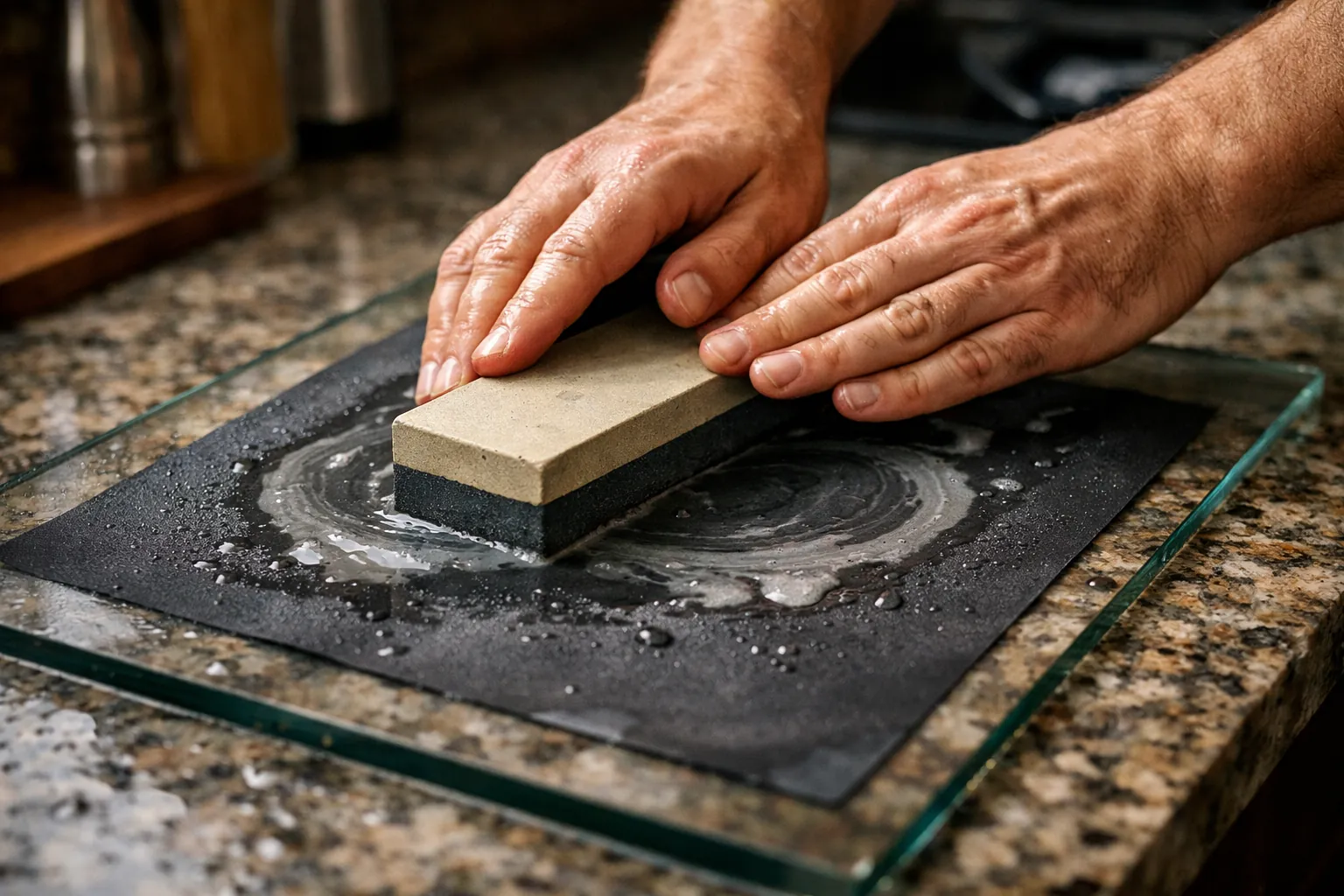
For sandpaper: silicon carbide wet-or-dry paper around 120 to 220 grit, on a sheet of thick glass or a large porcelain tile. Use plenty of water and switch to a fresh sheet as soon as it stops cutting.
How often, by stone
There's no fixed schedule from stone makers that we could find, so this is our rule of thumb. The real answer is "whenever the pencil grid says so".
| Stone | Check | Typical need |
|---|---|---|
| Coarse (220–400), soft soaking stones | Every session | Often every session, briefly |
| Medium (around 1000) | Every session | Every two to three sessions |
| Fine (3000–8000) | Every few sessions | Less often; these stones see light pressure |
| Diamond plates | Not needed | They don't dish; clean them instead |
Small and often beats big and rare. A stone that's flattened for thirty seconds after each use never gets a deep dish, and you lose far less stone than taking a millimeter off once a year. Soft stones dish fastest: the 1000 side of a King KW65 needs the grid more often than a harder splash-and-go stone.
Flatteners and cleaning gear on Amazon
- The Sharp Pebble 120/320 flattening stone is a 7.99 × 2.79 inch silicon carbide flattener with about 1,500 Amazon ratings. Its listing says to use the 120 side on coarse stones (900 grit and below) and the 320 side on stones of 1000 and up, so you don't scratch a fine finish.
- The SCOTTCHEN diamond lapping plate is a 10 × 3 inch double-sided plate in 120 and 180 grit, sold specifically for flattening stones.
- The Naniwa large whetstone flattener is a big 300 × 150 mm, #24 grit plate from a Japanese stone maker, at a higher price.
- If you don't own stones yet, the Amazon Basics 400/1000 + 3000/8000 set includes a flattening stone in the box, per its listing.
For cleaning:
- A King #8000 nagura stone, a small conditioning stone with about 1,000 Amazon ratings, for raising slurry and clearing glaze on fine water stones.
- An abrasive eraser block for rubbing off loading; check the listing for which surfaces it's meant for.
- For oil stones, a bottle of Lansky Nathan's honing oil, Lansky's own honing oil (its Deluxe clamp kit ships with honing oil).
- Any nylon brush. An old toothbrush is what DMT suggests.
For a side-by-side of every flattener type, with the flatness specs makers publish, see our best flattening stone guide.
After flattening, the stone's pores are full of slurry and old metal, so rinse it as described above. The grit progression chart has "check it's flat" as step two of its printable routine for exactly this reason, and the best whetstone sets guide notes which kits include a flattener. Upkeep is also part of choosing between a water stone and a diamond plate: diamond plates don't need flattening and clean with water, while water stones need both.
Care guidance quoted from DMT's FAQ, Spyderco's sharpener descriptions, Global Cutlery USA's knife care page and the USDA Forest Service's "An Ax to Grind"; diamond plate guidance from DMT's FAQ (dmtsharp.com). All checked October 3, 2026. Dish-to-angle figures calculated. Product details from Amazon listings checked the same day. How we research · Affiliate disclosure