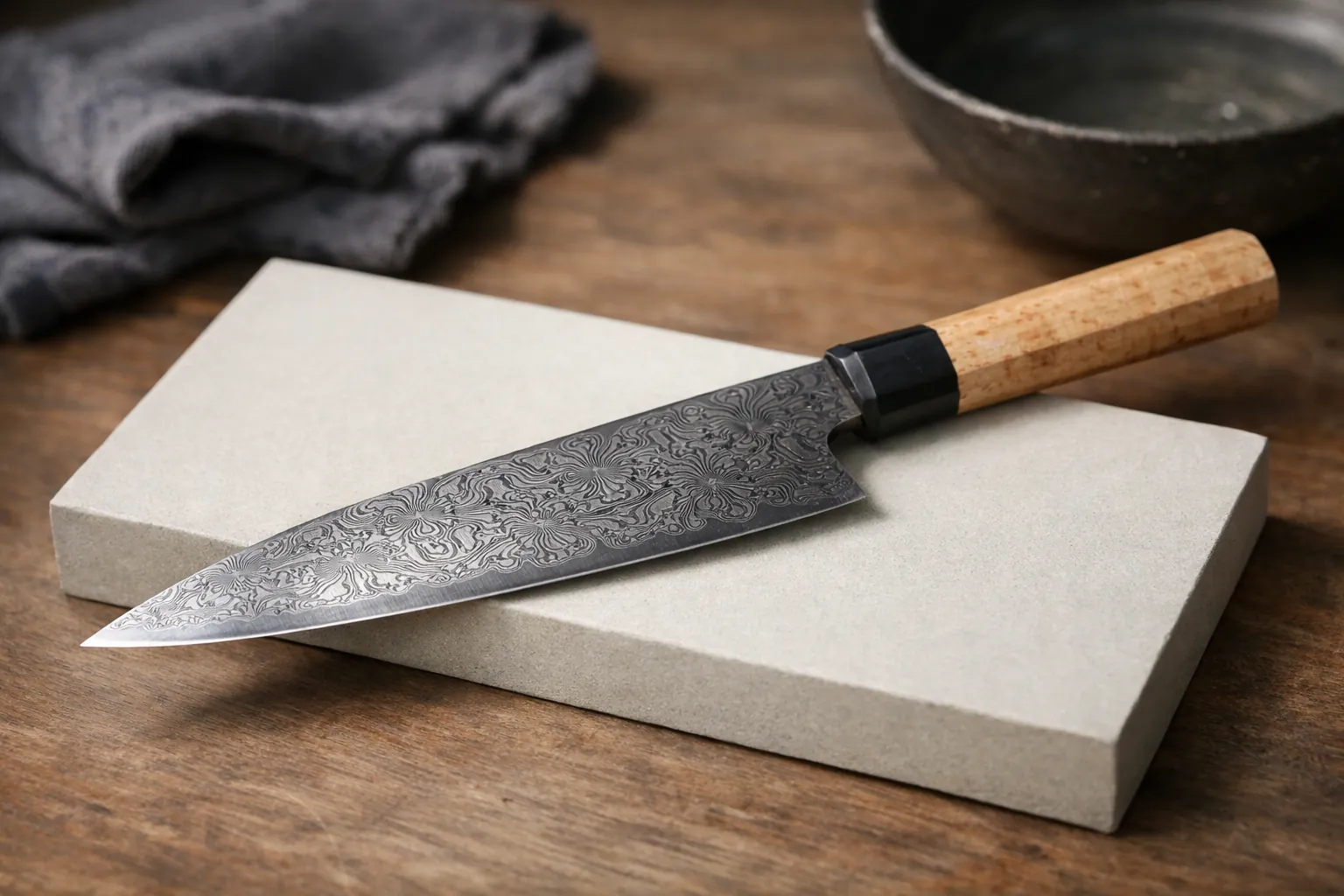
Miyabi knives are sharpened to 9.5 to 12 degrees per side. Zwilling, Miyabi's maker, puts that range on its Miyabi pages, and its general sharpening guide says 9 to 12. Either way it's lower than the 15° minimum on nearly every guided and electric sharpener sold, so the realistic options are a whetstone, a handful of low-angle tools, or a professional. Brand-by-brand numbers are in the knife sharpening angle chart.
What Zwilling says about Miyabi
Checked on zwilling.com on October 3, 2026:
- The Miyabi cutlery page: "Combined with a traditional, Japanese 9.5° to 12° edge angle, Honbazuke makes MIYABI knives remarkably sharp."
- The Kaizen 9.5-inch chef's knife page: "Hand-honed using the three-step Honbazuke process to a 9.5 to 12 degree edge."
- Zwilling's sharpening guide: "Santoku knives and all MIYABI and Kramer made by ZWILLING knives should be 9-12°."
Tormek's 2020 list of maker recommendations repeats the 9 to 12. The half-degree difference at the bottom isn't worth worrying about. Treat 10 to 11 as the middle of the target and stay there. Shun owners, see our Shun sharpener guide.
Miyabi lines, steels and the angle
The angle doesn't change between lines. The steel does, and that changes how you sharpen.
| Line | Steel (Zwilling's name) | Hardness Zwilling lists | Edge angle |
|---|---|---|---|
| Birchwood SG2 | SG2 (MC63) powder steel | 62–64 HRC (Rockwell 63) | 9.5–12° |
| Artisan | SG2 (MC63) | 63 Rockwell | 9.5–12° |
| Kaizen | VG10 (CMV60) | 60 Rockwell | 9.5–12° |
| Kaizen II 5000FCD | FC61 | 60–62 HRC | 9.5–12° |
| Fusion Morimoto Edition | VG10 (CMV60) | 60 Rockwell | 9.5–12° (brand-wide) |
| Red Morimoto Edition | special formula steel | 57 Rockwell | 9.5–12° (brand-wide) |
| Black 5000MCD67, Koh 4000FC, other lines | see Zwilling's line page | not checked | 9.5–12° (brand-wide) |
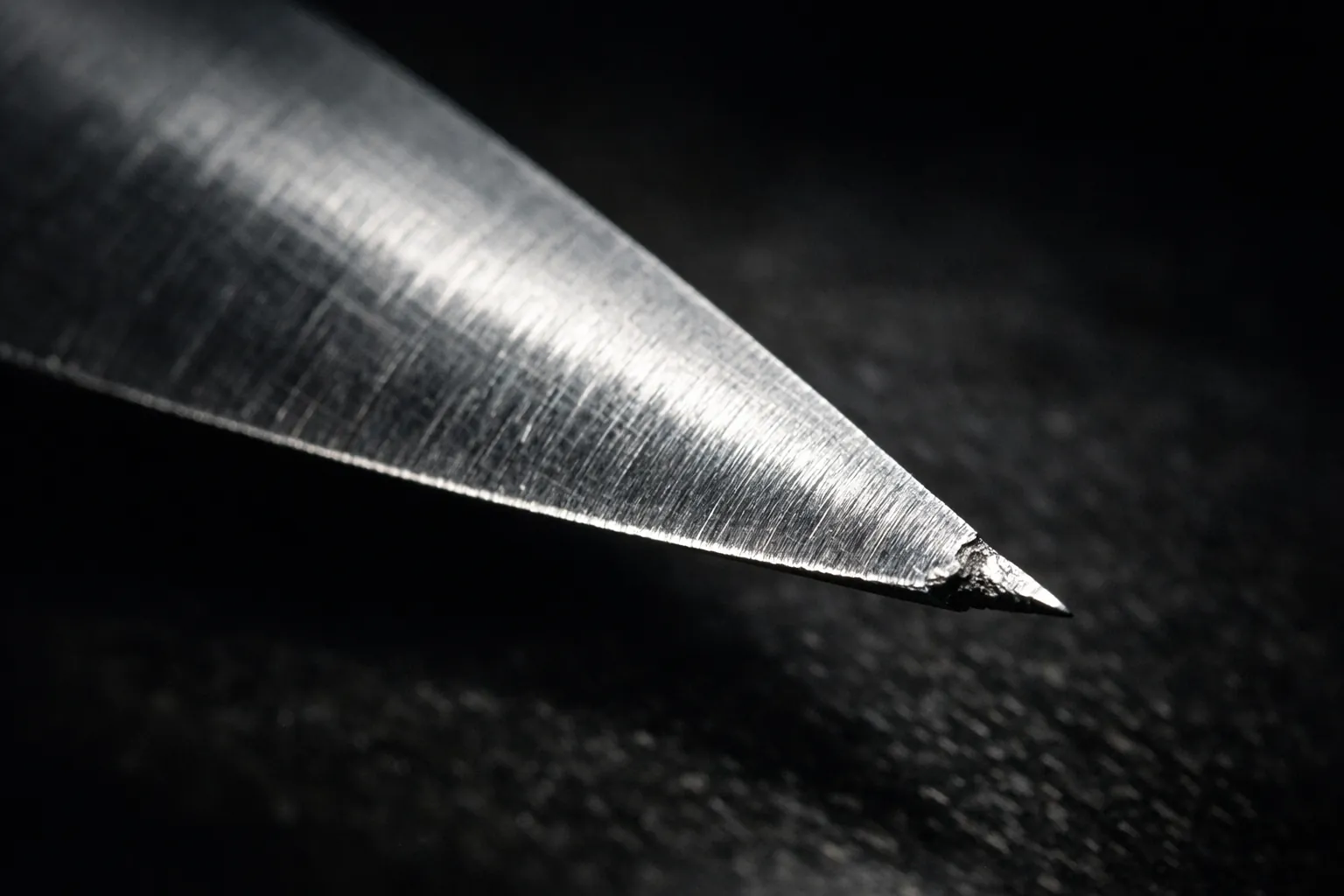
At 60 to 64 HRC, Miyabi's blades are several points harder than a typical German knife (Wüsthof lists 56 to 58 for its Gourmet and Classic lines). Hard steel holds a thin edge, but it chips rather than rolls when it fails, and a honing steel can't straighten a chip. That's why Miyabi's low angle and its hard steel go together, and why both shape the tools you should use.
How low 10 degrees really is
On a Miyabi chef's knife around 50 mm (2 inches) tall at the heel, 10° puts the spine about 8.7 mm off the stone. That's under six US pennies. Most people's freehand "low angle" is closer to 15°, which is 12.9 mm on the same blade, so a first attempt usually lands too high and thickens the edge.
| Blade width at heel | 9.5° | 10.5° | 12° | 15° (where most tools stop) |
|---|---|---|---|---|
| 25 mm / 1.0 in (paring) | 4.1 mm | 4.6 mm | 5.2 mm | 6.5 mm |
| 35 mm / 1.4 in (petty) | 5.8 mm | 6.4 mm | 7.3 mm | 9.1 mm |
| 45 mm / 1.8 in (santoku, nakiri) | 7.4 mm | 8.2 mm | 9.4 mm | 11.6 mm |
| 50 mm / 2.0 in (gyutoh) | 8.3 mm | 9.1 mm | 10.4 mm | 12.9 mm |
| 55 mm / 2.2 in (tall gyutoh) | 9.1 mm | 10.0 mm | 11.4 mm | 14.2 mm |
Spine centerline height = width × sin(angle). Widths are examples; measure your Miyabi at the heel.
The angle calculator with the Miyabi preset starts at 10.5° and gives your exact height, plus a lower height toward the tip if you enter a mid-blade width.
Why most sharpeners can't reach Miyabi's angle
Guided and electric sharpeners are built for the two angles that cover most knives sold, 15 and 20. Here's where the common ones bottom out:
| Tool | Lowest angle per side | Reaches 9.5–12°? |
|---|---|---|
| Work Sharp Precision Adjust (and Elite, Professional) | 15° | No |
| Spyderco Sharpmaker | 15° (30° inclusive slots) | No |
| Lansky clamp systems | 17° | No |
| Chef'sChoice 15XV | 15° | No |
| Rolling sharpeners (HORL 3, Tumbler Original) | 15° | No |
| Zwilling 4-Stage pull-through | 10° (Asian side, per Zwilling) | Yes, at 10° |
| SHARPAL 202H precision system | 10° (listing: adjustable 10–35°) | Yes, 10° and up |
| Work Sharp Ken Onion Elite Mk2 | 10° (listing: adjustable 10 to 35 degrees) | Yes, but a belt grinder on SG2 needs a light hand |
| Whetstone, freehand | any | Yes |
Zwilling's own pull-through has a 10° side, which makes it the simplest Miyabi-correct tool, though dragging SG2 through ceramic rods is still rougher than a stone. For a motorized option that goes low, the Tormek T-1 is the one we'd look at; our Tormek comparison covers its angle guide.
The stone route for Miyabi
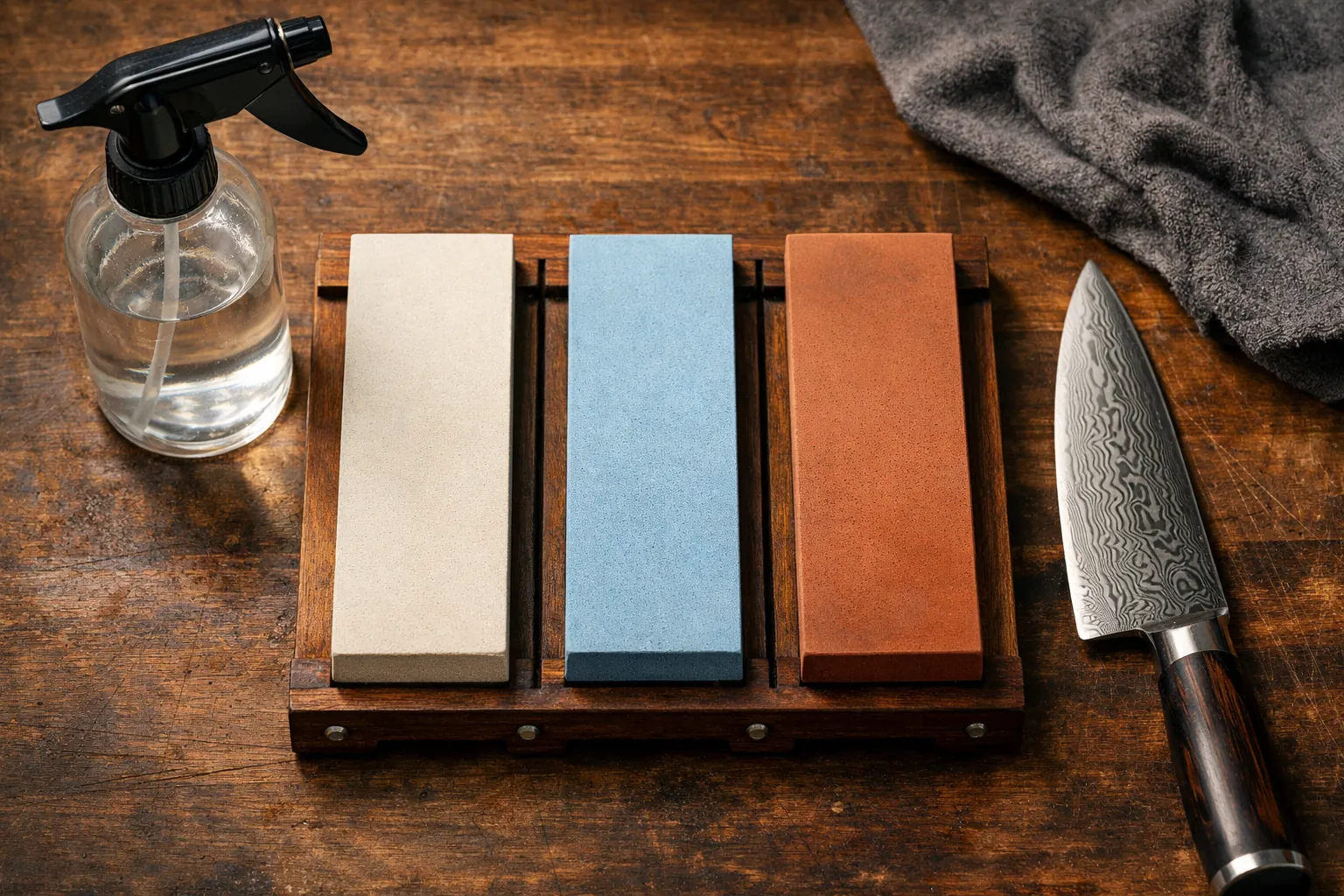
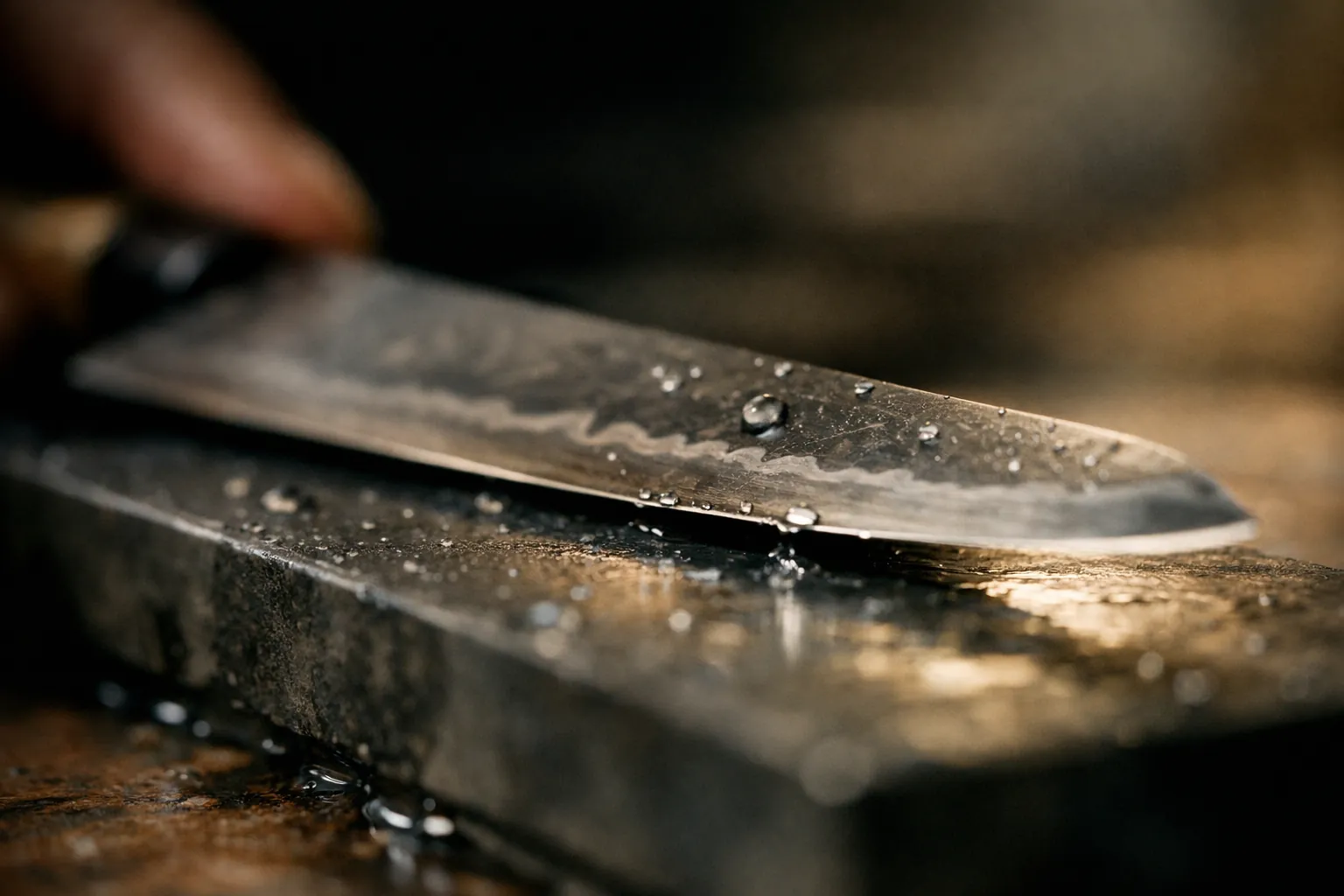
A whetstone is the tool that actually suits Miyabi: any angle, light pressure, minimal steel removed. A 1000-grit stone sets the 10° bevel and a 5000 to 8000 refines it. The Shapton Kuromaku 1000 + 5000 set is a good match for hard Japanese steel, and the King KW65 1000/6000 combination stone is the budget way in. Because the spine sits so low, a clip-on angle guide that sets 15° is worse than none here: learn the height with the table above and check it with a marker.
The whetstone grit progression chart gives the order by knife condition, and the best knife sharpeners for Japanese knives guide compares stones and low-angle tools.
What we'd do with a Miyabi
If you'll learn a stone: 1000 then 5000 or 6000, at 10 to 11 degrees, checked with a marker. If you won't: use Zwilling's 10° pull-through only for light touch-ups and send the knife out once or twice a year to someone who sharpens Japanese knives. What we wouldn't do is run a Miyabi through a 15° or 20° tool and call it done; the first pass grinds off the thin edge you paid for. Miyabi shares its angle with Zwilling's santokus and Kramer knives, covered on our Zwilling and Henckels sharpening angle page.
Quotes and steel specifications from zwilling.com (Miyabi cutlery page, Kaizen, Kaizen II 5000FCD and Birchwood SG2 product pages, US sharpening guide), checked October 3, 2026, cross-checked against Tormek's "Knife sharpening angles: Manufacturer's recommendations" (2020). Work Sharp Elite range from worksharptools.com. Spine heights calculated. Product details from Amazon listings checked the same day. How we research · Affiliate disclosure