Electric sharpeners are the fastest way to keep a kitchen full of knives sharp without learning to sharpen. The catch is that each machine has its own angle, its own stages and its own idea of which knives it takes, and a wrong match costs steel. Below are seven machines, then how to fit one to your knives and use it so the coarse slot stays a repair tool.
↑ SectionsQuick answer: which electric sharpener to buy
Buy the Chef'sChoice 15XV. It has two diamond stages plus a stropping stage, it puts a consistent 15° edge on the knife, and it takes serrated blades. Mixed block of German and Japanese knives? The Chef'sChoice AngleSelect adds a 20° setting. The Presto 08800 is the cheap option with nearly 19,000 ratings, and the Work Sharp Ken Onion Mk2 is the one to get if pocket knives and garden tools need sharpening too, since its guide adjusts from 15° to 30°. Watching for a sale on the Mk.2 or 15XV? See what to watch on Black Friday.
| What's in your drawer | Get | Why |
|---|---|---|
| Japanese knives, or recent Wüsthof and Zwilling | Chef'sChoice 15XV | Its 15° edge is within a degree of what those makers grind |
| A German chef's knife you want kept at 20°, next to a santoku | Chef'sChoice AngleSelect | Separate 15° and 20° stages, so neither knife gets reground |
| Inexpensive straight-edged knives, small budget | Presto 08800 | Cheap and simple; no serrated support |
| A drawer of every blade thickness, fillet to hunting | Presto 08810 | Thickness selector and a ceramic third stage |
| Pocket, hunting or kitchen knives, plus scissors | Work Sharp Ken Onion Mk2 | Any angle from 15° to 30°, variable speed |
| Kitchen knives one day, the mower blade the next | Work Sharp MK2 | A cheaper belt machine that takes tools |
| You want a button and nothing to think about | Work Sharp E2 | Push-button, with a ceramic hone wheel for daily touch-ups |
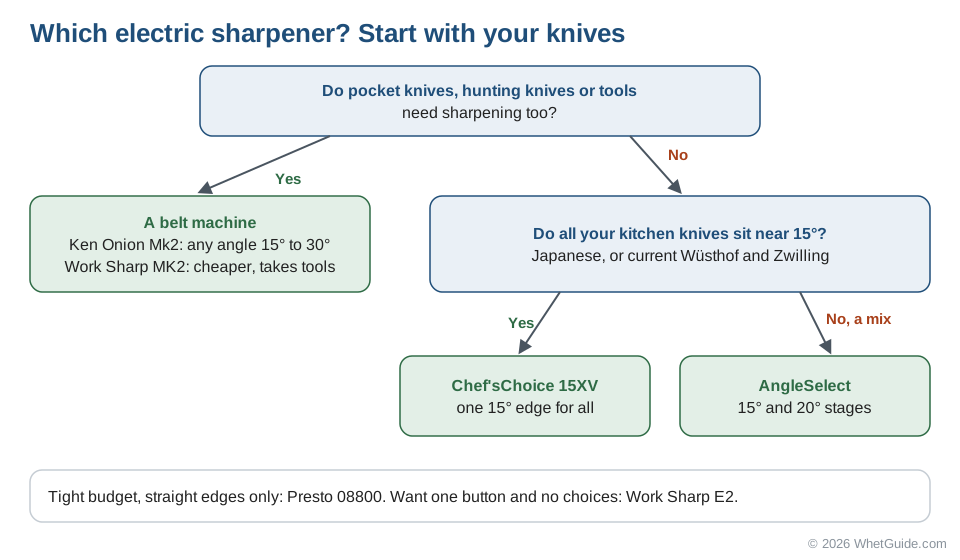
The rest of the page is for after you've picked. It covers how to match the machine's angle to your knives, which stage to use on which day, what a "pair" of pulls means, and the fixes for an edge that comes out worse. If you only read one extra section, read getting the best from an electric sharpener. Most of the damage people blame on these machines comes from living in the coarse slot.
Quick picks
| Best overall | Chef'sChoice 15XV EdgeSelect | Amazon |
|---|---|---|
| Best for German and Japanese knives | Chef'sChoice AngleSelect | Amazon |
| Best budget electric | Presto 08800 EverSharp | Amazon |
| Best budget pick for mixed blades | Presto 08810 Professional EverSharp | Amazon |
| Best adjustable-angle electric | Work Sharp Ken Onion Mk2 | Amazon |
| Best value for knives and tools | Work Sharp MK2 Knife & Tool Sharpener | Amazon |
| Easiest push-button option | Work Sharp E2 Electric Kitchen Sharpener | Amazon |
How we picked
We started with Amazon search results on October 3, 2026. The Chef'sChoice 15XV showed 2,000+ purchases last month, and the Presto 08800 showed 1,000+ with 18,800+ ratings. From there we compared what angle each machine sets, how many stages it has and whether the last stage hones or strops. We also checked which knives each maker says the machine handles, serrated and single-bevel blades in particular. Every spec below comes from the product's own listing. For the sales picture across every type, electric or not, see the best knife sharpeners on Amazon.
Then we read the reviews that rank for this search: America's Test Kitchen and Outdoor Life; ShouldIt and Food Network; Bob Vila; and what we could reach of CNN's sharpener roundup. They don't all agree, and where they disagree with our picks we say so in where reviewers disagree. The Chef'sChoice manuals, which we've read for our Chef'sChoice how-to, supply the pull counts quoted on this page. More on our sources in how we research.
↑ Back to all sectionsHow electric sharpeners work
A spring-loaded or fixed guide holds the blade at the angle while motor-driven wheels or belts grind. Wheel machines (Chef'sChoice, Presto) are the fastest and the easiest to get right. Belt machines (Work Sharp) take a wider range of blades, tools included. Some of them let you set the angle yourself.
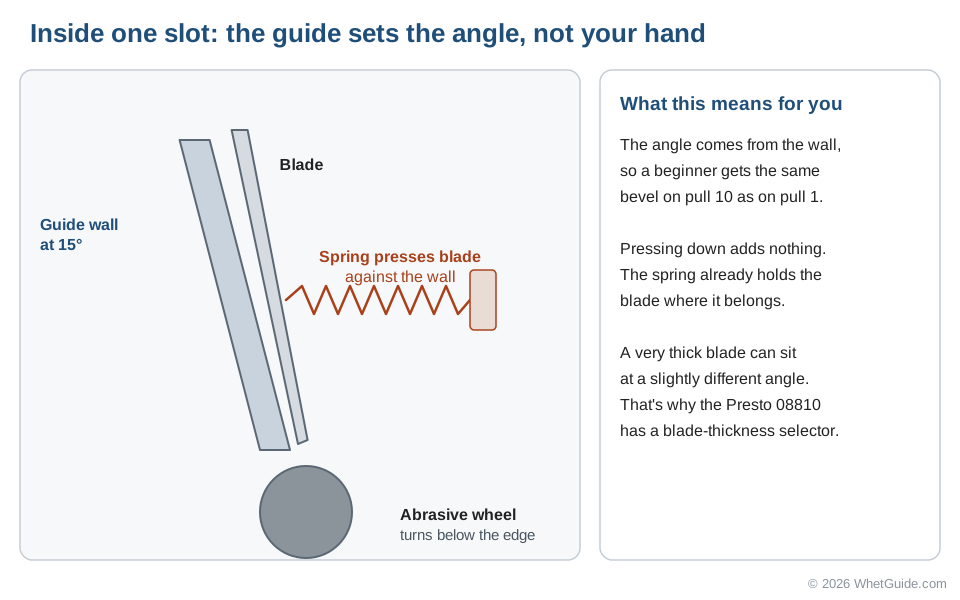
Inside each slot of a wheel machine, the job splits three ways. The guide wall is cut at the sharpening angle. A spring or flexible guide pushes the blade flat against that wall. The abrasive wheel turns below, where the edge meets it. Because the wall sets the angle, a beginner gets the same bevel on the tenth pull as on the first. That's the whole appeal, and it's why an electric beats a whetstone for anyone who won't practice on the stone.
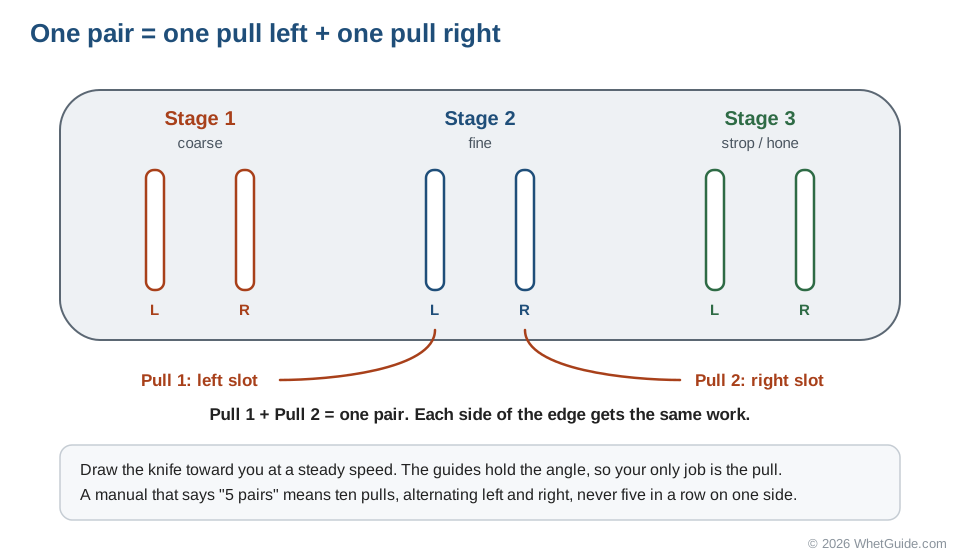
Most wheel machines also split each stage into a left slot and a right slot, one for each side of the edge. Manuals count in pairs: one pull through the left slot and one through the right. "Five pairs" means ten pulls, alternating, never five in a row on one side. Get this wrong and one bevel ends up wider than the other, which shows as a knife that steers sideways in a carrot.
The stages step from coarse to fine. Stages 1 and 2 on the 15XV are diamond, and Stage 3 is a flexible stropping disk. Chef'sChoice says each stage puts a slightly different facet on the edge, which it calls a "modified gothic arch," and gives durability at a thin angle as its reason for the triple facet. The Presto 08800 has two stages, grind then hone. The 08810 adds an extra-fine ceramic third stage. Belt machines don't have stages as such: you swap a coarse belt for a fine one, or change speed.
↑ Back to all sectionsThe 7 best electric knife sharpeners, by knife
Seven machines, in the order most kitchens should consider them. The first two are the Chef'sChoice wheel machines that most reviewers end up recommending. Then come the two Prestos for tight budgets, the two Work Sharp belt machines for knives and tools, and one push-button model for people who want no decisions at all.
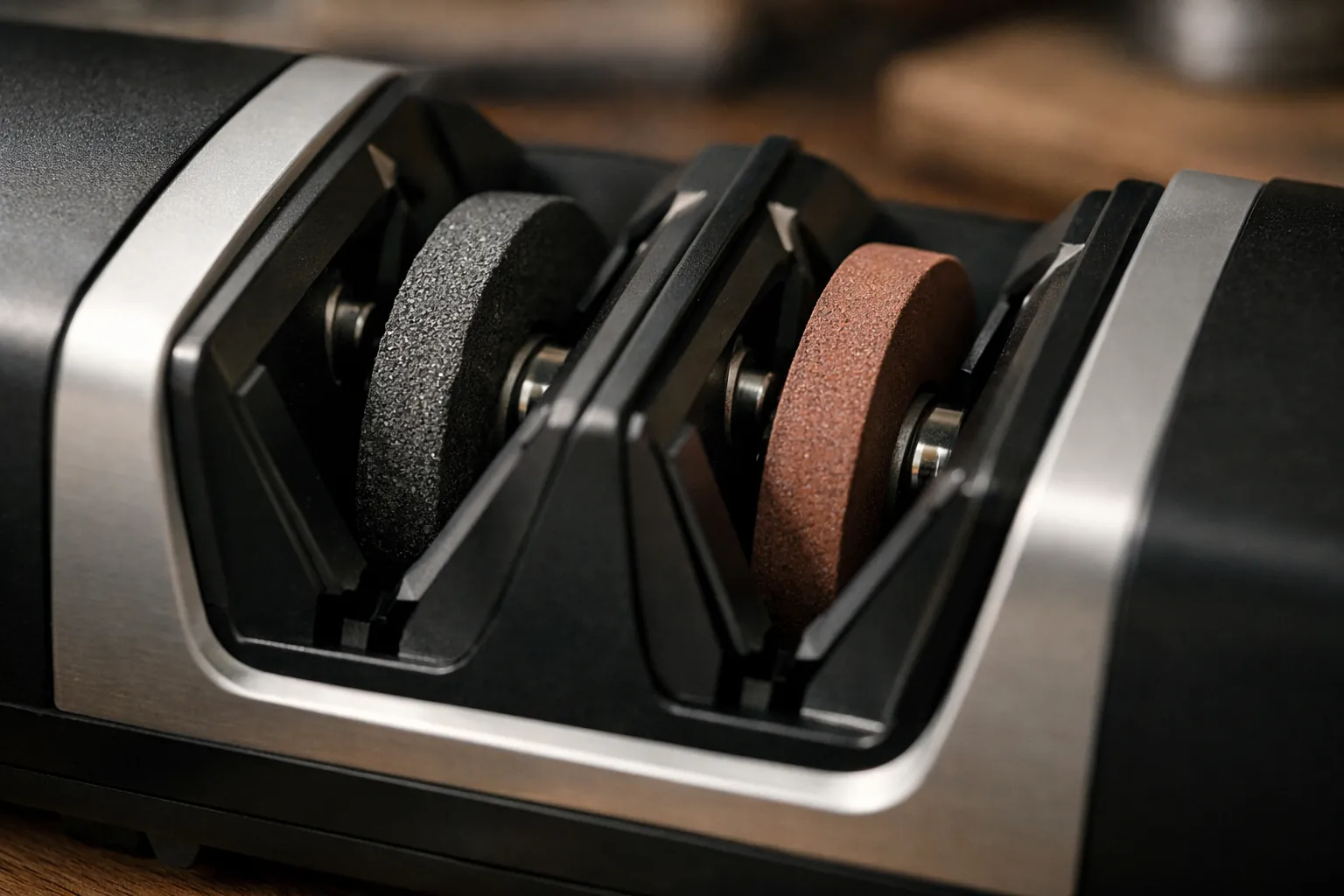
Chef'sChoice 15XV EdgeSelect
Most home electrics get measured against this one. Two stages coated in 100% diamond abrasives do the sharpening and honing, then a patented flexible third stage strops the edge, and spring guides set the angle for you. Chef'sChoice built it to turn a typical 20° factory edge into its own 15° edge. Once that first conversion is done, the maker says a re-sharpening takes about ten seconds. With 2,000+ purchases last month and 14,000+ ratings, it outsells everything else on this list. Full details and the manual's pull counts are in our Trizor XV review (same machine, sold under both names). Pull counts for the other Chef'sChoice models are in how to use a Chef'sChoice knife sharpener.
It's also our electric pick in best knife sharpener for Wüsthof knives, one degree off Wüsthof's 14, and for Henckels knives, right on Zwilling's 15.
- Stages3 (diamond, diamond, flexible stropping)
- Edge15°
- Kniveschef's, santoku, bread, hunting, fillet, pocket, serrated
- First sharpeningabout 1 minute (per maker)
Why it stands out
- Diamond stages and a stropping finish
- Serrated knives supported
- Fast enough to use weekly
Think twice if
- You want to keep 20° edges on heavy-duty knives
- You own single-bevel Japanese knives
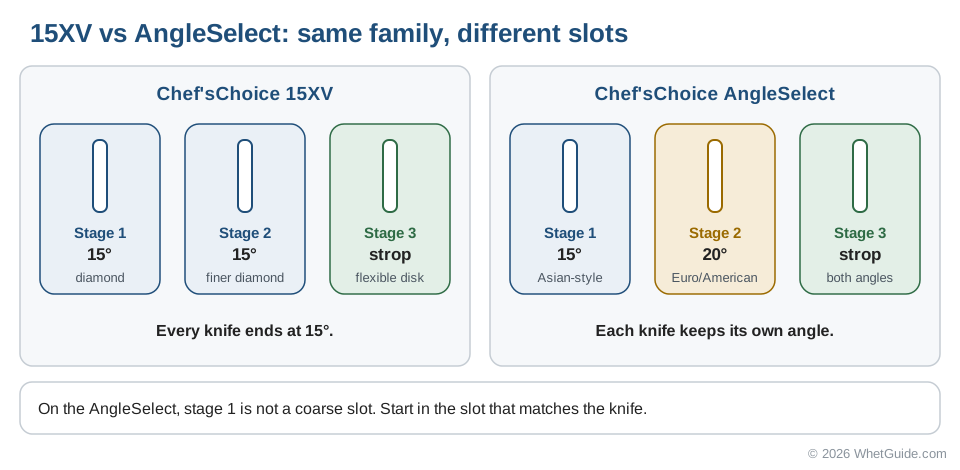
The 15XV and the AngleSelect are close relatives, and the choice between them is one question: do all your knives want 15°? Wüsthof grinds its standard blades at about 14° a side and Zwilling at 15, so a modern German block already fits the 15XV. The AngleSelect earns its place when you own an older German knife, a heavy carving knife or a cleaver-style blade that you want kept at 20°. For a spec-by-spec breakdown, the two machines go head to head in the Trizor XV review.
Chef'sChoice AngleSelect
A German chef's knife and a Japanese santoku want different edges, and this machine gives each one its own: 20° for European and American knives, 15° for Asian-style knives. Chef'sChoice lists it for straight and serrated blades, and for single- as well as double-bevel knives. Inside are diamond abrasives and flexible stropping disks.
- Stages3
- Angles20° (European/American) and 15° (Asian-style)
- Abrasives100% diamond + flexible stropping/polishing disks
- Knivesstraight, serrated, single- and double-bevel (per listing)
- Warranty3-year limited
Why it stands out
- Two angles for mixed knife sets
- Listed for single-bevel knives
- 3-year limited warranty
Think twice if
- You only own one style of knife: the 15XV is simpler
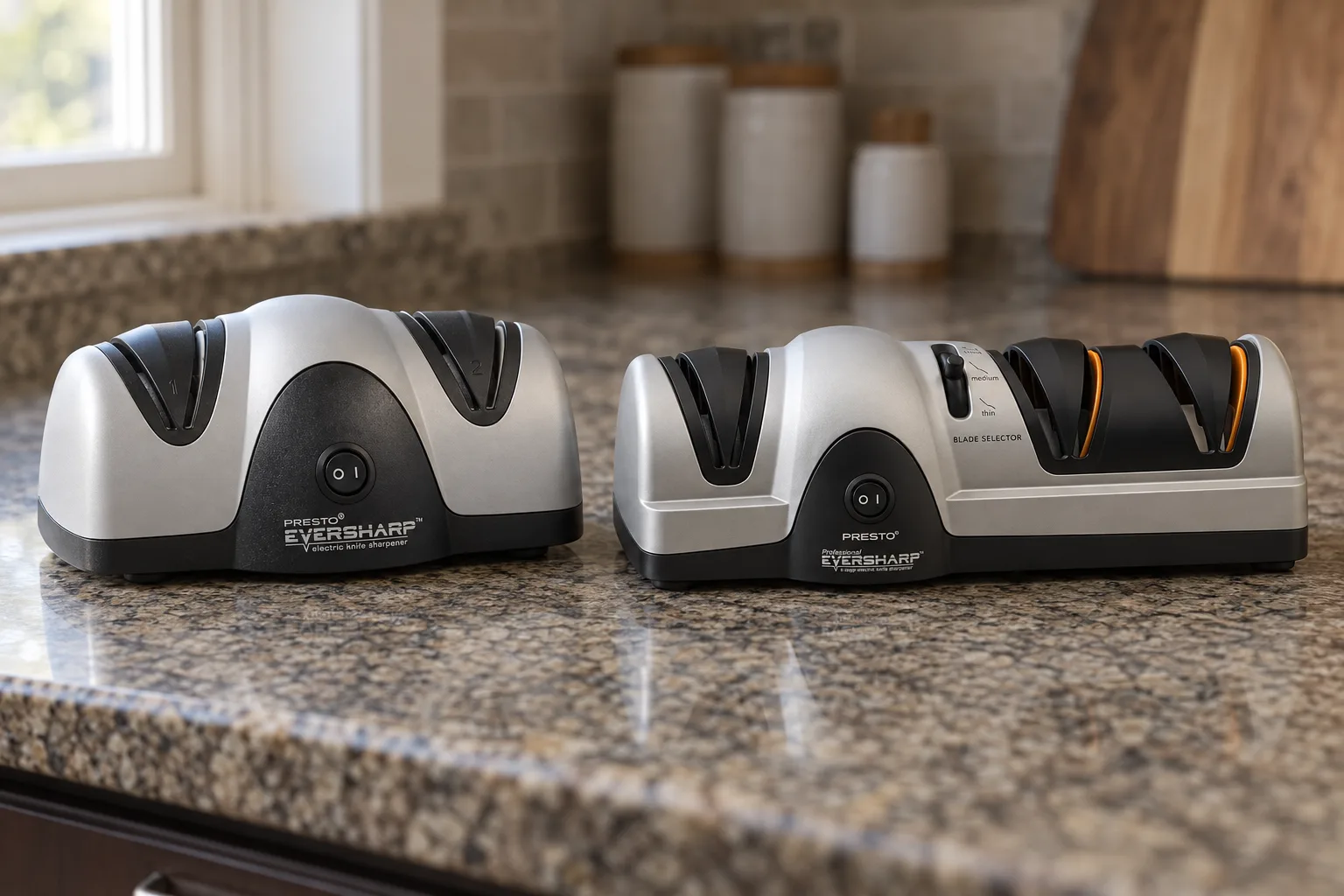
Presto 08800 EverSharp
Cheap and very widely owned: 18,800+ ratings, 1,000+ purchases last month. Sapphirite wheels in the first stage grind, the second stage hones, and blade guides keep the angle steady. Presto lists it for non-serrated blades only, so your bread knife needs something else.
- Stages2
- WheelsSapphirite (grind, then hone and polish)
- Kniveskitchen and sport knives, non-serrated
- Power120 V
Why it stands out
- Inexpensive and simple
- Huge owner base
Think twice if
- You need to sharpen serrated knives
- You want to choose the angle
Presto 08810 Professional EverSharp
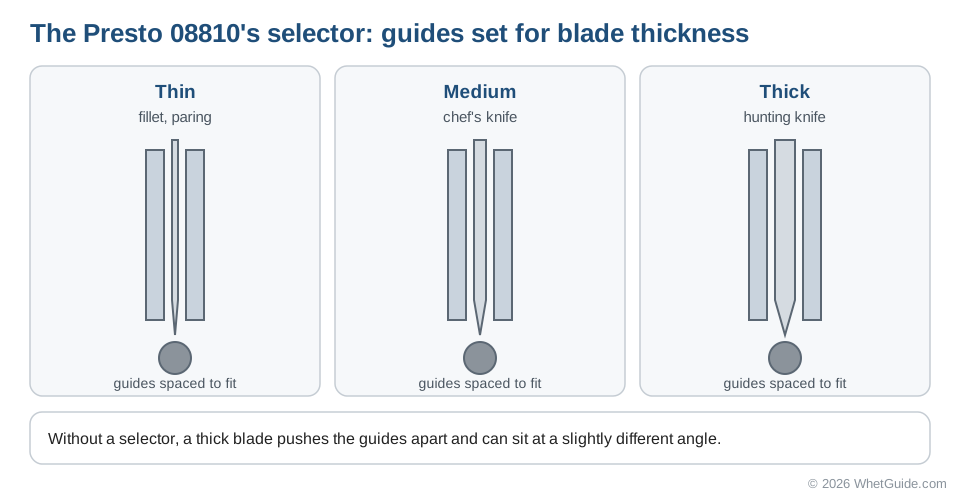
Spend a little more than the 08800 and you get two upgrades. One is a third stage of extra-fine ceramic. The other is a blade-thickness selector: thick for hunting knives, medium for chef's knives, thin for fillet and paring knives. If your drawer holds a real mix of blades, this is the better Presto.
- Stages3, final stage extra-fine ceramic
- Selectorblade thickness (thick, medium, thin)
- Kniveskitchen, sport, santoku
Why it stands out
- Adjusts guides for blade thickness
- Ceramic finishing stage
- 10,800+ ratings
Think twice if
- You need serrated support: check the listing
Work Sharp Ken Onion Mk2
Turn the guide anywhere from 15° to 30°, then pick a speed: slow for a kitchen knife, faster when you're repairing a chipped edge. Work Sharp lists it for pocket and chef's knives and serrated blades, and for scissors and garden tools. Belts swap quickly when you move from coarse to fine. Choosing between the Ken Onion models? See Work Sharp MK2 vs Ken Onion.
- Typepowered flexible belt
- Angle15° to 30°, adjustable guide
- Speedvariable
- Useskitchen and pocket knives, serrated blades, scissors, shears, garden tools
Why it stands out
- Any angle from 15° to 30°
- Handles knives and tools
- Variable speed
Think twice if
- You want the simplest pull-through operation
- You're heavy-handed: belts remove metal quickly
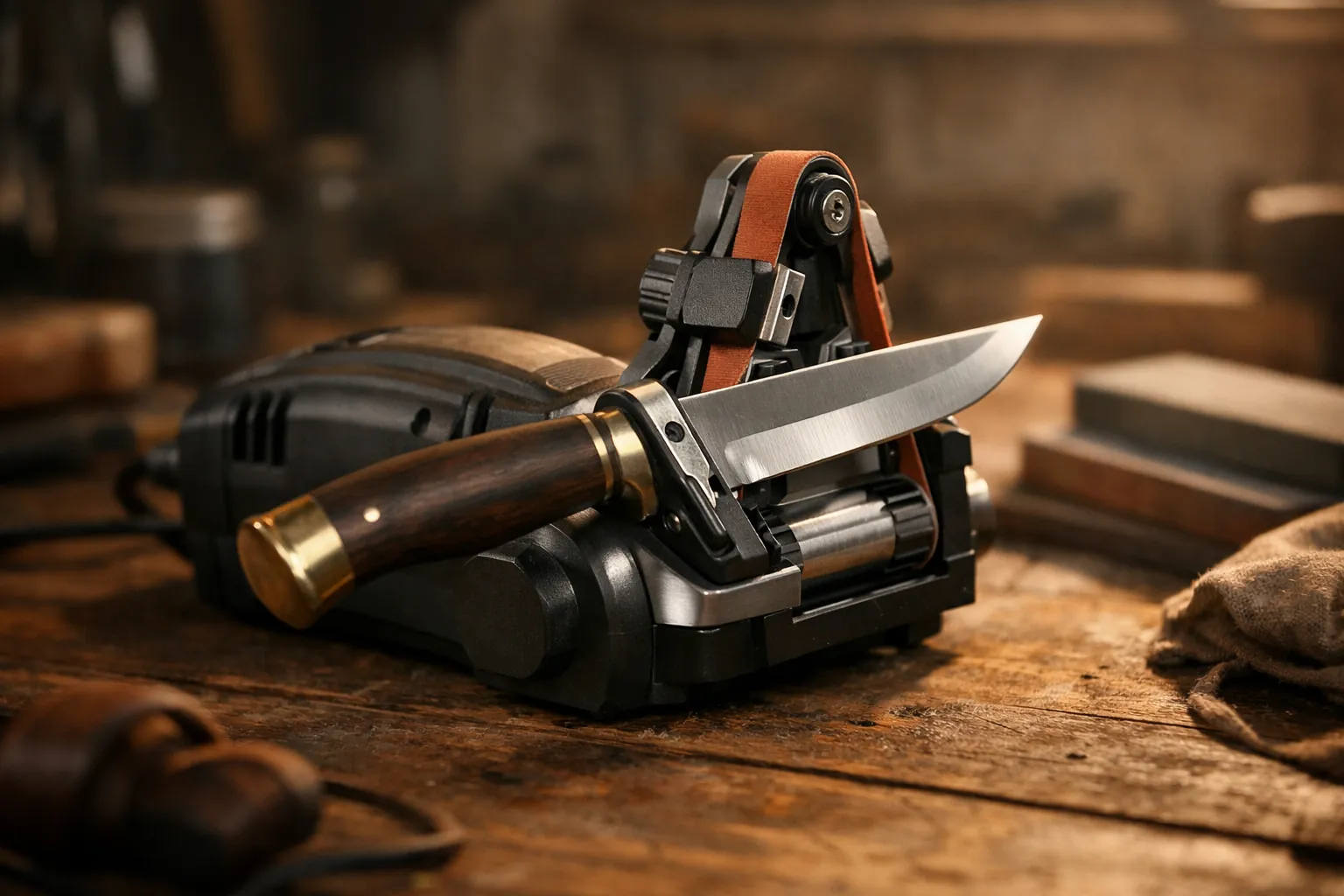
Work Sharp MK2 Knife & Tool Sharpener
Want a belt machine but not the Ken Onion's price? This is the stripped-down version. It runs at two speeds on flexible belts, and its edge guide supports the knife out to the tip. Buy it if the mower blade and the axe get sharpened in the same session as the kitchen knives. Belts can round off tips, so read is Work Sharp a good knife sharpener? before your first pass.
- Typepowered belt
- Motortwo-speed
- Beltsflexible
- Usesknives, serrated, scissors, mower blades, axes
- Warranty3 years
Why it stands out
- Sharpens almost any edge
- 8,100+ ratings
Think twice if
- You only sharpen kitchen knives
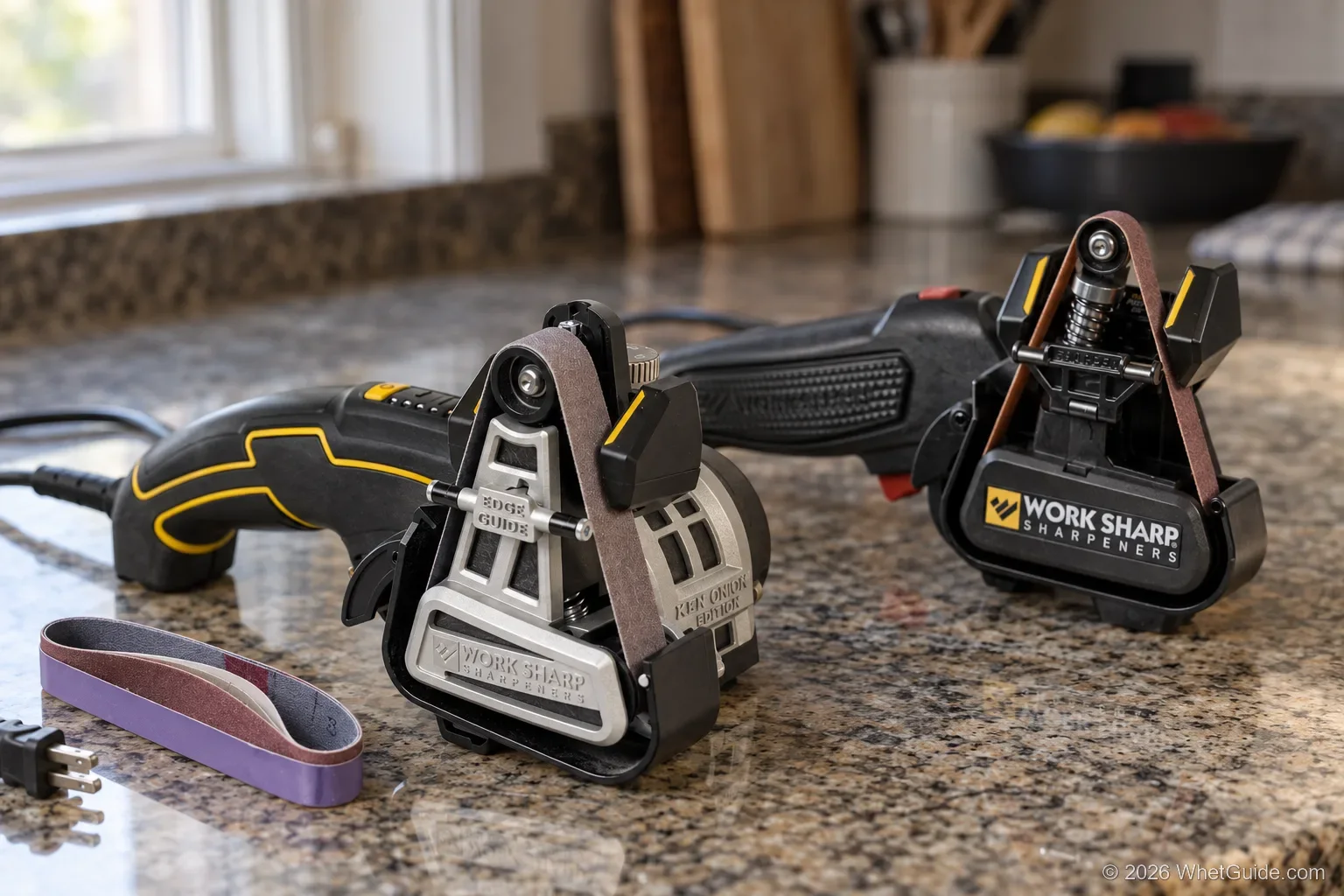
Work Sharp E2 Electric Kitchen Sharpener
Press the button, draw the knife through the guide, done. The guide keeps the angle even, and a built-in ceramic hone wheel handles the daily touch-ups between sharpenings. Work Sharp lists it for kitchen knives and serrated edges as well as scissors and shears.
- Operationpush-button, fully guided
- Extrasbuilt-in ceramic hone wheel
- Kniveskitchen knives, serrated, scissors, shears (per listing)
- Warranty3 years
Why it stands out
- Push-button simplicity
- Ceramic hone for daily touch-ups
Think twice if
- You want the best-rated option (it averages 4.3 stars)
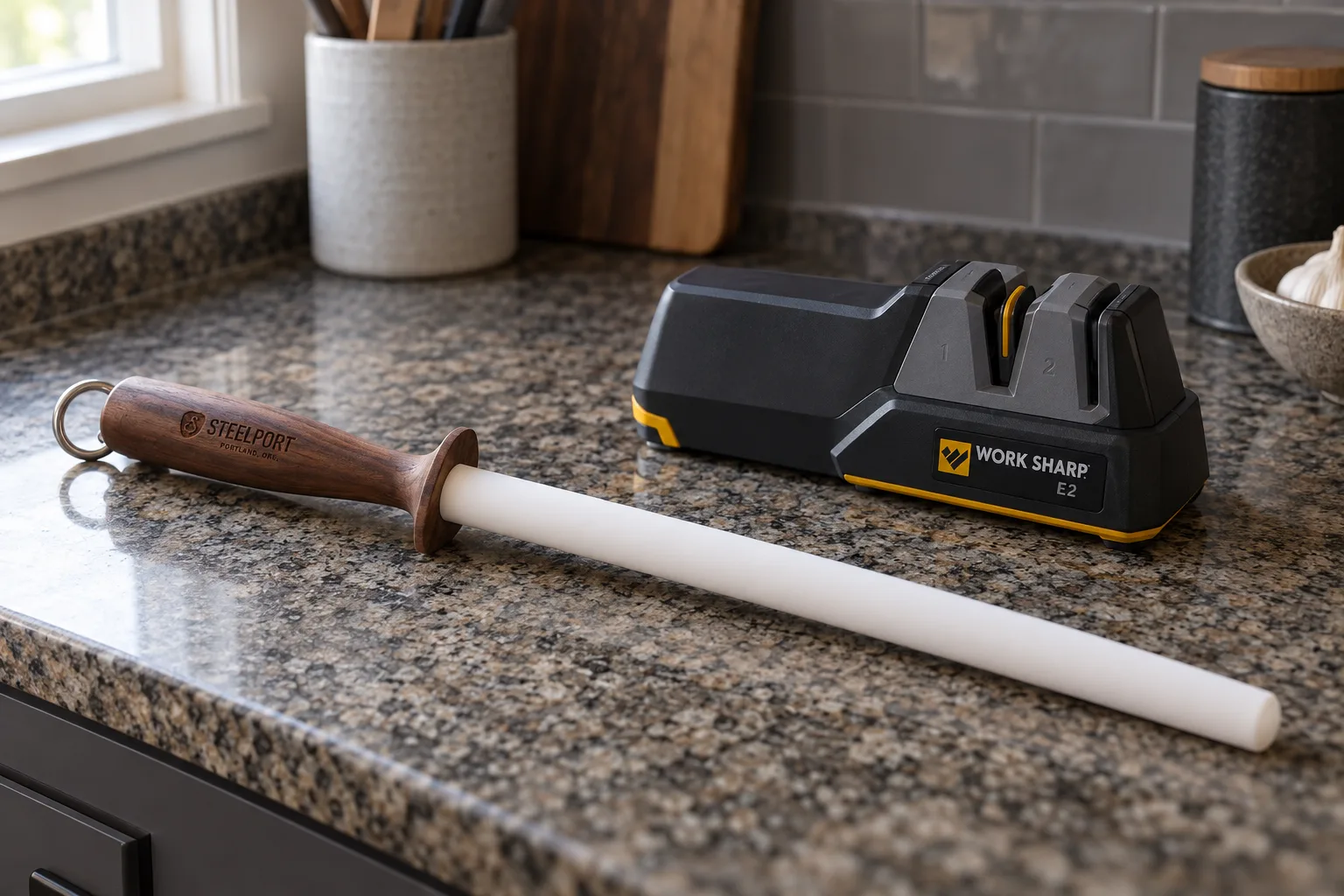
Side-by-side comparison
| Sharpener | Type | Angle | Stages | Serrated |
|---|---|---|---|---|
| Chef'sChoice 15XV | Wheels | 15° | 3 | Yes |
| Chef'sChoice AngleSelect | Wheels | 15° / 20° | 3 | Yes |
| Presto 08800 | Wheels | Fixed | 2 | No |
| Presto 08810 | Wheels | Thickness selector | 3 | Check listing |
| WS Ken Onion Mk2 | Belt | 15°–30° | Belts | Yes |
| WS MK2 | Belt | Guide (check listing) | Belts | Yes |
| WS E2 Kitchen | Guided, push-button | Check listing | Sharpen + hone | Yes |
And the details that decide the second tier of questions, all from the listings:
| Sharpener | Abrasive | Finishing stage | Single-bevel | Scissors and tools | Warranty |
|---|---|---|---|---|---|
| Chef'sChoice 15XV | Diamond, diamond, stropping disk | Flexible strop | Manual has a routine | No | Check listing |
| Chef'sChoice AngleSelect | Diamond + stropping disks | Flexible strop | Listed | No | 3-year limited |
| Presto 08800 | Sapphirite wheels | Hone stage | Not listed | No | Check listing |
| Presto 08810 | Sapphirite + ceramic | Extra-fine ceramic | Not listed | No | Check listing |
| WS Ken Onion Mk2 | Flexible belts | Fine belt, slow speed | Check listing | Yes | Check listing |
| WS MK2 | Flexible belts | Fine belt | Check listing | Yes; mower blades and axes too | 3 years |
| WS E2 Kitchen | Guided abrasive + ceramic hone wheel | Ceramic hone | Check listing | Scissors and shears | 3 years |
"Check listing" means the listing we read didn't say. That's worth knowing before you buy: a maker that's proud of a feature usually puts it in the bullets.
↑ Back to all sectionsBest professional electric knife sharpener
"Professional" usually means one of two things: a home machine with commercial-sounding features, or a unit that can keep up with a busy kitchen. The machines in this guide cover the first meaning. The Chef'sChoice 15XV and AngleSelect are the ones most cooks reach for. The Work Sharp Ken Onion Mk2 suits someone who sharpens a lot of knives and wants a dialed angle from 15 to 30 degrees. The Presto 08810 has "Professional" in its name, but it's a budget three-stage wheel machine.
Real commercial work is different. Sharpening services often use belt grinders, and many professional cooks still prefer whetstones for control over the angle and finish. If you want a machine for a working kitchen, a belt model is the closest fit here. For a wider look across tool types, the best knife sharpener for kitchen knives guide compares electrics with the rest.
↑ Back to all sectionsMore models worth knowing
The seven picks cover most kitchens, but reviewers name other machines, and you'll see them in search results. Here's where each one fits. They don't get full cards because each one duplicates a pick, costs more for little gain, or has no current listing with usable details.
| Model | What it is | Who should look at it |
|---|---|---|
| Chef'sChoice Model 130 | A 20° Chef'sChoice electric; confirm the stages on the listing | America's Test Kitchen's pick for 20° knives. An all-Western block you want kept at 20° |
| Chef'sChoice 315XV | A two-stage 15° Chef'sChoice; confirm the stages on the listing | America's Test Kitchen's best buy. Knives already at 15° that rarely need repair |
| Chef'sChoice Hybrid 290 AngleSelect | Electric stages plus a manual stage, at 15° and 20° | A mixed block on a smaller budget than the AngleSelect |
| Chef'sChoice Hybrid (20°) | Electric plus manual, one 20° angle | Western knives only, small budget |
| Chef'sChoice UltraHone | A mid-priced 15° Chef'sChoice diamond machine; confirm on the listing | Someone who wants a Chef'sChoice at 15° and doesn't need the 15XV's three stages |
| Work Sharp Ken Onion Elite Mk2 | The Ken Onion with a wider 10° to 35° range per its listing, and a keen, convex finish | Outdoor Life's best overall. Thin Japanese knives below 15°, or a serious tool bench |
| Mercer Culinary Triple Diamond | A three-stage diamond electric from a restaurant-supply brand | A busy home kitchen that wants a pro-supply name |
| Smith's Essentials Deluxe Diamond Electric | A budget diamond electric; confirm the stages and angle on the listing | CNN's best budget electric. A first machine on a small budget |
| Mueller Ultra-edge | A budget wheel electric | ShouldIt scored it 6.6, against 8.0 for its two leaders. Check the listing against the look-alike table |
| Mini belt sanders sold as knife sharpeners | A small belt grinder with a tilting angle shelf; Outdoor Life names the NuoDunco | Outdoor Life's budget belt option. Tools and outdoor blades, if you can live with more setup |
| Smith's electric belt sharpener | A Smith's belt machine; confirm the belts and guides on the listing | Outdoor Life's pick for scissors. Shears and scissors as much as knives |
| WEN wet sharpening system | A slow wet wheel, built like a budget Tormek grinder | Outdoor Life's wet-grinder pick. Axes and outdoor blades at low speed |
| Tormek T-1 | A powered diamond wheel with a stepless 8° to 22° guide and a honing wheel | ATK's pick for adjustable angles. A collection of good, thin kitchen knives |
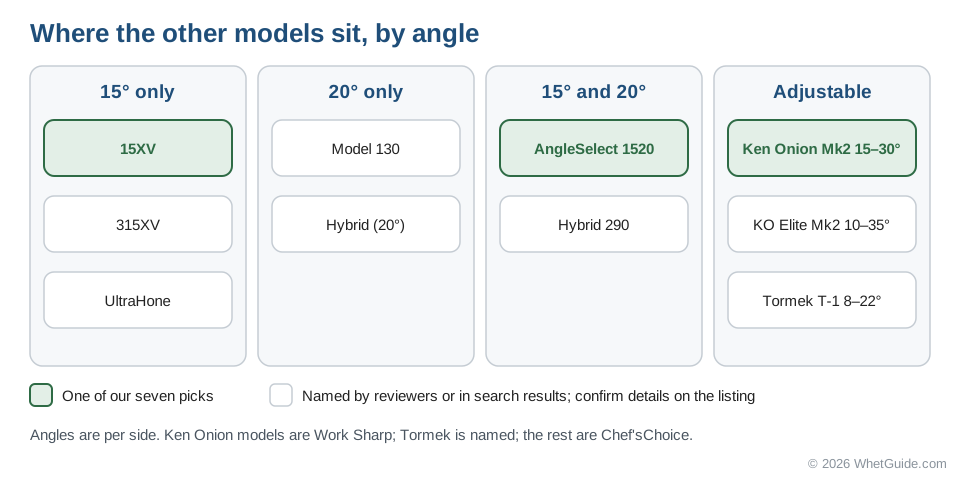
The AngleSelect on our list is the model Chef'sChoice numbers 1520, which America's Test Kitchen picked for mixed collections. So all four of ATK's Chef'sChoice winners are covered here: the 15XV and the 1520 as picks, the Model 130 and the 315XV in the table above. ATK's adjustable-angle pick, the Tormek T-1, is covered under alternatives and in our Tormek comparison.
↑ Back to all sectionsWhere reviewers disagree
Read five "best electric knife sharpener" lists and you'll find five different winners. Some of that is method. Some of it is that each publication is writing for a different reader. Here's the short version of who picked what, and what each pick tells you.
| Publication | Top electric pick | What they weighed | What to take from it |
|---|---|---|---|
| America's Test Kitchen | Chef'sChoice Trizor 15XV; Model 130 for 20°; Model 1520 for mixed sets | Edge sharpness (industrial tester, paper and tomato cuts) and repairing a drilled notch | Match the machine's angle to your knives. Presto models, Smith's Gourmet Mesa and the Sharpal 198H were not recommended |
| CNN | Chef'sChoice 15XV; Smith's Essentials Deluxe Diamond Electric for budget | A long test of 15 sharpeners | Another vote for the 15XV as the safe default |
| Outdoor Life | Work Sharp Ken Onion Elite Mk.2 | Worn knives of every kind: chef's, paring, pocket, hunting, bushcraft, machete | For outdoor and tool blades, a belt machine wins |
| ShouldIt | Trizor XV and Ken Onion, tied | Speed, a 25-minute continuous run, noise, heat, dust | The two leaders scored 8.0 each; cheaper Narcissus and EdgeKeeper units scored lowest |
| Food Network | Presto EverSharp | Tomato slicing, price, ease | For a cheap, simple machine, the Presto is fine; it's non-serrated only |
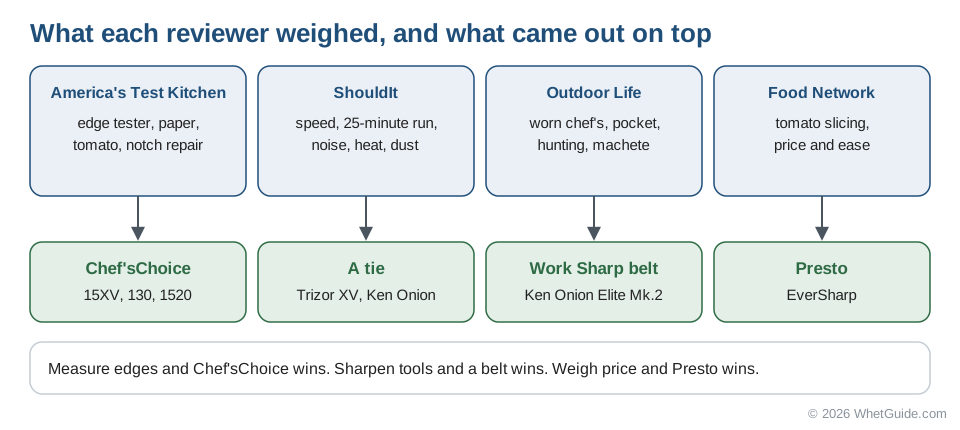
The pattern is plain enough. Reviewers who measure edges pick Chef'sChoice. Reviewers who sharpen outdoor knives and tools pick Work Sharp belts. Reviewers who weigh price heavily pick Presto. Our list follows the same split, which is why it has all three brands.
The one real disagreement is the Presto. ATK didn't recommend it; Food Network ranked it first. Both can be fair: ATK measures edges with an industrial tester against the best machines, and Food Network weighs price and ease. We keep it as the budget pick because its owner numbers are huge and its job is narrow: straight-edged kitchen knives on a small budget. If your knives cost more than the sharpener, buy the Chef'sChoice.
↑ Back to all sectionsDo electric sharpeners ruin knives?
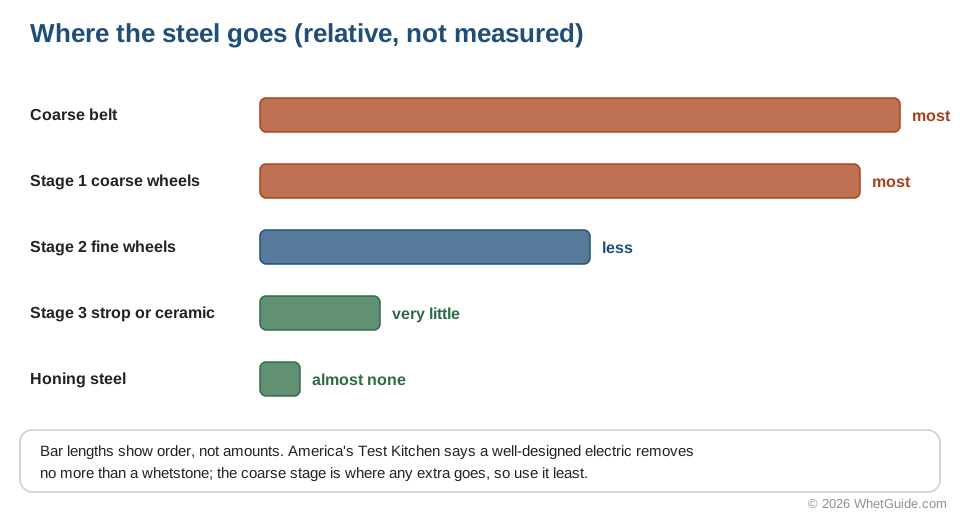
A good one, used properly, doesn't. That's America's Test Kitchen's view: a well-designed electric removes no more metal than a whetstone. The bad reputation comes from three habits, and all three are avoidable.
The first is the coarse stage. Coarse diamond wheels or a coarse belt take steel off fast, which is exactly what you want once, to set a new bevel or grind out a chip. Run a knife through the coarse slot every week and you'll take years off its life. The fix is a rule: start in the finest stage that brings the edge back, and go coarser only when it doesn't.
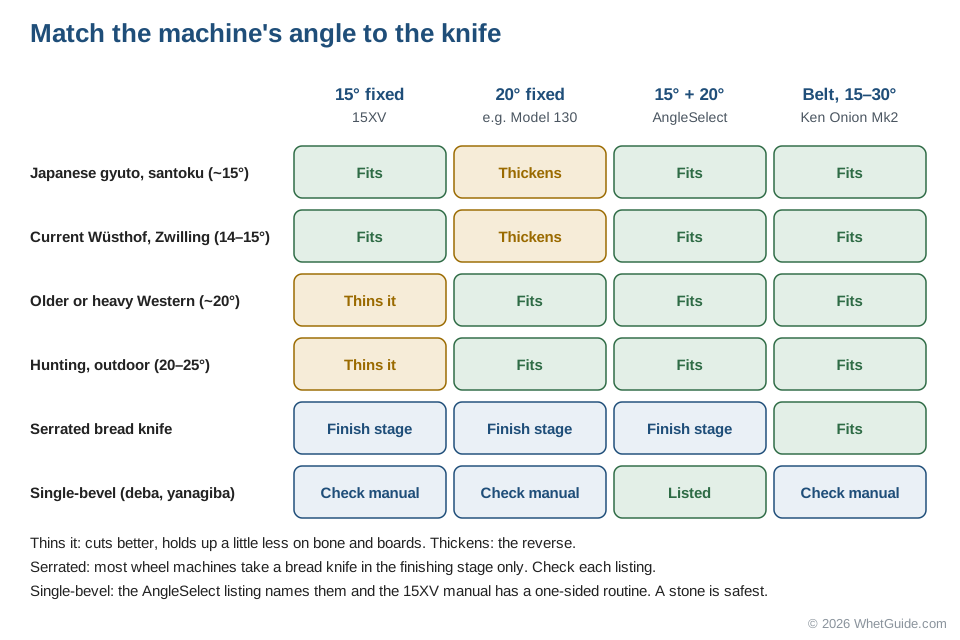
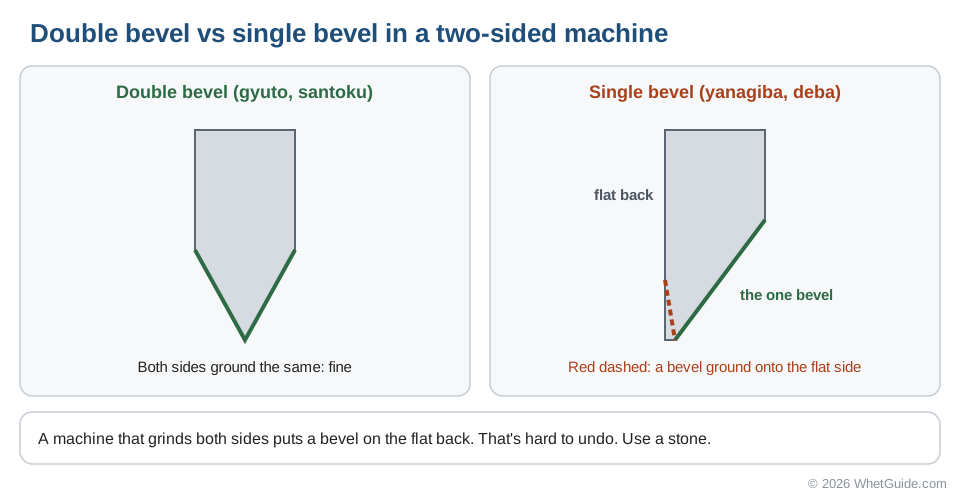
The second is the wrong knife. A single-bevel Japanese knife has one flat side and one bevel. A machine that grinds both sides equally will put a bevel on the flat side, and that's hard to undo. Serrated knives in a coarse slot lose their teeth. Ceramic blades don't belong in a steel-knife machine at all.
The third is pressure. The spring guides set the angle. Pushing down only makes the wheel bite deeper and heat the very edge. On a belt machine, pressure plus a slow pull can blue the thin steel at the tip, which ruins its temper. Let the knife's weight do the work.
There's also a fair point on the other side. Many people who own a whetstone never use it, and a knife that's always dull gets pushed harder and slips more. An electric that comes out every couple of weeks keeps a knife sharper over its life than a stone in a drawer. That trade is the whole case for buying one.
↑ Back to all sectionsMatch the machine's angle to your knives
Every electric sharpener has an angle built in, or a short list of them. Your knives have angles too, set by the maker. When the two match, the first sharpening is quick and the knife comes out the way it left the factory. When they don't, the machine regrinds the knife to its own angle. That's not a disaster, but it changes the knife, and the first session takes much longer. America's Test Kitchen splits its picks by angle: the Trizor 15XV for 15-degree knives, the Model 130 for 20-degree ones, and the Model 1520 for a block that mixes both.
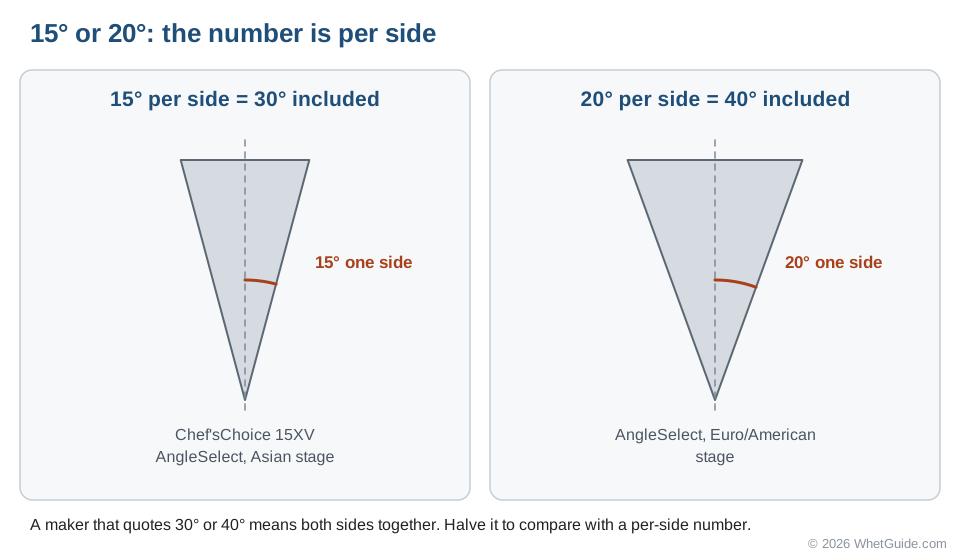
Angles are quoted two ways, and that trips people up. Most knife makers and sharpener makers quote per side: 15° means each bevel sits 15° from the center of the blade. Some quote the included angle, both sides together, so a 30° figure from one maker is the same edge as 15° from another. Halve any number above 25 before you compare it with a dial.
What the common knives want
| Knife | Maker's angle (per side) | Included | Best electric match |
|---|---|---|---|
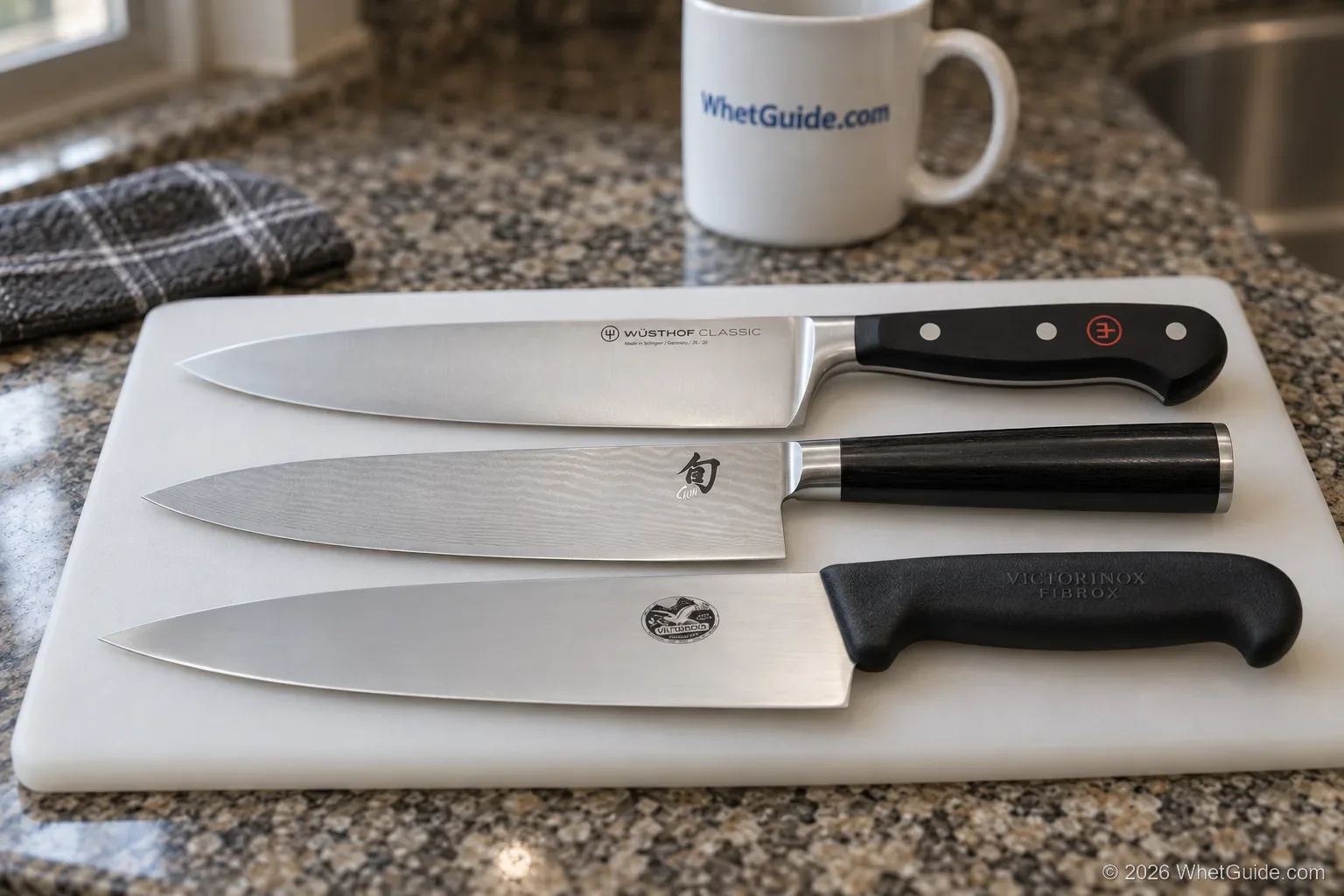
| Wüsthof standard blades | About 14° (Wüsthof's PEtec figure is 14.5°) | About 28° to 29° | 15XV or AngleSelect 15° stage |
| Zwilling / Henckels | 15° | 30° | 15XV |
| Shun | 16° | 32° | 15XV or AngleSelect 15° stage |
| Victorinox | 15° to 20° | 30° to 40° | Either; AngleSelect if you want a choice |
| Japanese gyuto and santoku (most double-bevel) | About 15° or a little lower | About 30° | 15XV, or the Ken Onion Elite for lower angles |
| Older or budget Western knives | About 20° | About 40° | AngleSelect 20° stage, or a 20° machine |
| Hunting and outdoor knives | 20° to 25° | 40° to 50° | Ken Onion Mk2 or MK2 |
The brand pages behind these numbers are on our Wüsthof, Zwilling, Shun and Victorinox angle guides, and the full list is in the angle chart. If you don't know what your knife is, the Sharpie trick shows you the angle it actually has.
What you give up at 15°
Japanese knives commonly sit around 15° per side, older German knives around 20°. Run a 20° knife through a 15° machine and the edge gets thinner: it cuts better and holds up a little worse. On a chef's knife that cuts vegetables on a wood board, you won't notice the worse part. On a knife that splits chicken backs or gets used on a glass board, you will, because a thin edge rolls and chips sooner. A two-angle model avoids that trade. Your knife maker's recommendation wins over any general rule.
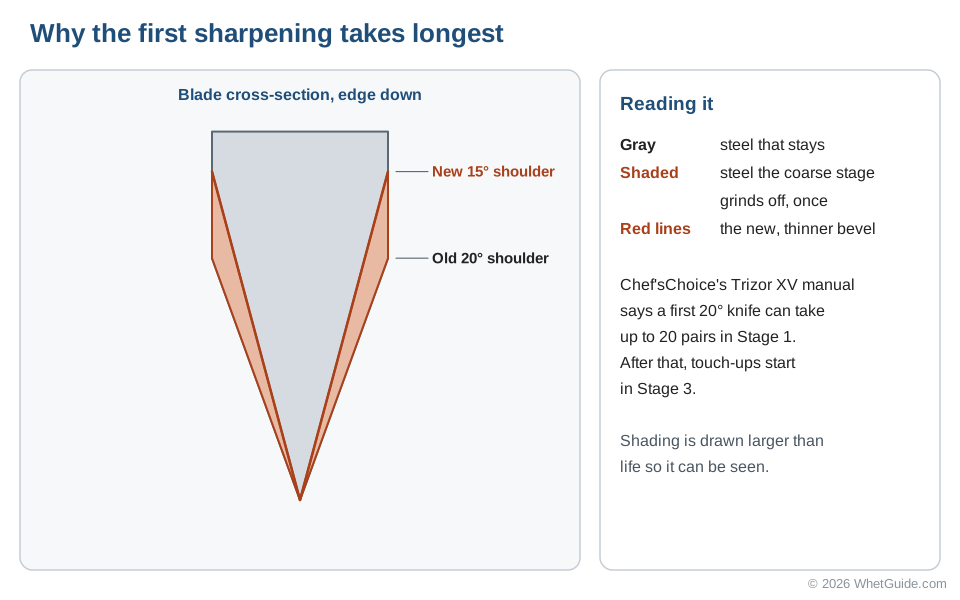
The first conversion is also slow. To turn a 20° bevel into a 15° one, the machine has to grind away two slivers of steel along the whole edge. Chef'sChoice's Trizor XV manual says it can take up to 20 pairs in Stage 1 the first time a 20° Western knife goes through. After that, the knife is at 15° and touch-ups start in the finishing stage.
Wheel machine or belt machine?
Every electric on this page is one of two designs. A wheel machine has fixed slots with abrasive wheels turning at the bottom; you pick a slot and pull. A belt machine runs a narrow abrasive belt over two pulleys, with an angle guide beside it; you pick an angle and a belt, then draw the knife across.
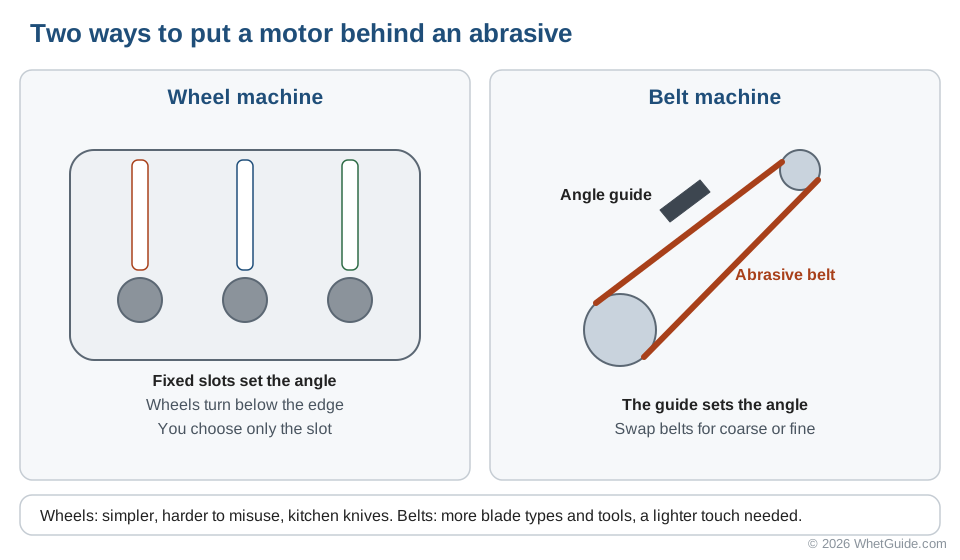
| Wheel machine (Chef'sChoice, Presto) | Belt machine (Work Sharp) | |
|---|---|---|
| Skill needed | Almost none: pick a slot and pull | Some: you set the angle and belt, and keep a light touch |
| Angle | Fixed per slot (15°, 20°, or both) | Adjustable on the Ken Onion; guided on the MK2 |
| Edge shape | Flat V-bevel | Slightly convex |
| Blades it takes | Kitchen knives; some take serrated in the last stage | Kitchen, pocket, hunting, serrated, scissors, many tools |
| Mess | Filings collect inside the machine | Grit and dust thrown off the belt; better in a garage or on a mat |
| Risk | Overusing the coarse slot | Rounding the tip, overheating thin steel |
| Wear parts | Wheels last a long time; not usually replaced at home | Belts wear and are swapped |
For a block of kitchen knives, get a wheel machine. It's simpler and much harder to misuse. A belt machine earns its place when the same bench also sees pocket knives, a hatchet or the pruning shears. Bob Vila's reviewers made the same point from the other direction: the metal dust off a belt machine is a workshop thing, not a countertop thing.
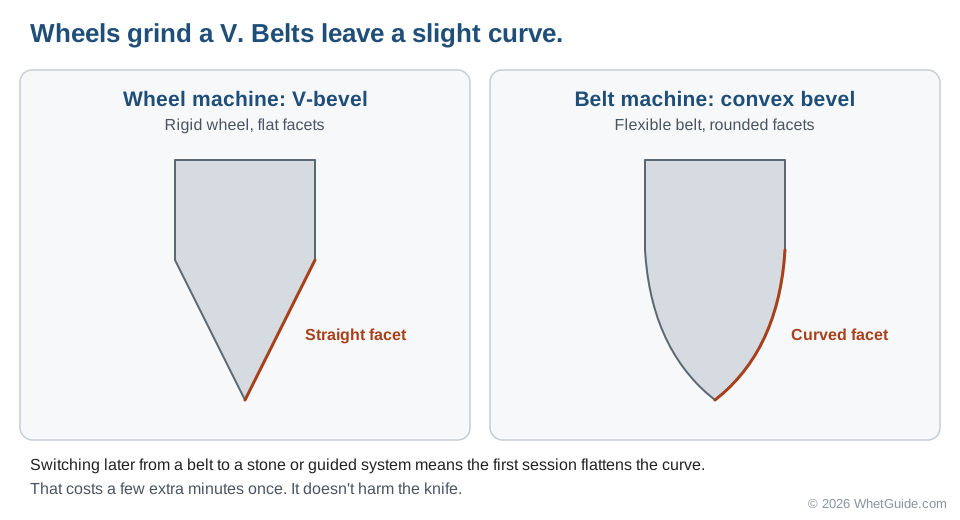
The convex edge from a belt is strong behind the apex and cuts well. The only catch comes later: if you ever move that knife to a stone or a clamp system, the first session flattens the curve back into a V. It costs a few minutes once and doesn't harm the knife. If you already have a belt sander in the garage, read how to sharpen a knife on a belt sander before you buy a dedicated machine; with the right belts it can do much of the same work.
↑ Back to all sectionsBuying guide
Look for a fine finishing stage
The ceramic hone or flexible strop stage is the one you'll use week to week, and it leaves the cleaner edge. All the wheel machines here have one. The belt machines get the same result from a fine belt. A machine with only a coarse and a "fine" diamond stage, and no hone or strop, leaves a burr that you then have to remove with a rod.
Serrated and single-bevel knives
Read the listing before you buy. If your machine can't do serrations, see how to sharpen a serrated knife. For single-bevel Japanese knives, a whetstone is still the safest choice; see sharpeners for Japanese knives. There's more on both in serrated, single-bevel and ceramic blades.
Check the heel: bolsters
Many forged German knives have a full bolster, a thick collar of steel where the blade meets the handle that runs down to the edge. A slot can't reach the edge right in front of it. Every sharpening takes a little off the rest of the edge and none off that last half inch, so after a few years a small step forms at the heel and the knife stops meeting the board there.
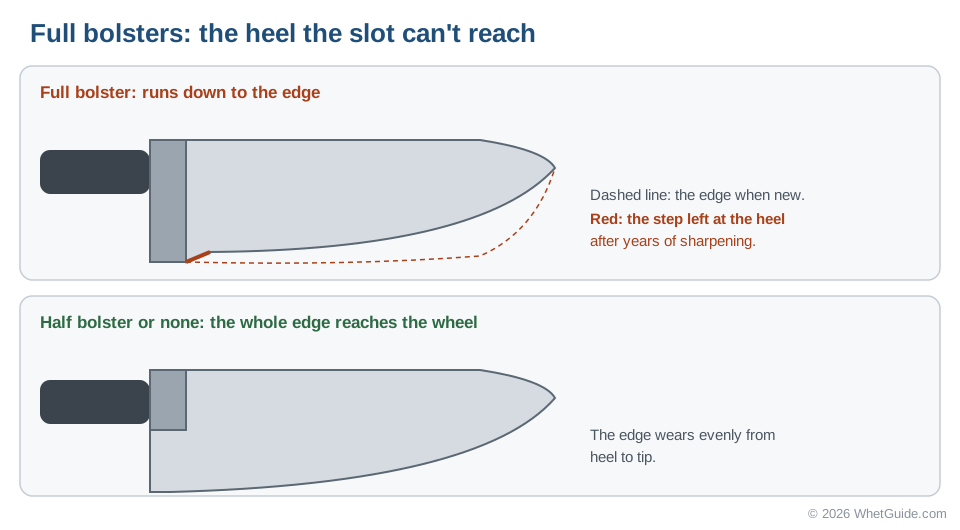
Look at your chef's knife from the side. If the thick part stops above the edge (a half bolster or no bolster), any electric is fine. If it runs all the way down, you have two choices: accept the step, or have the bolster ground back by a sharpening service every few years. A belt machine, which lets you angle the knife a little, reaches closer to a bolster than a fixed slot does.
Blade thickness and the slot
Slots are cut for kitchen knives. A thick hunting knife or a cleaver may not go in, or may go in but rest on the spring guide at a slightly different angle. The Presto 08810 handles this with its thickness selector. On other wheel machines, if the blade won't slide in without force, it doesn't belong there. Belt machines don't have this limit.
Space and noise
A wheel machine lives on the counter or in a cupboard near an outlet. Make sure the base has rubber feet and that you have a clear, stable spot at counter height, since you'll be pulling a knife toward yourself. Belt machines need more room and are happier on a bench. All of them are loud for a few seconds per pull, about like a small kitchen appliance.
Before you buy: a checklist
- Is your knife steel? Ceramic blades need a different tool.
- Double bevel or single? Single-bevel knives need a listed routine or a stone.
- What angle does your knife maker give, and does the machine offer it? More under matching the angle.
- Kitchen knives only, or tools too? That decides wheel or belt.
- Any serrated knives? Check the listing names them.
- Full bolsters on your forged knives? Expect a step at the heel over time.
- Does the thickest blade you own fit the slot without force?
- Is there a finishing stage (strop, ceramic hone or a fine belt)?
- How long is the warranty, and does the listing state one?
Cheap look-alikes: what to check
Search "electric knife sharpener" on Amazon and the first page is full of no-name two- and three-stage machines, some at a third of the Chef'sChoice price. A few are fine. Many say almost nothing about what's inside. Outdoor Life put a "buyer beware" note on this category, and ShouldIt's lowest scores went to cheaper units like the Narcissus and the EdgeKeeper.
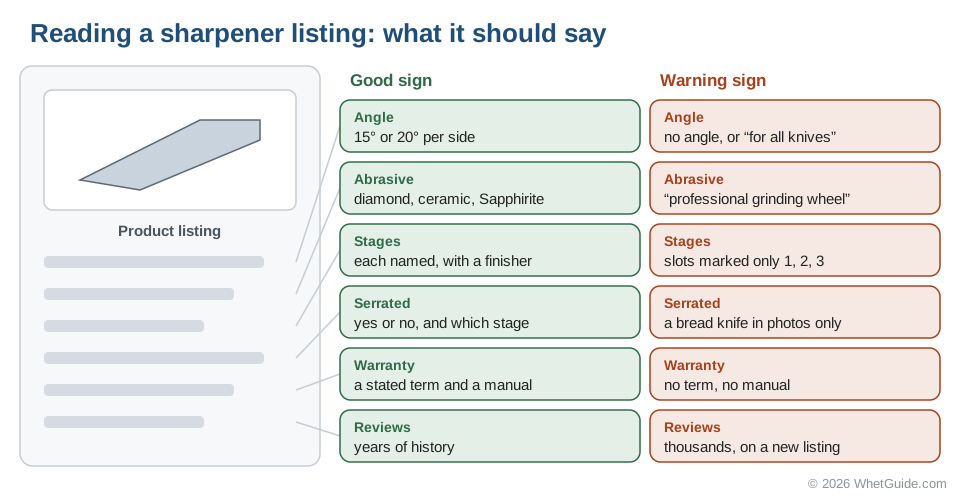
Here's what a good listing states and a vague one leaves out:
| On the listing | A good sign | A warning sign |
|---|---|---|
| Angle | A number per side (15°, 20°), or two numbers for two stages | No angle at all, or "suitable for all knives" |
| Abrasive | Named: diamond, ceramic, Sapphirite, a named belt grit | "Professional grinding wheel" with no material |
| Stages | Each stage named for what it does, with a finishing stage | Three slots labeled only 1, 2, 3 |
| Serrated | Says yes or no, and which stage | Photos of a bread knife with no mention in the text |
| Warranty and parts | A stated term and a maker with a website and manual | No warranty stated, no manual to download |
| Reviews | Years of history and photos of real edges | Thousands of ratings on a listing a few months old |
Budget two-stage units from brands like Northmas and Secura sell in big numbers. Read their listings against this table before you buy. ATK tested the SHARPAL 198H, a three-stage budget electric, and didn't recommend it. If the price gap to a Presto or a Chef'sChoice is small, take the known machine.
↑ Back to all sectionsWhat it costs to own one
The sticker price is most of the cost of a wheel machine, and less of it for a belt machine. Prices move every week, so we don't quote them here. Check the listing; if you can wait, the Black Friday watch list may save you money.
| Ongoing parts | Warranty on the listing | What wears out first | |
|---|---|---|---|
| Chef'sChoice 15XV | None at home | Check listing | The strop disks, slowly |
| Chef'sChoice AngleSelect | None at home | 3-year limited | The strop disks, slowly |
| Presto 08800 / 08810 | None at home | Check listing | The wheels, slowly |
| Work Sharp Ken Onion Mk2 | Replacement belts | Check listing | The coarse belt |
| Work Sharp MK2 | Replacement belts | 3 years | The coarse belt, faster on tools |
| Work Sharp E2 | Check listing | 3 years | The abrasive, slowly |
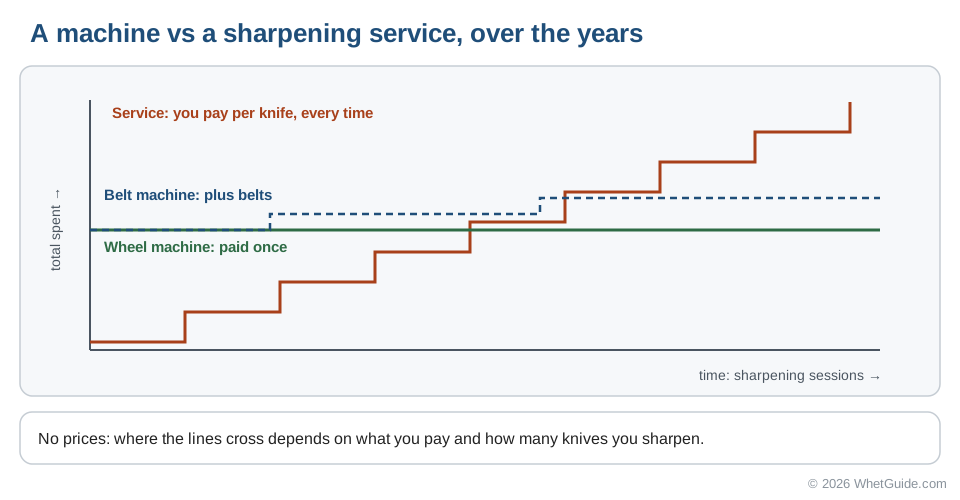
Compared with a sharpening service, the math is simple. A service charges per knife, every time. A machine is paid for once. If you sharpen a household block twice a year, a machine can pay for itself sooner than you'd think; knife sharpening service cost has typical rates to plug in. If you own two knives and sharpen once a year, a service or a mail-in service is cheaper.
↑ Back to all sectionsYour first sharpening, step by step
The first session is the one that sets the angle, so it's slower than every session after it. Read your model's manual once; the steps below are the common pattern, and the counts come from the Chef'sChoice manuals. Full model-by-model counts are in how to use a Chef'sChoice knife sharpener.
- 1Clean the knifeWash and dry it. Grease and food bits load the wheels.
- 2Set upFlat, dry counter at a comfortable height, cord out of the way.
- 3Pick the stageCoarse only for a new angle or a dull knife. Otherwise, the middle stage.
- 4Pull in pairsLeft slot, then right. Heel to tip at a steady speed, no pressure.
- 5Feel for the burrA slight rough lip along the whole edge, on the side away from the last pull.
- 6Step to the next stageA few pairs, per the manual.
- 7Finish in the last stageStrop or hone until the burr is gone.
- 8Test, wipe, emptyPaper or tomato test, wipe the blade, clear the filings.
On step 3: for a 15XV and a 20° Western knife, the manual starts you in Stage 1, and it can take up to 20 pairs of 3 to 4 second pulls before a burr forms. A knife that's already at 15° needs far fewer. For the AngleSelect 1520, Stage 1 is not a coarse stage: it's the 15° slot for Asian-style knives, and Stage 2 is the 20° slot. Use the one that matches the knife.
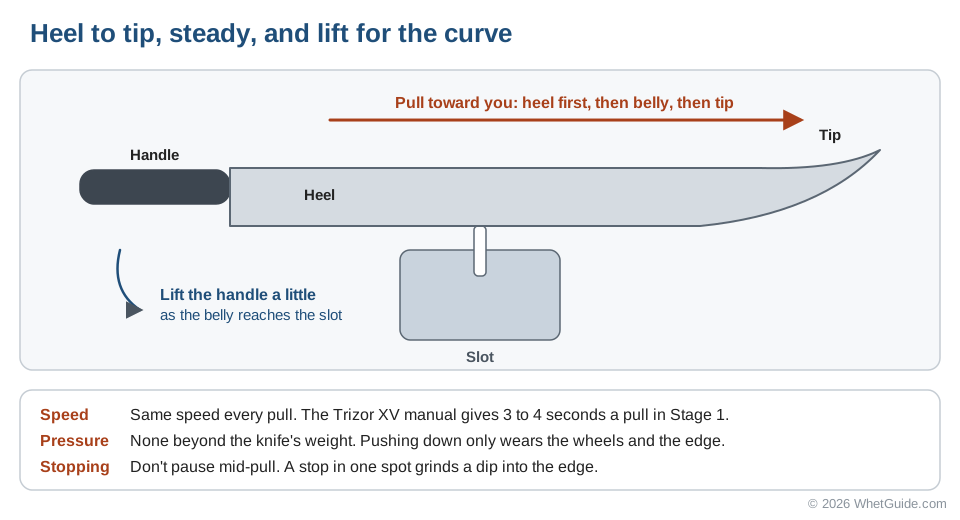
On step 5: run a fingertip gently across the edge, from the spine side off the edge, never along it. A burr feels like a faint rough lip; the other side feels smooth. No burr means more pairs in the same stage. A burr on only part of the edge means that part needs more work, often the tip, which leads to the pull technique below.
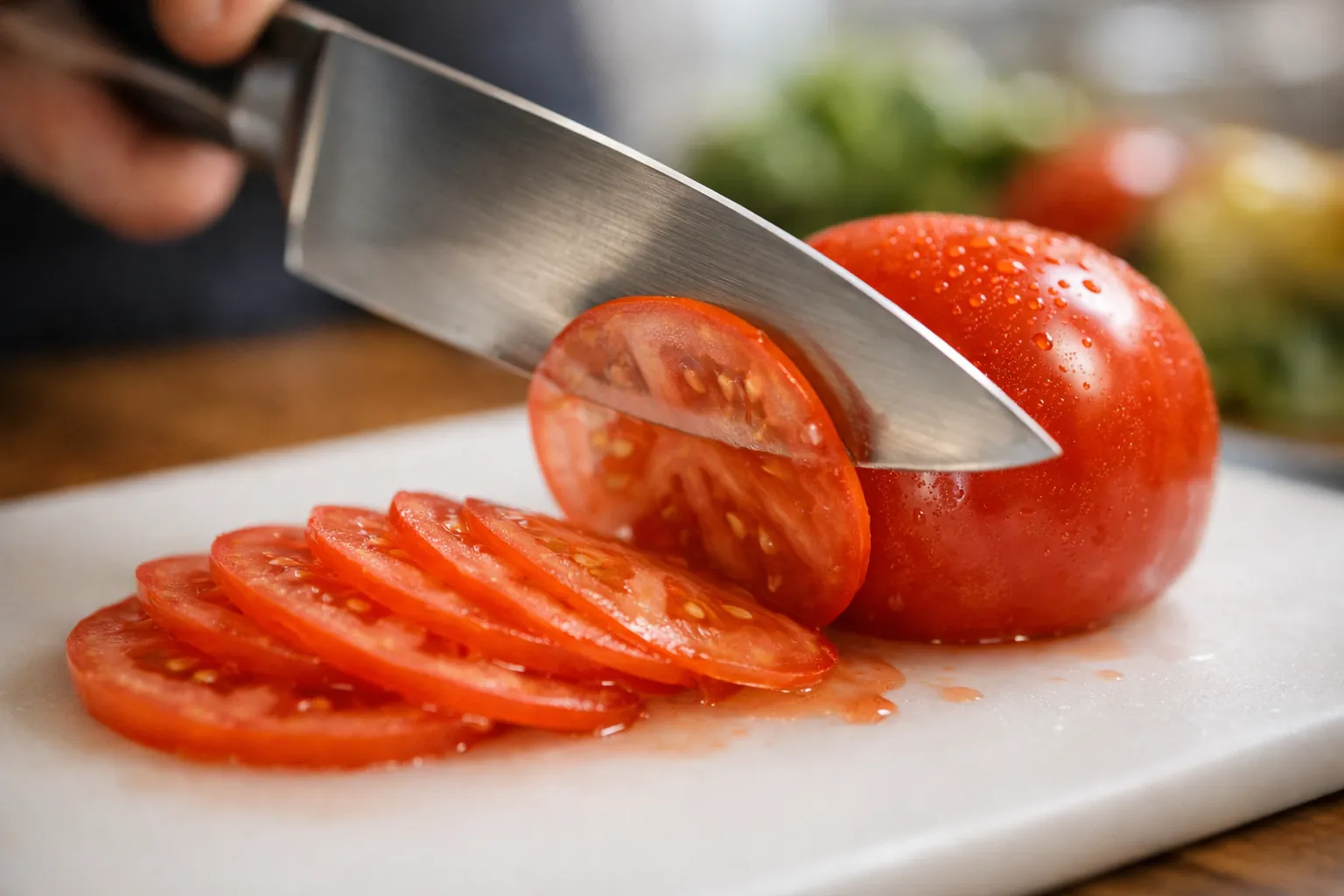
On step 8: the paper test is the simplest. Hold a sheet of printer paper by one corner and slice down through it. A sharp edge cuts cleanly with no tearing or snagging. A ripe tomato is the kitchen version: a sharp knife bites into the skin with no pressure. If the edge catches in one spot, that spot needs a few more pairs in the finishing stage.
↑ Back to all sectionsGetting the best from an electric sharpener
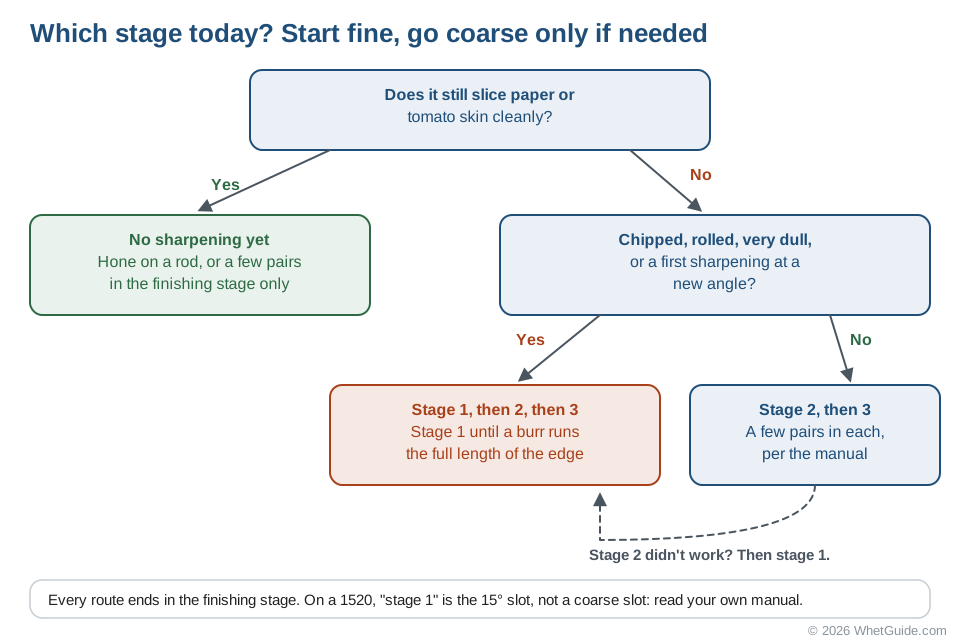
Start at the finest stage. Go coarser only if the knife doesn't respond, because the coarse stage is where electric sharpeners eat metal. Step-by-step use, including what the manuals mean by "pairs" of pulls, is in how to use a knife sharpener.
- Pull at a steady speed and don't push down. The guides set the angle; pressure only adds wear.
- Alternate slots or sides evenly, the way the instructions say.
- Lift the handle a little as you reach the tip so the curve gets sharpened too.
- Empty the metal dust as often as the maker recommends.
A stage schedule
| Stage | Use it when | How often, roughly |
|---|---|---|
| Finishing (strop, ceramic hone) | The knife feels a little off: slips on tomato skin, drags through onion | Often weekly in a busy kitchen; whenever it feels off |
| Middle (fine diamond, or a 20° stage on the 1520) | The finishing stage no longer brings the edge back | A few times a year; Food Network puts a full sharpening at about twice a year for an average cook |
| Coarse (stage 1 on most models) | A chip, a rolled edge, a very dull knife, or the first sharpening at a new angle | Rarely; some knives never need it again after the first time |
America's Test Kitchen's advice is the same in fewer words: touch up on the finest slot. The coarse stage is a repair tool, and a knife that only needs maintenance shouldn't go anywhere near it.
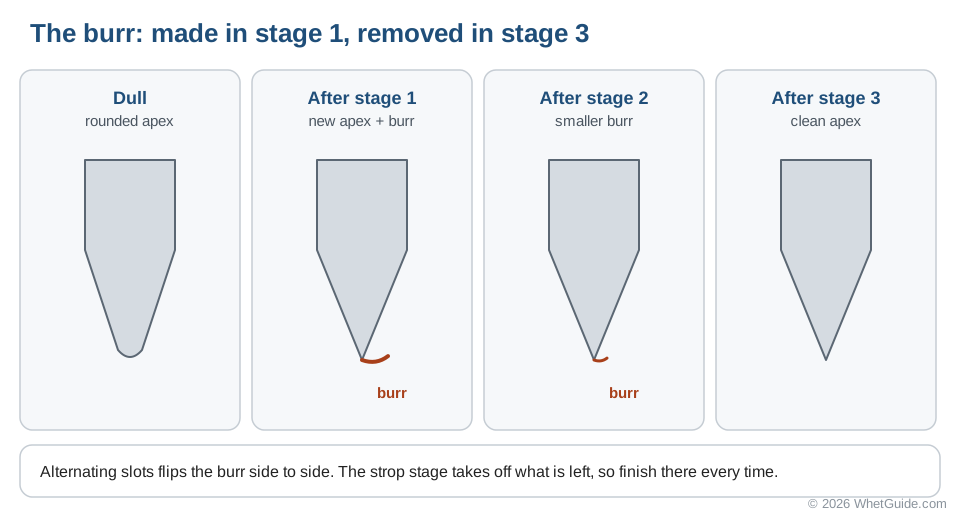
That last point is the most common reason people think their machine "doesn't work." The burr is a thin wire of steel that the coarse wheels push over to one side. It feels sharp at first. After a few cuts it folds over and the knife feels duller than before. The finishing stage exists to take it off, so always finish there, even when you're in a hurry.
Troubleshooting: when the edge comes out wrong
| What you see | Likely cause | Fix |
|---|---|---|
| Edge feels duller after sharpening | A burr left on the edge, or no finishing stage | A few light pairs in the finishing stage, or a few strokes on a honing rod |
| No burr forms in stage 1 | Not enough pulls on a first sharpening at a new angle, or pulling too fast | More pairs, slower; on the Trizor XV the first time can take up to 20 pairs |
| Burr on part of the edge only | The belly or tip isn't reaching the wheel | Lift the handle slightly as the curve comes through |
| Tip is rounded or shorter | Pulling the tip out of the slot at an angle, or a belt running past the tip | Stop the pull with the tip still in the slot; on a belt, end the stroke as the tip reaches the belt |
| One bevel wider than the other | More pulls on one side than the other | Count pairs and alternate every time |
| Knife steers sideways in food | Uneven bevels (see above) | Even it out with alternating pairs in the middle stage |
| Small dip near the heel | Full bolster, or pausing at the start of a pull | Start each pull with the heel already moving; see the bolster note |
| Scratches on the blade face | Pulling at a tilt so the face rubs the guide | Keep the blade upright and centered in the slot |
| Burning smell or blue tint (belt) | Too much pressure or too slow on a fast belt | Lighter touch, lower speed, more passes |
| Motor rattles or slows | Filings packed inside, or a knife forced into the slot | Unplug, clear the filings per the manual; don't force blades |
If a problem keeps coming back, suspect your technique first. Slow down, count pairs out loud for a session or two, and finish every time. For a closer look at how a burr forms and how to tell when it's gone, knife sharpening burr has photos and the fingertip test.
↑ Back to all sectionsSerrated, single-bevel and ceramic blades
Serrated knives
The Chef'sChoice 15XV and AngleSelect, the Work Sharp Ken Onion Mk2, the Work Sharp MK2 and the Work Sharp E2 all list serrated blades. The Presto 08800 says non-serrated only, and the 08810's listing doesn't say. On the Chef'sChoice machines, serrated knives go through the finishing stage only. The manuals give about 5 to 10 pairs there, and they keep serrated knives out of the coarse stage except for one quick pass per side when the teeth are badly damaged.
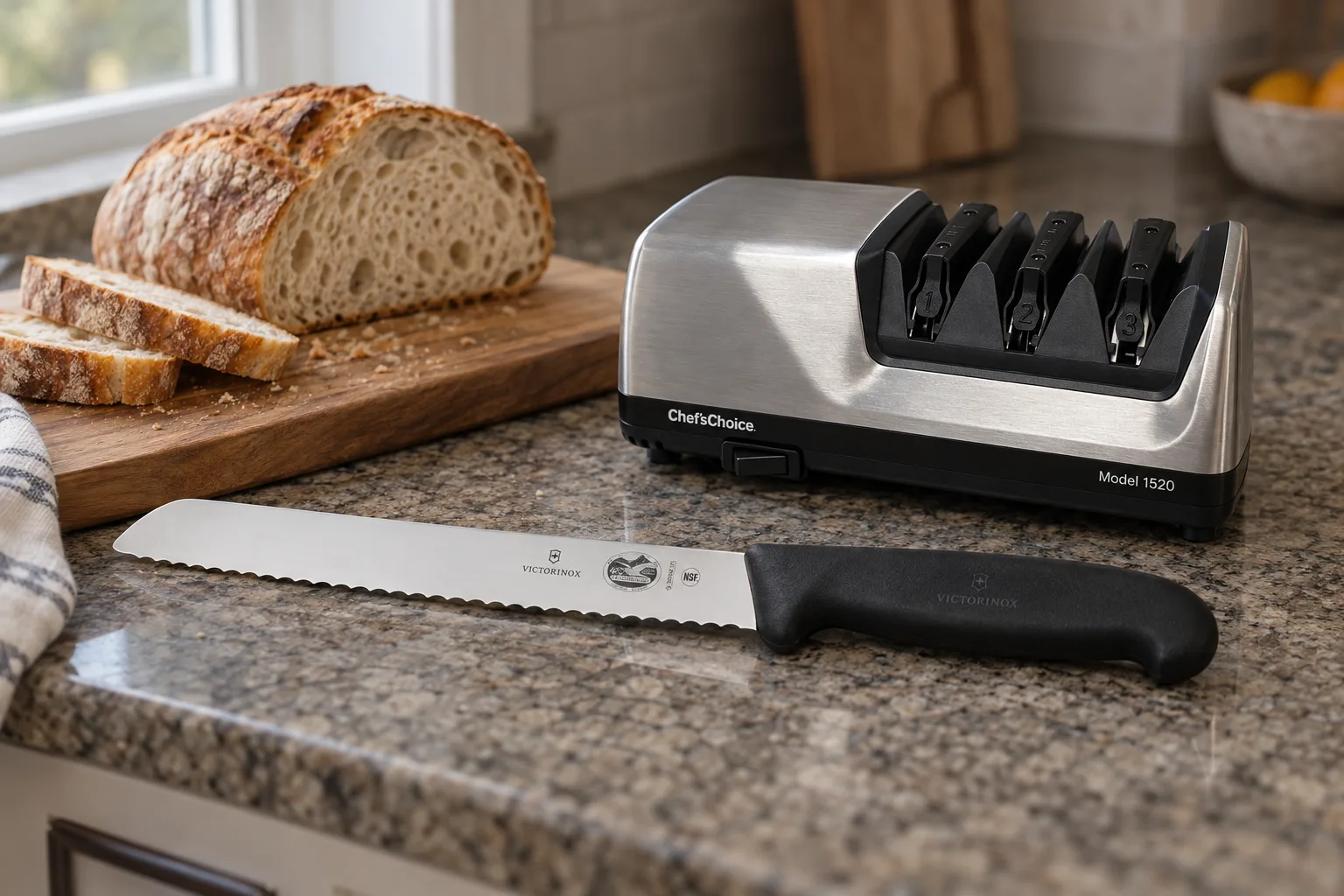
What the machine does to a serrated knife is limited. It touches the tips of the teeth and the edge between them, which brings a bread knife back to life, but it can't get into each scallop the way a tapered rod can. For a bread knife that needs real work, see how to sharpen a serrated knife, or our picks for sharpeners for serrated knives.
Single-bevel Japanese knives
A yanagiba, deba or usuba has one beveled side and one flat, slightly hollow side. Grinding the flat side ruins the knife's geometry. The AngleSelect's listing names single- as well as double-bevel knives, and the 15XV manual gives a one-sided routine, but most owners of these knives use a whetstone, and so would we. The Japanese knife sharpener guide has the options.
Ceramic knives
A ceramic blade is harder than most abrasives in a steel-knife machine. Don't put one in a normal electric sharpener unless the listing names ceramic. Diamond is the only abrasive that cuts it well, and it needs a light touch because ceramic chips rather than bends. Ceramic knives are a separate job: how to sharpen a ceramic knife.
Scissors and pocket knives
Wheel machines are for kitchen knives. For scissors and shears, the Work Sharp belt machines and the E2 list them; or try the scissor sharpener picks. Pocket and hunting knives are belt-machine work too, or a guided manual system: see sharpeners for pocket knives and for hunting knives.
↑ Back to all sectionsChips and rolled edges: when to call a pro
A rolled edge is the most common "damage" and the easiest to fix. The thin apex has bent over to one side, often from a bone or a hard board. Often a honing rod straightens it. If not, a few pairs in the middle stage will.
A small chip, the kind you can feel with a fingernail but can't easily see, needs the coarse stage. The machine has to grind the whole edge back until the chip is gone, which means many more pairs than a normal sharpening, then the usual steps through the finer stages. America's Test Kitchen tested machines on exactly this, a notch drilled into the edge, because it's where a weak coarse stage shows itself. A belt machine on a coarse belt is faster at chip repair than any wheel machine.
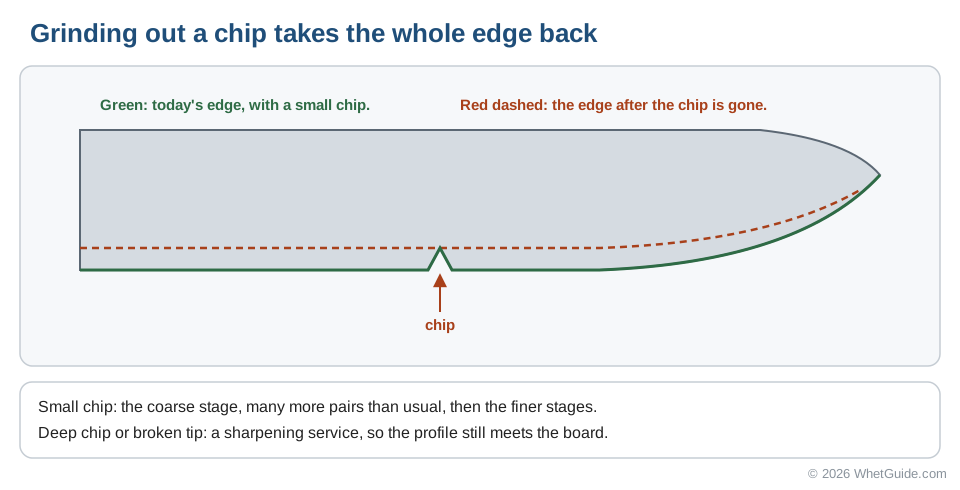
A deep chip, a broken tip or a bent blade is professional work. Grinding out a deep chip in a kitchen machine removes a lot of steel along the whole edge, not just at the chip, and a pro can reshape the profile so the knife still meets the board. Outdoor Life's Drew Conover draws a similar line for the 15XV, calling it best for maintaining a kitchen knife's sharpness rather than fixing heavy damage. Typical prices are in sharpening service cost, and the mail-in services page names the ones that ship.
↑ Back to all sectionsSafety and cleanup
An electric sharpener is safer than freehand sharpening, because the guides keep your fingers away from the abrasive. The risks are elsewhere: a sharp knife pulled toward your body, a machine that slides, and metal filings near food.
- Put the machine on a flat dry counter, and keep the rubber feet clean so it doesn't skate. Bob Vila's reviewers list a nonslip base among the first things to look for.
- Keep your free hand on top of the machine, behind the slots, never in front of the slot the knife is leaving.
- Cut-resistant gloves are cheap and worth wearing while you learn, and when you test the edge.
- Sharpen away from food prep. ShouldIt's precautions include keeping the machine away from food, and on belt machines, watching for sparks.
- Wipe the blade after the last pull to take off fine steel dust, then wash it before it touches food.
- Empty the filings as the manual says. On belt machines, a mat or a garage bench saves the countertop.
| Wheel machine | Belt machine | |
|---|---|---|
| Noise | A grinding whir for a few seconds per pull | Louder, longer runs |
| Dust | Collected inside; wipe the blade | Thrown off the belt; Bob Vila's reviewers say it suits a workshop |
| Heat | Little, at the pull speeds the manuals give | Real risk on thin steel; keep passes short and light |
| Sparks | No | Possible on coarse belts |
ShouldIt measured noise and heat, plus dust, in a 25-minute continuous run and scored the Trizor XV and the Ken Onion highest. For quiet, the Tormek T-1 lists 45 dB, which is about as quiet as powered sharpening gets.

Sharpening vs honing, and care between sessions
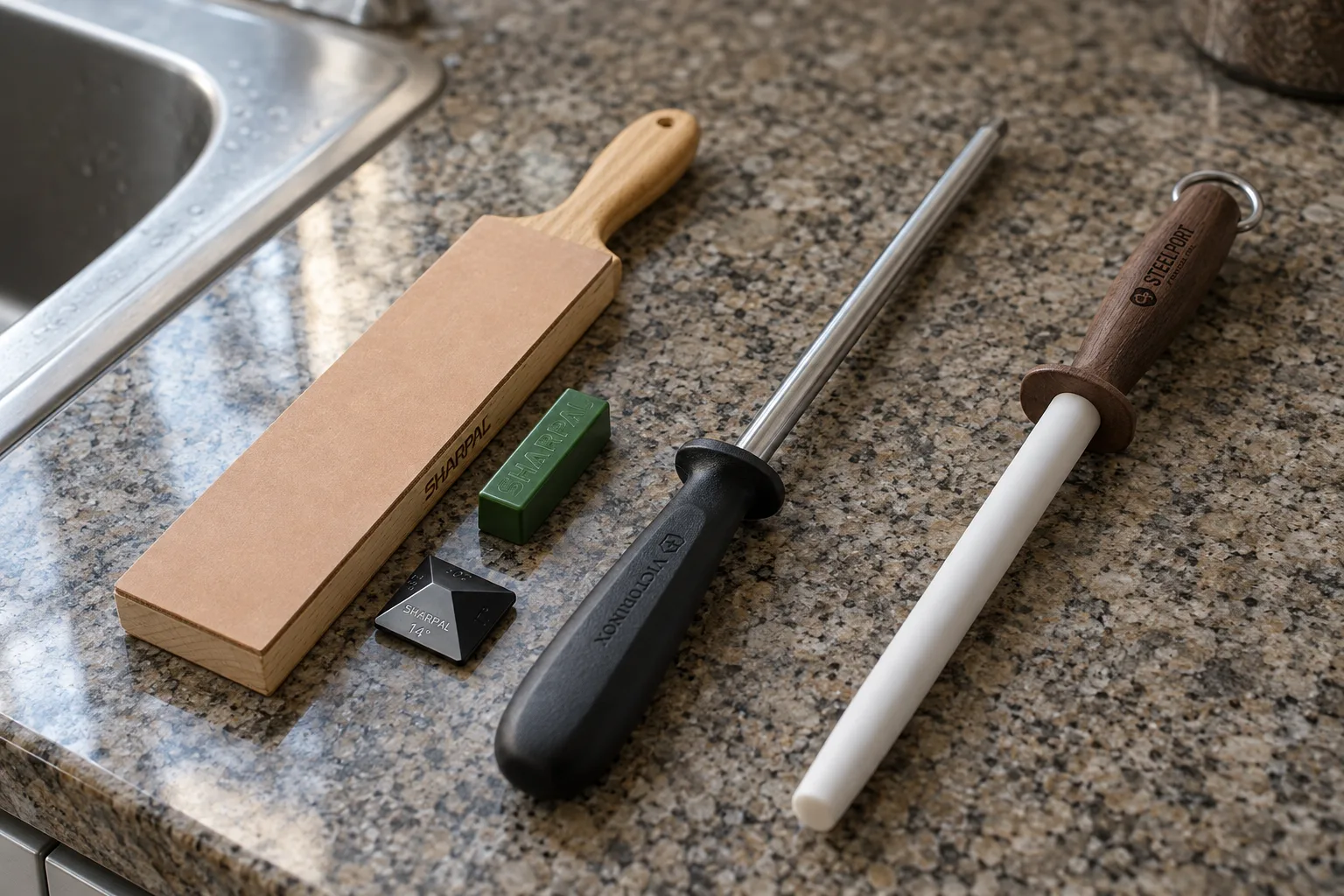
Sharpening removes steel to make a new edge. Honing pushes a bent edge back into line and removes almost none. Most of the time a knife "feels dull" because the edge has rolled, not because it's worn away, and a honing rod or the finishing stage fixes it in seconds.
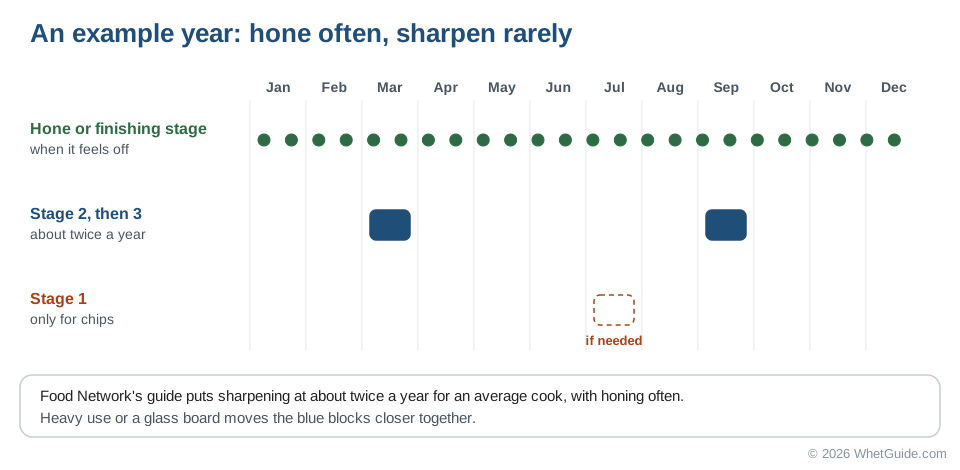
So the routine that keeps a knife sharp longest is mostly honing. Food Network's knife guide suggests sharpening about twice a year for an average cook and honing often. Many households with an electric sharpener find the finishing stage does the honing job, and that's fine: it removes very little steel. A ceramic rod beside the machine does the same thing by hand, and it's quicker for a single knife mid-dinner. Our honing rod vs whetstone and how to use a honing rod guides cover the technique.
The rest of the care routine is plain. Hand-wash and dry the knife; a dishwasher knocks the edge against other things. Cut on wood or soft plastic, never glass, stone or a plate. Store knives in a block, on a magnetic strip or in blade guards, not loose in a drawer. The whole routine is in knife care, and how often to sharpen knives has schedules by knife type.
↑ Back to all sectionsFour common knife blocks and the machine for each
If your block isn't any of these, go back to the angle table and match the knife you use most. That knife sets the machine; the others can live with a degree or two of difference.
↑ Back to all sectionsIf you'd rather not go electric
A guided manual system such as the Work Sharp Precision Adjust removes less metal and gives you any angle from 15° to 30°; a 1000/6000 whetstone gives the most refined edge. Compare in whetstone vs knife sharpener. If you'd rather skip the plug, the best manual knife sharpeners covers the pull-throughs worth buying. The Tormek T-1 is a premium powered option with a wide angle range.
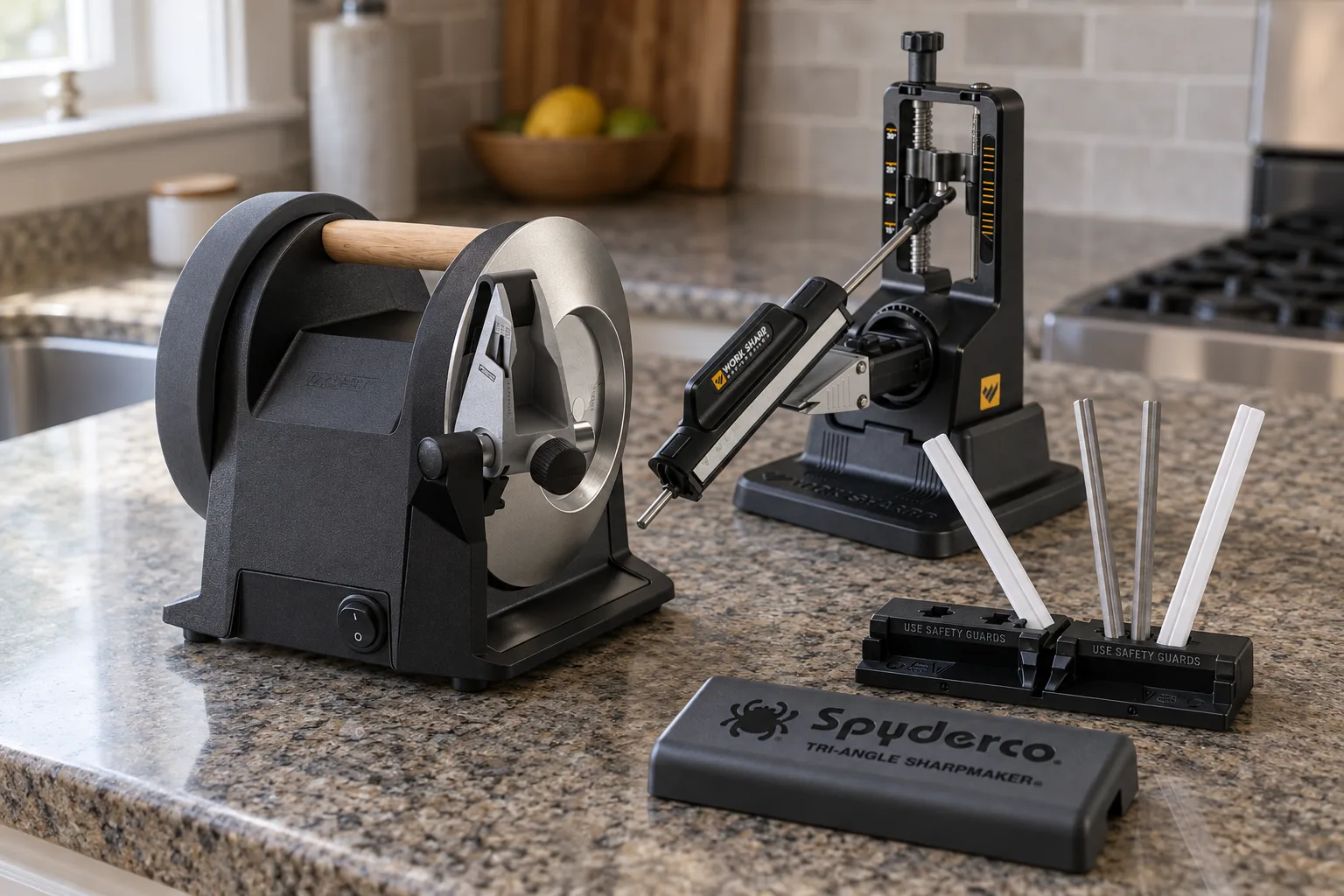
The way people usually move is from an electric to a guided system to stones. An electric gets your knives sharp tomorrow with no skill. A guided system like the Precision Adjust or a Spyderco Sharpmaker teaches you what the angle does while still holding it for you. Stones give you full control, and they're where most people end up if they get curious. You'll find the middle step in the best knife sharpening system guide, and beginner whetstone sets plus how to use a whetstone cover the last.
| Electric | Guided manual | Whetstone | |
|---|---|---|---|
| Time per knife | A minute or two | Several minutes | Longest, until practiced |
| Skill | None | A little | Real practice |
| Angle choice | Fixed per slot, or a belt dial | Any, in the system's range | Any |
| Single-bevel knives | Rarely | Some systems | Yes |
| Steel removed | More in the coarse stage | You choose the stone | You choose the stone |
When to buy
Electric sharpeners are a regular holiday-sale item, and the Chef'sChoice 15XV and the Work Sharp Ken Onion are the two most worth watching, because both are the pick in their class and both carry a price where a sale makes a real difference. Our Black Friday watch list tracks them. Buying one as a present? The knife sharpening gifts page has ideas at every budget.
↑ Back to all sectionsPick by what's in your knife block
All 15° Japanese-style knives, or a mix you don't mind thinning to 15°: the Chef'sChoice 15XV. A German chef's knife you want to keep at 20° next to a santoku: the Chef'sChoice AngleSelect. Cheap straight-edged knives and a small budget: the Presto 08800. Pocket knives and tools in the queue as well: the Work Sharp Ken Onion Mk2. Whichever you buy, live in the finest stage and save the coarse slot for knives that are truly dull.
Before the first use, read the manual's pull counts and check your knife's angle. Keep serrated and single-bevel knives out of the coarse slot, and finish every session in the last stage.
Specs come from Amazon listings, as do the ratings and sales figures, all checked October 3, 2026. Pull counts come from the Chef'sChoice instruction booklets. Reviewer picks come from America's Test Kitchen and Outdoor Life; ShouldIt and Food Network; Bob Vila and CNN, read November 14, 2026. We do not quote prices we have not checked. How we research · Affiliate disclosure