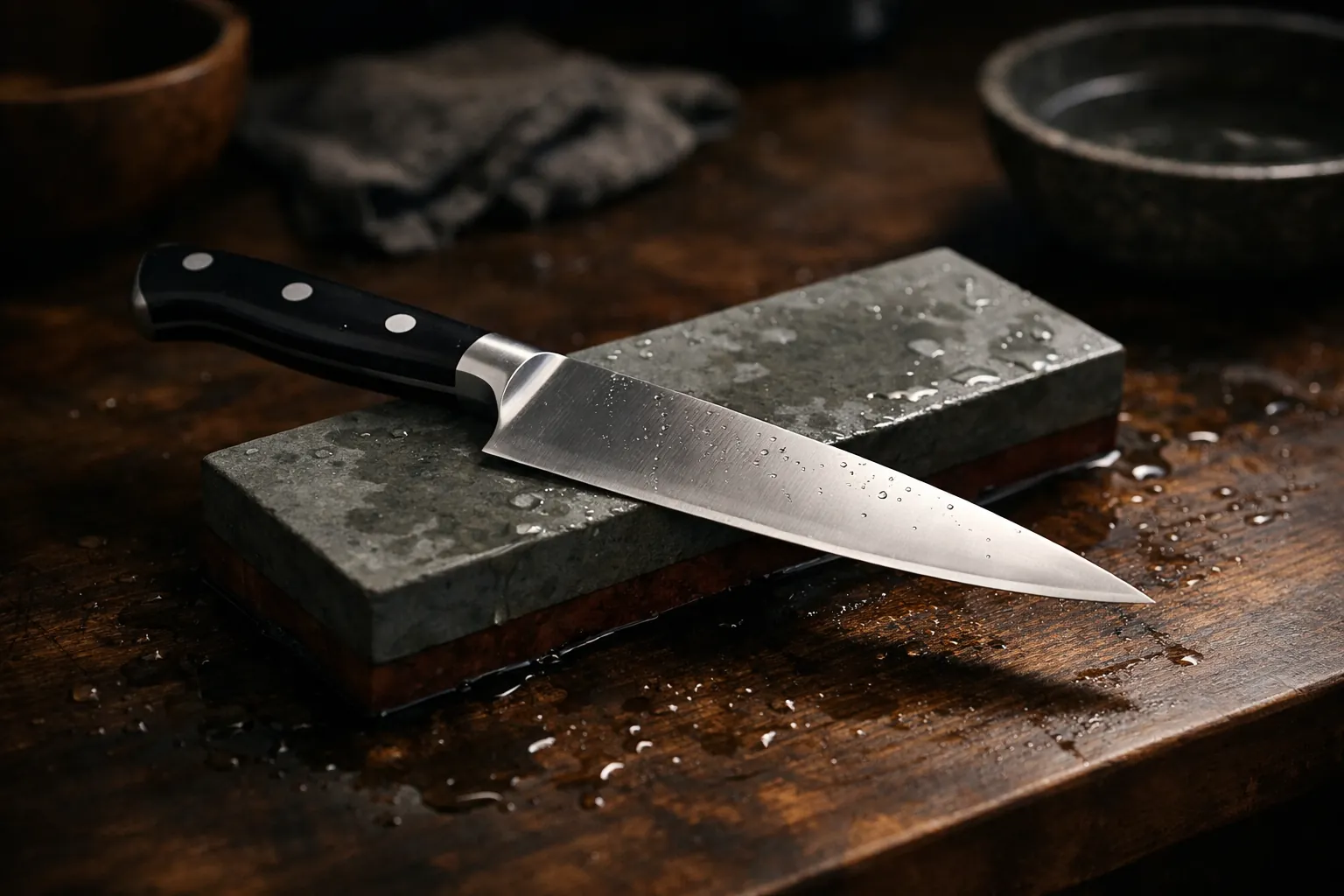
Sharpen Wüsthof standard blades at 14 degrees per side and Wüsthof santokus and nakiris at 10 degrees per side. Those are the figures on Wüsthof's own product pages, and they're what Tormek's compiled list of maker recommendations shows too. The only wrinkle is that two Wüsthof articles say 14.5°, a difference you won't feel on the board. For the bigger picture across brands, see our knife sharpening angle chart.
What Wüsthof says, word for word
Wüsthof repeats one sentence on its product pages: "Our sharpening angle for standard blades is 14˚ per side, and for Asian-style blades (Santokus, Nakiris) is 10˚ per side." We read it on the Gourmet 7" santoku page and the first half on the Classic 8" chef's knife page on October 3, 2026. The Universal hand-held sharpener page gives the same pair, 14 and 10.
Then there's 14.5. Wüsthof's article on PEtec, its robot-sharpened edge, calls it "14.5° per side" against about 20° for other brands, and its how-to-sharpen article tells you to tilt the knife to "a 14.5-degree angle". Its own Slider angle guide says "the proper 14-degree angle".
| Wüsthof source | Standard blades | Santoku, nakiri |
|---|---|---|
| Product pages (Classic, Gourmet) | 14° per side | 10° per side |
| PEtec article | 14.5° per side | not stated |
| How-to-sharpen article | 14.5° | 10° |
| Slider sharpening guide | 14° | "not meant to be used" on Asian-style knives |
| Two-Stage hand-held sharpener page | 14° per side (a Q&A on the page says 14.5°, 29° total) | not compatible |
| Tormek's maker list (2020) | 14° | 10° (also Chai Daos) |
Our read: 14.5 is the robot's target at the factory and 14 is the rounded number Wüsthof gives owners. Use 14. Your hand can't hold half a degree anyway, and a guided tool that stops at 15 is closer than any pull-through set to 20.
Wüsthof sharpening angle by line
Wüsthof doesn't publish a different angle for Classic, Classic Ikon, Ikon, Gourmet or its other lines. The split is by blade shape, not by collection. What changes between lines is the steel's hardness and the blade's height, which changes how high you hold the spine.
| Line and knife | Angle per side | What Wüsthof lists | Spine height at that angle |
|---|---|---|---|
| Classic 8" chef's knife | 14° | Width 1.9 in, 58 HRC, forged | 11.7 mm (0.46 in) |
| Classic 7" hollow-edge santoku | 10° | Width 1.8 in, 58 HRC | 7.9 mm (0.31 in) |
| Gourmet 7" hollow-edge santoku | 10° | Width 1.7 in, 56 HRC, non-forged | 7.5 mm (0.30 in) |
| Classic Ikon, Ikon chef's and utility knives | 14° | Brand-wide figure; no line-specific angle published | Measure yours |
| Any Wüsthof nakiri or Chai Dao | 10° | Asian-style blade | Measure yours |
Spine heights are blade width × sin(angle) at the heel, for the spine's centerline. Narrower blades and the area toward the tip need less height.
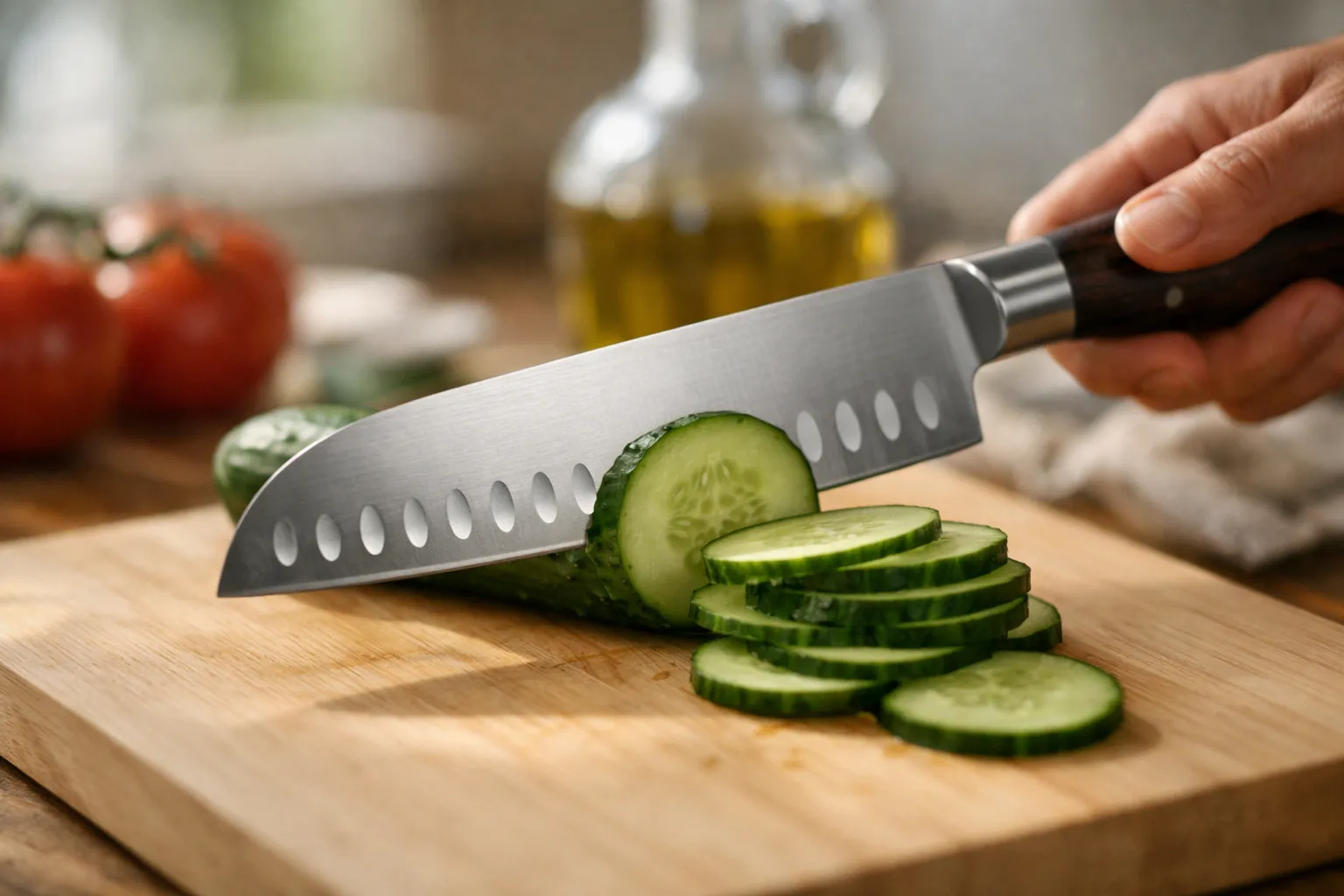
Spine heights for Wüsthof blades
A Classic 8" chef's knife is 1.9 inches (48 mm) tall at the heel, so holding 14° means the spine sits about 11.7 mm off the stone: roughly 7.7 US pennies (1.52 mm each). For a 1.8 inch santoku at 10°, it's only 7.9 mm, about five pennies. That's lower than most people's first guess, which is why santokus often come back from freehand sessions with a thicker edge than they left with.
| Blade width at heel | 10° | 14° | 14.5° | 15° (tool minimum) |
|---|---|---|---|---|
| 1.0 in / 25 mm (paring) | 4.3 mm | 6.0 mm | 6.3 mm | 6.5 mm |
| 1.6 in / 40 mm (utility, petty) | 7.0 mm | 9.7 mm | 10.0 mm | 10.4 mm |
| 1.7 in / 43 mm (Gourmet santoku) | 7.5 mm | 10.5 mm | 10.8 mm | 11.2 mm |
| 1.8 in / 46 mm (Classic santoku) | 7.9 mm | 11.1 mm | 11.5 mm | 11.8 mm |
| 1.9 in / 48 mm (Classic 8" chef's) | 8.4 mm | 11.7 mm | 12.1 mm | 12.5 mm |
For a blade not on the list, open the angle calculator with the Wüsthof preset loaded and type in your width. It also corrects for spine thickness if you're stacking coins.
Which sharpeners match 14° and 10°
Most tools on the market are built around 15 and 20 degrees. That makes Wüsthof's standard blades easy (15 is one degree off) and its santokus hard (almost nothing outside Wüsthof's own sharpener goes to 10).
| Tool | Angle it sets | Standard blades (14°) | Santoku, nakiri (10°) |
|---|---|---|---|
| Wüsthof 2-Stage hand-held | 14° per side on Wüsthof's page; the Amazon listing says 34° | Yes, made for them | No |
| Wüsthof Universal hand-held | 14° or 10° per side (switchable) | Yes | Yes |
| Chef'sChoice 15XV | 15° (electric, three stages) | Close: 1° thicker | No: 5° thicker |
| Work Sharp Precision Adjust | 15–30° per side | Close: set it to 15 | No |
| Spyderco Sharpmaker | 30° or 40° inclusive (15° or 20° per side) | Close: 30° slots | No |
| Whetstone, freehand | Whatever you hold | Yes | Yes, with practice |
A note on that 34°. Wüsthof's own 2-Stage sharpener page says 14 degrees per side, which is 28 inclusive (29 by the Q&A answer on the same page). The Amazon listing for the same sharpener says its carbide and ceramic slats sit at 34°. Those can't both be right. We'd go with Wüsthof's page, and if the number matters to you, color the bevel with a marker, make two pulls and look where the ink went.
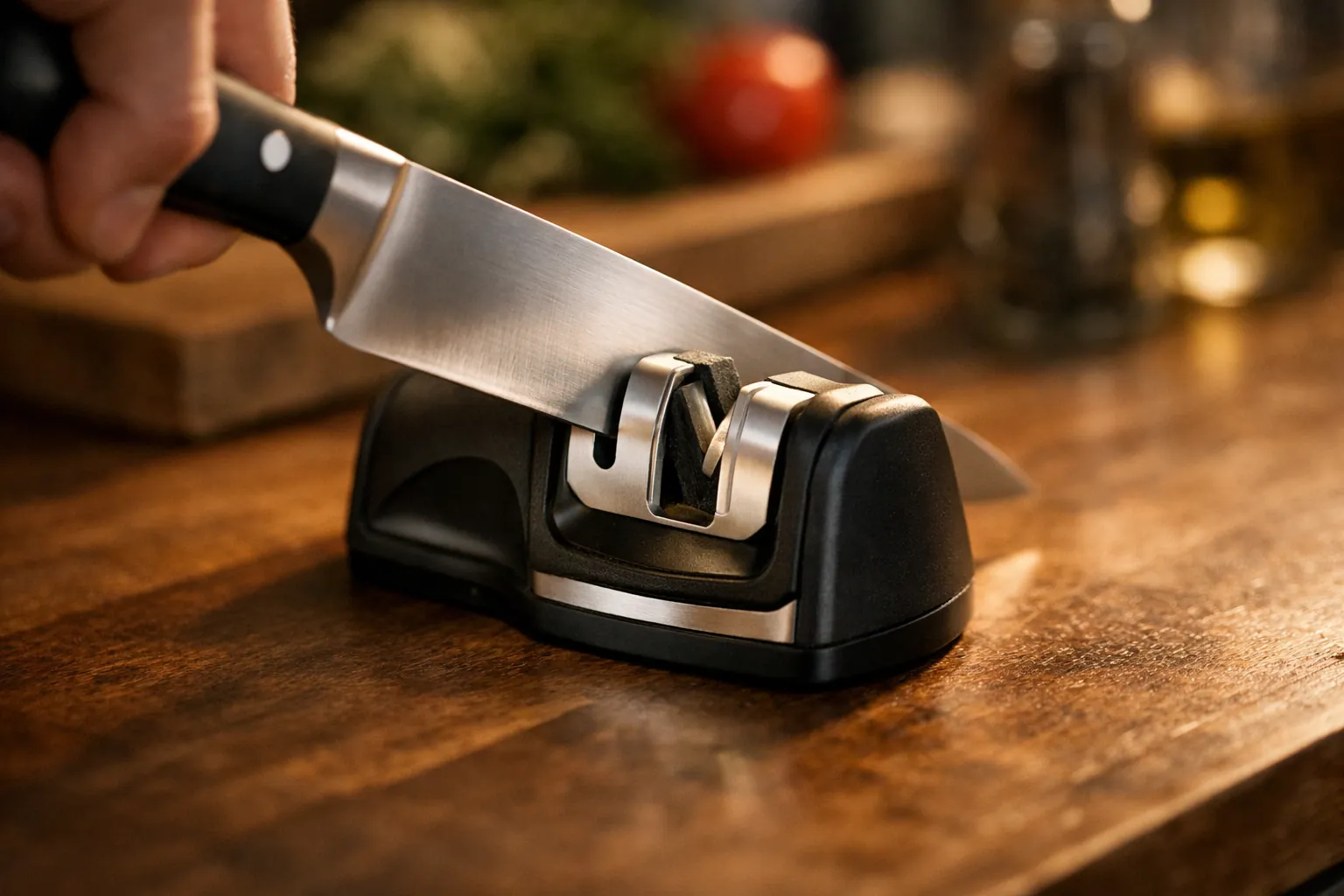
For the 10° knives, the realistic options are Wüsthof's Universal sharpener or a whetstone. A 1000/6000 combination stone such as the Sharp Pebble 1000/6000 covers both Wüsthof angles, and its listing says an angle guide is in the box (it doesn't say which angle the guide sets, so check it against the table above before trusting it at 10°). Our best knife sharpener for kitchen knives guide sorts the wider field by knife type, and the electric sharpener guide covers machines that hold 15°.
German steel at a Japanese-style angle: what to watch
Fourteen degrees is thin for a German knife. The traditional German edge was nearer 20, and Wüsthof's own PEtec article makes the comparison. What lets Wüsthof go thinner is the edge finish, not exotic steel: the Classic chef's knife is 58 HRC and the Gourmet santoku is 56, softer than most Japanese knives. Softer steel at a low angle rolls before it chips. Two habits follow from that:
- Hone often. A rolled edge comes straight back on a steel in a few strokes, where a chipped one needs the stone.
- Don't push a santoku below Wüsthof's 10°. Thinner still on 56 HRC steel goes wavy fast on a hard board.
The reverse matters too. Running a Wüsthof through a 20° pull-through won't ruin it, but it erases the thin edge you paid for, and every later 14° session has to grind that extra steel back off.
Honing between sharpenings
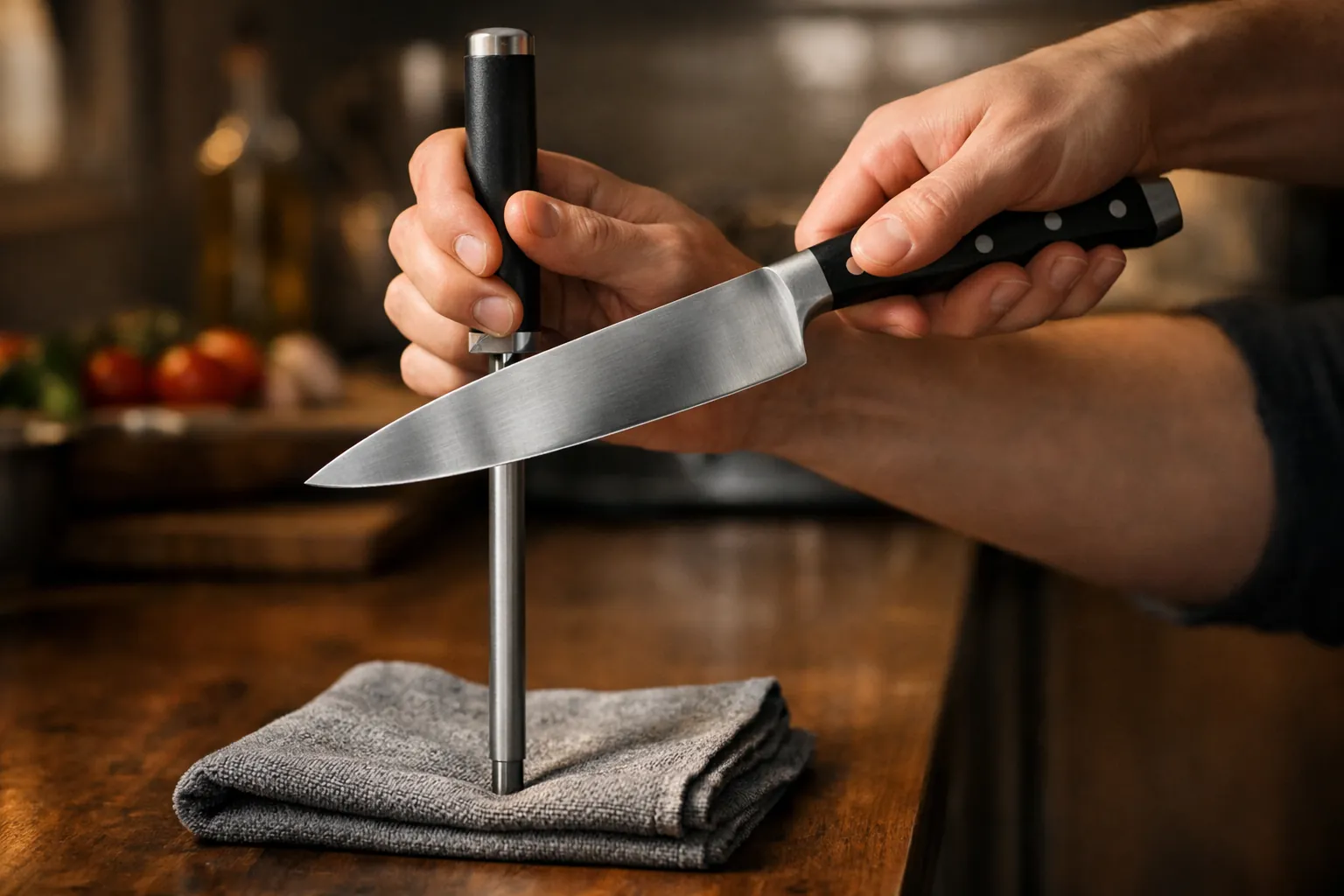
Wüsthof's how-to article says to run the blade down the steel heel to tip, "6-8 times while alternating sides", and to use the fine slot of its handheld sharpener regularly while saving the coarse slot for "once or twice a year". Hold the steel at about the same 14° you sharpen at; going steeper on the steel slowly builds a micro-bevel, which is fine as long as you know it's happening. Our best honing rod guide covers steel, ceramic and diamond rods for German knives.
If you only do one thing
Set your sharpener to 15 for the chef's, utility and paring knives, and keep the santoku off it entirely: take that one to a stone at 10°, or use Wüsthof's Universal sharpener. If your drawer also holds a Shun or a Victorinox, the printable angle chart by brand puts every number on one page.
Angles quoted from wusthof.com product pages and articles, checked October 3, 2026, cross-checked against Tormek's "Knife sharpening angles: Manufacturer's recommendations" (2020). Blade widths and hardness from the same Wüsthof product pages. Spine heights calculated. Product details from Amazon listings checked the same day. How we research · Affiliate disclosure