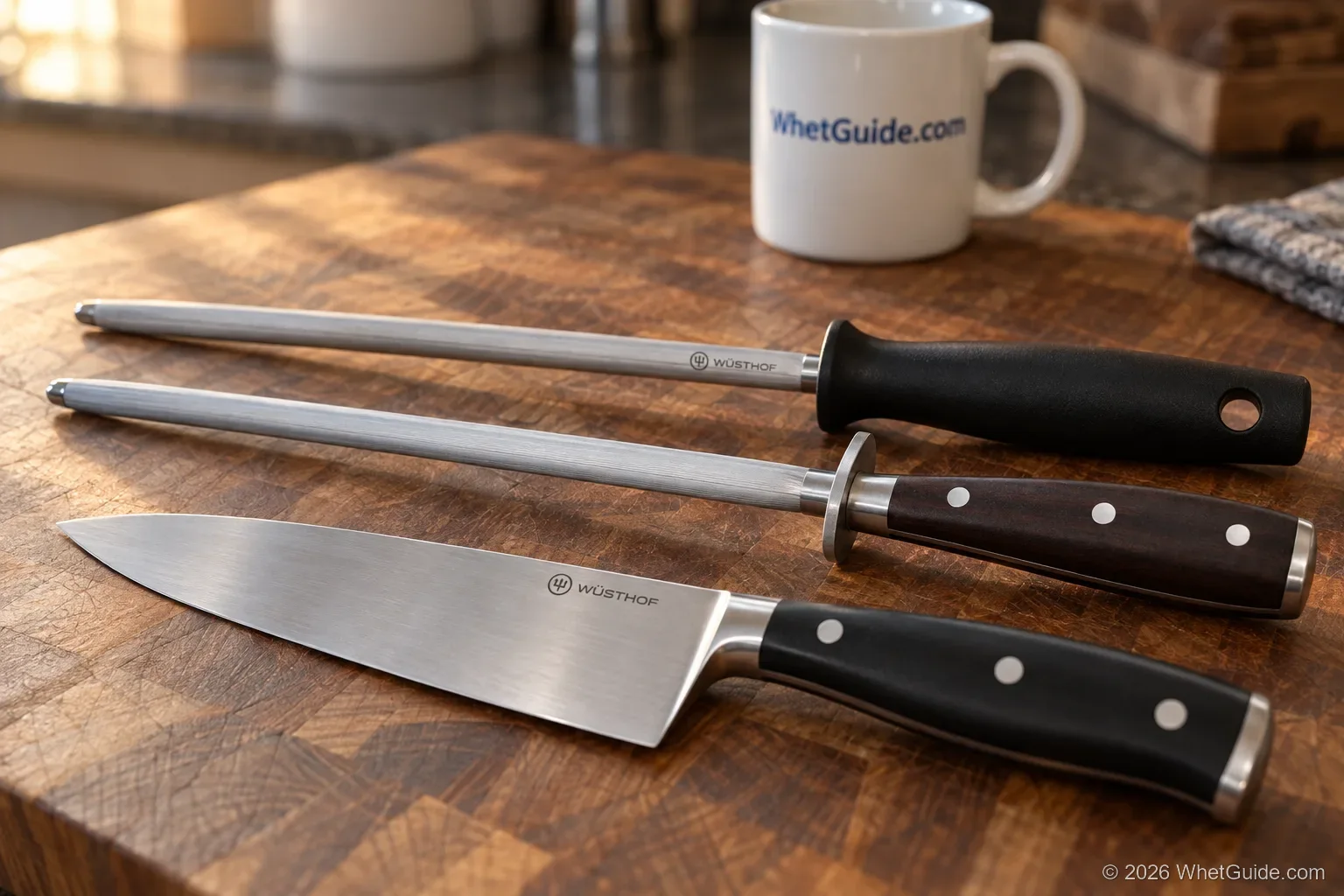
The best honing steel for Wüsthof knives, for most owners, is the Wüsthof 9 inch honing steel. It is the maker's own and long enough for the common 8 inch chef's knife, at a fraction of the price of the 10 inch Ikon with the blackwood handle. If you own a 9 or 10 inch slicer, buy the 10 inch steel instead. If your knives have gone dull, a diamond steel does a small sharpening job. A cheaper generic rod works too, if the listing is honest about what it is made of.
The best honing steel for Wüsthof knives is Wüsthof's own 9 inch steel if your longest blade is an 8 inch chef's knife, and the 10 inch steel if you own anything longer. Wüsthof's rule is a steel at least as long as the blade. Both are plain steels for daily upkeep, held at 14 degrees per side, or 10 on a santoku. If a few strokes no longer bring the edge back, step to Wüsthof's ceramic J3000 rod or sharpen the knife.
↑ SectionsQuick answer: 9 inch for an 8 inch chef's knife, 10 inch for anything longer
Buy the Wüsthof 9 inch honing steel if your longest knife is an 8 inch chef's knife. Buy the Wüsthof 10 inch steel if you own a 9 or 10 inch slicer or carving knife, because Wüsthof wants the steel at least as long as the blade. Hold 14 degrees per side, 10 for a santoku, and make three or four light strokes a side before you cook.
| Your situation | Buy |
|---|---|
| Wüsthof block, longest blade 8 in | Wüsthof 9 inch steel |
| You own a 9 or 10 in slicer or carver | Wüsthof 10 inch steel |
| Edges feel dull even after honing | Wüsthof diamond steel or the Wüsthof ceramic J3000 |
| Classic Ikon set, looks count | Wüsthof Ikon 10 inch steel |
| Tight budget | Cutluxe 10 inch or a fine ceramic like the Kimura |
| Chipped edge | No steel fixes chips. See Wüsthof sharpener picks |
Quick picks
| Best overall for Wüsthof knives | Wüsthof 9 inch honing steel | Amazon |
|---|---|---|
| Best for longer Wüsthof knives | Wüsthof 10 inch plain steel | Amazon |
| Best for a premium set | Wüsthof Classic Ikon 10 inch honing steel | Amazon |
| Best for dull Wüsthof knives | Wüsthof 10 inch diamond steel | Amazon |
| Best gentle sharpening rod | Wüsthof 10 inch ceramic rod J3000 | Amazon |
| Best budget rod | Utopia Kitchen 12 inch honing rod | Amazon |
| Best mid-price steel | Cutluxe 10 inch honing rod | Amazon |
| Best smooth steel | F. Dick 10 inch smooth steel | Amazon |
| Best simple brand-name steel | Henckels sharpening steel | Amazon |
| Best cheap diamond steel | SHARPAL 119N diamond steel | Amazon |
| Best ceramic option | Kimura 10 inch ceramic honing rod | Amazon |
| Best long diamond rod | DMT 12 inch extra fine diamond steel | Amazon |
How we picked these
We started from what Wüsthof owners search for: Wüsthof's own steels first, then the generic rods that outsell them. Amazon listing details on this page were recorded between October 21 and November 14, 2026. The Wüsthof 9 inch honing steel showed 400 purchases a month when we first pulled it, and the cheap Utopia 12 inch steel showed 3,000. Both are in here, because each answers a different question.
Lengths and materials come from the listing, and so does any hardness figure. Where a listing says nothing, we say so. Maker guidance comes from Wüsthof itself: its online how-to on sharpening Wüsthof knives, and a 2020 copy of its printed "Using a Steel" guide, which is the only Wüsthof document we've found that gives a hardness for its steels. The independent view comes from America's Test Kitchen's honing rod test, and the retail view from Knivesandtools, a European knife retailer whose buying guides go further than most. Edge angles tie back to our Wüsthof sharpening angle page.
This is a how we pick guide. We compared listings and maker guidance. How we research.
↑ Back to all sectionsWhich Wüsthof steel is which
Wüsthof makes more steels than most people realize. Knivesandtools stocks them in six lengths, from 18 cm to 32 cm, which is roughly 7 to 12.6 inches. In the US, Amazon carries a smaller set, and those are the ones this page covers. They split three ways: plain steels that only straighten an edge, a diamond steel that grinds, and a ceramic rod that grinds a little.
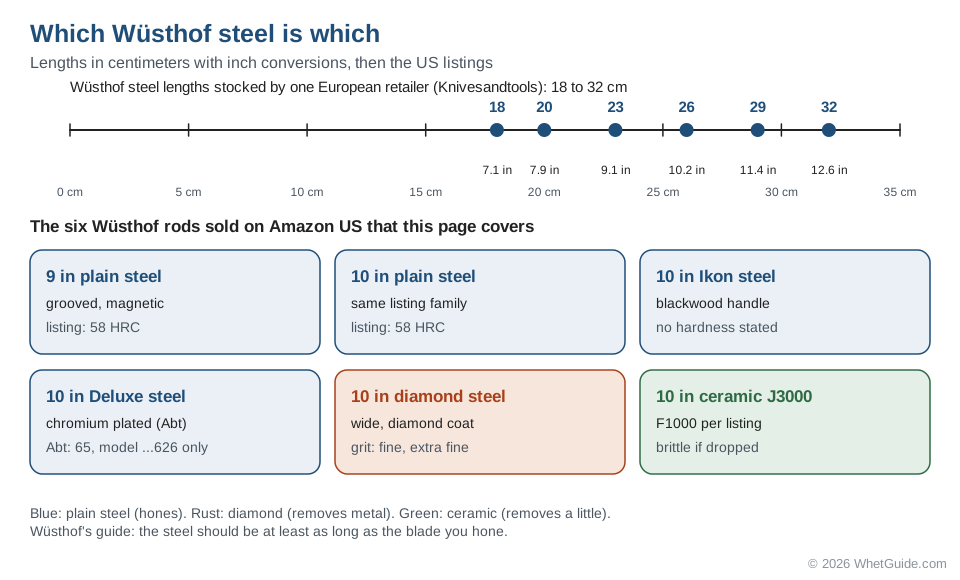
| Wüsthof rod | Length | Surface | What the listing says about hardness or grit |
|---|---|---|---|
| 9 inch honing steel | 9 in (23 cm) | Plain, grooved, magnetic | 58 HRC, high-carbon stainless |
| 10 inch sharpening steel | 10 in (26 cm) | Plain steel | 58 HRC, high-carbon stainless |
| Ikon 10 inch steel | 10 in | Plain steel | Not stated |
| Deluxe 10 inch steel | 10 in | Plain steel | Listing states none; Abt lists one Deluxe model at 65 Rockwell |
| 10 inch diamond steel, wide | 10 in | Diamond-coated steel | Grit "fine, extra fine" |
| 10 inch ceramic rod J3000 | 10 in | Ceramic | J3000, which the listing equates to F1000 |
Two oddities on Amazon are worth knowing before you shop. The 10 inch plain steel is titled "Sharpening Steel" even though it's a plain steel, the same kind as the 9 inch "Honing Steel". Its bullets call it a honing rod, and its 3,313 ratings are shared with the 9 inch listing, so you can't read anything into the two having nearly identical star counts. The model numbers differ, though: the 10 inch listing gives 3039700526, and the 9 inch gives 4461/23.
The Deluxe steel is a third plain 10 inch model. Its Amazon listing, as we recorded it, gives no specs beyond the title, so it doesn't get a card below. Abt, a US appliance retailer, lists a Wüsthof 10 inch Deluxe steel as chromium plated at 65 Rockwell under model 3039700626. Check that the model number on any listing you buy matches before you assume the same figure applies.
↑ Back to all sectionsPlain, diamond or ceramic?
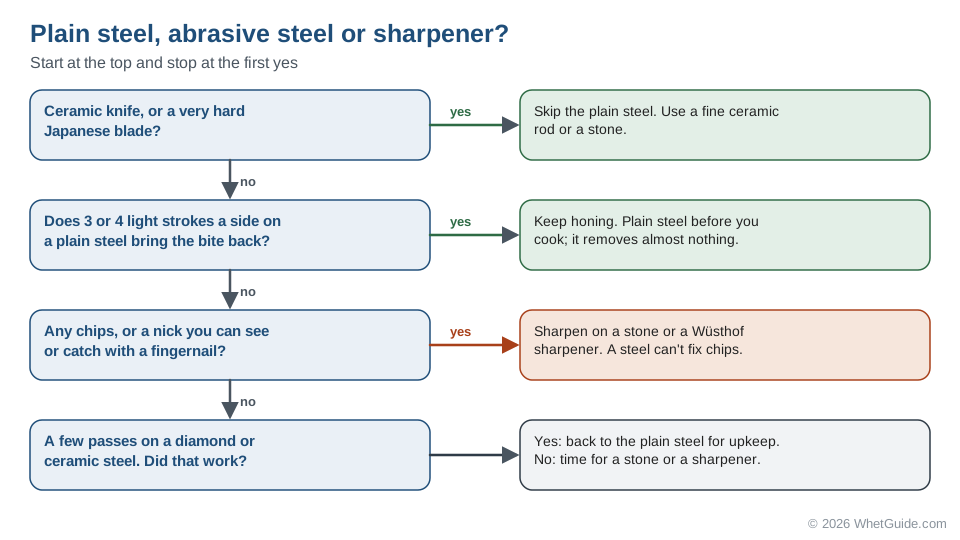
Wüsthof's guidance is simple. A plain steel is for routine upkeep, a few light strokes per side. Diamond and ceramic steels are abrasive, and Wüsthof suggests them when a knife has gone badly blunt.
| Your knife | What to use | Good fits |
|---|---|---|
| Sharp, just needs upkeep | Plain steel, a few strokes per side | Wüsthof 9 inch, Cutluxe 10 inch |
| Losing its bite | Diamond or ceramic steel | Wüsthof diamond steel, Kimura ceramic |
| Dull enough to need a stone | Sharpen first, then hone | Wüsthof sharpener picks |
What does abrasive mean on the board? Picture the edge under magnification. After a few days of cooking, the thinnest part of the edge folds over to one side. It feels dull, but the steel is all still there. A plain steel pushes that fold back upright. A diamond or ceramic steel grinds a sliver off both faces and forms a new apex, which is a small sharpening.
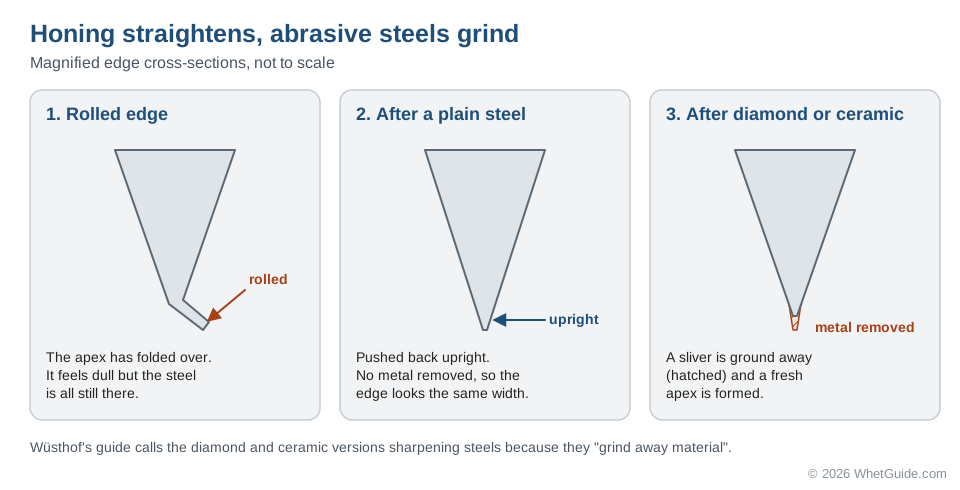
Wüsthof's guide gives a few details on its abrasive steels. The diamond steel has a solid stainless core carrying up to 2 million diamond grains, depending on its size, in what Wüsthof calls an "extremely fine grit". Its ceramic steels are "slightly less abrasive" than the diamond, come in 300 or 1,000 grit, and "will break if it is dropped". The one on Amazon US is the J3000, which its listing equates to F1000 on the European scale.
Which should you own? For most kitchens, one plain steel is enough, with a sharpener or stone for the day it stops working. An abrasive steel earns a place when you'd rather not sharpen often. A diamond steel takes more metal per stroke than ceramic, and America's Test Kitchen found that diamond coatings "ate away too much material" for routine honing. If you buy one abrasive rod, the ceramic is the gentler bet.

Honing steel or sharpening steel: the naming tangle
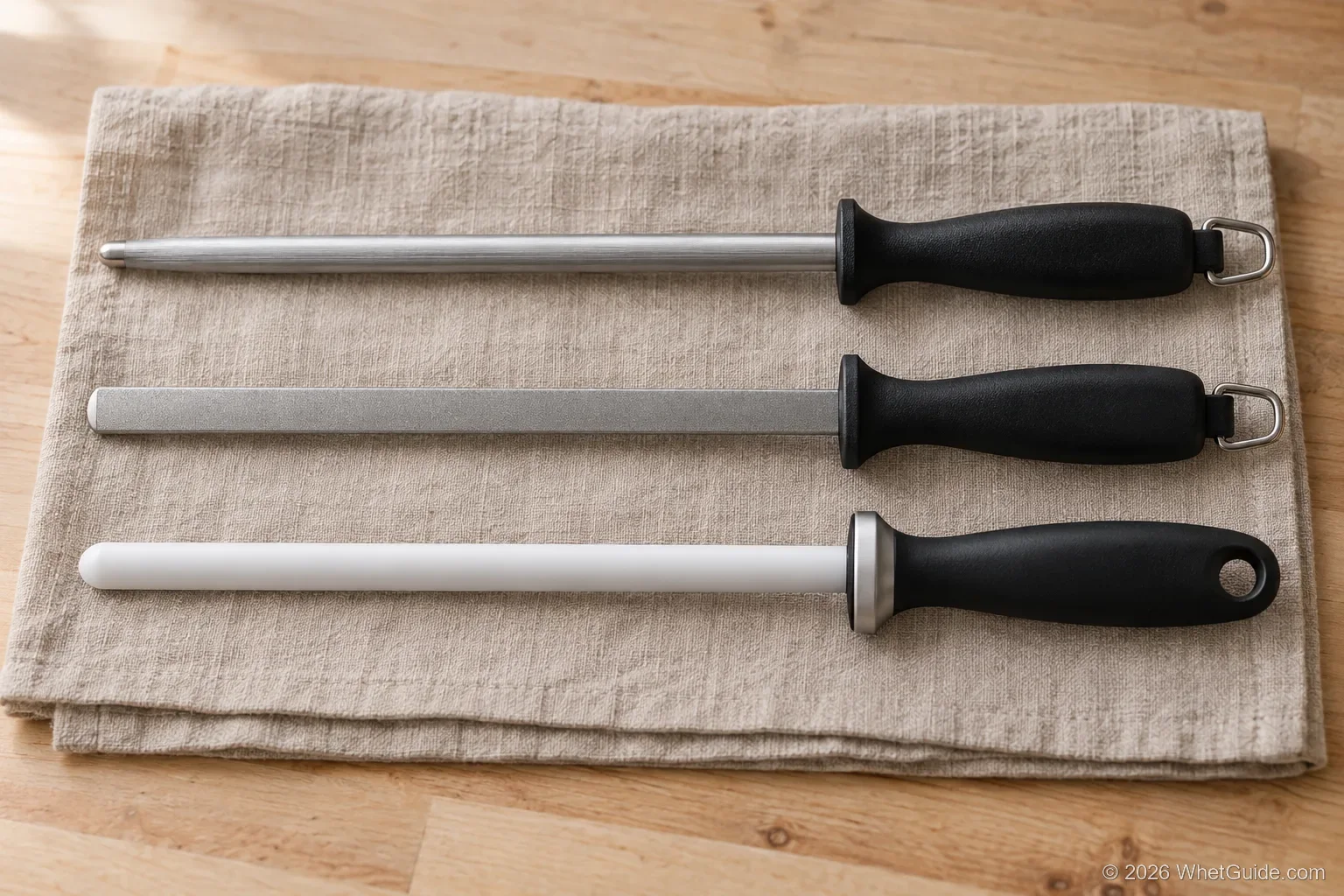
Search for a Wüsthof rod and you'll meet "honing steel", "sharpening steel", "honing rod" and "sharpening rod", sometimes for the same product. The words aren't used consistently, and the mix-up costs people money when they buy a diamond rod expecting gentle upkeep.
Knivesandtools draws the cleanest line. In its guide to the difference, a honing steel "is always made from steel" and is for use before each cutting session. A sharpening steel has a ceramic (aluminium oxide) or diamond layer and is needed "once or twice a month". On its UK honing steel page it goes further: "There is no such thing as a diamond or ceramic honing steel."
Wüsthof follows the same split in its guide, calling the diamond and ceramic versions sharpening steels because they grind away material. Then Amazon muddies it. The plain 10 inch steel is titled "Sharpening Steel", and the 9 inch listing's first bullet says it can "sharpen dull knives". Neither is abrasive.
| If the listing says | Look for | What it probably is |
|---|---|---|
| Honing steel | Bare steel, grooved or smooth | Plain steel; straightens only |
| Sharpening steel, no coating named | "High carbon stainless", "grooved" | Still a plain steel (Wüsthof's 10 inch) |
| Diamond sharpening steel | "Diamond-coated", a grit number | Abrasive; grinds metal |
| Ceramic rod or ceramic steel | White or black ceramic, a grit number | Abrasive, finer than most diamond |
How long should the steel be?
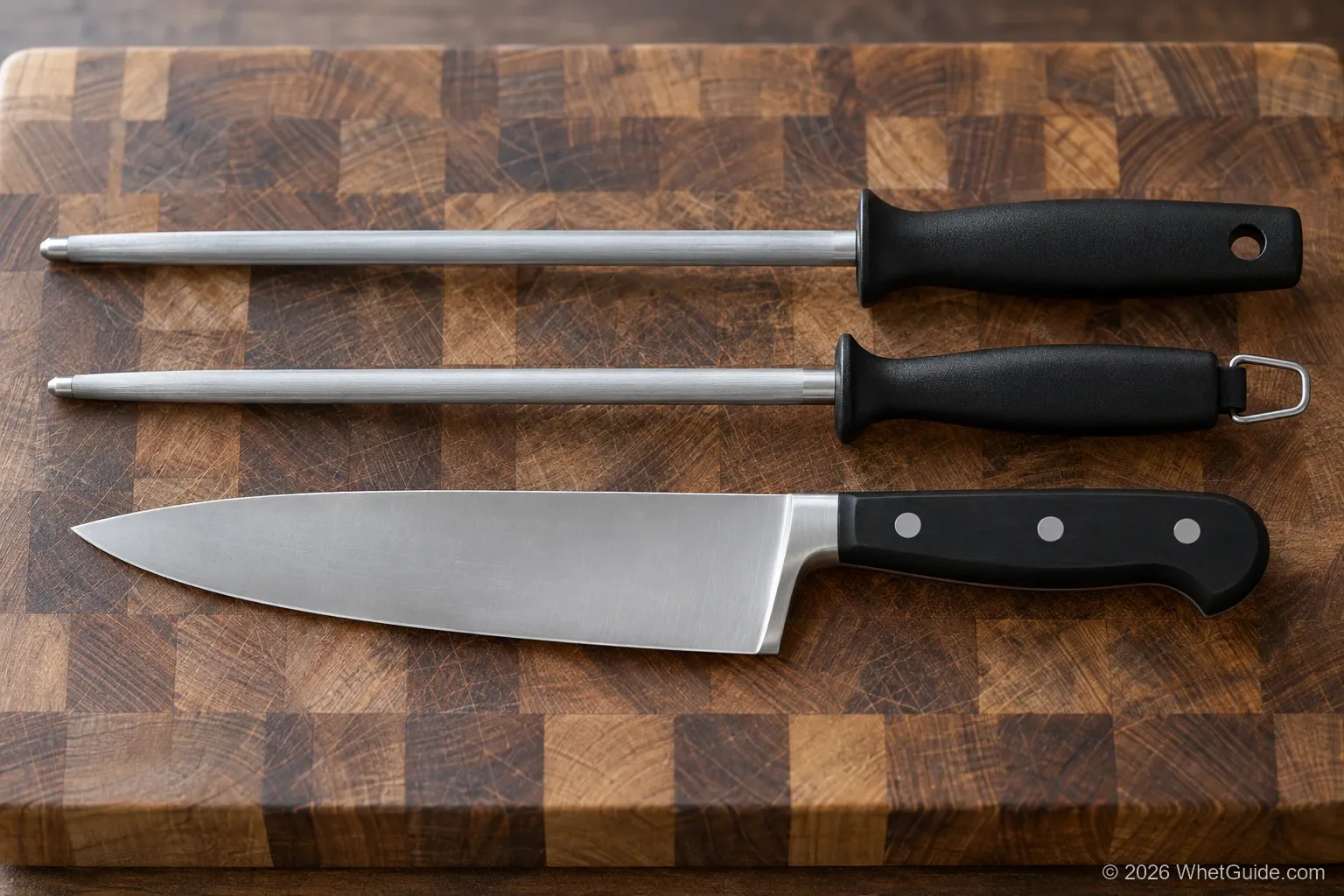
Wüsthof's own guide gives the rule: make sure the steel "is at least as long as the blade" you're honing. The test is whether you can draw the whole edge, heel to tip, along the rod in one stroke. A rod that is too short makes you hone in sections and lose the angle where the sections meet. Knivesandtools says much the same, more loosely: "The larger your knife, the better it is if your honing steel is longer."
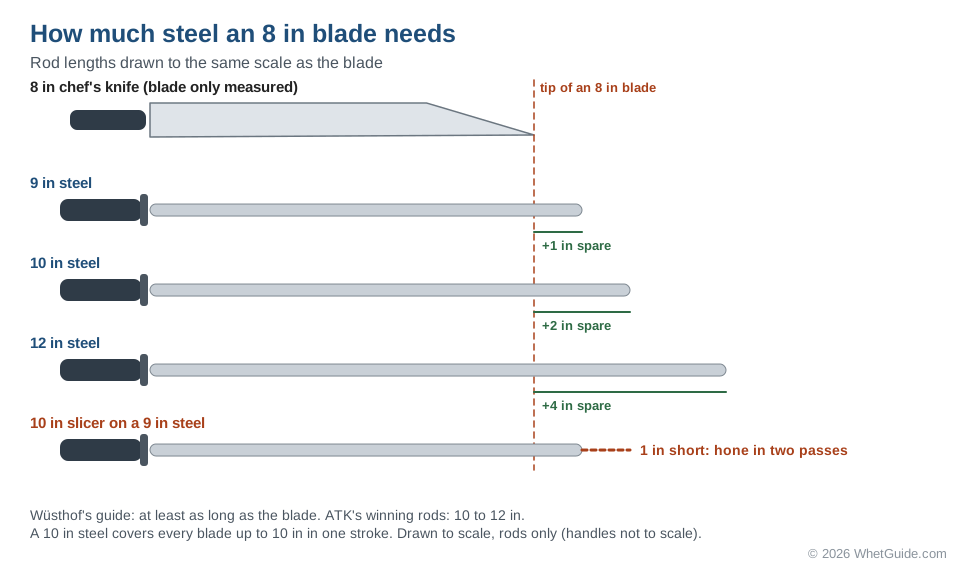
Other sources stretch the margin. One affiliate roundup we read says 2 to 3 inches longer than the blade, and America's Test Kitchen found that "longer lengths made it easier to keep the knife angle consistent", with 10 to 12 inches among its winning traits. Wüsthof's rule is the minimum. The others are about comfort.
| Longest knife you own | Minimum (Wüsthof's rule) | Comfortable | Notes |
|---|---|---|---|
| 6 in utility or chef's | 9 in steel | 9 in | Shortest common US size |
| 8 in chef's knife | 9 in | 10 in | The common chef's knife size |
| 9 in bread or carving knife | 9 in | 10 in | Bread knives need a tapered rod anyway |
| 10 in slicer or chef's | 10 in | 12 in | The 9 inch is too short |
| 12 in slicer | 12 in | 12 in | Utopia 12 or DMT 12 below |
Is there a downside to going long? Some. A reviewer on Wüsthof's own 12 inch steel page found it heavy and awkward on shorter blades, and a 12 inch rod won't fit most block slots. If your longest knife is 8 inches, the extra length mostly adds weight. Measure the blade, not the whole knife: a "9 inch" steel means 9 inches of rod, and the handle adds several more.
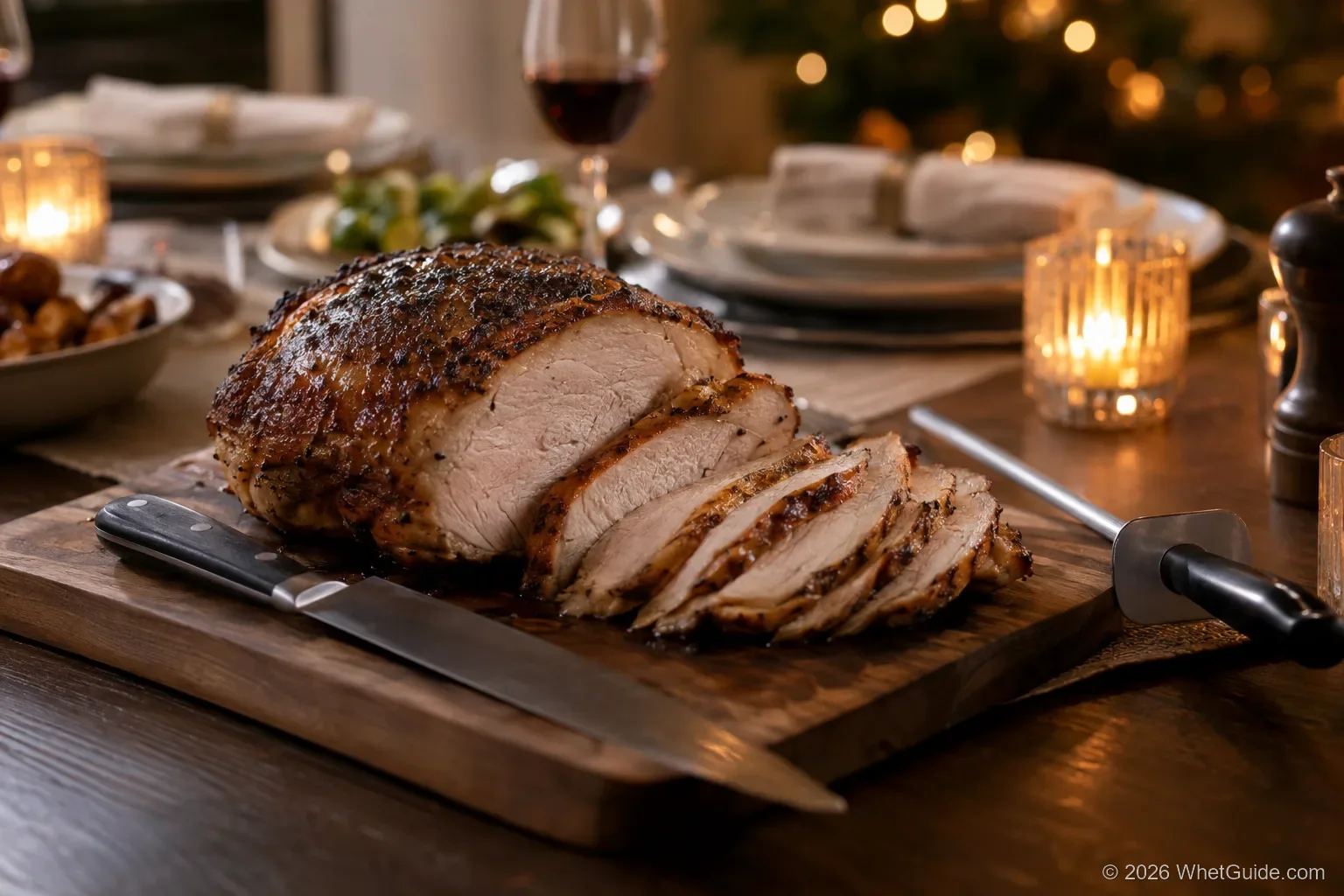
Holiday carving is where length bites. A long carving knife comes out once a year, often dull from the drawer, and the steel that came with the block may be shorter than it. If that's your kitchen, the 10 inch steel is cheap insurance.
Harder than the knife
Knivesandtools adds a rule most listings skip: "In any case, the honing steel must be harder than the knife." Its UK guide says most knives can be honed, "except for ceramic or very hard steel types seen in some Japanese knives", and that honing steels "work best on knives made from soft steel types". Wüsthof's German steel is on the soft side of that line. Our Wüsthof angle page puts the Classic chef's knife at 58 HRC and the Gourmet santoku at 56.
So is a Wüsthof steel harder than a Wüsthof knife? Wüsthof's own documents and the Amazon listings give different answers:
| Source | What it says | Applies to |
|---|---|---|
| Wüsthof "Using a Steel" guide (2020 copy) | "Hard chromium plated steel with a hardness of 65 Rockwell"; alloy tool steel 2210 with 1.15% carbon, 0.6% chromium, 0.03% vanadium | All Wüsthof honing steels |
| Amazon listing, 9 inch steel | "High Carbon Stainless Steel ... tempered to 58-degree HRC" | B00074PDE2 |
| Amazon listing, 10 inch steel | The same 58 HRC wording | B00009WDT8 |
| Abt (retailer) | 65 Rockwell, chromium plated | 10 inch Deluxe, model 3039700626 only |
| Amazon listing, Ikon 10 inch | No figure | B00192VVPQ |
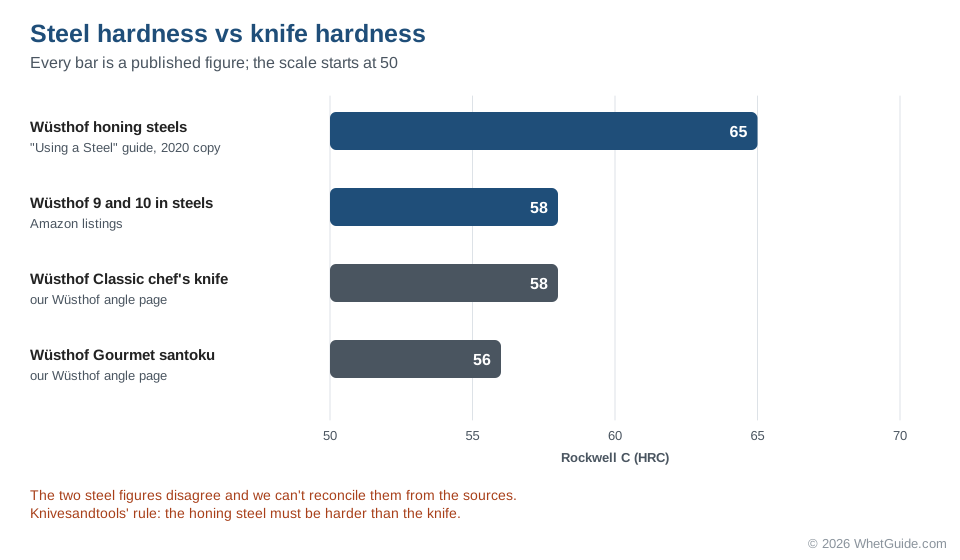
The guide is the older document and covers all Wüsthof honing steels. The listings are newer and name specific models. Neither explains the gap, so we show both.
What does each figure mean for your knife? At 65, a Wüsthof steel is clearly harder than a Classic at 58 or a Gourmet at 56, which is what Knivesandtools asks for. At 58, it only equals the Classic, and that is the case the harder-than-the-knife rule warns about. If that worries you, or a knife seems to resist a plain steel, a ceramic rod is harder than knife steel and settles the question. Much harder knives are a separate case, covered in the skip section further down.
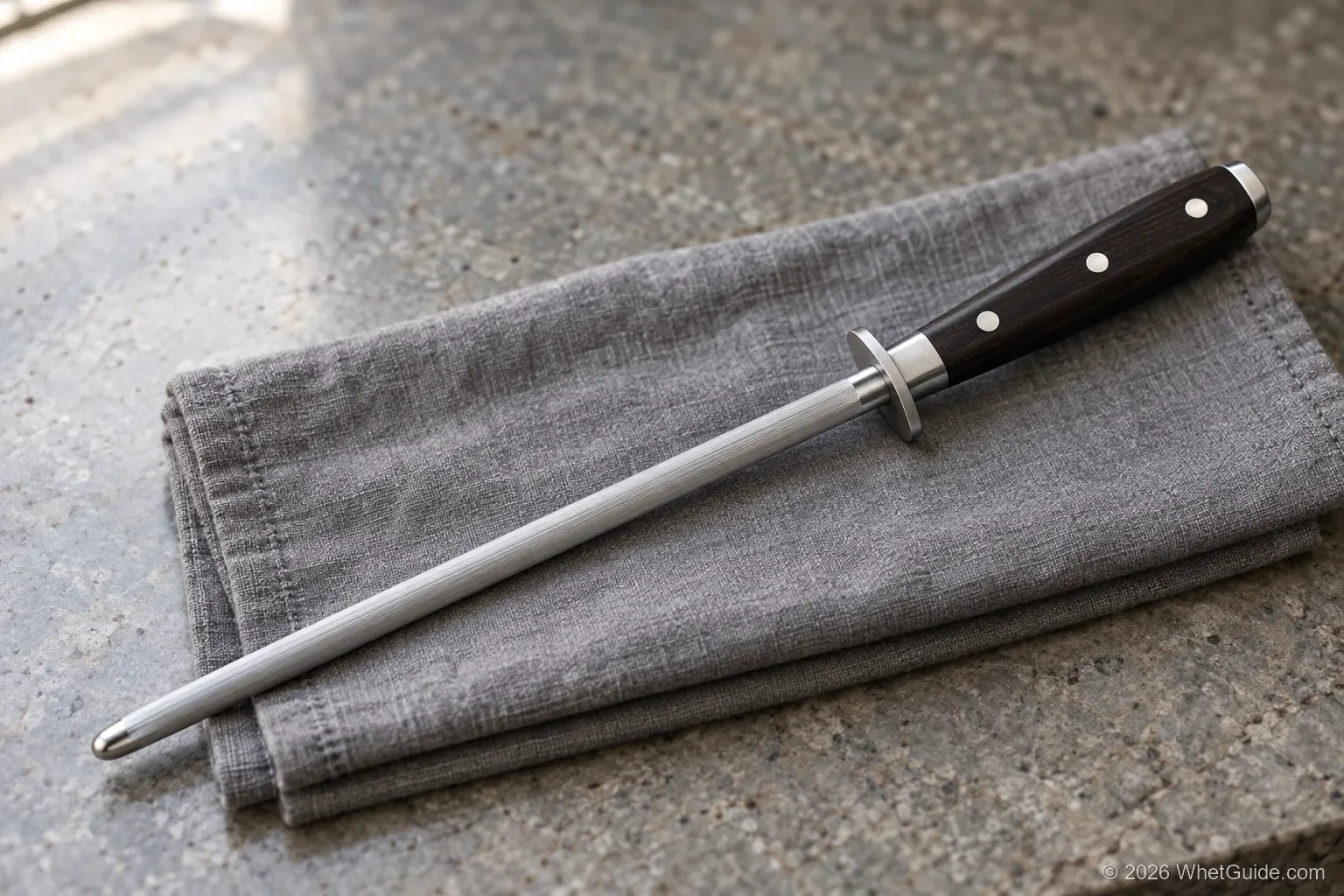
Grooved, smooth or coated: the rod's surface
Run a fingernail along a few rods and you'll feel the difference. A smooth steel is polished round. A grooved steel has fine ridges running its length. A diamond rod is gritty, and a ceramic one feels like unglazed porcelain.
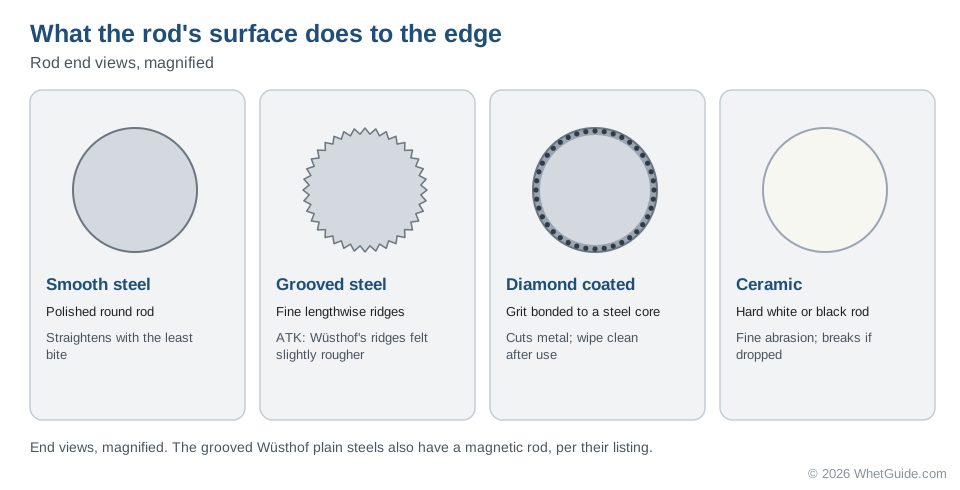
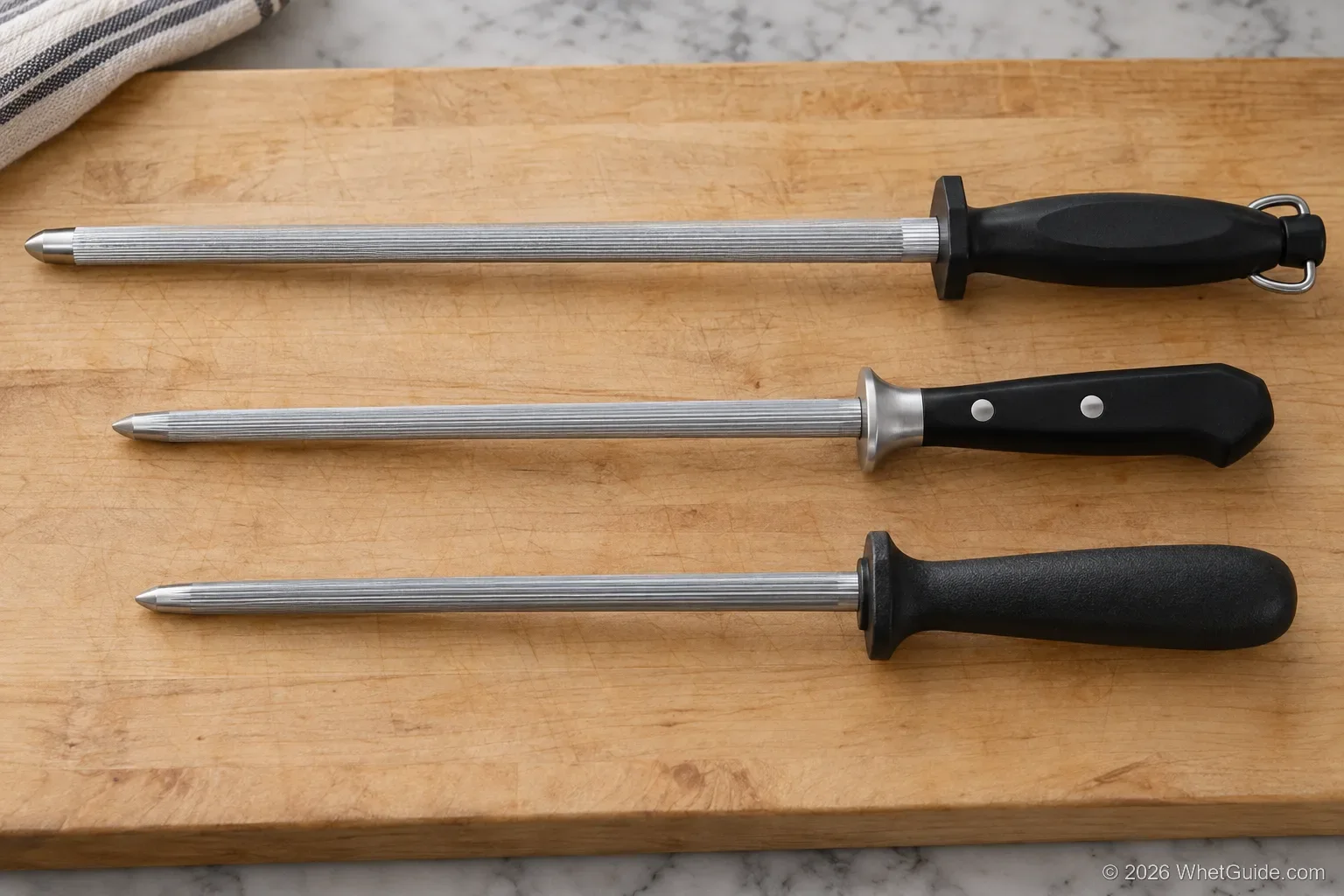
America's Test Kitchen looked at this closely. Its winning traits included a "lightly ribbed and/or smooth" surface, and it recommended the Wüsthof Triple Rivet 10 inch steel while noting its ridges felt "slightly rougher on the blade" than the best rods. The Wüsthof 9 inch listing describes a grooved, magnetic rod; the magnetism, it says, catches loose metal fibers during honing.
For a Wüsthof at 56 to 58 HRC, fine grooves are fine. If you want the gentlest possible plain steel, a smooth polished rod like the F. Dick 10 inch smooth steel takes the ridges out of the question. Coarse, deep grooves are the ones to avoid; they act more like a file on a soft edge.
↑ Back to all sectionsMatching the steel to your Wüsthof series
Knivesandtools suggests matching the steel to your knife series, for example a Classic Ikon steel with a Classic Ikon knife. That match is about the handle and the look in a block, since the rod's job is the same across series. Wüsthof's angle guidance doesn't change with the series either: 14 degrees for standard blades and 10 for Asian-style ones, whether the knife is Classic, Ikon or Gourmet.
| Your knives | Matching look | Does the same job for less |
|---|---|---|
| Classic (black triple-rivet) | Wüsthof 9 or 10 inch black-handled steel | Same steel; it is the cheap option |
| Classic Ikon or Ikon (blackwood) | Ikon 10 inch steel | Wüsthof 10 inch plain steel |
| Gourmet (stamped) | Any black-handled Wüsthof steel | Wüsthof 9 inch or a generic rod |
| Mixed set with santokus | Any | A fine ceramic for the santokus at 10° |
Wüsthof's 12 inch steel page, read when we first built this guide, said to hone regularly with a few strokes per side, wipe the steel with a damp cloth and dry it, and use a diamond or ceramic steel on badly dulled knives. Nothing in it changes by series.
↑ Back to all sectionsThe 12 best honing steels for Wüsthof knives
Five are Wüsthof's own rods. The other seven cover budgets, longer knives, a smoother surface and gentler abrasion. Lengths are rod lengths, not overall length.
Wüsthof 9 inch honing steel
This is Wüsthof's standard 9 inch steel, forged from one block of steel according to the listing. The grooves are fine enough for light upkeep, and the magnetic rod picks up loose steel fibers. At 9 inches it is long enough for the common chef's knife size and short enough to store in a block slot.
It will not fix a dull knife, whatever the first bullet on the listing says about sharpening. Its job is keeping a sharp edge sharp for longer between sharpenings.
- Length9 in
- Steelhigh-carbon stainless
- Hardness58 HRC per listing; Wüsthof's 2020 guide says 65
- Surfacegrooved, magnetic
- Warrantylifetime against defects (per listing)
- Ratings3,300+
Why it stands out
- Maker-made, with the most ratings of any Wüsthof rod here
- Comfortable length for most home kitchens
Think twice if
- Your knives are already dull, since this rod only maintains an edge
Wüsthof 10 inch plain steel
Same family as the 9 inch, with one more inch of rod. That inch is what lets it cover a 10 inch slicer or chef's knife in one stroke under Wüsthof's own length rule. The Amazon title calls it a sharpening steel, but nothing on the listing describes a coating; it is a plain steel.
If you're unsure which to buy and own anything longer than 8 inches, take this one. It weighs a little more than the 9 inch and may not fit a short block slot.
- Length10 in
- Steelhigh-carbon stainless
- Hardness58 HRC per listing; Wüsthof's 2020 guide says 65
- Model3039700526
- Warrantylimited lifetime (per listing)
Why it stands out
- Covers knives up to 10 inches
- Same maker, same stated hardness
Think twice if
- Your block slot is short, because the extra inch may not fit
Wüsthof Classic Ikon 10 inch honing steel
The only reason to buy this over the plain 10 inch steel is the set. The Blackwood handle matches the Ikon knives. The listing gives no hardness figure, so treat it as a handsome version of the same job. It has far fewer ratings (310) than the 9 inch steel.
- Length10 in
- HandleAfrican Blackwood
- Bladesingle-piece high-carbon stainless
- OriginSolingen, Germany
- Warrantylifetime against defects
Why it stands out
- Matches Classic Ikon knives
- Extra inch of length
Think twice if
- You do not own Ikon knives, because the cost buys looks
Wüsthof 10 inch diamond steel
It is Wüsthof's answer to a knife that has lost its bite but isn't worth sharpening on a stone. Diamond cuts metal, so a few passes bring back an edge that a plain steel can't. The listing says to wipe it with a damp cloth after each session. Don't hone with it daily.
Treat it as a sharpener in rod form. Four or five light passes a side, then test; if the edge is back, put it away and go back to the plain steel.
- Length10 in
- Surfacediamond-coated steel, wide
- Gritfine to extra fine (per listing)
- Handleslip-resistant plastic
- Warrantylifetime against defects
Why it stands out
- Adds a sharpening step without a stone
- Made by the knife maker
Think twice if
- Your knives are in good shape; use a plain steel
Wüsthof 10 inch ceramic rod J3000
Wüsthof's listing pitches this for "moderately sharp to blunt knives" and says ceramic produces "slightly less abrasion than a diamond rod" while being finer. That fits its guide. It's the abrasive rod we'd pick for Wüsthof owners who want one: it brings back bite with less metal lost than the diamond steel.
The listing itself recommends a plain Wüsthof steel for daily honing alongside it. Ceramic breaks if dropped, so hang it or keep it in a slot.
- Length10 in
- Materialceramic
- GritJ3000, F1000 European (per listing)
- Usemoderately sharp to blunt knives (per listing)
Why it stands out
- Gentler than diamond, still restores bite
- Same maker as your knives
Think twice if
- Your kitchen floor is tile and you drop things
Utopia Kitchen 12 inch honing rod
This is the bestseller on the page, and it costs a fraction of the Wüsthof steel. The listing does not state a hardness, so we cannot say whether it is harder than a 58 HRC knife. It is long, so it covers a 12 inch slicer, but heavy for a paring knife. The listing says it works on serrated edges too, a claim we would not lean on. There's a 10 inch Utopia too, for shorter blocks.
- Length12 in
- Materialcarbon steel, nickel-chrome plated
- Surfacefine
- Handlenon-slip, with hanging loop
- Ratings8,300+
Why it stands out
- Cheap and long, with thousands of ratings
- Hanging loop
Think twice if
- You want a stated hardness before you trust it with a pricey knife
Cutluxe 10 inch honing rod
A step up from the Utopia in handle and finish, and the same length as the Wüsthof 10 inch. The listing says the steel will not rust, bend or break, and gives no hardness. It suits a cook who wants a better feel than plastic without paying Wüsthof's price.
- Length10 in
- Materialhigh-carbon steel
- HandlePakkaWood
- Warrantylifetime (per listing)
- Ratings1,300+
Why it stands out
- PakkaWood handle
- 10 inch length
Think twice if
- You want a hardness figure, which the listing omits
F. Dick 10 inch smooth steel
The listing describes a smooth, polished, German-made steel rather than a grooved one. That makes it the gentlest plain steel on the page, which suits anyone worried about ridges scratching a Wüsthof edge. The listing says the orange handle is for high visibility in work environments; at home, it's easy to find in a drawer.
- Length10 in
- Surfacesmooth, polished
- OriginGermany (per listing)
- Handleorange, high visibility
Why it stands out
- Smooth surface, no ridges
- German made
Think twice if
- You want a handle that matches your block
Henckels sharpening steel
A plain Henckels steel at roughly the Utopia's price. The listing suggests honing "every other time" you use the knife, a gentler schedule than Wüsthof's. The listing gives only an overall length of 15.6 inches, handle included, so check the rod length before buying it for a long slicer.
- Materialstainless steel
- Handlepolypropylene
- Usebetween professional sharpenings (per listing)
- Warrantylifetime
- Ratings2,700+
Why it stands out
- Low price with a known brand
- Plain handle, light weight
Think twice if
- Your longest knife is over 8 inches
SHARPAL 119N diamond steel
A fine 1200 grit diamond surface is about as gentle as diamond gets, and the listing pitches it for routine maintenance. It also notes angle guides on the handle, but the listing doesn't say what angle they set, so check them against 14 degrees before relying on them. The listing gives 15 inches overall without a separate rod length, so check that the rod covers your longest blade.
- Surfacediamond, 1200 grit
- Handleergonomic, with protective ring
- Item highlightbuilt-in angle guides
- Ratings2,400+
- Gritextra fine
Why it stands out
- Diamond at a low cost
- Hand guard with a protective ring
Think twice if
- You'd use it daily, since even fine diamond removes metal
Kimura 10 inch ceramic honing rod
Ceramic hones and removes a little steel, so it falls between a plain steel and a diamond one. The listing tells you to hold 15 to 20 degrees, which is a general range. On a 14 degree Wüsthof, hold 14. Ceramic can break if dropped, which is a poor match for a tile floor. Kimura also makes a 10 inch diamond version if you want the coarser surface with the same handle.
- Length10 in
- Materialwhite ceramic
- Finish1200 grit
- Handlepolypropylene
- Listing's angle15 to 20 degrees
Why it stands out
- 1200 grit ceramic for a finer feel
- Hanging loop
Think twice if
- You drop things, since ceramic cracks
DMT 12 inch extra fine diamond steel
For an owner with a long slicer or a 12 inch carving knife, this covers the whole blade in one stroke. The listing says the extra fine grit is for "regular honing or final polishing", but it is still diamond, so treat it like the Wüsthof diamond steel: occasional use when the edge has lost its bite.
- Length12 in
- Surfacemicronized monocrystalline diamond, extra fine
- Handleplastic, large guard, hang ring
- OriginUSA (per listing)
Why it stands out
- Covers 12 inch blades
- Big hand guard
Think twice if
- Your longest knife is 8 inches, since a short rod is easier to control
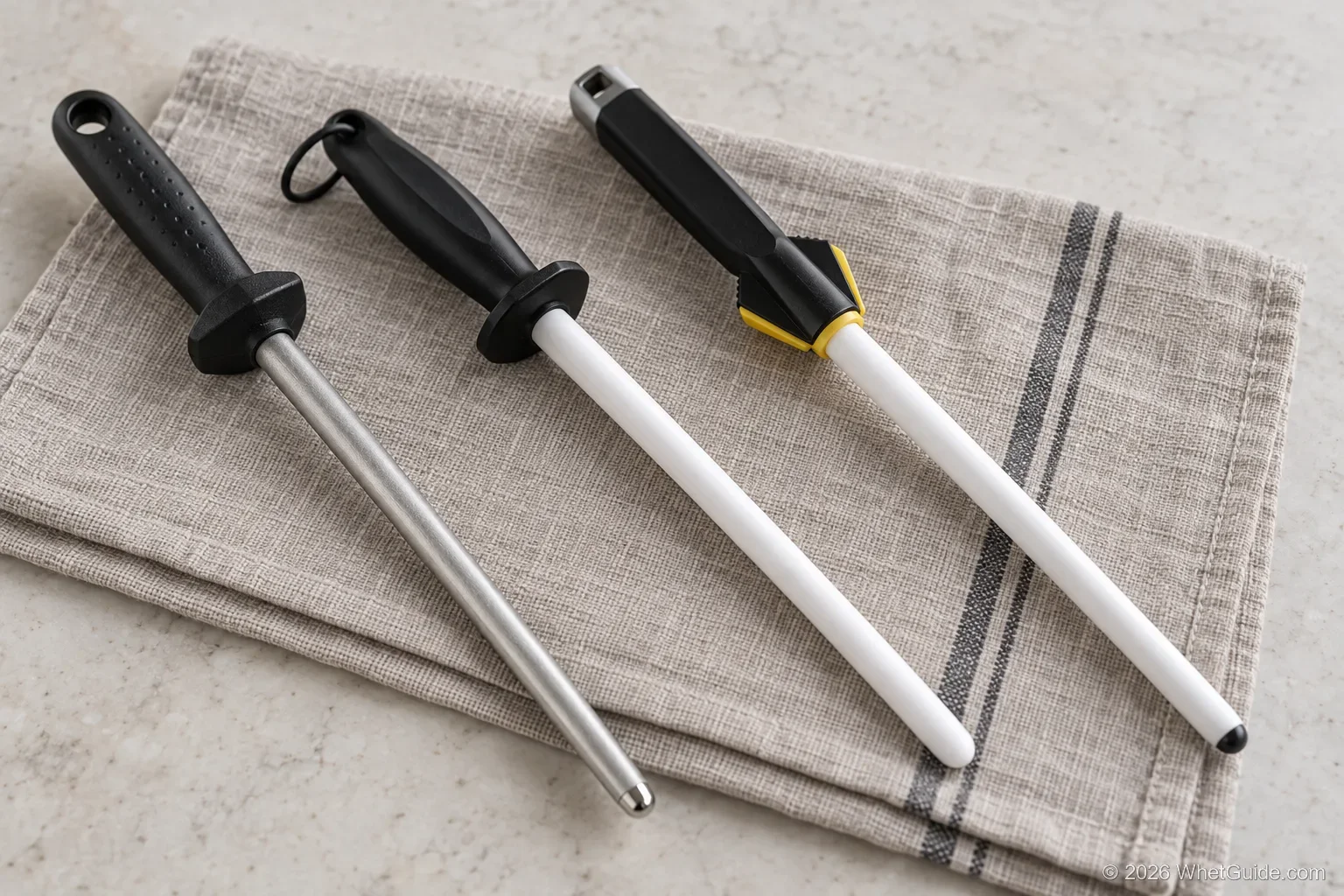
A few more rods came up in our research and are worth a line each. The Victorinox 10 inch Fibrox steel was recommended in America's Test Kitchen's rod test alongside the Wüsthof. The Messermeister 12 inch ceramic is a 1200 grit rod with a hang ring, for long knives. The Mac 8.5 inch ceramic says on its listing that it "only hones and does not sharpen", but at 8.5 inches it only just covers an 8 inch blade. The Work Sharp ceramic rod has angle guidance built in, at an angle its listing doesn't state, so check it against 14 degrees. The Green Elephant 11 inch ceramic lists 1500 grit and a shock-absorbing handle. The Kota Japan 12 inch diamond rod is oval and cheap, and like every diamond rod it removes metal.
↑ Back to all sectionsSide-by-side comparison
| Rod | Length | Surface | Hardness stated? | Grit stated? |
|---|---|---|---|---|
| Wüsthof 9 inch | 9 in | Grooved steel | 58 HRC (listing); 65 (2020 guide) | n/a |
| Wüsthof 10 inch | 10 in | Plain steel | 58 HRC (listing); 65 (2020 guide) | n/a |
| Wüsthof Ikon 10 inch | 10 in | Steel | No | n/a |
| Wüsthof diamond | 10 in | Diamond | No | Fine, extra fine |
| Wüsthof ceramic J3000 | 10 in | Ceramic | No | J3000 / F1000 |
| Utopia 12 inch | 12 in | Plated carbon steel | No | "Fine" |
| Cutluxe 10 inch | 10 in | High-carbon steel | No | n/a |
| F. Dick smooth | 10 in | Smooth steel | No | n/a |
| Henckels steel | Not stated (15.6 in overall) | Steel | No | "Fine" |
| SHARPAL 119N | Not stated | Diamond | No | 1200 |
| Kimura ceramic | 10 in | Ceramic | No | 1200 |
| DMT 12 inch | 12 in | Diamond | No | Extra fine |
"No" means the listing does not say. We would rather leave a gap than guess a number.
↑ Back to all sectionsWhat an independent rod test found
America's Test Kitchen ran the most thorough honing rod test we know of, and one Wüsthof steel made its list. Its ratings, in its own tiers:
| ATK rating | Rods | What it tells a Wüsthof owner |
|---|---|---|
| Highly recommended | Bob Kramer double-cut steel; Idahone 12 inch ceramic | A fine ceramic shares the top tier with a plain steel |
| Recommended | Wüsthof Triple Rivet 10 inch steel; Victorinox 10 inch; MAC 10.5 inch ceramic; Shun combination steel | Wüsthof's own steel is a solid choice, not the winner |
| Recommended with reservations | Chef'sChoice diamond oval rod; an OXO rod | Diamond took off more metal than routine honing needs |
Two of ATK's findings line up with Wüsthof's own advice. Longer rods made the angle easier to hold, which matches Wüsthof's rule that the steel should be at least as long as the blade. And diamond took off more metal than routine honing needs, which matches Wüsthof calling its diamond rod a sharpening steel. The one place ATK marks the Wüsthof down is feel: its ridges were "slightly rougher on the blade" than the top rods. If that bothers you, the smooth F. Dick or a fine ceramic answers it.
↑ Back to all sectionsWüsthof steel or a generic rod?
A steel has no idea whose name is on the knife. What you pay Wüsthof for is a stated hardness on the listing and a handle that matches the block. A lifetime warranty against defects comes with it. What a generic rod saves you is money, and on the Utopia, extra length.
| What you care about | Wüsthof steel | Generic rod |
|---|---|---|
| A hardness figure in writing | 58 HRC on the listings (65 in the 2020 guide) | Usually none |
| Matching your block | Same handle family | Rarely |
| Warranty | Lifetime against defects | Varies; Cutluxe lists lifetime |
| Length options | 9 and 10 in on Amazon US | 10 and 12 in common |
| Price | Higher | Lower |
Our view: if you'd buy one steel and keep it for twenty years, buy Wüsthof's. If you want a second steel for a cabin kitchen or an RV, or you're not sure you'll use one at all, start with a generic plain rod or a fine ceramic and upgrade if the habit sticks.
↑ Back to all sectionsUsing it at 14 degrees
Rest the rod's tip on a towel-lined counter. Wüsthof's guide calls this supported method the safest way to use a steel. Hold the knife so the spine sits just above the rod's face, about 14 degrees, and pull the blade down and across from heel to tip with almost no pressure, so the whole edge touches the rod once per stroke. Then do the other side. Wüsthof's own how-to gives the same 14 degrees, and 10 for its Asian-style knives.
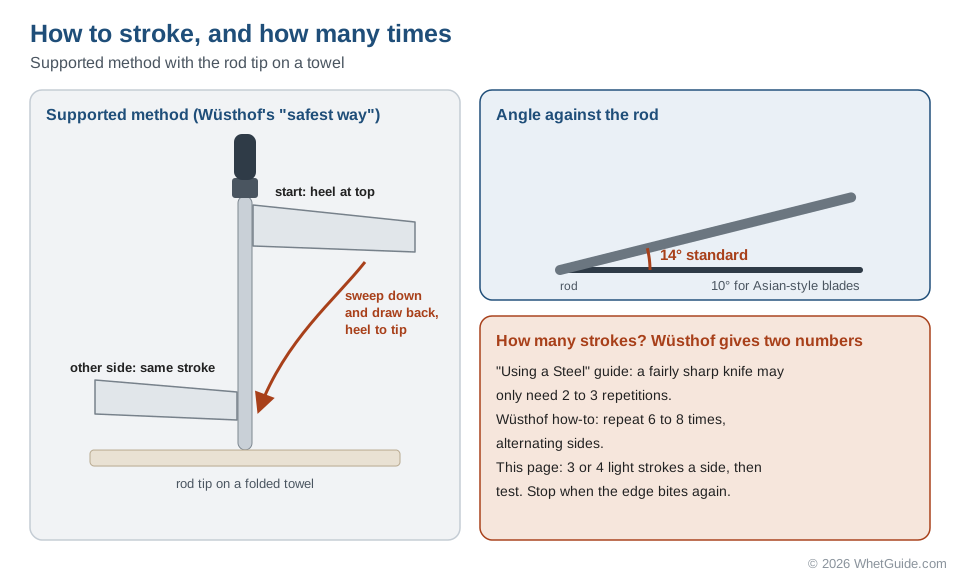
How many strokes? Wüsthof's two documents disagree. The "Using a Steel" guide says "a fairly sharp knife may only need 2-3 repetitions, while a dull knife will need more." The online how-to says to repeat 6 to 8 times, alternating sides, without saying whether that counts per side or in total. We suggest three or four light strokes per side, then a test cut. If the knife bites into a tomato skin, stop. If not, three or four more. Past ten or so with no change, the steel can't help and the edge needs grinding.
- 01Set upRod tip on a folded towel, handle in your weak hand.
- 02Find 14°Spine about 12 mm off the rod on a Classic 8 inch.
- 03StrokeHeel to tip, down the rod, almost no pressure.
- 04TestTomato skin or paper. Stop when it bites.
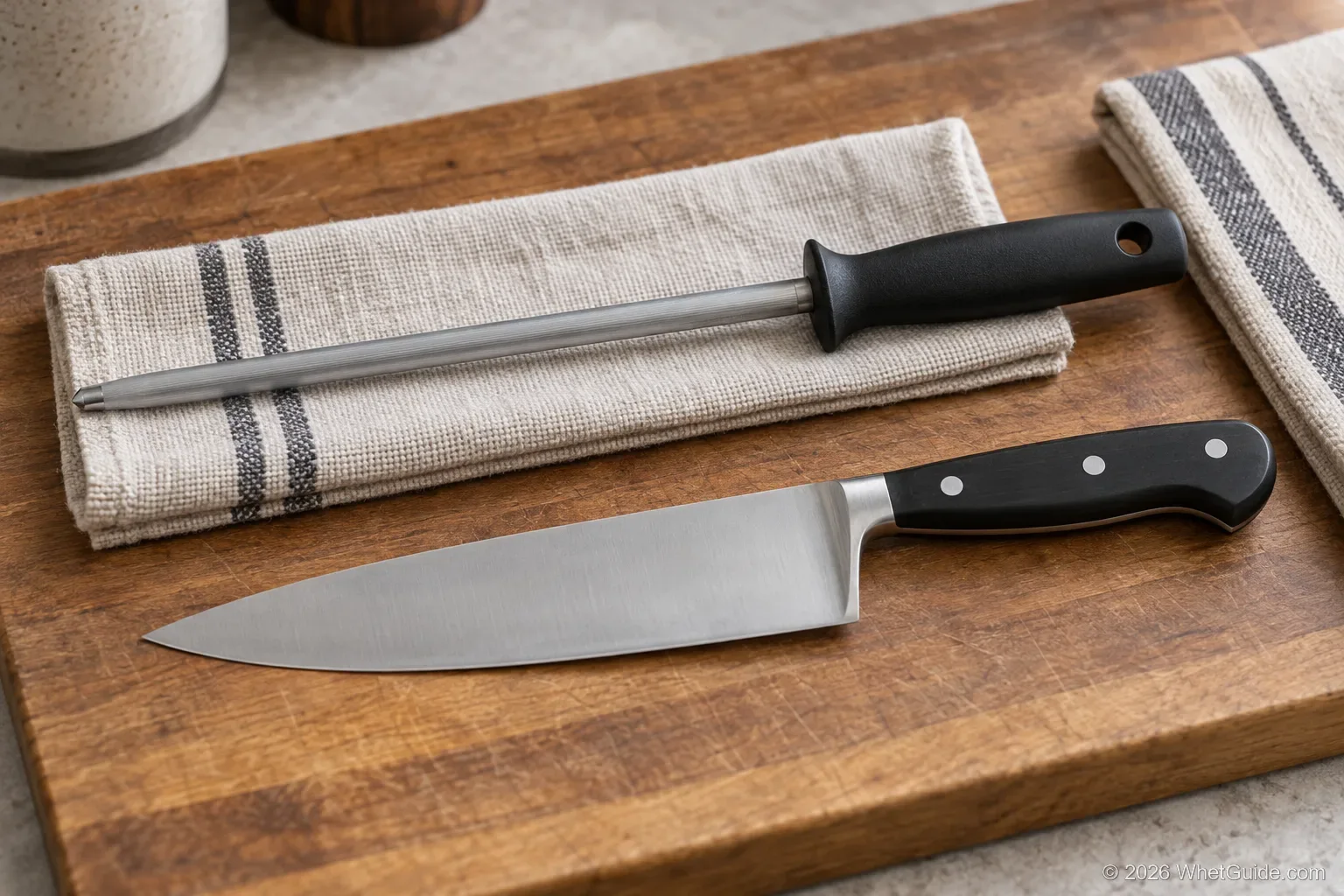
The motion is shown in more detail in how to use a honing rod, and ceramic vs steel explains the surface choice. Holding the rod in the air and swiping toward yourself, the way chefs do on television, works too. It is faster, but the angle wanders more easily.
When a few strokes stop helping, the edge needs sharpening. See the best knife sharpener for Wüsthof knives. Owners of other German brands can check Zwilling Henckels angles, and best honing rod covers the wider field.
↑ Back to all sectionsHow far off the rod the spine sits
Fourteen degrees is hard to see. A distance is easier. Hold the edge on the rod, and the gap between the spine and the rod's face is the blade's width times the sine of the angle. On a Classic 8 inch chef's knife, 48 mm wide at the heel, 14 degrees puts the spine 11.6 mm off the rod. A Classic santoku, 45.7 mm wide, at 10 degrees sits 7.9 mm off.
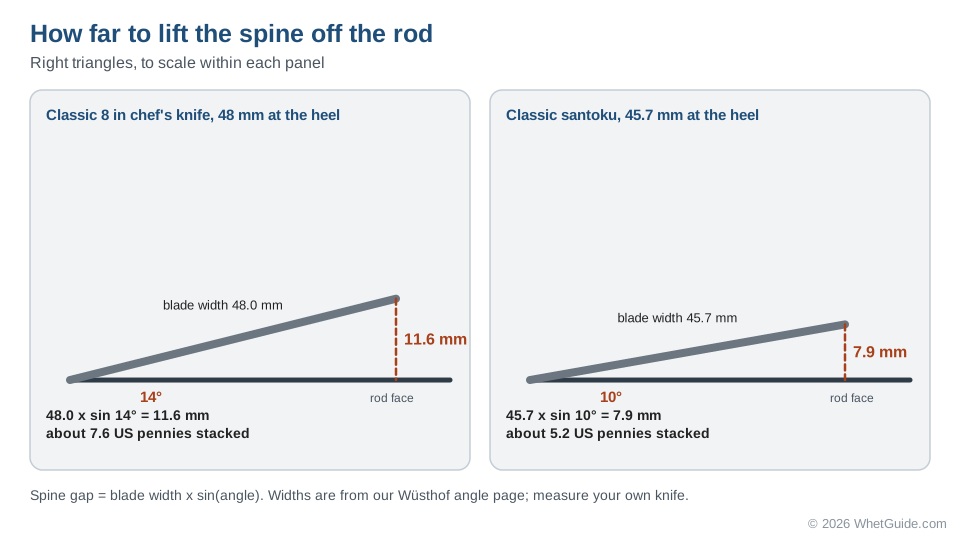
| Knife | Heel width | Angle | Spine gap | US pennies, roughly |
|---|---|---|---|---|
| Classic 8 in chef's | 48 mm | 14° | 11.6 mm | 7 to 8 |
| Classic santoku | 45.7 mm | 10° | 7.9 mm | 5 |
A US penny is about 1.52 mm thick. Stack seven or eight against the rod once, rest the spine on the stack, and look at the gap. You won't use the coins every time; the point is to learn what 14 degrees looks like on your knife. The SHARPAL 196N angle pyramid has a 14 degree face that does the same job and sits on a stone or counter.
Why 14 and not the 14.5 on our angle page? Wüsthof's steel guide and how-to both say 14 for honing. Its newer sharpening articles say 14.5 for the edge itself. Half a degree is about 0.4 mm of spine gap on a chef's knife, which no hand holds to on a steel.
↑ Back to all sectionsTroubleshooting: when honing doesn't seem to work
Most complaints about steels come from a handful of fixable habits. Here are the ones we see described again and again, with the fix for each.
| What you notice | Likely cause | Fix |
|---|---|---|
| No change after ten strokes | Edge is worn, not rolled | Abrasive steel or sharpen |
| Sharper at the heel than the tip | Stroke stops before the tip reaches the rod | Sweep the knife back as it slides down; check the rod length |
| Edge feels rougher after honing | Too much pressure or a steep angle | Lighter strokes, lower spine |
| One side feels different | Uneven angle between sides | Count strokes per side; finish with one light pass each |
| Scratches high on the blade face | Angle too low, rubbing the shoulder | Raise the spine toward 12 mm |
| Clicking or catching on the rod | Chip or deep nick | Sharpen; a steel can't fill a chip |
| Gray streaks on a ceramic rod | Steel left on the rod | Eraser, rinse, dry (see care) |
Pressing hard feels like it should help, but a plain steel works by gently pushing the edge back into line. Press hard at a steep angle and you roll the very edge the other way, and the knife comes off duller. Use about the weight of the knife itself.
The other common one is honing a knife that needs sharpening. If your Wüsthof hasn't seen a stone or sharpener in a year or more, a steel probably can't bring it back, and the frustration gets blamed on the steel. Sharpen once, then start honing.
↑ Back to all sectionsHow often to hone Wüsthof knives
Wüsthof's guide says a steel can be used "even after each use". Knivesandtools says before each cutting session for a plain steel, and a sharpening steel only "once or twice a month". The Henckels listing suggests every other use.
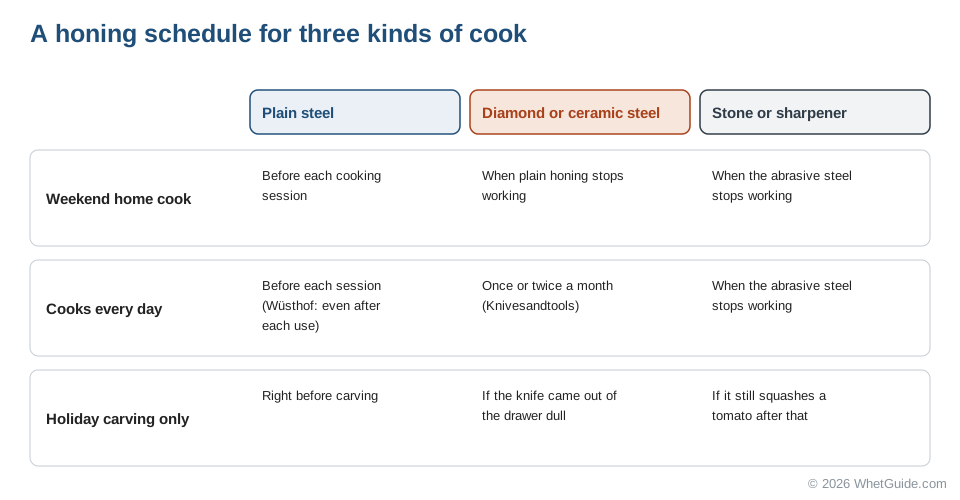
How long between sharpenings? That depends on how much you cook and what you cut on, and no source we trust gives a number for Wüsthof knives. Regular honing stretches it. Our guide to how often to sharpen knives has schedules by use.
↑ Back to all sectionsCleaning and storing the steel
Each kind of rod needs slightly different care. Knivesandtools says to clean a steel with water and a little soap and dry it thoroughly. Wüsthof's diamond steel listing says to wipe it with a damp cloth after each session. Wüsthof's guide adds a step for the knife: wipe the blade after honing, because the rod leaves fine steel dust on the edge.
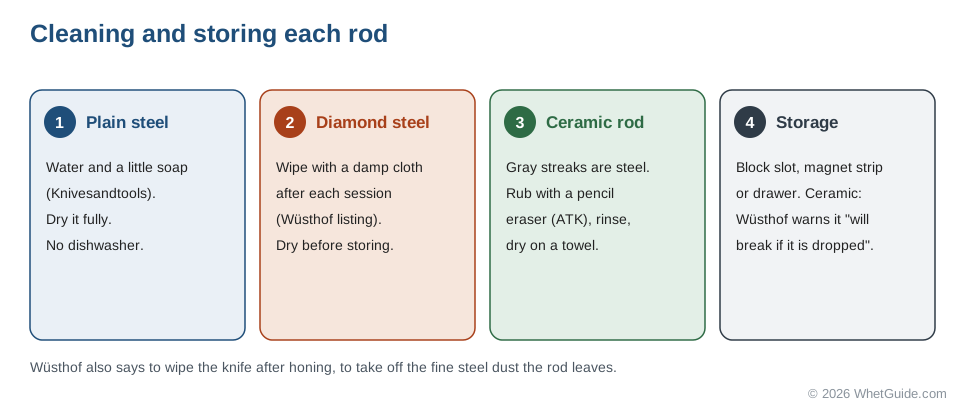
Ceramic rods have their own chore. America's Test Kitchen noted that ceramic collects gray metal residue, which is steel from your knives, and suggested rubbing it off with a pencil eraser. A loaded ceramic rod cuts less and starts to feel like a smooth steel, so it's worth doing every few weeks if you use one often.
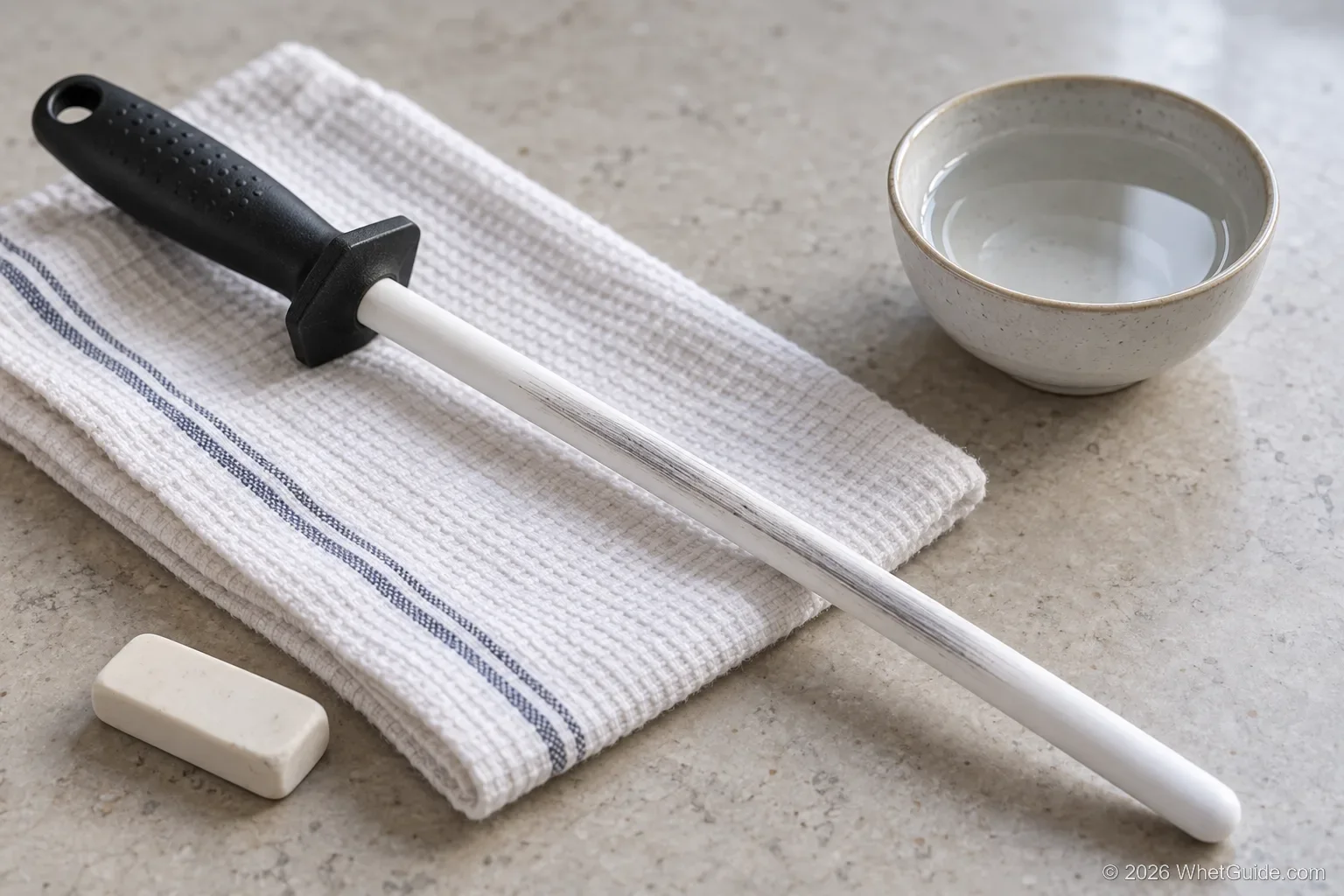
Storage is mostly about the tip and the coating. A plain steel can live in a block slot, on a magnet strip or in a drawer; Knivesandtools lists all three. Keep diamond steels from rattling against other tools in a drawer, since knocks can chip a coating. Ceramic should hang or sit in a slot where it can't roll off the counter, since Wüsthof's guide warns it "will break if it is dropped". The Utopia listing suggests wiping its steel with a cloth soaked in a little cooking oil, then drying it.
↑ Back to all sectionsWhen to skip the steel
Not every knife in a Wüsthof drawer belongs on a plain steel. Three cases call for something else.
Wüsthof's own santokus and nakiris sit at 10 degrees per side. They hone fine on the same steel, but the lower angle puts more of the edge's thin section against the rod, so keep the strokes especially light. A fine ceramic is a good match if you'd rather not risk the plain steel's grooves on a thin edge. Our Wüsthof angle page covers which of Wüsthof's knives are Asian-style.
↑ Back to all sectionsWhen a steel stops working
Every edge eventually wears past what straightening can fix. The signs are plain. The knife slides on a tomato skin after a full round of honing, or crushes herbs instead of slicing them. A nick you can catch with a fingernail is a chip, and only grinding removes it. From gentlest to most aggressive, the routes are:
| Route | When | Options |
|---|---|---|
| Abrasive steel | Dull but no chips | Wüsthof ceramic J3000 or the diamond steel |
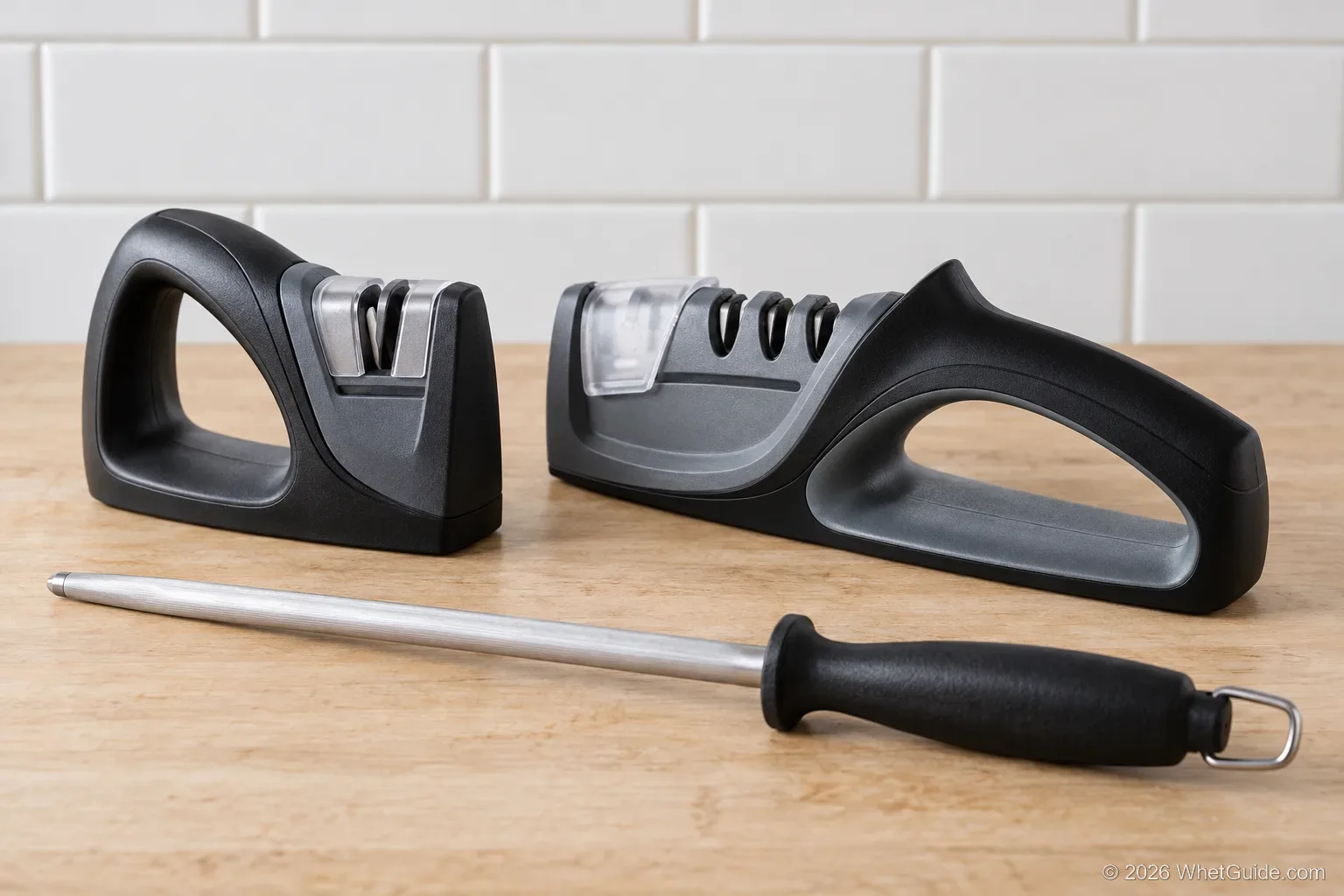
| Wüsthof hand-held sharpener | Dull, small nicks, no wish to learn a stone | Precision Edge 4-stage, Universal 4-stage |
| Whetstone | Chips, or you want control of the angle | See best whetstone |
A note on Wüsthof's 2-Stage hand-held sharpener: its listing gives a preset 34 degrees, which works out to about 17 per side, steeper than the 14 you hone at. It will still sharpen, but your first few honing sessions afterward will be at a slightly different angle than the edge. Our Wüsthof sharpener guide compares the models, and are pull-through sharpeners bad? covers the trade-offs.
Four kitchens, four answers
Here's how the advice above plays out for four common Wüsthof owners.
| Owner | Knives | Buy | Why |
|---|---|---|---|
| New Wüsthof block set | 8 in chef's plus shorter knives | Use the block's steel if it has one; if not, the 9 inch | Longest straight edge is 8 in |
| Daily cook with a 10 in chef's | 10 in chef's, santoku | 10 inch plain steel, plus the J3000 later | Wüsthof's length rule; ceramic for the santoku and monthly bite |
| Holiday carver | Carving knife, rarely used | 10 inch steel; diamond if it comes out dull | One annual job; a dull drawer knife needs metal off |
| Mixed drawer with a Japanese gyuto | Wüsthof plus a hard Japanese blade | Plain steel for the Wüsthofs, fine ceramic for the gyuto | Knivesandtools excludes very hard Japanese steel from plain steels |
The daily cook is the one who benefits most from owning two rods. A plain steel before each session keeps the edge in line, and a ceramic once or twice a month, the Knivesandtools schedule, puts back the bite that straightening can't.
↑ Back to all sectionsClaims you'll see, checked against sources
| Claim | What the sources say |
|---|---|
| "A honing steel sharpens your knife" | A plain one doesn't remove metal. Wüsthof and Knivesandtools both reserve sharpening for diamond and ceramic rods. |
| "Wüsthof steels are 58 HRC" | The Amazon listings say so; Wüsthof's 2020 guide says 65 Rockwell. Unresolved. |
| "Any length works" | Wüsthof says at least as long as the blade. |
| "Diamond is the best steel" | America's Test Kitchen marked diamond down for routine honing (see the independent test above). |
| "Hone at 20 degrees" | Wüsthof says 14 for standard blades and 10 for Asian-style ones. |
| "Honing works on every knife" | Knivesandtools excepts ceramic knives and very hard Japanese steels. |
| "A steel works on serrated edges" | The Utopia listing claims it; a tapered rod does the job properly. |
Small extras: an angle guide and a strop
Two cheap add-ons help once you have the steel. The SHARPAL 196N angle pyramid has four faces, from 14 to 25 degrees per its listing, and the 14 degree face matches Wüsthof's honing angle. Set it beside the rod for a few sessions to train your eye.
A strop finishes an edge after sharpening, before you return to the steel. The SHARPAL 205H double-sided leather strop comes with green compound and an angle guide. It doesn't replace the steel; it polishes what the stone or sharpener leaves. How to strop a knife shows the motion, which runs edge-trailing, the opposite of a honing stroke.
↑ Back to all sectionsBuying checklist
- Measure your longest straight blade. The rod should be at least that long.
- Decide plain or abrasive. Plain for upkeep; ceramic or diamond only for a knife that has lost its bite.
- Read the surface on the listing, not the title. "Sharpening steel" doesn't always mean a coating.
- Look for a hardness figure. Wüsthof's listings give one; most generic rods don't.
- Check the handle has a guard and, if you hang tools, a loop.
- For ceramic, plan where it will live so it can't fall.
- Skip any rod whose built-in guide is set for 20 degrees, like the Sharpeak 12 inch ceramic, unless you'll ignore the guide and hold 14.
Which one to buy
Buy the Wüsthof 9 inch honing steel if you want the straightforward answer, or the 10 inch if any knife you own is longer than 8 inches. Add the Wüsthof diamond steel only if your knives are past upkeep and you do not own a stone; the ceramic J3000 is the gentler choice for the same job. On a budget, the Cutluxe 10 inch is the rod to try.
Product details come from each Amazon listing as recorded between October 21 and November 14, 2026. Maker guidance comes from Wüsthof's "Using a Steel" guide (2020 copy) and its online how-to. Testing notes are America's Test Kitchen's; retail guidance is Knivesandtools'. Prices change, so the buttons show the current price on Amazon. How we research · Affiliate disclosure