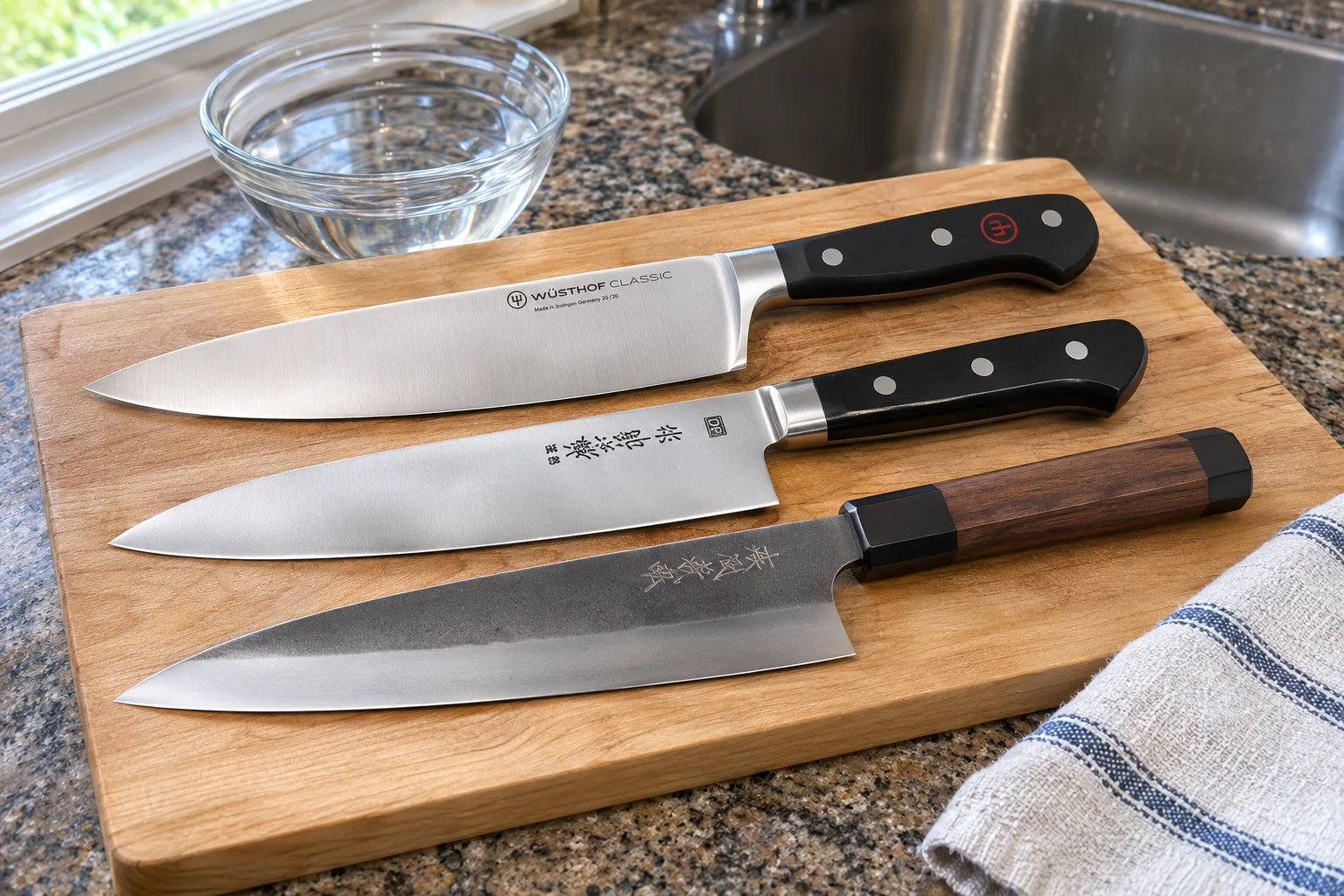
Quick answer: which steel should you buy?
For most home cooks, a German-style stainless knife (X50CrMoV15 or similar) is the easy pick: it shrugs off a wet sink and sharpens on anything. If you'll sharpen now and then and want a thinner, harder edge, go Japanese stainless (VG-10, AUS-10, 14C28N). Pick carbon steel (Shirogami, Aogami) only if you'll dry the knife every time. Powder steels like SG2 hold an edge longest and cost the most. Heat treatment and the grind matter as much as the steel's name.
| If you want | Look for | Usual hardness | The catch |
|---|---|---|---|
| Zero fuss, forgiving, cheap to sharpen | X50CrMoV15 and other German-style stainless | 55-58 HRC | Dulls sooner; you hone it often |
| Thinner, sharper, still stainless | VG-10, AUS-10, 14C28N, AEB-L | about 59-62 HRC | Chips if you twist it or hit bone |
| The keenest edge and the easiest sharpening | Shirogami, Aogami, 52100 | about 61-65 HRC | Rusts if left wet; patinas |
| The longest time between sharpenings | SG2 / R2, MagnaCut | about 62-64 HRC | Price, and slower on the stone |
Hardness ranges come from maker and dealer pages, sourced in each steel's section. Not sure which row you're in? The five questions sort it out in a minute.
↑ Back to all sectionsThe trade-off: edge retention, toughness and rust resistance
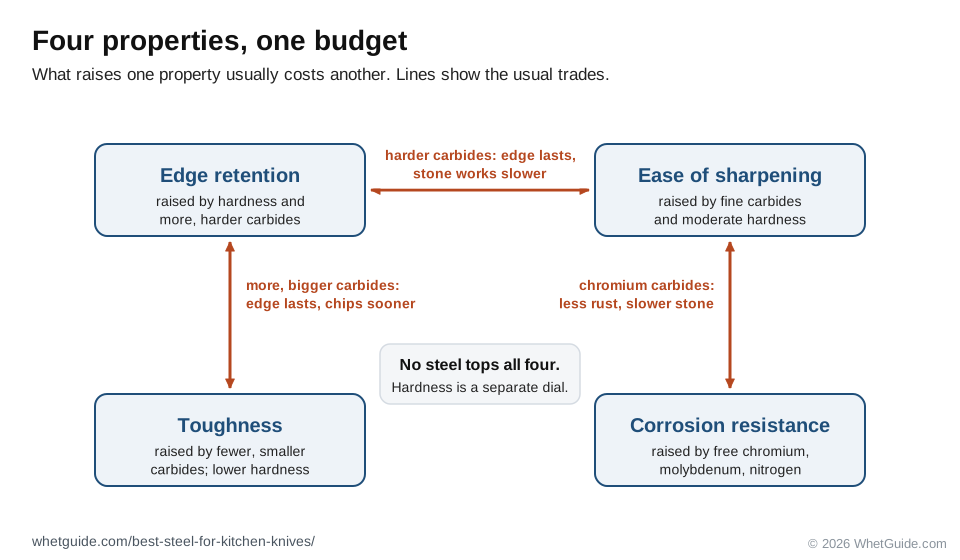
Every kitchen steel is a compromise between a few properties, and no steel maxes them all. Old knife pages listed "tensile strength" as one of them. That's an engineering number for how much pull a bar takes before it breaks, and you'll never feel it in a kitchen. The properties a cook actually notices are these:
| Property | What it means at the board | What raises it | What it costs you |
|---|---|---|---|
| Edge retention | How long the knife keeps cutting before it needs the stone | Higher hardness, and more (and harder) carbides | Usually toughness, and time on the stone |
| Toughness | Resistance to chipping and snapping. A tough edge rolls or dents; a brittle one chips | Fewer, smaller carbides; lower hardness; good heat treatment | Usually edge retention |
| Corrosion resistance | Whether it spots, stains or rusts when left wet or cut into acid | Chromium in solution, plus molybdenum and nitrogen | Often easy sharpening, since chromium also forms carbides |
| Ease of sharpening | How fast a stone raises a burr and how fine an edge it takes | Fine, low-volume carbides; moderate hardness | Usually edge retention |
Metallurgist Larrin Thomas's site, Knife Steel Nerds, defines toughness as resistance to fracture (chips and broken tips) and measures edge retention with CATRA abrasive-wear testing. The rule of thumb from that work: more carbide and larger carbide generally means less toughness, and the hardness of those carbides drives how long the edge lasts. Hardness is a separate dial again, covered next.
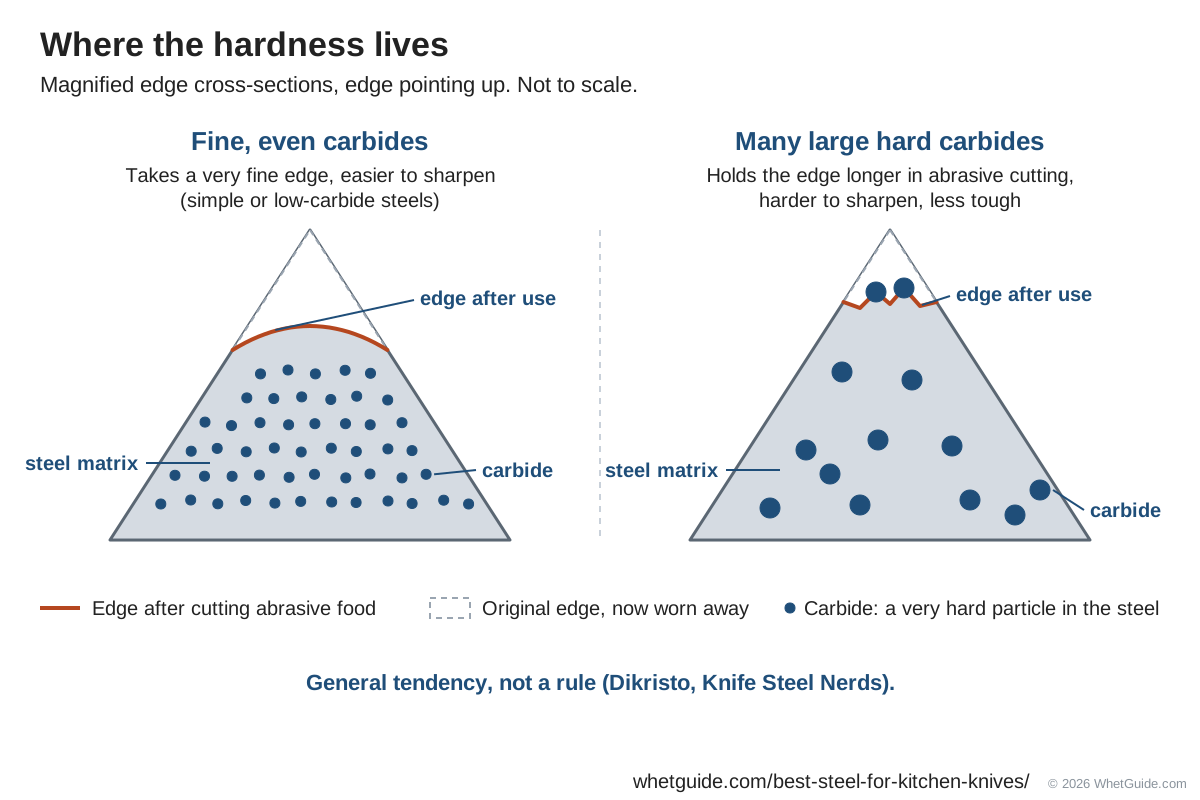
What that means when you're choosing: a soft, tough German knife forgives a careless cook and a cheap sharpener. A hard Japanese knife rewards a careful cook with an edge that lasts and punishes a twist through a squash. Neither is "better"; they suit different hands. The knifemaker Dikristo puts it bluntly on its steel page: nearly any decent steel works when the heat treatment and the geometry are right.
↑ Back to all sectionsHardness and HRC: what the number means
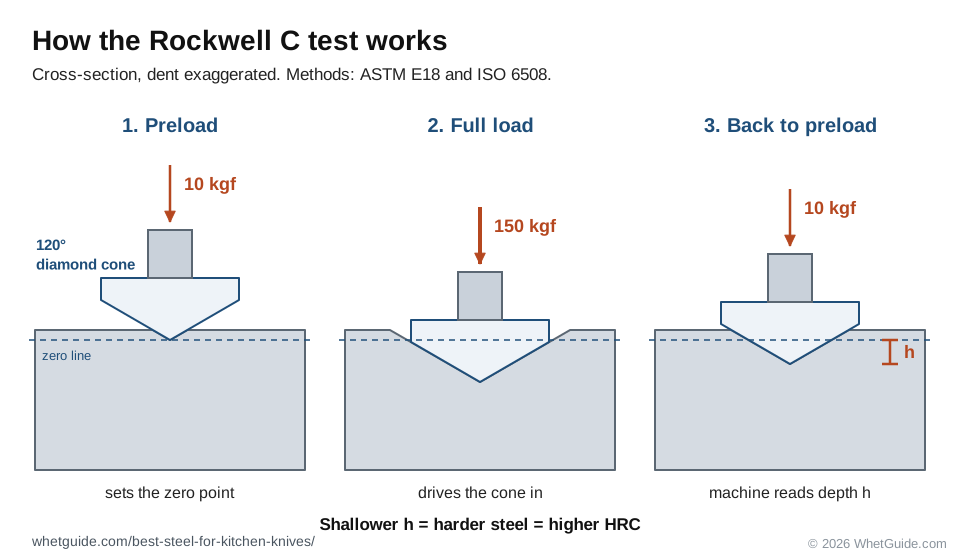
HRC is the Rockwell C hardness scale. The test presses a 120° diamond cone into the steel with a 10 kgf preload, then a 150 kgf main load, and turns the depth of the dent into a number (the method is set out in ASTM E18 and ISO 6508; ZwickRoell's summary is a readable version). A shallower dent means harder steel and a higher number.
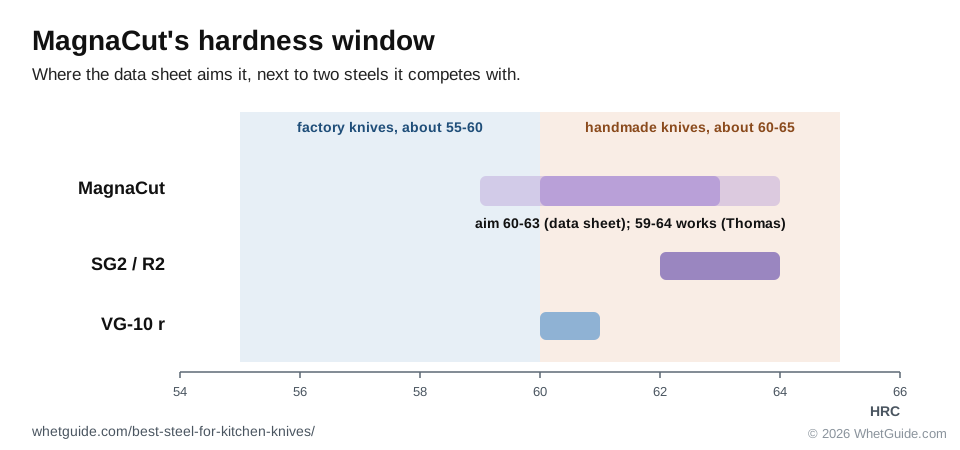
Kitchen knives live in a narrow band. Dikristo puts factory knives at about 55 to 60 HRC and handmade kitchen knives at about 60 to 65. A few points is a big difference at the edge: a 58 HRC German knife and a 63 HRC Japanese one behave like different tools.
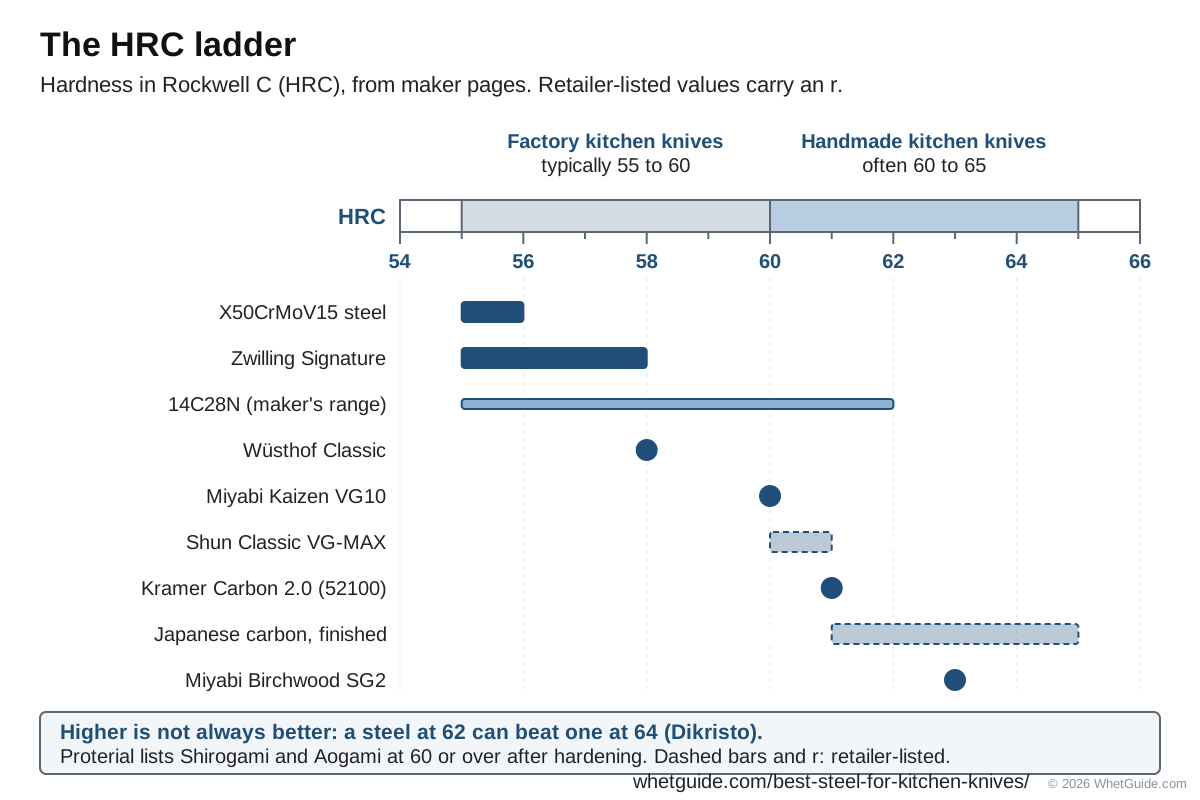
| Knife or steel | HRC | Source |
|---|---|---|
| X50CrMoV15 (the grade's general range) | 55-56 | Böker lexicon |
| Zwilling Signature chef's knife | 55-58 | zwilling.com |
| Zwilling Twin and Four Star lines | 57r | retailer listings |
| Wüsthof Classic 8" chef's knife | 58 | wusthof.com |
| 14C28N (the mill's recommended range) | 55-62 | Alleima |
| Miyabi Kaizen (VG10) | 60 | zwilling.com |
| Tojiro DP gyuto (VG10 core) | 60r | retailer listing |
| Shun Classic (VG-MAX) | 60-61r | retailer listing |
| Kramer by Zwilling Carbon 2.0 (52100) | 61 | zwilling.com |
| Shirogami and Aogami after hardening | 60 or over | Proterial |
| Finished Japanese carbon knives | about 61-65r | Japanese-steel dealer table (Chef's Edge) |
| Miyabi Birchwood (SG2) | 63 | zwilling.com |
| ZDP-189 and HAP40 (extremes) | up to about 67 and 68r | dealer table (Chef's Edge) |
Is a higher HRC better?
Not on its own. Dikristo's example: a steel at 62 HRC can beat one at 64 for edge life or toughness, depending on the alloy, the structure the heat treatment left behind, and what you cut. Hardness tells you three things you can count on, though:
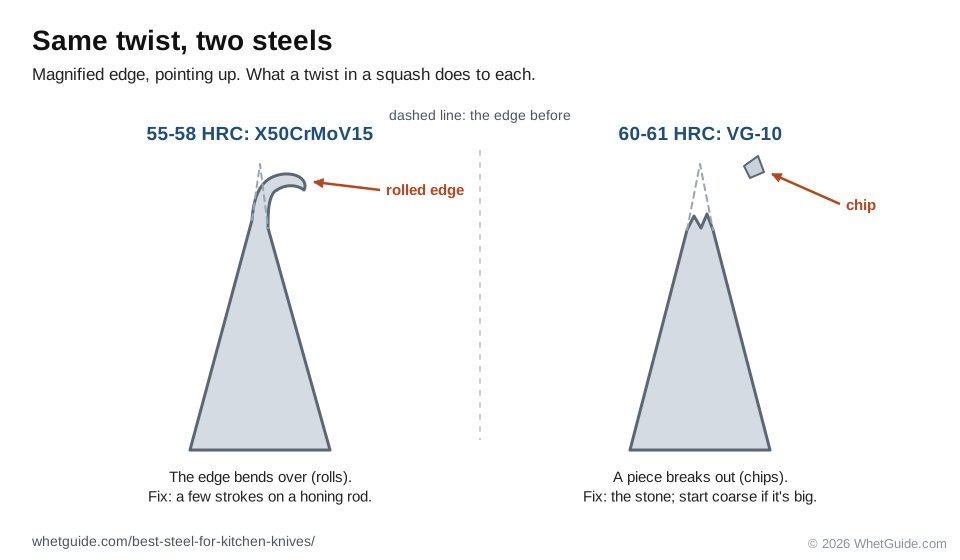
- Harder edges resist rolling. A 58 HRC knife folds its edge over in use, which is why German knives get honed so often. A 62 HRC edge stays straight longer.
- Harder, thinner edges chip instead of rolling. Twist a hard gyuto in a squash or drop it on a plate and you'll see a nick, not a bend.
- Harder steel takes longer to grind. On a coarse stone you'll feel the difference: the stone skates a little more and the burr takes longer to form. On a fine stone, hard simple steels often feel better than soft ones, because they don't smear.
Heat treatment: Friodur, cryo and "ice-hardened"
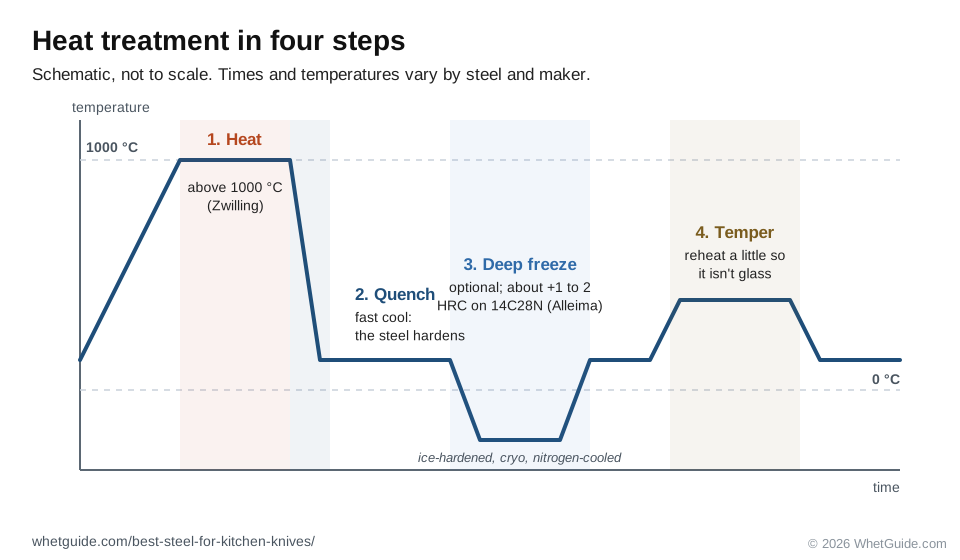
Hardness isn't a property of the steel's name. It's set at the factory by heat treatment: heat the blade until the structure changes, quench it, often chill it far below freezing, then temper it back a little so it isn't glass. The same bar can come out at 55 or 62. Alleima, the Swedish mill that makes 14C28N, recommends anything from 55 to 62 HRC for it and says a deep freeze adds about 1 to 2 HRC.
That's what the marketing words mean:
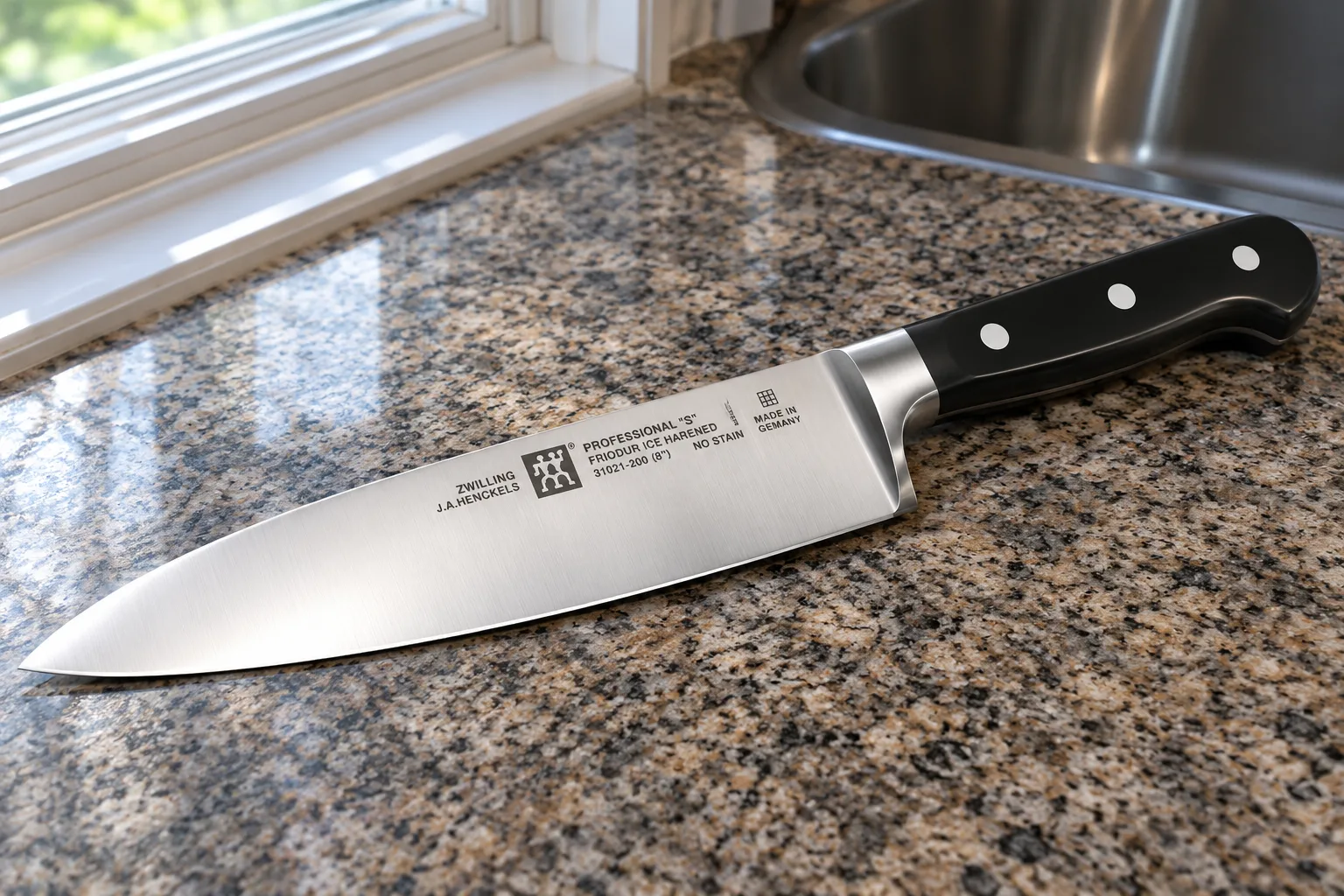
- Friodur is Zwilling's name for its process. Zwilling's production page says the steel is heated above 1000 °C and then ice-hardened to improve hardness and corrosion resistance. The same page lists its Cryodur process at Rockwell 60 and above.
- "Ice-hardened", "cryo", "deep-frozen" and "nitrogen-cooled" all describe the same step: chilling the blade far below freezing (some makers use liquid nitrogen) before tempering. Dikristo explains it as converting leftover soft structure so more of the blade ends up hard.
- None of these words tells you the final HRC. The maker's number does.
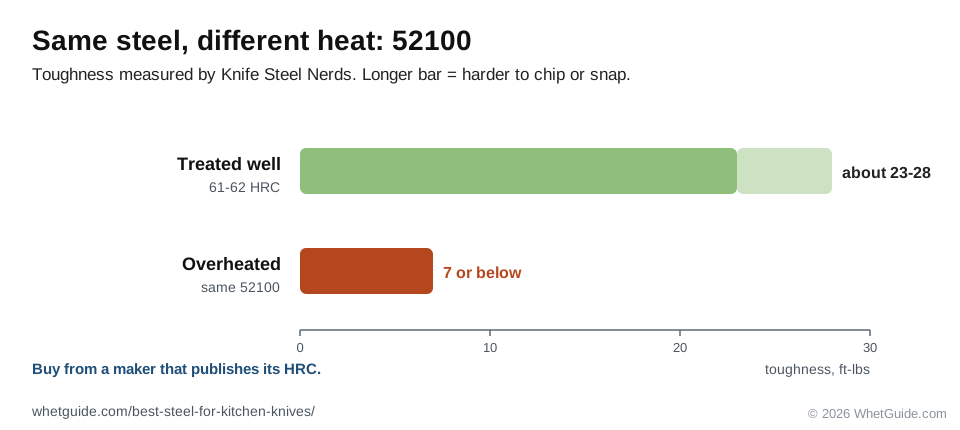
Heat treatment can also go wrong. Knife Steel Nerds measured properly treated 52100 at 61 to 62 HRC at about 23 to 28 ft-lbs of toughness, and an overheated batch of the same steel at 7 ft-lbs or below. Same name on the label, a quarter to a third of the toughness. That's the best argument there is for buying from a maker that publishes its hardness.
What carbon, chromium, vanadium and the rest do
Steel is iron plus carbon. Everything else is seasoning. This table is what you need to read a spec sheet with confidence; tap its heading to fold it away.
The elements in kitchen knife steel
| Element | What it does in a knife | Where you'll see a lot of it |
|---|---|---|
| Carbon (C) | Lets the steel harden at all. More carbon means higher possible hardness and more carbides | Aogami Super, 1.40-1.50%; X50CrMoV15 has about half a percent |
| Chromium (Cr) | At 10.5% and up, forms the thin passive film that makes steel stainless. Some of it also forms chromium carbides, which add wear resistance but take chromium out of the rust fight | 440C, 16-18%; VG-10, about 15% |
| Molybdenum (Mo) | Helps resist pitting and helps the steel harden evenly | SG2, about 2.3-3.3%; X50CrMoV15, 0.5-0.8% |
| Vanadium (V) | Forms very hard, very small carbides; keeps the grain fine so the edge can be very keen and last longer | MagnaCut, 4.0%; SG2, about 2% |
| Tungsten (W) | Forms hard carbides that slow edge wear; the "blue" in Aogami | Aogami Super, 2.00-2.50% |
| Nickel (Ni) | Adds toughness. It's often credited with rust resistance too, but one widely used steel reference doubts that; chromium does that job. Rare in kitchen knife steels | Small amounts in AUS-8r; none listed in Proterial's GIN 3 |
| Cobalt (Co) | Part of VG-10's recipe. Its effect at that level is small, so treat it as a line on the recipe card | VG-10, about 1.5% |
| Nitrogen (N) | Hardens like carbon but leaves more chromium free to fight rust | 14C28N, 0.11%; MagnaCut, 0.2% |
| Niobium (Nb) | Forms hard carbides without stealing chromium | MagnaCut, 2.0% |
| Manganese, silicon | Small amounts from steelmaking; help clean and harden the steel | Shirogami: Mn 0.20-0.30%, Si 0.10-0.20% |
| Phosphorus, sulfur | Impurities. Premium carbon steels keep them very low | Shirogami: P 0.025% max, S 0.004% max |
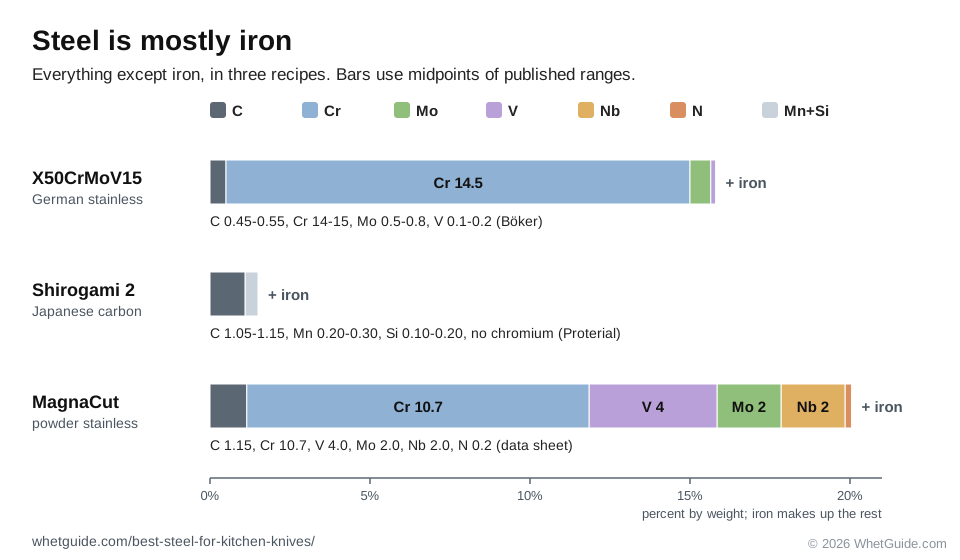
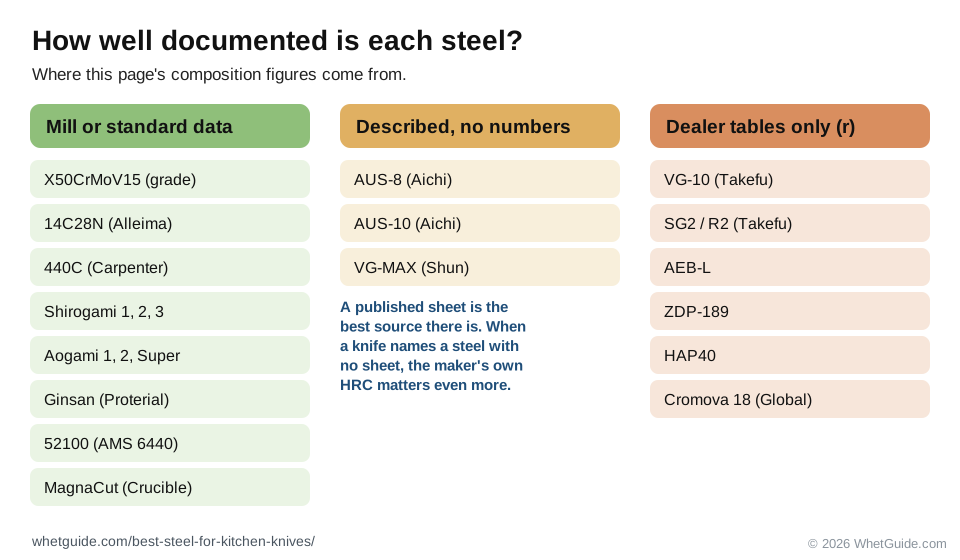
Composition figures come from the mills' and standards' data cited in each steel's section below.
↑ Back to all sectionsCarbon steel vs stainless steel
Iron becomes steel when carbon is added; carbon is what lets a blade be hardened. Every kitchen knife steel is "carbon steel" in that sense. When cooks say carbon steel, they mean steel with little or no chromium: it takes a keen edge, sharpens fast and rusts if you leave it wet. Stainless means enough chromium to protect the surface, which costs a little of that easy sharpening.
| Carbon steel (Shirogami, Aogami, 52100, 1095) | Stainless (X50CrMoV15, VG-10, 14C28N, SG2) | |
|---|---|---|
| Chromium | None to about 1.5% | 10.5% or more |
| Left wet | Orange rust spots, sometimes within hours | Usually fine; can spot or pit if left in salt or acid |
| Acidic food | Gray marks on onions and apples, a metallic taste until a patina forms | No reaction you'll notice |
| On the stone | Fast to sharpen, takes a very fine edge | From easy (X50CrMoV15, 14C28N) to slow (SG2, ZDP-189) |
| Daily care | Wipe and dry after each task, oil for storage | Hand wash, dry, store safely |
| Who it suits | Cooks who enjoy the knife and sharpen it themselves | Nearly everyone else, and every busy kitchen |
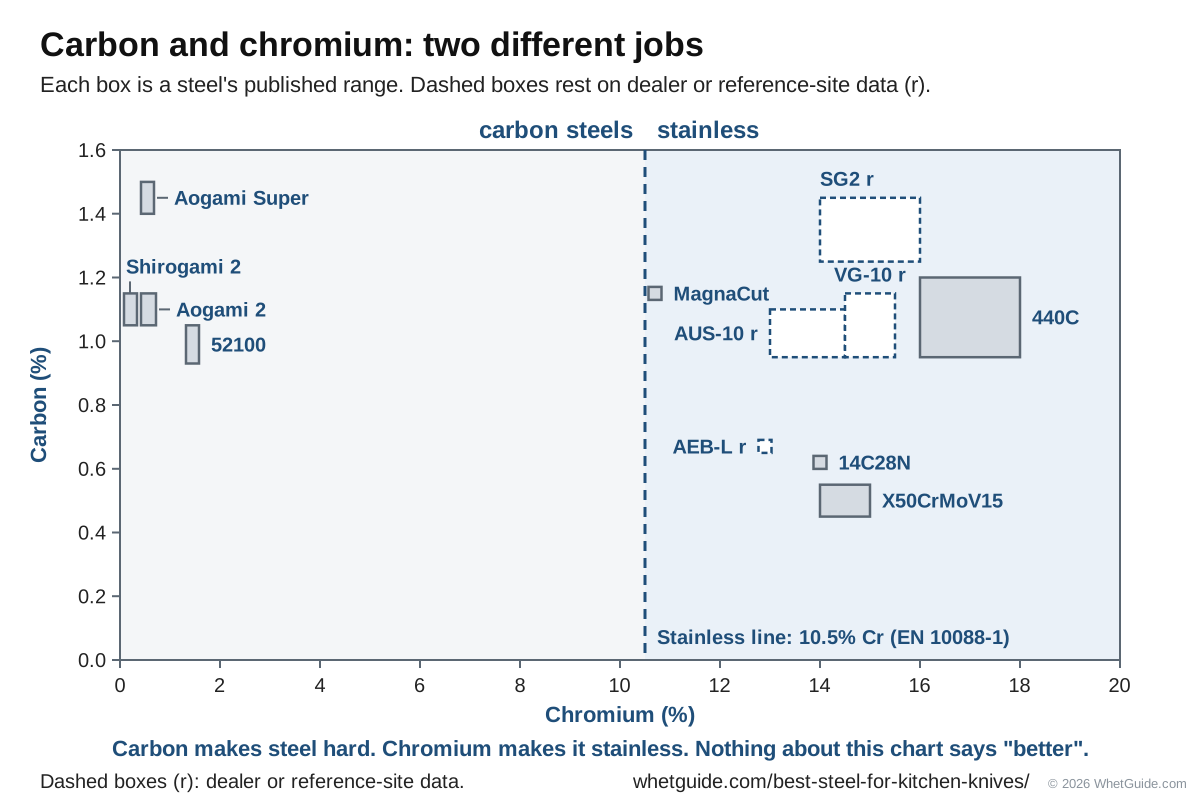
Do chefs prefer one? Busy professional kitchens mostly run on stainless, because nobody on a line has time to dry a knife after every lemon. Carbon knives are common among cooks who sharpen their own and like the edge. The beginner FAQ on Reddit's r/TrueChefKnives answers "is carbon superior?" with a plain no, and that's right: it's a different set of trade-offs.
What "stainless" actually means
The standard definition (European standard EN 10088-1, with ISO 15510 using the same limits, as the International Stainless Steel Forum explains) is steel with at least 10.5% chromium and no more than 1.2% carbon. That chromium forms a very thin, self-healing passive layer on the surface, per the stainless trade body Euro Inox. Scratch it and it re-forms.
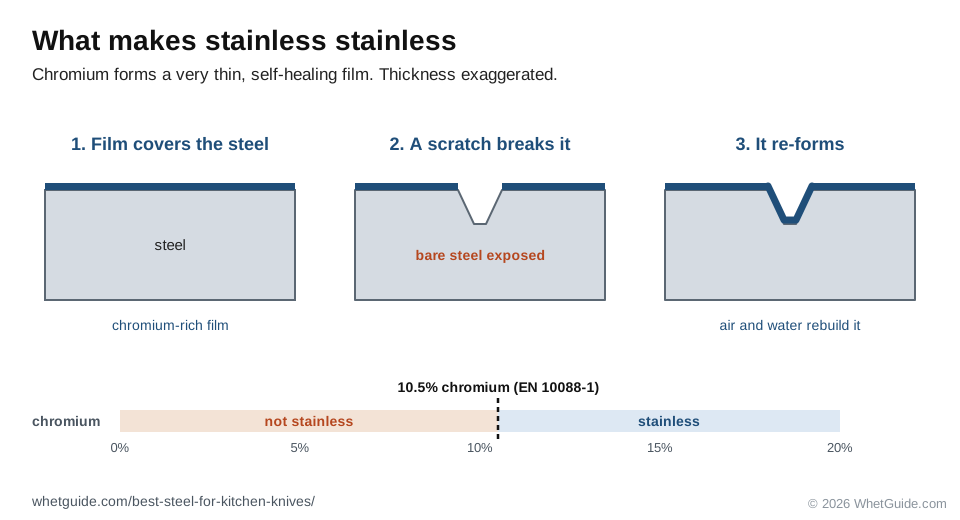
Stainless is stain-resistant, not stain-proof. Leave a stainless knife in a sink of salty, acidic water overnight, or run it through the dishwasher, and you can still get spots and small pits, especially on high-carbon stainless where some chromium is locked up in carbides. Old guides said stainless is always harder and harder to sharpen than carbon steel. Not true either: 14C28N, hardened anywhere in its 55 to 62 range, sharpens about as easily as anything, and finished White steel, up to about 65 HRC, is harder than most stainless knives you'll meet.
What carbon steel is, and why cooks still buy it
Japanese carbon steels such as Shirogami (White) and Aogami (Blue) are very pure, very hard and very simple. Proterial, the mill that makes them, lists Shirogami 2 with 1.05-1.15% carbon and no chromium at all, and calls it "carbon steel with minimum impurities". Cooks like it for three plain reasons:
- It gets extremely sharp. Fine structure, no big carbides, so the edge can be thinned to almost nothing.
- It sharpens fast. A burr comes up quickly even on a fine stone.
- The patina. A gray-blue oxide film builds up with use, and it slows red rust.
The price is attention. Wipe the blade between tasks, dry it at once, don't leave it on a wet board. If that sounds like a chore, buy stainless and don't look back. If it sounds like part of the fun, a carbon gyuto is the most rewarding knife on a stone there is. How to start a patina is in care by steel.
What "high-carbon stainless" means
"High-carbon stainless" is a marketing label with no standard behind it. It means stainless steel (still 10.5% chromium or more) with more carbon than basic stainless, so it can be hardened enough to hold a kitchen edge. In the knife trade, over about 0.5% carbon gets called "high-carbon" (that's trade usage, as Dikristo notes). By that yardstick nearly every kitchen knife steel qualifies:
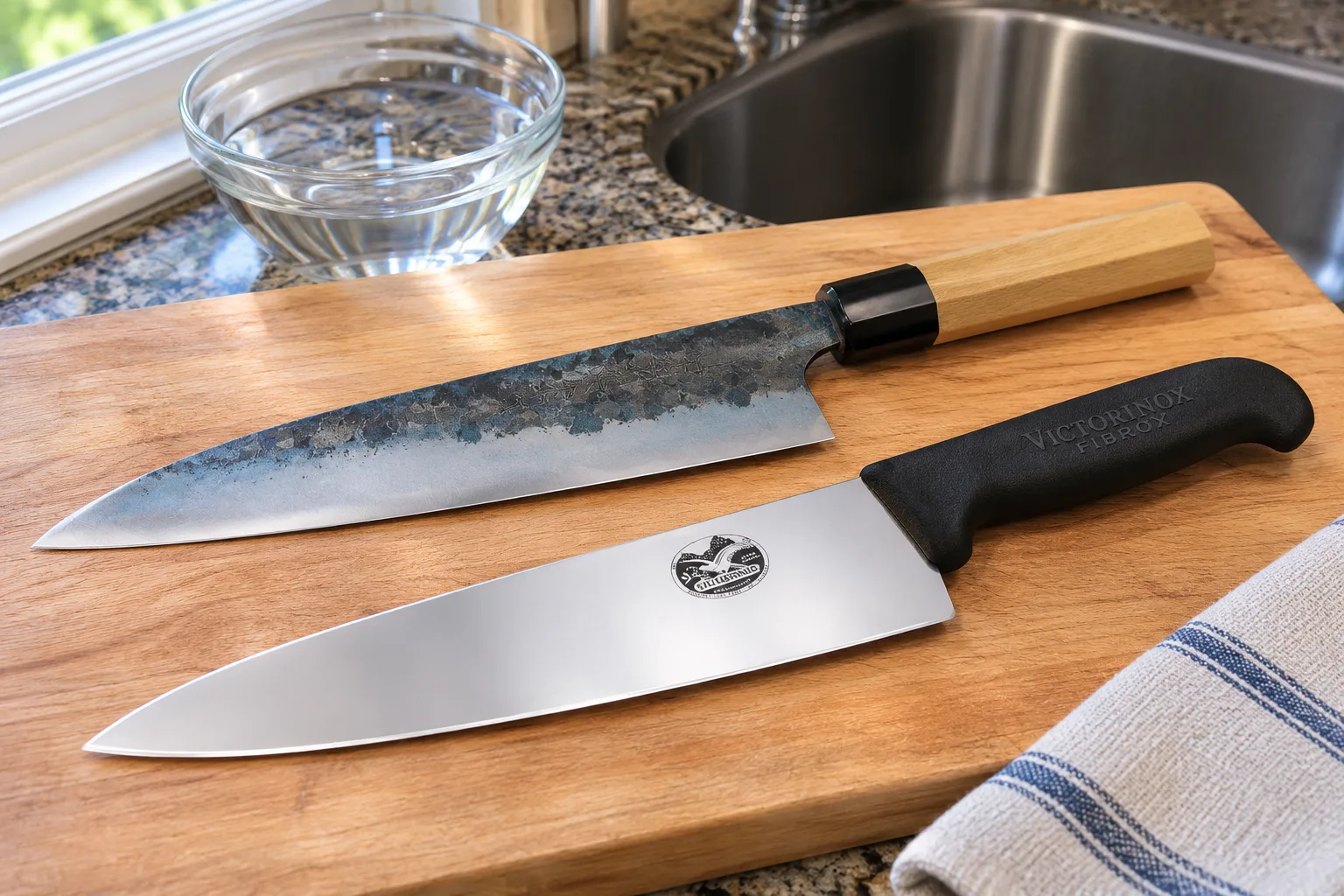
Typical figures: X50CrMoV15 0.45-0.55% (Böker), VG-10 about 1% (dealer tables), 440C 0.95-1.20% (Carpenter). So a "high-carbon stainless" label on a budget knife and on a premium one can mean very different steels. Victorinox, for one, sells its Fibrox Pro chef's knife as "high carbon stainless steel" without a grade or hardness on its listing.
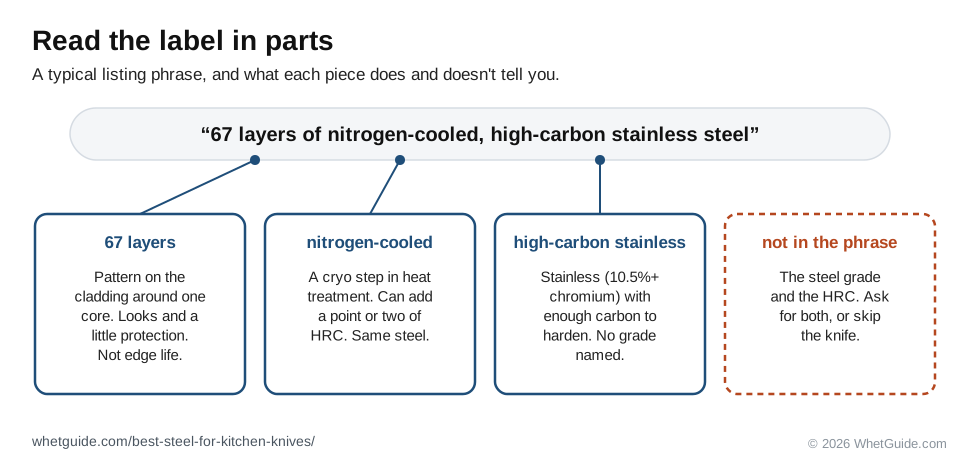
Knife listings stack more words on top. Take a typical knife-listing phrase: "67 layers of nitrogen-cooled, high-carbon stainless steel". Read it in three parts:
- "High-carbon stainless" means the core is a stainless steel with enough carbon to harden. Look for the actual grade (VG-10, AUS-10, SG2) somewhere in the listing. No grade, no way to compare.
- "Nitrogen-cooled" points to a cryogenic step in the heat treatment, the same idea as Zwilling's ice-hardening (see heat treatment). It can add a point or two of hardness; it doesn't change the steel.
- "67 layers" usually means a damascus-pattern cladding wrapped around one core. The core does the cutting; the layers are mostly looks and a little protection (see clad and damascus).
- Then find the HRC. If the maker gives one, compare it with the ladder above. If not, the label tells you little.
Common kitchen knife steels, one by one
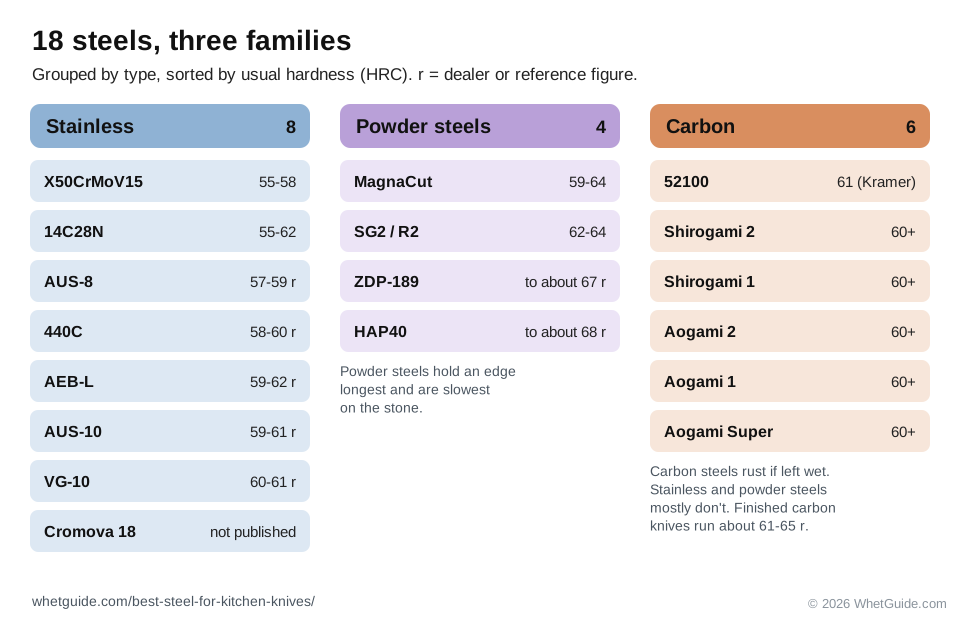
Here's every steel you're likely to see on a kitchen knife, in one table. Carbon and chromium are the mill's or standard's figures where published; "r" marks dealer or reference-site figures, given as ranges. The sharpening and rust columns are our plain-word summary, not a measured score.
| Steel | Type | Carbon % | Chromium % | Usual HRC | Sharpening | Left wet | Where you'll see it |
|---|---|---|---|---|---|---|---|
| X50CrMoV15 / 1.4116 | Stainless | 0.45-0.55 | 14-15 | 55-58 | Easy | Tolerant | German forged and stamped chef's knives |
| VG-10 | Stainless | 0.95-1.15r | 14.5-15.5r | 60-61r | Moderate | Mostly tolerant; can pit | Japanese stainless gyutos, clad cores |
| AUS-8 | Stainless | 0.70-0.80r | 13-14.5r | 57-59r | Easy | Tolerant | Budget Japanese-style knives |
| AUS-10 | Stainless | 0.95-1.10r | 13-14.5r | 59-61r | Moderate | Tolerant | Mid-price Japanese knives |
| 14C28N | Stainless | 0.62 | 14.0 | 55-62 | Easy | Very tolerant | Scandinavian and some Japanese kitchen knives |
| AEB-L | Stainless | about 0.67r | about 13r | 59-62r | Easy | Tolerant | Custom and small-maker kitchen knives |
| 440C | Stainless | 0.95-1.20 | 16-18 | 58-60r | Moderate | Very tolerant | Older and mid-price knives |
| Cromova 18 | Stainless | about 0.8r | not published | not published | Moderate | Tolerant | Global knives |
| SG2 / R2 | Powder stainless | 1.25-1.45r | 14-16r | 62-64 (Miyabi: 63) | Slower | Tolerant | Premium Japanese knives |
| MagnaCut | Powder stainless | 1.15 | 10.7 | 59-64 | Moderate | Very tolerant | Custom makers; mostly pocket knives |
| ZDP-189 | Powder stainless | about 3.0r | about 20r | up to about 67r | Hard work | Tolerant | A few high-end Japanese knives |
| HAP40 | Powder high-speed steel | not published here | not published here | up to about 68r | Hard work | Can spot | A few Japanese makers |
| Shirogami 2 (White 2) | Carbon | 1.05-1.15 | none | 60+ (finished up to about 61r) | Very easy | Rusts | Traditional Japanese knives |
| Shirogami 1 (White 1) | Carbon | 1.25-1.35 | none | 60+ (up to about 65r) | Very easy | Rusts | High-end traditional knives |
| Aogami 2 (Blue 2) | Carbon | 1.05-1.15 | 0.20-0.50 | 60+ (up to about 63r) | Easy | Rusts | Clad Japanese gyutos |
| Aogami 1 (Blue 1) | Carbon | 1.25-1.35 | 0.30-0.50 | 60+ (up to about 65r) | Easy | Rusts | High-end Japanese knives |
| Aogami Super | Carbon (alloyed) | 1.40-1.50 | 0.30-0.50 | 60+ (up to about 65r) | Moderate | Rusts, a bit slower | Premium clad knives |
| 52100 | Carbon (low-alloy) | 0.93-1.05 | about 1.45 | 61 (Kramer) | Easy | Rusts | Kramer Carbon, custom makers |
Which knives use which steel, and the sources for each number, are in the profiles below. Each profile follows the same order: the numbers, how it feels, what to sharpen it on, care, and who should buy it or skip it.
X50CrMoV15 and 1.4116: the German workhorse
C 0.45-0.55%Cr 14-15%Mo 0.5-0.8%V 0.1-0.2%55-58 HRC in knivesSharpens: easy
- Feels like
- A tough, slightly soft edge that rolls rather than chips. Forgiving of bone, squash and careless cutting.
- Sharpen it on
- Anything. A 1000 stone does most of the work; a honing steel brings it back between sharpenings.
- Care
- Hand wash and dry. It tolerates a wet board far better than most.
- Good if
- You want one knife that survives a busy family kitchen.
- Skip if
- You hate honing and want an edge that lasts weeks.
X50CrMoV15 is the steel's name spelled out under the German system: 0.5% carbon (X50), chromium (Cr), molybdenum (Mo) and vanadium (V), with about 15% chromium. Its material number is 1.4116, and the knife trade treats "4116" and X50CrMoV15 as the same family. Böker's steel lexicon calls it a classic top-grade kitchen knife steel and gives its composition and a 55-56 HRC range. Old guides called "Krupp 4116" a trade secret. It isn't: it's a published grade.
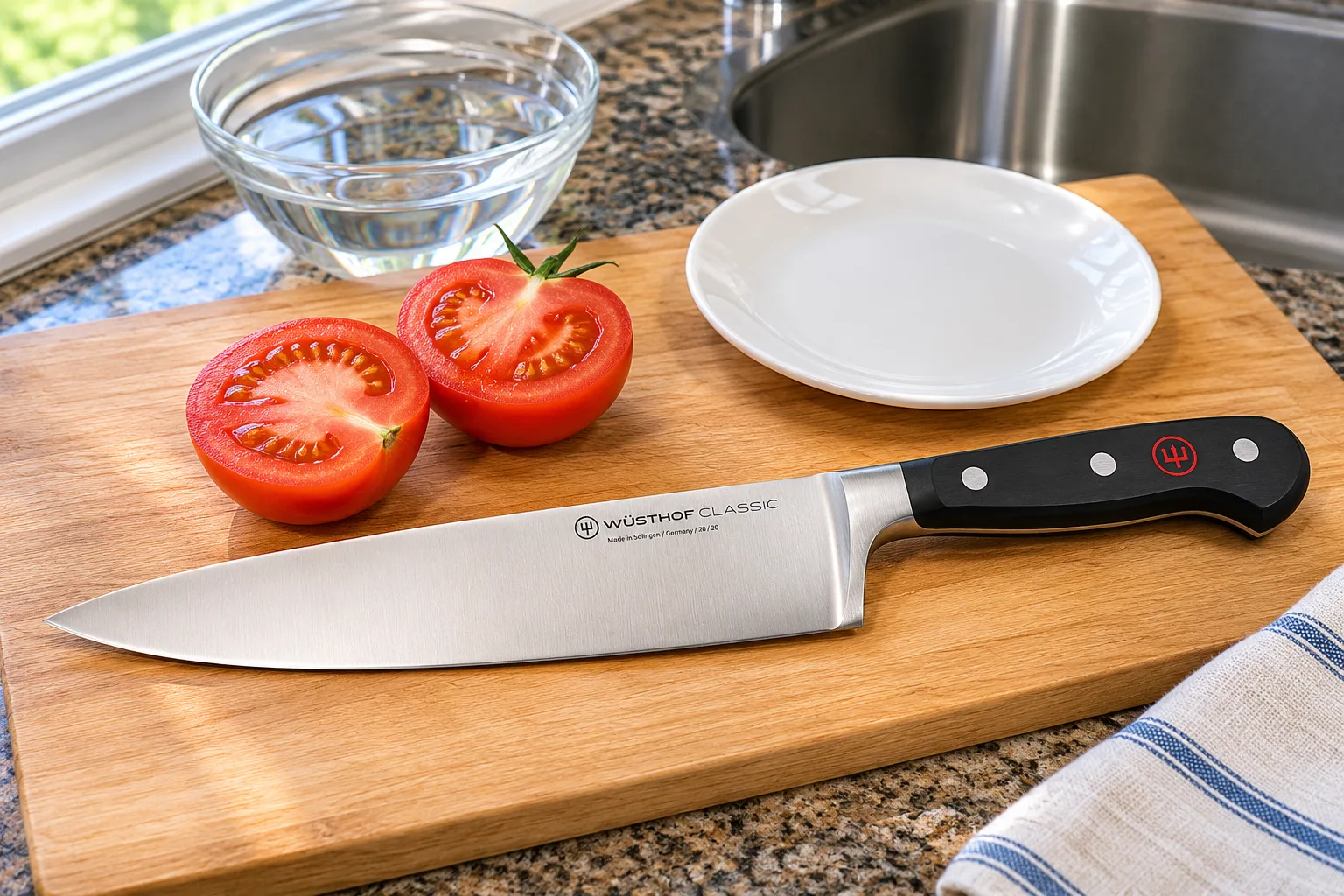
German knives commonly use X50CrMoV15 or a close cousin and push it a little harder in the heat treatment. Wüsthof lists its Classic 8-inch chef's knife at 58 HRC with a 14° per-side edge, and says its PEtec edge is 14.5° per side against "about 20" for competitors (Wüsthof). Zwilling lists its Signature chef's knife at 55 to 58 HRC, with its Friodur ice-hardening. Victorinox sells its Fibrox Pro as "high-carbon stainless" and doesn't publish a grade.
The trade-off shows up within a few dinners: the edge stays tough but rolls. That's why German knife owners hone. Our honing rod guide covers the stroke, and the Wüsthof and Zwilling angle pages give each maker's number.
VG-10 and Shun's VG-MAX
C about 1%rCr about 15%rCo about 1.5%rMo about 1%r60-61 HRCrSharpens: moderate
- Feels like
- Noticeably keener and stiffer than a German knife. Holds its bite longer; small chips if you twist or hit bone.
- Sharpen it on
- 1000, then 3000 to 6000. A ceramic rod for touch-ups, not a grooved steel.
- Care
- Hand wash and dry. Can pit if left wet in salt or acid.
- Good if
- You want your first Japanese knife and don't want to think about rust.
- Skip if
- You cut through chicken bones or let the kids use it on frozen food.
VG-10 comes from Takefu Special Steel in Japan. We couldn't find a Takefu data sheet online, so the numbers here come from dealer tables: about 1% carbon, 15% chromium, 1.5% cobalt, 1% molybdenum and a little vanadium, hardened to 60 to 61 HRC in most knives. The best maker-sourced figure: Miyabi lists its Kaizen VG10 line at 60 Rockwell with a 9.5 to 12° edge.
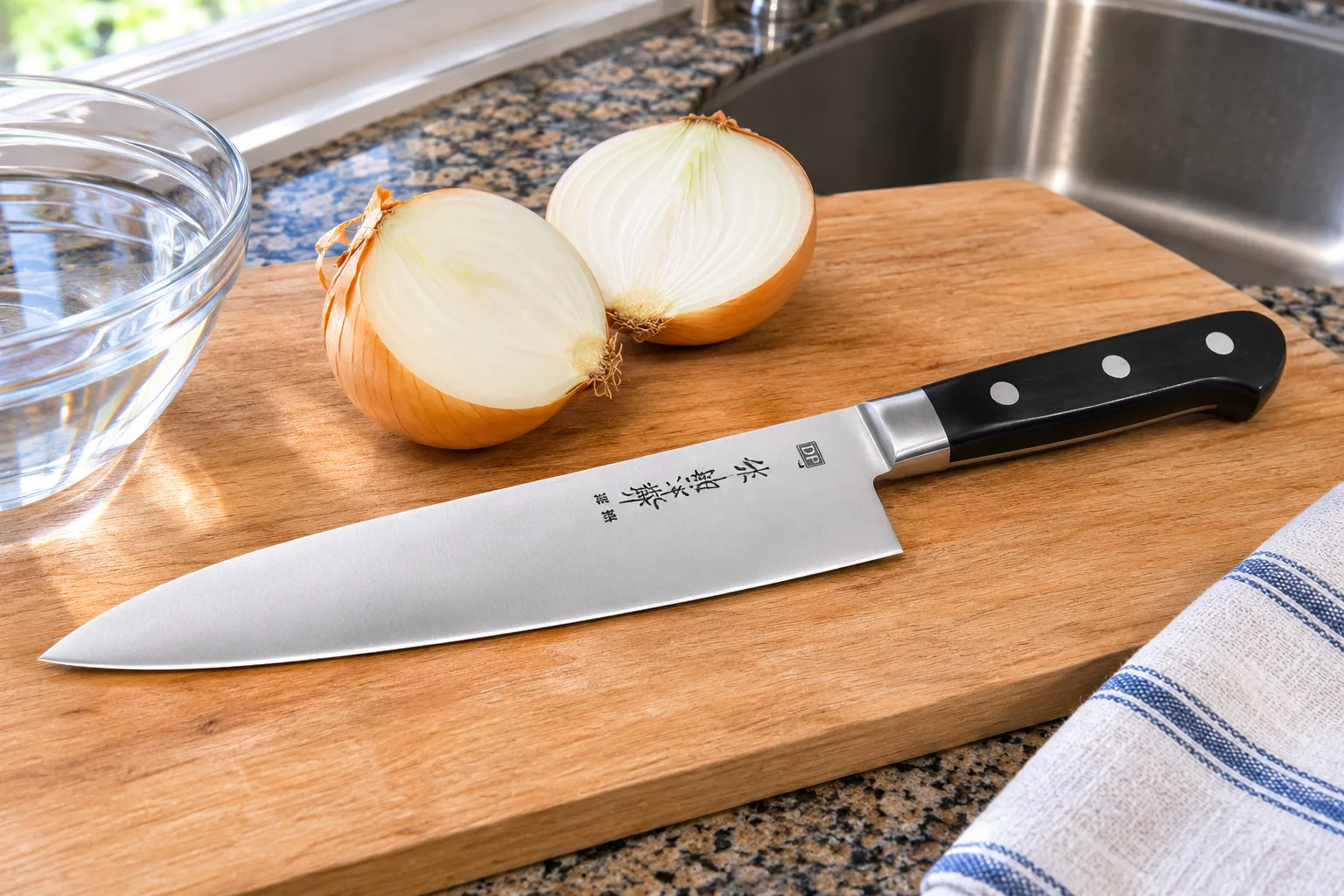
You'll find VG-10 as the core of the Tojiro DP (three layers, VG10 core, listed by retailers at 60 HRC) and the Miyabi Kaizen. Shun's Classic line uses VG-MAX, which Shun's blade steels page calls its own proprietary steel, "the newest in the line of VG super steels", with more carbon, more chromium, and added tungsten, molybdenum and vanadium than VG10. Shun publishes no numbers for it; retailers list the Classic at 60 to 61 HRC. Shun sharpens it to 16° per side at the factory (Shun FAQ). See the Shun and Miyabi angle pages.
Put the two side by side and the trade is simple. VG-10, hardened to 60 or more, will cut longer between sharpenings. X50CrMoV15, at 55 to 58, will forgive more mistakes: a twist, a bone, a rough honing. Which of those you'd rather have is the whole choice.
AUS-8 and AUS-10
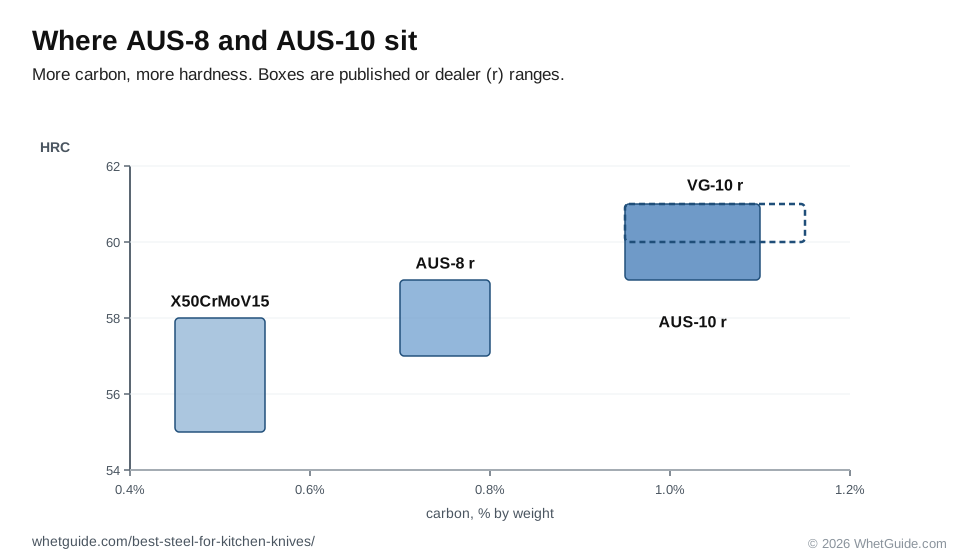
AUS-8: C 0.70-0.80%r, 57-59 HRCrAUS-10: C 0.95-1.10%r, 59-61 HRCrCr 13-14.5%rSharpens: easy (8), moderate (10)
- Feels like
- AUS-8: like a slightly harder German knife. AUS-10: close to VG-10.
- Sharpen it on
- 1000 then 3000 to 6000. AUS-8 also responds well to a honing steel.
- Care
- Easy stainless care.
- Good if
- You want a Japanese-style knife on a budget (AUS-8) or a VG-10 alternative (AUS-10).
- Skip if
- You want the longest edge life; both trail SG2 and the carbon steels.
Both come from Aichi Steel. Aichi's own blade steel page describes them only as increased-carbon grades with vanadium and molybdenum added for hardness and wear resistance. It publishes no numbers, so the figures above are dealer ranges, and those sources disagree a little.
The difference between them is mostly carbon. AUS-10 carries about a quarter of a percentage point more, so it hardens a couple of points higher, holds an edge longer and chips a little more easily. AUS-8 is softer and tougher, sharpens faster and takes a honing steel well. For a home kitchen, AUS-10 sits near VG-10; AUS-8 sits between German stainless and VG-10.
14C28N and AEB-L: the Swedish stainless steels
14C28N: C 0.62%, Cr 14.0%, N 0.11%55-62 HRC (mill range)AEB-L: C about 0.67%r, Cr about 13%r, 59-62 HRCrSharpens: easy
- Feels like
- A fine, keen edge that resists chipping better than most stainless steels at the same hardness.
- Sharpen it on
- Any good water stone. Raises a burr fast and takes a polish.
- Care
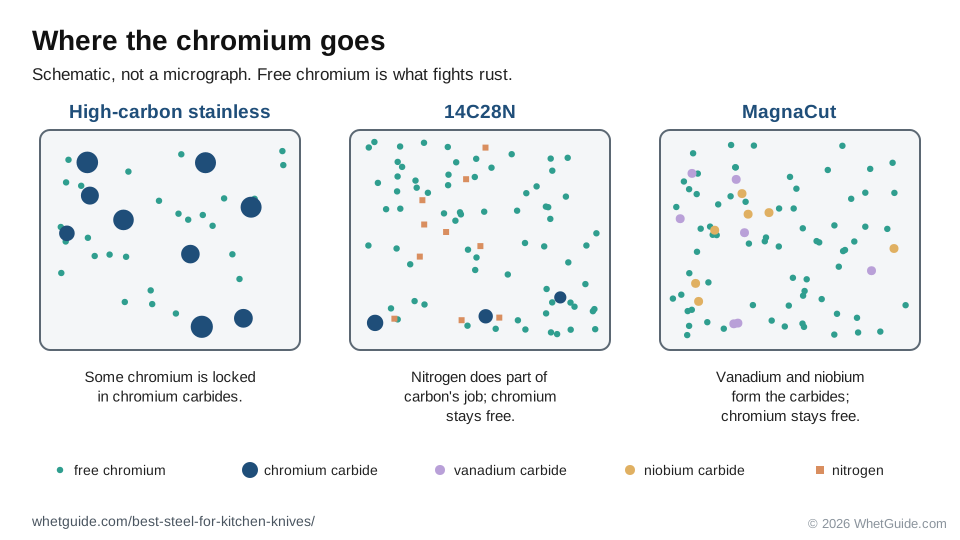
- Very forgiving; the nitrogen leaves more chromium free to resist rust.
- Good if
- You want a thin, hard knife that doesn't chip and doesn't rust.
- Skip if
- You need the longest possible edge life in abrasive cutting.
These are the best-documented steels on this page. Alleima (formerly part of Sandvik) publishes 14C28N's full chemistry on its product page: 0.62% carbon, 14.0% chromium, 0.11% nitrogen, a recommended 55 to 62 HRC, good edge stability against microchipping, folding and rolling, and easy re-sharpening. It names chef's knives as a use. The nitrogen is the trick: it adds hardness without tying up the chromium.
AEB-L was developed by Uddeholm as a razor-blade steel. Dealer sheets give about 0.67% carbon and about 13% chromium (sources disagree slightly), hardened to 59 to 62. Its carbides are small and few. Knife Steel Nerds puts AEB-L and 14C28N at the top of the "high toughness" stainless group, which is exactly what you want in a thin kitchen edge. Knife Informer's kitchen comparison sets AEB-L against VG-10: AEB-L rates tougher, VG-10 holds an edge longer. Sandvik's older 12C27 is a simpler cousin; an old guide called it "similar to S30V", which it isn't (S30V is a high-carbide powder steel).
440A, 440C, and budget 420 and 5Cr15MoV
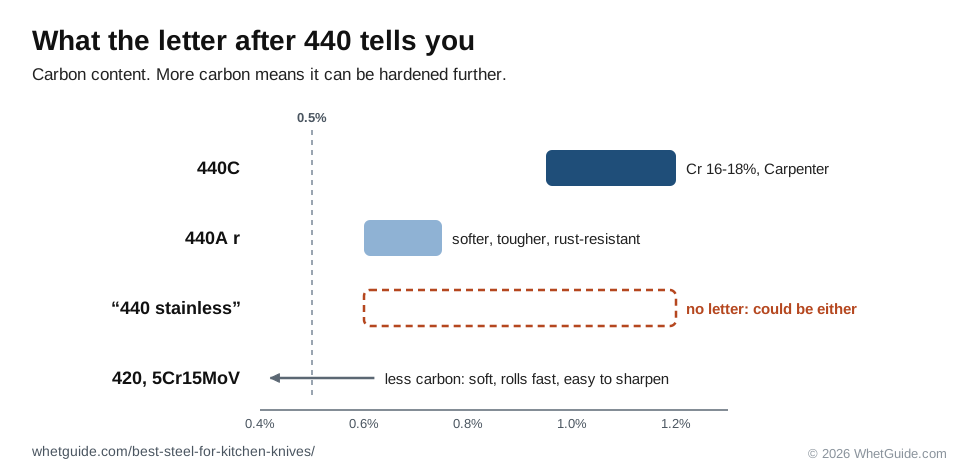
440C: C 0.95-1.20%, Cr 16-18%440A: C 0.60-0.75%r440C knives 58-60 HRCrSharpens: moderate
- Feels like
- 440C: decent edge life, very stain-resistant. 440A: softer and tougher.
- Sharpen it on
- 1000 then 3000. The chromium carbides make 440C a little slower than X50CrMoV15.
- Care
- Very easy.
- Good if
- You find a well-made knife at a fair price that names 440C.
- Skip if
- The listing just says "440 stainless" with no letter.
Carpenter's 440C sheet gives 0.95 to 1.20% carbon, and grade tables give 16 to 18% chromium: a lot of both. The extra chromium is why 440C stays bright. 440A has much less carbon (about 0.60 to 0.75%), leans toward rust resistance, and doesn't harden as far. In Knife Steel Nerds' lemon juice test, 440A barely lost any sharpness while 1095 carbon steel lost a lot.
Below these sit the budget stainless steels: the 420 family (420J and similar) and Chinese grades like 5Cr15MoV and 8Cr13MoV. They have less carbon, so they're softer, which is why cheap knives roll their edges fast and feel dull after a week. They're easy to sharpen and hard to rust. If a knife is cheap and doesn't name its steel, assume this class.
Shirogami (White 1, 2 and 3)
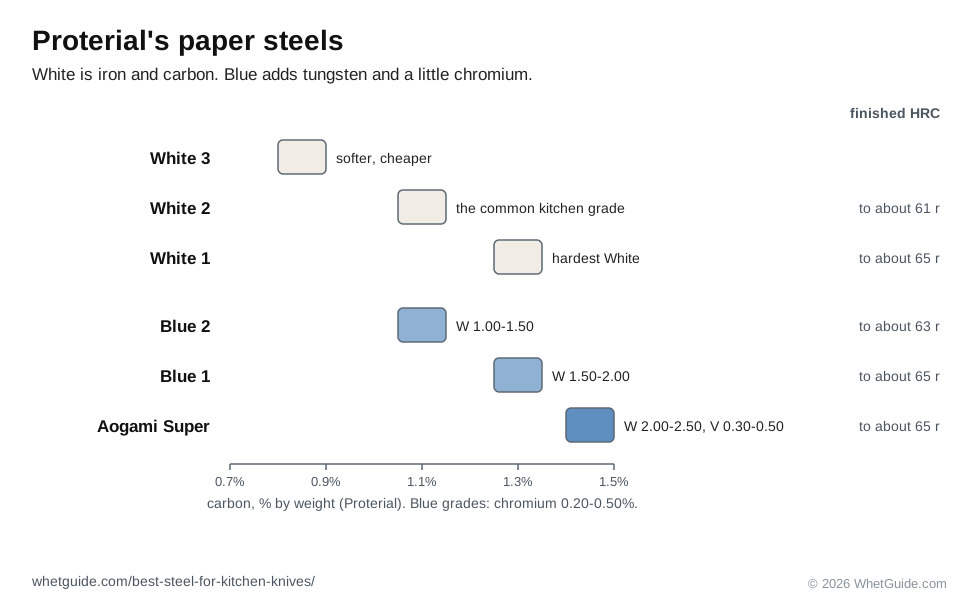
White 1: C 1.25-1.35%White 2: C 1.05-1.15%White 3: C 0.80-0.90%no chromium60+ HRC after hardeningSharpens: very easy
- Feels like
- The keenest edge on this page. Gets scary sharp on a fine stone and feels "grippy" on food.
- Sharpen it on
- 1000 then 4000 to 8000. Burrs come up in a few strokes, so go lightly.
- Care
- The most reactive steel here. Wipe between tasks, dry at once, oil for storage.
- Good if
- You sharpen your own and love doing it.
- Skip if
- Anyone else in the house will leave it in the sink.
Shirogami (white paper steel, named for the paper label the mill once wrapped it in) is Proterial's purest carbon steel. The mill's White 1, White 2 and White 3 pages list carbon of 1.25-1.35%, 1.05-1.15% and 0.80-0.90%, silicon 0.10-0.20%, manganese 0.20-0.30%, phosphorus no more than 0.025% and sulfur no more than 0.004%, and 60 HRC or over after hardening. Proterial lists chisels, razors, sickles and axes among White 2's uses.
More carbon means harder and a touch more brittle: White 1 is the hardest and the most demanding to heat-treat; White 2 is the common kitchen grade; White 3 is softer and cheaper. A dealer table puts finished knives at up to about 65 HRC for White 1 and about 61 for White 2. Dealers also say White steel patinas and rusts the most easily of the Japanese carbon steels, and that matches its chemistry: there's nothing in it but iron and carbon.
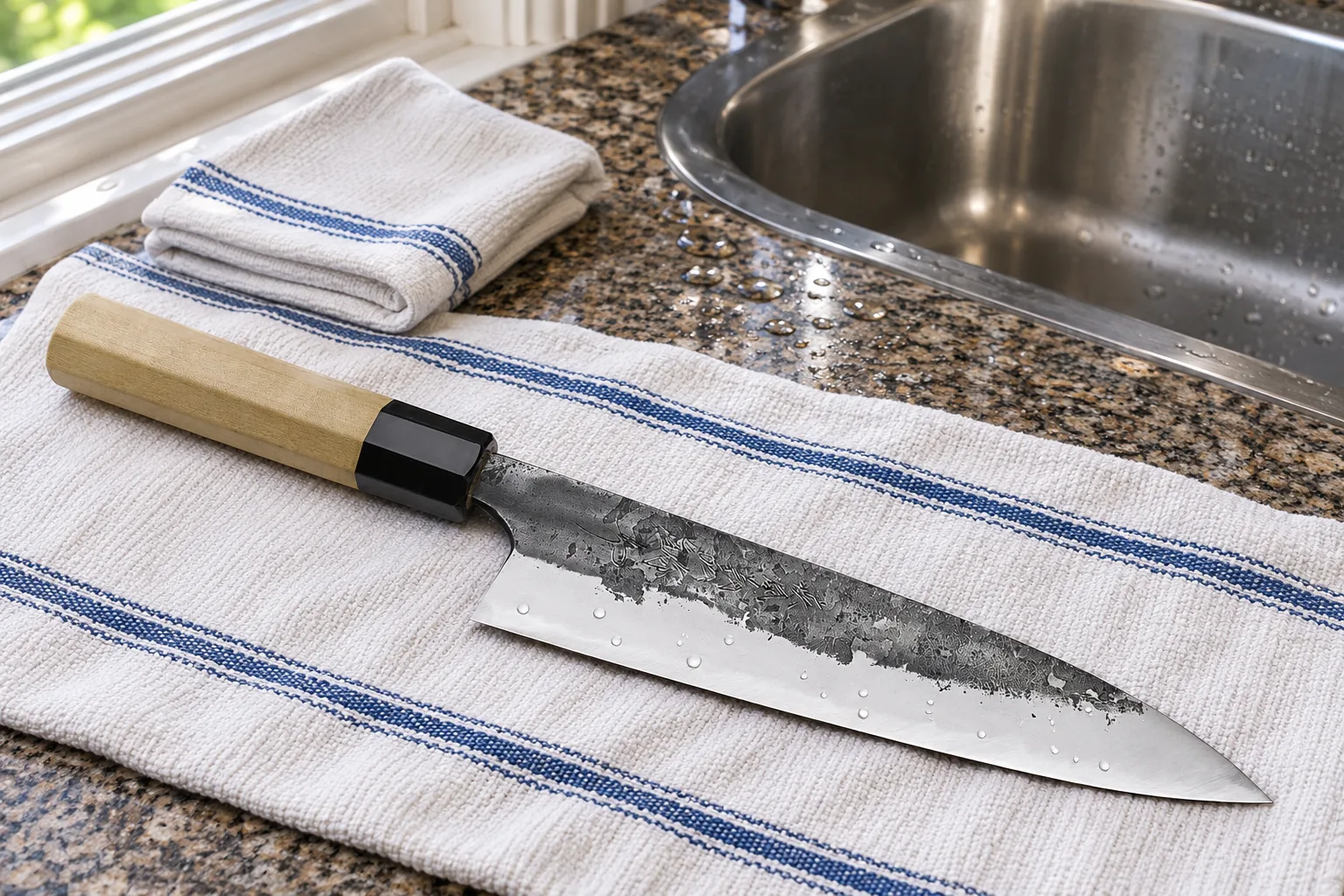
A Yoshihiro Nashiji White #2 gyuto is a typical example of the type. See it drying on a towel in the care section.
Aogami (Blue 1, Blue 2 and Aogami Super)
Blue 1: C 1.25-1.35%, W 1.50-2.00%Blue 2: C 1.05-1.15%, W 1.00-1.50%Super: C 1.40-1.50%, W 2.00-2.50%, V 0.30-0.50%Cr 0.20-0.50%60+ HRCSharpens: easy (Super: moderate)
- Feels like
- Nearly as keen as White steel and it holds the edge a little longer.
- Sharpen it on
- 1000 then 3000 to 6000. Super is a little slower on the coarse stone.
- Care
- Reactive, a bit less than White. Same routine: dry at once.
- Good if
- You want carbon steel's edge with a little more staying power.
- Skip if
- Rust spots would ruin your week.
Aogami (blue paper steel) is Shirogami with chromium and tungsten added. Proterial's pages for Blue 1, Blue 2 and Aogami Super give the figures in the card above and list kitchen knives as an application for Blue 2 and Super. The tungsten forms hard carbides that slow edge wear; Super adds vanadium for more of the same. Chromium stays under half a percent, so all three are firmly carbon steels.
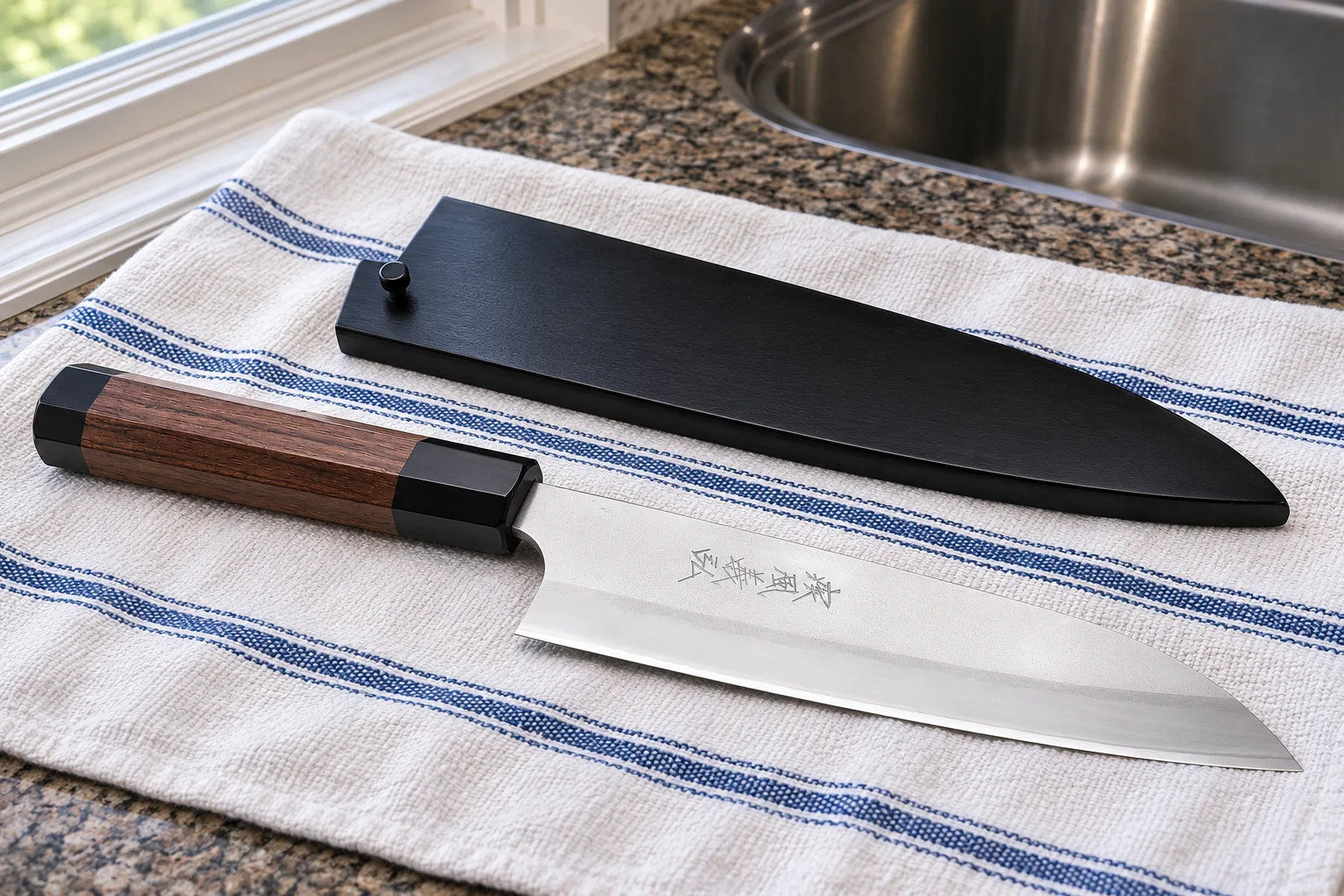
Most Aogami kitchen knives are clad: a carbon core with stainless sides (more in clad and damascus). That keeps rust to the edge, which is the part you wipe anyway. Examples include Yoshihiro's stainless-clad Blue #2 and Super Blue gyutos. Proterial also launched a newer blade steel, AIGAMI, in 2025, aimed at balancing sharpness and corrosion resistance (Proterial press release); it isn't widespread in kitchen knives yet.
52100: ball-bearing steel in a chef's knife
C 0.93-1.05%Cr about 1.45%61 HRC (Kramer Carbon 2.0)Sharpens: easy
- Feels like
- A carbon edge with more toughness than most Japanese carbon steels.
- Sharpen it on
- 1000 then 3000 to 6000; very responsive.
- Care
- Carbon steel care. It will rust.
- Good if
- You want carbon performance in a Western-shaped knife.
- Skip if
- You buy from a maker who doesn't publish the hardness; 52100 is very sensitive to heat treatment.
52100 is bearing steel. The aerospace standard AMS 6440 (SAE) titles it 1.45 Cr, 0.93-1.05 C. Zwilling's Kramer by Zwilling Carbon 2.0 chef's knife uses straight carbon 52100 at 61 HRC, finished by hand in Seki, Japan. Knife Steel Nerds calls well-treated 52100 good for general-purpose knives, and its toughness figures (about 23 to 28 ft-lbs treated well, 7 or below overheated) are the clearest case on this page for why heat treatment matters.
1055, 1075, 1095: the simple carbon steels
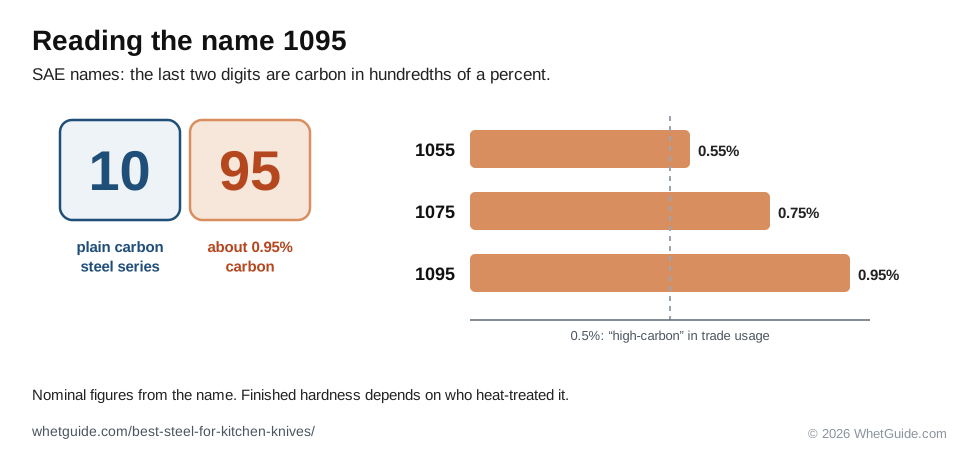
These are plain American carbon steels named under the SAE system, where the last two digits give the nominal carbon content in hundredths of a percent. They're cheap, tough and easy to forge, and they show up on cleavers, machetes, camp knives and many hand-forged kitchen knives. They're rare in factory chef's knives, which have mostly gone stainless.
The old Knife Planet guide gave 1095 a hardness of 56 HRC. That's a poor figure for a steel makers routinely harden well past that, and we don't repeat it; 1095's finished hardness depends entirely on who heat-treated it. What we can say with a source: in Knife Steel Nerds' lemon juice test, 1095 lost significant sharpness, so acid is hard on these edges. Care is the same as any carbon steel. If you're making a knife, these are the home bladesmith's steels (see outside the kitchen).
SG2 and R2: powder stainless at the top
C 1.25-1.45%rCr 14-16%rMo 2.3-3.3%rV 1.8-2.2%r62-64 HRC; Miyabi: 63Sharpens: slower
- Feels like
- Very hard, very keen, and it keeps going. Weeks between touch-ups for a home cook.
- Sharpen it on
- 1000 then 3000 to 6000; a diamond plate or a hard, fast-cutting stone saves time on repairs.
- Care
- Stainless care. Treat the thin edge gently.
- Good if
- You want the longest edge life and don't mind the price.
- Skip if
- You chop through bone, use glass boards, or want to learn sharpening on it.
SG2 (also sold as R2) is a powder stainless steel from Takefu. Dealer tables give 1.25-1.45% carbon, 14-16% chromium, 2.3-3.3% molybdenum and 1.8-2.2% vanadium, with knives usually at 62 to 64 HRC. The best maker figure: Miyabi lists its SG2 Birchwood line at 63 Rockwell. R2 is sold as the equivalent of SG2; treat the two names as the same family, not as a guarantee that two knives match.
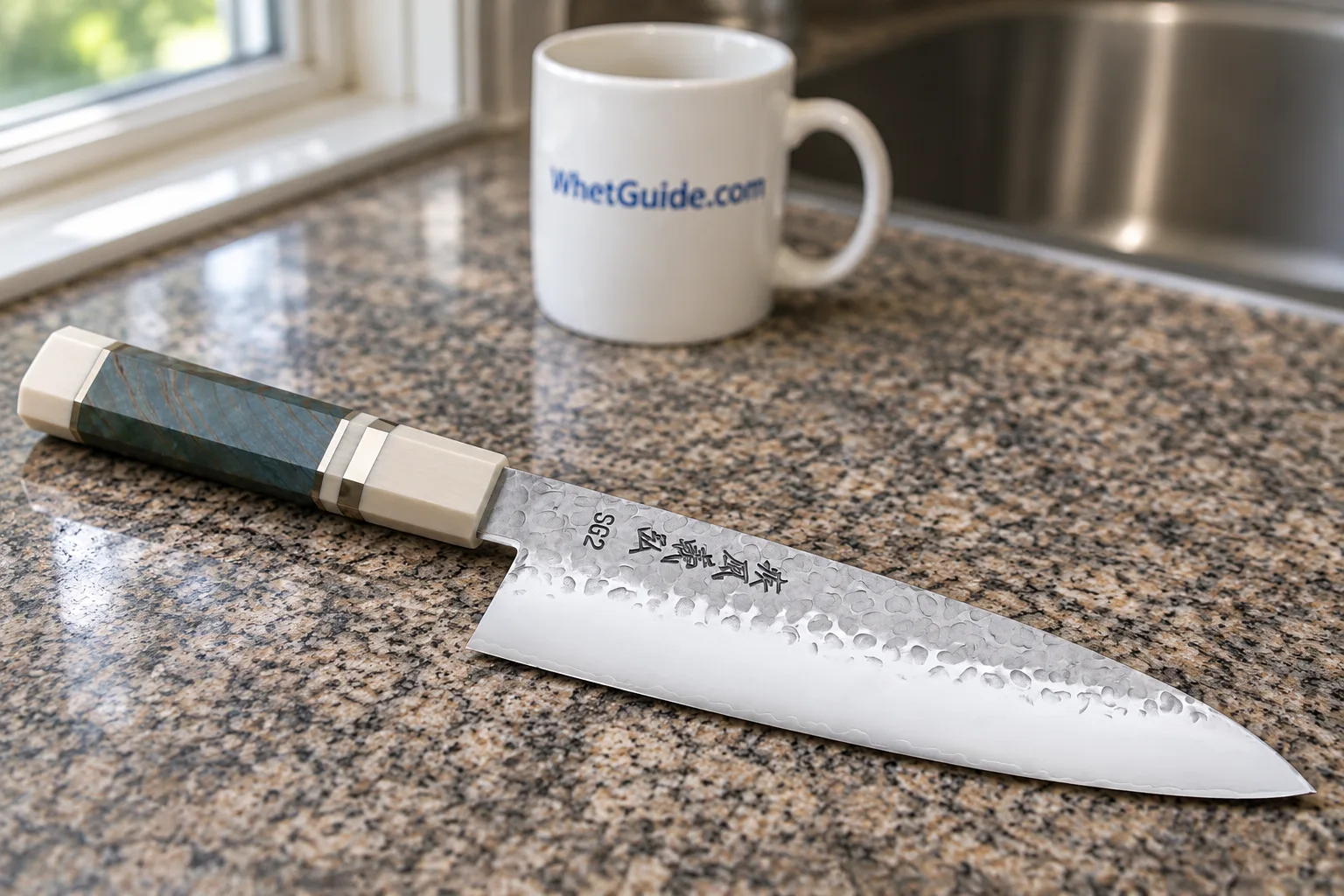
SG2 knives are almost always clad, often with a hammered or damascus finish, like the Yoshihiro hammered SG2 gyuto shown here. The hard core is thin and the edge angle is low, so the usual hard-steel rules apply: no twisting, no bones, no frozen food, no glass or stone boards.
Powder steels: what "PM" means, and MagnaCut
Ordinary steel is cast as a big ingot and cools slowly, so its carbides have time to clump into big chunks. Powder (PM) steel is made from fine powder pressed into a solid bar, which keeps the carbides small and evenly spread even in a very high-alloy recipe. That's how SG2 can carry over 1.25% carbon and plenty of vanadium and still take a fine edge. Crucible's steels carry "CPM" in the name for the same idea.
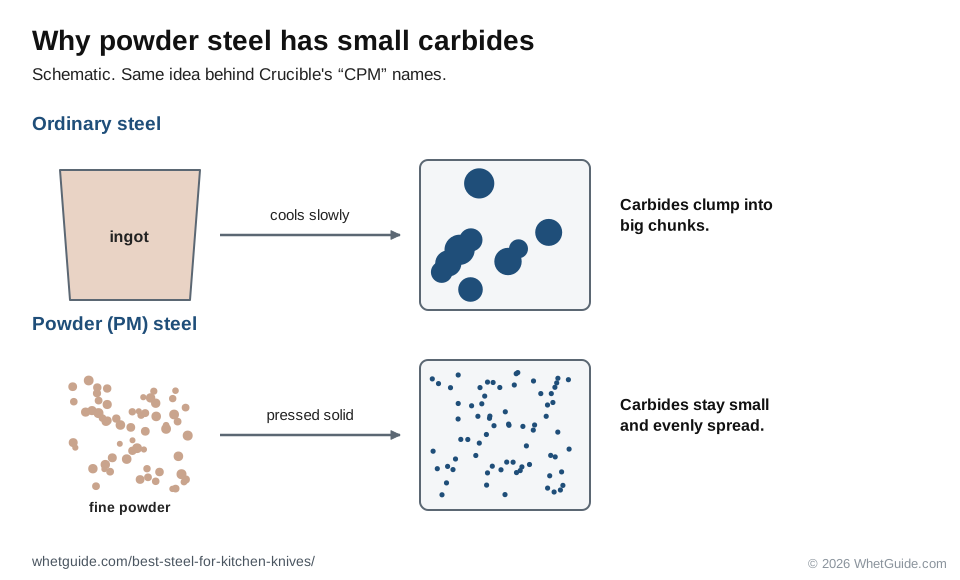
Most of the famous powder steels (S30V, S35VN, S90V, S110V, 10V, 20CV, M390, S125V and the CPM tool steels) were built for pocket knives, where edge life in cardboard and rope is the test. Nitro-V, a newer stainless that isn't a powder steel, lives mostly on pocket knives too. They're hard to sharpen and rarely make sense on a thin chef's knife. SG2, above, is one exception that shows up in kitchens. The other is newer:
MagnaCut
MagnaCut is a Crucible powder stainless designed by Larrin Thomas. The data sheet lists about 1.15% carbon, 10.7% chromium, 4.0% vanadium, 2.0% molybdenum, 2.0% niobium and 0.2% nitrogen, with an aim hardness of about 60 to 63; Thomas says anywhere between 59 and 64 can work. The trick is that the vanadium and niobium carbides don't steal chromium, so its 10.7% chromium goes further against rust than the number suggests. You'll mostly see it from custom makers. If you find a MagnaCut chef's knife from a maker who publishes the hardness, it's a strong all-rounder.
ZDP-189 and HAP40 are the other extreme; they're in other steels below.
Other names you'll see: Cromova 18, Ginsan, FC61 and more
| Name | What it is | What to know |
|---|---|---|
| Cromova 18 | Global's own stainless, about 0.8% carbonr | Global grinds its edges at 10 to 15° and advises a diamond or ceramic rod, not a grooved steel. See the Global angle page. |
| Ginsan (Silver 3) | Proterial's GIN 3: 0.95-1.10% carbon, 13-14.5% chromium, 59 HRC or over when hardened | Proterial calls it a stainless with hardness and sharpness comparable to carbon steel. Easy to sharpen, fine edge, few rust worries. |
| FC61 | The core steel of the Miyabi Kaizen II, which Zwilling describes as having fine carbide distribution; listed at 60-62 HRC | Sits with VG-10 and AUS-10 for most cooks. |
| VG-MAX | Shun's own steel, more carbon and alloy than VG10 | See VG-10. |
| ZDP-189 | Powder stainless, about 3% carbon and 20% chromiumr | Up to about 67 HRCr. Extreme edge life, slow to sharpen; a diamond plate helps. |
| HAP40 | Powder high-speed tool steel | Up to about 68 HRCr. Can spot; very slow on soft stones. |
| 154CM and ATS-34 | Older non-powder premium stainless steels (ATS-34 from Hitachi, now Proterial) | Mostly in custom and pocket knives; rare on chef's knives. |
| N690 | A Böhler stainless that the mill lists as 440C plus cobalt (1.4528) | Böhler sells it as a hand knife steel. Knife Steel Nerds rates its edge retention a little below D2's. |
| 12C27 | Alleima's simpler stainless | A tough, easy budget steel. Not a powder steel. |
| Cryodur, Friodur | Zwilling heat-treatment names, not steels | See heat treatment. |
| "Surgical", "German" or "Japanese" steel | Marketing words with no grade behind them | Look for the actual grade and HRC. |
Who makes the steel
Knife brands rarely make their own steel. A handful of mills supply most of it, and when one publishes a data sheet, that's the best source there is.
| Mill | Country | Kitchen knife steels | Publishes data? |
|---|---|---|---|
| Proterial (formerly Hitachi Metals), Yasugi Specialty Steel | Japan | Shirogami, Aogami, Aogami Super, Ginsan, AIGAMI | Yes, composition and hardening hardness per grade |
| Takefu Special Steel | Japan | VG-10, SG2 (R2) | Not in a form we could find online |
| Aichi Steel | Japan | AUS-8, AUS-10 | Description only, no numbers |
| Alleima (formerly part of Sandvik) | Sweden | 14C28N, 12C27 | Yes, full data sheets |
| Uddeholm | Sweden | AEB-L | Not found for AEB-L |
| Crucible | USA | MagnaCut, S30V and other CPM steels | Yes, through distributors' copies |
| Carpenter | USA | 440C | Yes |
| Several European mills | Europe | X50CrMoV15 / 1.4116 (a standard grade) | The grade itself is published |
Clad, san mai and damascus: what the layers do
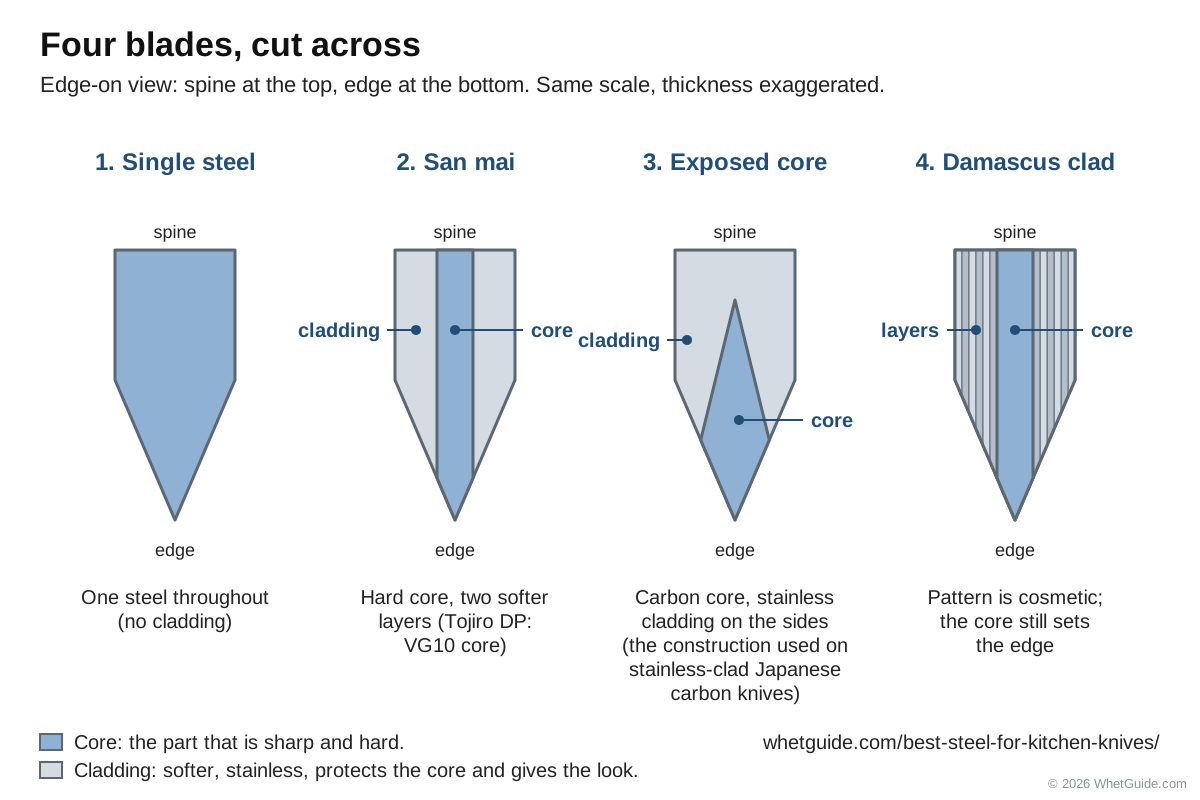
A lot of Japanese knives are made of more than one steel. A hard core that makes the edge is sandwiched between softer outer layers. Zwilling's production page describes its multi-layer blades as an ultra-hard core wrapped in at least two softer layers. Three layers is called san mai; the Tojiro DP is a three-layer knife with a VG10 core.
Why bother:
- The soft outer layers make a hard, brittle core safer to use and easier to grind during manufacture.
- Stainless cladding on a carbon core cuts rust down to the thin strip of core at the edge.
- The line where core meets cladding, and any damascus pattern, is a visual signature.
The name goes back to wootz, a crucible steel developed in southern India in the first millennium BC and traded to Damascus, where its blades became famous. Damascus today means a pattern-welded stack of two or more steels, etched so the layers show. The pattern by itself tells you nothing about edge life, toughness or hardness, as Blade HQ's steel guide says plainly. On a damascus kitchen knife, ask what the core is and what HRC it's hardened to; the layer count describes the cladding.
Two care notes for clad knives: a carbon core will still rust at the edge even when the sides are stainless, and once you've sharpened for years, the core line moves up the blade. Thinning or polishing the face can wear through a decorative pattern, so go easy with coarse stones on the sides.
↑ Back to all sectionsGerman vs Japanese steel
"Is Japanese or German steel better?" is really a question about two design philosophies. German knives use softer, tougher steel (55 to 58 HRC from the makers above) ground thicker, at a wider angle. Japanese knives use harder steel (60 HRC and up) ground thinner, at a narrower one. The makers' own edge angles show it:
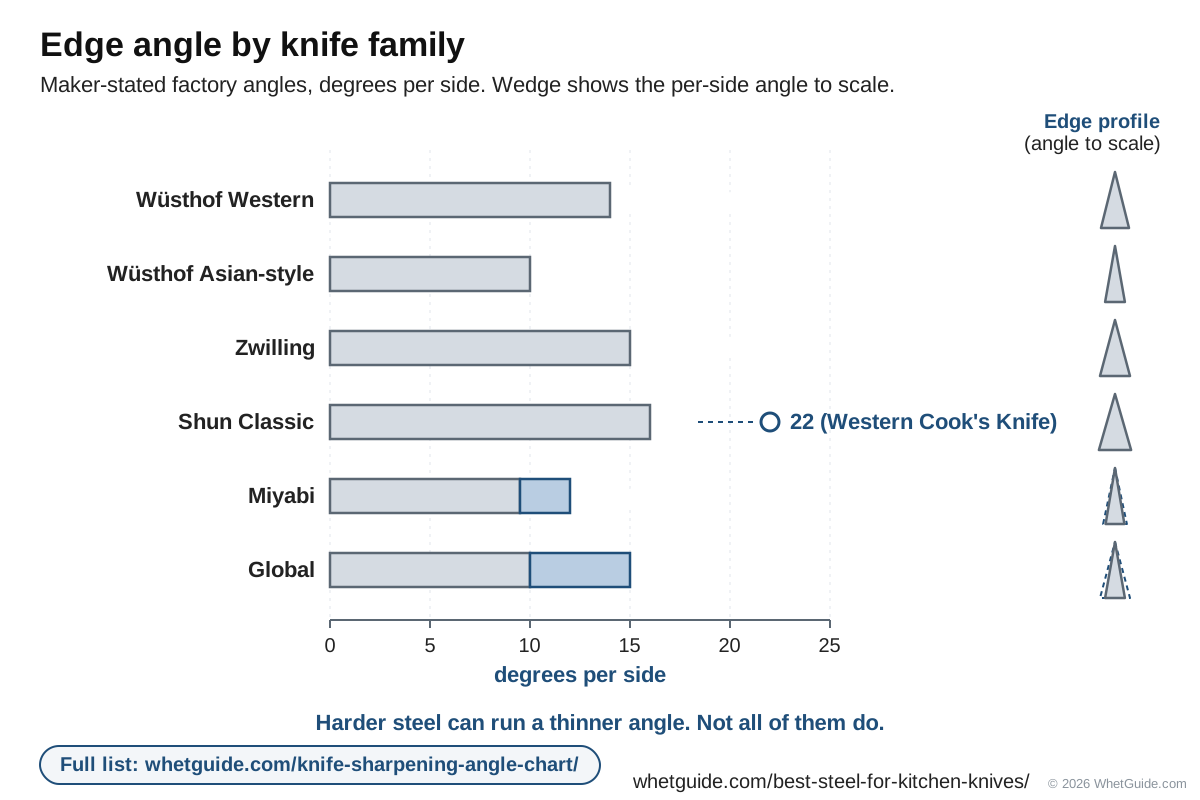
| Maker | Edge angle per side | Source |
|---|---|---|
| Wüsthof (Western knives) | 14° (PEtec: 14.5°) | Wüsthof |
| Wüsthof (Asian-style santoku, nakiri) | 10° | Wüsthof |
| Zwilling | about 15°; 9 to 12° for Miyabi, Kramer and santoku | Zwilling |
| Shun Classic | 16° (Western cook's knife: 22°) | Shun |
| Miyabi | 9.5 to 12° | Miyabi |
| Global | 10 to 15° | Global |
So which is better? For a cook who hacks through chicken, uses the knife to scrape the board and puts it in a drawer with the whisk, German. It rolls, you hone it, it comes back. For a cook who slices more than chops, uses a wood board and wants the knife to fall through an onion, Japanese. It stays sharp longer and cuts with less effort, and a chip is the price of carelessness.
The lines have blurred. Wüsthof now grinds its Western knives at 14°, close to Shun's 16°, and Zwilling's Kramer Carbon 2.0 is finished by hand in Seki, Japan. Shun even sells a Western cook's knife at 22°. Judge each knife by its own spec sheet. Brand-by-brand angles: Wüsthof, Zwilling, Shun, Miyabi, Global and Victorinox.
↑ Back to all sectionsHeat treatment and geometry matter as much as the name
Two knives in the same steel can cut nothing alike. Dikristo lists four things that decide how a kitchen knife performs: the steel, the heat treatment, the geometry, and the looks (which you're paying for whether you like it or not). In order of how much you'll feel them:
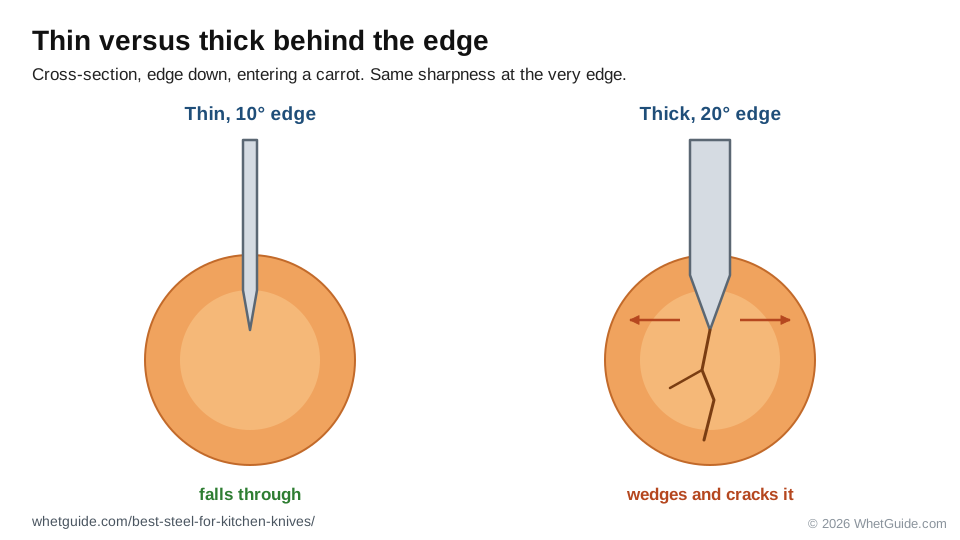
- Thickness behind the edge. A thin blade falls through a carrot; a thick one wedges and cracks it, however sharp. This is mostly why Japanese knives "feel sharper".
- Edge angle. A 10° edge cuts with less force than a 20° one, and needs harder steel to survive.
- Heat treatment. The 52100 example above: same steel, a quarter to a third of the toughness when overheated.
- The steel itself. It sets the ceiling. The other three decide whether you ever get near it.
Similar grades aren't identical knives either. SG2 and R2 are sold as equivalents; X50CrMoV15 shows up at 55 and at 58 HRC depending on the maker. Knife Informer makes the same point under the heading "Similar Grades Are Not Identical Knives". The steel name is a starting point. The maker's HRC and the blade's thickness finish the picture.
The rest of the knife decides how it feels in the hand: a full tang, the balance point and the handle shape. Weight and length do too. None of that changes the edge, though. Pick the shape you like holding, then let the steel and its hardness tell you how long the edge will last. Our guide to choosing a chef's knife covers the fit and feel side.
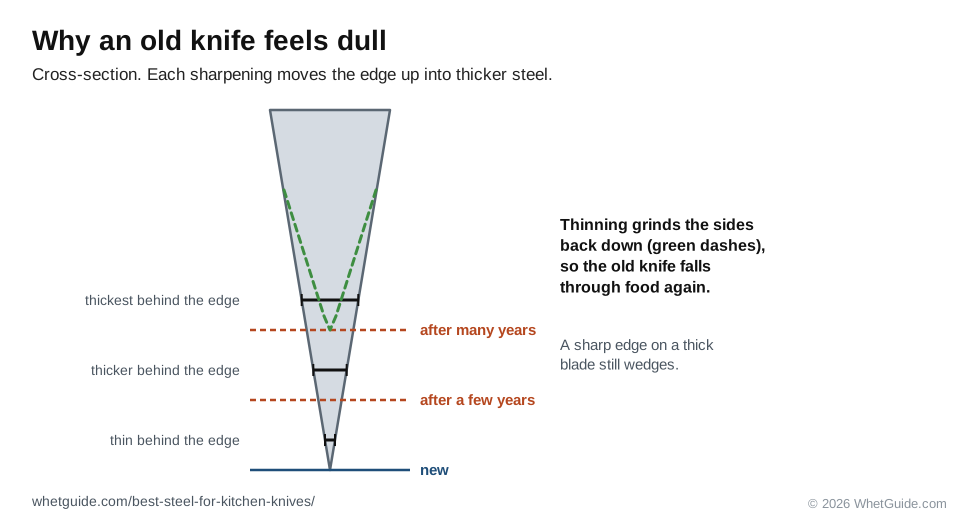
One more geometry note. Every sharpening moves the edge up into thicker steel, so after a few years even a great steel feels dull because the blade has gotten thick behind the edge. That's a thinning job, covered in our whetstone guide.
Which stone and what angle for each steel
Knife steel vs honing steel. "Knife steel" on this page means the metal the blade is made of. A "honing steel" (or "sharpening steel") is the rod you swipe the knife on to straighten a rolled edge. Lists of "best knife steels" are sometimes lists of honing rods. For those, see the best honing rods and ceramic vs steel honing rods.
Every steel on this page sharpens on ordinary water stones. What changes is how long it takes, how fine a finish is worth it, and what you touch it up with between sharpenings.
| Steel group | Main stone | Finish | Between sharpenings | Angle |
|---|---|---|---|---|
| German stainless (X50CrMoV15, 1.4116), 440, budget stainless | 1000 | 3000 to 6000; higher is wasted on soft steel | Steel or ceramic honing rod | Maker's: Wüsthof 14°, Zwilling about 15° |
| Japanese stainless (VG-10, VG-MAX, AUS-10, Ginsan) | 1000 | 3000 to 6000 | Ceramic rod or a strop | Shun 16°, Miyabi 9.5-12°, Global 10-15° |
| Swedish stainless (14C28N, AEB-L) | 1000 | 4000 to 8000; takes a fine polish | Strop or ceramic rod | Maker's angle |
| Japanese carbon (Shirogami, Aogami), 52100 | 1000, light pressure | 4000 to 8000 | Strop; a fine stone | Maker's angle |
| Powder steels (SG2, MagnaCut, ZDP-189, HAP40) | 1000 (a fast-cutting stone) | 3000 to 6000 | Strop | Maker's angle |
| Chipped edges on any hard steel | Coarse 220 to 400, or a diamond plate | Then the normal steps | n/a | Same as before |
Our how to use a whetstone guide covers the full method, the grit chart explains the numbers, and the grit progression chart lays out sequences by knife. For the hardest steels, a diamond plate speeds up repairs; whetstone vs diamond stone explains when it's worth it.
First sharpening of a hard Japanese knife, step by step
- Find the maker's angle. Shun is 16°, Miyabi 9.5 to 12°, Global 10 to 15°; the angle chart has the rest.
- Color the bevel with a marker and take two light strokes on a 1000 stone. Adjust until the ink comes off evenly from shoulder to edge.
- Sharpen one side with moderate pressure until you feel a burr along the whole edge. Hard steel makes a small, stiff burr; feel for it carefully across the edge, never along it.
- Repeat on the other side. Count your strokes and match them.
- Drop the pressure by half, then again, alternating sides with fewer strokes each time.
- Move to the 3000 to 6000 stone with light pressure only.
- Finish with a few feather-light trailing strokes or a strop. Check the burr is gone, then test on paper.
What you'll feel: on hard steel the stone sounds higher and feels glassier; on soft German steel it's quieter and grabs more. If the stone feels like it's skating and nothing is happening after a few minutes, it's either too fine for the job or it needs flattening.
Honing rods by steel
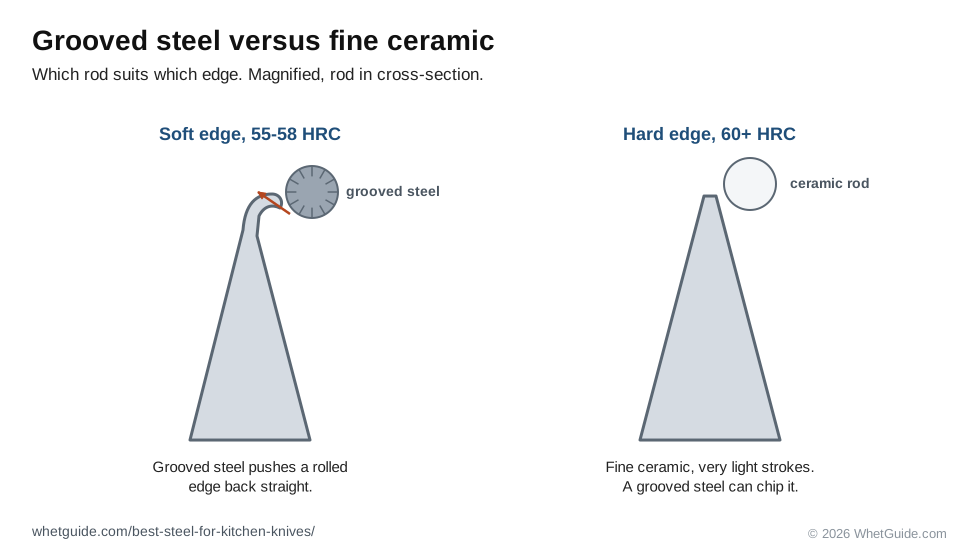
A grooved steel rod straightens a rolled edge, and that suits soft German knives. Victorinox says to hold the knife at 20° to the steel (Victorinox). Hard Japanese edges don't roll much; they chip, and a grooved steel can make that worse. Global advises a diamond or ceramic rod on its knives. For hard steel, use a fine ceramic rod with very light strokes, or a strop. Details in how to use a honing rod and honing rod vs whetstone. Ceramic blades are a different material altogether and need diamond; see how to sharpen a ceramic knife.
↑ Back to all sectionsCare by steel
All kitchen knives want the same basics: hand wash, dry, store the edge so it doesn't hit other metal. The differences by steel are about how fast things go wrong.
| Steel | Every use | Storage | Watch for |
|---|---|---|---|
| German and budget stainless | Hand wash, dry | Block, magnetic strip or edge guard | Rolled edges (hone them); dishwasher dulling and spotting |
| Japanese stainless and powder steels | Hand wash, dry; no twisting cuts | Same; never loose in a drawer | Small chips; pitting if left wet with salt or acid |
| Carbon steel | Wipe between tasks, wash, dry at once | Dry; a thin film of food-safe oil if stored for days | Orange rust spots, especially at the edge and near the handle |
| Clad carbon (stainless sides) | Treat as carbon steel | Same as carbon | Rust on the exposed core line |
Breaking in a carbon knife: how to start a patina
- Wash off any factory oil or lacquer with hot water and dish soap, then dry fully.
- Use the knife on ordinary food. Onions, potatoes and meat start a patina on their own within a few uses.
- Expect gray and blue-gray patches, sometimes a rainbow sheen. That's patina, an oxide film, and it's fine.
- Wipe the blade on a damp towel between ingredients, especially after acidic ones like citrus and tomatoes.
- Dry it after every session and before you walk away from the board.
- If you see orange, that's rust. Rub it off with a cork and a little baking soda or a fine abrasive, rinse, dry. The patina around it stays.
Some cooks force a patina with mustard or vinegar for an even color. Optional; a natural patina from use is just as protective.
Safety notes
- Never try to catch a falling knife. Step back and let it drop.
- Hard, thin edges aren't for bones, frozen food, or prying apart frozen burgers. Use a cleaver or a softer knife for those.
- Glass, stone and ceramic boards chip hard edges and dull every edge. Wood or plastic only.
- Dry a knife spine-first with the towel folded over it, and never leave one in a sink of soapy water where someone can reach in.
- Carbon steel is safe for food. A fresh blade can leave gray marks on onions and apples and a metallic taste on acidic food until it patinas; that fades with use.
Mistakes that ruin good steel, and the fixes
| Mistake | What happens | Fix |
|---|---|---|
| Dishwasher | Edges knock into racks and dull; stainless spots and pits; handles crack | Hand wash. Always. |
| Twisting a hard knife in squash or a stuck cut | Chips in the edge | Push straight through. Use a heavier knife on hard squash. Small chips come out on a coarse stone. |
| Grooved honing steel on 60+ HRC knives | Micro-chips, a ragged edge | Ceramic rod or strop, very light strokes |
| Leaving carbon steel wet | Orange rust, pitting at the edge | Dry at once. Remove light rust with a cork and baking soda. |
| Pull-through sharpener on a thin Japanese knife | Wrong angle, chipped or wavy edge | Stones at the maker's angle. See sharpeners for Japanese knives. |
| Sharpening a soft knife at a Japanese angle | Edge rolls almost at once | Stay at the maker's angle; soft steel needs a wider one. |
| Loose in a drawer | Dings and chips, and cut fingers | Block, strip, or a blade guard |
How often to sharpen depends on the steel and how much you cook, not on a calendar. Victorinox suggests sharpening its knives once or twice a year with honing in between; hard Japanese steels can go longer between sessions. Our how often to sharpen knives guide has the signs to watch for.
↑ Back to all sectionsWhich steel for which cook
The right steel is the one that suits how you cook and how much fuss you'll put up with. Dikristo frames the choice as five questions. Answer them honestly and the steel picks itself:
- What do you cut most?Bones, squash, frozen things: German stainless. Vegetables, fish, boneless meat: anything here.
- Edge life or easy sharpening?Edge life: SG2, VG-10, Aogami Super. Easy sharpening: 14C28N, Shirogami, X50CrMoV15.
- Who sharpens it?Nobody, or a pull-through: German stainless. You, on stones: anything, and carbon will reward you.
- How much rust can you tolerate?None: 14C28N, 440C, MagnaCut, X50CrMoV15. Some, for a better edge: Aogami, Shirogami, 52100.
- How rough are you with it?Rough: stay in the factory band, about 55 to 60 HRC. Careful: the handmade band, about 60 to 65, is open to you.
| You are | Steel to look for | Why |
|---|---|---|
| A beginner, or buying your first good knife | X50CrMoV15-class German stainless, or 14C28N | Forgiving, easy to sharpen, no rust worries. Learn to sharpen on it. |
| A busy household where others use the knives | German stainless; Victorinox-type stamped stainless | Survives the sink, the dishwasher accident and the frozen bagel |
| A hobby cook who sharpens on stones | Aogami 2 or Shirogami 2 clad; or SG2 | The best edge on the stone; carbon if you'll dry it, SG2 if you won't |
| A professional line cook | VG-10, AUS-10 or a German workhorse | Stainless that holds up through a shift and is cheap to replace |
| In a humid or coastal kitchen | 440C, 14C28N, MagnaCut | Lots of chromium (440C), or chromium kept free of carbides (nitrogen in 14C28N; vanadium and niobium in MagnaCut) |
| Cooking at camp or on a boat | 14C28N, MagnaCut | Tough and stainless; see outside the kitchen |
| Buying a gift | VG-10 or SG2 with a published HRC; stainless | Impressive edge, no surprise rust for the recipient |
On budget: past the point where a maker names the steel and publishes its hardness, more money mostly buys finish, handle, cladding and looks. A plain stainless knife with a known steel at a known HRC beats a pricier one that tells you neither. Steel does explain part of the gap at the top end: powder steels like SG2 and MagnaCut are costlier to make, and Knife Steel Nerds notes that powder metallurgy steels are much more expensive than a conventional steel like D2.
↑ Back to all sectionsMyths this page corrects
Stainless steel never rusts.
It resists rust. Left wet with salt or acid, or run through a dishwasher, it can spot and pit.
Higher HRC is always better.
Harder holds an edge longer and chips more easily. Dikristo's example: 62 can beat 64.
Ceramic knives never need sharpening.
They dull more slowly, chip readily, and need diamond to sharpen. See ceramic knives.
Carbon steel is unsafe with food.
It's safe. It can discolor some food and taste metallic on acids until a patina forms.
Damascus is a better steel.
Damascus is a pattern. The core steel and its hardness decide the edge.
Tensile strength is one of the three steel qualities.
Cooks feel edge retention, toughness, rust resistance and ease of sharpening.
"Krupp 4116" is a trade secret.
1.4116 / X50CrMoV15 is a published grade.
Sandvik 12C27 is similar to S30V.
12C27 is a simple, fine-carbide stainless. S30V is a high-carbide powder steel.
A honing steel sharpens the knife.
It straightens a rolled edge. Only an abrasive sharpens. See honing rod vs whetstone.
If you're shopping for pocket, hunting or camp knives
Outdoor knives get judged differently. They cut cardboard, rope and hide, they pry, and they get rained on, so toughness and rust resistance count for more and a 10° edge counts for less. Knife Informer's list of favorite steels names MagnaCut as its balanced everyday pick and 14C28N as its budget stainless, and both also work in a kitchen.
- Tool steels like CPM 3V and M4 are very tough or very wear-resistant, and either way slow to sharpen. Great in hard-use outdoor knives, rarely worth it in a chef's knife.
- D2 is a tool steel with a lot of chromium, but much of it is locked in carbides, so it's often called semi-stainless. It holds an edge well, takes a coarse edge better than a fine one, and will spot.
- 1095 and SK-5 are simple carbon steels on many outdoor and machete-style blades: tough, easy to sharpen, prone to rust.
For sharpening those, see how to sharpen a pocket knife and how to sharpen a hunting knife.
If you're making a knife yourself, the home bladesmith's usual steels are 1080, 1084, 1095 and 15N20, all simple carbon steels that forgive a backyard heat treatment, plus 5160 spring steel for big choppers (see 5160 vs 1084 in the FAQ). Knife Steel Nerds is the place to read about heat-treating them. Some common maker questions have short answers: 304 and 316 stainless can't be hardened into a blade by heat treatment; 1018 doesn't have enough carbon to harden; rebar and leaf springs are unknown alloys, so you're guessing at the heat treatment; and hot- or cold-rolled only describes how the bar was made, not what's in it.
↑ Back to all sectionsQuestions people ask about kitchen knife steel
What kind of steel is best for chef knives?
For most cooks, a stainless steel: German X50CrMoV15 if you want toughness and easy care, Japanese VG-10, AUS-10 or 14C28N for a harder, thinner edge. Carbon steels like Aogami and Shirogami give the keenest edge if you'll dry the knife every time. See the quick answer.
Does steel type matter for home cooks?
Less than the knife's thickness and how it's sharpened. A thin knife in an ordinary stainless steel, kept sharp, beats a thick knife in a premium steel kept dull. Steel decides how long the edge lasts and how much care the blade needs.
What are the key differences between carbon steel and stainless steel?
Chromium. Stainless has 10.5% or more, which forms a protective surface film. Carbon steel has little or none, so it rusts and patinas, but it usually sharpens faster and takes a finer edge. The full table is under carbon vs stainless.
Are stainless steel knives better?
For most kitchens, yes, because they forgive a wet sink. Carbon steel is better on the stone and for edge keenness. Neither is better at everything.
Is carbon steel superior to stainless?
No. It's a different trade: an easier, keener edge in exchange for constant drying. Many enthusiasts own both.
Do chefs prefer carbon steel or stainless steel knives?
Most professional kitchens run on stainless, because nobody on a line has time to dry a knife after every task. Cooks who sharpen their own often keep a carbon knife too.
What do professional chefs use for knives?
Mostly stainless chef's knives, German or Japanese, that they can sharpen themselves and replace without pain. Steel brand matters less to them than weight, balance and how thin the blade is.
What does Gordon Ramsay use for knives?
Celebrity endorsements change, so any brand answer goes stale fast. On the steel question, TV chefs use the same stainless German and Japanese knives the rest of the industry does.
Is Japanese or German steel better?
Japanese steel is harder and ground thinner; it cuts more easily and holds an edge longer, and it chips if mistreated. German steel is softer and tougher; it rolls and needs honing, but forgives rough use. See German vs Japanese.
Is Zwilling or Wüsthof better?
On steel, they're close. Both use German-style stainless: Wüsthof lists its Classic at 58 HRC and 14° per side; Zwilling lists its Signature at 55 to 58 HRC and sharpens at about 15°. Pick by handle feel and weight.
What is X50CrMoV15?
A German stainless knife steel: 0.45-0.55% carbon, 14-15% chromium, plus molybdenum and vanadium. Its material number is 1.4116. It's the classic steel of German kitchen knives. More under X50CrMoV15.
What are the differences between AUS-10 and AUS-8?
Carbon. AUS-10 has about 0.95-1.10%, AUS-8 about 0.70-0.80% (dealer figures; Aichi doesn't publish numbers). AUS-10 hardens to about 59-61 HRC and holds an edge longer; AUS-8 sits around 57-59, is tougher and sharpens faster.
What is SG2 or R2, and is it better than VG-10?
A powder stainless steel from Takefu, hardened to about 62-64 HRC (Miyabi lists 63). It holds an edge longer than VG-10 and takes a little longer to sharpen. R2 is sold as the equivalent of SG2.
Is ZDP-189 good for kitchen knives compared with VG-10?
For a skilled sharpener who wants the longest possible edge, yes. Dealers list it up to about 67 HRC with about 3% carbon. It's slower to sharpen and less forgiving of chips than VG-10, which is the better everyday choice.
Is Swedish steel good for kitchen knives?
Yes. 14C28N and AEB-L are fine-grained stainless steels that take a keen edge, resist chipping and sharpen easily. Alleima recommends 14C28N at 55 to 62 HRC and names chef's knives as a use.
Is 440 steel better than D2?
For a kitchen knife, 440C usually is: it's more stain-resistant and takes a finer edge. D2 is a tool steel that holds a coarse edge longer but spots more. "440" with no letter can mean the softer 440A, which is a different story.
What steel is better, 1095 or D2?
Different jobs. 1095 is a simple carbon steel: tough, easy to sharpen, rusts. D2 is semi-stainless and holds an edge longer, but is harder to sharpen. Neither is common on a chef's knife; see outside the kitchen.
Is D2 still hard to sharpen?
Harder than most kitchen steels, easier than the high-vanadium powder steels. D2 has about 12% chromium, but Knife Steel Nerds explains that its high carbon ties much of that up as chromium carbide, and its carbides are large. On the same site's carbide ladder, chromium carbides sit in the middle: harder than the iron carbide in simple carbon steels, softer than the vanadium and niobium carbides in MagnaCut. Going by that ladder, expect D2 to take longer than 1095, 14C28N or X50CrMoV15 to raise a burr on an ordinary stone, and the big carbides make a very thin, fine edge hard to keep; Knife Steel Nerds says they limit its edge stability. Use light pressure, and a diamond plate saves time. Powder versions such as CPM-D2 have smaller carbides.
Which is tougher, 1095 or MagnaCut?
MagnaCut, on what's published. We found no lab toughness test of the two by the same method, so there's no fair number to quote. In Knife Steel Nerds' toughness ranking of forging steels, 1095, with its high carbon in solution, had relatively poor toughness despite only a small amount of carbide. MagnaCut's data sheet calls it very resistant to chipping and breaking, with toughness similar to CPM 4V, a non-stainless tool steel. MagnaCut is stainless as well; 1095 rusts. For both, the heat treatment sets the final toughness, as the 52100 example shows.
Which steel is better for knife making, 5160 or 1084?
5160 for big, hard-used blades like choppers and machetes; 1084 for a simple, very tough carbon steel in smaller knives. 1084 is a plain carbon steel with 0.80 to 0.93% carbon under the SAE/AISI grade tables. 5160 is a chromium spring steel with less carbon, 0.56 to 0.64%, and 0.70 to 0.90% chromium. In Knife Steel Nerds' toughness ranking of forging steels, 1084 had very good toughness for its carbon content, and 5160 combined decent hardness (58 to 60 HRC) with very high toughness. The same site's rule of thumb is that more carbon tends to mean more edge retention and less toughness, which would give 1084 a small edge-life lead. It names 5160 a good choice for large knives that need very high toughness. Neither is stainless, so both need carbon-steel care.
Is D2 steel better than VG-10?
Not in a kitchen. VG-10 is truly stainless and takes a finer edge at kitchen angles. D2 belongs on outdoor knives.
Is 1050 high-carbon steel?
It sits right at the line. The knife trade calls steel with over about 0.5% carbon "high-carbon", and 1050 is a plain carbon steel with roughly that much (standard grade tables give 0.45 to 0.55%). It's tough but on the soft side, more common on machetes and swords than chef's knives.
What does "high-carbon stainless" mean?
Stainless steel with enough carbon to harden well, usually over about 0.5%. No standard defines it, so look for the actual steel name and HRC. See high-carbon stainless.
Will carbon steel rust? Can stainless rust?
Carbon steel will rust if left wet, sometimes within hours. Stainless resists rust but can spot and pit when left wet with salt or acid, or after dishwasher cycles.
Is carbon steel safe to use with food?
Yes. A new carbon blade can leave gray marks on onions or apples and a metallic taste on acidic foods until a patina builds. Wipe it between ingredients and it settles down within a few uses.
Is Damascus steel better?
Not by itself. The original Damascus blades were forged from wootz, an Indian crucible steel; modern damascus is a pattern of layered steels, usually cladding over a core. The core steel and its hardness decide the edge.
Does forged vs stamped change the steel?
No. The same grade, X50CrMoV15 for example, goes into both forged and stamped German knives. What changes is the shape: a forged blade usually has a bolster, the thick collar of steel where the blade meets the handle, and a heavier spine, while a stamped one is cut from flat sheet and is lighter. Heat treatment and the maker's HRC matter far more to the edge than how the blank was made. Check the steel name and the hardness, then pick the weight you like.
Which steel is easiest to sharpen?
Simple carbon steels like Shirogami, plus fine-grained stainless steels like 14C28N, AEB-L and X50CrMoV15. The slowest are the high-carbide powder steels: ZDP-189, HAP40 and, to a lesser degree, SG2.
What is the difference between knife steel and a honing steel?
Knife steel is what the blade is made of. A honing steel is a rod used to straighten a rolled edge between sharpenings. See stones by steel.
Does a knife's grind matter as much as the steel?
Often more. Thickness behind the edge and edge angle decide how easily a knife cuts; steel decides how long it keeps cutting. See beyond the steel.
What are the top 3 knives to own?
A chef's knife, a paring knife and a serrated bread knife cover nearly every kitchen job. Stainless is the easy choice for all three. For the bread knife's edge, see how to sharpen a bread knife.
What is the #1 knife brand, and what are the best kitchen knives this year?
There's no single answer that holds up, and rankings change with every review cycle. Pick a maker that names its steel and publishes the hardness, then choose the shape and weight you like.
How much should a good chef knife cost, and what's the best for the money?
Enough to get a named steel at a published hardness from a maker who stands behind it. Past that, extra money mostly buys looks, cladding and handle materials. A plain stamped stainless knife, kept sharp, is the best value there is.
Why don't chefs use Cutco?
It isn't about steel. Chefs buy by feel, weight, thinness behind the edge and replacement cost, and they want edges they can sharpen on their own stones. Any brand that fits those gets used.
How often should I sharpen my knives?
When honing or stropping stops bringing the edge back. Soft German steel gets honed often and sharpened a few times a year; hard Japanese steel goes longer. See how often to sharpen knives.
Which stone do I need for hard steels?
A good 1000 water stone sharpens everything on this page. For SG2, ZDP-189 and chip repair on any hard steel, a fast-cutting stone or a diamond plate saves time. See stones by steel.
Steel cheat sheet
The whole page on one card. Screenshot it, or print just the card for the knife drawer.
Kitchen knife steel: one-page cheat sheet
| Stainless | 10.5% chromium or more (EN 10088-1). Resists rust; can still spot and pit. |
|---|---|
| Carbon | Little or no chromium. Keenest edge, easiest to sharpen, rusts. Dry it every time. |
| HRC | Factory knives about 55-60, handmade about 60-65. Harder = longer edge, chips more easily. Ladder: Zwilling 55-58, Wüsthof 58, Miyabi VG10 60, Kramer 52100 61, Miyabi SG2 63. |
| German stainless | X50CrMoV15 / 1.4116. 55-58 HRC. Tough, rolls, hone often. Wüsthof 14°, Zwilling about 15° per side. |
| Japanese stainless | VG-10, VG-MAX, AUS-10: about 59-61 HRC. Swedish 14C28N and AEB-L: easy to sharpen, tough. Ceramic rod, not a grooved steel. |
| Japanese carbon | Shirogami (White), Aogami (Blue): 60+ after hardening, finished about 61-65. Patina is normal; orange is rust. |
| Powder | SG2 / R2 about 62-64 (Miyabi 63), MagnaCut 59-64. Longest edge life; slower on stones. |
| Stones | 1000 for all. Finish 3000-6000 (soft steel) or 4000-8000 (hard carbon, Swedish). Diamond for chips and the hardest steels. |
| Labels | "High-carbon stainless" = stainless with over about 0.5% C. "Ice-hardened", "cryo", "nitrogen-cooled" = heat treatment. "Layers", "damascus" = cladding. Find the core steel and the HRC. |
| Never | Dishwasher. Glass or stone boards. Bones and frozen food with a hard thin knife. Twisting cuts. Carbon steel left wet. |
whetguide.com/best-steel-for-kitchen-knives/
Next steps: keep whatever steel you own sharp
The best steel is the one with a sharp edge on it. Whatever you have, these are the next pages to read:
- How to sharpen kitchen knives: every method, from pull-through to stones.
- How to use a whetstone: the full step-by-step lesson.
- Knife sharpening angle chart: every brand's published angle.
- How to use a honing rod: keep a German edge straight between sharpenings.
- How often to sharpen knives: the signs to watch for.
Sources: steel chemistry and hardness from the mills and standards where published: Proterial Yasugi Specialty Steel catalog pages for Shirogami and Aogami; Alleima 14C28N; Carpenter 440C; SAE AMS 6440 (52100); the Crucible MagnaCut data sheet (distributor copy); Böker steel lexicon (X50CrMoV15); Aichi Steel (AUS, description only); EN 10088-1 and ISO 15510 via ISSF; Euro Inox (passive layer); ASTM E18 and ISO 6508 via ZwickRoell (Rockwell C). Knife hardness and angles from the makers: Wüsthof, Zwilling (including Miyabi and Kramer), Shun, Global, Victorinox. Properties and test results from Knife Steel Nerds and Dikristo. Figures marked "r" are from retailer or dealer tables (including Chef's Edge's Japanese steel guide) and are given as ranges. Product names are examples of each steel; we don't rank knives here. Pages read November 14, 2026. How we research