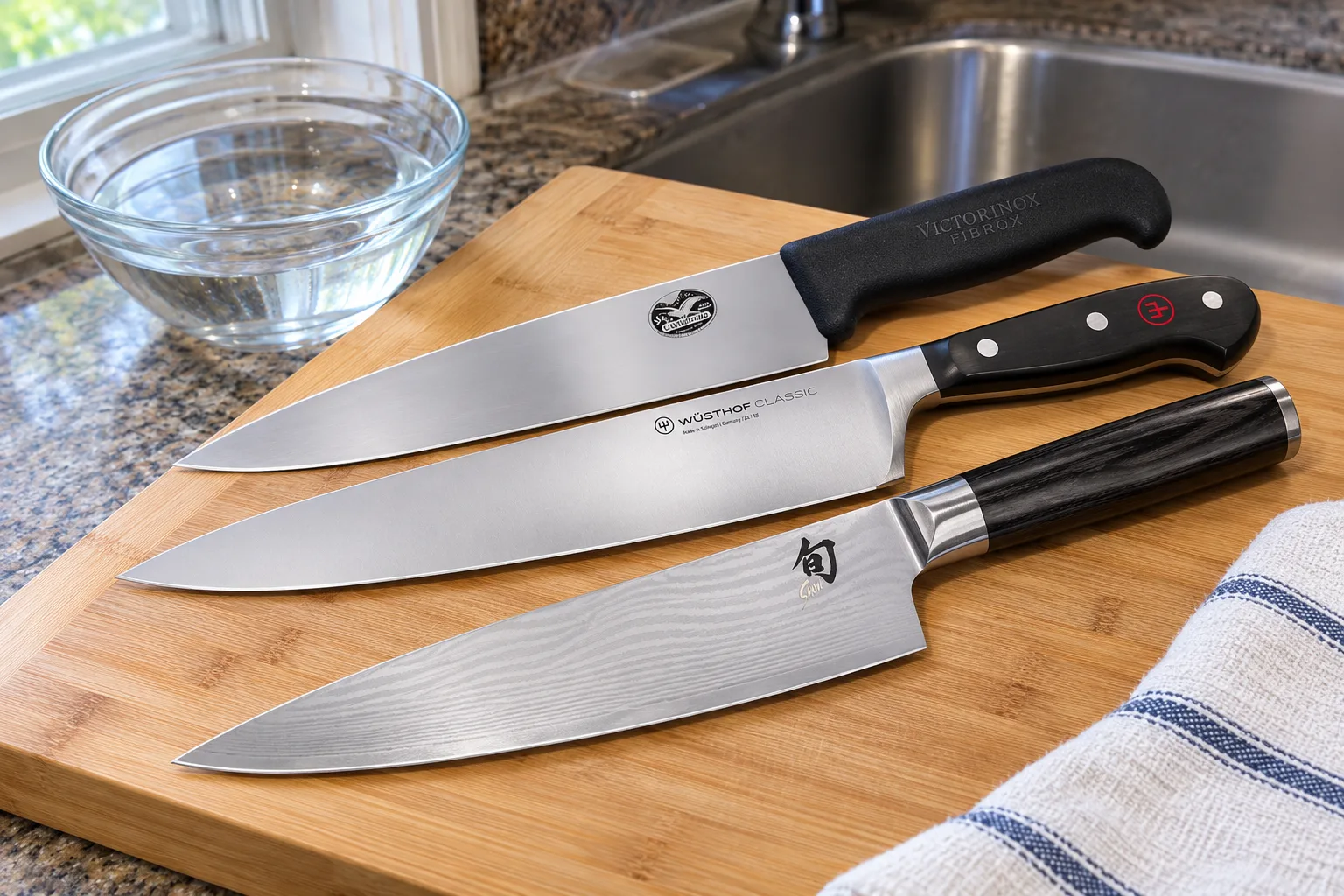
Quick answer: how to choose a chef's knife in 60 seconds
Buy one 8 inch chef's knife in stainless or high-carbon stainless steel, with a handle that fits your hand, at a price you won't regret: under about $50, or over about $100. Consumer Reports' own line is under $20 or over $100; we raise the low end to about $50 so it takes in the Victorinox Fibrox Pro. That's the right knife for most home cooks. Consumer Reports says to start with a single 8 inch chef's knife, and the culinary instructor it interviewed says a good one handles about 95 percent of the cutting in a kitchen. Put the money into that one knife, not a block.
Everything else is fit. Make five decisions, in this order:
- Pick the length. 8 inches (about 20 cm) unless your hands, board or drawer say otherwise. Small hands do well with 6 to 7 inches; big hands and batch cooking suit 10. Length guide
- Pick the style. A German knife if you rock-chop, cut squash and bone-in chicken, and want a knife that forgives a bump. A Japanese-style knife if you mostly push-cut vegetables, like a light blade and will sharpen on stones. Japanese vs German
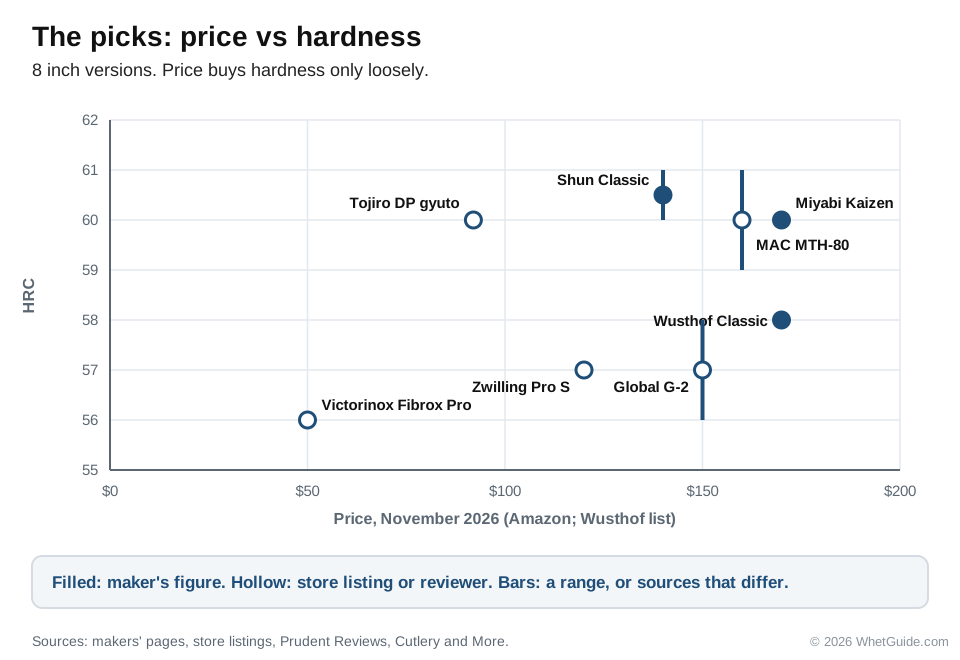
- Pick a steel you'll look after. Stainless at about 56 to 58 HRC lives happily with a honing steel and the odd careless moment. Harder steel at about 60 to 62 HRC holds a finer edge longer, but it chips if you twist it in a squash and it wants a whetstone. Hardness
- Set the budget. A $20 to $50 stamped knife cuts as well as plenty of $150 knives while it's sharp. Extra money buys weight, forging, finish, harder steel and a nicer handle. Budget tiers
- Hold it before you pay. Pinch grip, a gentle rock on a board, a thumb along the spine and the heel. Buying online? Buy only where returns are easy. The store test
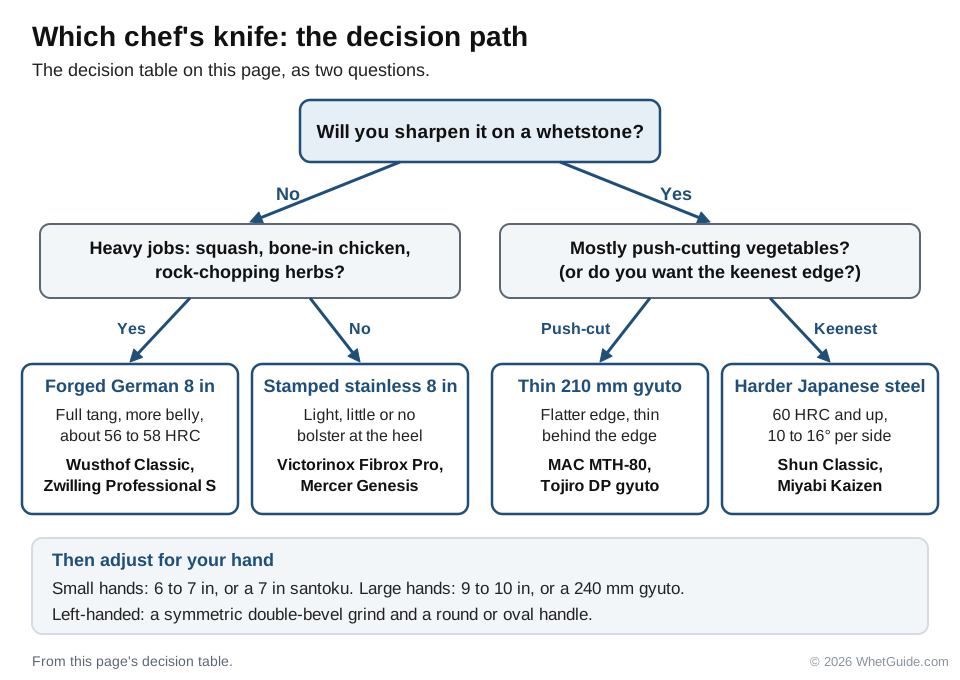
Which chef's knife fits which cook
This is the table that answers most "help me choose" threads. Find your row, then read the section it points to.
| If you | Look for | Names to look at | Why |
|---|---|---|---|
| Are buying your first good knife | 8 in stamped stainless, textured handle, little or no bolster at the heel | Victorinox Fibrox Pro, Mercer Genesis | Light, cheap, easy to sharpen all the way to the heel. Mistakes cost $40, not $170. |
| Cook mostly vegetables and push-cut | Thin 8 in (210 mm) gyuto or Japanese-style knife, flatter edge | MAC MTH-80, Tojiro DP gyuto | Thin behind the edge, so it falls through carrots instead of wedging. |
| Break down chickens, cut squash, rock-chop herbs | Forged German 8 in, full tang, more belly | Wusthof Classic, Zwilling Professional S | Heavier and tougher. America's Test Kitchen found forged knives got through butternut squash more easily. |
| Have small hands | 6 to 7 in chef's knife or a santoku, slim handle | A 7 in santoku, or a 6 in chef's knife | Less blade to steer. Prudent Reviews measured handles from about 2.8 to 3.5 in around. |
| Have large hands | 9 to 10 in blade or a 240 mm gyuto; a 4.5 to 5 in handle, by Prudent Reviews' guide | The 10 in version of any line you like | More knuckle room under the handle, more reach on big produce. |
| Won't sharpen and want a knife that takes abuse | Stainless around 56 to 58 HRC, partial or no bolster, a honing steel | Victorinox Fibrox Pro | Softer steel straightens on a steel. Victorinox even calls the Fibrox dishwasher safe. |
| Own whetstones, or want to learn | Harder Japanese steel, 60 HRC and up, finer angle | Shun Classic, Miyabi Kaizen, Global G-2 | Holds a 10 to 16 degree edge for a long time, and stones are how you keep it there. |
| Are left-handed | Symmetric double-bevel grind, round or oval handle | Most German knives; check Japanese grinds | Shun says its Classic's D-shaped handle is shaped for a right hand. Some Japanese edges are ground off-center for right-handers. |
- Buy the knife, not the set. Add a bread knife and a paring knife later.
- A sharp $40 knife beats a dull $170 one at every job.
- Hardness and edge angle decide how you'll sharpen. Check both before you buy.
- Never cut on glass, stone, marble or ceramic.
Anatomy of a chef's knife, and what each part means when you buy
Every part of a chef's knife changes how it cuts, how it feels or how it sharpens. Learn the names once and spec sheets start to make sense.
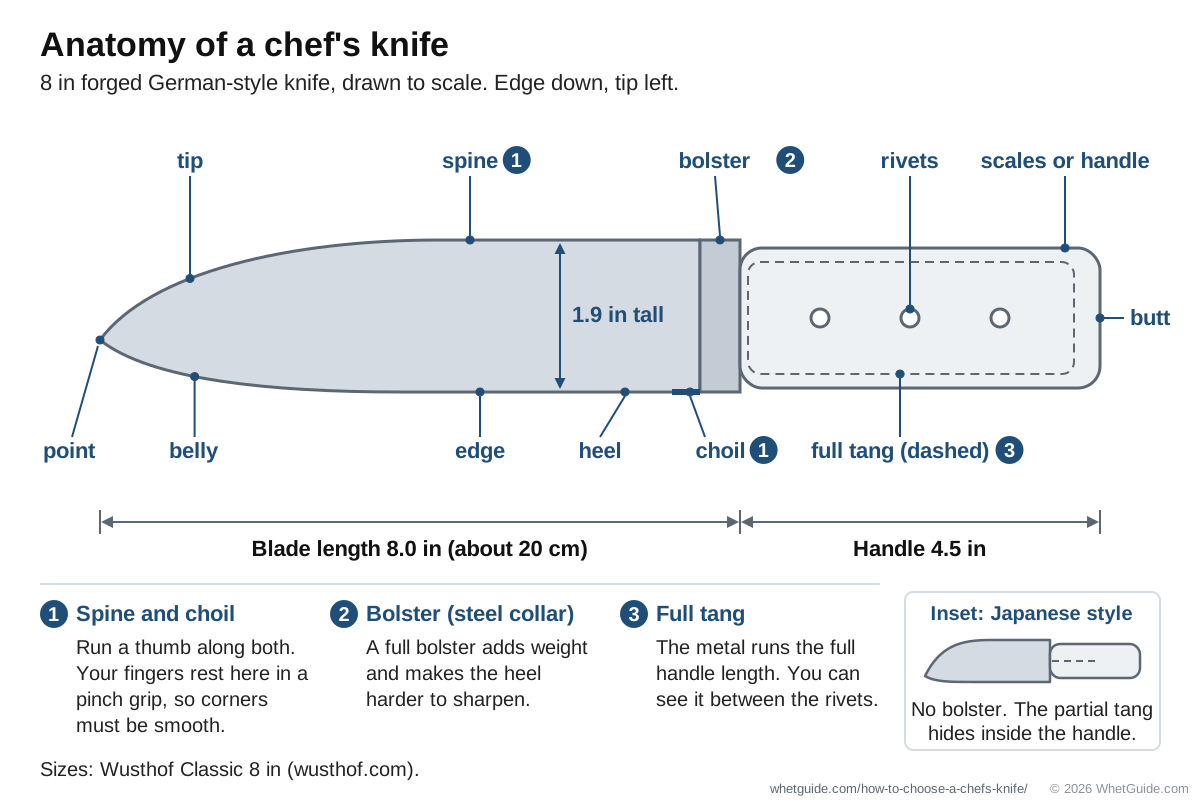
| Part | What it is | What to check when you buy |
|---|---|---|
| Point | The very end of the blade | A fine point pierces onion layers and scores fish skin. A thin point also snaps if you pry with it, so never use it as a can opener. |
| Tip | The front inch or two of the edge, where it starts to curve up | Where fine work happens: mincing garlic, shallots, herbs. It should come to a clean, centered point, not a lopsided one. |
| Belly | The curved stretch of edge between the tip and the flat | More belly rocks better. Less belly push-cuts better and keeps more edge on the board. |
| Edge | The sharpened part, from heel to point | The angle it's ground at decides how keen it is and how you'll sharpen it. See edge angle. |
| Heel | The rear corner of the edge, nearest the handle | The power zone for hard cuts. Blade height here sets how much room your knuckles get above the board. |
| Spine | The unsharpened top of the blade | Run a thumb along it. In a pinch grip your finger rests here, so sharp corners rub; a rounded spine is more comfortable. |
| Choil | The small notch or smooth step where the edge ends, just in front of the handle or bolster | It lets the stone reach the last of the edge. It should be smooth, never sharp: your middle finger touches it in a pinch grip. |
| Bolster | The thick band of steel between blade and handle on most forged knives (some makers call it the collar). It can run all the way down to the heel (full) or stop short of it (half), and stamped knives often have none. | It guards your fingers and moves weight back toward the handle. A full one that runs to the heel makes the heel harder to sharpen. |
| Tang | The part of the blade steel that runs into the handle | Full tang: a strip of steel visible along the handle between the scales. Partial or rat-tail tang: hidden inside the handle, lighter, usual on Japanese handles. |
| Rivets | Pins that hold the handle scales to the tang | Flush with the handle, with no gaps or raised edges where food can lodge. |
| Scales or handle | The two halves of the handle on a full tang, or a one-piece handle | Material, shape and size. See handle. |
| Butt | The end of the handle | A heavy end cap shifts balance back. Check that it doesn't dig into your palm. |
Spec sheets usually tell you which kind of bolster each knife has. Wusthof's product pages, for example, describe the Classic Ikon's as "half" and the Performer's as "full." On any knife the question is the same: full, half or none. Part names vary a little between makers and between German and Japanese knives, but the checks in the right-hand column are the same for every chef's knife.
↑ Back to all sectionsJapanese vs German chef's knives (and the gyuto in between)
German knives are heavier, softer and more forgiving. Japanese knives are lighter and harder, with thinner blades, and they cut with less effort right up until you chip one. That's the honest summary, and it's the right starting point. The makers' own numbers show the gap is smaller than most buying guides claim, though, especially on edge angle.
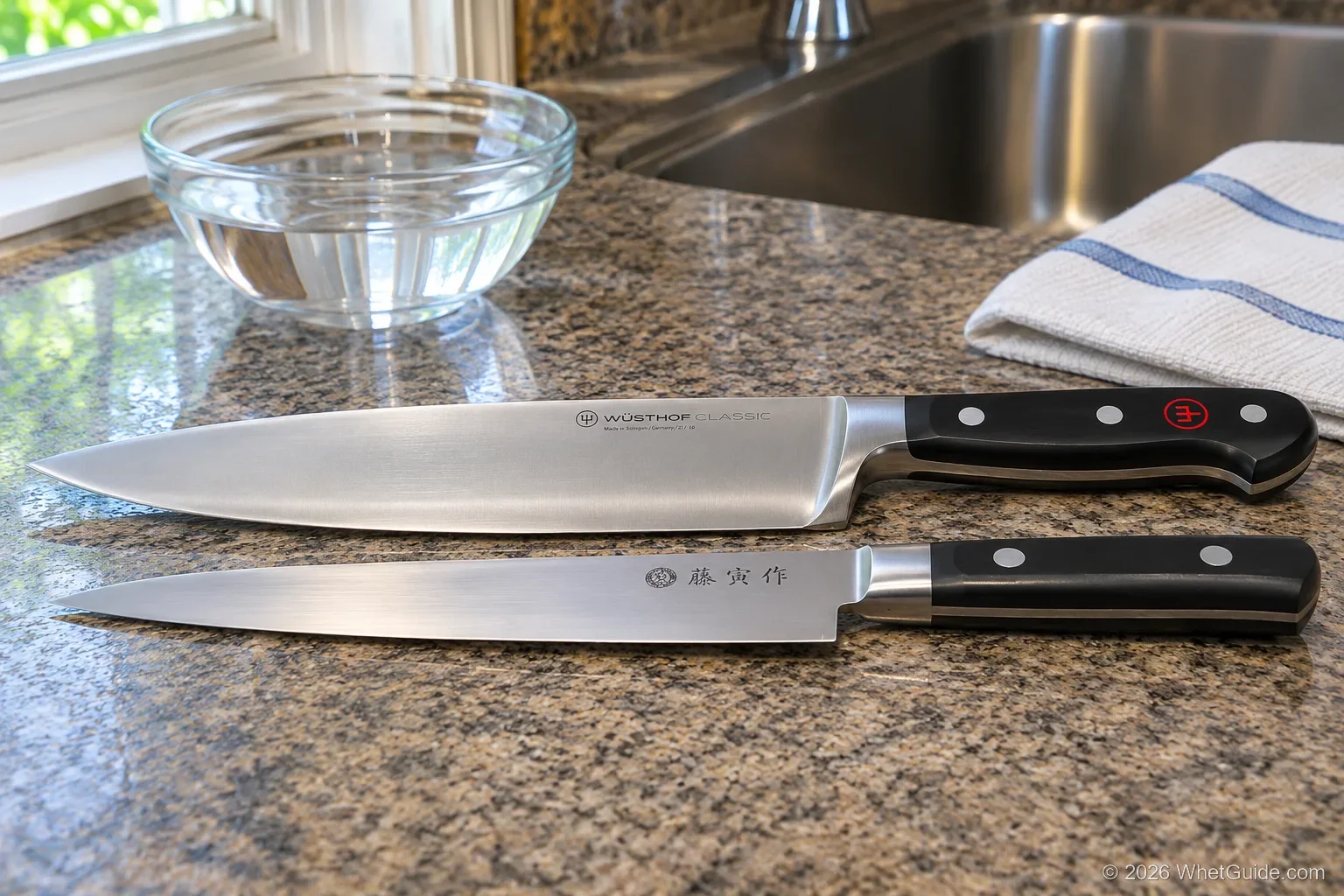
| Trait | German (Wusthof Classic, Zwilling Professional S) | Japanese-style (Shun Classic, Miyabi Kaizen, Global G-2, MAC, Tojiro) |
|---|---|---|
| Profile | Symmetric, gently curved, plenty of belly. Made for rocking. | Flatter edge and a lower tip. Made for push cuts and straight-down chopping. |
| Hardness | Wusthof lists its Classic at 58 HRC. Store listings put the Zwilling Professional S at 57. | Shun lists VG-MAX at 60 to 61 HRC. Miyabi lists its Kaizen at 60 and its SG2 Birchwood at 62 to 64. |
| Edge angle (per side) | Wusthof: 14° on standard blades, 14.5° on PEtec. Zwilling says to hone at about 15°. | Shun: 16°. Global: 10 to 15°. Miyabi: 9.5 to 12°. |
| Weight | Often heavier. One reviewer, Prudent Reviews, puts Western knives at 8 to 10 oz, but the stamped Victorinox Fibrox weighs 6.4 oz. | Lighter. Prudent Reviews' band is 5 to 7 oz; MAC lists its MTH-80 at 6.5 oz. |
| Bolster and tang | Forged, with a full bolster and full tang on the classic lines. Usually handle-heavy. | Often no bolster and a partial tang. Usually blade-heavy. There are exceptions both ways. |
| Handle | Riveted synthetic scales | Western-style riveted, Japanese wa (octagonal or D-shaped wood) or all-steel with a hollow handle (Global) |
| Care | Tolerates a honing steel and harder use. Hand wash. | Shun and Global say no dishwasher. Chips on bone and frozen food. Best kept on stones; Shun says not to use a diamond steel for regular honing. |
| Price, 8 in, November 2026 | Zwilling Professional S about $120; Wusthof Classic $170 list | Tojiro DP-line gyuto about $92; Shun Classic about $140; Global G-2 about $150; MAC MTH-80 about $160; Miyabi Kaizen about $170 |
| Best for | Heavy prep, rock-chopping, busy kitchens, cooks who won't baby a knife | Precise slicing, lots of vegetables, cooks who'll sharpen on stones |
Profile descriptions follow Wikipedia's chef's knife entry and Cutlery and More, which also notes the handle-heavy and blade-heavy tendency. Weight bands are from Prudent Reviews. Prices are Amazon listings seen in November 2026 and will move.
If you can't decide, the deciding question is about you, not the knife: will you sharpen it on a stone? If yes, a harder Japanese knife repays you every day. If the honest answer is "a pull-through, once a year," buy German or a Victorinox and skip the regret.
The gyuto: Japan's version of the chef's knife
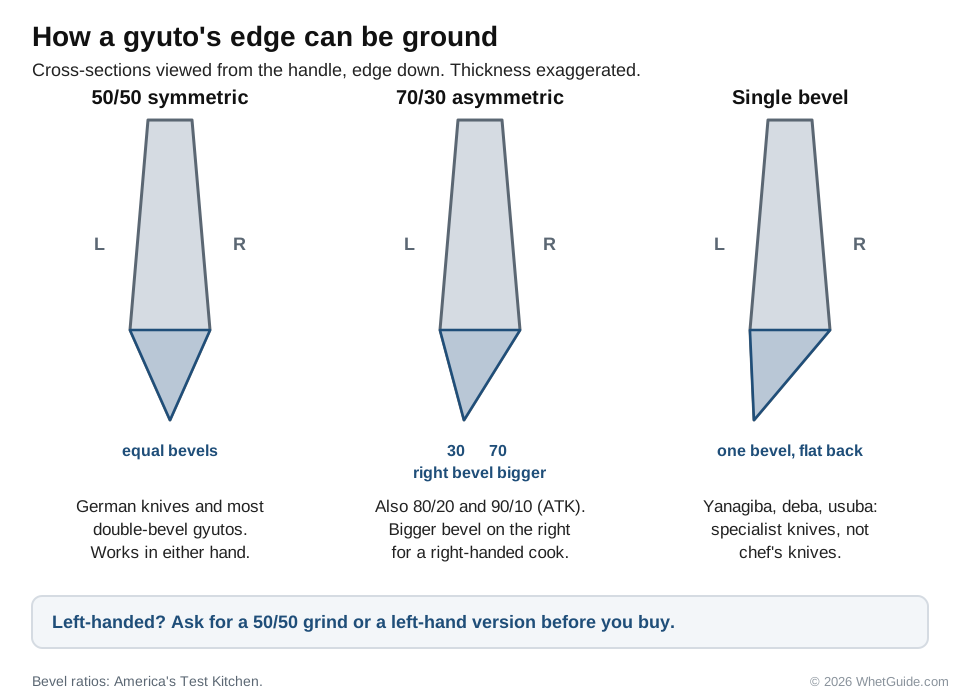
Gyuto is simply the Japanese name for the Western-style chef's knife. Japanese makers adopted it under Western influence in the Meiji era (1868 to 1912), according to Wikipedia. Gyutos are sold in millimeters: 210 mm is about 8.3 inches and 240 mm about 9.4 inches.
A gyuto is a double-bevel knife, sharpened on both sides like a German one. Single-bevel knives (yanagiba, deba, usuba) are specialist tools for fish and vegetables, not chef's knives, and they sharpen very differently; our whetstone guide covers both. Some gyutos are ground off-center: America's Test Kitchen lists 70/30, 80/20 and 90/10 bevel ratios, with the bigger bevel on the right for a right-handed cook. A left-hander should ask for a 50/50 grind or a left-hand version.
Santoku, nakiri and French: when another shape beats a chef's knife
- Santoku. Shorter (Made In lists them at about 5 to 7 inches), taller at the front, with a flat edge and a rounded-down tip. Great for small hands and for chop-and-push vegetable work; poor at rocking. Wusthof sharpens its santokus at 10° per side, finer than its chef's knives.
- Nakiri. A rectangular vegetable knife with a dead-flat edge. It chops straight down and doesn't rock at all. A second knife for vegetable lovers, never a first one.
- French profile. A chef's knife with a straighter edge that curves sharply up near the tip, per Wikipedia. It sits between the German rocker and the flatter gyuto.
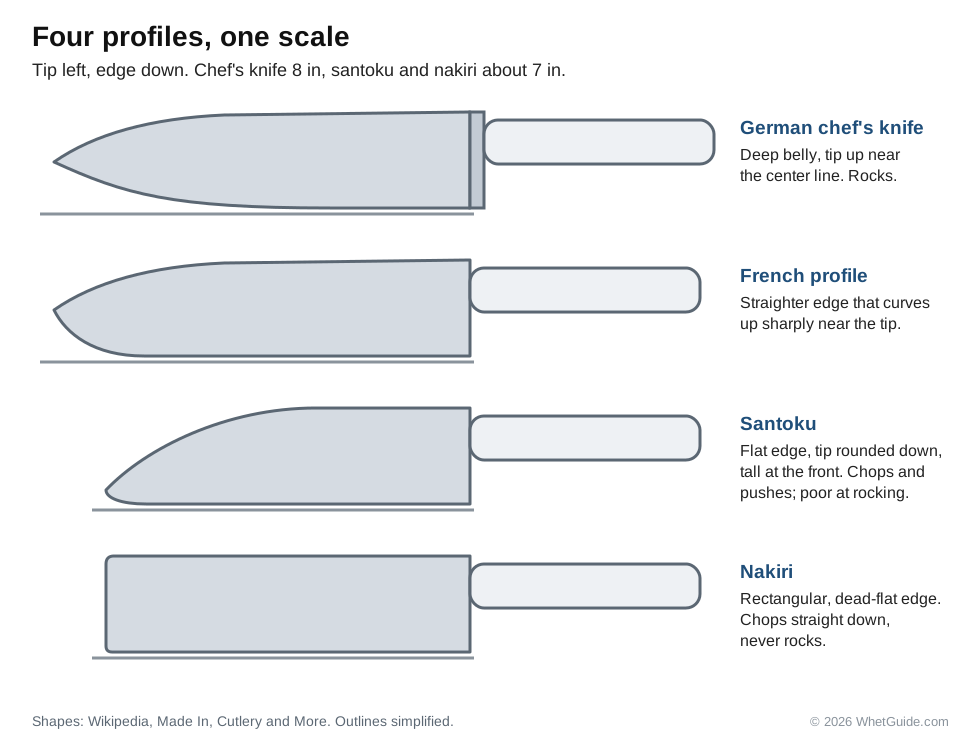
If you rock-chop herbs, buy a chef's knife. If your hands are small and you mostly slice vegetables, a 7 inch santoku may suit you better. Plenty of cooks own both.
Zwilling vs Wusthof, by the makers' numbers
Wusthof Classic 8 in
Forged, made in Germany, 58 HRC, 14° per side. Blade 8.0 in long and 1.9 in tall; handle 4.5 in. $170 list. All from Wusthof's product page.
Zwilling Professional S 8 in
Forged, 57 HRC and FRIODUR ice-hardened according to store listings. Zwilling says to hone its knives at about 15°. About $120 on Amazon in November 2026.
On paper, it's close to a tie: two forged German knives in very similar steel, one point of hardness apart, with near-identical edges. The difference you'll feel is the handle. Hold both and buy the one that fits. Zwilling and Henckels are the same company, by the way: Zwilling calls Henckels its everyday kitchen basics brand, and on Zwilling's own US store the Henckels Classic 8 inch chef's knife lists at $79.99 against $169.99 for the Zwilling Pro 8 inch. Henckels sharpening is covered in our Henckels sharpening guide. If you like the Classic but want an easier heel to sharpen, look at Wusthof's Classic Ikon: Wusthof says its half bolster makes the knife lighter and lets the entire blade be sharpened more easily.
↑ Back to all sectionsBlade shape: belly, tip, height, thinness behind the edge
Shape decides how a knife wants to move. Match it to the way you already cut, rather than learning a new motion to suit the knife.
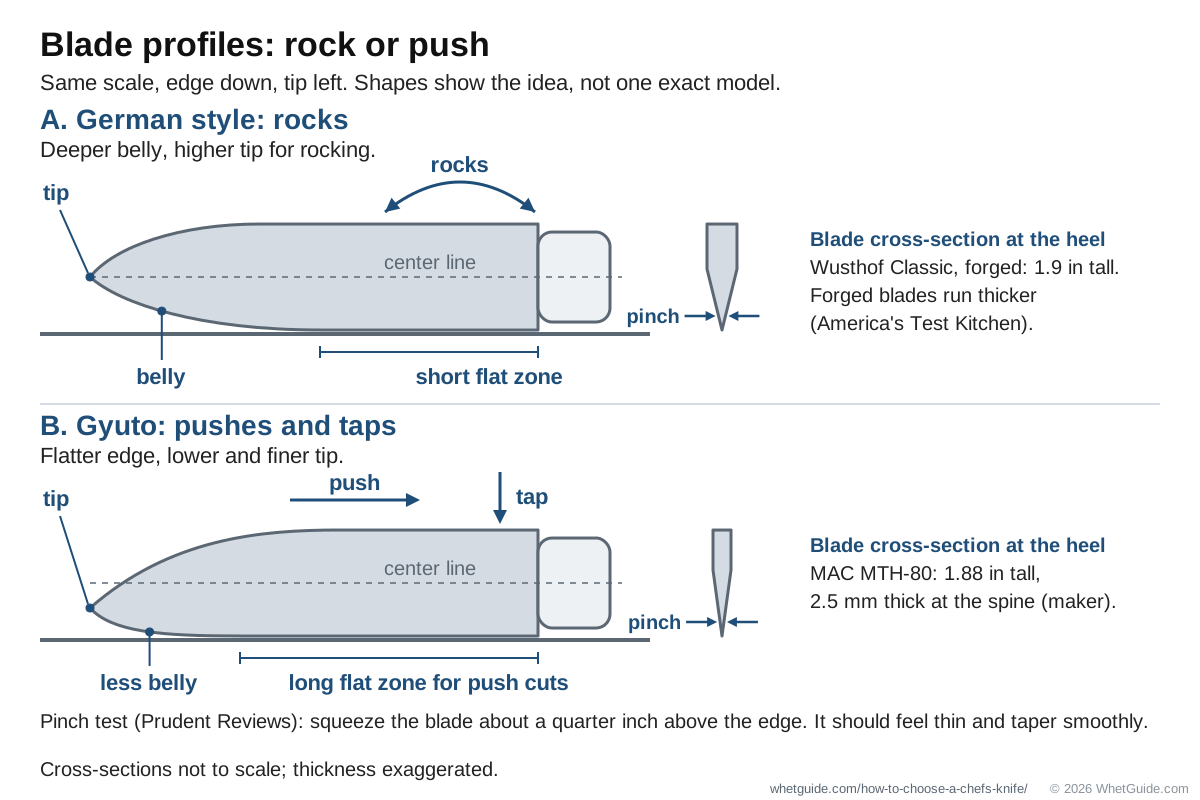
Belly. A German chef's knife curves gently from heel to tip, so it rocks: the tip stays on the board while the heel rises and falls through herbs or an onion. A gyuto or santoku is flatter, so more of the edge meets the board at once. It's happier pushing forward through a carrot or tapping straight down. If you rock-chop with a flat knife, the heel clacks and the cuts don't separate. If you push-cut with a curvy one, only a short stretch of edge touches the food.
Tip. A tip that sits low, close to the line of the edge, gives the precise gyuto style. A higher tip, up near the center line of the blade, gives a German knife its rocking arc. Neither is better; they suit different habits.
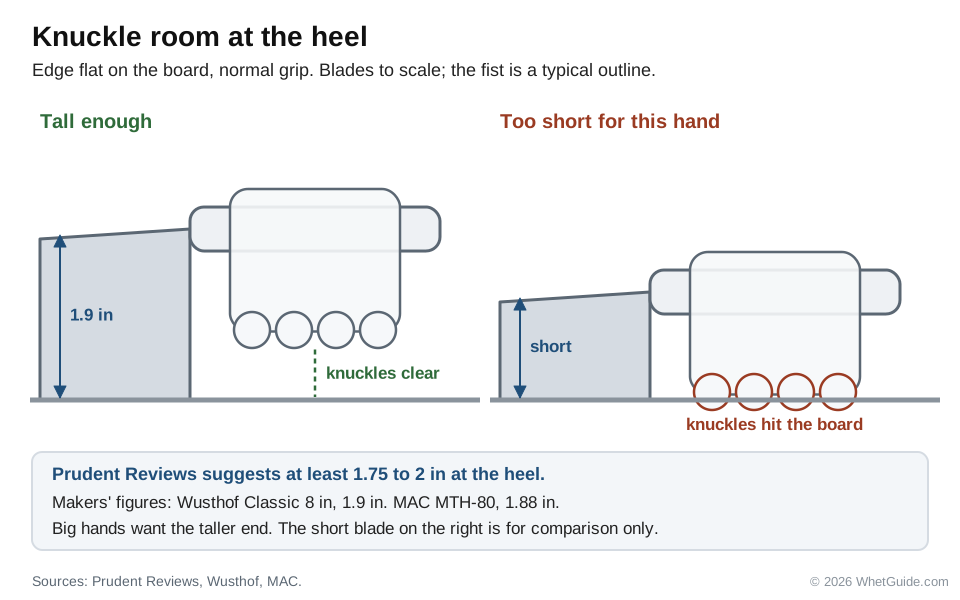
Height at the heel. A taller blade gives your knuckles room above the board and doubles as a scoop for chopped food. Prudent Reviews suggests at least 1.75 to 2 inches at the heel. The Wusthof Classic 8 inch is 1.9 inches tall and the MAC MTH-80 is 1.88 inches, by the makers' figures. Big hands want the taller end.
Thinness behind the edge. This is the shape detail most buyers never check and the one you notice every day. A blade that's thin just above the edge falls through a carrot or a sweet potato; a thick one wedges and cracks it. The metallurgist behind Knife Steel Nerds writes that heat treatment and edge geometry can mean more for performance than the steel itself. The MAC MTH-80 is 2.5 mm thick at the spine, by MAC's own figure, which is thin for a Western-handled knife.
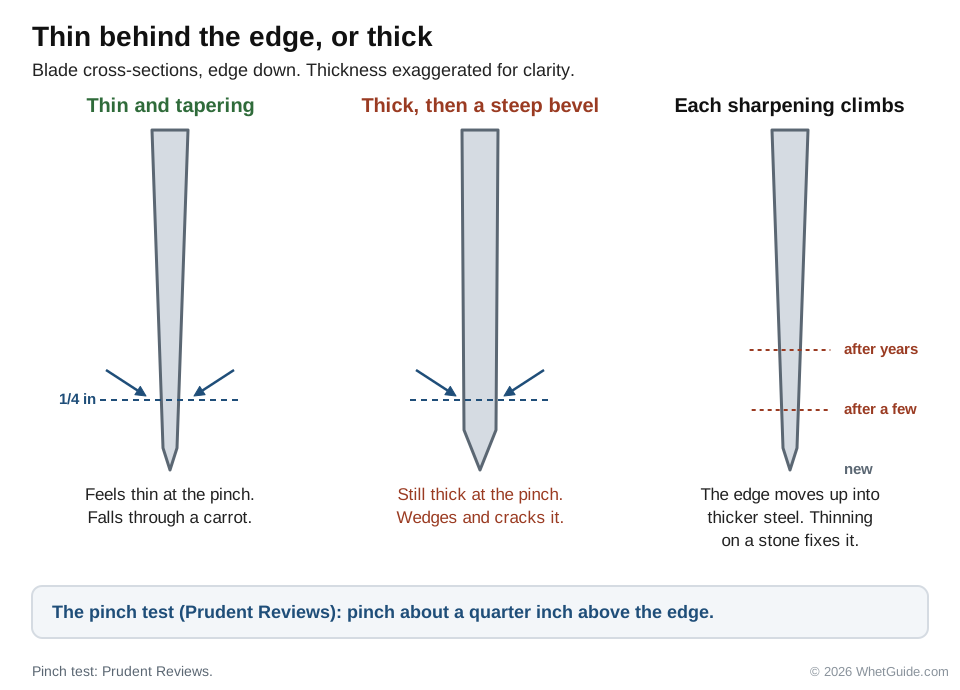
The test, credited to Prudent Reviews: pinch the blade about a quarter inch above the edge. It should feel thin and taper smoothly toward the edge, not stay thick and then drop to a steep bevel. Every sharpening moves the edge up into thicker metal, too, so a knife that starts thick only gets worse. A knife that has wedged its way through years of sharpening needs thinning, explained in our whetstone guide.
↑ Back to all sectionsLength: 6, 8, 10 or 12 inch?
Buy 8 inches unless you have a reason not to. A European chef's knife is generally about 20 cm (8 in) long and 4 cm (1.5 in) wide, and models run from 15 to 36 cm (6 to 14 in), according to Wikipedia. Tim Mussig, CEO of the chef's supplier JB Prince, told the Michelin Guide that 8 inches is a strong starting point for home cooks, and Consumer Reports gives the same advice.
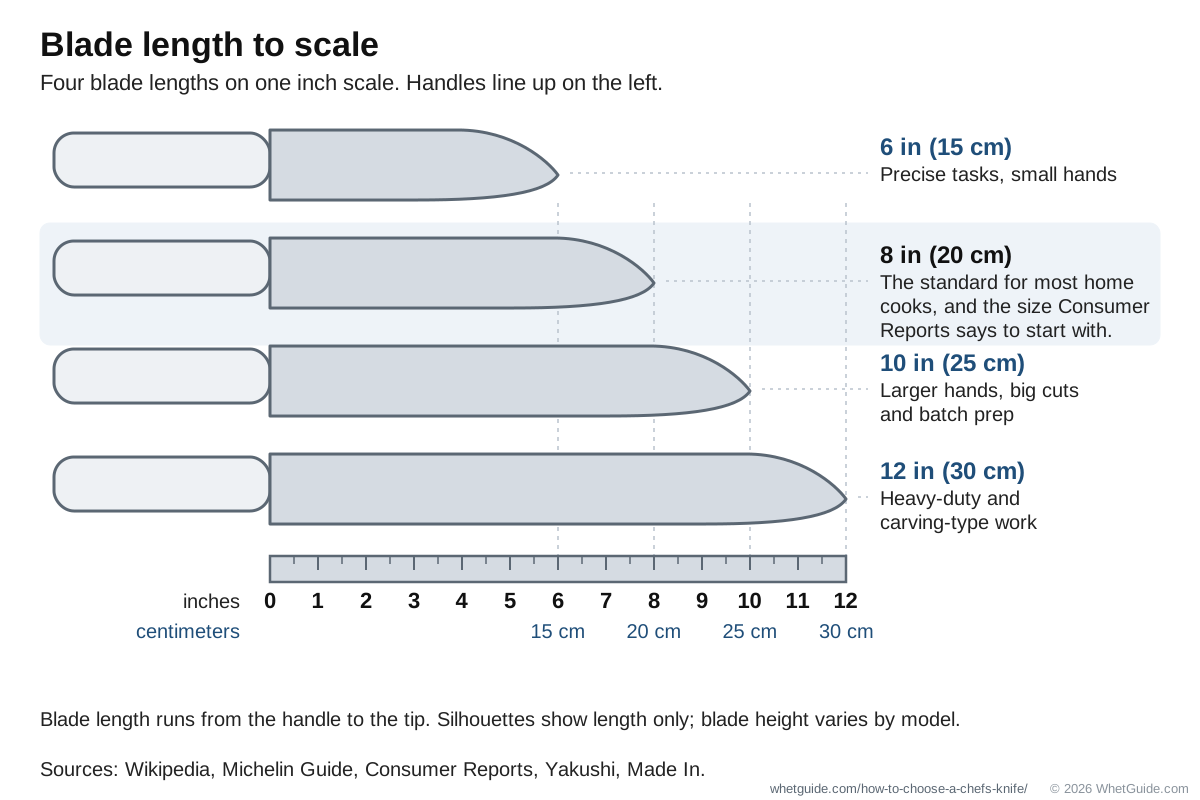
| Blade | Metric | Good at | Who it suits |
|---|---|---|---|
| 6 in | 15 cm | Garlic, shallots, small fruit, boneless chicken, small boards | Small hands, small kitchens, nervous beginners |
| 7 in (often a santoku) | 18 cm | Vegetables, everyday dinners for one or two | Small to medium hands that find 8 a stretch |
| 8 in (210 mm gyuto) | 20 cm | Everything a home kitchen asks of a knife | Most home cooks |
| 10 in (240 to 250 mm gyuto) | 25 cm | Cabbage, melons, big batches, long slices through a roast | Large hands, big boards, people who cook for crowds |
| 12 in | 30 cm | Carving, large roasts, heavy-duty batch work | Professionals and very large boards |
Metric figures are rounded conversions. Gyutos are sold by blade length in millimeters, so a 210 mm gyuto is the Japanese 8 inch and a 240 mm is between 9 and 10.
A longer knife covers more food per stroke and keeps its heel higher off the board, but it's harder to steer and won't fit every drawer or block slot. A shorter one is nimble and needs a lot more strokes on a cabbage. Two quick checks before you choose:
- Lay the knife diagonally on your own cutting board. If the tip or the handle hangs off the edge, the knife is too long for that board.
- Measure the slot it will live in, block or drawer tray, before you buy a 10 inch.
The knife retailer Yakushi suggests a forearm rule: measure from your wrist to your elbow, compare it with the standard sizes and round down. It's a seller's rule of thumb, not a standard, but it does push tall cooks toward a 10 inch and smaller cooks toward a 6 or 7.
8 or 10? If you have to ask, 8. The 10 inch earns its place for people who already know they want more reach, usually with large hands and a large board. Bigger hands should also check handle length, covered next.
↑ Back to all sectionsHandle: shape, size, material, wet grip
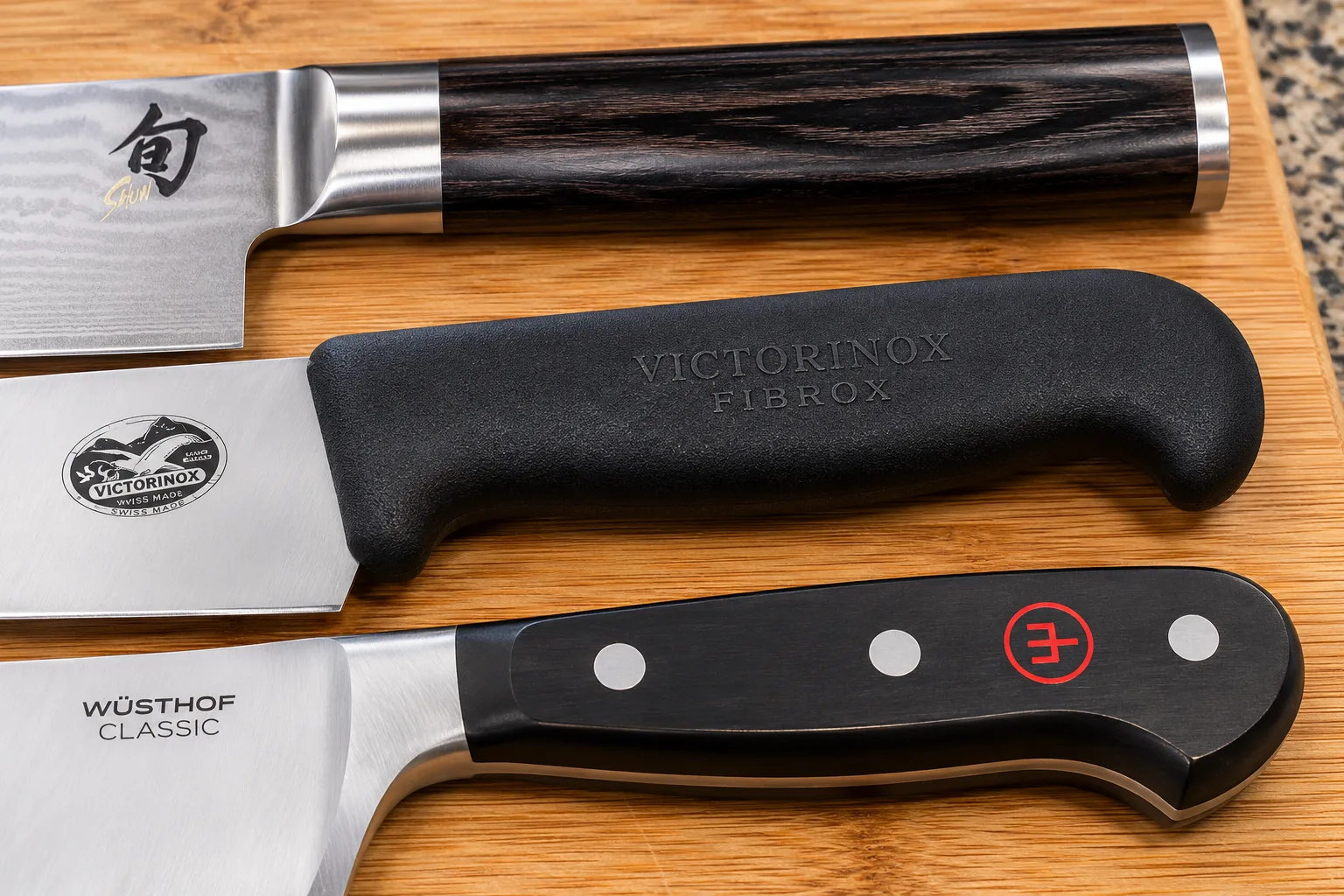
A handle you hate is the fastest way to stop using an expensive knife. The chefs the Michelin Guide interviewed put the handle near the top of their list, especially for cooks who hold the knife in a pinch grip. It's also the one thing a spec sheet can't tell you.
Shape
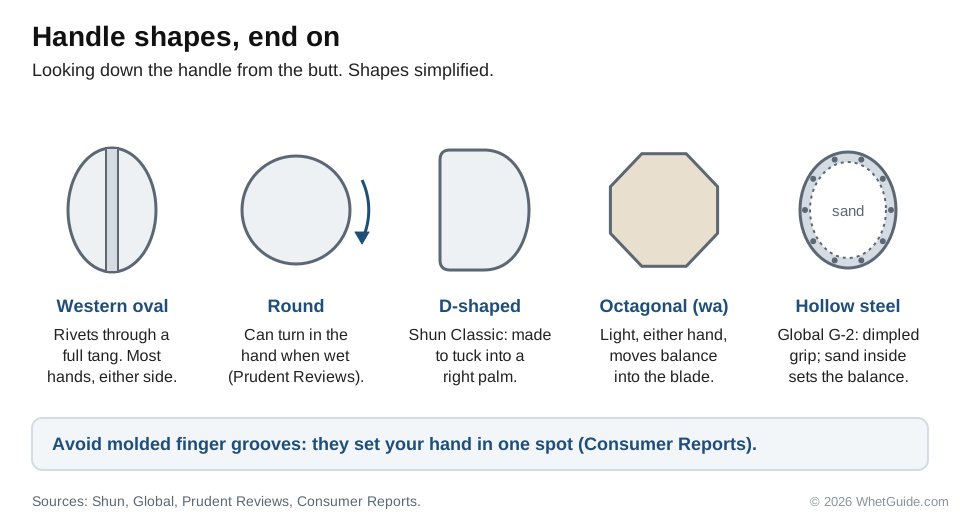
- Western riveted. An oval with rivets through a full tang. Familiar, comfortable in most hands, fine for left- or right-handers.
- Round. Prudent Reviews notes that round handles can rotate in the hand, which matters on a wet day or with a heavy cut.
- D-shaped. Shun says the D-shape on its Classic handle is designed to tuck into the palm of a right-handed user. It locks in nicely in the right hand and feels wrong in the left.
- Octagonal (Japanese wa). Light, works for either hand, and moves the balance forward into the blade.
- Steel. The Global G-2 has a hollow steel handle with a dimpled pattern; Global says the dimples hold even with wet hands and that sand inside the handle sets the balance. Some people love it and some find it cold. Hold one.
Size
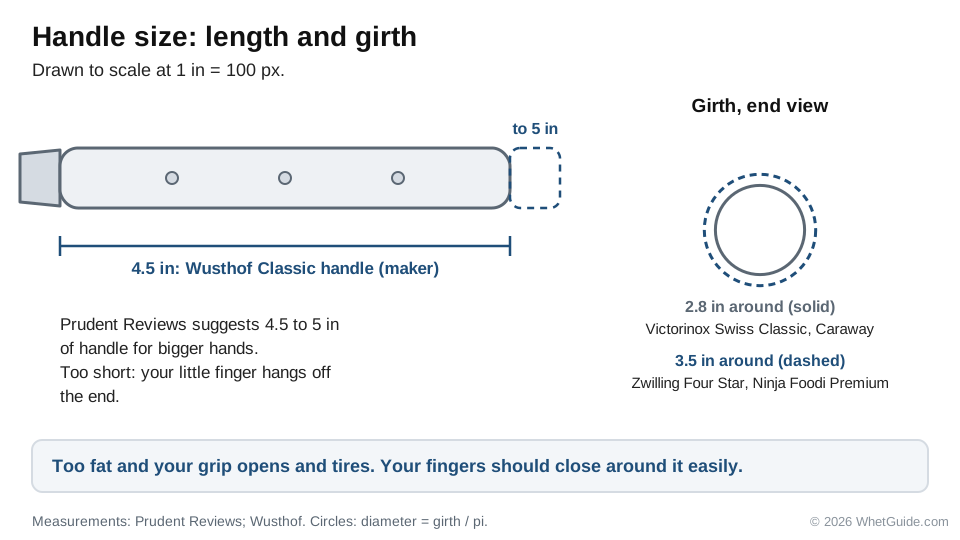
Handles vary more than blades. Prudent Reviews measured circumferences from about 2.8 inches (Victorinox Swiss Classic, Caraway) to 3.5 inches (Zwilling Four Star, Ninja Foodi Premium), and suggests a handle of about 4.5 to 5 inches long for bigger hands. Wusthof lists its Classic handle at 4.5 inches. A handle that's too short leaves your pinky hanging off the end; one that's too fat makes your grip open and tiring.
Material and wet grip
Here the sources disagree, which tells you to test it yourself. In Consumer Reports' tests, synthetic and plastic handles were the most slippery, while metal handles with divots and wood handles gripped better. Prudent Reviews reports the opposite for Victorinox's textured plastic handle, which it found stays grippy when wet. Texture beats material: a smooth, polished handle of any kind slips more than a textured one.
Consumer Reports also says to avoid handles with preformed grooves or fixed finger spots, because they force your hand into one place that probably isn't yours. America's Test Kitchen prefers simply shaped molded handles without sharp curves, bulges or long flat sides.
Material also decides the upkeep. Wusthof's care note says to treat wooden handles periodically with food-grade mineral oil. Its Classic and Classic Ikon handles are a synthetic, POM (polyoxymethylene), so they skip the oiling, and the Global G-2's hollow all-steel handle has no wood to oil. Whatever the material, don't soak it.
- Your fingers close around it without straining
- Your knuckles clear the board with the edge flat on it
- Nothing digs in when you pinch the blade
- The joint between handle and blade is tight, with no gap for food
- Molded finger grooves that don't match your fingers
- A sharp edge on the spine or the choil where your finger rests
- A polished handle that already slides when your hand is dry
- Your pinky hangs off the end
Weight and balance
Weight is a preference, not a quality mark. A heavy knife does some of the work through a squash; a light one is quicker and less tiring over a long prep session but relies more on a keen edge.
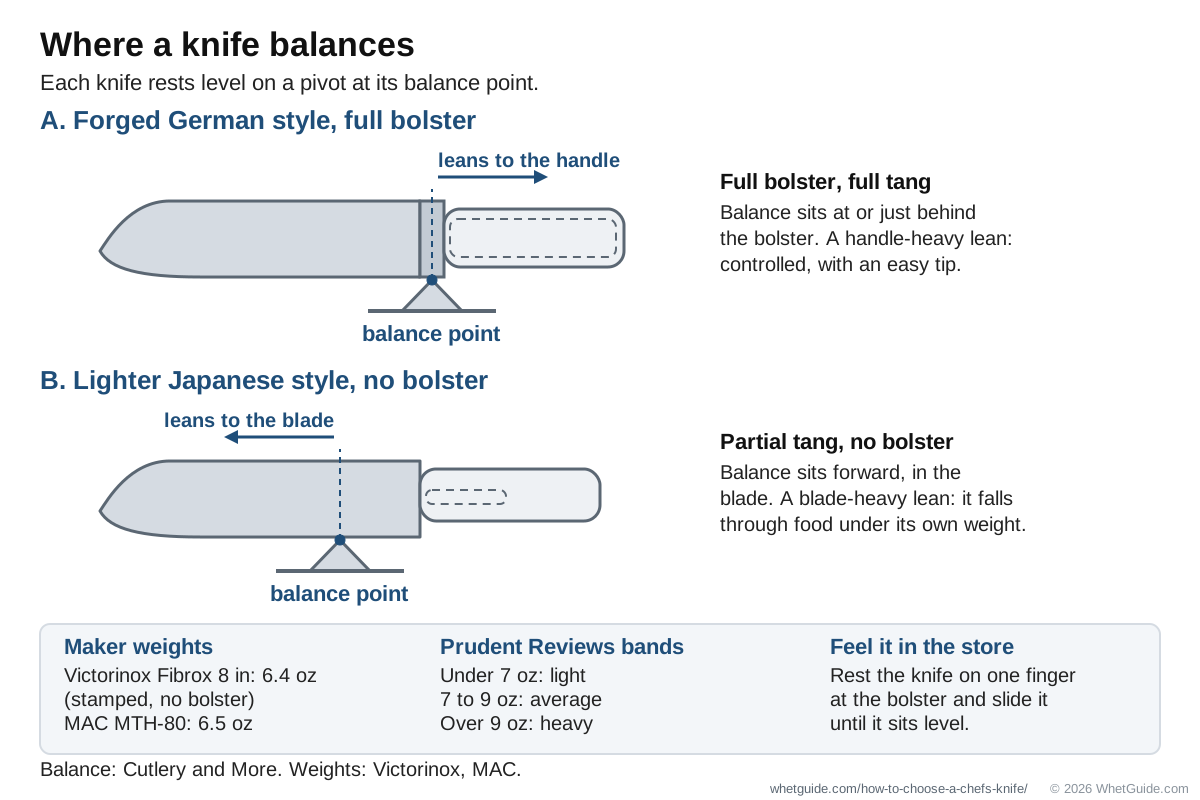
Prudent Reviews uses these bands: under 7 oz is light, 7 to 9 oz average and over 9 oz heavy, with Western knives often 8 to 10 oz and Japanese ones 5 to 7. The makers' own figures show why "Western" doesn't automatically mean heavy. Victorinox lists its stamped Fibrox Pro 8 inch at 6.4 oz, and MAC lists the MTH-80 at 6.5 oz. Both are Western-handled 8 inch knives in the Japanese weight band. Wusthof's product page doesn't list a weight for the Classic, so we don't print one.
Balance is where the weight sits. Cutlery and More describes German knives as often handle-heavy, because of the full bolster and full tang, and Japanese knives as often blade-heavy, with a partial tang and no bolster. Exceptions run both ways.
To find the balance point, rest the knife on one extended finger at the bolster or the heel and slide it until it sits level. Right at the bolster is neutral. Behind it is handle-heavy: controlled, with a light, easy tip. In front of it is blade-heavy: the knife falls through food under its own weight, and a tip-heavy one can feel whippy on fine work. Neither is wrong. Pinch-grip the knife and do a few slow chopping motions in the air, and you'll know in ten seconds which one you like.
↑ Back to all sectionsHow to hold a chef's knife: pinch grip, claw hand and first cuts
Most people hold a new chef's knife like a hammer, with all four fingers around the handle and maybe a finger on the spine. The pinch grip gives far more control, and it's the grip to judge a knife with in the store, because it puts your fingers exactly where a bad spine, choil or bolster will bother you.
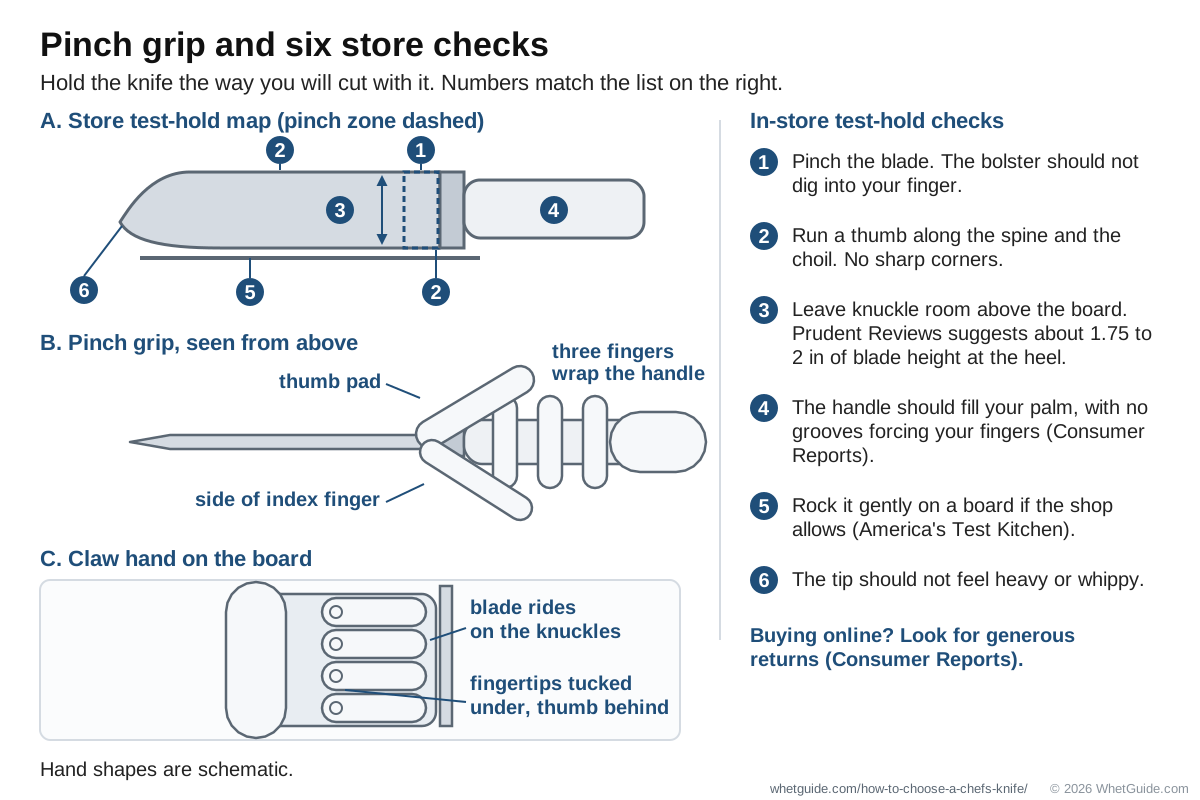
- Pinch the blade. Put the pad of your thumb on one face of the blade and the side of your bent index finger on the other, just in front of the handle.
- Wrap the handle. Close your middle, ring and little fingers around the handle. The grip should feel firm without squeezing.
- Make a claw with the other hand. Tuck your fingertips under, knuckles forward, and let the flat of the blade ride against your knuckles. Your thumb stays behind your fingers.
- Pick a motion. Rock: tip on the board, lift and lower the heel (German profiles). Push: slide forward and down through the food (gyutos, santokus). Tap: straight down, for flat edges. Slice: one long, light draw for meat.
- Let the edge work. A sharp knife needs little force. Pushing hard is a sign the knife is dull, and a dull knife skids off an onion skin toward your fingers.
Safety basics that also protect the edge
- Set the board on a damp towel or a non-slip mat so it can't slide.
- Cut on wood or plastic. The chefs the Michelin Guide interviewed call glass, stone and ceramic boards "trivets in disguise," and Global says not to cut on marble, stone, tile or glass.
- Never try to catch a falling knife. Step back and let it drop.
- Carry it point down at your side, and never leave it in a sink full of soapy water where someone can't see it.
- Scrape food off the board with the spine, not the edge.
Blade steel: stainless, high-carbon stainless, carbon, ceramic and Damascus
For most home cooks the right answer is a high-carbon stainless steel. Consumer Reports' advice is to forget the periodic table and look for those words. It notes that more carbon takes an edge better and is easier to sharpen, while the chromium in stainless fights rust. The table covers the other choices and what each one asks of you.
| Steel | Good | Less good | What it asks of you |
|---|---|---|---|
| Stainless and high-carbon stainless (German X50CrMoV15 and similar) | Resists rust, tough, forgives bumps, straightens on a honing steel | Doesn't hold a fine edge as long as harder steels | Hand wash, dry, hone often. Stainless resists stains but isn't stain-proof, the chefs in the Michelin Guide piece point out. |
| Harder Japanese stainless (VG10, VG-MAX, SG2, CROMOVA 18) | Takes and holds a keen, thin edge | Chips on bone, frozen food and twisting cuts; costs more | Stones or a fine ceramic rod, a wood or plastic board, no dishwasher |
| Carbon steel | Very keen edge, easy to sharpen | Rusts and discolors if left wet; darkens with use | Dry it the moment you finish, every time |
| Ceramic | Very sharp, holds its edge a long time | Chips, and America's Test Kitchen says to keep it off bone | No honing steel; see sharpening a ceramic knife |
| Damascus (layered pattern) | Looks beautiful | The pattern doesn't cut; the core steel does | Check the core steel's name and hardness, not the pattern |
Steel names you'll see on listings
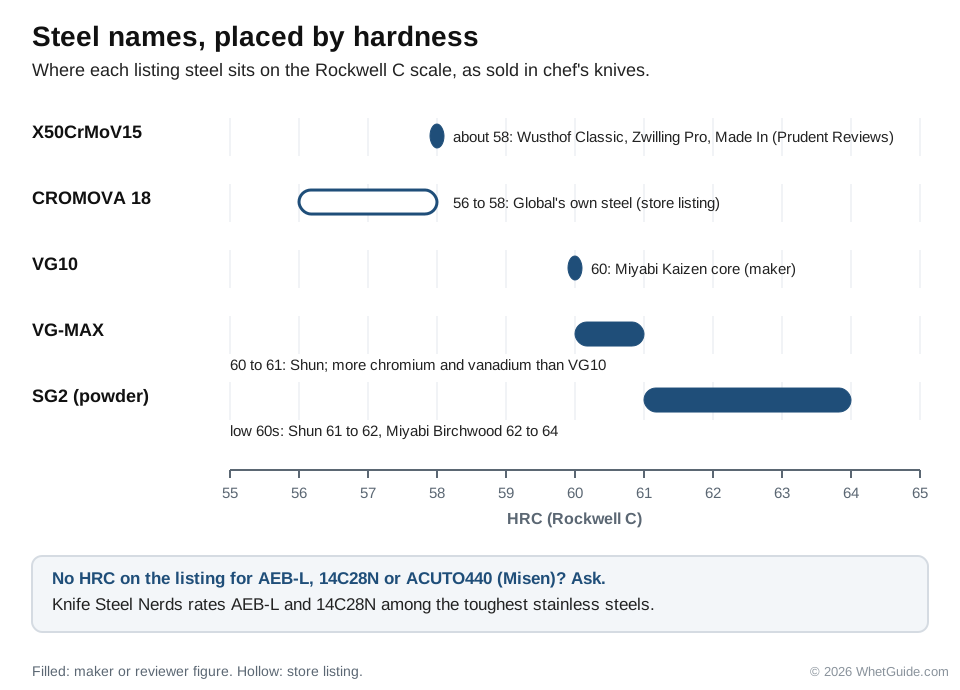
X50CrMoV15 is the German standard. Prudent Reviews says the Wusthof Classic, Zwilling Pro and Made In use it at about 58 HRC, and store listings name it for the Victorinox Fibrox too. On the Japanese side, Miyabi uses VG10 in its Kaizen. Shun's VG-MAX is its own steel and, Shun says, has more chromium and vanadium than VG10. SG2 is a powder steel that Shun and Miyabi harden to the low 60s. Global uses its own CROMOVA 18 high-carbon stainless, and Misen's current chef's knife uses a steel it calls ACUTO440.
Two points from the metallurgist Larrin Thomas at Knife Steel Nerds are worth carrying into any store. Toughness and edge retention "are generally opposing properties," so no steel wins at everything. And heat treatment and edge geometry can matter more than the steel name. He rates AEB-L and 14C28N among the best stainless steels in the high-toughness group, which is why you'll see them on knives that are thin but forgiving.
Titanium blades turn up now and then. Titanium is lighter and won't rust, but it's softer than good knife steel and doesn't hold an edge as well, so it's a curiosity for a chef's knife, not an upgrade. Titanium coatings on a steel blade are a different thing: the steel underneath does the cutting.
A steel name you can't find, or no steel name at all, is a red flag. Prudent Reviews makes the same point: reputable makers say what they use.
Real and fake Damascus
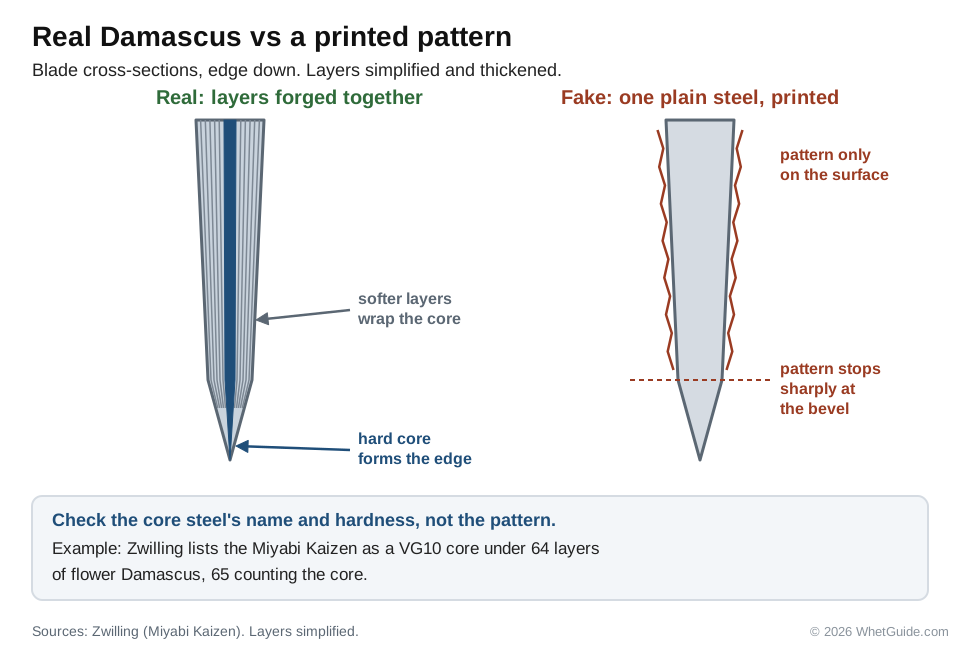
Real Damascus-pattern blades are made from layers of steel forged together, usually around a harder core that forms the edge. The wavy pattern shows where the layers surface after etching. Cheap knives sometimes etch or print a pattern onto a single plain steel, and some don't name the core steel at all. Look for the core steel's name and hardness on the listing. If the pattern ends sharply at the edge bevel with no change in the steel below, or the listing talks only about "layers," be wary. The Miyabi Kaizen is one well-known example: Zwilling lists a VG10 core under a flower Damascus pattern of 64 layers (65 counting the core).
↑ Back to all sectionsHardness (HRC): what the number means and which to buy
HRC is hardness on the Rockwell C scale. The test, as Wikipedia describes it, presses a 120 degree diamond cone with a 0.2 mm rounded tip into the steel under a 10 kgf load, then a 150 kgf load, and measures how far it sinks. A higher number means harder steel, and Wikipedia gives HRC 55 to 66 for very hard steels such as chisels and quality knife blades. When a listing says "Rockwell 60" or "60 HRC," it means the same thing.
What hardness buys you, and what it costs, comes down to two quotes from Knife Steel Nerds: the bigger reason to want higher hardness is "resisting edge deformation," and higher hardness "does lead to improved edge retention." The catch is toughness, which falls as hardness rises. Prudent Reviews puts it in buyer's terms: harder knives at 60 to 66 hold an edge longer but chip more and take longer to sharpen; softer ones at 54 to 57 dull faster and are easier to bring back.
| HRC | Feels like | Best for |
|---|---|---|
| About 56 to 58 | Tough and forgiving. The edge rolls before it chips, and a honing steel pushes it back. | Busy cooks, heavy prep, anyone who hones but rarely sharpens |
| About 59 to 61 | Holds a thin edge noticeably longer. Still reasonably tough. | Most people buying a Japanese-style knife and willing to use a stone |
| 62 and up | Very keen and long-lasting, but chips if twisted, dropped or used on bone | Enthusiasts who sharpen on stones and cut carefully |
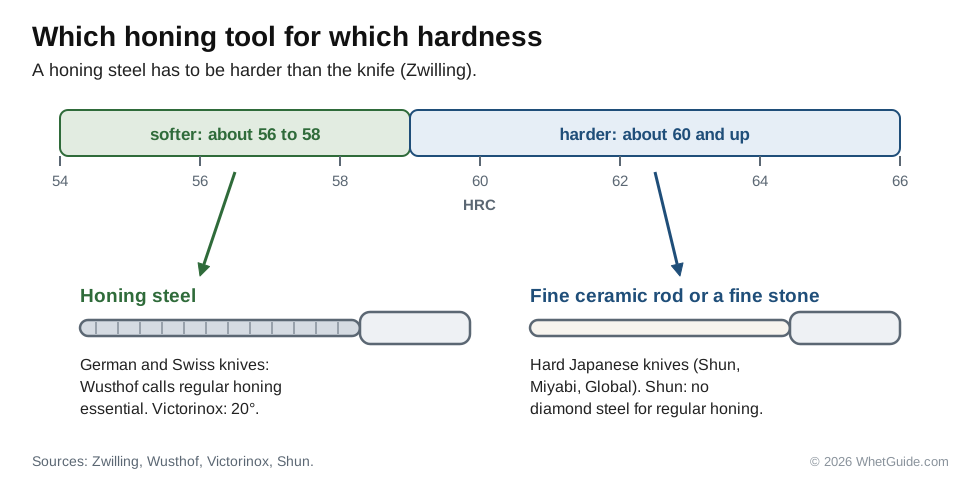
Hardness also decides your honing tool. Zwilling says a honing steel must be harder than the knife, which is why hard Japanese knives go on a ceramic rod or a fine stone instead of a plain steel. Ceramic vs steel honing rods explains which suits which knife. Is 58 good? Yes: it's where Wusthof puts its flagship. Is a 62 HRC knife better? Only if you'll sharpen it properly and keep it away from bones.
↑ Back to all sectionsEdge angle: what the makers actually grind
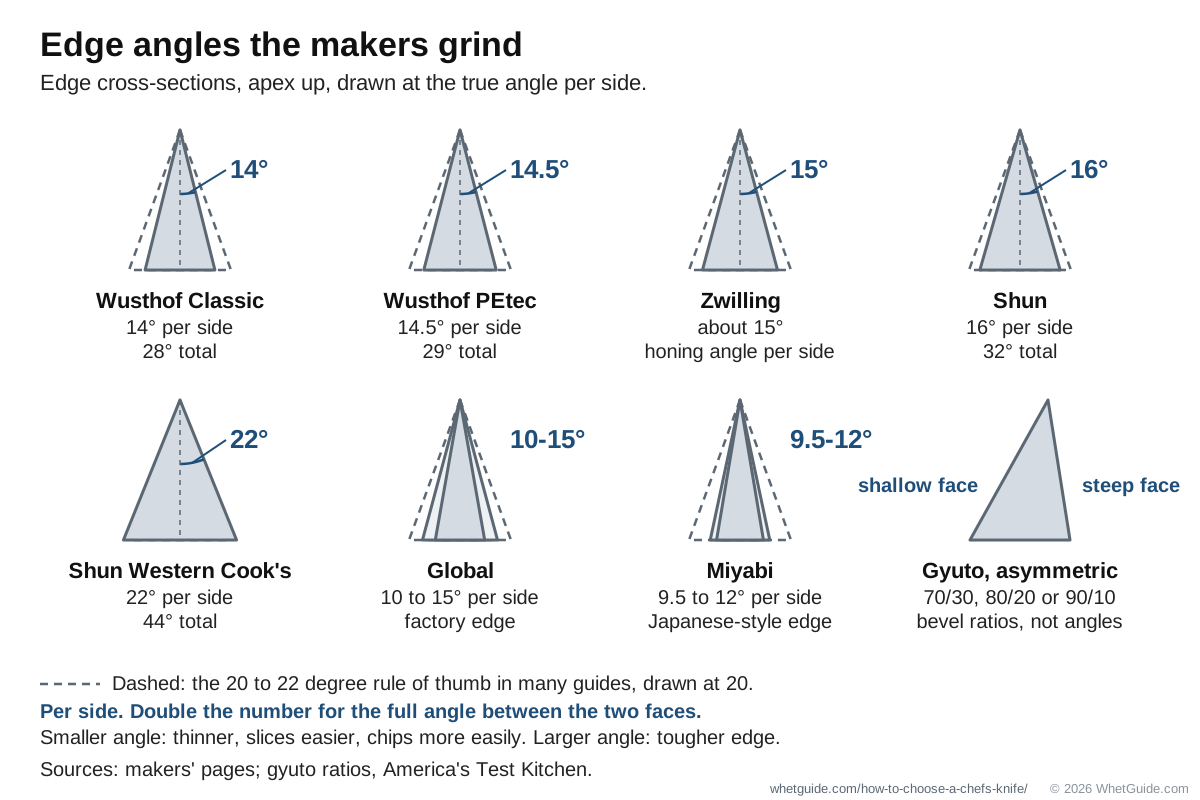
Nearly every buying guide repeats one rule: German knives are sharpened at 20 to 22 degrees per side, Japanese at 15. America's Test Kitchen gives the same figures. It's a fine rule of thumb for older and cheaper Western knives. The makers' own pages tell a different story for the knives most people actually compare.
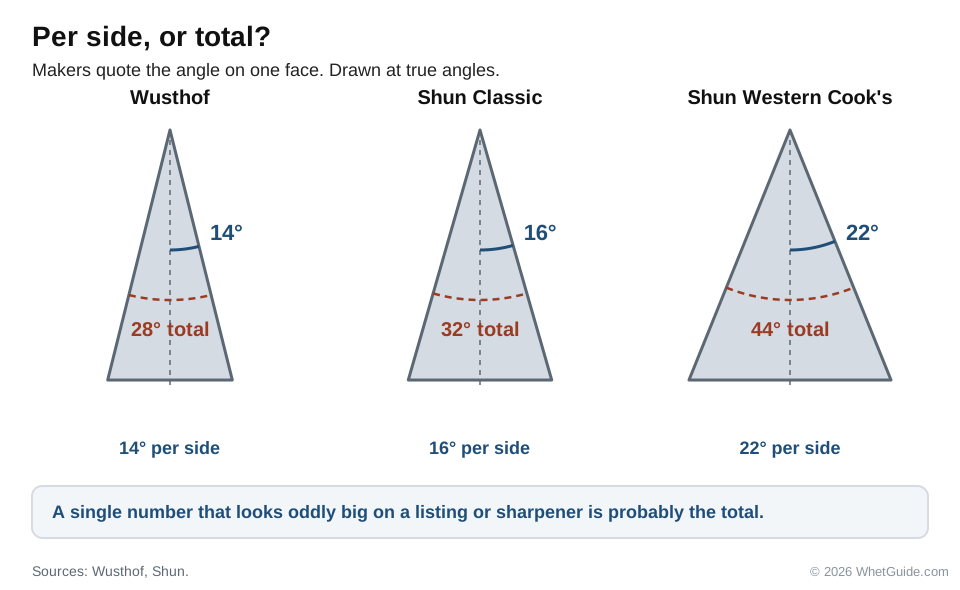
Wusthof says its standard blades are sharpened at 14 degrees per side, and its PEtec page puts its edge at 14.5 against "about 20 degrees per side" for competitors. Zwilling tells owners to hone at approximately 15 degrees. Shun sharpens to 16 degrees on each side, and its own FAQ describes German-style knives as typically ground wider, at about 20 to 25. That's Shun talking about other brands, and Wusthof's own figure says otherwise for its flagship. The one big-name knife on the list that matches the old rule is Shun's Western Cook's Knife, at 22 degrees per side. Victorinox's honing instructions use a 20 degree angle.
Per side or total?
Makers almost always quote the angle per side. The full angle between the two faces is double: a 14 degree Wusthof edge is 28 degrees in total, a 16 degree Shun 32 and Shun's 22 degree Western Cook's Knife 44. If a sharpener or a listing quotes a single number that looks oddly big, it's probably the total.
What the angle changes, and why it should change what you buy
A smaller angle makes a thinner edge. It slices with less force and feels sharper, but it has less steel behind it, so it chips and rolls more easily. Knife Steel Nerds notes that an obtuse edge resists chipping better than an acute one. That's why the finest angles come on the hardest knives: a 10 degree edge on soft steel would fold in a week.
For buying, the angle tells you how you'll sharpen. A pull-through or electric sharpener has fixed slots set at its maker's chosen angle, and it puts that angle on whatever knife goes in. A whetstone or a guided system can match any angle. If you're buying a Miyabi at 9.5 to 12 degrees, plan on stones. Our knife sharpening angle chart lists every brand's figure with its source, and the brand pages go deeper: Wusthof, Zwilling, Shun, Miyabi, Global and Victorinox.
↑ Back to all sectionsForged vs stamped, full tang vs partial, and the bolster
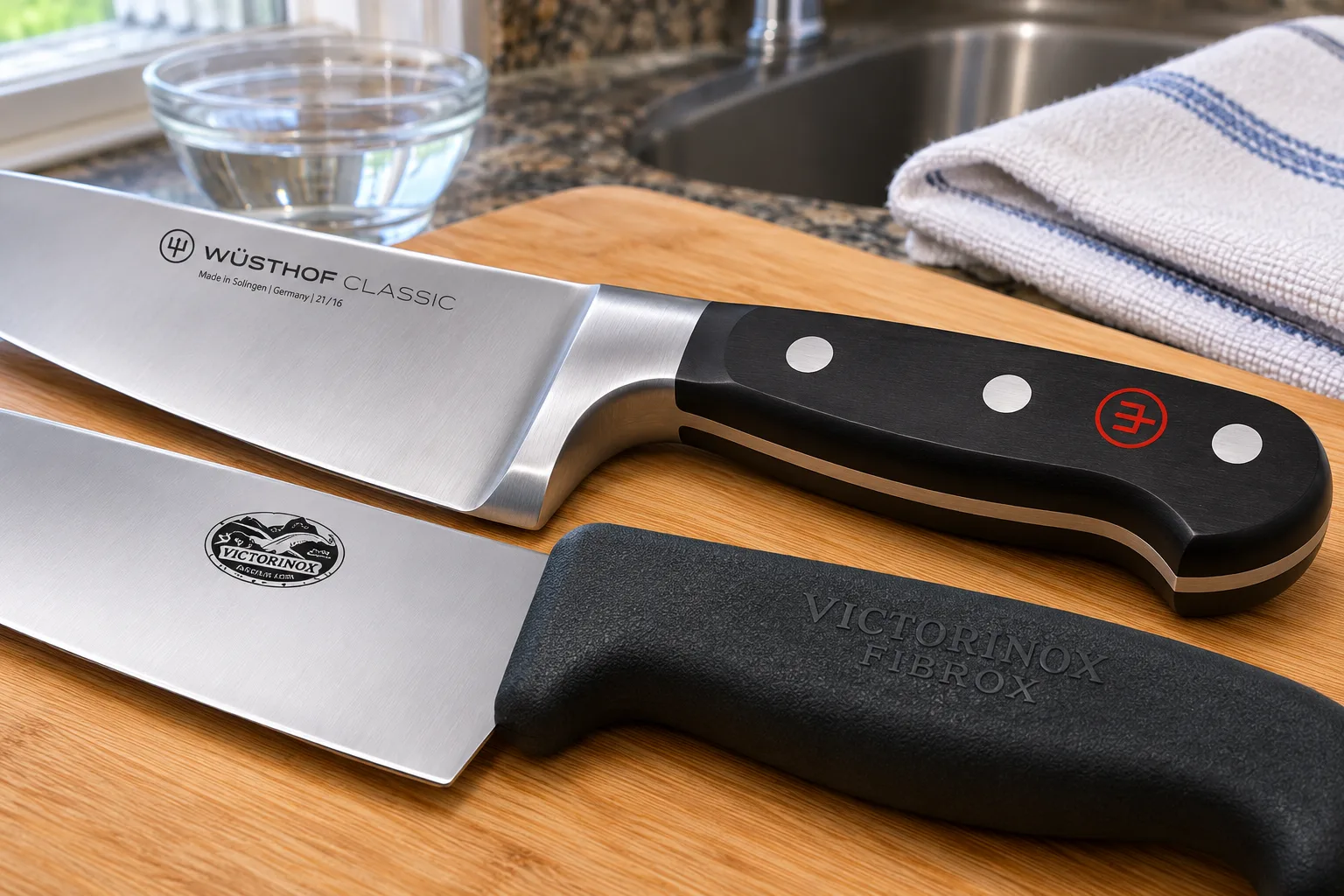
America's Test Kitchen describes the difference simply. A forged knife is pounded from red-hot steel; it's heavier and thicker, with a bolster, which helps the balance and guards your fingers. A stamped knife is cut from a sheet of steel, lighter, and usually has no bolster. ATK's own test cooks split on which they preferred, though the forged knives got through heavy jobs like butternut squash more easily.
Neither is automatically better. Victorinox's Fibrox Pro is stamped (Victorinox lists it as not forged), and it's the most common budget recommendation there is. Prudent Reviews calls the MAC MTH-80 a stamped knife and "one of the best-performing knives" it has tested. Wusthof sells both kinds itself. Its Gourmet 8 inch is listed as non-forged at 56 HRC, and the forged Classic at 58; Wusthof says its stamped blades are lighter and more economically priced. Treat "fully forged" on a box as a description, not a grade.
| Build | Feel | Sharpening | Examples |
|---|---|---|---|
| Forged, full bolster, full tang | Heavy, handle-heavy, solid on hard vegetables | The bolster blocks the stone at the heel; over years the heel can develop a dip. America's Test Kitchen says these knives shouldn't go in electric sharpeners. | Wusthof Classic, Zwilling Professional S |
| Forged, half bolster | Close to the above, a little lighter | The stone reaches the whole edge | Wusthof Classic Ikon |
| Stamped, no bolster | Light and quick, balance further forward | Easiest to sharpen heel to tip, on any sharpener | Victorinox Fibrox Pro; MAC MTH-80, according to Prudent Reviews |
| Japanese, no bolster, partial tang (wa handle) | Light, blade-heavy | Stone reaches the whole edge; hard steel wants stones | Many gyutos |
Tangs come in three kinds: full (the steel runs the whole length of the handle, visible between the scales), partial, and rat-tail (a thin rod hidden inside the handle). A full tang adds strength and weight toward the back. A partial tang isn't a flaw on a Japanese wa handle, which is built around it; on a cheap Western knife with a hollow-feeling handle, it can be.
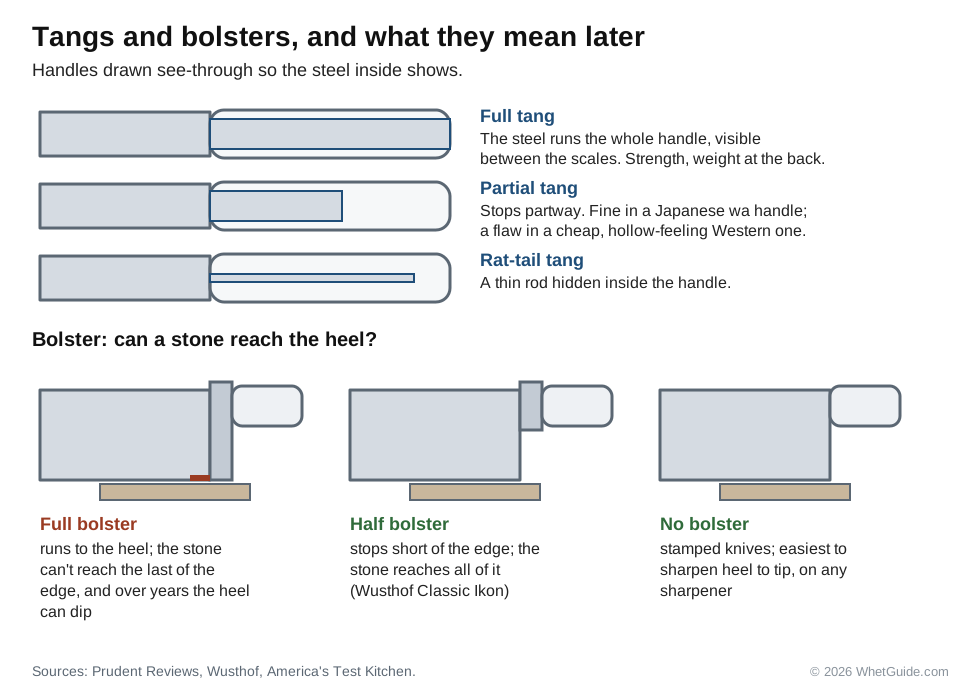
The bolster is the part with real consequences later. Prudent Reviews notes that a full bolster makes sharpening harder, because the stone can't reach the edge right next to it. So check for a full bolster, a half bolster or none before you buy. If you plan to sharpen at home, half or none makes life easier. That's one reason the bolster-free Victorinox is a common first knife for people learning on a stone.
↑ Back to all sectionsHow much to spend: budget tiers
Consumer Reports found 8 inch chef's knives priced from as little as $5 to more than $100, and the chef it consulted, Branden Lewis of Johnson and Wales, gives blunt advice: spend under $20 or over $100. In its tests one $20 knife did a decent job, the most ergonomic knife cost $40, and every other recommended knife cost $100 or more. The middle isn't forbidden, but it's where you most often pay for a brand name and a box.
What the extra money buys, in rough order: forging and weight, harder steel and a finer edge, fit and finish, a nicer handle, a warranty. What it doesn't buy is sharpness on day 400. A $40 knife you sharpen beats a $170 one you don't.
Consumer Reports suggests that a "lifetime" knife should come with a lifetime warranty or a mail-in sharpening and repair service. If yours doesn't, a mail-in sharpening service fills the gap; what sharpening services cost has the prices. Either way, set aside a little for a honing rod, because every knife on this page needs one or a fine stone.
Skip the knife set: buy three knives instead
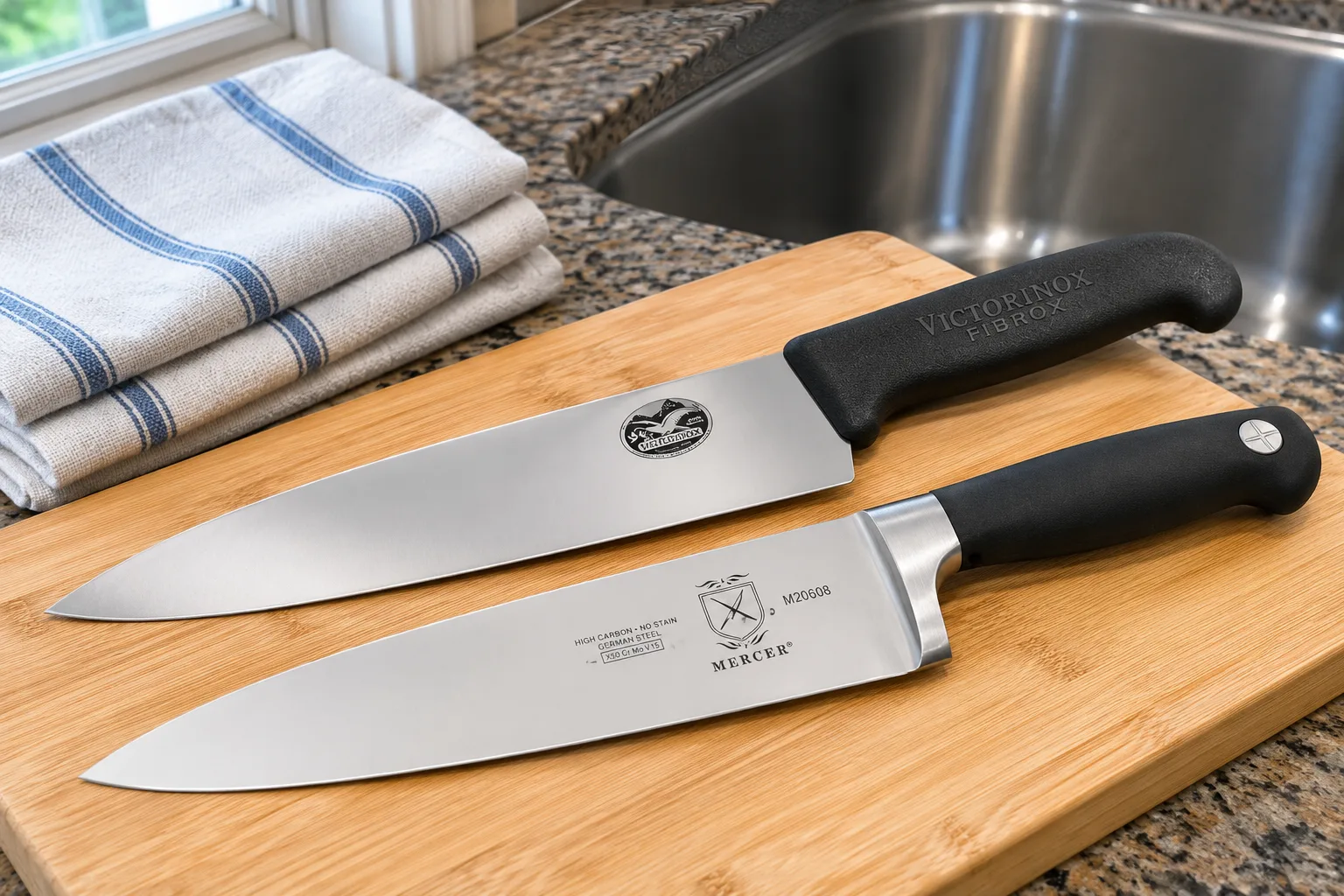
Consumer Reports' first rule is say no to knife sets, and its second is to then get a great bread knife. Prudent Reviews calls big 14 to 16 piece sets wasteful and names the same essentials: an 8 inch chef's knife, a bread knife and a paring knife. Those three are the "holy trinity" people ask about.
- The chef's knife. Spend most of your budget here. It does about 95 percent of the work.
- A serrated bread knife. It handles crusty bread, tomatoes and cake, the jobs that dull a chef's knife fastest. Serrations sharpen differently; see how to sharpen a bread knife.
- A paring knife. For peeling, hulling, trimming and anything you do in your hand.
After that, buy only what you miss: a boning knife if you break down chickens, a long slicer for roasts, a santoku or nakiri for vegetable days. A set sells you the knives you'd never choose, plus a block with slots you'll fill with the wrong things. Prudent Reviews also advises against self-sharpening blocks; if you're considering one anyway, read our notes on knife block sets with sharpeners first.
Without a block, store the knife on a magnetic strip, in an in-drawer knife dock, or in a blade guard. Global lists a block, a magnetic rack, a dock or a knife roll as good homes, and the chefs the Michelin Guide interviewed say to keep knives from touching other metal. A loose knife in a utensil drawer dulls every time the drawer opens.
↑ Back to all sectionsHow to test-hold a chef's knife in a store
Hold it before you buy it. Every expert source we read says some version of that, from the chefs the Michelin Guide spoke to, to Shun's own FAQ. America's Test Kitchen adds the detail that makes it useful: in a specialty shop, ask to hold the knives and, where the shop allows it, gently rock them on a cutting board. Start with the style you already know. The Michelin Guide's experts put it plainly: pick what you're familiar with and what feels comfortable. Here are the six checks, in the order you'd do them, and they match the numbers on the grip diagram above.
- Pinch it. Take a pinch grip on the blade. The bolster or the heel of the blade shouldn't dig into the side of your index finger, and your fingers shouldn't feel pushed back off the blade.
- Feel the spine and the choil. Run your thumb along the top of the blade and over the little step where the edge ends. Prudent Reviews flags sharp spines and choils as a common annoyance; they rub raw on a long prep day.
- Check your knuckles. Rest the edge flat on the counter or a board and grip the handle normally. Your knuckles should clear the surface. If they don't, you need a taller blade, about 1.75 to 2 inches at the heel by Prudent Reviews' guide.
- Fill your palm. The handle should fill your hand without molded grooves forcing your fingers into place, as Consumer Reports warns. Check that your little finger has somewhere to go.
- Rock it. If the shop allows, rest the tip on a board and rock the heel up and down, then try a push cut motion. Does the profile match the way you cut?
- Feel the tip. Find the balance point on one finger, then make a few slow chopping motions in the air. The tip shouldn't feel heavy or whippy.
One extra check if the staff will let you: pinch the blade about a quarter inch above the edge (the Prudent Reviews test). Thin and tapering is good; thick all the way down means it will wedge in hard vegetables.
Buying online: the returns checklist
Most people end up buying online, which is fine if you can send it back. Consumer Reports' advice is to try knives first or buy where returns are generous.
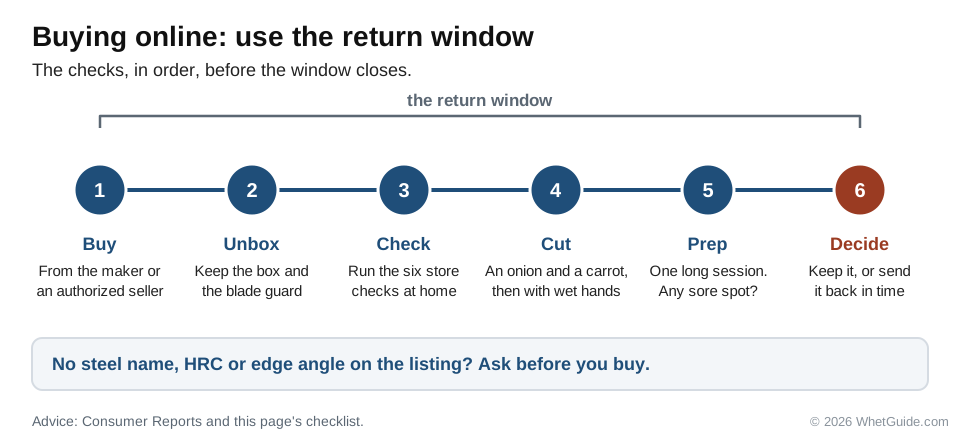
- Check the return window is long enough to cut a few dinners with it, and keep the box and the blade guard until you're sure.
- At home, run the six store checks above, then cut an onion and a carrot. Do one round with wet hands to test the grip.
- Buy from the maker or a seller the maker lists as authorized. Popular knives get copied, and a big-name knife at a fraction of its usual price is a warning.
- Do one long prep session before the window closes. If your hand tires or one spot on a finger gets sore, the handle doesn't fit you. Send it back.
- Read the listing for the steel name, the HRC and the edge angle. If any of them is missing, ask. A seller who can't say what steel it is has told you something.
Which steel, and what hardness (HRC)? Forged or stamped? Full, half or no bolster? Full or partial tang? What's the edge angle per side? How much does it weigh, and how tall is it at the heel? How long is the handle? Is it dishwasher safe according to the maker? What's the warranty, and is there a sharpening service? What's the return window?
Picks by type of cook
These are the knives that come up again and again in the guides and forums we read, matched to the cook each one suits. Every spec is from the maker unless we name a store or a reviewer. We have no favorite here; the right one is the one that passes your six checks.
First knife, smallest budget
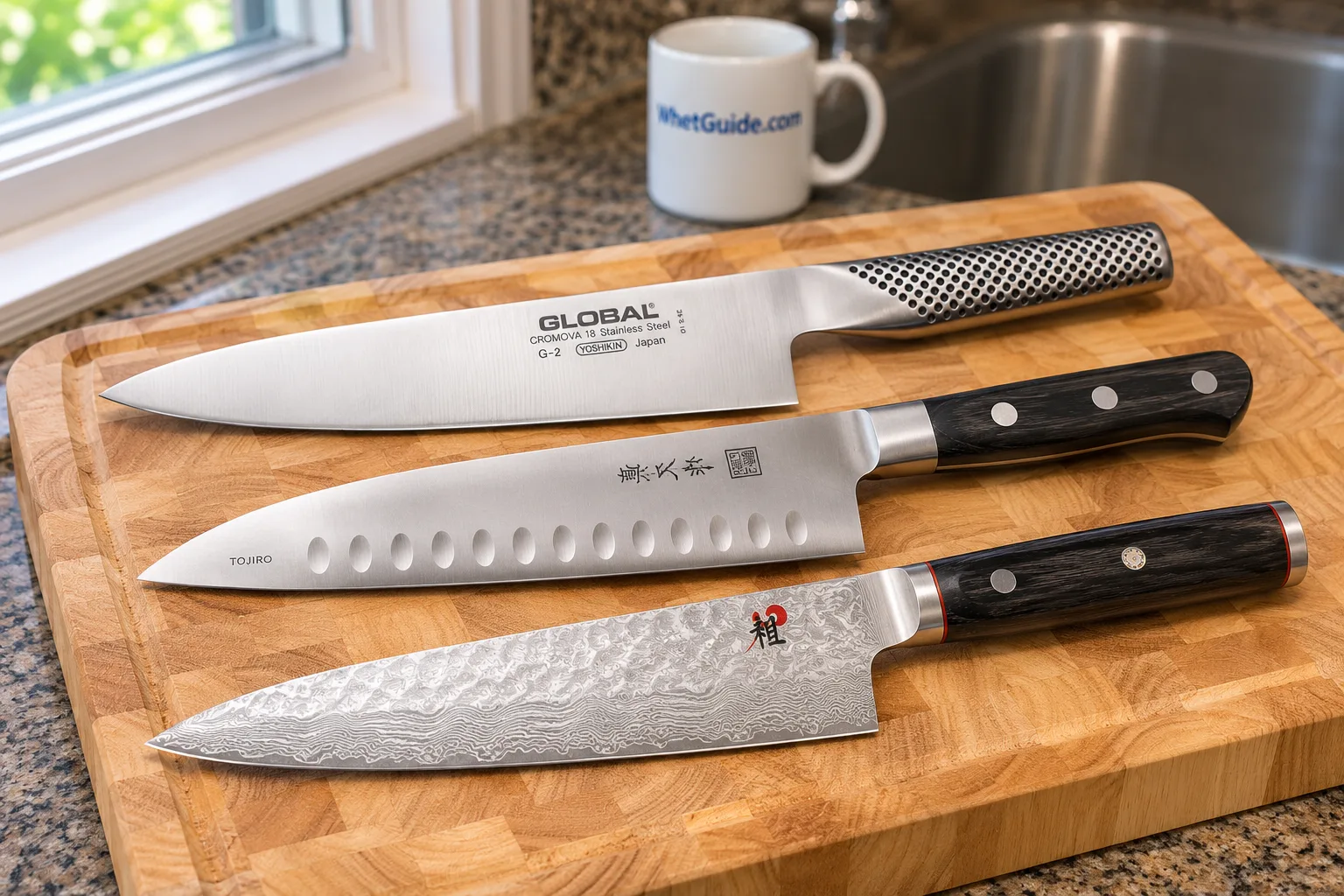
Mercer Millennia 8 in, about $20, which puts it on the cheap side of Consumer Reports' "under $20 or over $100" line. Or the Mercer Genesis 8 in, about $40, if you'd rather spend a little more.
First knife, the consensus pick
Victorinox Fibrox Pro 8 in. Stamped, Swiss made, 6.4 oz, a 7.9 in blade and no bolster to fight on a stone. Victorinox calls it dishwasher safe. About $50.
German workhorse
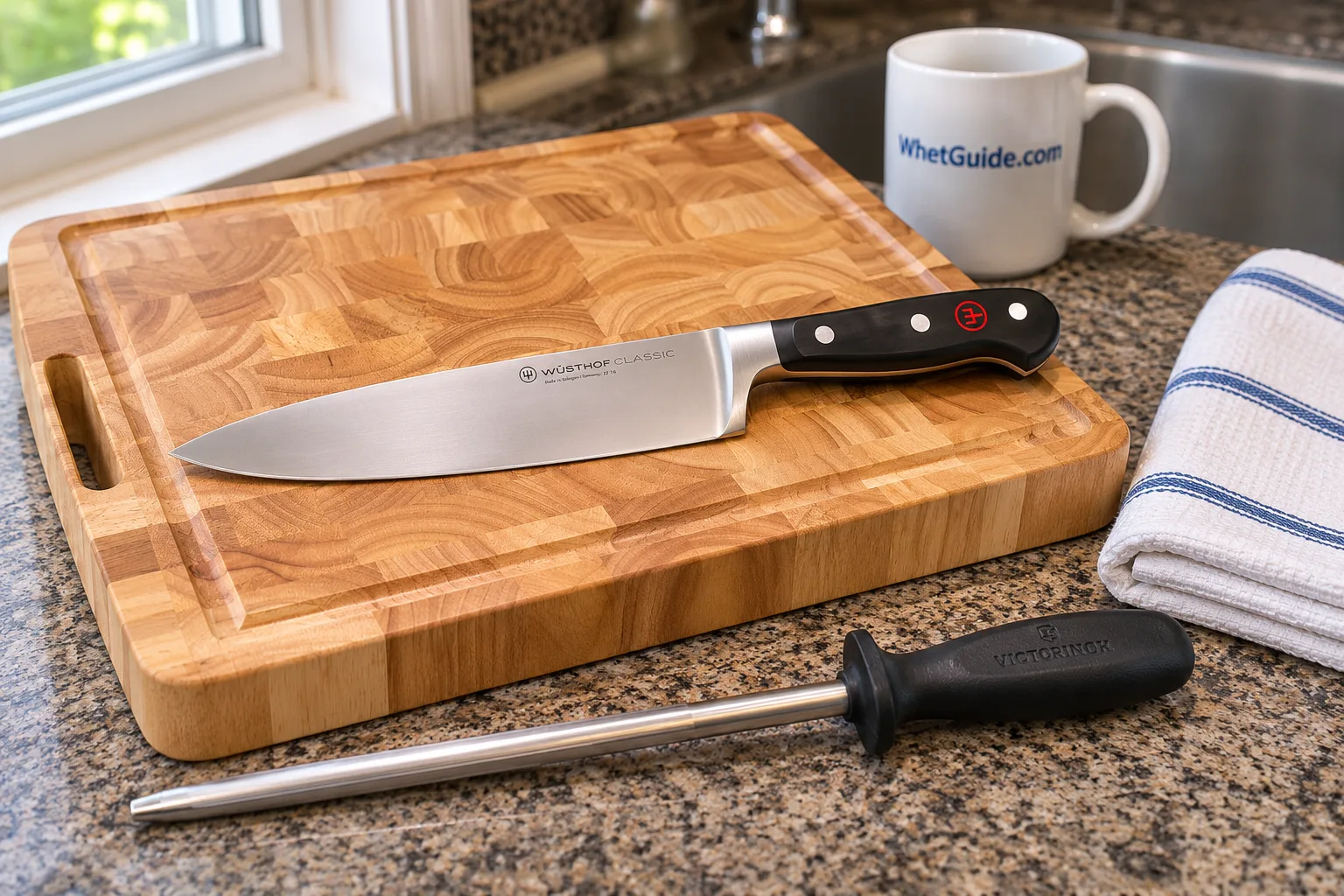
Wusthof Classic 8 in: forged, 58 HRC, 14° per side, $170 list. Or the Zwilling Professional S 8 in, 57 HRC by store listings, about $120. Hold both; buy the handle you like.
First Japanese knife
Tojiro DP-line gyuto, 210 mm, sold on Amazon as the Fujitora FU-808. A VG-10 core at about 60 HRC, according to store listings. About $92.
Thin and light, Western handle
MAC MTH-80: 6.5 oz, 2.5 mm thick and 1.88 in tall, by MAC's figures. Hardness is 59 to 61 depending on the source. About $160.
Hard Japanese steel, right hand
Shun Classic 8 in: VG-MAX at 60 to 61 HRC, 16° per side, and a D-shaped handle Shun designed for right-handed cooks. About $140.
Shun's tougher option
Shun Classic Western Cook's Knife 8 in: Shun grinds it at 22° per side, much wider than its other knives, and points to it for "heavier kitchen work" like breaking down chickens and cutting butternut squash or melons.
All steel
Global G-2 8 in: CROMOVA 18 stainless, factory sharpened at 10 to 15°, hollow all-steel handle with a dimpled grip. The first item on Epicurious's old list of the most important kitchen tools. About $150.
Premium Japanese
Miyabi Kaizen 8 in: VG10 at Rockwell 60, a 9.5 to 12° edge and a flower Damascus pattern over the core, by Zwilling's page. About $170. Plan on whetstones.
Collectors and handmade
Collectors buy on maker, steel and finish, which has little to do with dinner. A handmade knife from a small maker is a lovely second knife. Make it your second.
What your choice means for care
This is the part most buying guides leave to the end, and it's the part that decides whether you still like the knife in five years. Every choice above comes with a care routine. Pick a knife whose routine you'll actually follow.
| Knife | Dishwasher | Board | Honing | Sharpening |
|---|---|---|---|---|
| Stamped stainless (Victorinox Fibrox) | Victorinox says it's dishwasher safe. Hand washing is still kinder to the edge. | Wood or plastic | Victorinox: hone at 20° before or after each cooking session | Victorinox: about once or twice a year |
| German forged (Wusthof, Zwilling) | Wusthof: wash by hand, towel-dry, no soaking or abrasive sponges | Wusthof: avoid metal, glass and hardwoods like bamboo | Wusthof calls regular honing essential. Zwilling: about 15°, on a steel harder than the knife. | Stone, guided system or a service. Watch the heel if it has a full bolster. |
| Hard Japanese (Shun, Miyabi, Global) | Shun and Global: never | Global: no marble, stone, tile or glass | Shun: no diamond steel for regular honing. Fine ceramic rod or a strop. | Whetstone at the maker's angle |
| Wood handle (any steel) | Hand wash and towel-dry, never soak | Wood or plastic | As for its steel | As for its steel. Wusthof: oil wooden handles now and then with food-grade mineral oil. |
| Carbon steel | Never | Wood or plastic | As for its hardness | Easy on stones. Dry it the second you finish. |
Sources: Wusthof, Victorinox, Shun, Global, Zwilling and the Michelin Guide.
Two details are easy to miss. Bamboo boards are sold everywhere, yet Wusthof's own care note lists bamboo among the hardwoods to avoid, so a Wusthof owner should pick a different board. And the dishwasher rules differ by maker: Victorinox is the exception, not the rule. The chefs in the Michelin Guide piece explain why hand washing wins anyway: dishwasher detergent is caustic and abrasive.
Two more small ones. Don't leave food to dry on the blade: CHOICE warns that some foods contain acid that can stain it for good, so wipe off tomato, citrus and onion as you go, and do it sooner on carbon steel, which discolors anyway. And the safe boards aren't only wood and plastic. Maumasi, one of the experts in the Michelin Guide piece, also suggests the dense rubber boards sushi chefs use.
Honing vs sharpening
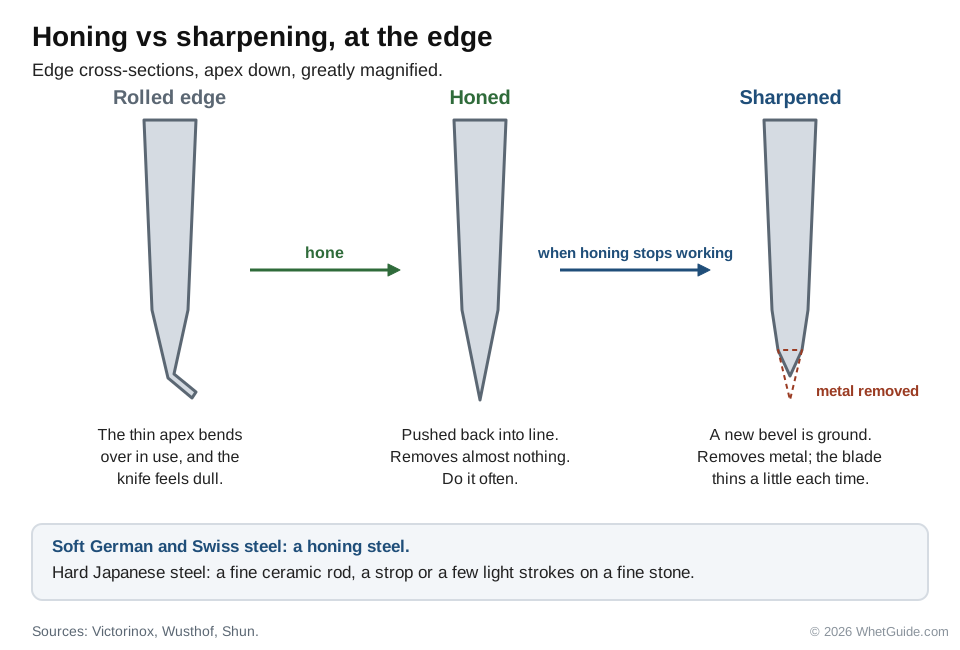
Honing pushes a bent edge back into line and removes almost nothing. Sharpening grinds new metal, and Victorinox points out that each sharpening thins the blade a little. Hone often, sharpen when honing stops bringing the edge back. Soft German and Swiss steel responds well to a honing steel. Hard Japanese steel rolls less and chips more, so it gets a fine ceramic rod, a strop or a few light strokes on a fine stone. The full method is in how to use a honing rod, and how often to sharpen knives sets a schedule.
The sharpener matters as much as the knife. America's Test Kitchen says knives with a bolster shouldn't go through electric sharpeners, because the wheels can't reach the whole edge. A fixed-angle pull-through also imposes its own angle on a knife ground at 10 or 14 degrees. Read are pull-through sharpeners bad? before you put a good knife through one, and how to sharpen kitchen knives for every method side by side.
- Wash it by hand right after use and dry it at once.
- Cut only on wood or plastic, never on a plate or a stone counter.
- Hone it before or after each cooking session, at the maker's angle.
- Store it in a block, on a magnetic strip or in a guard, not loose in a drawer.
- When honing stops working, sharpen it, on a whetstone or through a service.
Common buying mistakes and how to avoid them
| Mistake | Why it hurts | Do this instead |
|---|---|---|
| Buying a 15-piece block set | Most of the money goes on knives you won't use; the one you use daily is mid-range | Buy one good chef's knife, then a bread knife and a paring knife |
| Chasing the highest HRC | Very hard steel chips if twisted, dropped or used on bone, and it needs stones | Match hardness to how you'll sharpen. 58 is a fine number. |
| Trusting "professional" on the box | There's no standard behind the word | Look for the steel name, the HRC and the edge angle |
| Buying the Damascus pattern | The pattern doesn't cut, and some is etched or printed | Check the core steel and its hardness |
| Buying a handle you never held | Grooves, a hard choil or a slick finish ruin daily use | Do the six store checks, or buy with easy returns |
| Going too long or too short | A 10 inch hangs off a small board; a 6 inch struggles with a cabbage | Start at 8 and adjust for hands and board |
| Buying care you won't give | Carbon steel rusts in a wet sink; a hard Japanese edge chips in a pull-through | Pick a steel and an angle that fit your real habits |
| Ignoring the bolster | A full bolster makes the heel hard to sharpen and blocks electric sharpeners | If you'll sharpen at home, prefer a half bolster or none |
| A listing with no steel named | You can't judge hardness, toughness or care | Ask the seller, or buy something else |
| Cutting on glass or stone, or using the dishwasher | Flattens or chips the edge within days | Wood or plastic board; hand wash and dry |
Chef's knife buying cheat sheet
Everything above on one card. Screenshot it before you go to the store, or print it.
| Length | 8 in (20 cm, or a 210 mm gyuto) for most cooks. 6 to 7 in for small hands. 10 in for large hands and big boards. |
|---|---|
| Style | German: heavier, curved, rocks, forgiving. Japanese: lighter, flatter, push cuts, harder, wants stones. |
| Steel | High-carbon stainless for most. Carbon steel only if you'll dry it every time. Damascus pattern is decoration. |
| Hardness | 56 to 58 HRC: tough, hones on a steel. 59 to 61: thin edge, stones. 62 and up: enthusiasts. |
| Edge angle | Per side, from the makers: Wusthof 14, Zwilling about 15, Shun 16, Global 10 to 15, Miyabi 9.5 to 12. Double it for the total. |
| Build | Forged or stamped both work. A full bolster adds weight and makes the heel harder to sharpen. |
| Handle | Fills the palm, no molded grooves, smooth spine and choil, grips when wet. D-shapes favor one hand. |
| Budget | Under about $50 (Consumer Reports says under $20; our $50 takes in the Fibrox Pro), or over about $100. Spend on one knife, not a set. Look for a warranty or sharpening service. |
| In the store | 1 pinch it. 2 feel the spine and choil. 3 knuckles clear the board. 4 handle fills the palm. 5 rock it. 6 feel the tip and the balance. |
| Online | Generous returns. Authorized seller. Steel, HRC and angle named on the listing. |
| Care | Hand wash and dry. Wood or plastic board. Hone often. Sharpen when honing stops working. |
whetguide.com/how-to-choose-a-chefs-knife/
Next: keep the knife you chose sharp
Choosing the knife is the short part. Keeping it sharp is the part that lasts, and it's what this site is about. Start with how to use a honing rod for the daily habit, then how to use a whetstone when the edge needs real sharpening. The knife sharpening angle chart gives the right angle for your brand, and how often to sharpen knives tells you when. Hard Japanese knives have their own notes in sharpeners for Japanese knives, and if you'd rather never touch a stone, mail-in sharpening works for any knife on this page.
Not a kitchen knife? Fixed-blade and folding knives follow the same rules of steel, hardness and angle, with their own sharpening quirks: see pocket knives, hunting knives and, for the boning and fillet knives a barbecue cook leans on, fillet knives.
Sources: Wusthof, Classic 8" Cook's Knife (hardness, angle, dimensions, price, care) and What is PEtec; Shun, FAQ (angles, hardness, VG-MAX, D handle, care, honing); Zwilling, knife sharpening guide and Miyabi cutlery; Global, knife care; Victorinox, Fibrox Pro Chef's Knife and how to sharpen your kitchen knife; MAC, MTH-80; Misen, chef's knife; Consumer Reports; America's Test Kitchen; Michelin Guide; Knife Steel Nerds; Prudent Reviews (reviewer benchmarks, attributed where used); Cutlery and More; Yakushi (forearm rule); Made In (santoku length); Wikipedia, Chef's knife and Rockwell scale. Maker pages read November 14, 2026. Hardness figures not published by the maker are labeled as store listings or reviewer figures. Prices are Amazon listings on November 14, 2026, except Wusthof's list price. Metric conversions are calculated. How we research