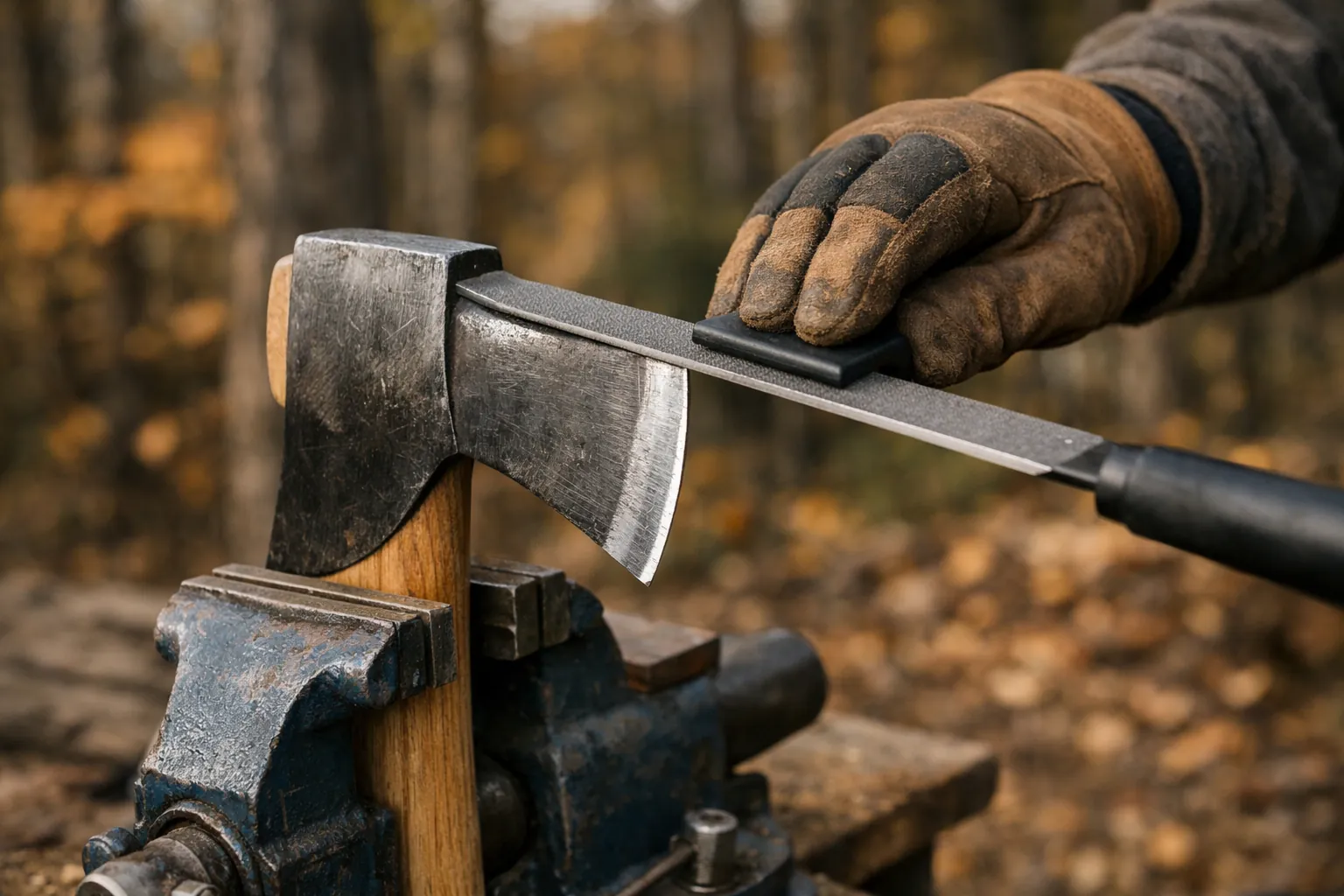
Sharpen a general-purpose axe to about 25 degrees with a slightly convex edge. That's Council Tool's figure, and the US Forest Service's axe manual lands in the same place for the very edge: a bevel around 18 degrees with a 25 degree microbevel at the tip. Neither source says whether its number is per side or total, so the reliable way to match your axe is a notch gauge, which you can cut from cardboard with the dimensions below. For the full process, see how to sharpen an axe with a file and puck. For knives, see our knife sharpening angle chart. Tools that hold that angle are in our best axe sharpener guide.
What the axe sources say
| Source | Angle | Shape |
|---|---|---|
| Council Tool, "How to sharpen an axe" | "about 25 degrees" | "slightly convex" |
| USDA Forest Service, An Ax to Grind, ch. 8: general | bevel about 18°, microbevel about 25°; figure gives 17–21° and 25–32° | Convex profile "works best for general chopping purposes" |
| Forest Service: double-bit ax | keen edge about 18° (clear wood); stunt edge up to 28° (knots, limbing) | One bit thin, one bit tough |
| Forest Service: racing ax | a bevel of 14° | Competition only |
The Forest Service manual also explains why the angle isn't the whole story. An axe edge blends back into its cheeks, and if the cheeks are too thick the axe glances off the wood however keen the edge is. That's why both sources talk about the profile as much as the bevel.
Angle by axe job
Only the felling and double-bit figures below come straight from the sources. The rest are our starting points, built from the same logic: thinner where the axe slices wood fibers, tougher where it hits knots, frozen wood or the ground.
| Axe | Starting point | Where it comes from |
|---|---|---|
| Felling or general chopping axe | about 25°, slightly convex (or an 18° bevel with a 25° microbevel) | Council Tool; Forest Service |
| Double-bit, clean wood side | about 18° | Forest Service (keen edge) |
| Double-bit, knots and limbing side | up to 28° | Forest Service (stunt edge) |
| Hatchet for camp and kindling | about 25°, a little steeper if it hits the ground | Our suggestion from Council Tool's figure |
| Splitting axe or maul | keep the existing wedge; just remove burrs and dings | Our suggestion: these split by wedge shape, not edge keenness |
| Carving axe | thinner than a chopping axe; follow the existing bevel | No maker figure found |
Make a notch gauge (printable dimensions)
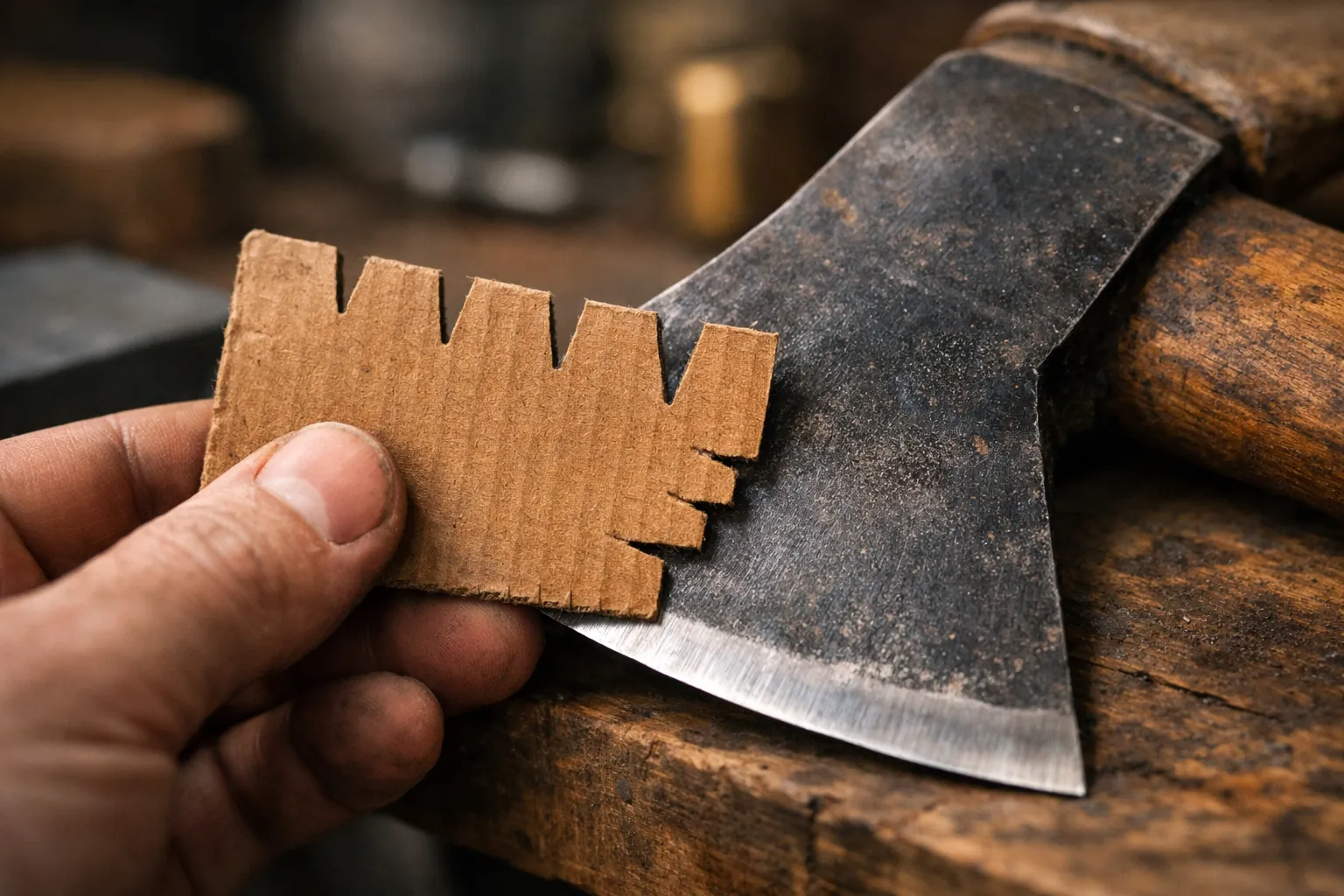
The Forest Service manual says an ax gauge "is the easiest way to determine if you have the correct angle". You can make one from stiff cardboard or a plastic lid. Cut a row of V-notches, each 1 inch (25 mm) deep, with these openings at the top. The opening is the total angle across both cheeks of the edge.
| Notch (total angle) | Opening at 25 mm depth | Opening at 1 in depth |
|---|---|---|
| 20° | 8.8 mm | 0.35 in |
| 25° | 11.1 mm | 0.44 in |
| 30° | 13.4 mm | 0.54 in |
| 35° | 15.8 mm | 0.63 in |
| 40° | 18.2 mm | 0.73 in |
| 50° | 23.3 mm | 0.93 in |
Opening = 2 × depth × tan(total angle ÷ 2). A notch's total angle is twice the per-side angle: the 50° notch is 25° per side.
Slide the axe edge into each notch. The one where both cheeks touch the sides right at the edge is your axe's current angle. Since the sources don't say per side or total, this tells you which reading your axe was ground to: if it fits the 25° notch, Council's "25" is a total for your axe; if it fits the 50° notch, it's per side. Keep sharpening to whichever notch it fits, then check again as you work. Our angle calculator converts per side and total if you need it.
Convex, not flat
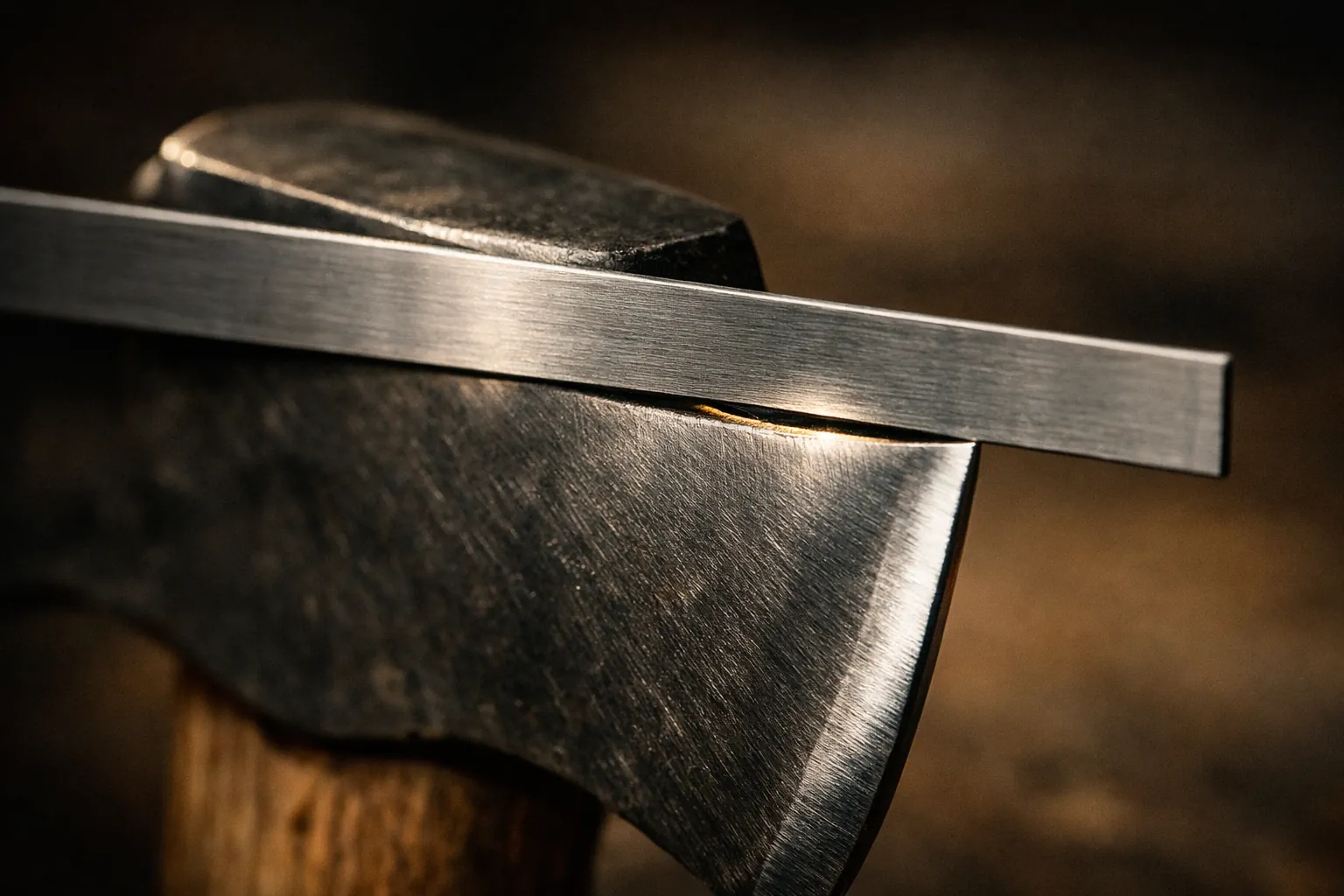
The Forest Service manual describes three profiles. Convex is its basic shape for a work axe: it splits the wood apart, releases easily and is thicker and more durable at the edge. Flat profiles penetrate deeper but stick. Chisel profiles are for broad axes used to shape timber, not to chop. Council Tool's "slightly convex" says the same. In practice that means you don't hold one rigid angle the way you would on a knife; you rock the file or stone slightly as you work toward the edge so the bevel blends into the cheek.
How to sharpen it: file, stone, strop
- Secure the axe. A vise, or the head braced on a log with the edge up. Wear cut-resistant or leather gloves; the Forest Service manual says at least on the hand that may touch the edge.
- File the shape. Use a mill or bastard file with a handle and a guard. Push the file into the edge and lift it on the return; don't saw back and forth, since the file only cuts on the push. Council Tool and the Forest Service both say to file into the edge, not off it, to avoid rolling it.
- Raise a burr. When a wire edge appears on the far side, turn the axe over and file the other side until the burr moves back.
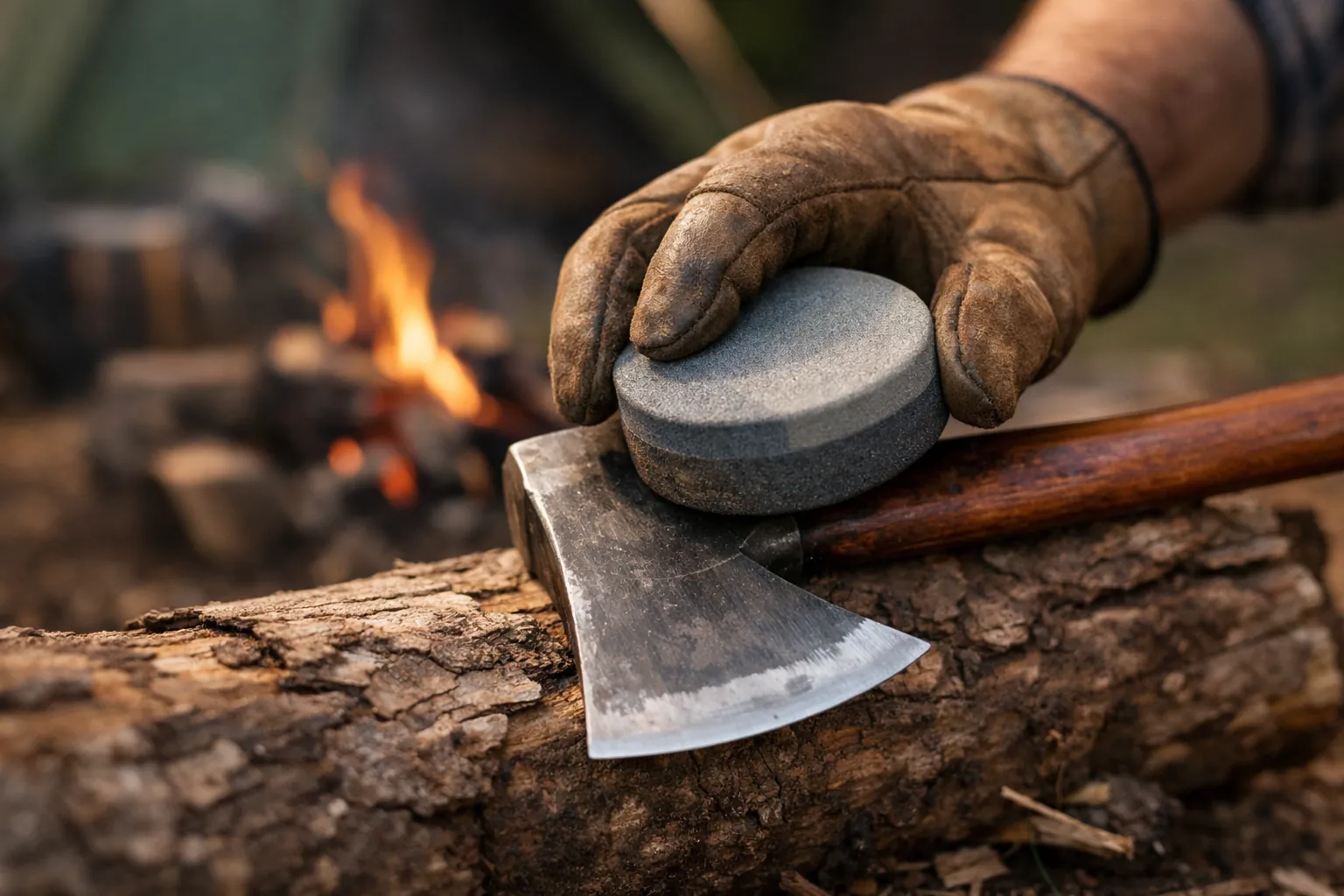
- Hone. Switch to a round axe stone or a diamond plate. The Forest Service describes working the coarse side in circles along the bevel up to the edge, then the fine side. Finish the microbevel on a fine stone.
- Strop. The manual says stropping removes the last thread of burr better than honing does. A leather strop on a board works.
If you use a grinder or belt sander, go slowly. The Forest Service warns that heat near the thin edge can "ruin the temper", and that blue or purple discoloration means you should stop immediately. The marker trick works on axes too: color the bevel, take a few strokes, and see where the ink came off. The sharpie trick guide explains the patterns.
Tools for the job
- The Lansky Puck is a dual-grit round sharpener with more than 18,000 Amazon ratings: the classic axe stone shape the Forest Service describes.
- The DDF IohEF axe and hatchet stone is a round 180/320 grit stone with a carry bag, and its listing names hatchets, machetes and tomahawks.
- A SHARPAL 181N dual-grit diamond file has 325 and 1200 grit diamond faces for shaping and honing, and its leather sheath doubles as a strop, per the listing.
- For a powered option, the Work Sharp MK2's flexible belts and two-speed motor are listed for axes and garden tools. Our Work Sharp MK2 vs Ken Onion comparison covers both belt sharpeners.
- Pruners and loppers are sharpened on one face only, so they need a different approach; see how to sharpen pruning shears.
Most axe owners also carry a knife. Hunting season pairs the two, and our best knife sharpener for hunting knives guide picks field sharpeners that handle both.
Angles and methods quoted from Council Tool's "How to sharpen an axe" and the USDA Forest Service's "An Ax to Grind", chapter 8, both checked October 3, 2026. Gauge dimensions calculated. Product details from Amazon listings checked the same day. How we research · Affiliate disclosure