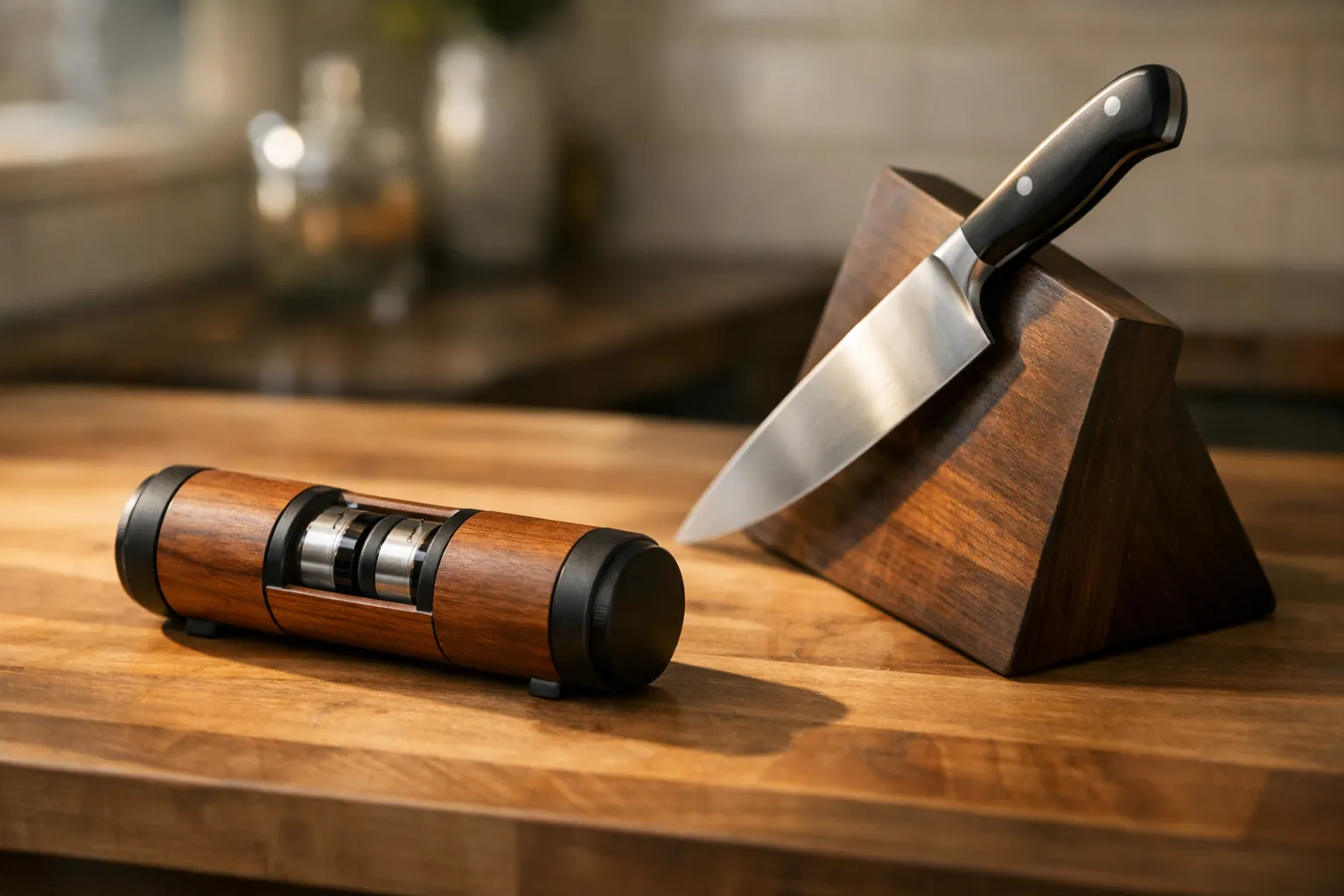
The best rolling knife sharpener for most kitchens is the HORL 3 Cruise. It is German-made, needs no setup and sold about 1,000 a month on Amazon at the Oct 3 check. The Tumbler Pro is the one to buy if you want a ceramic honing disc and whetstone discs later, and the AIERLIAN kit is the budget best seller at roughly four times the volume. Every rolling sharpener works the same way: a magnet holds the knife at 15 or 20 degrees and you roll a diamond disc along the edge. That makes them easy, and it caps what they can do. If your knives are below 15 degrees, read rolling sharpener vs whetstone before you buy.
↑ SectionsQuick answer: which rolling sharpener to buy
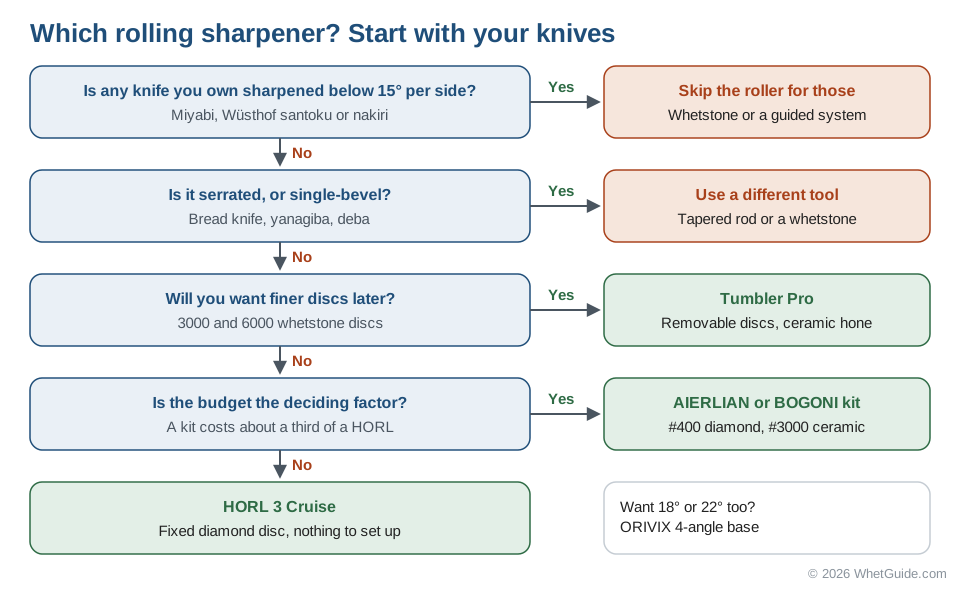
Buy the HORL 3 Cruise if your knives are ordinary double-bevel kitchen knives and you want a tool you can't set up wrong. It has one diamond disc that never comes off and one steel honing disc, and the block gives 15° and 20°. Spend less with the AIERLIAN kit, which adds a ceramic finishing disc and a leather strop at about a third of the price. Get the Tumbler Pro if you think you'll want finer whetstone discs later.
| What's in your drawer | Get | Why |
|---|---|---|
| German and Japanese double-bevel knives, no fuss wanted | HORL 3 Cruise | Fixed diamond disc, nothing to swap or lose |
| The same knives, smaller budget | AIERLIAN kit | #400 diamond, #3000 ceramic and a strop in the box |
| Hard Japanese steel, and you like a polished edge | Tumbler Pro | Ceramic hone now; 3000 and 6000 whetstone discs later |
| A gift with a name the recipient will know | Tumbler Original | Wood body, the brand's best seller |
| Pocket knives between 15° and 20°, or a few odd angles | ORIVIX 4-angle | 15°, 18°, 20° and 22° faces, four grits |
| The cheapest kit you can trust | Wooden kit | 1,200+ ratings; diamond and ceramic discs |
| Miyabi, thin santokus, single-bevel or serrated | None of these | A roller can't make those edges; use a stone or rod |
Quick picks
| Best overall | HORL 3 Cruise | Amazon |
|---|---|---|
| Best budget pick | AIERLIAN rolling knife sharpener kit | Amazon |
| Best for upgrading later | Tumbler Pro | Amazon |
| Most popular premium roller | Tumbler Original | Amazon |
| Runner-up on a budget | BOGONI rolling knife sharpener, Classic Kit | Amazon |
| Most angles | ORIVIX rolling sharpener with 4-angle base | Amazon |
| Budget kit with a strop | Rolling sharpener kit with leather strop | Amazon |
| Lowest-price kit with 1,000+ ratings | Wooden rolling knife sharpener kit (15°/20°) | Amazon |
How we picked
We pulled every rolling sharpener on Amazon's first two pages for "rolling knife sharpener" on October 3, 2026, with "bought in the past month" counts and ratings. The AIERLIAN kit led at about 4,000 a month, a BOGONI kit followed at about 3,000, and the Tumbler Original, HORL 3 Cruise and a four-angle kit each showed about 1,000. We then read each listing for disc grits and angles, and for what it says comes in the box. One caution: Tumbler's models share one Amazon review pool (3,388 ratings) and HORL's another (4,463), so their star counts don't separate one model from another. How we research.
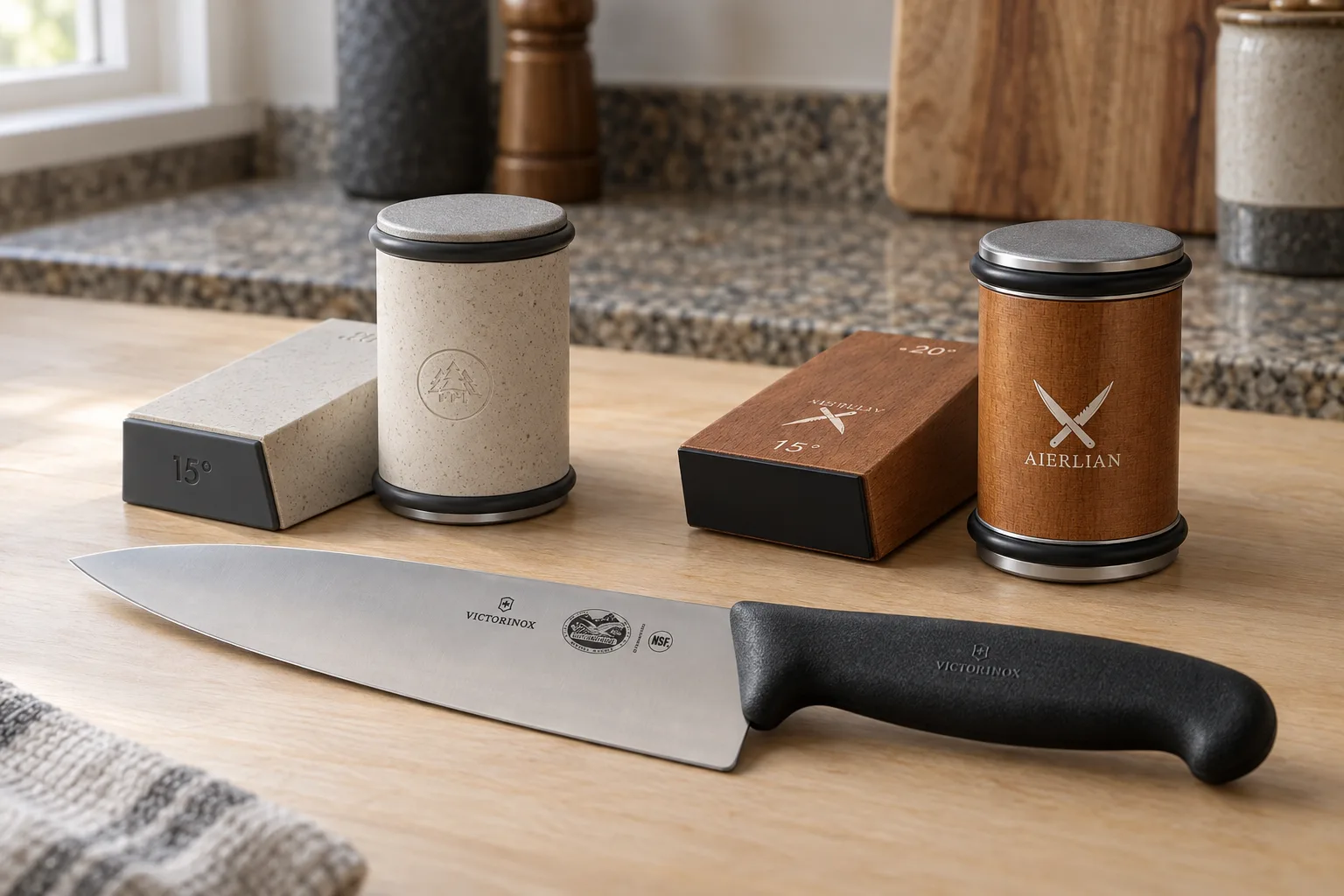
On November 14, 2026 we went back to the listings and rechecked every product link. We also read the reviews that rank for this search (Outdoor Life, GearJunkie, Prudent Reviews, Borough Kitchen and The Wearify), plus what search results show of Reviewed.com and Zelpio. Where a number or a limit comes from a reviewer, the page names the reviewer.
Where reviewers disagree with us
| Reviewer | Their top roller | What drove it |
|---|---|---|
| Outdoor Life (updated March 2026) | Work Sharp Rolling Knife Sharpener | Four angles (15°, 17°, 20° and 25°) and a broad knife range; it also names HONE for small blades |
| GearJunkie | Work Sharp, 7.8 out of 10 | A single-product review; the angle choice for knife types is its main praise |
| Prudent Reviews | HORL 3, reviewed on its own | Measured sharpness and time on three knives; lists blade shapes it can't handle |
| Zelpio (retail-style comparison, search snippet only) | HORL 2 | Ranked HORL 2 first and Work Sharp last of the three it compared, the reverse of Outdoor Life |
| Reviewed.com (search snippet only) | Tumbler, as "best rolling sharpener" in a mixed roundup | Only the search snippet is visible, with no reason given |
| This page | HORL 3 Cruise | Simplest setup, made in Germany, and steady buying volume on Amazon |
Buy the Work Sharp instead if most of your knives are folders or fixed blades at 17° or 25°. It also comes from a big sharpener brand that makes guided and electric sharpeners and sells extra discs for this roller, so parts are easy to find. If every knife you own is a kitchen knife near 15° or 20°, stay with the Cruise.
What a rolling knife sharpener is
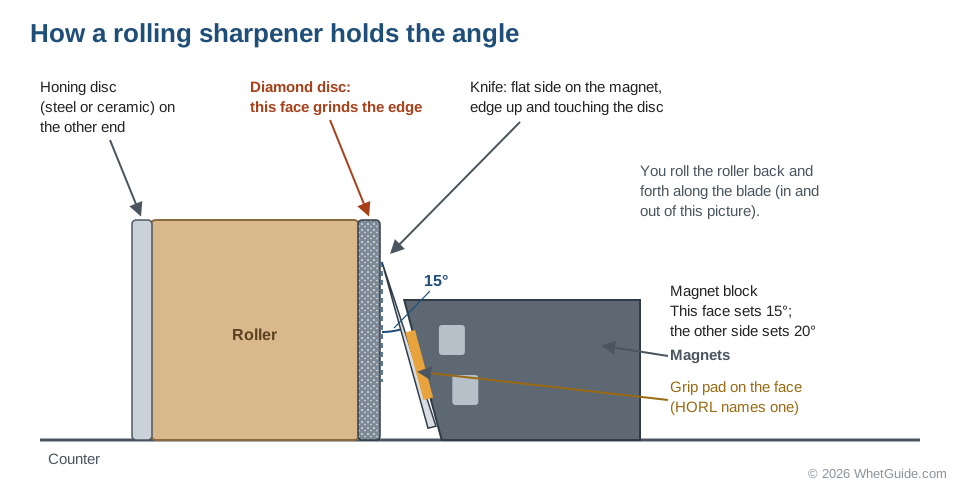
A rolling knife sharpener, sometimes called a roll sharpener or a tumbler sharpener, is a cylinder with a diamond disc at one end and a honing disc at the other. You stick the knife to a magnetic angle block with the edge facing out, set the block on the counter, and roll the cylinder along the edge. The block fixes the angle, so there is no skill to learn and no water to splash. Two brands dominate the searches: HORL, made in Germany, and Tumbler. Several cheaper kits copy the layout and add a strop. GearJunkie's Nick LeFort calls the HORL3 designed specifically to restore a dull edge, so think of it as upkeep for an edge that's merely dull; it won't fix a chipped blade.
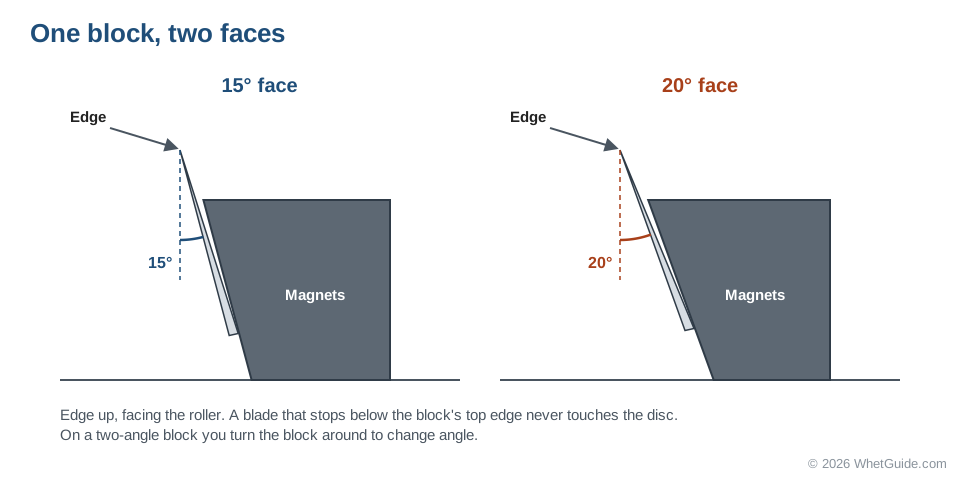
The trick is that the disc's flat face, not its rim, meets the edge. The block tilts the blade 15° or 20° off vertical, the disc face stands straight up, and the gap between them is your sharpening angle. Rolling the cylinder spins the disc across the edge, heel to tip and back. Change disc by turning the roller end for end.
| Part | What it does | What to check on a listing |
|---|---|---|
| Magnet block | Holds the knife and sets the angle; turn it around for the other angle | Which angles; whether they're printed or embossed; magnet count |
| Grip pad or face lining | Stops the blade sliding along the face as you roll | Named on HORL 3; most kits don't mention one |
| Diamond disc | Grinds the bevel and raises the burr | A grit number (#400 on most kits); fixed or removable |
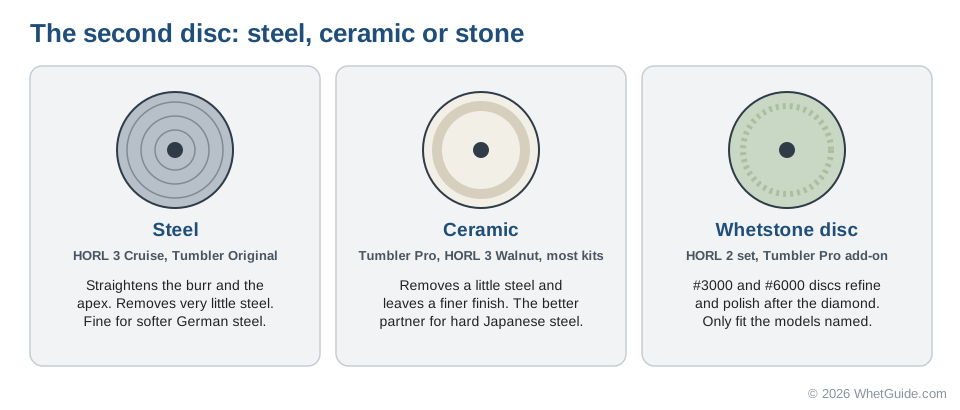
| Honing disc | Removes the burr and refines the apex | Steel, ceramic or whetstone, and its grit |
| Roller body | Carries the discs and rolls on the counter | Wood, resin or recycled plastic; weight helps it roll straight |
| Strop (some kits) | A last polish after the honing disc | Real leather; whether compound is included |
Angles: the spec that decides fit
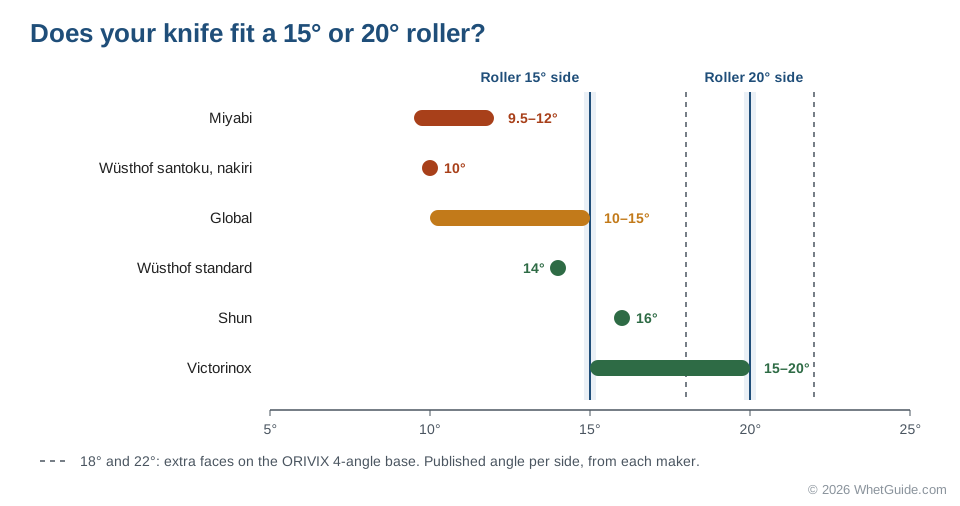
A roller can only make the angles its magnetic block offers. Here's how the usual 15 and 20 line up with what knife makers publish:
| Knife maker | Published angle per side | Roller side |
|---|---|---|
| Wüsthof standard blades | 14° | 15° |
| Shun | 16° | 15° |
| Global | 10–15° | 15° |
| Victorinox | 15–20° | 15° or 20° |
| Zwilling (its honing-steel angle; no factory edge figure) | 15° | 15° |
| Miyabi, Wüsthof santokus | 9.5–12°; 10° | None: skip the roller |
Not sure of your knife's angle? Brand presets live in the angle calculator, and the marker trick tells you whether a roller matches the existing bevel before you commit.
Angle by knife type
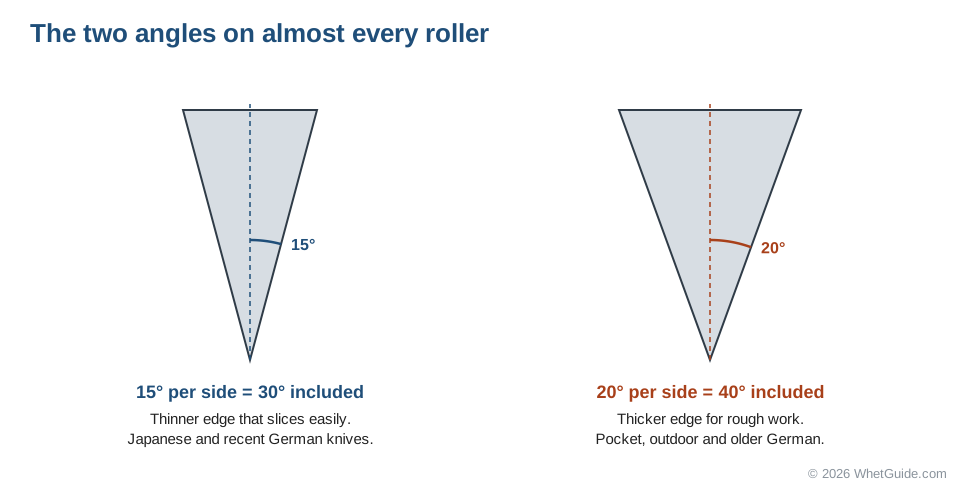
If you don't know the maker's figure, start from the knife's job. GearJunkie's Work Sharp review maps that roller's four angles to knife types: 15° for santoku and Eastern-style knives, 17° for general use, 20° for folders and 25° for fixed-blade and outdoor knives. Here is our version for a 15/20 roller and a four-angle base, built from our angle chart:
| Knife | Typical per side | On a 15/20 roller | On a 4-angle base |
|---|---|---|---|
| Double-bevel Japanese: santoku, gyuto | About 15° (lower on some) | 15° | 15° |
| Modern German chef's knife | About 14–15° | 15° | 15° |
| Older German or heavy Western chef's knife | About 20° | 20° | 20° |
| General utility and paring | 15–20° | Match the rest of the set | 18° |
| Pocket knives and folders | About 17–25°, often 20° | 20° | 18° or 20° |
| Hunting and outdoor fixed blades | About 20–25° | 20° | 22° |
| Cleavers | 25° or more | Not a roller job | Not a roller job |
Two rules cover most drawers. If the knife is thin and you mostly slice, use 15°. If it pries, chops or lives in a pocket, use 20°. Pick one side per knife and stay on it; switching each session means the first part of every session goes to regrinding the bevel. The full list of angles sits on the knife sharpening angle chart.
The 8 best rolling knife sharpeners
HORL 3 Cruise
The Cruise is HORL's simplest current model. The diamond disc is permanently fixed, so there's no setup and nothing to lose, and a stainless steel disc on the other end removes the burr. HORL's listing says the HORL 3's block diamonds remove up to 80 percent more steel than the HORL 2 did, and the grip pad on the magnet holds even small pocket knives. The body is made from ocean-bound recycled plastic.
- Sharpeningfixed diamond disc
- Honingstainless steel disc
- Angles15° and 20°
- Made inGermany
- Salesabout 1,000 last month
Why it stands out
- Made in Germany
- Nothing to configure
- Strong magnet for small blades, per HORL
Think twice if
- You want to add finer discs later; the diamond disc is fixed
AIERLIAN rolling knife sharpener kit
The AIERLIAN kit is the best-selling rolling sharpener on Amazon by a wide margin. You get a #400 diamond disc, a #3000 ceramic disc and a leather strop in a gift box, with a wooden roller and a magnet block (four N42 magnets, per the listing) at 15° and 20°. On paper it does everything the premium brands do.
- Sharpening#400 diamond disc
- Honing#3000 ceramic disc
- Angles15° and 20°
- Extrasleather strop, gift box
- Salesabout 4,000 last month
Why it stands out
- Strop included for a finished edge
- Top seller with 2,100+ ratings
- Ceramic finishing disc
Think twice if
- You care about where it's made; the listing doesn't say
Tumbler Pro
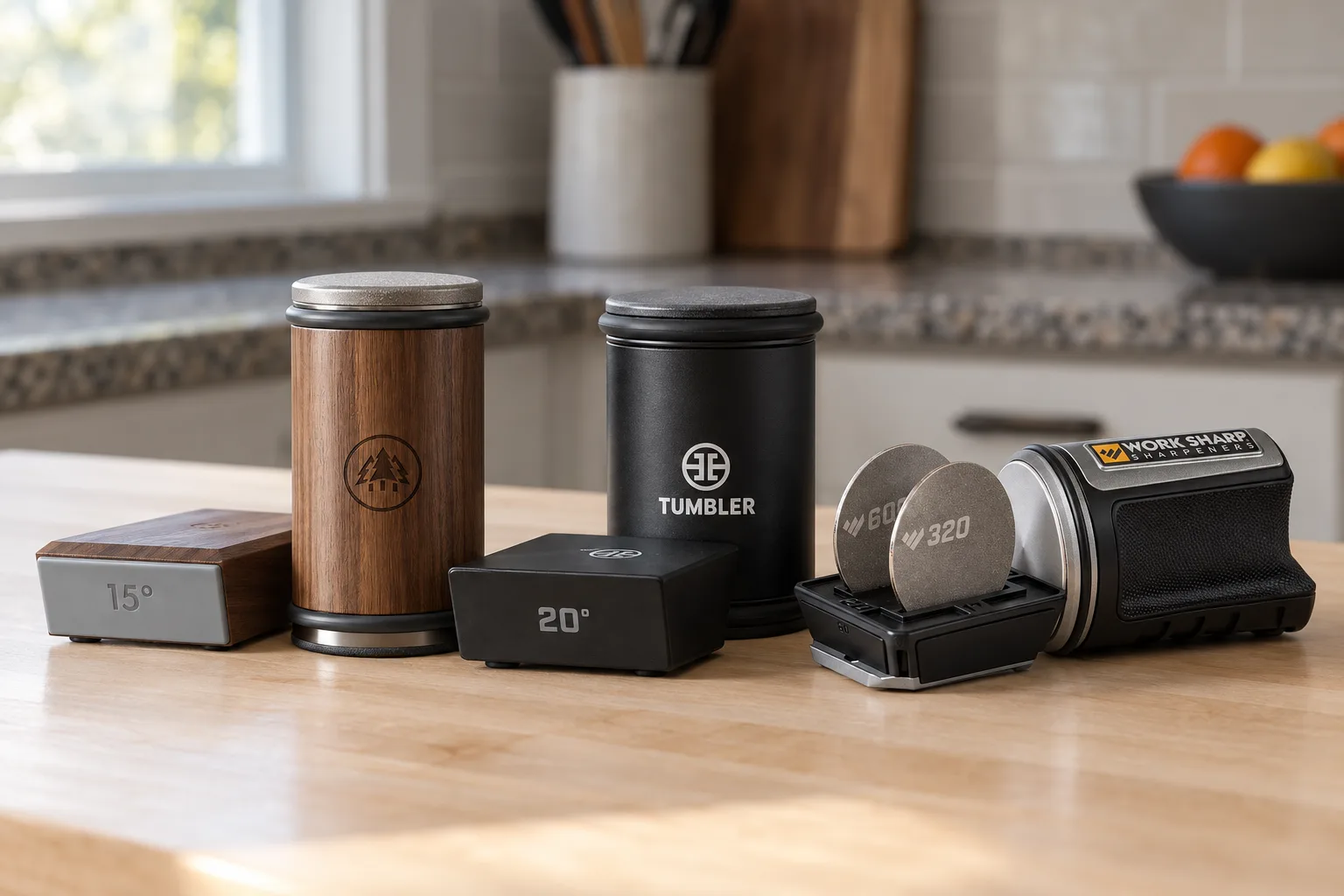
The Pro takes removable discs. Tumbler sells 3000 and 6000 whetstone discs for a finer finish and a coarse #150 diamond disc for chipped edges. One catch from Tumbler's own site: those accessory discs fit only Pro units bought after June 1, 2025, which have a hex recess above the screw threads. Detail on the two brands sits in Tumbler vs HORL.
- Sharpening4-layer diamond disc
- Honingceramic disc
- Angles15° and 20°
- Discsremovable; optional 3000/6000 whetstone discs
- Bodyweighted resin
Why it stands out
- Ceramic honing disc
- Whetstone and repair discs available
Think twice if
- You're buying used or old stock: check for the hex recess
Tumbler Original
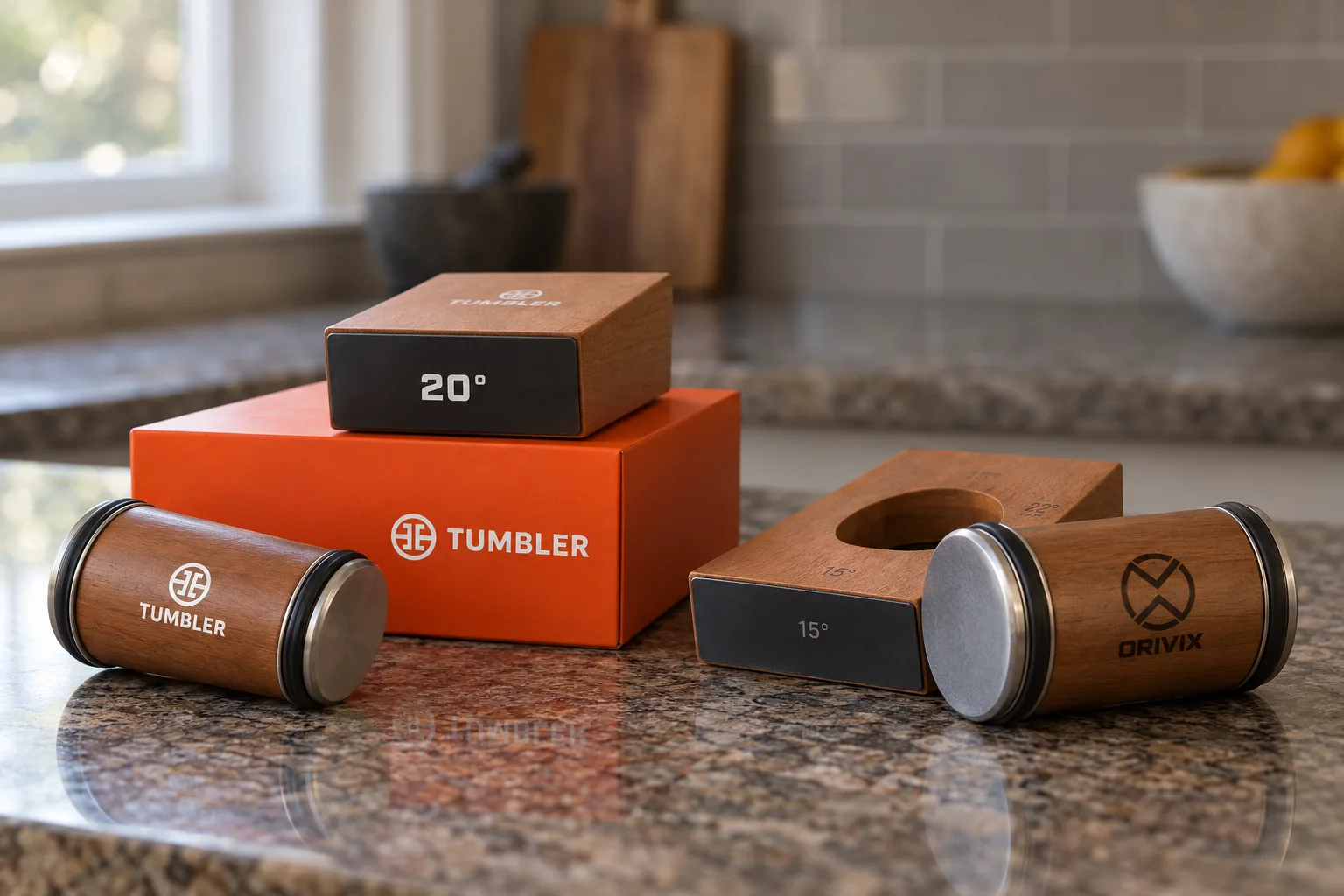
The Original is Tumbler's best seller: a diamond-plated disc, a stainless steel honing disc and a magnetic block at fixed 15° and 20°. It's a finished tool with no upgrade path, since Tumbler's Pro discs don't fit it. For a gift with a recognizable name it's the obvious pick.
- Sharpeningdiamond-plated disc
- Honingstainless steel helix disc
- Anglesfixed 15° and 20°
- Bodywood
- Salesabout 1,000 last month
Why it stands out
- Wood body
- About 1,000 sold last month
Think twice if
- You want ceramic honing or extra discs: get the Pro
BOGONI rolling knife sharpener, Classic Kit
The BOGONI kit is the second-best seller in the category, with the same 400 diamond and 3000 ceramic disc pairing as the AIERLIAN. Its discs are replaceable and the roller is wood. The listing says the magnet block uses six N52 magnets. Pick between this and the AIERLIAN on whichever is cheaper the day you buy; the AIERLIAN adds a strop.
- Sharpening400 grit diamond disc
- Honing3000 grit ceramic disc
- Angles15° and 20°
- Magnetssix N52
- Salesabout 3,000 last month
Why it stands out
- Replaceable discs
- Gift box
Think twice if
- You want a strop in the box: the AIERLIAN includes one
ORIVIX rolling sharpener with 4-angle base
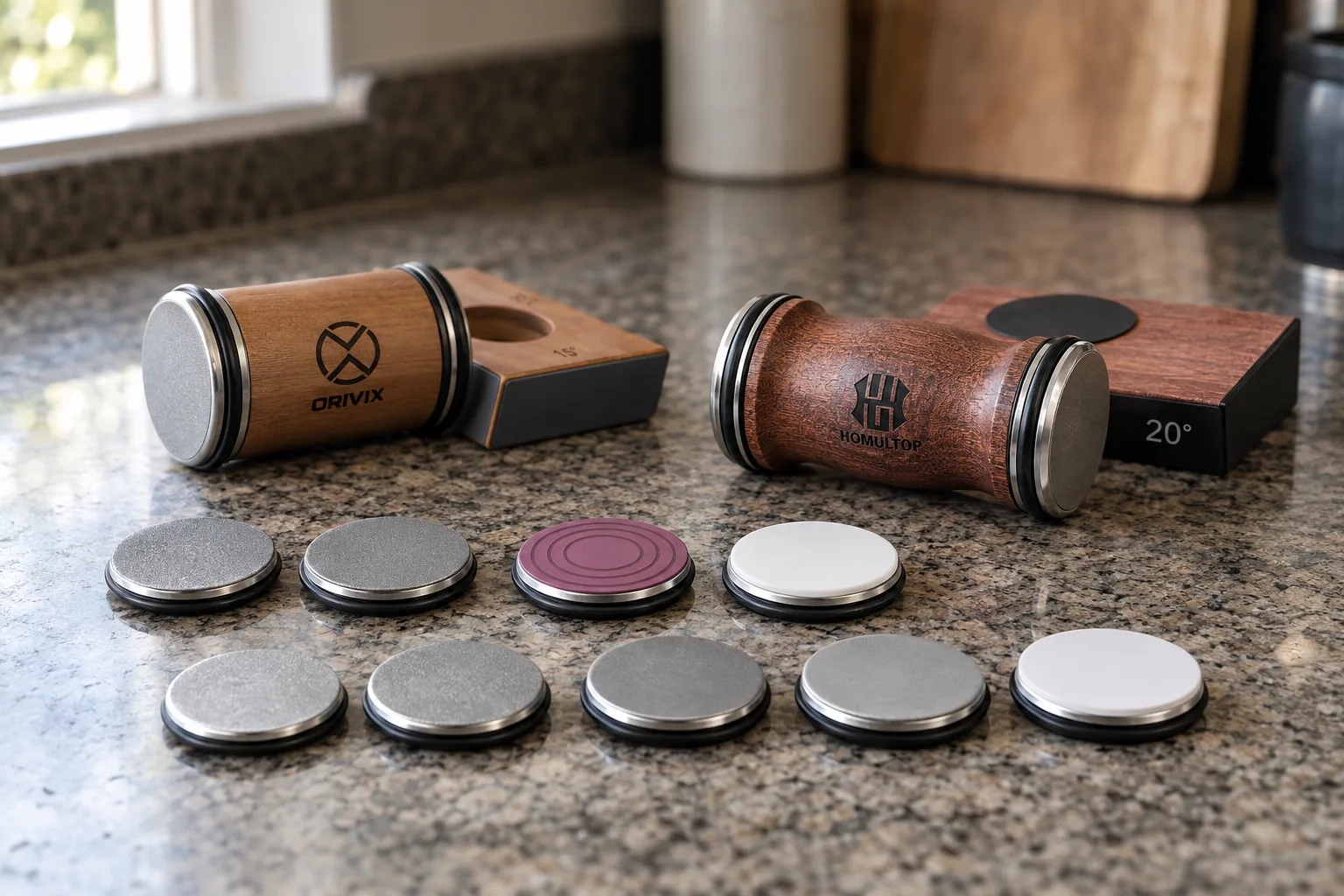
Most rollers give you two angles. This kit's magnetic base has four (15°, 18°, 20° and 22°) and four discs from 400 to 6000, plus a vegetable-tanned leather strop and a zippered case. The 18° setting is a nice fit for Benchmade-style pocket knives that sit between 15 and 20. It's the closest a roller gets to a whetstone kit.
- Angles15°, 18°, 20°, 22°
- Discs400 and 1000 diamond, 3000 and 6000 ceramic
- Extrasleather strop, carrying case
- Roller3.86 in wooden
- Salesabout 1,000 last month
Why it stands out
- Four angles and four grits
- Strop and case included
Think twice if
- You want the simplest tool; more discs means more swapping
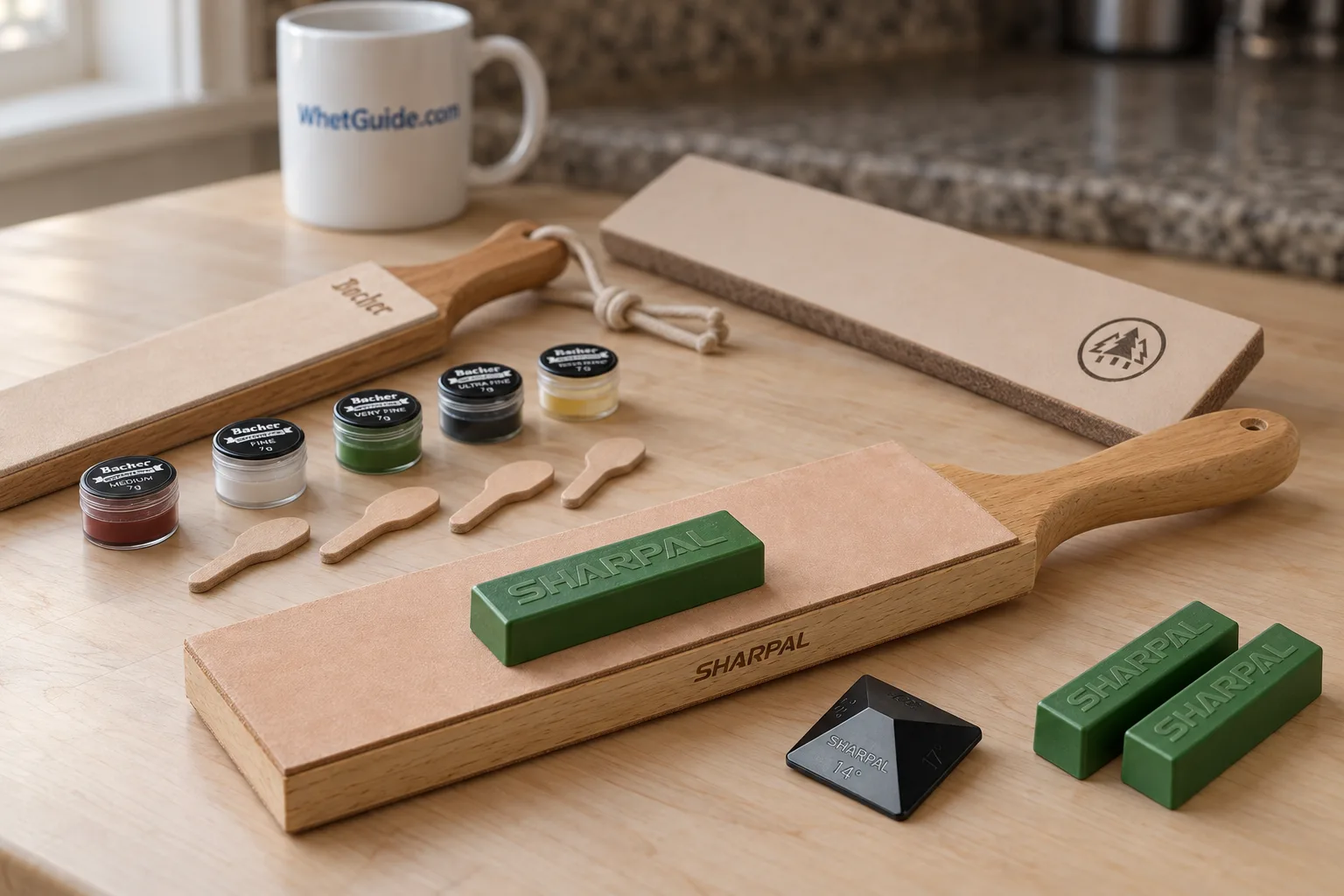
Rolling sharpener kit with leather strop
A newer budget kit that sells about 400 a month. Its listing pairs the magnetic 15° and 20° guide with a genuine leather strop for the finishing step. The listing aims it at steel kitchen knives. It has far fewer ratings than the AIERLIAN, so treat it as the cheaper gamble of the two.
- Angles15° and 20° magnetic guide
- Extrasleather strop
- Amazon4.4 stars, 400+ ratings, about 400 bought last month
Why it stands out
- Strop included
- 15° and 20° magnetic guide
Think twice if
- You want a proven record: it has about 400 ratings against the AIERLIAN's 2,000+
Wooden rolling knife sharpener kit (15°/20°)
The listing describes a diamond disc and a ceramic disc on a natural wood roller, with a magnetic block at 15° and 20°, packed in a gift box. Its 1,200+ ratings are the most of any no-name kit here after the AIERLIAN, and it sells about 300 a month. The 4.2 average is the lowest on the page.
- Angles15° and 20° magnetic
- Discdiamond, with ceramic disc
- Bodynatural wood
- Amazon4.2 stars, 1,200+ ratings, about 300 bought last month
Why it stands out
- 1,200+ ratings
- Gift box
Think twice if
- You want the best-rated kit: the AIERLIAN rates higher
Disc and angle comparison
| Sharpener | Sharpening disc | Honing disc | Angles | Extra discs | Strop |
|---|---|---|---|---|---|
| HORL 3 Cruise | Diamond (fixed) | Stainless steel | 15°, 20° | No | No |
| AIERLIAN | #400 diamond | #3000 ceramic | 15°, 20° | Check listing | Yes |
| Tumbler Pro | 4-layer diamond | Ceramic | 15°, 20° | Yes (post-June 2025 units) | No |
| Tumbler Original | Diamond-plated | Stainless steel | 15°, 20° | No | No |
| BOGONI Classic | 400 diamond | 3000 ceramic | 15°, 20° | Replaceable | No |
| ORIVIX 4-angle | 400 and 1000 diamond | 3000 and 6000 ceramic | 15°, 18°, 20°, 22° | Included | Yes |
| Strop kit | Check listing | Check listing | 15°, 20° | Check listing | Yes |
| Wooden kit | Diamond | Ceramic | 15°, 20° | Check listing | No |
From each product's Amazon listing and tumblerware.com, October 3, 2026. "Check listing" means the listing doesn't confirm it.
Discs and grits, explained
The sharpening disc does nearly all the work, and on most kits it's #400 diamond. That's coarse enough to raise a burr on a dull kitchen knife in a few minutes and fine enough that the honing disc can clean up after it. The premium brands don't print a grit for their main diamond disc. HORL describes its HORL 3 diamonds as "block diamonds" that remove more steel than the HORL 2's, and Tumbler calls the Pro's disc 4-layer diamond. You can't compare those to a #400 number directly.
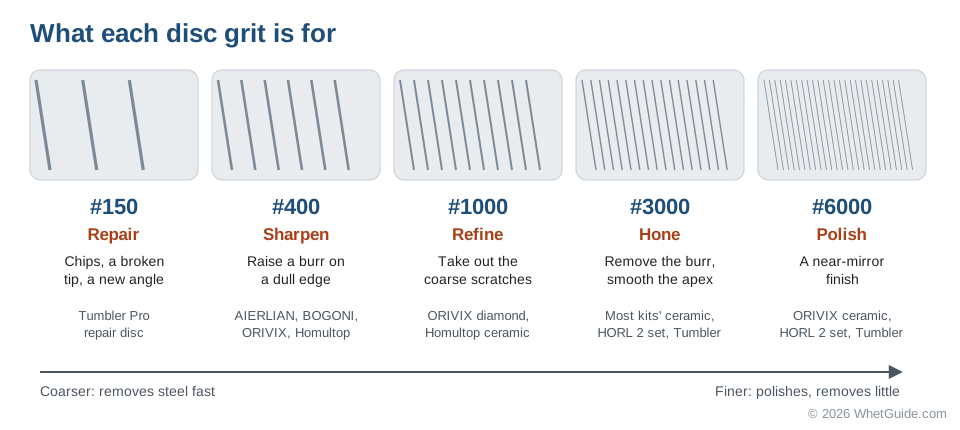
| Disc | Job | Use it when | Comes on |
|---|---|---|---|
| #150 diamond | Repair | Chips, a broken tip, or moving 20° to 15° | Tumbler Pro add-on (post-June 2025 units) |
| #400 diamond | Sharpen | The knife is dull and honing doesn't bring it back | AIERLIAN, BOGONI, ORIVIX, Homultop kits |
| Unrated diamond | Sharpen | Same as above | HORL 3 Cruise; Tumbler Original and Pro |
| #1000 | Refine | After #400, to take out the coarse scratches | ORIVIX (diamond), Homultop (ceramic) |
| #3000 ceramic or stone | Hone | Every session, after sharpening; also on its own for touch-ups | Most budget kits; HORL 2 set; Tumbler Pro add-on |
| #6000 ceramic or stone | Polish | When you want a near-mirror edge for push cuts | ORIVIX; HORL 2 set; Tumbler Pro add-on |
| Stainless steel | Hone | After sharpening and between sessions | HORL 3 Cruise, Tumbler Original |
Work Sharp rolling knife sharpener and other options
- The HORL 3 Walnut is the premium HORL, with a ceramic honing disc instead of steel. It's newer, with fewer sales so far. HORL's listing says the HORL 3 grip pad holds up to 70 percent better than the HORL 2's.
- The HORL 2 Walnut is the previous generation with interchangeable discs, still on sale.
- The Work Sharp Rolling Knife Sharpener has four sharpening angles, per its listing title, and Work Sharp's site says interchangeable diamond and ceramic discs are available. The listing doesn't print the four values; Outdoor Life and GearJunkie both give them as 15°, 17°, 20° and 25°. It's the top roller in both of those reviews.
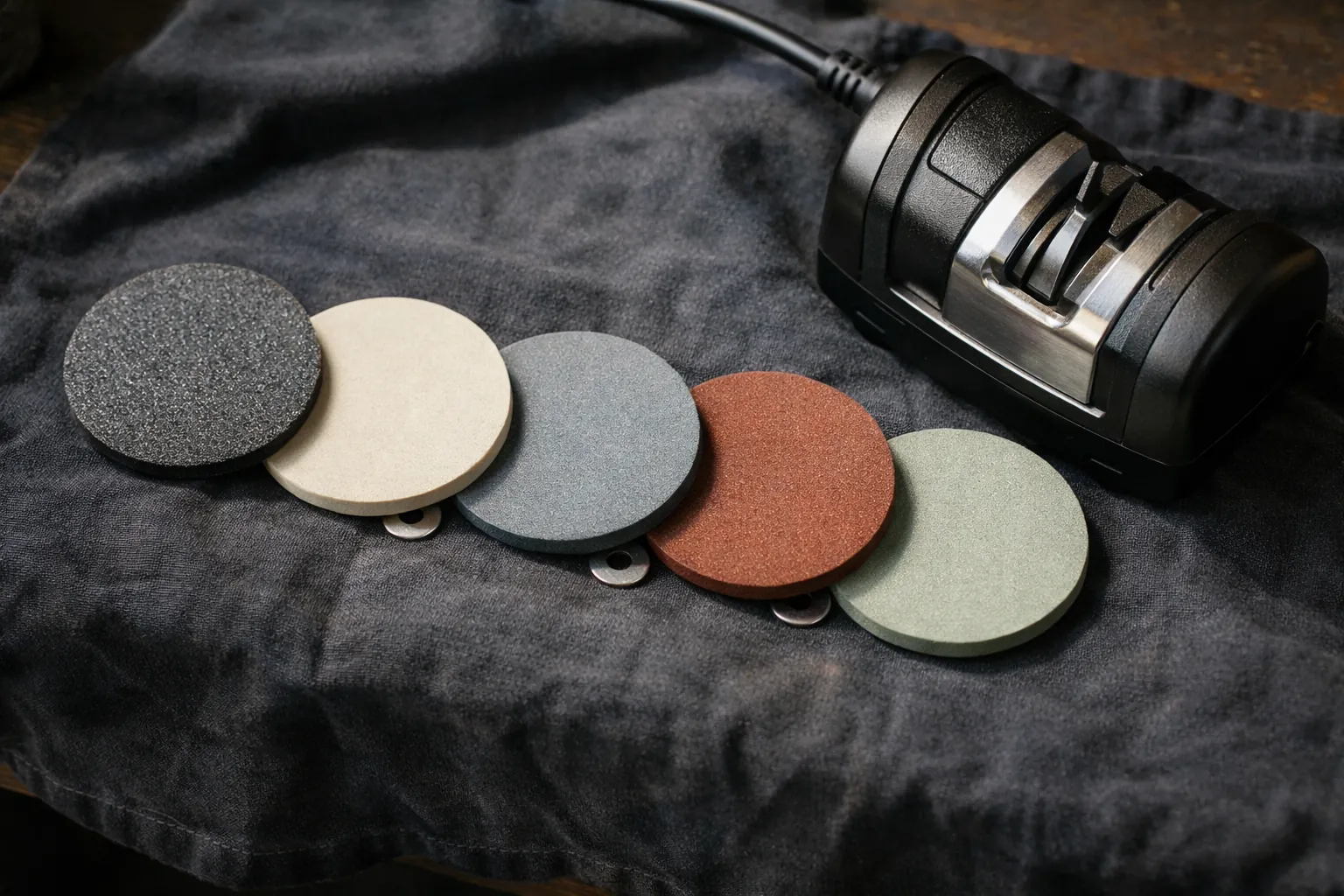
A few newer rollers fill gaps the eight picks leave. Their review histories are short or their specs thin, so they didn't make the list, but they're worth a look if you need what they do:
| Roller | What's different, per the listing | Who it's for |
|---|---|---|
| The Mini Tumbler (with case and strop) | Made for small knives: paring, hunting, folding pocket, utility | Small blades that sit too low on a full-size block |
| ONIXCORE 5-angle kit | Presets at 12°, 15°, 17°, 20° and 22°; #400 and #1000 diamond, #1000 and #3000 ceramic | Owners of 12° knives who still want a roller |
| Adjustable 10-40 degree rolling kit | A knob sets any angle from 10° to 40°; a height adjuster for large cleavers | Mixed drawers with cleavers and outdoor knives |
| Homultop replaceable-disc kit | #400 diamond plus #1000 and #3000 ceramic | Budget buyers who want a middle grit |
| LaPeak kit | #400 diamond and #3000 ceramic | The cheapest kit we found with 100+ ratings |
| HORL 3 Oak | The HORL 3 in an oak finish | A HORL 3 gift that matches a lighter kitchen |
Small blades: paring and pocket knives
A roller only sharpens what reaches the disc. On a full-size block, the knife's edge has to stand above the top of the block, because the disc face sits beside the block, not over it. A 3-inch paring knife or a short drop-point folder can sit so low that the disc never touches it, and the roller how-tos from Pro Tool Reviews, The Rational Kitchen and Hunker that we found in search list short drop-point folders among the trouble spots.
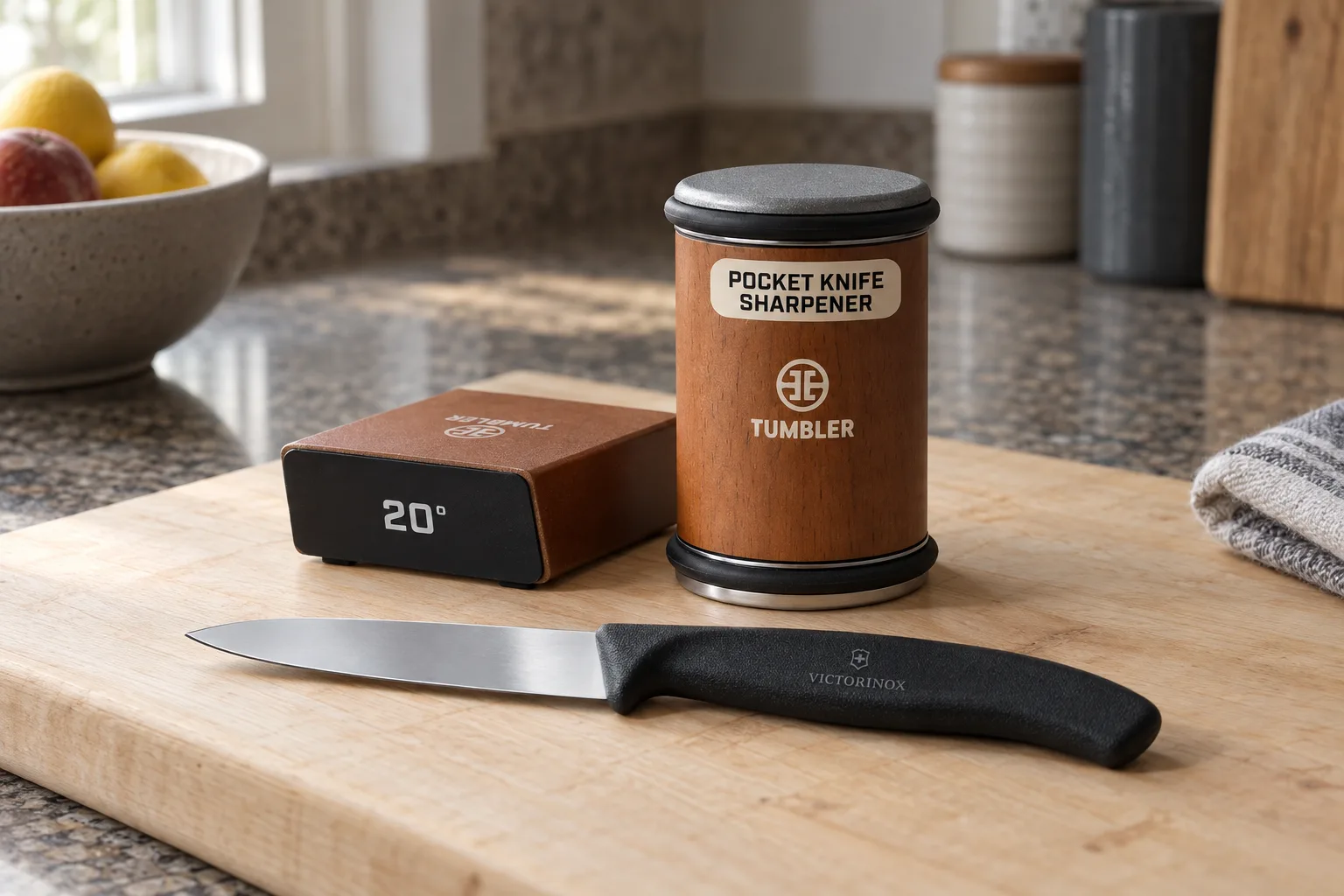
- Before you buy, measure your smallest knife from spine to edge and compare it with the block's height in the listing. A blade narrower than the block is tall may not clear the top.
- HORL says the HORL 3 grip pad holds small pocket knives, which helps them stay put; it doesn't change the height.
- Outdoor Life names HONE's roller, which has a ledge to rest small blades on, as its pick for them.
- The Mini Tumbler is built for this job. If most of your sharpening is pocket knives, look at our best sharpeners for pocket knives first; a guided or pocket system may suit you better than any roller.
Tumbler or HORL: which one
These are the two names most people type. Both roll a diamond disc on a knife held at 15 or 20 degrees by a magnet, so the choice is about discs and upgrades. HORL sells the HORL 3 Cruise (fixed diamond disc, stainless honing disc), the HORL 3 Walnut (ceramic honing disc) and the older HORL 2 Walnut with interchangeable discs. Tumbler sells the Original (diamond-plated disc, stainless helix honing disc) and the Pro (4-layer diamond disc, ceramic honing disc, removable discs). Amazon shows one shared review pool for each brand, about 4,500 ratings at 4.4 stars for HORL and about 3,400 at 4.4 for Tumbler, so the stars won't separate a model from its sibling.
| HORL 3 Cruise | HORL 3 Walnut | Tumbler Original | Tumbler Pro | |
|---|---|---|---|---|
| Honing disc | Stainless steel | Ceramic | Stainless steel helix | Ceramic |
| Removable discs | No | Check listing | No | Yes |
| Add-on discs | None | Check HORL | None | #150 repair; 3000 and 6000 whetstone |
| Body | Recycled plastic | Walnut | Wood | Weighted resin |
| Made in | Germany | Check listing | Check listing | Check listing |
| Warranty, per Outdoor Life | 1 year | Not listed | Lifetime (brand) | Lifetime (brand) |
Short version: HORL if you want German manufacture and the simplest tool, Tumbler Pro if you expect to add finer discs. Every model gets a turn in the Tumbler vs HORL comparison, including HORL 2 vs HORL 3 and Tumbler Original vs Pro.
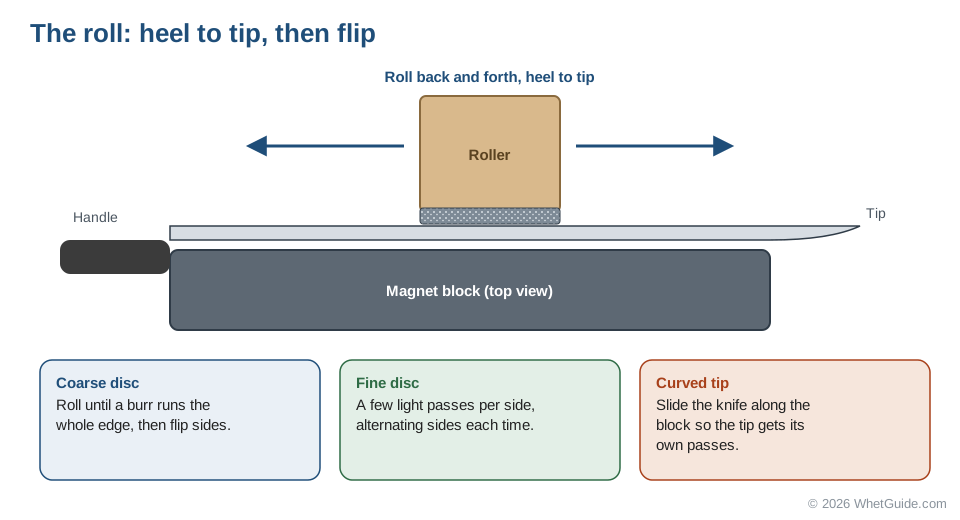
How to use a rolling sharpener: the first session
The instructions in the box are short, and most of the "it didn't get sharp" complaints come from stopping before a burr formed. The steps below follow the burr method Outdoor Life describes, and they work the same on every brand.
- 1Clean and dry the bladeOil and water make it slide on the magnet.
- 2Pick the face15° or 20°, matched to the knife. Stay on it every session.
- 3Mount the knifeFlat side against the magnet, centered on the block. Edge up, facing out.
- 4Diamond side ARoll heel to tip and back with light pressure until you feel a burr along the whole other side.
- 5Flip the knifeSame face of the block, other side of the blade. Roll until the burr folds back.
- 6Turn the rollerHoning disc (steel or ceramic) toward the knife.
- 7Hone, alternatingTwo or three light passes per side, switching sides each time.
- 8Strop (optional)A few edge-trailing strokes per side on leather.
- 9Test and wipeSlice paper; wipe the blade before it goes back in the block.
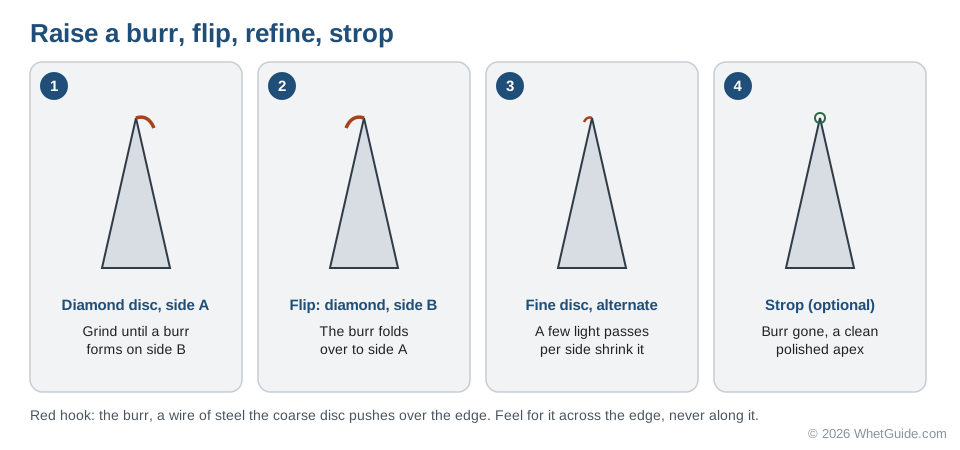
How to feel the burr
- Draw a thumb pad across the edge from spine to edge, on the side away from the disc, never along it.
- A burr feels like a slight catch or a rough lip. It has to run the whole length, so check the heel and the tip as well as the middle.
- No burr at the tip only? The tip curve is lifting off the disc. Slide the knife along the block and give the tip its own passes.
- Can't feel it at all? Look at the edge under a bright light: a dull edge reflects a thin bright line, a sharpened one doesn't.
Reading a burr gets more detail in the knife sharpening burr guide. Pressure should stay light the whole time. The magnet holds the knife and the disc does the cutting; pressing hard tips the roller and rounds the edge.
Why the first session takes longest
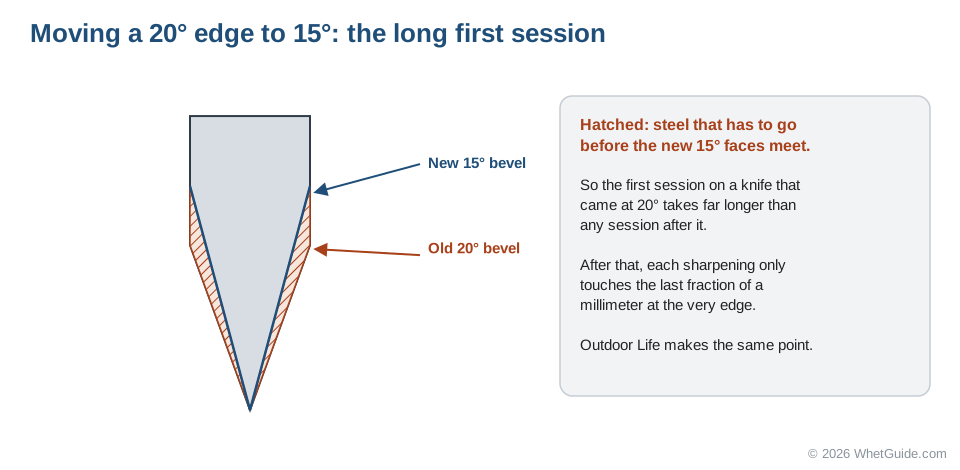
If a knife came from the factory at 20° and you put it on the 15° face, the disc has to grind a whole new bevel before the two sides meet. Outdoor Life notes that a smaller angle than the knife's existing edge means a longer first session, and the geometry explains why. After that first session, each sharpening only touches the last sliver at the apex, and it goes quickly. A coarse disc helps here: the Tumbler Pro's #150 repair disc exists for this job, and a #400 kit disc is faster than an unrated fine one.
| Where the knife starts | Start on | Then | Note |
|---|---|---|---|
| Slightly off, still cuts | Honing disc | Strop | No diamond at all; this is most weeks |
| Dull, already at the face you use | Diamond, until a burr runs the edge | Honing disc, alternating; strop | The normal session |
| New knife, factory edge near your face | Honing disc | Diamond only if honing doesn't help | Don't grind away a good factory edge early |
| Moving from 20° to 15° | The coarsest disc you have | Diamond, then hone | The long one; it happens once per knife |
| Small chips along the edge | #150 disc, if your roller takes one | #400, then hone | Big chips or a broken tip: a stone or a sharpening service |
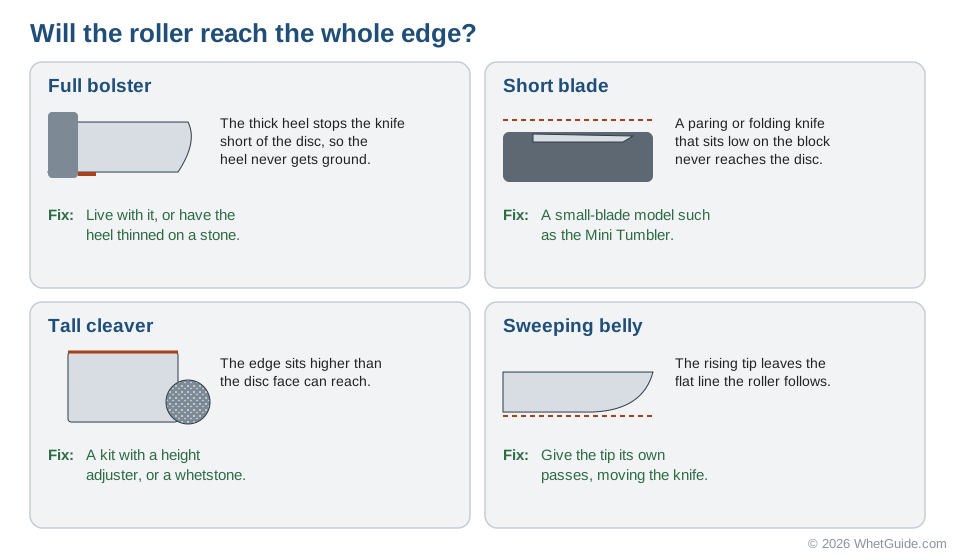
Will it touch my whole knife?
| Knife shape | What goes wrong | What to do |
|---|---|---|
| Full bolster (forged German classics) | The thick bolster stops the heel short of the disc; Prudent Reviews flags it | Accept a slightly dull heel, or have the bolster thinned on a stone; buy half-bolster knives next time |
| Sweeping belly or upswept tip | The tip rises out of the disc's contact line | Give the tip separate passes by sliding the knife along the block |
| Tall cleaver or nakiri | The edge sits higher than the disc reaches | A kit with a height adjuster, or a whetstone |
| Short paring or folder | The edge sits below the block top and never meets the disc | A small-blade roller or a ledge model; see small blades |
| Thick handle or finger guard | The handle hits the counter or block before the edge reaches | Mount the knife farther along the block; check the heel last |
What a roller can't fix
Serrated knives
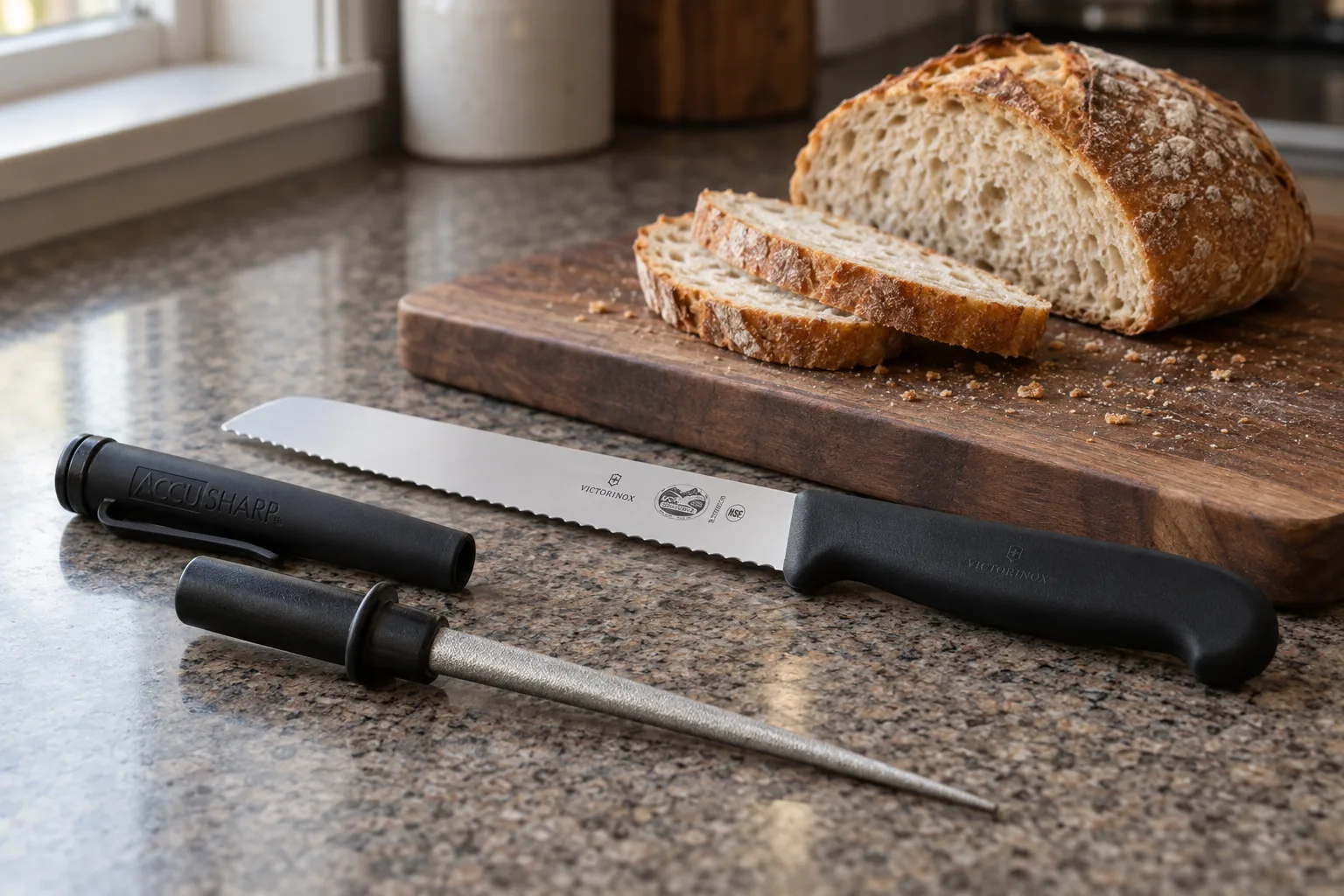
Every roller listing we read describes straight edges. For bread and serrated utility knives, a diamond tapered rod (AccuSharp sells a cheap one) does one scallop at a time, on the beveled side only. Serrated edges are walked through in the guide to sharpening a serrated knife, and the best sharpeners for serrated knives lists the tools.
Troubleshooting
| Problem | Likely cause | Fix |
|---|---|---|
| Knife slides or tips off the block | Wet or oily blade; small knife with little steel on the magnets | Dry the blade, center it, roll with lighter pressure |
| No burr after a few minutes | The knife's bevel is lower than the face you picked, or this is a first reprofile | Keep going on the diamond disc; use a coarser disc if you have one |
| Burr everywhere but the tip | The belly curves away from the disc | Slide the knife so the tip sits mid-block; give it its own passes |
| Heel stays dull | Bolster or handle stops the knife short | Mount the knife farther along the block; a full bolster may need a stone |
| One side sharper than the other | Uneven pass counts | Count passes; finish with alternating single passes |
| Edge sharp, then dull a day later | Burr left on the edge | More alternating passes on the honing disc, then strop |
| Disc comes loose | Prudent Reviews reported HORL's Quick Lock disc coming off on its HORL 3 | Seat the disc firmly before each session; check the maker's instructions |
| Nearby knives jump to the block | Strong magnets, which Prudent Reviews also noted | Store the block away from the knife block and steel tools |
Common mistakes
- Stopping before the burr. The disc hasn't reached the edge until you can feel a burr on the far side along the whole length. A few passes and a quick paper test won't tell you.
- Switching between 15° and 20° on the same knife. Each switch spends the next session grinding a new bevel.
- Pressing down hard. The roller should glide; extra pressure lifts one side of the disc and rounds the apex.
- Skipping the honing disc. The diamond leaves a burr, and a burr folds over on the first cut, which is why an edge can feel sharp and then go dull the next day.
- Using the diamond disc for weekly touch-ups. It removes steel each time. Hone first; sharpen only when honing stops working.
- Putting a wet knife on the block. Water lets the blade slide along the face and changes the angle mid-pass.
- Rolling on a soft or uneven surface. A tablecloth or a grooved cutting board lets the roller wander. Use a hard, flat counter with room for the full roll.
Rolling sharpener or whetstone
A rolling sharpener is faster to learn and keeps both sides of the edge matched. A whetstone costs less per sharpening, takes any angle and works on single-bevel Japanese knives, but it takes practice. A side-by-side for each kind of knife is in the rolling knife sharpeners vs whetstone review.
| Rolling sharpener | Whetstone | Electric | Pull-through | |
|---|---|---|---|---|
| Angles | Two (four on some) | Any | Fixed per slot | Fixed |
| Skill to learn | Very little | Weeks of practice | Very little | None |
| Noise | Quiet | Quiet | A motor whir | Scraping |
| Mess | None | Water and slurry | Metal dust in a tray | Some filings |
| Single-bevel knives | No | Yes | Rarely | No |
| Edge quality | Good to very good with a strop | As good as your skill | Good | Usually rough |
For knives below 15°
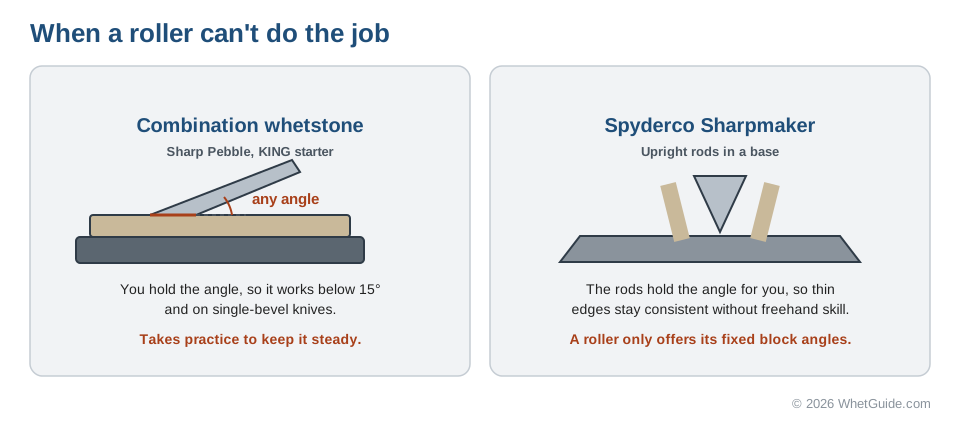
A 1000/6000 combination stone such as the Sharp Pebble or KING starter set handles Miyabi and thin santokus at whatever angle you hold. If you'd rather not freehand, a Spyderco Sharpmaker or a Work Sharp Precision Adjust holds the angle for you and goes lower than a roller. Options include the best whetstone sets for beginners, the Sharpmaker review and the Precision Adjust review. A clip-on whetstone angle guide is the cheapest way to hold 12° on a stone.
↑ Back to all sectionsStrops and upgrade discs
Most rollers stop at the honing disc. A strop adds a final polish, and the premium brands sell finer discs. The HORL leather strop is a German-made vegetable-tanned strop with about 700 bought last month. Owners of a HORL 2 can add the HORL 2 whetstone and strop set (#3000 and #6000 corundum discs; HORL says it is not compatible with the HORL 2 Cruise). Tumbler Pro owners can add the Tumbler Pro 3000 and 6000 whetstone discs, which the listing says are meant for edge refinement rather than coarse sharpening and fit only the Pro.
| Add-on | Fits | Doesn't fit |
|---|---|---|
| Tumbler Pro 3000/6000 whetstone discs | Tumbler Pro units bought after June 1, 2025 (hex recess above the threads) | Older Pro units, Tumbler Original |
| Tumbler #150 repair disc | Same post-June 2025 Pro units | Older Pro units, Tumbler Original |
| HORL 2 whetstone and strop set | HORL 2 | HORL 2 Cruise, per HORL |
| Any leather strop | Every roller; you strop by hand | Nothing |
Between sharpenings
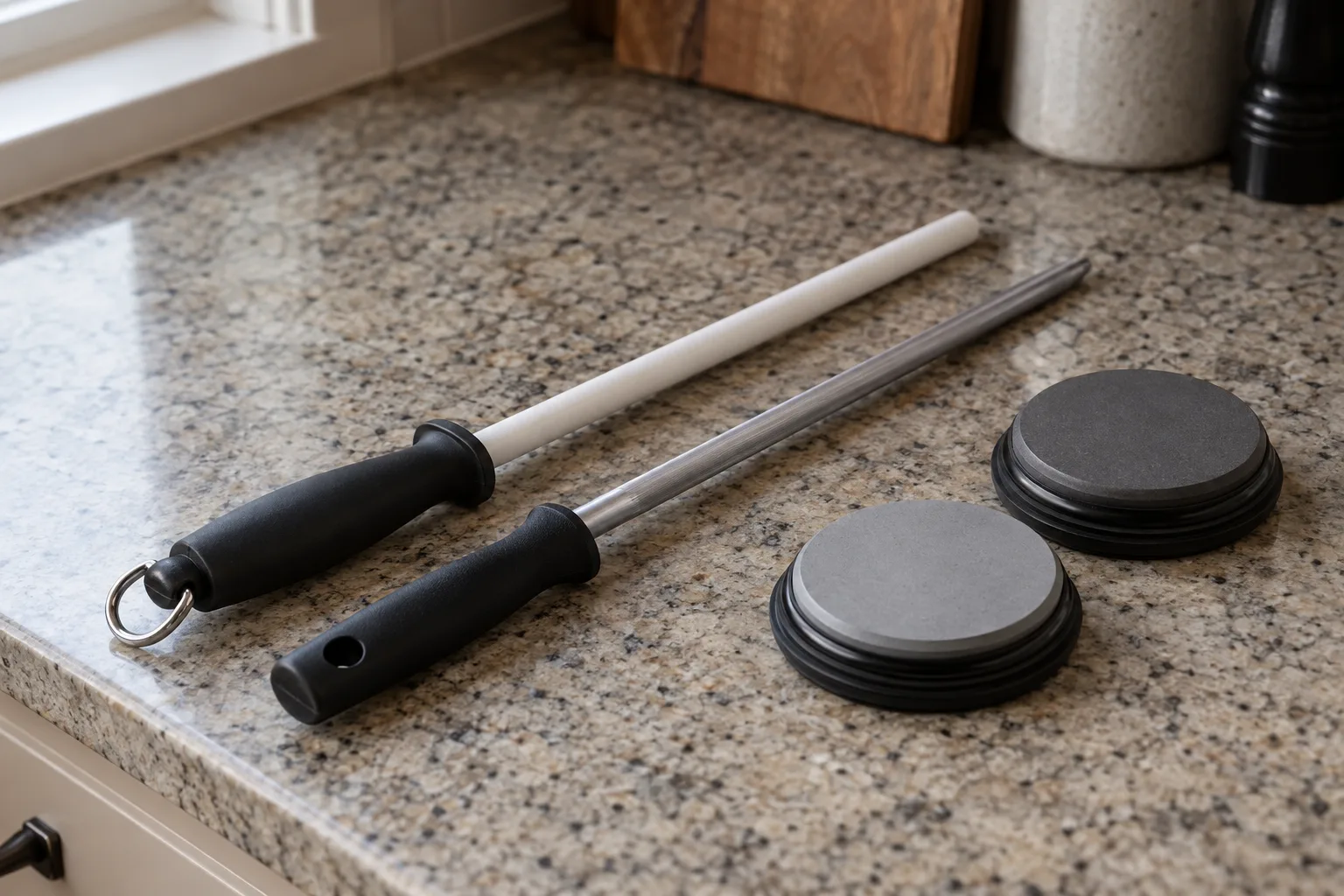
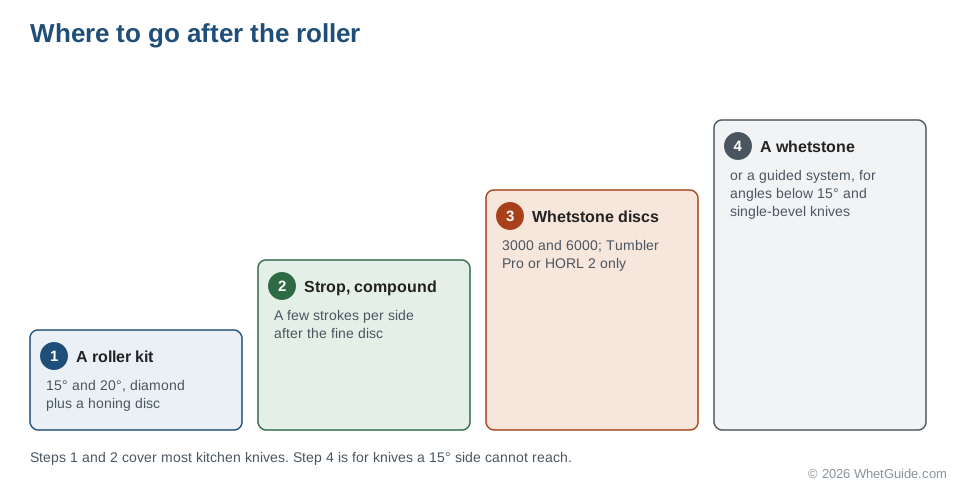
Use the honing disc on its own whenever the knife starts to feel off. Outdoor Life says a few passes on the honing disc keep an edge sharp longer, and it's faster than getting out a steel. Save the diamond disc for when honing stops working. The how often to sharpen guide gives numbers for that, by how much you cook.
- Honing disc: a few passes per side, alternating, whenever slicing tomatoes gets harder.
- Strop with compound: a handful of strokes per side after honing, as often as you like.
- A honing rod still has a place: a ceramic rod for hard steel, a steel rod for German knives, if you'd rather not set up the block (how to use a honing rod shows the technique).
- Wash and dry by hand, store in a block or on a strip, and cut on wood or plastic. The knife care guide covers the rest.
Looking after the roller
- Wipe both discs with a dry cloth after each session; steel dust builds up on the diamond face.
- Keep the discs off hard floors and out of the dishwasher. A dropped disc can chip, and a chipped face scratches the blade.
- Check that a removable disc is seated before you start, especially on rollers that use a quick-release mount.
- Store the magnet block where it can't grab other knives or utensils.
- If the diamond disc stops raising a burr in a reasonable time, the face may be clogged or worn. Clean it first, then look at replacement discs from the maker.
When you outgrow the roller
Most people never do. If you find yourself wanting a finer edge, add a strop first, then whetstone discs if your roller takes them. If you want angles below 15° or start buying single-bevel knives, that's the point to learn a whetstone or buy a guided system. The best sharpening systems page covers the guided options.
Buying guide: features to compare
| Feature | What it does for you | Our take |
|---|---|---|
| The honing disc | Steel honing discs (HORL 3 Cruise, Tumbler Original) straighten the edge; ceramic ones (Tumbler Pro, the budget kits) also remove a little steel and leave a finer finish. | Either works. Ceramic is the better partner for hard Japanese steel. |
| Whether discs come off | Fixed discs mean less to go wrong. Removable discs mean you can add a coarse disc for chips or fine whetstone discs later. | Decide whether you'll ever bother. If you won't, a fixed disc is one less thing to seat. |
| Number of angles | Two faces cover kitchen knives at 15° and older or tougher knives at 20°. Four or five faces add 17° or 18°, 22° and sometimes 12°. | Two is enough for a kitchen. Buy more angles only for a specific knife that needs one. |
| Printed or embossed angle marks | Borough Kitchen points out that some blocks emboss the 15 and 20 into the material while others print them, and printed marks can wear off. | If you'll use both faces, an embossed mark saves guessing a year from now. |
| Roller weight and body | A heavier roller tracks straighter with less hand pressure. The body material matters less than the weight; wood and plastic both roll fine on a flat counter. | Pick the body you like looking at; it lives on the counter. |
| Strop in the box | The AIERLIAN and ORIVIX include leather, as does the strop kit; HORL and Tumbler sell theirs separately. | A free strop is worth having. A separate double-sided one is cheap. |
| Warranty | Outdoor Life's table lists a lifetime warranty for Tumbler, three years for Work Sharp and one year for the HORL 3 Cruise. | Check the maker's page before you rely on it; budget kits rarely state one. |
The magnet
Small pocket knives slip on weak magnets. Outdoor Life says the Tumbler's magnets "aren't quite enough" for small outdoor and pocket knives. HORL calls out its grip pad for this, and the budget kits list their magnet counts. A strong magnet has a downside Prudent Reviews noticed: it pulls loose knives and steel tools toward it, so keep the block away from your knife block and utensil drawer.
| Roller | What the listing says about the magnet |
|---|---|
| HORL 3 Cruise and Walnut | Grip pad; up to 70 percent more grip than the HORL 2 (HORL's claim) |
| AIERLIAN | Four N42 magnets |
| BOGONI Classic | Six N52 magnets |
| Most other kits | "Strong magnet," no count |
Cheap-kit checklist
- Does the listing give a grit for each disc? "Diamond" with no number is a warning sign.
- Is the honing disc ceramic, and is its grit stated?
- Does it name the angles, and are there two or more?
- Does it say how many magnets, or what grade?
- Are there more than 100 ratings, and do recent ones mention the same problems?
- Does the seller offer replacement discs?
- Is a strop included, and is it real leather?
- Do the photos show the block's faces clearly enough to see the angle marks?
Before you buy: an eight-point check
- The published angle of every knife you'll sharpen
- Your shortest blade, measured spine to edge
- Your tallest blade, and whether it's a cleaver
- Full bolsters on any of them
- Serrated or single-bevel knives (those need another tool)
- Steel or ceramic hone, given how hard your steel is
- Strop in the box, or budget for one
- Replacement or add-on discs, and the warranty
As a gift
Rollers are popular gifts because they need no skill and look good on a counter. Pick by the recipient's knives first and the price second. Other ideas: the knife sharpening gifts guide, the Christmas gift guide and notes on what to watch for on Black Friday.
| Recipient | Pick | Why |
|---|---|---|
| Home cook with a good German or Japanese set | HORL 3 Cruise or Tumbler Original | Recognized names, nothing to configure |
| Someone who likes tools and tinkering | Tumbler Pro | Add-on discs make it a hobby |
| First apartment, tight budget | AIERLIAN or BOGONI kit | Gift box, strop or spare discs |
| Hunter or pocket-knife carrier | ORIVIX 4-angle, or the Mini Tumbler | 18° and 22° faces, or a small-blade roller |
| Someone who already owns a HORL 2 | The HORL 2 whetstone and strop set | Finer discs for the roller they have |
| Owner of Japanese knives under 15° | Not a roller | A whetstone set will serve them better |
If you can, check what knives the recipient owns. A roller is a poor gift for someone whose best knife is a Miyabi. Kits with a gift box and a strop look like more in the hand, and the box keeps the discs together. Add a note saying which face is 15° and which is 20°, the one thing new owners get wrong.
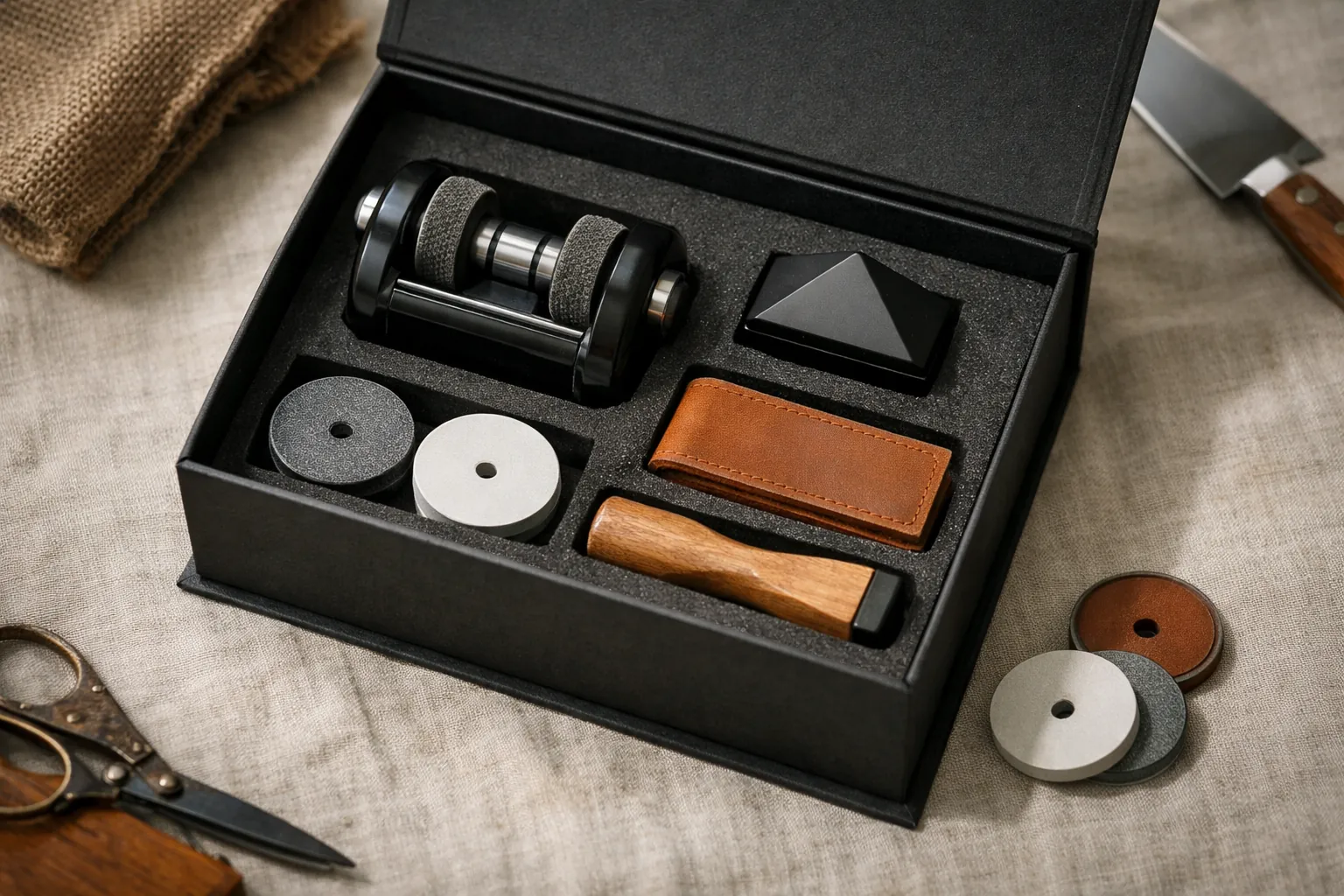
If you only buy one
The HORL 3 Cruise for a set-and-forget, German-made roller. The AIERLIAN kit if price matters more than pedigree; it's what most buyers choose. As a gift, either one works, and other ideas are in the knife sharpening gifts guide. Other kinds of kitchen sharpener show up in the best knife sharpeners for kitchen knives and the best electric knife sharpeners.
Specs, features and sales come from Amazon listings checked on October 3 and again on November 14, 2026. Tumbler disc compatibility is from tumblerware.com, and Work Sharp disc availability from worksharptools.com. Outdoor Life supplies the Work Sharp angle values, the warranty terms and the first-session point; GearJunkie, the knife-type angles; Prudent Reviews and Borough Kitchen, the blade-shape and magnet notes, plus the disc notes. The Zelpio and Reviewed.com picks come from search snippets, and knife angles from each knife maker's site. Prices change often, so the buttons show the current price on Amazon. How we research · Affiliate disclosure