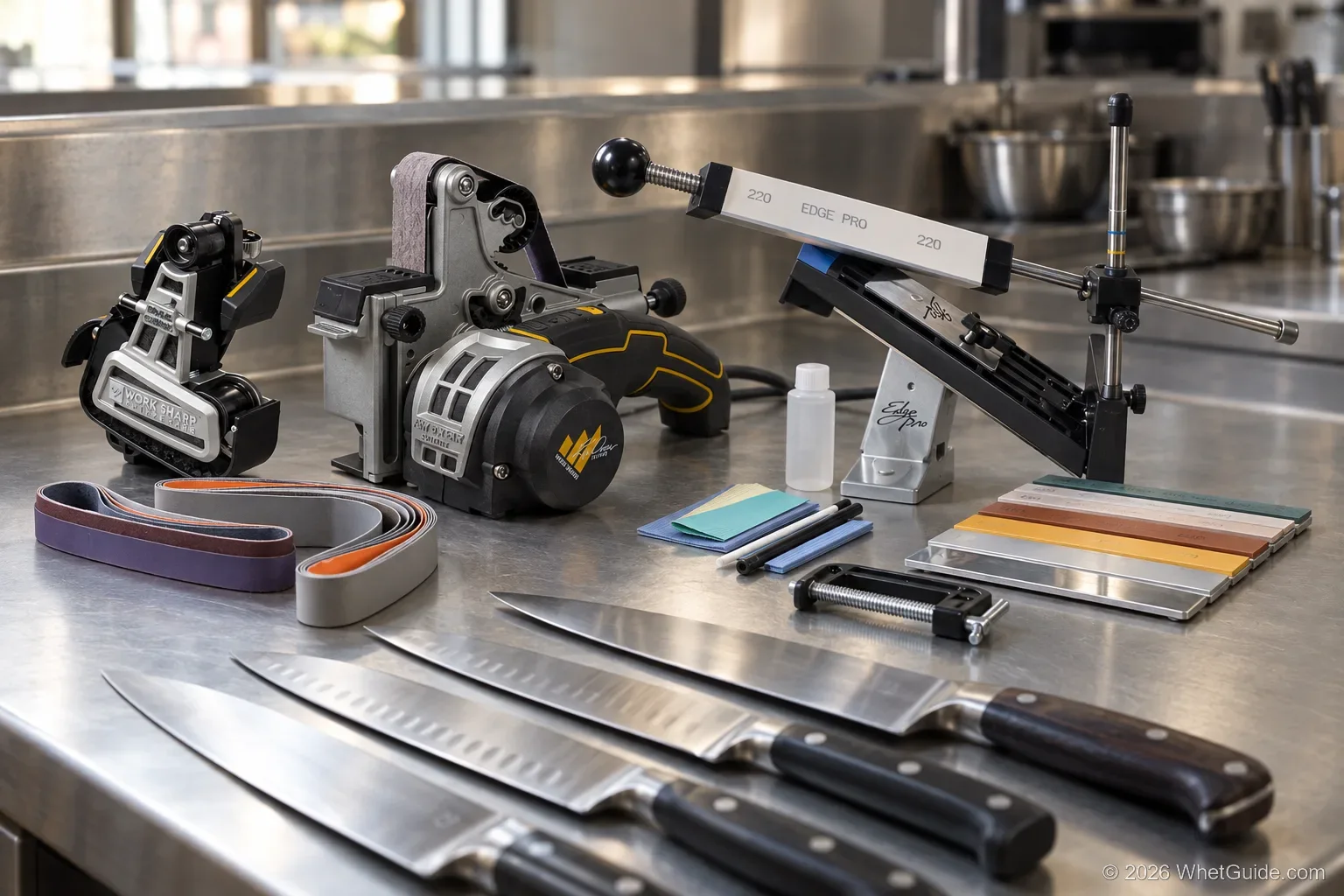
The best premium knife sharpener for most people is the Work Sharp Precision Adjust Elite. It is a guided clamp that sets any angle from 15 to 30 degrees, it comes with 320 and 600 grit diamond plates, a ceramic rod for serrated blades and a strop, and it costs a fraction of a Tormek or a Wicked Edge. Spend more on a high-end knife sharpener only for a specific reason. Get the Professional Elite if you sharpen for a household or a hunting camp, the Ken Onion Elite Mk2 belt machine if you want speed and a 10 degree floor, and the Edge Pro if you like waterstones. If you sharpen a handful of knives a year, mail them out or buy a basic kit instead.
↑ SectionsQuick answer: which high-end sharpener to buy
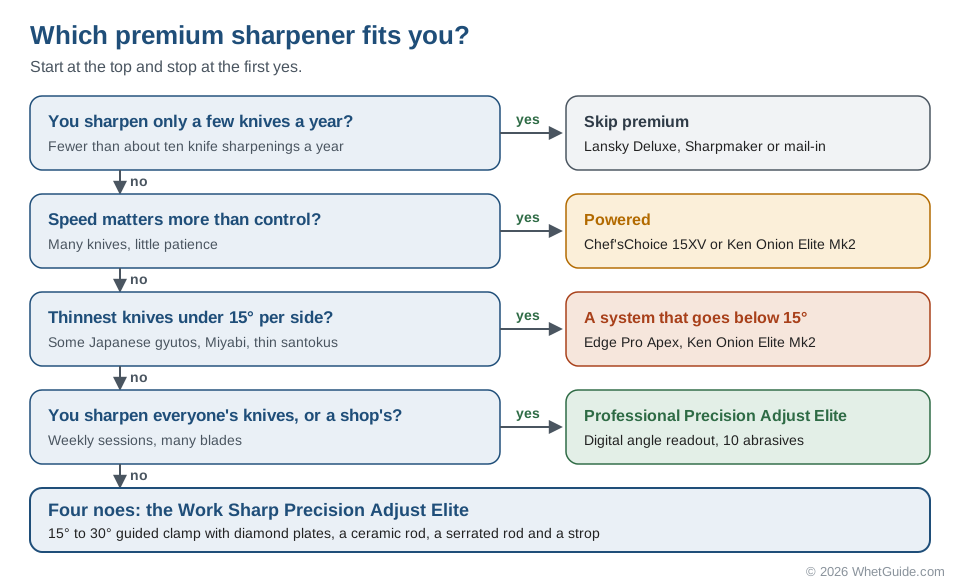
Match the machine to what you sharpen and how often. Most buyers who want to spend real money land on the Precision Adjust Elite; the other picks each solve one problem it doesn't.
| If you | Get | Why |
|---|---|---|
| Want one machine for kitchen and outdoor knives | Precision Adjust Elite | 15° to 30°, diamond plates, serrated rod |
| Sharpen everyone's knives, or a shop's | Professional Elite | Digital angle readout, 220 to 3000 grit, 12 lb base |
| Want speed and a 10° floor | Ken Onion Elite Mk2 | Variable-speed belt, 10° to 35° |
| Like waterstones and want control | Edge Pro Apex 4 or 4 Plus | Stone on an arm; Apex listings mark 10° to 24° |
| Want zero learning curve | Chef'sChoice 15XV | About a minute for a first sharpening |
| Sharpen chisels and axes as well as knives | Tormek T-4 Original | Water-cooled wheel; add the KJ-45 jig for knives |
| Sharpen a few knives a year | A basic kit or mail-in | The machine never pays for itself |
Quick picks
| Best premium system for most people | Work Sharp Precision Adjust Elite | Amazon |
|---|---|---|
| Best for a busy sharpener | Work Sharp Professional Precision Adjust Elite | Amazon |
| Best powered belt machine | Work Sharp Ken Onion Elite Mk2 | Amazon |
| Best for patient craftspeople | KME Precision Knife Sharpener System | Amazon |
| Best premium electric | Chef'sChoice 15XV EdgeSelect | Amazon |
| Best premium pull-through | Brod & Taylor VG2 Professional | Amazon |
| Best for water-stone fans | EDGE PRO 4 Plus | Amazon |
| The proven Edge Pro | Edge Pro Apex 4 | Amazon |
| Best for knives and workshop tools | Tormek T-4 Original | Amazon |
How we picked these
The gift guide on this site has a top tier of four sharpeners, and this page is the longer decision behind it. On October 29, 2026 we pulled Amazon listings and kept the systems that differ in method and have real ratings. The first pass leaned mostly on Outdoor Life and Bob Vila. In November we added GearJunkie and Knife Informer, rechecked the others, and added the Edge Pro Apex 4 and the Tormek T-4 as cards because both have Amazon listings with ratings behind them. The Tormek T-1, the Wicked Edge Gen 4 Pro and the HORL 2 Pro appear as options, not picks, because we found no Amazon listing for them to check. The angles and grits on each card come from the listing. Where a listing leaves a number out, we say so, and where two sources disagree we give both. Prices are the ones we saw at our last check and are dated in the charts, because they move.
This is a how we pick guide. We compared listings and published specs. How we research.
What a high-end knife sharpener actually buys you
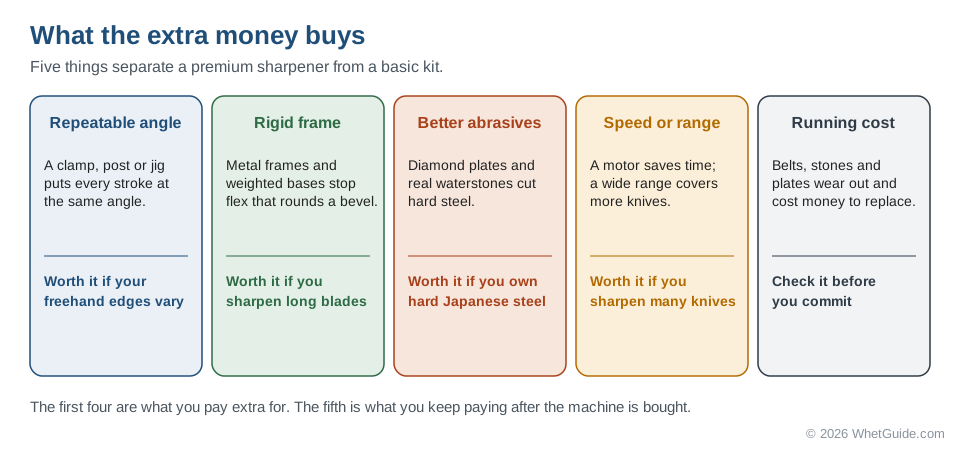
None of the big roundups define premium. Outdoor Life uses the word once, for the HORL 2 Pro. Neither GearJunkie nor Knife Informer pins it down. Our working definition is in the chart above: a sharpener earns its price by doing things a cheap one can't, and each is worth paying for only if you need it. The fifth column, running cost, is the one none of those reviews count. A belt machine eats belts and waterstones dish, and even diamond plates wear out. A cheap pull-through costs almost nothing to run because it does so little.
Outdoor Life's author, who runs a sharpening business, warns that very expensive sharpeners hit diminishing returns. Task & Purpose takes the other side with "buy once, cry once." Both are right for different people. If you sharpen weekly and own hard Japanese steel, the extra rigidity and the better stones show up on the edge. If you sharpen twice a year, they don't.
Four ways to spend more, and a fifth
| Method | What it does to the edge | You keep buying | Examples |
|---|---|---|---|
| Guided clamp with diamond plates | Holds one exact angle, flat bevel | Replacement plates, strop | Work Sharp Elite, KME |
| Belt machine | Fast, leaves a convex finish per the Work Sharp listing | Belts | Ken Onion Elite Mk2 |
| Table-stone system | You move the stone along the blade, flat bevel | Waterstones or tapes | Edge Pro 4 Plus |
| Electric diamond, preset angle | Converts to its own angle, fast | Little; plates last | Chef'sChoice 15XV |
| Wheel machine | Constant angle from a jig on a support bar, water-cooled | Wheels and jigs | Tormek T-4; T-1 from the maker |
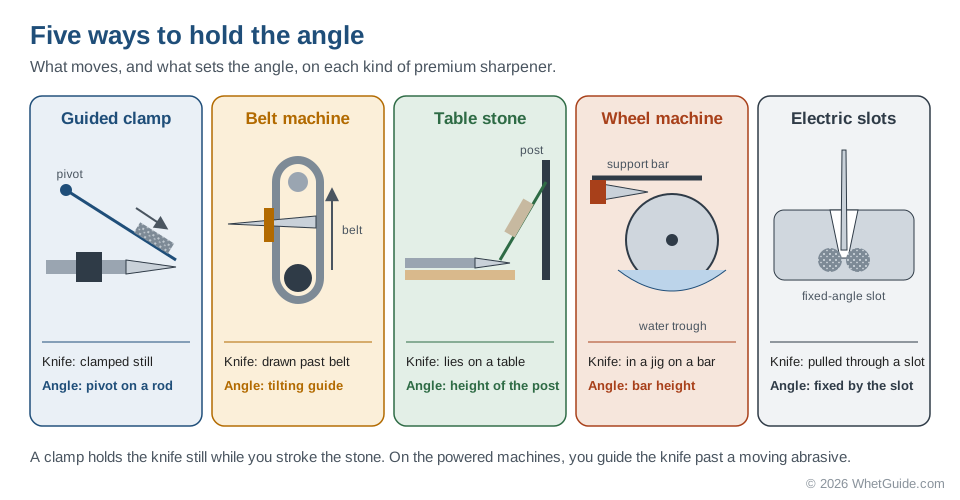
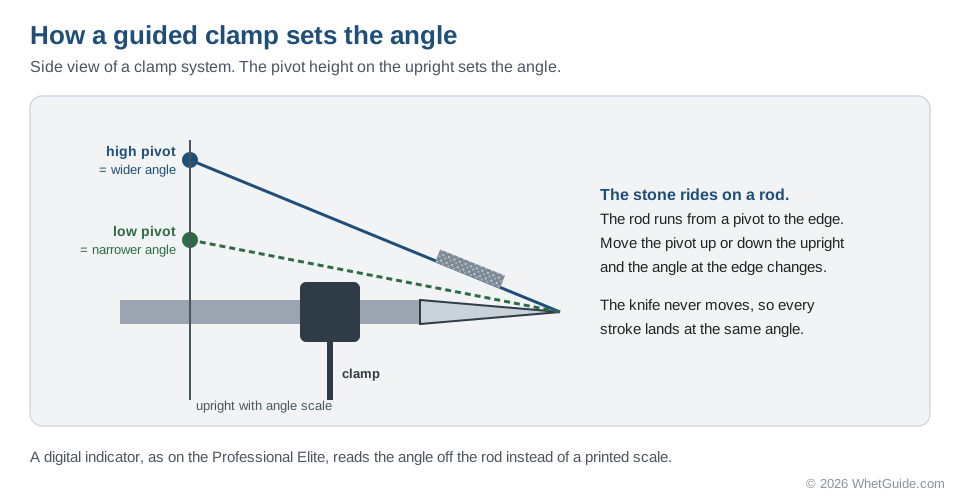
A guided clamp is the easiest of the five to understand. The knife sits still in a clamp, and the stone rides on a rod that runs from a pivot to the edge. Raise or lower the pivot and the angle changes. Because the blade never moves, you can't rock it, which is the mistake that rounds most freehand edges.
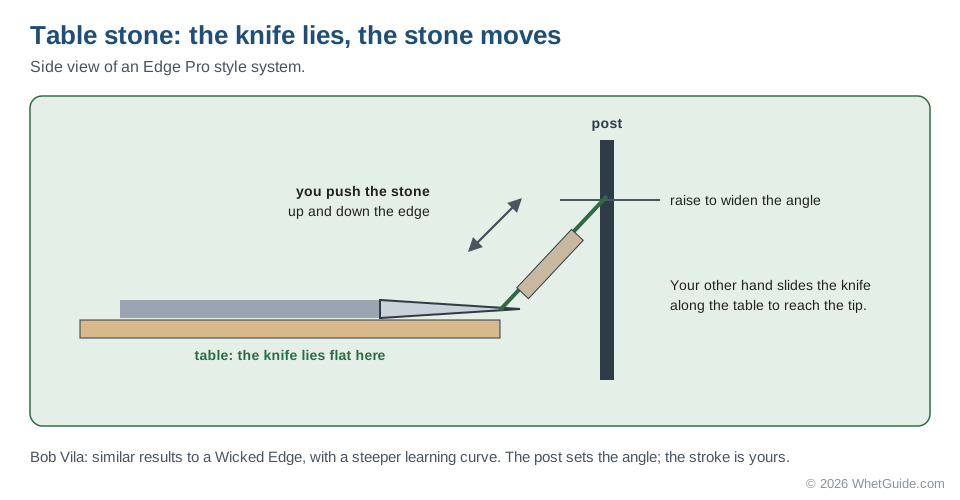
The table-stone system flips that. On an Edge Pro the knife lies loose on a table and you push a stone on an arm up and down the edge, with the arm running through a post whose height sets the angle. Your other hand slides the knife along to reach the tip. It gives you the feel of a waterstone with the angle taken care of, and it asks for more coordination.
What other guides call premium
Outdoor Life's current guide puts the Work Sharp Professional Precision Adjust first. Its upper tier also takes in the Tormek T-4 Bushcraft at $535, the TSPROF K03 Pro at $792 and the Ken Onion Edition Elite Mk.2 at $250, and it uses the word premium only for the HORL 2 Pro system for chef knives. It warns that very expensive sharpeners show diminishing returns, and that harder high-end steels need diamond abrasives because cheaper diamond coatings wear fast on them.
Bob Vila's guide names the Wicked Edge Pro-Pack its best manual system and says the Edge Pro Apex 4 gets similar results at about half the price, with a steeper learning curve. Task & Purpose's favorite powered model is the Tormek T-8, and it leaves pull-throughs out of its guide entirely. GearJunkie gave the Wicked Edge Generation 4 Pro 9.2 out of 10 and wrote that a starting price of $1,000 "is a high bar to clear to be deemed worth it, but the Gen 4 Pro rightfully sails over it." The disagreement is mostly about who the reader is. Outdoor Life and GearJunkie write for hunters and knife collectors, so they rate angle range and rigidity. Task & Purpose writes for people who will buy one tool for life. Kitchen-first buyers get the least help from any of them, which is why this page leads with kitchen knives and their angles.
The 9 best premium knife sharpeners
Work Sharp Precision Adjust Elite
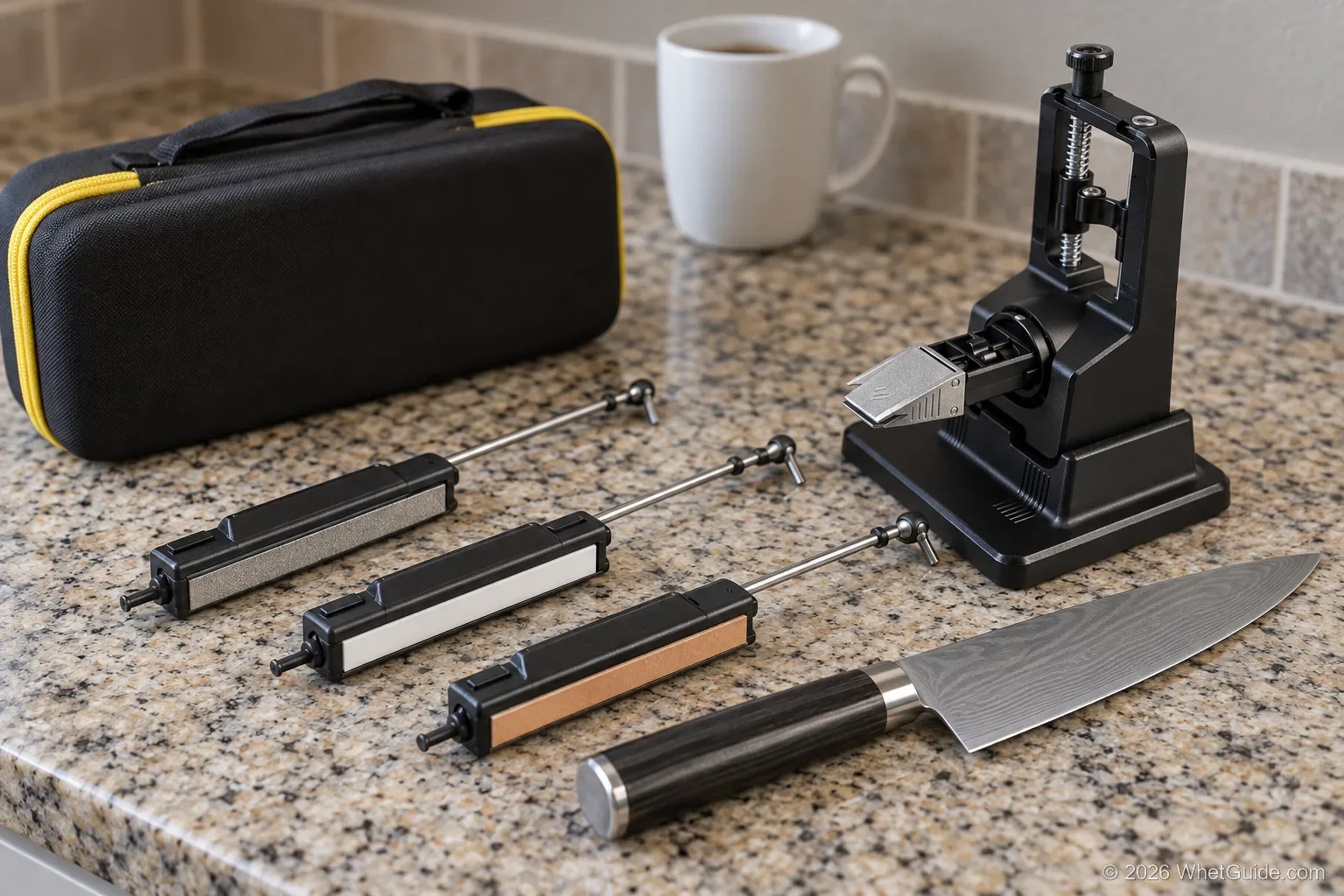
This is the answer for most buyers. The 15 degree floor covers most Japanese kitchen knives and the 30 degree top covers cleavers. The listing suggests 15 for Japanese-style knives, 20 for Western kitchen knives, 25 for hunting blades and 30 for cleavers. The two diamond plates cut hard steel, and the ceramic rod and strop finish the edge. A conical ceramic rod for serrated blades is included, so a bread knife does not need its own tool. Our Precision Adjust review compares it with the standard model, and Precision Adjust vs Elite lists what the extra money adds. The base model, the Precision Adjust, uses the same clamp and angle guide with fewer abrasives. If you already own a strop and a ceramic rod, it is the cheaper way into the same geometry.
- Angle15° to 30°
- Plates320 and 600 grit diamond
- Also includesceramic finishing rod, serrated rod, tri-brasive attachment, leather strop
- Ratings6,400+
Why it stands out
- Complete kit: plates, two rods, a strop
- Bench-top clamp holds blades steady
Think twice if
- You sharpen blades with a very thin edge below 15 degrees
Work Sharp Professional Precision Adjust Elite
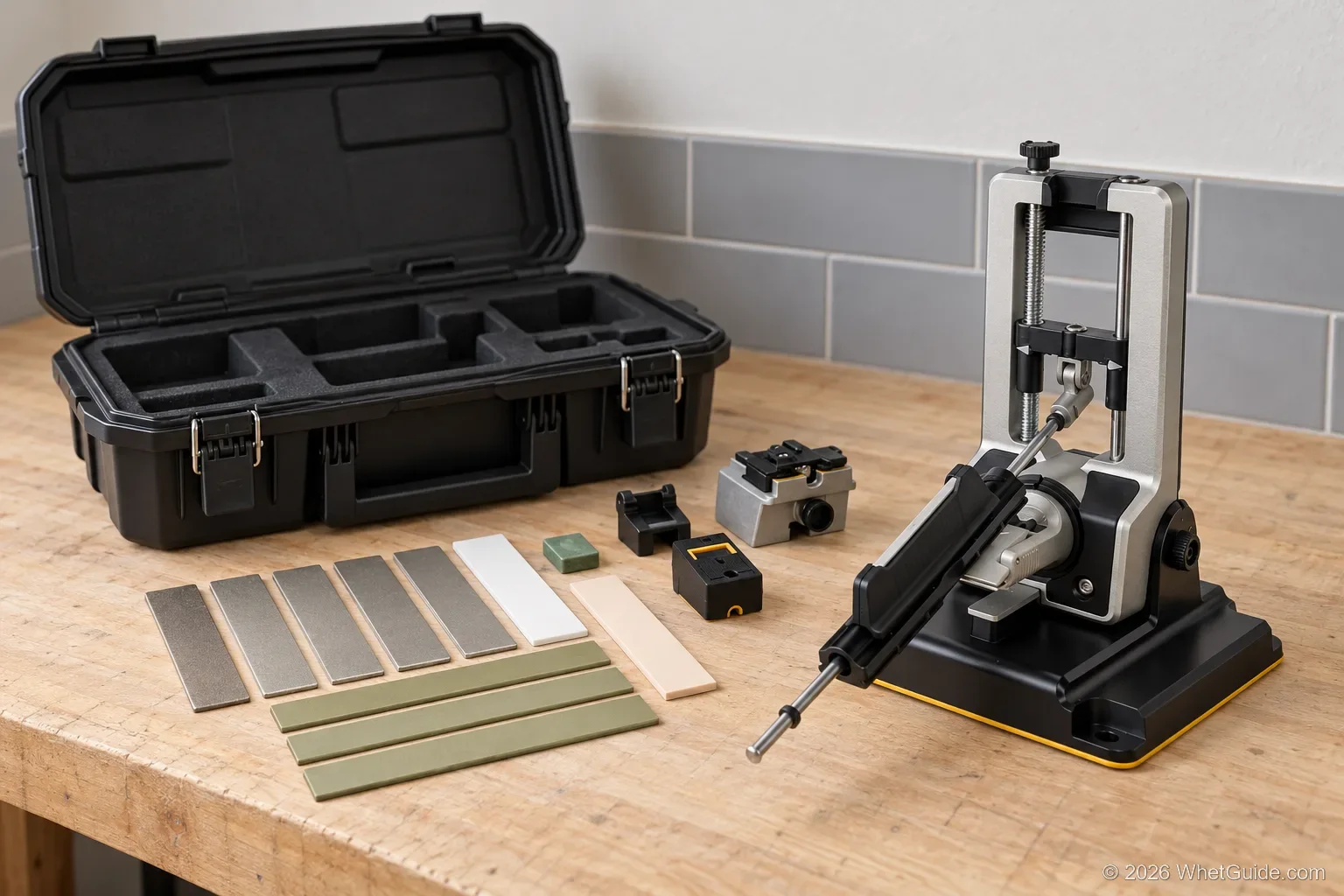
The step up buys stability and a wider grit spread. A digital angle indicator removes the guesswork when you reset the angle, and the weighted 12 lb base and clamp stabilizer keep the clamp from walking. The ten abrasives run from a 220 grit diamond plate to 3000 grit resin-bonded diamond, plus a fine ceramic and a leather strop, so you can reprofile a chipped blade and still finish fine. The listing says longer blades are sharpened in sections. Sources disagree on its range. The Amazon listing gives 15 to 30 degrees. Outdoor Life lists it at under 10 to over 40 degrees. Check the manual before you count on anything below 15. It is a lot of money for a home cook. It earns its price when a whole hunting party or a small shop hands you their knives.
- Angle15° to 30° per listing, digital indicator
- Abrasives10 pieces, 220 to 3000 grit
- Baseweighted 12 lb
- Blade capacityup to ¼ in thick, 15 in long
Why it stands out
- Digital angle readout
- Ten abrasives from 220 to 3000 grit
Think twice if
- You sharpen a handful of knives a year, since the standard Elite does most of this
Work Sharp Ken Onion Elite Mk2
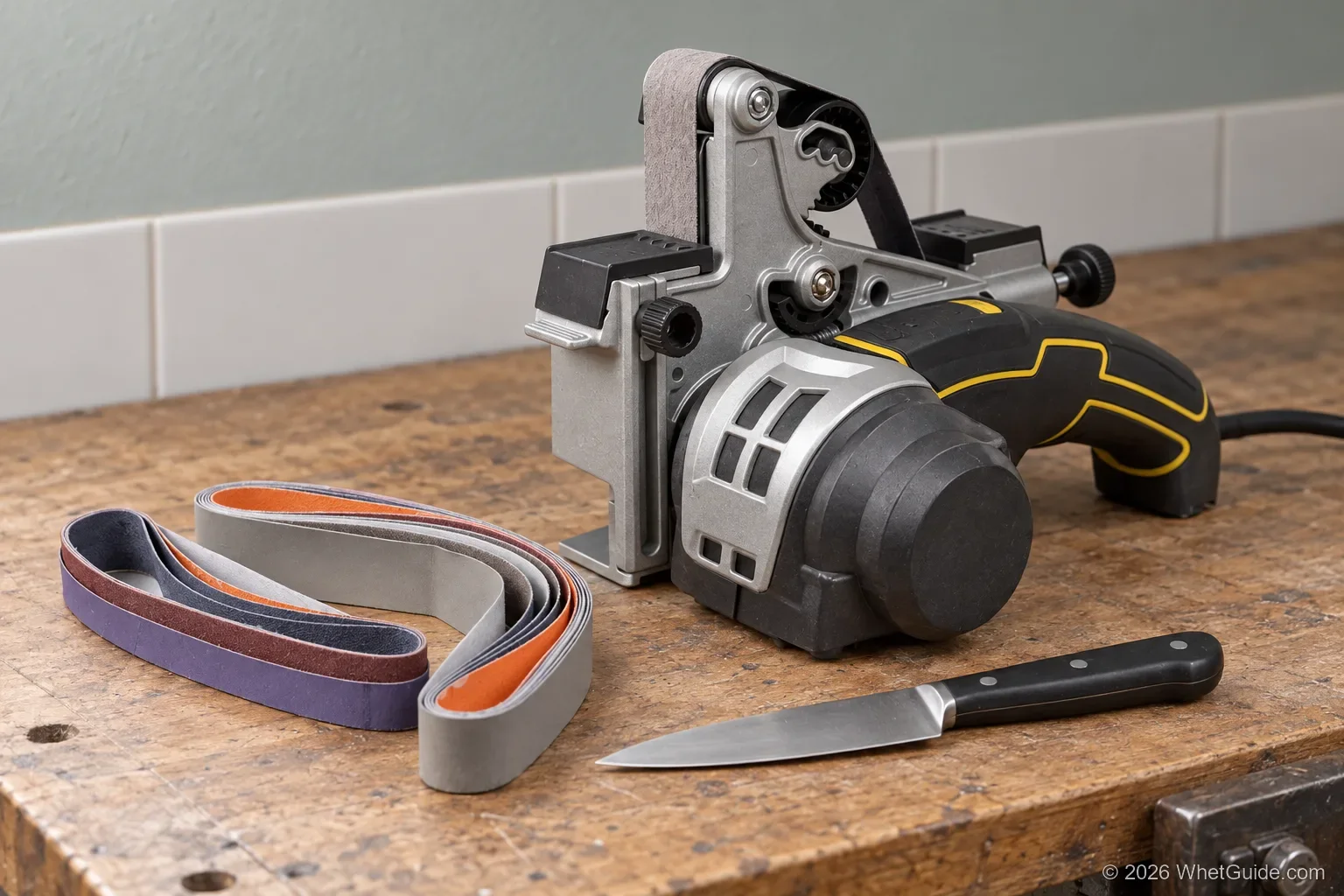
If you want speed, this is it. The belt hugs the blade and the listing says it sharpens and hones in one pass. The listed 10 degree floor sits below the standard Precision Adjust Elite's 15 and the KME's 17, so it covers the thinnest kitchen knives. Knife Informer adds a detail: 15 to 30 degrees with the standard setup, and 10 to 35 with the blade grinding attachment. It also grinds garden tools and scissors. Belts wear out, and a heavy hand or high speed takes metal off fast. The variable speed is the safety valve: run it slow on thin kitchen steel. The cheaper Ken Onion Mk2 and the MK2 use the same belt idea for less. For a head-to-head, see Work Sharp MK2 vs Ken Onion.
- Angle10° to 35° per listing
- Motorvariable speed
- Methodflexible abrasive belt
- Finishconvex
- Edgeskitchen, pocket, hunting, serrated, scissors, garden tools
- Weight2.1 lb
Why it stands out
- Fastest method here
- 10 to 35 degree range
Think twice if
- You want a flat bevel, since belts give a convex edge
KME Precision Knife Sharpener System
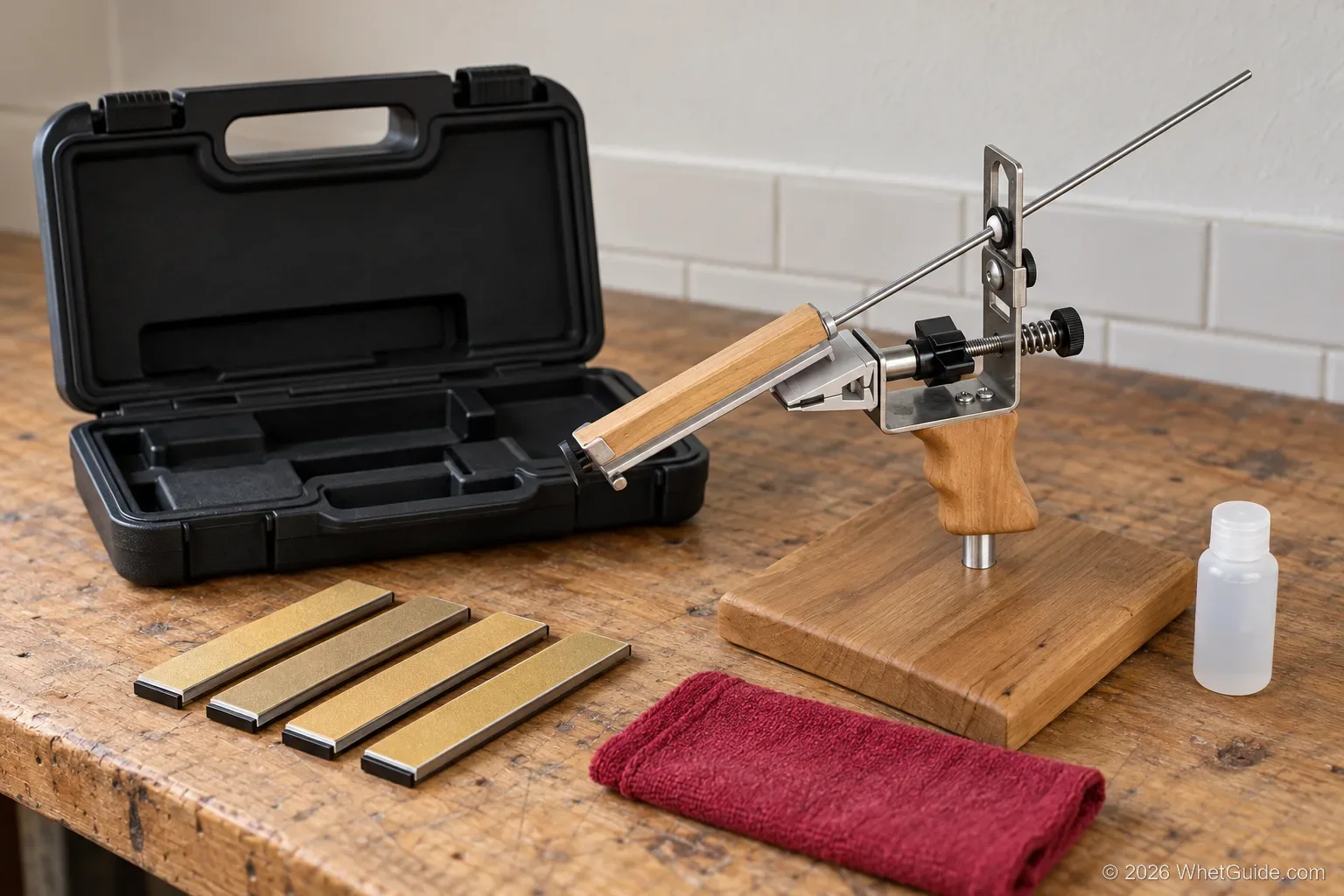
KME is a traditional guided rod system with a spherical bearing in the guide, so the stone does not wobble as you stroke. Four diamond hones run from 140 to 1500 grit. The 17 degree minimum is the catch: it cannot match a 15 degree Japanese edge, and it can't reach Wüsthof's 14 either. Pick it for Western kitchen knives at 17 to 20 and for outdoor blades, and keep a different tool for thin Japanese blades. It is also the lightest system here at 12 ounces, and it packs into a hard case, which makes it the one premium system you can take to a hunting camp.
- Angle17° to 30° in 1° steps
- Hones4 Gold Series diamond (140, 300, 600, 1500)
- Guidespherical bearing rod
- Weight12 oz
Why it stands out
- Stable guide with continuous angle adjustment
- Four diamond hones from 140 to 1500 grit
Think twice if
- You own 15 degree Japanese knives, because it starts at 17
Chef'sChoice 15XV EdgeSelect
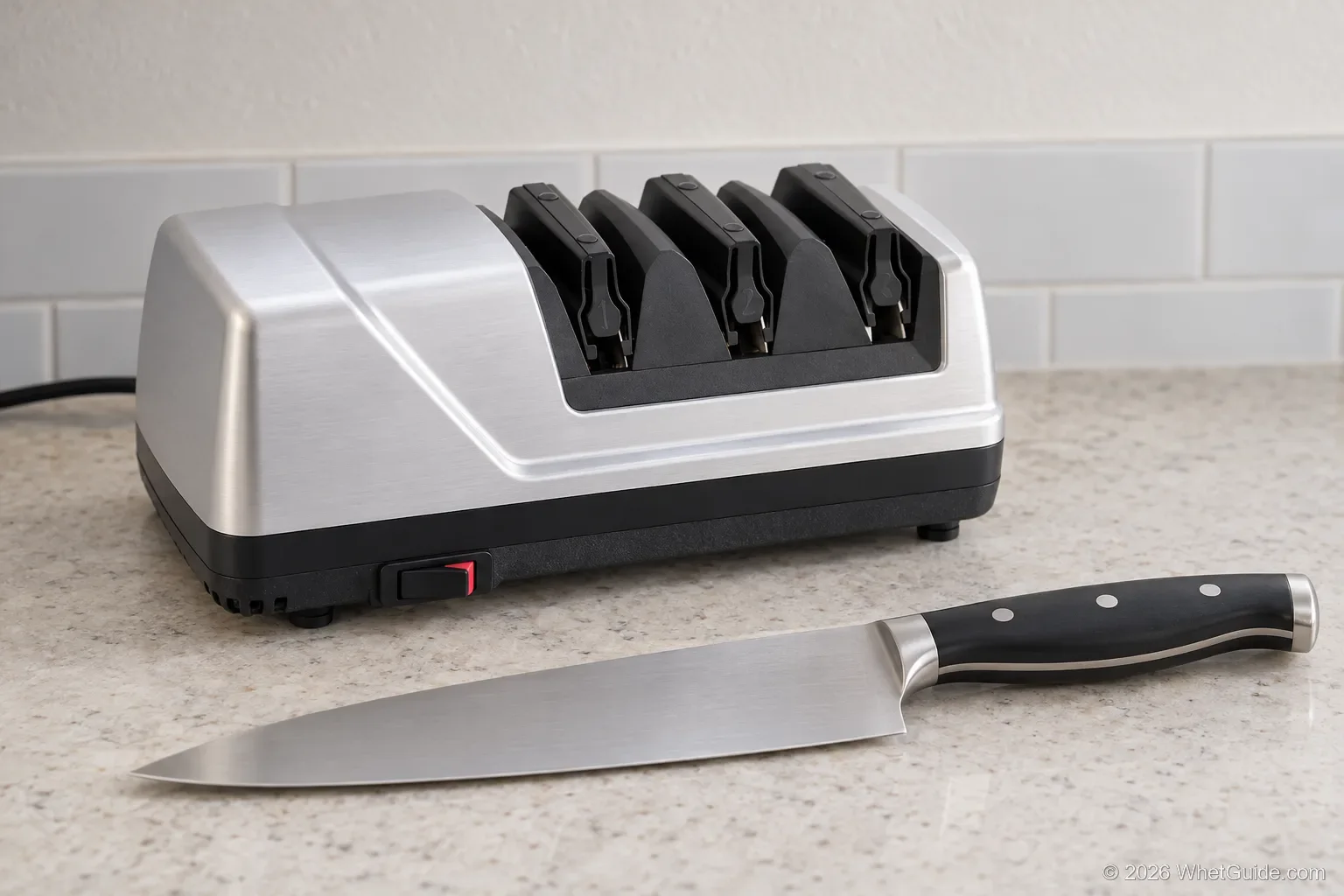
With 14,000 ratings it is the best-reviewed premium machine here. It converts a 20 degree factory edge to its own 15 degree profile in about a minute, per the listing, and resharpens in about ten seconds. For a household with many knives and no patience, that is the appeal. The catch is that it supplies its own angle, so a knife that was a different angle gets converted for good. Outdoor Life notes that electric sharpeners repair chips fast but can ruin a knife if used carelessly. Use light passes and stop when the edge is back. Our Trizor XV review covers the Trizor version, and how to use a Chef'sChoice walks through the stages.
- Angles15° (converts 20° edges)
- Stages3, two diamond plus a flexible stropping stage
- Knivesstraight and serrated
- Timeabout 1 minute first sharpening, about 10 seconds after, per listing
- Ratings14,000+
Why it stands out
- Fast and easy to learn
- Strop stage finishes the edge
Think twice if
- You want to choose your own angle
- Your knives are thinner than 15 degrees
Brod & Taylor VG2 Professional
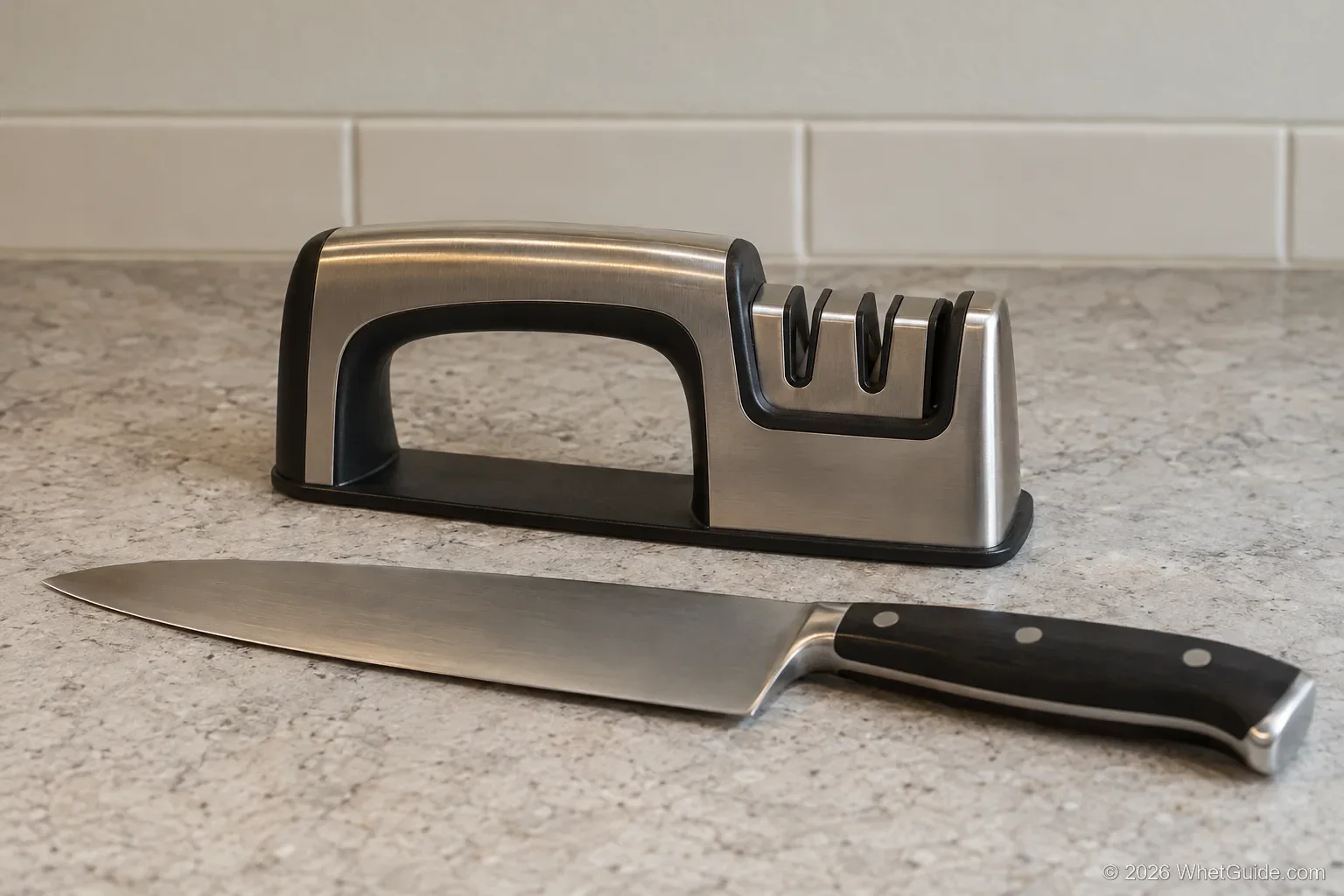
A pull-through with spring-loaded arms that set the angle for you. Pull with the tip down to sharpen, tip up to hone, and at an angle for serrated blades. The listing also says it does not remove excess metal and is safe on carbon steel and Damascus. Sharpening bars are replaceable. Treat it as a kitchen-counter tool for a cook who will never learn a stone, and look at the angle guidance before using it on hard Japanese steel. The listing does not give an angle. Our page on whether pull-through sharpeners are bad explains why carbide pull-throughs split opinion.
- Methodspring-loaded tungsten carbide bars
- Modessharpen, hone, serrated
- Basestainless steel
- Barsreplaceable, 5 to 10 years per the listing
Why it stands out
- Zero technique
- Replaceable bars
Think twice if
- You need a stated angle for a particular knife
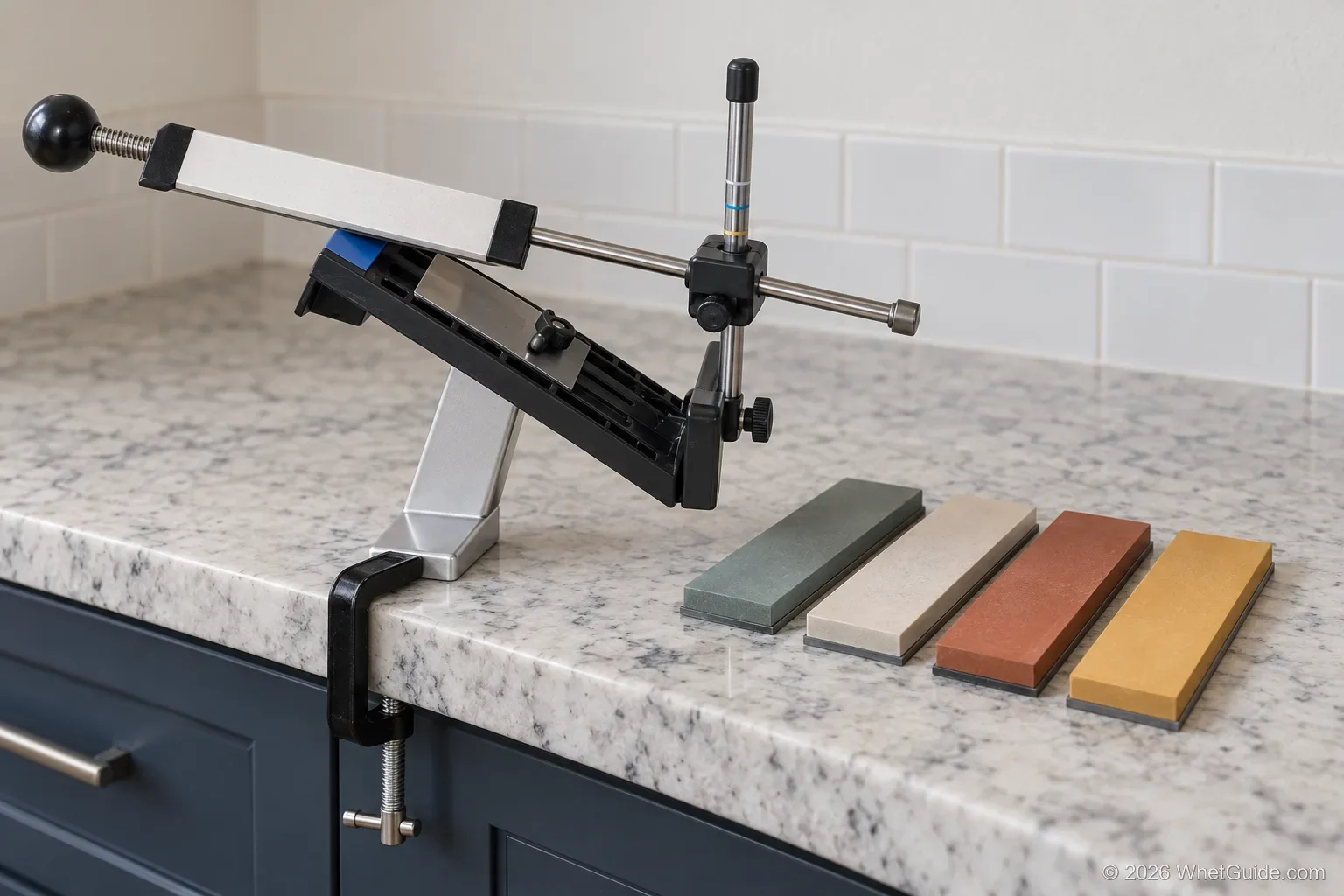
EDGE PRO 4 Plus
The stone moves on an arm and the knife lies loose on a table, which gives a flat, repeatable bevel. The 4 Plus adds the A-Plus frame, which clamps to a counter, sits on a weighted base or bolts down. Its listing gives no angle range. Edge Pro's Apex listings mark 10 to 24 degrees, and the 4 Plus listing says it is built on the Apex platform, so expect the same until the manual says otherwise. At our check the listing was new with three ratings, so there is little owner feedback yet. Buy it if you love water stones and the control they give, and see the Edge Pro review for how the kits differ.
- Grits120 to 1000 waterstones (five)
- Polishing2000 and 3000 grit tapes
- Includes8 in ceramic hone, A-Plus frame, C-clamp
- Anglenot stated on this listing
Why it stands out
- Five waterstones plus polishing tapes, 120 to 3000 grit
- Clamps to a counter or bolts down
Think twice if
- You want proven ratings; the listing had three at our check
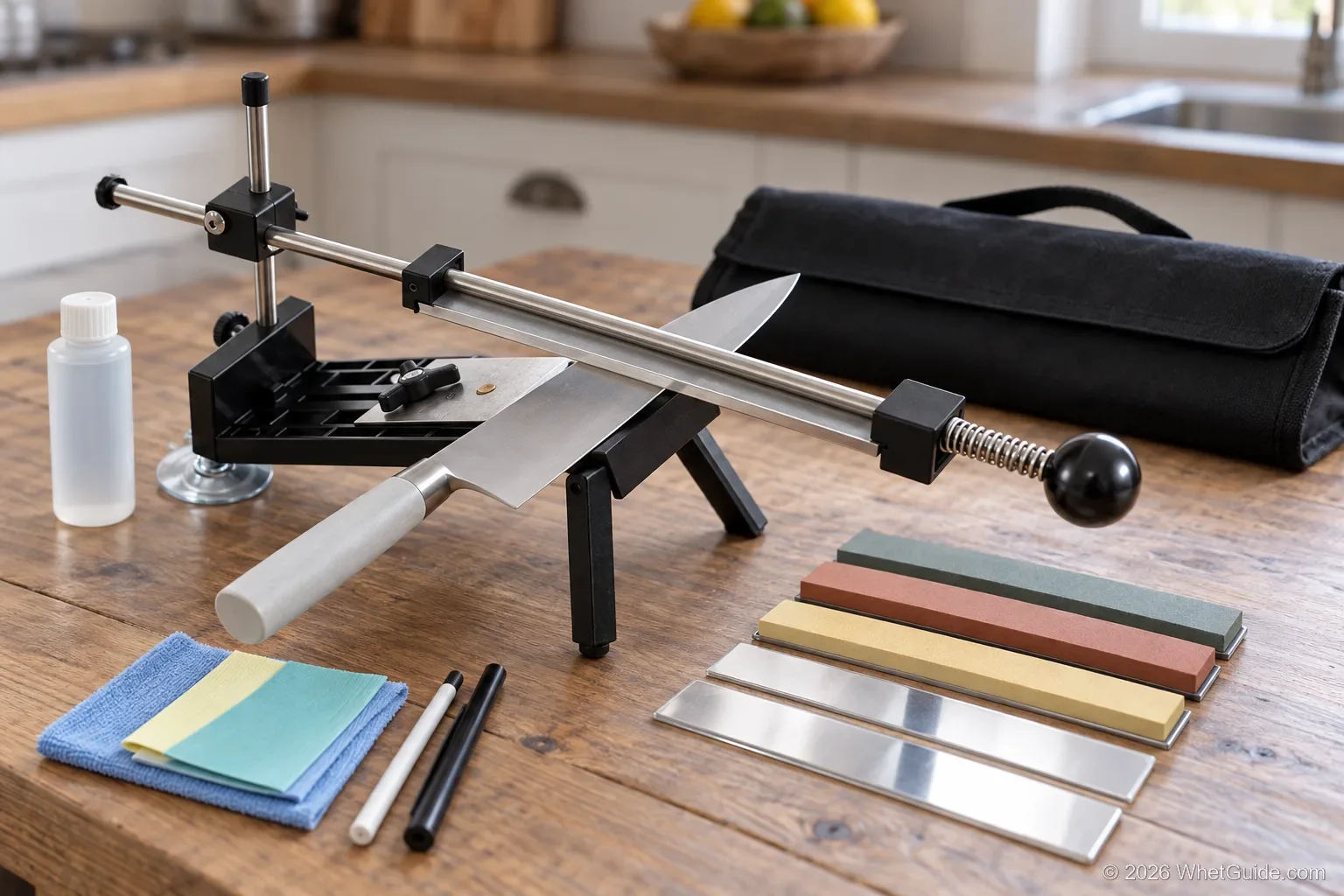
Edge Pro Apex 4
The Apex 4 is the long-running version, with about 400 ratings behind it. The listing marks the angle at 10, 15, 18, 21 or 24 degrees and says it is continuously adjustable between them. Edge Pro's own FAQ, per our review, suggests 21 as a starting point for most knives. It needs no clamp and no power, and the patented lip at the end of the table stops the knife from sliding past the stone. The 24 degree top is the limit to know. A thick camp knife you want at 25 to 30 is a job for a clamp system. Chef Knives To Go lists 10 to 35 for the Apex, which disagrees with the Amazon listings, so check the manual for your kit before planning on a wide angle.
- Angle10° to 24°, marked at 10, 15, 18, 21, 24
- Stones120 to 1000 grit (five)
- Polishing2000 and 3000 tapes
- Hone8 in, 1200 grit ceramic
- Ratings400+
Why it stands out
- Goes down to 10 degrees per its listing
- Proven design with hundreds of ratings
Think twice if
- Your outdoor knives need more than 24 degrees
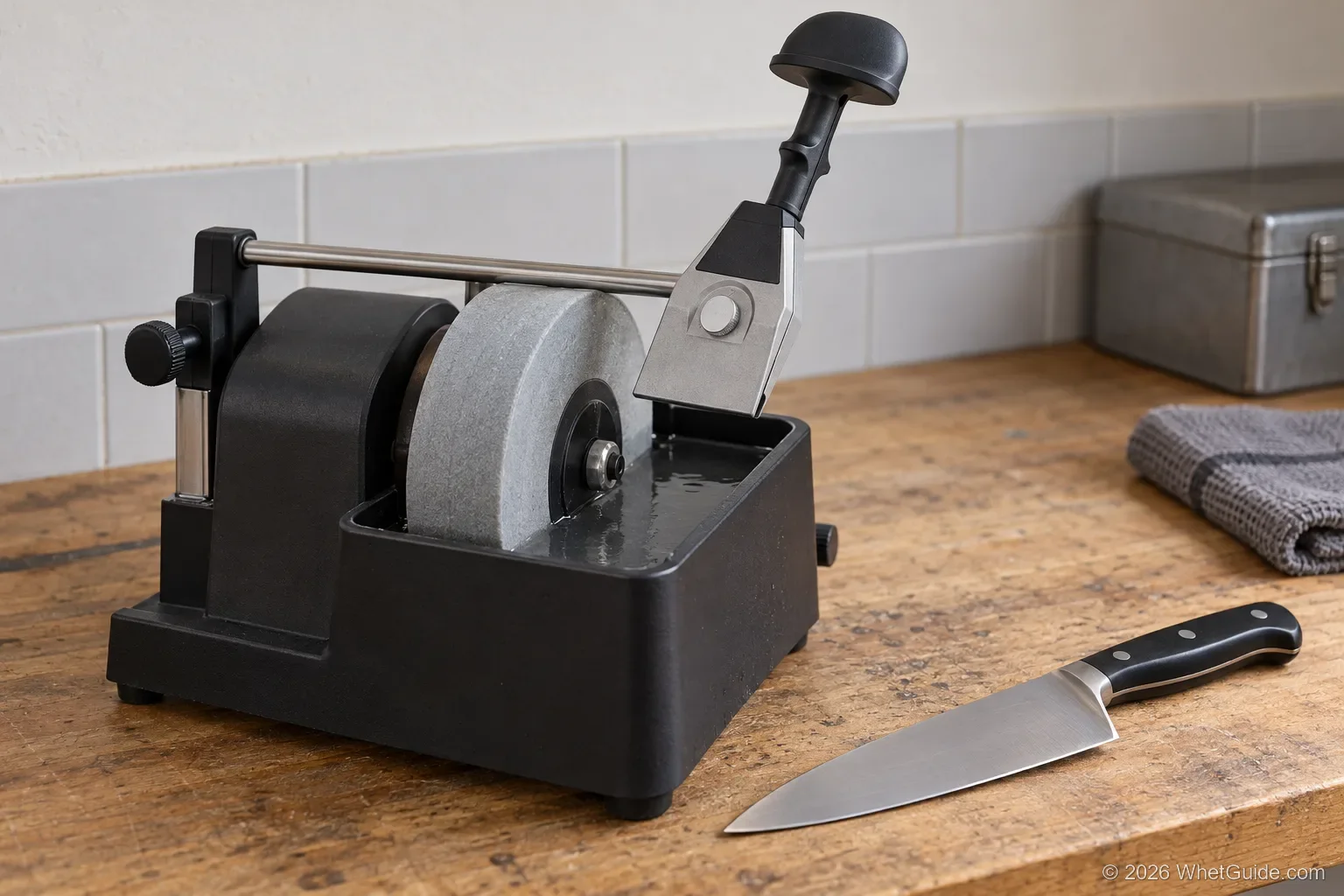
Tormek T-4 Original
The T-4 runs a grinding wheel through a water trough, so the steel stays cool while it cuts. It is the machine to buy if your sharpening list runs to woodworking chisels and axes as well as knives. Our Tormek comparison notes that the T-4 Original does not include a knife jig, so budget for the KJ-45 centering knife jig as well. The T-4 Bushcraft bundle adds the KJ-45 and an axe jig; Outdoor Life lists it at $535. For a kitchen-only buyer the T-1 is the better Tormek, but we found no Amazon listing for it. See the options Amazon barely sells.
- Typecompact water-cooled wheel machine
- VersionUS, English handbook
- Wheels200 mm
- Knife jignot included (KJ-45 sold separately)
- Ratings60+
Why it stands out
- Water cooling keeps the edge from overheating
- Sharpens woodworking tools and axes with the right jigs
Think twice if
- You only sharpen kitchen knives
- You don't want to buy the knife jig separately
How low each one goes, and why the floor decides it
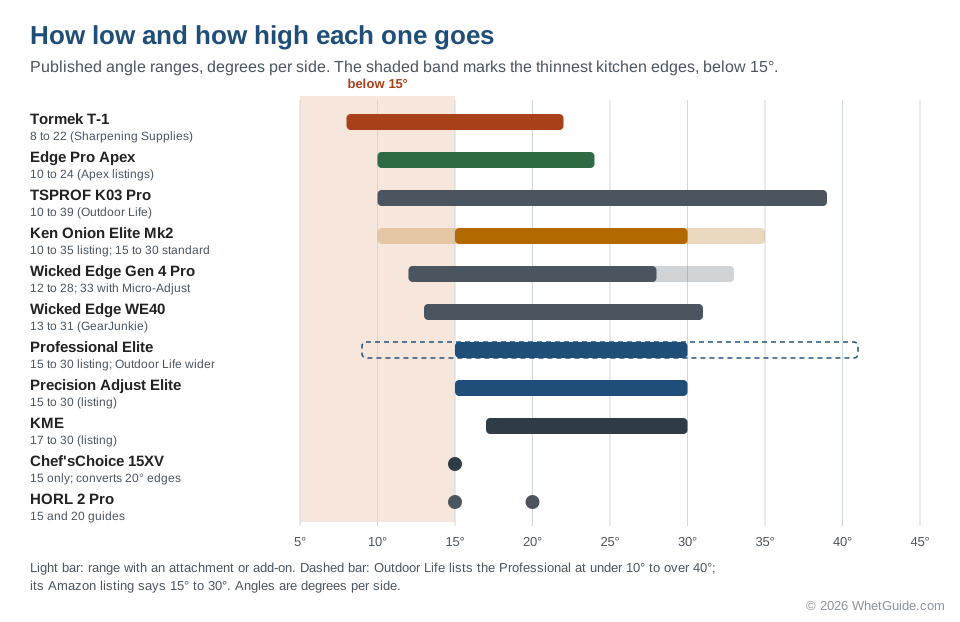
The lowest angle a machine can reach is the spec that most often rules a premium sharpener out. A system that starts at 17 degrees can't recreate a 15 degree edge; it can only make it thicker. Here is every system on this page with its published range and the source for each number.
| System | Lowest | Highest | Source |
|---|---|---|---|
| Tormek T-1 | 8° | 22° | Sharpening Supplies review |
| Edge Pro Apex 4 | 10° | 24° | Amazon listing (Chef Knives To Go says up to 35°) |
| TSPROF K03 Pro | 10° | 39° | Outdoor Life |
| Ken Onion Elite Mk2 | 10° | 35° | Amazon listing; Knife Informer gives 15° to 30° without the grinding attachment |
| Wicked Edge Gen 4 Pro | 12° | 28° | GearJunkie; 33° with the Micro-Adjust add-on |
| Wicked Edge WE40 | 13° | 31° | GearJunkie |
| Professional Elite | 15° (listing), under 10° (Outdoor Life) | 30° (listing), over 40° (Outdoor Life) | The two disagree |
| Precision Adjust Elite | 15° | 30° | Amazon listing |
| KME | 17° | 30° | Amazon listing |
| Chef'sChoice 15XV | 15° | 15° | Amazon listing; converts 20° edges |
| HORL 2 Pro | 15° | 20° | Outdoor Life; two fixed guides |
Two of these numbers needed sorting out. The Ken Onion's 10 degree floor is below the standard Elite and the KME, but it is not below every Work Sharp: Outdoor Life puts the Professional Precision Adjust under 10 degrees. Its own Amazon listing says 15. When a listing and a hands-on reviewer disagree, trust neither blindly. Set the angle with a marker on the bevel, the method in our Sharpie trick guide, and see where the stone actually cuts. The other was the Edge Pro 4 Plus. Its listing has no angle at all, so the 10 to 24 range on this page comes from the Apex listings and applies to the 4 Plus only because it shares the Apex platform.
Premium sharpeners for Japanese knives
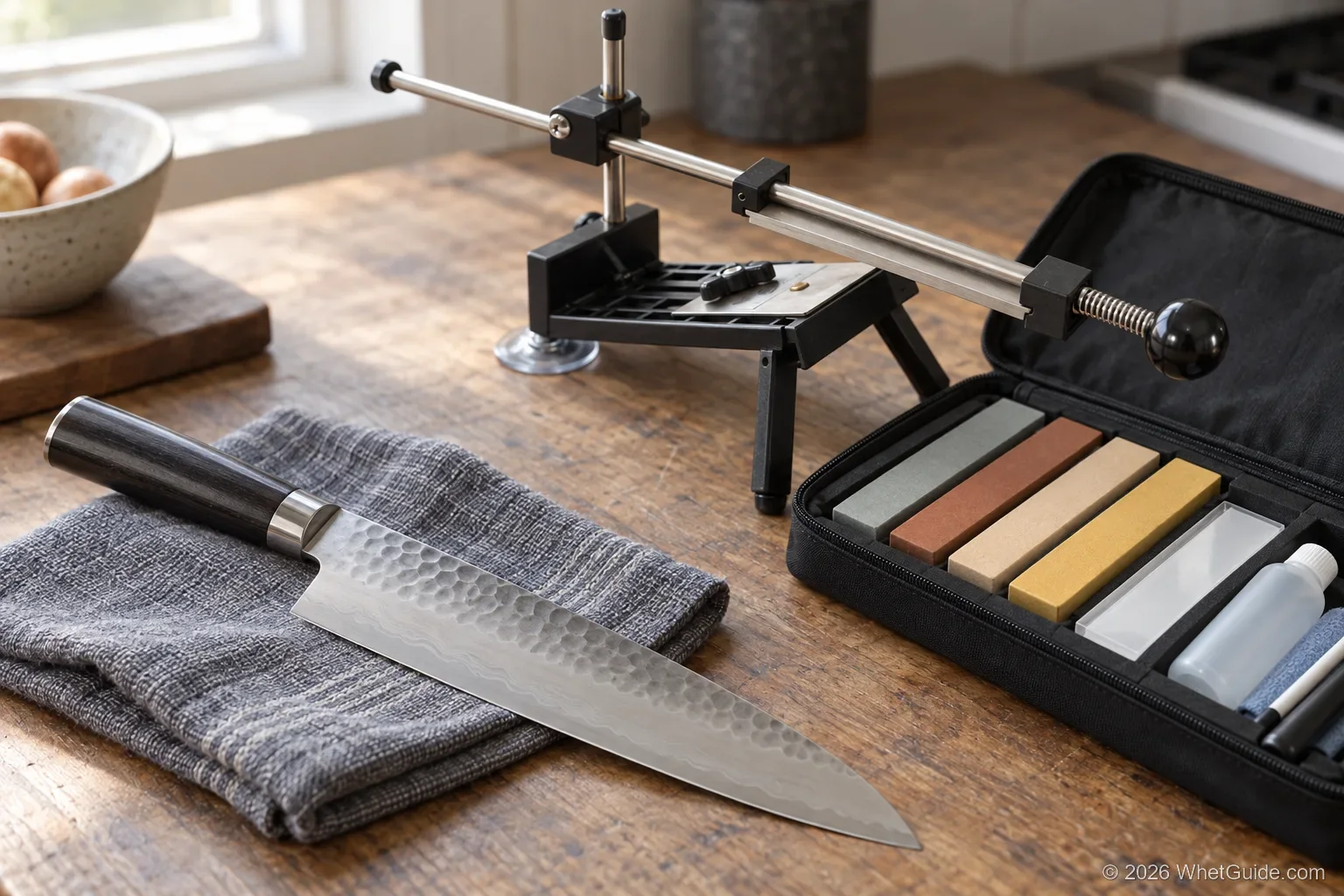
Thin Japanese knives are where the wrong premium sharpener does the most harm. The published angles on this site's brand pages run from 9.5 to 12 degrees for Miyabi, 10 to 15 for Global, about 16 for Shun and 14 for standard Wüsthof blades (a German maker that sharpens thin). A machine with a 15 degree floor handles Shun and most Global. It cannot reproduce a Miyabi edge.
| Your knife | Published angle | Systems that reach it |
|---|---|---|
| Miyabi | 9.5° to 12° | Tormek T-1, Edge Pro Apex, Ken Onion Elite Mk2 (10° and up) |
| Global | 10° to 15° | The above, plus any 15° system at the top of the range |
| Wüsthof standard | 14° | Anything that goes below 15° |
| Shun | 16° | Every adjustable system here except the KME, which starts at 17° |
Hard steel is the second issue. Outdoor Life says harder, high-end steels need diamond abrasives, because cheap diamond coatings wear fast on them. Everything that cuts on the Work Sharp and KME systems is diamond, and so are the 15XV's first two stages. The Edge Pro's stones are waterstones, which cut hard steel well but wear and need flattening. Single-bevel knives such as a yanagiba are a different job; none of these machines is built for them, and a whetstone is the tool. Our guides to the best knife sharpener for Japanese knives and the Miyabi sharpening angle go further.
V bevel or convex edge
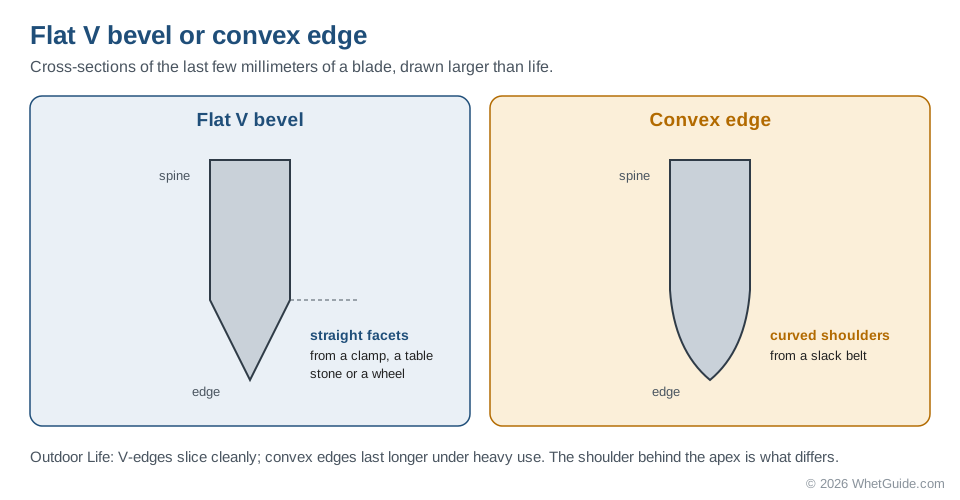
Edge shape is the choice the roundups leave you to make. Outdoor Life notes that V-edges slice cleanly and convex edges last longer under heavy use. Anything that holds the abrasive flat against the blade, whether a clamp, a table stone or a wheel, gives a flat V-bevel. A belt machine like the Ken Onion gives a convex finish, as its listing says, because the slack belt wraps around the edge.
Switching between the two costs metal. If you sharpen a convex edge on a clamp system, the first session grinds the shoulder flat before the stone reaches the apex. That is fine once; doing it every few months wears a knife down faster than needed. Pick one shape per knife and stay with the matching tool. For a chef's knife used mostly for slicing, the flat V suits. For a hatchet or a camp knife that chops, the convex edge is the better match.
Matching abrasives to your steel
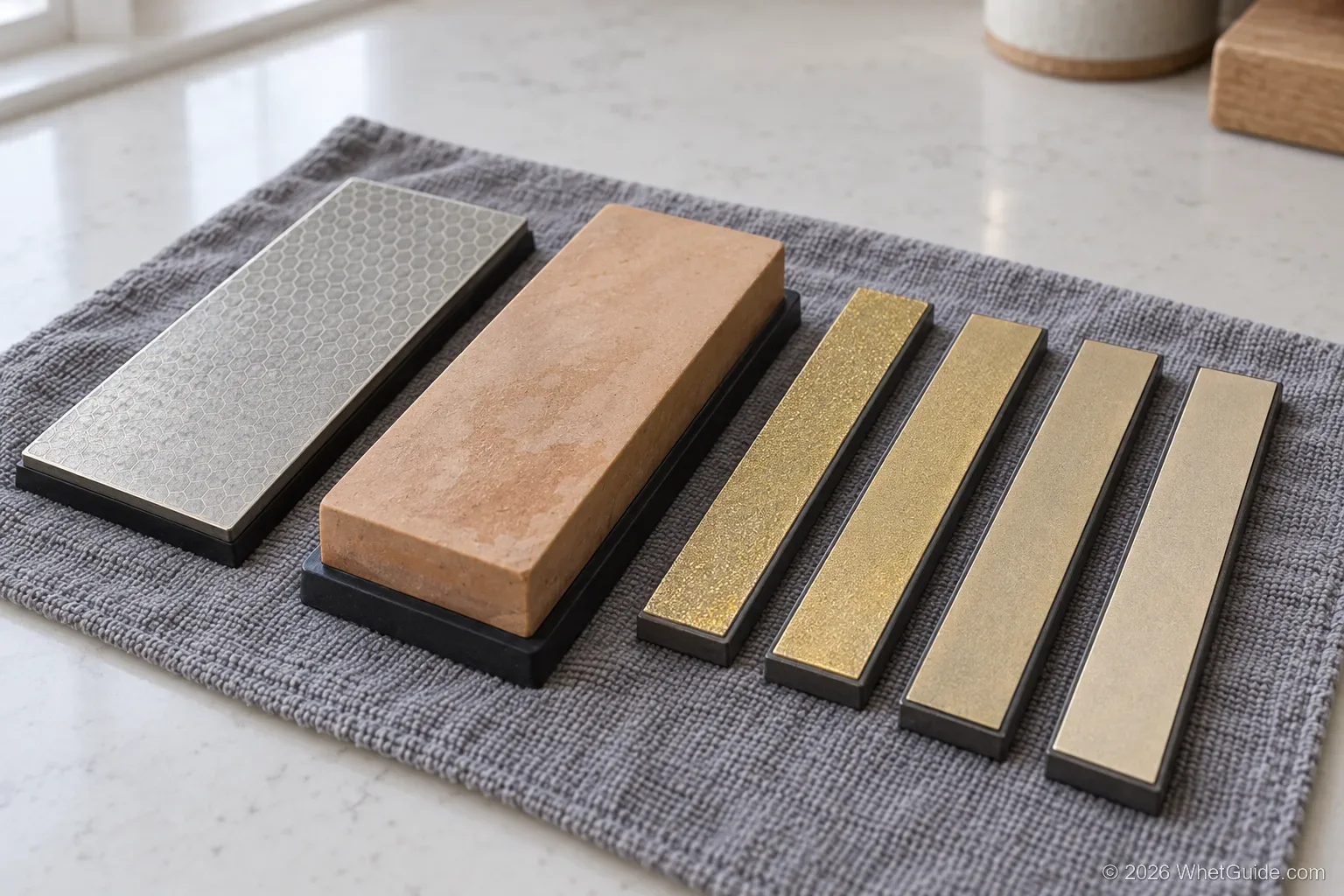
GearJunkie sorts knife steels into brackets by carbide content and matches abrasives to them, and Outdoor Life makes the same point more simply: the harder and more wear-resistant the steel, the more you need diamond. Here is how each system's abrasive fits.
| System | Abrasive | Grit range | Hard steel? |
|---|---|---|---|
| Precision Adjust Elite | Diamond plates, ceramic rod, strop | 320 to 600 diamond | Yes |
| Professional Elite | Diamond and resin-bonded diamond, ceramic, strop | 220 to 3000 | Yes |
| KME | Gold Series diamond hones | 140 to 1500 | Yes |
| Edge Pro | Waterstones, polishing tapes, ceramic hone | 120 to 3000 | Yes, with stone wear |
| Ken Onion Elite Mk2 | Abrasive belts | Not stated as grits on the listing | Depends on belt |
| Chef'sChoice 15XV | Diamond stages, flexible strop stage | Not stated | Yes |
| Tormek T-4 | 200 mm grinding wheel | Depends on wheel | Depends on the wheel fitted |
A wide grit range matters only at the ends. The coarse end (140 to 220) is for repair: chips, a broken tip, or changing a 20 degree edge to 15. The fine end (2000 and up) is for a polished edge that push-cuts paper. A kitchen knife in normal use lives between 600 and 1000, then a strop. Our grit chart maps each grit to a job.
Motors and heat
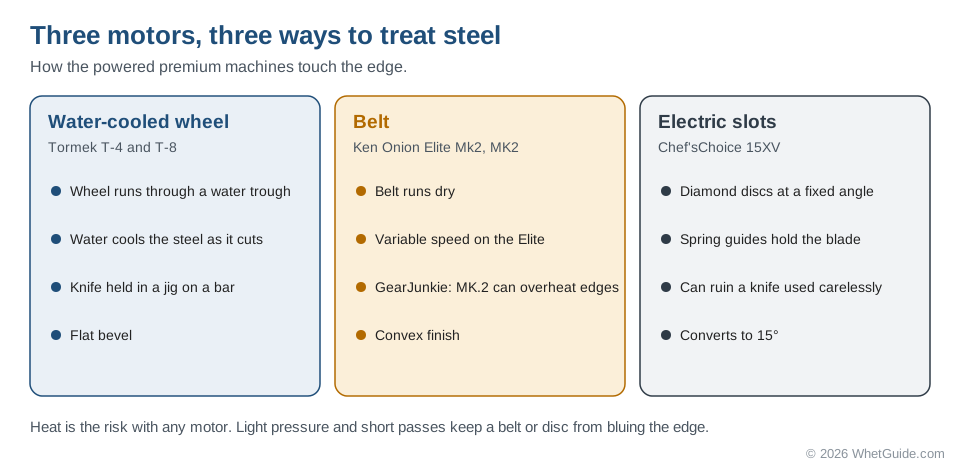
A motor saves time and adds a risk: heat. Steel that gets hot enough to change color at the edge loses its temper, and that soft spot won't hold an edge again until it is ground away. The three powered methods handle heat very differently. The Tormek's wheel runs through water, which cools the steel as it cuts. GearJunkie found that the Work Sharp MK.2 belt machine "can overheat edges" and called it loud and messy, with dust to clean up. The Ken Onion Elite's variable speed helps here: slow the belt for thin kitchen blades and make several light passes rather than one long one. On the 15XV, the risk is grinding too long. Stop at the listing's suggested time and check for a burr.
Wicked Edge, a manual system, makes the opposite pitch on its site: its hand-powered stones "don't work harden your blade." That is a maker's claim, and it is the reason some buyers stay manual.
Which machine for which blade
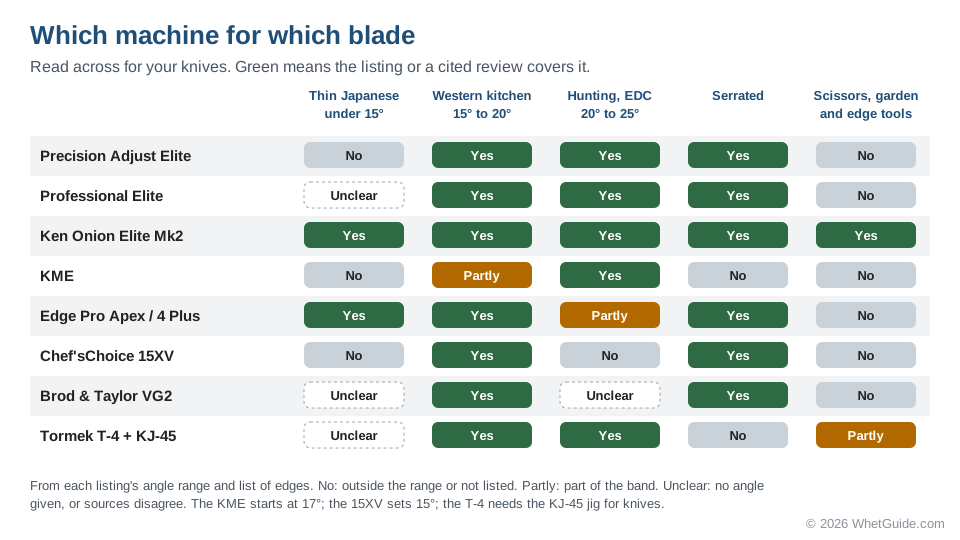
Most people own more than chef's knives. Read across for your drawer. The Ken Onion is the only machine with a yes in every column, which is the case for buying it if your sharpening includes garden shears and a bread knife. Serrated blades need a rod or a belt that fits the scallops; the Elite's conical rod and the 15XV's third stage handle them. For a heavy axe, GearJunkie calls the Wicked Edge "far from ideal" for restoring damaged edges on axes and tools, and Tormek's axe jig or a belt machine is the better route. Our guides to sharpening a serrated knife and the best sharpener for hunting knives go into each.
The price ladder
Here is what each system cost at our last check, from the basic kit we recommend instead to the most expensive manual system on the market.
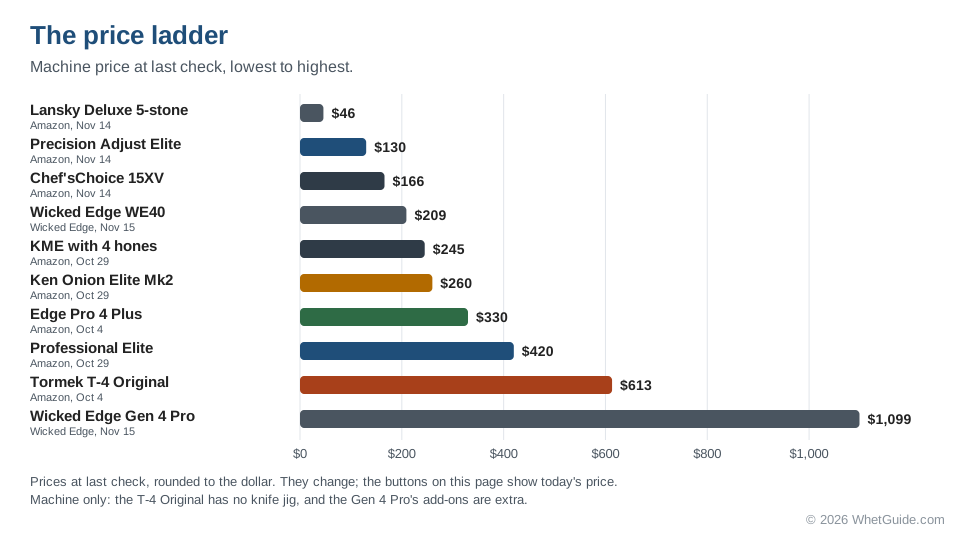
The headline price understates two of them. The T-4 Original ships without a knife jig, and the KJ-45 listed at $73 when we checked in October. The Wicked Edge Gen 4 Pro starts at $1,099 on the maker's site, and GearJunkie priced its add-ons at about $300 for storage, $200 for the Micro-Adjust, $250 for stones and $141 for the low-angle kit. A fully kitted Gen 4 Pro is close to twice its starting price.
When a premium sharpener pays for itself
The fair yardstick for a premium machine is a professional sharpening service. Most US services charge about $7 to $15 a kitchen knife, and Misen's mail-in service charged $69 for five knives ($14 each, shipping included) at our check. We used $14 a knife as the yardstick and divided each machine's price by it.
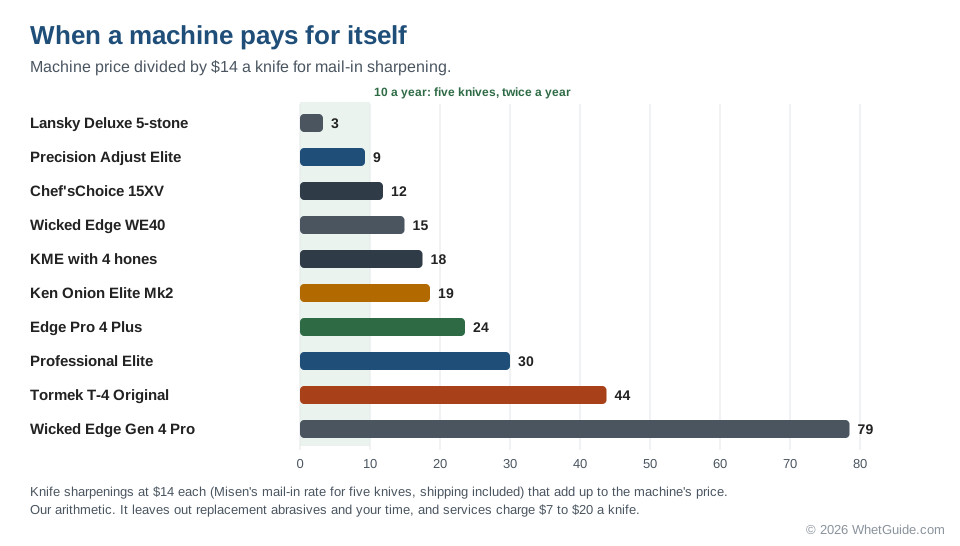
A household that sends five knives out twice a year spends about $140 a year at that rate. The Precision Adjust Elite pays for itself inside a year at that pace. The Professional Elite takes about three years, and the Wicked Edge Gen 4 Pro about eight before add-ons. If you own Shun knives, the numbers move against every machine: Shun sharpens its own knives free for a $15 shipping and processing fee. See what knife sharpening costs and mail-in services for the full price list.
The arithmetic is not the whole story. A service takes your knives away for a week or more, and a machine lets you touch up an edge the night before a big cook. If that is worth something to you, the break-even point comes sooner.
What you keep buying
| Method | What wears | Upkeep between sessions |
|---|---|---|
| Guided clamp (Work Sharp, KME) | Diamond plates or hones; strop leather | Rinse and dry the plates |
| Belt (Ken Onion) | Belts | Keep spare belts in each grit you use |
| Table stone (Edge Pro) | Waterstones dish; polishing tapes (the 4 Plus ships with 15 of each grit) | Flatten the stones |
| Wheel (Tormek) | Grinding wheel, honing compound | Follow the handbook |
| Electric (15XV) | Diamond stages | Follow the manual |
| Wicked Edge Gen 4 Pro | Diamond stones (GearJunkie: about $250 for more) | Follow the maker |
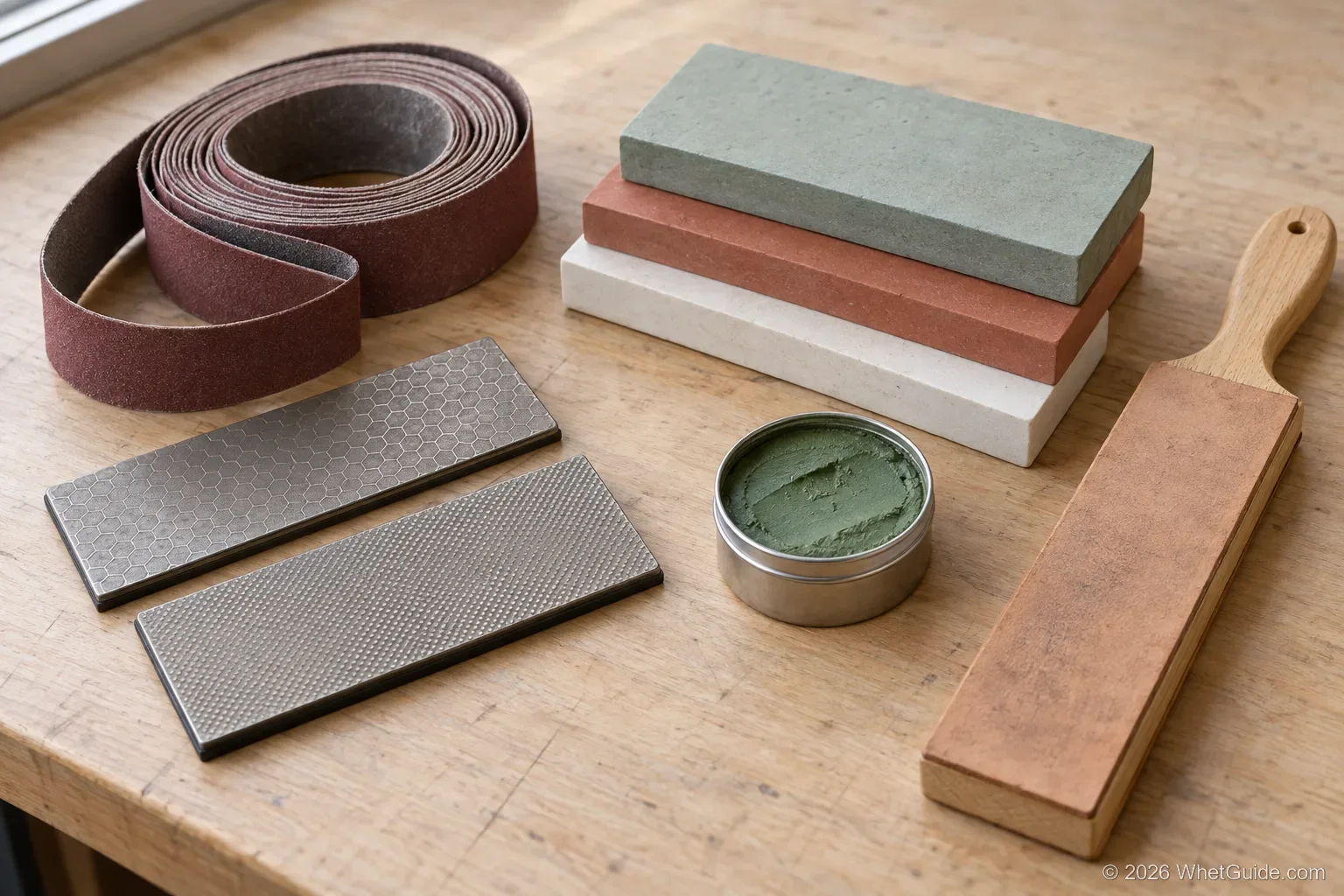
We don't have published prices for most replacement abrasives, so the table above lists what wears, not a dollar figure. Waterstones need the most care. A dished stone grinds a curved bevel, so flatten it every few sessions with a lapping plate like the Sharp Pebble 120/320 flattening stone or the SCOTTCHEN diamond plate. Our flattening guide shows how.
Your first session on a guided clamp
The first sharpening on any adjustable system is the one that sets you up for every touch-up after it, so it is worth doing slowly. This sequence works on the Precision Adjust, the Professional Elite and the KME.
- 1Find the angleLook up your knife maker's figure on our angle chart.
- 2Mark the bevelColor the edge bevel with a marker and make two strokes.
- 3Adjust until it matchesInk gone only at the shoulder: raise the angle. Only at the very edge: lower it.
- 4Coarse until a burrStay on the coarsest plate until you feel a burr along the whole other side.
- 5Flip and repeatRaise a burr on the second side, then step up a grit.
- 6Fine plates, lighterFewer, lighter strokes at each finer grit, alternating sides.
- 7StropA few edge-trailing strokes on leather take off what is left of the burr.
- 8Write it downNote the angle for each knife so the next session starts at step 4.
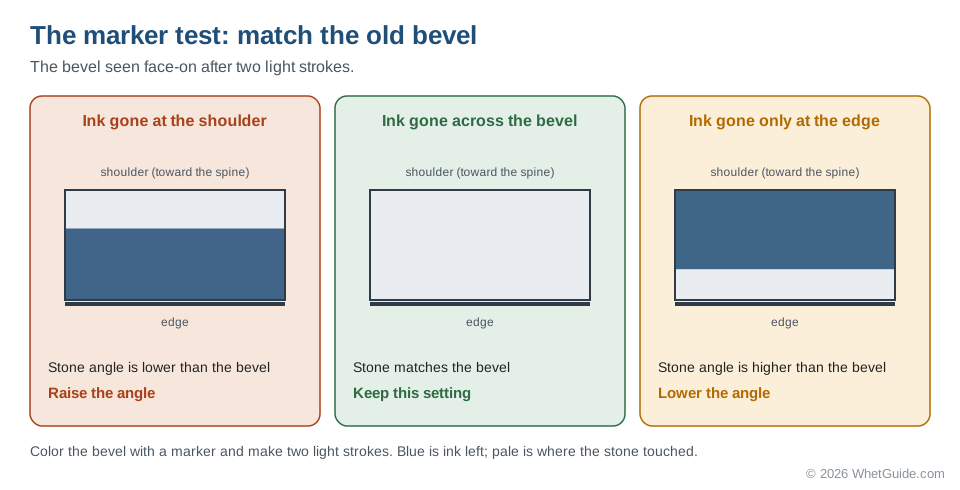
Step 8 is the one people skip and regret. The point of a premium clamp is that it can return to exactly the same angle, and it can only do that if you know what the angle was.
How much space and setup each one needs
| System | Weight | Setup notes |
|---|---|---|
| KME | 12 oz (listing) | Packs in a hard case; base included |
| Ken Onion Elite Mk2 | 2.1 lb (listing) | Plug in; change belts by hand |
| Edge Pro Apex | Under 3 lb (Bob Vila) | No clamp, no power |
| Professional Elite | 12 lb base (listing) | Bench-top; case included |
| Wicked Edge Pro-Pack I | About 18 lb with base (Bob Vila) | About 15 minutes to assemble; about 1 sq ft of bench |
| Wicked Edge Gen 4 Pro | Not stated | Stock vise takes blades under 5 mm thick (GearJunkie) |
The figures are from listings and from Bob Vila's hands-on notes. Weight is a feature on a bench and a drawback in a kitchen drawer. The Professional Elite's 12 lb base is what keeps it steady, and it is also why you won't pull it out for a two-minute touch-up. If the machine will live in a cupboard, the KME or the Ken Onion is easier to reach for.
How long it takes to learn, and to sharpen
| System | Learning curve | Time per knife, per the source |
|---|---|---|
| Chef'sChoice 15XV | Minutes | About 1 minute first time, 10 seconds after (listing) |
| Brod & Taylor VG2 | Minutes | "Seconds," per the listing |
| Precision Adjust Elite | Short; the clamp sets the angle | Not stated |
| Tormek T-1 | Short | About a minute on a moderately used chef's knife, up to about 10 for a very dull one (Sharpening Supplies) |
| Wicked Edge Pro-Pack I | Not rated | About 10 minutes to reprofile to 20° (Bob Vila) |
| Edge Pro Apex | Steepest of Bob Vila's picks | Not stated |
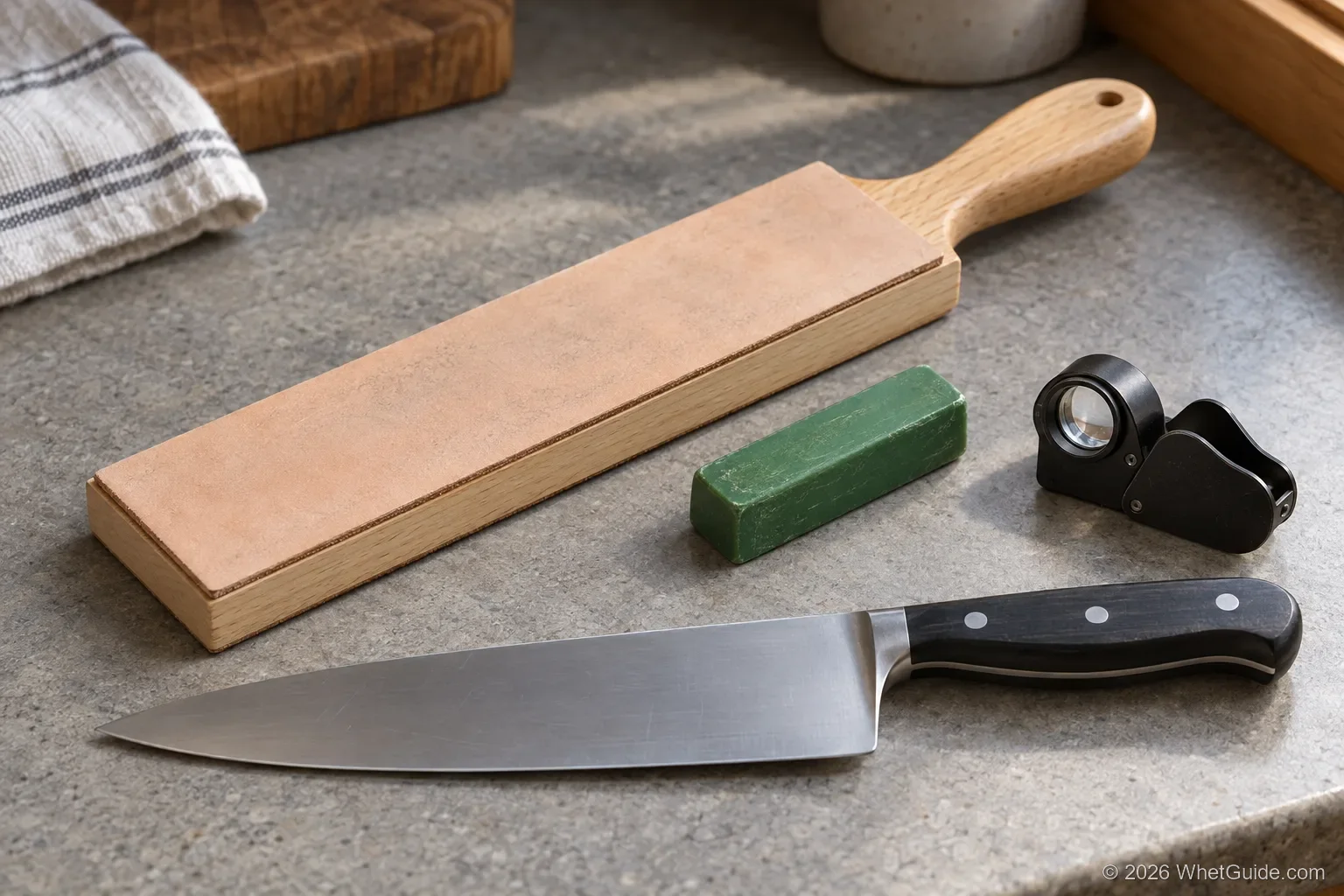
Every premium system holds the angle; they differ in how much of the rest is up to you. The first session on any adjustable system is the slow one, because you are changing the factory bevel to the angle you chose. After that, a touch-up at the same setting is quick. Learning to feel a burr is the skill that speeds up every system; our burr guide covers it, and a cheap illuminated loupe lets you see the edge instead of guessing.
Add-ons worth having with any of them
A premium sharpener cuts the edge; two cheap tools keep it. A leather strop with compound, such as the SHARPAL 205H strop and SHARPAL green compound, removes the last of the burr and revives an edge between sessions. A honing rod does the same daily job in the kitchen; see the best honing rod. Neither replaces the machine, and both make it come out less often. Our stropping guide covers the stroke.
Troubleshooting: problems and fixes
| What you see | Likely cause | Fix |
|---|---|---|
| No burr after many strokes | The set angle is lower than the old bevel, so the stone isn't reaching the edge | Mark the bevel and check where the ink comes off; go coarser for a big angle change |
| Bevel wide at the heel, narrow at the tip | The blade curves up at the tip, so the angle changes along it | Clamp nearer the middle of the blade; sharpen long blades in sections, as the Professional's listing says |
| Scratches on the blade face | Grit or metal dust under the clamp jaws | Wipe the jaws and blade before clamping; tape the blade face if needed |
| Edge rolls within days | Angle too low for the steel or the job | Raise it a few degrees for knives that chop or meet bone |
| Tip rounded off on a belt | The belt wraps the tip as you pull through | Slow the belt and lift the handle slightly as the tip arrives |
| Edge Pro bevel looks curved | A dished waterstone | Flatten the stone on a lapping plate |
| Discolored edge after a powered session | Heat from pressure or long contact | Grind past the discolored steel; use lighter, shorter passes next time |
Myths and what the sources say
| Claim you'll hear | What the sources say |
|---|---|
| "The more you spend, the sharper the knife" | Outdoor Life warns of diminishing returns at the top end. Past a rigid guided system, extra money buys range, speed or finish. |
| "Electric sharpeners ruin knives" | Outdoor Life says they repair chips fast and can ruin a knife used carelessly. The risk is the operator. |
| "Belt sharpeners always overheat" | GearJunkie says the MK.2 can overheat edges. The Elite's variable speed and light passes are the fix. |
| "Diamond is overkill for kitchen knives" | Outdoor Life says harder high-end steels need diamond. Many Japanese kitchen knives use exactly those steels. |
| "A pull-through can't be premium" | Task & Purpose leaves pull-throughs out. The VG2 is a carbide pull-through with replaceable bars and no stated angle, so judge it on that. |
| "A $1,000 system is for professionals only" | GearJunkie scored the Gen 4 Pro 9.2 out of 10 and said it clears its price, while calling axes and tools a poor fit. |
Four buyers, four answers
Three worked examples
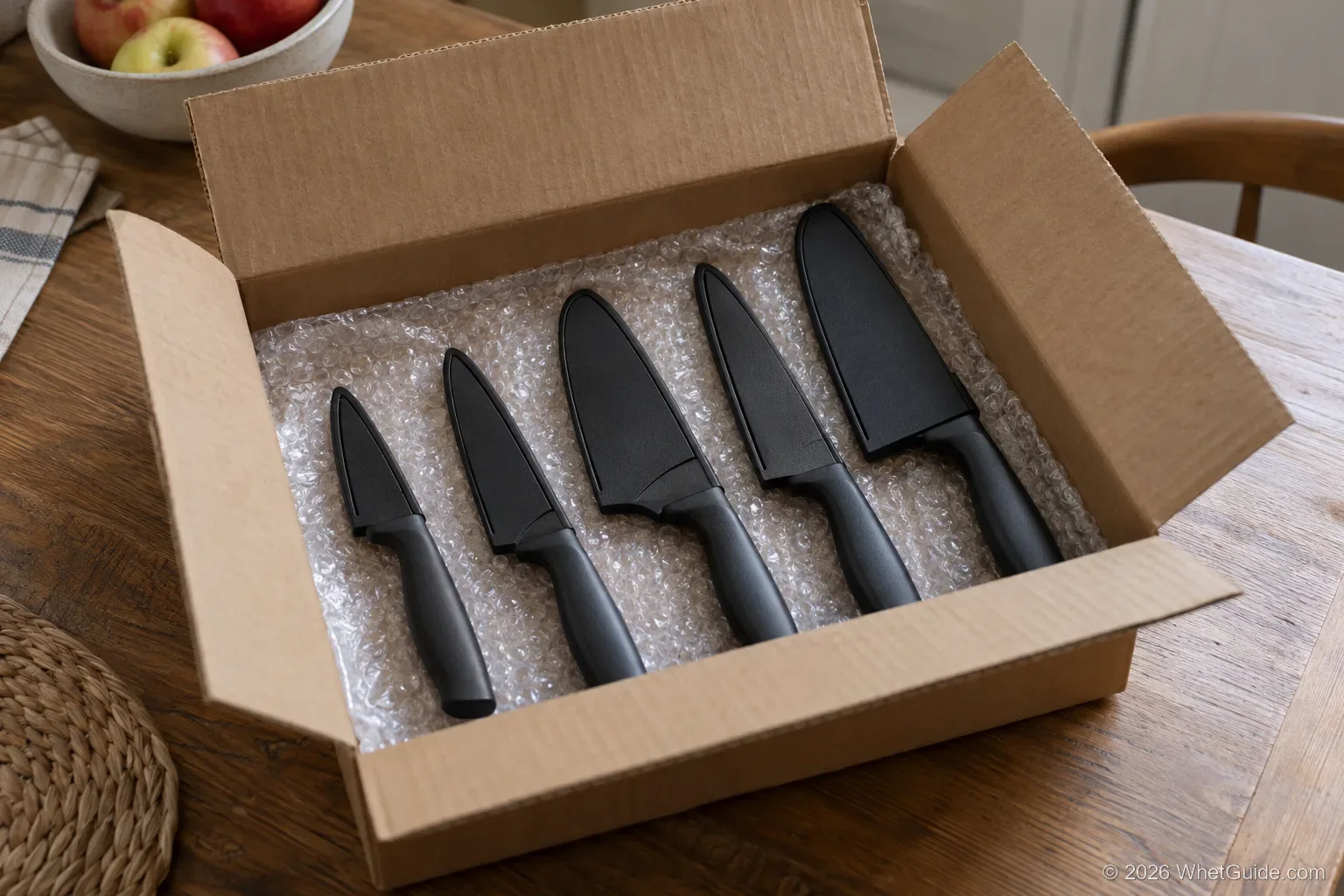
| Household | Sharpenings a year | Service cost a year | Best fit | Pays back in |
|---|---|---|---|---|
| Two cooks, five German knives, sharpened twice a year | 10 | About $140 | Precision Adjust Elite ($130) | About 1 year |
| One enthusiast, twelve knives incl. Japanese, sharpened four times a year | 48 | About $670 | Edge Pro Apex 4 or Ken Onion Elite Mk2 | Under 1 year |
| A family that sharpens three knives once a year | 3 | About $40 | Mail-in or a Lansky kit | A premium machine takes 3 or more years |
The rows use the prices at our last check and $14 a knife for mail-in service. The enthusiast in the middle row is the buyer premium machines are made for. At 48 sharpenings a year even the Professional Elite pays back in under a year, and the choice comes down to angle floor and method rather than price.
Before you buy: a short checklist
- Write down your thinnest knife's angle, and confirm the machine's floor is at or below it.
- Count your sharpenings a year and check the break-even chart.
- Decide V bevel or convex, and buy the method that makes it.
- Check that the kit includes what you need: a knife jig on the Tormek, a strop on the base Precision Adjust.
- Find out what the abrasives cost to replace before you commit.
- Measure where it will live. A 12 lb base needs a permanent spot.
The premium route without a machine
Plenty of cooks who care most about their knives never buy a machine. A pair of high-end stones and a flattening plate cost less than most systems on this page and sharpen any angle, including single-bevel knives no machine here handles. The cost is learning to hold the angle yourself.
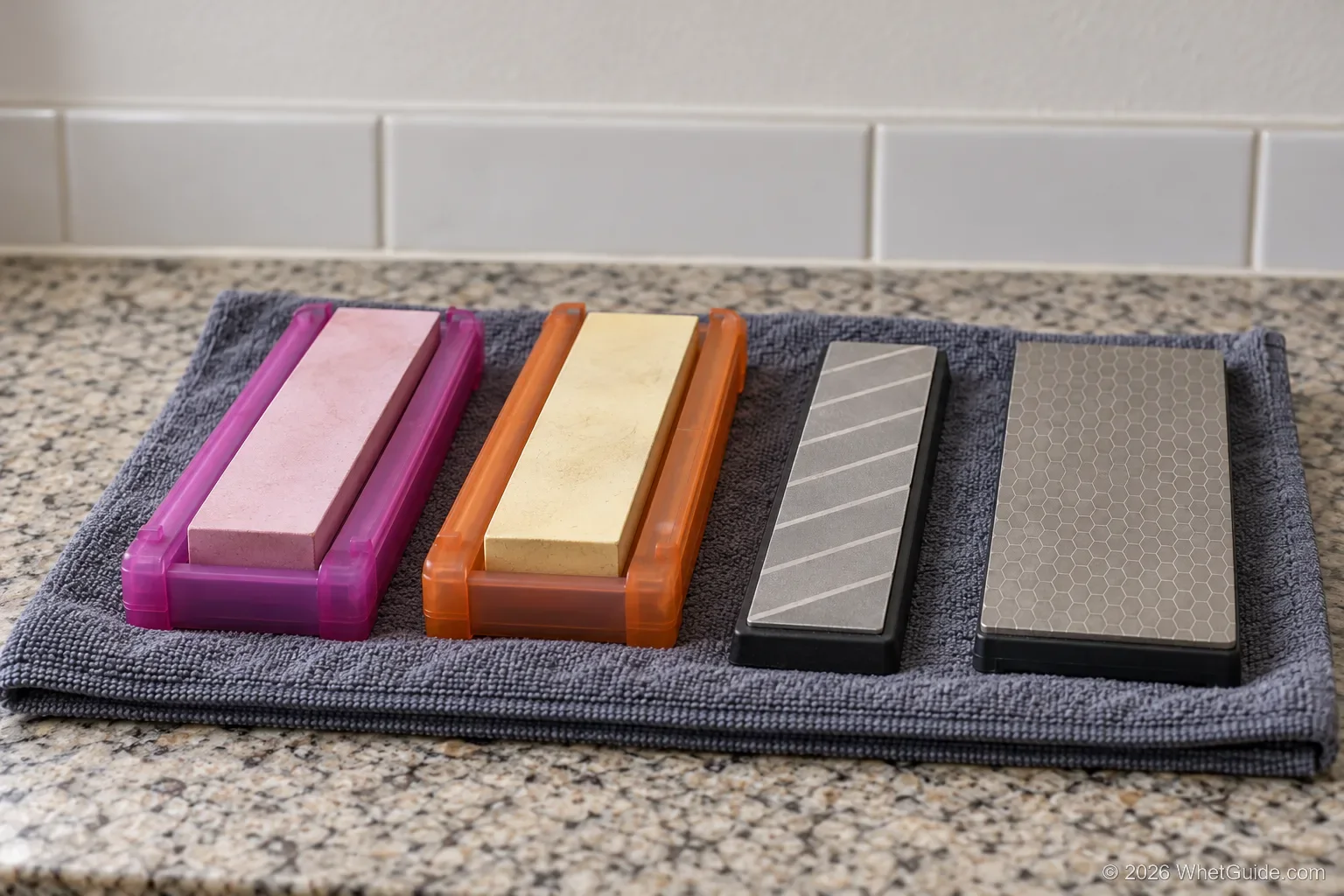
The Shapton Ha No Kuromaku 1000 and 5000 pair covers sharpening and polishing. For very hard steel, the Naniwa diamond #1000 cuts where a ceramic stone slows down. Our best Japanese whetstone and whetstone vs knife sharpener pages cover the choice, and the angle guides page lists clips that help while you learn.
The options Amazon barely sells
| System | Method | Angle | Price, per source |
|---|---|---|---|
| Tormek T-1 | Conical 600 grit diamond wheel plus fine honing wheel | 8° to 22°, 1° pointer | Not confirmed |
| Wicked Edge Gen 4 Pro | Two arms, diamond stones, vise | 12° to 28° | From $1,099 (maker) |
| Wicked Edge WE40 Carbon | Two arms, 200 plus 600 grit diamond | 13° to 31° | From $209 (maker) |
| TSPROF K03 Pro | Guided rod, 0.1° accuracy | 10° to 39° | $792 (Outdoor Life) |
| HORL 2 Pro | Rolling diamond disc on a magnet block | 15° and 20° guides | $478 with premium set (Outdoor Life) |
We could not check these on Amazon, so buy them from the maker or an authorized dealer. The Tormek T-1 is the kitchen machine in Tormek's range. Sharpening Supplies, a retailer, describes it as reaching 8 to 22 degrees with a conical diamond wheel and says its testing was informal. Knivesandtools lists the T-1 as an interesting choice for home cooks who want to keep their own kitchen knives sharp. The Tormek comparison sets it against the T-2, T-4 and T-8. The Wicked Edge uses two arms, so both bevels are sharpened in alternate strokes and the edge stays centered. The maker offers a lifetime warranty and says its systems are designed and assembled in the USA. GearJunkie liked the Gen 4 Pro but scored its speed 7 out of 10 and said it suits knives rather than axes. Our page on whether a Wicked Edge is worth it says it fits people who sharpen a lot of expensive blades. The HORL 2 Pro is a rolling sharpener; see the rolling sharpener guide for where rollers stop.
When a basic kit is the better answer
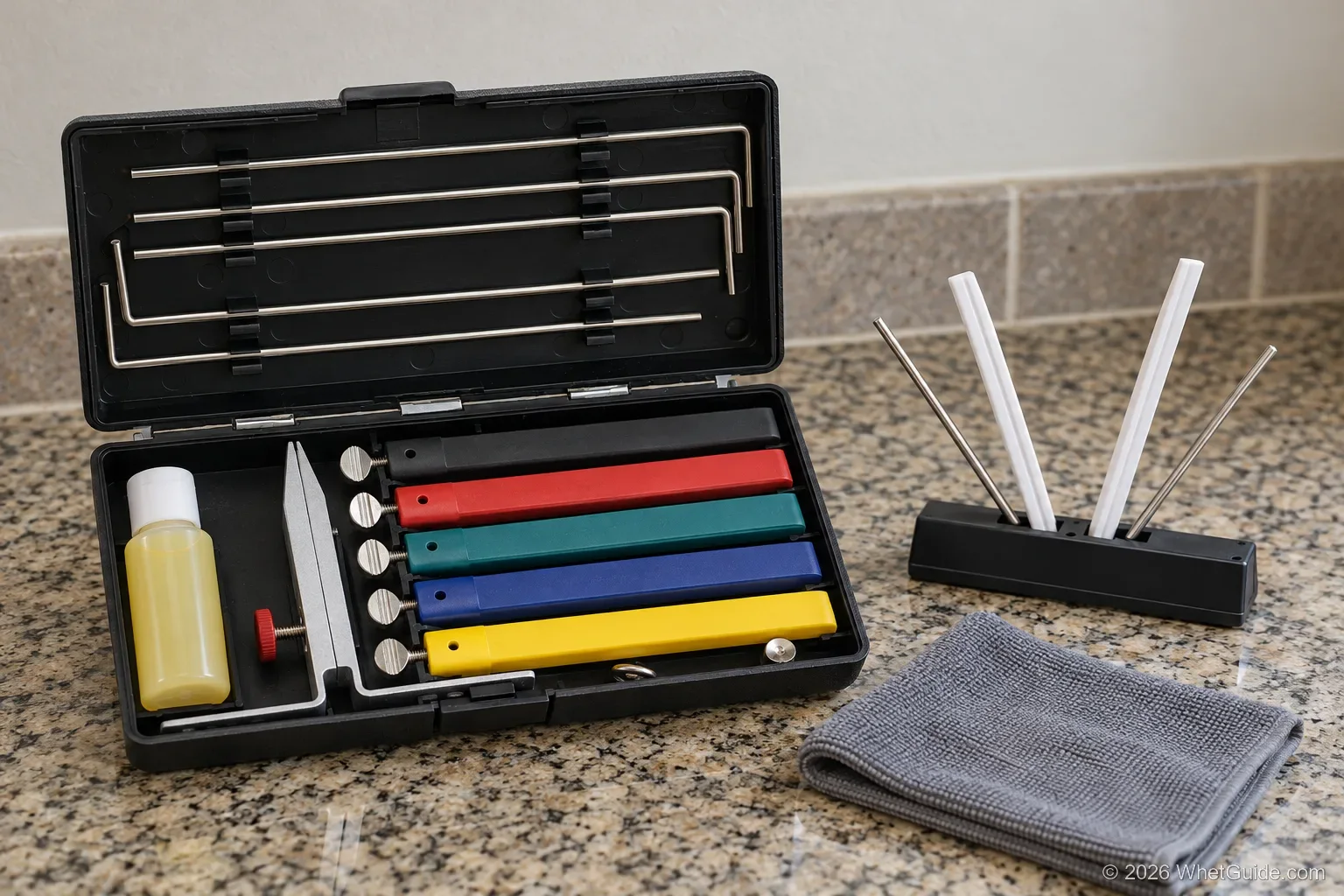
A Lansky-style kit does what a clamp system does for far less money, with slower results. The Lansky Deluxe 5-stone kit has 14,000-plus ratings and includes a clamp and five hones, from extra-coarse alumina oxide to an extra-fine ceramic, with honing oil. If you sharpen your kitchen knives twice a year, that is plenty, and the break-even chart above shows how long a premium machine takes to catch up at that pace. The other cheap route is the Spyderco Sharpmaker, which holds triangular ceramic rods at 15 or 20 degrees in a base. It is a touch-up tool more than a reprofiling one, and it keeps a good edge good with a few strokes. Our Sharpmaker review and Lansky kit guide compare the options.
Six mistakes buyers make with premium sharpeners
| Mistake | Why it hurts | Do this instead |
|---|---|---|
| Buying a 17° system for 15° knives | The KME can't go below 17, so it thickens a thinner edge | Check the floor against your thinnest knife |
| Converting a collection on a fixed-angle machine | The 15XV turns every knife into a 15° knife; wrong for a Miyabi | Keep thin Japanese knives off it |
| Buying the T-4 Original for knives alone | It ships without a knife jig | Add the KJ-45, or buy the Bushcraft bundle |
| Running a belt fast on thin steel | GearJunkie's heat warning applies | Slow the belt, make light passes |
| Trusting one spec source | Listings and reviewers disagree on the Professional Elite and the Edge Pro | Mark the bevel and check |
| Paying for range you won't use | Knives between 15° and 20° don't need a 10° to 40° machine | Buy the Elite and spend the rest on stones |
Side-by-side comparison
| System | Angle range | Method | Thin Japanese edges? |
|---|---|---|---|
| Work Sharp Elite | 15° to 30° | Guided clamp | Yes, down to 15 |
| Professional Elite | 15° to 30° (listing); under 10° to over 40° (Outdoor Life) | Guided clamp | 15 for sure; lower unconfirmed |
| Ken Onion Elite Mk2 | 10° to 35° (listing) | Belt | Yes, to 10 |
| KME | 17° to 30° | Guided rod | No, starts at 17 |
| Chef'sChoice 15XV | 15° | Electric | At 15, with limits |
| Brod & Taylor VG2 | Not stated | Spring pull-through | Check the angle first |
| Edge Pro 4 Plus | Not stated on its listing; Apex listings give 10° to 24° | Table stone | Likely, per the Apex range |
| Edge Pro Apex 4 | 10° to 24° (listing) | Table stone | Yes, to 10 |
| Tormek T-4 Original | Set by jig and support bar | Water-cooled wheel | Not stated |
Which one to buy
Buy the Work Sharp Precision Adjust Elite unless you have a specific reason not to. Step up to the Professional Elite if you sharpen for others. Choose the Chef'sChoice 15XV if speed matters more than control, and the Ken Onion Elite Mk2 if your knives go below 15 degrees or your list includes garden tools. Compare angle charts first at best sharpening system and the knife sharpening angle chart.