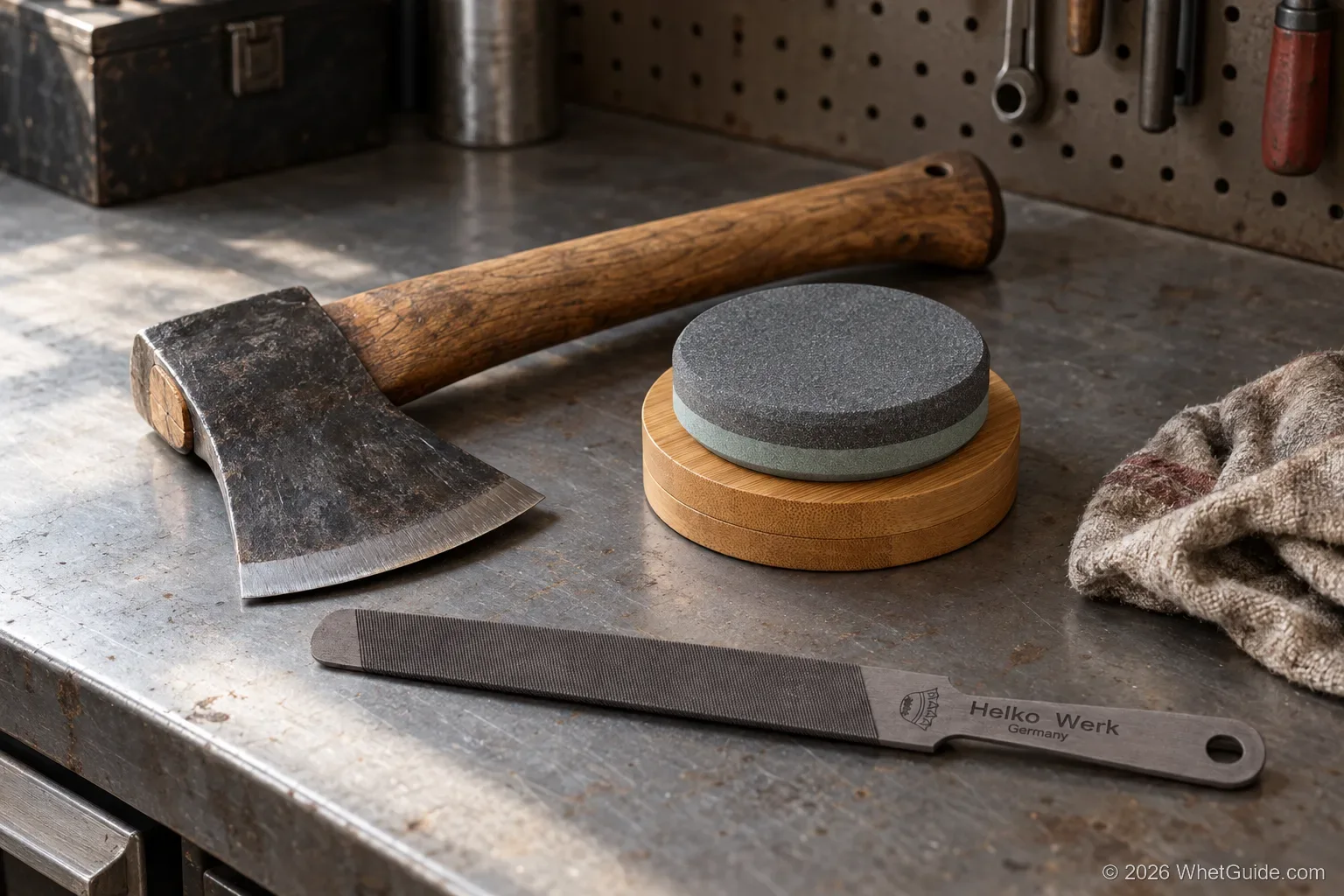
The best axe sharpener for most people is a dual-grit puck: the Lansky Puck if you want the proven, cheap one, or a bigger silicon carbide puck if your axe has a wide bit. Add a file if the edge is chipped, and a diamond stone if you hate oil and water. The tool matters less than matching it to the axe. A hatchet and a 3.5 pound felling axe do not need the same thing.
↑ SectionsQuick answer: which axe sharpener to buy
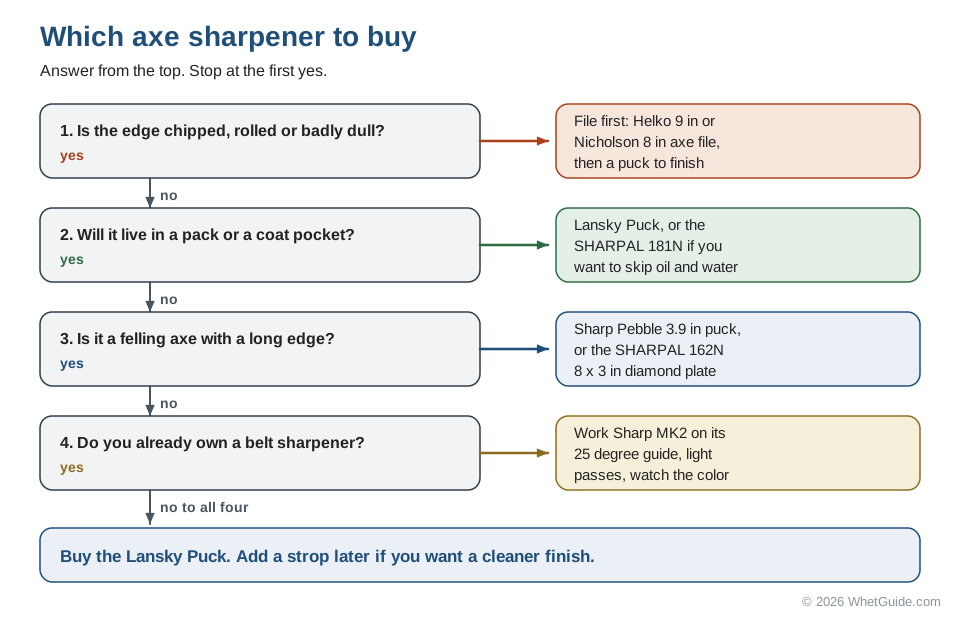
Most axe owners end up with two tools, and they do different jobs. A file takes steel off fast, so it fixes chips and resets a worn bevel. A puck or stone refines what the file leaves and keeps a sound edge biting between sessions. If your axe is in decent shape, the puck alone is enough. If it's been in a barn for ten years, you'll want both. Our how to sharpen an axe guide covers the technique; this page is about which tool to buy.
| Your situation | Buy |
|---|---|
| One hatchet or small axe, edge in fair shape | Lansky Puck |
| Felling axe with a long, wide edge | Sharp Pebble 3.9 in puck or the SHARPAL 162N plate |
| Chipped, rolled or neglected edge | Helko Werk 9 in file or Nicholson 8 in axe file, then a puck |
| Pack or pocket kit, no oil or water | SHARPAL 181N diamond stone |
| You also sharpen knives and mower blades | Work Sharp MK2, light passes |
| Splitting maul | A file. A stone is optional. |
Quick picks
| Best cheap all-rounder | Lansky Puck | Amazon |
|---|---|---|
| Best kit with a carry bag | DDF 180/320 axe and hatchet stone | Amazon |
| Best puck for a wider bit | Sharp Pebble axe puck | Amazon |
| Best dry, fast option | SHARPAL 181N diamond stone | Amazon |
| Best file for repairs | Helko Werk axe file | Amazon |
| Best for neglected tools | Norton Crystolon utility stone | Amazon |
| Best for a Gränsfors axe | Gränsfors Bruks ceramic puck | Amazon |
| Best budget axe file | Nicholson 8 in axe file | Amazon |
| Best long file for the vise | Nicholson 12 in mill bastard file | Amazon |
| Best small bench stone | Norton IB64 India combination stone | Amazon |
| Best bench plate for wide bits | SHARPAL 162N diamond plate | Amazon |
| Best pocket finisher | DMT DiaFold fine / extra fine | Amazon |
| Best belt sharpener for axes | Work Sharp MK2 | Amazon |
| Best adjustable belt sharpener | Work Sharp Ken Onion Mk2 | Amazon |
How we picked these
We first pulled Amazon search results for axe and hatchet sharpening stones on October 29, 2026, then kept products with real sales or thousands of ratings, and rechecked the listings for the tools added in mid-November. The Lansky Puck has more than 18,000 ratings. The DDF 180/320 axe stone has about 3,400. Every grit and size below comes from the product listing.
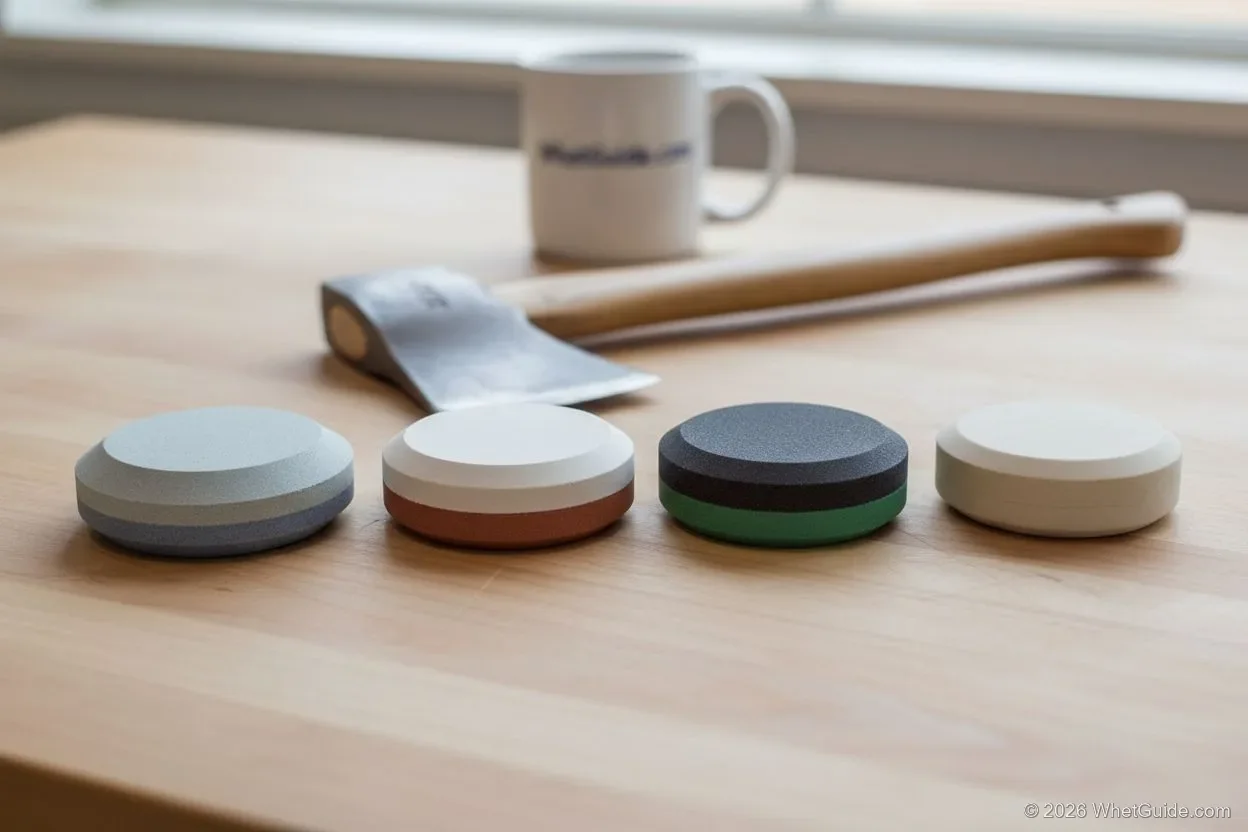
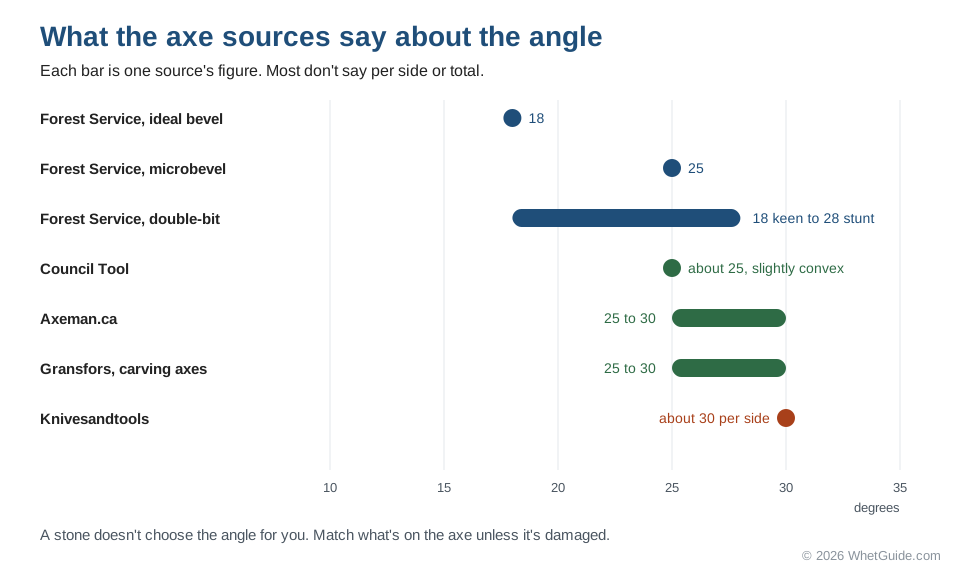
Pages ranking for this search are mostly product-seller blogs that name a stone without saying what it does to an edge. We sorted by the job instead: reshaping, finishing, or both. The judgment calls lean on the people who make axes. Council Tool and Gransfors Bruk publish sharpening advice for their own heads. So does Hultafors, and the Forest Service's axe manual has a whole chapter on it. Where they agree, we say so. Where they disagree, as they do on the angle, we show each figure and who gave it.
This is a how we pick guide. We compared listings and published maker guidance. How we research.
File, puck, stone, belt: what each one does to an axe
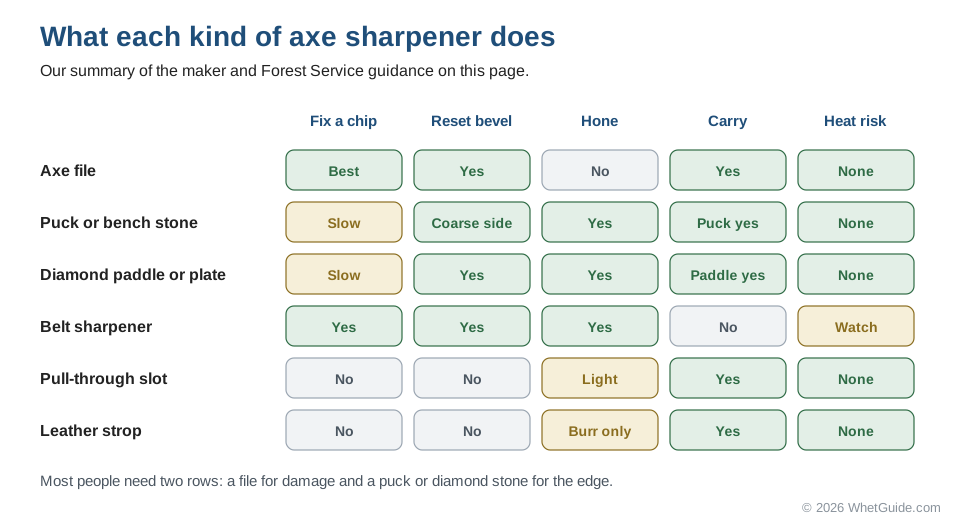
Axe sharpeners come in a handful of families. They differ in how fast they remove steel, whether they can follow the curved edge most axes carry, and how much heat they put into it. Speed is the least useful of those. A fast tool that overheats the edge or flattens the convex grind leaves you with a worse axe than you started with.
| Type | What it's for | Where it falls short | Our pick |
|---|---|---|---|
| Axe file | Chips, rolled edges, resetting the bevel | Leaves a rough edge; needs a stone after | Helko Werk 9 in |
| Dual-grit puck | Honing and light repair; follows the convex curve | Slow on a long edge or real damage | Lansky Puck |
| Bench stone | Shop sharpening with the head in a vise | Awkward to bring to the edge freehand | Norton IB64 India |
| Diamond paddle or plate | Dry cutting, stays flat, works on hard steel | Costs more; 325 grit is slow on chips | SHARPAL 181N |
| Belt sharpener | Fast on many tools; flexible belt follows a curve | Heat, and bulk | Work Sharp MK2 |
| Leather strop | Removing the wire edge stones leave (the Forest Service calls it the best way) | Doesn't sharpen; optional on a splitting axe | See finish the edge |
| Pull-through slot | Quick touch-ups on a sound edge | Fixed angle, no real repair | See what to skip |
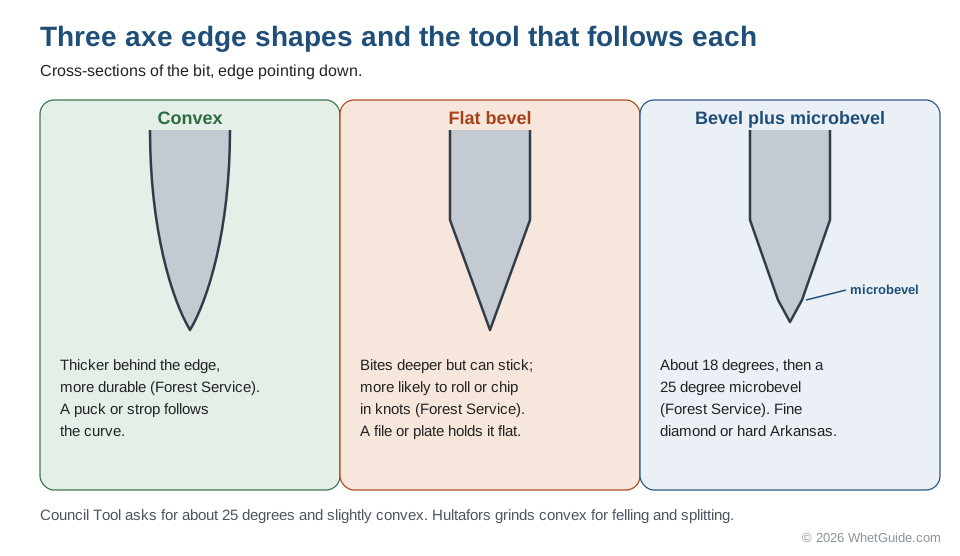
Shape decides a lot of this. Most axes leave the factory with a slightly convex edge, which a puck or a strop follows naturally because you're working freehand and rolling slightly with the curve. A file or a plate tends to leave a flatter face, which is fine on a carving axe and less fine on a felling axe that needs to release from the cut.
Match the tool to the axe
An axe edge does one of two things. A felling axe or hatchet cuts across wood fibers, so it needs a thin, keen bevel. A splitting maul wedges the wood apart, so it can live with a duller, thicker edge; mostly you keep its burrs down.
| Your tool | What the edge needs | Good fits |
|---|---|---|
| Camp hatchet or small axe | A quick touch-up, easy to carry | Lansky Puck, DDF 180/320 stone with bag |
| Felling axe, wide bit | A larger stone so you cover the edge in fewer passes | Sharp Pebble puck, SHARPAL 181N |
| Chipped or neglected edge | Fast metal removal first, then a fine finish | Helko axe file, Norton Crystolon |
| Splitting maul | Burr and mushroom cleanup, little else | A file; a stone is optional |
Why stone size matters on a wide bit
A 3 inch puck is easy to carry and slow to use on a long edge, because you work the bevel one section at a time and each section has to match the last. The lengths below come straight from the listings. If your axe's edge is longer than the stone, plan on overlapping strokes and checking the burr along the whole edge, as in our how to sharpen an axe guide. A long tool has its own catch. An 8 or 9 inch stone covers a felling axe's edge in one sweep, but you have to bring it to the axe rather than the axe to it, and that takes a steady wrist. The SHARPAL 162N plate solves it the other way: the axe moves and the 8 by 3 inch plate stays on the bench. Gransfors Bruk suggests honing along the edges of a whetstone rather than in the middle, which also keeps a bench stone from dishing in one spot.
File first, or stone first?
Two of the guides we read start with a file, not a stone. Outdoor Life's axe guide uses a Mill Bastard flat file to profile the edge and a dual-grit puck to refine it, and This Old House recommends a 10 or 12 inch Mill Bastard file for most sharpening, plus a dual-grit stone around 120/240 grit. A file only cuts on the push stroke, so push one way instead of sawing. Hardware stores sell Mill Bastard files, and the Helko file below does the same job.
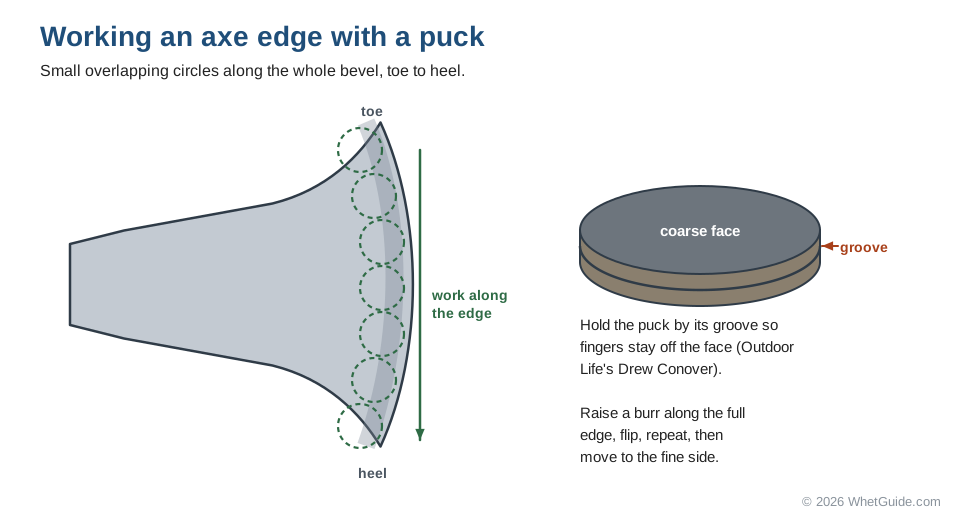
On the stone side, the shared advice is simple. Wet the stone with whichever lubricant it takes (the table under stones below has the pairings), match the bevel already on the axe, and color the edge with a marker to confirm the stone reaches it. Work until a burr runs the full length, flip the axe, and finish on the fine side. Axeman.ca describes the burr forming on the opposite side, and has you lightly sharpen that side to clear it and then check the edge is still even. Most axes carry a slightly convex, even-sided grind, so tilt the stone a little as you follow the curve.
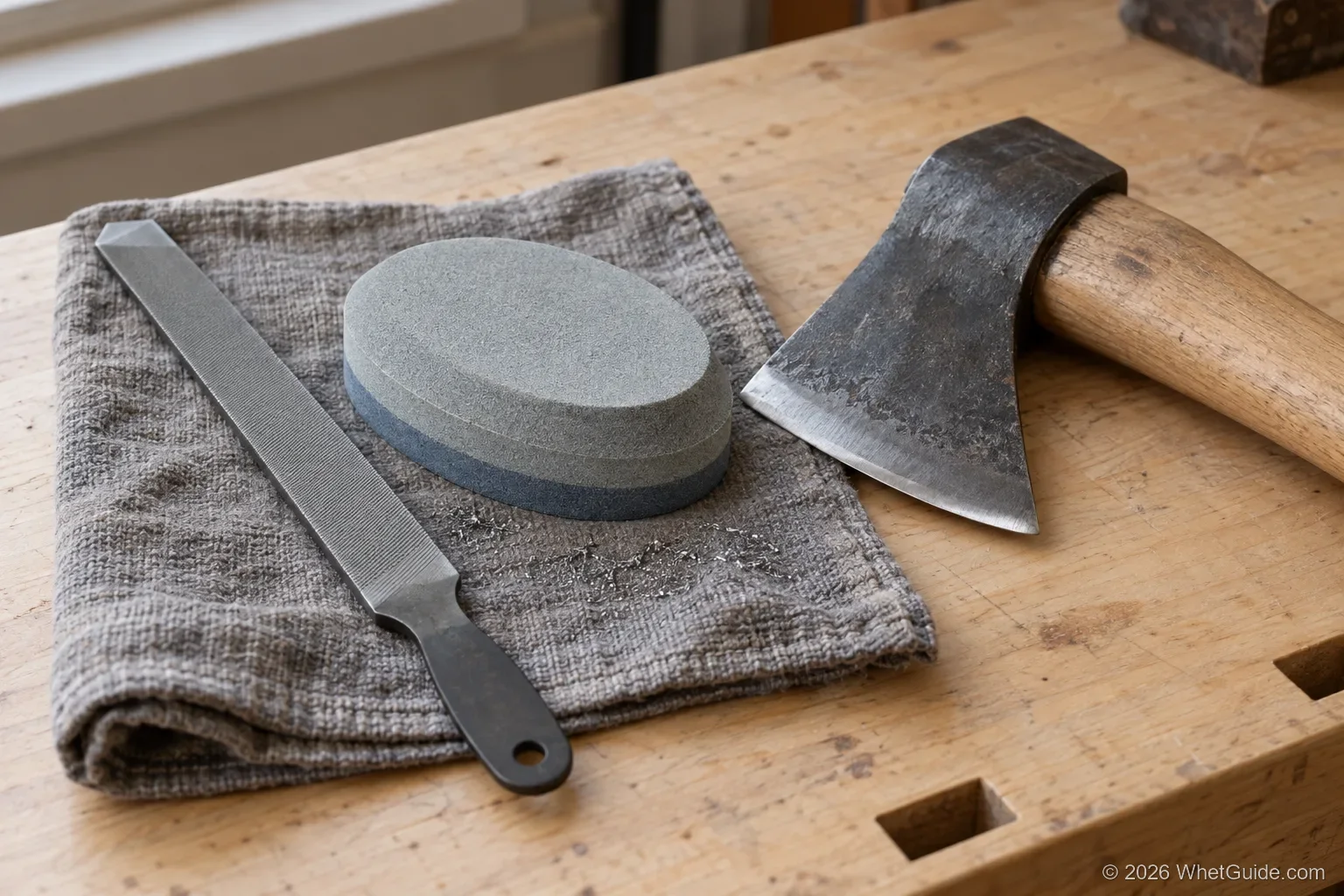
An axe does not need to be razor-sharp. This Old House notes that an overly sharp edge chips more easily, and says hatchets can take a finer edge than axes. Outdoor Life suggests honing with the finest stone after each use and saving a full sharpening for damage such as a rock or nail strike. Drew Conover's reasoning there is that filing every time removes more steel than the axe needs.
The 7 core axe sharpeners
Lansky Puck
It is the stone most people end up with, and the ratings explain why. Silicon carbide cuts steel quickly at 120 grit, and the 280 side gives the edge a usable finish for splitting and limbing. The puck shape fits a palm, so one hand holds the stone and the other holds the axe head against a stump. The weak point is size. On a felling axe with a wide bit you will make a lot of overlapping circles, and the medium side is the finest it goes.
- Gritcoarse 120 / medium 280
- Materialsilicon carbide
- Ratings18,000+
- Listed usesaxes, hatchets, machetes, shovels, mower blades
Why it stands out
- Cheap and compact, and widely stocked
- Thousands of ratings from people using it on axes and garden tools
Think twice if
- Your axe has a long edge and you want fewer passes
- You want a fine finish; 280 grit is the top of its range
DDF 180/320 axe and hatchet stone
The finer face here is 320, a step beyond the Lansky's 280, and the bag goes in a truck door or a cabin drawer without picking up dust. The listing shows about 3,400 ratings, which is a lot for a no-name puck. Treat the bag, which the listing calls soft leather, as a pouch, not a sheath. The stone is the point.
- Grit180 coarse (red) / 320 fine (white)
- Materialcorundum
- Size3.15 in
- Weight9.12 oz
- Includessoft carry bag
Why it stands out
- 180 and 320 grit give a wider coarse-to-fine spread than the Lansky
- Bag keeps it clean in a toolbox
Think twice if
- You want a recognized brand's quality control
Sharp Pebble axe puck
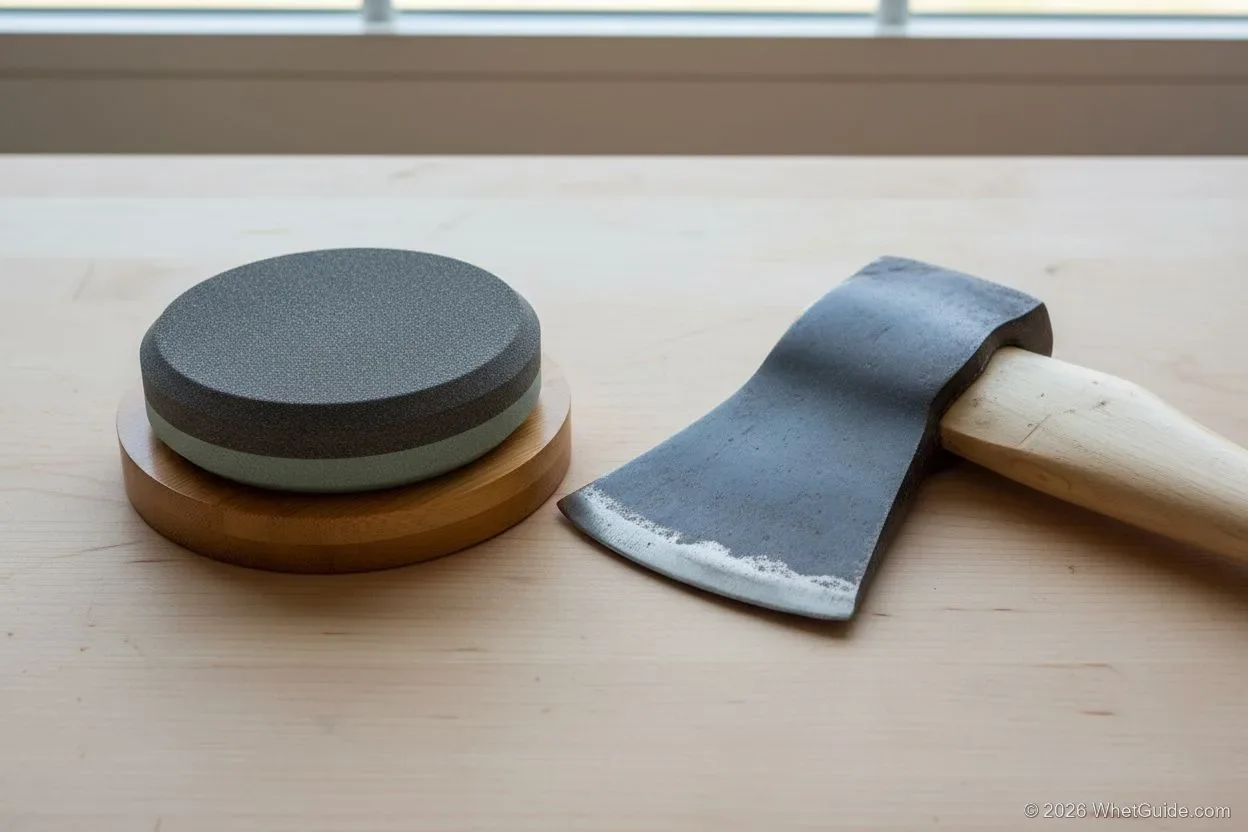
At 3.9 inches across, it covers a good deal more edge per stroke than the 3.15 inch DDF. The listing claims 40 percent more surface area, which is the maker's own comparison. At 1.2 pounds it is heavy for a puck, so it sits still on a bench.
- Grit150 coarse (black) / 320 fine (green)
- Materialsilicon carbide
- Size3.9 in
- Weight1.2 lb
- Includesbamboo storage box
Why it stands out
- Larger face for felling axes
- 150 and 320 grit pair
Think twice if
- You carry your kit in a pocket, because it is bulky
SHARPAL 181N diamond stone
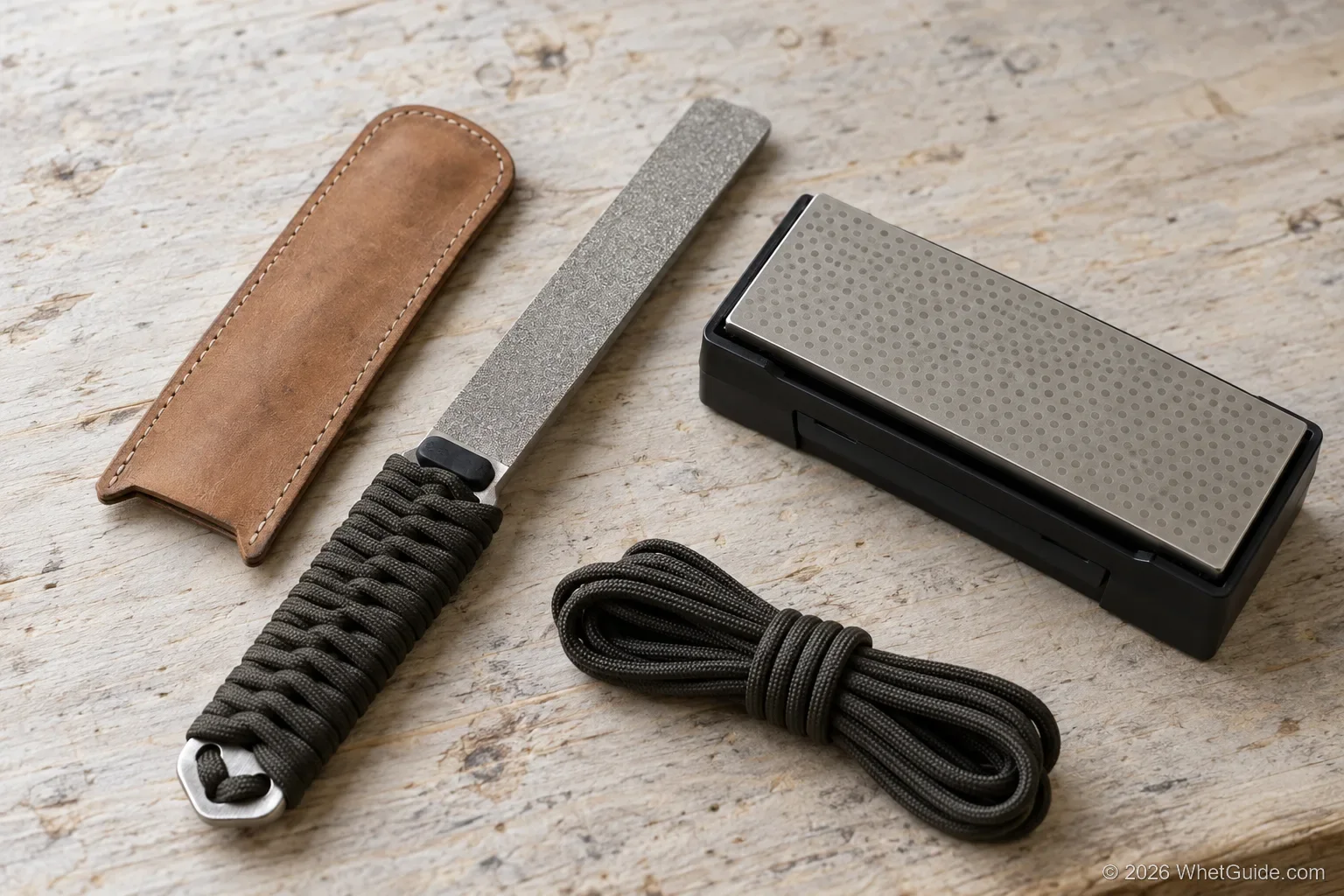
Diamond cuts without oil or water, so it is the one to throw in a pack for a cold morning. The 325 grit face is fine by axe standards, which means it is better at maintaining an edge than reshaping a chipped one. The 1200 side then does the work a strop would do. The sheath is cowhide and doubles as a strop, according to the listing. At 8.66 inches long it covers a wide edge in fewer strokes and still fits in a daypack.
- Gritcoarse 325 / extra fine 1200
- Materialmonocrystalline diamond on stainless steel
- Length8.66 in
- Weight160 g
- Includesleather sheath, 6.6 ft paracord
Why it stands out
- No oil or soaking, and the surface does not dish
- Long enough to cover a wide edge in one pass
Think twice if
- The edge is badly chipped, since 325 grit is slow for that
Open the SHARPAL listing to see how the leather sheath and paracord wrap look on the handle
Helko Werk axe file
A file takes a nick out faster than any stone on this list. One face is double-cut for removing metal and the other is single-cut for cleanup and deburring, and the toothless edges mean it will not scratch the axe head beside the bevel. Run it from the heel to the toe, then switch to a stone.
- Length9 in
- SteelGerman C125W2 high carbon
- Teethsingle-cut fine (top), double-cut fine (bottom)
- Weight3.9 oz
- Edgestoothless to protect adjacent surfaces
Why it stands out
- Fixes chips and rolled edges quickly
- Slim, so it stores with the axe
Think twice if
- You want a polished edge straight from one tool
Norton Crystolon utility stone
This one is for the rusty axe in the barn. The listing calls it a 100 grit, four-sided stone with a handle, meant for garden tools and mower blades, and the handle keeps your fingers well back from the edge. Use it with a little oil. Finish on a finer stone afterward, because 100 grit leaves a rough edge.
- Grit100 coarse
- Materialsilicon carbide
- Length14 in
- Weight16 oz
- Handlewood
Why it stands out
- Also handles garden tools and mower blades
- Handle keeps your hand away from the steel
Think twice if
- You only have one axe in good shape, since a coarse stone alone will not finish it
Gränsfors Bruks ceramic puck
The listing is thin: ceramic, coarse, usable wet or dry. It has 495 ratings, and at about $50 at last check it is the priciest stone on the page for its size. The case for it is the name on it.
- Materialceramic
- Gritcoarse (per listing)
- Sizeabout 1 x 3 in
- Usewith or without water
Why it stands out
- Works dry or wet
- Made by Gränsfors Bruk, the Swedish axe maker
Think twice if
- You want the lowest cost per square inch of stone
- You need grit numbers, which the listing does not give
Side-by-side comparison
| Tool | Grits | Type | Best job |
|---|---|---|---|
| Lansky Puck | 120 / 280 | Silicon carbide puck | Hatchet, general touch-up |
| DDF 180/320 | 180 / 320 | Corundum puck | Cabin kit |
| Sharp Pebble puck | 150 / 320 | Silicon carbide puck | Wider bit |
| SHARPAL 181N | 325 / 1200 | Diamond | Dry pack stone |
| Helko file | Fine single and double cut | File | Chip repair |
| Norton Crystolon | 100 | Silicon carbide, handled | Neglected tools |
| Gränsfors puck | Coarse (not stated) | Ceramic puck | Gränsfors axes |
| Nicholson 8 in axe file | Double cut / single cut | File | Budget chip repair |
| Nicholson 12 in mill bastard | Single cut, bastard | File | Long strokes in a vise |
| Norton IB64 India | Coarse / fine | Aluminum oxide bench stone | Shop honing |
| SHARPAL 162N | 325 / 1200 | Diamond plate, 8 x 3 in | Bench, wide bits |
| DMT DiaFold | Fine / extra fine | Folding diamond | Pocket finishing |
| SHARPAL 121N | 325 / 1200 | Diamond garden-tool file | Cheap dry option |
| Work Sharp MK2 | Belts (P80 to 6000 kit) | Belt sharpener | Many tools at once |
| Work Sharp Ken Onion Mk2 | Belts | Belt sharpener, 15 to 30 degree dial | Set the angle exactly |
Axe sharpening files and file guards
A file is the oldest axe sharpener and still the fastest way to fix real damage by hand. It shaves steel in curls you can see, so you know exactly how much is coming off, and it can't overheat the edge. Both Outdoor Life and This Old House start with one.
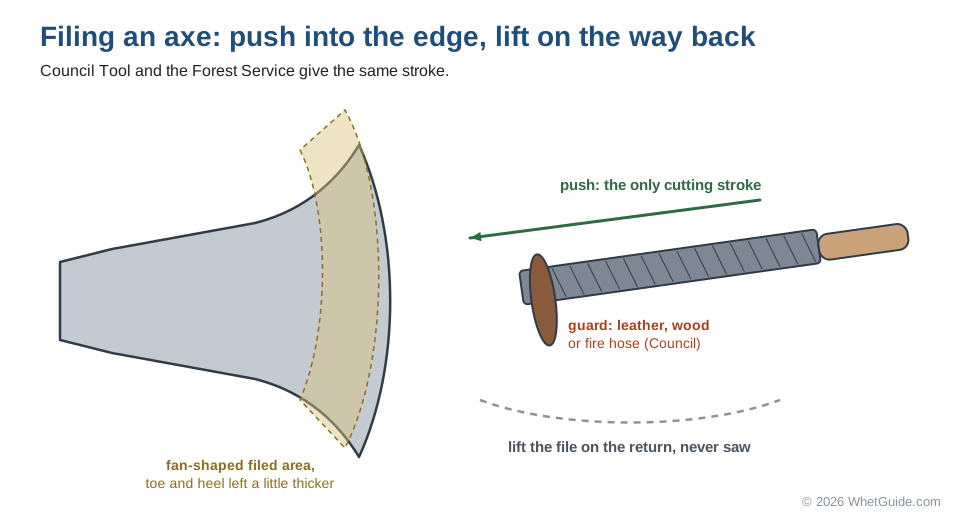
Field & Stream's Craig Caudill puts the rule plainly: "Always put your file at the same angle as the grind on the axe." Do that, push the file into the edge, and lift it on the way back. Council Tool says the same about direction ("Always file or grind into the edge of the axe") and adds that you should guard the file with a piece of leather, wood or fire hose so a slip doesn't put your knuckles on the bit.
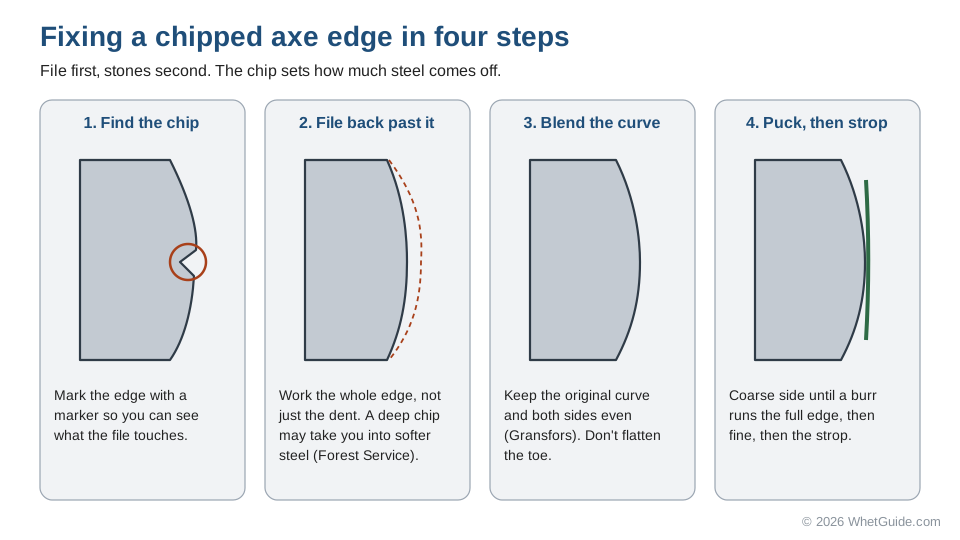
A chipped edge is where the file earns its keep. The temptation is to file only the dent. Work the whole edge instead, so the curve stays continuous, and keep both sides even. Gransfors Bruk says a wrongly ground axe slips more easily, and the Forest Service notes that a deep chip may take you past the hardest steel near the edge into softer metal behind it. If that happens, the edge will dull faster there until you've filed back to sound steel.
Nicholson 8 in axe file
This is the plain American version of the Helko: a rectangular axe file with a double-cut face for rough work and a single-cut face for finishing, plus two safe edges that won't bite the cheek next to the bevel. The listing calls it an axe file first and a garden-tool file second, which is the right order. It costs about half what the Helko does at last check. You give up the German tool steel and the hanging hole, and that's about it.
- Length8 in
- PatternAmerican axe file, rectangular
- Teethdouble cut one side, single cut the other
- Edgestwo safe edges
- Model06706NN
Why it stands out
- Both cuts on one file, like the Helko
- Safe edges protect the cheek
Think twice if
- You want a longer stroke; at 8 inches it's on the short side for a felling axe
Nicholson 12 in mill bastard file
This is the file Outdoor Life and This Old House mean when they say "Mill Bastard." Twelve inches gives you long, even strokes across a wide felling-axe bit, and the single-cut teeth leave a smoother face than a double cut. Outdoor Life's Conover recommends 8 inches or longer; This Old House says 10 or 12. It has no handle out of the box. Fit one, or at least wrap the tang, before you push hard.
- Length12 in
- Cutsingle cut, bastard grade
- Shapeflat mill
- Model21842NN
Why it stands out
- Long stroke for wide bits
- Same file mower-blade guides recommend, so it earns its drawer space
Think twice if
- You file freehand with the axe on your knee; a 12 inch file wants the head clamped
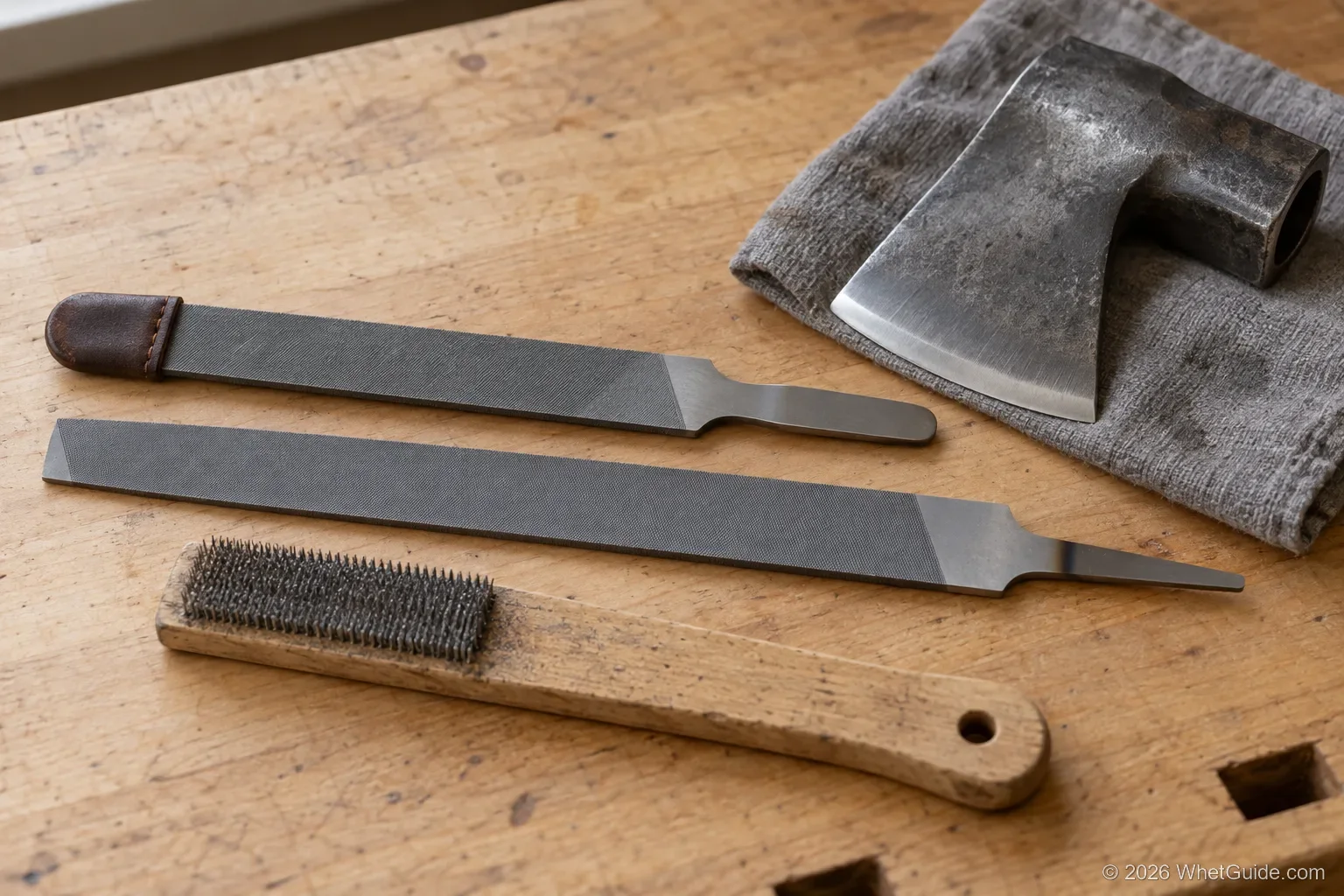
Axe sharpening stones and pucks
Stones come in three shapes for axes. Pucks are round and held in the hand, so you bring them to the axe. Bench stones and plates sit still, so the axe comes to them. Paddles and handled files sit in between: long and narrow, held like a file. The puck is the axe-specific shape, and the one to start with. Grit is the second choice. A coarse face around 100 to 180 sets or repairs the bevel, and a fine face around 280 to 600 finishes it. Outdoor Life's Conover uses pucks in 80/220, 220/400 and 220/600 pairings, and works the 220 side and then the 400. This Old House suggests about 120/240. Every puck in this guide falls inside that range, and nobody we read asks for a polished axe. Lubricant is the third choice, and the stone decides it:
| Stone | Use it with | Source |
|---|---|---|
| Clay or sandstone | Water | Gransfors Bruk |
| Carborundum (silicon carbide) or Arkansas | Oil | Gransfors Bruk |
| Any stone that has been oiled | Keep using oil | Forest Service |
| Diamond (SHARPAL 181N, 162N) | Nothing; sharpen dry | SHARPAL listings |
| Gränsfors ceramic puck | Water or nothing | Gränsfors listing |
Norton IB64 India combination stone
Sharpening Supplies, a sharpening retailer, puts Norton's round India stone on its axe list. This 4 by 1 by 1 inch combination stick is the same India abrasive in a form whose Amazon listing we could confirm. The stick shape works two ways: clamp the axe and stroke the stone along the bevel like a file, or set the stone on the bench for a hatchet.
- Abrasivealuminum oxide (India)
- Gritcoarse / fine
- Size4 x 1 x 1 in
- ModelIB64
Why it stands out
- Coarse and fine faces on one small stone
- Stays useful for knives and chisels
Think twice if
- You want a big face for a felling axe; at 4 inches it's small
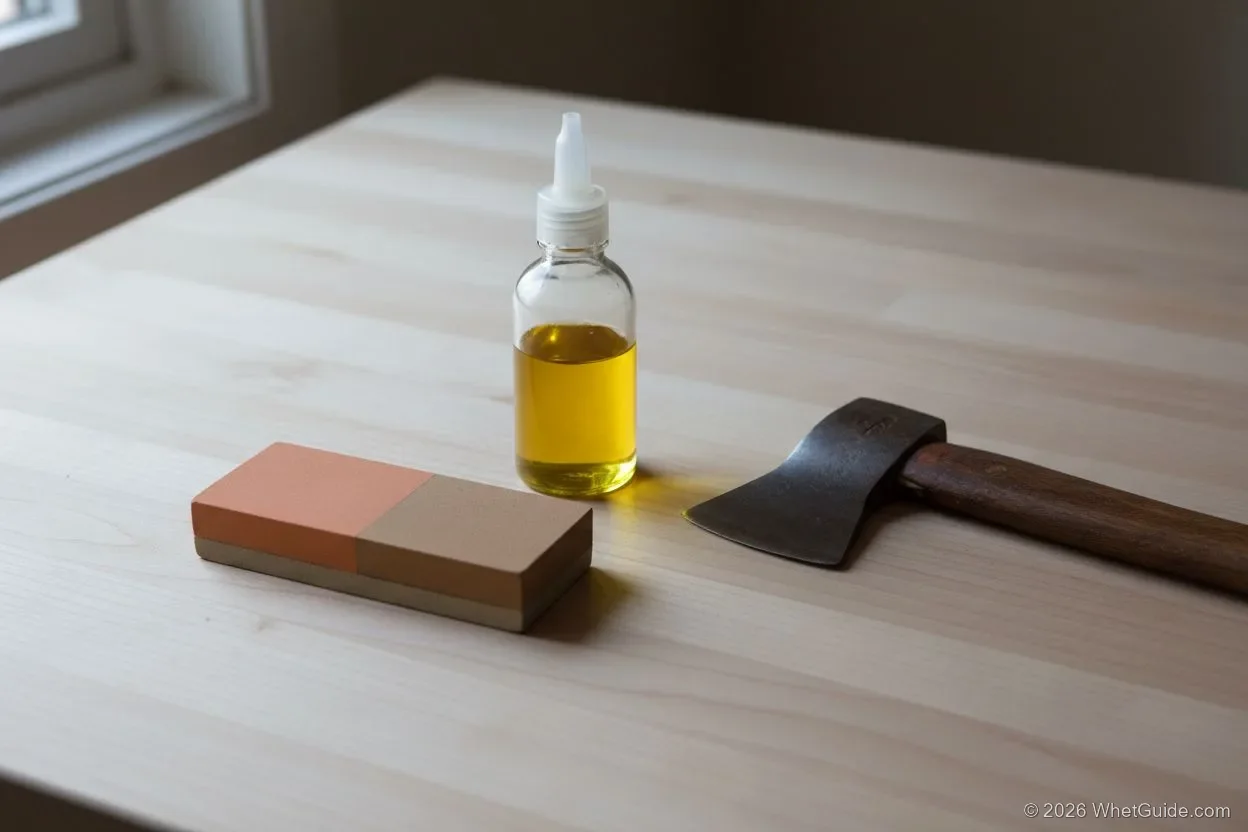
SHARPAL 162N diamond plate
The plate is the biggest flat face here, and it stays flat, which a silicon carbide stone does not. The listing calls the surface electroplated monocrystalline diamond on a thick stainless base and says it sharpens dry. On a wide felling axe you can lay a long section of the bevel on the plate at once. The angle guide in the box is for knives (four settings from 14 to 25 degrees). Ignore it for an axe and follow the bevel that's already there.
- Gritcoarse 325 (45 micron) / extra fine 1200 (12 micron)
- Size8 x 3 in
- Base0.35 in stainless steel
- Includesstorage box with non-slip base, angle guide
Why it stands out
- Large, flat, dry
- Also flattens and sharpens everything else in the shop
Think twice if
- The plate costs several times what a puck does
- You work at camp; it's a bench tool
DMT DiaFold fine / extra fine
A folding diamond paddle is the lightest way to touch up a hatchet in the field. This one is the fine and extra fine pair, so it is a finishing tool: use it after a puck or file, or for a few strokes at day's end. The polka-dot surface clears steel dust as you work, and the listing says it runs dry or with water. Sharpening Supplies lists DMT's coarser double-sided DiaFold as its axe pick. We could only confirm this finer version's listing, so pair it with a coarse puck rather than expecting it to do the heavy work.
- Gritsfine / extra fine diamond
- Formfolding paddle with polka-dot surface
- Weight2.4 oz
- Usedry or with water
Why it stands out
- Folds into its own handle, weighs next to nothing
- Dry, so nothing to spill in a pack
Think twice if
- The edge needs reshaping; fine and extra fine are too fine for that

Two more stones show up on other lists. The SHARPAL 121N is a cheaper diamond garden-tool file with the same 325 and 1200 grits as the 181N, plus 20 degree angle guides molded into the grip, which help with mower blades more than axes. The Fallkniven DC4 is a Swedish pocket stone, diamond on one face and ceramic on the other, about 4 inches long and 65 grams in a leather pouch, according to seller listings. Sellers don't agree on its grit figures, so we don't quote any. We couldn't confirm its Amazon listing for this update.
Axe sharpening kits: what's in the box
An axe sharpening kit is mostly the same file and stone you'd buy separately, in one box with care products. Helko Werk's North American site lists a standard axe maintenance kit at about $80 with a dual-sided file and a dual-grit stone, plus oils for the head and the handle, and the Helko file's listing says it fits those kits. That covers repair and honing, with the oils for storage. We couldn't confirm the kit's Amazon listing for this update.
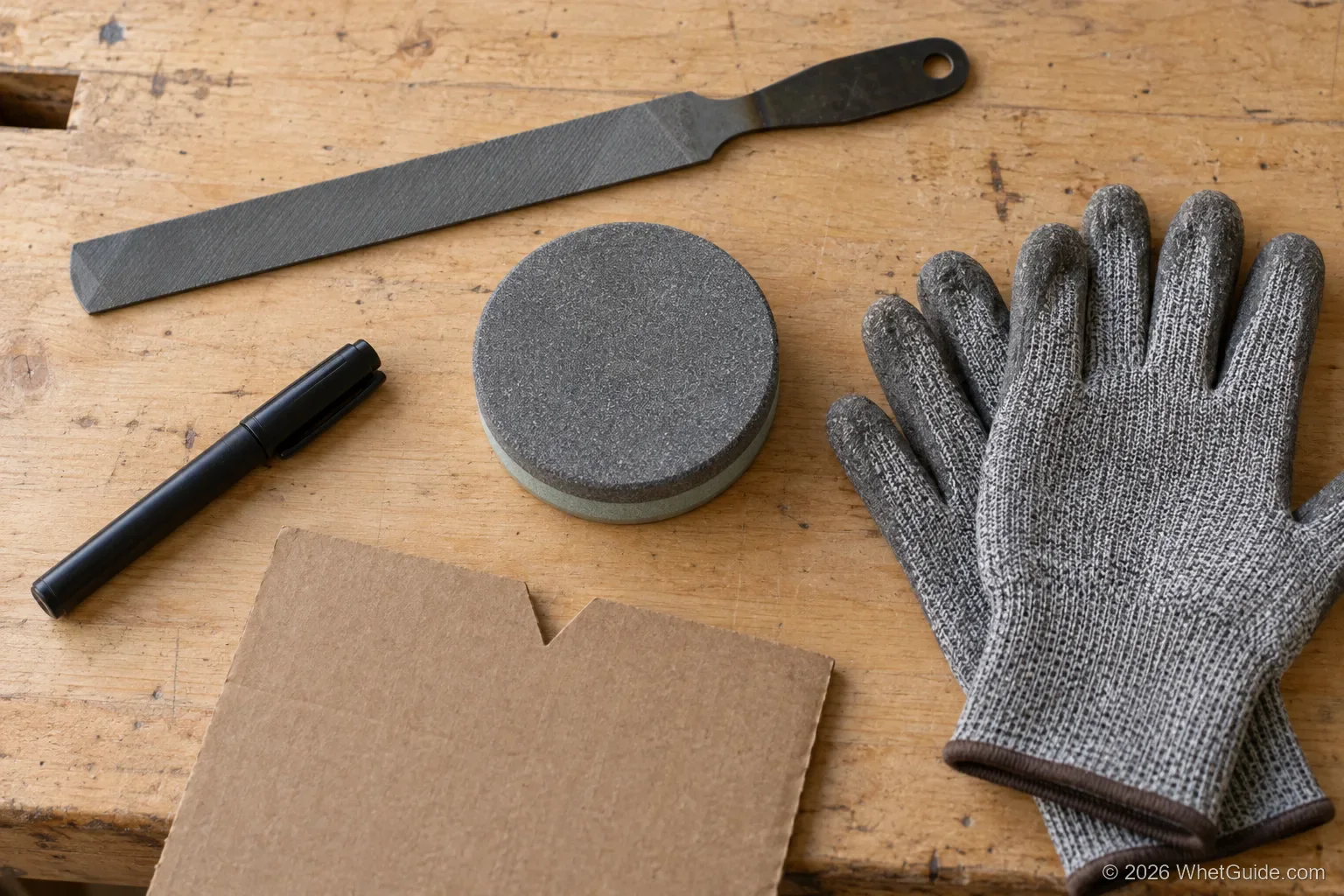
What almost no kit includes is a way to check the angle. Add a marker and a card notch gauge, both close to free. You can also build your own from the picks on this page. The budget column comes to well under half the boxed kit at last check:
| Job | Budget build | Step-up build |
|---|---|---|
| Fix damage | Nicholson 8 in axe file | Helko Werk 9 in file |
| Hone | Lansky Puck | Sharp Pebble puck or SHARPAL 181N |
| Finish | Scrap of leather on a board | BeaverCraft strop kit |
| Check the angle | Marker and a card notch | Add a Klein digital angle gauge |
| Spare or faster file | 8 inch axe file two-pack | Nicholson 10 inch double-cut bastard for heavy stock removal |
| Protect your hands | Leather work gloves you own | NoCry cut-resistant gloves |
Jigs and angle gauges
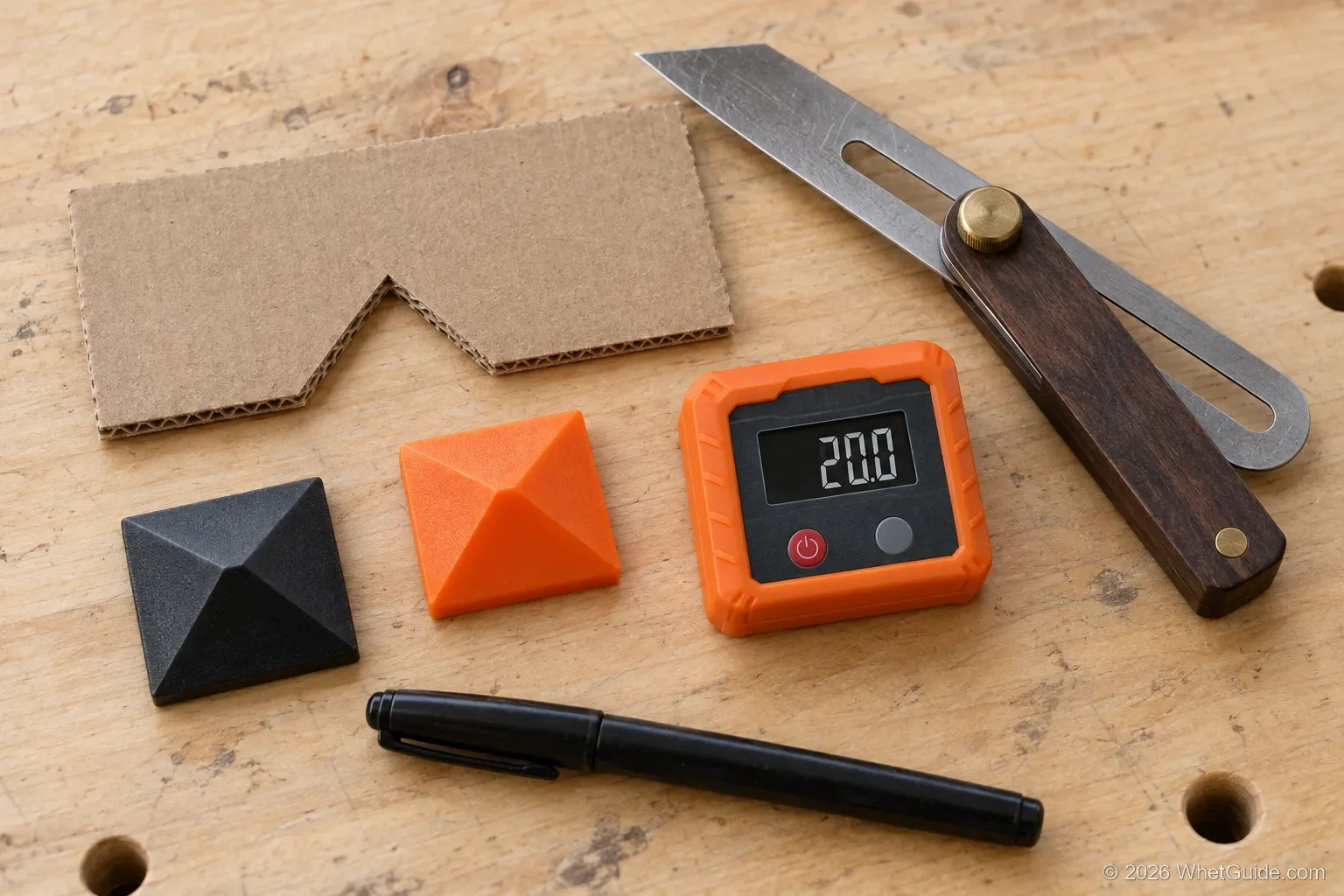
An axe jig is rarer than a knife jig, because an axe head is heavy and curved, so it's hard to clamp at a fixed angle. Tormek makes one, the AX-40, which comes with its T-4 Bushcraft wet grinder. Tormek's own class notes say freehand touch-ups slowly raise the angle and suggest re-sharpening to the intended angle after two or three of them; that note was written about knives, but the same drift happens on an axe. For most people a gauge is enough, and the cheapest one is cardboard.
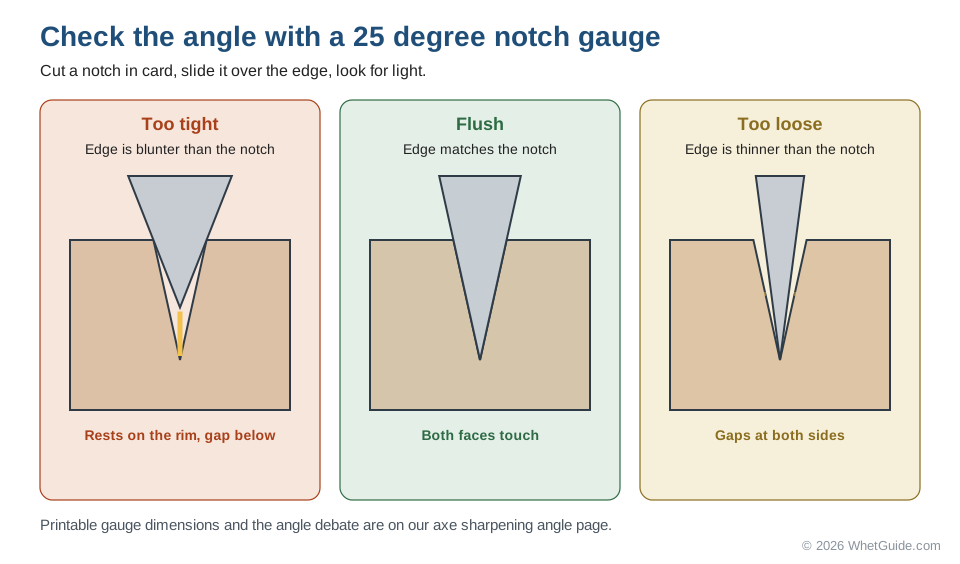
Cut notches from 20 to 30 degrees in 5 degree steps and find the one the edge seats in. Our axe sharpening angle guide has printable dimensions and the full argument about which number is right. Mark the bevel with a marker too, before you start. Knivesandtools describes the same check, and so do Tormek and the Forest Service: where the ink is gone, the tool touched; where it's left, it didn't.
Store-bought gauges help if you sharpen often. A Klein 935DAG digital angle gauge reads the tilt of a file or stone against level, which turns "hold it at the same angle" into a number you can repeat. The SHARPAL 196N angle pyramid is sold for knife stones, with four faces from 14 to 25 degrees. On an axe it's useful only as a reference to eyeball 25 against.
Belt and grinder tools, and the heat warning
Power tools are where axe sharpening goes wrong fastest. Steel that gets too hot loses the hardness the maker put into it, and you can't see that happen until the color shows. Hultafors says a blue area means "its tempered zone has disappeared." Gransfors Bruk says don't overheat the steel or it will lose its temper. The Forest Service treats blue or purple as a stop sign and uses power tools only to shape an edge, never to finish one.
The makers draw the line at dry, high-speed wheels. Council Tool: "Never use a high-speed dry bench grinder to sharpen your axe." Knivesandtools says not to use a grinding wheel at all. Field & Stream's Caudill keeps the grinder for heavily pitted axes and warns, "You must be vigilant not to leave it on the grinder so long that the steel begins to change color." Council and Hultafors both point to a wet grindstone as the safe powered option, which is what Tormek makes.
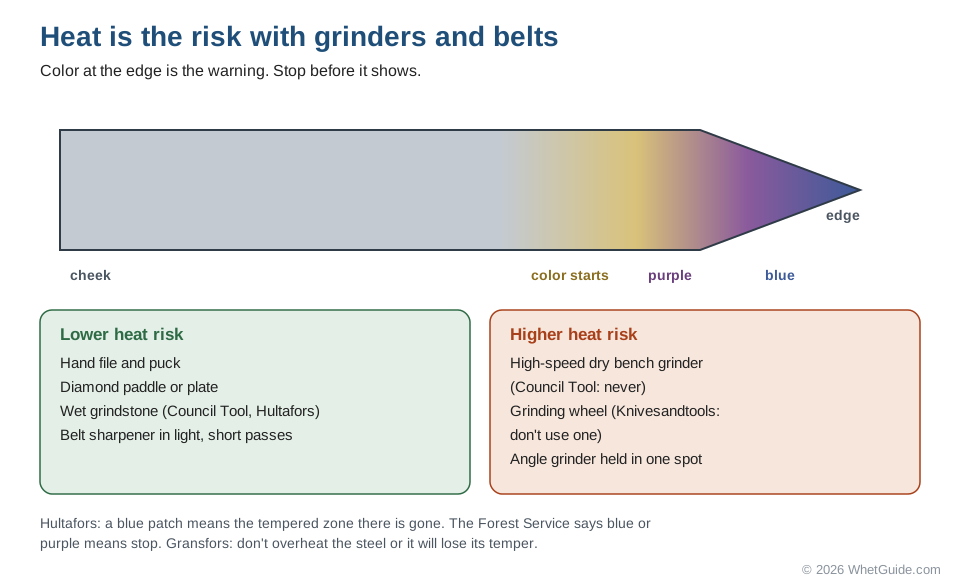
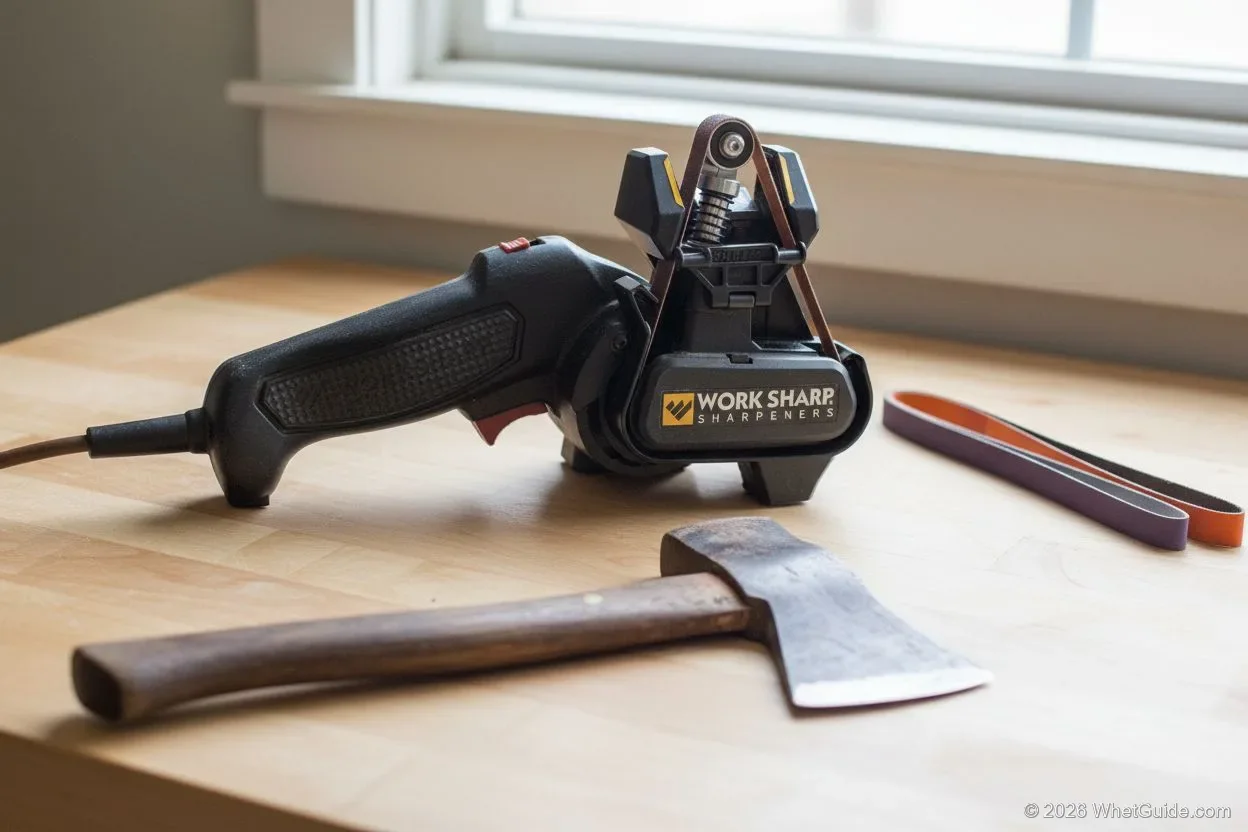
A belt sharpener sits between the two. The belt is narrow and flexible, so it follows a convex edge, but it still heats a thin edge if you hold it in one place. Keep each pass short and let the bit cool before the next; if it is too warm to hold a fingertip on, wait.
Work Sharp MK2
The MK2's listing pitches its two-speed motor at axes and mower blades as well as knives, and says the flexible belts can work as a grinder on outdoor tools. Its 25 degree guide is the setting our Work Sharp MK2 vs Ken Onion comparison points to for axes. For a large axe head you'll often work with the guide off, which makes it a freehand belt grinder; go slowly. The Work Sharp replacement belt kit (two belts each in three grits, P80 up to 6000) is listed as a direct fit for the WSKTS2. The P80 belt reshapes; the 6000 finishes.
- Guidesfixed 20 and 25 degrees per side, plus 65 degree scissor guide
- Belts1/2 x 12 in
- Motortwo-speed
- ModelWSKTS2
- Warranty3 years
Why it stands out
- Also handles your knives and mower blades
- Two fixed guides, nothing to set
Think twice if
- You own one axe; a file and puck cost far less
- You can't stay patient with light passes
Work Sharp Ken Onion Mk2
The Ken Onion Mk2 replaces the MK2's two fixed guides with a dial from 15 to 30 degrees and adds variable speed. Sharpening Supplies puts the Ken Onion Mk.2 first on its axe list. The dial lets you hit 25 or 30 exactly, and slower belt speed helps with heat.
- Angle15 to 30 degree dial
- Speedvariable
- Weight2 lb
- Listed usesknives, scissors, garden tools
Why it stands out
- Dial any angle from 15 to 30
- Variable speed for gentler passes
Think twice if
- It costs roughly twice what the MK2 does at last check
- Large axe heads still don't sit in the guide easily
Field kit vs shop kit
An axe used at camp and an axe used at the woodpile need different kits, mostly because of weight. The Forest Service notes that experienced axmen carry a small whetstone and give the edge a few swipes at the end of a cutting day. That's the field kit's whole job: keep a sound edge going until you get back to a bench.
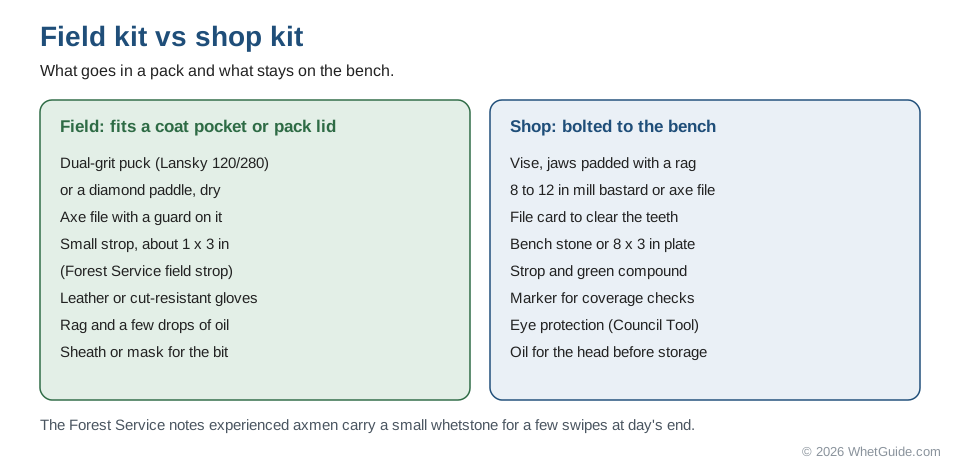
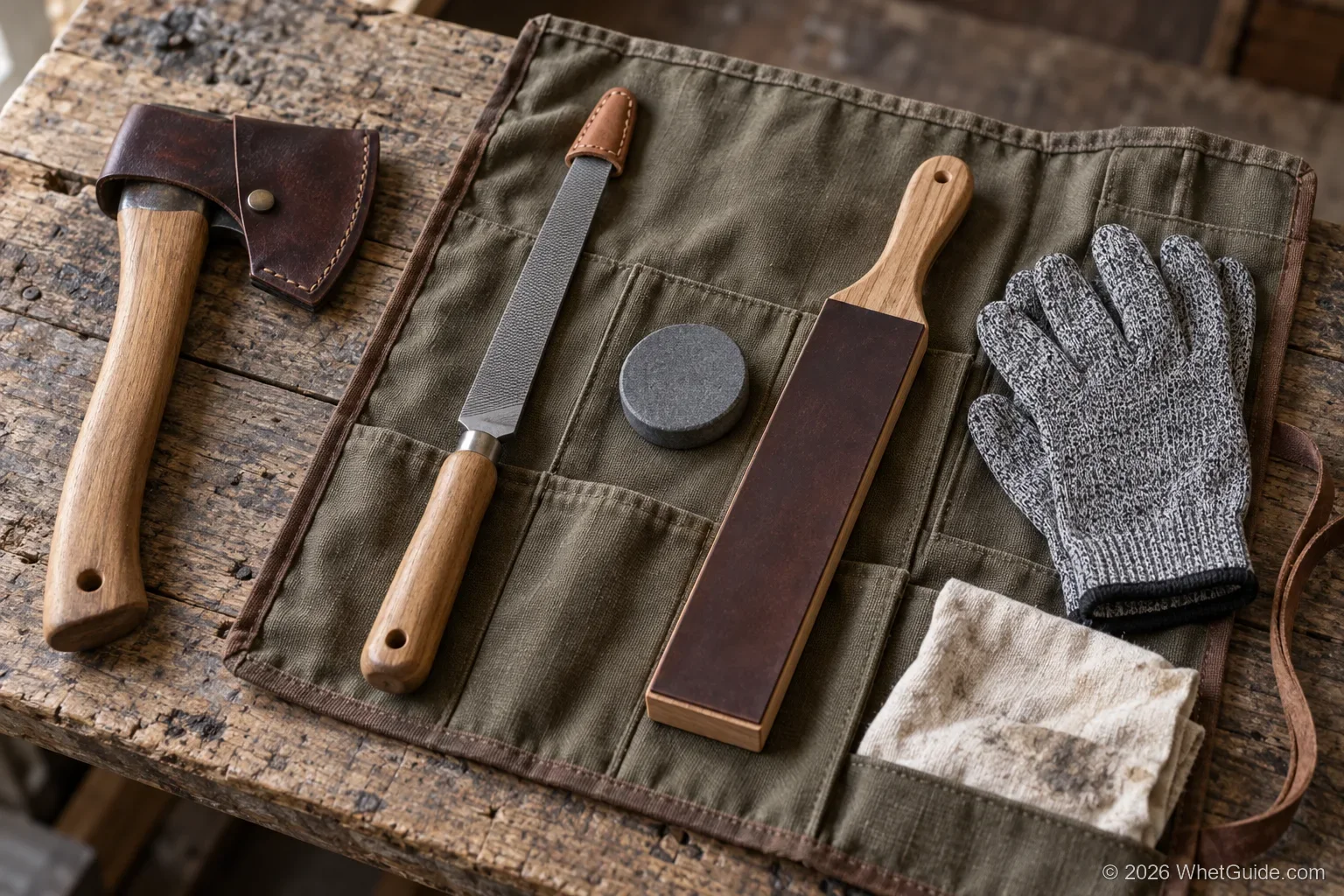
For the field, a Lansky Puck or a SHARPAL 181N is the core. Add a short file with a guard if you're going somewhere a rock strike is likely. The Forest Service describes a field strop of leather about 1 by 3 inches mounted on half-inch plywood, which weighs almost nothing. Gloves come too. The Forest Service wants cut-resistant or leather gloves at least on the hand nearest the edge while filing.
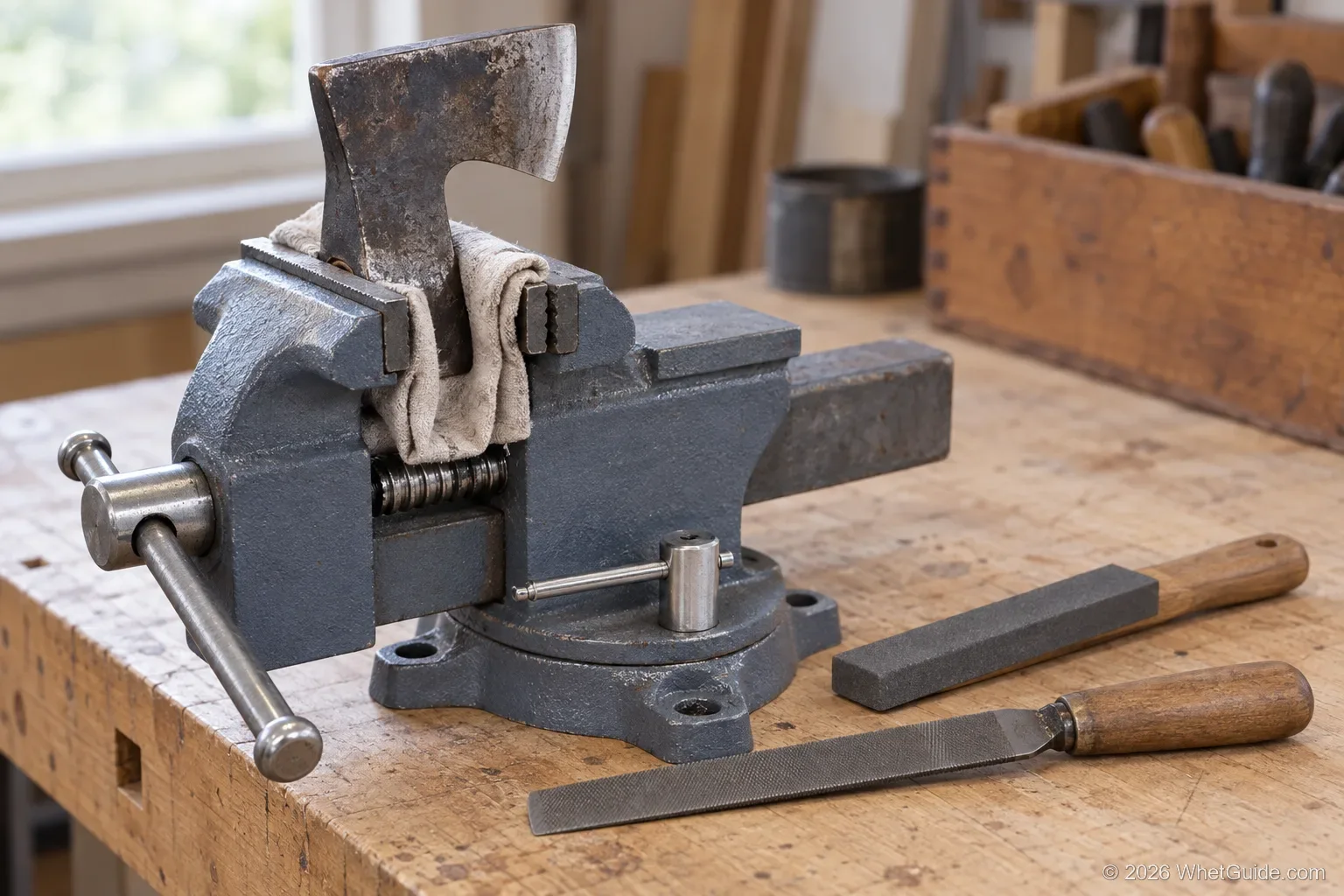
In the shop, the axe goes in a vise. A Yost LV-4 homeowner's vise is plenty for an axe head; pad the jaws with a rag. Council Tool adds eye protection to the filing kit. The longer 12 inch file, the plate or bench stone, and a proper strop all live here.
Which sharpener for which axe
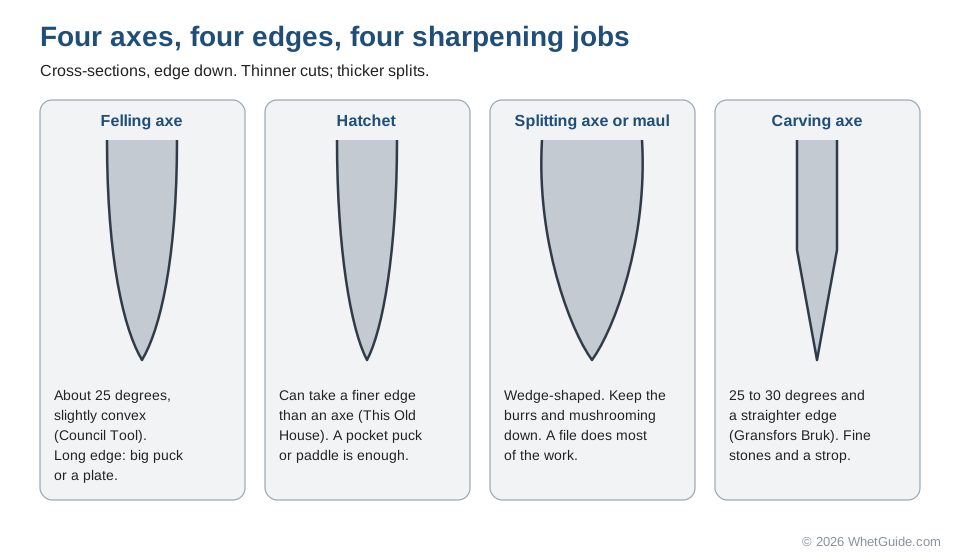
The axe's job sets the edge, and the edge sets the tool. Hultafors grinds a convex edge for felling and splitting work and a straighter one for hacking. Gransfors Bruk keeps curved edges on forest axes and straight edges on carving axes, and gives hardwood and frozen wood a thicker, more rounded bevel while softwood gets a more pointed one.
Felling and double-bit axes
The long edge is the problem. A 3 inch puck works slowly here; each section has to blend into the next. Use a bigger puck like the Sharp Pebble, a long diamond stone like the SHARPAL 181N, or clamp the head and use the 162N plate. Council Tool's "about 25 degrees (and slightly convex)" is the target for its axes. Double-bit axes are the same job twice: the Forest Service describes a keen edge of about 18 degrees on one bit for clean wood and a stunt edge of up to 28 degrees on the other for knots and limbing. Mark the stunt side.
Hatchets and camp axes
This Old House says hatchets can take a finer edge than axes, and the short edge makes any puck fast. The Lansky Puck plus a strop is the whole kit. If you carve with it, add the DMT DiaFold for a finer finish.
Splitting axes and mauls
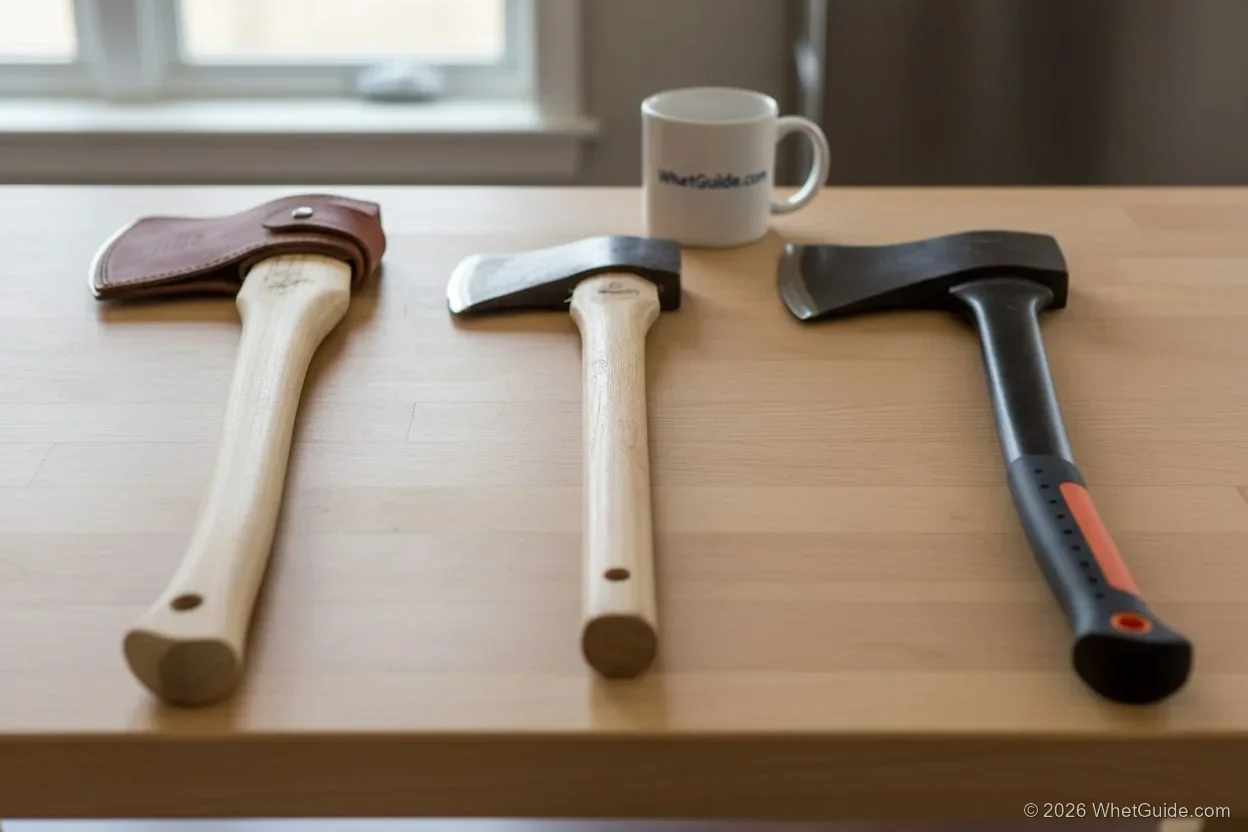
A maul wedges wood apart, so its edge can stay thick. Keep burrs down with a file and dress any mushrooming on the poll. A stone is optional. Gransfors notes that only its splitting maul's poll is meant for striking wedges, so check yours before you pound on it.
Carving axes
Gransfors Bruk gives 25 to 30 degrees for carving axes and keeps their edges straighter. Fine stones and a strop matter more here than anywhere else, because you're shaping wood with the edge rather than chopping. A flat diamond plate suits the straighter grind.

Five axes, five shopping lists
| The axe | Check first | Buy | Rough spend at last check |
|---|---|---|---|
| Inherited felling axe from the barn: rust, rounded edge, a couple of nicks | Cracks running from the edge into the cheeks; the Forest Service says a cracked head should be retired. Clean off rust and sap first (it suggests steel wool or sandpaper for sap). | Nicholson 12 inch mill bastard in a vise, then the Sharp Pebble puck | Under $40 |
| Weekend camp hatchet, dull but sound | Nothing to fix; it just needs an edge | Lansky Puck, a few strokes at day's end, as the Forest Service describes axmen doing | About $12 |
| Splitting axe that only splits | Burrs and rolled spots. Don't thin it; splitters are ground thick on purpose. | Nicholson 8 inch axe file once or twice a season; puck optional | About $14 |
| Carving axe for spoons and bowls | A straight, even edge at 25 to 30 degrees (Gransfors Bruk) | SHARPAL 162N plate, DMT DiaFold to refine, strop with green compound | The most of any list here |
| Homestead that also sharpens knives and mower blades | Whether you'll keep belt passes short and check the steel by fingertip | Work Sharp MK2 with the belt kit, plus a file for the day the axe meets a nail | About $115 |
Can a knife sharpener sharpen an axe?
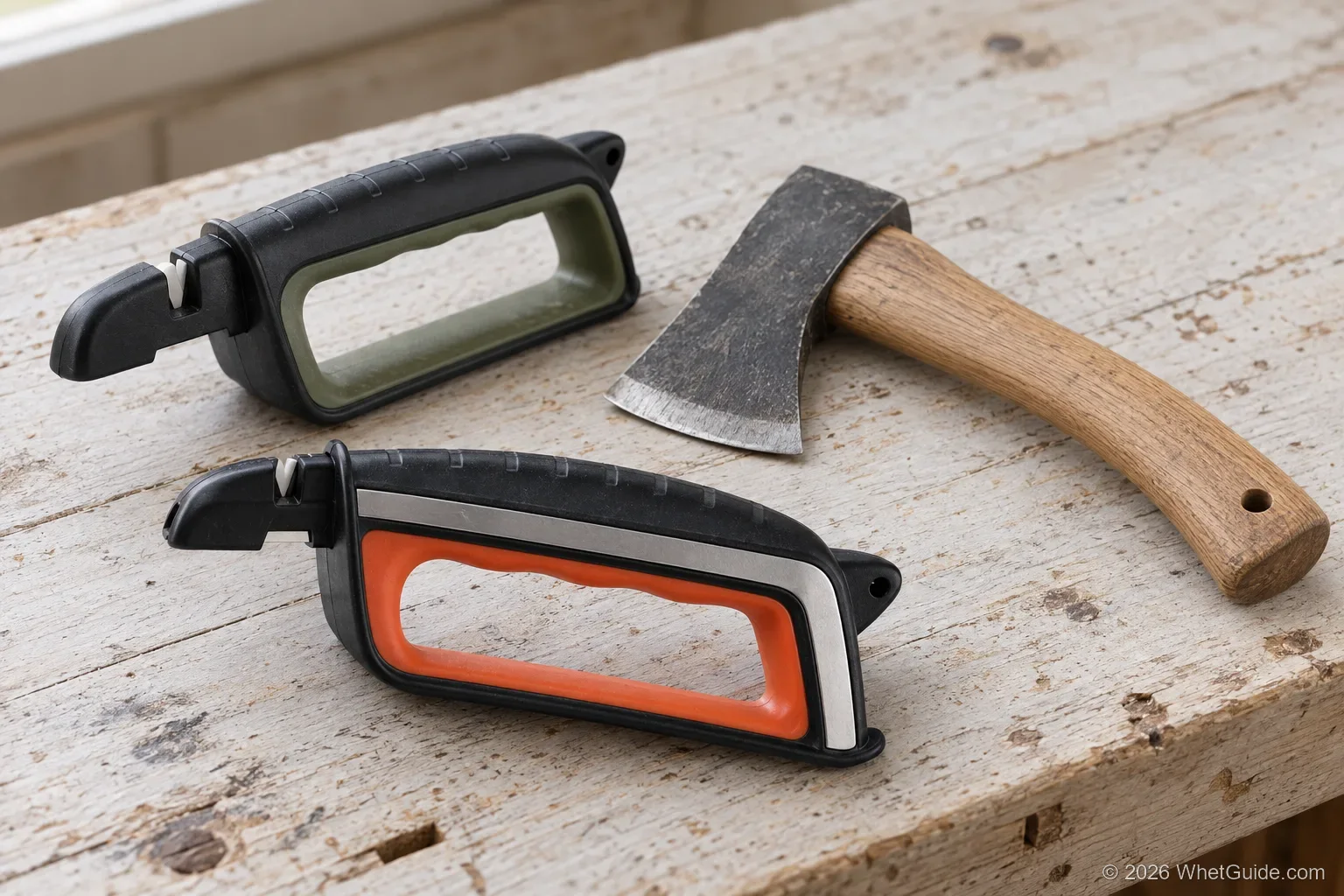
Some can, most can't, and the shape of the head decides it. A kitchen pull-through expects a thin blade sliding through a narrow slot. An axe bit is thick and curved, and it won't fit or won't sit level. The ones that work are built with tools in mind. The Work Sharp MK2's listing names axes, and its 25 degree guide is the axe setting. The SHARPAL 103N garden-tool sharpener has three preset slots, a tungsten carbide sharpener and a big hand guard, and its listing names axes and hatchets among its uses. The DMT Glide-Pro pairs a diamond stone with tungsten and ceramic surfaces in a 5.25 inch handheld sold for machetes and axes as well as knives. Both handhelds are touch-up tools; neither will fix a chip.
Pull-through axe sharpeners like Fiskars' have the same limit. They set the angle for you, which is easy, but they can't follow a convex edge and they're slow on real damage. Retailer write-ups of Fiskars' newer XSharp model describe a single ceramic stone behind two fixed guides set at 20 and 40 degrees. That's fine for keeping a Fiskars hatchet going and not much else. Rod systems and guided knife jigs have no way to clamp a heavy head, so we'd leave them for knives.
What to look for
Grit comes first. Pair a coarse face (100 to 180) with a fine one (280 to 600) and you can fix and finish with one tool. Material comes second: silicon carbide and corundum cut fast and wear, while diamond stays flat and works dry. Knivesandtools adds that diamond removes more steel than ceramic, which makes ceramic the gentler finisher. If you like natural stones, read about Arkansas stones; the Forest Service uses a hard Arkansas or fine diamond for an axe's microbevel. For diamond plates in general see our best diamond sharpening stone roundup.
The angle is the third thing, and a stone cannot choose it for you. Council Tool, a US axe maker, says about 25 degrees with a slightly convex edge, and Axeman.ca gives 25 to 30 degrees. Our axe sharpening angle guide has a cardboard gauge you can cut to check. A narrower bevel cuts easier and chips sooner in frozen or knotty wood. Tom Bartlett of Sharpening Supplies sums up the trade: "A lower sharpening angle creates a thinner, sharper edge but at the cost of durability."
Size is the fourth. Match the stone to the edge: a pocket puck for a hatchet, something 4 inches or longer, or a plate, for a felling axe. Weight matters only if it rides in a pack. Price is last, and it spreads further than you'd expect for a lump of abrasive. At last check:
| Band | What you get |
|---|---|
| Under $15 | Lansky Puck; Nicholson axe and mill files; budget file two-pack |
| $15 to $35 | DDF and Sharp Pebble pucks; Helko file; SHARPAL 181N and 121N; Norton Crystolon; DMT DiaFold |
| $35 to $100 | Norton IB64, Gränsfors puck, SHARPAL 162N plate, Work Sharp MK2 |
| Over $100 | Work Sharp Ken Onion Mk2 |
What to skip
The Fiskars axe and knife sharpener is a pull-through: you draw the edge through a slot behind a safety guard, and its listing says ceramic wheels sharpen both sides at once. It is rated 4.0 from about 3,400 ratings, the lowest on this page. A fixed slot leaves you no control over the bevel, which is the one thing an axe sharpener should give you, and it can't follow a convex grind. For a machete the choices differ, so see how to sharpen a machete.
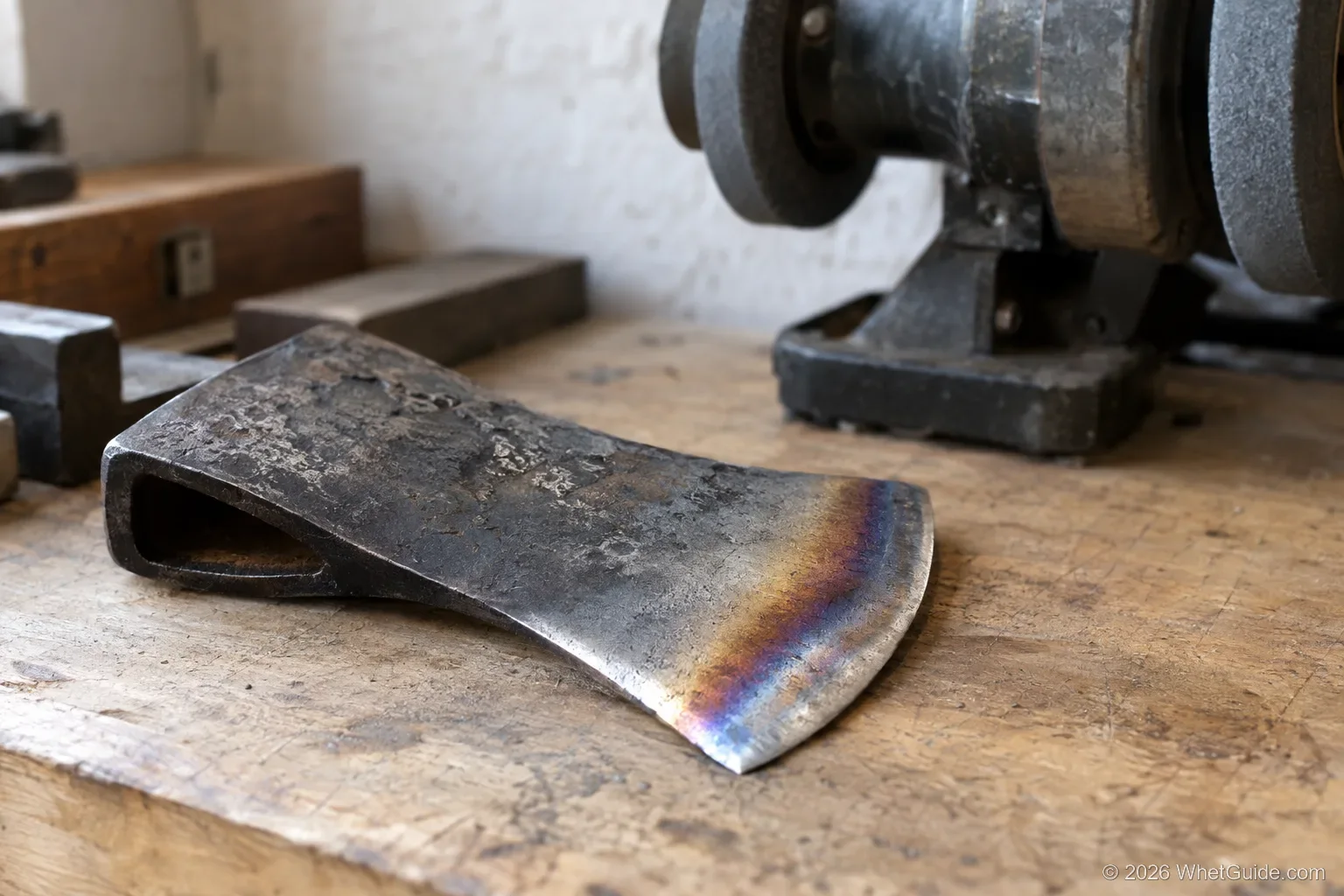
Skip the high-speed dry bench grinder too, unless you're reshaping a ruined bit and you know how to keep steel cool. Council Tool's warning against it is the bluntest line in any maker's guide. Kitchen pull-throughs, electric knife sharpeners with narrow slots and rod systems are the wrong shape for an axe.
Finish the edge
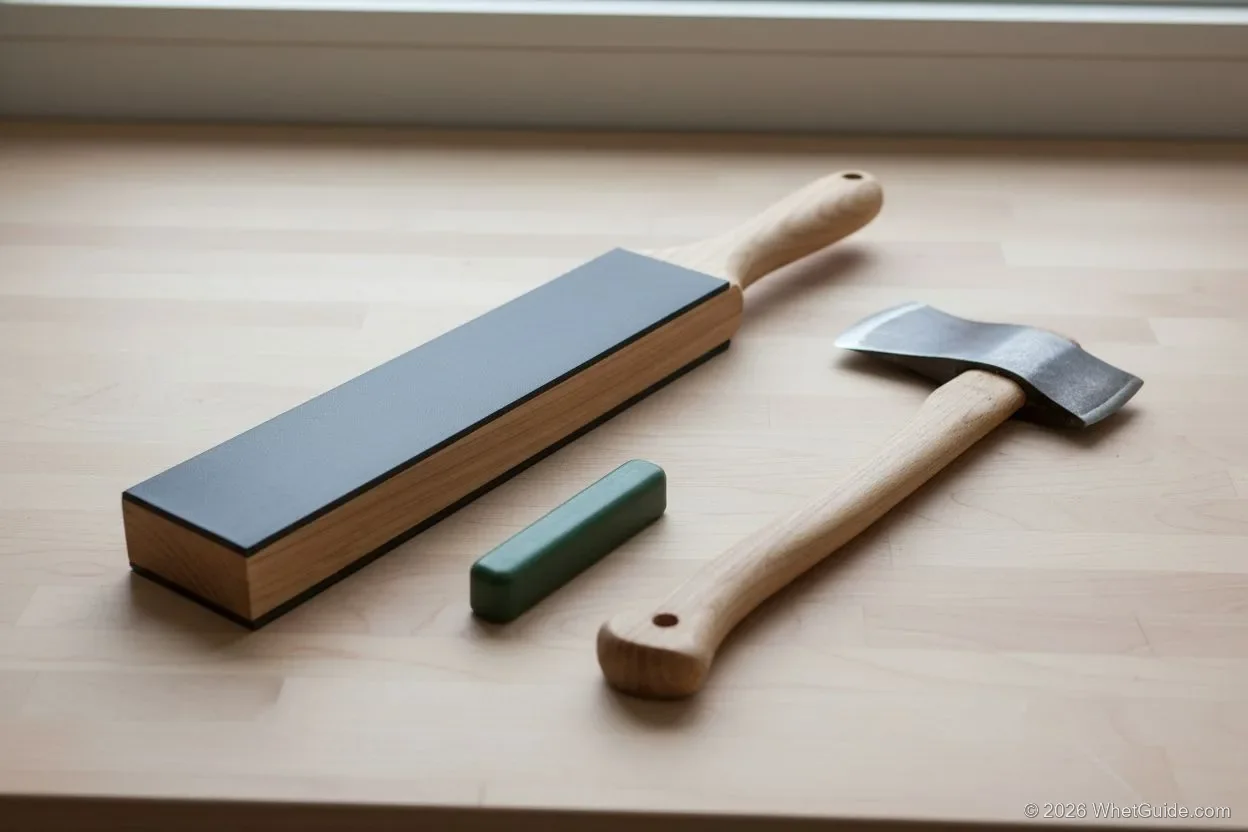
A strop with a little compound removes the last of the burr on a hatchet or felling axe. It is optional for firewood work. The Forest Service calls stropping the best way to remove a wire edge and gives the details: draw the axe backward so the edge trails, never cut into the leather, and hold it at about 35 to 40 degrees with the edge slightly raised. It wants leather an eighth of an inch thick or more, and says a barbershop razor strop isn't appropriate. The BeaverCraft strop kit comes with compound, and a bar of SHARPAL 208H green compound lists axes among its uses. If you want one, see our best leather strop picks and how to strop.
Care: oil, sheath, storage
A sharp edge stays sharp longer when it isn't banging around or rusting. Gransfors Bruk says to oil the head before storage and to keep the bit and sheath dry when sheathed, and recommends oiling the handle once a year. Council Tool wants the axe stored dry, out of direct sunlight, somewhere somewhat cool, with the head slightly oiled. Hultafors warns against excessively dry places like a boiler room, where the handle dries out and the head loosens.
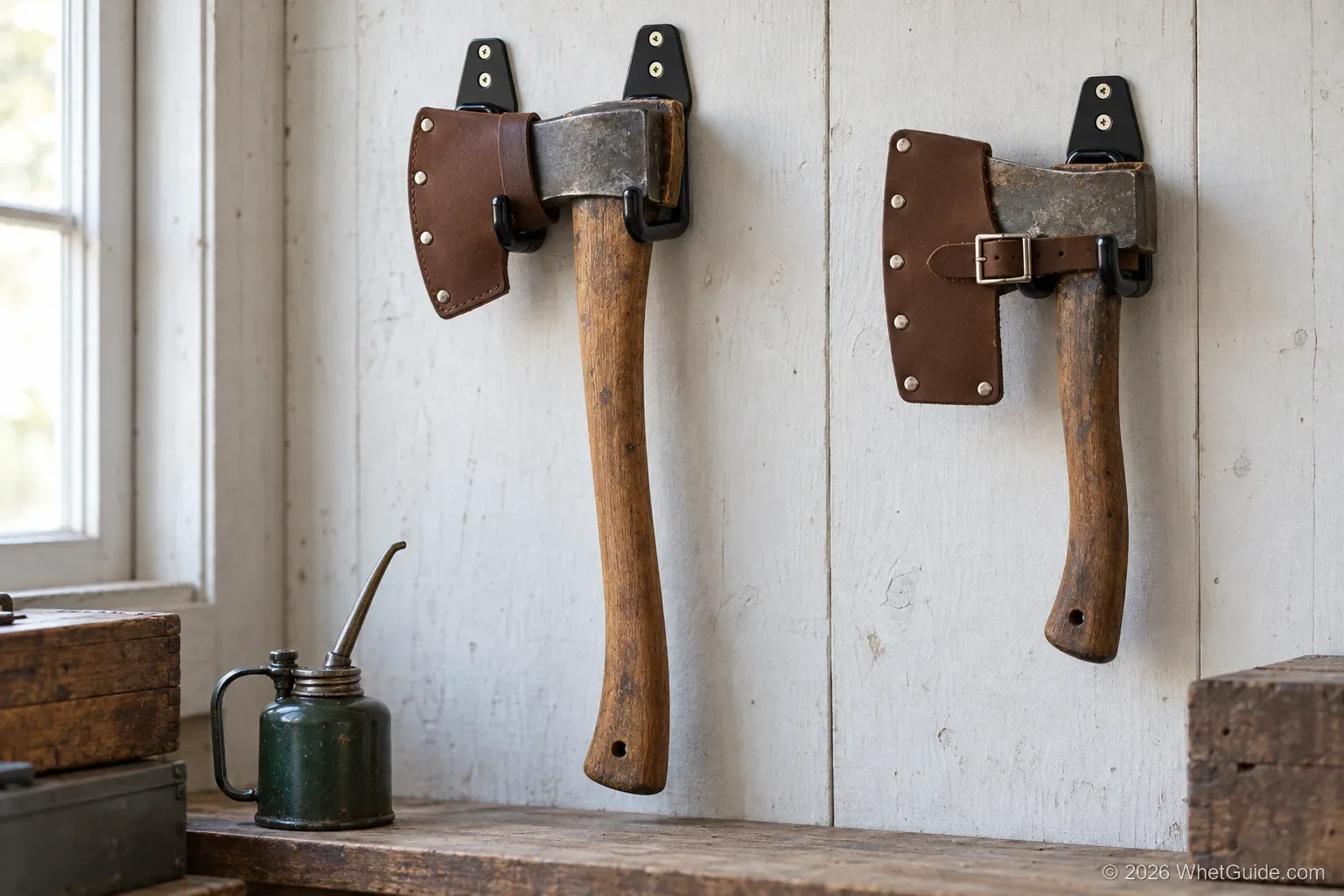
The Forest Service adds the details. Hang axes on pegs or hooks rather than leaning them in a corner, keep the sheath on until you reach the worksite, and be careful with oily rags, which can catch fire on their own. Clean sap off the head with kerosene or a citrus solvent, then wipe off the citrus residue, since the Forest Service warns its acid corrodes steel.
The sharpeners need care too. Clear a file's teeth with a file card as they clog, which the Forest Service builds into its filing routine, and give it a sleeve: Outdoor Life notes files snap if dropped on metal or concrete. Rinse a puck after use and let it dry before it goes in a bag. Keep oil stones on oil. Diamond plates need only a wipe and a brush. Our axe guide has a full storage section with humidity figures.
When the new sharpener doesn't seem to work
| What you see | Likely cause | Fix |
|---|---|---|
| Marker stays on the very edge | Tool held too flat; you're grinding the shoulder | Raise the back of the stone or file slightly |
| Marker gone only at the edge | Tool held too steep; you're adding a new, blunter bevel | Lower it until the whole bevel loses ink |
| No burr after a lot of strokes | Fine side on a dull edge, or a clogged stone | Go back to the coarse side or the file; clean the stone |
| Burr on one stretch only | Toe or heel being skipped | Work the ends on purpose; re-mark and check |
| Axe sticks in the cut | A flat bevel; the Forest Service says flat profiles penetrate but stick | Round the shoulder over with a puck toward a convex edge |
| Edge chips in knots or frozen wood | Bevel too thin for the wood | Steeper bevel, or a 25 degree microbevel as the Forest Service describes |
| Edge rolls over | Thin flat grind, which the Forest Service says rolls and chips more easily | File back past the rolled steel and reshape |
| Axe pulls to one side in the cut | One side ground more than the other | Even the sides; Gransfors says a wrongly ground axe slips more easily |
Buying and sharpening mistakes
| Mistake | Why it hurts | Fix |
|---|---|---|
| Buying a knife pull-through for an axe | Fixed slot, wrong shape, no repair | A puck and, if needed, a file |
| Sharpening to a knife angle | A thin edge chips in knots and frozen wood | Follow the existing bevel; check with a 25 degree notch |
| Dry grinder on a dull axe | Heat draws the temper | File by hand, or a wet grindstone |
| Filing only the chip | Leaves a dip; edge goes wavy | Work the whole edge and blend |
| Sawing the file back and forth | Dulls the teeth, rolls the edge | Push to cut, lift to return |
| Finishing one side before the other | Uneven grind; the axe pulls in the cut | Alternate sides, as the Forest Service says |
| Forgetting the toe and heel | The ends stay dull | Marker check before and after |
Axe sharpener myths vs what the sources say
| You'll hear | What the sources say |
|---|---|
| "A sharp axe should shave hair." | This Old House says an overly sharp edge chips more easily. Knivesandtools' test: rest the edge on a thumbnail at about 45 degrees; "If the axe slides off it is not sharp enough." |
| "A grinder is fine if you're quick." | Council Tool says never use a high-speed dry bench grinder. Hultafors says blue means the tempered zone is gone. |
| "Sharpen it like a kitchen knife." | Most axe sources sit between 25 and 30 degrees, and the Forest Service's thinnest working bevel still gets a 25 degree microbevel. A thin knife edge chips in knots and frozen wood. |
| "Saw the file back and forth to go faster." | Outdoor Life and the Forest Service both say a file cuts on the push only. Sawing dulls it. |
| "Oil or water, it doesn't matter." | Gransfors pairs each with different stones, and the Forest Service says a stone once oiled stays on oil. |
| "The maker's own puck sharpens better." | The Gränsfors puck's listing gives no grit at all, so there is nothing to compare. Judge any puck by its grits and size. |
Which one to buy
Buy the Lansky Puck for a hatchet or a single small axe. Pay a little more for the Sharp Pebble puck if your axe has a wide bit. Own a chipped felling axe? The Helko file plus either puck is the combination that fixes it. If you want one dry tool for the pack, take the SHARPAL 181N. If a belt sharpener would also earn its keep on your knives and mower blades, the Work Sharp MK2 handles axes too, as long as you keep the passes light.
Grit and size come from each Amazon listing, first checked October 29, 2026, with additions checked in November 2026. Maker guidance comes from the axe makers named above and the US Forest Service's axe manual. Prices change, so the buttons show the current price on Amazon. How we research · Affiliate disclosure