- 25 to 35°top-plate filing angle by chain type (Husqvarna, ECHO)
- 1/5of the file's diameter above the top plate (Oregon)
- .025 indepth gauge setting on most Oregon pro chain (Madsen's)
- 4 mmlongest cutter left: below that, replace (Husqvarna)
Quick answer: how to sharpen a chainsaw chain
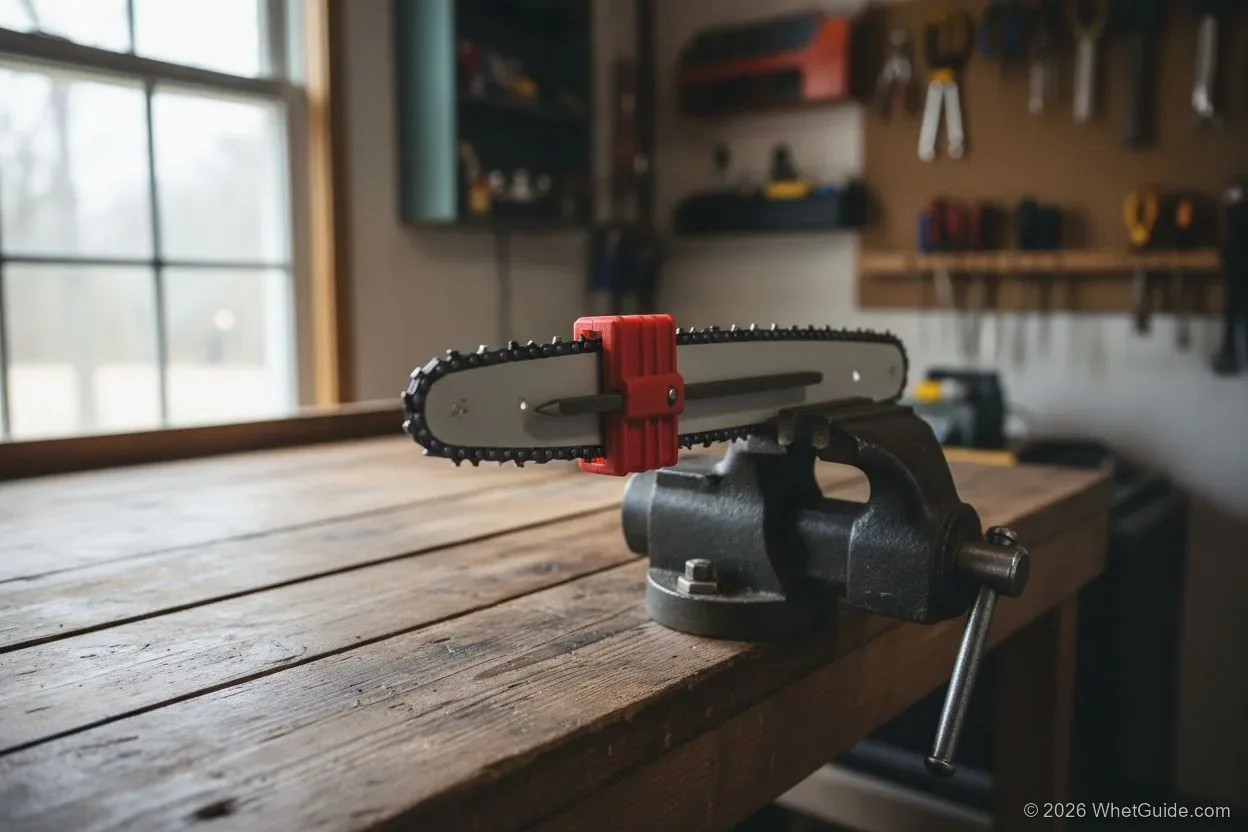
Here is how to sharpen a chainsaw chain by hand: set the chain brake, clamp the bar lightly in a vise and fit a round file that matches the chain's pitch into a file guide. File every second cutter with full, even push strokes at the angle marked on the guide. On most chains that's somewhere from 25 to 35 degrees, with 30 the common one. Give each cutter the same number of strokes. Turn the saw around and file the other row the same way. Then lay a depth gauge tool over the chain and file down any raker that pokes up through the slot. Family Handyman puts the whole job at 15 to 45 minutes.
Two things decide whether the saw cuts straight afterward. Every cutter has to end up the same length ("It is important that all teeth are the same length," as Husqvarna's support article puts it), and the depth gauges have to sit at the height the chain was built for.
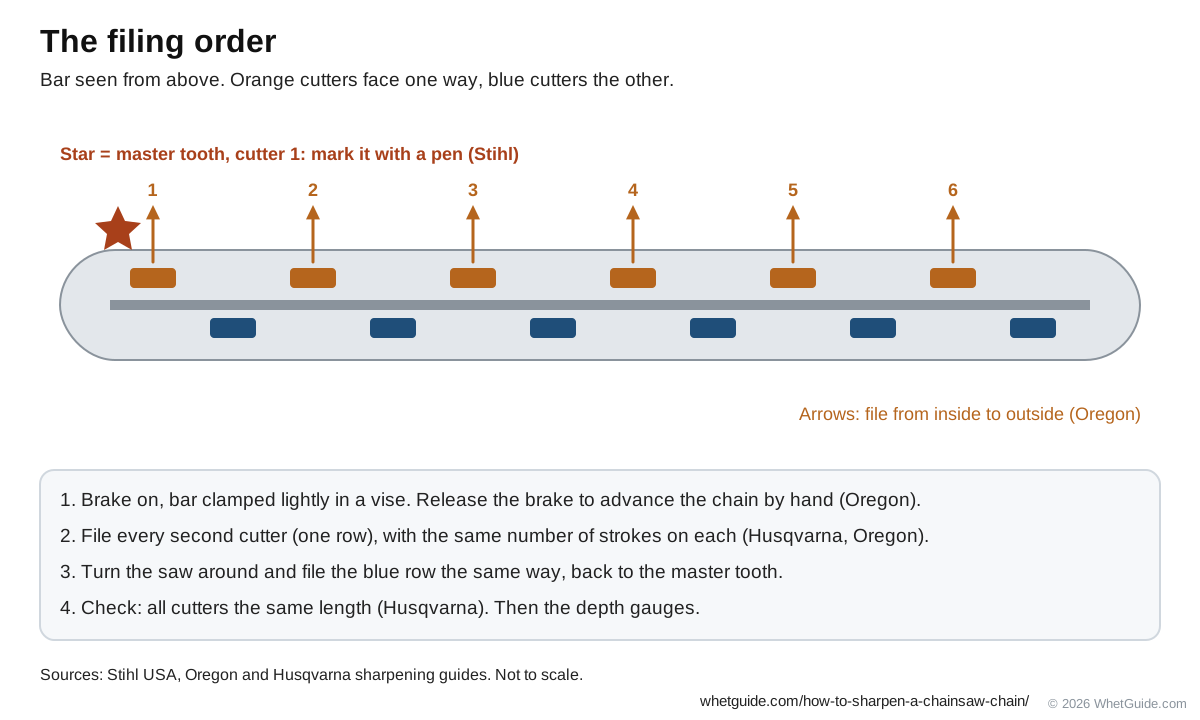
The 8 steps, brake on to test cut
- Make it safeEngine off and cool. Spark plug lead off, or the battery out. Gloves and glasses on.
- Brake on, bar in the viseClamp the bar lightly. Snug the chain a little tighter than you'd run it.
- Match the file to the chainPitch from the box, the drive links or three rivets. File size from the chart.
- Mark a starting cutterA pen line on one cutter so you know when you're back around.
- File one rowEvery second cutter, push strokes only, inside to outside. Same count on each.
- Turn the saw, file the other rowSame angle, same count. Match the shortest cutter.
- Check the depth gaugesGauge tool on the chain, flat file on anything that sticks up. Round the front.
- Oil, set tension, test cutBrush off the filings, oil the chain, reset tension, make a cut and read the chips.
If you've only got ten minutes in the woods, filing both rows (steps 5 and 6) on a chain that's slightly dull gets you cutting again. Save the depth gauges for the bench, but don't skip them for long. A chain with sharp cutters and tall rakers still makes dust.
↑ Back to all sectionsParts of a cutter, and the words this guide uses
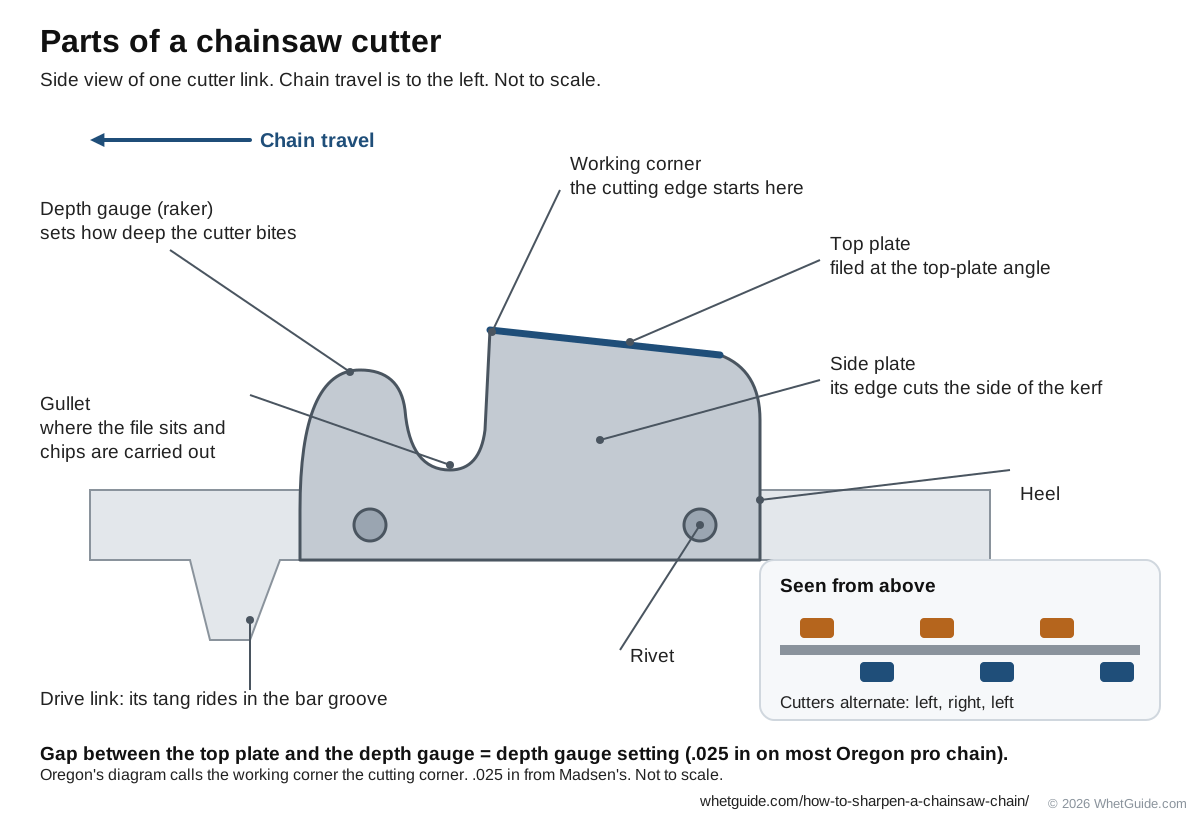
A saw chain is a loop of three kinds of links riveted together. Drive links have a tang underneath that rides in the bar's groove and gets pulled around by the sprocket. Tie straps hold the drive links together on the side opposite each cutter. Cutters do the work, and they alternate: one faces left, the next faces right. Oregon's diagram labels the working corner as the "cutting corner," so expect either name.
| Part | What it does | What you do to it |
|---|---|---|
| Top plate | The flat top of the cutter. Its front edge slices across the wood fibers. | Filed at the top-plate angle, 25 to 35 degrees on most chain. |
| Side plate | The vertical face. Its front edge cuts the side of the kerf. | Sharpened by the same file stroke. Its angle comes from the chain's design. |
| Working corner | Where the top plate and side plate meet. The point that hits wood first. | Keep it crisp. A rounded corner is a dull chain. |
| Gullet | The hollow between the depth gauge and the cutting edge. Chips leave through it. | The round file rides here. It's also where you test-fit a file. |
| Depth gauge (raker) | The hump in front of each cutter. It limits how thick a chip the cutter can take. | Filed down with a flat file every few sharpenings, to the height on the gauge tool. |
| Drive link | Rides in the bar groove. Its thickness is the chain's gauge. | Nothing, but its stamped code tells you which chain you have. |
| Tie strap and rivets | Hold the loop together. | Inspect. Rivets that turn under your fingers mean a worn-out chain (Oregon). |
Chisel, semi-chisel and square chisel
Cutters come in a few shapes, and the shape decides how you sharpen. UGA Extension's circular on chains and bars, written by Josh Fuder in 2020 and reviewed in 2024, sorts them out plainly. UGA says chisel cutters are easy to sharpen by hand and any shop can do them, and semi-chisel cutters are simple to file or grind. Square chisel cutters are the exception. UGA calls them hard to hand file, and they usually go on a grinder or to a shop. Oregon's guide also treats square-ground chain as its own case. If your chain's box says "square," a round file is the wrong tool; skip to the grinder section.
Signs your chain is dull
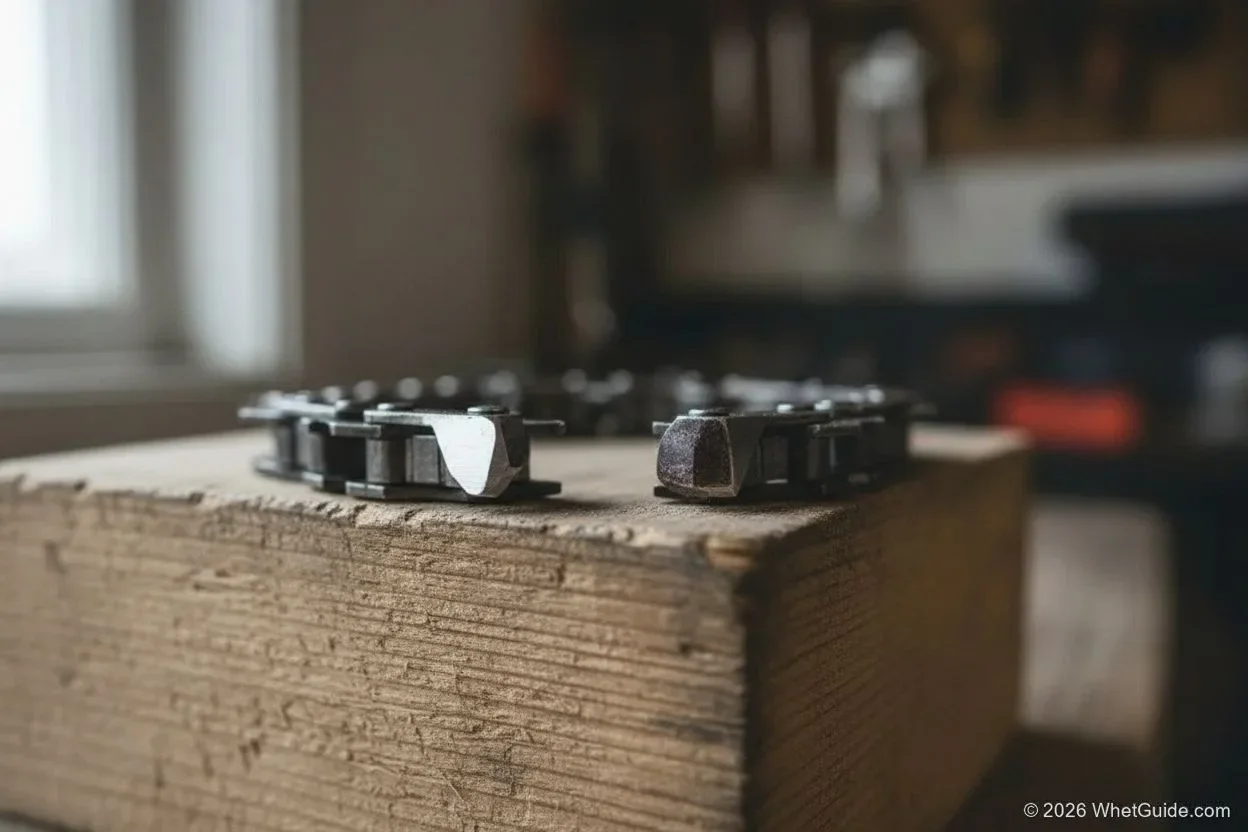
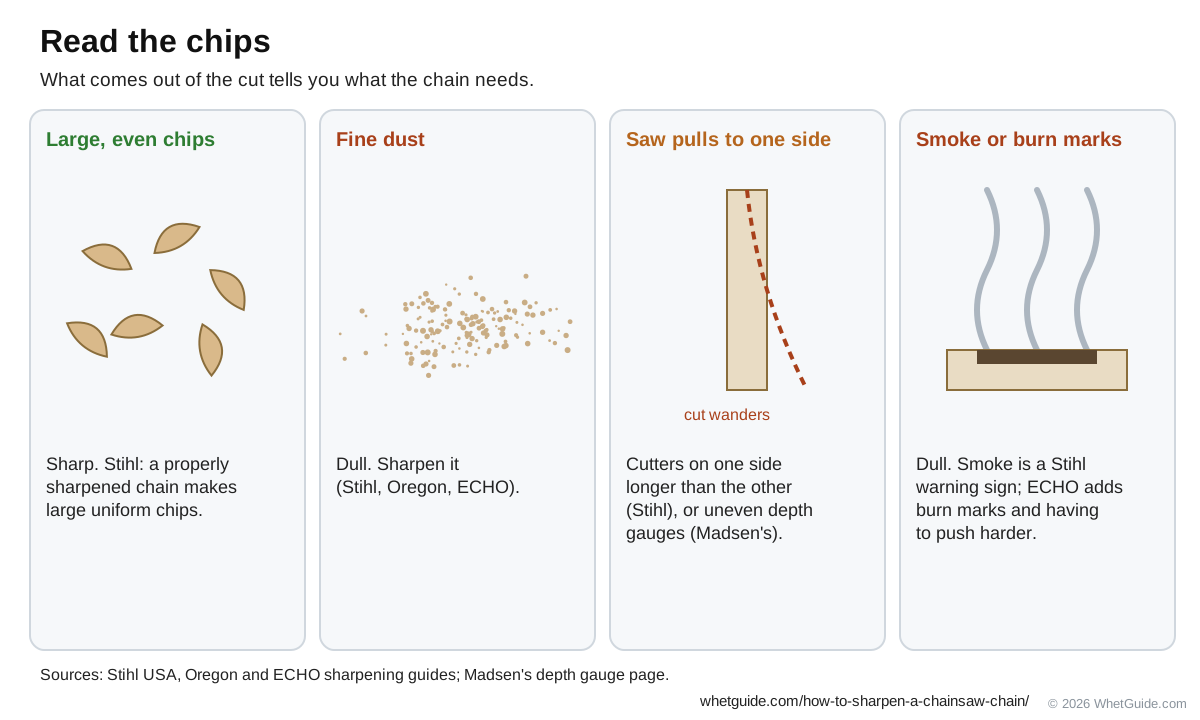
The chips tell you first. Stihl's guide says it in one line: "A properly sharpened chain produces large uniform chips." When the cut throws fine sawdust instead, the chain is dull. Stihl and Oregon both use that as the trigger to sharpen. You'll feel it before you look, too. A sharp chain pulls itself into the wood. A dull one has to be pushed.
The full list of signs, combined from the Stihl and ECHO guides:
- Fine sawdust or small dusty chips instead of thick curls.
- You have to lean on the saw to make it cut.
- Smoke from the cut even though the chain is oiled.
- Burn marks on the wood.
- The saw pulls to one side or cuts crooked.
- Chatter and bounce as the chain hits the wood.
- Slow cutting even at full throttle.
- On a battery saw, a charge that runs out sooner than it used to (ECHO lists this one).
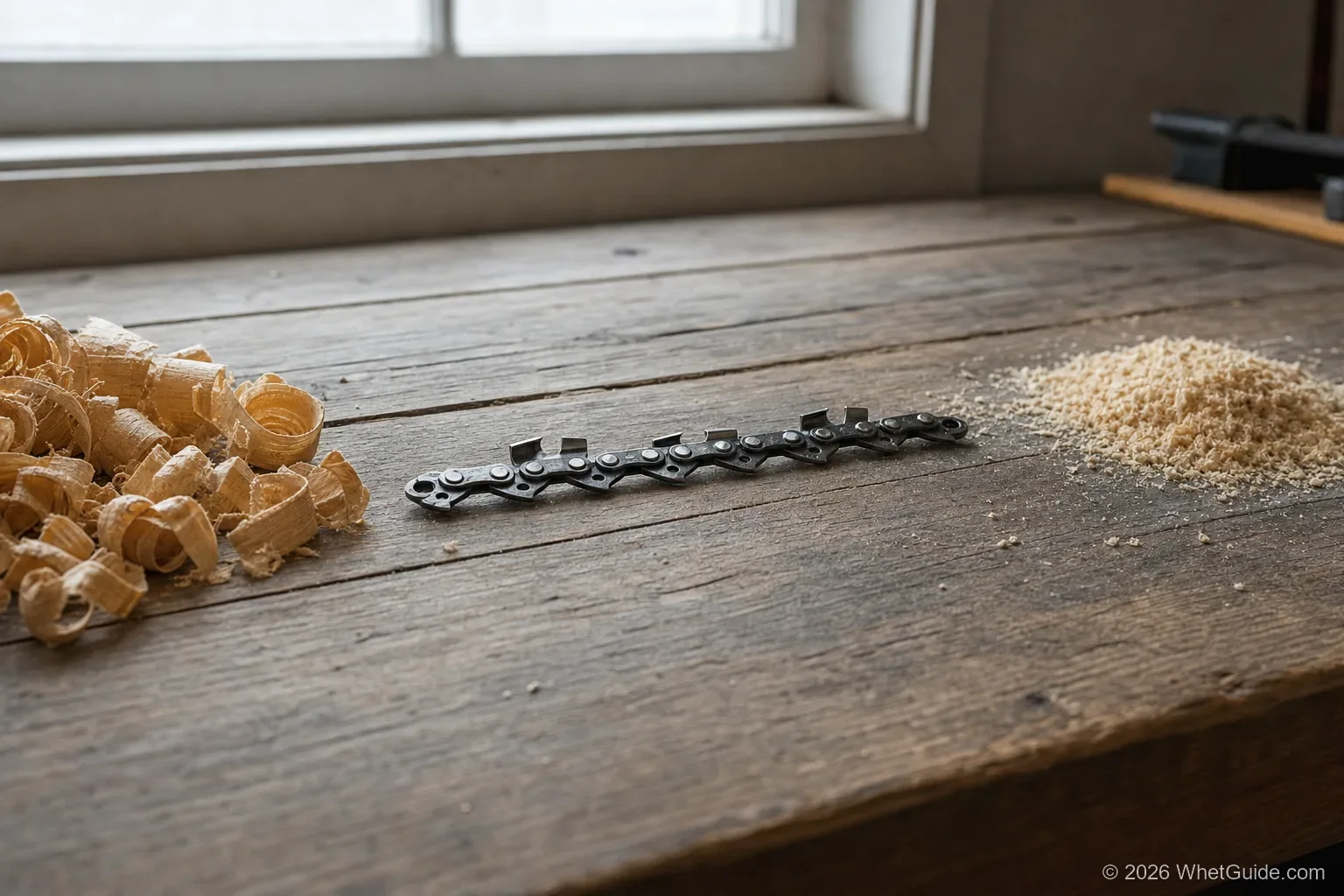
Two of these need a second look before you grab the file. A saw that cuts crooked after you've sharpened it often has longer cutters on one side; Stihl names uneven tooth length as a cause. And a sharp chain that still won't bite often has depth gauges that are too tall, and that one is fixed at the rakers. The troubleshooting table sorts these out.
Oregon's guide says a dull chain raises the risk of kickback. People push harder on a dull saw, and a chain that bounces and chatters is harder to control. Husqvarna adds that hitting stone or soil dulls a chain at once, so sharpen right away rather than finishing the cut.
Tools you need (and what you can skip)
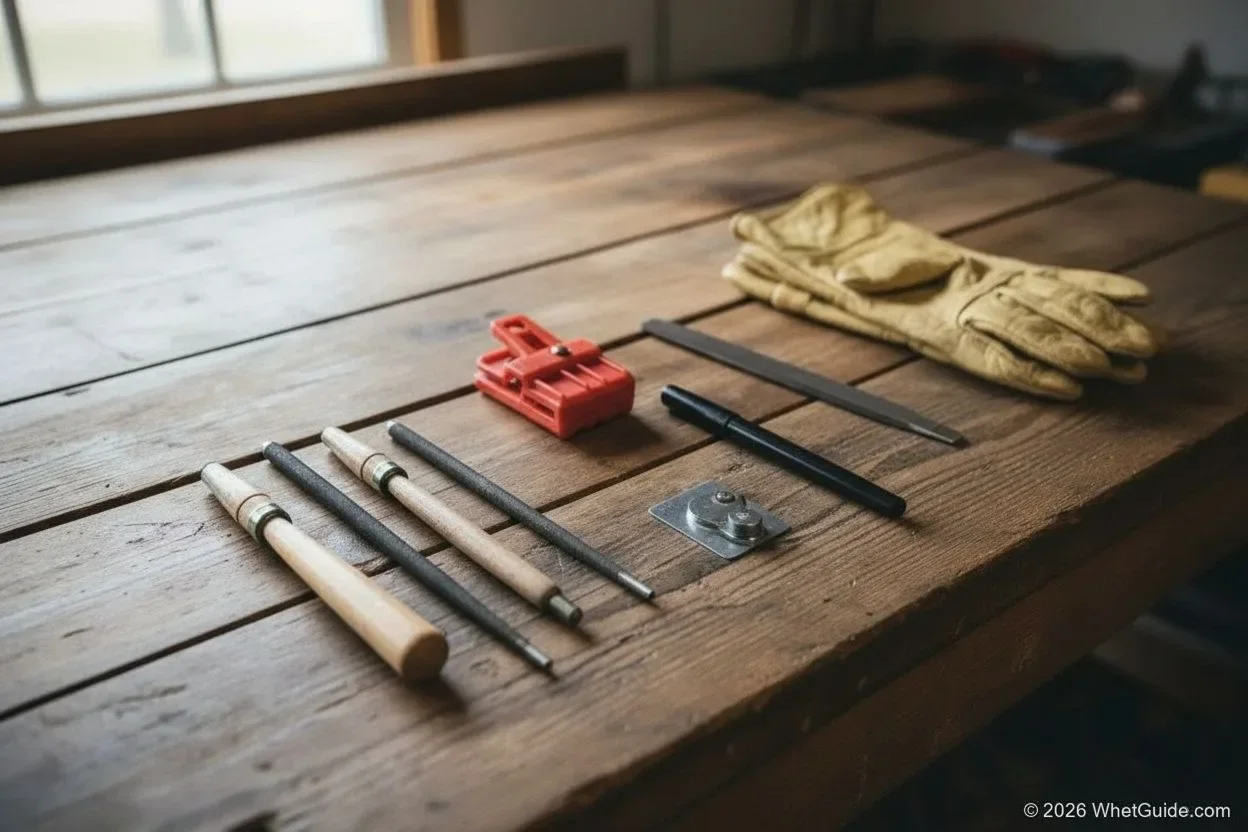
Hand filing needs very little. The round file and guide do the cutting. The rakers need a flat file and a gauge tool, and a vise frees both hands for the file. Products are named in plain text so you know what to ask for at the counter.
| Tool | Why | Need it? |
|---|---|---|
| Round chainsaw file in your chain's size | Sharpens the top plate and side plate in one stroke. Size matched to pitch (see file size). Buy two or three; they wear. | Yes |
| File guide (clip-on or roller type) | Holds the file at the right height and shows the angle lines. Oregon's guide contacts the top plate at one point and the depth gauge at two. | Yes, unless you've filed for years |
| File handle | Something to push on. Bare tangs cut palms. | Yes |
| Flat file | Takes the depth gauges down. | Yes |
| Depth gauge tool | A steel template with a slot. Sits on two cutters; the raker pokes through if it's too tall. Some have soft and hard wood settings (Husqvarna). | Yes |
| 2-in-1 file guide | Holds a round file and a flat file together, so the rakers get a touch on every pass. Stihl's guide describes one. | Optional |
| Bench vise or stump vise | Holds the bar so both hands are on the file. | Strongly recommended |
| Felt-tip pen or paint marker | Marks the starting cutter. | Yes |
| Gloves and safety glasses | ECHO's minimum for the job. Cutters are sharp even when dull. | Yes |
| Small brush, rag, bar groove cleaner | Clears filings and packed sawdust before and after. | Yes |
| Bar and chain oil | Goes back on the clean chain. | Yes |
| Electric chain grinder, 12 V or 120 V | For square chisel chain, heavy rock damage, or a pile of chains. | Optional |
| Bar-mounted sharpener | Clamps to the bar and steers the file along a set path. | Optional |
| Rotary tool with a chain grinding stone | Fast, but easy to overdo. WEN is one brand that sells a sharpening kit for it. | Skip unless you know it |
If you buy one thing beyond the round file, make it the guide. Freehand filing is a skill that takes a while to learn. The guide holds the file height for you, and file height is the error you can't see. Oregon's guide sets the file so a fifth of its diameter stays above the top plate.
↑ Back to all sectionsSafety: brake, gloves, clamp
Family Handyman's guide has a line worth keeping in mind: "Sharpening the chainsaw chain is the safest part of the very dangerous task of running a chainsaw." It's safe as long as the engine can't start and the bar can't move.
- Engine off and cool. ECHO says to let the saw cool down before you touch the chain.
- Kill the power for good. On a gas saw, ECHO says to disconnect the spark plug lead. On a battery saw, take the battery out. A corded saw gets unplugged.
- Gloves and safety glasses. ECHO calls these the minimum. Filings fly, and a cutter can open a knuckle even when it's too dull to cut wood.
- Chain brake on. Oregon's method is to engage the brake, clamp the bar, then release the brake only when you need to advance the chain by hand.
- Clamp the bar lightly in a vise, near the middle, with the chain clear of the jaws. Oregon says lightly, because the chain has to stay free to advance.
- Snug the chain a little. Husqvarna's Chainsaw Academy says to keep the chain tighter than you would for cutting while you file, so it doesn't rock under the file. Loosen it back to normal tension before you run the saw.
- Keep the flat file away from cutters you've just sharpened. Stihl warns about it, because one careless swipe across a fresh top plate undoes the work. Held flat, the depth gauge tool covers the cutters.
Know your chain: pitch and gauge
Before you can pick a file, you need the pitch. Pitch is the spacing of the chain: the distance between any three rivets in a row, divided by two. The easiest place to find it is the chain's box or your saw's manual. Bob Vila's guide says it flatly: "Always check your user manual to be certain that you are using the correct file." The next easiest is the code stamped on the drive links, which Oregon prints on its chain, and which a parts counter can look up. If the box is gone and the stamp has worn off, measure it. UGA Extension's circular gives the method: "measure any three consecutive rivets in the saw chain from center to center in 1/16-in. increments," then halve the result.
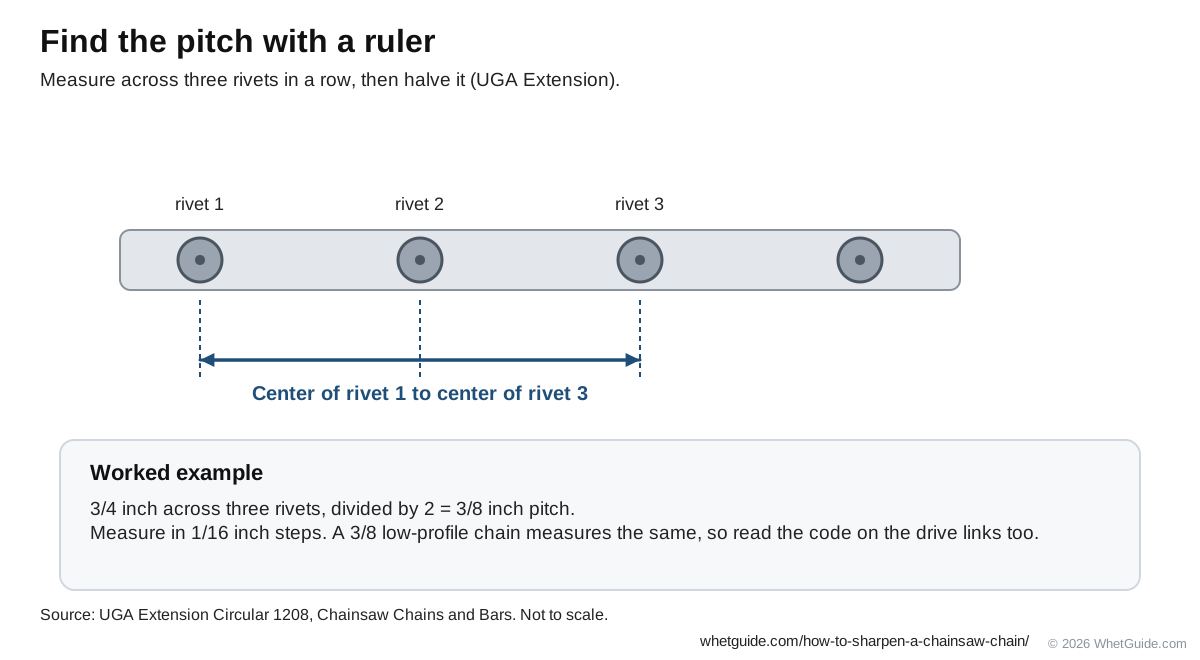
A ruler can't tell standard 3/8 chain from 3/8 low profile, because both have the same spacing. They take different files, though, so this is where the drive link code or the box earns its keep. Husqvarna lists the common pitches as 1/4, 1/4 mini, .325, .325 mini, 3/8, 3/8 mini and .404.
Gauge: the other number
Gauge is the thickness of the drive links where they ride in the bar groove. Husqvarna lists four: .043, .050, .058 and .063 inch. It doesn't change how you sharpen, but you need it when you buy a new chain. Husqvarna's chain size article is blunt about it: "The chain gauge must match the guide bar groove." And: "A chain that is too thin may fit loosely and operate unsafely." So a .043 chain doesn't belong on a .050 bar. Check the bar or the old chain's box for yours.
| Number | What it is | Where to find it | What it decides |
|---|---|---|---|
| Pitch | Rivet spacing: three rivets divided by two | Chain box, manual, drive link code, or a ruler | File size; the sprocket and bar it fits |
| Gauge | Drive link thickness | Stamped on the bar; chain box | Which chain fits the bar groove |
| Depth gauge setting | How far the raker sits below the top plate | Stamped on Oregon cutters' depth gauges (Madsen's); chain box | Which depth gauge tool to use |
File size by chain pitch
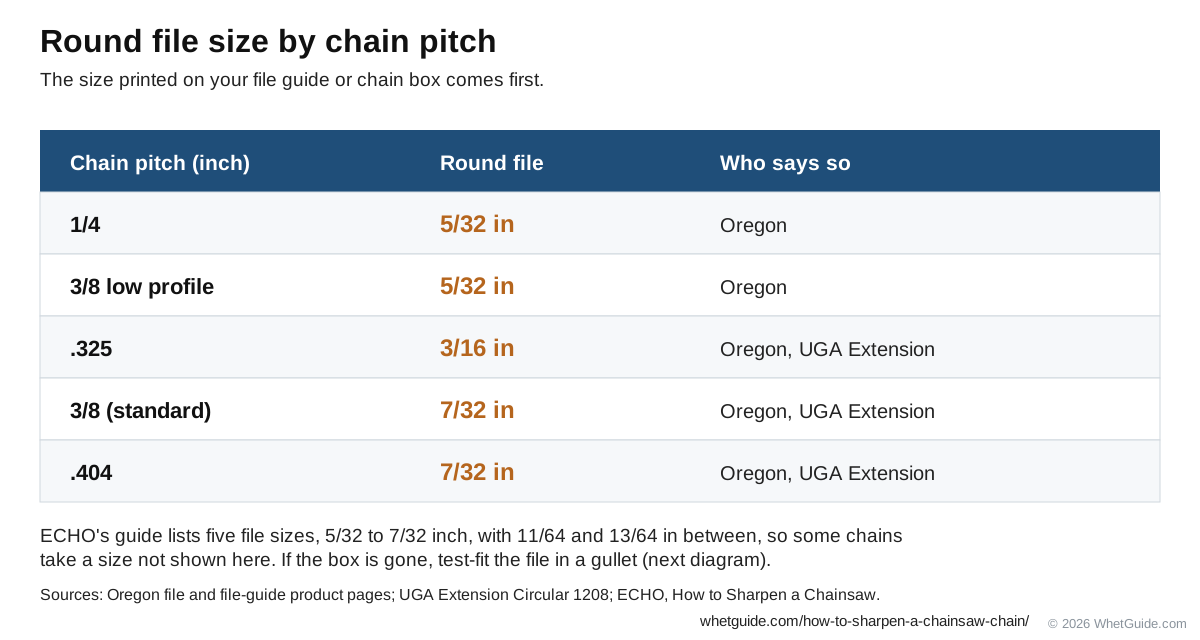
The round file has to match the gullet, or you'll file the cutter at the wrong height no matter how good your angle is. Here are the sizes where Oregon's own file and file-guide listings and UGA Extension's table line up:
| Chain pitch | Round file | Source |
|---|---|---|
| 1/4 in | 5/32 in | Oregon |
| 3/8 in low profile | 5/32 in | Oregon |
| .325 in | 3/16 in | Oregon, UGA Extension |
| 3/8 in (standard) | 7/32 in | Oregon, UGA Extension |
| .404 in | 7/32 in | Oregon, UGA Extension |
Those five cover most saws, but not every chain. ECHO's guide lists five round file sizes: 5/32, 11/64, 3/16, 13/64 and 7/32 inch. If your box calls for 13/64, buy 13/64. Shop by the inch size; retailer charts don't agree on the metric equivalents.
No box? Test-fit the file
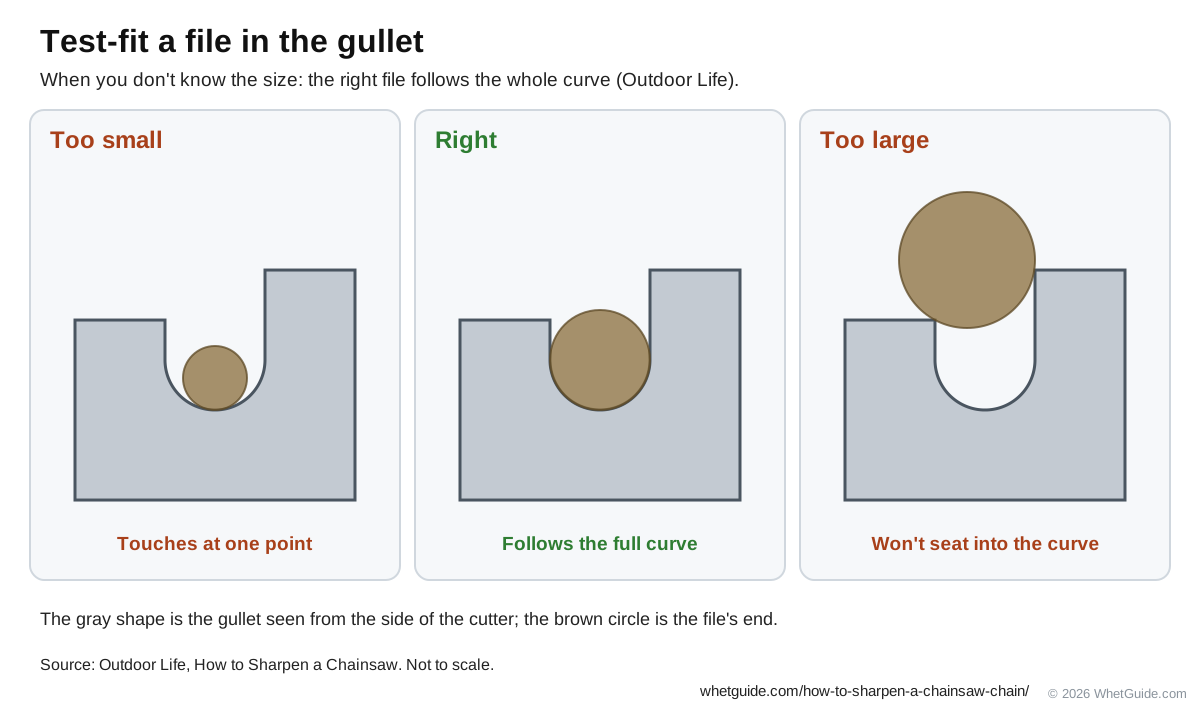
Outdoor Life's guide has the best trick for a chain of unknown size. Set the file in a gullet and look at it from the side. The right file touches the full curve. If it touches at one point, it's too small. If it touches only at the top and bottom, or won't seat into the curve at all, it's too large. Try the next size until it sits snug in the curve.
Look after the file
- Rotate it a little as you work so it wears evenly. Stihl's guide says to, and it's common advice on arborist forums too.
- Replace it when it skates instead of biting. A worn file cuts slowly and leaves a ragged edge.
Angles and file height: where the file sits
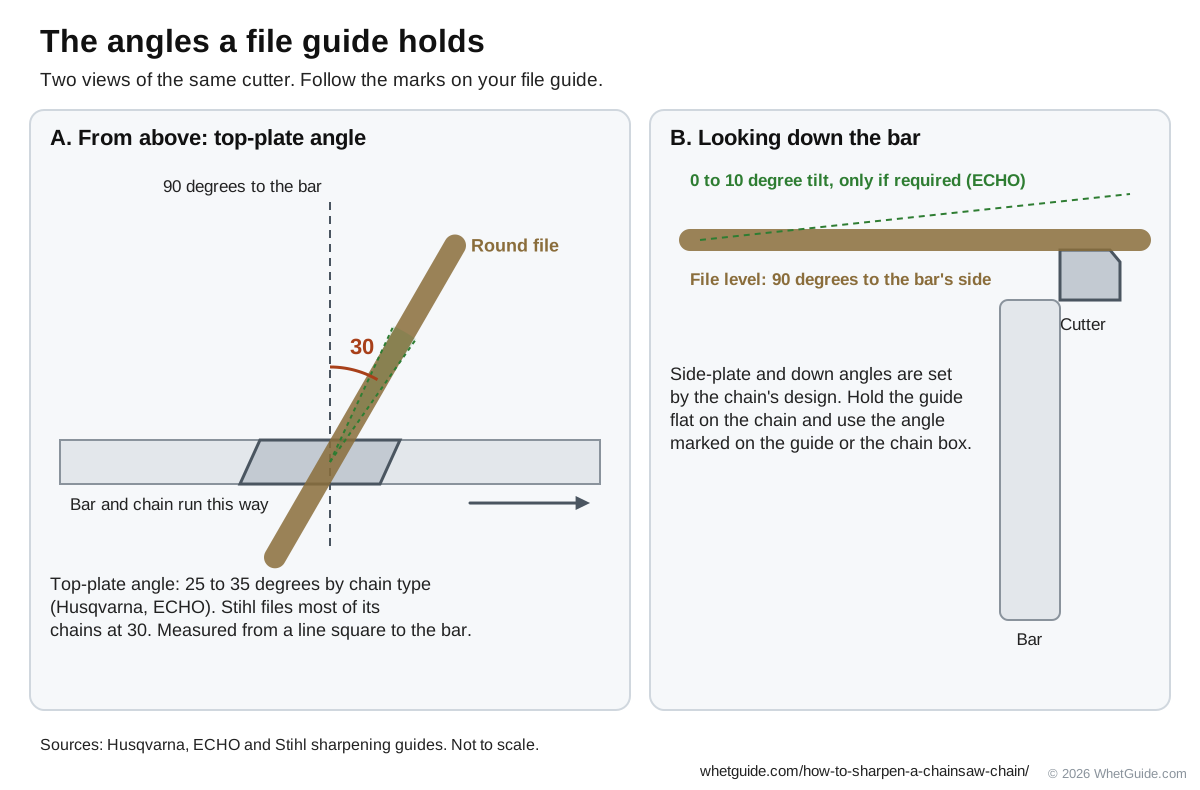
Three things about the file's position decide the edge: two angles and a height. The top-plate angle is the one printed on file guides. Look down on the chain and imagine a line square across the bar; the file crosses that line at the top-plate angle. Husqvarna's Chainsaw Academy puts it at 25 to 35 degrees depending on chain type, and ECHO gives the same range. Stihl's guide says its chains are generally filed at 30. Your guide or chain box tells you which number your chain wants, and most guides have lines for it scribed on top. The vertical angle is about how you hold the file seen from the end of the bar. Both Husqvarna and Stihl say to hold it at 90 degrees to the bar, which means level when the bar is level in the vise. ECHO allows a tilt of 0 to 10 degrees "if required" by the chain. Unless your chain's instructions call for a tilt, hold the file level.
File height: the setting you can't see
The file has to sit at the right height in the gullet, with a sliver of it above the top plate. Oregon says about 1/5 (20 percent) of the file's diameter should be above the top plate. Stihl's guide says about a quarter. On a 5/32 inch file the two differ by less than a hundredth of an inch, and a guide holds it for you.
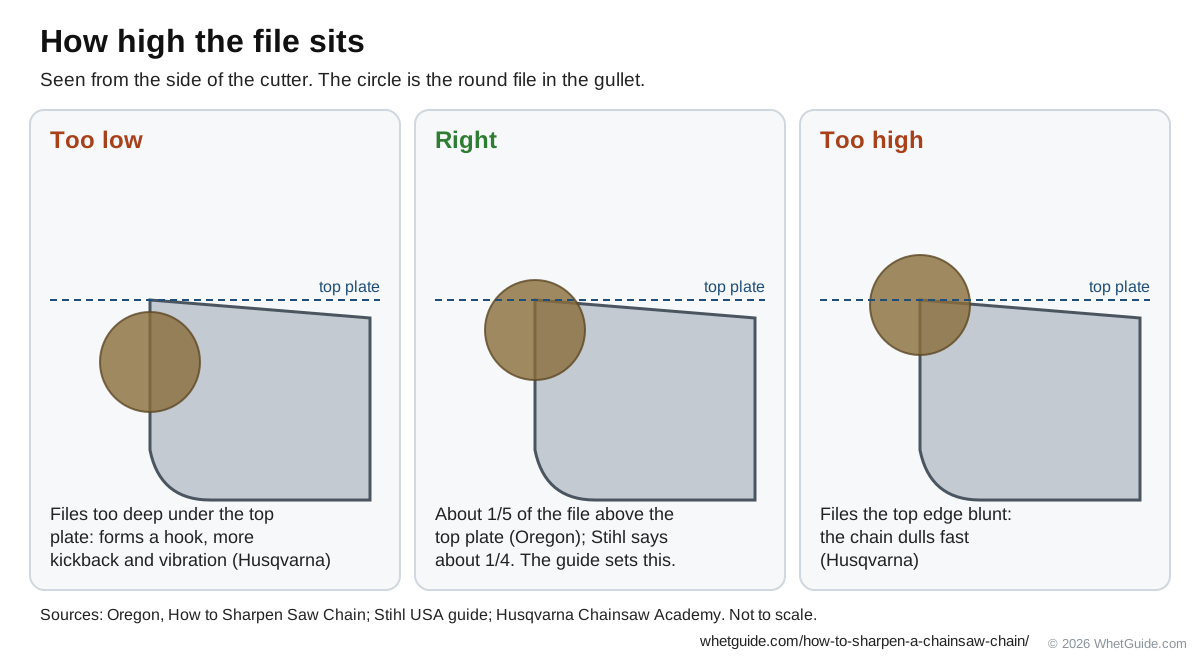
Husqvarna's Chainsaw Academy names both ways it goes wrong. "Avoid filing too high," it says, because that dulls the edge; and avoid filing too deep, "which will produce a 'hook'". A hooked cutter grabs. Husqvarna ties it to more kickback and more vibration. A cutter filed too high is left with a blunt top edge that dulls fast.
| Setting | Typical value | Who says | How you hold it |
|---|---|---|---|
| Top-plate angle | 25 to 35°; 30° on most Stihl chain | Husqvarna, ECHO, Stihl | Line the guide's marks up with the bar |
| Vertical angle | 90° to the bar (level) | Husqvarna, Stihl | File level; 0 to 10° tilt only if the chain calls for it (ECHO) |
| File height | 1/5 to 1/4 of the file above the top plate | Oregon (1/5), Stihl (1/4) | The file guide sets it |
| Side plate and down angle | Set by the chain's design | Chain maker | Right file size, right height, guide flat on the chain |
Step by step with a round file and guide
1. Mark where you start
Stihl's guide starts with a "master tooth": pick one cutter and mark it with a pen. Outdoor Life offers a second option. Many chains have a natural starting point, a spot where two cutters in a row face the same way, or a colored link. Either works. What you need is a way to know when you've gone all the way around. Some people start with the shortest cutter on the chain instead, so every other cutter gets filed to match it. That's the right move on a chain that's been hit or filed unevenly before. On a chain that's only dull and was filed evenly last time, the master tooth is enough.
| Date | Strokes per cutter | Rakers checked? | Sharpening no. |
|---|---|---|---|
| ☐ | |||
| ☐ | |||
| ☐ | |||
| ☐ |
2. Set the file and make the stroke
- Seat the file in the gullet of the master tooth, with the guide resting flat on top of the cutter and its depth gauge.
- Line the angle marks on the guide up with the bar.
- Push the file forward, from the inside of the cutter toward the outside, in one full-length, even stroke. Oregon files inside to outside.
- Lift the file off on the way back. Stihl says to file on forward strokes only, and Outdoor Life gives the reason: files cut only on the push. Dragging it back dulls the file.
- Count. Oregon's instruction is to make "full-length even strokes until the face is shiny and silver," then use the same number on every cutter.
How many strokes? Outdoor Life and Family Handyman both say about three per cutter on a chain that's dull but undamaged. More if it's very dull. If the first cutter needs eight strokes to come up bright, every cutter on that side gets eight. Use light, steady pressure, which is common advice on arborist forums.
3. Check each cutter before you move on
Two more checks tell you a cutter is done. Look straight at the cutting edge under good light. Stihl's guide notes that a dull edge reflects light; when no bright line shows along the top plate and side plate, it's sharp. Then feel for the burr. Outdoor Life says a small burr along the top and outside of the cutter confirms you've filed the full cutting surface.
4. Advance the chain, then turn the saw
Release the brake, pull the chain forward by hand to bring the next cutter on the same side into position, set the brake again if your vise lets the chain creep, and repeat. Husqvarna's support article says to file every second tooth, with an even, pushing stroke. Keep going until the master tooth comes back around, then turn the saw around in the vise. Oregon finishes one side before turning, and Husqvarna's support article says to file the rest from the opposite direction. Use the same angle mark (it's mirrored now) and the same stroke count. Look closely at the cutter length on this side as you go.
5. Even them up
When you're back at the master tooth, look along the chain. The cutters should be the same length, side to side and front to back. If one is clearly shorter, from a rock or an earlier bad filing, the others have to come down to it. Stihl lists uneven tooth length on one side as a cause of a saw that pulls or cuts crooked, and that's what you're preventing here.
↑ Back to all sectionsSetting the depth gauges (rakers)
Every cutter has a depth gauge in front of it, and the gap between the top of the gauge and the top plate decides how thick a chip that cutter can take. Each time you file a cutter, it gets a little shorter and its top plate drops a little lower, because the top plate slopes down toward the heel. The gauge doesn't change. So after a few sharpenings the gap shrinks, and the chain takes thinner and thinner bites until it barely cuts, even with fresh edges. Stihl's guide makes the point directly: sharpening shortens the cutters, so the depth gauges often need adjusting.
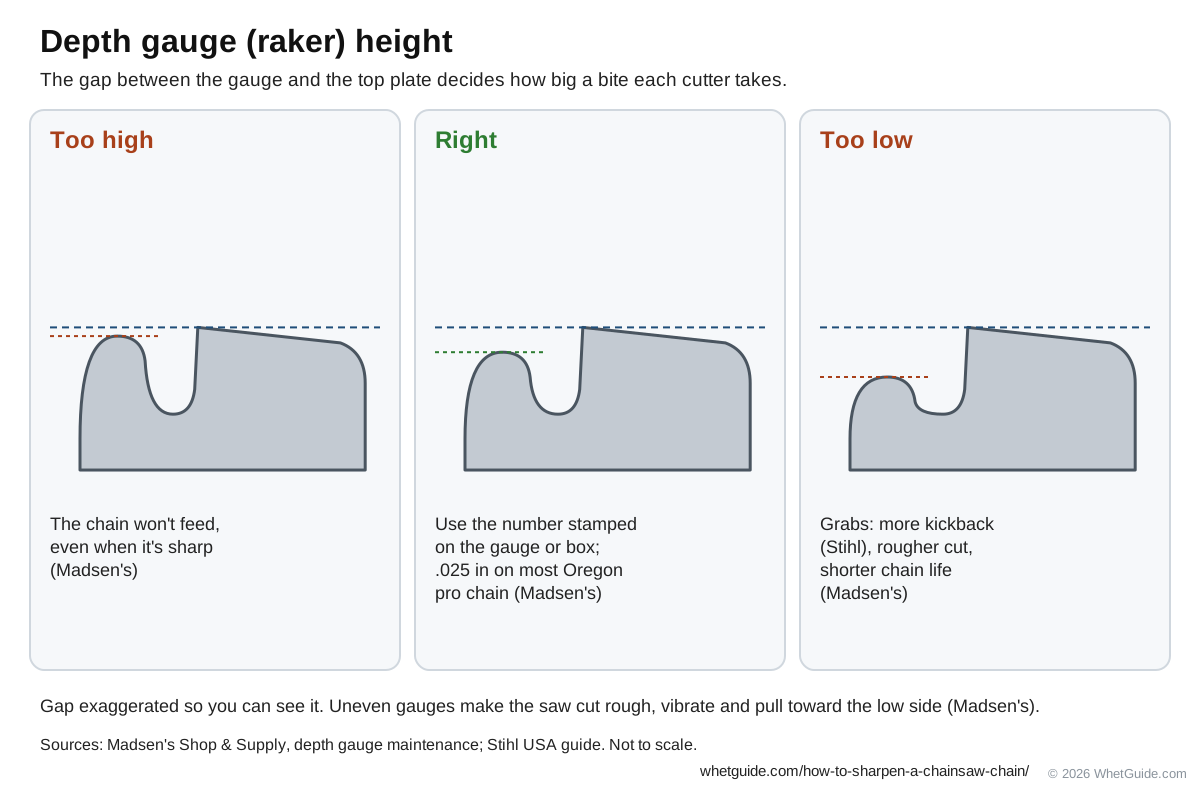
Madsen's, a chain supplier in Washington, has the clearest explanation of what goes wrong on each side. With gauges too high, "the chain will not feed, even when it's sharp." With gauges too low, the chain cuts more aggressively for a while, but you get shorter chain life, a rougher cut, more fatigue for the person running the saw and a higher risk of kickback. Stihl says the same about the last one: "If the depth gauge is too low, it will increase your chainsaw's kickback." Uneven gauges make the chain cut rough and vibrate, Madsen's adds, and the saw pulls toward the low side.
How low?
Use the number for your chain. Madsen's says .025 inch is correct for most Oregon professional chain, and points out that Oregon stamps the value on the depth gauge of its cutters. Depth gauge tools are sold by that number, and some have two settings. Husqvarna's tool has a "Soft" slot for softwood and a "Hard" one for hardwood. If your chain's box gives a different figure, go with the box.
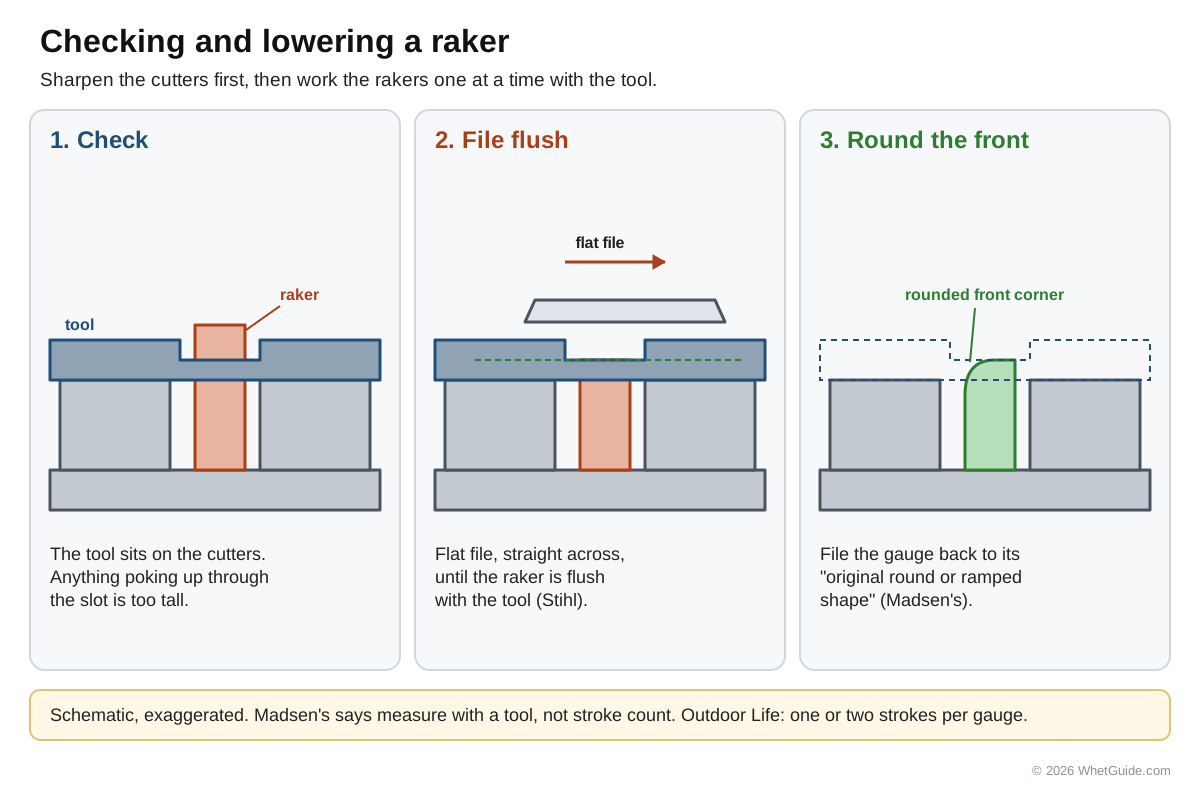
Filing them
- Sharpen all the cutters first. The gauge setting is measured against the filed top plate.
- Lay the depth gauge tool on the chain so the slot sits over a raker. Stihl calls it the filing gauge.
- If the raker sticks up through the slot, file it with a flat file, straight across, until it's flush with the tool. Stihl says to file until flush. Outdoor Life says one or two strokes per gauge is usually all it takes.
- Don't count strokes as a substitute for checking. Madsen's says to measure with a tool rather than going by stroke count.
- Round off the front. Madsen's says to file the gauge back to its "original round or ramped shape."
- Move the tool to the next raker and repeat, all the way around.
On chains with humped drive links, Stihl says the humps are worked at the same time as the depth gauges. Take them down only to the tool, like the gauges.
The two Husqvarna figures come from different pages: its support article says every third or fifth filing, assuming normal wear, and its Chainsaw Academy matches ECHO at three to four. The tool goes on the chain every time; the flat file comes out only for the gauges that show through it.
↑ Back to all sectionsElectric grinders and bar-mounted sharpeners
A file and guide handles routine sharpening on chisel and semi-chisel chain. Machines make sense in three cases: square chisel chain, which UGA Extension calls hard to hand file; chain with rock damage that would take a long time to file out; and a stack of chains to do at once.
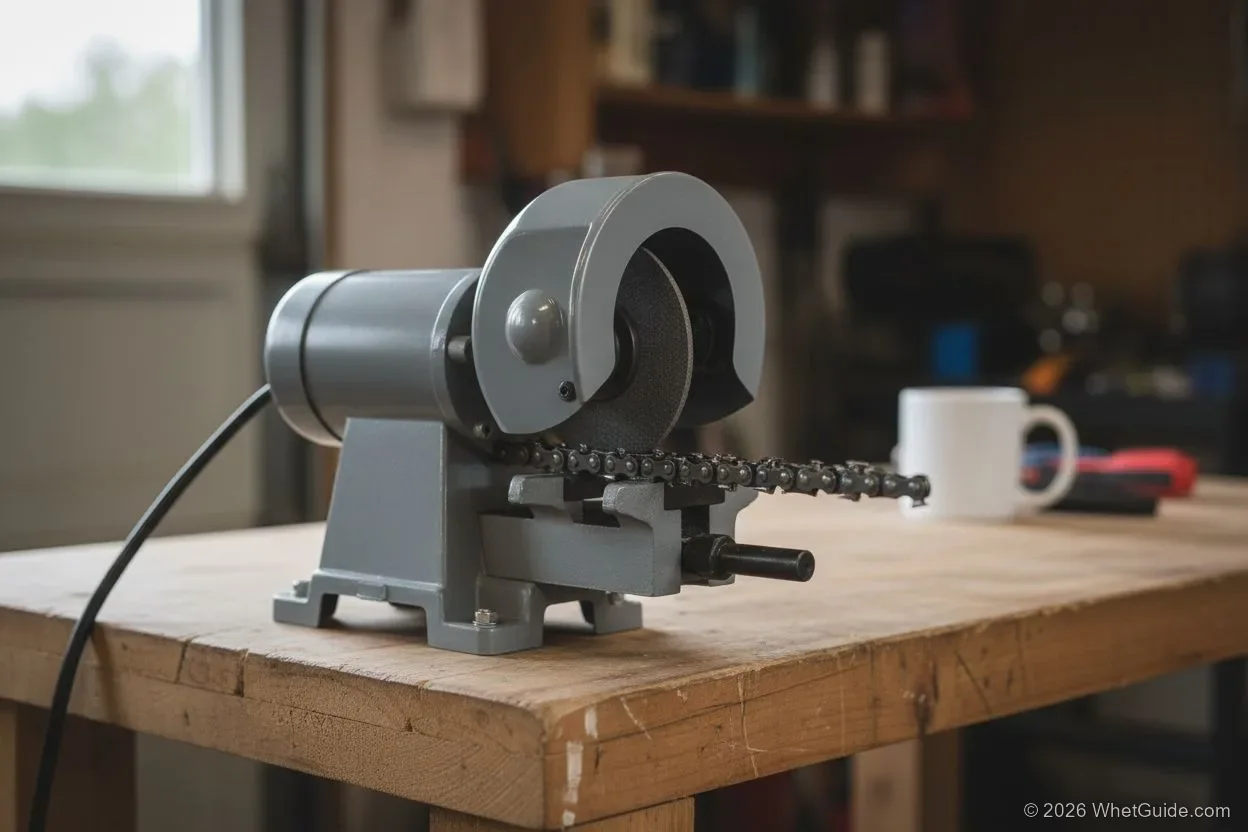
Bench chain grinders clamp the chain in a vise, with the angle set on a dial and a depth stop that limits how far the wheel drops into the gullet. Oregon's guide has a section on electric sharpeners. Its key instruction is to grind each cutter with a quick tapping motion rather than holding the wheel against the steel, and it covers dressing the wheel, which restores the wheel's edge profile. A wheel with the wrong profile does the same damage as a wrong-size file.
Our guide to knives on a bench grinder covers wheel heat in more detail. Grind each cutter in short touches and let it cool if it gets warm. Arborist forum regulars also argue that ground chains wear out sooner than hand-filed ones. Nobody has measured it, but it's a fair reason to use the lightest touch that cleans the edge.
| Method | Good for | Watch for |
|---|---|---|
| Round file and clip-on guide | Chisel and semi-chisel chain; routine touch-ups; the field | Even strokes, file height, worn files |
| Bar-mounted sharpener | Clamps to the bar and carries the file along a fixed path. Angle and height stay put. | Setup for your pitch and angle; even stroke counts |
| Bench chain grinder | Square chisel chain, heavy damage, many chains | Heat; wheel profile and dressing; taking too much steel |
| Rotary tool with a stone | Quick work by someone who's done it before | No guide for height; easy to overheat or grind too deep |
| Shop service | Square chisel chain, badly damaged chain, no time | Ask whether they set the depth gauges too |
Ripping chain and specialty chains
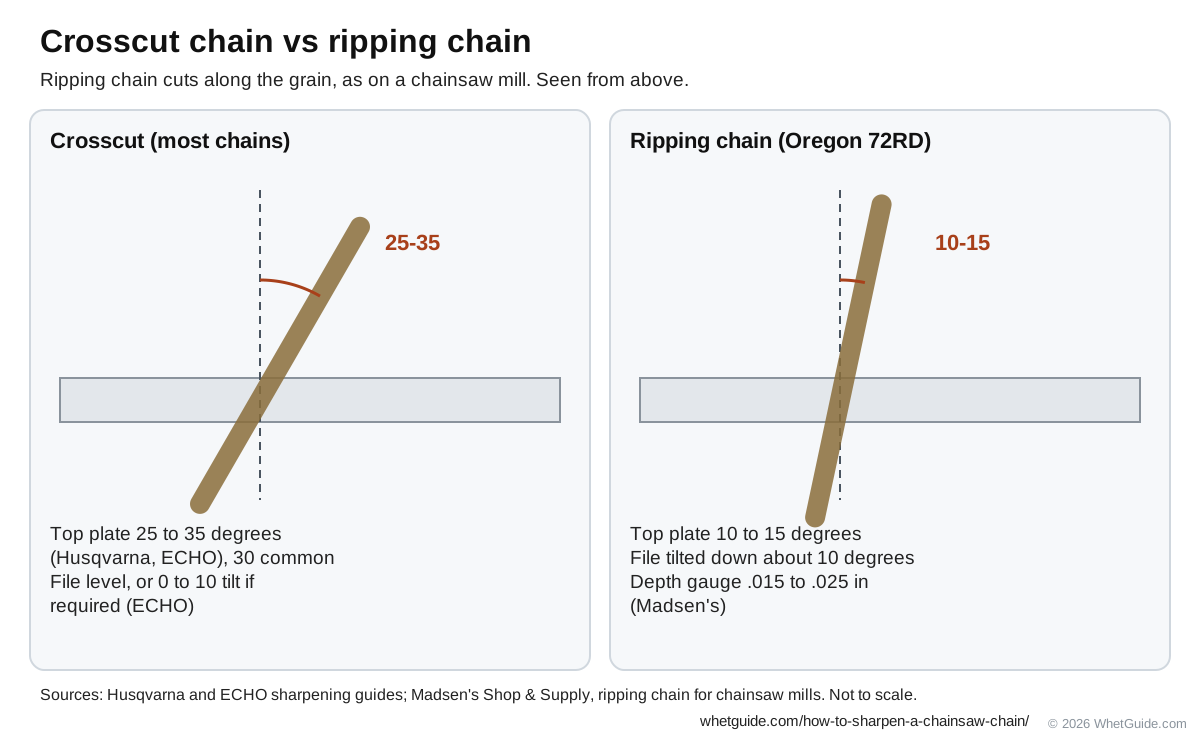
Ripping chain is made for cutting along the grain, mostly on chainsaw mills that turn logs into boards. The angles are different from the crosscut chain this page is about. Madsen's gives its numbers for Oregon's 72RD ripping chain: "the top-plate filing angle should be 10°- 15°," with the file tilted down about 10 degrees, and depth gauges at .015 to .025 inch. The low end of that gauge range gives a smoother finish on the boards. Read the box before you sharpen any specialty chain. Ripping chain filed at crosscut angles, or crosscut chain filed flat like ripping chain, won't cut the way it was designed to.
↑ Back to all sectionsSharpening in the field
You don't need a bench. Husqvarna's Chainsaw Academy shows a filing vise that you drive into a stump with an axe or a breaking bar, which holds the bar steady at a comfortable height. Keep the chain a little tighter than for cutting while you file, the Academy says, so it doesn't move under the file, then set it back to running tension before you start the saw.
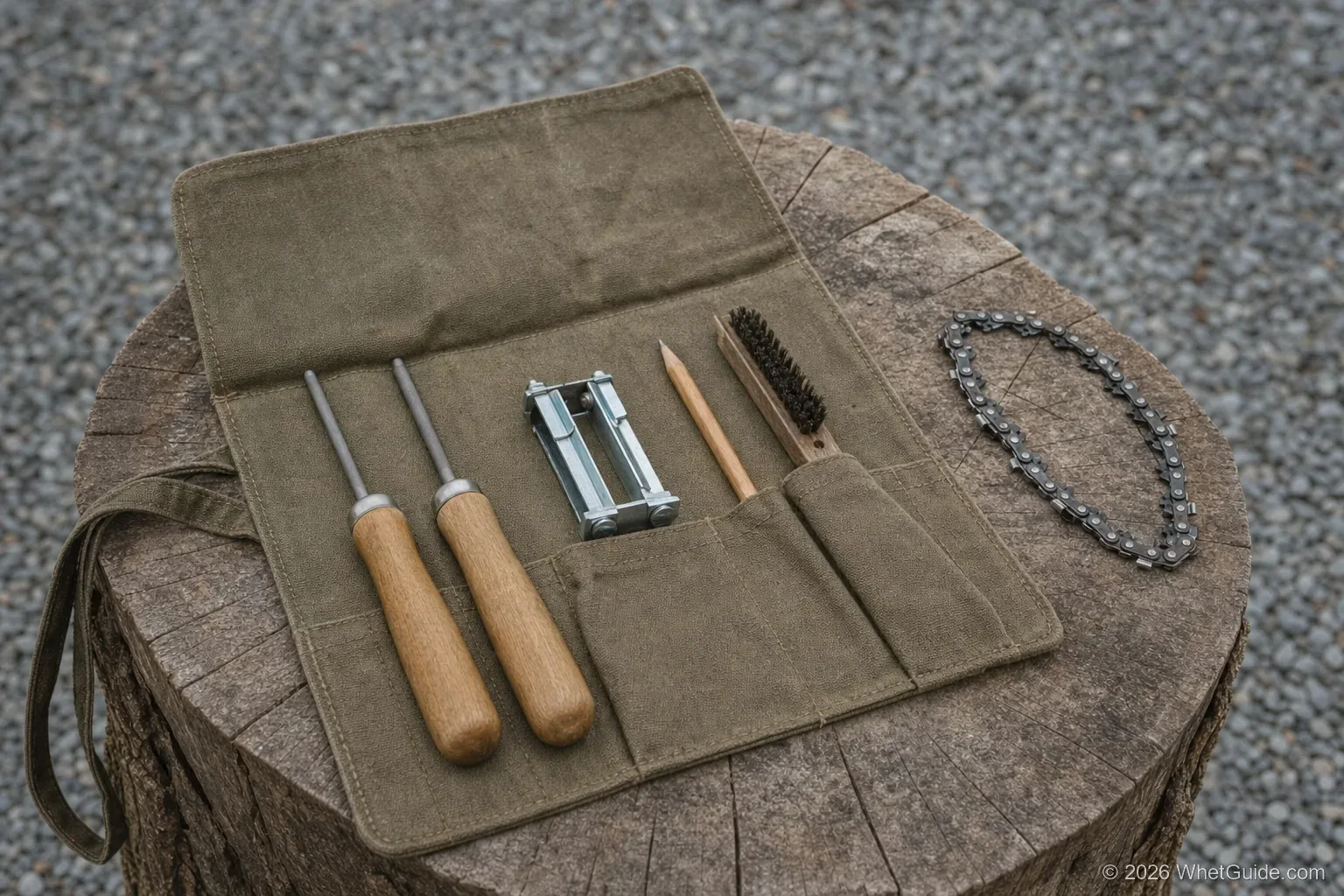
The field is where chains get ruined, so this is also where a touch-up pays off most. Husqvarna says cutting stone or soil dulls a chain, and to sharpen it right away. Family Handyman's advice is simpler: keep the chain out of the dirt. Cut logs on a buck or a block where you can, and roll the log rather than cutting down into the ground. If the chain does hit dirt, a few strokes per cutter on the stump beats finishing the job with a dull chain. The field kit is the bench kit minus the vise:
- Two round files in your size. One will wear out or snap.
- The file guide and a file handle.
- A flat file and the depth gauge tool.
- A marker for the master tooth.
- A small brush for sawdust packed into the gullets.
- Gloves. Oregon's touch-up at every refuel is easiest when the kit rides in the same box as the fuel and bar oil.
After filing: clean the chain, look after the bar
Pitch and packed sawdust hide damage and gum up the file. Clean the chain before you sharpen if it's dirty, and always after. Bob Vila's guide uses a towel, a screwdriver to clear the bar groove, and mineral spirits if the gunk won't come off. For stubborn resin, Stihl's cleaning advice is a resin solvent, with the chain and bar taken off the saw first and the chain sprayed with care oil afterward.
Before you run the saw, oil the chain and set the tension back to normal. ECHO's guide says a correctly tensioned chain pulls away from the bar rail "a little less than 1/4 inch." Don't leave it slack. Husqvarna's Chainsaw Academy warns that a slack chain can jump off the bar. A brand-new chain needs a second look: UGA Extension says to run it for 2 to 3 minutes, then recheck the tension. For storage, Oregon suggests keeping a spare chain in a container with lubricant so it doesn't rust.
How often to sharpen a chainsaw chain
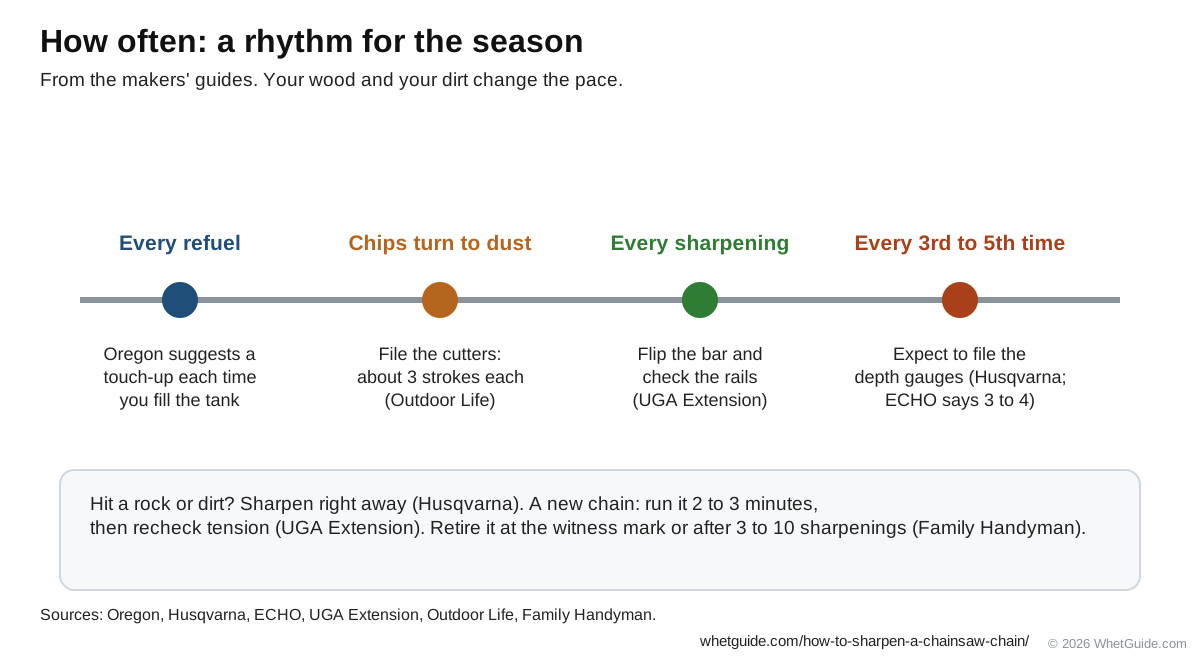
Let the chips set the schedule. When a cut that used to throw thick curls throws dust, sharpen. Oregon's guide suggests a touch-up each time you refuel, which is a good habit for anyone cutting firewood for a day. Husqvarna adds the exception: if the chain touches stone or soil, sharpen it right away. My preference is the refuel habit. A stroke or two each time means you're always filing a chain that's close to sharp, and a chain that's close to sharp is easier to keep even.
| When | What | Source |
|---|---|---|
| Each refuel | A quick touch-up: a stroke or two per cutter | Oregon |
| Chips turn to dust, or you're pushing | A full sharpening, about 3 strokes per cutter on a dull chain | Stihl, ECHO; Outdoor Life and Family Handyman for the strokes |
| After hitting stone or soil | Sharpen immediately | Husqvarna |
| Every sharpening | Flip the bar, check the rails | UGA Extension |
| Every 3rd to 5th sharpening | Expect to file the depth gauges (check them with the tool every time) | Husqvarna; ECHO says every 3 to 4 |
| New chain | Run 2 to 3 minutes, recheck tension | UGA Extension |
Sharpen or replace?
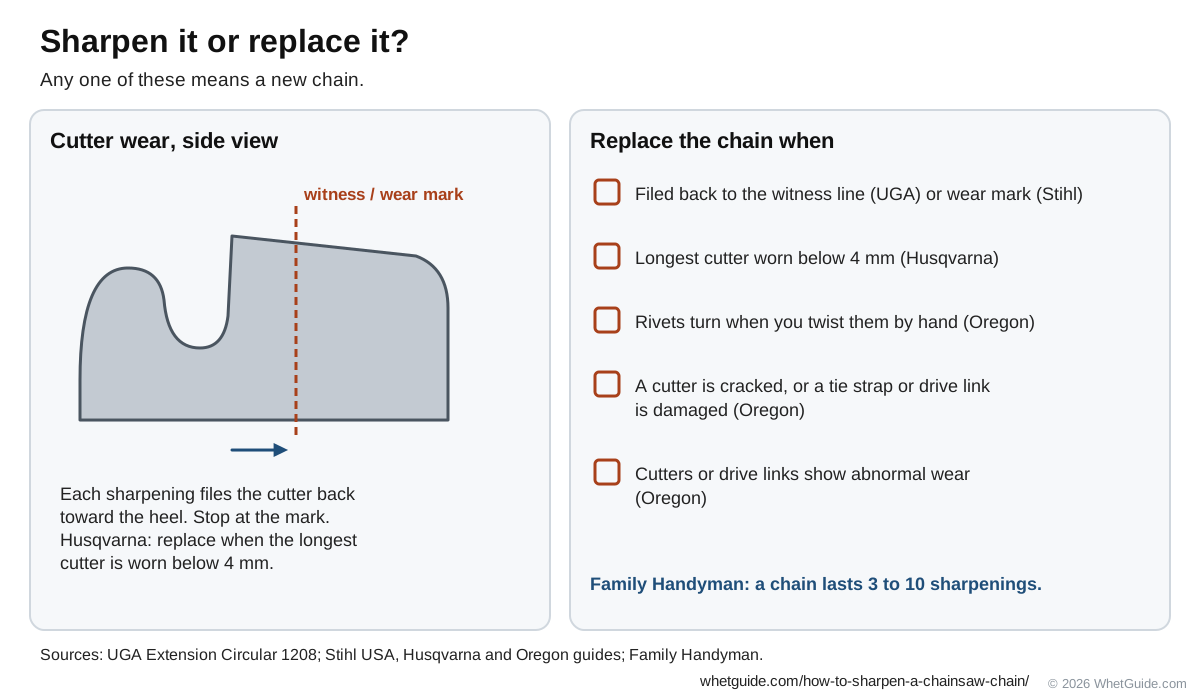
A chain has a set amount of cutter to file away, and every sharpening uses some. Family Handyman puts a typical chain at 3 to 10 sharpenings. How many you get depends on how much each one takes off, which is the best argument for frequent light touch-ups over occasional heavy ones.
The limits come from the makers and from UGA Extension:
- The witness mark. UGA Extension: "The chain must be replaced when filed to the witness line." Stihl calls it the wear marking.
- Husqvarna's Chainsaw Academy gives a measurement: replace the chain when the longest cutter is worn below 4 mm.
- Loose rivets. Oregon's test is to try rotating the rivets with your fingers. If they turn, the chain is too loose and should be replaced.
- Cracked cutters, or damaged tie straps or drive links. Oregon lists these in its inspection, along with any abnormal wear.
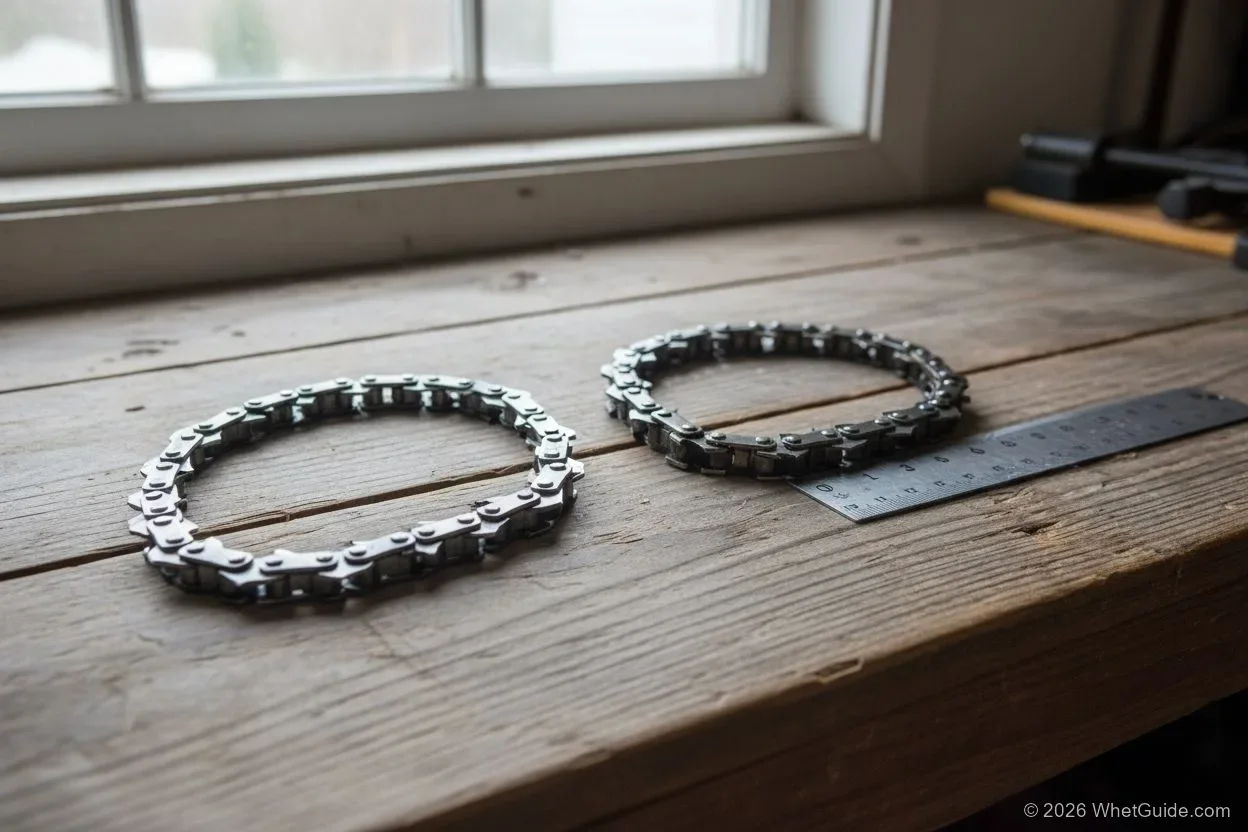
Drive links are the part people forget to look at, since they sit under the chain. With the chain off and gloves on, look along the tangs: a bent or chipped one means a new chain, however much cutter is left (Oregon lists damaged drive links in its inspection).
↑ Back to all sectionsSharpened it, and it still won't cut right?
Most problems after a sharpening trace back to the depth gauges or to cutters that don't match. Find your symptom here.
| Symptom | Likely cause | Fix |
|---|---|---|
| Sharp edges, still makes dust and won't pull in | Depth gauges too high. Madsen's: "the chain will not feed, even when it's sharp." | Gauge tool and flat file; round the fronts. |
| Pulls to one side or cuts crooked | Cutters on one side longer (Stihl), or uneven depth gauges (Madsen's) | File all cutters to the shortest; check the gauges. |
| Grabs, kicks or vibrates hard | Depth gauges too low (Stihl, Madsen's), or cutters filed too deep into a hook (Husqvarna) | Gauges can't be raised; if they're far too low, replace the chain. Refile at the right height. |
| Dulls again within minutes | Filed too high, leaving a blunt edge (Husqvarna); or the chain touched dirt or stone | Use the guide for height; keep the chain out of the dirt. |
| Chatters and bounces | Dull or uneven cutters (Stihl) | Sharpen, then check that every cutter matches. |
| Smokes | Dull chain (Stihl) | Sharpen. |
| File skates without cutting | Worn file, or you're dragging it backward | New file; lift it on the return stroke (Stihl). |
Worked examples: seven chains on the bench
| The chain in front of you | What you see | What to do |
|---|---|---|
| Battery saw, 3/8 low-profile chain, dust after an afternoon of firewood | Corners slightly rounded; cutters all about the same length | Battery out (ECHO). 5/32 file (Oregon). About 3 push strokes per cutter (Outdoor Life, Family Handyman). Check the rakers with the tool. |
| .325 farm saw that touched dirt at the end of a cut | Several cutters dull at once; dust right away | Sharpen now, not after the cut (Husqvarna). 3/16 file. Give the damaged cutters the strokes they need, then bring every cutter down to the shortest (Husqvarna, Stihl). |
| Freshly filed chain that still won't pull into the wood | No bright line on the edges; rakers poke up through the gauge tool | Depth gauges too high (Madsen's). File them to the tool and round the fronts. |
| Saw that cuts in a curve after you filed it yourself | Cutters on one side visibly longer | File the long side down to match (Stihl). Check that the gauges are even (Madsen's). Flip the bar (UGA Extension). |
| Chain that kicks and grabs more than it used to | Rakers well below the gauge tool, or hooked cutter faces | Low gauges raise kickback (Stihl) and can't be built back up. If they're far too low, replace the chain. Refile cutters at guide height (Husqvarna). |
| Old chain near the end of its life | Cutters back to the witness mark; rivets turn under your fingers | Replace it (UGA Extension, Oregon). Filing won't fix either one. |
| Square chisel chain from a pro saw | The box or the cutter shape says square | A grinder or a shop (UGA Extension). A round file is the wrong tool. |
Common mistakes and the fix for each
| Mistake | What happens | Fix |
|---|---|---|
| Wrong file size | The file sits too high or too low in the gullet | Match the pitch; test-fit in the gullet (Outdoor Life). |
| Filing freehand without a guide | File height drifts from cutter to cutter | Use a guide. It holds 1/5 of the file above the top plate (Oregon). |
| Filing too deep | A hooked cutter: more kickback and vibration (Husqvarna) | Keep the guide flat on the cutter; right file size. |
| Filing too high | A blunt edge that dulls fast (Husqvarna) | Same: guide, right size. |
| Sawing back and forth | A dull file and a ragged edge | Push only; lift on the return (Stihl, Outdoor Life). |
| Different stroke counts | Uneven cutters; the saw pulls to one side (Stihl) | Count. Same number on every cutter (Oregon). |
| Skipping the depth gauges | A sharp chain that won't feed (Madsen's) | Check each time; expect to file every 3rd to 5th sharpening (Husqvarna). |
| Filing gauges by guesswork | Too low: kickback (Stihl); uneven: rough cut and pull (Madsen's) | Use the tool, not a stroke count (Madsen's). |
| Flat file across fresh cutters | Ruined top plates | Keep it in the tool's slot (Stihl). |
| Chain loose while filing | The cutter rocks under the file | Snug it a little tighter than running tension (Husqvarna). |
| Leaving it tight afterward, or slack | Slack chain can jump off the bar (Husqvarna) | Reset to running tension (ECHO). |
| Spark plug lead or battery left connected | The saw can start | Lead off or battery out first (ECHO). |
| Grinding with long, heavy passes | Heat and lost steel | Quick tapping motion (Oregon). |
| Filing past the witness mark | A chain past its service life | Replace the chain (UGA Extension). |
The two that cause real harm are the depth gauges filed too low and a hooked cutter, because both make the saw kick. Everything else costs you cutting speed or chain life, and you fix it by filing again properly.
↑ Back to all sectionsShop talk vs what the sources say
| You'll hear | What the sources say |
|---|---|
| "Give the dull cutters a few extra strokes." | Uneven cutters make the saw pull (Stihl). Oregon's rule is the same count on every cutter; if one needs more, the rest come down to match it. |
| "Saw back and forth, it's faster." | Files cut only on the push (Outdoor Life). Stihl says to lift the file on the return. |
| "Take the rakers way down and it'll really cut." | It cuts harder for a while. Madsen's lists the cost: a rougher cut; shorter chain life; more fatigue; more kickback, which Stihl also warns about. |
| "Rakers never need touching." | Sharpening shortens the cutters, so the gauges need adjusting (Stihl). Husqvarna says about every third to fifth sharpening. |
| "Any round file will do." | File size goes with pitch (Oregon, UGA Extension). The wrong size sits at the wrong height, which leaves a hook or a blunt edge (Husqvarna). |
| "A .043 chain runs fine on a .050 bar." | The chain gauge must match the bar groove; a chain that's too thin may fit loosely and operate unsafely (Husqvarna). |
| "A dull chain is just slower." | Oregon says a dull chain raises the risk of kickback. |
| "Square chisel files like any chain." | UGA Extension calls it hard to hand file; it usually goes on a grinder or to a shop. |
Pay a shop instead?
Family Handyman puts professional chain sharpening at about $10 to $20 a chain, and prices vary by shop. UGA Extension notes that any shop can sharpen chisel chain, while square chisel chain is the one that usually needs a grinder or a shop. When you drop a chain off, ask whether they check the depth gauges as part of the job.
- 15 to 45 minto sharpen a chain by hand
- $10 to $20a chain at a sharpening shop
- 3 to 10sharpenings in a typical chain's life
A shop earns its fee on square chisel chain and on a chain that met a rock, where filing out the damage by hand takes a long time. For routine dullness, the file is faster than the drive to the shop, and Oregon's touch-up-at-every-refuel habit only works if you can do it yourself. If the vise is already out, the axe guide and mower blade guide cover the other edges a saw owner usually keeps, and a machete or pruners take a flat file.
↑ Back to all sectionsChainsaw chain cheat sheet
The whole job on one card. Print it and keep it with the files.
| ☐ Safe | Engine off and cool. Plug lead off or battery out (ECHO). Gloves and glasses. |
|---|---|
| ☐ Clamp | Brake on. Bar lightly in the vise (Oregon). Chain a little tighter than running tension (Husqvarna). |
| ☐ File | 1/4 and 3/8 LP: 5/32. .325: 3/16. 3/8 and .404: 7/32. Box or guide wins. My chain: ______ |
| ☐ Angle | Top plate 25 to 35° (30 common). File level, 90° to the bar. 1/5 of the file above the top plate. |
| ☐ Stroke | Mark a master tooth. Inside to outside, push only. About 3 strokes on a dull chain. Same count every cutter: ____ |
| ☐ Turn | Every second cutter, then turn the saw. File all cutters to the shortest. |
| ☐ Rakers | Check each time; expect to file every 3rd to 5th. Gauge tool, flat file to flush, round the front. .025 in on most Oregon pro chain. |
| ☐ Finish | Brush, oil, flip the bar. Tension: pulls out a little under 1/4 in (ECHO). Test cut: big chips. |
| Replace | Witness mark, longest cutter under 4 mm, rivets that turn by hand, cracks. |
Sources: Oregon, How to sharpen saw chain (file height; stroke counts; filing direction; the vise-and-brake method; inspection; the loose-rivet test; electric sharpeners) and its file guide listings for 5/32 inch and 3/16 inch files; Stihl USA, How to sharpen a chainsaw (signs of a dull chain; the master tooth; 30 degrees; file height; depth gauges; kickback); Husqvarna, How to sharpen a chainsaw chain, Chainsaw Academy Filing the chain (angles; hooks; the 4 mm limit; the field vise) and its chain size explainer (pitch and gauge); ECHO, How to sharpen a chainsaw (file sizes; angles; tension; safety; signs); UGA Extension, Circular 1208: Chainsaw chains and bars by Josh Fuder (pitch measurement; file sizes; cutter types; the witness line; bar care); Madsen's Shop & Supply, Depth gauge maintenance and Ripping chain for chainsaw mills; Outdoor Life, How to sharpen a chainsaw (the file fit test; stroke counts; the burr check); Family Handyman, How to sharpen a chain saw (time; cost; chain life); Bob Vila, How to sharpen a chainsaw (cleaning); Stihl UK, chain cleaning advice (resin solvent). Forum advice from arboristsite.com is labeled as such. Where sources differ, the page names them. How we research