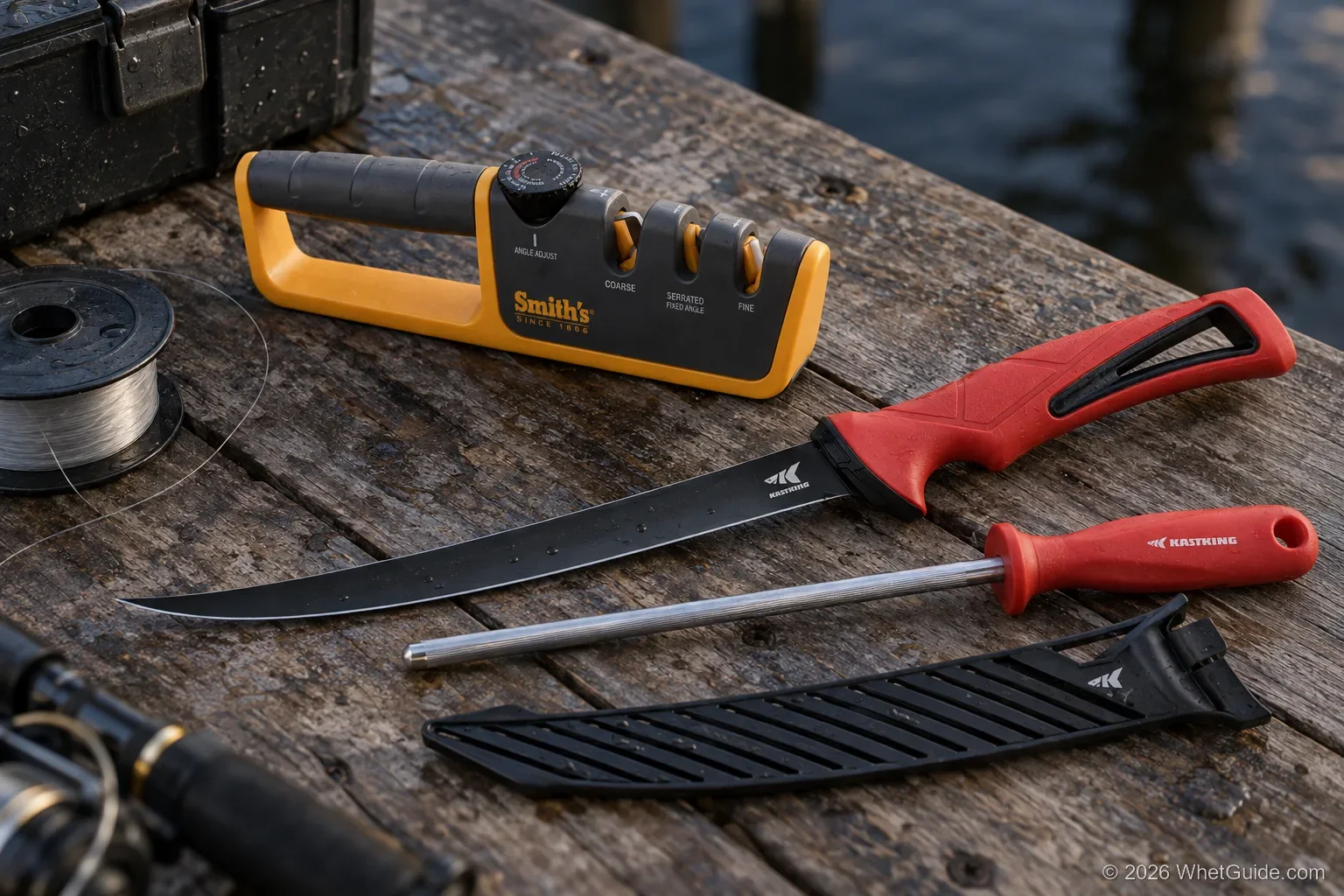
The best knife sharpener for fillet knives is the Work Sharp Guided Field Sharpener for anyone who cleans fish on a boat or at a dock: it fits a tackle box and its 20 degree guide suits soft fillet steel. At home, the Work Sharp Precision Adjust holds any angle from 15 to 30 degrees, useful on a blade that bends. Kitchen cooks who fillet store-bought fish can use the Chef'sChoice 15XV, whose manual says fish knives go through Stages 2 and 3. Every pick below was chosen with a thin, flexible blade in mind. For technique, see how to sharpen a fillet knife; for every kind of guided tool, our best sharpening system guide.
Quick picks
| Best for the boat | Work Sharp Guided Field Sharpener | Amazon |
|---|---|---|
| Easiest with wet or gloved hands | Work Sharp Pull-Through Kitchen Sharpener | Amazon |
| Best backup (it floats) | Smith's CCKS 2-Step Sharpener | Amazon |
| Best dock tool | Smith's 50729 Fillet Knife & Hook Sharpener | Amazon |
| Best for hooks and serrations | Smith's PP1 Pocket Pal | Amazon |
| Best folding plate | DMT DiaFold Extra Fine / Fine | Amazon |
| Best for home | Work Sharp Precision Adjust | Amazon |
| Best bench plate | SHARPAL 162N Diamond Plate (8 x 3 in) | Amazon |
| Best budget stone | KEENBEST 400/1000 Whetstone | Amazon |
| Best electric (kitchen) | Chef'sChoice 15XV EdgeSelect | Amazon |
| Budget electric | Presto 08810 EverSharp Professional | Amazon |
| Best between fish | Utopia 12-inch Honing Rod | Amazon |
| Best ceramic rod | Sharpeak 12-inch Ceramic Rod | Amazon |
Quick answer: one pick for each place
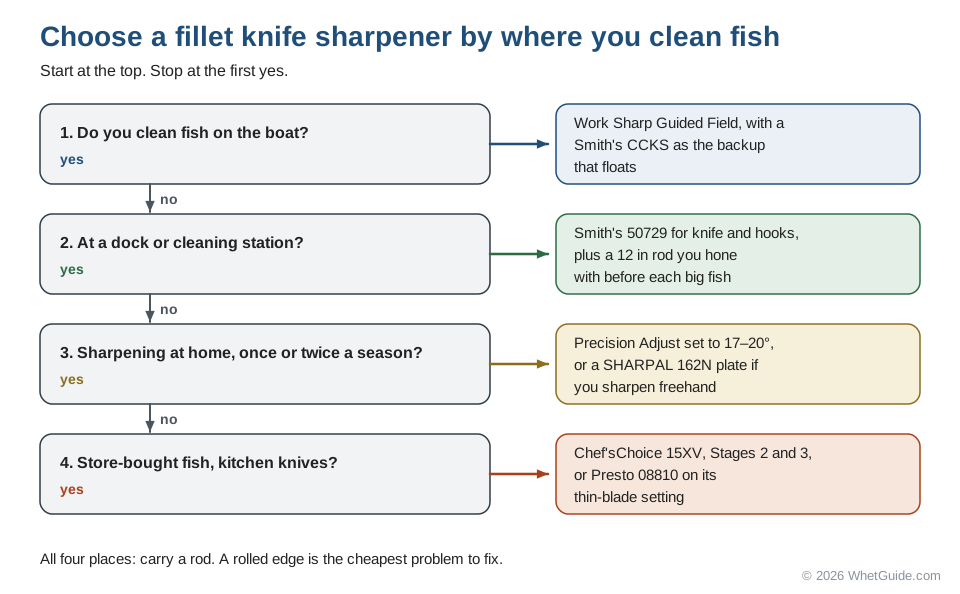
If you only remember one thing, make it the angle. A soft stainless fillet knife ground at 15 degrees cuts beautifully for a few fish and then rolls on the first backbone. Pick a sharpener that can reach 17 to 20 degrees, and keep a rod nearby, because most fillet edges go dull by rolling over, and a rod straightens a roll in seconds.
↑ Back to all sectionsHow we picked
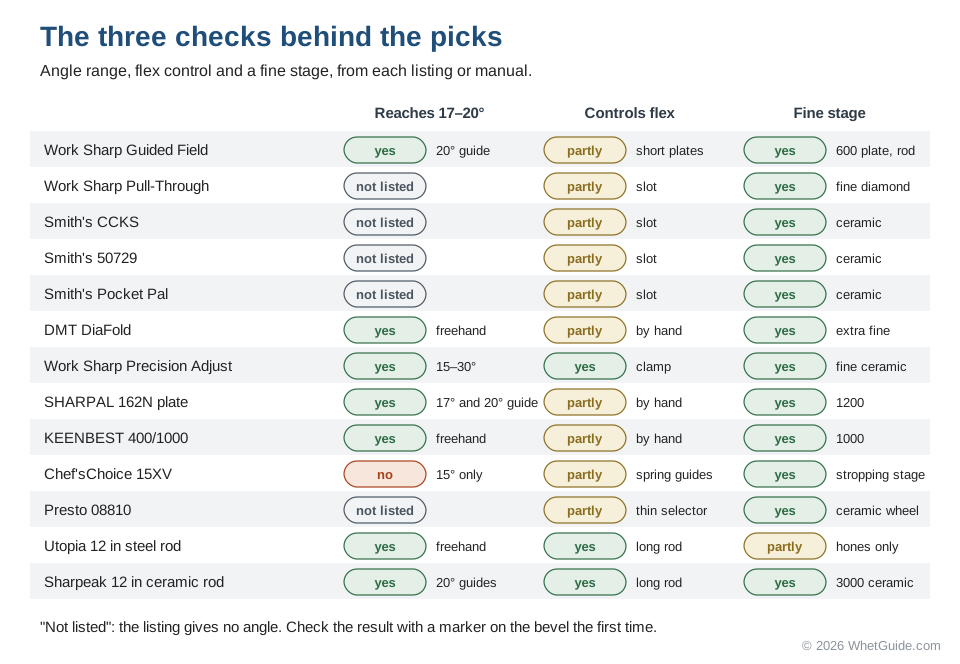
We pulled Amazon search results for fillet knife sharpeners on October 21, 2026. Later product checks through mid-November added more candidates. We kept tools with real sales and large rating counts. On October 21 the Work Sharp Guided Field Sharpener showed about 3,000 bought in the past month with nearly 13,000 ratings; Smith's CCKS showed 2,000 with about 17,000. Then we checked each listing (and the Chef'sChoice manual) for the three things a fillet knife needs: an angle in the right range, a way to sharpen without bending the blade, and a fine stage for touch-ups between fish.
Ray Mercer, our sharpening contributor, pulled these details from the listings and from manuals and maker pages. How we research.
| Left out | Why |
|---|---|
| Carbide-only pull-throughs with no fine stage | Every pull on a fillet knife takes steel, and touch-ups are most of the job. |
| Tools whose listings give no angle and no grit | No way to tell whether they suit soft fillet steel. |
| Premium belt grinders | Price well above what most anglers spend; Work Sharp's Mk2 covers the belt route. |
| Water stones that need a long soak, for the boat | AFTCO says traditional stones soak 20 to 30 minutes. Fine at home, awkward on a boat. |
Why fillet knives need their own sharpener
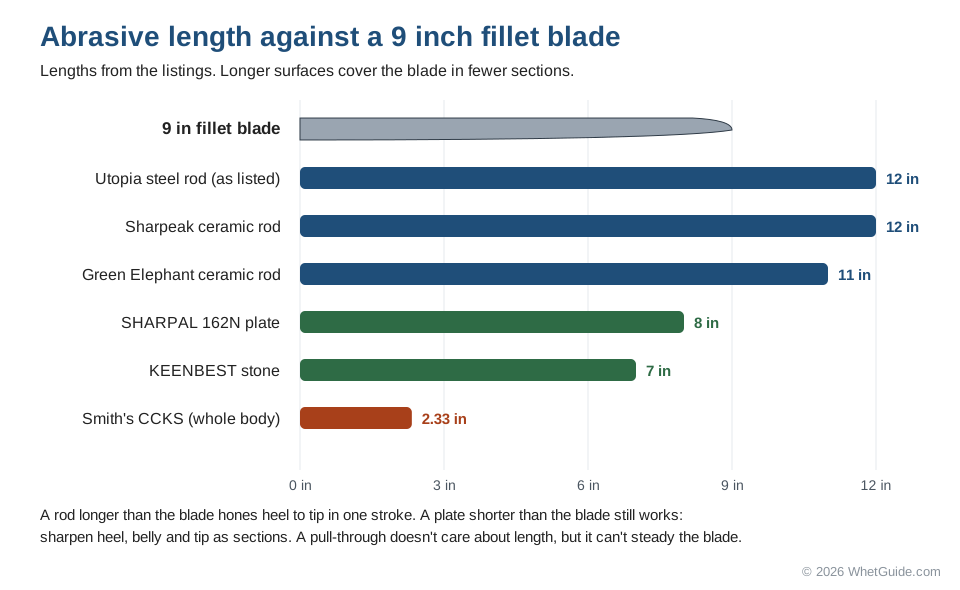
A fillet knife is hard on sharpeners for reasons that stack up. The steel is usually soft stainless, chosen so the edge rolls on a rib instead of chipping. The blade is thin, so it bends under pressure and the apex gets rounded instead of sharpened. And it's long, often 7 to 9 inches, which short field rods and small plates can't sweep in one stroke.
| Your knife | Angle per side | Sharpener that holds it |
|---|---|---|
| Outdoor fillet knife, soft stainless | 17–20° | Guided Field at 20°, Precision Adjust at 17–20°, Smith's adjustable (14–24° range) |
| Big saltwater fish, cutting ribs | 20–22° | Guided Field at 20°, Precision Adjust |
| Kitchen fillet or boning knife | 15–17° | Chef'sChoice 15XV (15°), Precision Adjust |
| Hard Japanese slicer | 12–15° | Whetstone; most tools here stop at 14–15° |
| Electric fillet knife blades | Serrated | Replace the blade pair |
Why the published angles disagree
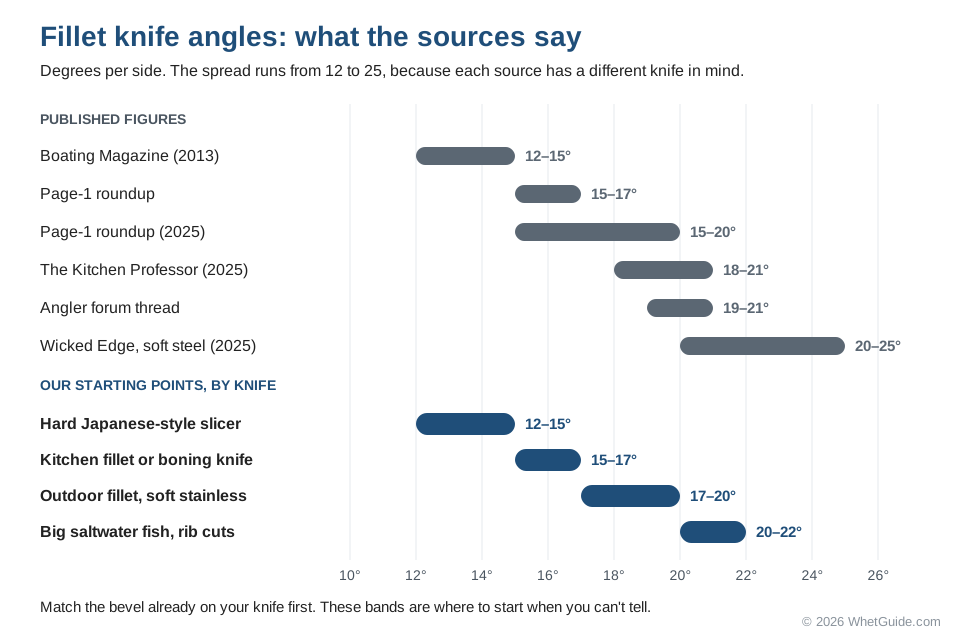
Look up a fillet knife angle and you'll get numbers from 12 to 25 degrees per side. Boating Magazine's tips column puts it at 12 to 15. One roundup on the first page of results says 15 to 17, another 15 to 20. The Kitchen Professor says about 18 to 21. Owners on a British Columbia sport-fishing forum land around 19 to 21, and Wicked Edge recommends 20 to 25 for fillet knives made of soft steel.
They aren't all wrong. A thin 12 to 15 degree edge is right for a hard kitchen slicer that never meets bone. Soft 4116 stainless, which AFTCO uses at 56 to 58 Rockwell, needs more steel behind the edge or it folds over on the first rib. Our table sits inside the spread: 17 to 20 for most outdoor fillet knives, 15 to 17 for kitchen ones. That spread is the buying point. A tool that only offers 15 degrees is a kitchen tool. One that reaches 17 to 20 handles the knife most anglers actually carry.
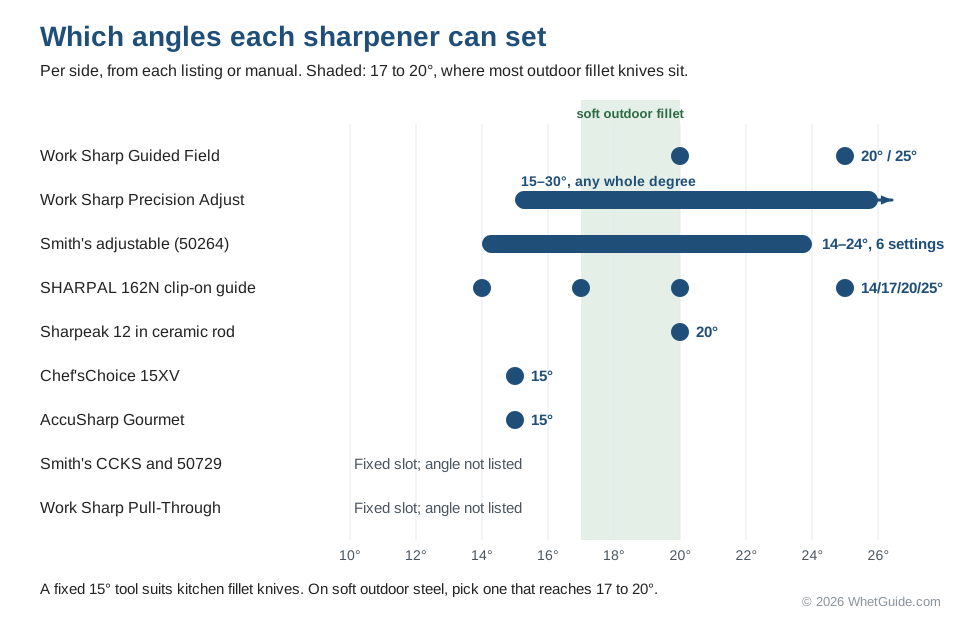
If you're unsure what your knife has, a marker on the bevel tells you in one pass; the Sharpie trick explains how to read it, and the angle chart covers other knives in the drawer. Holding an angle freehand, including the coin shortcuts AFTCO and Boating Magazine describe, is covered step by step in our fillet knife sharpening guide.
↑ Back to all sectionsPick by where you clean fish
| Where | What you need | Pick | Skip |
|---|---|---|---|
| On the boat | Small, works wet, a fine stage for touch-ups | Guided Field Sharpener, or Smith's CCKS as a backup that floats | Anything that needs a bench or power |
| Dock or cleaning station | Quick between fish, hook care | Smith's 50729 fillet and hook sharpener, plus a honing rod | Water stones that need soaking |
| Garage or kitchen, once or twice a season | Exact angle, no blade flex | Precision Adjust, or a SHARPAL 162N diamond plate if you sharpen freehand | Carbide-only pull-throughs |
| Kitchen, store-bought fish | Fast, consistent | Chef'sChoice 15XV | Field tools you'll never use |
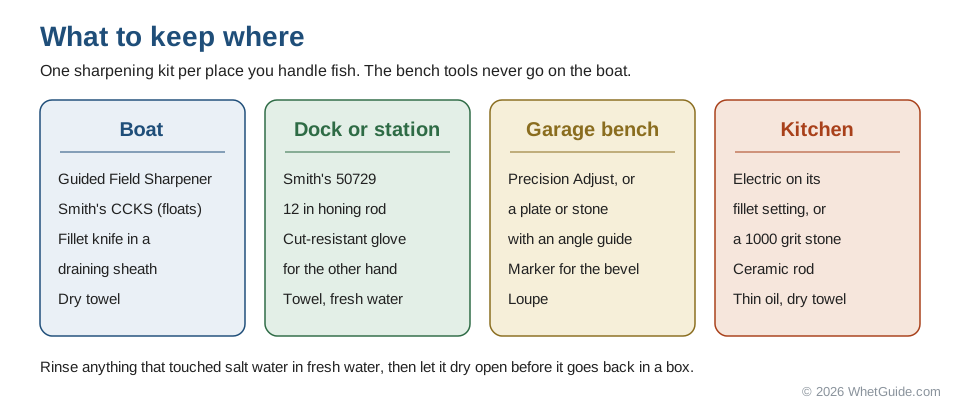
What to keep where
The tools that suit a rocking boat are the wrong ones for a bench, and the reverse. Splitting the kit by place means each tool is where it gets used, and the bench gear never sits in a damp tackle box.
The 14 best sharpeners for fillet knives
For the boat and dock
Work Sharp Guided Field Sharpener
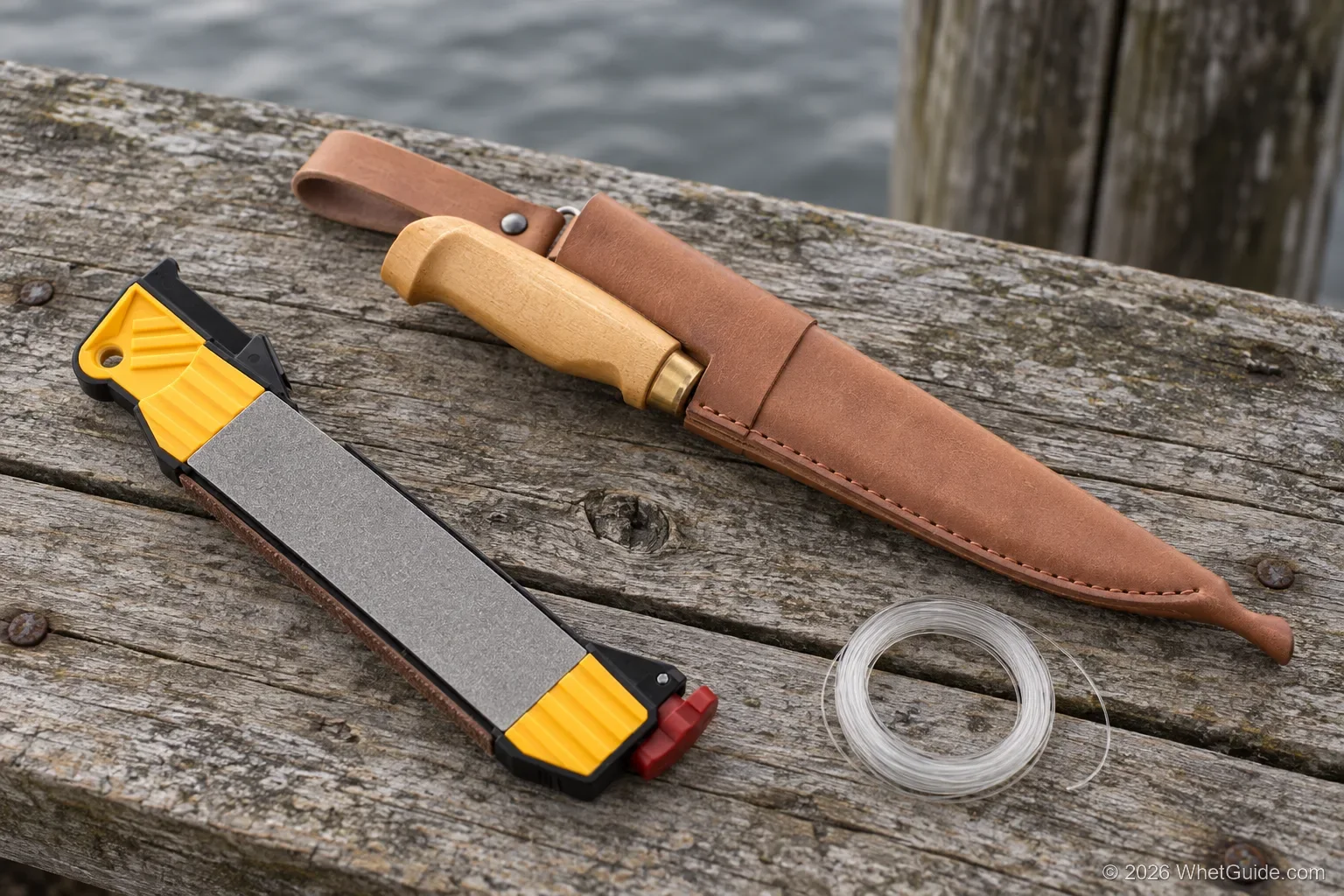
This is the tool to keep in the tackle box. Its 20 degree guide is right in the range for soft outdoor fillet steel (ignore the 25 unless you're cutting through big ribs), and the five surfaces cover every job on the water: the 220 diamond for a damaged edge, the 600 for a dull one, the ceramic rod for touch-ups between fish, and the strop to finish. A groove in the ceramic rod sharpens hooks. Our records show 4.7 stars across about 12,700 ratings (October and November 2026). The plates are short compared with a 9 inch blade, so you sharpen in sections. Brace it on a cooler lid rather than holding it in the air. The step-by-step is in the Guided Field Sharpener review.
- Angle guides20° and 25°
- Abrasives220 and 600 diamond plates, ceramic rod, leather strop
- Weight4.6 oz
- Extrashook groove, broadhead wrench
Why it stands out
- Fixed 20° guide suits soft fillet steel
- Sharpens and strops in one 4.6 oz tool
- Hook groove for the rest of the tackle
Think twice if
- Your fillet knife is hard Japanese steel that wants 15° or less
Work Sharp Pull-Through Kitchen Sharpener
Work Sharp's own fillet guide recommends this one for the field, because a slot is easier to use with wet, cold or gloved hands than a plate you have to hold at an angle. The guide describes a ceramic slot for regular touch-ups and a diamond slot for bigger repairs; the Amazon listing describes a coarse stage and a fine stage, and makes a point of using diamond, which grinds evenly, instead of carbide, which shears steel off. Keep in mind the maker is recommending its own product. Still, it's the gentlest pull-through here on a thin blade, and the right one for anglers who fish in gloves.
- Stagescoarse and fine
- Abrasivediamond
- Angleguided slots (not listed)
- Typepull-through
Why it stands out
- Diamond abrasive, not carbide
- Nothing to hold at an angle
Think twice if
- You want to set the angle yourself (it isn't listed)
Smith's CCKS 2-Step Sharpener
The listing calls it especially handy for fillet knives, and the detail that counts on a boat is in the same listing: it floats. It's the cheapest tool here and one of the most bought, with about 2,000 sold in the month before October 21 and more than 17,000 ratings, so it's the one to throw in a second tackle box or the truck. Smith's says 3 to 4 strokes through the carbide restore a very dull edge. Like any pull-through, it fixes the angle for you. Use the ceramic side most of the time and pull slowly with light pressure. The Smith's sharpener review sets it beside the rest of the lineup, including the Smith's adjustable pull-through (six settings from 14 to 24 degrees) if you want to choose the angle.
- Slotscarbide (coarse) + ceramic (fine)
- Size2.33 x 2.71 in
- Weightunder 2 oz
- Floatsyes (listing)
Why it stands out
- Floats if it goes over the side
- Under 2 oz
- Huge owner base
Think twice if
- You want precision; a fixed carbide slot is a blunt instrument on a flexible blade
Smith's 50729 Fillet Knife & Hook Sharpener
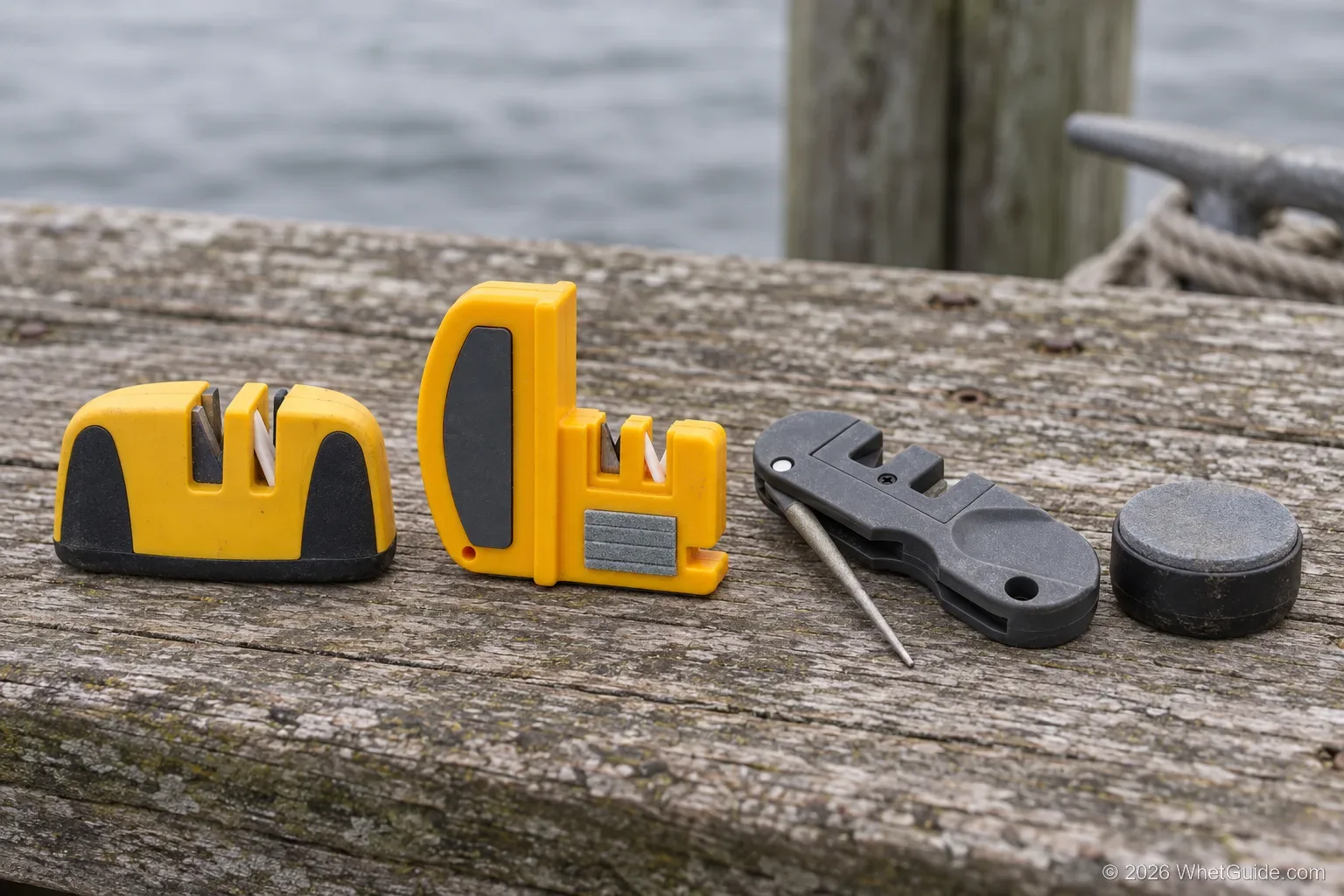
The only sharpener on this list built around fishing, and The Kitchen Professor's outdoor pick too. It has a carbide slot for a very dull edge, crossed ceramic rods for touch-ups, several hook-sharpening grooves and a line cutter on the side. At a cleaning station, it's quick: a few light pulls through the ceramic between fish. The listing doesn't state the slot angle, so check the result with a marker the first time. Keep the carbide slot for real damage. Carbide scrapes steel off, and a thin blade flexing in the slot comes out ragged. If you want to see the layout before buying,
the listing photos show where the hook grooves and line cutter sit on the body
.- Slotscarbide (coarse) + ceramic (fine)
- Extrasfish hook grooves, line cutter
- Weightunder 2.5 oz
- Sizeabout 3 x 3 in
Why it stands out
- Hook grooves and line cutter in one tackle-box tool
- Ceramic stage for quick touch-ups
Think twice if
- You want to know the exact angle (not listed)
- Your knife has a hard, thin edge that carbide can chip
Smith's PP1 Pocket Pal
The Pocket Pal adds what the other Smith's tools lack: a fold-out tapered diamond rod that the listing says handles serrations, small gut hooks and fish hooks. That makes it the one to carry if you also own a serrated bait knife, or if you'd rather sharpen hooks on a round rod than in a groove. At an ounce, it rides on a lanyard. The carbide slot is for straight edges only, per the listing, and the stones reverse and can be replaced.
- Slotscarbide + ceramic, preset
- Extrafold-out tapered diamond rod
- Size3.5 x 1 in
- Weight1 oz
Why it stands out
- Diamond rod for hooks and serrations
- Weighs about an ounce
Think twice if
- You need a fine finish; it's a touch-up tool
DMT DiaFold Extra Fine / Fine
A pocket diamond plate for anglers who'd rather sharpen freehand than pull through a slot. The two sides are fine and extra fine, which is exactly where fillet work happens; there's no coarse side, so it won't repair a chip. It's used dry or with water and needs no oil and it folds to pocket size. Hold the angle yourself, and support the blade with fingertips as you go. More in the DMT review.
- Gritsextra fine and fine diamond
- Usedry or with water
- Weight2.4 oz
- Foldsyes, handles cover the plate
Why it stands out
- Fine grits suit fillet touch-ups
- Made in the USA, per the listing
Think twice if
- You can't hold an angle by hand yet
For the bench at home
Work Sharp Precision Adjust
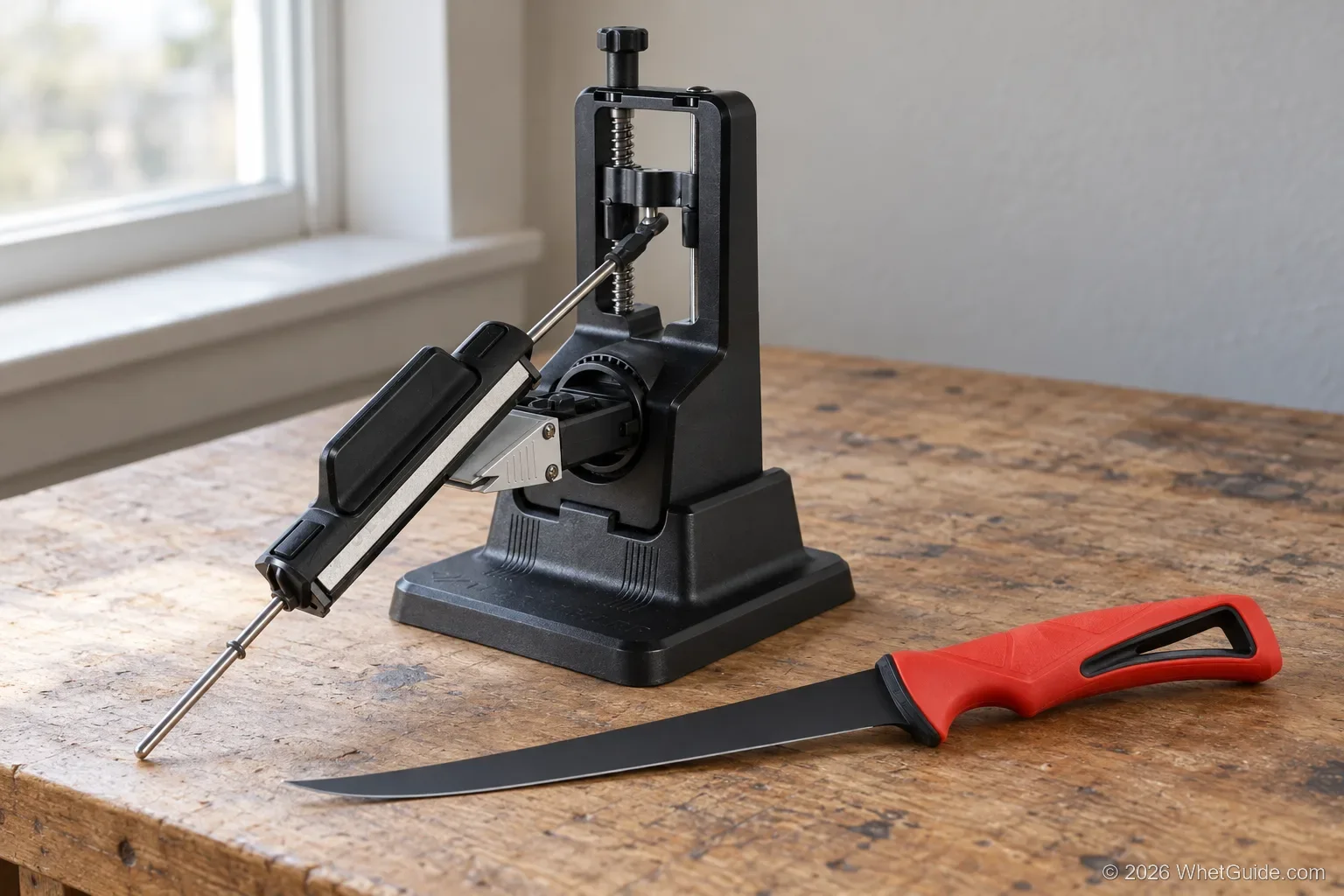
The Precision Adjust clamps the blade and swings the abrasive on an arm, so your hand never has to hold an angle on a bending blade. Set it anywhere from 15 to 30 degrees to match what's on the knife; the listing names fillet blades among the knives it handles. It has more than 11,500 Amazon ratings, one of the largest owner bases of any clamp system. Flexible blades need one adjustment: clamp as high on the blade as it allows and keep the strokes light, which is the same advice Wicked Edge gives for its own clamp system. Long fillet knives may need two clampings. The Precision Adjust review covers setup.
- Angle15° to 30°, adjustable
- Abrasives320 and 600 diamond, fine ceramic on a three-sided rod
- Typeclamp on a benchtop base
- Listing namesfillet and hunting blades
Why it stands out
- Any whole angle from 15° to 30°
- No angle-holding by hand on a flexible blade
- No oil or water
Think twice if
- You want something for the boat; it needs a table
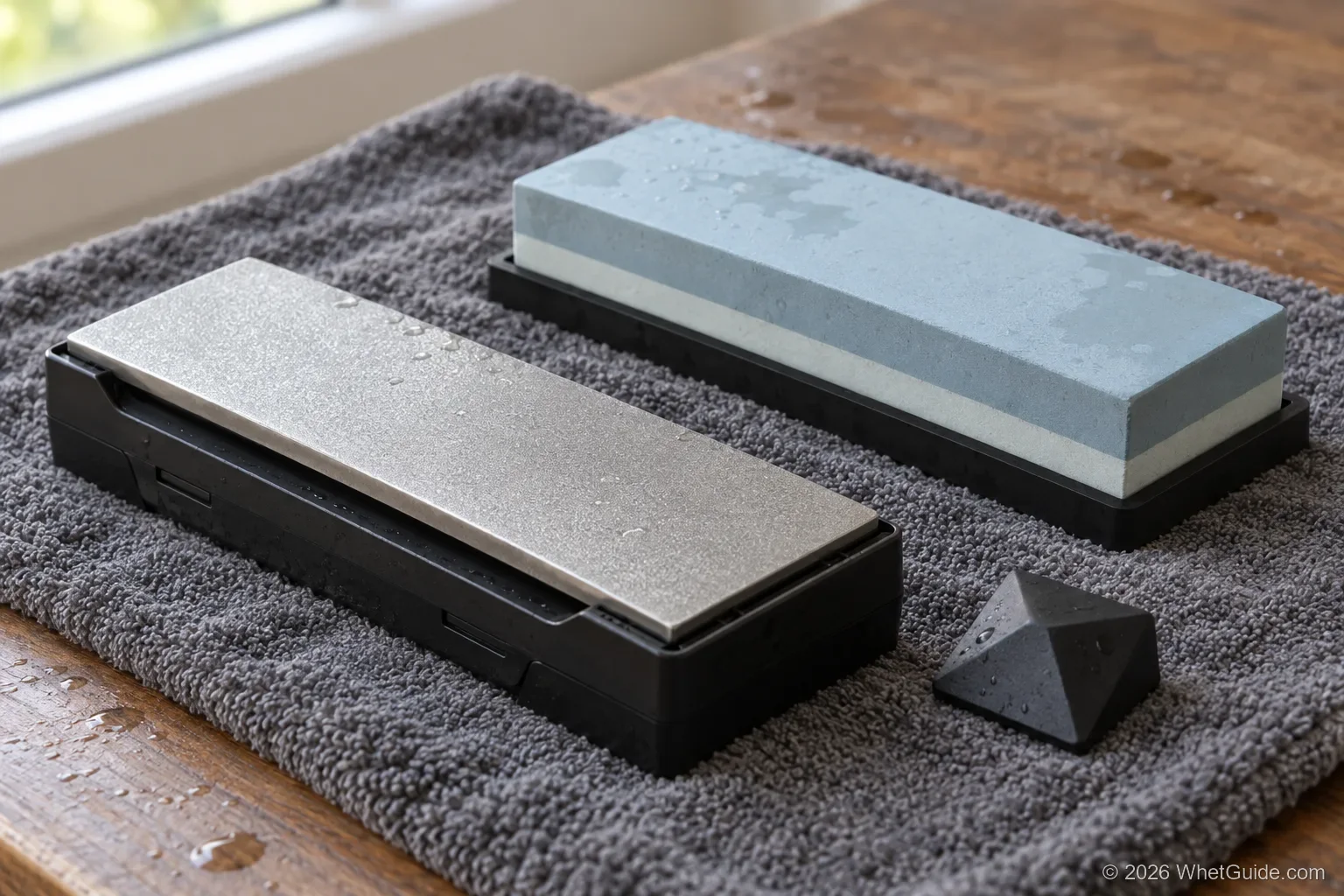
SHARPAL 162N Diamond Plate (8 x 3 in)
For freehand sharpeners, a long plate is kinder to a fillet knife than a small one: 8 inches lets you sweep most of the blade without lifting off the end. The 1200 side is fine enough to finish a fillet edge, and the 325 side handles chips. It's used dry, which helps at a cabin or campsite without running water. The clip-on guide's 17 and 20 degree settings sit right in the fillet range. Diamond cuts fast, so keep pressure light and fingertips just behind the edge to stop the blade flexing.
- Grits325 / 1200 diamond
- Size8 x 3 in
- Usedry, no oil or water
- Angle guide14°, 17°, 20°, 25°
Why it stands out
- Long, flat surface for long blades
- Dry use: no soaking or oil
- Angle guide includes 17° and 20°
Think twice if
- You've never sharpened freehand and don't want to learn on a flexible blade
KEENBEST 400/1000 Whetstone
If you'd rather learn on a stone, this is the cheapest sensible start: the 400 side fixes chips and the 1000 side is the one a fillet knife lives on. AFTCO, which sells fillet knives of its own, says the best fillet knife sharpeners use water stones. It was the best-selling budget combination stone we found on October 21 (about 6,000 bought in the month before). The listing says to soak it 10 to 15 minutes, so it's a home tool. Pair it with an angle guide such as the SHARPAL 196N pyramid (four settings from 14 to 25 degrees) until your hands learn the angle.
- Grits400 / 1000
- Size7 x 2.2 in
- Soak10 to 15 minutes (listing)
- Basenon-slip rubber
Why it stands out
- 400 and 1000 cover repair and routine sharpening
- Inexpensive way to learn
Think twice if
- You want a tool for the boat; it needs soaking and a flat bench
For the kitchen
Chef'sChoice 15XV EdgeSelect
If you fillet salmon from the fish counter rather than walleye from the lake, this is the fast option. The Model 15XV manual's section on game and fish says, "For filleting fish use a thin but sturdy blade sharpened in Stages 2 and 3," so fish knives skip the first stage. The listing quotes about a minute for the first sharpening and 10 seconds after that. On October 21 it showed about 4,000 bought in the past month. The catch is the angle. Its 15 degree edge is thin for a soft outdoor fillet knife, which will need touching up more often. The Trizor XV review goes into the machine in depth.
- Angle15°
- Stages3 (diamond, diamond, flexible stropping)
- Timeabout 1 minute first sharpening, about 10 seconds resharpening (listing)
Why it stands out
- The manual gives a stage path for filleting knives
- Consistent 15° edge in seconds
- Handles serrated kitchen knives too
Think twice if
- Your fillet knives are soft-steel outdoor blades used on bony fish
Presto 08810 EverSharp Professional
The Presto turns up in three of the roundups ranking for this search, and the reason is in its listing: a blade thickness selector whose thin setting is meant for "light blades like fillet and paring knives." The guides adjust to the blade, and the last stage is an extra-fine ceramic wheel. It doesn't list an angle. It's a sensible kitchen buy if the 15XV is more than you want to spend, with the same warning: a fast electric takes more steel per session than a rod or fine stone, so use it when the knife is dull, and hone in between.
- Stages3
- Selectorthick, medium, thin blade guides
- Finishextra-fine ceramic wheel
- Listing namesfillet and paring knives on the thin setting
Why it stands out
- Thin setting named for fillet knives
- Ceramic finishing stage
Think twice if
- You want to know the angle (not listed)
For between fish
Utopia 12-inch Honing Rod
A soft fillet edge rolls before it dulls, and a rod pushes it straight again in a few strokes. That's why AFTCO tells owners to hone ideally before each large fish. Length matters for fillet knives: a 12 inch rod covers a 9 inch blade in one pass, where short field rods don't. It was among the best sellers in our October 21 fillet sharpener search, at about 3,000 bought in the month before. Carbon steel rusts if it's stored wet. Utopia's own care note says to wipe it dry completely and hang it to air-dry, so wipe it down after a day of saltwater fishing.
- Length12 in
- Materialnickel-chrome plated carbon steel
- Usestraight and serrated edges
Why it stands out
- 12 in length matches long fillet blades
- Fixes a rolled edge in seconds
Think twice if
- The edge is truly dull: a rod realigns, it doesn't sharpen
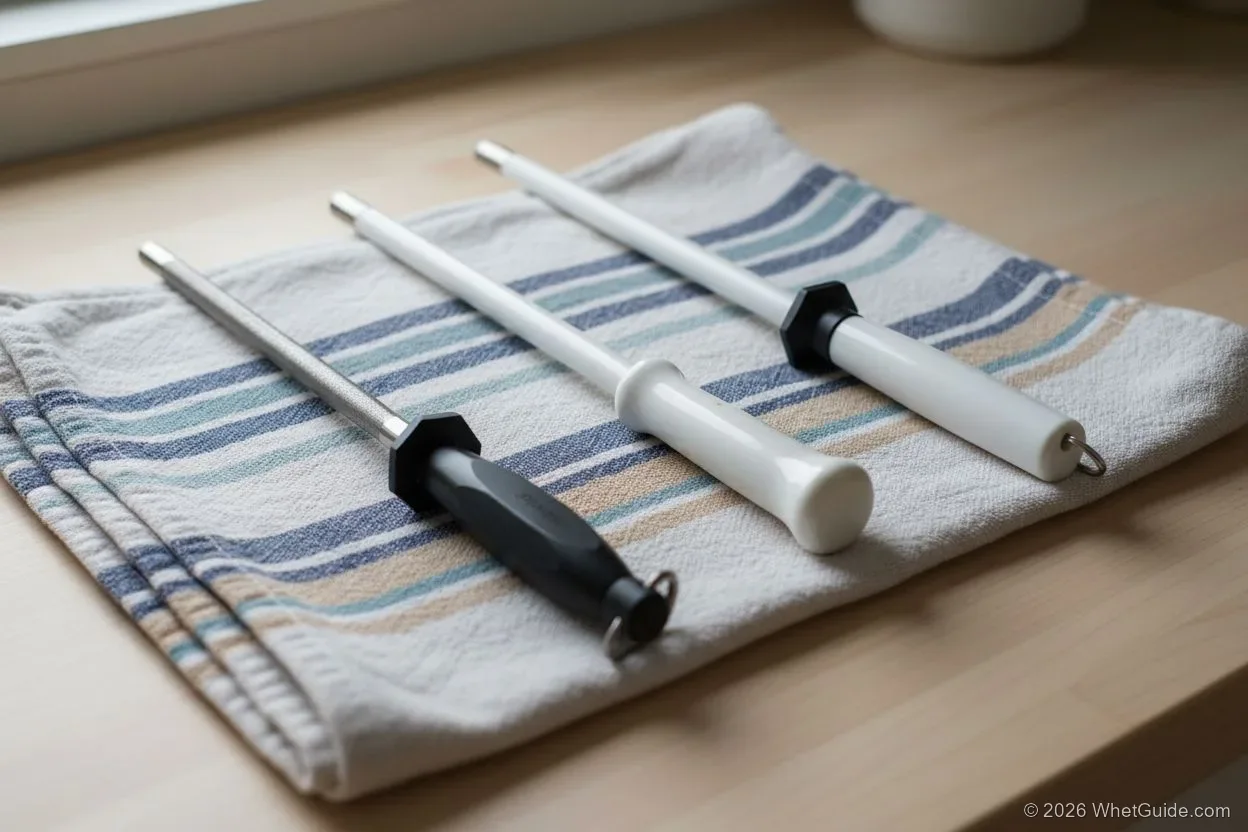
Sharpeak 12-inch Ceramic Rod
The ceramic counterpart to the Utopia, and the better fit for salt water: the listing says the ceramic never rusts. It goes one step past a steel rod by removing a little metal, so it can freshen an edge that a steel only straightens. Two details suit fillet knives in particular. The rod is 12 inches long without the handle (the listing points out that some "12 inch" rods count the handle), and it has built-in 20 degree angle guides, right on the number most soft outdoor fillet knives want. A rubber cap protects it if it's dropped, though ceramic can still chip on a dock.
- Rod length12 in (17.5 in overall)
- Grit3000 ceramic
- Angle guidesbuilt-in 20°
- Rustnone (ceramic)
Why it stands out
- Built-in 20° guides
- Won't rust after a salt day
Think twice if
- It's going in a loose tackle box where ceramic can crack
Side-by-side comparison
| Sharpener | Angle | Abrasive | Where | Wet or gloved hands |
|---|---|---|---|---|
| Guided Field | 20° / 25° | Diamond, ceramic, leather | Boat, field | Good |
| Work Sharp Pull-Through | Fixed (not listed) | Diamond | Boat, kitchen | Best |
| Smith's CCKS | Fixed (not listed) | Carbide, ceramic | Boat backup | Good; floats |
| Smith's 50729 | Fixed (not listed) | Carbide, ceramic | Dock | Good |
| Smith's Pocket Pal | Fixed (not listed) | Carbide, ceramic, diamond rod | Good | |
| DMT DiaFold | Freehand | Diamond, two fine grits | Pocket, camp | Fair |
| Precision Adjust | 15–30° | Diamond, ceramic | Home | Not for the boat |
| SHARPAL 162N | Freehand (guide 14–25°) | Diamond 325/1200 | Home, cabin | Fair |
| KEENBEST 400/1000 | Freehand | Water stone | Home | Not for the boat |
| Chef'sChoice 15XV | 15° | Diamond, polishing stage | Kitchen | No |
| Presto 08810 | Not listed (thin setting) | Wheels, ceramic finish | Kitchen | No |
| Utopia rod | Freehand | Steel (hones) | Anywhere | Good; dry it after |
| Sharpeak ceramic rod | 20° guides | Ceramic 3000 | Dock, kitchen | Good |
Angles and abrasives from each listing or manual. "Wet or gloved hands" is our judgment of how easy the tool is to use on a boat. The Smith's adjustable is covered in the CCKS card above.
↑ Back to all sectionsSix kinds of sharpener, rated on a thin blade
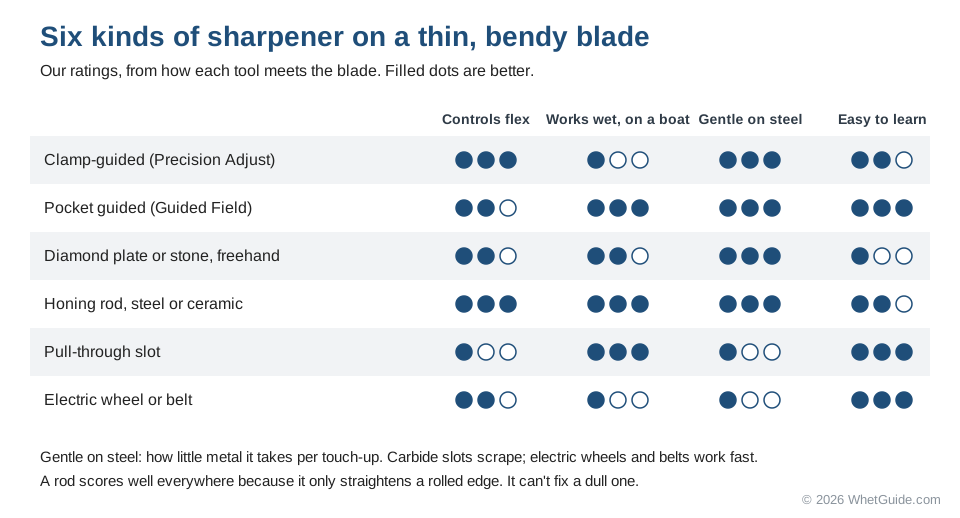
Read the chart by your weakest point. If you fish from a small boat in cold weather, the "works wet" column decides it and a pocket guided tool or a good pull-through wins. If you sharpen once a season at home, flex control matters more, and so does how much steel each session takes. A clamp system or a plate is worth the setup. Electrics score well only on ease: they're fast and forgiving, and they take steel quickly, which a thin fillet blade has little of to spare. The rod looks like a cheat in the chart, and it is one in a sense. It does a small job (straightening a rolled edge), and it does that job well everywhere. That's why it turns up in nearly every kit on this page, and none of the other tools replaces it.
| If your priority is | Type | Pick from this page |
|---|---|---|
| Best possible edge | Clamp-guided or freehand plate | Precision Adjust, SHARPAL 162N |
| Use with cold, wet or gloved hands | Pull-through with a fine stage | Work Sharp Pull-Through, Smith's CCKS |
| One tool for the boat and home | Pocket guided | Guided Field |
| Speed, many kitchen knives | Electric | Chef'sChoice 15XV, Presto 08810 |
| Lowest cost to keep a knife cutting | Rod | Utopia steel, Sharpeak ceramic |
Pull-through sharpeners for fillet knives: which ones, and how
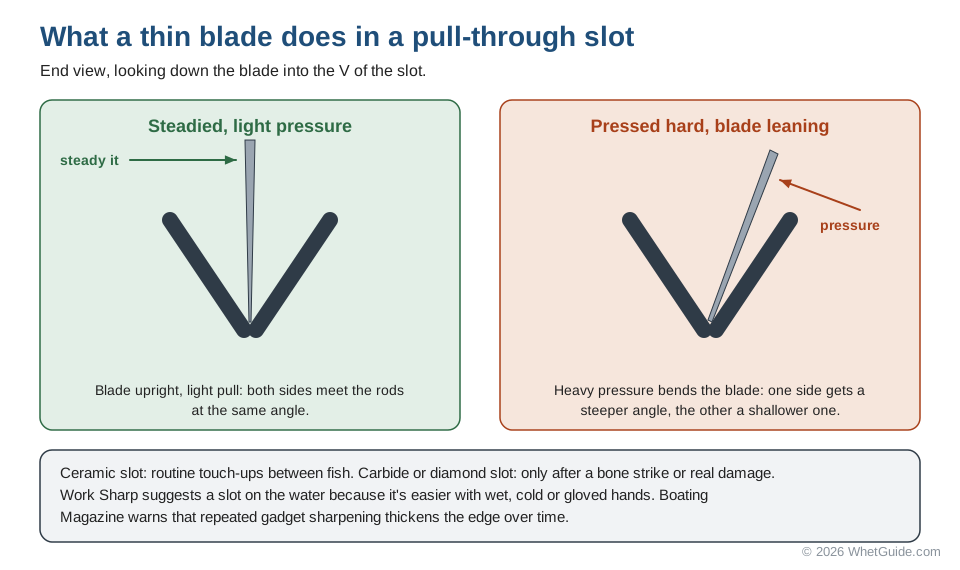
Opinion on pull-throughs splits hard. On the British Columbia forum thread, one owner's whole answer was "Never a pull thru." Boating Magazine's tips column says gadget sharpeners are acceptable but "ruin the edge over time by making it thicker." And Work Sharp, which sells plates and belt machines as well as slots, still points anglers to a pull-through for the boat, because it's easier with wet, cold or gloved hands.
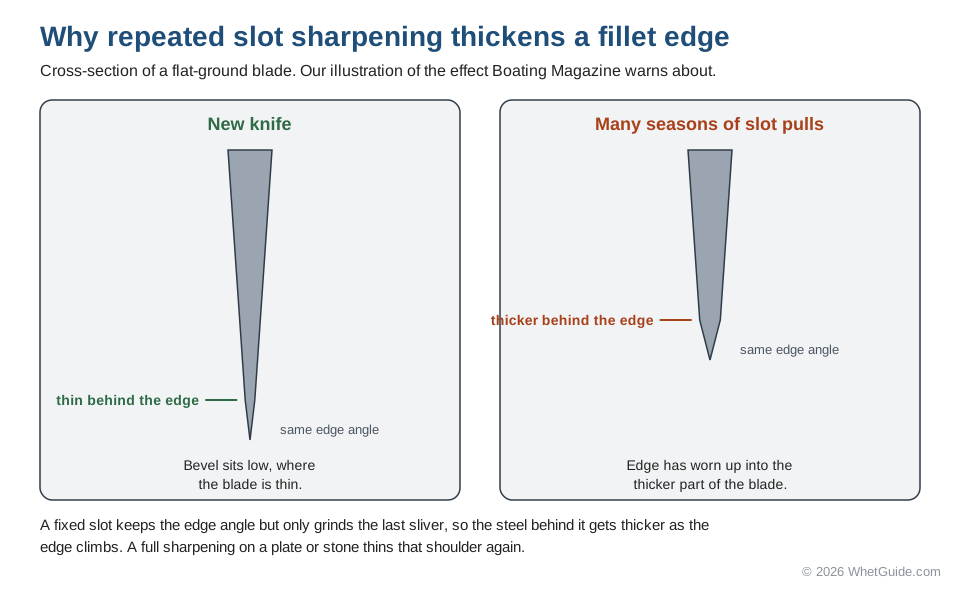
Both sides have a point, and the abrasive decides who's right for a given tool. A carbide slot shears steel off; it's fast, and on a thin blade it leaves a rougher edge. A ceramic or diamond slot grinds. It's slower and more even. So the buying rule is simple: get a pull-through with a fine ceramic or diamond stage, use that stage nearly every time, and save the coarse slot for a bone strike. The fillet sharpening guide has the technique, and are pull-through knife sharpeners bad? covers the wider argument.
| Pull-through | Coarse stage | Fine stage | Angle | Fillet extras |
|---|---|---|---|---|
| Work Sharp Pull-Through | Diamond | Diamond | Not listed | Maker recommends it for wet or gloved hands |
| Smith's CCKS | Carbide | Ceramic | Not listed | Floats |
| Smith's 50729 | Carbide | Ceramic | Not listed | Hook grooves, line cutter |
| Smith's Pocket Pal | Carbide | Ceramic | Not listed | Diamond rod for hooks |
| Smith's adjustable (50264) | Carbide | Ceramic | 14–24°, six settings | Serrated slot; sharpens hooks |
| AccuSharp | Carbide only | None | Not listed | Listing names filet knives; finger guard |
Electric sharpeners and fillet knives
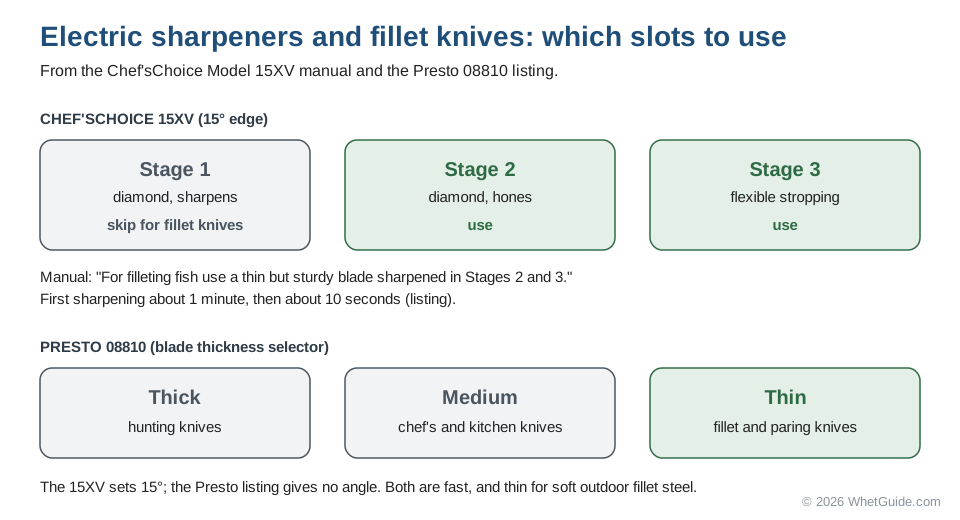
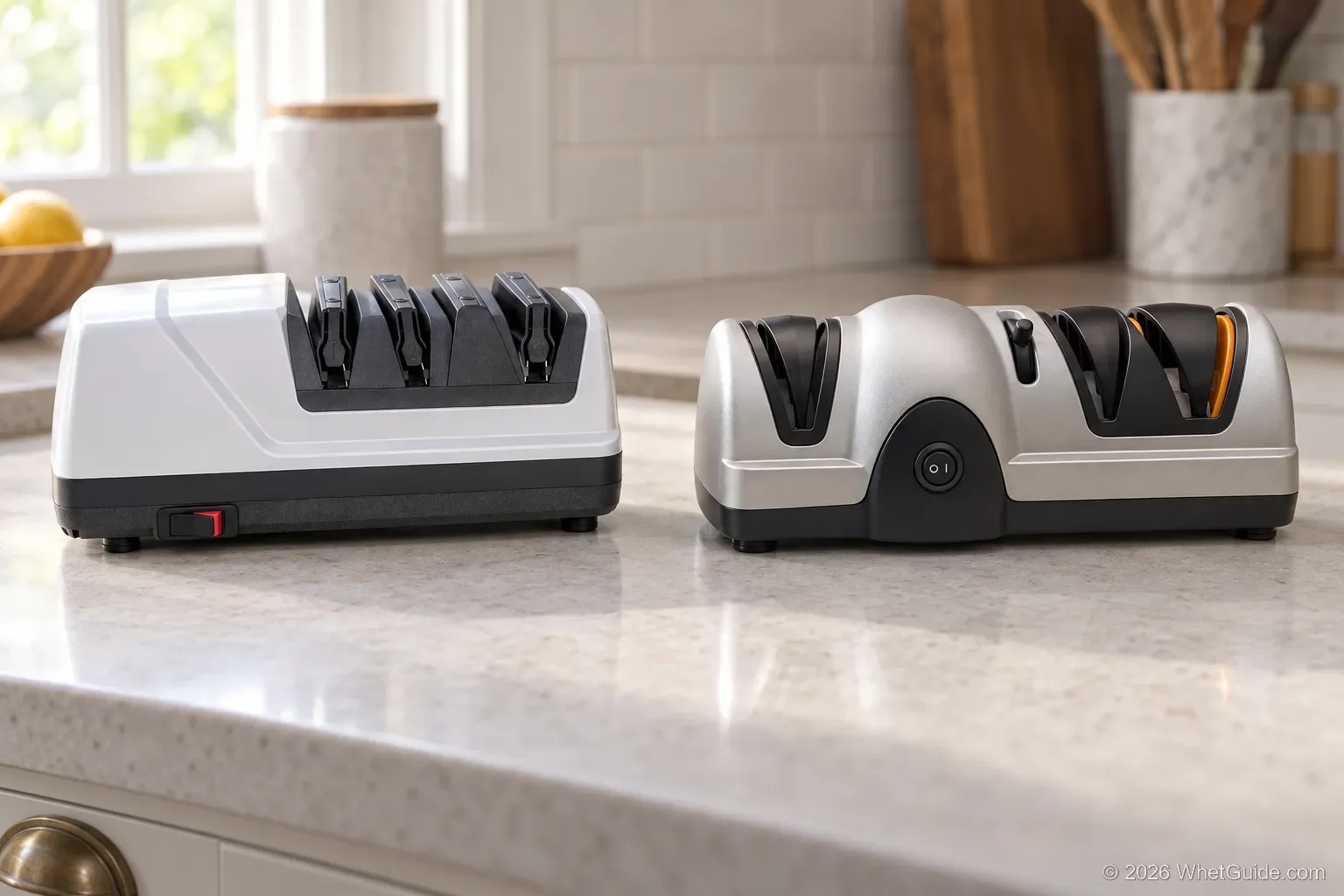
Electrics make sense in one situation: a kitchen where the fillet knife is one of many knives and the fish come from a store or a charter's cooler, already cleaned. Speed matters there. The knife rarely meets heavy bone. The 15XV's stage path keeps the first, most aggressive stage off the fillet knife. The Presto does the same job with a thickness selector. Anglers who clean dozens of fish a weekend are the wrong buyers. Even on the forum thread where owners praised their Chef's Choice machines, one noted that electric grinders wear a knife down more than a stone does. If you want a powered option that copes better with a thin blade, a belt machine such as the Work Sharp Mk2 uses flexible belts that conform to the edge and a guide that supports the knife to the tip; Work Sharp's fillet guide suggests its Mk2 line for home sharpening. Keep the passes light and quick so the thin edge doesn't heat. Our best electric knife sharpener guide compares more machines.
| Machine | Fish setting | Angle | Best for |
|---|---|---|---|
| Chef'sChoice 15XV | Stages 2 and 3 (manual) | 15° | Kitchen fillet and boning knives |
| Presto 08810 | Thin selector (listing) | Not listed | Budget kitchen use |
| Work Sharp Mk2 | Flexible belt, edge guide to the tip | Not in our record | Home bench, many knives, light passes |
What to look for in a fillet knife sharpener
An angle you can set to 17–20°. Fixed 15 degree tools suit kitchen fillet knives. For outdoor knives on soft steel, a 20 degree guide or an adjustable tool keeps the edge from rolling on every rib. Next, the sharpener has to keep the blade from bending. Clamps (Precision Adjust) solve it mechanically; on plates and stones, it's light pressure and fingertips just behind the edge. Pull-throughs are the weak spot here: the blade can flex and twist in the slot, so pull slowly and steady the blade near the sharpener.
Why the fine stage matters most
Most fillet sharpening is touch-up work, so the fine stage does the bulk of the job. A ceramic slot, fine diamond plate or rod gets used far more often than the coarse one. Boating Magazine's 2016 fillet knife test shows how little steel a fillet edge needs: resharpening seven knives on a 400-grit diamond stone took between 6 and 20 strokes each.
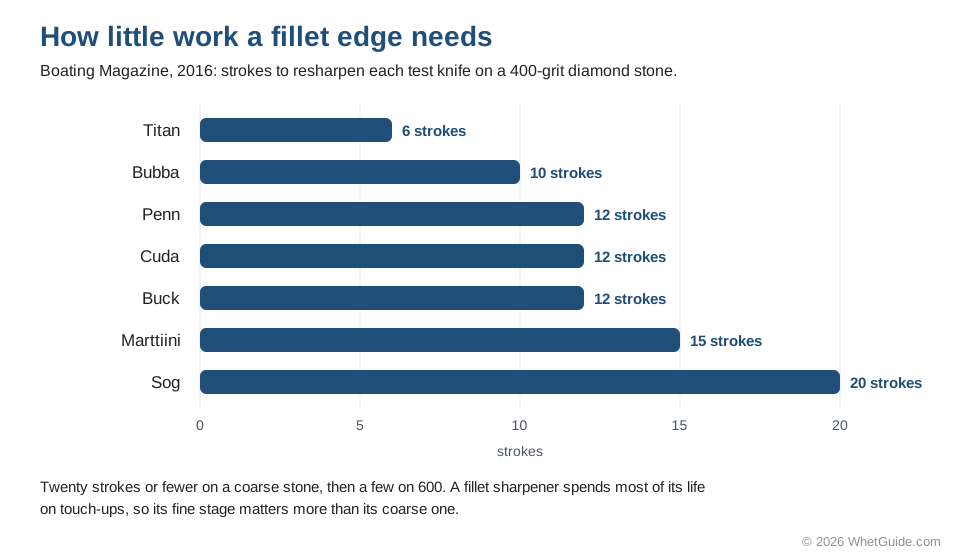
That's a useful check when you shop. A sharpener sold on how fast its coarse stage "restores" an edge is selling the part you'll use least. Look at what it offers for every other session: the fine slot, the ceramic rod, the 600 or 1200 plate.
Buyer's checklist
- Reaches 17 to 20° (or 15 to 17° for a kitchen knife)
- Has a fine ceramic, diamond or 1000+ grit stage
- Holds the blade or lets you support it near the edge
- Long enough for your blade, or easy to use in sections
- Survives a fresh-water rinse: ceramic, carbide or stainless parts
- Small enough for the place you'll actually use it
- Hook grooves, if you sharpen hooks on the same trip
- A rod to go with it
Match the sharpener to your fillet knife
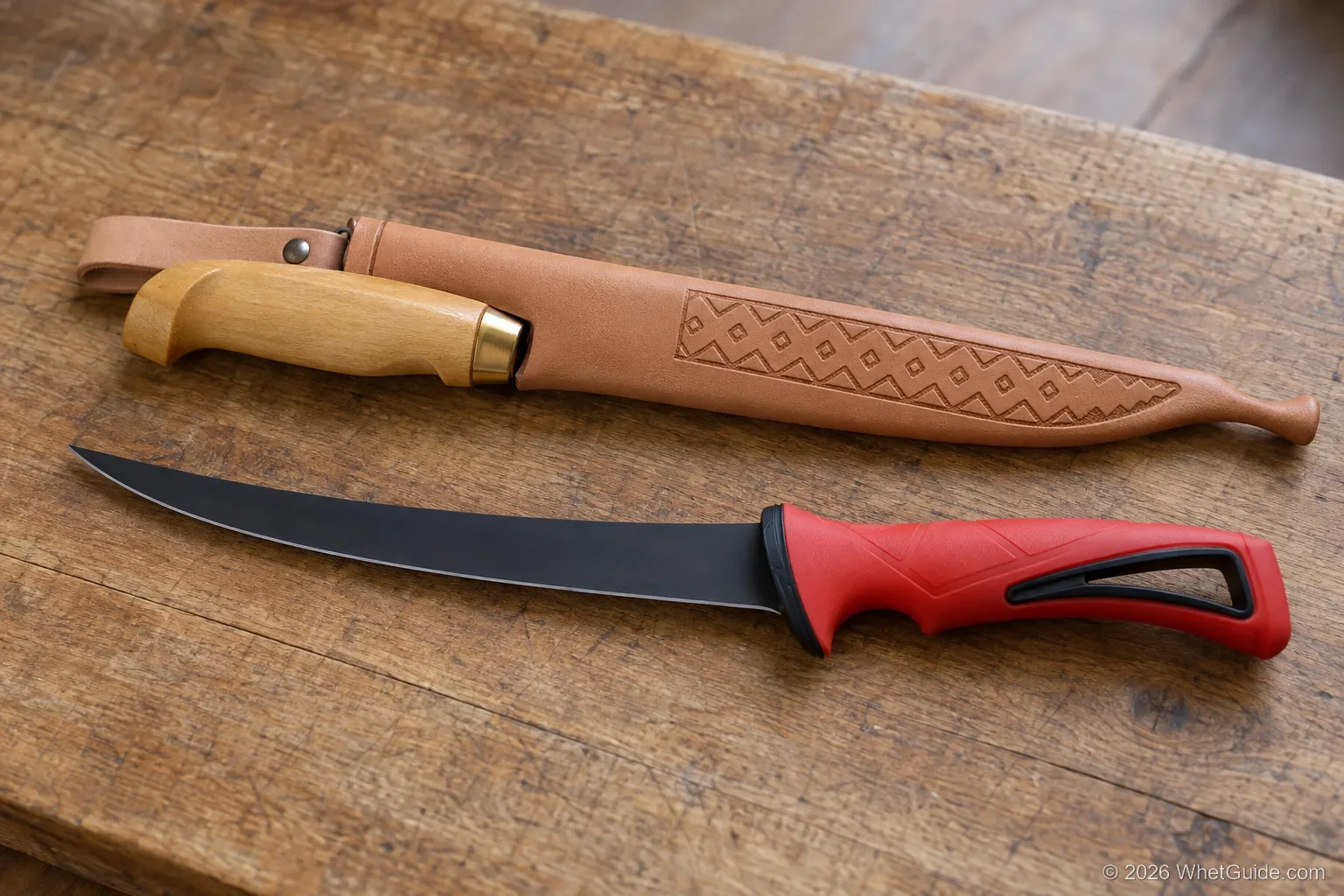
The knife decides the angle, and the angle decides which sharpeners are in the running. Few fillet knife makers publish an angle. More publish the steel, and the steel tells you most of what you need: soft stainless wants the steeper end, hard steel can go thinner.
| Knife or steel | What the maker or a test says | Start at | Good sharpener match |
|---|---|---|---|
| AFTCO fillet knives | 4116 stainless, 56–58 Rockwell (AFTCO) | 17–20° | Guided Field, Precision Adjust |
| KastKing Intimidator | G4116 German stainless; ships with a honing rod (listing) | 17–20° | Guided Field, Sharpeak rod |
| Cuda | 4116 (Boating Magazine, 2016) | 17–20° | Guided Field, Precision Adjust |
| Bubba | 56–58 Rockwell (Boating Magazine, 2016) | 17–20° | Guided Field, Precision Adjust |
| Buck | 420HC at 58 Rockwell (Boating Magazine, 2016) | 17–20° | Any tool that reaches 17–20° |
| Rapala Fish'n Fillet | No angle or hardness published that we found; ships with a single-stage sharpener | Check with a marker | Adjustable tools until you know |
| Kitchen fillet or boning knife | Usually harder than outdoor steel | 15–17° | Chef'sChoice 15XV, Precision Adjust |
| Japanese-style slicer | Hard steel, thin edge | 12–15° | Whetstone; see Japanese knife sharpeners |
The Rapala row is the common case: a knife with no published angle and a small sharpener in the box. That in-box sharpener is fine for touch-ups. When it stops working, color the bevel with a marker, make one light pass on an adjustable tool and see where the ink comes off; then you know which fixed-angle tools will match. If your knife came with a rod, as the KastKing does, that rod is already your between-fish tool. Hunters who sharpen fillet knives and hunting knives on one tool should look at the adjustable picks. Hunting knives usually run a few degrees steeper; our best hunting knife sharpeners has the details.
↑ Back to all sectionsSalt water and the sharpener itself
Most care advice is about the knife. On The Water's maintenance column sums that side up: hand wash, no dishwasher, "A dry knife is a rust-free knife," a thin layer of vegetable oil for off-season storage. The sharpener rides in the same wet box and gets less attention. None of the listings on this page make a saltwater claim, so treat every sharpener the same way you treat the knife.
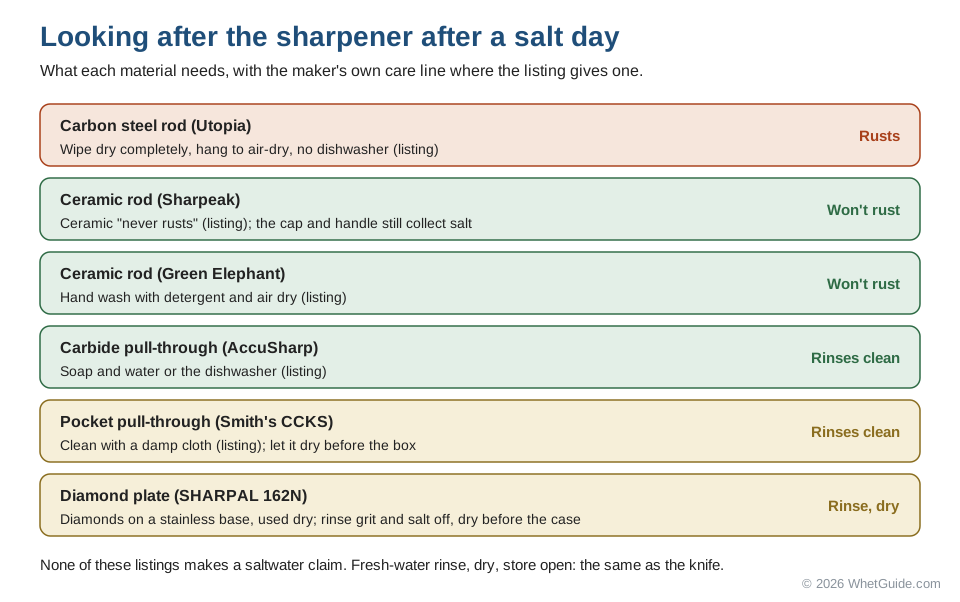
After a salt day, rinse the sharpener in fresh water along with the knife, shake it off and let it dry open before it goes back in a closed box. Steel rods and plated parts rust; ceramic and carbide don't, but their holders and screws can. Sealing a wet steel rod in a tackle tray overnight invites rust. Boating Magazine's 2016 knife test judged corrosion by spraying the knives with salt and checking them under a microscope after only 24 hours.
| When | Knife | Sharpener |
|---|---|---|
| Before each big fish | A few light strokes on a rod (AFTCO) | Rod within reach, wiped clean |
| End of each trip | Fresh-water rinse, dry, sheath only when dry | Rinse, dry open, steel rods wiped with a little oil |
| When it drags | Sharpen on the fine stage (On The Water: sharpen when it drags) | Check slots for packed grit or scale; rinse out |
| About once a year | Full sharpening (AFTCO) | Check pull-through rods and carbides for wear; the Smith's adjustable and Pocket Pal listings say theirs are replaceable |
| Off season | Thin vegetable oil, stored dry (On The Water) | Store out of the tackle box, somewhere dry |
Five anglers, five answers
What we'd buy for five common ways of fishing.
| Angler | Buy | Why |
|---|---|---|
| Walleye and perch from a small boat, many fish a day | Guided Field + Utopia or Sharpeak rod | Rod between fish, the 600 plate when the rod stops working. Everything fits the tackle box. |
| Cold-water salmon or steelhead, gloves on | Work Sharp Pull-Through + Sharpeak rod | A slot is easier with gloves, per Work Sharp; the ceramic rod won't rust in the boat. |
| Pier or surf angler with a cheap Rapala | Smith's 50729 or CCKS | Low cost, light, hook care on the 50729. Use the ceramic slot almost every time. |
| Offshore, cutting through ribs on big fish | Guided Field on 20° + Precision Adjust at home at 20–22° | Steeper edge survives ribs; the clamp sets it exactly at home. |
| Home cook, fish from the counter | Chef'sChoice 15XV or Presto 08810 | Fast and consistent. The fillet knife shares the machine with the rest of the block. |
Troubleshooting: when the sharpener isn't working
| Symptom | Likely cause | Fix |
|---|---|---|
| Sharp at the heel, dull toward the tip | Short plate or pull-through lifting off at the tip; blade flexing | Work in sections; on a pull-through, raise the handle slightly as the tip comes through |
| Feels sharp, dull after a few fish | A burr left on from a carbide slot | Finish on the ceramic slot or rod with lighter strokes |
| Edge rolls on every rib | Angle too thin for soft steel (often a fixed 15° tool) | Move to 17–20°, or 20–22° for big fish |
| Cuts worse each season, pulls take longer | Edge thickening from repeated fixed-slot sharpening (Boating Magazine) | A full sharpening on a plate or stone to thin the bevel again |
| Scratches on the blade face | Blade leaning in a slot, or a clamp missing its pads | Keep the blade upright; tape the blade face before clamping |
| Uneven bevel, wider on one side | Pressing harder on one side in a pull-through | Same number of light pulls each time; check with a marker |
| Rust spots on the rod or tool | Stored wet in a closed box | Rinse, dry, store open; switch to a ceramic rod on the boat |
| Nothing brings it back | Chip, bent tip or an edge worn past its bevel | A coarse stone, or a sharpening service |
If a knife has a chip you can see or a tip bent over, the cost of fixing it may beat the cost of the knife. Our guides to knife sharpening service cost and mail-in sharpening services help you decide. A pocket loupe makes most of the symptoms above easy to see before they're easy to feel.
↑ Back to all sectionsFillet sharpener myths, checked against the sources
| You'll hear | What the sources say |
|---|---|
| "Every fillet knife is 15 degrees." | Published figures run from 12 to 25 degrees per side; Wicked Edge recommends 20 to 25 for soft steel. |
| "Never use a pull-through on a fillet knife." | Work Sharp recommends one on the boat for wet, cold or gloved hands. Boating Magazine calls gadget sharpeners acceptable but warns they thicken the edge over time. |
| "Electric sharpeners aren't for fish knives." | The Chef'sChoice 15XV manual gives fish knives their own stage path, and the Presto listing names fillet knives for its thin setting. |
| "Sharpen after every trip." | AFTCO says hone before each large fish and sharpen fully about once a year with normal use. |
| "Stainless means you don't need to dry it." | On The Water: "A dry knife is a rust-free knife." The same goes for the sharpener's steel parts. |
| "You can't use a stone on a flexible blade." | Work Sharp's fillet guide: a fillet knife "can absolutely be sharpened on a stone." AFTCO's own method is built on water stones. |
Also worth having
| Item | Why a fillet knife owner might want it |
|---|---|
| Sharp Pebble 1000/6000 stone | A step up from the KEENBEST, with a polishing side and a bamboo base. On a soft outdoor fillet knife, most people can stop at the 1000. |
| SHARPAL leather strop | Cleans off the last burr after a stone. Better stones are in the whetstone guide. |
| Green Elephant 11 inch ceramic rod | A second ceramic rod for the kitchen: 1500 grit, with a shock-absorbing handle. |
| Work Sharp angle-guided ceramic rod | Built-in angle guidance for anyone who finds freehand honing awkward. |
| danco fillet sharpener | A small sharpener sold to fit a tackle box. Few ratings on our record, so treat it as a spare. |
| Camellia oil | For steel rods and knives that sit through the off season. |
| Brod & Taylor VG2 | The Kitchen Professor's kitchen pick. It's a carbide sharpener, so we'd keep it to kitchen knives. |
If you only buy one
Get the Work Sharp Guided Field Sharpener and use its 20 degree guide. It goes wherever the fish are, does a full resharpen or a quick touch-up on the ceramic rod, and handles your hooks too. Add a 12 inch rod for between fish, and the Precision Adjust later if you start sharpening the whole family's knives at home.
Sources: Amazon listings and search results (sales and ratings), checked October 21, 2026, with product records through November 2026; Chef'sChoice Model 15XV instructions (EdgeCraft); AFTCO, Tips for Sharpening Fillet Knives; Wicked Edge, How to Sharpen Long, Flexible Blades; Boating Magazine, "5 Tips for Keeping Your Fillet Knife Sharp" and "Fillet Knives Tested and Compared"; On The Water, "Fillet Knife Maintenance"; Work Sharp Education Hub, "Fillet Knife Sharpening Guide"; The Kitchen Professor, "Best Sharpener For Fillet Knives"; SportFishing BC forum. Prices change, so the buttons show the current price on Amazon. How we research · Affiliate disclosure