
For most people the POWERTEC adjustable holder is the whetstone holder to buy. It grips any stone from 5-1/2 to 9 inches long, which covers nearly every kitchen whetstone, and it has more owner ratings than anything else in the category. If you sharpen with water stones and your sink is between 6-3/4 and 17-3/4 inches wide inside, a sink bridge like the SCOTTCHEN is cleaner still. Before you buy any holder, measure the length of your stone. Fit range is the one spec that decides whether a holder works, and it's the spec the roundups skip. For stones themselves, start at the whetstones hub.
Quick picks
| Best overall | POWERTEC Adjustable Sharpening Stone Holder | Amazon |
|---|---|---|
| Best sink bridge | SCOTTCHEN 17-3/4 in Sink Bridge | Amazon |
| Best for standard stones | Kota Japan Stainless Steel Whetstone Holder | Amazon |
| Widest countertop range | SCOTTCHEN Tabletop Whetstone Holder | Amazon |
| Best for a clean counter | SHARPAL 149H Silicone Whetstone Tray | Amazon |
| Best for small stones that travel | SHARPAL 160H Holder and Storage Case (2-pack) | Amazon |
How we picked
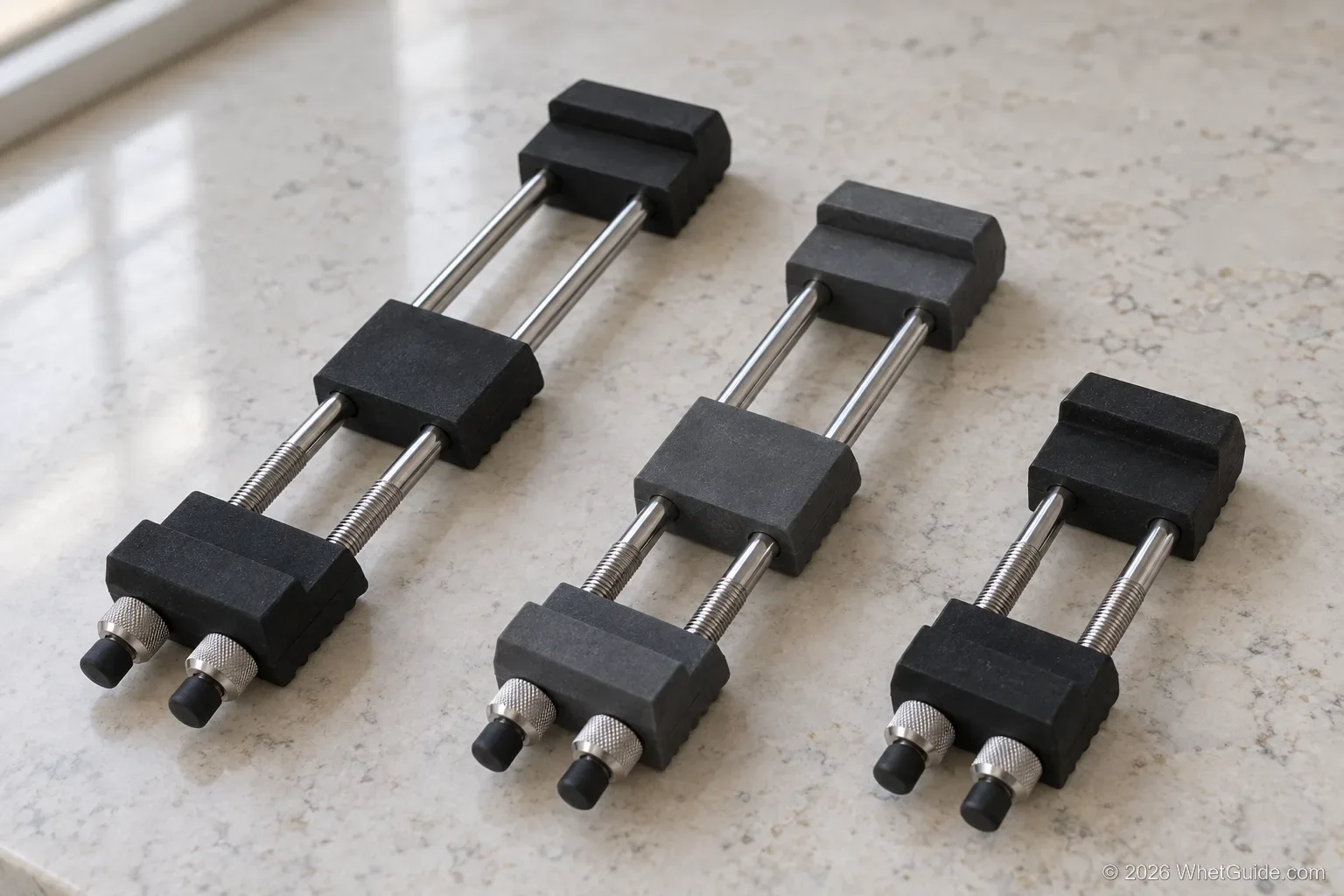
We pulled Amazon's results for "whetstone holder" on Oct 21, 2026, with bought-in-the-past-month counts and rating totals, then checked each listing's stated fit range and size with our product tool. We also went through the holders and sink bridges sold by Sharpening Supplies, a specialist retailer, to see which designs it carries. Page one of Google for this search is almost entirely roundups that never give a fit range, so every pick below lists the range its maker states. On November 15 we reread every listing and confirmed each product was still for sale. On keeping stones still and storing them, we leaned on what Fine Woodworking and Popular Woodworking have published over the years, from David Charlesworth's 2004 waterstone guide to a 2025 tray review. Rating counts on this page are the October 21 figures; they drift by a few each month. How we research.
One caution about the numbers. Amazon pools ratings across related listings, so the POWERTEC adjustable holder and the POWERTEC sink bridge both show the same 2,103 ratings. All it tells you is that POWERTEC holders are popular. It isn't a count for either one. We also left out holders we couldn't pin down: a few names that turn up in roundups had no listing we could match to a fit range, and we don't guess ranges.
↑ Back to all sectionsFive kinds of holder
| Type | How it holds | Best for | Watch out for |
|---|---|---|---|
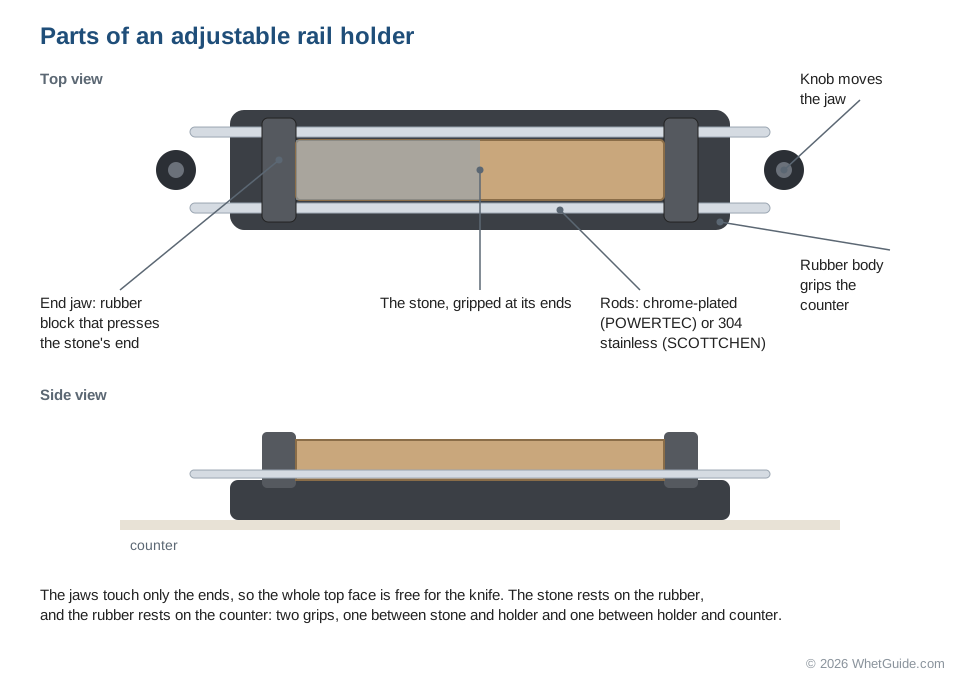
| Adjustable rail (POWERTEC, Kota Japan, S SATC) | Two rubber jaws on metal rods, tightened against the stone's ends | Most stones on a counter or bench | Water runs off onto the counter; add a mat or tray |
| Sink bridge (SCOTTCHEN, Kramer) | A bar that spans the sink, with jaws for the stone | Water stones you splash as you go | Your sink's inner width must fit its range |
| Case that becomes a base (SHARPAL 160H) | The stone sits in a rubber-lined box | Small stones that travel or live in a drawer | Maximum stone size is fixed |
| Tray or mat (SHARPAL 149H, Norton mat) | Grips the stone or holder and catches water | Pairing with a holder, oil stones | A mat alone grips less than jaws do |
| The base in your kit | Bamboo or rubber block | Getting started | Some wobble; swap when it slides |
If you bought a kit or a budget stone, you probably own one of the last kind already. The Sharp Pebble 1000/6000 ships on a bamboo base, the KING KW65 1000/6000 comes with a plastic base, and kits like the Intelitopia set pack a bamboo base plus three rubber ones. Those bases are fine until they aren't. A bamboo base that rocks on a damp counter, or a rubber one that has gone slick, is the usual reason to buy a rail holder. A sink bridge is a different decision: you buy one to move the mess off the counter, and it only makes sense with water stones.
Some retailers sell further variations: holders with a tilted base, single-rod designs, and "pond" bases that sit the stone over a water reservoir. They all do one of two things, either clamping the ends or sitting the stone on a grippy surface, so the questions on this page still apply. Start with the stone range. After that, the material that sits in water and the place the runoff ends up decide the rest.
↑ Back to all sectionsWhat actually stops the stone moving
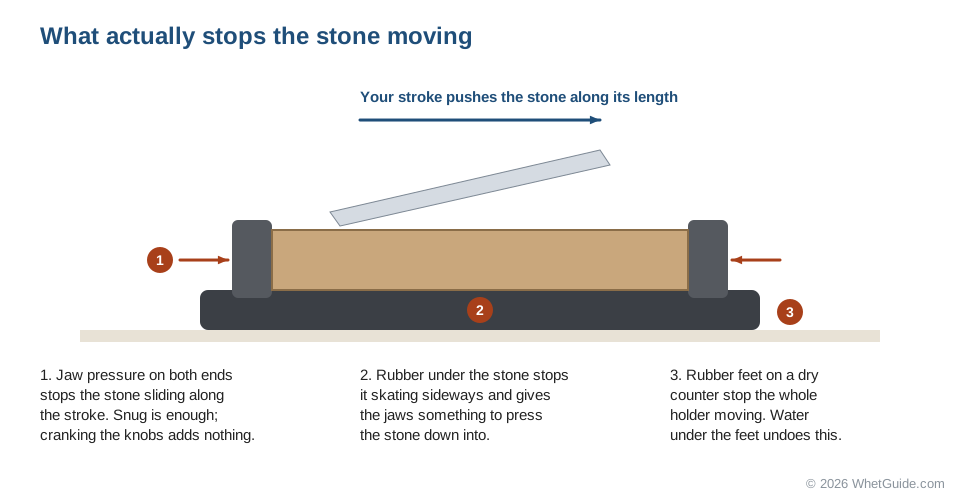
A sharpening stroke pushes the stone along its length, and on the return stroke it pulls it back. The end jaws stop exactly that movement, which is why rail holders feel so much steadier than a towel: nothing can move end to end once the jaws are snug. Sideways skating and lifting are handled by the rubber under the stone, and the holder itself stays put because its rubber feet grip the counter. That last contact is the one people forget. A rubber body sitting on a film of water slides almost as easily as a bare stone, so wiping the counter dry before you set the holder down matters as much as which holder you bought. It also explains why more clamping force doesn't help. Once the jaws stop end-to-end movement, extra turns on the knobs add strain to the threads and rubber without stopping anything new. If a snug stone still moves, look at the other two contacts first. The wobble check further down goes through the four usual causes.
↑ Back to all sectionsWill it fit your stone? Check the length first
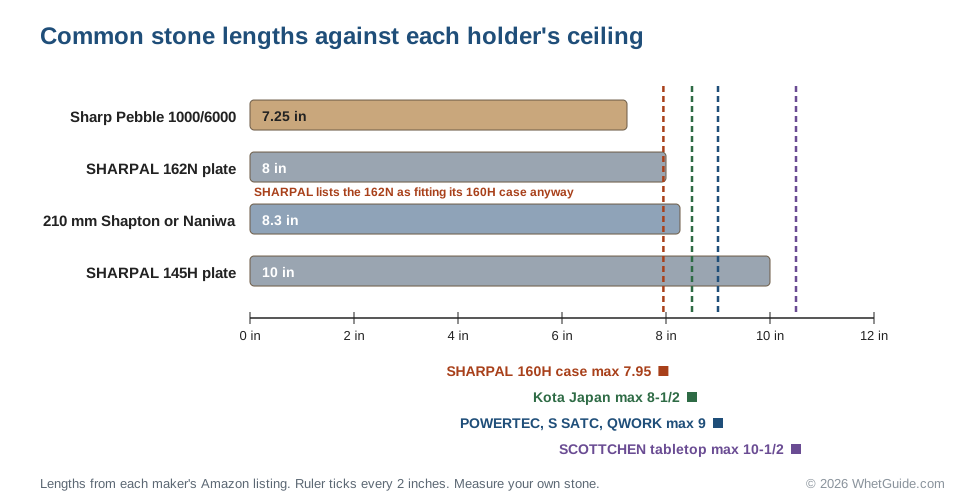
Most whetstones come in two lengths. Budget combination stones run about 7 inches (Sharp Pebble's 1000/6000 listing gives 7.25 x 2.25 x 1 inches). Japanese stones from Shapton and Naniwa are typically 210 mm, about 8.3 inches. Here's how the holders' stated ranges line up:
Thickness is the other check, and thin stones get their own section below. A stone that comes mounted on a base, like the Naniwa Chosera, is measured with the base.
The bottom end of a range matters less often, but it does matter. A 4-inch pocket stone or a short slip won't reach the jaws of a 5-1/2 inch minimum holder at all, which is where the SCOTTCHEN tabletop (from 3-1/8 inches) and the sink bridges (from 3 or 3-1/4 inches) come in. If you own one short stone and one long one, pick the holder by the short one; it's the one that rules out most of the list.
↑ Back to all sectionsCommon stones and the holders that take them
| Stone | Size (from its listing) | Comes with | Holders that take its length |
|---|---|---|---|
| Sharp Pebble 1000/6000 | 7.25 x 2.25 x 1 in | Bamboo base, angle guide | Every holder on this page, including the SHARPAL 160H case |
| Shapton Kuromaku (Pro) 1000 | 210 x 70 x 15 mm (8.3 x 2.8 x 0.6 in) | Plastic case that works as a base | Rail holders and bridges by length; thin, so see thickness |
| Naniwa Chosera 400 | 210 x 70 x 25 mm | Mounted on a base | Usually needs none; measure with the base if you want a bridge |
| KING KW65 1000/6000 | Check your stone | Plastic base | Measure it with and without the base before ordering |
| SHARPAL 162N diamond | 8 x 3 in | Storage box with a non-slip rubber pad that works as a base | Rail holders and bridges; SHARPAL lists it as fitting the 160H case even though 8 x 3 in is over the case's stated 7.95 x 2.95 in maximum |
| SHARPAL 145H lapping plate | 10 x 4 in | Anti-slip rubber base | SCOTTCHEN tabletop and the sink bridges; too long for 9-inch rail holders |
The sizes come from each product's Amazon listing, read in October, and the rows cover stones that come up again and again in our other whetstone guides: the Shapton Kuromaku 1000, the Naniwa Chosera 400 and the SHARPAL 162N among them. Width rarely causes trouble. The POWERTEC rail holder is 2-3/4 inches wide according to its listing, and the jaws close on the ends, so a 3-inch-wide plate still sits on it; the SHARPAL 160H case is the one product here where width is a hard limit, at 2.95 inches. If your stone isn't in the table, a tape measure settles it in ten seconds. Do it before every holder order.
↑ Back to all sectionsThin stones and plates: why they sit low
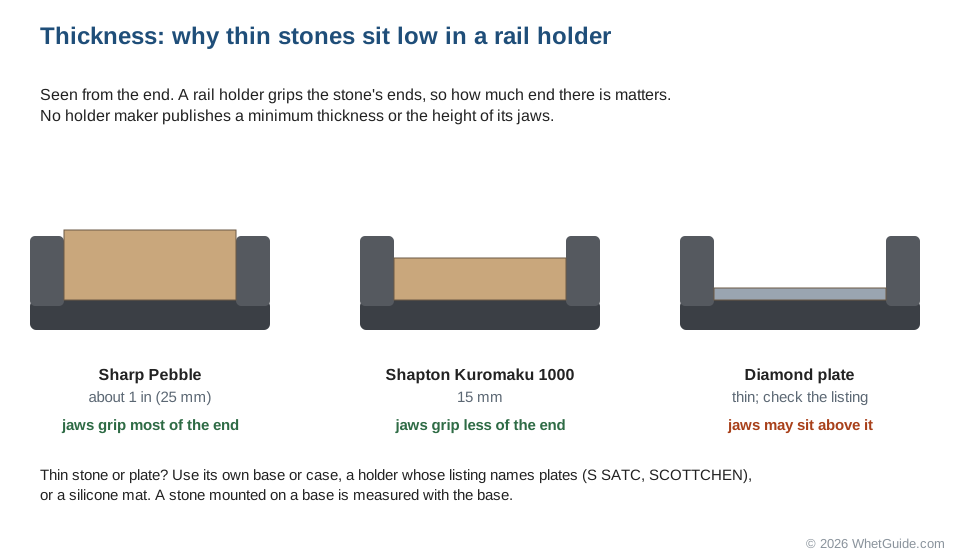
The classic inch-thick combination stone sits high and square between a rail holder's jaws. Splash-and-go stones are thinner, and as they wear they get thinner still. A diamond plate is thinner again: SHARPAL lists the steel under its 162N's diamond at 0.35 inch. Less end means less for the jaws to press. Nobody publishes a minimum, so we can't give you a number. What we can say is where the listings point. S SATC describes its rail holder as designed for diamond stones, SCOTTCHEN lists diamond plates for its tabletop holder and both bridges, and SHARPAL's own plates come with a box or pad that works as a base.
A worn stone is worth a separate thought. If you've flattened a stone for a couple of years and it's now noticeably thinner, it may have started slipping in a holder it used to sit in firmly. Before blaming the holder, set the stone on a silicone mat or its original base and see whether it behaves.
↑ Back to all sectionsThe best whetstone holders
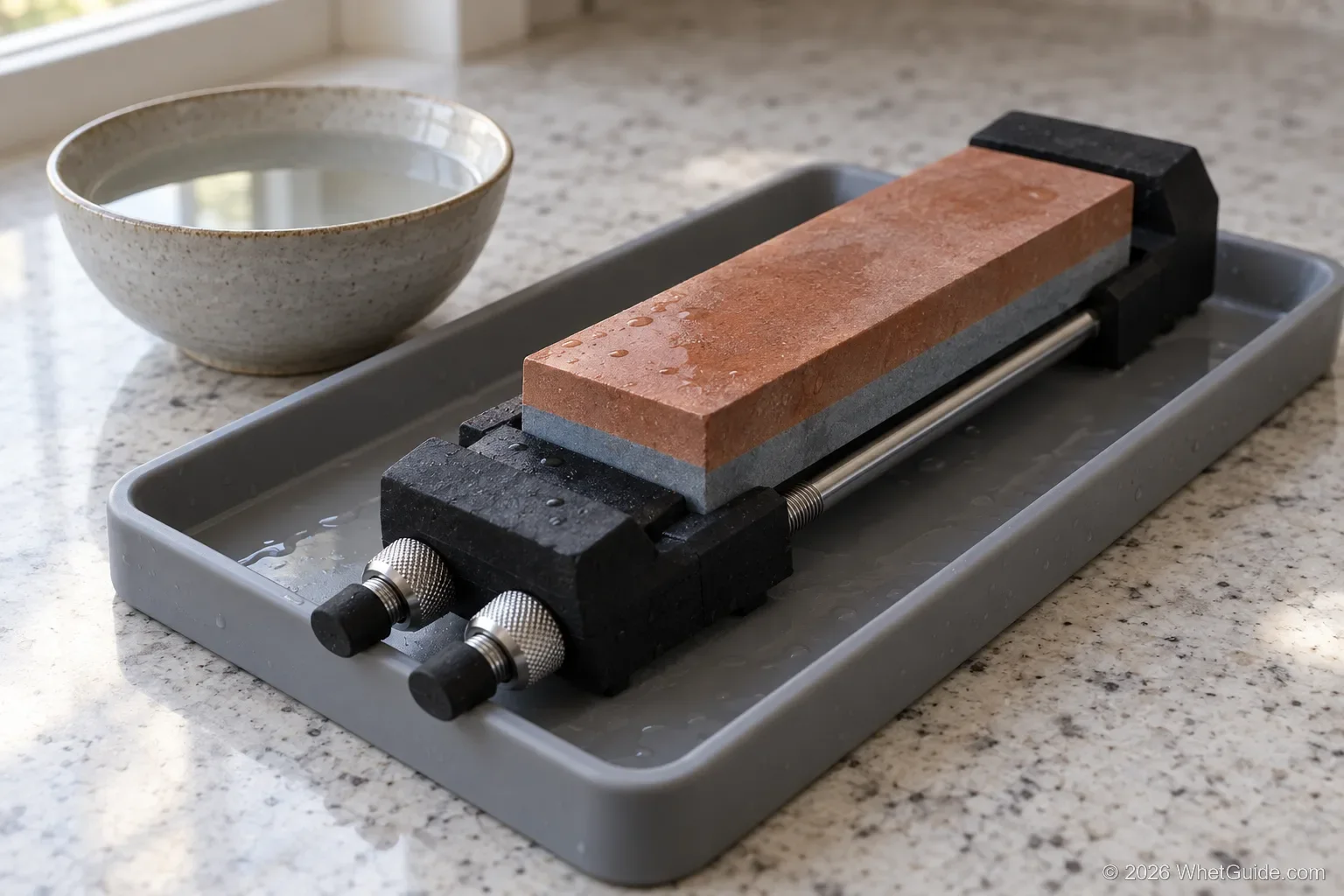
POWERTEC Adjustable Sharpening Stone Holder
The holder that most of Amazon buys, at about 300 a month when we checked. A rubber body sits on the counter, and two jaws on chrome-plated rods tighten against the stone's ends with ridged knobs. The 5-1/2 to 9 inch range covers a 7-inch budget stone and a 210 mm Japanese stone with room to spare. POWERTEC lists oil stones and diamond plates as compatible, as well as water stones. Chrome plating resists rust as long as you dry the holder after use; it's the one habit this holder asks of you.
- Fitsstones 5-1/2 to 9 in long
- Width2-3/4 in
- Bodynon-slip rubber
- Armschrome-plated
- Usewater, oil, diamond stones
- Ratings2,103 (4.7, shared with POWERTEC's sink bridge)
Why it stands out
- Fits nearly every kitchen whetstone
- Rubber body grips the counter
- Quick knob adjustment between stones
Think twice if
- Your stone is longer than 9 inches
- You want water to go down the sink instead of onto the counter
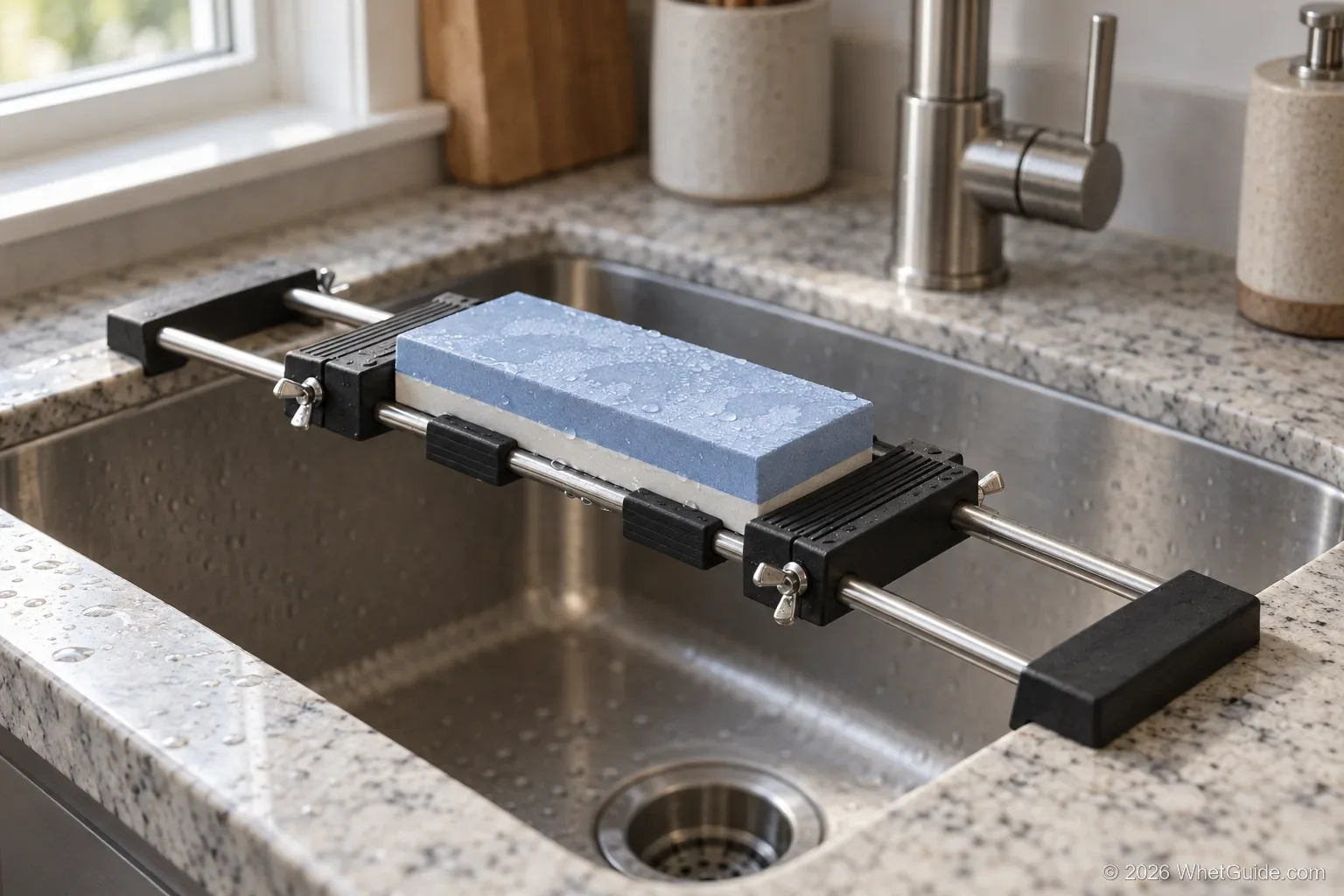
SCOTTCHEN 17-3/4 in Sink Bridge
The highest-rated holder here. It spans the sink so the water and slurry rinse straight down the drain, and it raises the stone above the rim so your knuckles clear the edge. The stone range is the widest of any holder we found. SCOTTCHEN's listing is blunt about the one thing that can go wrong: measure the inside of your sink basin first. It needs to be at least 6-3/4 and no more than 17-3/4 inches across. POWERTEC sells a bridge with the same ranges, the POWERTEC sink bridge.
- Fitsstones 3-1/4 to 14-1/4 in
- Sinkinner width 6-3/4 to 17-3/4 in
- Build304 stainless poles and screws, solid rubber body
- Ratings644 (4.8)
Why it stands out
- No water on the counter
- Holds stones from 3-1/4 to 14-1/4 inches
- Stainless hardware for a wet job
Think twice if
- Your sink is wider than 17-3/4 inches inside; see the 24-inch model below
- You use oil stones
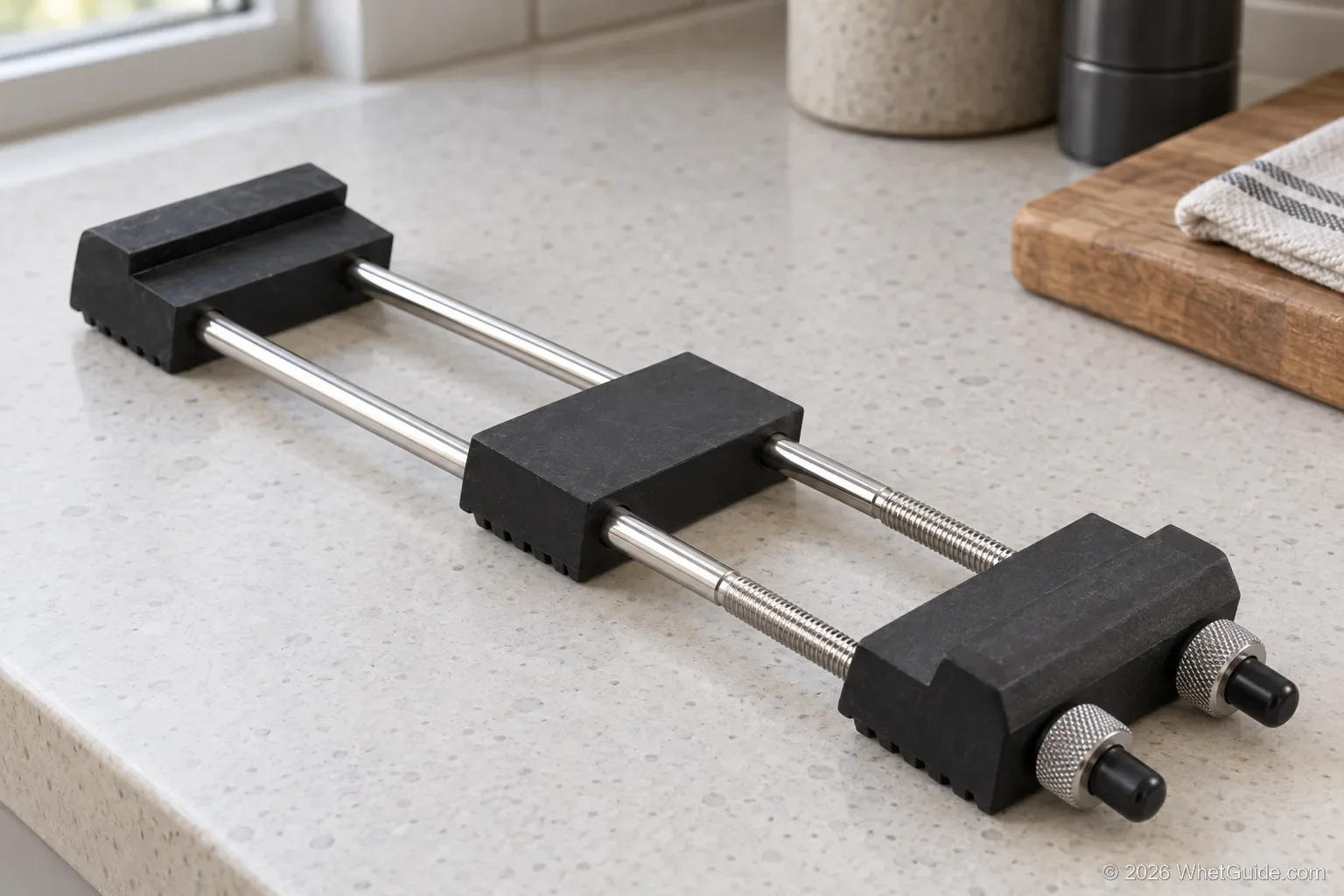
Kota Japan Stainless Steel Whetstone Holder
A simpler stainless holder with a narrower range, 6 to 8-1/2 inches. That still fits a 7-inch combination stone and a 210 mm stone, which is what most people own. Pick it over the POWERTEC if you'd rather have stainless steel than chrome plating on something that lives wet. The narrow range is the trade: there's no room for a 9-inch stone or a short slip, so it suits someone who owns one or two standard stones and doesn't plan to branch out.
- Fitsstones 6 to 8-1/2 in
- Buildstainless steel, non-skid rubber base
- Ratings462 (4.7)
Why it stands out
- Stainless build
- Covers the two common stone lengths
Think twice if
- You have a short stone under 6 inches, or a long one over 8-1/2
SCOTTCHEN Tabletop Whetstone Holder
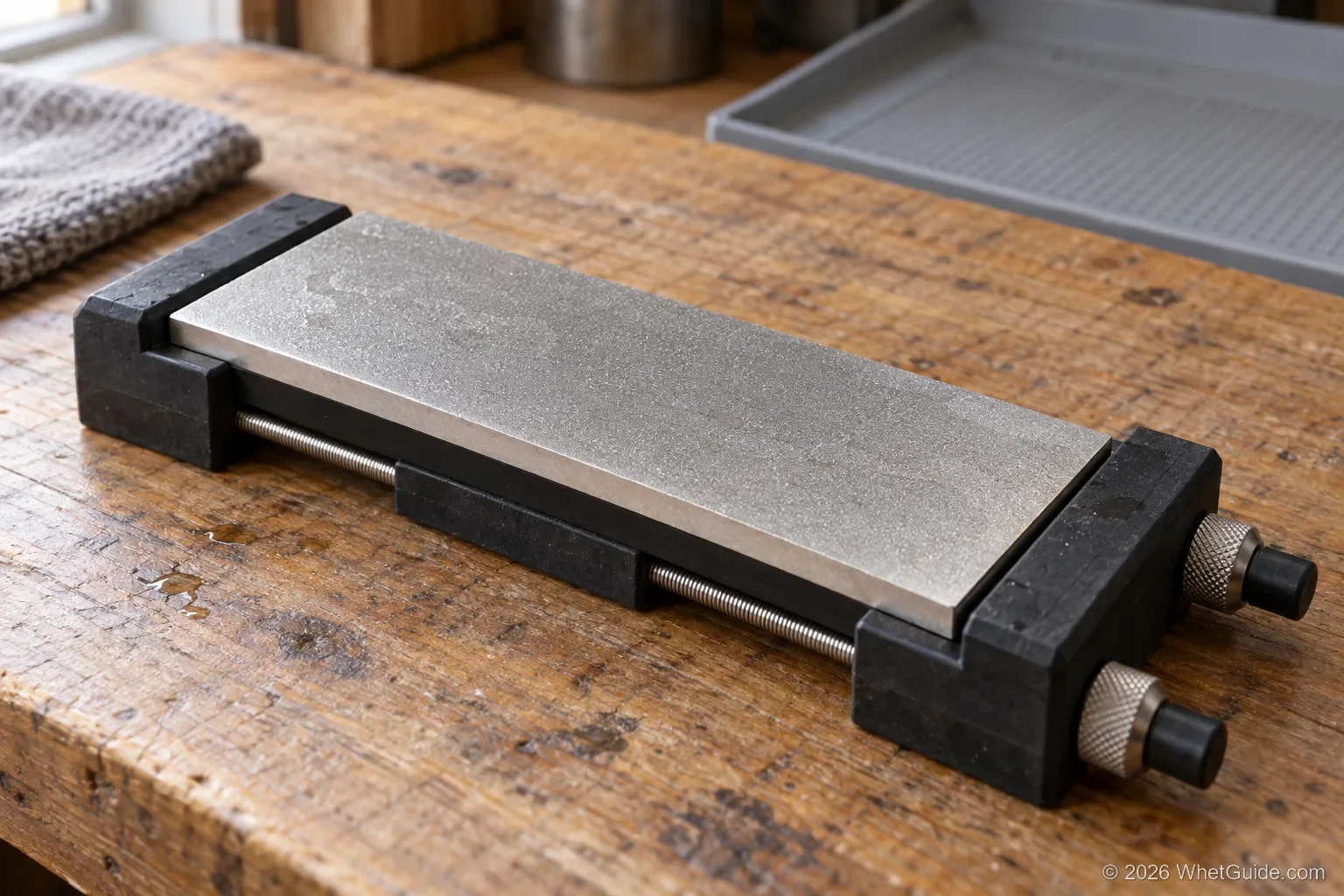
For the bench or counter, with a much wider range than the rail holders: anything from a 3-inch pocket stone to a 10-1/2 inch bench stone or diamond plate. The listing says plainly that it isn't a sink bridge. It's the one to get if you sharpen tools on large stones as well as knives, and it's the only countertop holder here that takes a 10-inch lapping plate like the SHARPAL 145H.
- Fitsstones 3-1/8 to 10-1/2 in
- Build304 stainless rods, solid rubber blocks
- Usetabletop only, not for sinks
- Ratings297 (4.6)
Why it stands out
- Takes short and long stones alike
- Rust-resistant 304 stainless rods
Think twice if
- You want to sharpen over the sink
SHARPAL 149H Silicone Whetstone Tray
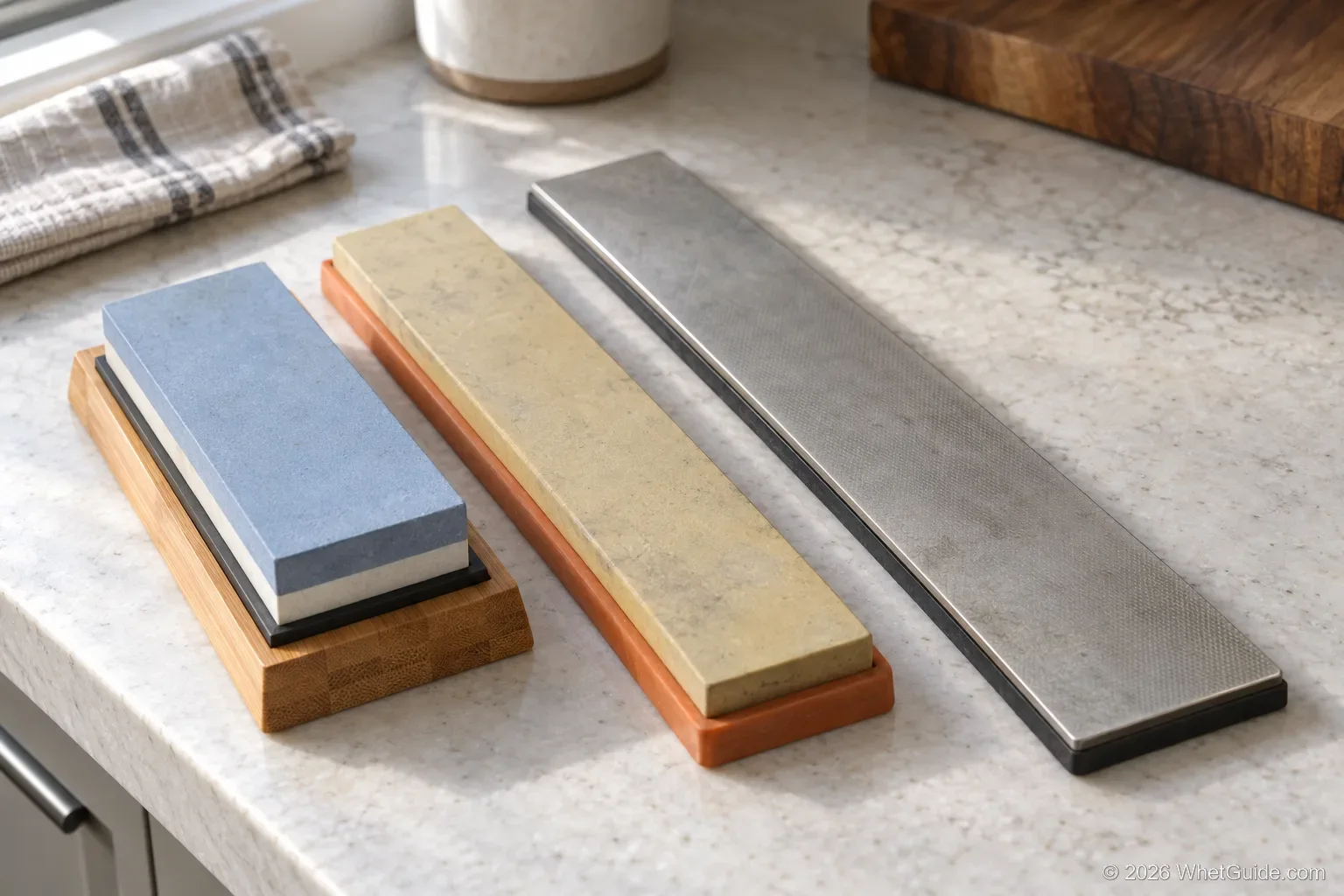
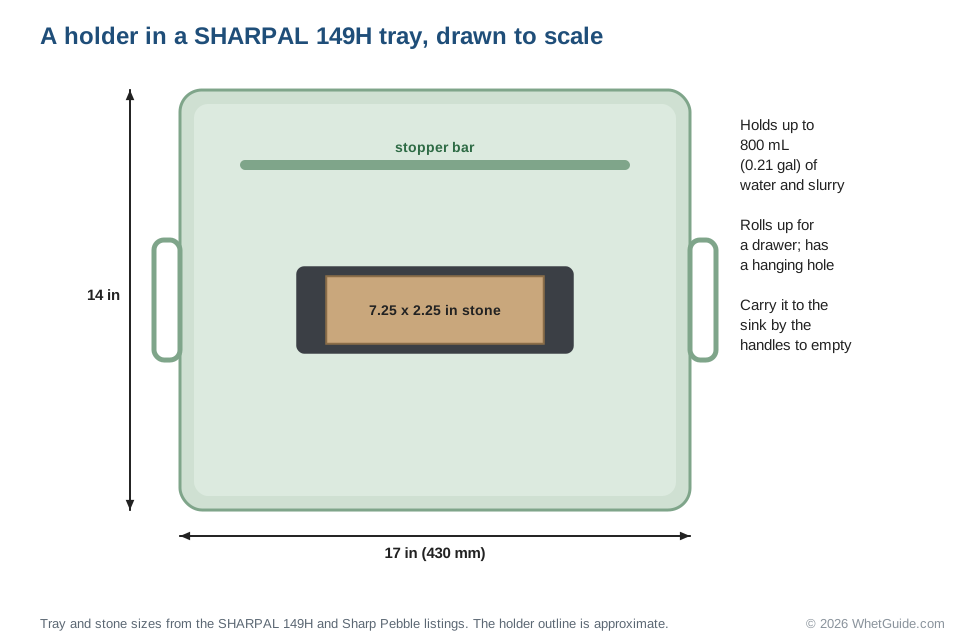
A silicone tray with raised edges that catches the water and slurry a countertop holder sends everywhere. The stopper bar keeps a stone from sliding on its own, but it works best with a holder or kit base sitting in it. When you're done, carry it to the sink by the handles and pour it out. It sold about 200 a month when we checked.
- Size17 x 14 in (430 x 360 mm)
- Holdsup to 800 mL of water
- Gripanti-slip texture and a stopper bar
- Storagerolls up, hanging hole
- Ratings239 (4.6)
Why it stands out
- Contains water and slurry
- Rolls up for a drawer
Think twice if
- You already sharpen over the sink
SHARPAL 160H Holder and Storage Case (2-pack)
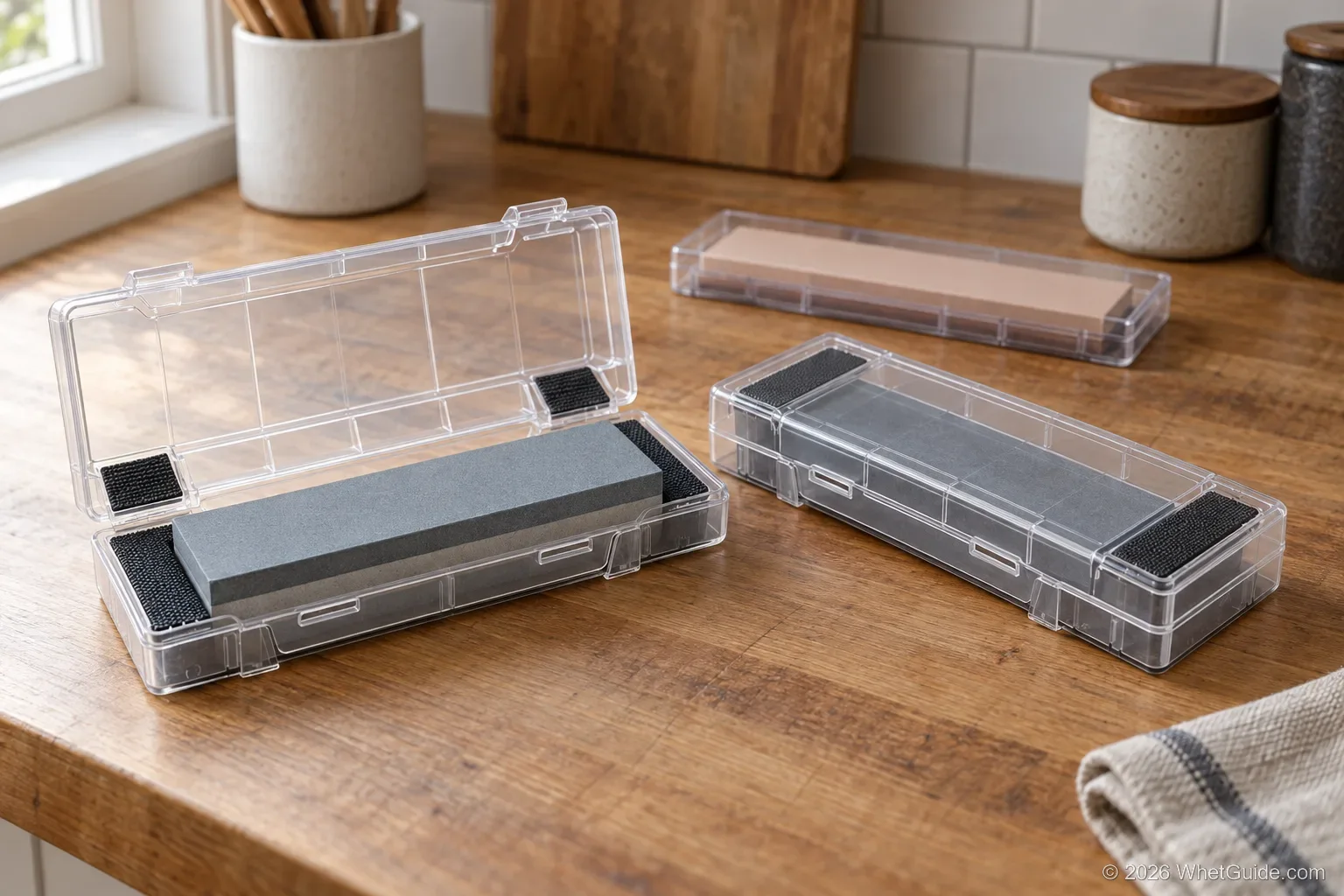
Two clear boxes that hold a stone or strop while you sharpen and close over it for storage. They fit a 7-inch combination stone, and SHARPAL names its own 162N diamond plate as a model the case takes, even though that plate's nominal 8 by 3 inches is a touch over the stated maximum. They keep coarse grit away from fine stones in a drawer. They won't take a 210 mm Japanese stone, which is longer than the 7.95-inch maximum.
- Fitsstones up to 7.95 x 2.95 x 1.1 in
- Useholder in use, snap-shut case in storage
- Basetextured rubber inside, anti-skid rubber underneath
- Ratings164 (4.4)
Why it stands out
- Holder and case in one
- Keeps each stone separate in storage
Think twice if
- Your stones are 210 mm or longer
All six side by side
| Pick | Type | Stone length | Other limit | Wet parts | Ratings (Oct 21) |
|---|---|---|---|---|---|
| POWERTEC adjustable | Rail holder | 5-1/2 to 9 in | Width 2-3/4 in | Chrome-plated arms | 2,103 pooled with POWERTEC's bridge (4.7) |
| SCOTTCHEN 17-3/4 in bridge | Sink bridge | 3-1/4 to 14-1/4 in | Sink 6-3/4 to 17-3/4 in inside | 304 stainless | 644 (4.8) |
| Kota Japan | Rail holder | 6 to 8-1/2 in | None stated | Stainless | 462 (4.7) |
| SCOTTCHEN tabletop | Rail holder | 3-1/8 to 10-1/2 in | Tabletop only | 304 stainless rods | 297 (4.6) |
| SHARPAL 149H tray | Tray | Any that fits on 17 x 14 in | 800 mL capacity | Silicone | 239 (4.6) |
| SHARPAL 160H case | Case and base | Up to 7.95 in | 2.95 in wide, 1.1 in thick | Plastic and rubber | 164 (4.4) |
Sink bridges: measure two numbers, not one
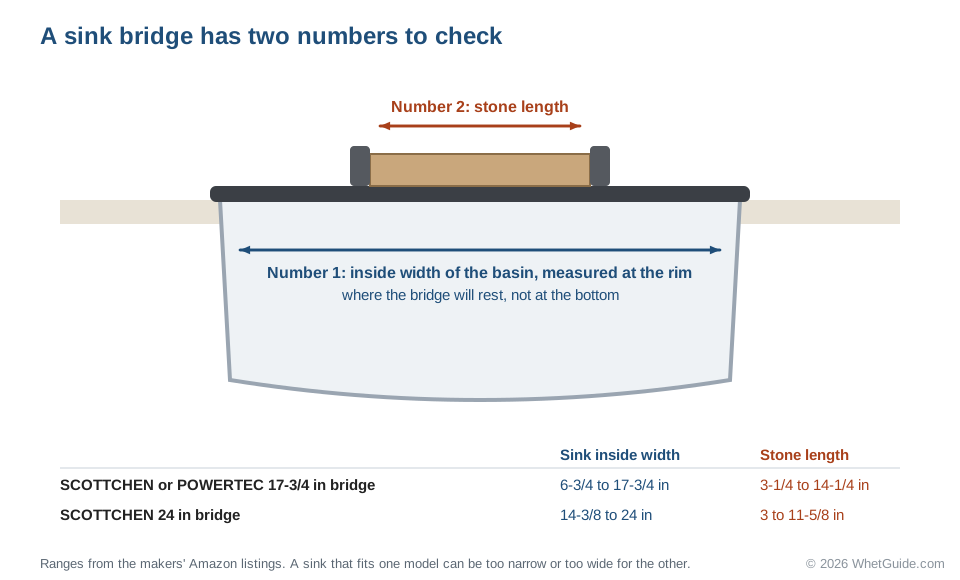
Every sink-bridge listing we read says some version of "measure first", and it's the right advice, because the bridge rests on the rim of the basin and an inch either way decides whether it sits or falls in. The catch is that there are two ranges on each listing, and they're easy to mix up. One is the inside width of the sink the bridge can span. The other is the length of stone its jaws can hold. The SCOTTCHEN and POWERTEC 17-3/4 inch bridges span sinks 6-3/4 to 17-3/4 inches wide and hold stones 3-1/4 to 14-1/4 inches long. The SCOTTCHEN 24 inch bridge spans 14-3/8 to 24 inches, for wide farmhouse sinks, and its stone range is shorter, 3 to 11-5/8 inches. A sink between 14-3/8 and 17-3/4 inches inside fits either model.
Here's how to measure without guessing:
- Decide which basin you'll use. In a double sink, measure each side. One may fit the standard bridge when the other doesn't.
- Measure straight across the inside of the basin at the rim, where the bridge's feet will sit. Sinks taper toward the bottom, so a measurement lower down reads short.
- Measure in the direction you'll stand. A bridge spans the basin side to side or front to back, and the two distances are often different.
- Check the number against the bridge's sink range. If you're near either end of a range and your sink also fits the other model, pick the one where you sit closer to the middle.
- Measure your stone's length, with its base if it's mounted, and check it against the stone range.
- Look up. A tall faucet or a low cabinet over the sink can get in the way of a full stroke once the stone is raised above the rim.
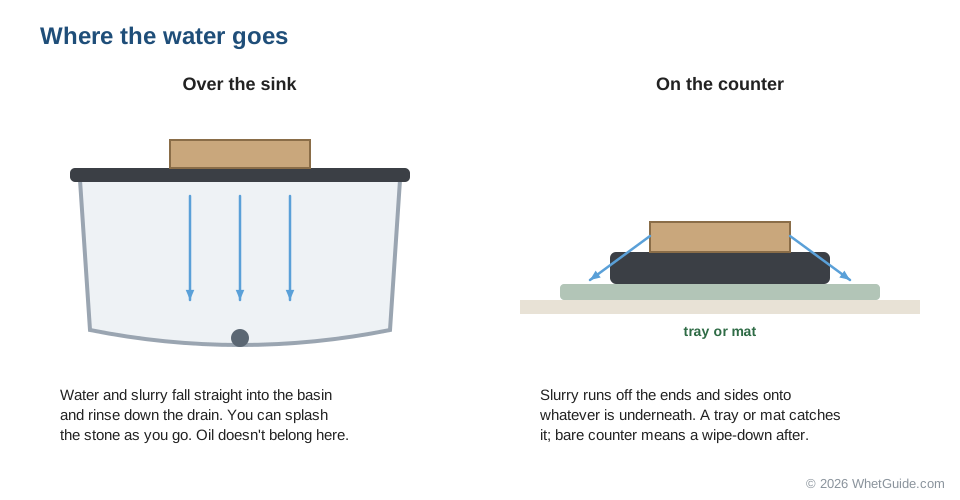
The payoff is real for water stones. SCOTTCHEN's listing makes the case: everything the stone sheds washes straight down the drain, metal filings included, and you can keep the stone wet without a towel. Sharpening Supplies, which sells both bridges and countertop holders, says something similar about its adjustable bridge: if you sharpen with water, working over a sink is convenient. A bridge's rubber ends protect the sink, and the 24-inch SCOTTCHEN adds two silicone pads for extra grip. The Kramer by Zwilling bamboo bridge is the good-looking option, made in Japan to go with Kramer's stones, though its listing gives no sink or stone range. Check your stone size and sink width against the seller's figures before ordering.
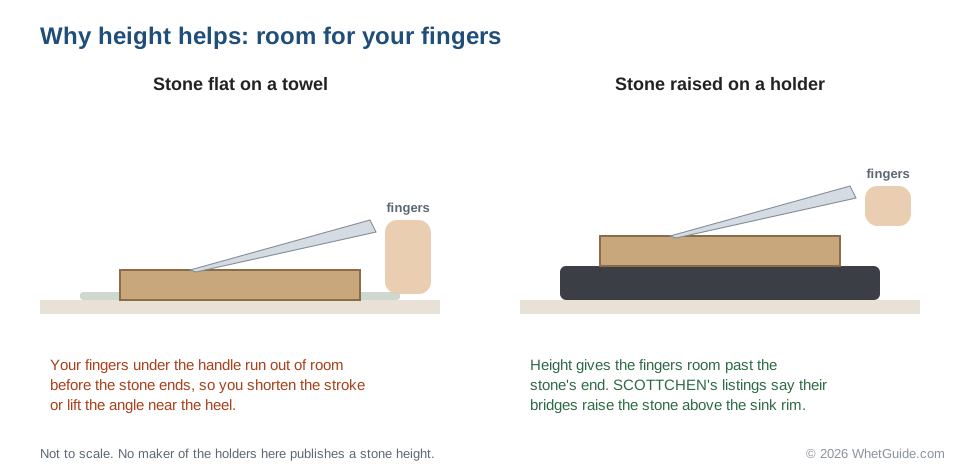
The other advantage is height. SCOTTCHEN says its bridges raise the stone above the sink rim to give your knuckles room. That's the problem with a stone lying flat on a towel: the fingers wrapped under the handle run out of space before the stone ends. Chef Knives To Go, which sells its own universal countertop holder, gives that holder's stone elevation as about 7/8 inch, so height isn't only a bridge feature. None of the holders on our list publishes a height figure, so we can't rank them on it. What we'd say is that if you've been shortening your strokes near the end of the stone, any raised holder will feel better than the towel did.
↑ Back to all sectionsOther holders you'll see, and how they compare
| Holder | Stated range | Build | Why it's not a main pick |
|---|---|---|---|
| POWERTEC sink bridge | Sinks 6-3/4 to 17-3/4 in; stones 3-1/4 to 14-1/4 in | 304 stainless, rubber, star knobs | Same ranges as the SCOTTCHEN; its ratings are pooled with POWERTEC's rail holder, so there's no separate count to judge it by |
| SCOTTCHEN 24 in bridge | Sinks 14-3/8 to 24 in; stones 3 to 11-5/8 in | Stainless pole (3/8 in), aluminum blocks, two silicone pads | Only for wide sinks; a strong pick if yours is one |
| S SATC holder | 5-1/2 to 9 in | Rubber and stainless | Same range as the POWERTEC; listed as designed for diamond stones |
| QWORK holder | 5-1/2 to 9 in | Chrome-plated iron and silicone | Same range again, fewer ratings |
| Kramer bamboo bridge | Not stated | Bamboo, made in Japan | No range on the listing; check your stone and sink first |
| Naniwa A-902 | Not stated | Not stated on Amazon | The listing says only "High quality"; check your stone size |
Three rail holders on this list share the same 5-1/2 to 9 inch range: the POWERTEC, the S SATC and the QWORK. With fit settled, the deciding detail is what the wet parts are made of. POWERTEC lists chrome-plated arms and QWORK chrome-plated iron, while S SATC lists stainless steel; the Kota Japan, with its shorter 6 to 8-1/2 inch range, is stainless too. Chrome plating holds up if you dry the holder after every session. If you know you'll leave it on the drainboard, stainless is the more forgiving choice. People who own Naniwa or Kramer stones tend to ask about those brands' own holders. Both may suit your stones well, and we'd like to tell you their ranges, but neither Amazon listing gives one.
↑ Back to all sectionsWhich holder for your setup
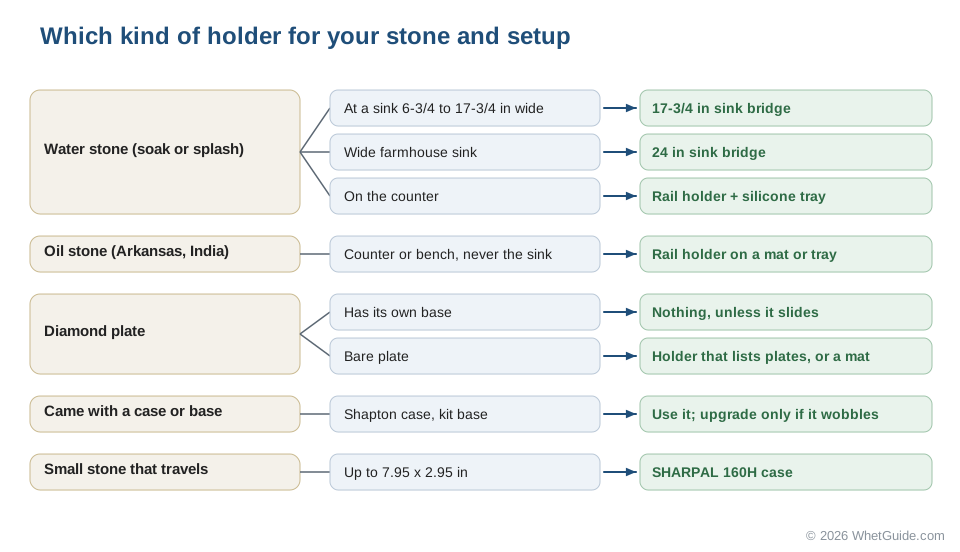
| Where and what you sharpen | Get |
|---|---|
| Water stones, a standard kitchen sink | SCOTTCHEN 17-3/4" sink bridge (measure the inside of the sink) |
| Water stones, a wide farmhouse sink | SCOTTCHEN 24" sink bridge: sinks 14-3/8 to 24 in, stones 3 to 11-5/8 in |
| Counter, one or two 7 to 8 inch stones | POWERTEC holder on a SHARPAL tray |
| Oil stones (Arkansas, India) | A rail holder on a Norton silicone mat (8 x 14 in); keep oil out of the sink |
| Workshop stones and long plates | SCOTTCHEN tabletop, 3-1/8 to 10-1/2 in |
| A Shapton stone in its case | Nothing. The case is the holder |
| A diamond plate with its own base | Nothing, unless the base slides |
Mats and trays: the half of the job a holder ignores
A rail holder fixes the stone. It does nothing about the gray water that runs off both ends, and on a counter that water goes somewhere. Fine Woodworking has come back to this problem more than once. In January 2025 Asa Christiana reviewed Rockler's silicone sharpening trays for the same magazine, and his reason for liking them is telling: the waterstones he'd been setting on old silicone potholders tended to wobble, and the trays' grippy dimples kept them level while channels carried the water away.
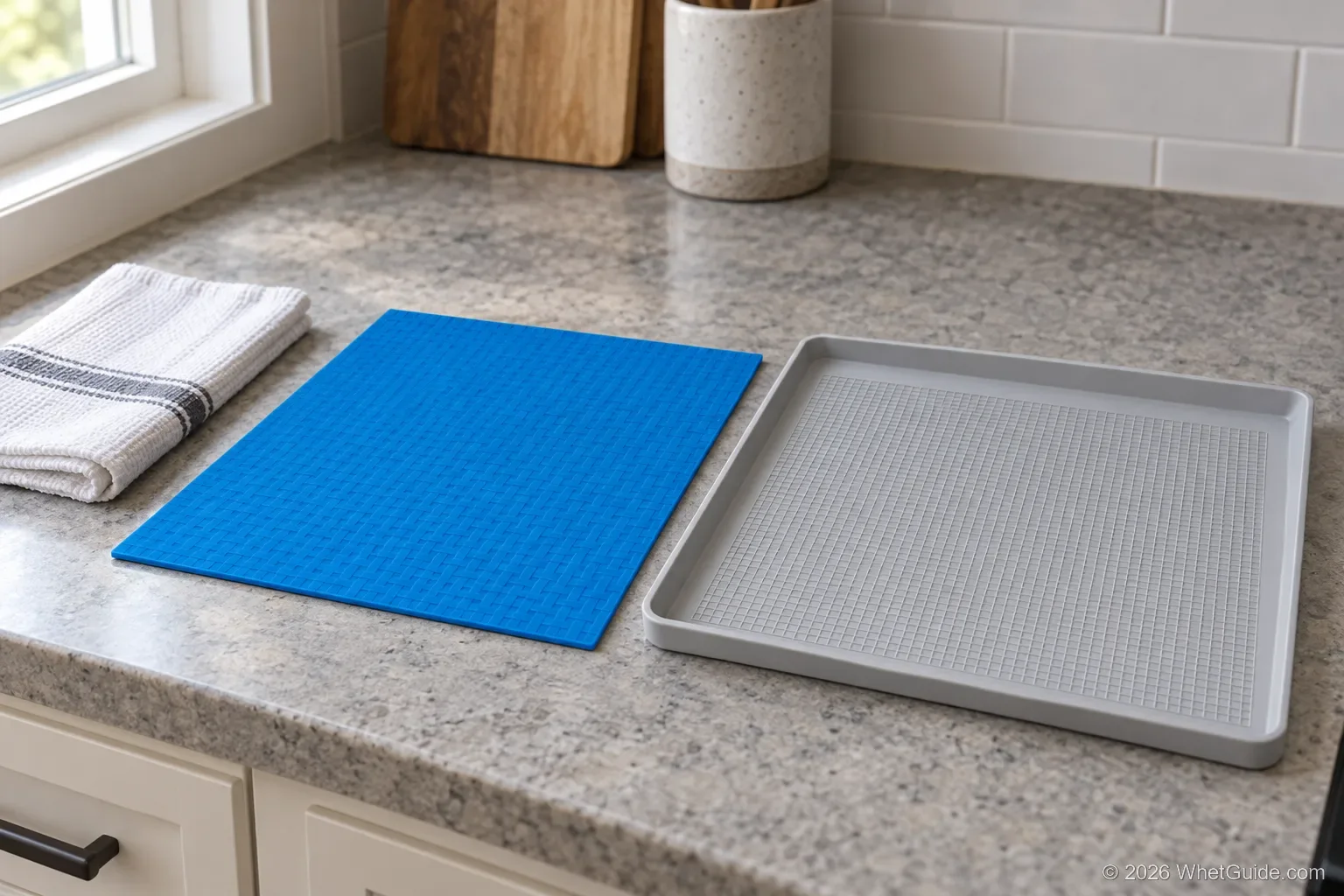
Popular Woodworking's Yoav Liberman came at it from the cheap end in 2020, using a child's silicone placemat as a sharpening mat. His verdict is useful because it's honest about the limits. The placemat kept the stone still most of the time and kept the water contained thanks to its raised rim, but he said plainly that it doesn't guarantee shift-free sharpening, and thin silicone can skid or fold. That's the trade with any mat used alone. Under a rail holder, though, a mat or tray only has to stop the holder and catch water, which it does well. The Norton silicone mat is 8 by 14 inches, textured on both sides, and Norton says it keeps slurry off the bench, whether it comes from a water stone or an oil stone. The SHARPAL 149H is bigger, at 17 by 14 inches, with raised edges, an 800 mL capacity and handles for carrying it to the sink.
| Surface | Grips the stone alone? | Catches water? | Use it when |
|---|---|---|---|
| Damp towel on a board | Fairly; compresses on long strokes | Soaks some up | You're learning or sharpening once a month |
| Silicone baking mat or placemat | Mostly; can skid or fold if thin | A placemat's rim holds some | You want a cheap fix that washes clean |
| Norton silicone mat, 8 x 14 in | Better; textured both sides | Keeps it off the bench | Oil stones, or under a rail holder |
| SHARPAL 149H tray, 17 x 14 in | Stopper bar holds an oil stone | Up to 800 mL inside raised edges | Water stones on a counter with a holder in it |
| Rail holder plus tray | Yes; jaws on the ends | Yes | Regular sharpening on the counter |
Oil stones: keep them on the bench
Arkansas and India stones use oil, and oil changes the setup. Most of the holders here say they'll take an oil stone (POWERTEC, QWORK, the SCOTTCHEN tabletop and both SCOTTCHEN bridges name them), so grip isn't the issue. The issue is the runoff. Oil and steel swarf don't belong in a kitchen drain, which rules out the sink bridge for oil stones even though the bridge would hold one perfectly well. Use a rail holder on the counter or bench with something under it that contains oil. Norton names oil specifically for its mat, and SHARPAL describes the 149H tray's stopper bar as being there to hold an oil stone in place. Wipe the holder's rubber after an oil session as well; a film of oil on the feet is a slippery thing to set down on a counter next time. If you're choosing between oil and water stones in the first place, our Arkansas stone guide and the page on sharpening stone oil cover that side.
↑ Back to all sectionsDiamond plates: often you need nothing
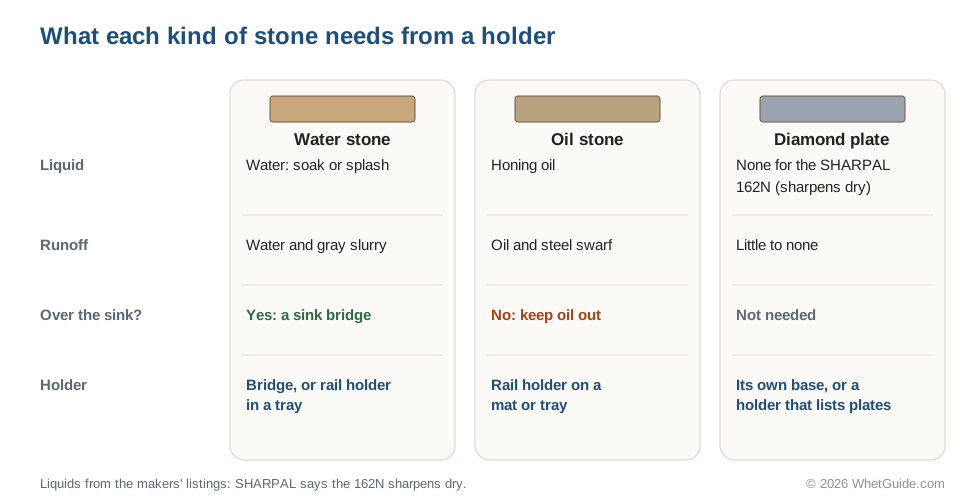
Diamond plates are the stone type least likely to need a separate holder. Many come with a base already, and SHARPAL's 162N is a typical case: it ships in a storage box with a non-slip rubber pad that its listing says doubles as a stone base, and the lapping plate SHARPAL sells, the 145H, has an anti-slip rubber base of its own. SHARPAL says the 162N sharpens dry, with no water or oil, so the mess problem that makes sink bridges attractive mostly goes away. Buy a holder for a plate only if its base slides or the plate is bare. When you do, a holder whose listing names plates is the safer choice: S SATC says its holder is designed for diamond stones, and the SCOTTCHEN tabletop takes a 10-inch plate where 9-inch rail holders can't. For picking the plate itself, see the best diamond sharpening stone guide.
↑ Back to all sectionsFlattening with a holder
Water stones wear in use; David Charlesworth put it plainly in his 2004 Fine Woodworking guide to waterstones, writing that they're designed to erode and that beginners hollow them quickly. Flattening is the fix, and a holder makes it easier: lock the stone in a rail holder or on a bridge, then rub a flattening stone or lapping plate across it. A sink bridge suits water stones here too, since the slurry goes down the drain. Some people prefer the opposite approach, with the plate fixed on the counter and the stone moved over it. Either works as long as nothing rocks. For the flattener, a silicon carbide block like the Sharp Pebble 120/320 is the cheap start, and a diamond plate like the SHARPAL 145H lasts longer. Our best flattening stone picks cover the plate side of that job, and how to flatten a whetstone has the method. One holder-specific tip: after flattening, take the stone out and rinse the jaws and rods, because flattening grit packed into the jaws ends up on the next stone you clamp.
↑ Back to all sectionsStone still moving? Find the cause
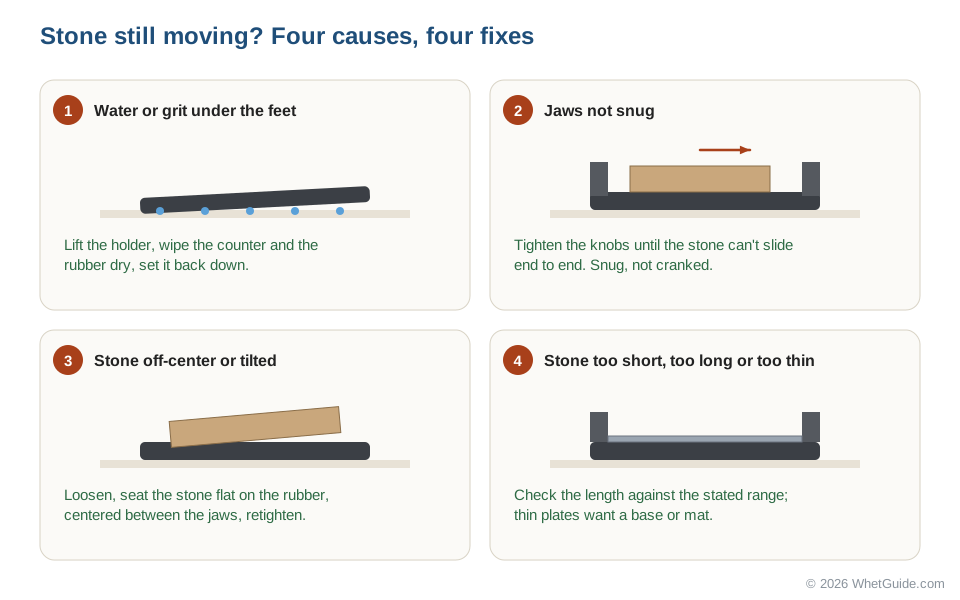
| What you notice | Likely cause | Fix |
|---|---|---|
| The whole holder creeps across the counter | Water or slurry under the rubber feet | Lift it, wipe the counter and the feet dry, set it down again; put a mat or tray under it |
| The stone shifts end to end inside the holder | Jaws not snug, or the stone is near the bottom of the range | Tighten until it can't slide; if the jaws bottom out, the stone is too short for this holder |
| The stone rocks side to side | Seated off-center, tilted, or a dished base underneath | Loosen, seat it flat and centered on the rubber, retighten |
| The sink bridge sags or tips | Sink near either end of the bridge's range | Remeasure at the rim; switch to the other bridge size if you're at the limit |
| An oil stone skates even when clamped | Oil film on the rubber or the counter | Degrease the feet and counter; work on a mat or tray |
| A kit's bamboo base slides | Wet bamboo on a smooth counter | Set the base on a damp towel or silicone mat, or move to a rail holder |
Start with the first row. A counter that looked dry when you started doesn't stay dry once you splash a water stone, and a holder slides on that film. That's the strongest argument for a tray under a countertop holder, and it's why a bridge, whose feet sit on the dry counter outside the basin, tends to stay put.
↑ Back to all sectionsCare: rinse it, then dry the threads
A holder spends its working life wet, and the parts that suffer are the metal ones. Chef Knives To Go is unusually frank about this on its own universal stone holder's page: the rails and hardware aren't stainless, they'll rust if left wet, and the shop's advice is to rinse the holder, dry the threaded adjusters, and give them a light coat of oil every few months. That advice applies to any holder with chrome-plated or plain steel parts, which includes the POWERTEC and QWORK rail holders by their own descriptions. Stainless rods, like the 304 stainless on the SCOTTCHEN models, are more forgiving, but slurry left to dry in the threads still makes the knobs gritty and stiff.
| When | What to do | Why |
|---|---|---|
| After every session | Take the stone out, rinse the holder under the tap, wipe the rods and knobs, dry it on a towel | Slurry and steel swarf dry hard in the jaws and threads |
| After flattening | Rinse the jaws and rubber with extra care | Coarse flattening grit left behind ends up on your next, finer stone |
| After an oil stone | Wipe oil off the rubber feet and body with a little dish soap | An oily base slides on the counter next time |
| Every few months (non-stainless) | A light coat of oil on the threaded parts | Chef Knives To Go's advice for metal hardware that isn't stainless |
| When the rubber goes slick | Wash it in warm soapy water; replace the holder if it still won't grip | Rubber that has lost its grip undoes the whole point of the holder |
| Trays and mats | Pour out, wash with soap and water, roll or hang to dry | Norton says its mat washes with soap and water; SHARPAL's tray rolls up and has a hanging hole |
Storing stones and holders

The holder is the easy part: dry it and put it in a drawer. Stones are where storage choices matter. David Charlesworth described his own routine in a Fine Woodworking guide to waterstones back in 2004. He kept his 800 and 1,200 grit stones on their sides in plastic trays of shallow water, kept finer stones dry and sprayed them before use, and warned against storing stones in water anywhere that might freeze. Whatever you store, keep coarse grit away from fine stones. This is where the SHARPAL 160H earns its place: each stone, up to 7.95 x 2.95 x 1.1 inches, gets its own snap-shut box that also works as a holder, and a clear lid shows which grit is inside. Shapton's case does the same job for its stones. For stones without a case, a towel between them in a drawer is the low-tech answer. Make sure a soaked stone is dry before it goes into any closed box.
↑ Back to all sectionsFive kitchens, five answers
| The setup | What to get | Why |
|---|---|---|
| A Sharp Pebble 1000/6000 on its bamboo base, which slides on a granite counter | Try a damp towel or silicone mat under the base first; if it still moves, a POWERTEC holder | The 7.25-inch stone fits every holder; the cheapest fix is more grip under what you have |
| Two 210 mm Japanese water stones and a single-basin sink 16 inches wide inside | SCOTTCHEN or POWERTEC 17-3/4 inch bridge | 16 inches is inside the 6-3/4 to 17-3/4 range, and an 8.3-inch stone is well inside 3-1/4 to 14-1/4 |
| A 30-inch farmhouse sink and soaking stones | A rail holder in a SHARPAL 149H tray on the counter | 30 inches is wider than even the 24-inch bridge spans |
| An Arkansas stone, a 10-inch diamond lapping plate and chisels in a garage | SCOTTCHEN tabletop on a Norton mat | Takes 3-1/8 to 10-1/2 inches, the only countertop holder here that fits the plate; the mat contains oil |
| One small stone and a strop that go camping | SHARPAL 160H 2-pack | One box for the stone, one for the strop; each works as a base on a picnic table |
What to look for in a holder
Grip comes first. Rubber jaws and a rubber base stop the stone, whatever the steel looks like. Stainless or 304 stainless hardware earns its place only because a holder spends its life wet. Height is underrated: a sink bridge lifts the stone above the rim, and on a counter a raised holder or a stone on a thick base does a similar job. Holders with a built-in angle guide come up in searches. Angle guides clip to the knife, not the holder, so any holder works with them. Our how to use a whetstone guide covers finding and holding the angle. Before ordering, run through this list:
- Your stone's length, measured, sits inside the stated range, ideally not at either end.
- For a bridge, your sink's inside width at the rim sits inside the sink range too.
- Thin stone or bare plate: the listing names plates, or you have a base or mat instead.
- The parts that stay wet are stainless, or you're happy to dry chrome-plated ones after every session.
- You know where the water goes: down the drain, into a tray, or onto a mat.
- Oil stone: you're buying a countertop holder and a mat, not a bridge.
Can you skip the holder?
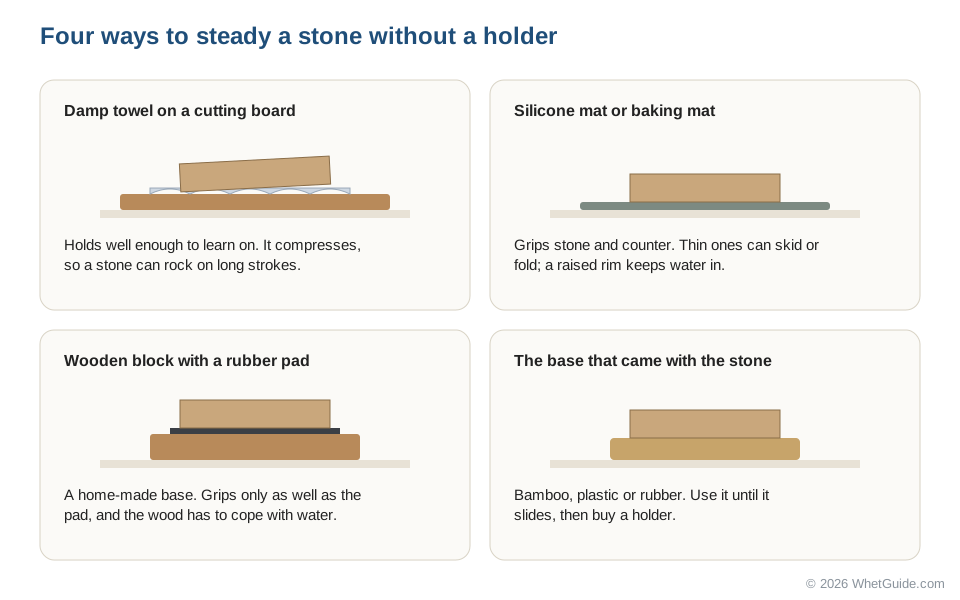
Yes, for a while. A damp kitchen towel folded on a cutting board holds a stone well enough to learn on. John Barfield, in a Fine Woodworking workshop tip, puts a silicone baking mat under his diamond plates and waterstones and says it keeps them very stable. A wooden block with a rubber pad does the same job, and homemade wooden and 3D-printed holders both turn up in search suggestions for this topic. The towel's weakness is that it compresses and the stone can rock on long strokes. When you notice the stone moving, that's when a holder pays for itself. If you're still choosing stones, the beginner whetstone sets mostly include a base, and our best whetstone picks note which stones come mounted.
↑ Back to all sectionsClaims you'll see, checked against the listings
| The claim | Where it comes from | What we found |
|---|---|---|
| "Universal" holder | Product names, including QWORK's listing and Chef Knives To Go's own holder | Every holder with a published range has limits. The rail holders stop at 9 inches or less, and the SHARPAL case at 7.95 |
| Holds stones "regardless of thickness" | A seller's blog about its holders | No maker we read publishes a minimum thickness, and rail holders grip the ends, so thin stones and plates are the ones to check |
| A holder makes your stone last longer | The same seller's blog, with no figure | A holder keeps a stone still. Wear comes from use, and flattening is what keeps a worn stone usable |
| "Rust-proof" | SCOTTCHEN's listing titles | Fair for 304 stainless rods. Chrome-plated parts (POWERTEC's arms, QWORK's iron) last if you dry them, and Chef Knives To Go says its non-stainless hardware rusts if left wet |
| Suits "big kitchen sinks" | POWERTEC's sink bridge listing | Its stated sink range tops out at 17-3/4 inches inside. Wider sinks need a 24-inch bridge |
| The most-rated holder | Amazon's rating count | POWERTEC's holder and bridge share one pooled count, so it doesn't describe either product alone |
Cheat sheet: whetstone holders on one card
| Question | Short answer |
|---|---|
| Best all-round holder? | POWERTEC rail holder, 5-1/2 to 9 in |
| Water stones at the sink? | SCOTTCHEN 17-3/4 in bridge, sinks 6-3/4 to 17-3/4 in |
| Wide farmhouse sink? | SCOTTCHEN 24 in bridge, sinks 14-3/8 to 24 in |
| Stainless, standard stones? | Kota Japan, 6 to 8-1/2 in |
| Long stones and 10-inch plates? | SCOTTCHEN tabletop, 3-1/8 to 10-1/2 in |
| Water all over the counter? | SHARPAL 149H tray under the holder |
| Oil stones? | Rail holder on a mat or tray; never the sink |
| Diamond plate with a base? | Nothing, unless it slides |
| Shapton in its case? | The case is the holder |
| 210 mm stone in the SHARPAL 160H? | No; it takes up to 7.95 in |
| Stone keeps moving? | Dry the counter and the feet first |
| After every session? | Rinse, dry the threads, store dry |
What to buy
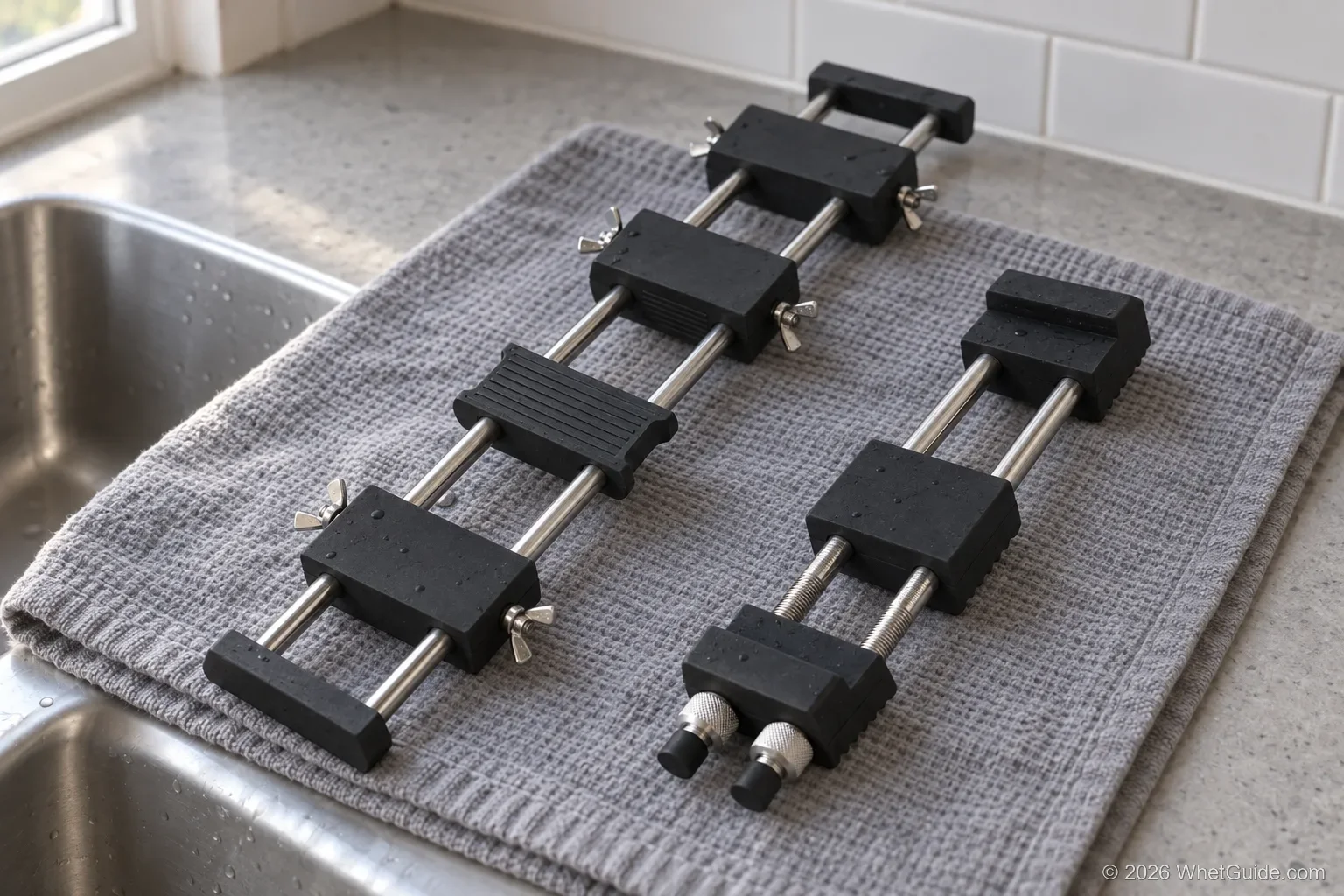
Sharpen at the sink? Measure it, then buy the SCOTTCHEN sink bridge. Sharpen on the counter? Get the POWERTEC adjustable holder and set it in a tray. Check your stone's length against the range before you order either. For Japanese stones, the best Japanese whetstone guide notes which ones come with a case that already does this job.
Keep going
- Using the stone once it's held: how to use a whetstone and the knife sharpening angle chart.
- Keeping it flat: how to flatten a whetstone and the best flattening stones.
- Choosing stones: best whetstone, best Japanese whetstone and the King whetstone review.
- Grits: the sharpening stone grit chart.
- Diamond and oil stones: best diamond sharpening stone and the Arkansas stone guide.
Sources: Amazon listings for each holder (fit ranges and materials; ratings and sales counts too), checked Oct 21, 2026 and reread Nov 15, 2026; Sharpening Supplies, sharpening accessories, Oct 21, 2026; Chef Knives To Go, Universal Stone Holder product page; John Barfield, silicone baking mat tip, Fine Woodworking (2020); Yoav Liberman, "Inexpensive liner for your wet sharpening needs", Popular Woodworking (2020); Asa Christiana, review of Rockler's silicone sharpening stone trays, Fine Woodworking (2025); David Charlesworth, "A User's Guide to Waterstones", Fine Woodworking (2004). How we research · Affiliate disclosure