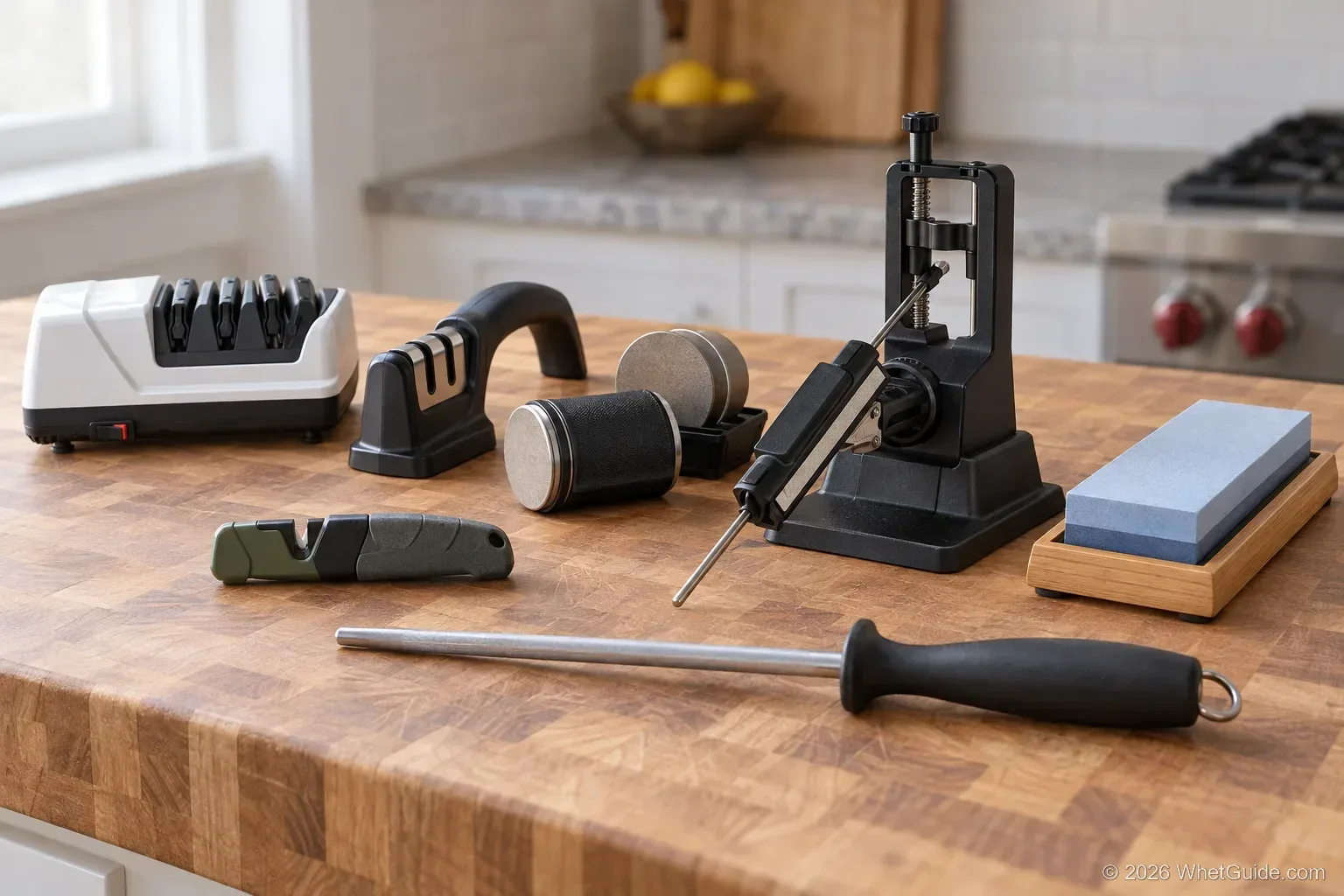
Quick answer: the best knife sharpener by type
The best knife sharpener for most kitchens is the Chef'sChoice 15XV, an electric that puts a 15° edge on a knife in a couple of minutes and asks nothing of you. If you want one name, that's it. But which sharpener suits you depends far more on how you'll use it than on whatever model tops a list, so here is one pick for each kind, chosen for the person who'd actually buy that kind.
| Type | Our pick | Buy it if you |
|---|---|---|
| Electric | Chef'sChoice 15XV | Want sharp knives fast, with no skill involved |
| Manual pull-through | Chef'sChoice Pronto 463 | Want a drawer tool for 15° kitchen knives, no cord |
| Rolling | Work Sharp Rolling | Own mostly chef's knives and santokus and like a slow, tidy ritual |
| Guided clamp | Work Sharp Precision Adjust | Want a very sharp edge at any angle without learning freehand |
| Whetstone | Sharp Pebble 1000/6000 | Will practice, and want the best edge on any blade |
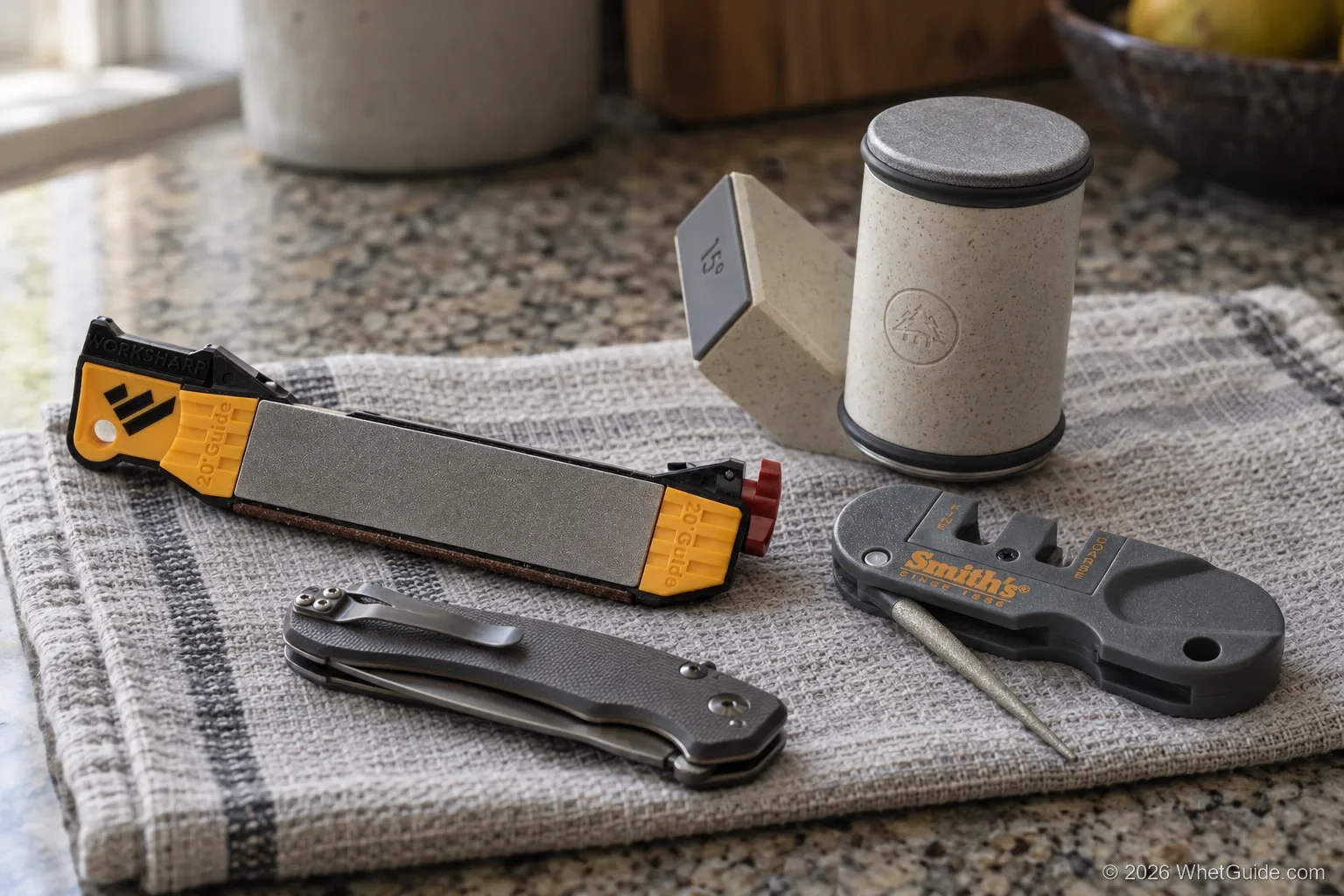
| Field and pocket | Work Sharp Guided Field | Sharpen pocket or hunting knives away from home |
| Cheapest worth buying | KitchenIQ Edge Grip | Own inexpensive stainless knives and need something today |
| Add-on for everyone | Messermeister ceramic rod | Want any of the above to last longer between sessions |
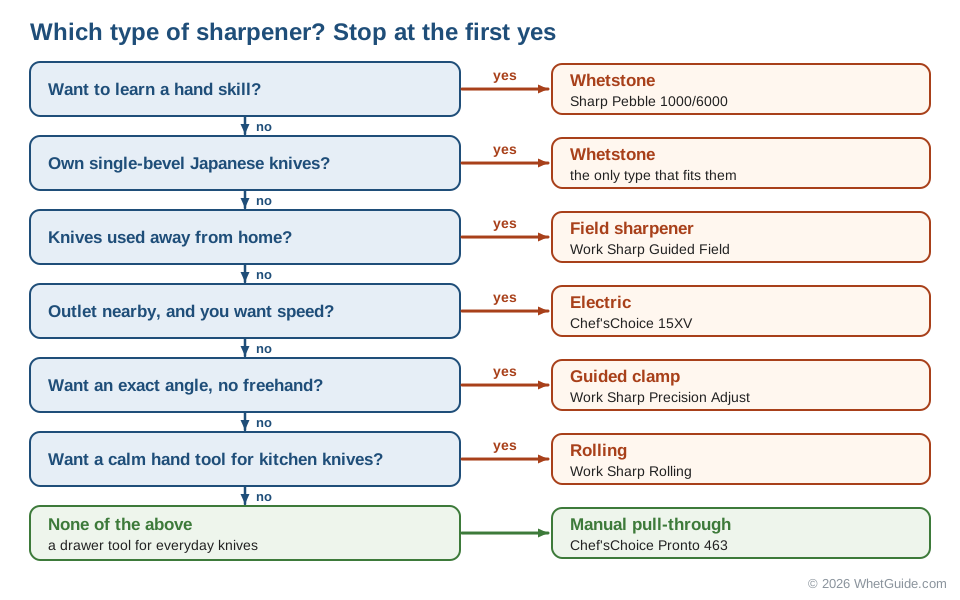
Each pick links to the full ranking for its type, so this page doesn't repeat those lists. Its job is to get you to the right kind first. Pick the wrong kind and even the best model in it will annoy you: a whetstone in the hands of someone who won't practice, or a pull-through slot on a $200 Japanese gyuto.
Quick picks
| Best electric | Chef'sChoice 15XV EdgeSelect | Amazon |
|---|---|---|
| Best manual pull-through | Chef'sChoice Pronto 463 | Amazon |
| Best rolling | Work Sharp Rolling Knife Sharpener | Amazon |
| Best guided clamp | Work Sharp Precision Adjust | Amazon |
| Best first whetstone | Sharp Pebble 1000/6000 Whetstone | Amazon |
| Best field sharpener | Work Sharp Guided Field Sharpener | Amazon |
| Cheapest worth buying | KitchenIQ Edge Grip 2-Stage | Amazon |
| Best honing add-on | Messermeister 12-inch Ceramic Rod | Amazon |
How these picks were chosen
This page sits on top of WhetGuide's type guides. Each of those ranks a whole field of one kind of sharpener from maker specs and Amazon listings, plus the reviews that publish real measurements. Here we take one model from each field and explain which person it fits. Specs and listing details were checked on Amazon on November 15, 2026. Prices move every week, so the cards link to the live price instead of printing one.
Four things decided each pick. Does it hold its angle the same way every time? Can the person who buys this type use it on day one? Does it reach the angles that type's buyers usually need? And do the reviewers who measure edges, rather than just describing boxes, keep landing on it? America's Test Kitchen has framed the choice by type since its 2022 guide, which names an electric winner and a manual one, with whetstones as the third route, instead of one overall winner, and that's the frame used here too. Gadgets with no fixed angle and no known abrasive didn't make it. Neither did anything sold mainly on a star rating with nothing behind it. Where a pick has a known weakness, the card says so, and the "who should skip it" line under each type is there because a sharpener that suits one person will frustrate the next.
↑ Back to all sectionsThe seven kinds of sharpener, and who each one suits
Every sharpener does the same job. It grinds two bevels until they meet in a clean line, then takes off the burr that grinding leaves. Where they differ is in who holds the angle (a motor guide, a slot, a magnet, a clamp or your own hands) and in how much say you get over the steel that comes off.
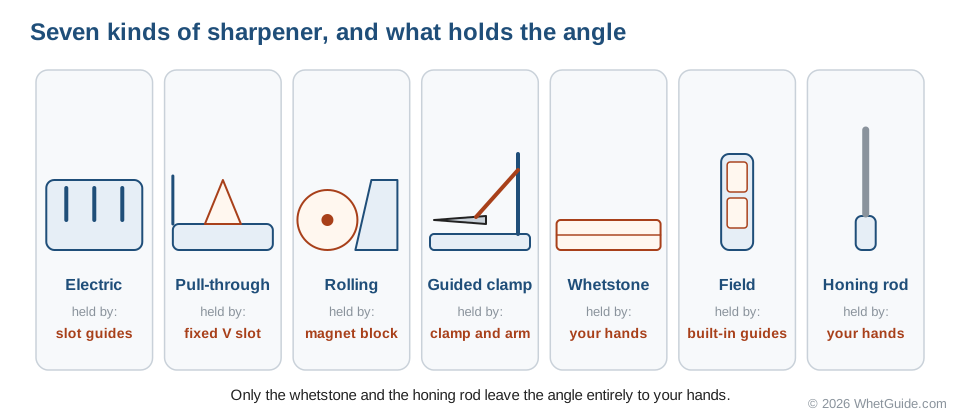
| Type | What holds the angle | Skill needed | Skip it if |
|---|---|---|---|
| Electric | Guides in fixed slots, motor turns the abrasive | None | Your best knives are single-bevel, or noise bothers you |
| Manual pull-through | A fixed V slot | None | Your knives are thin and expensive |
| Rolling | A magnetic block with set angle faces | Low | You mostly sharpen small or curved pocket knives |
| Guided clamp | A clamp plus an arm on a pivot | Low | You want to finish a knife in two minutes |
| Whetstone | Your hands | High, at first | You know you won't practice |
| Field | Built-in angle guides | Low | The knives never leave your kitchen |
| Honing rod | Your hands | Low | The knife is already truly dull (a rod can't fix that) |
A belt machine such as the Work Sharp MK2 is an eighth kind, and a good one for a garage where axes and mower blades get sharpened too. For a kitchen it's more machine than most people need, so it shows up here only as a step up from the electric slot.
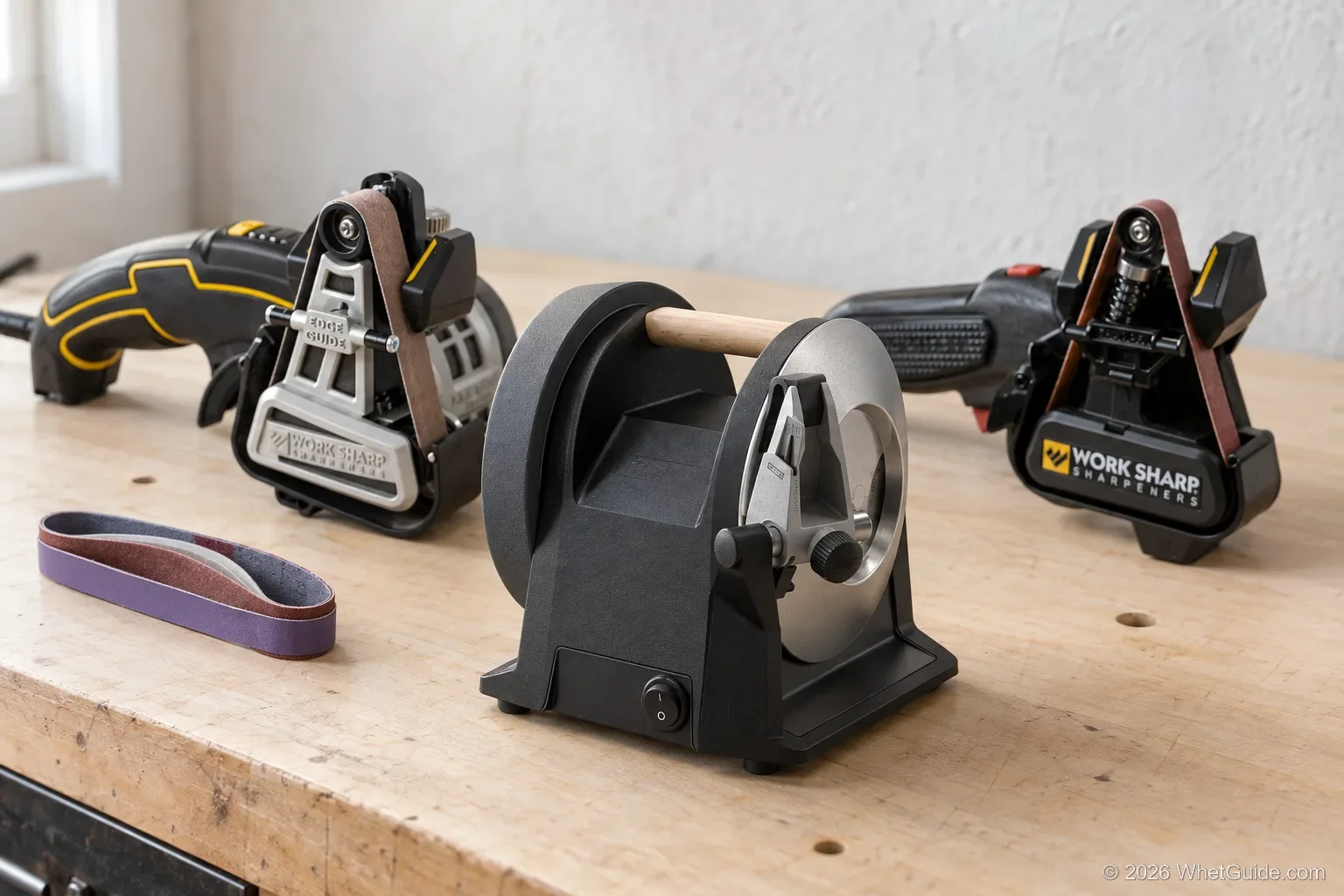
Budget isn't a type at all. It's a price slot, and every type above has a cheap end and an expensive end. The cheapest-worth-buying pick below happens to be a pull-through because that's where the lowest prices are, but a cheap whetstone is the better buy for a good knife.
↑ Back to all sectionsWhich type are you?
Ignore brand names for a minute. How often you'll really sharpen, how much patience you have for a skill and what sits in the knife block decide the type, and the brand comes after.
| If this sounds like you | Start with |
|---|---|
| "I'll sharpen when the tomatoes start squashing, maybe twice a year." | Electric, or a pull-through on cheaper knives |
| "I want it right, but I don't want a hobby." | Guided clamp |
| "I'd enjoy ten quiet minutes on a Sunday." | Rolling, or a whetstone if you'll stick with it |
| "I own a Japanese knife or two I care about." | Whetstone, or a guided clamp that reaches 15° |
| "My knives live in a pack, a truck or a tackle box." | Field sharpener |
| "I rent, the knives came with the place, and I have no budget." | The cheapest-worth-buying pick |
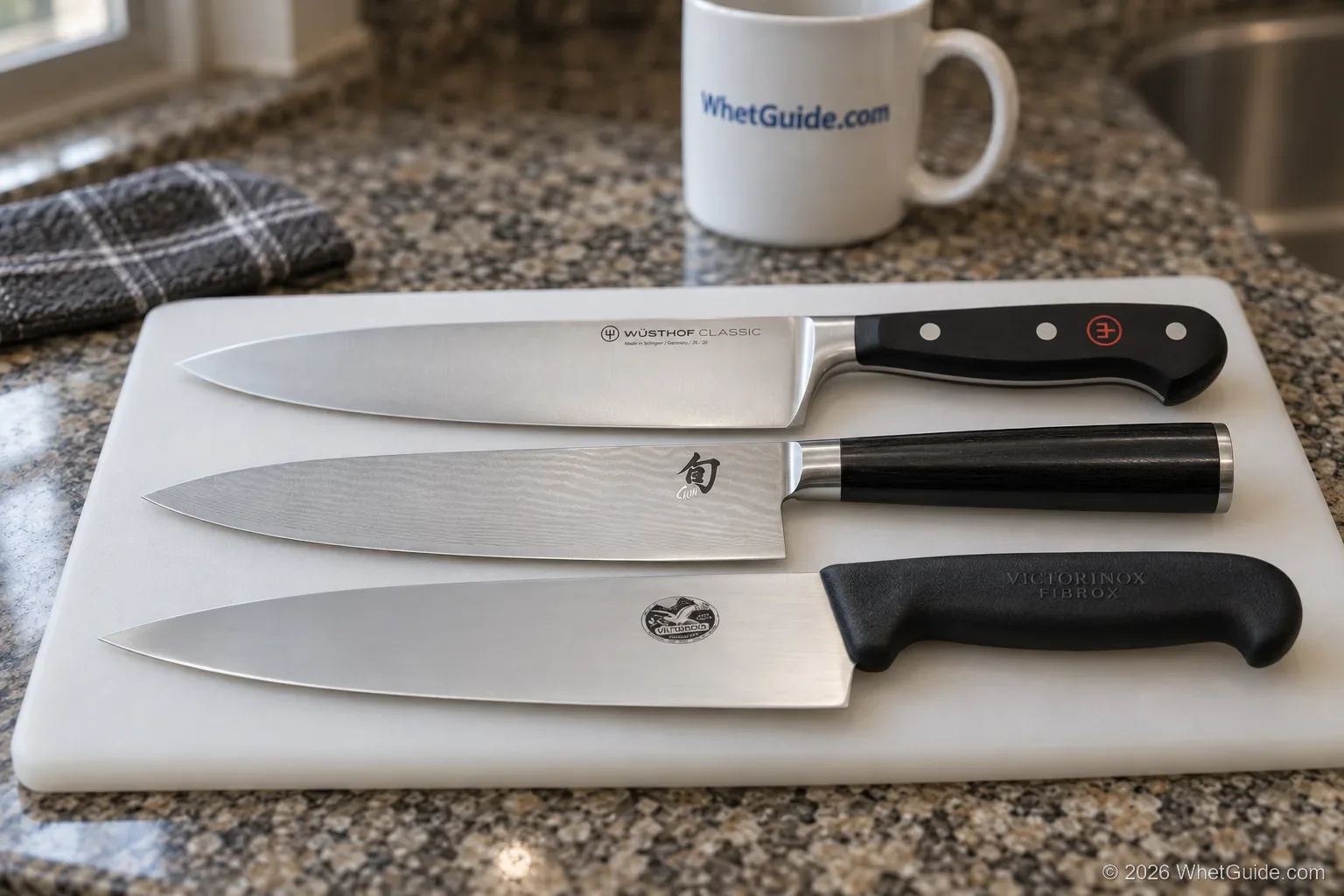
Two things change the answer more than people expect. One is counter space: an electric wants a spot near an outlet, and a whetstone wants a sink and a towel, while a clamp kit or a pull-through lives in a drawer. The other is a mixed block. If yours holds both a thin Japanese gyuto and a thick German chef's knife, a sharpener stuck at one angle will be wrong for half of it. That points you toward the AngleSelect electric, a guided clamp or stones.
If you're still torn, buy for the knife you'd be most upset to ruin. A pull-through is fine for the $25 knife and wrong for the expensive one, while a stone or a clamp is fine for both.
Electric: the pick for most kitchens
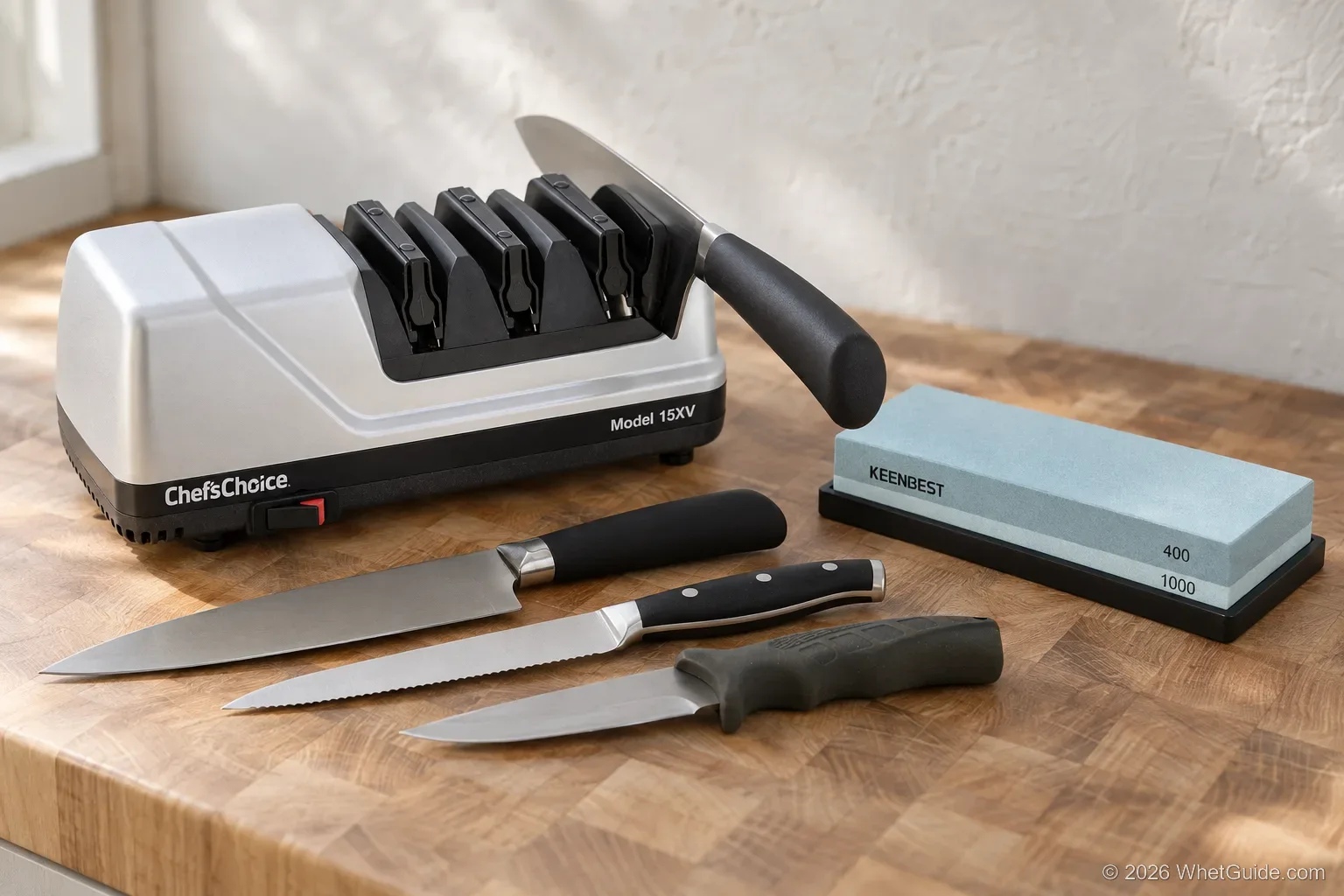
An electric puts the angle inside the machine. You draw the knife through a slot a set number of times, a motor spins the abrasive, and guides hold the blade at one angle while you do it. Popular Mechanics made the plainest case for them back in 2022. After dulling its knives on 80-grit sandpaper, it found that a knife needed ten times as many strokes on one of the stones it tried as on the Trizor XV before it was usable.
Chef'sChoice 15XV EdgeSelect
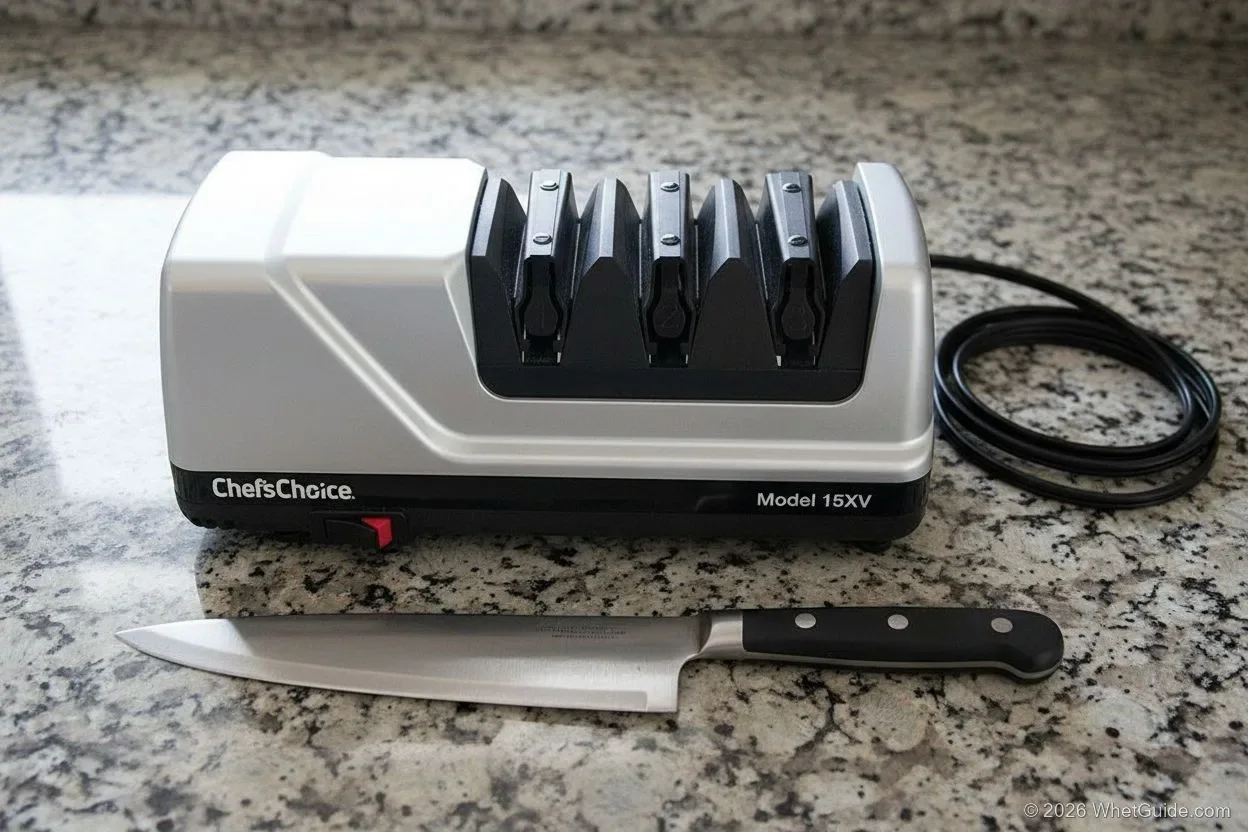
This is the machine America's Test Kitchen calls the Trizor XV, and its 2022 guide said it "restored dull blades to sharper than when they came out of the box." Two diamond stages grind and the third, a flexible stropping stage, polishes. It sets a 15° edge, thinner than the 20° many German knives leave the factory with, so the first session on a German knife grinds a narrower bevel, which takes longer than later touch-ups.
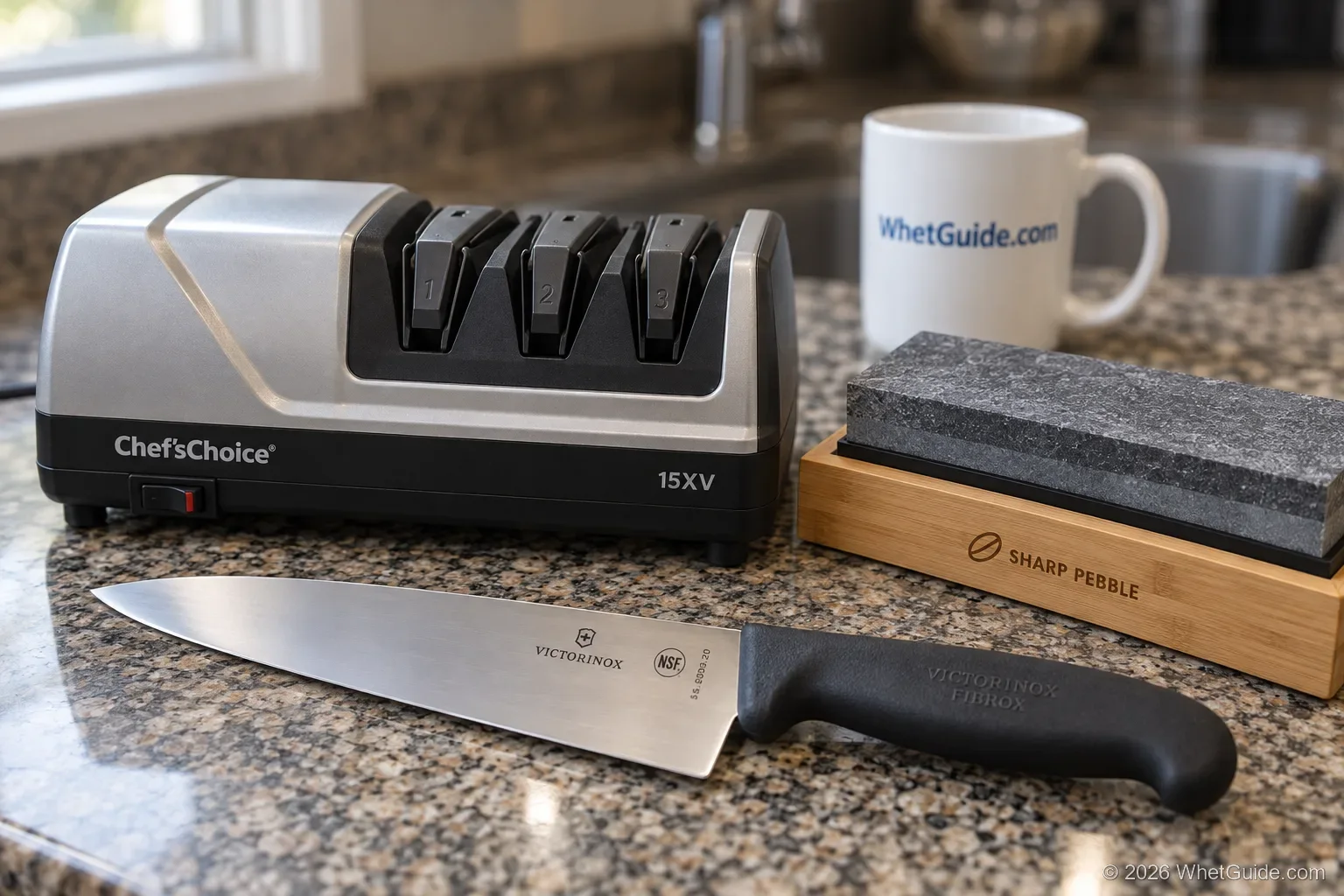
Prudent Reviews' 2026 testing took a cheap chef's knife from 924 to 173 on a BESS edge tester with it (lower means sharper) and also noted the noise, in the mid to high 80s in decibels. It's loud for the minute or two it runs.
- Type3-stage electric
- Edge angle15°
- Abrasivesdiamond in stages 1 and 2, flexible stropping in stage 3
- Knivesstraight and serrated
- First sharpeningabout 1 minute (per maker)
Why it stands out
- Nothing to learn
- Handles serrated knives too
- The 15° edge suits double-bevel Japanese knives
Think twice if
- You own single-bevel knives
- Your block is mostly 20° German knives and you want to keep that angle
- Noise bothers you
Who should leave the electric slot? If your block mixes 15° and 20° knives, the Chef'sChoice AngleSelect has a slot for each angle, so each group keeps its own angle. If the sharpener will live in a garage and see axes and mower blades, the belt-driven Work Sharp MK2 is the better tool, and the Work Sharp Ken Onion Mk2 is its adjustable big brother.
One warning applies to every electric. TechGearLab, which measured 17 sharpeners with a laser goniometer for its December 2024 update, cautions that electrics can strip away a lot of steel if you aren't careful. Use the coarse slot only when the finer one stops working, and count your passes. The full field, with budget electrics and the Presto models, is in our electric sharpener ranking, and how to use a Chef'sChoice covers the stage order.
↑ Back to all sectionsPull-through: the drawer tool
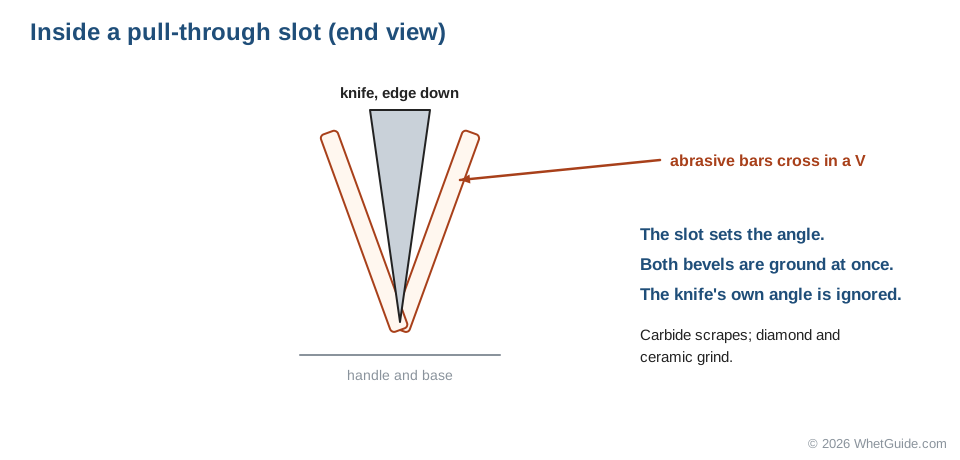
A manual pull-through is the simplest sharpener there is. It's a handle with two or three slots, each holding abrasives set in a V, and you draw the knife through. There's no cord or setup, and it fits in a drawer next to the can opener. The catch is that the slot decides the angle and grinds whatever goes through it. The cheapest models use carbide, which scrapes steel off the edge. Slots lined with diamond or ceramic grind it instead.
Chef'sChoice Pronto 463
America's Test Kitchen picked a Chef'sChoice Pronto as its manual winner in 2022, writing that it "can handily restore razor-sharp edges to dull blades." The 463 is the 15° Pronto, with diamond in both stages and no carbide anywhere. You hold the handle, set it on the counter, and pull the knife toward you.
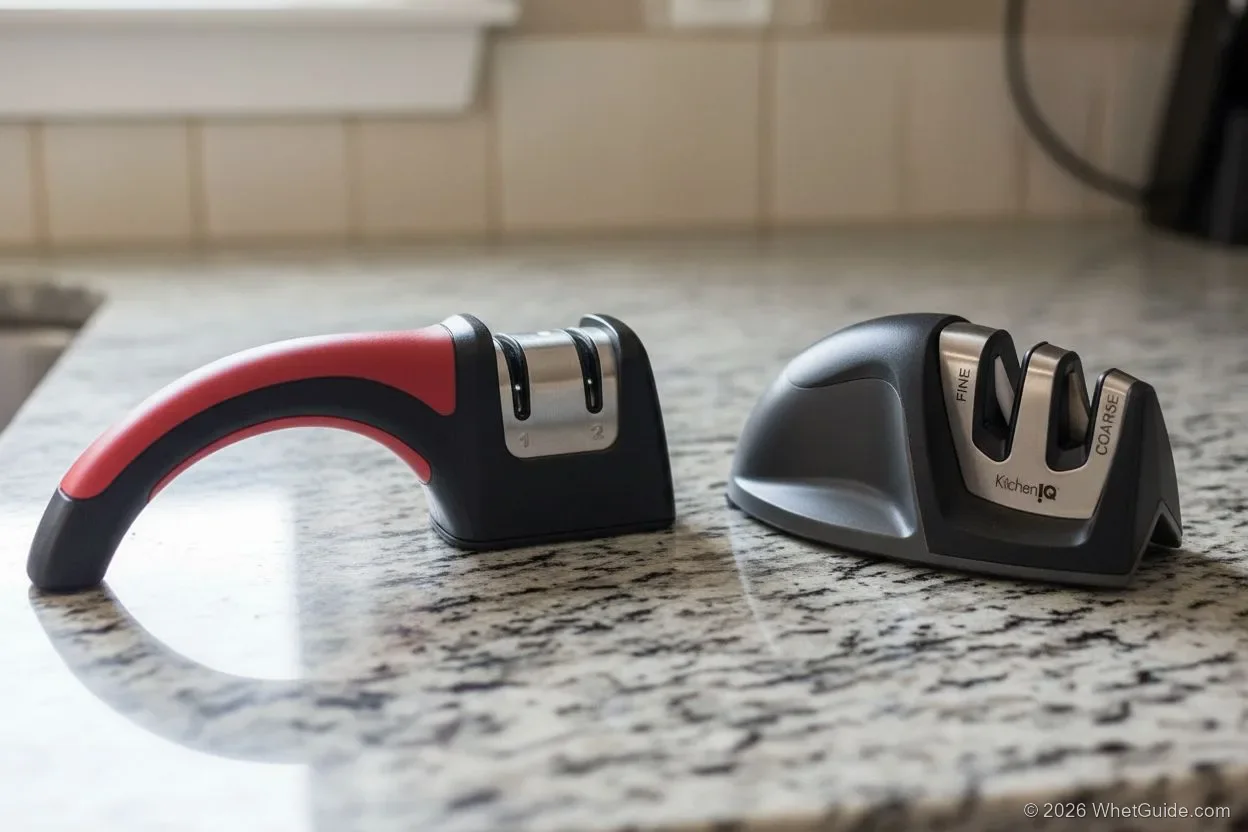
It's the pull-through to buy for 15° knives you care about but don't treat as precious. For a drawer of mostly 20° German knives, our pull-through ranking has a mixed-angle Pronto as well.
- Stages2 (diamond sharpen, diamond hone and polish)
- Angle15°
- Knivesstraight edge and serrated
- Warranty1-year limited
Why it stands out
- Diamond in both stages
- No cord, lives in a drawer
- Takes serrated knives
Think twice if
- Your knives are 20° and you want them to stay that way
- You own single-bevel or very thin, hard Japanese knives
Leave the pull-through slot as soon as you own something thin and expensive. A fixed slot can't follow the angle a maker ground, and a single-bevel knife has only one bevel to begin with, so a V slot puts a second one on it. Our page on whether pull-through sharpeners are bad goes through which knives they suit and how to spot the damage.
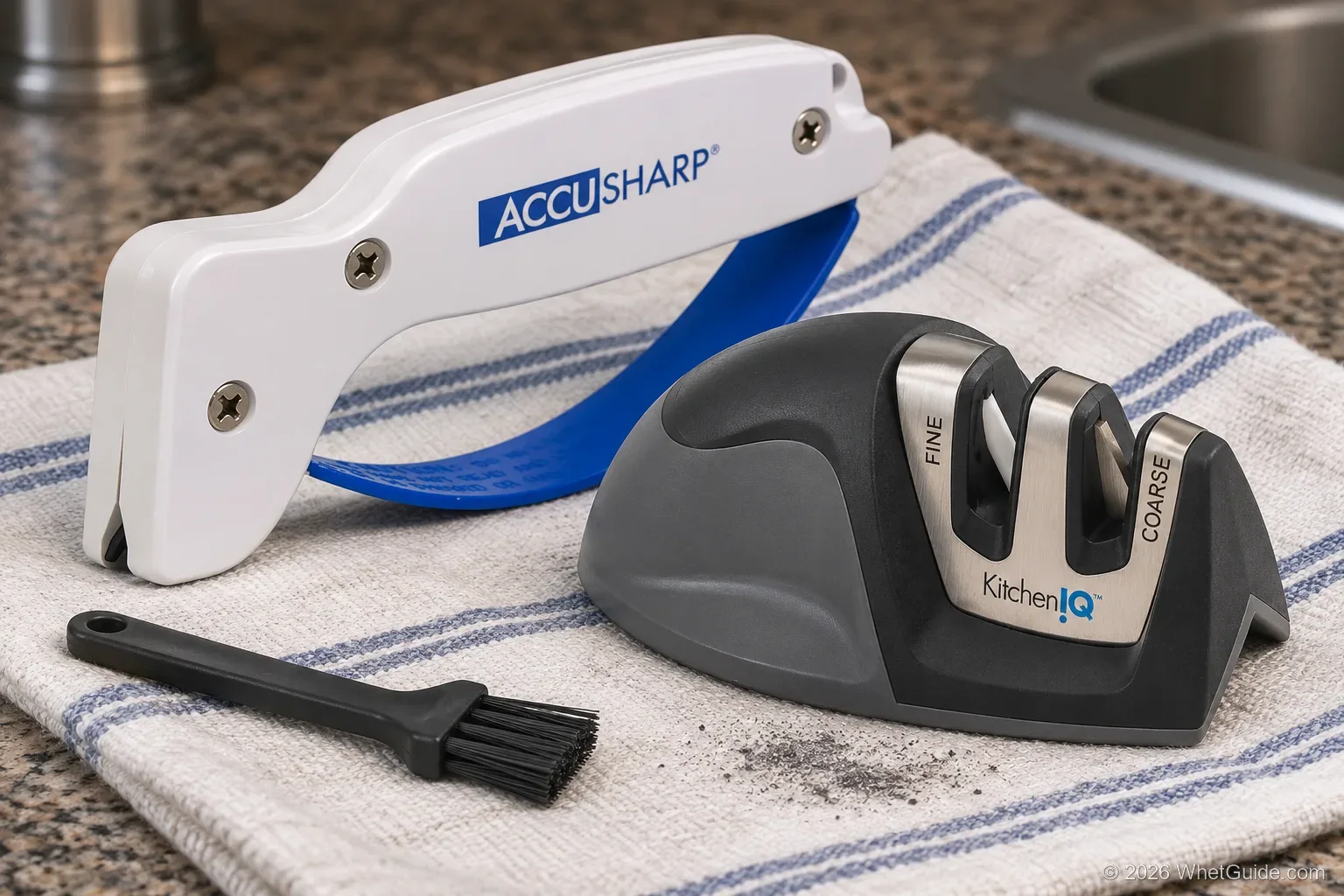
The complete list, including the Work Sharp diamond model and the cheapest carbide tools, is in the full pull-through ranking, and how to use a knife sharpener covers technique: light pressure, the same number of pulls each time, and the fine slot first, with the coarse one only when the fine slot stops working.
↑ Back to all sectionsRolling: a calm hand tool for kitchen knives
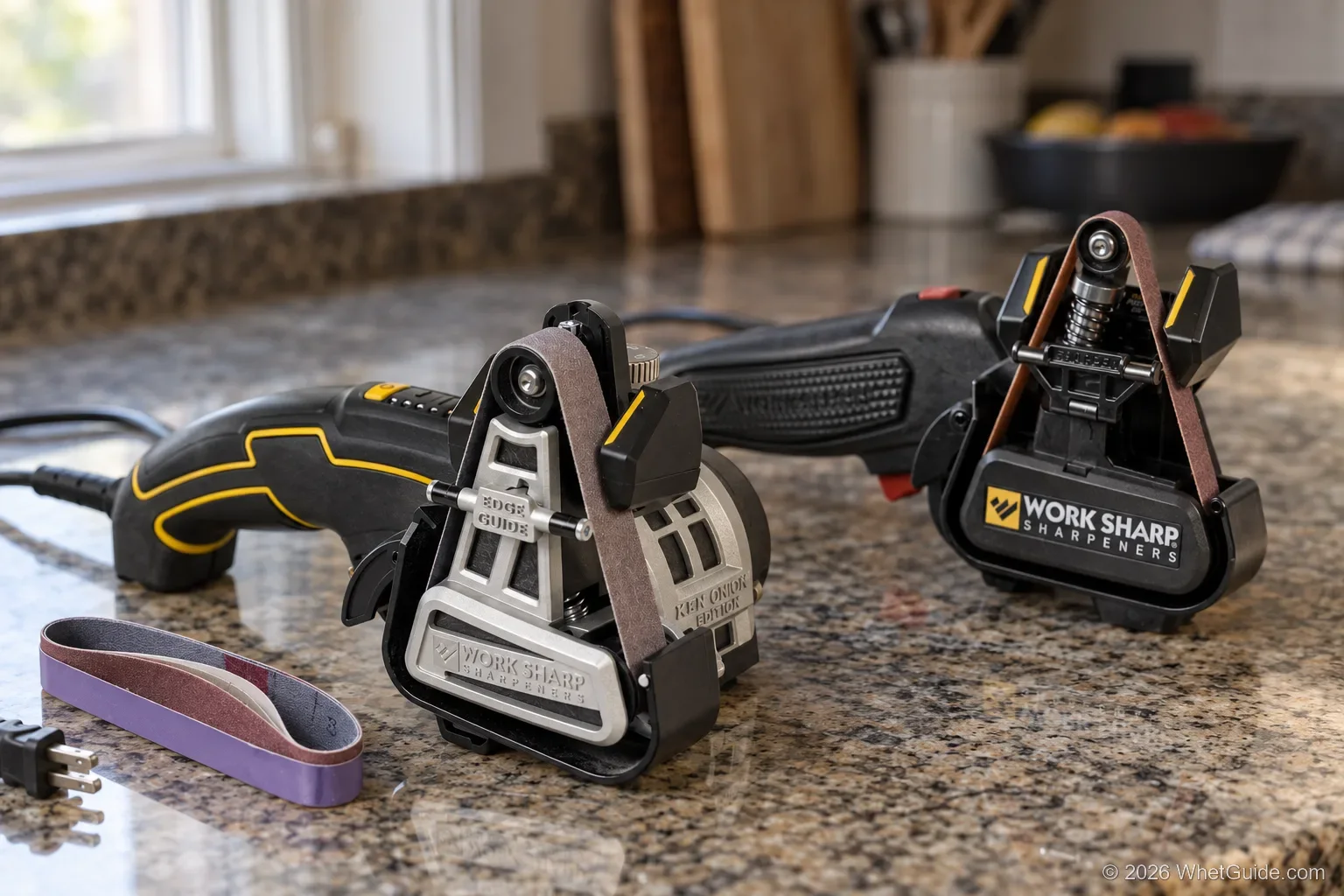
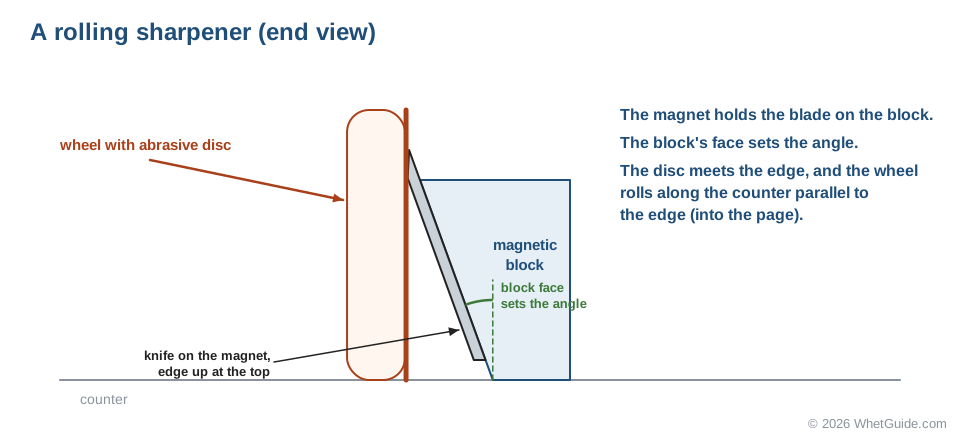
A rolling sharpener splits the job in two. A magnetic block holds the knife at a set angle on the counter, and you roll a wheel with an abrasive disc back and forth along the edge. Because the magnet holds the blade and the block's face sets the angle, there's no wrist angle to get wrong. It's slower than an electric and far quieter.
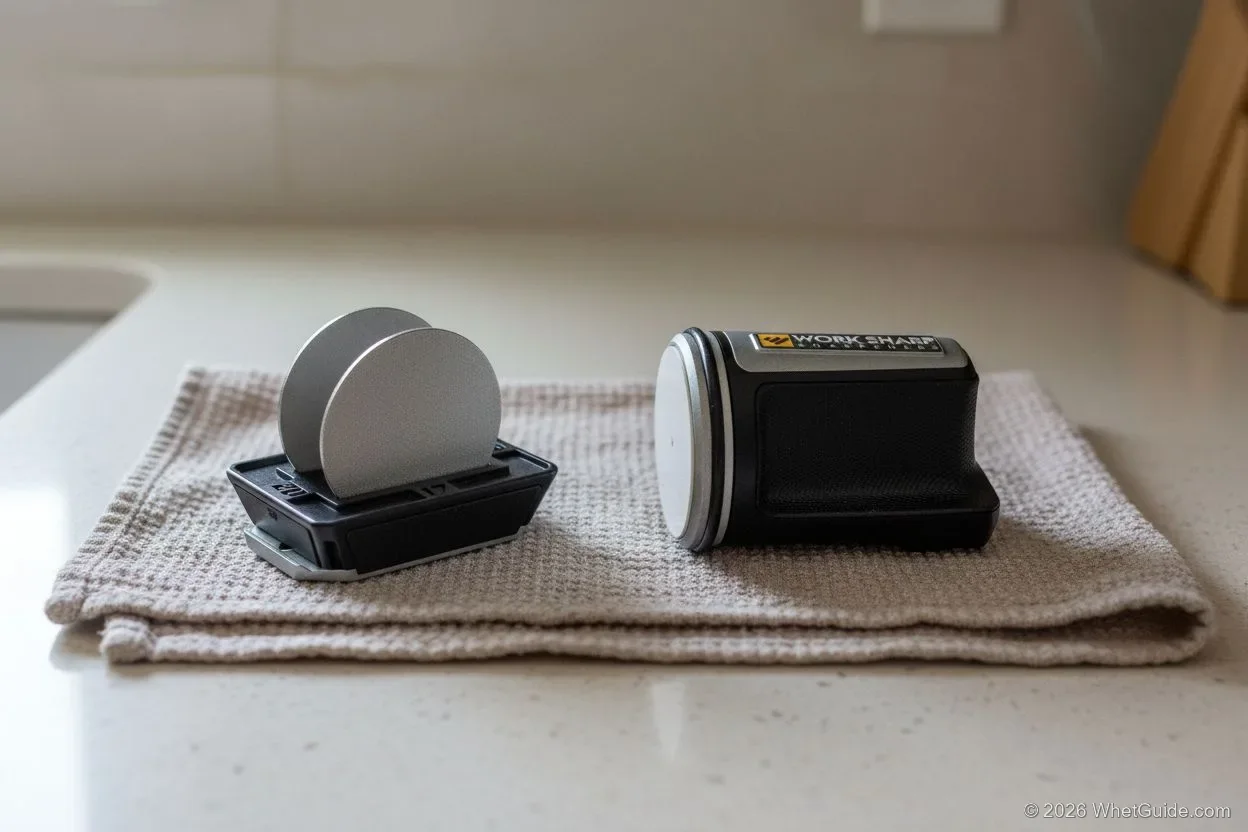
Work Sharp Rolling Knife Sharpener
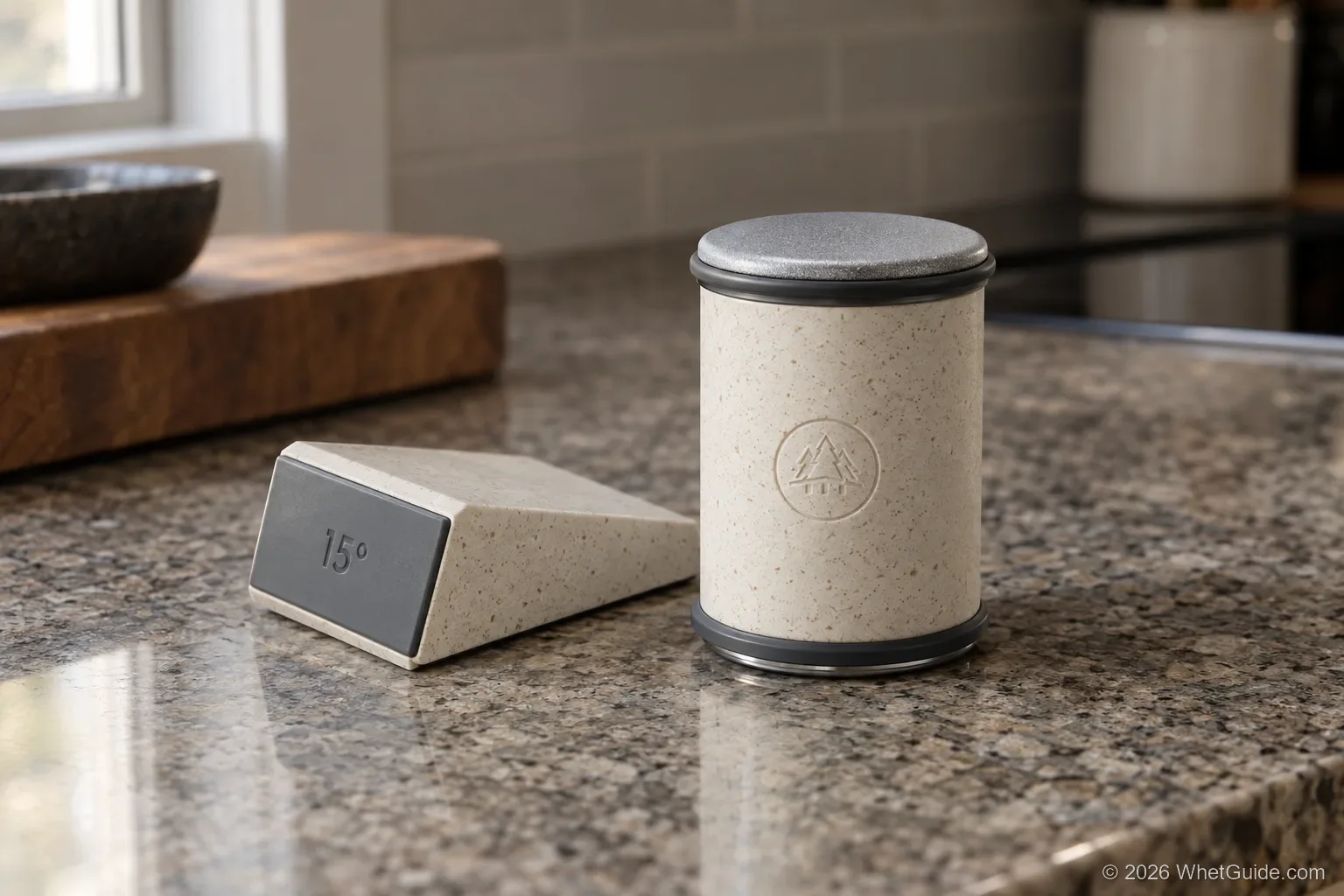
Four angle settings are why it gets the pick over the two-angle rollers. A Japanese gyuto at 15°, a German chef's knife at 20°, and a heavier blade at 25° all have a face to sit on. The listing title says four angles without printing them; our rolling guide gives them as 15°, 17°, 20° and 25° from two published reviews.
It's not a field tool. MeatEater's 2026 roundup, written for hunters, scored it lowest of its picks at 6.8, and that fits what rollers are: kitchen tools for long, straight-ish blades. Small or strongly curved pocket knives don't sit well on the block.
- Angles15°, 17°, 20°, 25°
- Abrasivediamond disc
- Extra discsdiamond and ceramic sold separately (per Work Sharp)
- Angle sourcefour presets per the listing
Why it stands out
- Four angles, so most kitchen knives have a match
- Quiet, and hard to get wrong
Think twice if
- You mostly sharpen pocket or hunting knives
- You want a knife done in a minute
Our full rolling ranking puts the HORL 3 Cruise first for kitchen use because its diamond disc is fixed, so there's nothing to set up or lose. The HORL 3 Walnut is the wooden HORL 3 with diamond and ceramic discs and 15° and 20° faces, per its listing. If you're weighing a roller against stones, rolling sharpener vs whetstone lays out the trade, and HORL vs Tumbler settles the brand question.
Guided clamp: a sharp edge without the freehand skill
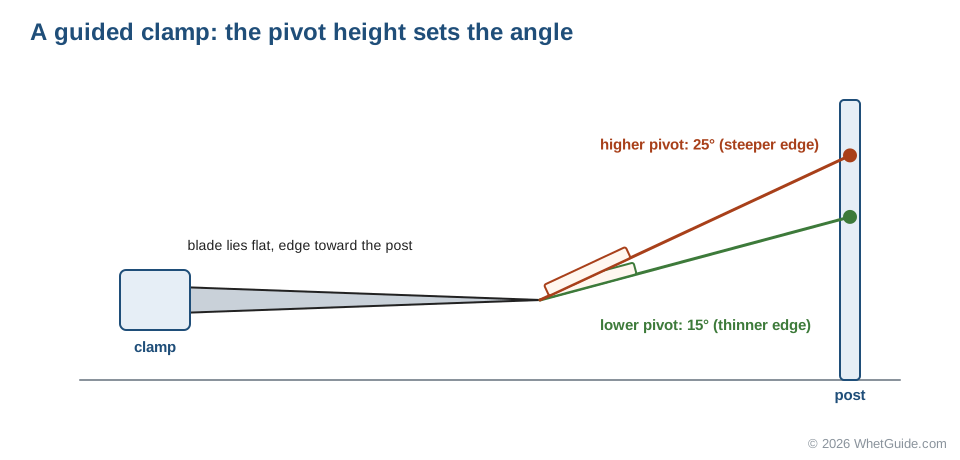
A guided clamp system holds the knife still and moves the abrasive on an arm that pivots from a fixed point. The height of that pivot sets the angle, so every stroke lands at the same angle without any skill from you. It's the type most enthusiasts start with, and the one that gets a beginner closest to a whetstone edge on the first try.
Work Sharp Precision Adjust
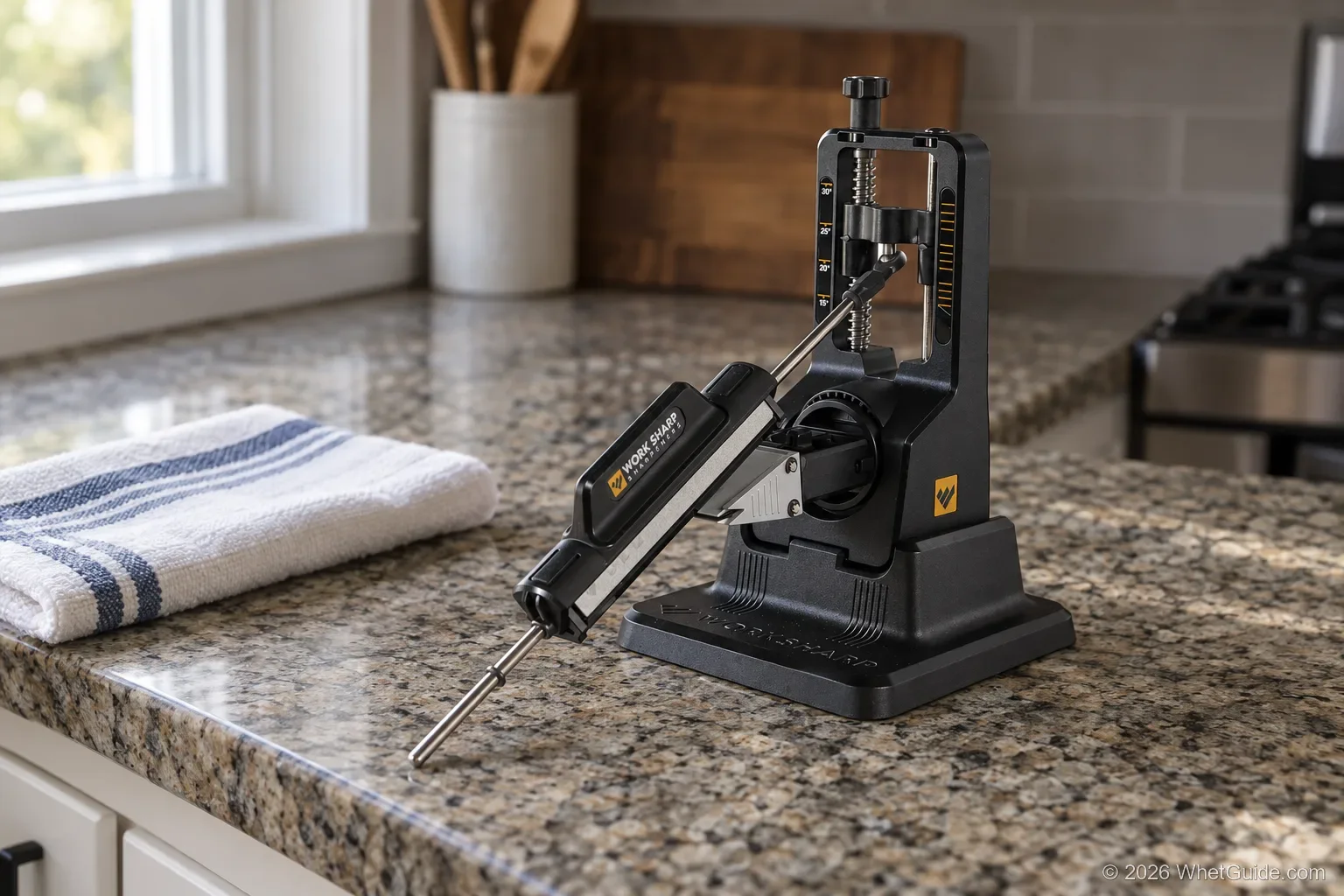
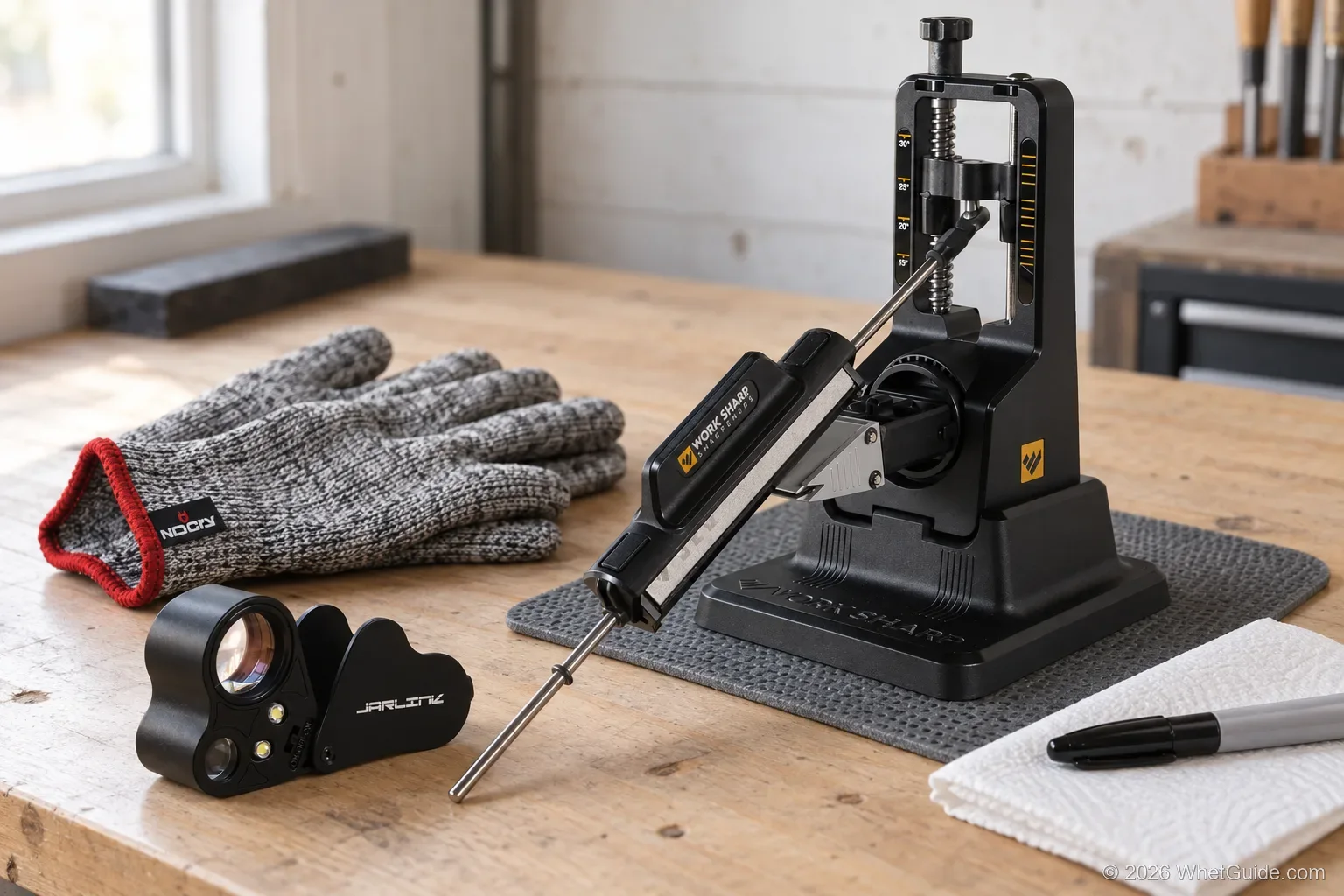
The knife sits in a clamp on a stable base. You dial the angle, then slide a three-sided abrasive along the edge on its arm, turning it to change grit. It runs dry and quiet, and it covers kitchen knives as well as pocket and hunting blades.
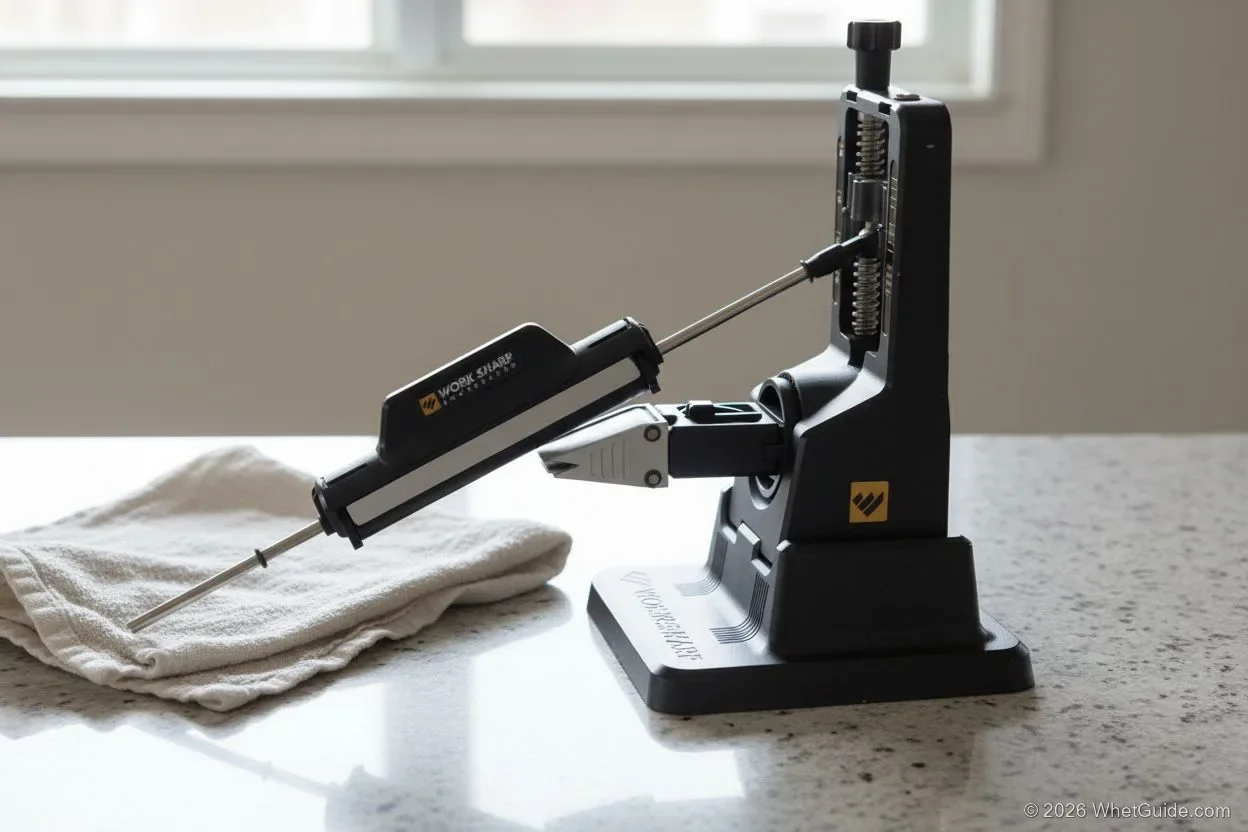
It isn't lab-perfect. When TechGearLab set one to 20° and measured the result, "the actual blade angle measured 16 deg in the middle and 14 deg at the ends." Expect an edge a little lower than the dial says, and check it with the marker trick. The coarsest face is 320 grit, so a chipped knife takes a while.
- Typeclamp + arm, benchtop
- Angle15° to 30°, one-degree steps
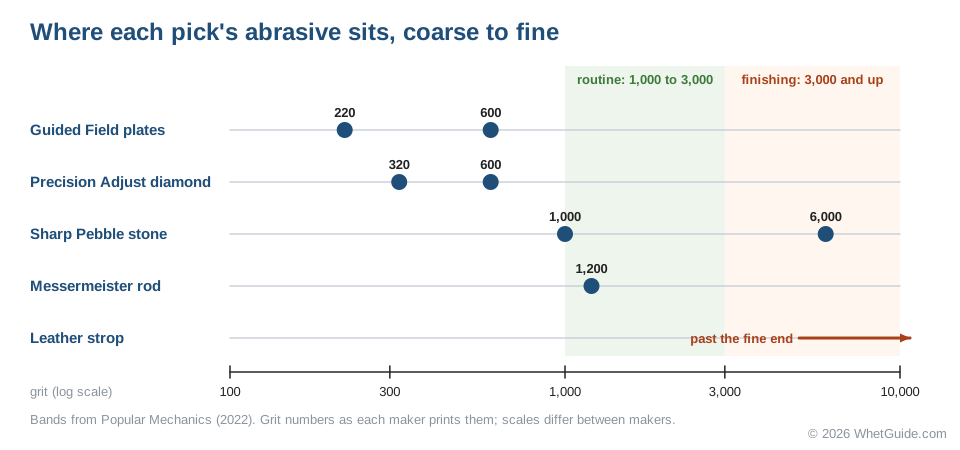
- Abrasives320 and 600 diamond plus fine ceramic
- Lubricantnone
Why it stands out
- Any angle from 15° to 30°
- No oil, no water, no power
- Gets a beginner very close to a stone edge
Think twice if
- You regularly repair chips
- You want a knife done in a minute
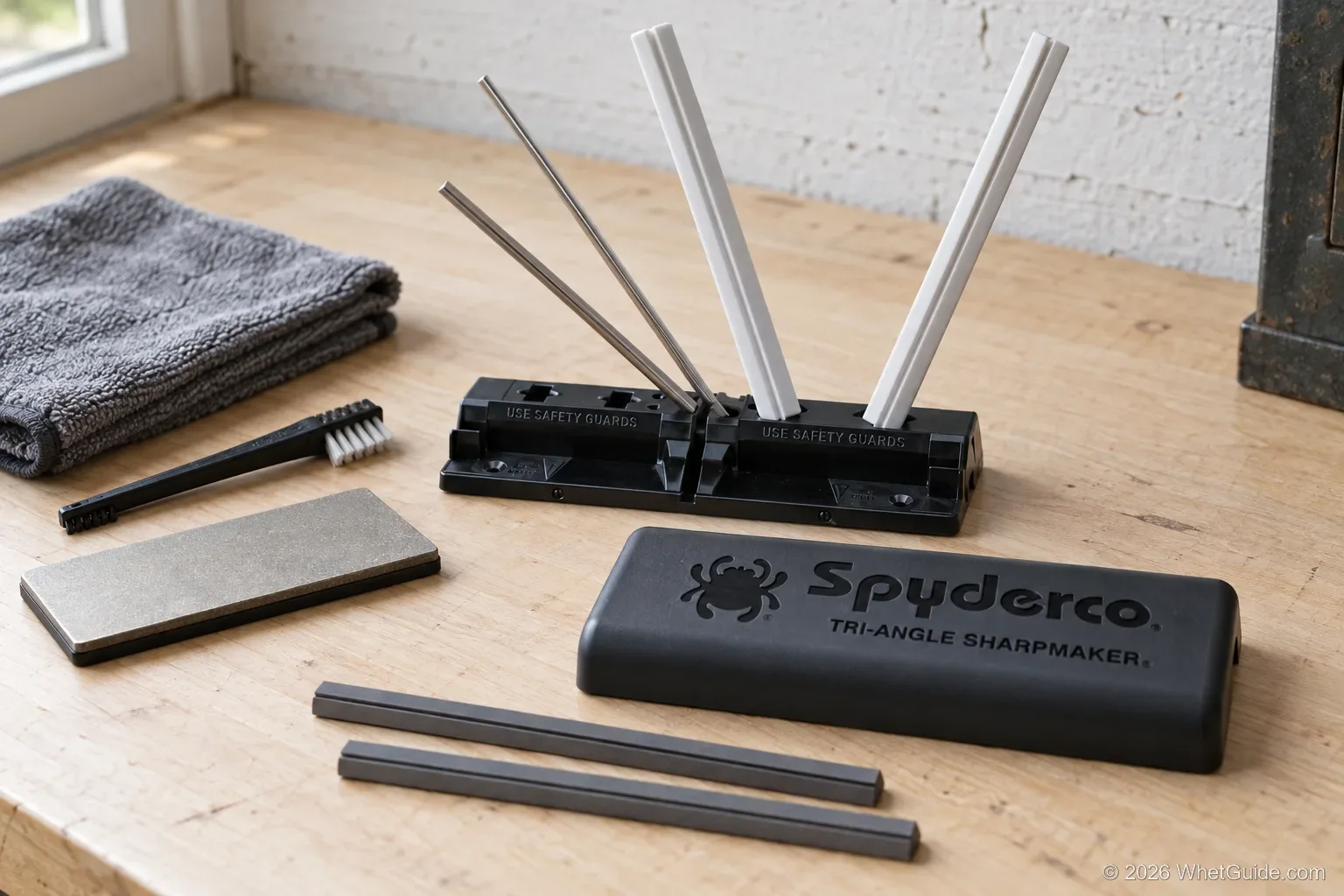
The Precision Adjust Elite adds more abrasives and a strop. For serrated knives and quick upkeep, the Spyderco Sharpmaker is the classic, with rods at 15° and 20° per side. For chips on a budget, the Lansky Deluxe has a 70-grit hone; Knife Informer calls the Lansky a "stepping stone," which is fair. Low angles below 15° need something like the Edge Pro 4, which reaches 10°.
Every one of those is ranked in our full guided-system ranking, with Work Sharp vs Lansky and a Sharpmaker review for the close calls.
↑ Back to all sectionsWhetstone: the skill that pays you back
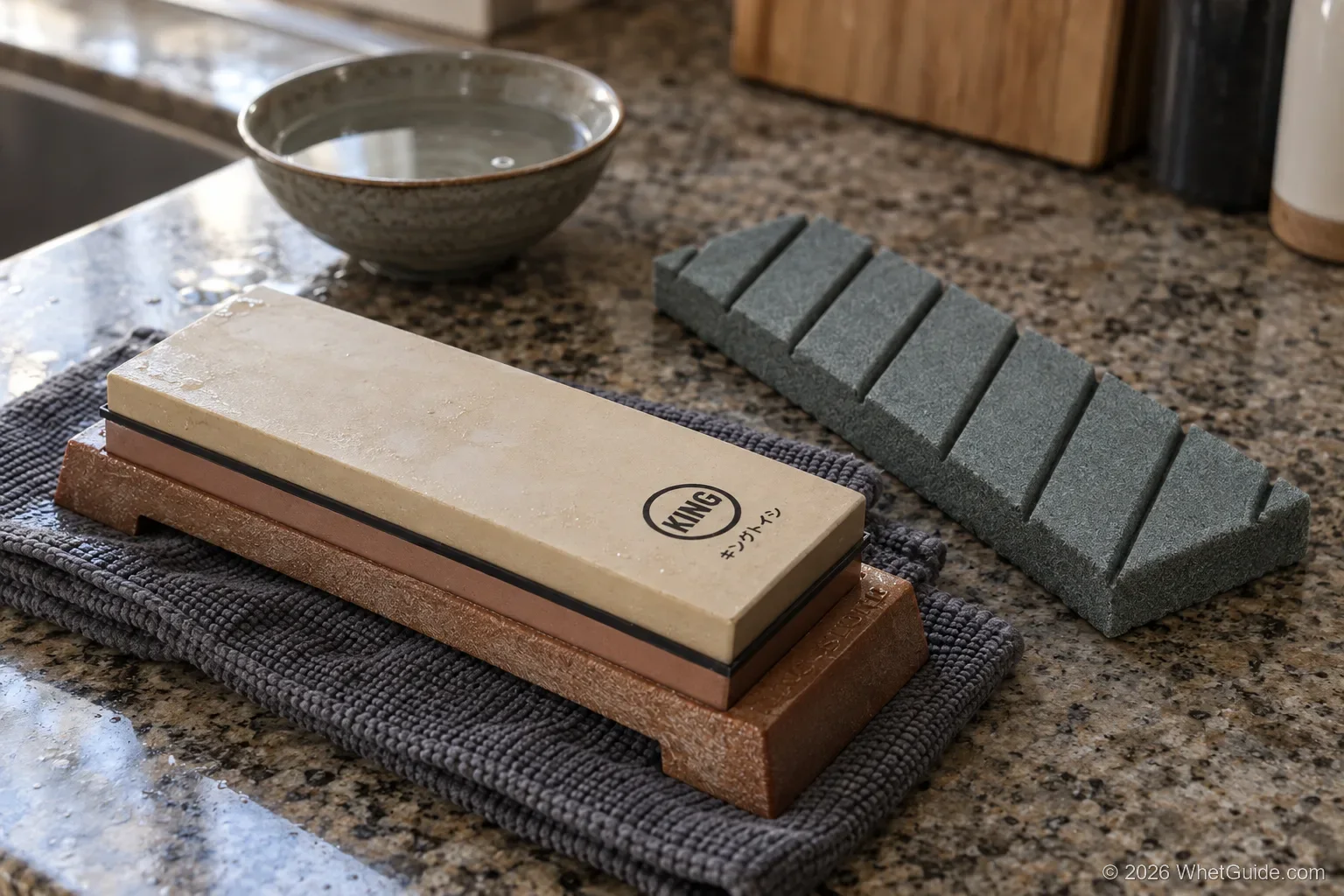
On a whetstone your hands hold the angle. That makes it the slowest type to learn and the most capable once you have. A stone works on every blade in the house, single-bevel Japanese knives included, and it takes off only as much steel as you decide to. America's Test Kitchen's advice from 2022 still holds: stones take real practice, so learn on a cheap knife first.
Sharp Pebble 1000/6000 Whetstone
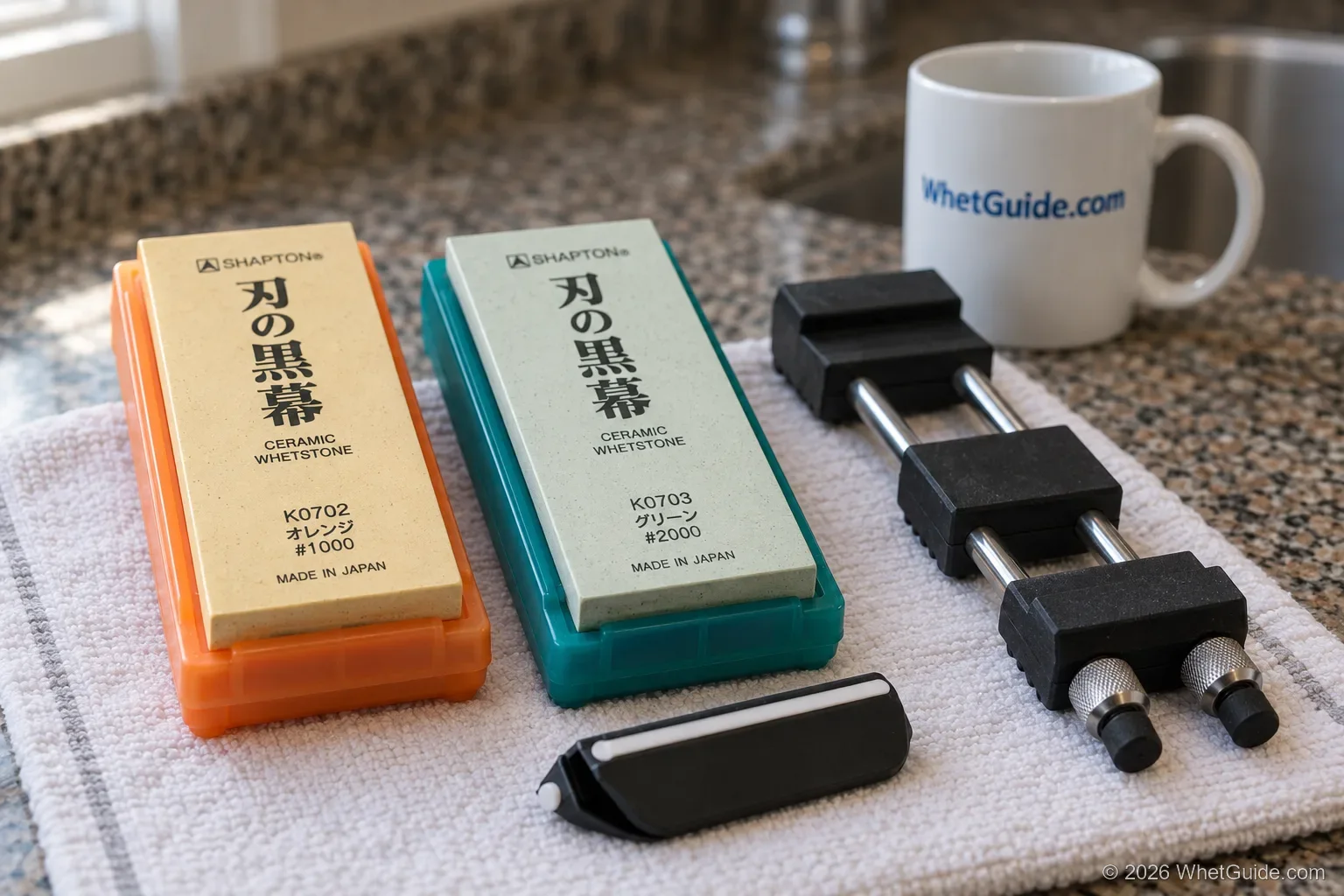
The 1000 side sharpens and the 6000 side polishes, which lines up with Popular Mechanics' advice from 2022: a medium stone "in the 1,000 to 3,000 range" for routine work, then a fine one of 3,000 or higher. The kit ships with a bamboo base and an angle guide, and for a first-timer that's the reason to pick it over a bare stone. You won't need to rig a holder, and the guide gives you a starting angle to copy.

Our whetstone ranking puts the King KW65 first for kitchen knives. It's the same 1000/6000 pairing from a Japanese maker, and either is a fine first stone. Choose the Sharp Pebble if you want the base and guide in the box.
- Grits1000 / 6000
- Lubricantwater
- Size7.25 x 2.25 x 1 in
- Includedbamboo base, angle guide
Why it stands out
- Works on every straight blade, single-bevel too
- Comes with a base and an angle guide
- You decide how much steel comes off
Think twice if
- You won't practice
- You need a fast fix tonight
A few more stones round out a kit later. The King KW65 is the classic 1000/6000 alternative. For chipped or very dull knives, a coarse stone such as the KEENBEST 400/1000 does the heavy work faster. Outdoor Life named the SHARPAL 162N diamond stone its best stone in its January 2026 update, and diamond suits very hard steels. Water stones wear hollow, so plan on a flattening stone sooner or later. Technique lives on its own pages: how to use a whetstone for the strokes, beginner whetstone sets for kits, and how to flatten a whetstone for upkeep. The full whetstone ranking has the rest.
Field and pocket: a sharpener that travels
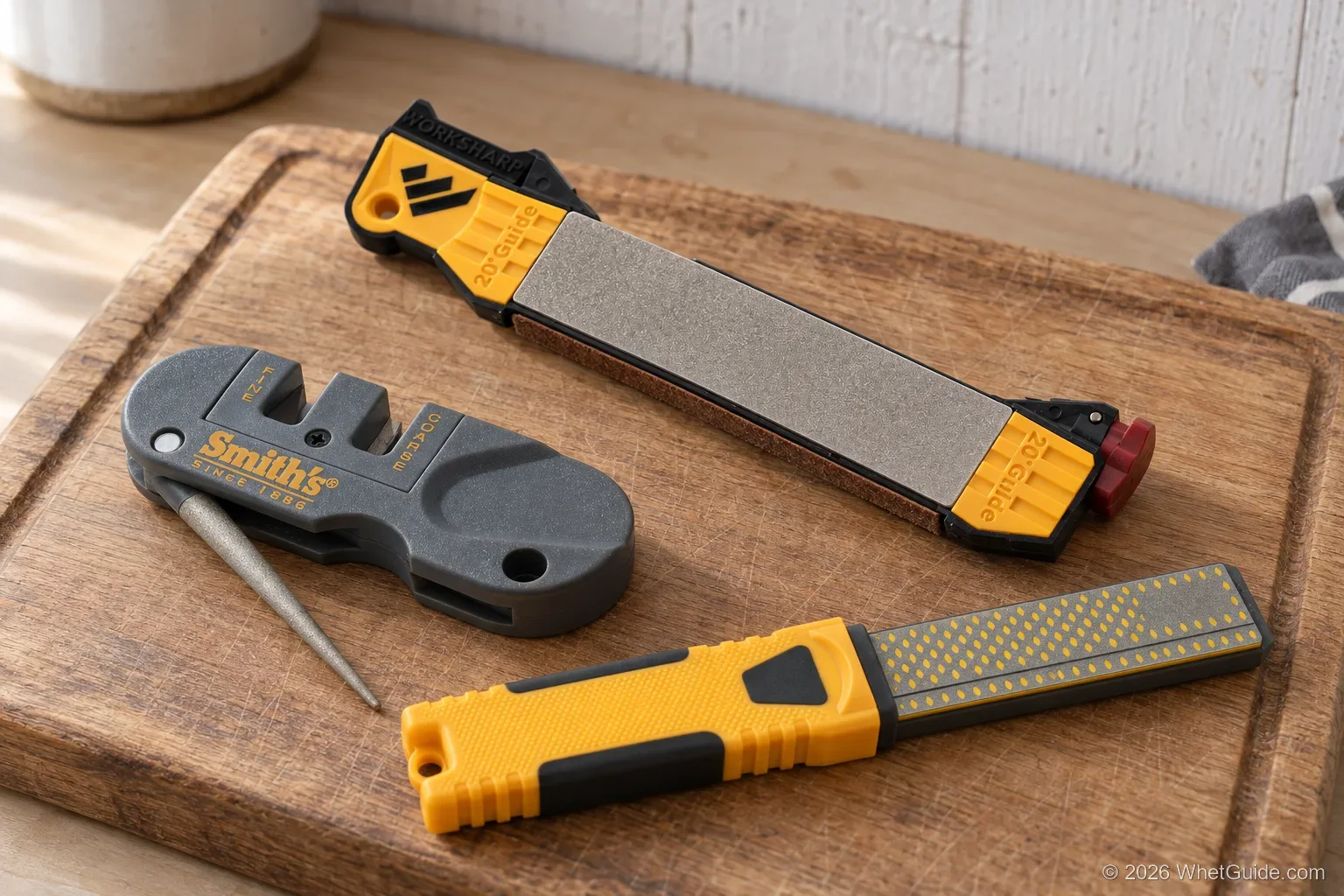
A field sharpener packs abrasives and angle guides into something that rides in a pocket or a pack. It needs no bench and no water. Most are built around pocket and hunting knives, which usually carry a thicker edge than kitchen knives, so our pick's guides start at 20°.
Work Sharp Guided Field Sharpener
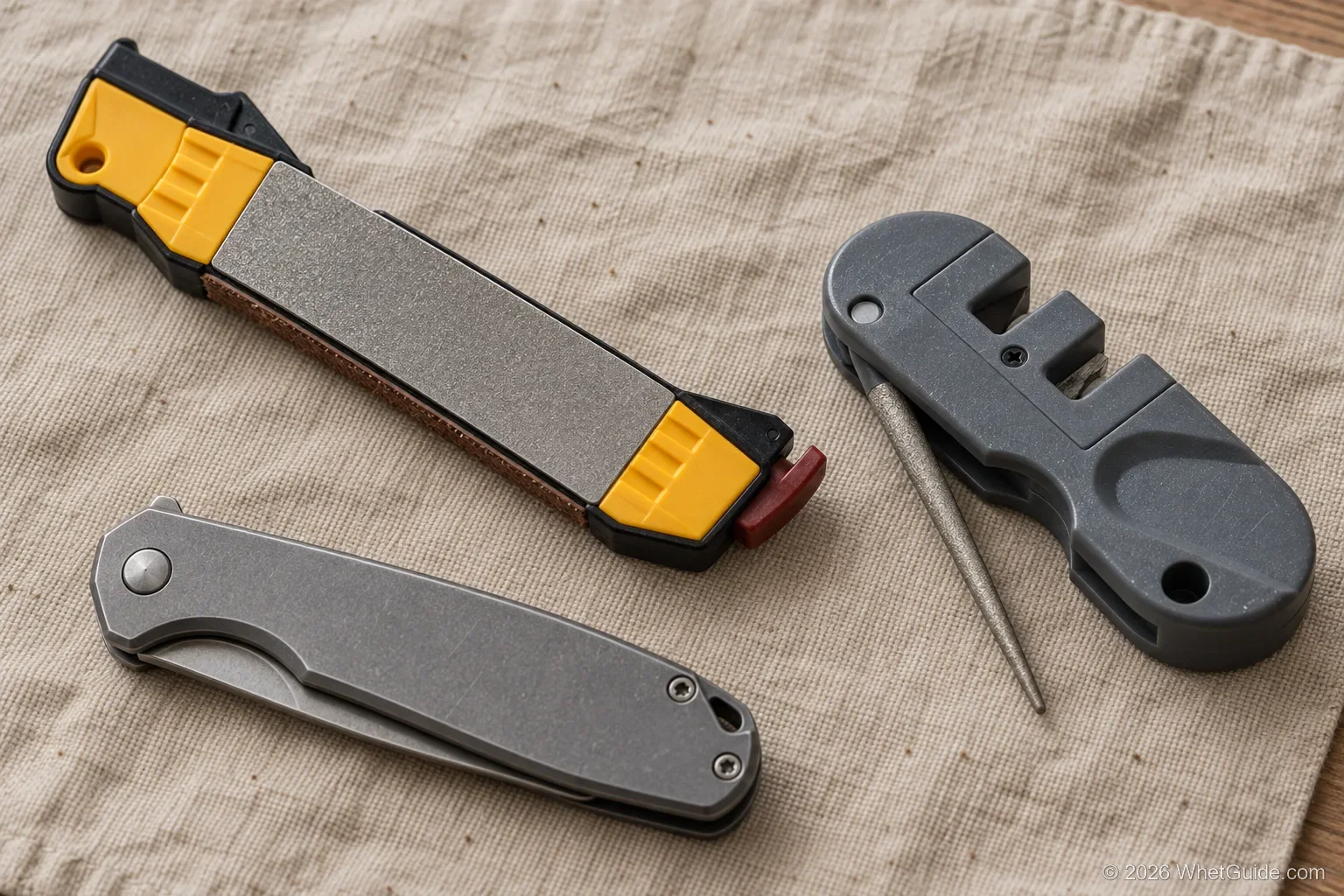
Everything for a field edge in one body: coarse and fine diamond plates for sharpening, a ceramic rod for touch-ups and serrations, and a leather strop to finish. Built-in guides show you the angle to hold. MeatEater named it the best portable pick in its 2026 roundup. Its guides are 20° and 25°, which suit outdoor knives but are the wrong numbers for a 15° Japanese kitchen knife, so keep it out of the kitchen drawer.
- Angle guides20° and 25°
- Abrasives220 and 600 diamond plates, ceramic rod, leather strop
- Weight4.6 oz
- Extrashook groove
Why it stands out
- Coarse diamond to leather in one tool
- Handles serrations on the rod
- Light enough for a pack
Think twice if
- Your knives are 15° kitchen knives
- You want a bench tool for a big collection
For a lighter kit, the Smith's Pocket Pal puts carbide and ceramic slots and a fold-out rod into a keychain-sized body. Bob Vila's guide, first published in 2020, named it the best sharpener for pocket knives. The full lists are in our pocket knife sharpener ranking and the portable sharpener guide, and hunters should see sharpeners for hunting knives.
Cheapest sharpener worth buying
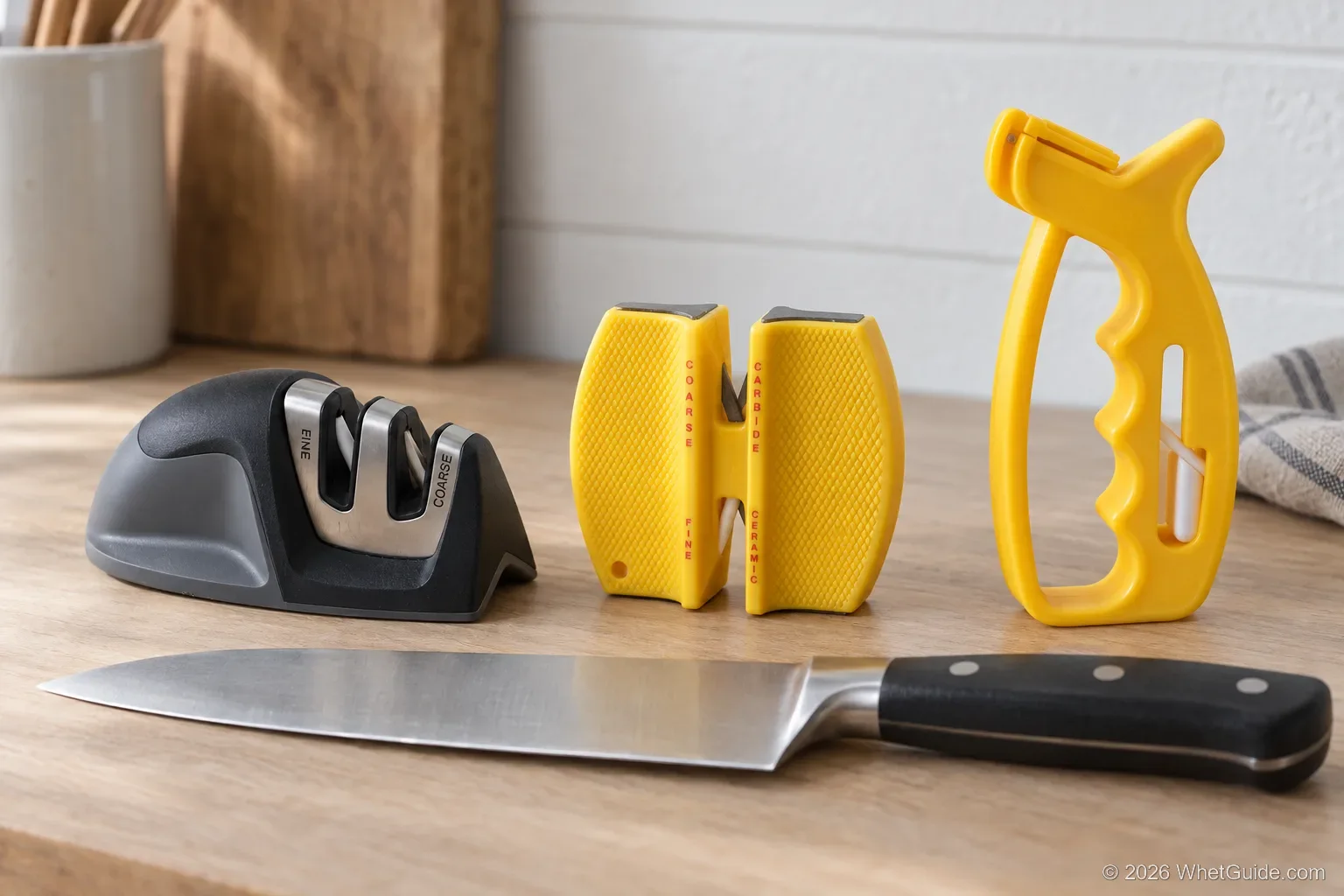
A cheap sharpener on cheap knives is a reasonable deal. The stamped stainless knives in a rental kitchen or a starter block don't care much about their angle, and the alternative is often no sharpening at all. What a cheap sharpener shouldn't touch is a thin, hard, expensive knife.
KitchenIQ Edge Grip 2-Stage

The base has a notch that hooks over the edge of the counter, so the sharpener stays put while you pull. Use the ceramic slot for regular touch-ups and save the carbide slot for a knife that's truly dull, because carbide takes steel off fast. Know what you're buying, though: Popular Mechanics noted in 2022 that it didn't reach the edge a whetstone gives. For a $20 knife that's fine.
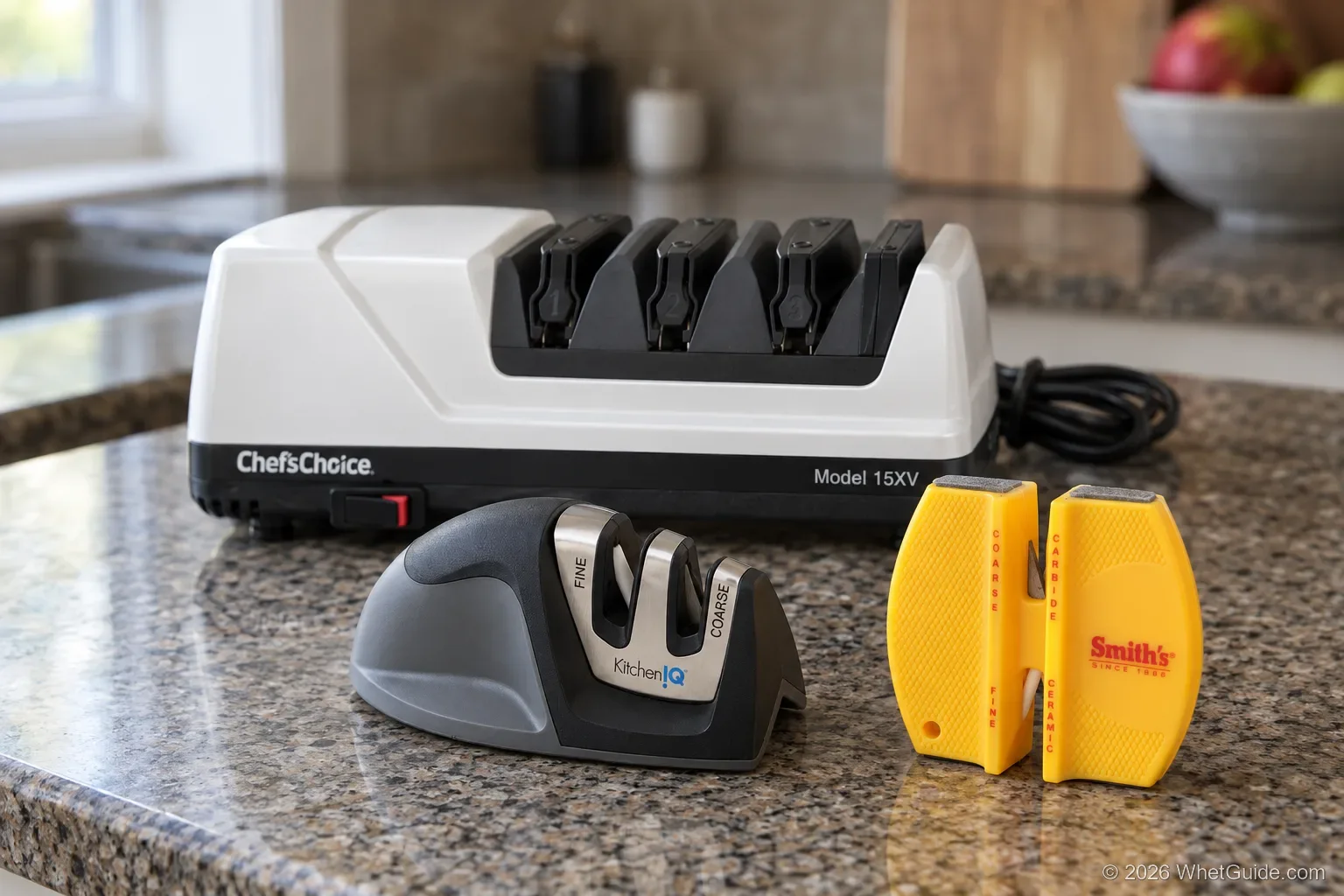
- Typemanual pull-through
- Stagescarbide (coarse) + ceramic (fine)
- Knivesstraight and serrated
- Basenon-slip, counter-edge V grip
Why it stands out
- Costs about what one professional sharpening does
- Grips the counter edge
- Takes serrated knives
Think twice if
- The knife is thin, hard or expensive
- You want a polished edge
The Smith's CCKS 2-Step is even smaller and floats if it goes overboard, and the AccuSharp is the one to throw in a toolbox. If the knife is good, though, spend the same small money on a KEENBEST 400/1000 stone instead. The full list is in our sharpeners under $50 guide, and sharpeners for beginners covers the easiest options at every price.
The add-on that makes any sharpener last: a honing rod
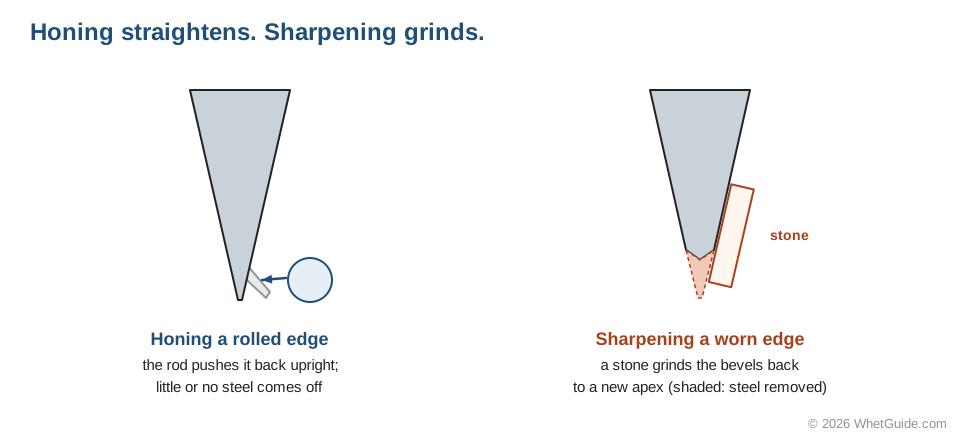
Two plain facts first. Sharpening grinds steel away to make a new edge. Honing pushes an edge that has rolled over during use back into line, and it removes little or no steel. You hone often and sharpen rarely, and the rod is what stretches the time between sharpenings.
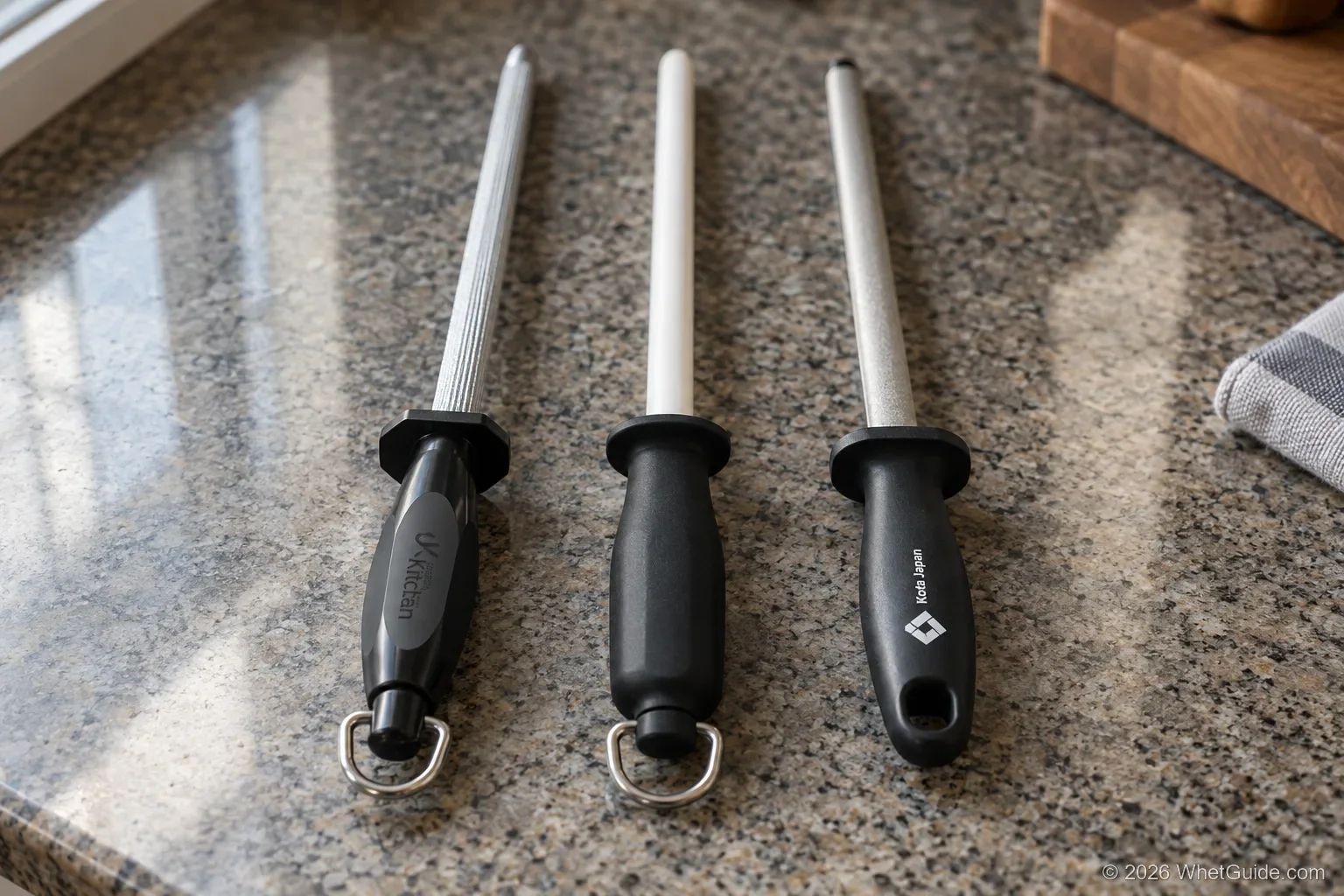
Messermeister 12-inch Ceramic Rod
A fine ceramic rod straightens the edge and cuts very lightly at the same time, which makes it more useful than a smooth steel on harder knives. Twelve inches gives a chef's knife room to make a full stroke. It's also the top pick in our honing rod guide.

Use light, alternating strokes, a few per side, at the same angle the knife was sharpened at. Pressing hard does nothing good. How to use a honing rod walks through it.
- Materialsolid ceramic, break-resistant (per listing)
- Gritfine 1200
- Length12 in
- Handleergonomic, with hang ring
Why it stands out
- Hones and refines in one step
- Long enough for a 10-inch knife
Think twice if
- It lives somewhere it could be dropped on tile
On a tight budget, the Utopia 12-inch honing rod is a plated carbon steel rod that works well on softer German and stamped knives. The choice between the two materials is laid out in ceramic vs steel honing rod, and the full honing rod ranking covers diamond rods and brand steels.
All eight picks side by side
| Pick | Type | Angle per side | Abrasive | Serrated? | Lives in |
|---|---|---|---|---|---|
| Chef'sChoice 15XV | Electric | 15° | Diamond, plus a stropping stage | Yes | Counter, near an outlet |
| Chef'sChoice Pronto 463 | Pull-through | 15° | Diamond | Yes | Drawer |
| Work Sharp Rolling | Rolling | 15°, 17°, 20°, 25° | Diamond disc | Not listed | Drawer |
| Work Sharp Precision Adjust | Guided clamp | 15° to 30° | 320 and 600 diamond, fine ceramic | Tops of the teeth only | Drawer or shelf |
| Sharp Pebble 1000/6000 | Whetstone | Any you can hold | 1000 and 6000 water stone | No, use a rod | Shelf, used at the sink |
| Work Sharp Guided Field | Field | 20° or 25° | Diamond plates, ceramic rod, strop | Yes, on the rod | Pocket or pack |
| KitchenIQ Edge Grip | Pull-through | Preset (not stated) | Carbide plus ceramic | Yes | Drawer |
| Messermeister ceramic rod | Honing rod | Whatever you hold | Fine 1200 ceramic | Hones only | Drawer or a hook |
Read the angle column first. A sharpener that can't reach your knife's angle will grind a new one, and every other column is secondary to that. The serrated column comes next if your block has a bread knife or steak knives in it.

Three kitchens, three answers
A German block with one Japanese santoku, sharpened twice a year
This is the most common mixed block, and it's where a single fixed angle goes wrong. The 15XV would regrind the German knives to 15°, which changes their edge for good. The Chef'sChoice AngleSelect keeps a 20° slot for the German knives and a 15° slot for the santoku, so nothing changes shape. If the owners would rather not have a machine on the counter, the Precision Adjust handles both angles from a drawer.
A hunter with outdoor knives and a cheap kitchen set
Two tools beat one here. The Guided Field goes in the pack, at the 20° or 25° the outdoor knives want. At home, the Precision Adjust covers the same knives plus the kitchen set, and it reaches the thicker hunting edges a kitchen electric isn't made for. If the kitchen knives are stamped and inexpensive, a KitchenIQ in the drawer is enough for them.
A new cook with one good gyuto and a curious streak
This is the whetstone buyer. Start with the Sharp Pebble 1000/6000 and its angle guide, practice on a cheap knife as ATK suggests, and only then move to the gyuto. Add the ceramic rod for the weeks between sessions. A stone handles the gyuto's thin edge at whatever angle its maker ground, and it'll handle a single-bevel knife later if the curiosity sticks.

Why the big reviews never agree on one winner
Read five sharpener roundups and you'll get five different winners. Each publication tests for its own reader, and the reader decides the winner long before the first knife goes through anything.
| Publication | Headline pick | Written for |
|---|---|---|
| America's Test Kitchen (2022) | Trizor XV electric; Pronto Diamond Hone manual | Home cooks |
| Popular Mechanics (2022) | Trizor XV overall; Presto EverSharp for value | Home cooks who like a tool |
| TechGearLab (December 2024) | Work Sharp E2 overall, at 78 points | Readers who want measured angles |
| Outdoor Life (January 2026) | Work Sharp Professional Precision Adjust | Hunters and outdoor knife owners |
| MeatEater (2026) | Lansky Controlled Angle | Hunters |
| Knife Informer (2025, revised 2026) | Declines to name one | Enthusiasts with high-end kits |
Kitchen-first publications land on an electric, and even TechGearLab's measured winner is a powered Work Sharp. Outdoor Life and MeatEater land on clamp systems, which suit the pocket and hunting knives their readers carry. Knife Informer, whose list runs to $165 to $475 kits, won't pick at all. If one of those readers sounds like you, its winner is worth a look; the type picks above line up with each camp.
Match the sharpener to your knife's angle
Angles on knives are quoted per side, the angle between one bevel and the center line of the blade. Double it for the total, or inclusive, angle. Many Western and German kitchen knives sit around 20° per side, and many Japanese knives around 15° or lower. The line isn't clean, since some newer German knives are ground thinner, closer to 15°. Check the maker's figure when you can find it.
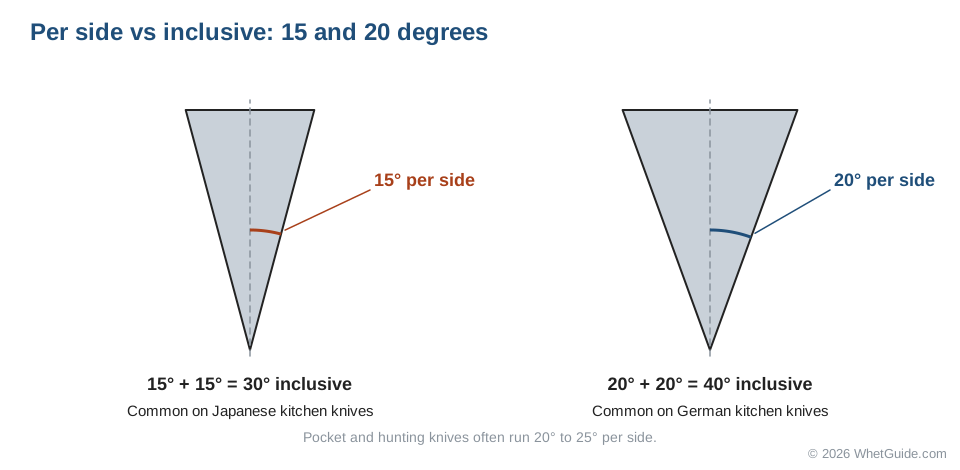
A sharpener whose angle doesn't match the knife grinds its own angle onto the blade. A sharpener set steeper than the knife meets the very edge first and adds a narrow second bevel, which is quick and harmless. Set lower than the knife, it hits the shoulder of the bevel first and has to remove a band of steel before it reaches the edge. TechGearLab's measurements show how much the machine decides: one electric reset a 14° test blade to 20°, and a budget electric left 13° on one side and 15° on the other.
| Knife | Typical angle per side | Picks that match without regrinding |
|---|---|---|
| Japanese double-bevel (gyuto, santoku) | About 15° or lower | 15XV, Pronto 463, Work Sharp Rolling at 15°, Precision Adjust, any whetstone |
| German or Western chef's knife | About 20° (some newer lines near 15°) | AngleSelect's 20° slot, Work Sharp Rolling at 20°, Precision Adjust, any whetstone |
| Pocket and hunting knives | Often 20° to 25° | Guided Field, Precision Adjust, Work Sharp Rolling at 25° |
| Single-bevel (yanagiba, deba) | One side only | A whetstone. Nothing else on this page |
Don't know your knife's angle? Color the bevel with a permanent marker, make one light pass at your chosen setting, and look where the ink came off. Ink gone only at the very edge means the setting is steeper than the knife; ink gone only at the shoulder means it's lower. Outdoor Life's testers use the same marker trick. Our Sharpie trick guide shows the patterns, the knife sharpening angle chart lists brands one by one, and the angle calculator turns a spine height into degrees.
Hard steel, soft steel: what the abrasive has to cut
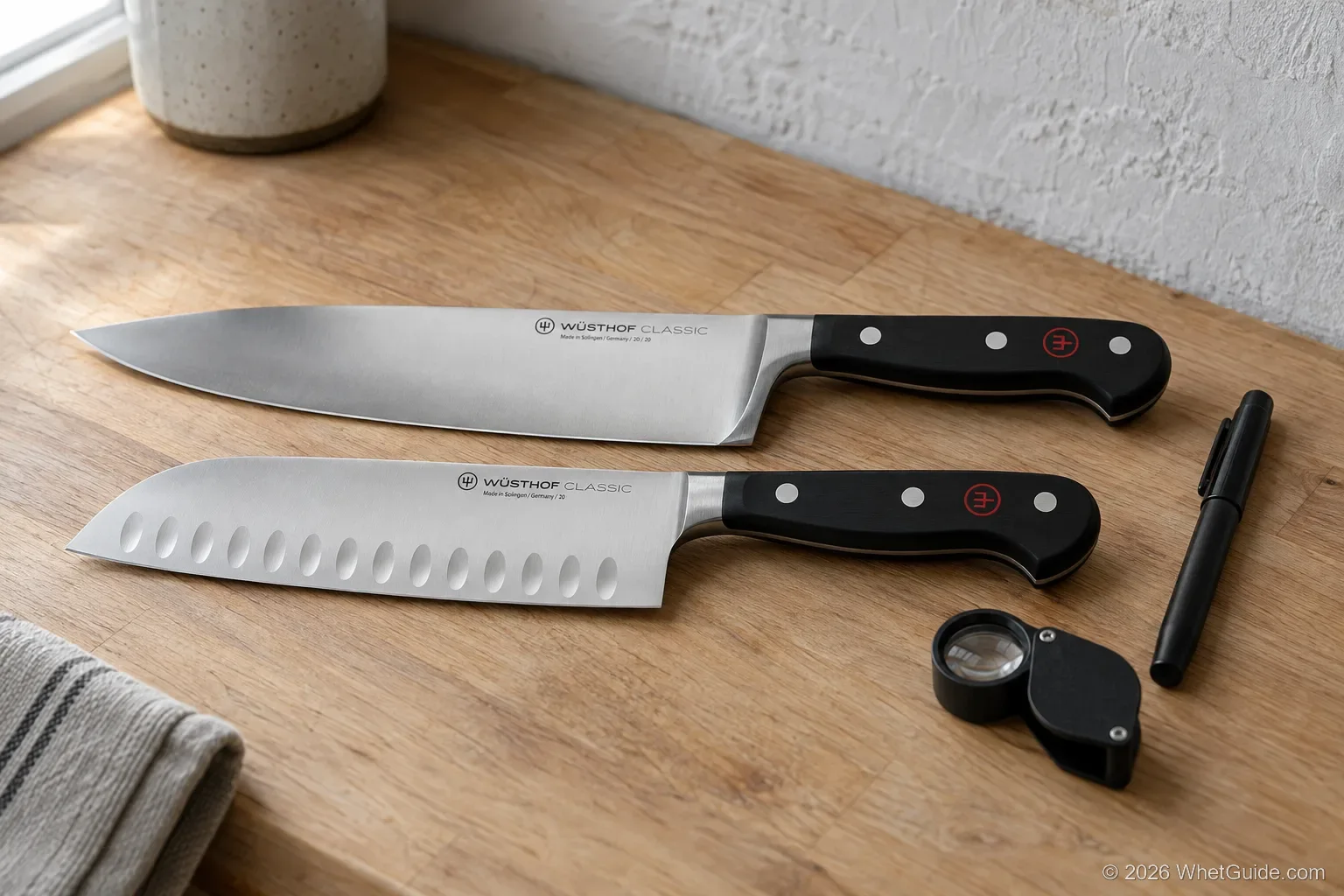
The steel in the knife changes which sharpener feels fast. Most stamped knives and most German knives use a softer stainless that any decent abrasive cuts quickly. Many Japanese knives, and plenty of modern pocket knives, use harder steels that hold an edge longer and take longer to sharpen. Ceramic and fine stones work slowly on those, while diamond cuts at about the same pace on anything. Carbide scraper slots are rough on every steel, hard or soft.
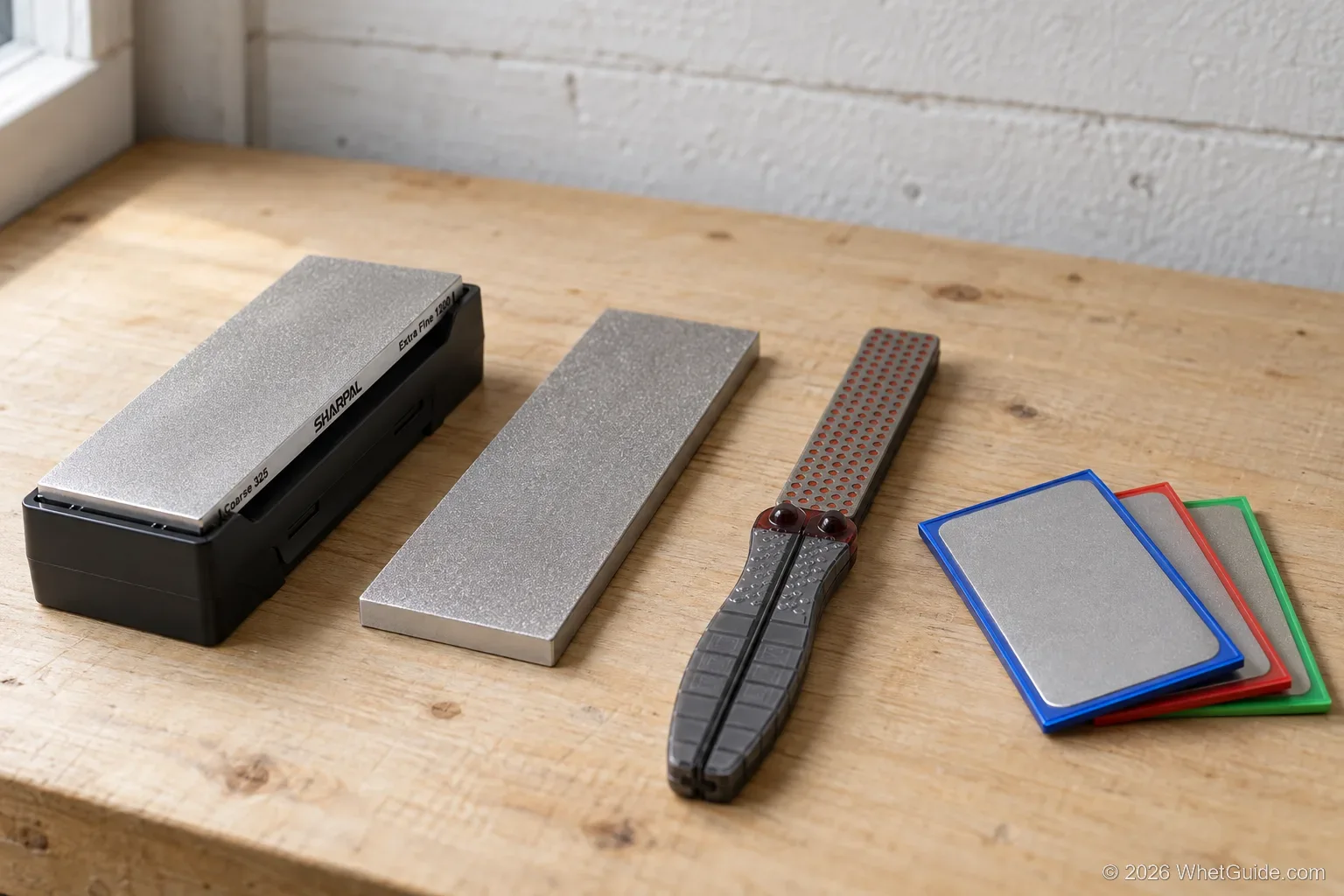
Most of the type picks here are diamond where it counts: both stages of the Pronto, the grinding stages of the 15XV, the Precision Adjust's two coarser faces, the Guided Field's plates and the Work Sharp Rolling's disc. The whetstone and the honing rod are the exceptions. If your knives are very hard, a diamond plate such as the SHARPAL 162N mentioned above is a sensible first stone, and our guide to kitchen knife steels explains which steels count as hard.
Serrated knives: which picks cope
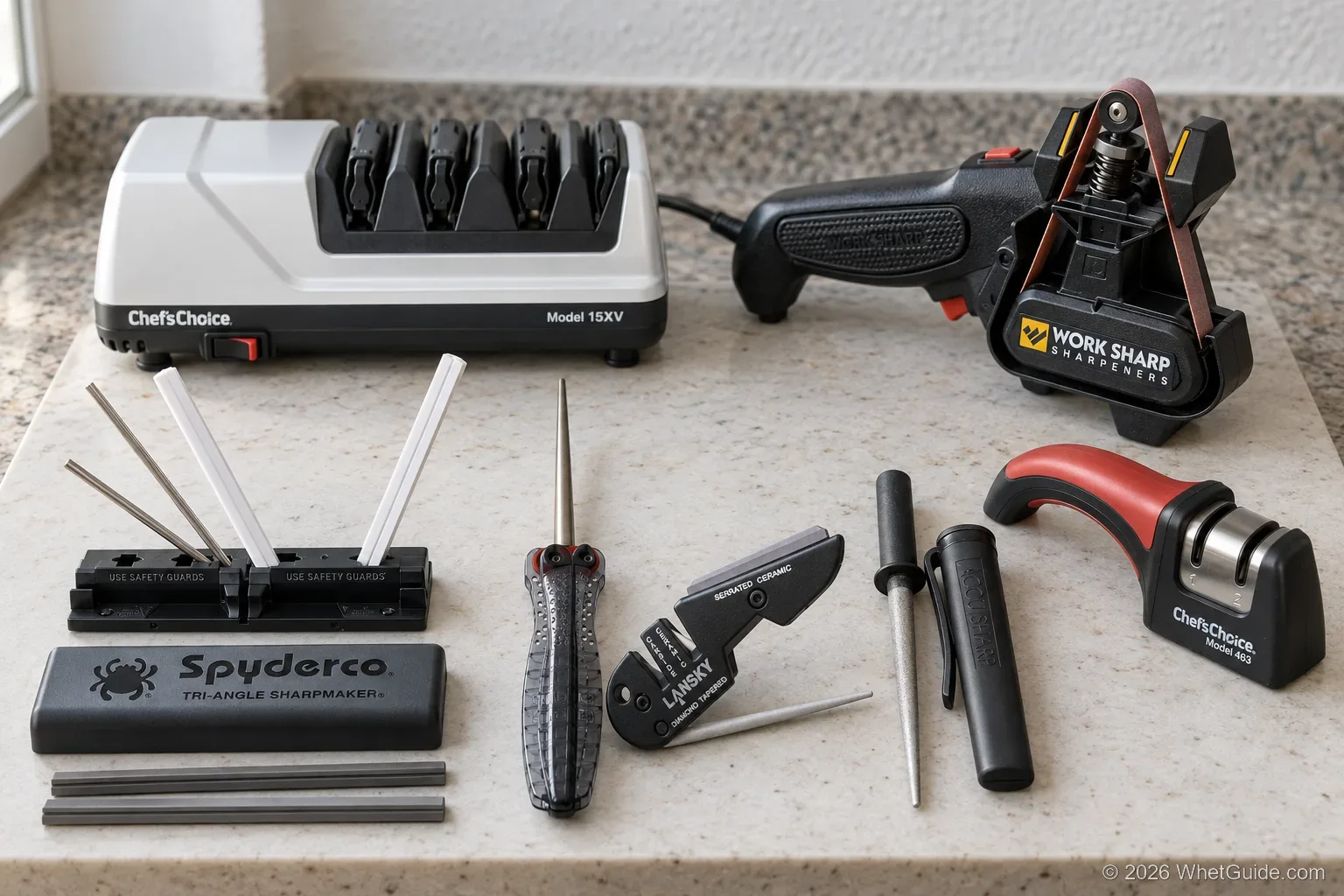
A serrated edge is a row of scallops. A flat stone or plate only touches the points between them, while a round rod can sit inside each scallop and sharpen the curve. That's why rods do most serrated work. Of the type picks, the 15XV, the Pronto 463 and the KitchenIQ all list serrated knives, and the Guided Field's ceramic rod handles them by hand. The Spyderco Sharpmaker, mentioned under guided systems, is the classic tool for a drawer full of them.
When a bread knife needs it, see how to sharpen a serrated knife or the serrated knife sharpener guide.
Already know your knife? Go straight to its page
If your block is mostly one brand or one kind of knife, a page written for it will serve you better than this one. Each of these picks sharpeners for that knife's angle and steel.
| Your knives | Read |
|---|---|
| A mixed kitchen block (German plus Japanese) | Sharpeners for kitchen knives |
| Japanese kitchen knives | Sharpeners for Japanese knives |
| Wüsthof | Sharpeners for Wüsthof knives |
| Henckels or Zwilling | Sharpeners for Henckels knives |
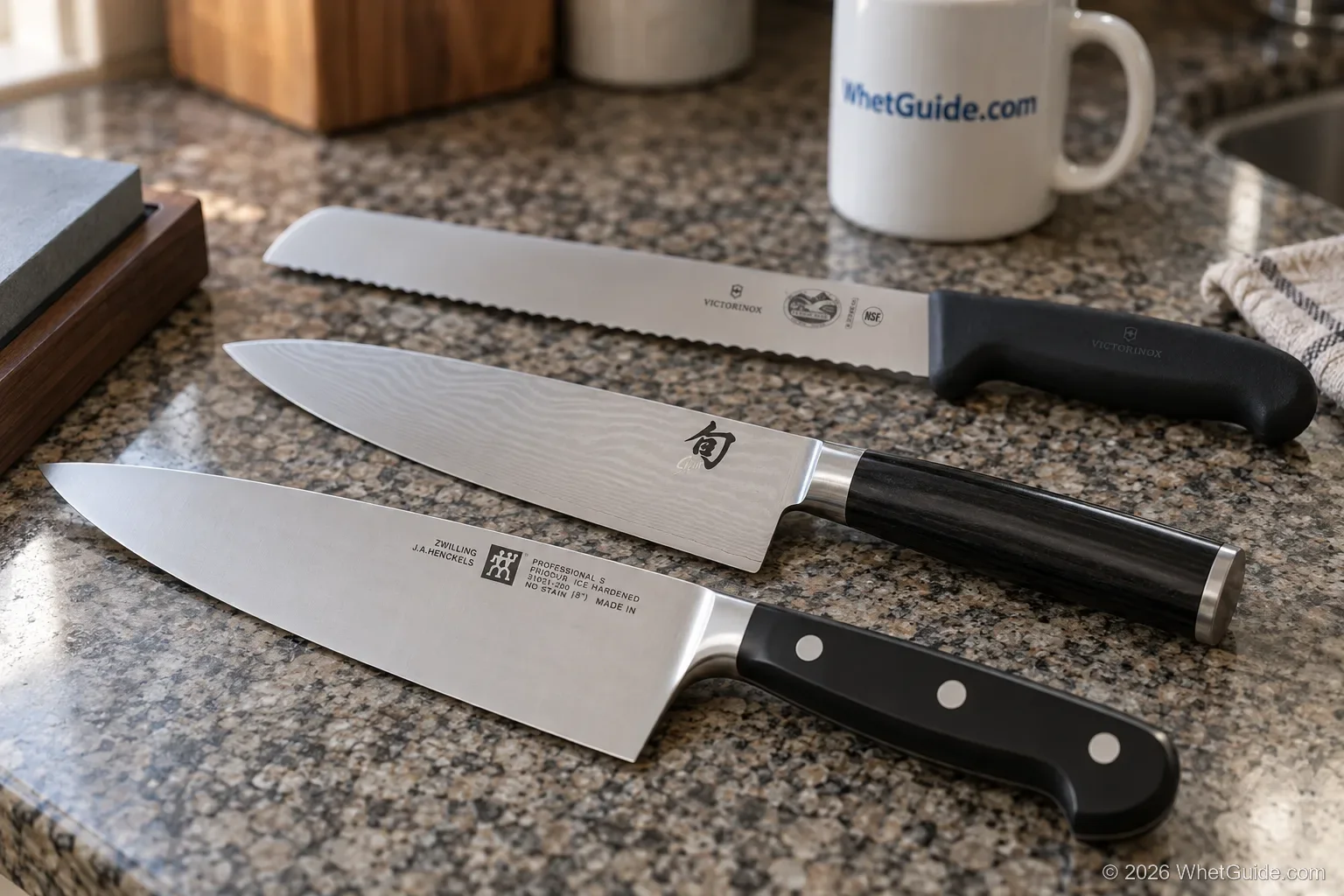
| Victorinox | Sharpeners for Victorinox knives |
| Hunting knives | Sharpeners for hunting knives |
| You've never sharpened before | Sharpeners for beginners |
What every sharpener has to do: raise and remove a burr
Grinding one side of an edge pushes a thin wire of steel over to the other side. That wire is the burr, and it's the only reliable sign that you've ground all the way to the edge. A sharpener that never raises one hasn't sharpened anything. Once it's there, it has to come off, which is what the fine slot on an electric, the 6000 side of a stone or a few strokes on a strop are for.
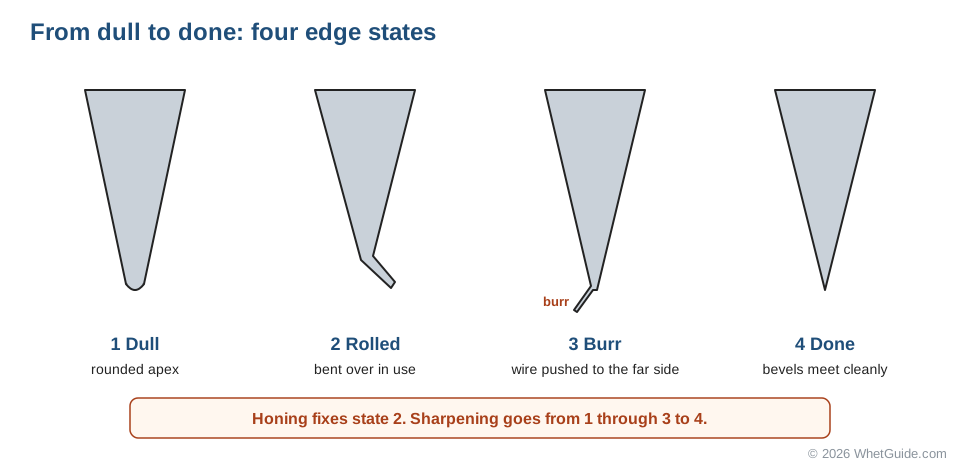
Feel for it by drawing a fingertip from the spine side off the edge, never along it. A slight catch on one side is the burr. On a guided rod system both sides get worked in turn, and Knife Informer makes the point that "having dual rods means that the edge burr is always even." Our knife burr guide covers how to find it and get rid of it.
↑ Back to all sectionsYour first session with each type
Electric (15XV)
On the Model 15, stage 1 is the repair stage, and routine touch-ups start in stage 3. A dull knife goes through the stages in order, alternating sides with light, steady pulls; a knife that only feels a little off gets a few pulls in stage 3 alone. Our Chef'sChoice guide has each model's routine from its booklet.

Pull-through (Pronto or KitchenIQ)
Set the sharpener on the counter, hold the handle, and draw the knife toward you from heel to tip with light pressure. Use the same number of pulls every time, and start in the fine slot. Drop to the coarse slot only when the fine one stops bringing the edge back.
Rolling (Work Sharp Rolling)
Stick the knife to the magnetic block with the edge facing up and out, on the face that matches the knife's angle. Roll the wheel back and forth along the whole edge, flip the knife to the other side of the block, and repeat. Finish with the finer disc if you've fitted one.
Guided clamp (Precision Adjust)
Color the bevel with a marker and clamp the knife near its balance point. Set the angle, make a few light strokes and check where the ink came off, then adjust until it comes off evenly. Work side one until you feel a burr along the whole edge, match it on side two, then move up through the finer faces.
Whetstone (Sharp Pebble 1000/6000)
Wet the stone the way its instructions say and seat it in the base. Use the included angle guide for your first knives, and push the edge across the 1000 side in smooth strokes until a burr forms along the whole length. Do the other side, move to the 6000 side with lighter strokes, then strop or make a few alternating passes to take off the burr. Practice on a cheap knife first, as ATK advises.
Field (Guided Field)
Rest the blade against the angle guide, sharpen on the coarse diamond plate until you raise a burr, then repeat on the fine plate. A few strokes on the ceramic rod and the strop finish it. On a serrated blade, work each scallop on the rod.
The mistakes that wear knives out fastest
Most knife damage from home sharpening comes from a handful of habits, and every type has its own.
| Type | Common mistake | What to do instead |
|---|---|---|
| Pull-through | Pressing hard and sawing back and forth | Light pulls in one direction, the same count each time |
| Electric | Using the coarse stage for every touch-up | Touch up in the finishing stage; save the coarse stage for a truly dull knife |
| Electric or pull-through | Pausing at the heel on each pull | Keep the pull moving, or the heel wears into a dip over the years |
| Guided clamp | Clamp jaws scratching a polished blade | A strip of tape on the jaws |
| Whetstone | Running the stone off the tip, and never flattening | Stop the stroke while the stone is still on steel, and flatten the stone regularly |
| Any | Testing the edge with a thumb | Slice paper |
Two of those deserve a word. A stone that runs past the tip rounds it, and a rounded tip won't pierce a tomato skin however sharp the rest of the edge is. And a dished stone grinds a curved bevel, which is why a flattening stone shows up in the pairings table. Belt machines add a third risk: they remove steel fast enough to overheat a thin edge if you linger.
When the sharpener itself wears out
Sharpeners wear too, only slowly. Diamond plates and discs lose their bite and start to feel smooth. Ceramic rods and fine slots load up with gray steel until they barely cut. Water stones dish in the middle, and belts glaze over. Most of that can be cleaned or flattened away long before anything needs replacing.

| Abrasive | Care | Replace when |
|---|---|---|
| Diamond (plates, discs, Pronto slots) | Rinse or brush off the swarf and dry before storing | It feels bald and cuts slowly even when clean |
| Ceramic (rods, fine slots) | Scrub off the gray steel with an abrasive cleanser and water | Rarely, unless it chips or snaps |
| Water stone | Flatten whenever it dishes | It's too thin to flatten again |
| Belt | Keep it dry and store it flat | Glazed or torn, or it no longer cuts |
| Leather strop | Reload the compound when it stops darkening | The leather is cut or has gone hard |
A pull-through whose slots no longer raise a burr after a good clean has worn out. On a stone, a straightedge laid across the face shows the dish before it shows up in your bevels.
↑ Back to all sectionsIs it sharp yet? Three quick tests
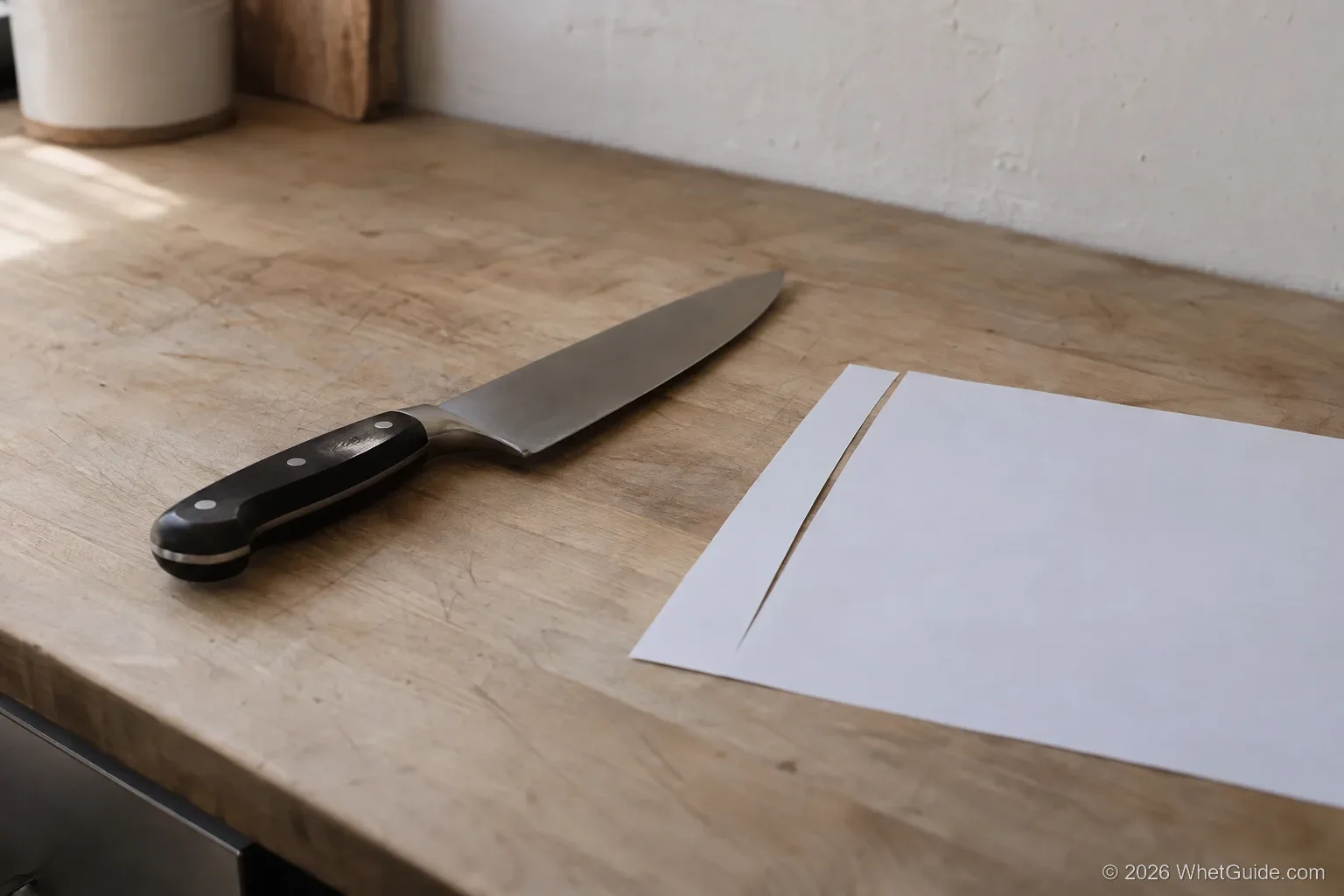
Paper is the first test. Hold a sheet of printer paper by one corner and slice down through it from heel to tip. A clean, quiet cut along the whole edge means you're done, and a snag marks the stretch that needs another pass. A ripe tomato is the second: a sharp knife bites the skin with its own weight, and a dull one skids. Popular Mechanics used paper and tomatoes in its 2022 tests, and they're still the two everyone reaches for.
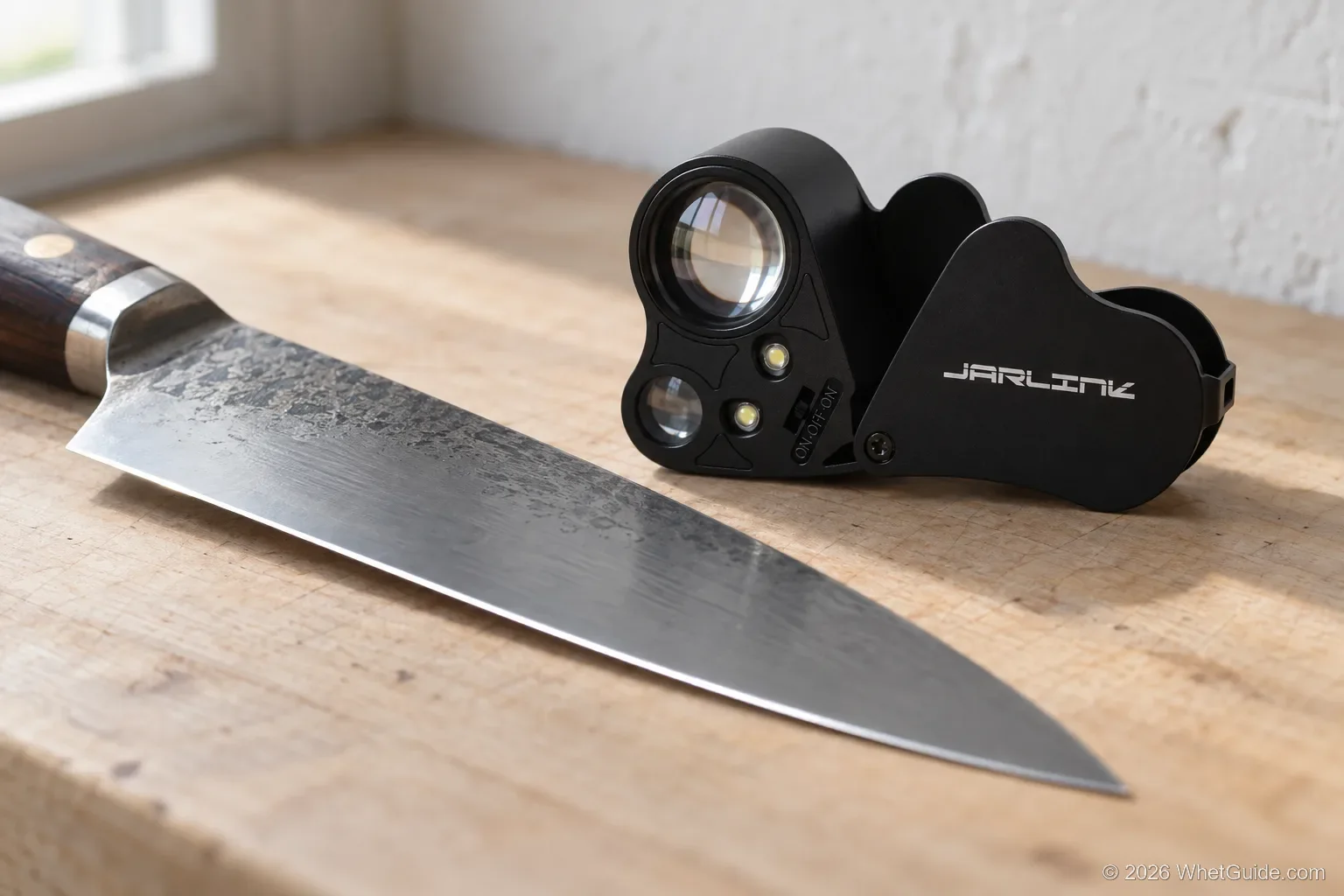
The third is a lamp. Look straight down at the edge under a bright light. A dull or rolled edge shows a thin bright line, because a flat spot reflects light, while a sharp apex doesn't. Bright patches show you exactly where to go back. Never test by running a thumb along the edge.
↑ Back to all sectionsStill not sharp? Fixes by symptom
| What you see | Likely cause | Fix |
|---|---|---|
| Paper still tears after sharpening | A burr is still hanging on the edge | Finish on the finest stage or a strop with light, alternating passes |
| Sharp at the heel, dull near the tip | The stroke stops short of the tip, or the tip lifts off the abrasive | Follow the curve all the way out; on a clamp, check the stone reaches the tip |
| Marker ink left at the very edge | The angle is lower than the knife's bevel, so the edge hasn't been reached | Keep going until the burr forms, or raise the angle to match |
| One bevel wider than the other | Uneven strokes or pressure from side to side | Count strokes per side and keep pressure light and equal |
| Edge dull again within days | The edge is rolling in use and getting sharpened instead of honed | Hone more often; save the sharpener for when honing stops working |
| Ragged, toothy edge from a pull-through | Heavy pressure, or the carbide slot every time | Light pulls in the fine slot; the coarse slot only for a truly dull knife |
| Stone or rod feels slick and slow | Loaded with steel, or a stone has dished | Clean it, and flatten a dished stone |
Staying safe, and the mess each type makes
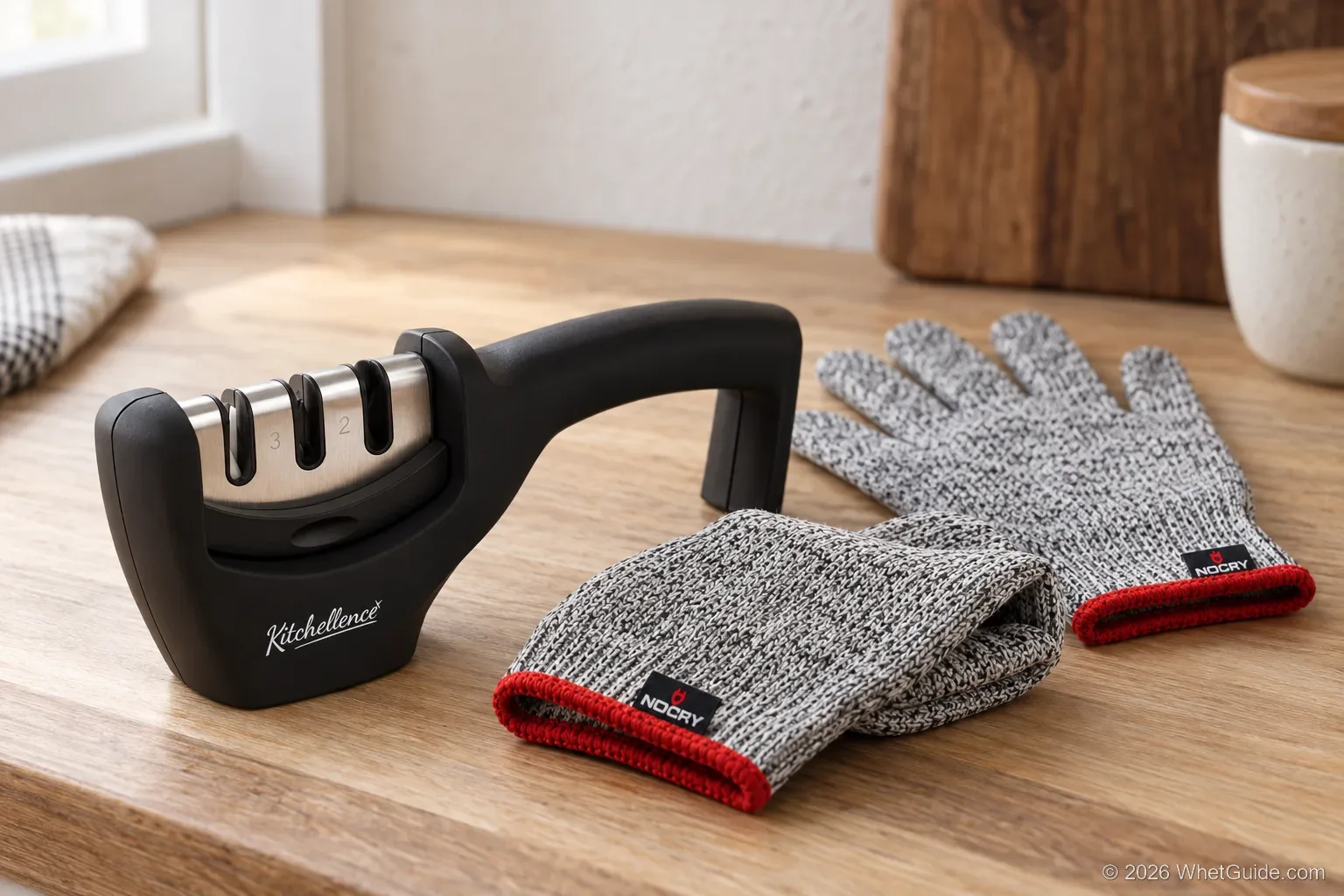
Sharpening cuts come from two places: a knife that moves while a hand is in its path, and a thumb run along a fresh edge to "check" it. A non-slip base and a pair of cut-resistant gloves deal with the first. Paper deals with the second. On a belt machine, add eye protection and keep loose sleeves away from the belt.
Each type leaves its own noise and mess behind. An electric is loud for the minute or two it runs, and a belt machine throws fine metal dust. Whetstones need a sink nearby and leave a gray slurry on the towel. Pull-throughs drop a little steel dust under the slots. Rolling sharpeners and clamp kits are the tidiest; they run dry and quiet and wipe clean.
| Pick | Size or weight (listing) | Where it lives |
|---|---|---|
| Smith's CCKS | 2.33 x 2.71 in, under 2 oz | Pocket, tackle box or drawer |
| Work Sharp Guided Field | 4.6 oz | Pack or glove box |
| Sharp Pebble 1000/6000 | 7.25 x 2.25 x 1 in stone | Shelf, used at the sink |
| Chef'sChoice AngleSelect | 12 x 6.2 x 6.4 in | Counter or cupboard, near an outlet |
What a sharpener can't fix
A home sharpener restores an edge, and that's about the limit of it. Chips deep enough to see from across the room, a snapped tip, a bent blade and a heel worn into a dip by years of pull-through use all need either a lot of coarse grinding or a professional. Services list chip and tip repair at about $5 to $15 on top of the sharpening, and thinning a worn blade starts around $40.
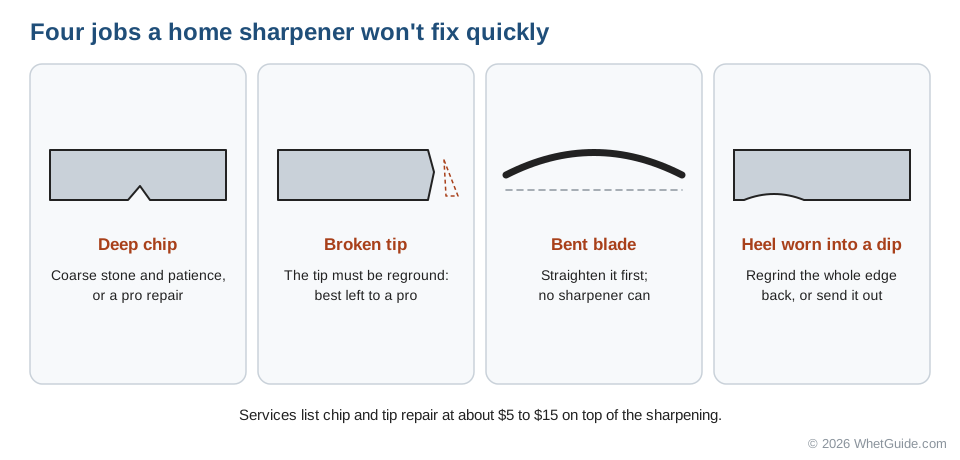
Some knives are outside a home sharpener's lane from the start. Single-bevel Japanese knives need a stone or a specialist. Ceramic knives need diamond, and most kitchen sharpeners can't help them (our ceramic knife guide has the options). America's Test Kitchen put it honestly in 2022: a professional is "probably going to be able to put a better edge on a knife than you will be able to at home." For an expensive or damaged knife, that's worth paying for.
Our knife sharpening service cost page lists what shops charge for each kind of job, and the mail-in sharpening services page covers sending knives away. If there's an Ace nearby, does Ace Hardware sharpen knives explains its kiosk.
↑ Back to all sectionsSharpener or service: the five-year math
Most US services charge about $7 to $15 to sharpen a standard kitchen knife. Ace's Resharp kiosk lists a suggested $6.99, Sur La Table's stores charge $8, and Misen's mail-in service runs $11 to $14 a knife with shipping included. For a household that sends four knives twice a year, that's about $64 to $112 a year at published rates.
| Years | Service: four knives, twice a year |
|---|---|
| 1 | $64 to $112 |
| 3 | $192 to $336 |
| 5 | $320 to $560 |
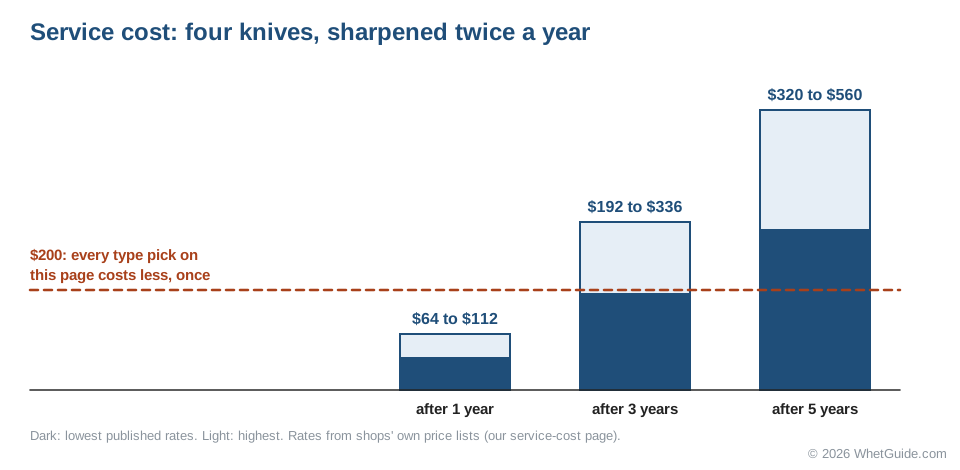
Every type pick on this page costs less than three years of that, and most cost far less. A sharpener also lets you fix an edge the day it slips instead of waiting for the next trip. The service still wins in two cases: repair work, and a single expensive knife that only needs attention once a year. A good plan for that knife is a honing rod at home and a professional once a year.
↑ Back to all sectionsSharpener myths, checked against the sources
| The claim | What the sources say |
|---|---|
| "There's one best sharpener for everyone." | The big roundups each pick a different winner. ATK picks by type, and Knife Informer declines to pick at all. |
| "A honing rod sharpens." | It pushes a rolled edge back into line. Once the edge is worn round, only sharpening brings it back. |
| "Higher grit is always better." | Popular Mechanics suggests 1,000 to 3,000 for routine sharpening, with finer stones only to finish. |
| "Electric sharpeners eat knives." | TechGearLab's warning is narrower: they can take off a lot of steel if you aren't careful. Touch up in the finest stage. |
| "Pull-throughs ruin every knife." | They're fine on cheap stainless and wrong for thin Japanese and single-bevel knives. |
| "A guided system gives exactly the angle on its dial." | TechGearLab set a Precision Adjust to 20° and measured 16° mid-blade and 14° at the ends. |
Pairings that work
| If you bought | Add | Why |
|---|---|---|
| An electric or a pull-through | A ceramic honing rod | Fewer trips through the coarse slot, so less steel lost |
| A rolling sharpener | A SHARPAL 205H leather strop | Takes off what's left of the burr |
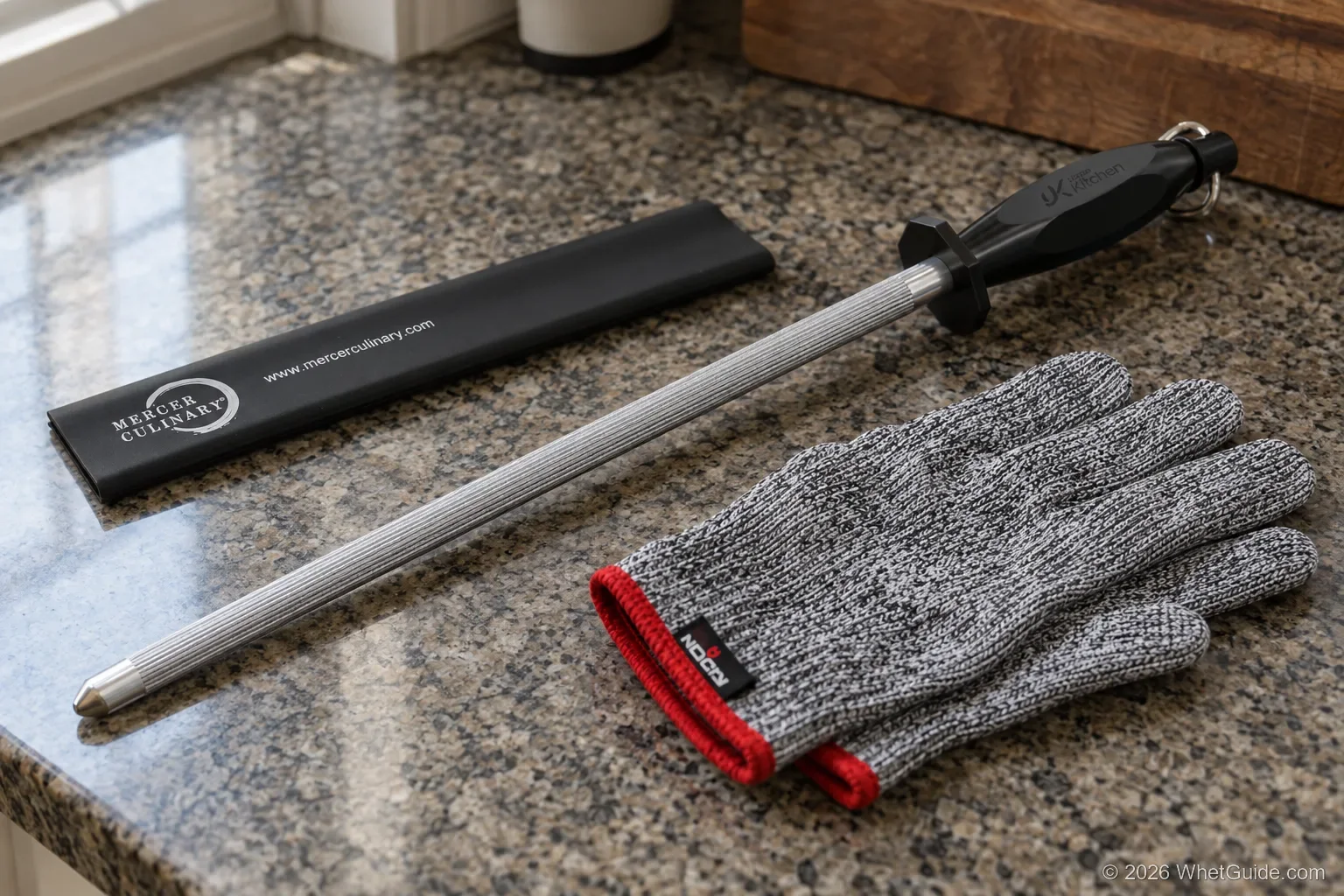
| A guided clamp | The strop, plus cut-resistant gloves | A polished edge, and protection while you clamp and unclamp |
| A whetstone | A flattening stone | A dished stone rounds your bevel |
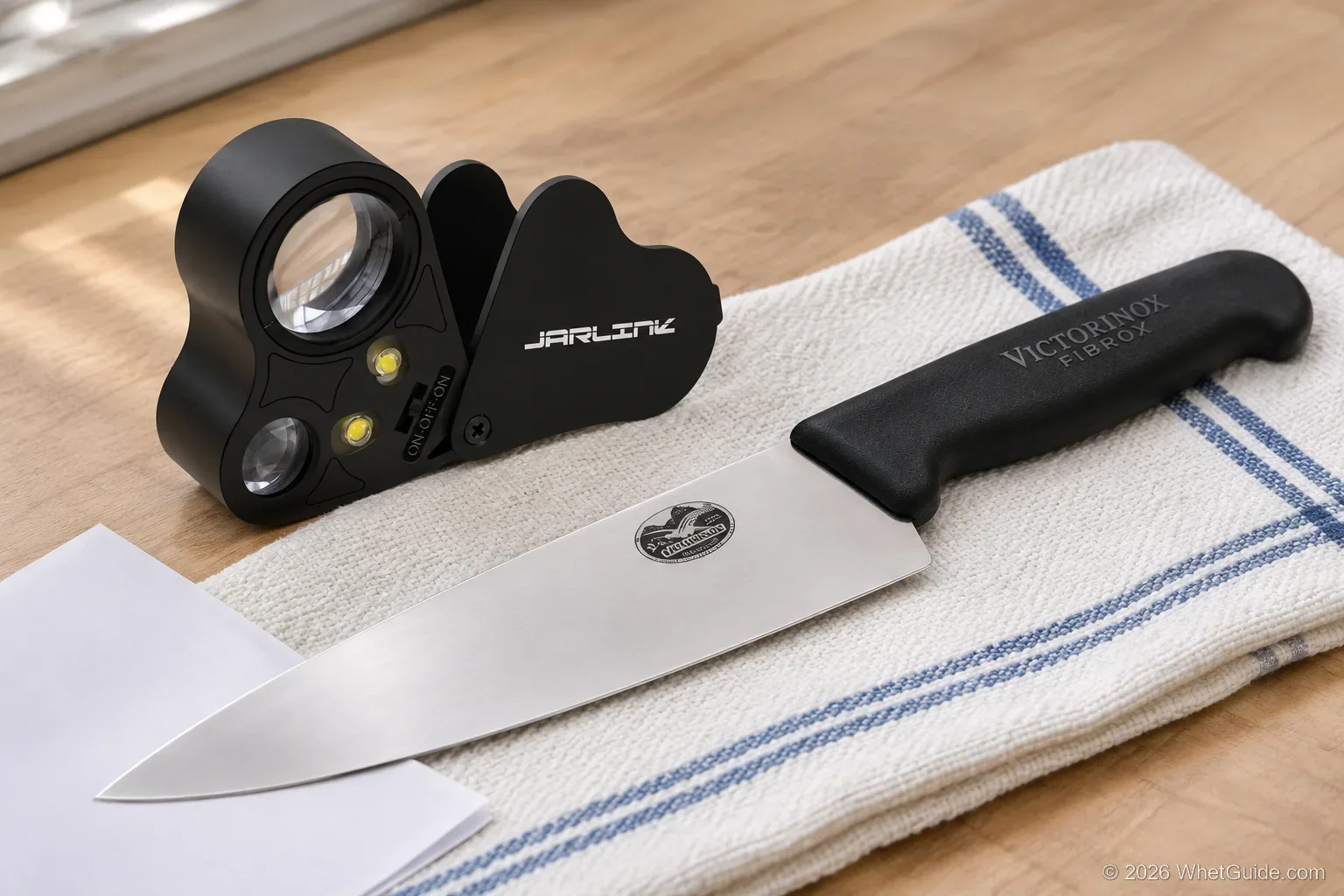
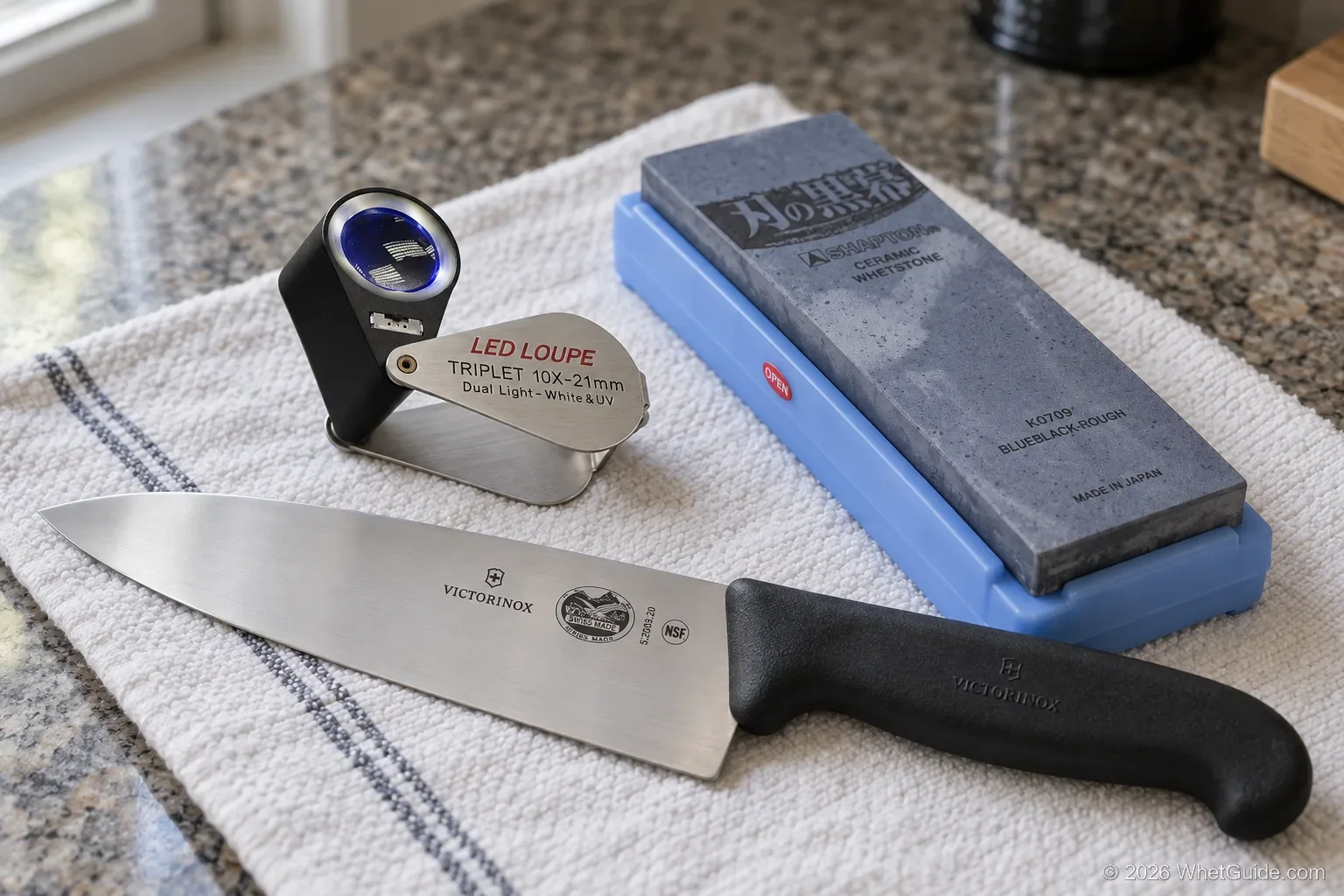
| Anything | A 10X jeweler's loupe | You can see the burr and the bevel instead of guessing |
Buying a sharpener as a gift? Pick from the no-skill end. An electric or a rolling sharpener is a gift; a whetstone is a project, and a welcome one only for someone who has asked for it. More ideas are in knife sharpening gifts, and boxed sets are in the best knife sharpening kit guide.
↑ Back to all sectionsHow often each tool comes out
For normal home cooking, Popular Mechanics suggests sharpening every three to six months. Honing advice ranges from every use to about once a week depending on whose guidance you read, and once a week is a sensible default for a home kitchen. The pattern matters more than the numbers: hone until honing stops bringing the knife back, then sharpen.
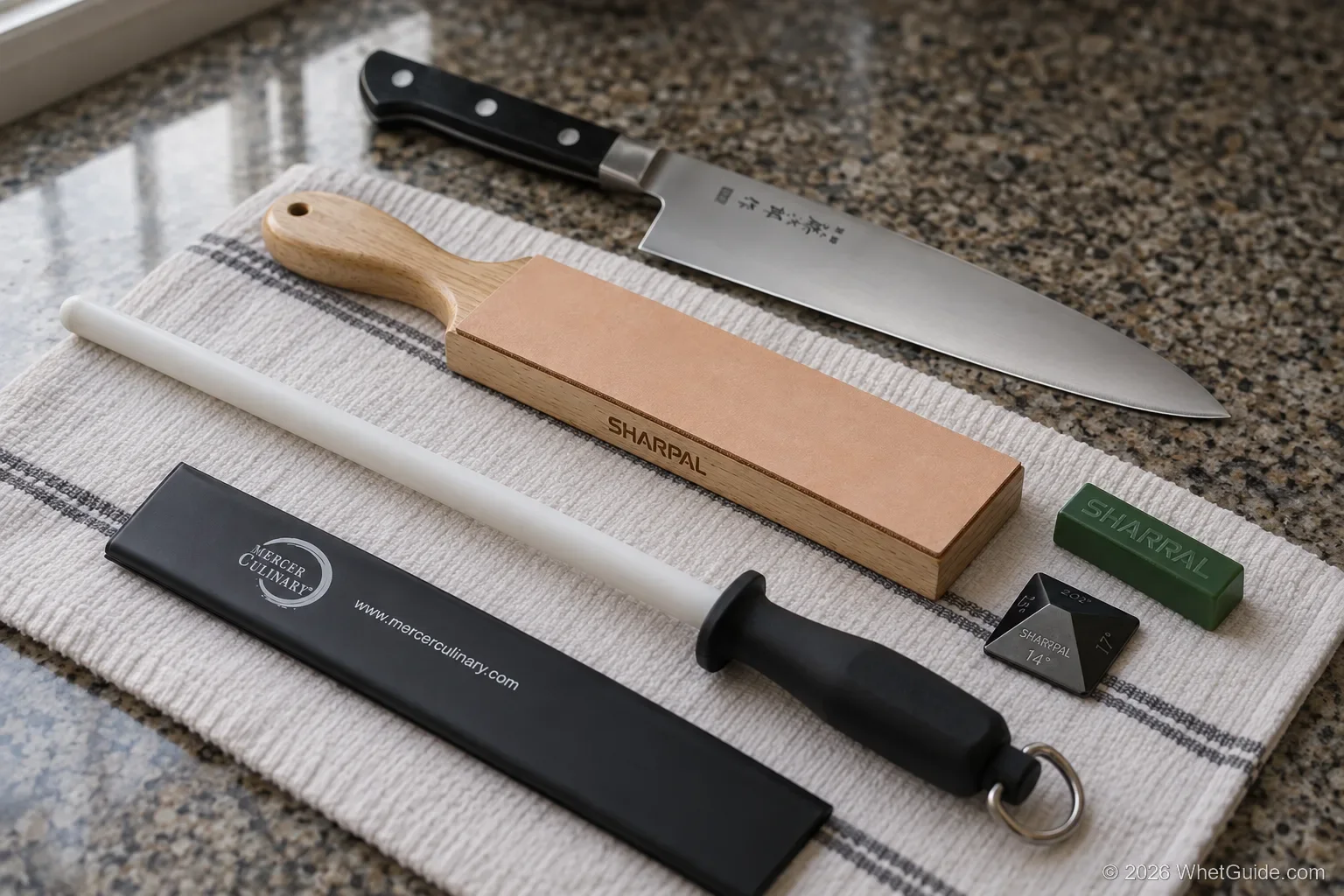
The type you bought changes the rhythm a little. An electric or a pull-through tempts people to sharpen when they should hone, which costs steel, so keep the rod next to it. A stone or a clamp session takes longer, so most people batch the whole block at once. Our guide to how often to sharpen knives has schedules by knife and by use, and knife care covers washing and storage.
↑ Back to all sectionsOne last thing: put a rod next to it
Whichever pick you buy, keep a ceramic honing rod in the same drawer. Every week it keeps an edge in line is a week the sharpener doesn't take steel off, which adds up over a knife's life.
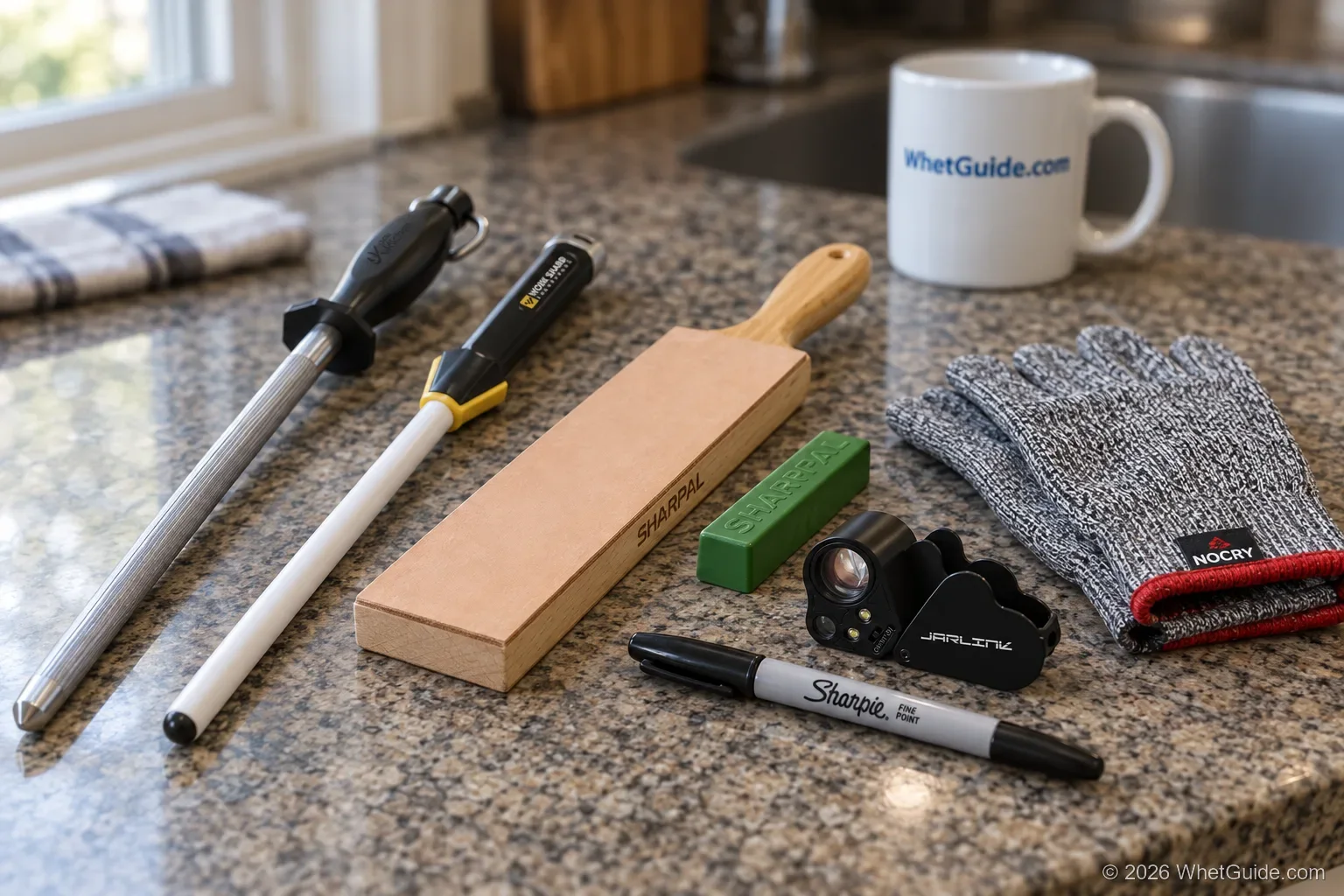
Still unsure? The best knife sharpener for kitchen knives guide goes deeper on German versus Japanese blocks, whetstone vs knife sharpener settles that one choice, and the best knife sharpener on Amazon page sorts the best sellers.
Outside sources named on this page: America's Test Kitchen (Hannah Crowley, 2022); Popular Mechanics (Bradley Ford and Adrienne Donica, 2022); TechGearLab (Graham Faulknor, updated December 2024); Prudent Reviews (Andrew Palermo, 2026); MeatEater (Matthew Every, 2026); Outdoor Life (updated January 2026); Knife Informer (Matt Davidson); Bob Vila; GearJunkie, in the questions below. Specs come from Amazon listings checked on November 15, 2026. Service rates come from shops' own price lists, as collected on our service-cost page. We don't print product prices, because they change weekly. How we research · Affiliate disclosure